Article

Reconfigurable Millimeter-Wave Generation via Mutually Injected Spin-VCSELs

1
School of Optoelectronic Science and Engineering & Collaborative Innovation Center of Suzhou Nano Science and Technology, Soochow University, Suzhou 215006, China
2
Key Laboratory of Advanced Optical Manufacturing Technologies of Jiangsu Province & Key Laboratory of Modern Optical Technologies of Education Ministry of China, Soochow University, Suzhou 215006, China
*
Authors to whom correspondence should be addressed.
Photonics 2026, 13(1), 28; https://doi.org/10.3390/photonics13010028
Submission received: 30 November 2025 / Revised: 24 December 2025 / Accepted: 26 December 2025 / Published: 29 December 2025

Abstract

We propose a novel scheme for generating high-frequency millimeter-wave signals by exploiting period-one (P1) dynamics in a mutual injection configuration of two spin-polarized vertical-cavity surface-emitting lasers (spin-VCSELs). The frequency of the generated millimeter-wave signal is jointly determined by the birefringence rate of the spin-VCSEL and the frequency detuning between the two lasers. By leveraging the complex dynamics of free-running spin-VCSELs, we explore the coupling of three distinct dynamic states: continuous-wave (CW) injected into CW, CW injected into P1 oscillation, and P1 oscillation injected into P1 oscillation. Our results reveal that these interactions not only enhance the tunability and frequency of the millimeter-wave output but also significantly reduce the linewidth, offering substantial advantages for reconfigurable photonic systems. This study demonstrates the remarkable potential of mutually injected spin-VCSELs for generating high-performance, tunable photonic millimeter waves and highlights their promising applications in advanced communication and radar systems.

1. Introduction

Microwave photonics, an emerging interdisciplinary field, offers groundbreaking solutions to overcome the inherent limitations of conventional electronics in bandwidth and speed [1]. Over the past decades, photonic-based microwave generation techniques have attracted considerable interest due to their large bandwidth and robustness against electromagnetic interference, finding broad applications in radio-over-fiber systems, terahertz spectroscopy, photonic radar, and all-optical signal processing [2,3,4,5,6,7,8]. Several microwave generation mechanisms have been successfully developed, including direct modulation [9,10], external modulation [11,12], optoelectronic oscillators [13,14], optical heterodyning [15,16], and nonlinear dynamics in semiconductor lasers [17,18,19,20]. Among these, direct modulation and external modulation schemes offer simple structures, but the signal performance is significantly constrained by the external microwave source. The conventional optical heterodyning scheme is straightforward to implement; however, it lacks mutual phase correlation, resulting in inferior signal quality. Although the optical frequency comb scheme delivers better signal quality, it comparatively sacrifices a degree of tunability and entails greater system complexity. In comparison, the approach based on the period-one (P1) nonlinear dynamical state in semiconductor lasers stands out for its wide frequency tunability and relatively simple configuration.
The most established method to excite P1 dynamics is through a master–slave optical injection system. In this scheme, continuous-wave light from a master laser is unidirectionally injected into the cavity of a slave laser via an optical isolator. When the injection strength and frequency detuning fall within specific ranges, the P1 dynamical state is effectively excited [21,22,23]. Under this state, the laser’s optical spectrum splits into two dominant frequency components: a red-shifted original cavity mode and a blue-shifted new mode regenerated by the optical injection. These two optical carriers beat at a high-speed photodetector, directly converting the frequency difference into a corresponding microwave signal. By precisely adjusting the injection parameters, the generated microwave frequency can be continuously tuned from several gigahertz to over ten times the relaxation oscillation frequency of the solitary laser, providing remarkable all-optical tuning flexibility. Various semiconductor lasers have been extensively explored for implementing this technique, such as distributed feedback lasers [24,25], quantum dot lasers [26,27,28], and vertical-cavity surface-emitting lasers (VCSELs) [29,30,31,32,33]. Beyond optical injection schemes, spin-polarized VCSELs (spin-VCSELs) offer a distinct alternative pathway. Unlike conventional approaches requiring external injection, spin-VCSELs exploit the carrier spin degree of freedom, utilizing intrinsic birefringence and polarization anisotropy to directly initiate P1 dynamics without external perturbation, where the oscillation frequency is governed by birefringence rather than relaxation oscillations [34,35]. To gain deeper insight into the operating principles of spin-VCSELs, Miguel et al. proposed a four-level model, known as the spin-flip model (SFM) [36]. The SFM accounts for the laser’s response under external perturbation while also incorporating the effects of birefringence, dichroism, and polarization in the medium. To further streamline the analysis, Martin-Regalado et al. derived a set of simplified rate equations based on the SFM framework [37]. Remarkably, polarization oscillations exceeding 250 GHz have been successfully demonstrated through advanced techniques such as piezoelectric substrate bending [38], thermal tuning [39], and integrated surface gratings [40], paving the way for a new approach to millimeter-wave generation.
However, this self-pulsation scheme suffers from a significant drawback: limited tunability of the P1 oscillation frequency, which severely restricts its practical applicability. To combine high frequency with tunability, Shen et al. proposed a hybrid scheme integrating external optical injection with a spin-VCSEL, effectively merging the tunability of conventional optical injection with the high-frequency potential of spin-VCSEL self-pulsation, achieving millimeter-wave frequency tuning from a few GHz to 150 GHz [41]. Despite this progress, a fundamental challenge persists: microwave signals generated by both conventional optical injection and spin-VCSEL schemes are inherently affected by spontaneous emission noise, leading to broad linewidth and high phase noise, which considerably degrades performance in high-end applications. To enhance signal quality, several noise suppression techniques such as optical feedback, optoelectronic feedback, and harmonic modulation have been proposed. While these methods can improve signal purity, they often come at the cost of increased system complexity and compromised stability. Consequently, the co-optimization of high frequency, wide tunability, and high signal quality remains a critical scientific challenge in the field of millimeter-wave signal generation.
To address this challenge, we propose a reconfigurable scheme for photonic millimeter-wave generation based on mutually injected quantum-well spin-VCSELs. We systematically investigate three distinct coupling scenarios: continuous-wave injection into continuous-wave, continuous-wave injection into a P1 state, and mutual P1 state injection, elucidating the underlying dynamical evolution and millimeter-wave generation mechanisms. Our approach offers several key advantages: first, compared to a single spin-VCSEL, the mutually injected system enables P1 oscillations with higher frequencies and broader tuning ranges; second, relative to unidirectional optical injection, the mutual injection architecture effectively forms an active optical feedback loop, in which its self-stabilizing mechanism suppresses mode competition and noise, yielding millimeter-wave signals with narrower linewidth; finally, this scheme supports dual-path millimeter-wave output, enhancing functional density and system flexibility. This work not only provides a novel and efficient solution for high-performance photonic millimeter-wave sources but also deepens the understanding of complex dynamics in mutually injected nonlinear laser systems.

2. Scheme and Theoretical Model

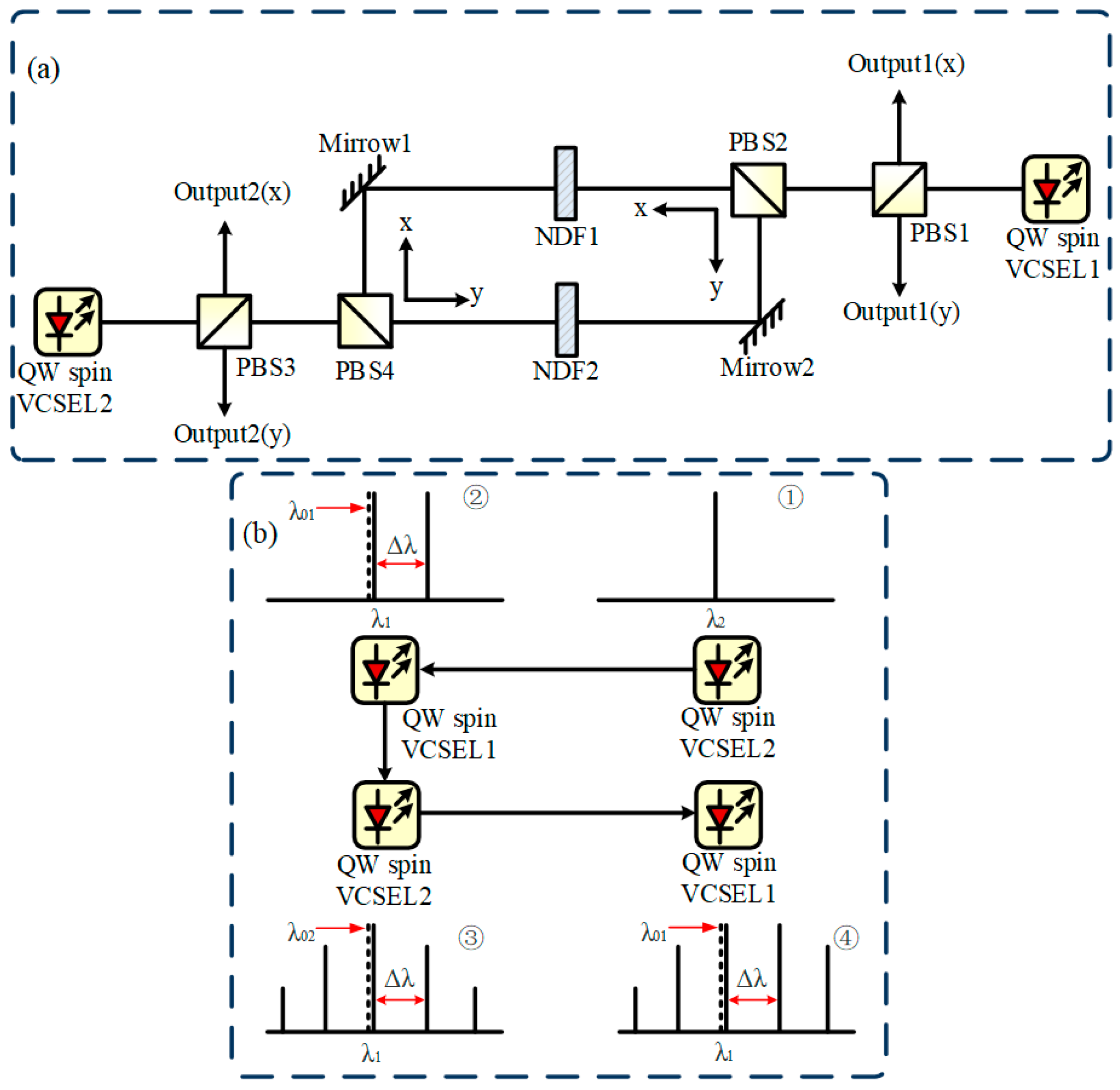
The proposed architecture for photonic millimeter-wave generation is illustrated in Figure 1a, which depicts a symmetric mutual injection setup between two spin-VCSELs. In this configuration, the optical output from spin-VCSEL1 is first divided into two paths. One path serves as a direct system output, while the other is fed into a polarization beam splitter (PBS) to resolve its x- and y-polarization components. These two orthogonally polarized beams are then injected into the corresponding x- and y-polarization modes of spin-VCSEL2, respectively. Crucially, this optical path is fully reciprocal. An identical process occurs in the reverse direction, with the output of spin-VCSEL2 being similarly split, polarization-resolved, and injected back into the polarization modes of spin-VCSEL1. This mutually injected structure is fundamentally significant, because it effectively causes each spin-VCSEL to act as an active, polarization-selective mirror for the other. Unlike a conventional static mirror, this “active mirror” not only reflects light but also introduces fresh gain and nonlinear dynamics. Consequently, for any given spin-VCSEL, the incoming light from its counterpart serves a dual purpose: it provides optical injection to induce and modulate the nonlinear dynamics while simultaneously establishing a self-consistent, active feedback loop. This inherent feedback mechanism is pivotal for spectral purification, as it promotes mode competition and coherence, thereby effectively narrowing the linewidth of the generated microwave signal and enhancing its spectral purity. Taking the scenario where both lasers operate in the continuous-wave (CW) as an example, Figure 1b illustrates the underlying mechanism of P1 signal generation.
Based on the spin-flip model (SFM), the rate equations for two mutually injected QW spin-VCSELs can be described by [42,43].
d E x 1 , x 2 d t = κ 1 , 2 1 + i α 1 , 2 N 1 , 2 E x 1 , x 2 E x 1 , x 2 + i n 1 , 2 E y 1 , y 2 γ α 1 , α 2 + i γ p 1 , p 2 E x 1 , x 2 i Δ ω E x 1 , x 2 + k i n j 1 , i n j 2 E x 2 , x 1 t τ 1 exp i ω τ 1 + F x 1 , x 2
d E y 1 , y 2 d t = κ 1 , 2 1 + i α 1 , 2 N 1 , 2 E y 1 , y 2 E y 1 , y 2 i n 1 , 2 E x 1 , x 2 + γ α 1 , α 2 + i γ p 1 , p 2 E y 1 , y 2 i Δ ω E y 1 , y 2 + k i n j 1 , i n j 2 E y 2 , y 1 t τ 2 exp i ω τ 2 + F y 1 , y 2
d N 1 , 2 d t = γ 1 , 2 η 1 , 2 γ 1 , 2 N 1 , 2 1 + E x 1 , x 2 2 + E y 1 , y 2 2 i γ 1 , 2 η 1 , 2 E y 1 , y 2 E x 1 , x 2 * E x 1 , x 2 E y 1 , y 2 *
d n 1 , 2 d t = γ 1 , 2 P 1 , 2 η 1 , 2 γ s 1 , s 2 n 1 , 2 γ 1 , 2 n 1 , 2 E x 1 , x 2 2 + E y 1 , y 2 2 i γ 1 , 2 N 1 , 2 E y 1 , y 2 E x 1 , x 2 * E x 1 , x 2 E y 1 , y 2 *
where the subscripts 1 and 2 represent the spin-VCSEL1 and spin-VCSEL2, respectively. E x , y denotes the x- and y-polarizations of the complex electric field, respectively. The normalized carrier variables N and n are written as N = n + + n / 2 and n = n + n / 2 , where n + and n are separately the normalized densities of electrons with spin-down and spin-up.
Angular frequency ω = 2 f π , where f denotes the central frequency corresponding to the laser wavelength, and the VCSEL’s lasing wavelength is 1550 nm. The angular frequency detuning ω = ω 2 ω 1 / 2 , where ω 1 and ω 2 correspond to the central angular frequency of the spin-VCSEL1 and spin-VCSEL2, respectively. The central frequency of spin-VCSELs is the mean of their frequency of x- and y-polarization. Correspondingly, Δ f = Δ ω 2 π . There are two experimentally controllable parameters, i.e., the total normalized pump intensity η = η + + η and the pump polarization ellipticity P = η + η / η + + η , where η + and η correspond to the right and left circular polarization components of the pump. The second term in Equations (1) and (2) is a polarization coupling term, which introduces linear birefringence and dichroic effects into the light field equation. The third term and the fourth term are separately the frequency detuning term and the injection term, where k i n j 1,2 denote the injection strength, and τ 1,2 represent the injection delay time. γ p is the linear birefringence rate. In Equation (4), the second term in the equation represents the spin-flip contribution, where γ s 1,2 correspond to the spin relaxation rate. The last terms F x and F y in Equations (1) and (2) represent the spontaneous emission noise, which is modeled as [44].
F x 1 , x 2 = β S F γ N 1 , 2 + n 1 , 2 + G N N t 2 κ 1 , 2 2 ξ 1 + β S F γ N 1 , 2 n 1 , 2 G N N t 2 κ 1 , 2 2 ξ 1
F y 1 , y 2 = i β S F γ N 1 , 2 + n 1 , 2 + G N N t 2 κ 1 , 2 2 ξ 2 i β S F γ N 1 , 2 n 1 , 2 + G N N t 2 κ 1 , 2 2 ξ 2
In the following calculations, the parameter values are presented in Table 1. The parameter values used in [29] are employed in this simulation. ξ 1,2 in Equations (5) and (6) is the strength of the spontaneous emission (which is the independent Gaussian white noise source with unit variance and zero mean). A fourth-order Runge–Kutta algorithm is used to numerically solve Equations (1)–(4) with a time step of 1 ps. The optical spectra and radio frequency (RF) spectra are obtained by applying fast Fourier transform on E x , y and E x , y 2 , respectively. The microwave linewidth is calculated by smoothing to evaluate the microwave linewidth. For the aforementioned given parameter sets in the spin-VCSEL, the RO frequency is about 5.03 GHz, according to f r = 2 κ γ η 1 / 2 π [45]. In the simulation, a timespan of 0.18 ms is retained to calculate the microwave linewidth, while a time duration of 1 µs is adopted in other investigations. The right circularly polarized field output is only considered in the following research. When the value of the same parameter in two spin-VCSELs is equal, use the symbol without a number in the subscript to represent the equal parameter value of the two spin-VCSELs in the following content.

3. Results and Discussion

In a mutually injected configuration, it should be noted that, from the perspective of either individual laser, although the injected optical field is regenerated in its counterpart, the overall dynamics of the system do not simply represent a linear “superposition” of two free-running lasers [46,47,48]. For instance, by adjusting the injection strength and frequency detuning, the dynamics of the injected laser can be actively controlled to a certain extent. Even when both lasers initially operate in the CW state, the mutual interaction can drive the system into producing complex dynamics, even chaotic outputs. To be more specific, the mutually injected system is a new nonlinear system characterized by its own dynamics that cannot be directly attributed to its parts; any other states of the injected system are new inherent states enabled by the coupling of the two lasers.
Unlike traditional lasers, the free-running spin-VCSEL exhibits rich dynamics due to the introduction of the spin degree of freedom, including CW, P1, period-two (P2), and complex dynamics [42]. The aim of this study is to investigate the generation of millimeter-wave signals, with a focus on the CW and P1 dynamics of spin-VCSELs. For the coupled structure, we consider three scenarios: CW injected into CW, CW injected into P1, and P1 injected into P1. The main objective of the study is to analyze the frequency, linewidth, and phase noise characteristics of the millimeter-wave signal under mutual injection conditions.

3.1. CW–CW Case

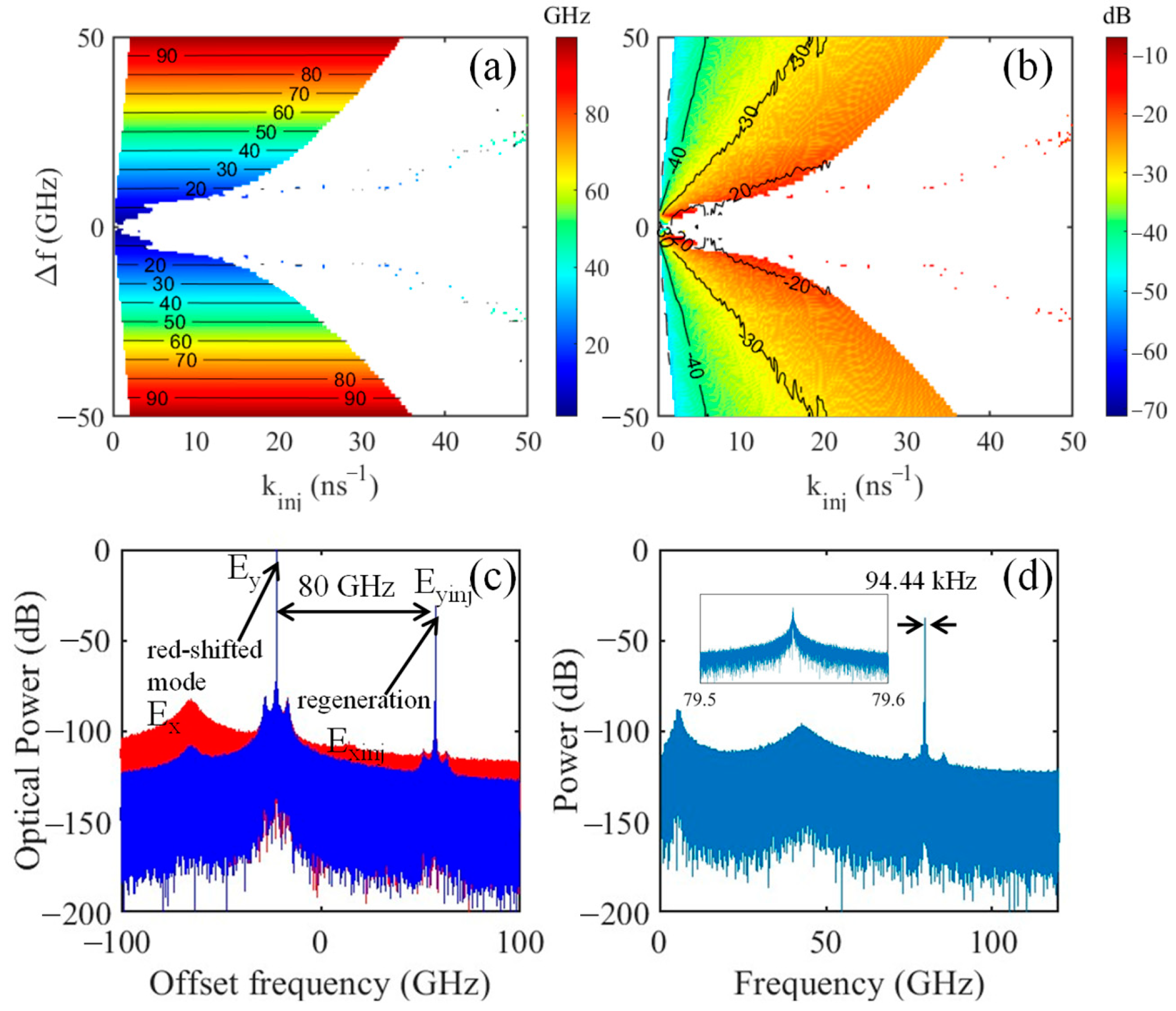
At first, we consider the mutual injection scenario where both spin-VCSELs operate in the CW state, that is, CW injected into CW. Figure 2a,b illustrate the dynamic map of spin-VCSEL1, where the parameters are set as follows: γ s = 10   n s 1 ,   γ p = 40 π   n s 1 ,   a n d   τ = 0.5   n s . Since the outputs of the two lasers exhibit symmetry, we only discuss the output of spin-VCSEL1 in this section. We only consider the P1 dynamics, which are labeled in color, while other dynamics are labeled in white. In Figure 2a, we plot the evolution of the P1 frequency. One can see that the P1 frequency strongly depends on the frequency detuning ( f = 2 Δ f ). This situation is similar to traditional mutually injected lasers, where the P1 oscillation frequency is primarily determined by frequency detuning [49,50]. Figure 2b plots the millimeter-wave power, which is used to evaluate the generated millimeter signal. Here, the millimeter-wave power is defined as the peak power at the relatively high millimeter-wave power that typically occurs under conditions of stronger coupling strength, and it is almost independent of the P1 frequency. Figure 2c,d present a typical example of millimeter-wave generation, where ( k i n j ,   Δ f ) = ( 20   n s 1 , 40   G H z ) . In the optical spectrum (see Figure 2c), the red and blue spectral lines represent the x- and y-polarization components of the laser output, respectively, where the two dominant modes are the red-shifted cavity mode of spin-VCSEL1 (on the left) and the regenerated mode caused by the injection from spin-VCSEL2, with a frequency difference of approximately 80 GHz between them. Equal to the difference of these two modes, a millimeter-wave signal with a frequency of approximately 80 GHz is generated after beat frequency detection in the photodetector, as shown in Figure 2d. Additionally, we observe that the linewidth of the generated millimeter-wave signal is 94.44 kHz, which is at least one order of magnitude narrower than the linewidth of millimeter-wave signals generated by optically injected semiconductor lasers and self-beat frequency lasers.
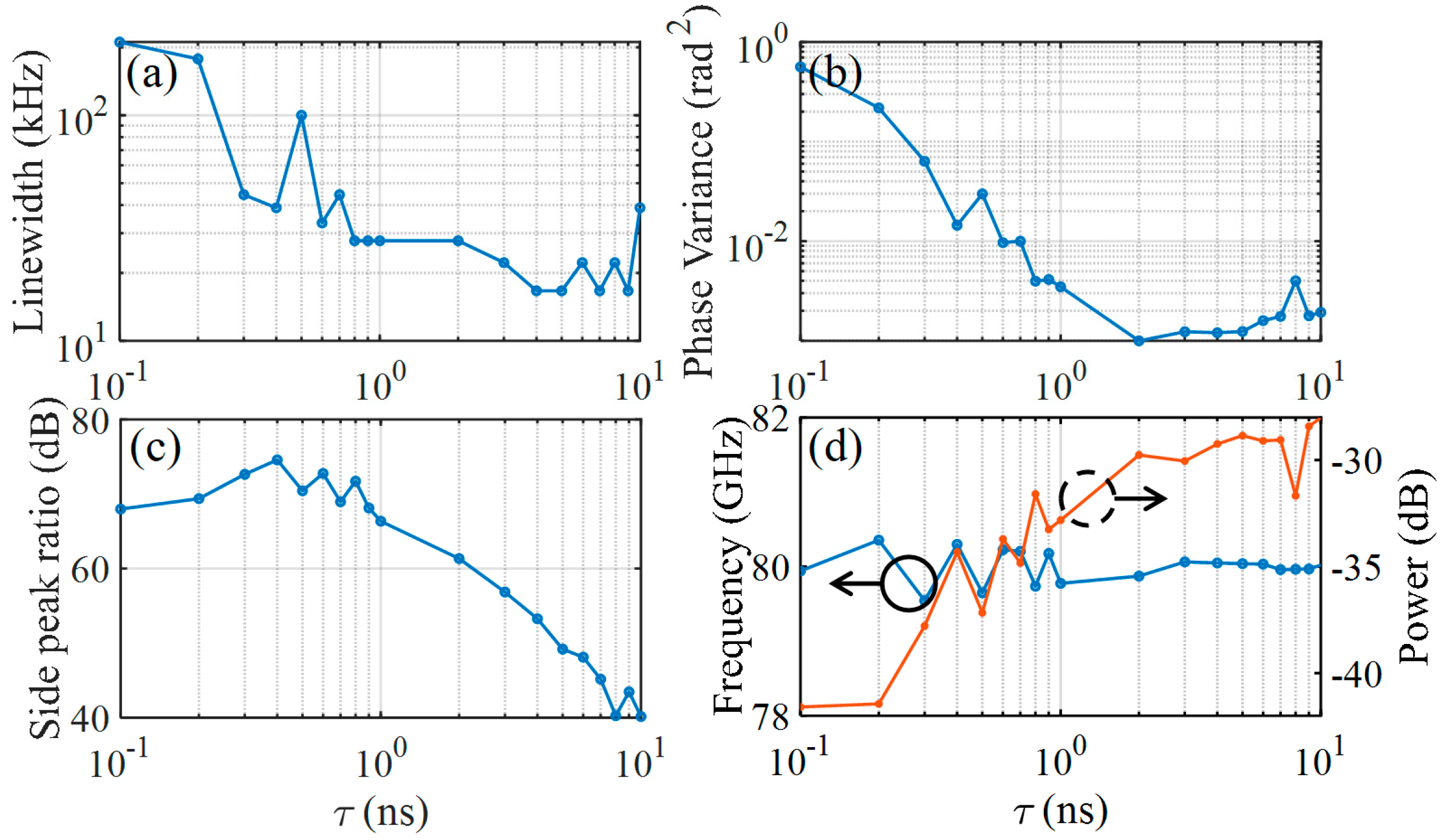
The quality of the millimeter-wave signals is fundamental for practical applications. Figure 3 investigates the quality of the millimeter-wave signal, including linewidth, phase variance, side mode suppression ratio (SMSR), and frequency. We first study the impact of coupling delay time on the quality of the millimeter-wave signal. In Figure 3a, as the injection delay time increases, the spectral width gradually decreases, reaching a minimum near a few kilohertz, and then fluctuates around this value. Figure 3b provides a more intuitive view of the variation in phase variance. When τ approaches two nanoseconds, the phase variance drops to its minimum and then increases slowly. This slow increase occurs because, with further increases in injection delay, the sideband modes around the fundamental frequency become increasingly dense, amplifying the phase variance. This trend is also reflected in the SMSR, as shown in Figure 3c, where the SMSR first increases slowly and then decreases gradually with the increasing delay time. A similar phenomenon has been observed in semiconductor lasers subjected to optical injection and feedback. Figure 3d shows that, as the delay time increases, the P1 oscillation stabilizes and microwave power significantly improves. Due to the changing separation between external cavity modes as τ varies, the signal frequency exhibits jump phenomena between adjacent modes, a phenomenon also discussed in Ref. [20].
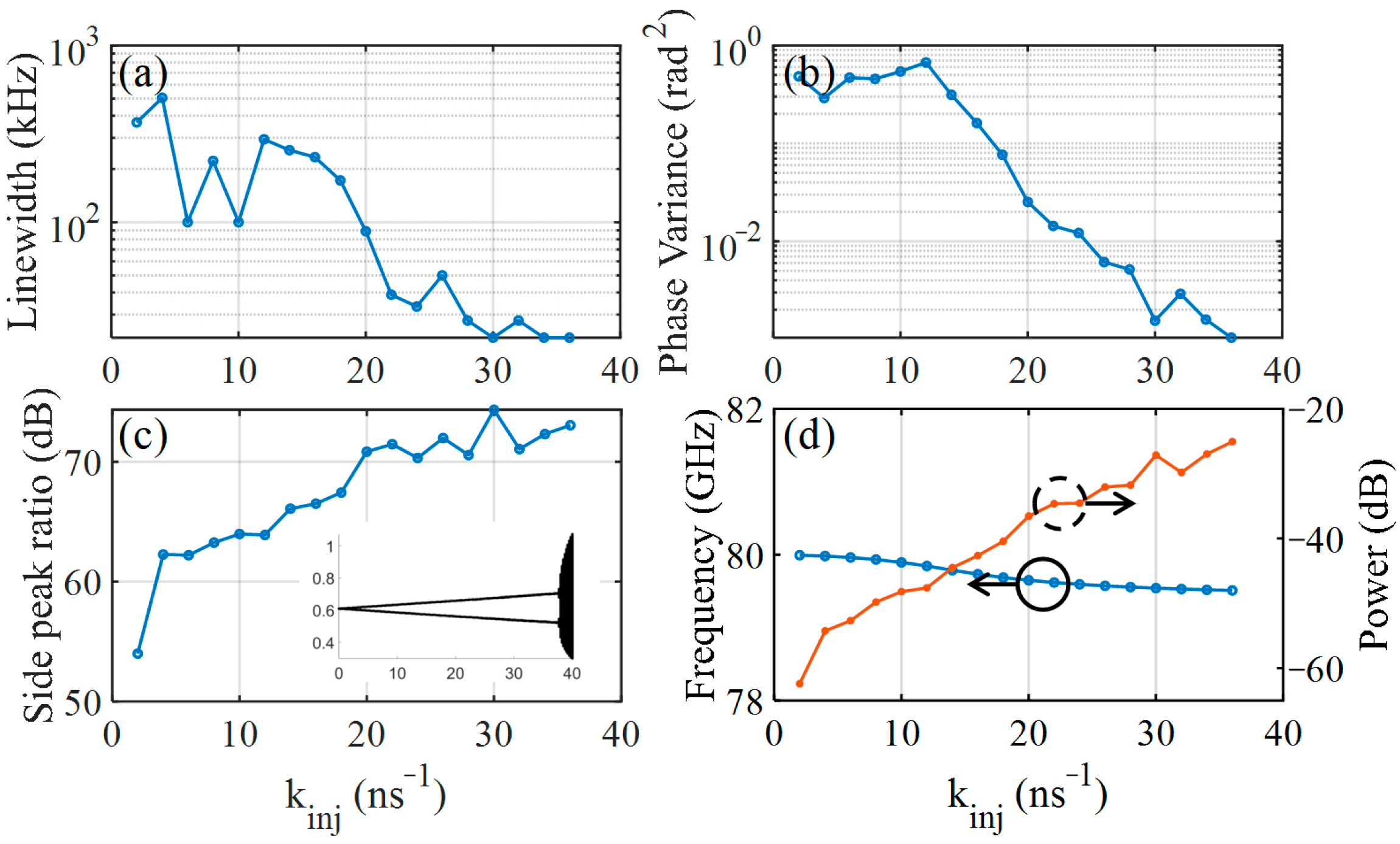
On the other hand, Figure 4 also explores the impact of injection strength. We set the injection strength range from 2 ns−1 to 38 ns−1, with the spin-VCSEL operating in the P1 state. When the injection strength is below 2 ns−1, the two spin-VCSELs can be approximately considered to operate in the CW mode. In contrast, when the injection strength exceeds 38 ns−1, the output of the spin-VCSEL exhibits more complex dynamic behavior, as shown in the inset of Figure 4c. In Figure 4a,b, as expected, as the injection strength increases, the microwave linewidth and phase variance significantly decrease, and the corresponding SMSR increases substantially. However, the SMSR exhibits a marked increase with the coupling strength, as shown in Figure 4c. It is observed that the trend in the SMSR curve closely aligns with the variation in millimeter-wave signal power. This suggests that the increase in SMSR is primarily attributed to the enhanced fundamental frequency power of the laser due to the injection strength. Furthermore, Figure 4d shows that increasing the injection strength slightly affects the signal frequency, which is consistent with the results from single-optical injection semiconductor laser systems. The results shown in Figure 3 and Figure 4 are similar to those obtained in a single-feedback scheme when varying the feedback strength and delay time [35]. This correlation further validates the feasibility of optimizing signal quality using the mutual injection system.

3.2. CW–P1 Case and P1–P1 Case

Usually, because of the cavity anisotropies, spin-VCSELs operate in one of two orthogonally linearly polarized modes, in which they have different emission frequencies. Following the SFM, the steady-state frequency splitting can be described as f = γ p α γ a / π , where the gain saturation is neglected [51]. When the dichroism γ a and linewidth enhancement factor α are small values, the frequency difference is primarily determined by the linear birefringence in the cavity described by γ p . When all spin-VCSELs operate in the CW, this scenario bears similarities to mutual injection between two single-mode lasers [49]. Here, we consider the mutual coupling of spin-VCSELs operating in the P1 state. This is not achievable in other coupled systems, thanks to the rich dynamic behavior of spin-VCSELs. For details on the dynamics of free-running spin-VCSELs and the generation of self-beat frequency millimeter-wave signals, please refer to our previous work. In this study, we focus on the scenario where CW is injected into P1.
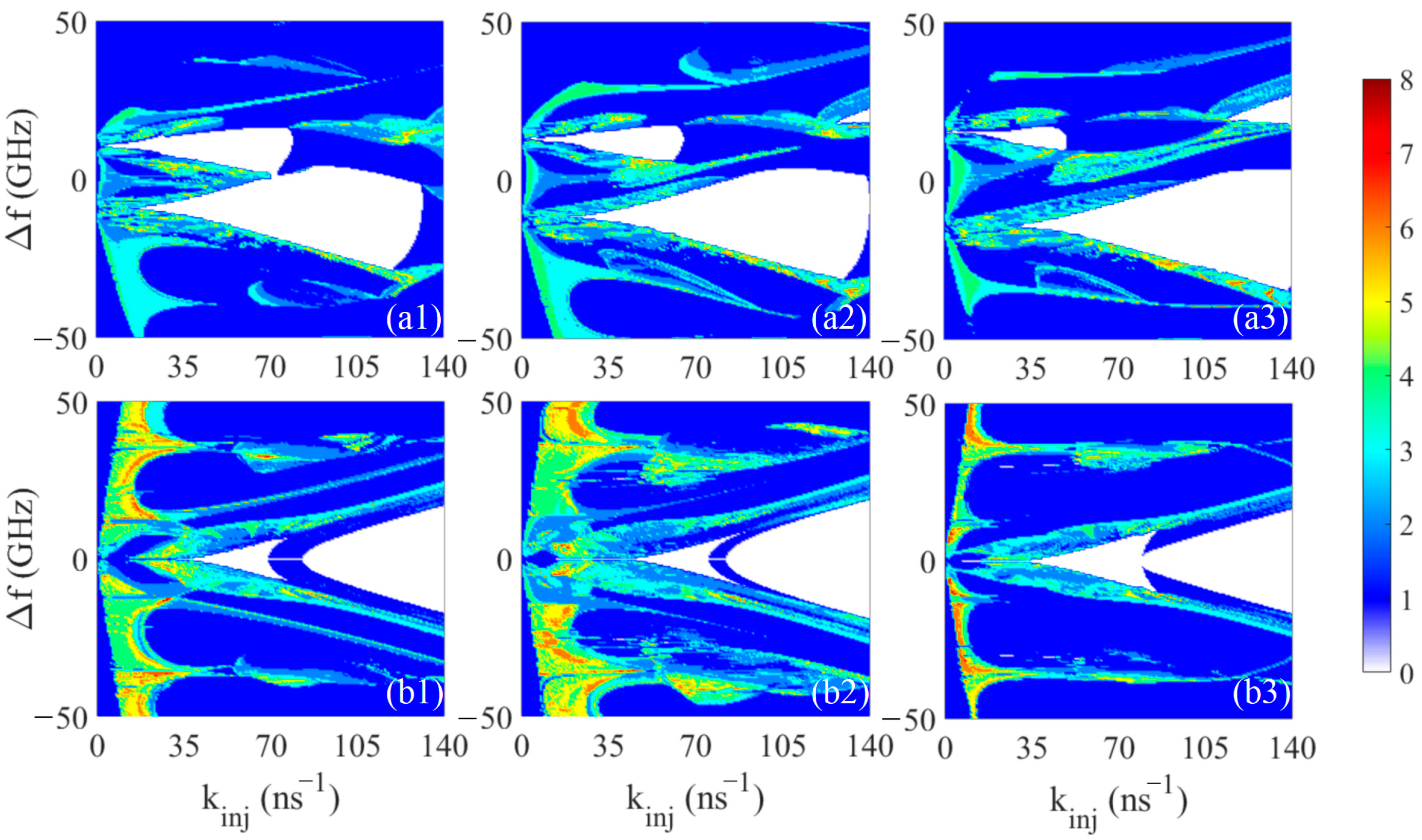
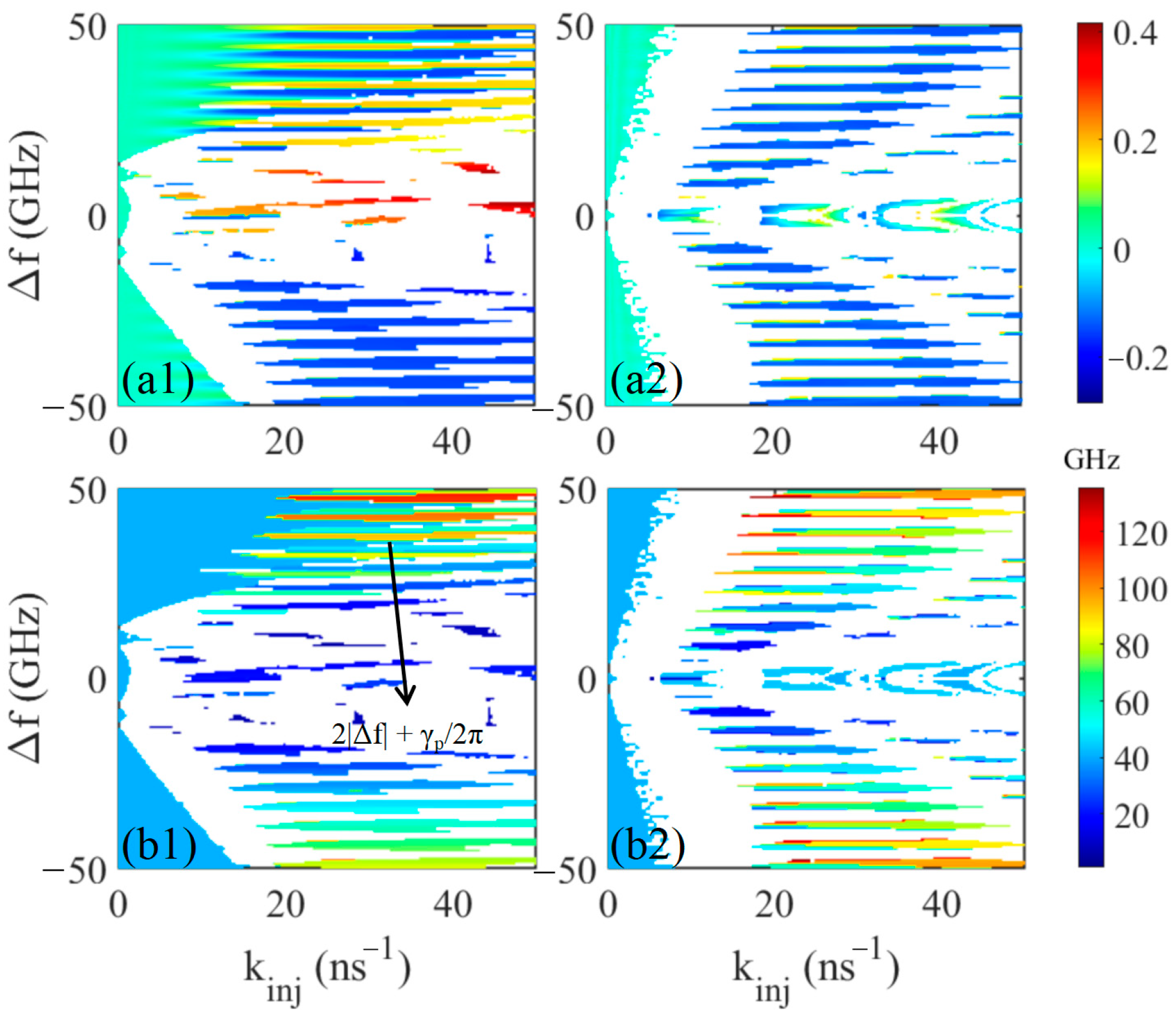
Figure 5 depicts the two-parameter bifurcation diagram within the plane of the injection strength and frequency detuning under τ = 0.01   n s to analyze the dynamics of the mutually injected spin-VCSELs with a few different values of the linear birefringence rate γ p under the CW–P1 case and P1–P1 case. In the figure, the white color represents the CW regions, blue represents the P1 regions, and other colors denote more complex dynamics, including chaos, which can be identified by calculating the number of intensity extrema from E + 2 and having been discussed in various laser systems [52]. In the CW–P1 scenario, spin-VCSEL1 is set to operate in the CW, while spin-VCSEL2 operates in the P1; the results shown in the figure correspond solely to spin-VCSEL2. For subsequent studies, in order to maintain spin-VCSEL1 in the CW, the following parameter values were assigned to spin-VCSEL1: γ p , γ s = 5 π   n s 1 ,   10   n s 1 . A relatively small value of γ p is employed to ensure that the fundamental frequency of spin-VCSEL1 remains as close as possible to its central frequency, thereby facilitating subsequent frequency representation. Furthermore, in the following analysis of the CW–P1 scenario, γ p is used by default to denote the linear birefringence rate of spin-VCSEL2. In the P1–P1 case, where both spin-VCSELs share the same linear birefringence rate value, γ p = γ p 1 = γ p 2 applies. In Figure 5, a triangular P1 region is observed in the area of lower injection strength. Here, the P1 dynamics are generated by the beat note between the laser’s intrinsic x- and y-polarization modes, as the injection strength is too weak to perturb the existing P1 state. However, as the injection strength increases, a bifurcation is observed: the injected mode gains sufficient power to generate additional sidebands through beating, leading to more complex dynamical states. With a further increase in injection strength, polarization switching (PS) occurs, suppressing either the x- or y-polarization mode. Consequently, the injected mode and the remaining mode interact to produce new P1 dynamics. Nevertheless, in the positive detuning region of the CW–P1 case, it is observed that increasing the injection strength can directly induce polarization switching without driving the system into more complex dynamics. For the CW–P1 case in Figure 5, the P1 regions at positive and negative detuning are asymmetric; the P1 region at positive detuning is slightly larger than that at negative detuning. As γ p increases, this asymmetry becomes more pronounced, with part of the P1 region at negative detuning transitioning into the CW region. In contrast, for the P1–P1 case in Figure 5, the bifurcation diagram exhibits nearly symmetric dynamical regions in its upper and lower parts. Distinct striped P1 domains are observed, separated by narrow intervals of other, more complex dynamics. More detailed frequency variations and mode transitions are illustrated in Figure 6 and Figure 7.
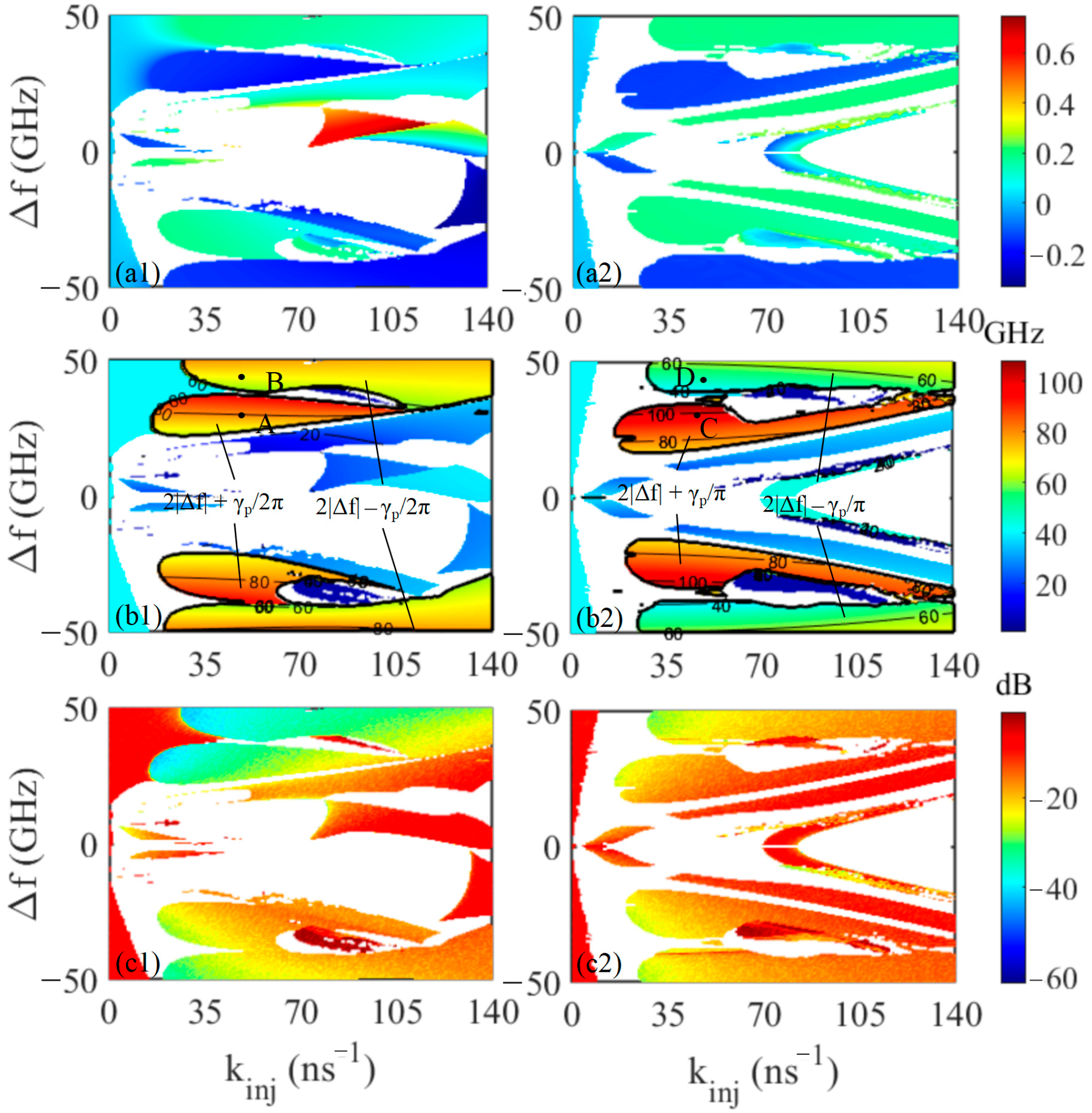
To garner more understanding of the evolution process of the microwave signal in the k i n j , Δ f plane, the output ellipticity, frequency, and power under the CW–P1 case and the P1–P1 case are shown in Figure 6, where the linear birefringence rate γ p = 40 π   n s 1 , corresponding to Figure 5(a1,b1). Note here that, in Figure 6b, the PS occurs in the dominant polarization mode and plays a crucial role in the frequency change, which was discussed in Ref. [29]. The interesting high-frequency P1 region is outlined by the black line in Figure 6(b1,b2). The remaining low-frequency regions include microwave signals at frequencies of γ p π generated by the beat note between the two modes of the spin-VCSEL operating in the P1 under low injection strength, as well as injection-locked regions under high injection strength, among others. The high-frequency region demarcated by the black line in Figure 6(b1,b2) exhibits overall symmetric characteristics with respect to Δ f = 0 , which is more clearly observable in Figure 6(b2). As can be observed from Figure 6(a1,a2), the sign of the output ellipticity changes at both Δ f = 0 and Δ f = γ p , indicating the occurrence of PS. This implies that the spin-VCSEL operates with a different dominant mode in these adjacent high-frequency regions, which also explains the abrupt jump in the microwave signal frequency with slight variations in the frequency detuning. Here, a positive output ellipticity indicates that the x polarization mode is dominant, while a negative value denotes that the y polarization mode as dominant.
The frequency expressions for different regions are labeled in Figure 6(b1,b2). Due to the symmetry between the upper and lower parts under positive and negative detuning, the positive detuning region is taken as an example to analyze the frequency variations under different conditions. Two representative points, A and B, are selected from distinct regions under the CW–P1 case in Figure 6(b1), and the other two points C and D in Figure 6(b2) represent distinct regions under the P1–P1 case. In the region containing point A, the frequency is enhanced and follows the expression f = 2 Δ f + γ p 2 π , which is greater than twice the frequency detuning observed in the CW–CW case. However, as the frequency detuning gradually increases, PS occurs upon entering the region where point B is located. The mode participating in the beat note with the injection mode changes, leading to a transition in the frequency expression to f = 2 Δ f γ p 2 π . In this regime, the microwave signal frequency becomes suppressed. A similar transition can be observed in Figure 6(b2). Unlike the CW–P1 case, in this case, PS can occur in both spin-VCSELs, as the frequency detuning is varied. In the region containing point C, where the frequency is enhanced, the expression is given by f = 2 Δ f + γ p π . Compared to the enhanced-frequency region around point A in the CW–P1 case, the frequency here is higher by an additional γ p 2 π , which is contributed by the second spin-VCSEL. However, in the region containing point D, the frequency is also further suppressed, in contrast to the point B case. Moreover, close inspection of Figure 6(b2) reveals that the contour lines are not completely parallel but exhibit slight curvature with increasing the value of k i n j , which is primarily attributed to the red-shift effect. Similar experimental phenomena have been reported in the literature: for instance, in Ref. [17] for an optically injected distributed-feedback semiconductor laser. In Figure 6(c1), it can be observed that the output power at negative detuning is slightly higher than that at positive detuning. However, in Figure 6(c2), where both lasers have identical parameters, the output power shows almost no difference between positive and negative detuning.
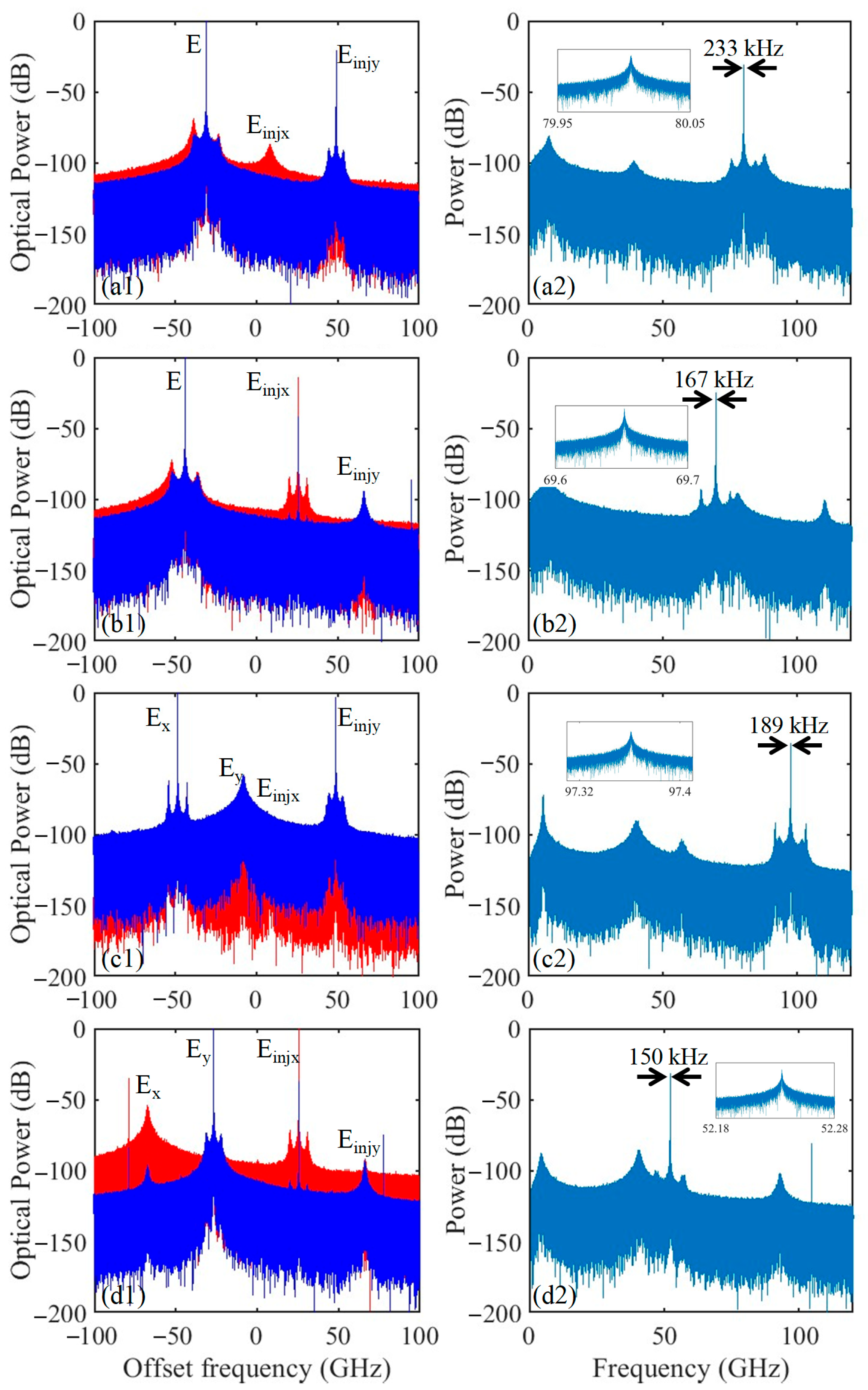
From an optical spectral perspective, the essence of microwave signal frequency variation lies in the mutual injection-induced PS, which suppresses the undesired mode, thereby allowing deliberate selection of the two polarization modes participating in the beat note and enabling tuning of the microwave frequency. Figure 7 displays the optical and power spectra at points A, B, C, and D marked in Figure 6(b1,b2), with insets showing zoomed-in views of the fundamental frequency region in the power spectra. For the optical spectra in Figure 7, the blue and red curves correspond to the x- and y-polarization components, respectively, with different mode names labeled near their peaks. In Figure 7(a1), E denotes the sole mode of spin-VCSEL1 operating in the CW, E i n j x represents the injected x component mode from spin-VCSEL2, and E i n j y denotes the injected y component mode from spin-VCSEL2. A suppressed E i n j x can be observed, indicating that the microwave signal is generated by the beat note between E and E i n j y , corresponding to a negative output ellipticity. The power spectrum in Figure 7(a2) shows a microwave signal at approximately 80 GHz, following the expression 2 Δ f + γ p 2 π . When the frequency detuning increases to 45 GHz, PS occurs. As shown in Figure 7(b1), the dominant mode switches from E i n j y to E i n j x . Although the frequency detuning is increased, the two beating modes are closer in optical spectra due to PS, resulting in a reduced microwave frequency of 70 GHz, as shown in Figure 7(b2).
In the P1–P1 scenario, both spin-VCSELs operate in the P1 state, causing the original mode E to split into E x and E y . In Figure 7(c1), the intermediate modes E y and E i n j x are suppressed, and the microwave signal frequency is determined by the spectral separation between E x and E i n j y . In contrast, Figure 7(d1) illustrates the case after PS where two marginal modes are suppressed. Compared to the CW–P1 case, the linear birefringence rate γ p exerts a stronger influence on the microwave signal frequency in the P1–P1 case, enabling the generation of higher frequencies under identical parameters. Furthermore, the results demonstrate that the microwave signal frequency can be continuously tuned by adjusting the values of γ p and Δ f .
The study also revealed that varying the mutual injection delay τ can significantly influence the system dynamics. Therefore, we further investigated the evolution of the high-frequency microwave signal region with injection strength and frequency detuning under different injection delay times. Figure 8 presents color maps of the output ellipticity and microwave signal frequency for the two mutual injection configurations at τ = 0.1   n s , with other parameters consistent with those in Figure 6. Most notably, compared to the case of τ = 0.01   n s , the striped P1 regions become narrower and more densely distributed. As observed in Figure 8(a1,a2), the number of PS events increases under this condition, leading to an overall reduction and fragmentation of the P1 dynamical regions. Taking the positive detuning region in Figure 8(a1) as an example, alternating yellow and blue stripes can be observed in areas with relatively high injection strength, which implies that multiple polarization switching events occur. The blue regions indicate y-polarization mode dominance, analogous to the situation in Figure 7(a1), where the microwave signal frequency is enhanced. These regions correspond to the high-frequency areas in the frequency map shown in Figure 8(b1). In contrast, the yellow stripes in the positive detuning region and the blue stripes in the negative detuning region both correspond to suppressed frequencies. In comparison, Figure 8(b2) reveals that the P1–P1 configuration exhibits smaller high-frequency regions, each occupying only a small portion of the striped domains. Most of the area corresponds to cases where both spin-VCSELs own identical dominant modes, resulting in microwave signal frequencies that are neither enhanced nor suppressed. Furthermore, unlike the CW–P1 case, the high-frequency regions are distributed across both positive and negative detuning ranges.
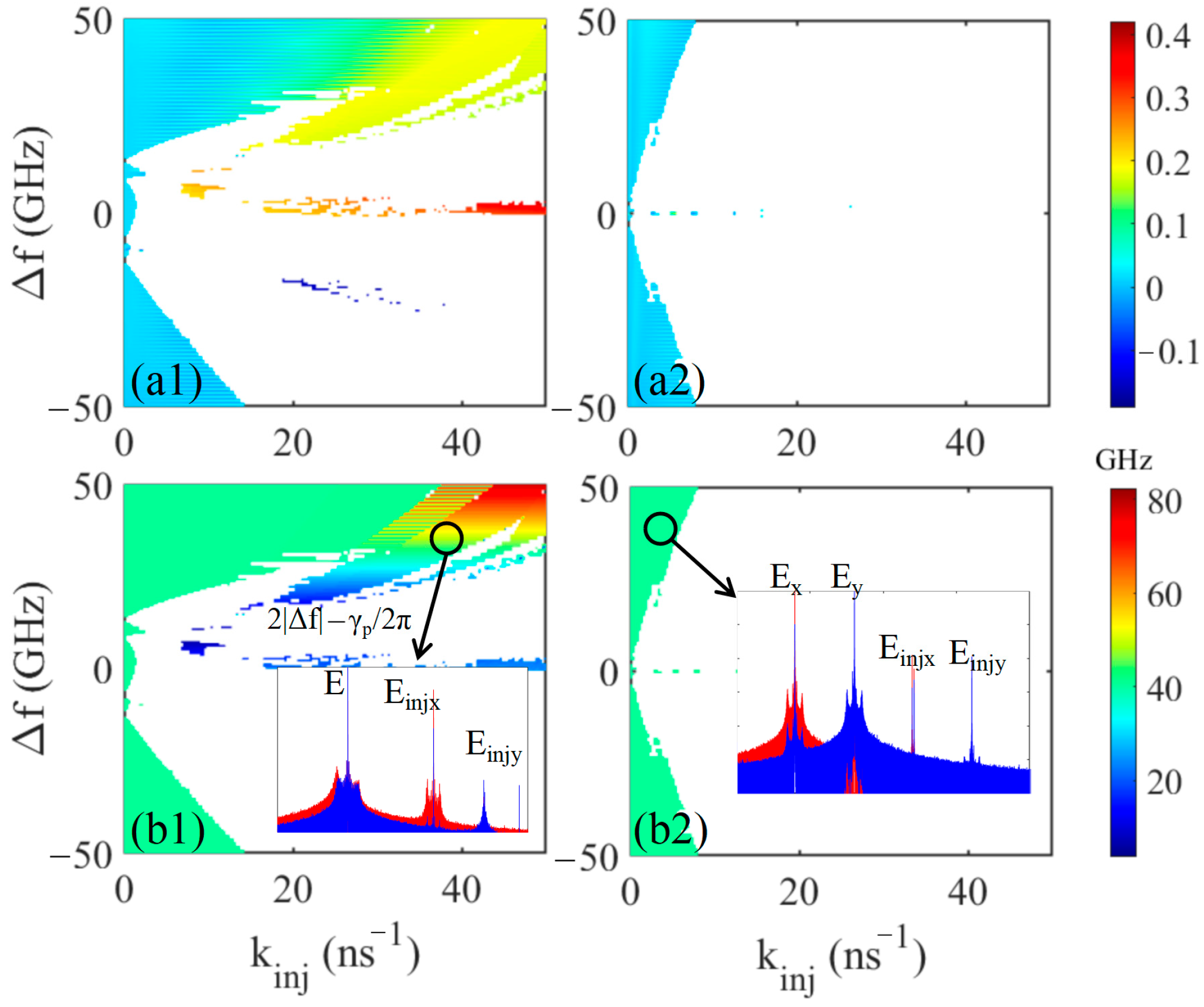
As the mutual injection delay time τ is further increased to 0.5 ns, as shown in Figure 9, the P1 regions become even smaller. In Figure 9(a1), a relatively large P1 dynamical region remains only in the positive detuning area, while the region at negative detuning nearly vanishes. The inset of Figure 9(b1) shows the optical spectra at a specific point within this region, where the injected x-polarization mode dominates, resulting in suppression of the signal frequency. In contrast, the P1 regions with enhanced frequencies disappear under these conditions. The reduction in P1 regions is even more pronounced in Figure 9(a2), where only the P1 region at low injection strength persists. Here, the injection strength is insufficient to trigger PS, so the output ellipticity remains close to zero. The inset of Figure 9(b2) reveals that the microwave frequency in this region originates from the beat note between the intrinsic x- and y-polarization modes of the spin-VCSEL, yielding a constant frequency of γ p π . Meanwhile, the peak powers of the injected x- and y-polarization modes remain relatively low. It can be concluded: PS in the mutually injected spin-VCSELs system is closely linked to the injection delay, with longer injection delays leading to a higher number of PS events. This correlation, to some degree, imposes a constraint on generating high-frequency millimeter-wave signals via PS.
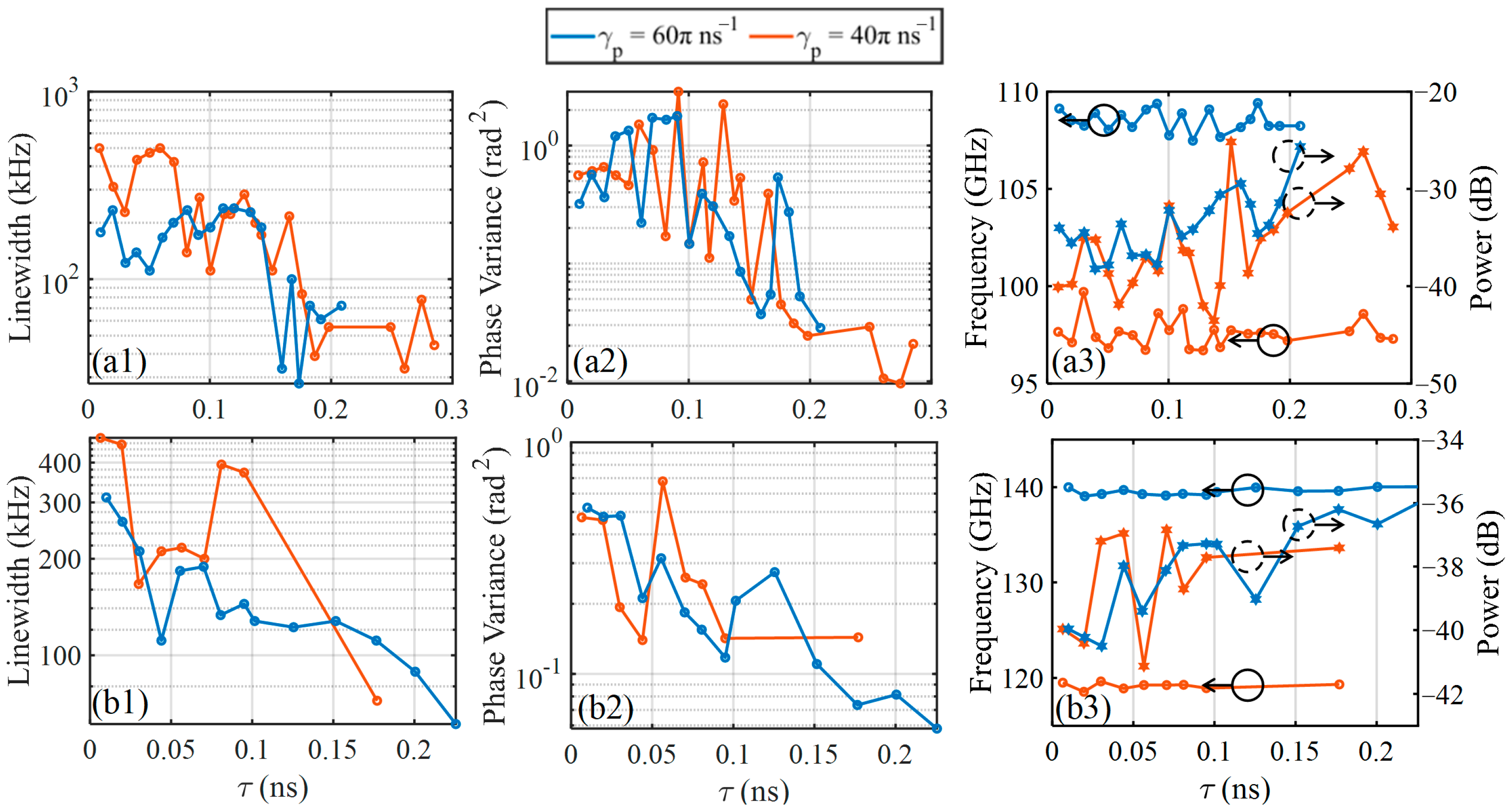
To gain more details on the effects of the parameters on the photonic microwave signal, we display the evolution of the spectral purity parameters as a function of the injection delay time τ for several values of the birefringence split, as shown in Figure 10. Here, the frequency detuning is set to 40 GHz and the injection strength to 30 ns−1. Furthermore, due to constraints in the parameter space, the injection delay for microwave signals with enhanced frequencies is limited to below 0.3 ns. As we can see from Figure 10(a1,b1), the microwave linewidth exhibits slight fluctuations while generally narrowing with increasing the injection delay time for all cases. The fluctuations arise primarily from shorter injection delay periods. Overall, a longer external cavity is beneficial for linewidth narrowing, so a compromise should be made between the parameter regime and the signal quality. Similarly, Figure 10(a2,b2) show that the phase variance exhibits a general decreasing trend, albeit with minor fluctuations. Unlike the behavior observed in Figure 3b, no gradual increase in phase variance is seen with further increases in the injection delay here, owing to the shorter injection delays employed in this case. This absence of an increase can be attributed to the fact that the side mode spacing is determined by the injection delay and is numerically equal to its reciprocal. Under short injection delays, the side mode spacing is wider, making it farther and lower for the secondary peaks, without a significant influence on the phase variance. This also explains why the SMSR was not analyzed in this context. Figure 10(a3,b3) show that, benefiting from the mutual injection operation, the P1 oscillation is consolidated and microwave signal power exhibits an increasing trend as the delay time increases. Moreover, the signal frequency exhibits slight fluctuations due to jumps between adjacent modes induced by variations in the injection delay time, as discussed in Ref. [27].
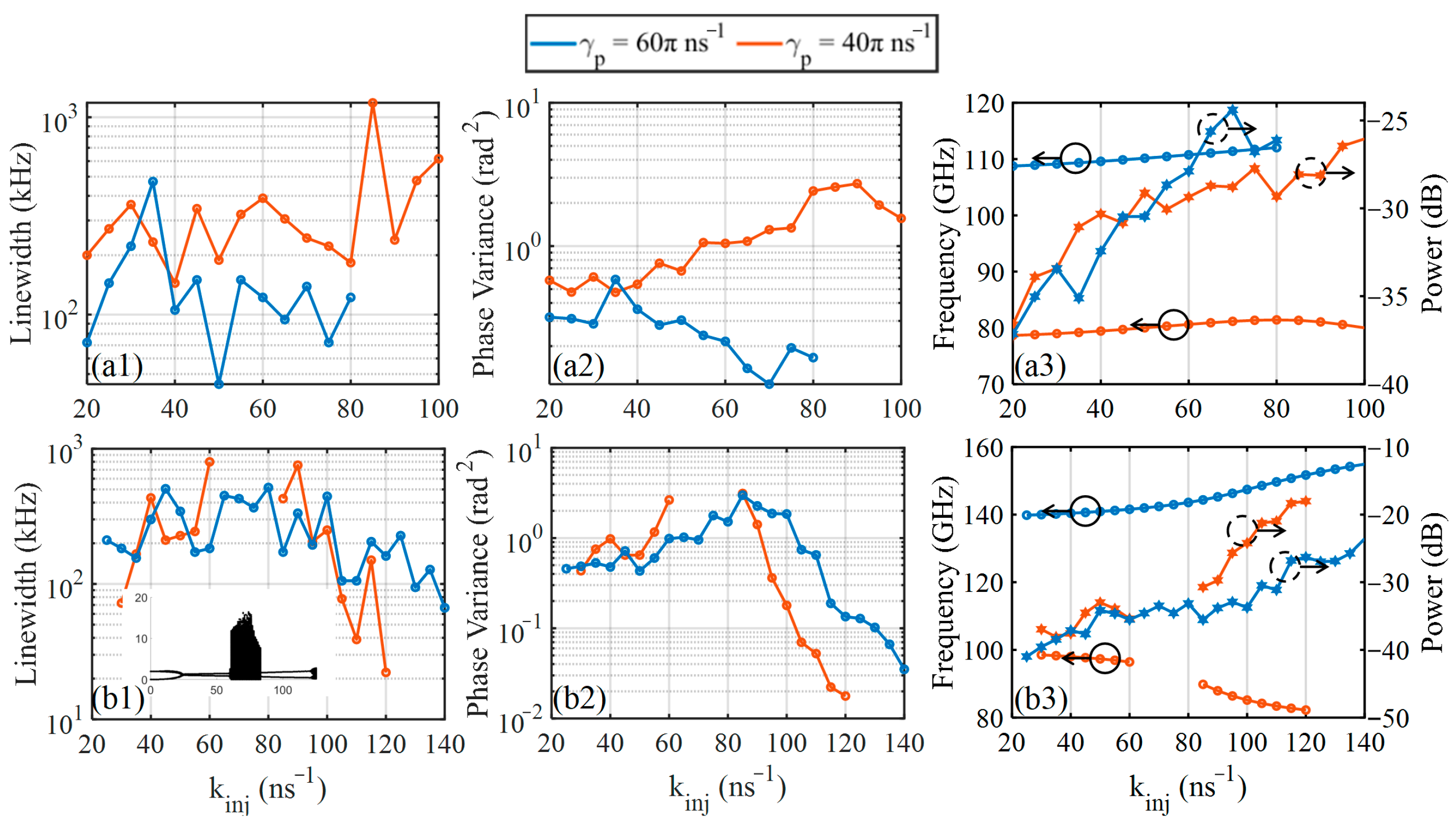
Another key injection parameter that significantly influences spectral purity characteristics is the injection strength, so we also consider the influence of the injection strength on the quality of microwave signals. To achieve a wide range of injection strengths, the injection delay time in Figure 11 is set to τ = 0.01   n s . Since the parameter is set at γ p , Δ f = 40 π   n s 1 , 40   G H z , which predominantly leads to other more complex dynamics, the frequency detuning here is adjusted to 30 GHz, while the other parameters remain the same as in Figure 10. In Figure 11(b1), the linewidth under both configurations shows a trend of initially increasing and then decreasing with the rising injection strength, achieving narrower linewidths at higher injection levels. The inset presents the bifurcation diagram at γ p = 40 π   n s 1 , where the system exhibits other dynamical states when k i n j = 60   n s 1 ~ 80   n s 1 . For the CW–P1 case in Figure 11(a1), the linewidth fluctuates within the range of several hundred kHz. The phase variance, however, demonstrates a more distinct trend. In Figure 11(a2), the phase variance at γ p = 40 π   n s 1 initially increases gradually and then decreases slightly with the increasing injection strength, while the phase variance at γ p = 60 π   n s 1 primarily exhibits a declining trend. In Figure 11(b2), similar to the behavior in Figure 11(b1), the phase variance in both cases shows comparable variations: it first rises slowly and then decreases markedly once the injection strength exceeds 80   n s 1 , dropping by approximately two orders of magnitude from its maximum value in both instances. Compared to the variations in frequency and power shown in Figure 11(a3), those in Figure 11(b3) are more pronounced. As expected, the microwave signal peak power increases significantly with the injection strength in both plots. Interestingly, in Figure 11(b3), the frequency exhibits different trends via injection strength under different delay times, a phenomenon also observed in optically injected systems.
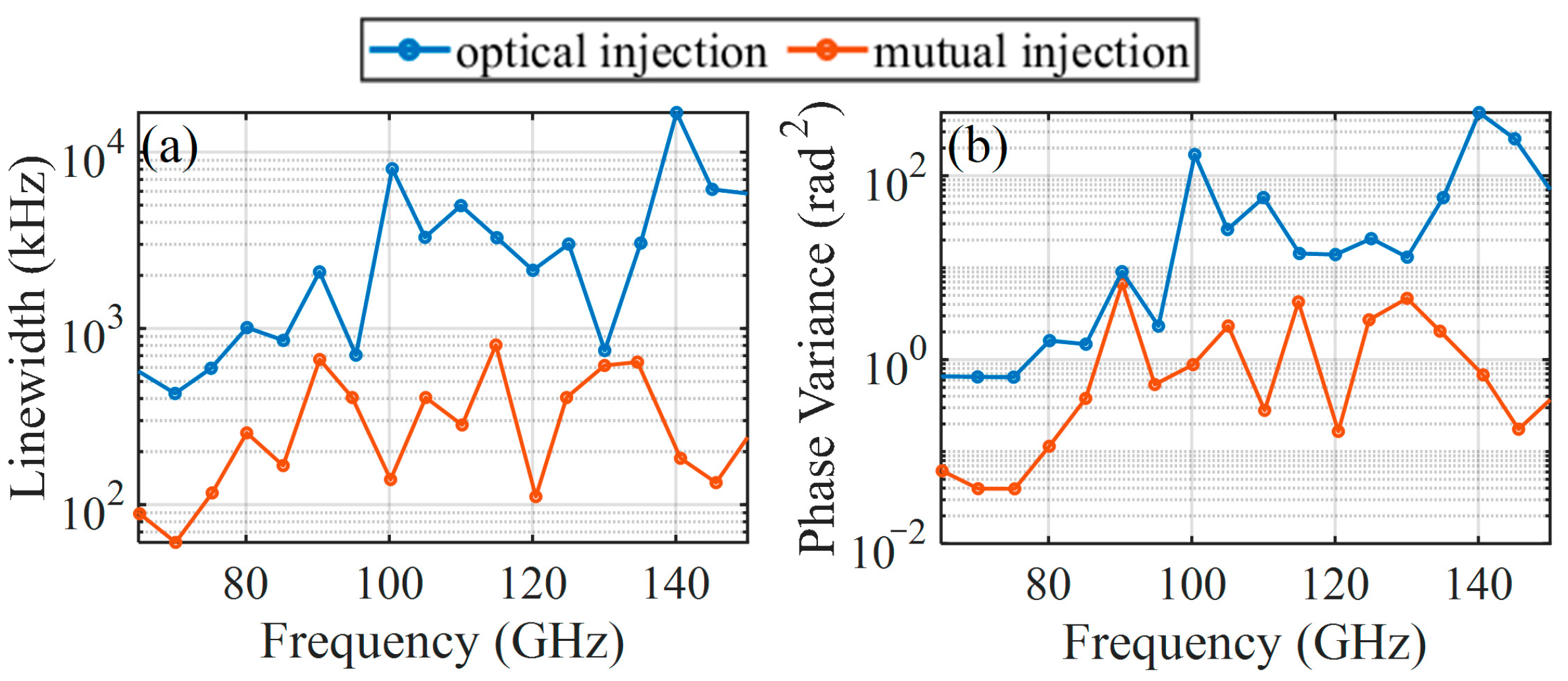
Finally, in Figure 12, we investigate the wider frequency range of the spin-VCSEL under different configurations. For the optical injection configuration, some parameters are set as k i n j 2 = 0   n s 1 and τ 1 = τ 2 = 0   n s . The mutual injection configuration corresponds to the P1–P1 case, with the maximum injection delay set to τ = 0.1   n s in this scheme. In the optical injection configuration, γ p = 50   n s 1 throughout. Meanwhile, in the mutual injection scheme, both γ p and f are simultaneously adjusted to control the signal frequency. This is because certain frequencies can only be attained within specific regions under particular delay settings. The injection strengths are set at or near their optimal values. As shown in Figure 12a, the linewidth of the mutual injection configuration remains consistently lower than that of the optical injection configuration across all frequencies. Moreover, as the frequency increases, the linewidth of the optical injection configuration generally broadens. In contrast, the mutual injection configuration maintains a stable linewidth within a narrower range. A similar trend can be observed in Figure 12b, where the mutual injection configuration demonstrates superior performance at high frequencies. At the same frequency, the maximum difference in phase noise variance between the two configurations exceeds two orders of magnitude.
Compared to previous methods (such as optical injection [29], optical feedback [28], optical heterodyne [16], or optical frequency combs [53]), our proposed scheme offers two significant advantages. On the one hand, the oscillation frequency of P1 depends on birefringence and frequency detuning, which allows for a wider and more flexible tunable range. On the other hand, the mutual injection system effectively forms an active feedback mechanism, which can significantly improve the quality of the millimeter-wave signal. In this work, we have only discussed the impact of spontaneous emission noise on semiconductor lasers, which is a well-studied issue in conventional operation. For other types of noise, such as thermal noise and noise introduced by photodetection, we have not delved further, as these can be optimized using certain techniques and can be effectively eliminated using balance detection technology.

4. Conclusions

In summary, we have systematically investigated a novel photonic millimeter-wave generation scheme based on two mutually injected spin-VCSELs. This study investigates the characteristics of microwave signals generated by two lasers operating under different dynamics. It was found that, when both spin-VCSELs operate in the CW, the signal frequency equals twice the frequency detuning. As the injection strength and/or delay time increases, the microwave linewidth decreases significantly. When at least one spin-VCSEL operates in the P1, the microwave signal frequency is also influenced by the birefringence γ p , with the frequency value increasing up to 2 f + γ p π . Moreover, increasing the injection delay leads to a sharp reduction in the P1 dynamical regions, particularly in the high-frequency regime. This phenomenon is more pronounced when both lasers operate in the P1 state. As the injection delay time increases, both the microwave linewidth and phase variance exhibit a decreasing trend. In the case where both spin-VCSELs operate in the P1 dynamical state, the linewidth and phase variance first increase and then decrease with the increasing injection delay time. Compared to conventional optical injection schemes, the mutual injection configuration achieves higher frequencies under identical parameters and demonstrates superior linewidth and phase performance at the same frequency. In the future, millimeter-wave generation schemes based on laser nonlinear dynamics are expected to be further explored, targeting signals with higher frequencies and superior quality, as well as more integrated system architectures. In the fields of wireless communication and radar, utilizing millimeter waves as carriers holds promise for enabling broader bandwidths and higher-speed communication and detection.

Author Contributions

Conceptualization, Y.X., Y.H. and N.L.; Validation, P.Z.; Formal analysis, K.L.; Investigation, Y.X.; Writing—original draft, Y.X.; Writing—review and editing, Y.H. and N.L.; Funding acquisition, Y.H. and N.L. All authors have read and agreed to the published version of the manuscript.

Funding

This work has received funding from the National Natural Science Foundation of China (62171305 and 62405206); the Natural Science Foundation of Jiangsu Province (BK20240778 and BK20241917); China Postdoctoral Science Foundation (2024M752314).

Data Availability Statement

The raw data supporting the conclusions of this article will be made available by the authors on request.

Conflicts of Interest

The authors declare no conflicts of interest.

References

  1. Marpaung, D.; Yao, J.; Capmany, J. Integrated microwave photonics. Nat. Photonics 2019, 13, 80–90. [Google Scholar] [CrossRef]
  2. Capmany, J.; Li, G.; Lim, C.; Yao, J. Microwave Photonics: Current challenges towards widespread application. Opt. Express 2013, 21, 22862–22867. [Google Scholar] [CrossRef] [PubMed]
  3. Novak, D.; Waterhouse, R.B.; Nirmalathas, A.; Lim, C.; Gamage, P.A.; Clark, T.R.; Dennis, M.L.; Nanzer, J.A. Radio-Over-Fiber technologies for emerging wireless systems. IEEE J. Quantum Electron. 2016, 52, 0600311. [Google Scholar] [CrossRef]
  4. Adams, M.J.; Hurtado, A.; Labukhin, D.; Henning, I.D. Nonlinear semiconductor lasers and amplifiers for all-optical information processing. Chaos Interdiscip. J. Nonlinear Sci. 2010, 20, 037102. [Google Scholar] [CrossRef]
  5. Capmany, J.; Mora, J.; Gasulla, I.; Sancho, J.; Lloret, J.; Sales, S. Microwave photonic signal processing. J. Light. Technol. 2013, 31, 571–586. [Google Scholar] [CrossRef]
  6. Cui, C.; Chan, S.-C. Performance analysis on using period-one oscillation of optically injected semiconductor lasers for radio-over-fiber uplinks. IEEE J. Quantum Electron. 2012, 48, 490–499. [Google Scholar] [CrossRef]
  7. Zhou, P.; Zhang, F.; Guo, Q.; Li, S.; Pan, S. Reconfigurable radar waveform generation based on an optically injected semiconductor laser. IEEE J. Sel. Top. Quantum Electron. 2017, 23, 1801109. [Google Scholar] [CrossRef]
  8. Zhou, C.D.; Huang, Y.; Yang, Y.G.; Cai, D.Y.; Zhou, P.; Lau, K.Y.; Li, N.Q.; Li, X.F. Streamlined photonic reservoir computer with augmented memory capabilities. Opto-Electron. Adv. 2025, 8, 240135. [Google Scholar] [CrossRef]
  9. Hwang, S.K.; Liu, J.M.; White, J.K. 35-GHz Intrinsic Bandwidth for Direct Modulation in 1.3-μm Semiconductor Lasers Subject to Strong Injection Locking. IEEE Photonics Technol. Lett. 2004, 16, 972–974. [Google Scholar] [CrossRef]
  10. Lau, E.K.; Zhao, X.; Sung, H.-K.; Parekh, D.; Chang-Hasnain, C.; Wu, M.C. Strong optical injection-locked semiconductor lasers demonstrating > 100-GHz resonance frequencies and 80-GHz intrinsic bandwidths. Opt. Express 2008, 16, 6609–6618. [Google Scholar] [CrossRef]
  11. Chi, H.; Yao, J. Frequency quadrupling and upconversion in a radio over fiber link. J. Light. Technol. 2008, 26, 2706–2711. [Google Scholar] [CrossRef]
  12. Lin, C.T.; Shih, P.T.; Jiang, W.J.; Chen, J.; Peng, P.C.; Chi, S. A continuously tunable and filterless optical millimeter-wave generation via frequency octupling. Opt. Express 2009, 17, 19749–19756. [Google Scholar] [CrossRef] [PubMed]
  13. Yao, X.S.; Malek, L. Multiloop optoelectronic oscillator. IEEE J. Quantum Electron. 2000, 36, 79–84. [Google Scholar] [CrossRef]
  14. Pan, S.; Yao, J. Wideband and frequency-tunable microwave generation using an optoelectronic oscillator incorporating a fabry-perot laser diode with external optical injection. Opt. Lett. 2010, 35, 1911–1913. [Google Scholar] [CrossRef]
  15. Yao, X.S.; Malek, L. Optoelectronic oscillator for photonic systems. IEEE J. Quantum Electron. 1996, 32, 1141–1149. [Google Scholar] [CrossRef]
  16. Romeira, B.; Javaloyes, J.; Figueiredo, J.M.L.; Ironside, C.N.; Cantu, H.I.; Kelly, A.E. Delayed feedback dynamics of liénard-type resonant tunneling-photo-detector optoelectronic oscillators. IEEE J. Quantum Electron. 2013, 49, 31–42. [Google Scholar] [CrossRef]
  17. Chan, S.C.; Hwang, S.K.; Liu, J.M. Period-one oscillation for photonic microwave transmission using an optically injected semiconductor laser. Opt. Express 2007, 15, 14921–14935. [Google Scholar] [CrossRef]
  18. Simpson, T.B.; Jia-Ming, L.; AlMulla, M.; Usechak, N.G.; Kovanis, V. Linewidth sharpening via polarization-rotated feedback in optically injected semiconductor laser oscillators. IEEE J. Sel. Top. Quantum Electron. 2013, 19, 1500807. [Google Scholar] [CrossRef]
  19. Cai, Q.; Zhang, Y.; Zheng, J.; Zhang, Y.; Li, P.; Shore, K.A.; Wang, Y.A. Monolithically integrated two-section laser for wideband and frequency-tunable photonic microwave generation. J. Light. Technol. 2023, 41, 404–411. [Google Scholar] [CrossRef]
  20. Li, S.S.; Zou, X.; Wang, L.; Wang, A.; Pan, W.; Yan, L. Stable period-one oscillations in a semiconductor laser under optical feedback from a narrowband fiber bragg grating. Opt. Express 2020, 28, 21286–21299. [Google Scholar] [CrossRef]
  21. Simpson, T.B.; Liu, J.M.; Huang, K.F. Nonlinear dynamics induced by external optical injection in semiconductor lasers. Quantum Semiclassical Opt. 1997, 9, 765–784. [Google Scholar] [CrossRef]
  22. Hwang, S.K.; Liu, J.M.; White, J.K. Characteristics of period-One oscillations in semiconductor lasers subject to optical injection. IEEE J. Sel. Top. Quantum Electron. 2004, 10, 974–981. [Google Scholar] [CrossRef]
  23. Donati, S.; Hwang, S.-K. Chaos and high-level dynamics in coupled lasers and their applications. Prog. Quantum Electron. 2012, 36, 293–341. [Google Scholar] [CrossRef]
  24. AlMulla, M.; Liu, J.M. Effects of the linewidth enhancement factor on the microwave linewidth of the period-one oscillations of optically injected semiconductor lasers. Opt. Lett. 2022, 47, 1166–1169. [Google Scholar] [CrossRef]
  25. Fan, L.; Xia, G.Q.; Chen, J.J.; Tang, X.; Liang, Q.; Wu, Z.M. High-purity 60GHz band millimeter-wave generation based on optically injected semiconductor laser under subharmonic microwave modulation. Opt. Express 2016, 24, 18252–18265. [Google Scholar] [CrossRef]
  26. Wang, C.; Raghunathan, R.; Schires, K.; Chan, S.C.; Lester, L.F.; Grillot, F. Optically injected InAs/GaAs quantum dot laser for tunable photonic microwave generation. Opt. Lett. 2016, 41, 1153–1156. [Google Scholar] [CrossRef]
  27. Chen, C.Y.; Cheng, C.H.; Lin, F.Y. Single-sideband photonic microwave generation with an optically injected quantum-dot semiconductor laser. Opt. Express 2016, 24, 30537–30546. [Google Scholar] [CrossRef]
  28. Shen, Z.Y.; Huang, Y.; Zhu, X.; Zhou, P.; Mu, P.H.; Li, N.Q. Broad tunable and high-purity photonic microwave generation based on an optically pumped QD Spin-VCSEL with optical feedback. Photonics 2023, 10, 326. [Google Scholar] [CrossRef]
  29. Alharthi, S.S. Broad tunable photonic microwave signal generation using optically-injected 1310 nm spin-VCSELs. Results Phys. 2022, 42, 106007. [Google Scholar] [CrossRef]
  30. Ji, S.; Hong, Y.H.; Spencer, P.S.; Benedikt, J.; Davies, I. Broad tunable photonic microwave generation based on period-one dynamics of optical injection vertical-cavity surface-emitting lasers. Opt. Express 2017, 25, 19863–19871. [Google Scholar] [CrossRef]
  31. Pérez, P.; Quirce, A.; Valle, A.; Consoli, A.; Noriega, I.; Pesquera, L.; Esquivias, I. Photonic generation of microwave signals using a single-mode VCSEL subject to dual-beam orthogonal optical injection. IEEE Photonics J. 2015, 7, 5500614. [Google Scholar] [CrossRef]
  32. Huang, Y.; Gu, S.Q.; Feng, Y.H.; Yang, Y.G.; Xiang, S.Y.; Zhou, P.; Li, N.Q. Wideband chaos generation using a VCSEL with intensity modulation optical injection for random number generation. Sci. China-Inf. Sci. 2024, 67, 169401. [Google Scholar] [CrossRef]
  33. Bian, H.F.; Zhang, X.M.; Li, P.; Jia, Z.W.; Ma, L.; Xu, B.J.; Shore, K.A.; Qin, Y.W.; Wang, Y.C. Sub-40 GHz broadband polarization chaos generation using mutually coupled free-running VCSELs. Photonics 2023, 10, 219. [Google Scholar] [CrossRef]
  34. Huang, Y.; Gu, S.; Zeng, Y.; Shen, Z.; Zhou, P.; Li, N. Numerical investigation of photonic microwave generation in an optically pumped spin-VCSEL subject to optical feedback. Opt. Express 2023, 31, 9827–9840. [Google Scholar] [CrossRef] [PubMed]
  35. Huang, Y.; Zhou, P.; Li, N. Broad tunable photonic microwave generation in an optically pumped spin-VCSEL with optical feedback stabilization. Opt. Lett. 2021, 46, 3147–3150. [Google Scholar] [CrossRef] [PubMed]
  36. Miguel, M.S.; Feng, Q.; Moloney, J.V. Light-polarization dynamics in surface-emitting semiconductor lasers. Phys. Rev. A 1995, 52, 1728–1739. [Google Scholar] [CrossRef]
  37. Martin-Regalado, J.; Prati, F.; Miguel, M.S.; Abraham, N.B. Polarization properties of vertical-cavity surface-emitting lasers. IEEE J. Quantum Electron. 1997, 33, 765–783. [Google Scholar] [CrossRef]
  38. Pusch, T.; Lindemann, M.; Gerhardt, N.C.; Hofmann, M.R.; Michalzik, R. Vertical-cavity surface-emitting lasers with birefringence splitting above 250 GHz. Electron. Lett. 2015, 51, 1600–1602. [Google Scholar] [CrossRef]
  39. Pusch, T.; La Tona, E.; Lindemann, M.; Gerhardt, N.C.; Hofmann, M.R.; Michalzik, R. Monolithic vertical-cavity surface-emitting laser with thermally tunable birefringence. Appl. Phys. Lett. 2017, 110, 151106. [Google Scholar] [CrossRef]
  40. Pusch, T.; Debernardi, P.; Lindemann, M.; Erb, F.; Gerhardt, N.C.; Hofmann, M.R.; Michalzik, R. Vertical-cavity surface-emitting laser with integrated surface grating for high birefringence splitting. Electron. Lett. 2019, 55, 1055–1057. [Google Scholar] [CrossRef]
  41. Shen, Z.; Huang, Y.; Zhou, P.; Mu, P.; Zhu, X.; Li, N. Quantum-dot spin-VCSELs subject to optical injection and feedback for flexible photonic millimeter wave generation. Chaos Solitons Fractals 2024, 186, 115206. [Google Scholar] [CrossRef]
  42. Li, N.; Susanto, H.; Cemlyn, B.R.; Henning, I.D.; Adams, M.J. Stability and bifurcation analysis of spin-polarized vertical-cavity surface-emitting lasers. Phys. Rev. A 2017, 96, 013840. [Google Scholar] [CrossRef]
  43. Xue, C.; Chang, D.; Fan, Y.; Ji, S.; Zhang, Z.; Lin, H.; Spencer, P.S.; Hong, Y. Characteristics of microwave photonic signal generation using vertical-cavity surface-emitting lasers with optical injection and feedback. J. Opt. Soc. Am. B 2020, 37, 1394–1400. [Google Scholar] [CrossRef]
  44. Pérez, P.; Valle, A.; Pesquera, L. Polarization-resolved characterization of long-wavelength vertical-cavity surface-emitting laser parameters. J. Opt. Soc. Am. B 2014, 31, 2574–2580. [Google Scholar] [CrossRef]
  45. Homayounfar, A.; Adams, M.J. Analysis of SFM dynamics in solitary and optically-injected VCSELs. Opt. Express 2007, 15, 10504–10519. [Google Scholar] [CrossRef]
  46. Winful, H.G.; Wang, S.S. Stability of phase locking in coupled semiconductor-laser arrays. Appl. Phys. Lett. 1988, 53, 1894–1896. [Google Scholar] [CrossRef]
  47. Kominis, Y.; Kovanis, V.; Bountis, T. Controllable asymmetric phase-locked states of the fundamental active photonic dimer. Phys. Rev. A 2017, 96, 1–19. [Google Scholar] [CrossRef]
  48. Vaughan, M.; Susanto, H.; Li, N.Q.; Henning, I.; Adams, M. Stability boundaries in laterally-coupled pairs of semiconductor lasers. Photonics 2019, 6, 6020074. [Google Scholar] [CrossRef]
  49. Tseng, C.H.; Chien, W.T.; Hwang, S.K. Spectral purity analysis on tunable, V- and W-band microwaves generated through two mutually injected semiconductor lasers at period-one nonlinear dynamics. Opt. Express 2025, 33, 35765–35783. [Google Scholar] [CrossRef]
  50. Tang, J.; Bai, G.F.; Tang, Y.L.; Xu, L.; Wang, G.X.; Shang, D.S.; Jiang, Y. All-optical microwave oscillator based on a mutual-injection coupling between DFB-LDs. Opt. Express 2022, 30, 42168–42177. [Google Scholar] [CrossRef]
  51. Prati, F.; Caccia, P.; Castelli, F. Effects of gain saturation on polarization switching in vertical-cavity surface-emitting lasers. Phys. Rev. A 2002, 66, 063811. [Google Scholar] [CrossRef]
  52. Li, X.F.; Pan, W.; Luo, B.; Ma, D.; Wang, Y.; Li, N.H. Nonlinear dynamic behaviors of an optically injected vertical-cavity surface-emitting laser. Chaos Solitons Fractals 2006, 27, 1387–1394. [Google Scholar] [CrossRef]
  53. Alshaykh, M.S.; McKinney, J.D.; Weiner, A.M. Radio-frequency signal processing using optical frequency combs. IEEE Photonics Technol. Lett. 2019, 31, 1874–1877. [Google Scholar] [CrossRef]
Figure 1. (a) Schematic of the proposed photonic microwave generation system; PBS, polarization beam splitter; NDF, neutral density filter. (b) The schematic diagram of optical spectra of spin-VCSELs in different stages: ① the free-running spin-VCSEL2, ② the output of the spin-VCSEL2 is injected to spin-VCSEL1, and the P1 oscillation is presented, ③ the P1 signal is fed back to the spin-VCSEL2, and the mode regeneration and the optical–optical modulation are presented, and ④ the regenerated mode and the modulated optical signal is fed back to the spin-VCSEL1, the P1 signal is enhanced, and the optical–optical modulation is also presented. λ01: the wavelength of free-running spin-VCSEL1 output; λ02: the wavelength of free-running spin-VCSEL2 output; λ1: the wavelength of spin-VCSEL1 output after red-shift; λ2: the wavelength of spin-VCSEL2 output after red-shift; ∆λ: the wavelength difference between the nearest neighbor two modes of the P1 signal.
Photonics 13 00028 g001
Figure 2. Color maps for (a) the frequency and (b) power in the ( k i n j ,   Δ f ) plane. (c) Optical spectra and (d) power spectra, where ( k i n j ,   Δ f ) = ( 20   n s 1 , 40   G H z ) .
Photonics 13 00028 g002
Figure 3. (a) Linewidth, (b) phase variance, (c) SMSR, and (d) frequency and power with respect to the injection delay time, where ( k i n j ,   Δ f ) = ( 20   n s 1 , 40   G H z ) .
Photonics 13 00028 g003
Figure 4. (a) Linewidth, (b) phase variance, (c) SMSR (inset: bifurcation diagram with injection strength increasing), and (d) frequency and power with respect to the injection strength, where ( τ ,   Δ f ) = ( 0.5   n s , 40   G H z ) .
Photonics 13 00028 g004
Figure 5. Two-parameter bifurcation diagrams in the ( k i n j ,   Δ f ) plane. (a1,b1) γ p = 40 π   n s 1 , (a2,b2) γ p = 50 π   n s 1 , and (a3,b3) γ p = 60 π   n s 1 ; (a) CW–P1 and (b) P1–P1.
Photonics 13 00028 g005
Figure 6. Color maps for (a) output ellipticity, (b) frequency, and (c) power with γ p = 40 π   n s 1 . (a1c1) CW–P1 and (a2c2) P1–P1.
Photonics 13 00028 g006
Figure 7. (a1d1) Optical spectra and (a2d2) power spectra of signals where (a) CW–P1, k i n j = 50   n s 1 and Δ f = 30   G H z , (b) CW–P1, k i n j = 50   n s 1 and Δ f = 45   G H z , (c) P1–P1, k i n j = 50   n s 1 and Δ f = 30   G H z , and (d) P1–P1, k i n j = 50   n s 1 and Δ f = 45   G H z . The insets in (a2d2) are magnified at the fundamental frequency.
Photonics 13 00028 g007
Figure 8. (a) Output ellipticity and (b) signal frequency of (a1,b1) CW–P1 and (a2,b2) P1–P1, where the other parameters are the same as those in Figure 8 and the injection delay time is τ = 0.1   n s .
Photonics 13 00028 g008
Figure 9. (a) Output ellipticity and (b) signal frequency of (a1,b1) CW–P1 and (a2,b2) P1–P1, where the other parameters are the same as those in Figure 6 and the injection delay time is τ = 0.5   n s . The insets are the optical spectra of the marked positions.
Photonics 13 00028 g009
Figure 10. (a1,b1) Linewidth, (a2,b2) phase variance, (a3,b3) frequency, and power of (a) CW–P1 and (b) P1–P1 with respect to the injection delay time, where the blue line corresponds to the case of γ p , Δ f = 60 π   n s 1 , 40   G H z , and the orange line corresponds to the case of γ p , Δ f = 40 π   n s 1 , 40   G H z .
Photonics 13 00028 g010
Figure 11. (a1,b1) Linewidth, (a2,b2) phase variance, (a3,b3) frequency, and power of (a) CW–P1 and (b) P1–P1 with respect to the injection strength, where the blue line corresponds to the case of γ p , Δ f = 60 π   n s 1 , 40   G H z , and the orange line corresponds to the case of γ p , Δ f = 40 π   n s 1 , 30   G H z . The inset is the bifurcation diagram with the injection strength increasing.
Photonics 13 00028 g011
Figure 12. (a) Linewidth and (b) phase variance under optical injection configuration and mutual injection configuration with respect to the signal frequency.
Photonics 13 00028 g012
Table 1. Values of laser parameters used in the numerical calculation.
Parameter and SymbolValueParameter and SymbolValue
optical field decay rate κ 250 ns−1carrier recombination rate γ 1 ns−1
pump intensity η 3pump polarization ellipticity P −0.7
dichroism rate γ α 0linewidth enhancement factor α 2
number of carriers at transparency N t 9 × 10⁶differential gain G N 2.152 × 10⁴ s−1
coefficient of spontaneous emission β S F 6.5 × 10⁻⁴
Disclaimer/Publisher’s Note: The statements, opinions and data contained in all publications are solely those of the individual author(s) and contributor(s) and not of MDPI and/or the editor(s). MDPI and/or the editor(s) disclaim responsibility for any injury to people or property resulting from any ideas, methods, instructions or products referred to in the content.