
Article

Design of Circularly Polarized VCSEL Based on Cascaded Chiral GaAs Metasurface


1
Postdoctoral Innovation Practice Base, Chengdu Polytechnic, Chengdu 610041, China
2
Sichuan Provincial Engineering Research Center of Thermoelectric Materials and Devices, Chengdu 610041, China
3
Kunming Institute of Physics, Kunming 650223, China
4
Institute of Semiconductors, Chinese Academy of Sciences, Beijing 100083, China
5
Institute of Intelligent Photonics, Nankai University, Tianjin 300071, China
6
School of Mechanical Engineering, Chengdu University, Chengdu 610106, China
*
Authors to whom correspondence should be addressed.
These authors contributed equally to this work.
Photonics 2026, 13(1), 87; https://doi.org/10.3390/photonics13010087 (registering DOI)
Submission received: 19 November 2025 / Revised: 15 January 2026 / Accepted: 15 January 2026 / Published: 19 January 2026

Abstract

Vertical cavity surface emitting lasers (VCSELs) have shown great potential in high-speed communication, quantum information processing, and 3D sensing due to their excellent beam quality and low power consumption. However, generating high-purity and controllable circularly polarized light usually requires external optical components such as quarter-wave plates, which undoubtedly increases system complexity and volume, hindering chip-level integration. To address this issue, we propose a monolithic integration scheme that directly integrates a custom-designed double-layer asymmetric metasurface onto the upper distributed Bragg reflector of a chiral VCSEL. This metasurface consists of a rotated GaAs elliptical nanocolumn array and an anisotropic grating above it. By precisely controlling the relative orientation between the two, the in-plane symmetry of the structure is effectively broken, introducing a significant optical chirality response at a wavelength of 1550 nm. Numerical simulations show that this structure can achieve a near 100% high reflectivity for the left circularly polarized light (LCP), while suppressing the reflectivity of the right circularly polarized light (RCP) to approximately 33%, thereby obtaining an efficient in-cavity circular polarization selection function. Based on this, the proposed VCSEL can directly emit high-purity RCP without any external polarization control components. This compact circularly polarized laser source provides a key solution for achieving the next generation of highly integrated photonic chips and will have a profound impact on frontier fields such as spin optics, secure communication, and chip-level quantum light sources.

1. Introduction

Distributed Bragg reflectors (DBRs) are the cornerstone of traditional VCSELs and are indispensable components for forming high-finesse optical resonators [1,2]. Their function of providing high reflectivity within a specific stopband is crucial for establishing the feedback mechanism necessary for laser oscillation. However, the inherent characteristics of DBRs, particularly their significant thickness (typically exceeding several micrometers) and their purely scalar response to light, fundamentally limit the functionality and miniaturization of VCSELs [3,4]. In sharp contrast, metasurfaces [5,6,7,8], as ultrathin two-dimensional artificial materials, bring about a paradigm shift. Replacing the top DBR with a metasurface not only drastically reduces the device size by several orders of magnitude but also introduces unprecedented capabilities for vectorial light field manipulation. This enables the laser to directly generate complex structured light [9,10,11,12] (such as high-purity circularly polarized beams) from the cavity, a feat unattainable with traditional DBRs. Therefore, the metasurface-based approach transcends mere miniaturization and paves the way for versatile, on-chip integrated light sources with customized polarization and wavefront functionalities for advanced applications in optical communications, sensing, and quantum technologies. Furthermore, cholesteric liquid crystals (CLC) can produce circularly polarized selective reflection due to their self-organized helical phase. They have attracted considerable attention due to their advantages such as simple preparation, low cost, and the potential to achieve large-area flexible devices [13,14,15].
When designing chiral metasurfaces capable of modulating circularly polarized light, the reason why multilayer structures [16,17,18,19] are more likely to achieve strong chiral responses than single-layer ones lies in their ability to provide longer and controllable interaction paths for the light field. A single-layer chiral metasurface [12,20,21,22] is like a two-dimensional “planar stamp”, and its manipulation of the light polarization state mainly relies on the resonant effects existing in the nanostructures. This approach often faces the limitation of insufficient interaction thickness, which leads to a weak circular dichroism (the difference in responses of two circularly polarized lights). While multilayer metasurfaces construct a three-dimensional-like “chiral helix [23,24,25]”, and by carefully designing the spatial arrangement, rotational orientation, and coupling strength between layers, they can guide the light wave to undergo directional and cumulative phase delay and energy conversion. This is similar to passing a linearly polarized light through a series of wave plates to synthesize circularly polarized light, thereby significantly enhancing the degree of freedom, efficiency, and bandwidth of the control. However, this performance improvement comes at the cost of greatly increased design complexity. The main challenges faced by multilayer metasurfaces include: strict alignment accuracy, huge computational load, and the unpredictability of interlayer coupling [26,27]. In short, multilayer structures have opened the door to “three-dimensional design” for achieving high-performance chiral control, but they have also pushed researchers into the “dimensional disaster” deep water zone, posing extreme requirements for simulation, design, and fabrication. In addition, the technology based on tilted optical anisotropy is also a novel idea for manufacturing chiral VCSELs, and it is also an important branch in the chiral VCSEL family [28,29].
We propose a novel design strategy that decouples the bilayer structure into a polarizer and a single-layer metasurface. This approach leverages the mature simulation methodologies available for polarizers, thereby reducing the problem to optimizing only the single-layer metasurface. Consequently, the number of simulation parameters is drastically reduced to that of a single-layer system. Based on this method, we successfully designed a bilayer metasurface exhibiting a near-unity reflectance of 0.9999 for LCP and a significantly lower reflectance of 0.33 for RCP. This performance corresponds to a large circular dichroism (CD) of 0.67, which is crucial for promoting the dominance of the LCP mode during laser oscillation. The proposed metasurface serves as a promising candidate to replace the conventional DBR in VCSELs, enabling direct generation of high-purity circularly polarized light without additional optical components. This work establishes a new paradigm for developing compact, chiral laser sources.

2. Materials and Methods

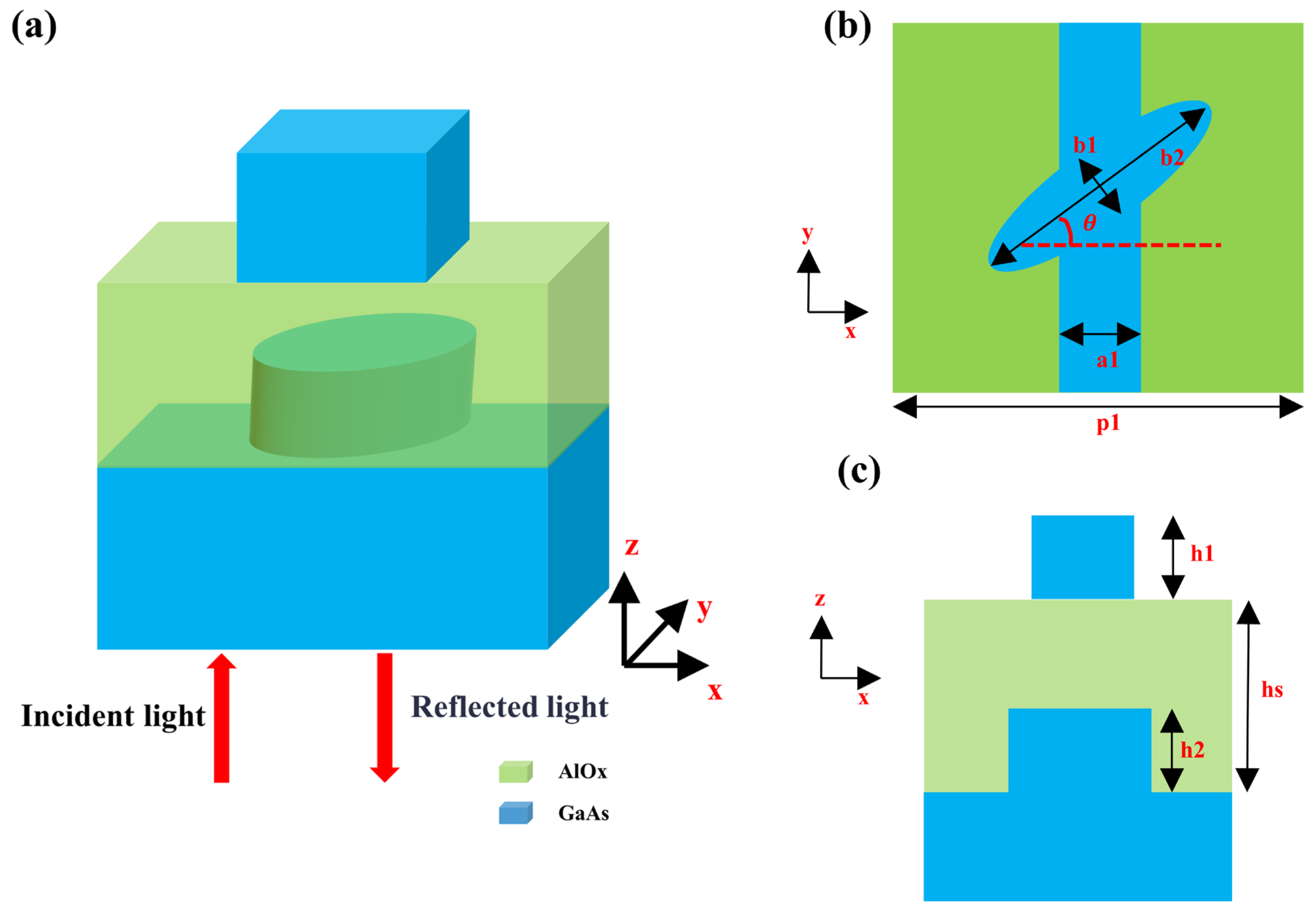
Figure 1a shows the three-dimensional structure of the unit cell of the chiral double-layer metasurface. The double-layer metasurface consists of a lower layer of GaAs elliptical cylinder array, an intermediate AlOX spacer layer, and an upper GaAs line grating. Figure 1b,c respectively present the top view and front view of the double-layer metasurface, which provide detailed size information. The refractive indices of GaAs and AlOX are 3.38 and 1.62, respectively. The reflection of the double-layer metasurface was calculated based on the COMSOL 5.6 simulation software. In the simulation model, periodic boundary conditions and perfect matching layer conditions were respectively applied to the four side surfaces and the upper and lower end surfaces. The polarization characteristics of the incident light were added at the incident port, and the reflection was the area integral of the Poynting vector representing the electromagnetic energy flow density at the reflection port. Moreover, when the metasurface serves as a mirror of the laser resonator, it provides a strong polarization-selective feedback. The near-perfect reflection (R~0.9999) of the metasurface to LCP creates low-loss and low-threshold conditions for the LCP mode to oscillate in the cavity. Meanwhile, the low reflection (R~0.33) of the metasurface to RCP means that the RCP mode will experience extremely high loss in the cavity and cannot reach the lasing threshold. During the laser startup process, this significant asymmetry in optical feedback directly triggers mode competition [30]. As a result, the LCP mode can quickly consume most of the gain and establish steady-state laser oscillation, while the RCP mode is effectively suppressed and “starved to death”. Ultimately, the laser can directly output high-purity LCP determined by the metasurface without any additional polarization elements.
In addition, the complete fabrication and integration process of the designed dual-layer metasurface circularly polarized VCSEL operating at 1550 nm wavelength [31] can be summarized as follows. Firstly, a VCSEL epitaxial wafer with an n-DBR, quantum well active region, and p-type contact layer is grown on a GaAs substrate by metal–organic chemical vapor deposition, and the laser mesa is formed by inductively coupled plasma etching. Subsequently, on another independent GaAs substrate, a bottom GaAs elliptical column array is fabricated successively by electron beam lithography and dry etching. An AlOx intermediate layer is precisely grown by atomic layer deposition, and an upper GaAs line grating is formed on the AlOx layer by electron beam lithography and etching processes, thus completing the independent fabrication of the dual-layer metasurface. Finally, the fabricated metasurface structure is permanently integrated with the VCSEL mesa through wafer bonding technology, replacing the traditional upper DBR, or the metasurface structure is directly flipped, aligned, and bonded to the top of the etched VCSEL structure after its fabrication to form optical and electrical contacts. In addition, after integration, the n/p electrodes need to be fabricated, annealed, and alloyed, and the device is verified through spectral and polarization tests to determine whether it can achieve stable circularly polarized laser output at 1550 nm wavelength. In addition, a more detailed process flow chart has been added to the Supplementary Materials.

3. Results

The design inspiration of the double-layer chiral metasurface comes from the classic optical system composed of a linear polarizer and a quarter-wave plate. This conceptual framework enables us to decompose the complex double-layer structure into two independent components with distinct functions and easy management. The upper layer works as a linear polarizer grating, while the lower layer functions as a single-layer metasurface. Its basic working principle can be summarized as a circular polarization selective feedback mechanism. For RCP, the system is designed to be transmissive. The bottom metasurface layer acts as a quarter-wave plate, converting the incident RCP light into a linear polarization state, thereby passing through the top polarizer grating with minimal loss. For LCP, the system provides high reflectivity to establish laser oscillation. LCP is first converted by the bottom metasurface (acting as a quarter-wave plate) into orthogonal linear polarization. The linear state is then strongly reflected by the top polarizer grating, and the reflected light passes through the bottom metasurface, effectively coupling it back into the laser gain medium. This functional decomposition successfully simplifies the arduous task of simulating the coupled double-layer system into the more manageable problem of characterizing two separate and easily understandable components, thereby significantly reducing the complexity and computational cost of the simulation.

3.1. The Design of Linear Polarizers

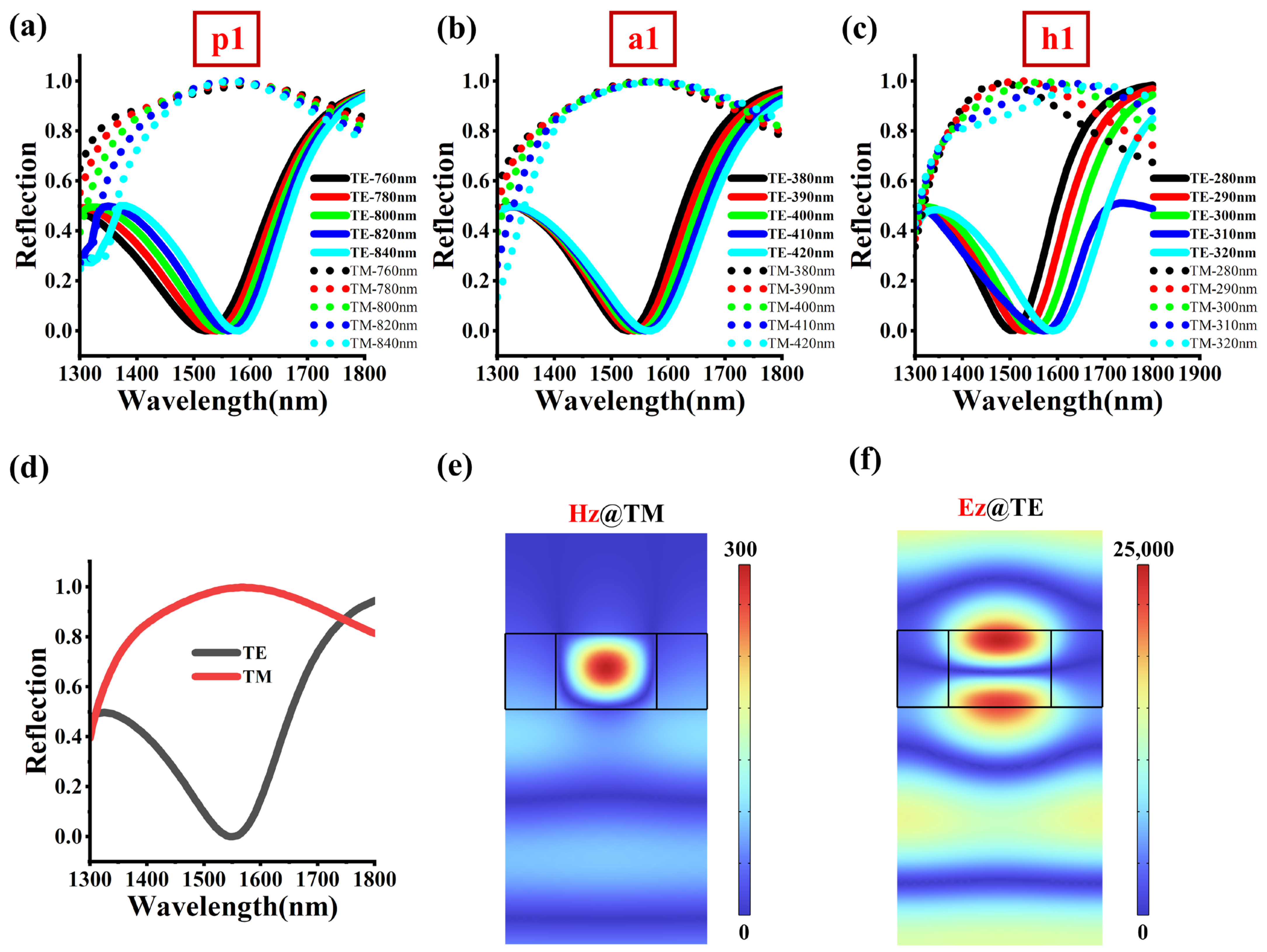
Figure 2 shows the reflection characteristics of the top linearly polarized grating in the double-layer metasurface. Figure 2a demonstrates the influence of period p1 on the linearly polarized grating. Near the wavelength of 1550 nm, the change in the TM mode is very weak, while the reflection valley of the TE mode redshifts as p1 increases. Figure 2b shows the effect of the grating width a1. It can be found that the influence of a1 on the peak shift is not significant. However, as shown in Figure 2c, the influence of thickness h1 is intense. Within the range of 280 nm to 320 nm, the reflection peak corresponding to the TM mode shifts by at least 200 nm, and the redshift distance of the TE mode is close to 100 nm. Figure 2d presents the reflection spectrum of the optimized grating structure, with the corresponding period p1, width a1, and thickness h1 being 800 nm, 400 nm, and 300 nm, respectively. At the operating wavelength of 1550 nm, the reflection rate corresponding to the TE mode is close to 0, while that corresponding to the TM mode is close to 1, demonstrating an extremely ideal linear polarization selection effect. Figure 2e shows the magnetic field intensity distribution of the linearly polarized grating in the TM mode. It can be observed that the majority of the energy is localized in the GaAs columns, with almost no energy transmission above the grating, and a waveform similar to a plane reflection wave appears below the grating. The linearly polarized grating acts as a perfect mirror, completely blocking the TM mode. However, as shown in Figure 2f, there is a significant energy leakage phenomenon at the boundaries between the linearly polarized grating and the upper and lower dielectric, which corresponds to a typical electromagnetic radiation state. Moreover, the linearly polarized grating can serve as a propagation channel for the TE mode, and thus it cannot perfectly reflect the energy to the bottom.

3.2. The Reflectivity of Double-Layer Metasurfaces

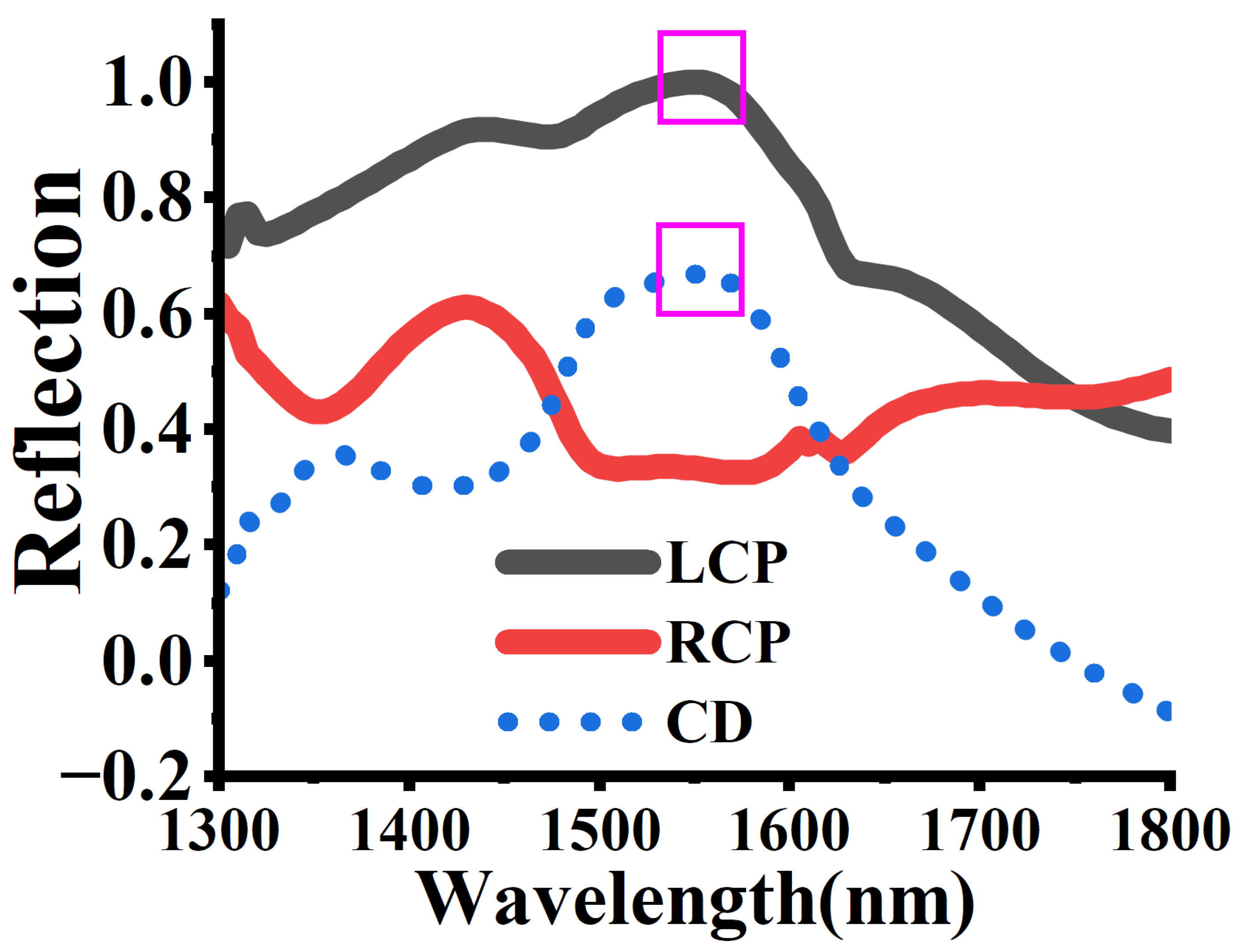
Once the design of the upper linear polarizer is finalized, the simulation of the complex bilayer metasurface is reduced to that of a single anisotropic nanostructure array (e.g., composed of elliptical or rectangular elements). Figure 3 shows the reflection spectra and CD spectra of the bilayer chiral metasurface. Within the wavelength range of 1300 nm to 1800 nm, the reflection of LCP shows an overall trend of increasing first and then decreasing. At the operating wavelength of 1550 nm, the reflection reaches an astonishing 0.9999. However, for RCP, the reflection remains basically at 0.33 near 1550 nm wavelength, resulting in a CD as high as 0.66. Here, CD = RLCP − RRCP, where RLCP and RRCP correspond to the reflection of the bilayer chiral metasurface for LCP and RCP, respectively. Therefore, this bilayer chiral metasurface can be used as the upper reflector of a VCSEL. It achieves efficient polarization selection within the laser cavity by providing near-perfect reflection feedback for LCP while significantly suppressing RCP, eliminating the need for external polarization control components in traditional schemes and enabling the miniaturization and functional integration of the device.

3.3. Analysis of Ultra-High Reflectivity Close to 100%

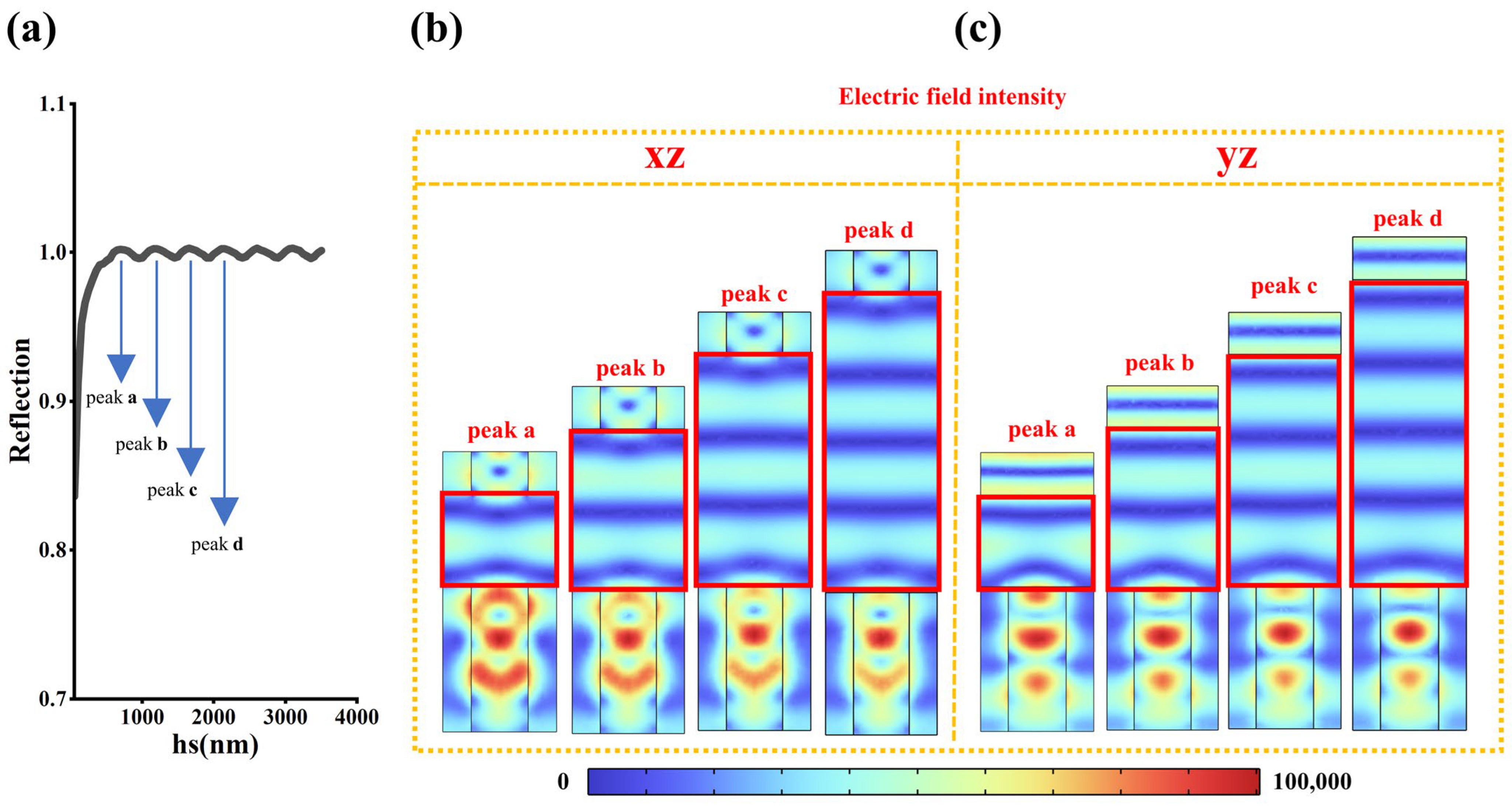
When a double-layer optical structure exhibits the optical phenomenon of ultra-high reflectivity, it is easily associated with the optical resonance mode [32,33]. Figure 4a shows the relationship between the reflectivity and hs when the double-layer metasurface is in the case of LCP incidence, where hs is the spacing between the upper linear grating and the lower single-layer metasurface. It can be observed that the reflectivity exhibits a sinusoidal-like characteristic as hs increases. For ease of representation, the first four peaks generated by the variation in hs are successively named peak a, peak b, peak c, and peak d. Figure 4b,c present the cross-sectional diagrams of the electric field intensity of the double-layer metasurface at different peaks under LCP incidence. The red box marks the boundary of the optical cavity between the two layers of the metasurface. A very typical phenomenon here is that the larger the hs corresponding to the peak, the more blue and white stripes in the optical cavity, that is, the more antinodes and nodes of the standing wave. By comprehensively considering the periodicity in Figure 4a and the “standing wave” patterns observed in Figure 4b,c, the oscillation of the reflectivity modulated by the thickness variation of the middle layer, hs, essentially stems from the coherent interference within the middle layer of the phase-dependent reflection fields provided respectively by the upper grating and the lower anisotropic array. The alteration of hs can directly adjust the propagation phase difference between the two reflected fields, thereby determining the phenomenon of constructive interference (high reflection) they produce at a specific wavelength and in a specific circular polarization state.

3.4. Analysis of Giant Circular Dichroism

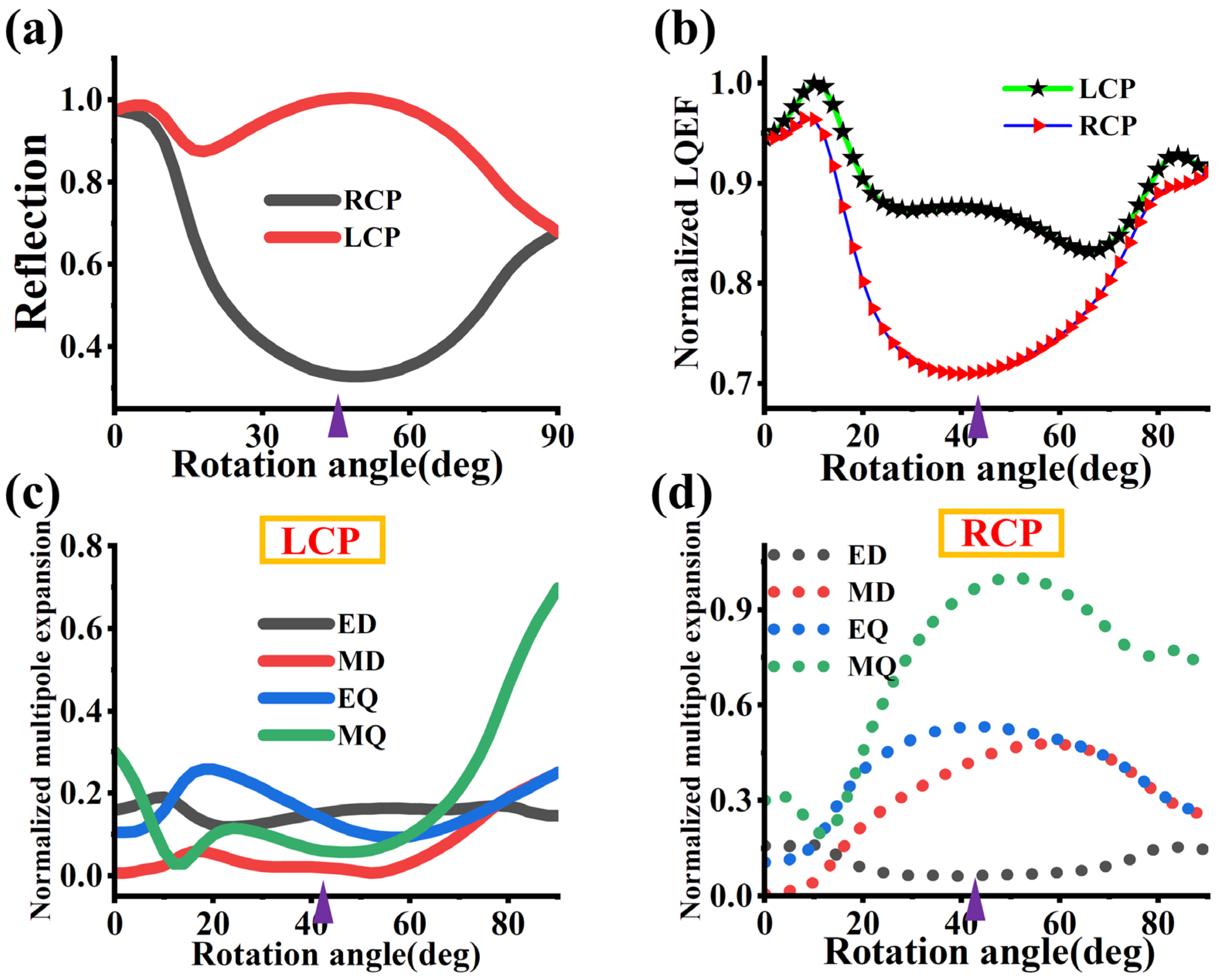
A perfect mirror that can replace the upper DBR in a circularly polarized laser must not only have a reflectivity close to 100%, but also possess high circular dichroism to ensure that only one circularly polarized light mode is excited among the two orthogonal circularly polarized lights. In metasurfaces, chiral symmetry structures [34,35] refer to structures that cannot be completely superimposed with their mirror images through any rotational operation, similar to the relationship between our left and right hands. In metasurface systems, such structures are usually artificially designed microscopic units with dimensions much smaller than the wavelength. They break mirror symmetry by designing special asymmetric geometries (such as L-shaped, G-shaped, helical, or twisted nanorods, etc.) in the plane or in three-dimensional space. There is a direct causal relationship between the circular dichroism of metasurfaces and these chiral symmetry structures. It is precisely because the metasurface units have chirality that they respond differently to LCP and RCP (such as different absorption, refraction, or phase modulation). It can be said that chiral structures are the physical origin of the strong circular dichroism. In Figure 1, the unit cell of the bilayer metasurface contains two geometric structures, namely the upper rectangular strip and the lower ellipse. The angle between the long axes of the rectangular strip and the ellipse is defined as the rotation angle θ. If the rotation angle is 0 degrees or 90 degrees, the bilayer metasurface and its mirror image structure can be superimposed through rotation. However, once the rotation angle is not so trivial, a chiral symmetry structure is formed. Figure 5a shows the relationship between the rotation angle and the reflectivity of the bilayer metasurface. The CD is zero at 0 degrees and 90 degrees, and at a rotation angle of 43 degrees, the CD approaches 0.7. Figure 5b shows the normalized local quantity of electric field (LQEF) of the bilayer metasurface under LCP and RCP incident conditions. It can be found that the LQEF exhibits the same characteristics as the reflectivity, which is that when the rotation angle increases from 0 degrees to 90 degrees, the LQEF starts from zero, increases, and then gradually decreases to zero. L Q E F = | E | | E 0 | d V , where E and E0 are the electric field intensities in the metasurface and the incident light, respectively, and the integration region corresponds to the volume occupied by the bilayer metasurface. In addition, the multipole expansion [36,37] method is also often used to analyze metasurfaces. The multipole expansion method refers to an analytical method that decomposes the complex light scattering process into the sum of contributions from a series of basic radiation sources (such as electric dipoles (ED), magnetic dipoles (MD), electric quadrupoles (EQ), and magnetic quadrupoles (MQ), etc.). The total scattering power can be decomposed into
I = ω 4 c 3 | E D | 2 + ω 4 c 3 | M D | 2 + ω 6 5 c 5 Q α β Q α β + ω 6 20 c 5 M α β M α β
E D = 1 i ω j d v
M D = 1 2 c ( r × j ) d v
Q α β = 1 i ω [ r α j β + r β j α 2 3 ( r . j ) ] d v
M α β = 1 3 c [ ( r × j ) α r β + ( r × j ) β r α ] d v
Here, Qαβ and Mαβ are the components of the EQ and MQ respectively, j is the current density in the metasurface, c is the speed of the light, and α and β are any two orthogonal units in the three-dimensional spatial coordinate system. Figure 5c,d respectively show the relationship between the intensity of the multipole and the rotation angle when the incident light is LCP and RCP. For LCP, when the rotation angle is 43 degrees, the resonance of the metasurface is mainly controlled by ED and EQ. We boldly speculate that the occurrence of optical interference between the ED and EQ modes led to the appearance of a significant reflection peak at this wavelength for the metasurface. However, for RCP, although the MQ mode are strongly excited, due to its inherent dark mode characteristics—weak coupling with free-space light and low radiative loss—it did not cause intense radiative scattering interference.

3.5. Analysis of Potential Errors

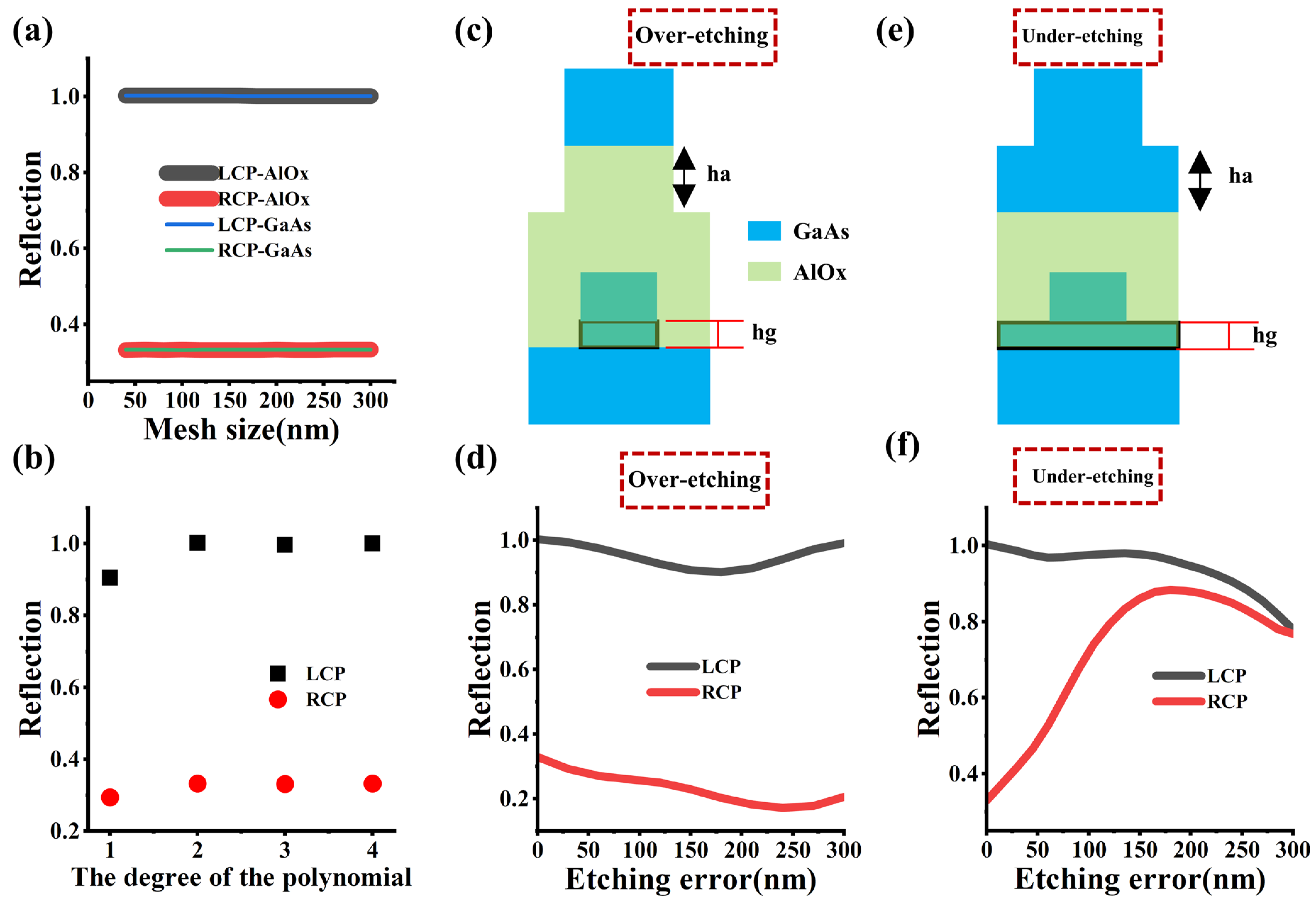
When simulating metasurfaces using the finite element method, it is crucial to comprehensively analyze the mesh size [38], the number of terms in the discretized polynomial [39], and the etching process error. The mesh size directly determines the resolution of the simulation model for the complex nanostructures of the metasurface. The mesh that is too large will smooth out critical electromagnetic field details, leading to inaccurate calculations of resonant frequencies and field distributions. The number of terms in the discretized function affects the balance between computational accuracy and efficiency. Too few terms will introduce numerical diffusion and fail to accurately describe nonlinear effects such as local field enhancement, while too many terms will impose unnecessary computational burdens. More importantly, the simulation results must be correlated with the fabrication process. For instance, due to factors such as imperfect edges of the photoresist, spatial non-uniformity of the etching rate, and minor fluctuations in process parameters, which are difficult to completely avoid during processing, the dimensions and morphology of the etched structure will inevitably deviate from the ideal design, making etching errors ubiquitous. Therefore, systematically evaluating these factors can effectively bridge the gap between “ideal design” and “experimental fabrication”, enhancing the credibility of the simulation results and the success rate of the design. Figure 6a shows the influence of the mesh size, revealing that the reflectivity of the metasurface remains stable when the mesh size is within the range of 50 nm to 300 nm. Figure 6b indicates that the reflectivity remains largely unchanged when the degree of the polynomial is ≥2. Figure 6c,e display the etching patterns. Here, we assume that the etching rate ratio of GaAs to AlOx is 10:1, i.e., hg/ha = 10:1. As shown in Figure 6d, as hg increases, CD remains significant, which is an encouraging finding, but the reflectivity of the LCP deviates from 100%. In addition, Figure 6f shows that CD decreases significantly with the increase in under-etching error hg. As shown in Table 1, the dual-layer chiral metasurface we designed has the best reflectivity and a decent CD. Additionally, the Z-shaped silicon metasurface in reference [40] also performs very well, but its relatively low CD means that it is difficult to generate highly pure circularly polarized light.

4. Discussion and Conclusions

This study successfully simulated a double-layer metasurface, which is expected to help VCSELs achieve direct emission of high-purity circularly polarized light. The core significance of this result lies in that we fundamentally avoided the reliance on discrete optical components in traditional schemes through an innovative “in-cavity” design. Traditional methods for generating circularly polarized light, such as loading a quarter-wave plate outside the laser, although technically mature, are inherently incompatible with the trend of compact and scalable integrated photonics due to their inherent volume and alignment requirements. Our work demonstrates that integrating a carefully designed optical metasurface as an inherent part of the VCSEL resonator is an effective way to resolve this contradiction.
The ingenious aspect of the double-layer structure of rotating elliptical nanocolumns and gratings that we designed lies in the precise “tailoring” of the in-plane symmetry of the structure by controlling the relative orientation between the two layers. This is in sharp contrast to most works that rely on a single chiral meta-atom or merely utilize geometric phase. Numerical simulation results confirm that this symmetry-breaking mechanism can produce nearly perfect reflection under a specific chiral (LCP) light field, while significantly suppressing the feedback of the opposite chirality. This strong chiral-selective response directly functions as an efficient polarization filter within the laser cavity, ensuring that the laser mode can stably oscillate in the pre-designed circular polarization state. This discovery aligns with the recent research trend of using metasurfaces to control the symmetry of light fields, but we creatively apply this principle to the active cavity of a semiconductor laser, demonstrating the great potential of metasurfaces in active photonic devices. In addition, the current simulation conclusion provides crucial design guidance and performance prediction for the subsequent experimental preparation, and experimental verification is the core of our next step of work.
From a broader perspective, the significance of this work extends beyond VCSELs themselves. It provides a design paradigm that can be drawn upon for the development of other types of on-chip circularly polarized lasers, such as microdisk lasers and DFB lasers. At the application level, this compact light source capable of directly generating circularly polarized light is undoubtedly a key step towards higher integration of photonic chips. In spin optics and quantum optics experiments, high-purity circularly polarized light is an important tool for manipulating electron spin states or preparing specific quantum states, and our device offers a plug-and-play light source solution for these fundamental studies. In the field of optical communications, the circular polarization state, as an independent information multiplexing dimension, can be used to increase channel capacity or enhance communication security, and our technology enables this to be achieved at the chip scale.
Certainly, there is still room for further exploration in this research. Firstly, the current design is targeted at fixed laser wavelengths and chirality. Future work can explore the realization of dynamically switchable circularly polarized output through electro-tuning or thermal-tuning mechanisms. Secondly, although numerical simulations predict excellent performance, the fabrication, packaging of actual devices and their performance stability at high temperatures need to be verified through experiments in depth. We will also list “Based on the measured/simulated Jones matrix of the metasurface, combined with the gain model, the complete laser threshold and polarization state analysis is carried out using the generalized vector Barkhausen criterion” as the most urgent and important theoretical work in the subsequent research. This will be the core to achieve the leap from “component” to “device”. Additionally, extending this concept to a broader wavelength range (such as the telecommunication band or visible light band) also holds significant application value. We believe that with the continuous advancement of nanofabrication technology, this monolithic integrated metasurface strategy will open up new avenues for the next generation of high-performance integrated photonic devices.

Supplementary Materials

The following supporting information can be downloaded at: https://www.mdpi.com/article/10.3390/photonics13010087/s1, Figure S1: The following picture is the detailed process steps. (a) Vertical cavity surface emitting lasers (VCSELs) with n-type distributed Bragg reflectors (DBRs), quantum well active regions and p-type contact layers were grown on GaAs substrates by metal-organic chemical vapor deposition. The laser mesa was formed by inductively coupled plasma etching. Then, photoresist was spin-coated on the surface where the pads were to be fabricated (the p-type contact layer surface of the VCSEL). Using a UV lithography machine, the photoresist layer was exposed and developed through a pre-designed mask containing the pad patterns, thereby opening precise windows in the photoresist layer that corresponded to the pad positions and shapes. The sample was placed in an electron beam evaporation or magnetron sputtering system, where a thin adhesion layer (such as Ti or Cr, about 10–50 nm) and a bonding metal layer (such as Au, or eutectic alloys like AuSn, about 100–300 nm thick) were deposited successively. The metal was only deposited on the substrate areas exposed by the photoresist windows and the photoresist surface. The sample was immersed in a specific solvent (such as acetone) for stripping. The solvent dissolved the photoresist and removed the metal layer deposited on the photoresist, leaving only the patterned metal pads within the windows. (b) On another independent GaAs substrate, a bottom GaAs elliptical column array was fabricated successively through electron beam lithography and dry etching processes. (c) The photoresist was spin-coated, the gold film was grown, and a cross alignment mark was fabricated successively through electron beam lithography and lift-off processes. (d) A flat layer of alumina was deposited on the etched elliptical column array by atomic layer deposition (ALD) technology. Subsequently, the alumina surface was planarized by chemical mechanical polishing (CMP) to obtain a smooth interface. (e) The GaAs film was epitaxially grown, and then the top GaAs line grating was fabricated successively through electron beam lithography and dry etching processes. (f) The temporary carrier wafer substrate is removed by selective wet etching (such as a mixture of citric acid and hydrogen peroxide) or a combination of mechanical thinning and dry etching, leaving only the required metasurface structure layer. This process is similar to the preparation of SOI wafers and is relatively standardized. (g) The same process as (a) is used to pre-fabricate solder pads (such as gold-tin or indium) on the back of the metasurface. (h) Subsequently, with the assistance of an infrared alignment system, the two are precisely positioned (the alignment accuracy needs to be controlled within ~1 μm), and finally, in a vacuum or nitrogen environment, appropriate temperature and pressure are applied to complete the permanent bonding, while forming good electrical and optical contacts.

Author Contributions

Conceptualization, X.W. and B.C.; methodology, B.C.; software, G.S.; validation, B.C., Y.Z. and K.Z.; formal analysis, B.C.; investigation, B.C.; resources, X.W.; data curation, X.W.; writing—original draft preparation, B.C. and X.W.; writing—review and editing, K.Z. and F.S.; visualization, X.W.; supervision, X.W.; project administration, X.W.; funding acquisition, K.Z. All authors have read and agreed to the published version of the manuscript.

Funding

This research was funded by the Natural Science Foundation of Tianjin, grant number NO. 24JCQNJC01880; This research was funded by the Research on Optoelectronic Fusion Technology, ZB253015; This research was funded by the Young Elite Scientists Sponsorship Program of Cast, grant number NO. YESS20240775; This research was funded by the Strategic Priority Research Program of the Chinese Academy of Sciences (grant no. XDB0980000).

Data Availability Statement

The raw data supporting the conclusions of this article will be made available by the authors on request.

Acknowledgments

The authors are grateful to Jietao Liu, Hanxiao Shao of Institute of Semicon-ductors, Chinese Academy of Sciences.

Conflicts of Interest

The authors declare no conflicts of interest.

References

  1. Chase, C.; Rao, Y.; Hofmann, W.; Chang-Hasnain, C.J. 1550 nm high contrast grating VCSEL. Opt. Express 2010, 18, 15461–15466. [Google Scholar] [CrossRef] [PubMed]
  2. Nishiyama, N.; Caneau, C.; Hall, B.; Guryanov, G.; Hu, M.H.; Liu, X.S.; Li, M.J.; Bhat, R.; Zah, C.E. Long-Wavelength Vertical-Cavity Surface-Emitting Lasers on InP with Lattice Matched AlGaInAs–InP DBR Grown by MOCVD. IEEE J. Sel. Top. Quantum Electron. 2005, 11, 990–998. [Google Scholar] [CrossRef]
  3. Baba, T.; Hamano, T.; Koyama, F.; Iga, K. Spontaneous emission factor of a microcavity DBR surface-emitting laser. IEEE J. Quantum Electron. 2002, 27, 1347–1358. [Google Scholar] [CrossRef]
  4. Cook, K.T.; Qi, J.; Wang, J.; Cabello, N.; Chang-Hasnain, C.J. Novel Oxide Spacer High-Contrast Grating VCSELs. In Proceedings of the CLEO: Science and Innovations, San Jose, CA, USA, 13–18 May 2018. [Google Scholar]
  5. Fleury, R.; Sounas, D.L.; Alù, A. Negative Refraction and Planar Focusing Based on Parity-Time Symmetric Metasurfaces. Phys. Rev. Lett. 2014, 113, 023903. [Google Scholar] [CrossRef]
  6. Guo, J.; Jin, R.; Fu, Z.; Zhang, Y.; Yu, F.; Chen, J.; Wang, X.; Huang, L.; Zhou, C.; Chen, X. Topologically Engineered High-Q Quasi-BIC Metasurfaces for Enhanced Near-Infrared Emission in PbS Quantum Dots. Nano Letters 2025, 25, 2357–2365. [Google Scholar] [CrossRef]
  7. Xu, Z.; Bao, S.; Liu, J.; Chang, J.; Kong, X.; Galdi, V.; Cui, T.J. Observation of Analog Flatland Cherenkov Radiations on Metasurfaces. Laser Photonics Rev. 2024, 18, 2300763. [Google Scholar] [CrossRef]
  8. Ji, J.; Li, J.; Wang, Z.; Li, X.; Sun, J.; Wang, J.; Fang, B.; Chen, C.; Ye, X.; Zhu, S. On-chip multifunctional metasurfaces with full-parametric multiplexed Jones matrix. Nat. Commun. 2024, 15, 8271. [Google Scholar] [CrossRef]
  9. Jia, X.; Kapraun, J.; Wang, J.; Qi, J.; Ji, Y.; Chang-Hasnain, C. Metasurface reflector enables room-temperature circularly polarized emission from VCSEL. Optica 2023, 10, 1093–1099. [Google Scholar] [CrossRef]
  10. Cheng, B.; Zou, Y.; Song, G. Ultrahigh-reflectivity chiral mirrors based on the metasurface of the quarter-waveplate. Heliyon 2024, 10, e40143. [Google Scholar] [CrossRef]
  11. Wang, C.; Wang, R.; Cheng, X.; Hu, X.; Wang, C. Passively Broadband Tunable Dual Circular Dichroism via Bound States in the Continuum in Topological Chiral Metasurface. ACS Nano 2024, 18, 18922–18932. [Google Scholar] [CrossRef]
  12. Shi, T.; Deng, Z.-L.; Geng, G.; Zeng, X.; Zeng, Y.; Hu, G.; Overvig, A.; Li, J.; Qiu, C.-W.; Alù, A.; et al. Planar chiral metasurfaces with maximal and tunable chiroptical response driven by bound states in the continuum. Nat. Commun. 2022, 13, 4111. [Google Scholar] [CrossRef]
  13. Xie, Y.; Tao, L.; Yang, T.S.; Zhao, K.X.; Hu, P.; Wang, B.Q.; Zhao, K.Q.; Bai, X.Y. Cholesteric liquid crystals based on triphenylene bridged binaphthyl derivatives: Mesomorphism, optical properties and circular polarization luminescence properties. J. Mol. Struct. 2025, 1329, 141449. [Google Scholar] [CrossRef]
  14. Li, Y.C.; Huang, Y.M.; Wang, C.T. Electrically reflectance-tunable circular polarization reflector based on thin polymer-stabilized cholesteric liquid crystals. Opt. Laser Technol. 2025, 180, 111530. [Google Scholar] [CrossRef]
  15. Wei, W.; Farooq, M.A.; Xiong, H. Cholesteric Liquid Crystalline Polyether with Broad Tunable Circularly Polarized Luminescence. Langmuir 2021, 37, 11922–11930. [Google Scholar] [CrossRef] [PubMed]
  16. Cheng, B.; Zou, Y.; Shao, H.; Li, T.; Song, G. Full-Stokes imaging polarimetry based on a metallic metasurface. Opt. Express 2020, 28, 27324–27336. [Google Scholar] [CrossRef]
  17. Basiri, A.; Chen, X.; Bai, J.; Amrollahi, P.; Carpenter, J.; Holman, Z.; Wang, C.; Yao, Y. Nature-inspired chiral metasurfaces for circular polarization detection and full-Stokes polarimetric measurements. Light Sci. Appl. 2019, 8, 78. [Google Scholar] [CrossRef]
  18. Bai, J.; Wang, C.; Chen, X.; Basiri, A.; Wang, C.; Yao, Y. Chip-integrated plasmonic flat optics for mid-infrared full-Stokes polarization detection. Photon. Res. 2019, 7, 1051–1060. [Google Scholar] [CrossRef]
  19. Zuo, J.; Bai, J.; Choi, S.; Basiri, A.; Chen, X.; Wang, C.; Yao, Y. Chip-integrated metasurface full-Stokes polarimetric imaging sensor. Light Sci. Appl. 2023, 12, 218. [Google Scholar] [CrossRef]
  20. Zhu, A.Y.; Chen, W.T.; Zaidi, A.; Huang, Y.-W.; Khorasaninejad, M.; Sanjeev, V.; Qiu, C.-W.; Capasso, F. Giant intrinsic chiro-optical activity in planar dielectric nanostructures. Light Sci. Appl. 2018, 7, 17158. [Google Scholar] [CrossRef]
  21. Chen, Y.; Deng, H.; Sha, X.; Chen, W.; Wang, R.; Chen, Y.-H.; Wu, D.; Chu, J.; Kivshar, Y.S.; Xiao, S.; et al. Observation of intrinsic chiral bound states in the continuum. Nature 2023, 613, 474–478. [Google Scholar] [CrossRef]
  22. Deng, Q.-M.; Li, X.; Hu, M.-X.; Li, F.-J.; Li, X.; Deng, Z.-L. Advances on broadband and resonant chiral metasurfaces. npj Nanophotonics 2024, 1, 20. [Google Scholar] [CrossRef]
  23. Gansel, J.K.; Thiel, M.; Rill, M.S.; Decker, M.; Bade, K.; Saile, V.; von Freymann, G.; Linden, S.; Wegener, M. Gold Helix Photonic Metamaterial as Broadband Circular Polarizer. Science 2009, 325, 1513–1515. [Google Scholar] [CrossRef] [PubMed]
  24. Ji, R.; Wang, S.-W.; Liu, X.; Guo, H.; Lu, W. Hybrid Helix Metamaterials for Giant and Ultrawide Circular Dichroism. ACS Photonics 2016, 3, 2368–2374. [Google Scholar] [CrossRef]
  25. Fan, W.; Wang, Y.; Zheng, R.; Liu, D.; Shi, J. Broadband high efficiency asymmetric transmission of achiral metamaterials. Optics Express 2015, 23, 19535–19541. [Google Scholar] [CrossRef]
  26. Rao, R.; Shi, Y.; Wang, Z.; Wan, S.; Li, Z. On-Chip Cascaded Metasurfaces for Visible Wavelength Division Multiplexing and Color-Routing Meta-Display. Nano Letters 2025, 25, 2452–2458. [Google Scholar] [CrossRef]
  27. Wu, X.; Pan, K.; Wu, X.; Fan, X.; Zhou, L.; Zhao, C.; Wen, D.; Liu, S.; Gan, X.; Li, P. Wavelength-insensitive snapshot Stokes polarimetric imaging based on cascaded metasurfaces. Adv. Photonics 2025, 7, 11. [Google Scholar] [CrossRef]
  28. Torrelli, V.; D’Alessandro, M.; Elser, W.; Debernardi, P. On-demand polarization by a vertical-cavity surface-emitting laser with two tilted sub-wavelength gratings. Opt. Lett. 2024, 49, 4. [Google Scholar] [CrossRef]
  29. Torrelli, V.; Miri, L.; D’Alessandro, M.; Gullino, A.; Zimmer, M.; Dahler, K.; Jetter, M.; Michler, P.; Elsäßer, W.; Bertazzi, F.; et al. Elliptical polarization in VCSELs via joint interaction of a tilted sub-wavelength grating and intrinsic semiconductor anisotropies. Opt. Lett. 2025, 50, 3082–3085. [Google Scholar] [CrossRef]
  30. Ahmed, M.; Yamada, M. Influence of Instantaneous Mode Competition on the Dynamics of Semiconductor Lasers. IEEE J. Quantum Electron. 2002, 38, 682–693. [Google Scholar] [CrossRef]
  31. Ren, M.; Gu, X.; Liang, Y.; Kong, W.; Zeng, H. Laser ranging at 1550 nm with 1-GHz sine-wave gated InGaAs/InP APD single-photon detector. Opt. Express 2011, 19, 13497–13502. [Google Scholar] [CrossRef]
  32. Feng, S.; Zhang, X.; Klar, P.J. Waveguide Fabry-Pérot microcavity arrays. Appl. Phys. Lett. 2011, 99, 2985. [Google Scholar] [CrossRef]
  33. Zhang, X.; Yan, S.; Zeng, J.; Fang, Y. Study on the Transmission and the Field Enhancement of Bi-Rhombic Aperture Arrays Structure. IEEE Photonics J. 2023, 15, 2200806. [Google Scholar] [CrossRef]
  34. Selinger, J.V.; Wang, Z.G.; Bruinsma, R.F.; Knobler, C.M. Chiral symmetry breaking in Langmuir monolayers and smectic films. Phys. Rev. Lett. 1993, 70, 1139–1142. [Google Scholar] [CrossRef]
  35. Ginsparg, P.H.; Wilson, K.G. A remnant of chiral symmetry on the lattice. Phys. Rev. D 1982, 25, 2649–2657. [Google Scholar] [CrossRef]
  36. Sheppard, C.J.R.; Torok, P. Efficient calculation of electromagnetic diffraction in optical systems using a multipole expansion. Opt. Acta Int. J. Opt. 1997, 44, 803–818. [Google Scholar] [CrossRef]
  37. Johnson; B., R. Calculation of light scattering from a spherical particle on a surface by the multipole expansion method. J. Opt. Soc. Am. A 1996, 13, 326–337. [Google Scholar] [CrossRef]
  38. Ribeiro Filho, M.; Pinho, J.T.; Silva, J.P.; Nobrega, K.Z.; Hernandez-Figueroa, H.E. A FEM mesh generator for large size aspect ratio problems with applications in optoelectronics. In Proceedings of the International Microwave & Optoelectronics Conference, Foz do Iguacu, Brazil, 20–23 September 2003. [Google Scholar]
  39. Jin, J.M. The Finite Element Method in Electromagnetics; John Wiley & Sons: Hoboken, NJ, USA, 2015. [Google Scholar]
  40. Cheng, B.; Jiang, B.; Zou, Y.; Song, G. Ultrahigh-Reflectivity Circularly Polarized Mirrors Based on the High-Contrast Subwavelength Chiral Metasurface. Photonics 2024, 11, 923. [Google Scholar] [CrossRef]
  41. Gao, Z.; Wang, P.; Xu, Z.; Zhao, T. Chiral metasurface absorber with near-infrared excitation-induced dual circular dichroism. Opt. Laser Technol. 2024, 175, 110826. [Google Scholar] [CrossRef]
Figure 1. Double-layer chiral metasurface mirror. (a) Three-dimensional structure diagram of the unit cell of the chiral mirror. It introduces the material and structural information of metasurfaces. (b) Top view. p1 = 800 nm, a1 = 400 nm, b1 = 312 nm, b2 = 720 nm, θ = 43°. The upper structure is a rectangular strip, and the lower structure is an elliptical cylinder. (c) Front view. hs = 640 nm, h2 = 1020 nm. The space between the upper structure and the lower structure is filled with AlOx films.
Photonics 13 00087 g001
Figure 2. The reflection spectrum and electric field distribution diagram of the linearly polarized grating. The influence of the variations in some parameters (a) Period p1. (b) Width a1. (c) Thickness h1 on the reflection spectrum the grating. (d) Reflectance spectrum of the optimized structure. (e) Magnetic field intensity in TM mode. (f) Magnetic field intensity in TE mode. The black frame corresponds to the position of the linearly polarized grating, with the GaAs columns located in the center of the frame. The TE and TM modes respectively correspond to the linearly polarized incident light with the electric field direction perpendicular and parallel to the long axis of the grating.
Photonics 13 00087 g002
Figure 3. Reflection spectra and CD spectra of the double-layer chiral metasurface. The pink frame corresponds to the operating wavelength of 1550 nm.
Photonics 13 00087 g003
Figure 4. (a) The relationship between the hs and the reflectivity under LCP incidence. (b) The xz cross-sectional view of the electric field intensity of the double-layer metasurface under different hs conditions. (c) The yz cross-sectional view of the electric field intensity of the double-layer metasurface under different hs conditions. The purple triangular symbol corresponds to a rotation angle of 43 degrees.
Photonics 13 00087 g004
Figure 5. (a) Relationship between rotation angle θ and reflectivity in a double-layer chiral metasurface. (b) Normalized local field quantity. (c) Multipole expansion diagram under LCP incidence condition. (d) Multipole expansion diagram under RCP incidence condition. The purple triangular symbol corresponds to a rotation angle of 43 degrees.
Photonics 13 00087 g005
Figure 6. The influence of some factors on the reflectivity of the double-layer metasurface (a) The mesh size of the model. The grid size here represents the upper limit of the lengths that the sides of the free quadrilateral can take. (b) The number of terms of the polynomial in the FEM algorithm. (c) Schematic diagram of over-etching. (d) The influence of over-etching error hg on the double-layer metasurface at the operating wavelength. (e) Schematic diagram of under-etching. (f) The influence of Under-etching error hg on the double-layer metasurface at the operating wavelength.
Photonics 13 00087 g006
Table 1. Performance comparisons of some chiral metasurfaces.
StructurePublicationWavelength (μm)CDEfficiency
Hybrid meta [17]2019~1.50.80.8
Scythe- shaped [12]2022~1.5/0.96
Gammadion-shaped [9]20230.940.0020.984
Z-shaped [40]20240.980.021~0.99
π-shaped [41]20241.550.70.83
π-shaped [41]20242.550.75~0.81
This work 1.550.670.9999
Disclaimer/Publisher’s Note: The statements, opinions and data contained in all publications are solely those of the individual author(s) and contributor(s) and not of MDPI and/or the editor(s). MDPI and/or the editor(s) disclaim responsibility for any injury to people or property resulting from any ideas, methods, instructions or products referred to in the content.