Article

Conditions for a Rotationally Symmetric Spectral Degree of Coherence Produced by Electromagnetic Scattering on an Anisotropic Random Medium

School of Physical Science and Technology, Southwest Jiaotong University, Chengdu 610031, China
*
Author to whom correspondence should be addressed.
Photonics 2026, 13(1), 102; https://doi.org/10.3390/photonics13010102
Submission received: 15 December 2025 / Revised: 16 January 2026 / Accepted: 17 January 2026 / Published: 22 January 2026
(This article belongs to the Section Lasers, Light Sources and Sensors)

Abstract

The problem was recently reported that the far-zone electromagnetic momentum of light produced by scattering on a spatially anisotropic random medium can be the same at every azimuthal angle of scattering. Here, we extend the analysis to focus on the possibility of producing a rotationally symmetric spectral degree of coherence (SDOC) generated by scattering by an anisotropic process. The necessary and sufficient conditions for producing such a SDOC in the far zone are derived when a polychromatic electromagnetic plane wave is scattered by an anisotropic Gaussian Schell-model medium. We find that, unlike the generation of a rotationally symmetric momentum flow, it is not enough to simply restrict the structural characteristics of the medium and the incident light source to achieve a SDOC with rotational symmetry. An additional and essential requirement is that the azimuthal angles of scattering corresponding to the two observation points of the SDOC must be constrained to be equal. Only when all these constraints are satisfied simultaneously can a rotationally symmetric electromagnetic SDOC generated by scattering by an anisotropic process be realized. In addition, we find that although the medium parameter conditions for generating a rotationally symmetric SDOC and a rotationally symmetric momentum flow are completely different, it remains possible that the SDOC and the momentum flow produced by a spatially anisotropic medium can still simultaneously exhibit rotational symmetry, provided that the distribution of the correlation function of the scattering potential of the medium is isotropic in the plane perpendicular to the incident direction. Our results not only contribute to a deeper understanding of the far-field distribution of light scattering on an anisotropic scatterer, but also have potential applications in light-field manipulation and in the inverse scattering problem.

1. Introduction

Scattering of electromagnetic waves is an old and useful topic that has attracted considerable attention in various areas such as remote sensing, object detection, medical imaging, and diagnostics. The potential scattering theory, as one of the typical theories for predicting the scattering behavior of electromagnetic radiation in different regimes, has undergone rapid developments in recent years due to the establishment of the theory of partial optical coherence for randomly fluctuating light fields in the space-frequency domain. On the one hand, initial studies primarily focused on rather ideal cases where the light sources utilized to illuminate scatterers were scalar plane waves [1,2,3,4,5]. After applying the angular spectrum theory of stochastic light fields to scattering problems and establishing scattering matrix theory, it is possible to conduct more detailed research on the scattering of stochastic scalar fields with any spectral composition and any correlation properties in both continuous and discrete media [6,7]. Subsequently, researchers further extended the scattering theory to more realistic incident waves such as stochastic electromagnetic light waves [8,9,10], plane-wave pulses [11,12], vortex beams [13,14,15], and multi-Gaussian Schell-model beams [16,17,18,19], to name a few. On the other hand, the scattering media have evolved from deterministic media to random media [4], from continuous scatterers to collections of particles [20,21,22], and from isotropic media to anisotropic media [23,24,25,26]. In addition, various types of non-traditional media have also been discussed, including semi-soft boundary media [27,28,29], stationary non-uniformly correlated media [30], random orbital angular momentum (OAM)-inducing scatterers [31], materials with Parity–Time symmetry [32,33,34,35,36,37], and so on.
Among these developments, the evolution from isotropic to anisotropic media represents a particularly significant advancement because anisotropic media are more general in nature and can model more intricate physical systems, for example, ellipsoids and elliptocytes in blood [38]. Such a generalization has prompted extensive research into various properties of anisotropic media, such as reciprocity relations [25,39], inverse scattering problems [40], spectral changes [26], polarization modulations [41], correlation between intensity fluctuations [42], and equivalence theorems [43]. These results showed that, unlike light scattering from an isotropic medium, the scattered radiation produced by an anisotropic medium strongly depends on the azimuthal angle of scattering; that is, the scattered radiation is not rotationally symmetric. An interesting question naturally caught the attention of researchers: Can an anisotropic medium also produce rotationally symmetric scattering? Inspired by a study that reported that anisotropic plane radiation sources can generate rotationally symmetric radiant intensity [44], Du and Zhao demonstrated that, in the context of scalar scattering, an anisotropic medium can realize rotationally symmetric scattering provided that the medium parameters are appropriately chosen [45]. The authors further derived the conditions for producing a spectral density and a SDOC with rotational symmetry, respectively. Subsequently, Ding extended this work within the framework of electromagnetic scattering, and demonstrated the possibility that the flow of the scattered electromagnetic momentum in the far zone can exhibit a rotationally symmetric distribution when a polychromatic electromagnetic plane is scattered by an anisotropic medium. The distinction from the scalar field case is that achieving a rotationally symmetric momentum flow in the electromagnetic scattered field requires not only appropriate medium parameters but also suitable light-source parameters [46]. Also, the realization of a rotationally symmetric distribution of the scattered momentum flow is independent of the spectral degree of polarization of the incident field, i.e., a rotationally symmetric scattered momentum flow can always be achieved regardless of whether the incident light field is fully polarized, partially polarized, or completely unpolarized. These results clearly show that rotationally symmetric scattering has a more profound implication in the context of electromagnetic scattering than in the scalar case.
Given that momentum flow is a single-point function of spatial position, we here further extend the analysis to address the possibility of producing a rotationally symmetric electromagnetic SDOC (which is a two-point correlation function) generated by scattering by an anisotropic process. We will first derive the analytical expression for the SDOC resulting from the scattering of a polychromatic plane electromagnetic wave by an anisotropic medium. Based on this, the necessary and sufficient conditions for achieving a rotationally symmetric SDOC will be analyzed, and a detailed discussion on the implications of these conditions will be presented. Finally, numerical examples will be provided to confirm our results.

2. Scattering of a Polychromatic Electromagnetic Plane Wave by an Anisotropic Gaussian Schell-Model Medium

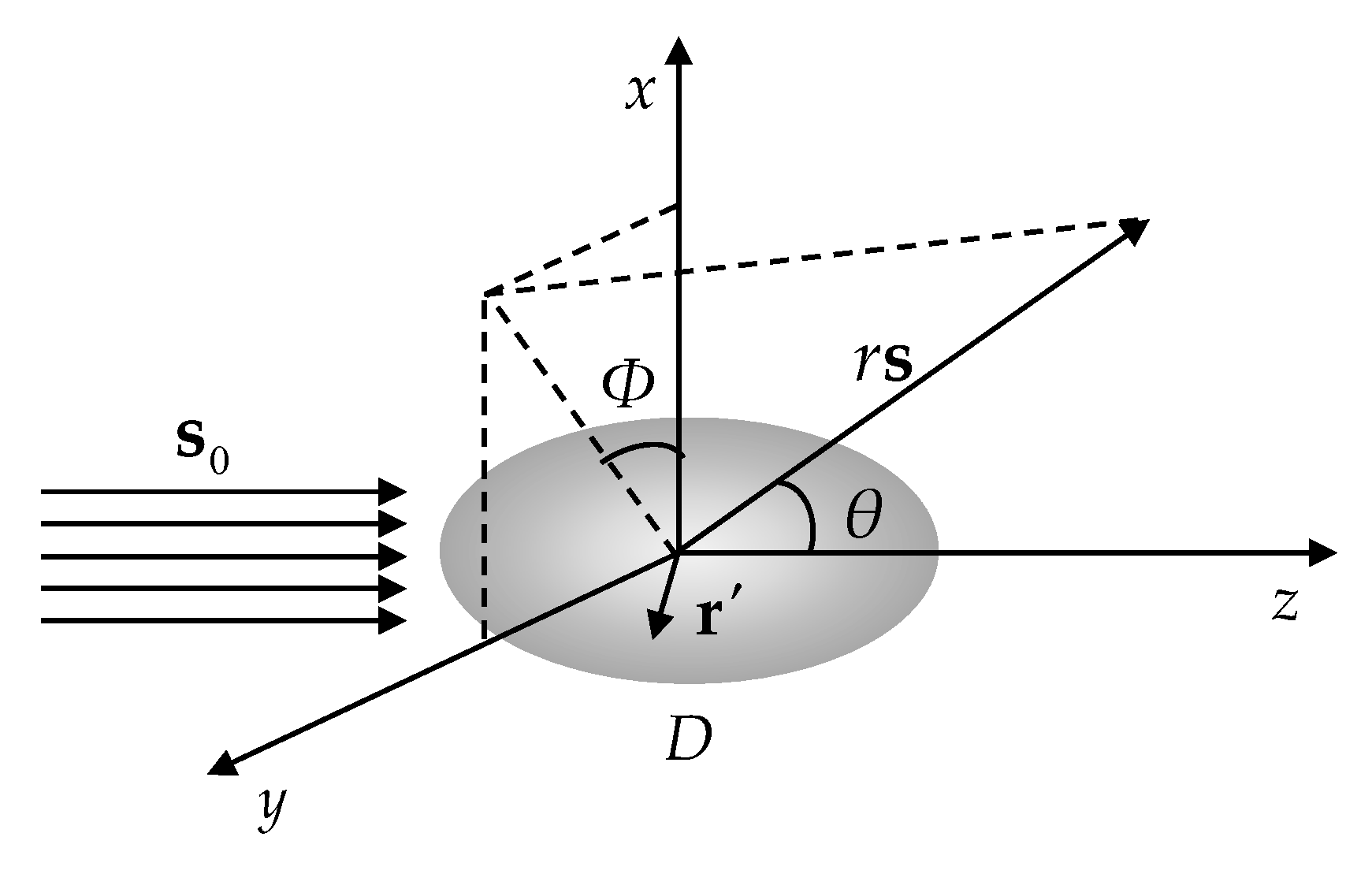
Let us consider that a polychromatic electromagnetic plane light wave propagating in a direction specified by a unit vector s 0 is incident on a statistically stationary, anisotropic random medium, occupying a finite domain D (as shown in Figure 1). Here, we assume that s 0 lies along the z axis, and the incident electric field at a point specified by a position vector r can be represented by
E i r , ω = E x i r , ω               E y i r , ω               0 ,
where E x i r , ω = a x ω exp i k s 0 r and E y i r , ω = a y ω exp i k s 0 r are components of the incident electric field along the x axis and the y axis, respectively. Here, ω is the angular frequency and k denotes the wave number in vacuum. a x ω and a y ω represent the random spectral amplitudes of the electric field along the x and y axes, respectively.
Assuming that the medium is a weak scatterer, the scattering can be treated within the accuracy of the first-order Born approximation [4]. As the scattered wave in the far field can be globally regarded as a spherical wave, its radial component vanishes. Accordingly, it is more convenient to perform scattering analysis in the spherical coordinate representation. Thus the far-zone scattered electric field at a point r s (with s being a unit vector pointing in the scattering direction) in the spherical coordinate system can be represented as [10]
E s r s , ω = exp i k r r D F r , ω E i r , ω A θ , Φ exp i k s r d 3 r ,
where the symbol “ ” is matrix multiplication and F r , ω represents the scattering potential of the scatterer, characterizing the properties of the medium in the potential scattering theory. θ is the scattering angle which denotes the angle between the directions of s 0 and s , Φ is the azimuthal angle, and
A θ , Φ = 0 cos θ cos Φ sin Φ 0 cos θ sin Φ cos Φ 0 sin θ 0 .
On substituting from Equations (1) and (3) into Equation (2), we can find that each component in Equation (2) can be expressed as
E r s r s , ω = 0 ,
E θ s r s , ω = exp i k r r D F r , ω a x ω cos θ cos Φ + a y ω cos θ sin Φ × exp i k s r s 0 r d 3 r ,
E Φ s r s , ω = exp i k r r D F r , ω a x ω sin Φ + a y ω cos Φ × exp i k s r s 0 r d 3 r .
In the theory of partial optical coherence, the second-order correlation properties of the electromagnetic scattered field at two points specified by the position vectors r s 1 and r s 2 in the far zone can be described by the so-called cross-spectral density matrix, which is defined as the following form [9]:
W s r s 1 , r s 2 , ω = E s r s 1 , ω E s r s 2 , ω = E i s * r s 1 , ω E j s r s 2 , ω   i = r , θ , Φ ; j = r , θ , Φ , = W i j s r s 1 , r s 2 , ω
where the dagger stands for the Hermitian adjoint, the asterisk is the complex conjugate, and the angular brackets represent ensemble average (average over an ensemble of realizations in the sense of coherence theory in the space-frequency domain). On substituting from Equations (4)–(6) into Equation (7), one can find that matrix elements related to E r s r s , ω are equal to 0, i.e., W r r = 0 ,   W r θ = 0 ,   W r Φ = 0 ,   W θ r = 0 , and W Φ r = 0 (for simplicity, the variables r s 1 ,   r s 2 , and ω of the cross-spectral density matrix elements will be omitted hereafter), and the remaining non-zero matrix elements can be calculated as the following forms:
W θ θ = E θ s * r s 1 , ω E θ s r s 2 , ω = C ˜ F K 1 , K 2 , ω r 2 S x x ω cos θ 1 cos Φ 1 cos θ 2 cos Φ 2 + S y x ω cos θ 1 sin Φ 1 cos θ 2 cos Φ 2 + S x y ω cos θ 1 cos Φ 1 cos θ 2 sin Φ 2 + S y y ω cos θ 1 sin Φ 1 cos θ 2 sin Φ 2 ,
W Φ Φ = E Φ s * r s 1 , ω E Φ s r s 2 , ω = C ˜ F K 1 , K 2 , ω r 2 S x x ω sin Φ 1 sin Φ 2 S y x ω cos Φ 1 sin Φ 2 S x y ω sin Φ 1 cos Φ 2 + S y y ω cos Φ 1 cos Φ 2 ,
W θ Φ = E θ s * r s 1 , ω E Φ s r s 2 , ω = C ˜ F K 1 , K 2 , ω r 2 S x x ω cos θ 1 cos Φ 1 sin Φ 2 S y x ω cos θ 1 sin Φ 1 sin Φ 2 + S x y ω cos θ 1 cos Φ 1 cos Φ 2 + S y y ω cos θ 1 sin Φ 1 cos Φ 2 ,
W Φ θ = E Φ s * r s 1 , ω E θ s r s 2 , ω = C ˜ F K 1 , K 2 , ω r 2 S x x ω sin Φ 1 cos θ 2 cos Φ 2 + S y x ω cos Φ 1 cos θ 2 cos Φ 2 S x y ω sin Φ 1 cos θ 2 sin Φ 2 + S y y ω cos Φ 1 cos θ 2 sin Φ 2 ,
where S i j ω = a i ω a j ω   ( i = x , y ; j = x , y ) refers to the spectral correlation between the two orthogonal components E i i r , ω and E j i r , ω , whereas S i i ω corresponds to the spectra of the incident field along the i - th axis. K 1 = k ( s 1 s 0 ) and K 2 = k ( s 2 s 0 ) are analogous to the momentum transfer vector of the quantum mechanical theory of potential scattering, and
C ˜ F K 1 , K 2 , ω = D D C F r 1 , r 2 , ω exp i K 1 r 1 + K 2 r 2 d 3 r 1 d 3 r 2
is the six-dimensional Fourier transform of the correlation function, with
C F r 1 , r 2 , ω = F r 1 , ω F r 2 , ω
being the correlation function of the scattering potential of the scatterer.
If we now assume that the scatterer is a Schell-like medium, i.e., a medium generating a correlation function depending only on the difference of the two pertinent position vectors r 1 and r 2 , then the normalized correlation coefficient of the scattering potential of the medium can be denoted by μ F r 2 r 1 , ω . As a result, the correlation function of the scattering potential C F r 1 , r 2 , ω given in Equation (13) can be written as
C F r 1 , r 2 , ω = I F r 1 , ω I F r 2 , ω μ F r 2 r 1 , ω ,
where I F r , ω is the strength of the scattering potential of the medium at the point r . In the following, without loss of generality, we will assume that I F r , ω and μ F r 2 r 1 , ω are both Gaussian-centered [23], i.e.,
I F r , ω = A 0 exp x 2 2 σ x 2 y 2 2 σ y 2 z 2 2 σ z 2 ,
μ F r 2 r 1 , ω = exp x 2 x 1 2 2 μ x 2 y 2 y 1 2 2 μ y 2 z 2 z 1 2 2 μ z 2 ,
where A 0 is a positive constant. σ i and μ i   ( i = x , y , z ) are the effective radius and coherence length of the scatterer along the i -th axis, respectively. On substituting from Equations (15) and (16) into Equation (14) first, and then inserting the results into Equation (12), after some long but straightforward algebra, the six-dimensional Fourier transform of the correlation function can be computed as the following form:
C ˜ F K 1 , K 2 , ω = 8 A 0 π 3 σ x 2 σ y 2 σ z 2 μ x μ y μ z μ x 2 + 4 σ x 2 μ y 2 + 4 σ y 2 μ z 2 + 4 σ z 2 × exp i K 1 i + K 2 i 2 σ i 2 2 K 2 i K 1 i 2 σ i 2 μ i 2 2 μ i 2 + 8 σ i 2   i = x , y , z ,
Now let us turn to the spectral coherence of the scattered field. The SDOC of the scattered field can be derived from its cross-spectral density matrix in Equation (7), which is defined by the following expression [9]:
μ s r s 1 , r s 2 , ω = Tr W s r s 1 , r s 2 , ω Tr W s r s 1 , r s 1 , ω Tr W s r s 2 , r s 2 , ω ,
where Tr denotes the trace. On substituting from Equations (8)–(11) and (17) into Equation (18), after performing a series of intricate analytical steps, we obtain the expression for the SDOC of the scattered field as
μ s r s 1 , r s 2 , ω = L r s 1 , r s 2 , ω M r s 1 , r s 2 , ω ,
where L r s 1 , r s 2 , ω is a factor related to the parameters of the light source and M r s 1 , r s 2 , ω is a factor related to the structure of the medium, which are separately expressed as
L r s 1 , r s 2 , ω = S x x ω cos θ 1 cos Φ 1 cos θ 2 cos Φ 2 + sin Φ 1 sin Φ 2 + S y y ω cos θ 1 sin Φ 1 cos θ 2 sin Φ 2 + cos Φ 1 cos Φ 2 + S x y ω cos θ 1 cos Φ 1 cos θ 2 sin Φ 2 sin Φ 1 cos Φ 2 + S y x ω cos θ 1 sin Φ 1 cos θ 2 cos Φ 2 cos Φ 1 sin Φ 2 n S x x ω cos 2 θ n cos 2 Φ n + sin 2 Φ n + S y y ω cos 2 θ n sin 2 Φ n + cos 2 Φ n + 2 Re S x y ω cos 2 θ n cos Φ n sin Φ n sin Φ n cos Φ n   ( n = 1 , 2 )
and
M r s 1 , r s 2 , ω = exp i K 1 i + K 2 i 2 4 σ i 4 2 μ i 2 + 8 σ i 2 ( i = x , y , z ) ,
where Re means the real part. With s = sin θ cos Φ , sin θ sin Φ , cos θ and s 0 = 0 , 0 , 1 , the momentum transfer vectors K 1 and K 2 can be expressed in terms of the parameters of the spherical polar coordinate system as
K 1 = k sin θ 1 cos Φ 1 e x + sin θ 1 sin Φ 1 e y + cos θ 1 1 e z ,
K 2 = k sin θ 2 cos Φ 2 e x + sin θ 2 sin Φ 2 e y + cos θ 2 1 e z ,
where e x , e y , and e z are unit vectors along the x , y , and z axes, respectively. On substituting Equations (22) and (23) into Equation (21), we rewrite Equation (21) as
M r s 1 , r s 2 , ω = exp 4 σ x 4 k 2 sin θ 1 cos Φ 1 + sin θ 2 cos Φ 2 2 2 μ x 2 + 8 σ x 2 4 σ y 4 k 2 sin θ 1 sin Φ 1 + sin θ 2 sin Φ 2 2 2 μ y 2 + 8 σ y 2 4 σ z 4 k 2 cos θ 2 cos θ 1 2 2 μ z 2 + 8 σ z 2 .
Equations (20) and (24) show that the realization of a rotationally symmetric SDOC in the context of electromagnetic scattering is generally difficult, which is mainly caused by the two-point position dependence of SDOC itself. Moreover, we find that, unlike the generation of a rotationally symmetric momentum flow, the SDOC still remains dependent on the azimuthal angles Φ 1 and Φ 2 if we only control the source parameter S i j   ( i = x , y , z ;   j = x , y , z ) and the structural parameters σ i and μ i   ( i = x , y , z ) of the medium. Clearly, the realization of azimuthal invariance of the SDOC requires more elaborate conditions.

3. Conditions for Generating a Rotationally Symmetric SDOC

We now analyze the conditions under which the SDOC exhibits rotational symmetry. According to Equations (20) and (24), we find that for any pair of scattering polar angles ( θ 1 , θ 2 ) , the SDOC μ s r s 1 , r s 2 , ω remains identical for every value of the azimuthal angle Φ , provided that the following four conditions are simultaneously satisfied:
S x x ω = S y y ω ,
Re S x y ω = 0 ,
σ x 4 2 μ x 2 + 8 σ x 2 = σ y 4 2 μ y 2 + 8 σ y 2 ,
Φ 1 = Φ 2 .
Equations (25) and (26) provide constraint conditions on the structural characteristics of the incident light source. Equation (25) demands that the spectra of the incident field along the x and y axes must be equal, while Equation (26) requires that the real part of the spectral correlation between the two mutually orthogonal components, E x i r , ω and E y i r , ω , must be zero. It is important to note that these conditions impose no additional constraint on the imaginary part of S x y ω (which, together with S x x ω , S y y ω , and Re [ S x y ω ] , determines the spectral degree of polarization of the incident field [5]), and therefore do not impose any additional constraints on the spectral degree of polarization of the incident field. Thus, recalling the requirement for the incident field to generate a rotationally symmetric momentum flow of the scattered field in Ref. [46], we can conclude that the realization of a rotationally symmetric SDOC and a rotationally symmetric momentum flow are both independent of the spectral polarization of the incident light wave; that is, irrespective of whether an incident field is fully polarized, partially polarized, or completely unpolarized, it has the ability to produce not only a rotationally symmetric momentum flow but also a rotationally symmetric SDOC, even when it is scattered by an anisotropic scatterer.
Equation (27) imposes an explicit constraint on the structural parameters of the scattering medium, whose mathematical form is completely different from the one required for generating a rotationally symmetric momentum flow in Ref. [46]. We note that if we fix the values of the parameter pair ( μ x , μ y ) but permit the values of the parameter pair ( σ x , σ y ) to be varied in Equation (27), we can find that for certain values of σ x , there exists a corresponding value of σ y that makes Equation (27) hold for each of these σ x s . This means that the scattering media have the same ( μ x , μ y ) but different ( σ x , σ y ) , yet all of them can produce a rotationally symmetrical SDOC. The same is true for the complementary situation, i.e., the scattering media have the same ( σ x , σ y ) but different ( μ x , μ y ) . As we mentioned above, the medium parameter conditions for generating a rotationally symmetric SDOC and a rotationally symmetric momentum flow are completely different. However, we now show that a spatially anisotropic scatterer still can achieve rotational symmetry in both quantities simultaneously. To approach this, we combine the medium condition required for generating a rotationally symmetric momentum flow, 1 / 4 σ x 2 + 1 / μ x 2 = 1 / 4 σ y 2 + 1 / μ y 2 , with that required for generating a rotationally symmetric SDOC in Equation (27), and after some simple algebra, we have
μ y 2 = μ x 2 σ y 4 + 4 σ x 2 σ y 4 4 σ x 4 σ y 2 σ x 4
and
μ x 2 = 4 σ x 2 σ y 2 μ y 2 σ y 2 μ y 2 σ x 2 μ y 2 σ x 2 4 σ y 2 .
On substituting from Equation (29) into Equation (30) and performing straightforward but lengthy algebra, we arrive at
σ y 2 σ x 2 μ x 4 + 8 σ x 2 μ x 2 + 16 σ x 4 = 0 .
Equation (31) clearly shows the condition that the SDOC and the momentum flow exhibit rotationally symmetric distributions simultaneously, i.e., σ x = σ y . From Equations (29) and (30), it is easy to see that this condition also implies μ x = μ y . Therefore, the simultaneous realization of a rotationally symmetric SDOC and a rotationally symmetric momentum flow is possible only when the distribution of the correlation function of the scattering potential of the scatterer is isotropic in the plane perpendicular to the incident direction. Of course, one must keep in mind that σ x = σ y and μ x = μ y do not imply that the scatterer itself is isotropic, since the structural parameter of the medium along the z axis remain unrestricted.
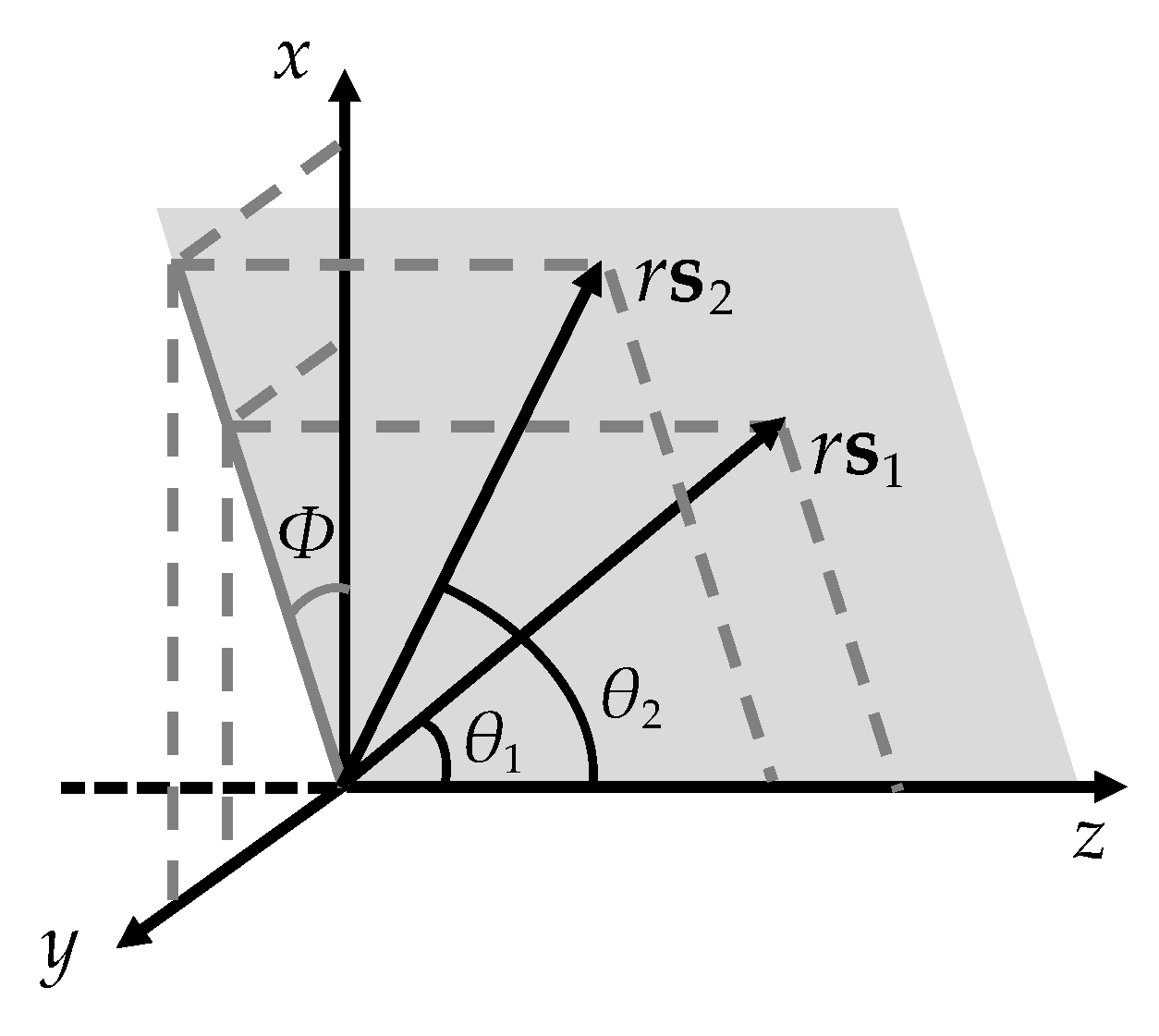
Finally, Equation (28) gives an additional constraint beyond those imposed by the incident field and the scatterer, which indicates that the position vectors r s 1 and r s 2 of the two observation points of the SDOC should have the same azimuthal angle of scattering. It should be emphasized that the fact that r s 1 and r s 2 have the same azimuthal angle does not imply that these two position vectors coincide, but rather only requires that r s 1 , r s 2 , and the z axis lie in the same plane, as illustrated in Figure 2, where the azimuthal angles Φ 1 and Φ 2 in the figure satisfy Φ 1 = Φ 2 = Φ . This requirement for the position vectors of the two observation points of the SDOC constitutes the most significant difference from the conditions for generating a rotationally symmetric momentum flow, because the scattered momentum flow itself is only a single-point function of spatial position and does not require any additional constraint on the position vector of its observation point.

4. Numerical Examples

In the following section, some numerical examples will be provided to demonstrate the feasibility of achieving a rotationally symmetric SDOC generated by scattering by an anisotropic process.
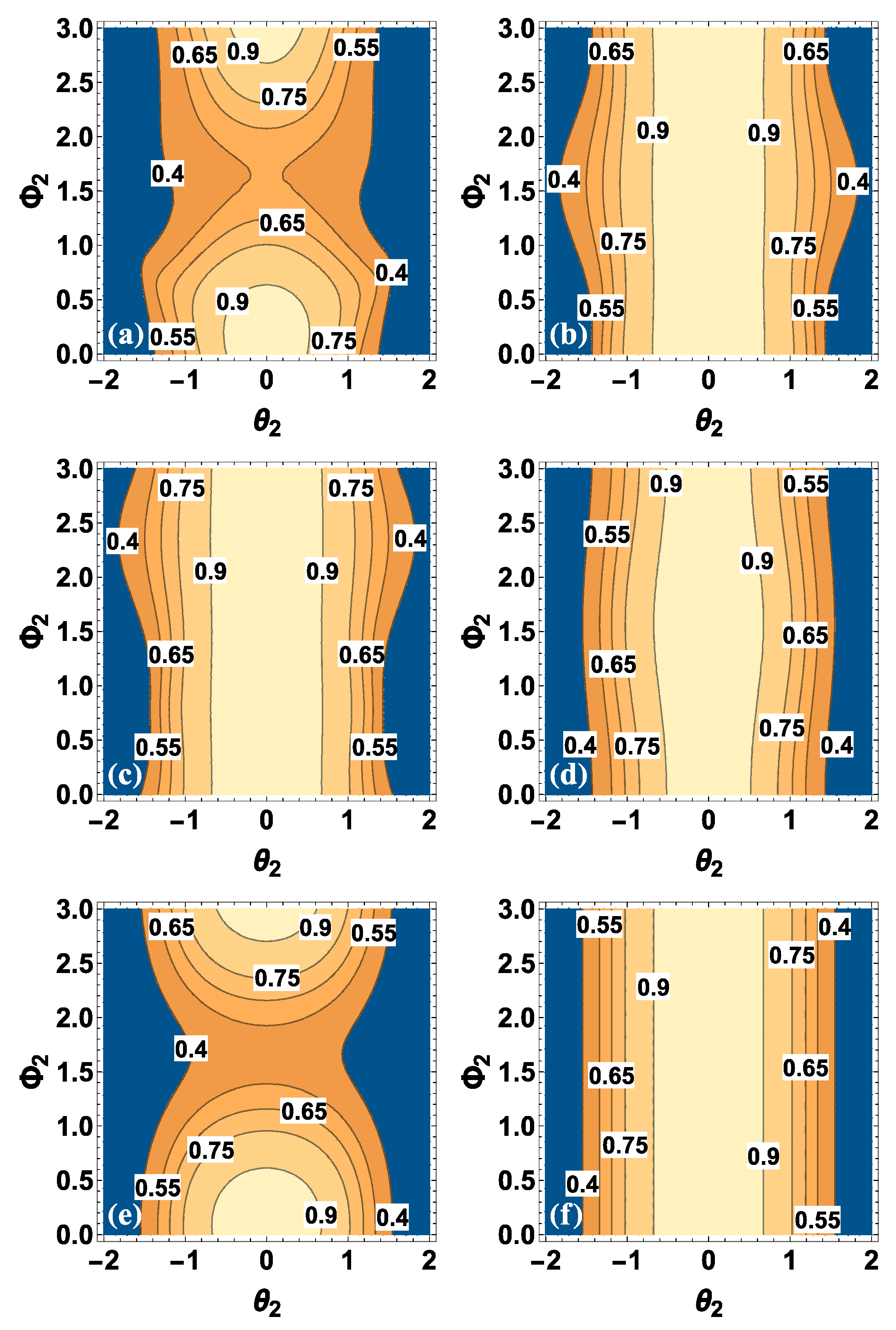
Figure 3 presents contours of the modulus of the SDOC as a function of the scattering angle θ 2 and the azimuthal angle Φ 2 , resulting from the scattering of partially polarized electromagnetic plane waves by anisotropic Gaussian Schell-model media. To investigate the impact of the four conditions described in Equations (25)–(28), respectively, six representative cases are depicted in Figure 3a–f. In Figure 3a, none of the four conditions are satisfied, demonstrating a general case without rotational symmetry. In Figure 3b, only Equation (25) is violated, while the remaining three conditions are met. In Figure 3c, Equation (26) is not satisfied, but all other conditions for rotational symmetry are fulfilled. In Figure 3d, rotational symmetry is broken, as only Equation (27) is not satisfied. In Figure 3e, the positions of the two observation points do not satisfy Equation (28), whereas the other parameters conform to the required conditions. Finally, in Figure 3f, all four conditions are satisfied, resulting in a rotationally symmetric distribution of the SDOC. From Figure 3, it can be observed that if any one of the four required conditions is not satisfied, the SDOC varies with the azimuthal angle Φ 2 , indicating a loss of rotational symmetry. Only when all four conditions in Equations (25)–(28) are satisfied does the SDOC exhibit a rotationally symmetric distribution, as shown in Figure 3f.
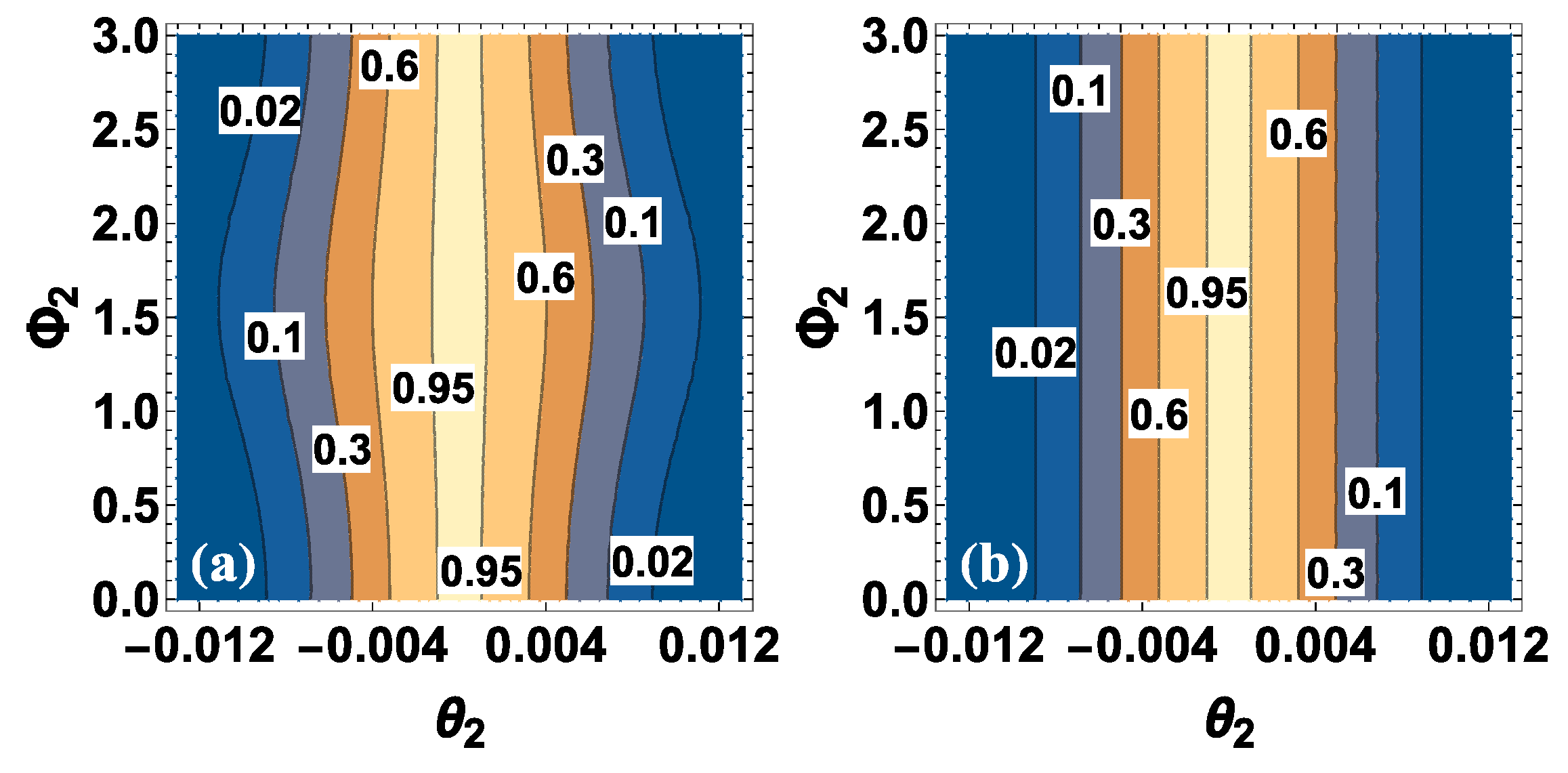
We now turn to a special case where the medium is a quasi-homogeneous anisotropic Gaussian Schell-model scatterer ( σ μ ). In this case, Equation (27) can be simplified to σ x = σ y . Figure 4 illustrates the contours of the modulus of the SDOC, generated by partially polarized electromagnetic plane waves on scattering from quasi-homogeneous anisotropic Gaussian Schell-model media and plotted as a function of θ 2 and Φ 2 . In this figure, the requirements for both the incident light source (Equations (25) and (26)) and the azimuthal angle of scattering (Equation (28)) have been satisfied. Comparing Figure 4a with Figure 4b, we can see that the realization of the rotationally symmetric distribution of the SDOC in a quasi-homogeneous case indeed only require the structural parameters of the medium to meet σ x = σ y , which is also in accordance with the so-called reciprocal theorem [39].

5. Conclusions

This paper investigated the possibility of realizing a rotationally symmetry distribution of the SDOC when a polychromatic electromagnetic plane wave is scattered by a spatially anisotropic random scatterer. We derived the necessary and sufficient conditions for producing a rotationally symmetric SDOC and found that unlike the realization of a rotationally symmetric momentum flow, the generation of a rotationally symmetric SDOC is generally difficult. We not only need to control the structural characteristics of both the light source and the scattering medium, but also need an additional restriction on the position vectors of the two observation points of the SDOC, i.e., the position vectors r s 1 and r s 2 of the two observation points of the SDOC must lie at the same azimuthal angle. In addition, by combining the completely different medium conditions required for generating a rotationally symmetric SDOC and a rotationally symmetric momentum flow, we found that the simultaneous generation of a rotationally symmetric momentum flow and a rotationally symmetric SDOC is still possible, provided that the distribution of the correlation function of the scattering potential of the medium is isotropic in the plane perpendicular to the incident direction. Our results also revealed that the requirements for producing a rotationally symmetric SDOC in the context of electromagnetic scattering are far more complicated than those in the scalar field case discussed by Du et al. in Ref. [45], where the realization of rotational symmetry is possible provided that the medium parameters are appropriately chosen. This is actually a natural manifestation of the complexity of electromagnetic scattering. We expect that our results not only provide a deeper insight into the far-zone distribution of light scattering from an anisotropic scatterer, but also find useful applications in light-field regulation and in the inverse scattering problem [47,48].

Author Contributions

Conceptualization, Y.D.; methodology, Y.D.; software, X.X.; validation, X.X. and Y.D.; formal analysis, X.X. and Y.D.; investigation, X.X.; resources, X.X.; data curation, X.X.; writing—original draft preparation, X.X.; writing—review and editing, Y.D.; visualization, X.X.; supervision, Y.D.; project administration, Y.D.; funding acquisition, Y.D. All authors have read and agreed to the published version of the manuscript.

Funding

This research was funded by the National Natural Science Foundation of China, grant number 12204385, and the Natural Science Foundation of Sichuan Province, grant number 2025ZNSFSC0078.

Institutional Review Board Statement

Not applicable.

Informed Consent Statement

Not applicable.

Data Availability Statement

The original contributions presented in this study are included in the article. Further inquiries can be directed to the corresponding author.

Conflicts of Interest

The authors declare no conflicts of interest.

References

  1. Carter, W.H.; Wolf, E. Scattering from quasi-homogeneous media. Opt. Commun. 1988, 67, 85–90. [Google Scholar] [CrossRef]
  2. Jannson, J.; Jannson, T.; Wolf, E. Spatial coherence discrimination in scattering. Opt. Lett. 1988, 13, 1060–1062. [Google Scholar] [CrossRef]
  3. Gori, F.; Palma, C.; Santarsiero, M. A scattering experiment with partially coherent light. Opt. Commun. 1990, 74, 353–356. [Google Scholar] [CrossRef]
  4. Born, M.; Wolf, E. Principles of Optics, 7th ed.; Cambridge University: Cambridge, UK, 1999. [Google Scholar]
  5. Wolf, E. Introduction to the Theory of Coherence and Polarization of Light; Cambridge University: Cambridge, UK, 2007. [Google Scholar]
  6. Korotkova, O.; Wolf, E. Scattering matrix theory for stochastic scalar fields. Phys. Rev. E 2007, 75, 056609. [Google Scholar] [CrossRef] [PubMed]
  7. Sahin, S.; Korotkova, O. Scattering of scalar light fields from collections of particles. Phys. Rev. A 2008, 78, 063815. [Google Scholar] [CrossRef]
  8. Xin, Y.; Chen, Y.; Zhao, Q.; Zhou, M. Beam radiated from quasi-homogeneous uniformly polarized electromagnetic source scattering on quasi-homogeneous media. Opt. Commun. 2007, 278, 247–252. [Google Scholar] [CrossRef]
  9. Wang, T.; Zhao, D. Scattering theory of stochastic electromagnetic light waves. Opt. Lett. 2010, 35, 2412–2414. [Google Scholar] [CrossRef]
  10. Tong, Z.; Korotkova, O. Theory of weak scattering of stochastic electromagnetic fields from deterministic and random media. Phys. Rev. A 2010, 82, 033836. [Google Scholar] [CrossRef]
  11. Ding, C.; Cai, Y.; Korotkova, O.; Zhang, Y.; Pan, L. Scattering-induced changes in the temporal coherence length and the pulse duration of a partially coherent plane-wave pulse. Opt. Lett. 2011, 36, 517–519. [Google Scholar] [CrossRef] [PubMed]
  12. Ding, C.; Cai, Y.; Zhang, Y.; Pan, L. Scattering-induced changes in the degree of polarization of a stochastic electromagnetic plane-wave pulse. J. Opt. Soc. Am. A 2012, 29, 1078–1090. [Google Scholar] [CrossRef]
  13. Zhang, Y.; Zhou, J. Weak scattering of multi-Gaussian Schell-model vortex beams on a deterministic medium. J. Opt. Soc. Am. B 2018, 35, 2711–2717. [Google Scholar] [CrossRef]
  14. Pires, D.; Litchinitser, N.; Brandão, P. Scattering of partially coherent vortex beams by a PT-symmetric dipole. Opt. Express 2021, 29, 15576–15586. [Google Scholar] [CrossRef] [PubMed]
  15. Li, Z.; Yang, X.; Qu, T.; Li, H.; Wu, Z. Light scattering of a uniform uniaxial anisotropic sphere by an on-axis high-order Bessel vortex beam. J. Opt. Soc. Am. A 2023, 40, 510–520. [Google Scholar] [CrossRef] [PubMed]
  16. van Dijk, T.; Fischer, D.G.; Visser, T.D.; Wolf, E. Effects of spatial coherence on the angular distribution of radiant intensity generated by scattering on a sphere. Phys. Rev. Lett. 2010, 104, 173902. [Google Scholar] [CrossRef] [PubMed]
  17. Liu, S.; Yang, A.; Liu, Z. Scattering of the generalized multi-Gaussian correlated Schell-model beam upon a deterministic medium with semi-hard boundary. Results Phys. 2024, 63, 107888. [Google Scholar] [CrossRef]
  18. Feng, Y.; Xing, Y.; Liu, Y.; Wang, T.; Wu, H. Incident power-dependent spectral density analysis for multi-Gaussian Schell-model beams scattered by particle collections. Opt. Express 2025, 33, 17824–17841. [Google Scholar] [CrossRef]
  19. Ding, Y.; Zhao, D. Triad of equivalence theorems of partially coherent beams on scattering. Opt. Lett. 2025, 50, 1739–1742. [Google Scholar] [CrossRef]
  20. Dogariu, A.; Wolf, E. Spectral changes produced by static scattering on a system of particles. Opt. Lett. 1998, 23, 1340–1342. [Google Scholar] [CrossRef]
  21. Sahin, S.; Korotkova, O. Effect of the pair-structure factor of a particulate medium on scalar wave scattering in the first Born approximation. Opt. Lett. 2009, 34, 1762–1764. [Google Scholar] [CrossRef]
  22. Ding, Y.; Zhao, D. Scattering of light waves from a collection of particles of L types. Opt. Lett. 2022, 47, 5493–5496. [Google Scholar] [CrossRef]
  23. Du, X.; Zhao, D. Scattering of light by Gaussian-correlated quasi-homogeneous anisotropic media. Opt. Lett. 2010, 35, 384–386. [Google Scholar] [CrossRef]
  24. Du, X.; Zhao, D. Scattering of light by a system of anisotropic particles. Opt. Lett. 2010, 35, 1518–1520. [Google Scholar] [CrossRef]
  25. Du, X.; Zhao, D. Reciprocity relations for scattering from quasi-homogeneous anisotropic media. Opt. Commun. 2011, 284, 3808–3810. [Google Scholar] [CrossRef]
  26. Du, X.; Zhao, D. Spectral shifts produced by scattering from rotational quasi-homogeneous anisotropic media. Opt. Lett. 2011, 36, 4749–4751. [Google Scholar] [CrossRef]
  27. Sahin, S.; Gbur, G.; Korotkova, O. Scattering of light from particles with semisoft boundaries. Opt. Lett. 2011, 36, 3957–3959. [Google Scholar] [CrossRef] [PubMed]
  28. Liu, S.; Liu, Z. Cosine-Gaussian correlated Schell-model pulsed beams scattered by a semi-hard boundary medium. Opt. Express 2025, 33, 25339–25348. [Google Scholar] [CrossRef]
  29. Yu, Y.; Zhang, Y.; Pu, J.; Chen, H.; Lin, H. Far-zone spectral density of light waves scattered by random anisotropic hollow medium. Photonics 2025, 12, 331. [Google Scholar] [CrossRef]
  30. Li, J.; Korotkova, O. Scattering of light from a stationary nonuniformly correlated medium. Opt. Lett. 2016, 41, 2616–2619. [Google Scholar] [CrossRef]
  31. Korotkova, O. Random OAM-inducing scatterers. Opt. Lett. 2024, 49, 5671–5674. [Google Scholar] [CrossRef] [PubMed]
  32. Brandão, P.A.; Cavalcanti, S.B. Scattering of partially coherent radiation by non-hermitian localized structures having parity-time symmetry. Phy. Rev. A 2019, 100, 043822. [Google Scholar] [CrossRef]
  33. Brandão, P.A.; Korotkova, O. Scattering theory for stationary materials with PT symmetry. Phys. Rev. A 2021, 103, 013502. [Google Scholar] [CrossRef]
  34. Korotkova, O.; Brandão, P.A. Light scattering from stationary PT-symmetric collections of particles. Opt. Lett. 2021, 46, 1417–1420. [Google Scholar] [CrossRef]
  35. Zhang, X.; Chen, Y.; Wang, F.; Cai, Y. Scattering of partially coherent vector beams by a deterministic medium having parity-time symmetry. Photonics 2022, 9, 140. [Google Scholar] [CrossRef]
  36. Zhang, X.; Liu, Y.; Chen, Y.; Wang, F.; Cai, Y. Noncentrosymmetric far-zone spectral density induced by light scattering with random media having parity-time symmetry. Phys. Rev. A 2022, 105, 023510. [Google Scholar] [CrossRef]
  37. Yue, J.; Wu, G.; Wang, F.; Cai, Y. Intensity correlations of light waves scattered by random media having parity-time symmetry. J. Opt. Soc. Am. A 2025, 42, 31–35. [Google Scholar] [CrossRef] [PubMed]
  38. Khairy, K.; Foo, J.; Howard, J. Shapes of red blood cells: Comparison of 3D confocal images with the bilayer-couple model. Cell. Mol. Bioeng. 2008, 1, 173–181. [Google Scholar] [CrossRef] [PubMed]
  39. Wu, H.; Pan, X.; Zhu, Z.; Ji, X.; Wang, T. Reciprocity relations of an electromagnetic light wave on scattering from a quasi-homogeneous anisotropic medium. Opt. Express 2017, 25, 11297–11305. [Google Scholar] [CrossRef]
  40. Harris, I.; Nguyen, D.L. Orthogonality sampling method for the electromagnetic inverse scattering problem. SIAM J. Sci. Comput. 2020, 42, B722–B737. [Google Scholar] [CrossRef]
  41. Peng, X.; Li, J.; Chang, L. Evolution properties of polarization states of far-zone electromagnetic field scattered from an anisotropic medium. Opt. Express 2018, 26, 6679–6691. [Google Scholar] [CrossRef]
  42. Li, J.; Chen, F.; Chang, L. Correlation between intensity fluctuations of electromagnetic waves scattered from a spatially quasi-homogeneous, anisotropic medium. Opt. Express 2016, 24, 24274–24286. [Google Scholar] [CrossRef]
  43. Zhang, J.; Lv, J.; Xing, Y.; Xiao, Y.; Wang, T.; Wu, H. Equivalence theorem for light waves on scattering from particle collections with anisotropic random distributions. J. Opt. Soc. Am. A 2025, 42, 267–275. [Google Scholar] [CrossRef] [PubMed]
  44. Li, Y.; Wolf, E. Radiation from anisotropic Gaussian Schell-model sources. Opt. Lett. 1982, 7, 256–258. [Google Scholar] [CrossRef] [PubMed]
  45. Du, X.; Zhao, D. Rotationally symmetric scattering from anisotropic media. Phys. Lett. A 2011, 375, 1269–1273. [Google Scholar] [CrossRef]
  46. Ding, Y. Can a spatially anisotropic random scatterer produce a rotationally symmetric scattered momentum flow in the far zone? Opt. Express 2024, 32, 2856–2866. [Google Scholar] [CrossRef]
  47. Li, J.; Korotkova, O. Direct and inverse problems of weak scattering from quasi-homogeneous biological tissue. Waves Random Complex Media 2020, 30, 241–249. [Google Scholar] [CrossRef]
  48. Ding, Y.; Zhao, D. Resolving an inverse problem through a momentum flow within the framework of electromagnetic scattering. Opt. Lett. 2023, 48, 5347–5350. [Google Scholar] [CrossRef]
Figure 1. Illustration of notations.
Photonics 13 00102 g001
Figure 2. Graphical notation guide.
Photonics 13 00102 g002
Figure 3. Distribution of the modulus of the SDOC. Set θ 1 = 0 , λ = 600   nm , k = 2 π / λ , σ z = 0.16 λ , and μ z = 0.15 λ . The other parameters for calculations are (a) σ x = 0 . 15 λ , σ y = 0.11 λ , μ x = 0.11 λ , μ y = 0.1 λ , S x x = 1 , S y y = 0.8 , S x y = 0.8 + 0.5 i , S y x = 0.8 0.5 i , Φ 1 Φ 2 , and Φ 1 = π / 36 ; (b) σ x = σ y = 0 . 11 λ , μ x = μ y = 0 . 1 λ , S x x = 1 , S y y = 0 . 1 , S x y = 0 + 0 . 5 i , S y x = 0 0 . 5 i , and Φ 1 = Φ 2 ; (c) σ x = σ y = 0 . 11 λ , μ x = μ y = 0 . 1 λ , S x x = S y y = 1 , S x y = 0.8 + 0.5 i , S y x = 0.8 0.5 i , and Φ 1 = Φ 2 ; (d) σ x = 0 . 15 λ , σ y = 0.11 λ , μ x = 0.11 λ , μ y = 0 . 1 λ , S x x = S y y = 1 , S x y = 0 + 0 . 5 i , S y x = 0 0 . 5 i , and Φ 1 = Φ 2 ; (e) σ x = σ y = 0 . 11 λ , μ x = μ y = 0 . 1 λ , S x x = S y y = 1 , S x y = 0 + 0.5 i , S y x = 0 0.5 i , Φ 1 Φ 2 , and Φ 1 = π / 36 ; and (f) σ x = σ y = 0 . 11 λ , μ x = μ y = 0 . 1 λ , S x x = S y y = 1 , S x y = 0 + 0.5 i , S y x = 0 0.5 i , and Φ 1 = Φ 2 .
Photonics 13 00102 g003
Figure 4. Distribution of the modulus of the SDOC. Set θ 1 = 0 , λ = 600   nm , k = 2 π / λ , S x x = 1 , S y y = 1 , S x y = 0 + 0 . 5 i , S y x = 0 0 . 5 i , σ z = 60 λ , μ x = 1 λ , μ y = 2 λ , μ z = 5 λ , and Φ 1 = Φ 2 . The other parameters are chosen as follows: (a) σ x = 50 λ , σ y = 40 λ ; (b) σ x = 50 λ , σ y = 50 λ .
Photonics 13 00102 g004
Disclaimer/Publisher’s Note: The statements, opinions and data contained in all publications are solely those of the individual author(s) and contributor(s) and not of MDPI and/or the editor(s). MDPI and/or the editor(s) disclaim responsibility for any injury to people or property resulting from any ideas, methods, instructions or products referred to in the content.