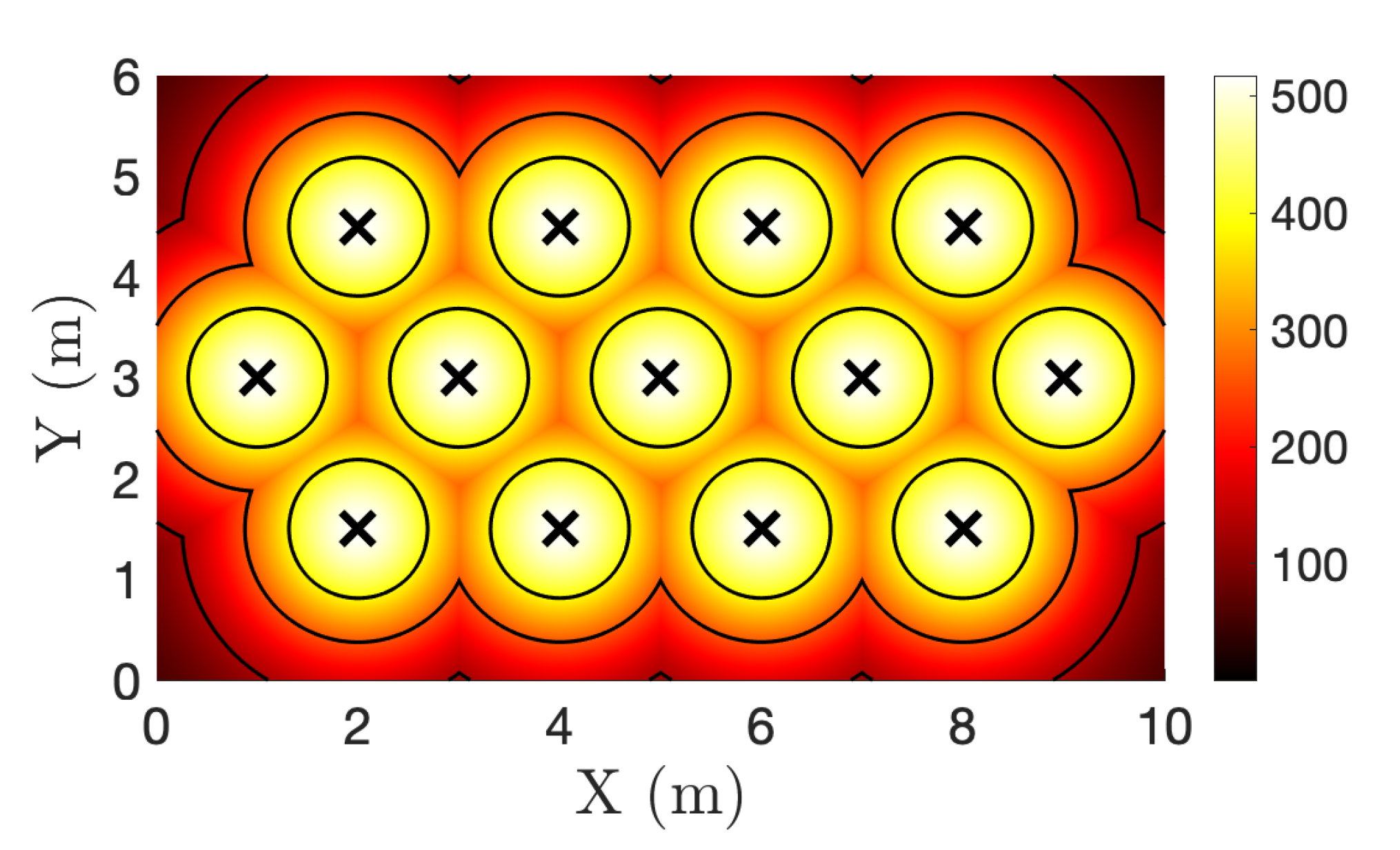
A Review of Advanced Transceiver Technologies in Visible Light Communications



Abstract
1. Background
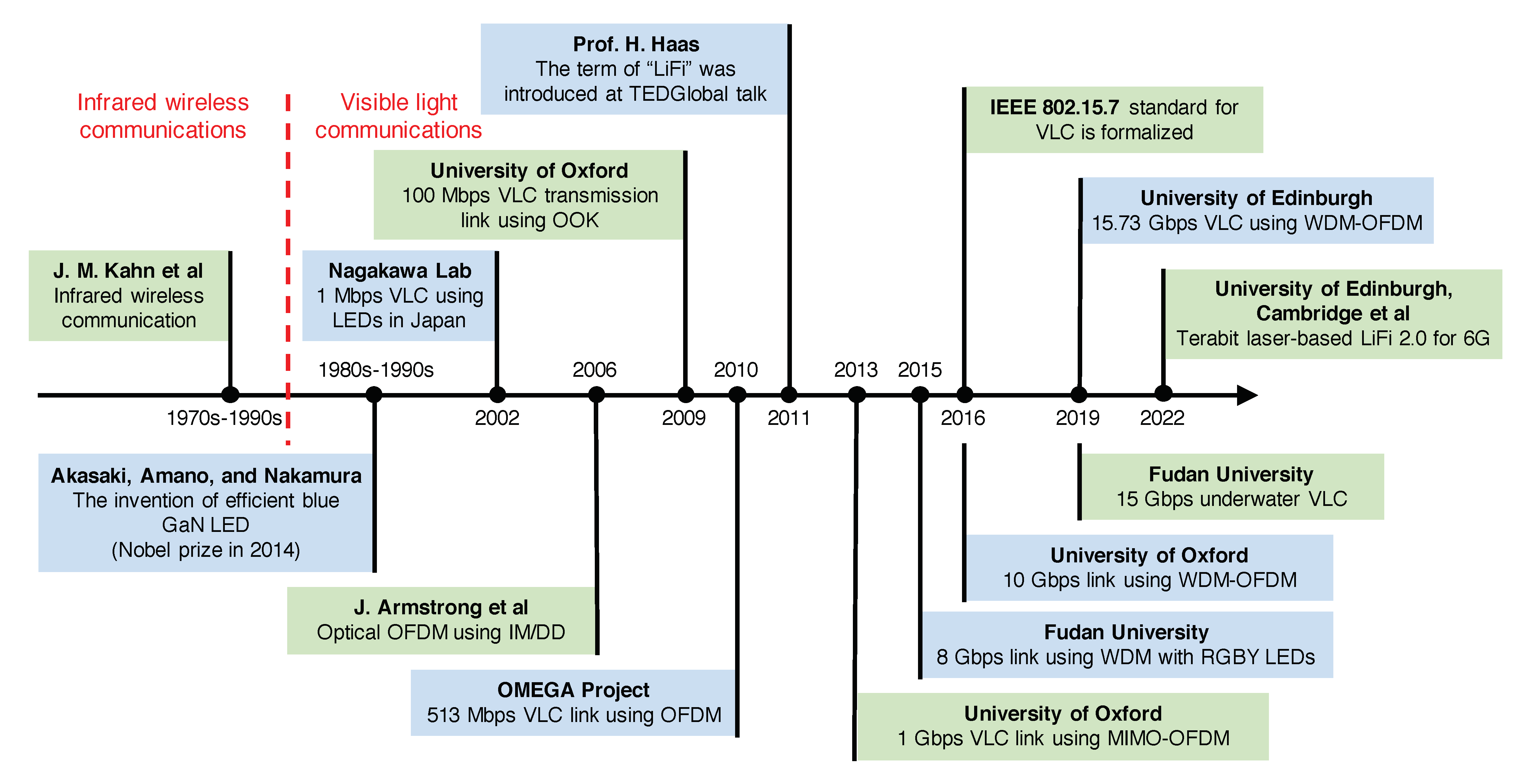
2. Milestones of VLC Research
3. LED Transmitter
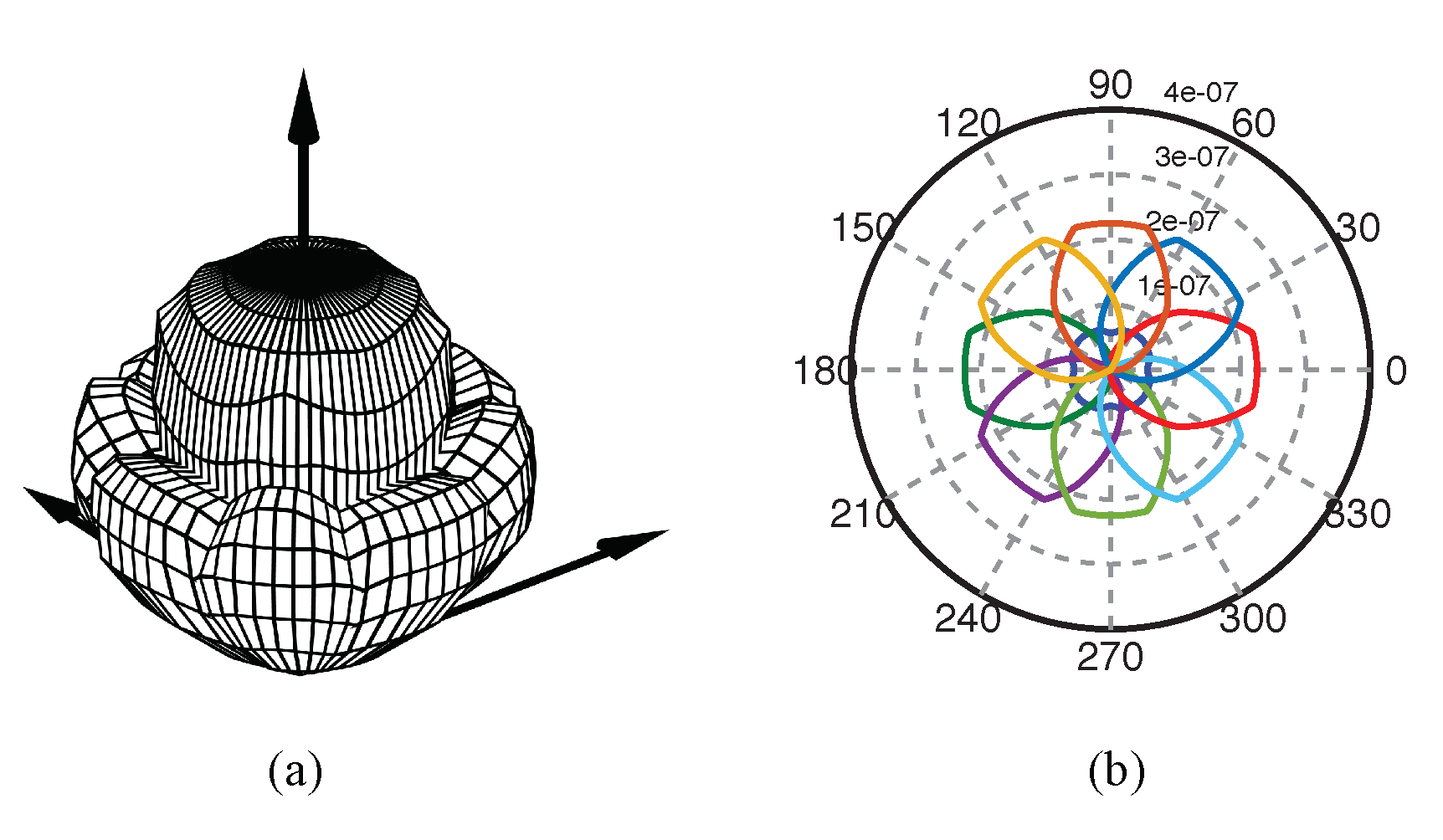
3.1. LED Radiation Pattern
3.2. Fast Color Converter
4. VLC Receiver
4.1. Optical Filter
4.2. Optical Concentrator
4.3. Fluorescent Antenna
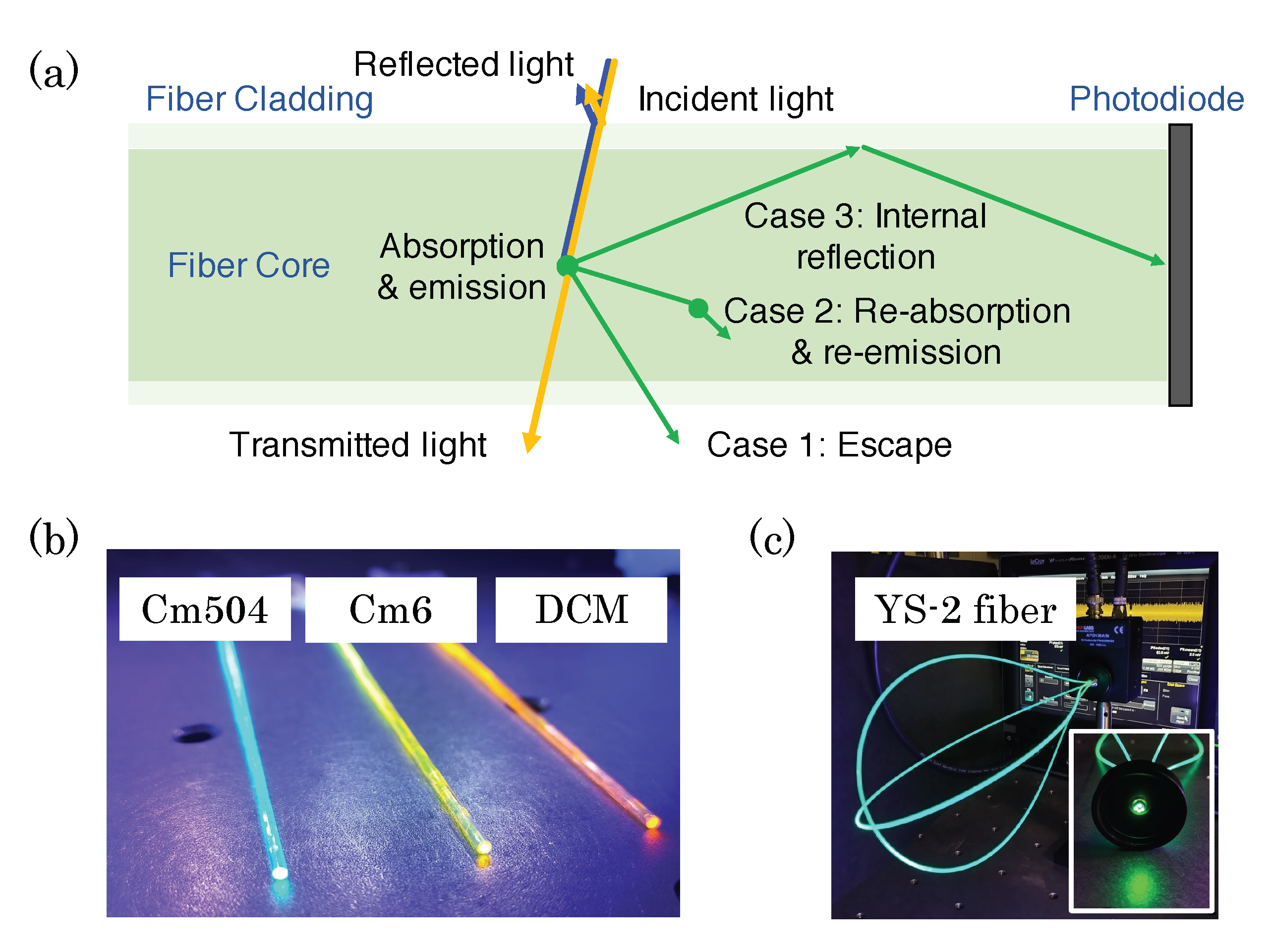
4.4. Photodetector
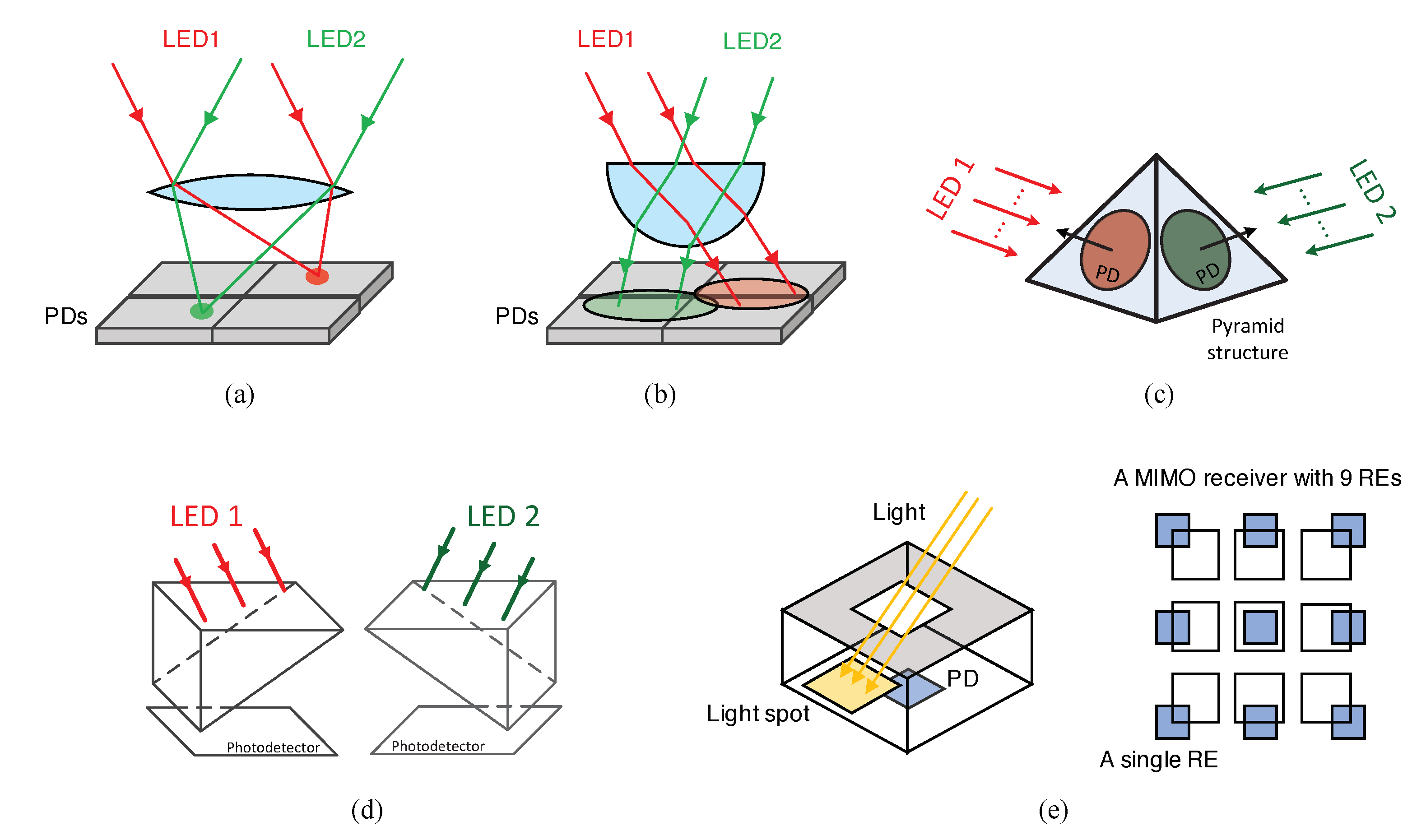
4.5. Optical MIMO Receiver
5. Recent Trends and Future Challenges
6. Conclusions
Author Contributions
Funding
Institutional Review Board Statement
Informed Consent Statement
Data Availability Statement
Conflicts of Interest
References
- Barry, J.R. Wireless Infrared Communications; Springer Science & Business Media: New York, NY, USA, 1994; Volume 280. [Google Scholar]
- Gfeller, F.R.; Bapst, U. Wireless in-house data communication via diffuse infrared radiation. Proc. IEEE 1979, 67, 1474–1486. [Google Scholar] [CrossRef] [Scilit]
- Kahn, J.M.; Barry, J.R. Wireless infrared communications. Proc. IEEE 1997, 85, 265–298. [Google Scholar] [CrossRef] [Scilit]
- Komine, T.; Nakagawa, M. Fundamental analysis for visible-light communication system using LED lights. IEEE Trans. Consum. Electron. 2004, 50, 100–107. [Google Scholar] [CrossRef] [Scilit]
- Le Minh, H.; O’Brien, D.; Faulkner, G.; Zeng, L.; Lee, K.; Jung, D.; Oh, Y.; Won, E.T. 100-Mb/s NRZ visible light communications using a postequalized white LED. IEEE Photonics Technol. Lett. 2009, 21, 1063–1065. [Google Scholar] [CrossRef] [Scilit]
- Armstrong, J.; Lowery, A.J. Power efficient optical OFDM. Electron. Lett. 2006, 42, 1. [Google Scholar] [CrossRef] [Scilit]
- O’Brien, D. High speed optical wireless demonstrators in the omega project: Summary and conclusions. In Proceedings of the 18th European Conference on Network and Optical Communications & 8th Conference on Optical Cabling and Infrastructure (NOC-OC&I), Graz, Austria, 10–12 July 2013; pp. 159–162. [Google Scholar]
- Javaudin, J.P.; Bellec, M.; Varoutas, D.; Suraci, V. OMEGA ICT project: Towards convergent Gigabit home networks. In Proceedings of the IEEE 19th International Symposium on Personal, Indoor and Mobile Radio Communications, Cannes, France, 15–18 September 2008; pp. 1–5. [Google Scholar]
- Javaudin, J.P.; Bellec, M. Omega project: On convergent digital home networks. In Proceedings of the 3d International Workshop on Cross Layer Design, Rennes, France, 30 November–1 December 2011; pp. 1–5. [Google Scholar]
- Vučić, J.; Kottke, C.; Nerreter, S.; Langer, K.D.; Walewski, J.W. 513 Mbit/s visible light communications link based on DMT-modulation of a white LED. J. Light. Technol. 2010, 28, 3512–3518. [Google Scholar] [CrossRef] [Scilit]
- Haas, H.; Yin, L.; Wang, Y.; Chen, C. What is lifi? J. Light. Technol. 2015, 34, 1533–1544. [Google Scholar] [CrossRef] [Scilit]
- IEEE Association. IEEE Standard for Local and Metropolitan Area Networks-Part 15.7: Short-Range Wireless Optical Communication Using Visible Light; IEEE: Piscataway, NJ, USA, 2011; pp. 1–309. [Google Scholar]
- Azhar, A.H.; Tran, T.A.; O’Brien, D. A gigabit/s indoor wireless transmission using MIMO-OFDM visible-light communications. IEEE Photonics Technol. Lett. 2012, 25, 171–174. [Google Scholar] [CrossRef] [Scilit]
- Wang, Y.; Tao, L.; Huang, X.; Shi, J.; Chi, N. 8-Gb/s RGBY LED-based WDM VLC system employing high-order CAP modulation and hybrid post equalizer. IEEE Photonics J. 2015, 7, 1–7. [Google Scholar]
- Chun, H.; Rajbhandari, S.; Faulkner, G.; Tsonev, D.; Xie, E.; McKendry, J.J.D.; Gu, E.; Dawson, M.D.; O’Brien, D.C.; Haas, H. LED based wavelength division multiplexed 10 Gb/s visible light communications. J. Light. Technol. 2016, 34, 3047–3052. [Google Scholar] [CrossRef] [Scilit]
- Bian, R.; Tavakkolnia, I.; Haas, H. 15.73 Gb/s visible light communication with off-the-shelf LEDs. J. Light. Technol. 2019, 37, 2418–2424. [Google Scholar] [CrossRef] [Scilit]
- Zhou, Y.; Zhu, X.; Hu, F.; Shi, J.; Wang, F.; Zou, P.; Liu, J.; Jiang, F.; Chi, N. Common-anode LED on a Si substrate for beyond 15 Gbit/s underwater visible light communication. Photonics Res. 2019, 7, 1019–1029. [Google Scholar] [CrossRef] [Scilit]
- Kazemi, H.; Sarbazi, E.; Soltani, M.D.; Safari, M.; Haas, H. A Tb/s indoor optical wireless backhaul system using VCSEL arrays. In Proceedings of the IEEE 31st Annual International Symposium on Personal, Indoor and Mobile Radio Communications, London, UK, 31 August–3 September 2020; pp. 1–6. [Google Scholar]
- Hong, Y.; Feng, F.; Bottrill, K.R.; Taengnoi, N.; Singh, R.; Faulkner, G.; O’Brien, D.C.; Petropoulos, P. Demonstration of >1Tbit/s WDM OWC with wavelength-transparent beam tracking-and-steering capability. Opt. Express 2021, 29, 33694–33702. [Google Scholar] [CrossRef] [Scilit]
- Soltani, M.D.; Kazemi, H.; Sarbazi, E.; Qidan, A.A.; Yosuf, B.; Mohamed, S.; Singh, R.; Berde, B.; Chiaroni, D.; Béchadergue, B.; et al. Terabit Indoor Laser-Based Wireless Communications: LiFi 2.0 for 6G. arXiv 2022, arXiv:2206.10532. [Google Scholar]
- Kazemi, H.; Sarbazi, E.; Soltani, M.D.; El-Gorashi, T.E.; Elmirghani, J.M.; Penty, R.V.; White, I.H.; Safari, M.; Haas, H. A Tb/s indoor mimo optical wireless backhaul system using VCSEL arrays. IEEE Trans. Commun. 2022, 70, 3995–4012. [Google Scholar] [CrossRef] [Scilit]
- Wei, Z.; Wang, L.; Li, Z.; Chen, C.J.; Wu, M.C.; Wang, L.; Fu, H. Micro-LEDs Illuminate Visible Light Communication. IEEE Commun. Mag. 2023, 61, 108–114. [Google Scholar] [CrossRef] [Scilit]
- Yoshida, K.; Manousiadis, P.P.; Bian, R.; Chen, Z.; Murawski, C.; Gather, M.C.; Haas, H.; Turnbull, G.A.; Samuel, I.D. 245 MHz bandwidth organic light-emitting diodes used in a gigabit optical wireless data link. Nat. Commun. 2020, 11, 1171. [Google Scholar] [CrossRef] [Scilit]
- Zhou, Y.; Wei, Y.; Hu, F.; Hu, J.; Zhao, Y.; Zhang, J.; Jiang, F.; Chi, N. Comparison of nonlinear equalizers for high-speed visible light communication utilizing silicon substrate phosphorescent white LED. Opt. Express 2020, 28, 2302–2316. [Google Scholar] [CrossRef] [Scilit]
- Ji, Y.w.; Wu, G.f.; Wang, C.; Zhang, E.f. Experimental study of SPAD-based long distance outdoor VLC systems. Opt. Commun. 2018, 424, 7–12. [Google Scholar] [CrossRef] [Scilit]
- Huang, X.; Chen, S.; Wang, Z.; Shi, J.; Wang, Y.; Xiao, J.; Chi, N. 2.0-Gb/s visible light link based on adaptive bit allocation OFDM of a single phosphorescent white LED. IEEE Photonics J. 2015, 7, 1–8. [Google Scholar] [CrossRef] [Scilit]
- Huang, X.; Wang, Z.; Shi, J.; Wang, Y.; Chi, N. 1.6 Gbit/s phosphorescent white LED based VLC transmission using a cascaded pre-equalization circuit and a differential outputs PIN receiver. Opt. Express 2015, 23, 22034–22042. [Google Scholar] [CrossRef] [Scilit] [PubMed]
- Wu, F.M.; Lin, C.T.; Wei, C.C.; Chen, C.W.; Huang, H.T.; Ho, C.H. 1.1-Gb/s white-LED-based visible light communication employing carrier-less amplitude and phase modulation. IEEE Photonics Technol. Lett. 2012, 24, 1730–1732. [Google Scholar] [CrossRef] [Scilit]
- Khalid, A.; Cossu, G.; Corsini, R.; Choudhury, P.; Ciaramella, E. 1-Gb/s transmission over a phosphorescent white LED by using rate-adaptive discrete multitone modulation. IEEE Photonics J. 2012, 4, 1465–1473. [Google Scholar] [CrossRef] [Scilit]
- Grubor, J.; Lee, S.C.J.; Langer, K.D.; Koonen, T.; Walewski, J.W. Wireless high-speed data transmission with phosphorescent white-light LEDs. In Proceedings of the 33rd European Conference and Exhibition of Optical Communication-Post-Deadline Papers; Research Gate: Berlin, Germany, 2008; pp. 1–2. [Google Scholar]
- Afgani, M.Z.; Haas, H.; Elgala, H.; Knipp, D. Visible light communication using OFDM. In Proceedings of the 2nd International Conference on Testbeds and Research Infrastructures for the Development of Networks and Communities, Barcelona, Spain, 1–3 March 2006; pp. 1–6. [Google Scholar]
- Komine, T.; Nakagawa, M. Integrated system of white LED visible-light communication and power-line communication. IEEE Trans. Consum. Electron. 2003, 49, 71–79. [Google Scholar] [CrossRef] [Scilit]
- Hu, F.; Chen, S.; Li, G.; Zou, P.; Zhang, J.; Hu, J.; Zhang, J.; He, Z.; Yu, S.; Jiang, F.; et al. Si-substrate LEDs with multiple superlattice interlayers for beyond 24 Gbps visible light communication. Photonics Res. 2021, 9, 1581–1591. [Google Scholar] [CrossRef] [Scilit]
- Lu, I.C.; Lai, C.H.; Yeh, C.H.; Chen, J. 6.36 Gbit/s RGB LED-based WDM MIMO visible light communication system employing OFDM modulation. In Proceedings of the Optical Fiber Communication Conference, Los Angeles, CA, USA, 19–23 March 2017; p. W2A.39. [Google Scholar]
- Kosman, J.; Almer, O.; Jalajakumari, A.V.; Videv, S.; Haas, H.; Henderson, R.K. 60 Mb/s, 2 m visible light communications in 1 klx ambient using an unlensed CMOS SPAD receiver. In Proceedings of the IEEE Photonics Society Summer Topical Meeting Series (SUM), Newport Beach, CA, USA, 11–13 July 2016; pp. 171–172. [Google Scholar]
- Wang, Y.; Huang, X.; Tao, L.; Shi, J.; Chi, N. 4.5-Gb/s RGB-LED based WDM visible light communication system employing CAP modulation and RLS based adaptive equalization. Opt. Express 2015, 23, 13626–13633. [Google Scholar] [CrossRef] [Scilit] [PubMed]
- Wang, Y.; Huang, X.; Zhang, J.; Wang, Y.; Chi, N. Enhanced performance of visible light communication employing 512-QAM N-SC-FDE and DD-LMS. Opt. Express 2014, 22, 15328–15334. [Google Scholar] [CrossRef] [Scilit]
- Cossu, G.; Khalid, A.; Choudhury, P.; Corsini, R.; Ciaramella, E. 3.4 Gbit/s visible optical wireless transmission based on RGB LED. Opt. Express 2012, 20, B501–B506. [Google Scholar] [CrossRef] [Scilit]
- Kottke, C.; Hilt, J.; Habel, K.; Vučić, J.; Langer, K.D. 1.25 Gbit/s visible light WDM link based on DMT modulation of a single RGB LED luminary. In Proceedings of the European Conference and Exhibition on Optical Communication, Amsterdam, The Netherlands, 16–20 September 2012; pp. 1–3. [Google Scholar]
- Xu, F.; Qiu, P.; Tao, T.; Tian, P.; Liu, X.; Zhi, T.; Xie, Z.; Liu, B.; Zhang, R. High Bandwidth Semi-Polar InGaN/GaN Micro-LEDs with Low Current Injection for Visible Light Communication. IEEE Photonics J. 2023, 15, 7300704. [Google Scholar] [CrossRef] [Scilit]
- Qiu, P.; Zhu, S.; Jin, Z.; Zhou, X.; Cui, X.; Tian, P. Beyond 25 Gbps optical wireless communication using wavelength division multiplexed LEDs and micro-LEDs. Opt. Lett. 2022, 47, 317–320. [Google Scholar] [CrossRef] [Scilit]
- Chang, Y.H.; Huang, Y.M.; Gunawan, W.H.; Chang, G.H.; Liou, F.J.; Chow, C.W.; Kuo, H.C.; Liu, Y.; Yeh, C.H. 4.343-Gbit/s green semipolar (20-21) μ-LED for high speed visible light communication. IEEE Photonics J. 2021, 13, 1–4. [Google Scholar] [CrossRef] [Scilit]
- Islim, M.S.; Ferreira, R.X.; He, X.; Xie, E.; Videv, S.; Viola, S.; Watson, S.; Bamiedakis, N.; Penty, R.V.; White, I.H.; et al. Towards 10 Gb/s orthogonal frequency division multiplexing-based visible light communication using a GaN violet micro-LED. Photonics Res. 2017, 5, A35–A43. [Google Scholar] [CrossRef] [Scilit]
- Rajbhandari, S.; Jalajakumari, A.V.; Chun, H.; Faulkner, G.; Cameron, K.; Henderson, R.; Tsonev, D.; Haas, H.; Xie, E.; McKendry, J.J.; et al. A multigigabit per second integrated multiple-input multiple-output VLC demonstrator. J. Light. Technol. 2017, 35, 4358–4365. [Google Scholar] [CrossRef] [Scilit]
- Ferreira, R.X.; Xie, E.; McKendry, J.J.; Rajbhandari, S.; Chun, H.; Faulkner, G.; Watson, S.; Kelly, A.E.; Gu, E.; Penty, R.V.; et al. High bandwidth GaN-based micro-LEDs for multi-Gb/s visible light communications. IEEE Photonics Technol. Lett. 2016, 28, 2023–2026. [Google Scholar] [CrossRef] [Scilit]
- Manousiadis, P.; Chun, H.; Rajbhandari, S.; Mulyawan, R.; Vithanage, D.A.; Faulkner, G.; Tsonev, D.; McKendry, J.J.; Ijaz, M.; Xie, E.; et al. Demonstration of 2.3 Gb/s RGB white-light VLC using polymer based colour-converters and GaN micro-LEDs. In Proceedings of the IEEE Summer Topicals Meeting Series (SUM), Nassau, Bahamas, 13–15 July 2015; pp. 222–223. [Google Scholar]
- Tsonev, D.; Chun, H.; Rajbhandari, S.; McKendry, J.J.; Videv, S.; Gu, E.; Haji, M.; Watson, S.; Kelly, A.E.; Faulkner, G.; et al. A 3-Gb/s Single-LED OFDM-Based Wireless VLC Link Using a Gallium Nitride μLED. IEEE Photonics Technol. Lett. 2014, 26, 637–640. [Google Scholar] [CrossRef] [Scilit]
- Chun, H.; Manousiadis, P.; Rajbhandari, S.; Vithanage, D.A.; Faulkner, G.; Tsonev, D.; McKendry, J.J.D.; Videv, S.; Xie, E.; Gu, E.; et al. Visible Light Communication Using a Blue GaN μ LED and Fluorescent Polymer Color Converter. IEEE Photonics Technol. Lett. 2014, 26, 2035–2038. [Google Scholar] [CrossRef] [Scilit]
- McKendry, J.J.; Massoubre, D.; Zhang, S.; Rae, B.R.; Green, R.P.; Gu, E.; Henderson, R.K.; Kelly, A.; Dawson, M.D. Visible-light communications using a CMOS-controlled micro-light-emitting-diode array. J. Light. Technol. 2011, 30, 61–67. [Google Scholar] [CrossRef] [Scilit]
- McKendry, J.J.; Green, R.P.; Kelly, A.; Gong, Z.; Guilhabert, B.; Massoubre, D.; Gu, E.; Dawson, M.D. High-speed visible light communications using individual pixels in a micro light-emitting diode array. IEEE Photonics Technol. Lett. 2010, 22, 1346–1348. [Google Scholar] [CrossRef] [Scilit]
- Minotto, A.; Haigh, P.A.; ukasiewicz, .G.; Lunedei, E.; Gryko, D.T.; Darwazeh, I.; Cacialli, F. Visible light communication with efficient far-red/near-infrared polymer light-emitting diodes. Light. Sci. Appl. 2020, 9, 70. [Google Scholar] [CrossRef] [Scilit] [PubMed]
- Haigh, P.A.; Bausi, F.; Le Minh, H.; Papakonstantinou, I.; Popoola, W.O.; Burton, A.; Cacialli, F. Wavelength-multiplexed polymer LEDs: Towards 55 Mb/s organic visible light communications. IEEE J. Sel. Areas Commun. 2015, 33, 1819–1828. [Google Scholar] [CrossRef] [Scilit]
- Haigh, P.A.; Bausi, F.; Ghassemlooy, Z.; Papakonstantinou, I.; Le Minh, H.; Fléchon, C.; Cacialli, F. Visible light communications: Real time 10 Mb/s link with a low bandwidth polymer light-emitting diode. Opt. Express 2014, 22, 2830–2838. [Google Scholar] [CrossRef] [Scilit] [PubMed]
- Chun, H.; Chiang, C.J.; Monkman, A.; O’Brien, D. A study of illumination and communication using organic light emitting diodes. J. Light. Technol. 2013, 31, 3511–3517. [Google Scholar] [CrossRef] [Scilit]
- Haigh, P.A.; Ghassemlooy, Z.; Le Minh, H.; Rajbhandari, S.; Arca, F.; Tedde, S.F.; Hayden, O.; Papakonstantinou, I. Exploiting equalization techniques for improving data rates in organic optoelectronic devices for visible light communications. J. Light. Technol. 2012, 30, 3081–3088. [Google Scholar] [CrossRef] [Scilit]
- Chen, C.; Basnayaka, D.A.; Haas, H. Downlink performance of optical attocell networks. J. Light. Technol. 2015, 34, 137–156. [Google Scholar] [CrossRef] [Scilit]
- Chen, C.; Videv, S.; Tsonev, D.; Haas, H. Fractional frequency reuse in DCO-OFDM-based optical attocell networks. J. Light. Technol. 2015, 33, 3986–4000. [Google Scholar] [CrossRef] [Scilit]
- He, C.; Wang, T.Q.; Masum, M.A.; Armstrong, J. Performance of optical receivers using photodetectors with different fields of view in an indoor cellular communication system. In Proceedings of the International Telecommunication Networks and Applications Conference (ITNAC), Sydney, NSW, Australia, 18–20 November 2015; pp. 77–82. [Google Scholar]
- O’Brien, D.; Rajbhandari, S.; Chun, H. Transmitter and receiver technologies for optical wireless. Philos. Trans. R. Soc. A 2020, 378, 20190182. [Google Scholar] [CrossRef] [Scilit]
- Xiao, X.; Xiao, H.; Liu, H.; Wang, R.; Choy, W.C.; Wang, K. Modeling and analysis for modulation of light-conversion materials in visible light communication. IEEE Photonics J. 2019, 11, 1–13. [Google Scholar] [CrossRef] [Scilit]
- Sajjad, M.T.; Manousiadis, P.P.; Chun, H.; Vithanage, D.A.; Rajbhandari, S.; Kanibolotsky, A.L.; Faulkner, G.; O’Brien, D.; Skabara, P.J.; Samuel, I.D.; et al. Novel fast color-converter for visible light communication using a blend of conjugated polymers. ACS Photonics 2015, 2, 194–199. [Google Scholar] [CrossRef] [Scilit]
- Sajjad, M.T.; Manousiadis, P.P.; Orofino, C.; Cortizo-Lacalle, D.; Kanibolotsky, A.L.; Rajbhandari, S.; Amarasinghe, D.; Chun, H.; Faulkner, G.; O’Brien, D.C.; et al. Fluorescent red-emitting BODIPY oligofluorene star-shaped molecules as a color converter material for visible light communications. Adv. Opt. Mater. 2015, 3, 536–540. [Google Scholar] [CrossRef] [Scilit]
- Vithanage, D.; Manousiadis, P.; Sajjad, M.T.; Rajbhandari, S.; Chun, H.; Orofino, C.; Cortizo-Lacalle, D.; Kanibolotsky, A.; Faulkner, G.; Findlay, N.; et al. BODIPY star-shaped molecules as solid state colour converters for visible light communications. Appl. Phys. Lett. 2016, 109, 013302. [Google Scholar] [CrossRef] [Scilit]
- Sajjad, M.T.; Manousiadis, P.; Orofino, C.; Kanibolotsky, A.; Findlay, N.J.; Rajbhandari, S.; Vithanage, D.; Chun, H.; Faulkner, G.; O’Brien, D.; et al. A saturated red color converter for visible light communication using a blend of star-shaped organic semiconductors. Appl. Phys. Lett. 2017, 110, 013302. [Google Scholar] [CrossRef] [Scilit]
- Dursun, I.; Shen, C.; Parida, M.R.; Pan, J.; Sarmah, S.P.; Priante, D.; Alyami, N.; Liu, J.; Saidaminov, M.I.; Alias, M.S.; et al. Perovskite nanocrystals as a color converter for visible light communication. ACS Photonics 2016, 3, 1150–1156. [Google Scholar] [CrossRef] [Scilit]
- Mei, S.; Liu, X.; Zhang, W.; Liu, R.; Zheng, L.; Guo, R.; Tian, P. High-bandwidth white-light system combining a micro-LED with perovskite quantum dots for visible light communication. ACS Appl. Mater. Interfaces 2018, 10, 5641–5648. [Google Scholar] [CrossRef] [Scilit]
- Kang, C.H.; Dursun, I.; Liu, G.; Sinatra, L.; Sun, X.; Kong, M.; Pan, J.; Maity, P.; Ooi, E.N.; Ng, T.K.; et al. High-speed colour-converting photodetector with all-inorganic CsPbBr3 perovskite nanocrystals for ultraviolet light communication. Light. Sci. Appl. 2019, 8, 94. [Google Scholar] [CrossRef] [Scilit]
- Li, X.; Cai, W.; Guan, H.; Zhao, S.; Cao, S.; Chen, C.; Liu, M.; Zang, Z. Highly stable CsPbBr3 quantum dots by silica-coating and ligand modification for white light-emitting diodes and visible light communication. Chem. Eng. J. 2021, 419, 129551. [Google Scholar] [CrossRef] [Scilit]
- Zhao, S.; Chen, C.; Cai, W.; Li, R.; Li, H.; Jiang, S.; Liu, M.; Zang, Z. Efficiently luminescent and stable lead-free Cs3Cu2Cl5@ silica nanocrystals for white light-emitting diodes and communication. Adv. Opt. Mater. 2021, 9, 2100307. [Google Scholar] [CrossRef] [Scilit]
- Mo, Q.; Yu, J.; Chen, C.; Cai, W.; Zhao, S.; Li, H.; Zang, Z. Highly Efficient and Ultra-Broadband Yellow Emission of Lead-Free Antimony Halide toward White Light-Emitting Diodes and Visible Light Communication. Laser Photonics Rev. 2022, 16, 2100600. [Google Scholar] [CrossRef] [Scilit]
- Ali, A.; Qasem, Z.A.; Li, Y.; Li, Q.; Fu, H. All-inorganic liquid phase quantum dots and blue laser diode-based white-light source for simultaneous high-speed visible light communication and high-efficiency solid-state lighting. Opt. Express 2022, 30, 35112–35124. [Google Scholar] [CrossRef] [Scilit] [PubMed]
- Mardani, S.; Khalid, A.; Willems, F.M.; Linnartz, J.P. Effect of blue filter on the SNR and data rate for indoor visible light communication system. In Proceedings of the European Conference on Optical Communication (ECOC), Gothenburg, Sweden, 17–21 September 2017; pp. 1–3. [Google Scholar]
- Sung, J.Y.; Chow, C.W.; Yeh, C.H. Is blue optical filter necessary in high speed phosphor-based white light LED visible light communications? Opt. Express 2014, 22, 20646–20651. [Google Scholar] [CrossRef] [Scilit] [PubMed]
- Hu, J.; Hu, F.; Jia, J.; Li, G.; Shi, J.; Zhang, J.; Li, Z.; Chi, N.; Yu, S.; Shen, C. 46.4 Gbps visible light communication system utilizing a compact tricolor laser transmitter. Opt. Express 2022, 30, 4365–4373. [Google Scholar] [CrossRef] [Scilit]
- Weber, W.H.; Lambe, J. Luminescent greenhouse collector for solar radiation. Appl. Opt. 1976, 15, 2299–2300. [Google Scholar] [CrossRef] [Scilit]
- Collins, S.; O’Brien, D.C.; Watt, A. High gain, wide field of view concentrator for optical communications. Opt. Lett. 2014, 39, 1756–1759. [Google Scholar] [CrossRef] [Scilit]
- Manousiadis, P.P.; Rajbhandari, S.; Mulyawan, R.; Vithanage, D.A.; Chun, H.; Faulkner, G.; O’Brien, D.C.; Turnbull, G.A.; Collins, S.; Samuel, I.D. Wide field-of-view fluorescent antenna for visible light communications beyond the étendue limit. Optica 2016, 3, 702–706. [Google Scholar] [CrossRef] [Scilit]
- Manousiadis, P.P.; Chun, H.; Rajbhandari, S.; Vithanage, D.A.; Mulyawan, R.; Faulkner, G.; Haas, H.; O’Brien, D.C.; Collins, S.; Turnbull, G.A.; et al. Optical antennas for wavelength division multiplexing in visible light communications beyond the étendue limit. Adv. Opt. Mater. 2020, 8, 1901139. [Google Scholar] [CrossRef] [Scilit]
- He, C.; Collins, S.; Murata, H. Capillary-based fluorescent antenna for visible light communications. Opt. Express 2023, 31, 17716–17730. [Google Scholar] [CrossRef] [Scilit]
- Kang, C.H.; Alkhazragi, O.; Sinatra, L.; Alshaibani, S.; Wang, Y.; Li, K.H.; Kong, M.; Lutfullin, M.; Bakr, O.M.; Ng, T.K.; et al. All-inorganic halide-perovskite polymer-fiber-photodetector for high-speed optical wireless communication. Opt. Express 2022, 30, 9823–9840. [Google Scholar] [CrossRef] [Scilit] [PubMed]
- Peyronel, T.; Quirk, K.; Wang, S.; Tiecke, T. Luminescent detector for free-space optical communication. Optica 2016, 3, 787–792. [Google Scholar] [CrossRef] [Scilit]
- Kang, C.H.; Trichili, A.; Alkhazragi, O.; Zhang, H.; Subedi, R.C.; Guo, Y.; Mitra, S.; Shen, C.; Roqan, I.S.; Ng, T.K.; et al. Ultraviolet-to-blue color-converting scintillating-fibers photoreceiver for 375-nm laser-based underwater wireless optical communication. Opt. Express 2019, 27, 30450–30461. [Google Scholar] [CrossRef] [Scilit]
- Sait, M.; Trichili, A.; Alkhazragi, O.; Alshaibaini, S.; Ng, T.K.; Alouini, M.S.; Ooi, B.S. Dual-wavelength luminescent fibers receiver for wide field-of-view, Gb/s underwater optical wireless communication. Opt. Express 2021, 29, 38014–38026. [Google Scholar] [CrossRef] [Scilit]
- Ali, W.; Ahmed, Z.; Matthews, W.; Collins, S. The impact of the length of fluorescent fiber concentrators on the performance of VLC receivers. IEEE Photonics Technol. Lett. 2021, 33, 1451–1454. [Google Scholar] [CrossRef] [Scilit]
- He, C.; Lim, Y.; Murata, H. Study of using different colors of fluorescent fibers as optical antennas in white LED based-visible light communications. Opt. Express 2023, 31, 4015–4028. [Google Scholar] [CrossRef] [Scilit] [PubMed]
- He, C.; Lim, Y.; Tang, Y.; Chen, C. Visible Light Communications Using Commercially Available Fluorescent Fibers as Optical Antennas. In Proceedings of the Opto-Electronics and Communications Conference (OECC), Shanghai, China, 2–6 July 2023; pp. 1–4. [Google Scholar]
- Chang, Y.H.; Tsai, D.C.; Chow, C.W.; Wang, C.C.; Tsai, S.Y.; Liu, Y.; Yeh, C.H. Lightweight Light-Diffusing Fiber Transmitter Equipped Unmanned-Aerial-Vehicle (UAV) for Large Field-of-View (FOV) Optical Wireless Communication. In Proceedings of the Optical Fiber Communications Conference and Exhibition (OFC), San Diego, CA, USA, 5–9 March 2023; pp. 1–3. [Google Scholar]
- Chang, Y.H.; Chow, C.W.; Wang, C.C.; Jian, Y.H.; Gunawan, W.H.; Liu, Y.; Yeh, C.H. Free-Space Visible Light Communication with Downstream and Upstream Transmissions Supporting Multiple Moveable Receivers Using Light-Diffusing Fiber. In Proceedings of the Optical Fiber Communications Conference and Exhibition (OFC), San Diego, CA, USA, 5–9 March 2023; pp. 1–3. [Google Scholar]
- Chang, Y.H.; Chow, C.W.; Lin, Y.Z.; Jian, Y.H.; Wang, C.C.; Liu, Y.; Yeh, C.H. Bi-Directional Free-Space Visible Light Communication Supporting Multiple Moveable Clients Using Light Diffusing Optical Fiber. Sensors 2023, 23, 4725. [Google Scholar] [CrossRef] [Scilit]
- Zhang, L.; Chitnis, D.; Chun, H.; Rajbhandari, S.; Faulkner, G.; O’Brien, D.; Collins, S. A comparison of APD-and SPAD-based receivers for visible light communications. J. Light. Technol. 2018, 36, 2435–2442. [Google Scholar] [CrossRef] [Scilit]
- Cova, S.; Ghioni, M.; Lacaita, A.; Samori, C.; Zappa, F. Avalanche photodiodes and quenching circuits for single-photon detection. Appl. Opt. 1996, 35, 1956–1976. [Google Scholar] [CrossRef] [Scilit] [PubMed]
- Chitnis, D.; Collins, S. A SPAD-based photon detecting system for optical communications. J. Light. Technol. 2014, 32, 2028–2034. [Google Scholar] [CrossRef] [Scilit]
- Zhang, L.; Chun, H.; Ahmed, Z.; Faulkner, G.; O’Brien, D.; Collins, S. The future prospects for SiPM-based receivers for visible light communications. J. Light. Technol. 2019, 37, 4367–4374. [Google Scholar] [CrossRef] [Scilit]
- Matthews, W.; He, C.; Collins, S. DCO-OFDM Channel Sounding with a SiPM Receiver. In Proceedings of the IEEE Photonics Conference (IPC), Vancouver, BC, Canada, 18–21 October 2021; pp. 1–2. [Google Scholar]
- He, C.; Lim, Y. Silicon Photomultiplier (SiPM) Selection and Parameter Analysis in Visible Light Communications. In Proceedings of the 31st Wireless and Optical Communications Conference (WOCC), Shenzhen, China, 11–12 August 2022; pp. 41–46. [Google Scholar]
- Huang, S.; Chen, C.; Bian, R.; Haas, H.; Safari, M. 5 Gbps optical wireless communication using commercial SPAD array receivers. Opt. Lett. 2022, 47, 2294–2297. [Google Scholar] [CrossRef] [Scilit]
- He, C.; Ahmed, Z.; Collins, S. Optical OFDM and SiPM receivers. In Proceedings of the IEEE Globecom Workshops, Taipei, Taiwan, 7–11 December 2020; pp. 1–6. [Google Scholar]
- Huang, S.; Chen, C.; Soltani, M.D.; Henderson, R.; Haas, H.; Safari, M. SPAD-Based Optical Wireless Communication with ACO-OFDM. arXiv 2022, arXiv:2210.14101. [Google Scholar] [CrossRef] [Scilit]
- Zhang, L.; Jiang, R.; Tang, X.; Chen, Z.; Li, Z.; Chen, J. Performance Estimation and Selection Guideline of SiPM Chip within SiPM-Based OFDM-OWC System. Photonics 2022, 9, 637. [Google Scholar] [CrossRef] [Scilit]
- Huang, S.; Li, Y.; Chen, C.; Soltani, M.D.; Henderson, R.; Safari, M.; Haas, H. Performance analysis of SPAD-based optical wireless communication with OFDM. J. Opt. Commun. Netw. 2023, 15, 174–186. [Google Scholar] [CrossRef] [Scilit]
- He, C.; Ahmed, Z.; Collins, S. Signal pre-equalization in a silicon photomultiplier-based optical OFDM system. IEEE Access 2021, 9, 23344–23356. [Google Scholar] [CrossRef] [Scilit]
- Zhang, L.; Jiang, R.; Tang, X.; Chen, Z.; Chen, J.; Wang, H. A simplified post equalizer for mitigating the nonlinear distortion in SiPM based OFDM-VLC system. IEEE Photonics J. 2021, 14, 1–7. [Google Scholar] [CrossRef] [Scilit]
- He, C.; Collins, S. Signal Demodulation Using a Radial Basis Function Neural Network (RBFNN) in a Silicon Photomultiplier-Based Visible Light Communication System. IEEE Photonics J. 2022, 14, 1–14. [Google Scholar] [CrossRef] [Scilit]
- Jiang, R.; Sun, C.; Zhang, L.; Tang, X.; Wang, H.; Zhang, A. Deep learning aided signal detection for SPAD-based underwater optical wireless communications. IEEE Access 2020, 8, 20363–20374. [Google Scholar] [CrossRef] [Scilit]
- Zhang, L.; Tang, X.; Sun, C.; Chen, Z.; Li, Z.; Wang, H.; Jiang, R.; Shi, W.; Zhang, A. Over 10 attenuation length gigabits per second underwater wireless optical communication using a silicon photomultiplier (SiPM) based receiver. Opt. Express 2020, 28, 24968–24980. [Google Scholar] [CrossRef] [Scilit] [PubMed]
- Li, J.; Ye, D.; Fu, K.; Wang, L.; Piao, J.; Wang, Y. Single-photon detection for MIMO underwater wireless optical communication enabled by arrayed LEDs and SiPMs. Opt. Express 2021, 29, 25922–25944. [Google Scholar] [CrossRef] [Scilit] [PubMed]
- Hong, X.; Du, J.; Wang, Y.; Chen, R.; Tian, J.; Zhang, G.; Zhang, J.; Fei, C.; He, S. Experimental demonstration of 55-m/2-Gbps underwater wireless optical communication using SiPM diversity reception and nonlinear decision-feedback equalizer. IEEE Access 2022, 10, 47814–47823. [Google Scholar] [CrossRef] [Scilit]
- Ali, W.; Faulkner, G.; Ahmed, Z.; Matthews, W.; Collins, S. Giga-bit Transmission between an Eye-safe transmitter and wide field-of-view SiPM receiver. IEEE Access 2021, 9, 154225–154236. [Google Scholar] [CrossRef] [Scilit]
- Liu, Y.; Wajahat, A.; Chen, R.; Bamiedakis, N.; Crisp, M.; White, I.H.; Penty, R.V. High-capacity optical wireless VCSEL array transmitter with uniform coverage. In Free-Space Laser Communications XXXV; SPIE: Paris, France, 2023; Volume 12413, pp. 144–150. [Google Scholar]
- Khalighi, M.A.; Uysal, M. Survey on free space optical communication: A communication theory perspective. IEEE Commun. Surv. Tutorials 2014, 16, 2231–2258. [Google Scholar] [CrossRef] [Scilit]
- Singh, D.; Swaminathan, R. Comprehensive Performance Analysis of Hovering UAV-Based FSO Communication System. IEEE Photonics J. 2022, 14, 1–13. [Google Scholar] [CrossRef] [Scilit]
- Xu, G.; Zhang, N.; Xu, M.; Xu, Z.; Zhang, Q.; Song, Z. Outage Probability and Average BER of UAV-assisted Dual-hop FSO Communication with Amplify-and-Forward Relaying. IEEE Trans. Veh. Technol. 2023; early access.
- Fath, T.; Haas, H. Performance comparison of MIMO techniques for optical wireless communications in indoor environments. IEEE Trans. Commun. 2012, 61, 733–742. [Google Scholar] [CrossRef] [Scilit]
- Basnayaka, D.A.; Haas, H. MIMO interference channel between spatial multiplexing and spatial modulation. IEEE Trans. Commun. 2016, 64, 3369–3381. [Google Scholar] [CrossRef] [Scilit]
- Chen, C.; Yang, H.; Du, P.; Zhong, W.D.; Alphones, A.; Yang, Y.; Deng, X. User-centric MIMO techniques for indoor visible light communication systems. IEEE Syst. J. 2020, 14, 3202–3213. [Google Scholar] [CrossRef] [Scilit]
- Zeng, L.; O’Brien, D.C.; Le Minh, H.; Faulkner, G.E.; Lee, K.; Jung, D.; Oh, Y.; Won, E.T. High data rate multiple input multiple output (MIMO) optical wireless communications using white LED lighting. IEEE J. Sel. Areas Commun. 2009, 27, 1654–1662. [Google Scholar] [CrossRef] [Scilit]
- Wang, T.Q.; Sekercioglu, Y.A.; Armstrong, J. Analysis of an optical wireless receiver using a hemispherical lens with application in MIMO visible light communications. J. Light. Technol. 2013, 31, 1744–1754. [Google Scholar] [CrossRef] [Scilit]
- Chen, C.; Yang, Y.; Deng, X.; Du, P.; Yang, H. Space division multiple access with distributed user grouping for multi-user MIMO-VLC systems. IEEE Open J. Commun. Soc. 2020, 1, 943–956. [Google Scholar] [CrossRef] [Scilit]
- He, C.; Wang, T.Q.; Armstrong, J. Performance comparison between spatial multiplexing and spatial modulation in indoor MIMO visible light communication systems. In Proceedings of the IEEE International Conference on Communications (ICC), Kuala Lumpur, Malaysia, 22–27 May 2016; pp. 1–6. [Google Scholar]
- Yang, H.; Chen, C.; Zhong, W.D.; Alphones, A. Joint precoder and equalizer design for multi-user multi-cell MIMO VLC systems. IEEE Trans. Veh. Technol. 2018, 67, 11354–11364. [Google Scholar] [CrossRef] [Scilit]
- Mesleh, R.Y.; Haas, H.; Sinanovic, S.; Ahn, C.W.; Yun, S. Spatial modulation. IEEE Trans. Veh. Technol. 2008, 57, 2228–2241. [Google Scholar] [CrossRef] [Scilit]
- Chen, C.; Zhong, X.; Fu, S.; Jian, X.; Liu, M.; Yang, H.; Alphones, A.; Fu, H. OFDM-based generalized optical MIMO. J. Light. Technol. 2021, 39, 6063–6075. [Google Scholar] [CrossRef] [Scilit]
- Başar, E.; Panayirci, E.; Uysal, M.; Haas, H. Generalized LED index modulation optical OFDM for MIMO visible light communications systems. In Proceedings of the IEEE International Conference on Communications (ICC), Kuala Lumpur, Malaysia, 22–27 May 2016; pp. 1–5. [Google Scholar]
- Zhong, X.; Chen, C.; Fu, S.; Zeng, Z.; Liu, M. DeepGOMIMO: Deep Learning-Aided Generalized Optical MIMO with CSI-Free Detection. Photonics 2022, 9, 940. [Google Scholar] [CrossRef] [Scilit]
- Chen, C.; Zhong, W.D.; Yang, H.; Zhang, S.; Du, P. Reduction of SINR fluctuation in indoor multi-cell VLC systems using optimized angle diversity receiver. J. Light. Technol. 2018, 36, 3603–3610. [Google Scholar] [CrossRef] [Scilit]
- Chen, C.; Fu, S.; Jian, X.; Liu, M.; Deng, X.; Ding, Z. NOMA for energy-efficient LiFi-enabled bidirectional IoT communication. IEEE Trans. Commun. 2021, 69, 1693–1706. [Google Scholar] [CrossRef] [Scilit]
- Chen, T.; Liu, L.; Tu, B.; Zheng, Z.; Hu, W. High-spatial-diversity imaging receiver using fisheye lens for indoor MIMO VLCs. IEEE Photonics Technol. Lett. 2014, 26, 2260–2263. [Google Scholar] [CrossRef] [Scilit]
- Nuwanpriya, A.; Ho, S.W.; Chen, C.S. Indoor MIMO visible light communications: Novel angle diversity receivers for mobile users. IEEE J. Sel. Areas Commun. 2015, 33, 1780–1792. [Google Scholar] [CrossRef] [Scilit]
- Wei, L.; Zhang, H.; Song, J. Experimental demonstration of a cubic-receiver-based MIMO visible light communication system. IEEE Photonics J. 2016, 9, 1–7. [Google Scholar] [CrossRef] [Scilit]
- Wei, L.; Zhang, H.; Yu, B.; Song, J.; Guan, Y. Cubic-receiver-based indoor optical wireless location system. IEEE Photonics J. 2016, 8, 1–7. [Google Scholar] [CrossRef] [Scilit]
- Chen, Z.; Serafimovski, N.; Haas, H. Angle diversity for an indoor cellular visible light communication system. In Proceedings of the IEEE 79th Vehicular Technology Conference (VTC Spring), Seoul, Republic of Korea, 17–21 May 2014; pp. 1–5. [Google Scholar]
- Wang, T.Q.; Green, R.J.; Armstrong, J. MIMO optical wireless communications using ACO-OFDM and a prism-array receiver. IEEE J. Sel. Areas Commun. 2015, 33, 1959–1971. [Google Scholar] [CrossRef] [Scilit]
- Wang, T.Q.; He, C.; Armstrong, J. Performance analysis of aperture-based receivers for MIMO IM/DD visible light communications. J. Light. Technol. 2016, 35, 1513–1523. [Google Scholar] [CrossRef] [Scilit]
- Steendam, H. A 3-D positioning algorithm for AOA-based VLP with an aperture-based receiver. IEEE J. Sel. Areas Commun. 2017, 36, 23–33. [Google Scholar] [CrossRef] [Scilit]
- He, C.; Cincotta, S.; Mohammed, M.M.; Armstrong, J. Angular diversity aperture (ADA) receivers for indoor multiple-input multiple-output (MIMO) visible light communications (VLC). IEEE Access 2019, 7, 145282–145301. [Google Scholar] [CrossRef] [Scilit]
- He, C.; Wang, T.Q.; Armstrong, J. Performance of optical receivers using photodetectors with different fields of view in a MIMO ACO-OFDM system. J. Light. Technol. 2015, 33, 4957–4967. [Google Scholar] [CrossRef] [Scilit]
- Cincotta, S.; He, C.; Neild, A.; Armstrong, J. High angular resolution visible light positioning using a quadrant photodiode angular diversity aperture receiver (QADA). Opt. Express 2018, 26, 9230–9242. [Google Scholar] [CrossRef] [Scilit] [PubMed]
- Shen, S.; Menéndez Sánchez, J.M.; Li, S.; Steendam, H. Pose Estimation for Visible Light Systems Using a Quadrature Angular Diversity Aperture Receiver. Sensors 2022, 22, 5073. [Google Scholar] [CrossRef] [Scilit] [PubMed]
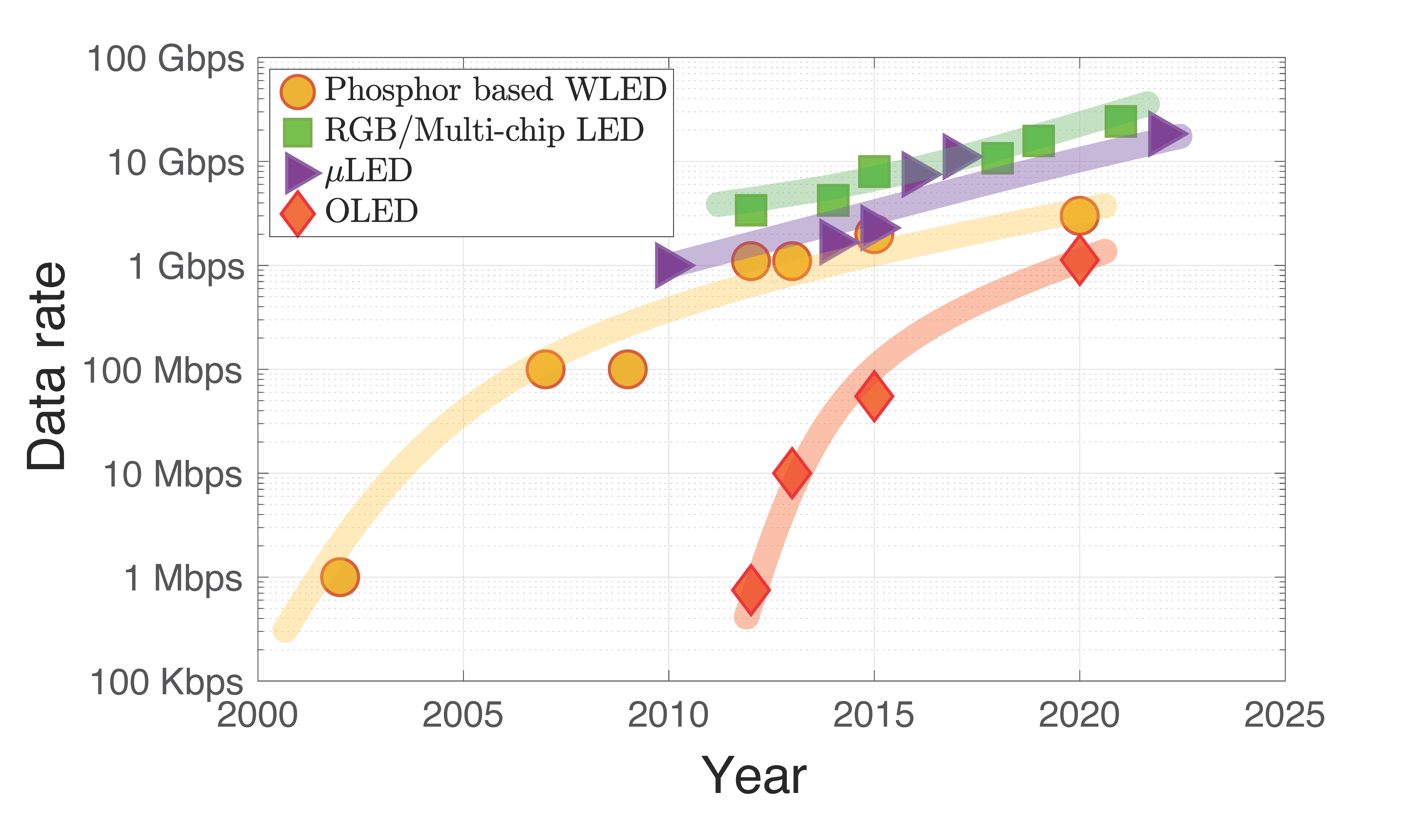
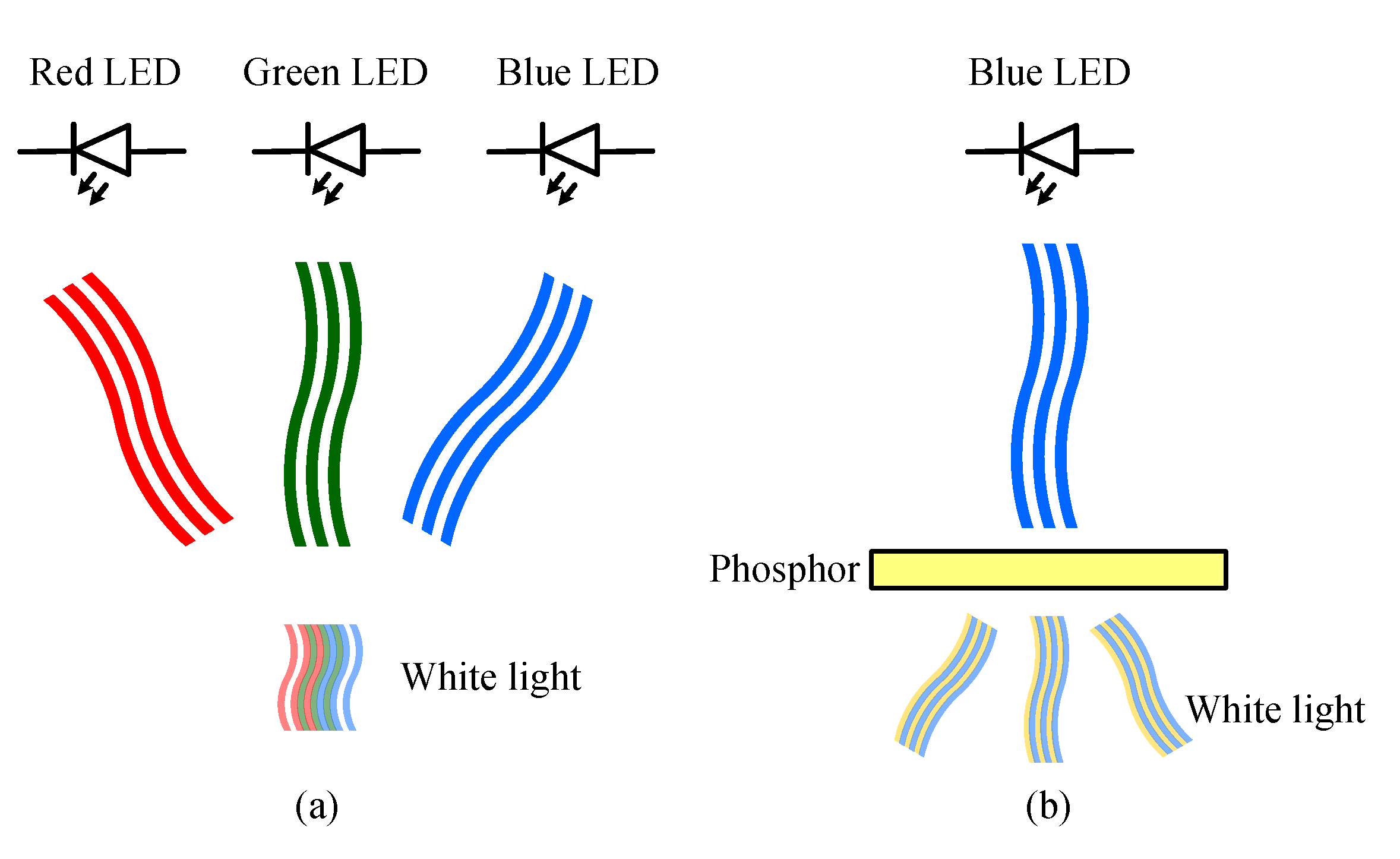
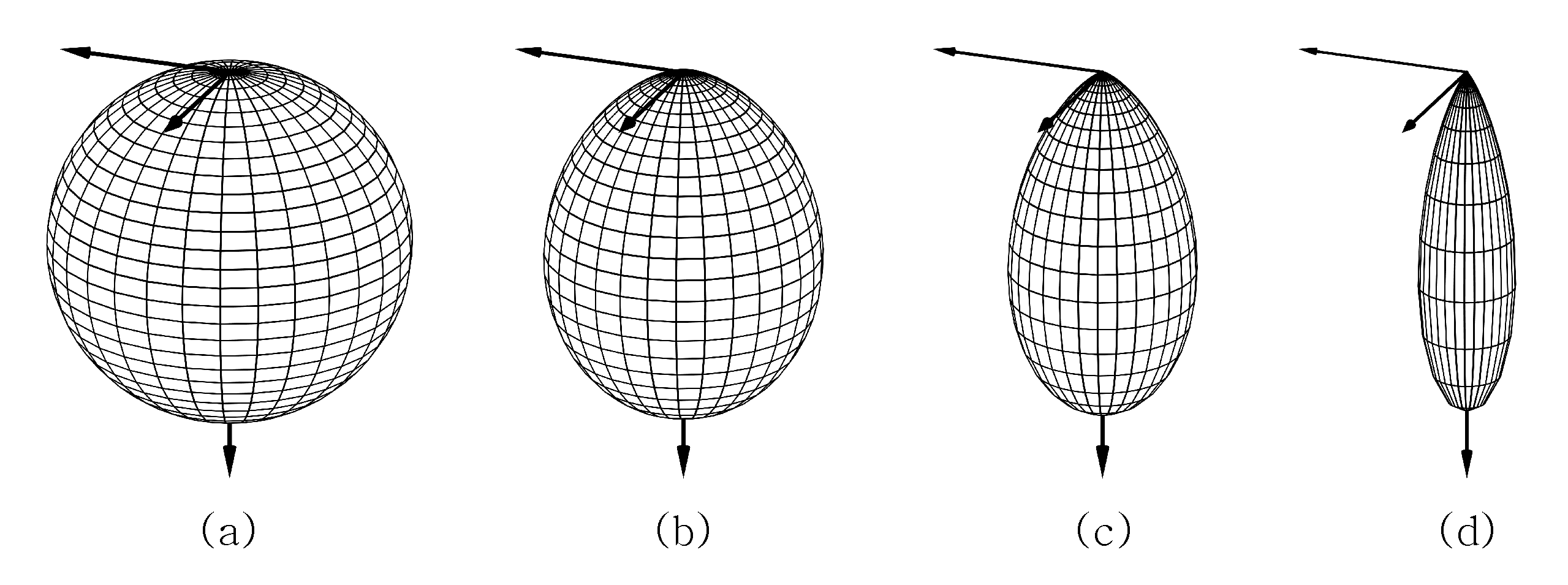

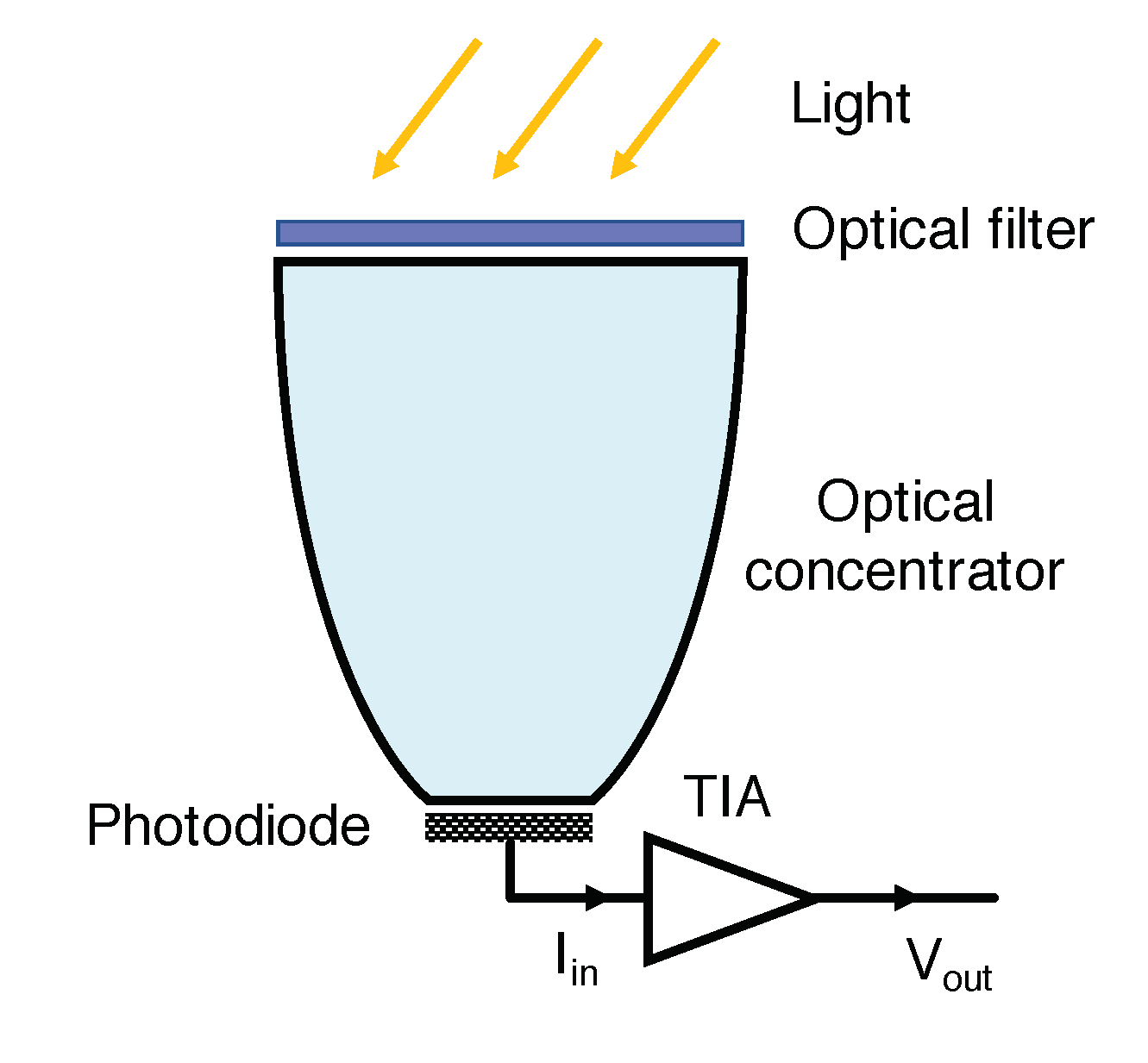
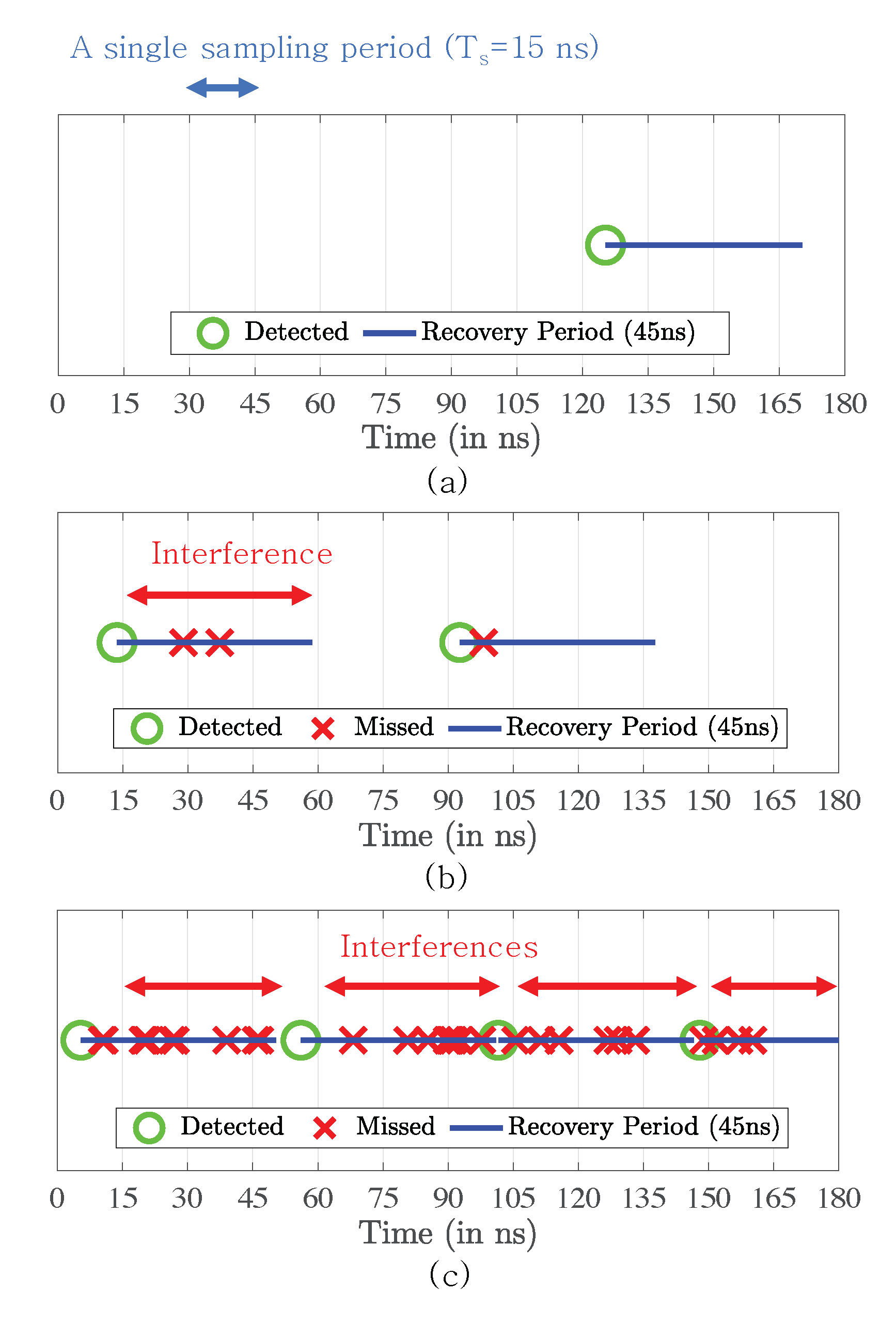
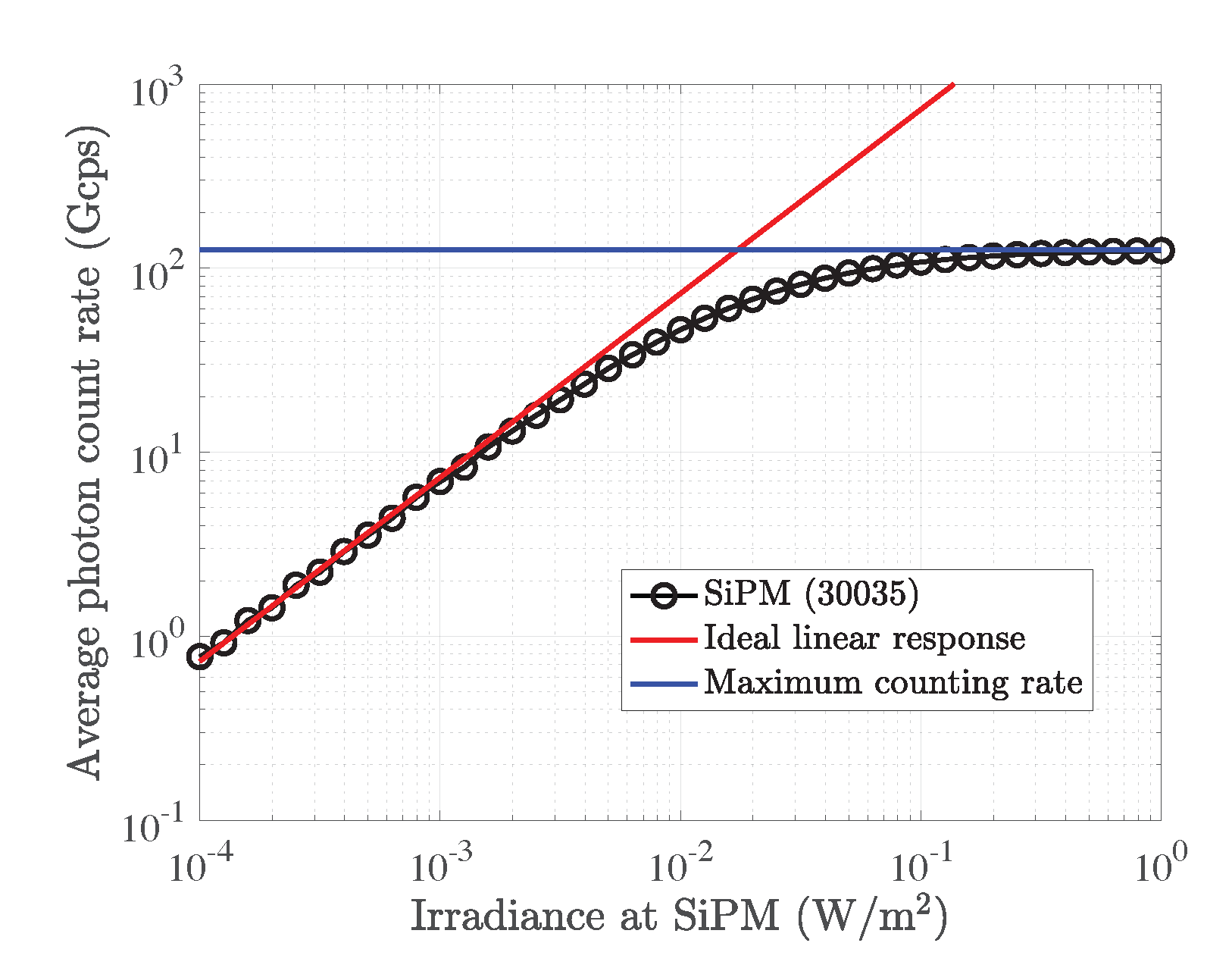
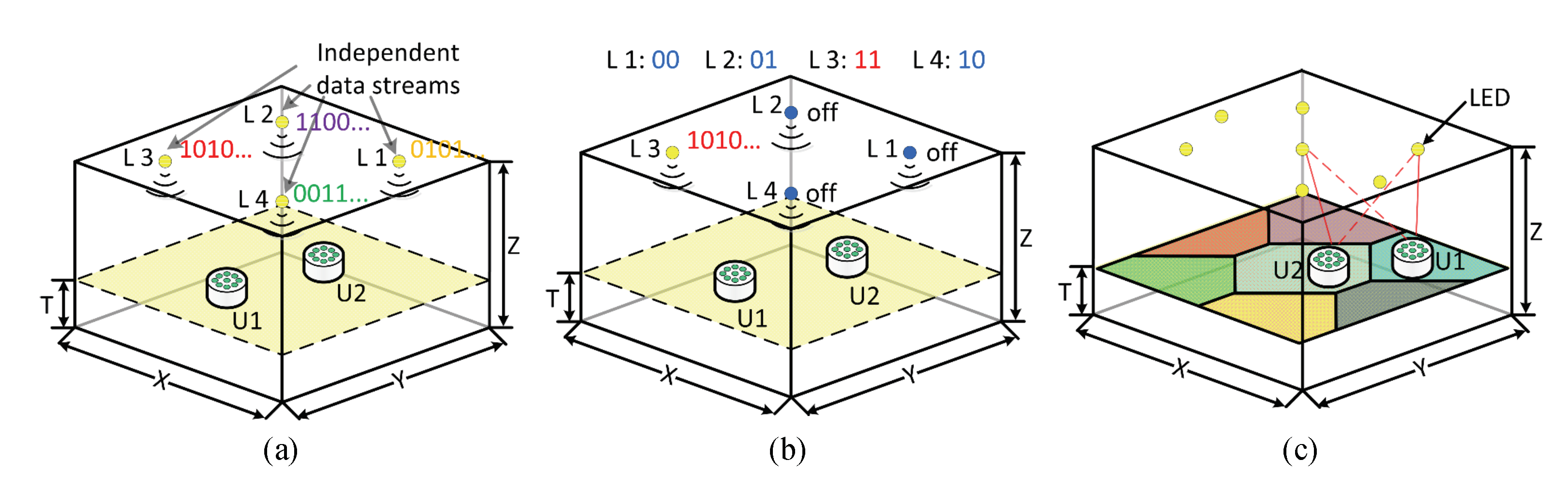
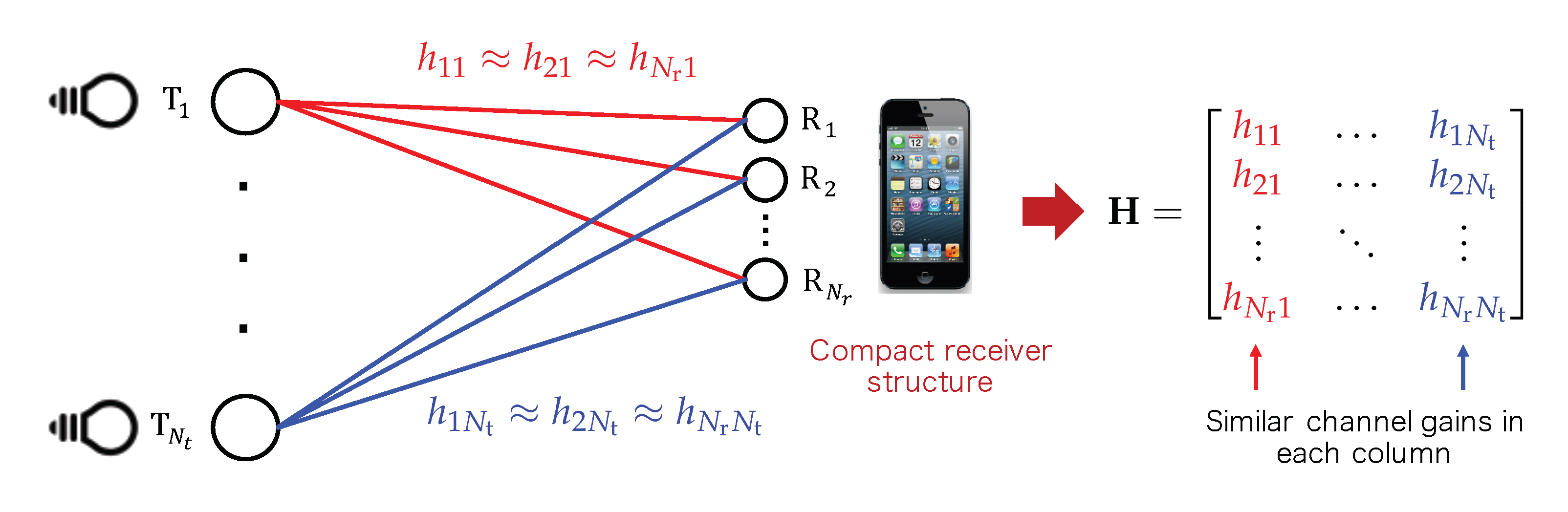

| Year | Transmitter | Receiver | Modulation | Multiplexing | Distance | Data Rate | Ref. |
|---|---|---|---|---|---|---|---|
| 2020 | white LED | PIN | DMT | - | 1 m | 3 Gbps | [24] |
| 2018 | white LED | SPAD | OOK | - | 1.2 km | 2 Mbps | [25] |
| 2015 | white LED | PIN | OFDM | - | 1.5 m | 2 Gbps | [26] |
| 2015 | white LED | PIN | OFDM | - | 1 m | 1.6 Gbps | [27] |
| 2013 | white LED | PIN | OFDM | MIMO | 1 m | 1.1 Gbps | [13] |
| 2012 | white LED | PIN | CAP | - | 0.23 m | 1.1 Gbps | [28] |
| 2012 | white LED | APD | DMT | - | 0.1 m | 1 Gbps | [29] |
| 2010 | white LED | APD | DMT | - | 0.3 m | 513 Mbps | [10] |
| 2009 | white LED | PIN | OOK | - | 0.1 m | 100 Mbps | [5] |
| 2007 | white LED | PIN | OFDM | - | 0.01 m | 100 Mbps | [30] |
| 2006 | white LED | PIN | OFDM | - | 1 m | 16 Kbps | [31] |
| 2002 | white LED | PIN | BPSK | - | - | 1 Mbps | [32] |
| Year | Transmitter | Receiver | Modulation | Multiplexing | Distance | Data Rate | Ref. |
|---|---|---|---|---|---|---|---|
| 2021 | 16 Si-LEDs | PIN | DMT | WDM | 1.2 m | 24.25 Gbps | [33] |
| 2019 | RGBY LEDs | PIN | OFDM | WDM | 1.6 m | 15.73 Gbps | [16] |
| 2019 | RGBYC Si-LEDs | PIN | DMT | WDM | 1.2 m | 15.17 Gbps | [17] |
| 2017 | RGB LEDs | PIN | OFDM | WDM + MIMO | 1 m | 6.36 Gbps | [34] |
| 2016 | RGB LEDs | SPAD | OFDM | WDM | 2 m | 60 Mbps | [35] |
| 2015 | RGBY LEDs | PIN | CAP | WDM | 1 m | 8 Gbps | [14] |
| 2015 | RGB LEDs | PIN | CAP | WDM | 1.5 m | 4.5 Gbps | [36] |
| 2014 | RGB LEDs | APD | OFDM | WDM | 0.01 m | 4.22 Gbps | [37] |
| 2012 | RGB LEDs | APD | OFDM | WDM | 0.1 m | 3.4 Gbps | [38] |
| 2012 | RGB LEDs | APD | DMT | WDM | 0.1 m | 1.25 Gbps | [39] |
| Year | Transmitter | Receiver | Modulation | Multiplexing | Distance | Data Rate | Ref. |
|---|---|---|---|---|---|---|---|
| 2023 | LED | APD | OFDM | - | 0.31 m | 3.5 Gbps | [40] |
| 2022 | LED | APD | OFDM | WDM | 0.25 | 18.43 Gbps | [41] |
| 2021 | LED | APD | OFDM | - | 0.25 | 4.343 Gbps | [42] |
| 2017 | LED | PIN | OFDM | - | 0.275 m | 11.12 Gbps | [43] |
| 2016 | LEDs | PIN | OFDM | WDM | 1.5 m | 10 Gbps | [15] |
| 2016 | LED | APD | PAM-4 | MIMO | 0.5 m | 7.5 Gbps | [44] |
| 2016 | LED | PIN | OFDM | - | 0.75 m | 5.37 Gbps | [45] |
| 2015 | LED | APD | OFDM | WDM | - | 2.3 Gbps | [46] |
| 2014 | LED | PIN | OFDM | - | 0.05 m | 3 Gbps | [47] |
| 2014 | LED | APD | OFDM | - | 0.03m | 1.68 Gbps | [48] |
| 2011 | LED | PIN | OOK | - | - | 512 Mbps | [49] |
| 2010 | LED | PIN | OOK | - | - | 1 Gbps | [50] |
Disclaimer/Publisher’s Note: The statements, opinions and data contained in all publications are solely those of the individual author(s) and contributor(s) and not of MDPI and/or the editor(s). MDPI and/or the editor(s) disclaim responsibility for any injury to people or property resulting from any ideas, methods, instructions or products referred to in the content. |
© 2023 by the authors. Licensee MDPI, Basel, Switzerland. This article is an open access article distributed under the terms and conditions of the Creative Commons Attribution (CC BY) license (https://creativecommons.org/licenses/by/4.0/).
Share and Cite
He, C.; Chen, C. A Review of Advanced Transceiver Technologies in Visible Light Communications. Photonics 2023, 10, 648. https://doi.org/10.3390/photonics10060648
He C, Chen C. A Review of Advanced Transceiver Technologies in Visible Light Communications. Photonics. 2023; 10(6):648. https://doi.org/10.3390/photonics10060648
Chicago/Turabian StyleHe, Cuiwei, and Chen Chen. 2023. "A Review of Advanced Transceiver Technologies in Visible Light Communications" Photonics 10, no. 6: 648. https://doi.org/10.3390/photonics10060648
APA StyleHe, C., & Chen, C. (2023). A Review of Advanced Transceiver Technologies in Visible Light Communications. Photonics, 10(6), 648. https://doi.org/10.3390/photonics10060648