Article

Phytochemical Analysis of Extracts from Waste of Technical Grape Varieties and Pomegranate Peel Processed in South Kazakhstan


by
Almira A. Saparbekova
1,
Gulzhan O. Kantureyeva
1,*,
Alimjon D. Matchanov
2,
Ulugbek R. Togaev
2,3,
Amanbay J. Pirniyazov
2,
Darikha E. Kudassova
1,
Gulnur M. Kaldybekova
1 and
Alina Altekey
1
1
Biotechnology Department, M. Auezov South Kazakhstan Research University, Tauke-Chan Av., 5, Shymkent 160012, Kazakhstan
2
O.S. Sadikov Institute of Bioorganic Chemistry, Academy of Sciences of Uzbekistan, M. Ulugbek Str., 83, Tashkent 100125, Uzbekistan
3
Engineering School, Central Asian University in Tashkent, 264 Milliy, Bog St, Tashkent 111221, Uzbekistan
*
Author to whom correspondence should be addressed.
Separations 2026, 13(8), 213; https://doi.org/10.3390/separations13080213

Submission received: 9 June 2026 / Revised: 8 July 2026 / Accepted: 10 July 2026 / Published: 26 July 2026
(This article belongs to the Topic Advances in Analysis of Food and Beverages, 2nd Edition)

Abstract

The food industry is interested in utilizing active compounds from agri-food waste to produce healthy products and promote sustainability and resource efficiency. This study aimed to conduct a phytochemical analysis of grape pomace derived from Vitis vinifera wine grape varieties Saperavi and Cabernet Sauvignon, as well as pomegranate (Punica granatum L.) peel of the Nar-Shirin variety, which are widely processed in South Kazakhstan. The extraction processes were simple and employed water and ethanol, two food-grade solvents widely used in green extraction due to their low toxicity and compatibility with food applications.Among the extraction methods tested, aqueous–alcoholic extraction demonstrated the highest efficiency in recovering total phenolic content (TPC), yielding 225.5 ± 1.46 mg GAE/g extract from pomegranate peel, 153.9 ± 1.25 mg GAE/g extract from Cabernet Sauvignon pomace, and 98.6 ± 0.83 mg GAE/g extract from Saperavi pomace. Phenolic profiling of the aqueous–alcoholic extract was performed using ultra-high-performance liquid chromatography coupled with quadrupole time-of-flight tandem mass spectrometry (HPLC-Q-TOF MS/MS). The total ion chromatograms revealed the presence of predominant phenolic compounds in all analyzed samples. Key identified constituents in grape pomace included kaempferol 3-O-β-D-xylofuranoside, kaempferol 3-O-β-glucopyranoside-7-O-α-rhamnopyranoside, quercetin-3-O-α-L-arabinoside, genistin, and megastigmane glycoside. In pomegranate peel, compounds such as myricetin, 5-(2Z,8Z)-pentadecadien-1-yl-1,3-benzenediol were identified for the first time. These findings highlight the rich phenolic composition of grape pomace and pomegranate peel’s extracts and support their potential as valuable sources of bioactive compounds for food, pharmaceutical, and industrial applications.

1. Introduction

The evolving global economy and shifting consumer lifestyles have heightened awareness of the value of a balanced, nutritious diet. This trend is particularly noticeable in agriculture. There has been a marked rise in fruit and vegetable farming to meet the growing demand for nutritious food. However, increased consumption also leads to a significant rise in agricultural and food surplus, waste, and losses (SWL) generated throughout the production, transportation, storage, and processing stages of the food supply chain [1,2]. Food loss and waste represent significant economic and logistical challenges and pose serious environmental threats by disrupting ecological balance and contributing to inefficient resource utilization [3].
The problem’s global reach demands coordinated efforts from governments, international bodies, the private sector, and civil society. These strategies must focus on promoting sustainable agriculture and improving the management, reduction, and valorization of SWL [4,5]. Agricultural and food by-products have gained significant attention in recent years due to their rich content of bioactive compounds, such as polyphenols and antioxidants [6]. These compounds are well-known for their functional properties, serving as natural additives in food [7], bioactive components in biomedical materials [8], and ingredients in cosmetics [9,10]. Furthermore, they extend the shelf life and enhance the microbiological safety of ready-to-eat foods [11,12].
Grape pomace and pomegranate peel stand out as particularly promising sources of polyphenolic compounds among fruit by-products [13]. The climates of Southern Kazakhstan and Uzbekistan are uniquely suited for large-scale grape and pomegranate cultivation and processing. This regional wealth presents a strategic opportunity to harness the potential of processing residues rich in biologically active compounds.
Most grape pomace is discarded in open areas, posing potential environmental hazards [14,15]. Grape pomace accounts for 10–20% of the total grape weight and consists of skins, seeds, and other solid materials remaining after juice extraction, amounting to approximately 10.5–13.1 million tonnes of waste globally per year [16,17]. Although some phenolic compounds are transferred to wine during vinification, studies show that up to 70% remain in the pomace [18]. A wide range of polyphenolic compounds, such as phenolic acids, flavonoids, anthocyanins, flavanols, stilbenes, and others, are found in grape pomace. These substances contribute to its antioxidant, cardioprotective, neuroprotective, anti-inflammatory, anticarcinogenic, and antimicrobial activities [19,20].
Valorizing viticultural by-products such as grape pomace offers opportunities to enhance food quality and develop value-added products [21]. Similarly, pomegranate processing generates substantial waste. Global pomegranate output surpasses 3 million tons annually. The peels and seeds account for about 54% of the fruit’s weight, generating over 1.62 million tons of waste each year [22]. Juice production alone generates around nine tons of waste per ton of juice produced. Pomegranate by-products are rich in phenolic compounds such as anthocyanins, gallagyl esters, hydroxybenzoic and hydroxycinnamic acids, gallotannins, and ellagitannins like punicalagin and punicalin, which exhibit exceptionally high antioxidant capacity [23,24].
Compounds derived from grape and pomegranate by-products show promise as alternatives to synthetic preservatives, which have raised health concerns [25,26]. However, there is a lack of information on the polyphenolic content of grape pomace from Saperavi and Cabernet Sauvignon wines made in South Kazakhstan. Similarly, the composition of pomegranate peel from the Nar-Shirin variety, grown in Uzbekistan and processed in South Kazakhstan, remains largely unexplored.
In light of these knowledge gaps and the growing need for sustainable valorization of food processing by-products, the present study aims to investigate the proximate composition and phytochemical profile of grape pomace (Saperavi and Cabernet Sauvignon) and pomegranate peel (Nar-Shirin variety). The study addressed whether grape pomace and pomegranate peel can serve as valuable sources of bioactive phenolic compounds. We hypothesized that these by-products contain diverse phenolic compounds that can be efficiently extracted with aqueous ethanol and water for potential industrial applications.

2. Materials and Methods

2.1. Agri-Food By-Products and Sample Preparation

Grape pomace samples of two industrial wine grape cultivars, Saperavi and Cabernet Sauvignon, and pomegranate peel (Punica granatum L.) from the Nar-Shirin variety were collected during the 2021–2022 harvest seasons from local fruit-processing facilities in Southern Kazakhstan. All samples were collected immediately after the mechanical pressing of fresh fruits for juice or wine production. Following collection, the samples were immediately dried and stored under appropriate laboratory conditions.
The drying procedures were selected as stabilization steps prior to extraction and chromatographic analysis. Grape pomace was subjected to convective drying, whereas pomegranate peel was dried using infrared radiation due to differences in the physical structure of the plant matrices. Infrared drying was selected due to its high drying efficiency, short processing time, and ability to preserve the quality of plant-derived materials with a dense and compact structure and lower moisture diffusivity [27]. The purpose of drying was to reduce moisture content, inhibit enzymatic activity, and ensure sample stability before analysis.
Grape pomace was dried in convection dryer with forced-air circulation oven (ShS-80, SpetsKhlebMash LLC, Novosibirsk, Russia) for 24 h, until the residual moisture content reached approximately 7%. Fresh pomace contained 15–40% grape seeds, whereas the dried form contained up to 65% by weight. Pomegranate peel was dried at 40 °C for 24 h in an infrared dryer (Universal-SD-4-40, SpetsKhlebMash LLC, Novosibirsk, Russia) utilizing combined radiation and convection to achieve a final moisture content below 13%. The dried materials were milled to a uniform particle size (≤0.5 mm) and stored in airtight containers at 22 ± 2 °C under dry conditions until analysis. All analytical determinations were performed within 2–3 months after sample collection and sample preparation.

2.2. Extraction of Phenolic Compounds

Phenolic compounds were extracted from the dried grape pomace (GP) and pomegranate peel (PP) using two methods: (1) aqueous extraction and (2) aqueous–alcoholic extraction both followed by ultrasonic-assisted extraction (UAE). UAE is recognized as a green and efficient method to enhance the release of polyphenols from plant matrices, including agri-food by-products, provided optimal ultrasound conditions are maintained to avoid compound degradation [28].
For both GP and PP samples, aqueous extraction was carried out by mixing by-products powder with distilled water in a 1:4 (w/v) ratio, followed by stirring at 60 °C. The extraction was repeated twice, and the three extracts were combined.
Aqueous–alcoholic extractions were performed using 40% ethanol as a solvent in a 1:4 (w/v) ratio. A 40% (v/v) aqueous ethanol solution was selected based on the laboratory extraction protocol developed from previous literature reporting its effectiveness as an environmentally friendly solvent for the recovery of phenol compounds from plant matrices [29,30,31].
The mixtures were stirred for 10 min and left at room temperature overnight for maceration.
The resulting aqueous and aqueous–alcoholic extracts were subjected to ultrasonic treatment at 38–40 °C using an ultrasonic bath (frequency: 35 kHz; intensity: 70 W/cm2; vacuum pressure: 76 mm Hg) for 15 min. These conditions were selected based on the laboratory protocol and published reports indicating that these mild conditions provide efficient extraction of phenolic compounds while limiting their degradation [32,33]. The mixtures were filtered sequentially using a calico cloth and a 0.45 μm nylon membrane filter. Subsequently, the extracts were concentrated using a rotary evaporator (RE100-Pro, DLAB Scientific Co., Ltd., Beijing, China) to one-third of their original volume for the effective and gentle removal of solvent. Concentrated extracts were then spray-dried using a Unopex B230, Unopex, Izmir, Turkey (75 °C; atomizer speed: 8500 rpm; feed rate: 6.0–6.5 L/h) to obtain fine polyphenolic extracts.
In total, four grape pomace extract samples (two varieties, two extraction solvents) and two pomegranate peel samples (aqueous and aqueous–alcoholic) were obtained for subsequent analysis. Total phenolic content and total flavonoid content was carried out for all extracts.

2.3. Chemical Analysis

2.3.1. Composition of Agri-FoodBy-Products

The composition, including moisture, ash, crude fat, proteins, and dietary fiber, was determined according to the Official Methods of Analysis of AOAC International (Methods 925.09, 923.03, 920.39, 978.04, and 991.43, respectively). Total carbohydrates were calculated by difference.

2.3.2. Total Phenolic Content (TPC)

The total content of phenolic compounds in grape pomace and pomegranate peel extracts (aqueous and aqueous-alcoholic) was determined by the modified Folin-Ciocalteu method with some additions. In this study, 0.25 mL of each extract (GP and PP) were measured into a volumetric flask, and then 1.25 mL of the Folin-Ciocalteu reagent (previously diluted 10 times) and 1 mL of a 7.5% sodium carbonate solution were added, and the reaction mixture was kept for 30 min (at 20 °C). After incubation, the absorbance at 765 nm was measured using a spectrophotometer (Shimadzu Corp., Kyoto, Japan). Gallic acid was used to prepare the standard solutions, using concentrations ranging from 10–100 µg/mL. The total phenolic content of the extracts was determined as gallic acid (mg) equivalents/gram of sample (mg GAE/g extract).

2.3.3. Total Flavonoid Content (TFC)

The total flavonoid content in grape pomace and pomegranate peel extracts (aqueous and aqueous–alcoholic) was measured by the colorimetric method with slight modifications. 0.5 mL of the extract was introduced into a 5 mL graduated test tube, 1.5 mL of 95% ethanol solution, 0.1 mL of 10% aluminum chloride solution, 0.1 mL of 1 M sodium acetate solution, and 2.8 mL of distilled water were added. The mixture was kept at room temperature for 30 min, and the optical density of the analyzed solution was measured on a spectrophotometer at a wavelength of 415 in a cuvette with an optical path length of 10 mm relative to the reference solution. The same reagents were used as the reference solution, replacing the analyzed extract with 0.5 mL of distilled water. Quercetin was used as standard compound to obtain the calibration curve in the range of 0.5–50 µg/mL. The total flavonoid content of the extracts was expressed as quercetin equivalents (mg)/gram of sample (mg Q/g extract).

2.3.4. HPLC-Q-TOF LC-MS/MS Conditions

HPLC analysis for the presence and identification of phenolic compounds in polyphenolic powders of pomegranate peel and mixture of pomace from two grape varieties (Saperavi and Cabernet Sauvignon) was carried out by mass spectrometry on an Agilent 6520 Accurate-Mass Q-TOF LC/MS System with an Agilent 1200 Series HPLC (Agilent Technologies, Santa Clara, CA, USA). Reverse-phase nano-LC-MS/MS was performed using an Agilent Nano LC system coupled to an Agilent Technologies CHIP-Q-TOF Agilent Technologies 6520B series mass spectrometer (Agilent Technologies, Santa Clara, CA, USA). The sample was fractionated using an Agilent Technologies 1200 series chromatograph through a Zorbax SB C18, 5 µm, 75 µm × 43 mm ChIP (Agilent Technologies, Santa Clara, CA, USA). Mobile phase: A—0.1% formic acid solution + 5% acetonitrile, B—acetonitrile + 0.1% formic acid + 10% deionised water. Application was carried out on an Agilent Technologies 1260 series Cap Pump instrument (Agilent Technologies, Santa Clara, CA, USA) at a flow rate of 4 µL/min. Elution was carried out by Nano Pump at a flow rate of 0.6 µL/min. Solution B concentration gradient was in min: 0%–3 min, 60%—12–18 min, 0%—20 min. Solutions were degassed on an Agilent Technologies 1260 µ-degasser instrument (Agilent Technologies, Santa Clara, CA, USA). Samples were applied to the column using an Agilent Technologies Micro WPS instrument (Agilent Technologies, Santa Clara, CA, USA) in 2 μL increments. The eluted fractions were analyzed mass spectrometrically under the following conditions: Ionisation source: ESI+, drying gas flow: 4 L/min, drying gas temperature: 350 °C, voltage at skimmer cone: 65 V, at fragmenter 175 V, mass range: in MS 50 mode—3000 m/z, in MS/MS 50 mode—2500 m/z, with CAP voltage in the range of 1800–2500 V. Method of ionization is positive.
The Q-TOF mass spectrometer was externally calibrated before analysis using the manufacturer’s standard calibration solution. Mass accuracy for the six identified compounds ranged from 0.00 to 7.57 ppm, whereas two highly abundant flavan-3-ol isomers (catechin and epicatechin) showed larger apparent precursor mass deviations, although their identities were confirmed by characteristic MS/MS fragmentation and chromatographic separation.

2.3.5. Statistical Analysis

All experiments were performed in triplicate, and the results are expressed as mean ± standard deviation (SD). Statistical analysis was performed using Student’s t-test to compare two independent groups for each measured parameter. Differences were considered statistically significant at p < 0.05.

3. Results and Discussion

A preliminary characterization of dried grape pomace and pomegranate peel was conducted to support the implementation of a multi-product processing technology that generates no additional waste during or after production. The analysis focused on the proximate chemical composition, including protein, fat, carbohydrate, ash, and dietary fiber. This assessment was crucial for evaluating the suitability of secondary raw materials for use in the food, pharmaceutical, and other bio-based industries. It also aims to develop value-added products that contribute to a circular economy.

3.1. Chemical Composition of Dried Grape Pomace of Saperavi (V. vinifera), Cabernet Sauvignon (V. vinifera) Varieties

The results of the chemical composition of Saperavi (V. vinifera), Cabernet Sauvignon (V. vinifera) dried grape pomace are given in Table 1.
The main component of the two grape pomaces studied was dietary fiber (DF), with concentrations of 51.38% in Saperavi and 46.15% in Cabernet Sauvignon. DF is associated with polyphenols, thereby enhancing its antioxidant effects. This combination enhances the health benefits of dietary fibre and antioxidants [34].
Regarding the fat and carbohydrate content, minor variations were observed between two grape pomace (GP) varieties. For GP Saperavi, the fat and carbohydrate contents were 4.38% and 19.63%, respectively, while for GP Cabernet Sauvignon, the values were 8.16% and 29.30%, respectively. Grape fat is predominantly concentrated in the seeds, with fat content showing slight variation across samples. Research shows that grape seed fats consist of approximately 90% monounsaturated fatty acids, which have demonstrated potential health benefits in disease prevention and wound healing [35]. The higher carbohydrate content observed in Cabernet Sauvignon pomace is in agreement with previous studies, describing Cabernet Sauvignon pomace as a carbohydrate-rich by-product [36].
Protein content in both grape pomace varieties was similar, ranging from 12.35 to 13.90 g/100 g, consistent with findings from other studies [37].
The mass concentration of alkaline and alkaline earth elements in the grape pomace extracts of Saperavi and Cabernet Sauvignon was 38.52 g/100 g and 39.82 g/100 g, respectively. The main substances were potassium (30.82 g/100 g for Saperavi and 29.22 g/100 g for Cabernet Sauvignon), followed by calcium (5.42 g/100 g and 8.74 g/100 g, respectively) and magnesium (1.40 g/100 g and 1.86 g/100 g). Several studies have highlighted potassium as the most abundant element in grape products, though its concentration varies with variety and growing conditions. For instance, other studies have reported lower potassium contents ranging from 1.18 to 2.72 g/100 g [38], with some reporting 1.87 ± 0.11 g/100 g [39]. Potassium remains the most significant element when compared with others. Potassium accumulates in the grape skin during ripening and forms soluble and insoluble salts of organic acids [40].
These findings provide insights into the technological potential and valuable reserves of components in grape pomace from technical grape species. Preliminary studies on the production of fortified foods from grape pomace and seed extracts, using various extraction methods, have yielded promising results [41,42].

3.2. Chemical Composition of Dried Pomegranate Peel

The primary focus of pomegranate (Punica granatum L.) fruit processing is the extraction of polyphenolic compounds from the peel. However, the pomegranate peel (PP) is rich in other biologically active, water-soluble components that remain underexplored. This study aims to investigate the potential of essential dietary fibre, carbohydrates, proteins, and other bioactive components in pomegranate peel for use in food and various industrial applications. This research further underscores the value of PP as a multifunctional by-product in sustainable processing.
Table 2 summarizes this study’s findings. The indicator values match those in previous research [43,44,45], which examined the composition of PP powder, focusing on its primary components. These studies show that PP provides vital dietary fiber, carbohydrates, proteins, and other components, which, together with polyphenolic compounds, enhance its significant biological effects.
The proximate analysis in this study confirms that dried pomegranate peel is abundant in essential nutrients, including carbohydrates, proteins, fats, moisture, dietary fiber, and ash. Carbohydrates were the most predominant component at 60.81 ± 0.18 g/100 g, while ash content was the least at 2.8 ± 0.05 g/100 g.
Functional and bioactive dietary fiber (DF) plays a crucial role in human health and food processing. It was the dominant constituent of PP, with values ranging from 33% to 62% [45], making it an essential natural source. Comparative analysis of DF in our samples and the literature shows that DF is the second-most abundant substance functional component after carbohydrates [46]. Other experimental parameters were aligned with previously published data.
All tested minerals were detected in the pomegranate peel powders. The predominant minerals in the powder were Ca, K, P, Na, and Mg, with contents of 6.11, 30.06, and 2.22, 0.44, and 1.27 g/100 g of powder, respectively. These findings differ from those reported in previous works [47,48], which indicated that PP powders contain higher levels of Ca (50–342 mg/100 g), K up to 150 mg/100 g, P (117.90–120.00 mg/100 g), Na (64.63–68.00 mg/100 g), and Mg up to 56 mg/100 g.
Valorization of PP presents significant positive impacts both economically and environmentally. The high value and potential of pomegranate peel, due to its dietary fiber and minerals, are highlighted by many studies for a range of applications [49,50].

3.3. Determination of Total Phenolic Content (TPC) and Total Flavonoid Content (TFC) in Pomegranate Peel and Grape Pomace Extracts

The TPC and TFC of PP samples are shown in Table 3. Sample No. 1, the pomegranate peel aqueous extract (PP AE), exhibited a TPC of 136.3 ± 0.96 mg/GAE g dry extract. Sample No. 2, the pomegranate peel aqueousalcoholic extract (PP AAE), demonstrated a significantly higher concentration of 225.5 ± 1.46 mg GAE/g dry extract (p = 0.0475), which is approximately 40% greater than that of the aqueous extract.
Comparable studies have reported varying TPC values. For instance, Hayder et al. [51] reported a TPC of 188.1 mg/GAE g for PP AAE. Another investigation of Peršurić et al [52] examined alcoholic extracts of PP from Western Herzegovina, with TPC meanings from 57.66 to 105.99 mg/GAE g, which are slightly lower than the values obtained in the present work.
The TPC values in this study were higher than the values reported by [53] (175.75–189.45 mg GAE/g extract) for ultrasound-assisted extraction. Differences in TPC are expected because phenolic recovery is influenced by extraction conditions, solvent composition, cultivar, geographical origin, and growing conditions.
According to Table 3, among the tested samples, sample No. 2 (PP, AAE) exhibited the highest flavonoid concentration, at 92.1 ± 0.80 mg quercetin equivalents (Q/g extract). It was 48% greater than Sample No.1 (PP, AE) (p = 0.0472). These findings are consistent with the study by Abd El-Rahman & Sandak [43], which reported a higher antioxidant yield from alcoholic PP extraction than from aqueous extraction.
The aqueous–alcoholic extract (AAE) of Cabernet Sauvignon exhibited a TPC of 98.6 ± 0.83 mg GAE/g extract. AAE of Saperavi, showed a significantly higher concentration of 153.9 ± 1.25 mg GAE/g. In comparison, the aqueous extracts (AE) of these same varieties provided lower TPC values of 32.13 ± 0.45 and 99.4 ± 0.55 mg GAE/g extract, respectively.
Various studies have yielded similar or differing outcomes, influenced by grape variety and extraction methods. Zhang et al. [54] discovered that red Amur grapes contain 47.6 ± 0.21 mg GAE/g. Comparable values (45.34 ± 2.33–81.81 ± 3.86 mg GAE/g) have been reported for hydroethanolic whole grape pomace extracts from Romanian grape cultivars [55]. These values are consistent with the high extraction efficiency of hydroethanolic solvents for polyphenolic compounds.
The TFC of the grape pomace extracts ranged from 10.8 ± 0.4 to 54.7 ± 0.7 mg QE/g dry extract. The highest flavonoid content was observed in the AAE of Saperavi pomace, whereas the lowest value was obtained for the aqueous extract of Cabernet Sauvignon. In both grape cultivars, aqueous–alcoholic extraction yielded higher TFC than aqueous extraction, confirming the superior ability of hydroethanolic solvents to recover flavonoids. These findings are consistent with previous studies reporting that flavonoid extraction efficiency depends on solvent polarity, grape cultivar, and extraction conditions.
Likewise, Kumar & Neeraj [56] found that alcohol extraction of flavonoids from tray-dried Bhagwa variety PP produced 14.48 ± 0.005 mg/g, outperforming water extraction at 10.65 ± 0.003 mg/g. However, the TFC values in given work were approximately 75–80% lower than our results. In contrast, other investigations [57] have reported flavonoid concentrations from 61.01–86.86 mg RE/g.These differences are likely attributable to grape cultivar, pomace composition, extraction conditions, and the use of different reference standards (quercetin vs. rutin).
The ultrasound-assisted extraction (UAE) to enhance phenolic yield is a key feature of the current work. Numerous researchers have reported comparable results for grape pomace: TPC values of 42.1 mg GAE/g and 64.85–117.32 mg GAE/g under ultrasonic extraction conditions have been noted [58,59]. Using ultrasound-assisted extraction (56 °C, 20 min, 53% ethanol), Drevelegka and Goula [58] reported a TPC of 48.76 mg GAE/g DW. Moreover, ultrasonic extraction improves recovery efficiency by reducing extraction time, temperature, energy, and solvent consumption while increasing phenolic yield (up to 283.18 mg GAE/g DW) [60].

3.4. Identification of Phenolic Compounds in AqueousAlcohol Extracts of Pomegranate Peel

The polyphenolic powders of pomegranate peel obtained using the optimal extraction conditions (a combination of aqueous-alcohol extraction and additional ultrasonic treatment) were analyzed for individual phenolic content using HPLC-Q-TOF: ESI (+), MS.LC-QTOF-MS/MS analysis was performed in positive electrospray ionization mode (ESI+) because the analytical conditions were optimized for positive ion detection, providing stable protonated ions and informative MS/MS fragmentation for the tentative identification of the target phenolic compounds.
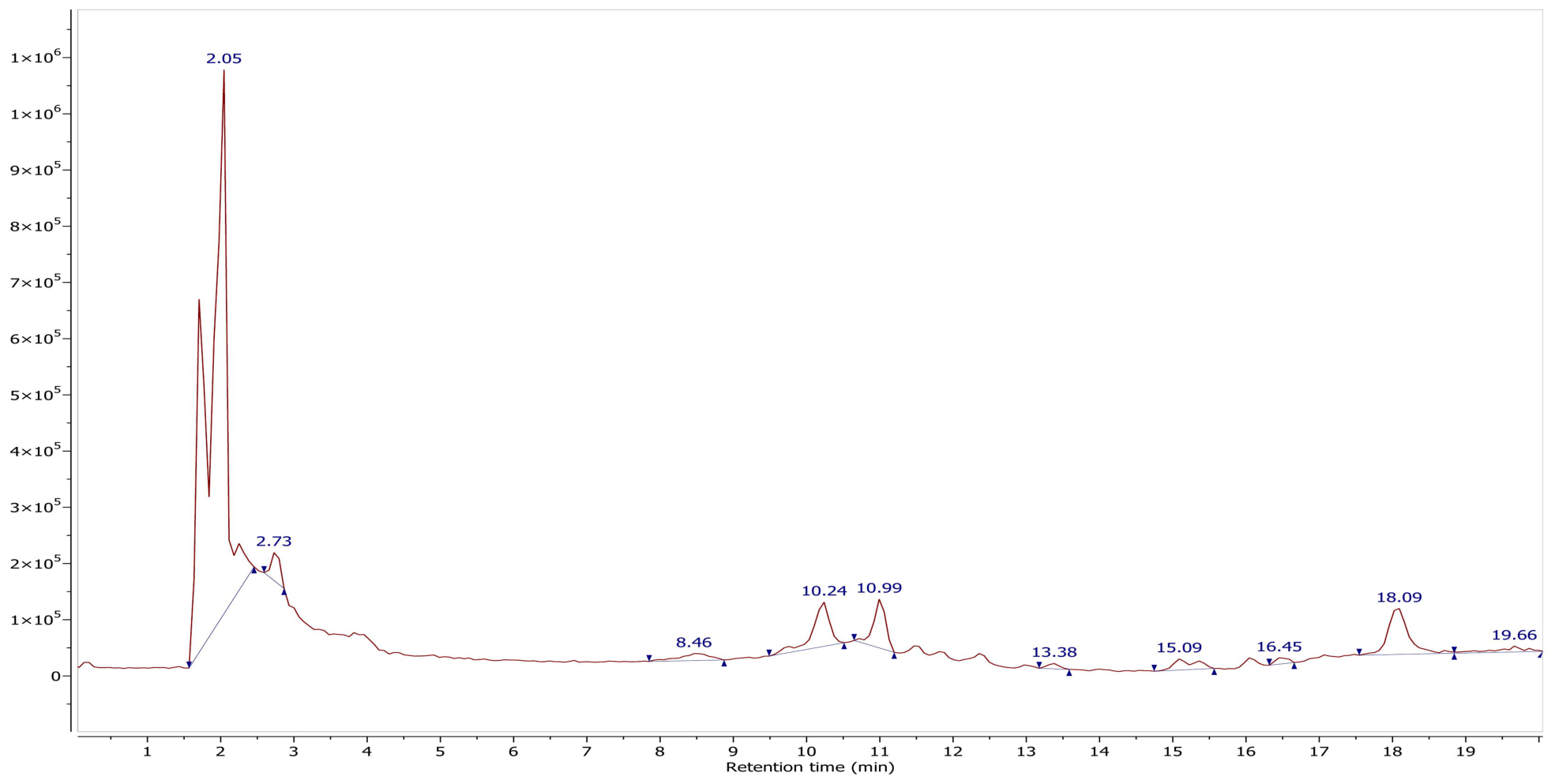
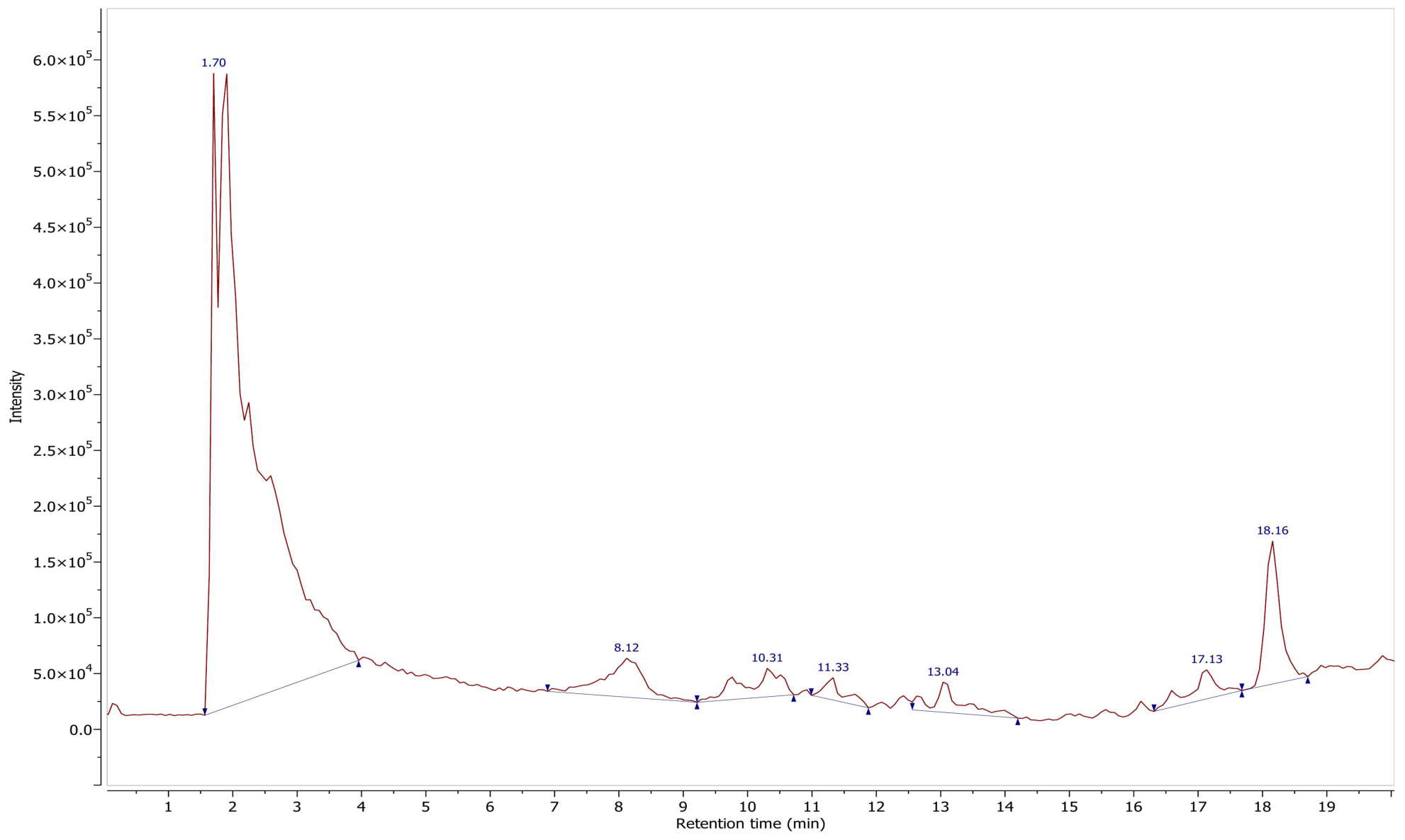
The total ion chromatogram (TIC) (Figure 1) in the m/z range of 50–1000, obtained using Q-TOF with ESI(+) and MSn = 2, revealed predominant peaks corresponding to major phenolic compounds typically present in pomegranate peel extracts. Multiple isomeric forms of phenolic compounds with identical molecular weights were detected, alongside the characterization of several previously unreported compounds.
Compound identification was performed through careful annotation of MS/MS fragmentation data, supported by available spectral databases and literature references.
To identify the raw data obtained from Agilent LC/MS Mass Hunter, we used Thermo Fisher Scientifics’ Mass Frontier-8.1 software, which offers online access to library spectral data and first converted it to mzML format. Table 4 presents all compounds tentatively identified in the sample based on their values from the positive-ion ([M+H]+) mass spectra.
Representative ion chromatograms and MS/MS of the aqueous–alcoholicpomegranate peel extract acquired in positive ion mode are presented in Supplementary Figure S1. The figure includes the molecular ions, fragmentation patterns, molecular formulas, and proposed structures of the phenolic compounds identified in Table 4. The identified phenolic profile is consistent with the antioxidant activity previously reported for these extracts. In our previous study, the pomegranate peel and grape pomace extracts exhibited pronounced antioxidant activity, with antiradical activity (DPPH assay) values of 2.24 and 3.56, respectively [61]. These findings support the contribution of the identified phenolic compounds to the antioxidant properties of the extracts and their potential application as natural ingredients in food, nutraceutical, pharmaceutical, and cosmetic formulations [62,63,64].
All findings emphasize the presence of a diverse array of phenolic compounds in pomegranate peel. The total ion chromatogram (TIC) was further processed into a base peak chromatogram (BPC), which revealed numerous molecular ion peaks. Compounds were tentative identified by high-resolution LC-QTOF-MS/MS using accurate mass measurements, molecular formula prediction, characteristic MS/MS fragmentation patterns, and comparison with spectral databases and published literature. No authentic reference standards were used for compound confirmation.
At 16.49 min, a prominent precursor ion at m/z 319.0448 ([M+H]+) was detected and tentatively assigned to myricetin (C15H10O8). The MS/MS spectrum showed characteristic product ions at m/z 301.0342 and 273.0393. The ion at m/z 301.0342 corresponds to the loss of a water molecule (−18 Da), which is characteristic of highly hydroxylated flavonoids, while the fragment at m/z 273.0393 is consistent with the reported fragmentation behavior of myricetin. The proposed fragmentation pathway is presented in Supplementary Figure S1 (Myricetin). These results are in agreement with fragmentation patterns of myricetin in study of Cao et al. [65], who confirmed m/z 319.0448 as the quasi-molecular ion of myricetin and m/z 301.0343 as its diagnostic fragment.
Another ion detected at m/z 317.2475 ([M+H]+) produced a key fragment at m/z 163.0754. Based on MS/MS data and molecular formula prediction (C21H32O2), the compound was tentatively identified as 5-(2Z, 8Z)-Pentadecadien-1-yl-1,3-benzenediol. This compound belongs to the class of polyenylphenols, characterized by long unsaturated hydrocarbon chains that contribute to increased chemical reactivity and potential biological activity. The detected m/z 317.2475 corresponds to the protonated molecular ion of a compound with a neutral mass of 316 Da.
A peak detected at 12.41 min with m/z 465.1028 fragmented to m/z 303.05, consistent with the loss of a 162 Da sugar moiety—characteristic of glycosidic bond cleavage in quercetin glycosides. Based on this fragmentation pattern, the compound was approximately defined as isoquercitrin (quercetin-β-D-glucoside; C21H20O12). The MS/MS data correspond well with those reported by Sulaiman & Gopalakrishnan [66].
Additionally, at 12.36 min, another compound with m/z 479.0842 formed a fragment ion at m/z 303.0495, losing 176 Da, consistent with glucuronic acid cleavage. This pattern is indicative of miquelianin (quercetin-3-O-glucuronide; C21H18O13), a flavonoid glucuronide known for its antioxidant potential. Miquelianin is part of the flavonoid-3-O-glucuronides, characterized by an O-glycosidic linkage of glucuronic acid to the C3 position of the flavonoid aglycone. Its presence, along with other quercetin derivatives, contributes to the powerful antioxidant profile of pomegranate peel. These findings are confirmed by the results of Man et al. [67].
At the retention time—12.38 min, the mass spectrum revealed a molecular ion at m/z 443.0945. Fragmentation gave in a notable ion at m/z 291, corresponding to the catechin moiety, indicating the loss of gallic acid (−152 Da). Additional fragments at m/z 153, 137, typical for flavonoid structure, were also observed. The tentative molecular formula, C22H18O10, matches that of catechin gallate, a flavan-3-ol derivative. This compound was confidently identified through Thermo Fisher Scientifics’ Mass Frontier – 8.1 software, which provided an exact molecular formula match against the mass spectral library. Previous research has reported the presence of catechin and gallocatechin in pomegranate peel with high antioxidant activity, providing health benefits of pomegranate peel [68].
A distinct peak at m/z 317.0680 corresponds to a molecular mass of 316 Da. Fragment ions in the ranges of m/z ~81–95, 147–161, 230–250, and 281–297 are consistent with flavonoid fragmentation pathways. This spectral pattern supports the identification of rhamnetin, a monomethoxyflavone structurally related to quercetin (methylated at position 7). Its moderate polarity is consistent with the observed retention time of 11.89 minin a reversed-phase chromatographic system. The experimental m/z value (317.0680) closely matches the theoretical protonated mass of rhamnetin (317.0661), further supporting this identification [69].
At Rt 10.99 min, a spectrum with a molecular ion at m/z 291.0863 was recorded. This corresponds to the protonated form of catechin with a theoretical molecular weight of 290.0790 Da (C15H14O6). The fragmentation pattern includes ions at m/z 123.041, 165.0546, and 207.0652, indicative of catechin’s characteristic breakdown involving cleavage of the C-ring and losses of small neutral molecules such as H2O and CO.
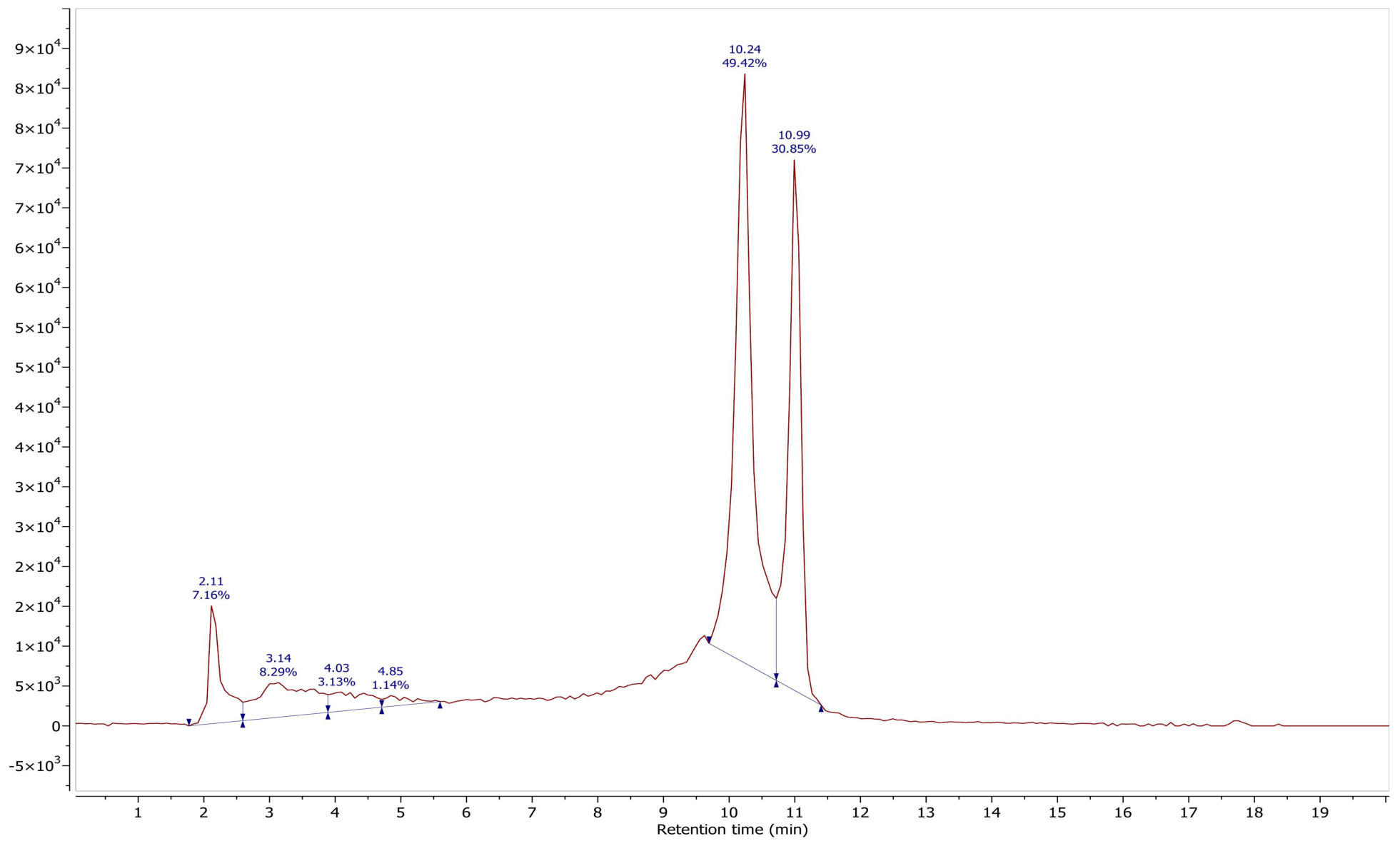
A second chromatographic peak was detected with the same protonated ion at m/z 291.0706, but at a retention time of 10.24 min. Since both peaks have the same accurate mass but different retention times, they are more likely to represent structural isomers or stereoisomers rather than different ionic adducts. The peak at 10.24 was about 1.3 times as intense as the one at 10.99. This suggests a higher concentration or better ionization under the current chromatographic conditions.
Comparison of the obtained mass spectra with the spectral library revealed two compounds with the same molecular formula, C15H14O6, and virtually identical MS/MS spectra. Apparently, based on the order of column elution times, the compounds correspond to stereoisomers.
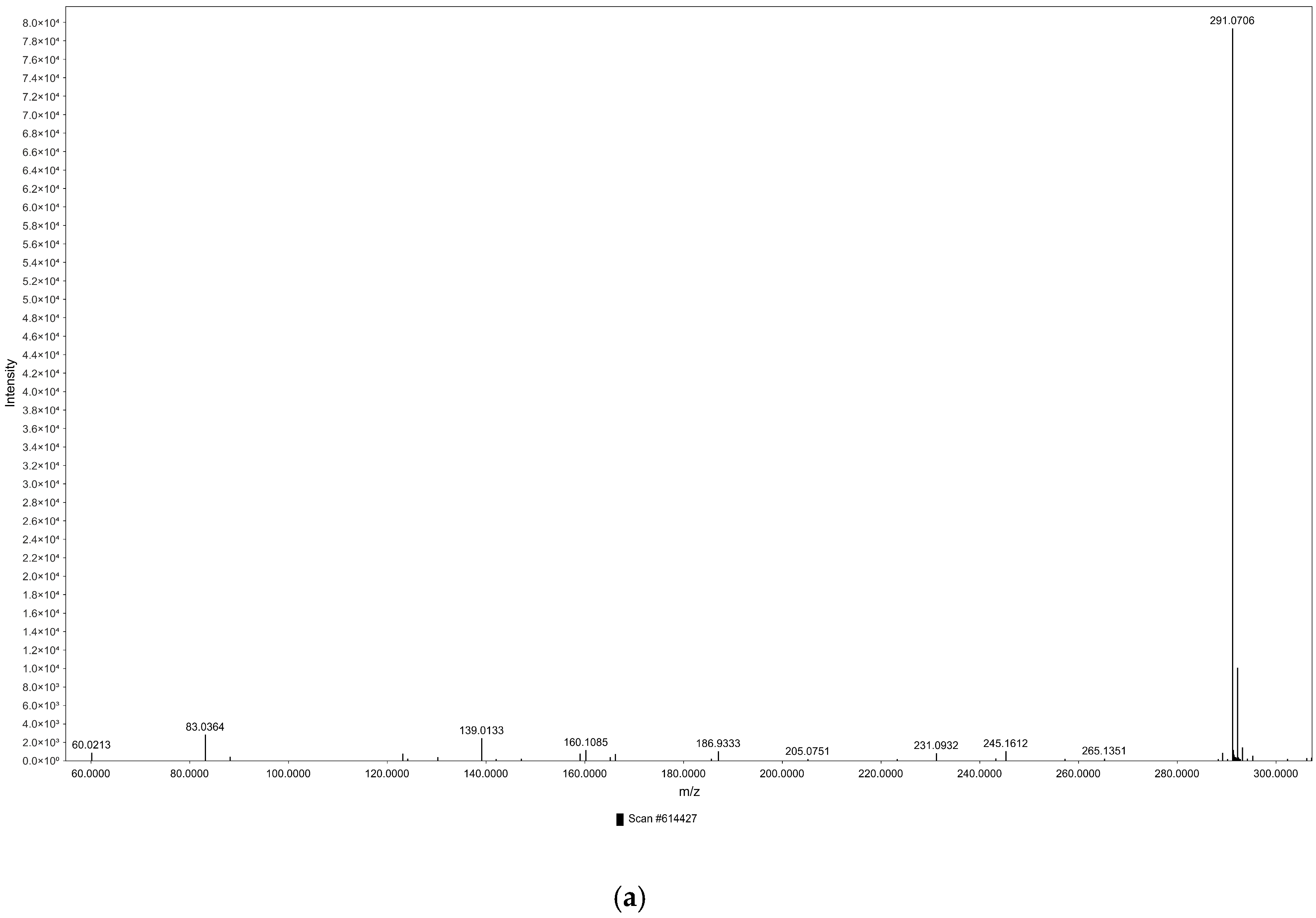
Analysis of fragment characteristics confirms that the compounds belong to flavan-3-ols–catechin and epicatechin (Figure 2 and Figure 3a,b).
The presence of diagnostic fragments at m/z 231, 139, 123, and 245 is consistent with typical degradation mechanisms of catechin and epicatechin, including the retro-Diels–Alder reaction (RDA) and heterocyclic cleavage (HRF). Despite the same mass, the spatial orientation of the OH group at C3 differs, altering the probabilities of RDA and HRF cleavage and the relative intensities of the fragments at m/z 231 and 245.
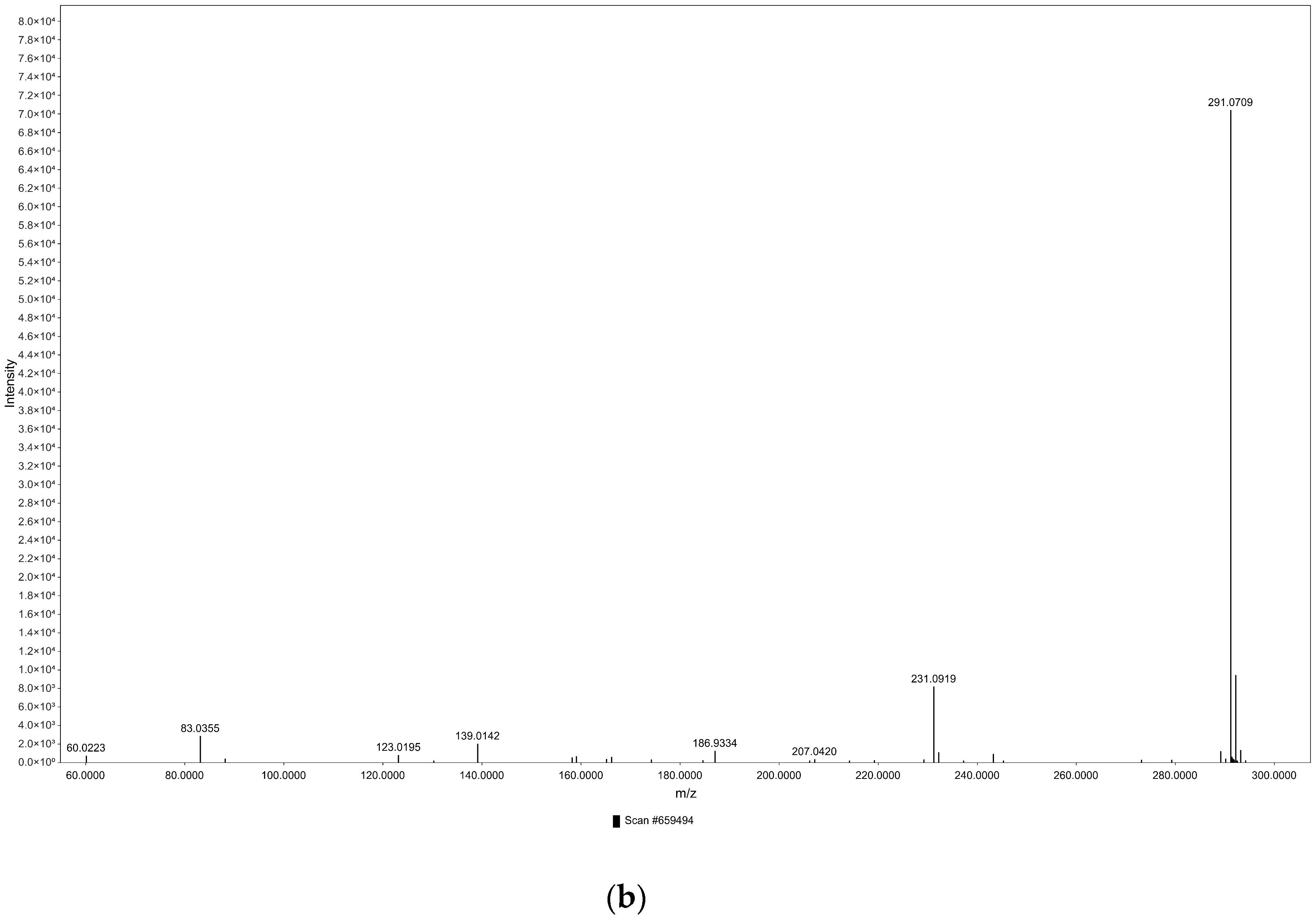
Thus, the [M+H]+ precursor m/z 291.0706–291.0709 coincides with the theoretical mass (291.0863, error 50–55 ppm—typical for QTOF without internal calibration) and corresponds to catechin. The main diagnostic fragments (classic for catechins in positive ESI) are observed, with 139.013–139.014 being very characteristic fragment, obtained by RDA cleavage and fragmentation of the C ring using the Diels-Alder method. In addition, 231.09 m/z indicates the loss of C2H4O2. Fragments at 160.108, 205.075, 245.161, and 265.135 m/z correspond to loss of water and CO, and to fragmentation of ring B.
Almost all fragments are present in both spectra, but there are distinctive features. For example, the spectrum of Rt 10.99 shows a fragment at 231 m/z that is significantly more intense, almost tens of times higher than the precursor. This indicates catechin, as does comparison with the mass spectral library.
The spectrum of Rt 10.24 shows more small fragments (245, 160, 265, and 205 m/z) and is relatively higher at 139 m/z. A literature search indicates that this compound corresponds to epicatechin.
The overall spectral patterns are very similar (for stereoisomers), but there are differences in relative intensities, typical of separation on columns with C18 adsorbent. Epicatechin typically elutes earlier than catechin. Based on the above, both peaks belong to flavan-3-ols. Specifically, peak Rt 10.24 with a precursor at m/z 291.0706 corresponds to epicatechin, while peak Rt 10.99 with a precursor at m/z 291.0709 corresponds to catechin, as confirmed by comparison with the library spectral data.
The combination of high-resolution LC-QTOF-MS/MS accurate mass measurements, molecular formula prediction, and characteristic MS/MS fragmentation patterns provides strong evidence for the tentative identification of catechin in the pomegranate peel extract. Catechin and epicatechin have been widely reported as dominant flavonoids in the pomegranate peel. Works of Monika et al. [70] and Mphahlele et al. [71] corroborate our findings.

3.5. Identification of Phenolic Compounds in AqueousAlcohol Extracts of Grape Pomace

The polyphenolic extracts of mixture of pomace from two grape varieties (Saperavi and Cabernet Sauvignon) were obtained using optimal extraction conditions (a combination of aqueousalcohol extraction and additional ultrasonic treatment) and analyzed for individual phenolic content by HPLC-Q-TOF: ESI (+), MS.
Chromatogram (Figure 4) provided superior separation, and compound identification was based on this dataset. Tandem mass spectrometric analysis in positive ion mode detects 10 major phenolic compounds in the grape pomace aqueous–alcoholic extract (AAE). Notably, five of these compounds were identified in grape pomace for the first time.
The identification of these compounds, including their precursor ion m/z values and diagnostic fragment ions, was accomplished by comparing the experimental results with established data from previously published mass spectrometric studies.
Table 5 describes all the compounds that were tentatively identified in the samples of mixture of pomace from two grape varieties (Saperavi and Cabernet Sauvignon) based on their value from MS spectra in positive ionization mode ([M+H]+), using online mz Cloud, an Advanced Mass Spectral Database. Mass spectra with fragmentation of phenolic compounds described in Table 5 are shown in Supplementary Figure S2.
Based on the observed protonated molecular ion at m/z 319.0448 and the characteristic product ions at m/z 290.0421, 273.0393, and 165.0181, the compound was tentatively identified as myricetin. The fragment ions at m/z 290 and 273 are consistent with dehydration and subsequent CO loss, which are characteristic fragmentation pathways of flavonol aglycones. The fragment at m/z 165 is attributed to the cleavage of the B ring and is commonly observed in the MS/MS spectra of flavonoids. The measured accurate mass, molecular formula (C15H10O8), MS/MS fragmentation pattern, and retention time (Rt = 16.59 min) were in good agreement with published data and public spectral databases, supporting the tentative identification of myricetin. The presence of myricetin and its derivatives in grape pomace has been widely reported, highlighting grape pomace as a valuable source of antioxidant phenolic compounds [72,73].
Additionally, a compound with a protonated molecular ion at m/z 419.0973 and a retention time (Rt) of 13.66 min was tentatively identified as kaempferol 3-O-β-D-xylofuranoside. The MS/MS spectrum showed a characteristic product ion at m/z 287.0448, corresponding to a 132 Da loss, consistent with cleavage of a pentose moiety (xylose) and formation of the kaempferol aglycone. A further fragment at m/z 241.0495 is consistent with the subsequent fragmentation of the aglycone. This fragmentation pattern is characteristic of flavonoid O-glycosides and supports the proposed structural assignment. The measured accurate mass, molecular formula, MS/MS fragmentation pattern, and retention behavior were consistent with the proposed compound. Although direct reports of kaempferol 3-O-β-D-xylofuranoside in grape pomace are currently lacking, related kaempferol glycosides have been identified in grape-derived materials and other plant species [74,75]. These findings further support the presence of diverse flavonoid aglycones and glycosides in grape pomace, highlighting its potential as a valuable source of bioactive phytochemicals.
A compound eluting at Rt 13.05 min with a protonated molecular ion at m/z 449.1116 was tentatively identified as trifolin (kaempferol-3-O-galactoside) based on its accurate mass, molecular formula (C21H20O11), characteristic MS/MS fragmentation pattern, and comparison with the mzCloud spectral library. The prominent product ion at m/z 287.0548 corresponds to the kaempferol aglycone formed after the neutral loss of a hexose residue (162 Da), which is characteristic of kaempferol glycosides. The obtained spectrum showed high similarity to the mz Cloud reference spectrum (confidence score 94.8%), supporting the tentative assignment of this compound as trifolin. The occurrence of trifolin (kaempferol-3-O-galactoside) in grape pomace has previously been reported by Lu and Foo [76], supporting the tentative identification of this compound in the present study.
An ion with molecular formula C27H30O15 and m/z 595.1654 likely indicates the presence of a flavonoid glycoside. It may be kaempferol 3-O-glucoside 7-O-rhamnoside, which belongs to the class of organic compounds known as flavonoid-7-O-glycosides. These phenolic compounds contain a flavonoid moiety that is O-glycosidically linked to a carbohydrate moiety at the C7-position. While direct studies on kaempferol 3-O-beta-glucopyranoside-7-O-alpha-rhamnopyranoside in grape pomace are limited, research on grape pomace reveals the presence of kaempferol and other flavonoid glycosides [77]. As previously mentioned by Kroll et al. [78], a new flavonol glycoside (kaempferol 3-O-beta-glucopyranoside-7-O-alpha-rhamnopyranoside) was found in the alcoholic extract of a plant named Iberis amala L. In our work, this compound was tentatively identified from the AAE of grape pomace.
A compound eluting at Rt 12.52 min with a protonated molecular ion at m/z 303.0499 was tentatively identified as quercetin (C15H10O7). The observed product ions at m/z 285.0393, 257.0444, and 153.0183 are consistent with the characteristic MS/MS fragmentation pattern of quercetin reported in the literature. The measured accurate mass, molecular formula, MS/MS fragmentation pattern, and retention behavior collectively support the tentative assignment of this compound as quercetin. The presence of quercetin in grape pomace has been widely documented, and its presence has been confirmed in several studies, including that of Radulescu et al. [73], highlighting grape pomace as a valuable source of bioactive flavonoids.
Avicularin (quercetin-3-O-α-L-arabinoside) is a naturally occurring flavonol with the molecular formula C20H18O11. Mass spectrometric analysis in positive ion mode showed characteristic fragment ions at m/z 303.0499, 285.0393, and 153.0183. The fragment ion at m/z 153.0183 is attributed to further cleavage of the quercetin skeleton. The observed fragmentation pattern, together with the retention time (12.09 min), supports the tentative identification of quercetin-3-O-α-L-arabinoside in the analyzed sample. To the best of our knowledge, this compound has been only rarely reported in this sample matrix, suggesting that its detection may represent a novel finding.
Furthermore, a compound with m/z 433.1129 and the molecular formula C21H20O10 was tentatively identified as genistin, an isoflavone O-glycoside. In the positive-ion mode, genistin undergoes a characteristic neutral loss of a glucosyl moiety (162 Da), yielding the protonated genistin aglycone at m/z 271. Additional fragment ions at m/z 243, 215, and 150 are consistent with the reported fragmentation pattern of genistin, further supporting this assignment.Although genistin is predominantly associated with soybeans and other legumes, previous studies have reported trace levels of isoflavones in grape-derived materials, particularly in grape seeds [79]. The detection of this compound in the present study is consistent with these observations and suggests that grape pomace may contain minor isoflavonoid constituents.
At a retention time of 10.84 min, a compound with the molecular formula C19H30O8 and a protonated molecular ion at m/z 387.1931 was tentatively assigned as a megastigmane glycoside based on accurate mass and mzCloud spectral matching. The observed fragment ions at m/z 351.17, 225.14, 207.13, 149.09, and 147.11 were consistent with the library spectrum. Megastigmanes (C13norisoprenoids) are naturally occurring terpenoid derivatives that have been isolated from numerous plant species and have attracted considerable attention for their reported antioxidant and hepatoprotective activities [80]. The presence of this class of compounds in grape pomace is plausible, as norisoprenoid glycosides are known secondary metabolites in grape tissues and contribute to the aroma precursor pool of grapes and wines. Although information on this specific megastigmane glycoside in grape pomace is limited, its tentative detection broadens the phytochemical profile of grape-derived by-products and warrants further structural confirmation using authentic standards.
At a retention time of 10.51 min, a compound with the molecular formula C15H14O6 and a protonated molecular ion at m/z 291.0706 was tentatively identified as catechin. The observed MS/MS fragmentation pattern supports this assignment. The fragment ion at m/z 273 corresponds to the loss of a water molecule (−18 Da), which is characteristic of flavan-3-ols. The fragment at m/z 207 is attributed to retro-Diels–Alder (RDA) cleavage of the C ring, a well-established fragmentation pathway of flavonoids. Additional fragment ions at m/z 165 and 139 arise from further cleavage of the flavonoid skeleton, providing additional support for the tentative assignment. These observations are consistent with previous reports by Antonic et al. and Yu and Ahmedna, who identified catechin as one of the major phenolic constituents of grape pomace [38,72].
At a retention time of 8.33 min, a compound with the molecular formula C15H14O7 and a protonated molecular ion at m/z 307.0812 ([M+H]+) was tentatively identified as epigallocatechin (EGC). The observed MS/MS spectrum exhibited characteristic fragment ions at m/z 289, 247, 181, and 139, which are consistent with the reported fragmentation pattern of EGC. The fragment ion at m/z 289 corresponds to the loss of a water molecule (−18 Da), whereas the ions at m/z 247 and 181 arise from subsequent fragmentation of the flavan-3-ol skeleton. These fragmentation characteristics are in good agreement with previously published data [81] and support the tentative assignment of the detected compound as epigallocatechin.

4. Conclusions and Perspectives

The chemical composition of the agro-industrial by-products, grape pomace and pomegranate peel, was comprehensively characterized by HPLC-QTOF-MS/MS. Metabolite profiling revealed the presence of flavones, flavonols, flavonoid glycosides, and polyenylphenols. To the best of our knowledge, kaempferol-3-O-β-D-xylopyranoside, kaempferol-3-O-β-glucopyranoside-7-O-α-rhamnopyranoside, quercetin-3-O-α-L-arabinopyranoside, genistin, and a megastigmane glycoside were tentatively identified in grape pomace extracts for the first time based on accurate mass measurements and characteristic MS/MS fragmentation patterns. Likewise, myricetin and 5-(2Z,8Z)-pentadeca-2,8-dien-1-ylbenzene-1,3-diol were tentatively identified in pomegranate peel extracts and, to the best of our knowledge, have not been previously reported in this matrix.
These findings deepen our understanding of the specialized metabolites present in these underutilized plant-derived residues and further link their biosynthetic origins and chemical diversity to potential functional roles. The data support the feasibility of valorizing agro-industrial waste streams and underscore their relevance to a circular bioeconomy. By converting by-products into valuable phytochemical resources, we contribute to waste reduction, environmental remediation, and sustainable industrial applications.

Supplementary Materials

The following supporting information can be downloaded at: https://www.mdpi.com/article/10.3390/separations13080213/s1, Figure S1: The most remarkable examples of ion chromatogram mass spectra of aqueous-alcohol extraction of pomegranate peel obtained by tandem mass spectrometry in the positive mode; Figure S2: The most remarkable examples of ion chromatogram mass spectra of aqueousalcohol extraction of pomace mixture from two grape varieties (Saperavi and Cabernet Sauvignon) obtained by tandem mass spectrometry in the positive mode.

Author Contributions

G.O.K.: writing original draft, investigation, writing review and editing. A.A.S.: writing—review and editing, supervision, project administration. A.D.M.: writing original draft, formal analysis. U.R.T.: formal analysis, data curation. A.J.P.: methodology, investigation. D.E.K.: methodology, formal analysis. G.M.K.: investigation, data curation. A.A.: investigation, data curation. All authors have read and agreed to the published version of the manuscript.

Funding

This work was performed within the framework of grant funding by Ministry of Education and Science of the Republic of Kazakhstan on topic AP23488383 “Research of effective microorganisms of enzyme producers, enzyme complexes obtained on the basis of genetic and breeding methods for processing of secondary plant raw materials of agro-industrial complex”.

Data Availability Statement

All relevant data are within the manuscript and its Supplementary Materials.

Acknowledgments

We extend our sincere gratitude to all authors who contributed to this study and to the Institute of Bioorganic Chemistry of the Academy of Sciences of the Republic of Uzbekistan for providing the necessary facilities for analysis. Data collection, writing, and editing were made by authors. The academic style of the text was improved using the DeepL Write (web version, free version; DeepL SE, Cologne, Germany) and Grammarly (web version, free version; Grammarly Inc., San Francisco, CA, USA).

Conflicts of Interest

The authors declare no conflicts of interest.

References

  1. Rodrigues, J.P.B.; Liberal, Â.; Petropoulos, S.A.; Ferreira, I.C.F.R.; Oliveira, M.B.P.P.; Fernandes, Â.; Barros, L. Agri-Food Surplus, Waste and Loss as Sustainable Biobased Ingredients: A Review. Molecules 2022, 27, 5200. [Google Scholar] [CrossRef]
  2. Rai, N.; Pavankumar, T.L.; Ghotra, B.; Dhillon, S.; Juneja, V.; Amaly, N.; Pandey, P. Essential Recycling and Repurposing of Food Waste for Environment and Sustainability. Front. Sustain. Food Syst. 2025, 9, 1575113. [Google Scholar] [CrossRef]
  3. Dilucia, F.; Lacivita, V.; Conte, A.; Del Nobile, M.A. Sustainable Use of Fruit and Vegetable By-Products to Enhance Food Packaging Performance. Foods 2020, 9, 857. [Google Scholar] [CrossRef] [PubMed]
  4. Shafiee-Jood, M.; Cai, X. Reducing Food Loss and Waste to Enhance Food Security and Environmental Sustainability. Environ. Sci. Technol. 2016, 50, 8432–8443. [Google Scholar] [CrossRef] [PubMed]
  5. Otles, S.; Despoudi, S.; Bucatariu, C.; Kartal, C. Chapter 1—Food Waste Management, Valorization, and Sustainability in the Food Industry. In Food Waste Recovery; Galanakis, C.M., Ed.; Academic Press: San Diego, CA, USA, 2015; pp. 3–23. ISBN 978-0-12-800351-0. [Google Scholar]
  6. Castrica, M.; Rebucci, R.; Giromini, C.; Tretola, M.; Cattaneo, D.; Baldi, A. Total phenolic content and antioxidant capacity of agri-food waste and by-products. Ital. J. Anim. Sci. 2019, 18, 336–341. [Google Scholar] [CrossRef]
  7. Piccolella, S.; Crescente, G.; Candela, L.; Pacifico, S. Nutraceutical polyphenols: New analytical challenges and opportunities. J. Pharm. Biomed. Anal. 2019, 175, 112774. [Google Scholar] [CrossRef] [PubMed]
  8. Panzella, L.; Napolitano, A. Natural phenol polymers: Recent advances in food and health applications. Antioxidants 2017, 6, 30. [Google Scholar] [CrossRef] [PubMed]
  9. Aslam, M.N.; Lansky, E.P.; Varani, J. Pomegranate as a cosmeceutical source: Pomegranate fractions promote proliferation and procollagen synthesis and inhibit matrix metalloproteinase-1 production in human skin cells. J. Ethnopharmacol. 2006, 103, 311–318. [Google Scholar] [CrossRef] [PubMed]
  10. Zillich, O.V.; Schweiggert-Weisz, U.; Eisner, P.; Kerscher, M. Polyphenols as active ingredients for cosmetic products. Int. J. Cosmet. Sci. 2015, 37, 55–64. [Google Scholar] [CrossRef] [PubMed]
  11. Costa, M.; Sezgin-Bayindir, Z.; Losada-Barreiro, S.; Paiva-Martins, F.; Saso, L.; Bravo-Díaz, C. Polyphenols as Antioxidants for Extending Food Shelf-Life and in the Prevention of Health Diseases: Encapsulation and Interfacial Phenomena. Biomedicines 2021, 9, 1909. [Google Scholar] [CrossRef] [PubMed]
  12. Panzella, L.; Moccia, F.; Nasti, R.; Marzorati, S.; Verotta, L.; Napolitano, A. Bioactive Phenolic Compounds From Agri-Food Wastes: An Update on Green and Sustainable Extraction Methodologies. Front. Nutr. 2020, 7, 60. [Google Scholar] [CrossRef] [PubMed]
  13. Dini, I.; Grumetto, L. Recent Advances in Natural Polyphenol Research. Molecules 2022, 27, 8777. [Google Scholar] [CrossRef] [PubMed]
  14. Dabetic, N.; Todorovic, V.; Malenovic, A.; Sobajic, S.; Markovic, B. Optimization of Extraction and HPLC–MS/MS Profiling of Phenolic Compounds from Red Grape Seed Extracts Using Conventional and Deep Eutectic Solvents. Antioxidants 2022, 11, 1595. [Google Scholar] [CrossRef] [PubMed]
  15. Teixeira, A.; Baenas, N.; Dominguez-Perles, R.; Barros, A.; Rosa, E.; Moreno, D.A.; Garcia-Viguera, C. Natural Bioactive Compounds from Winery By-Products as Health Promoters: A Review. Int. J. Mol. Sci. 2014, 15, 15638–15678. [Google Scholar] [CrossRef] [PubMed]
  16. Hogervorst, C.J.; Uroš, M.; Vladimir, P. 5—Extraction of Bioactive Compounds from Grape Processing By-Products. In Handbook of Grape Processing By-Products; Galanakis, C.M., Ed.; Academic Press: Cambridge, MA, USA, 2017; pp. 105–135. ISBN 9780128098707. [Google Scholar] [CrossRef]
  17. Izaskun, D.; Eduardo, R.; Itziar, E.; Labidi, J.; Patricia, G. 2—The Biorefinery Concept for the Industrial Valorization of Grape Processing By-Products. In Handbook of Grape Processing By-Products; Galanakis, C.M., Ed.; Academic Press: Cambridge, MA, USA, 2017; pp. 29–53. ISBN 9780128098707. [Google Scholar] [CrossRef]
  18. Ribeiro, L.F.; Ribani, R.H.; Francisco, T.M.G.; Soares, A.A.; Pontarolo, R.; Haminiuk, C.W.I. Profile of bioactive compounds from grape pomace (Vitis vinifera and Vitis labrusca) by spectrophotometric, chromatographic and spectral analyses. J. Chromatogr. B 2015, 1007, 72–80. [Google Scholar] [CrossRef] [PubMed]
  19. Caponio, G.R.; Noviello, M.; Calabrese, F.M.; Gambacorta, G.; Giannelli, G.; De Angelis, M. Effects of Grape Pomace Polyphenols and In Vitro Gastrointestinal Digestion on Antimicrobial Activity: Recovery of Bioactive Compounds. Antioxidants 2022, 11, 567. [Google Scholar] [CrossRef] [PubMed]
  20. Ratnasooriya, C.C.; Rupasinghe, H.V. Extraction of phenolic compounds from grapes and their pomace using β-cyclodextrin. Food Chem. 2012, 134, 625–631. [Google Scholar] [CrossRef] [PubMed]
  21. Gabur, G.-D.; Teodosiu, C.; Fighir, D.; Cotea, V.V.; Gabur, I. From Waste to Value in Circular Economy: Valorizing Grape Pomace Waste through Vermicomposting. Agriculture 2024, 14, 1529. [Google Scholar] [CrossRef]
  22. Cano-Lamadrid, M.; Martínez-Zamora, L.; Castillejo, N.; Artés-Hernández, F. From Pomegranate Byproducts Waste to Worth: A Review of Extraction Techniques and Potential Applications for Their Revalorization. Foods 2022, 11, 2596. [Google Scholar] [CrossRef] [PubMed]
  23. Fischer, U.A.; Carle, R.; Kammerer, D.R. Identification and quantification of phenolic compounds from pomegranate (Punica granatum L.) peel, mesocarp, aril and differently produced juices by HPLC-DAD–ESI/MSn. Food Chem. 2011, 127, 807–821. [Google Scholar] [CrossRef] [PubMed]
  24. Verotta, L.; Panzella, L.; Antenucci, S.; Calvenzani, V.; Tomay, F.; Petroni, K.; Caneva, E.; Napolitano, A. Fermented pomegranate wastes as sustainable source of ellagic acid: Antioxidant properties, anti-inflammatory action, and controlled release under simulated digestion conditions. Food Chem. 2018, 246, 129–136. [Google Scholar] [CrossRef] [PubMed]
  25. Andrade, M.A.; Lima, V.; Sanches Silva, A.; Vilarinho, F.; Castilho, M.C.; Khwaldia, K.; Ramos, F. Pomegranate and Grape By-Products and Their Active Compounds: Are They a Valuable Source for Food Applications? Trends Food Sci. Technol. 2019, 86, 68–84. [Google Scholar] [CrossRef]
  26. Saparbekova, A.A.; Kantureyeva, G.O.; Kudasova, D.E.; Konarbayeva, Z.K.; Latif, A.S. Potential of Phenolic Compounds from Pomegranate (Punica granatum L.) by-Product with Significant Antioxidant and Therapeutic Effects: A Narrative Review. Saudi J. Biol. Sci. 2023, 30, 103553. [Google Scholar] [CrossRef] [PubMed]
  27. Doymaz, İ.; Borucu, E.; Kayacan-Çakmakoglu, S.; Sagdic, O. Influence of Infrared Radiation on Drying Characteristics, Total Phenolic Content, Antioxidant Capacity, and Color Properties of Pomegranate Seeds. Period. Polytech. Chem. Eng. 2025, 69, 113–122. [Google Scholar] [CrossRef]
  28. Rajha, H.N.; Koubaa, M.; Boussetta, N.; Maroun, R.G.; Louka, N.; Lebovka, N.; Vorobiev, E. Selective ultrasound-assisted aqueous extraction of polyphenols from pomegranate peels and seeds. J. Food Process. Preserv. 2020, 44, e14545. [Google Scholar] [CrossRef]
  29. Rodrigues, R.P.; Sousa, A.M.; Gando-Ferreira, L.M.; Quina, M.J. Grape Pomace as a Natural Source of Phenolic Compounds: Solvent Screening and Extraction Optimization. Molecules 2023, 28, 2715. [Google Scholar] [CrossRef] [PubMed]
  30. Silva, J.T.d.P.; Borges, M.H.; de Souza, C.A.C.; Fávaro-Trindade, C.S.; Sobral, P.J.d.A.; de Oliveira, A.L.; Martelli-Tosi, M. Grape Pomace Rich-Phenolics and Anthocyanins Extract: Production by Pressurized Liquid Extraction in Intermittent Process and Encapsulation by Spray-Drying. Foods 2024, 13, 279. [Google Scholar] [CrossRef] [PubMed]
  31. Rahnemoon, P.; Jamab, M.; Dakheli, M.; Bostan, A. Phenolic Compounds and Antimicrobial Properties of Pomegranate (Punica granatum) Peel Extracts. World Acad. Sci. Eng. Technol. Int. J. Agric. Biosyst. Eng. 2016, 10, 646–651. [Google Scholar] [CrossRef]
  32. Kantureyeva, G.; Saparbekova, A.; Kudasova, D.; Lomolino, G. Study of the effect of extraction using enzyme preparation—PECTINOL F-RKM0719 on the yield of phenolic substances in pomegranate peel. Rep. Natl. Acad. Sci. Repub. Kazakhstan 2021, 6, 131–138. [Google Scholar] [CrossRef]
  33. Kumar, K.; Srivastav, S.; Sharanagat, V.S. Ultrasound assisted extraction (UAE) of bioactive compounds from fruit and vegetable processing by-products: A review. Ultrason. Sonochem. 2021, 70, 105325. [Google Scholar] [CrossRef] [PubMed]
  34. Eskicioglu, V.; Kamiloglu, S.; Nilufer-Erdil, D. Antioxidant dietary fibres: Potential functional food ingredients from plant processing by-products. Czech J. Food Sci. 2016, 33, 487–499. [Google Scholar] [CrossRef]
  35. Deng, Y.; Wang, W.; Liu, D. Ultrasound-Assisted Accelerated Penetration Extraction of Polyphenols from Pomegranate Peels: Enhanced Mass Transfer by Calcium Ion Precipitation and Utilization of Fick’s Law. Food Bioprocess Technol. 2024, 17, 1017–1029. [Google Scholar] [CrossRef]
  36. Shen, Y.; Kang, B.; Lu, Y.; Du, X.; Qin, C.; Li, J.; Zhao, Z.; Yu, R.; Shi, S.; Han, L. Production of optical pure L-lactic acid from Cabernet Sauvignon grape pomace by engineered Lactiplanti bacillus plantarum. Front. Energy Res. 2023, 11, 1228827. [Google Scholar] [CrossRef]
  37. Barriga-Sánchez, M.; Cáceres Hiparraguirre, H.; Rosales-Hartshorn, M. Chemical composition and mineral content of Black Borgoña (Vitis labrusca L.) grapes, pomace and seeds, and effects of conventional and non-conventional extraction methods on their antioxidant properties. Food Sci. Technol. 2022, 42, e120021. [Google Scholar] [CrossRef]
  38. Antonić, B.; Jančíková, S.; Dordević, D.; Tremlová, B. Grape Pomace Valorization: A Systematic Review and Meta-Analysis. Foods 2020, 9, 1627. [Google Scholar] [CrossRef] [PubMed]
  39. Lou, W.; Li, B.; Grevtseva, N. Preparation of grape pomace powders and analysis of their nutritive compositions. ACTA Innov. 2021, 39, 22–31. [Google Scholar] [CrossRef]
  40. Tikhonova, A.; Ageeva, N.; Globa, E. Grape pomace as a promising source of biologically valuable components. BIO Web Conf. 2021, 34, 06002. [Google Scholar] [CrossRef]
  41. Kalli, E.; Lappa, I.; Bouchagier, P.; Tarantilis, P.A.; Skotti, E. Novel application and industrial exploitation of winery by-products. Bioresour. Bioprocess. 2018, 5, 46. [Google Scholar] [CrossRef]
  42. Mădălina, I.; Mironeasa, S. Potential of grape byproducts as functional ingredients in baked goods and pasta. Compr. Rev. Food Sci. Food Saf. 2020, 19, 2473–2505. [Google Scholar] [CrossRef] [PubMed]
  43. Abd El-Rahman, S.N.; Sandak, R.N. Characteristic Analysis, Antioxidant Components, and Benefits of Pomegranate Peel and Red Onion Skin as Natural Antioxidants on Sunflower Oil Stability. Nov. Tech. Nutr. Food Sci. 2023, 6, 45–54. [Google Scholar] [CrossRef]
  44. Singh, J.; Kaur, H.P.; Verma, A.; Chahal, A.S.; Jajoria, K.; Rasane, P.; Kaur, S.; Kaur, J.; Gunjal, M.; Ercisli, S.; et al. Pomegranate Peel Phytochemistry, Pharmacological Properties, Methods of Extraction, and Its Application: A Comprehensive Review. ACS Omega 2023, 8, 35452–35469. [Google Scholar] [CrossRef] [PubMed]
  45. Hasnaoui, N.; Wathelet, B.; Jiménez-Araujo, A. Valorization of pomegranate peel from 12 cultivars: Dietary fibre composition, antioxidant capacity and functional properties. Food Chem. 2014, 160, 196–203. [Google Scholar] [CrossRef] [PubMed]
  46. Hussain, S.; Jõudu, I.; Bhat, R. Dietary Fiber from Underutilized Plant Resources—A Positive Approach for Valorization of Fruit and Vegetable Wastes. Sustainability 2020, 12, 5401. [Google Scholar] [CrossRef]
  47. Moradi, A.G.; Rahmani, F.; Aziz, A.S.; Qiami, M.F. Effects of feeding pomegranate peel silage on feed intake and growth performance of Turkey bred sheep. Int. J. Agric. Res. Innov. Technol. 2020, 10, 146–154. [Google Scholar] [CrossRef]
  48. Omer, H.A.A.; Abdel-Magid, S.S.; Awadalla, I.M. Nutritional and chemical evaluation of dried pomegranate (Punica granatum L.) peels and studying the impact of level of inclusion in ration formulation on productive performance of growing Ossimi lambs. Bull. Natl. Res. Cent. 2019, 43, 182. [Google Scholar] [CrossRef]
  49. Das, A.K.; Nanda, P.K.; Chowdhury, N.R.; Dandapat, P.; Gagaoua, M.; Chauhan, P.; Pateiro, M.; Lorenzo, J.M. Application of Pomegranate by-Products in Muscle Foods: Oxidative Indices, Colour Stability, Shelf Life and Health Benefits. Molecules 2020, 26, 467. [Google Scholar] [CrossRef] [PubMed]
  50. Ben Youcef, N.; Mameri, N. Valorization of Pomegranate Peels as a Healthy Ingredient to Preserve Orange Juice. Turk. J. Agric.-Food Sci. Technol. 2023, 11, 1038–1045. [Google Scholar] [CrossRef]
  51. Hayder, Z.; Elfalleh, W.; Othman, K.B.; Benabderrahim, M.A.; Hannachi, H. Modeling of polyphenols extraction from pomegranate by-product using rotatable central composite design of experiments. Acta Ecol. Sin. 2020, 41, 150–156. [Google Scholar] [CrossRef]
  52. Peršurić, Ž.; Saftić Martinović, L.; Malenica, M.; Gobin, I.; Pedisić, S.; Dragović-Uzelac, V.; Kraljević Pavelić, S. Assessment of the Biological Activity and Phenolic Composition of Ethanol Extracts of Pomegranate (Punica granatum L.) Peels. Molecules 2020, 25, 5916. [Google Scholar] [CrossRef] [PubMed]
  53. Habchi, C.; Badran, A.; Srour, M.; Daou, A.; Baydoun, E.; Hamade, K.; Hijazi, A. Determination of the Antioxidant and Antiproliferative Properties of Pomegranate Peel Extract Obtained by Ultrasound on HCT-116 Colorectal Cancer Cell Line. Processes 2023, 11, 1111. [Google Scholar] [CrossRef]
  54. Zhang, L.; Zhu, M.; Shi, T.; Guo, C.; Huang, Y.; Chen, Y.; Xie, M. Recovery of dietary fiber and polyphenol from grape juice pomace and evaluation of their functional properties and polyphenol compositions. Food Funct. 2017, 8, 341–351. [Google Scholar] [CrossRef] [PubMed]
  55. Grosu, A.C.; Diguță, F.C.; Pristavu, M.-C.; Popa, A.; Badea, F.; DragoiCudalbeanu, M.; Orțan, A.; Dopcea, I.; Băbeanu, N. ExploringthePhytochemicalProfiles, and Antioxidant and AntimicrobialActivitiesoftheHydroethanolic Grape PomaceExtractsfromTwoRomanianIndigenousVarieties. Fermentation 2024, 10, 470. [Google Scholar] [CrossRef]
  56. Kumar, N.; Neeraj, D. Study on physico-chemical and antioxidant properties of pomegranate peel. J. Pharmacogn. Phytochem. 2018, 7, 2141–2147. Available online: https://www.researchgate.net/publication/325654068_Study_on_physico-chemical_and_antioxidant_properties_of_pomegranate_peel (accessed on 9 July 2026). [CrossRef]
  57. Da Rocha, C.B.; Noreña, C.P.Z. Microwave-Assisted Extraction and Ultrasound-Assisted Extraction of Bioactive Compounds from Grape Pomace. Int. J. Food Eng. 2020, 16, 20190191. [Google Scholar] [CrossRef]
  58. Mazza, K.E.; Santiago, M.C.; do Nascimento, L.S.; Godoy, R.L.; Souza, E.F.; Brígida, A.I.S.; Borguini, R.G.; Tonon, R.V. Syrah grape skin valorisation using ultrasound-assisted extraction: Phenolic compounds recovery, antioxidant capacity and phenolic profile. Int. J. Food Sci. Technol. 2019, 54, 641–650. [Google Scholar] [CrossRef]
  59. Drevelegka, I.; Goula, A.M. Recovery of grape pomace phenolic compounds through optimized extraction and adsorption processes. Chem. Eng. Process.—Process Intensif. 2020, 149, 107845. [Google Scholar] [CrossRef]
  60. Dimitrov, K.; Pradal, D.; Vauchel, P.; Baouche, B.; Nikov, I.; Dhulster, P. Modeling and optimization of extraction and energy consumption during Ultrasound-Assisted Extraction of antioxidant polyphenols from pomegranate peels. Environ. Prog. Sustain. Energy 2019, 38, 13148. [Google Scholar] [CrossRef]
  61. Saparbekova, A.; Kantureyeva, G.; Matchanov, A.; Kaldybekova, G. Study of antioxidant and antibacterial activity of plant technical raw materials for use in food and pharmacological purposes. Microbiol. Virol. 2025, 1, 255–268. [Google Scholar] [CrossRef]
  62. Matchanov, A.D.; Dalimov, D.N.; Zainutdinov, U.N.; Vypova, N.L.; Islamov, A.K.; Bekpolatova, B.M. Preparation and physicochemical and biological properties of molecular associates of lagochilin and lagochirsine with glycyrrhizic acid and its monoammonium salt. Chem. Nat. Compd. 2017, 53, 665–669. [Google Scholar] [CrossRef]
  63. Matchanov, U.; Saydullaeva, K.; Esanov, R.; Sobirova, F.; Raxmonov, B.; Baratov, Q.; Tagayalieva, N.; Matchanov, A.; Eshimbetov, A.; Togaev, U. Preparation and biological activity of molecular complexes based on secondary metabolites of Glycyrrhiza glabra L. and Sophora japonica L. New Mater. Compd. Appl. 2026, 10, 121–137. [Google Scholar] [CrossRef]
  64. Madrakhimova, S.D.; Matmuratov, B.Y.; Yunuskhuja, Y.T.; Jumaniyazova, M.E.; Togaev, U.; Matchanov, A.D. Polyphenols from Cydonia oblonga Miller leaves: Extraction, characterization, and biological activities. Ann. Phytomed. Int. J. 2025, 14, 754–759. [Google Scholar] [CrossRef]
  65. Cao, H.; Yi, L.; Zhong, J.; Högger, P.; Wang, M.; Prieto, M.A.; Simal-Gandara, J.; Xiao, J. Investigation of new products and reaction kinetics for myricetin in DMEM via an in situ UPLC–MS–MS analysis. Food Front. 2020, 1, 243–252. [Google Scholar] [CrossRef]
  66. Sulaiman, C.T.; Gopalakrishnan, V.K. Liquid Chromatography Coupled with Q-TOF Mass Spectrometry for the Characterization of Phenolics from Acacia Catechu. Chem. Nat. Compd. 2014, 50, 360–362. [Google Scholar] [CrossRef]
  67. Man, G.; Xu, L.; Wang, Y.; Liao, X.; Xu, Z. Profiling Phenolic Composition in Pomegranate Peel From Nine Selected Cultivars Using HPLC-QTOF-MS and UPLC-QQQ-MS. Front. Nutr. 2022, 8, 807447. [Google Scholar] [CrossRef] [PubMed]
  68. Plumb, G.W.; de Pascual-Teresa, S.; Santos-Buelga, C.; Rivas-Gonzalo, J.C.; Williamson, G. Antioxidant properties of gallocatechin and prodelphinidins from pomegranate peel. Redox Rep. 2002, 7, 41–46. [Google Scholar] [CrossRef] [PubMed]
  69. Shi, W.; Liu, L.; Li, J.; Qu, L.; Pang, X.; Yu, H.; Zhang, Y.; Wang, T. Bioactive flavonoids from Flos Sophorae. J. Nat. Med. 2017, 71, 513–522. [Google Scholar] [CrossRef] [PubMed]
  70. Monika, P.; Chandraprabha, M.N.; Murthy, K.N.C. Catechin, epicatechin, curcumin, garlic, pomegranate peel and neem extracts of Indian origin showed enhanced anti-inflammatory potential in human primary acute and chronic wound derived fibroblasts by decreasing TGF-β and TNF-α expression. BMC Complement. Med. Ther. 2023, 23, 181. [Google Scholar] [CrossRef] [PubMed]
  71. Mphahlele, R.R.; Fawole, O.A.; Mokwena, L.M.; Opara, U.L. Effect of extraction method on chemical, volatile composition and antioxidant properties of pomegranate juice. S. Afr. J. Bot. 2016, 103, 135–144. [Google Scholar] [CrossRef]
  72. Yu, J.; Ahmedna, M. Functional components of grape pomace: Their composition, biological properties and potential applications. Int. J. Food Sci. Technol. 2012, 48, 221–237. [Google Scholar] [CrossRef]
  73. Radulescu, C.; Olteanu, R.L.; Buruleanu, C.L.; Dulama, I.D.; Stirbescu, R.M.; Bucurica, I.A.; Stanescu, S.G.; Banica, A.L. Polyphenolic Screening and the Antioxidant Activity of Grape Pomace Extracts of Romanian White and Red Grape Varieties. Antioxidants 2024, 13, 1133. [Google Scholar] [CrossRef] [PubMed]
  74. Diantini, A.; Subarnas, A.; Lestari, K.; Halimah, E.; Susilawati, Y.; SupriyatnaJulaeha, E.; Achmad, T.H.; Suradji, E.W.; Yamazaki, C.; Kobayashi, K.; et al. Kaempferol-3-O-rhamnoside isolated from the leaves of Schima wallichii Korth. inhibits MCF-7 breast cancer cell proliferation through activation of the caspase cascade pathway. Oncol. Lett. 2012, 3, 1069–1072. [Google Scholar] [CrossRef] [PubMed]
  75. Zhou, P.; Ma, Y.Y.; Peng, J.Z.; Hua, F. Kaempferol-3-O-Rutinoside: A Natural Flavonoid Glycosides with Multifaceted Therapeutic Potential. Neurochem. J. 2023, 17, 247–252. [Google Scholar] [CrossRef]
  76. Lu, Y.; Foo, L.Y. The Polyphenol Constituents of Grape Pomace. Food Chem. 1999, 65, 1–8. [Google Scholar] [CrossRef]
  77. Rodriguez-Rodriguez, R.; Justo, M.L.; Claro, C.M.; Vila, E.; Parrado, J.; Herrera, M.D.; De Sotomayor, M.A. Endothelium-dependent vasodilator and antioxidant properties of a novel enzymatic extract of grape pomace from wine industrial waste. Food Chem. 2012, 135, 1044–1051. [Google Scholar] [CrossRef] [PubMed]
  78. Kroll, U.; Reif, K.; Lederer, I.; Förster, G.; Zapp, J. Kaempferol-3,4′-di-O-beta-glucopyranoside-7-O-alpha-rhamnopyranoside as a new flavonoid from Iberis amara L. Die Pharm. 2009, 64, 142–144. [Google Scholar] [CrossRef]
  79. Bettaiah, A.; Prabhushankar, H.B. Screening of Novel Source for Genistein by Rapid and Sensitive UPLC-APCI-TOF Mass Spectrometry. Int. J. Food Sci. 2021, 2021, 5537917. [Google Scholar] [CrossRef] [PubMed]
  80. Rao, A.S. Isolation, absolute configuration and bioactivities of megastigmanes or C13 isonorterpinoides. Chem. Int. 2017, 3, 69–91. Available online: https://www.academia.edu/27021779/Isolation_absolute_configuration_and_bioactivities_of_megastigmanes_or_C13_isonorterpinoides (accessed on 9 July 2026).
  81. Jiang, C.; Gates, P.J. Systematic Characterization of the Fragmentation of Flavonoids Using High-Resolution Accurate Mass Electrospray Tandem Mass Spectrometry. Molecules 2024, 29, 5246. [Google Scholar] [CrossRef] [PubMed]
Figure 1. Total ion chromatogram (TIC) of pomegranate peel extract obtained by HPLC-Q-TOF-MS/MS analysis in positive electrospray ionization mode (ESI+). The main detected ions and tentative compound identifications are presented in Table 4.
Separations 13 00213 g001
Figure 2. EIC of 291.071 m/z at the Rt 10.24 (Epicatechin) and 10.99 (Catechin).
Separations 13 00213 g002
Figure 4. Total ion chromatogram (TIC) of grape pomace extract obtained by HPLC-Q-TOF-MS/MS analysis in positive electrospray ionization mode (ESI+). The main detected ions and tentative compound identifications are presented in Table 5.
Separations 13 00213 g004
Figure 3. (a) Catechin fragment ions (Rt 10.99); (b) Epicatechin fragment ions (Rt 10.24).
Separations 13 00213 g003aSeparations 13 00213 g003b
Table 1. Chemical composition of Saperavi (V. vinifera), Cabernet Sauvignon (V. vinifera) grape pomace.
IndicatorsGP of Saperavi (V. vinifera)GP of Cabernet Sauvignon
(V. vinifera)
Moisture Content, %6.87 ± 0.157.00 ± 0.20
Ash Content, g/100 g4.63 ± 0.045.55 ± 0.05
Fat, g/100 g4.38 ± 0.038.16 ± 0.015
Protein, g/100 g13.90 ± 0.1012.35 ± 0.05
Dietary Fiber, g/100 g51.38 ± 0.0246.15 ± 0.07
Carbohydrate Content, g/100 g19.63 ± 0.0429.30 ± 0.05
Results are presented as a mean ± SD of triplicate analyses.
Table 2. Chemical composition of dried powder of pomegranate peel.
IndicatorsExperimental Sample[43,46] *[44,45] *
Moisture Content, %12.83 ± 0.15nd **8.43–13.80
Ash Content, g/100 g2.8 ± 0.054.213.35–6.07
Fat, g/100 g0.2 ± 0.010.780.55–3.36
Protein, g/100 g3.47 ± 0.052.003.24–3.46
Dietary Fiber, g/100 g30.0 ± 0.41nd33.10–62.09
Carbohydrate Content, g/100 g60.81 ± 0.1876.1259.52–61.34
Results are presented as a mean ± SD of triplicate analysis. * For comparison, literature values are provided. ** Note: nd = not determined.
Table 3. Total phenolic and flavonoid content of pomegranate peel and grape pomace extracts.
Samples StudiedTotal Phenolic Content
(TPC), (mg/GAE g Extract)
Total Flavonoid Content (TFC), (mg/Q g Extract)
No. 1 (PP AAE)136.3 ± 0.947.6 ± 1.0
No. 2 (PP AE)225.5 ± 1.492.1 ± 0.8
No. 3 (Cabernet Sauvignon GPAAE)98.6 ± 0.844.7 ± 0.7
No. 4 (Cabernet Sauvignon GPAE)32.13 ± 0.410.8 ± 0.4
No. 5 (Saperavi GP AAE)153.9 ± 1.254.7 ± 0.7
No. 6 (Saperavi GP AE)99.4 ± 0.533.3 ± 0.5
Data are expressed as a mean ± SD (n = 3).
Table 4. Characterization of phenolic compounds in pomegranate peel extract samples by LC-QTOF-MS (ESI+ Ionization).
NoProposed Compounds *RT (min)Molecular FormulaNeutral Monoisotopic Mass (Da)Calculated m/z ([M+H]+)Observed m/z ([M+H]+)MS-MS Fragmentation
1** Myricetin16.49C15H10O8318.0376319.0449319.0448301.0342, 273.0393
2** 5 2Z 8Z 2 8 Pentadecadien 1 yl 1 3 benzenediol15.36C21H32O2316.2402317.2475317.2475149.0597
163.0754
3Isoquercitrin12.41C21H20O12464.0955465.1028465.1028303.05
4Miquelianin12.36C21H18O13478.0747479.0820479.0842303.05
5Catechin gallate12.38C22H18O10442.0900443.0973443.0945291, 153, 137
6Rhamnetin11.89C16H12O7316.0583 *317.0656317.068086.0321, 81.0335
7Catechin ***10.99C15H14O6290.0790291.0863291.0709123.041, 165.0546, 207.0652
8Epicatechin ***10.24C15H14O6290.0790291.0863291.0706123.041, 165.0546, 207.0652
* All compounds listed in Table 4 were tentatively identified by high-resolution LC-QTOF-MS/MS based on accurate mass, molecular formula prediction, MS/MS fragmentation, and database matching. No authentic reference standards were used for confirmation. ** Despite the absence of any mention of these compounds in the existing literature concerning pomegranate peel, the findings of this work suggest its presence. This finding may represent a new discovery that would benefit from further study and confirmation. *** Both compounds have the same molecular weight and formula but differ in retention time, confirming the existence of isomeric forms of catechin (Trans configuration at C-2 and C-3 has catechin and Cis configuration at C-2,C-3 has epicatechin).
Table 5. Characterization of phenolic compounds of grape pomace extract samples by LC-QTOF-MS (ESI+ Ionization).
NoProposed Compounds *RT (min)Molecular FormulaNeutral Monoisotopic Mass (Da)Calculated m/z ([M+H]+)Observed m/z ([M+H]+)MS-MS Fragmentation
1Myricetin16.59C15H10O8318.0376319.0449319.0448290.0421
273.0393 165.0181
2Kaempferol 3-O-beta-D-xylofuranoside *13.66C20H18O10418.0900419.0973419.0972287.0448
241.0495
153.0186
121.0289
3Kaempferol-3-O-galactoside13.05C21H20O11448.1006449.1079449.1116287.0546
4Kaempferol 3-O-beta-glucopyranoside-7-O-alpha-rhamnopyranoside *12.67C27H30O15594.1585595.1658595.1654287.0550
449.1078
5Quercetin12.52C15H10O7302.0426303.0499303.0499153.0183
257.0444
285.0393
6Quercetin-3-O-α-L-arabinoside *12.09C20H18O11434.0849435.0922435.0921303. 0499
285.0393
153.0183
7Genistin *11.04C21H20O10432.1056433.1129433.1129271.06
243.06
215.07
8Megastigmane glycoside *10.84C19H30O8386.1941387.2014387.1931351.17
207.13
225.14
149.09
147.11
9Catechin10.51C15H14O6290.0790291.0863291.0863273.07 207.06
165.05 139.03
10Epigallocatechin8.33C15H14O7306.0740307.0812307.0812289. 07 181.04
139.03
* Compounds tentatively identified from grape pomace for the first time.
Disclaimer/Publisher’s Note: The statements, opinions and data contained in all publications are solely those of the individual author(s) and contributor(s) and not of MDPI and/or the editor(s). MDPI and/or the editor(s) disclaim responsibility for any injury to people or property resulting from any ideas, methods, instructions or products referred to in the content.