
The Effects of Outlet Diameter on Particle Movement and Separation Performance of the Cylindrical Hydrocyclone

 ,
,
Abstract
1. Introduction
2. Simulation Method and Conditions
2.1. Model Description
2.2. Model Adaptability
2.3. Simulation Conditions
3. Results and Discussion
3.1. Partition Curve
3.2. Particle Velocity Distribution
3.2.1. Tangential Velocity
3.2.2. Axial Velocity
3.3. Particle Circulation Flow
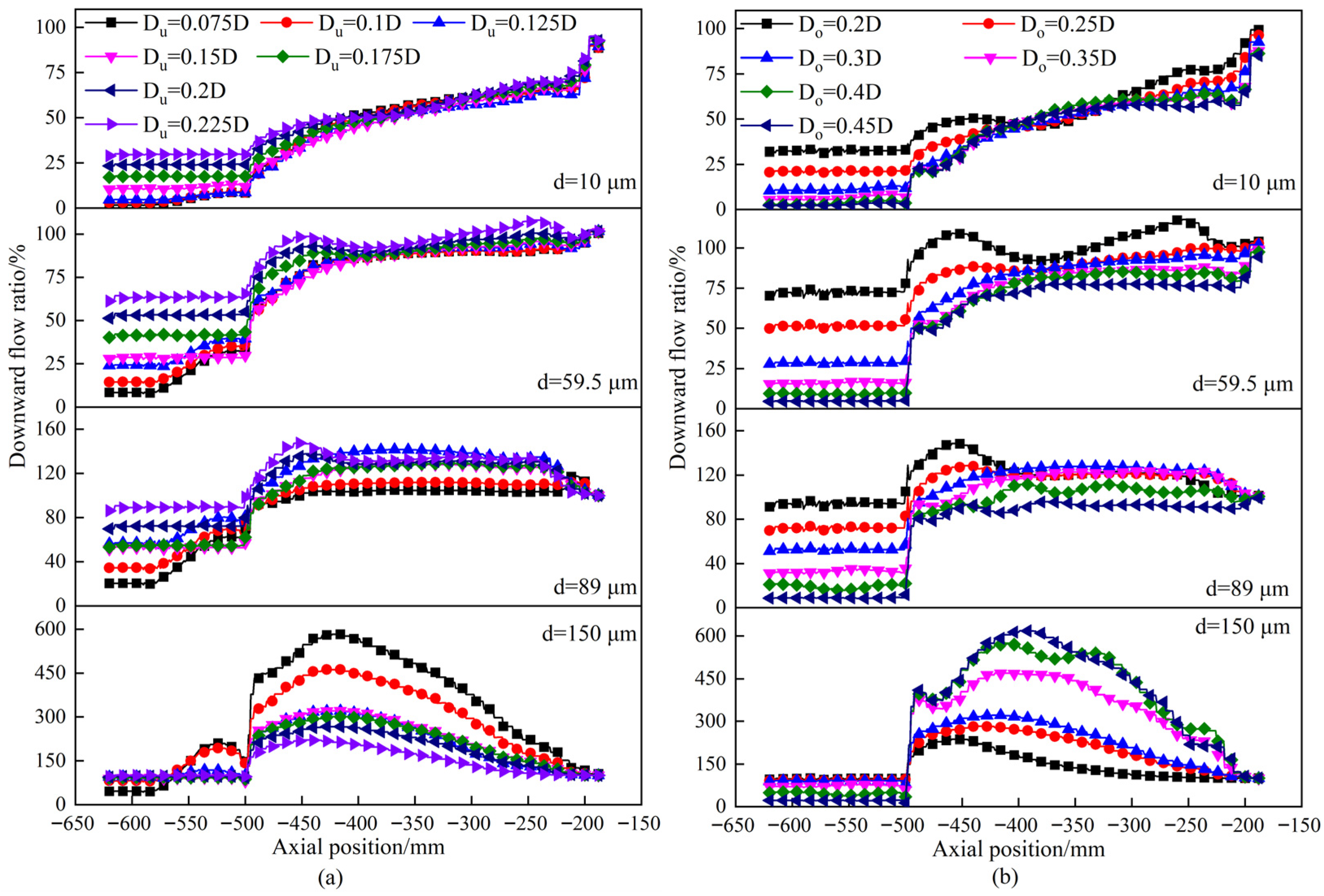
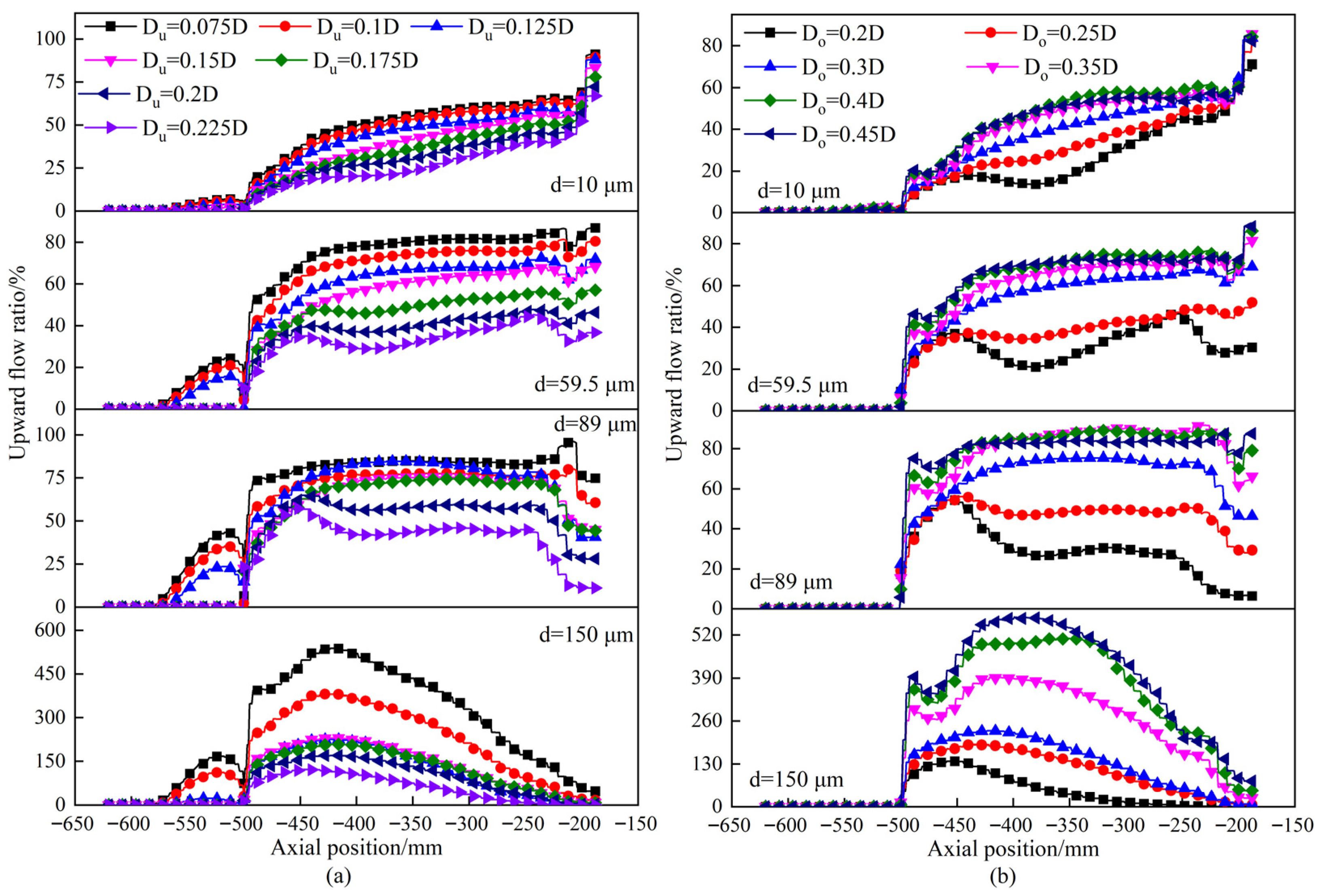
3.3.1. Downward Flow Ratio and Upward Flow Ratio
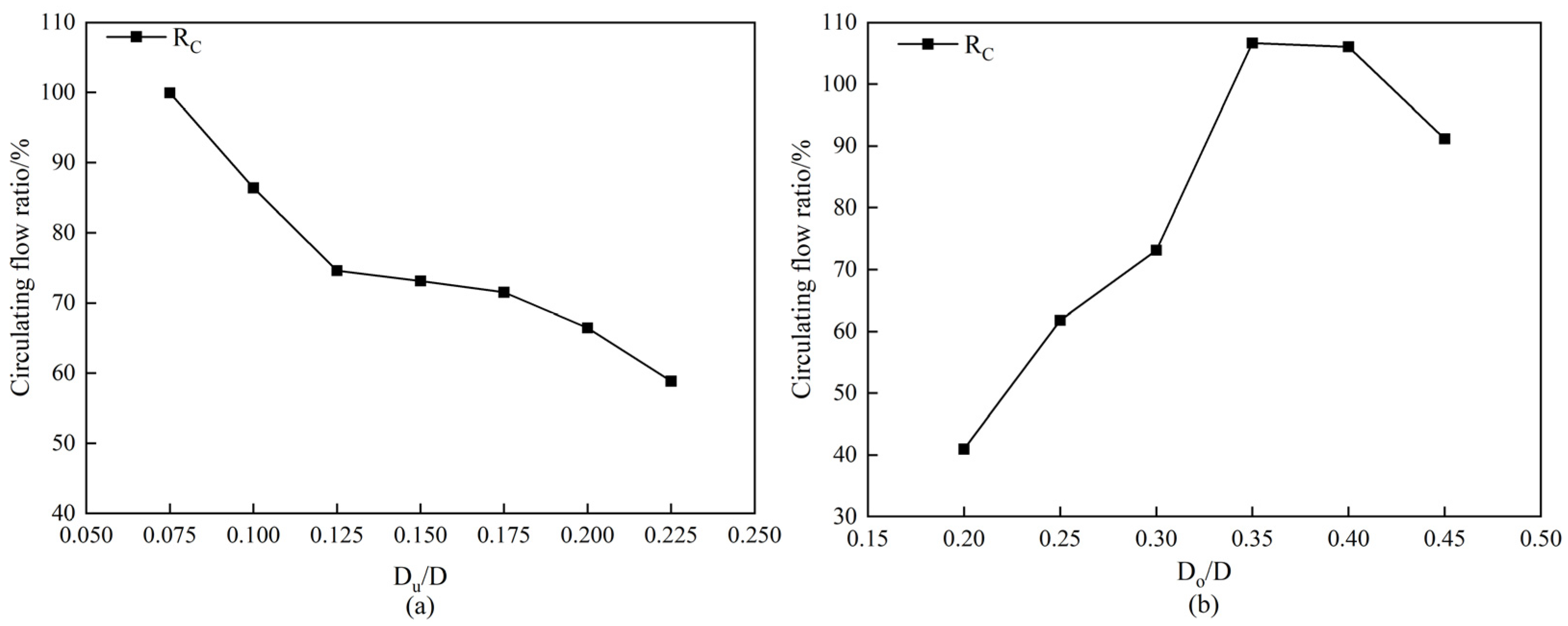
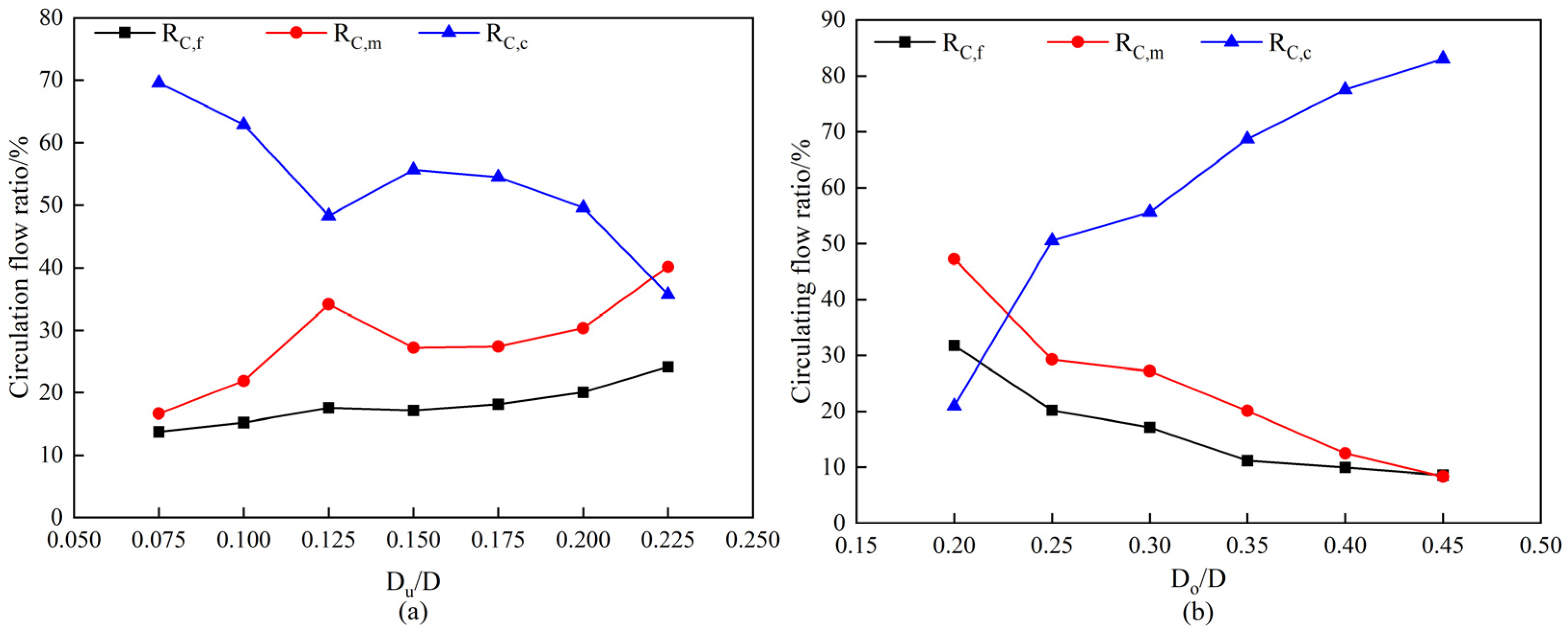
3.3.2. Circulation Flow Ratio and Circulation Flow Proportion
3.4. Particle Size Distribution
4. Conclusions
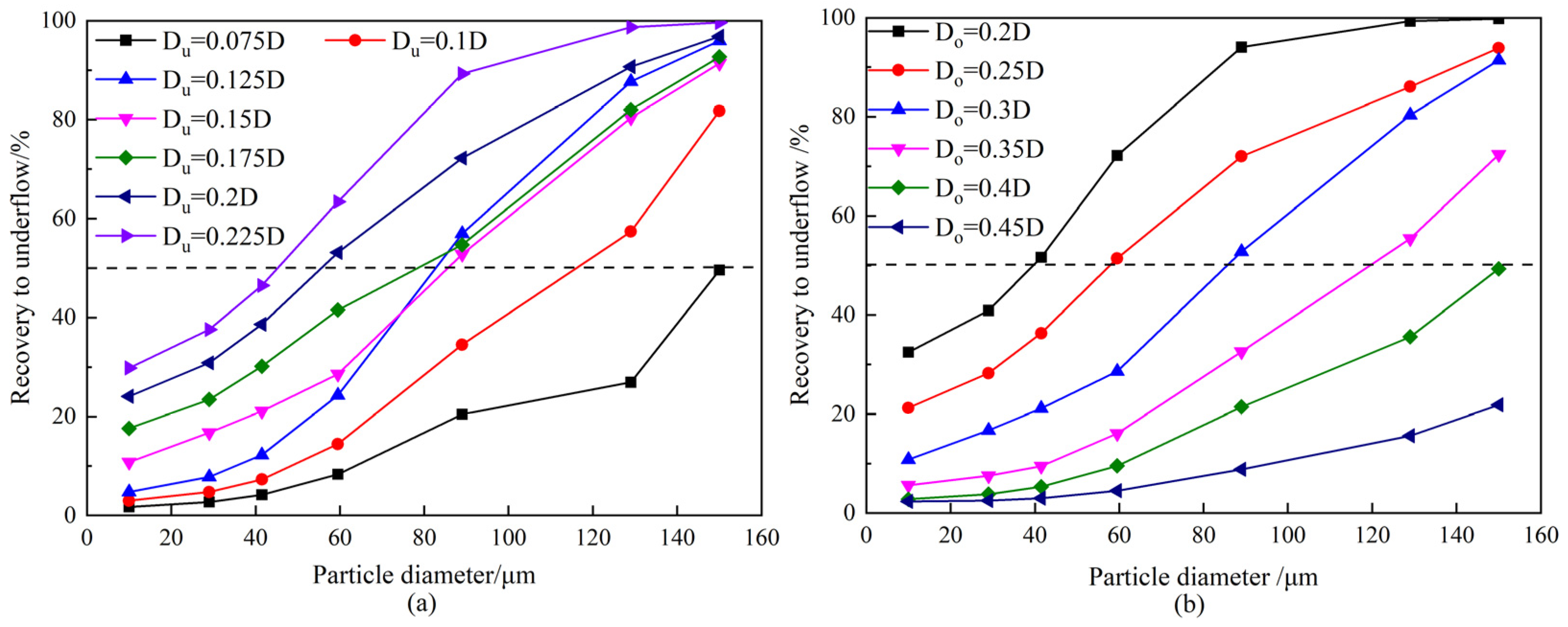
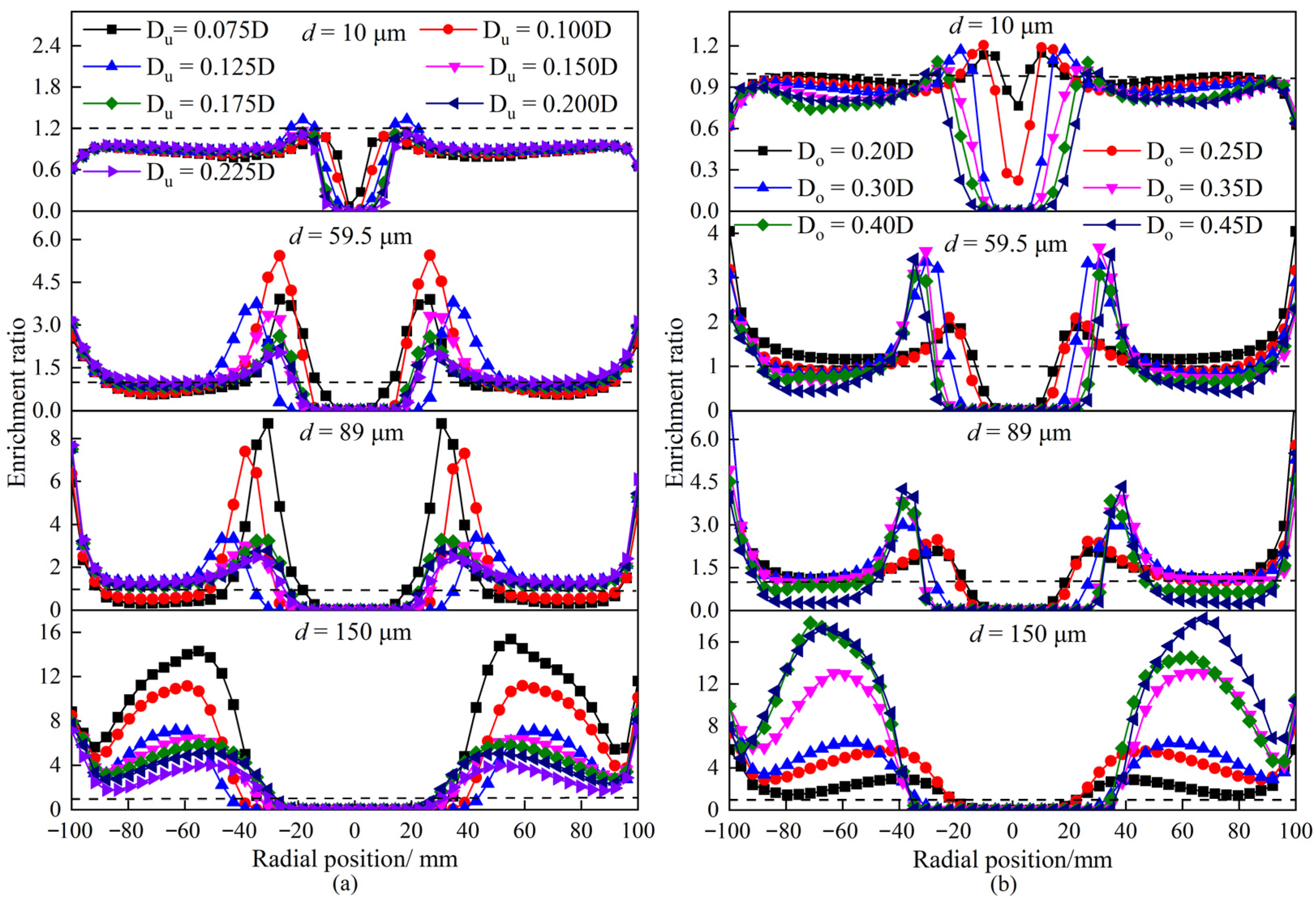
- Except for Du = 0.125 D, either increasing the spigot diameter or decreasing the vortex finder diameter increases the particle recovery rate in the underflow. With Du = 0.075 D and Do ≥ 0.4 D, the particle recovery rate for every size in the underflow is below 50%, resulting in severe particle misplacement.
- Both reducing the spigot diameter and increasing the vortex finder diameter increase the cut size, but appropriately reducing the spigot diameter and appropriately increasing the vortex finder diameter contribute to minimizing Ep and I, enhancing the separation accuracy.
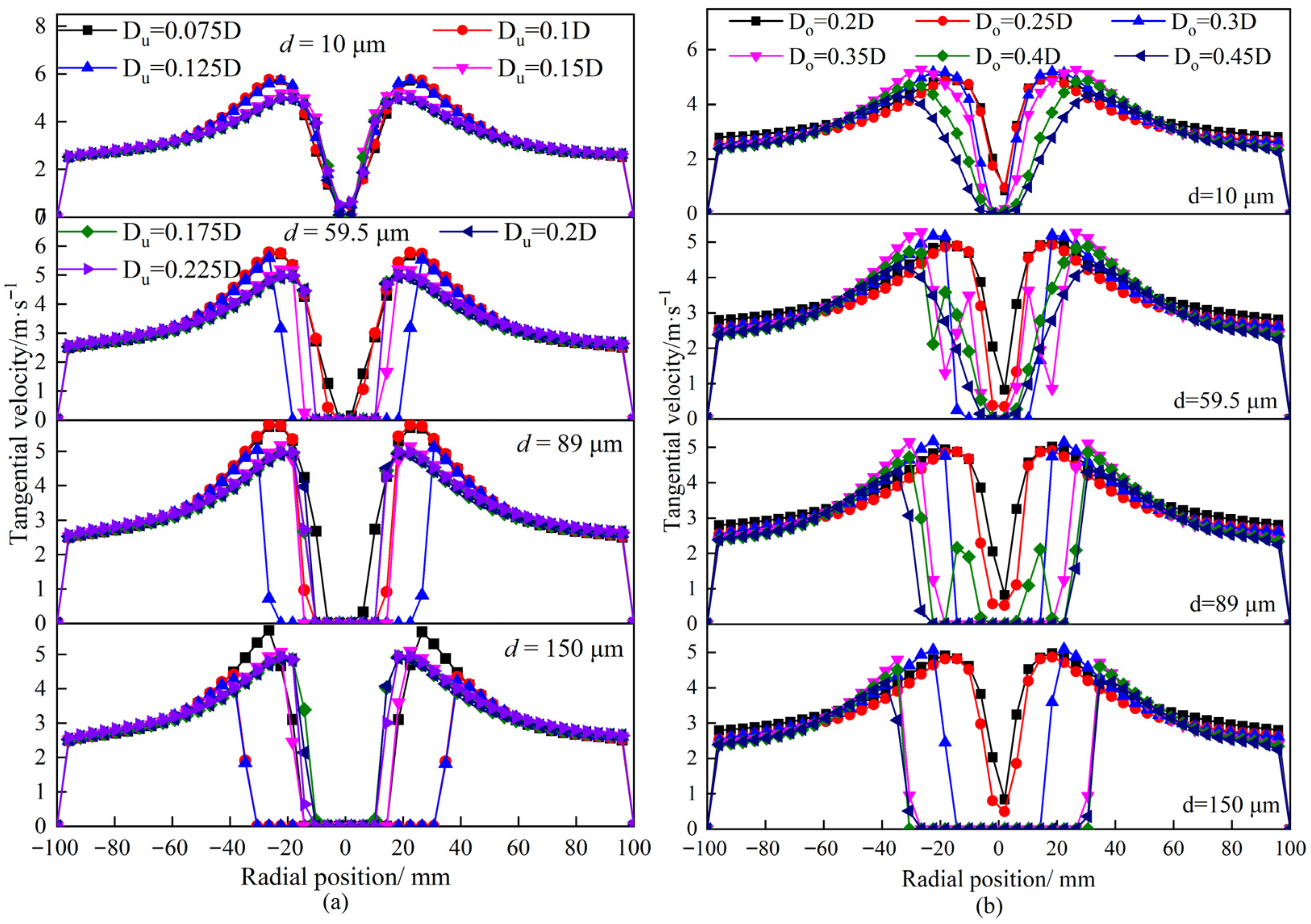
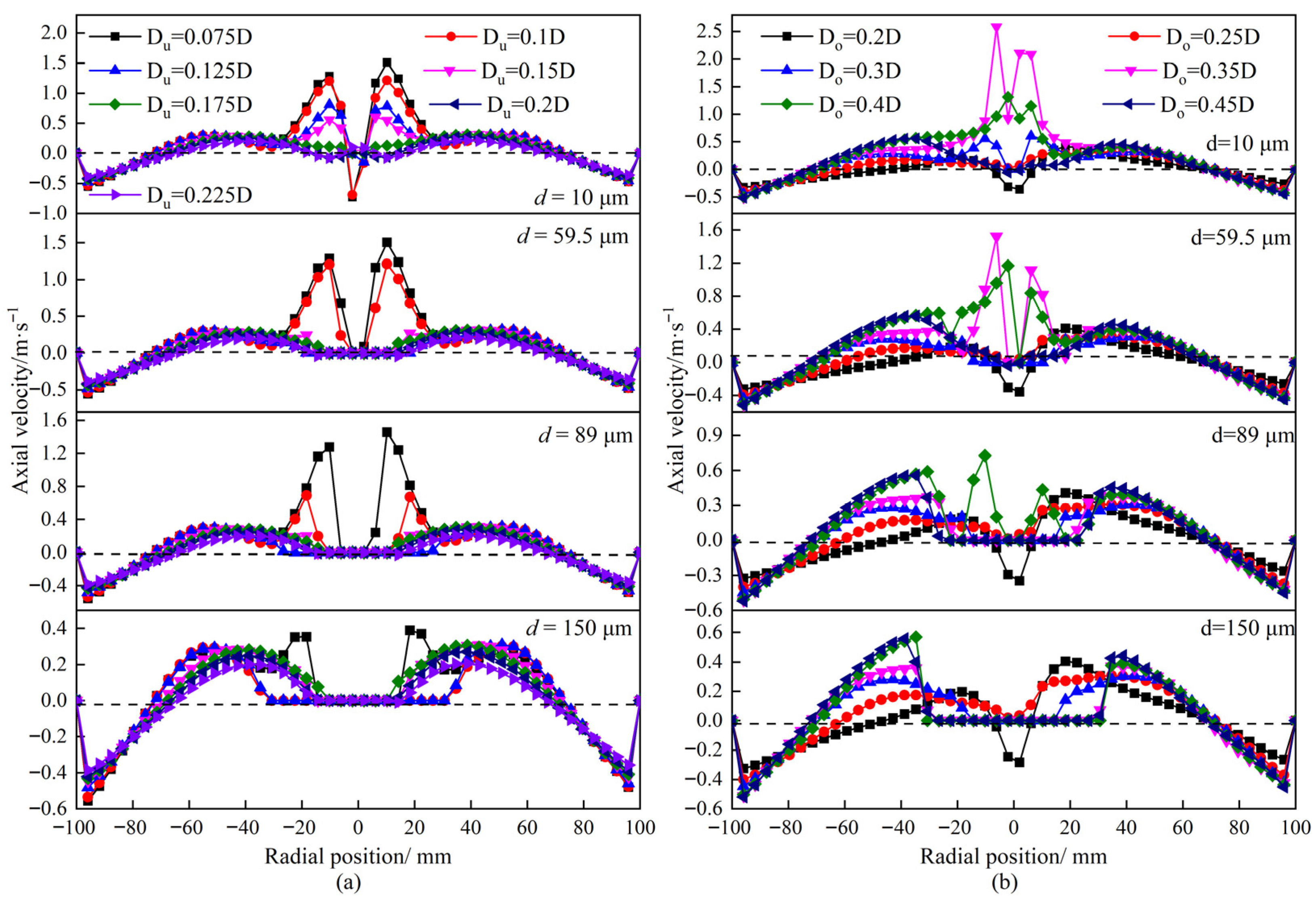
- The impact of outlet diameter on particle tangential velocity is concentrated in the region around the air core. Increasing the spigot diameter and decreasing the vortex finder diameter both reduce the particle axial velocity, promoting the LZVV migration toward the axis, thereby increasing the particle recovery rate in the underflow.
- Decreasing the spigot diameter and increasing the vortex finder diameter increase the circulation flow ratio and the coarse particle circulation flow proportion, thereby increasing the coarse particle enrichment ratio and consequently increasing the separation size.
Supplementary Materials
Author Contributions
Funding
Data Availability Statement
Conflicts of Interest
References
- Wei, Q.; Xiong, Z.; Zhao, J.; Huang, Y.; Huang, Y.; Lv, W.; Wang, H. In-situ reduction of heavy metal contaminated soil by hydrocyclone based on axial sorting of particles. J. Hazard. Mater. 2025, 491, 137912. [Google Scholar] [CrossRef] [Scilit] [PubMed]
- Tsamoutsoglou, K.; Kechagias, A.; Katzourakis, V.E.; Chrysikopoulos, C.V.; Gikas, P. Investigation and efficiency estimation of a hydrocyclone for the treatment of primary municipal wastewater. J. Environ. Manag. 2025, 380, 125134. [Google Scholar] [CrossRef] [Scilit]
- Trisap, W.; Photaworn, S.; Khongprom, P. Impact of Hydrocyclone Geometry on Glycerol Separation Efficiency in Biodiesel Purification. Int. J. Chem. Eng. 2025, 2025, 1758062. [Google Scholar] [CrossRef] [Scilit]
- Pukkella, A.K.; Vega-Garcia, D.; Hadler, K.; Cilliers, J. The influence of surface-wall roughness on hydrocyclone performance. Sep. Purif. Technol. 2025, 360, 131109. [Google Scholar] [CrossRef] [Scilit]
- Hwang, K.-J.; Wu, W.-H.; Qian, S.; Nagase, Y. Nagase†, CFD Study on the Effect of Hydrocyclone Structure on the Separation Efficiency of Fine Particles. Sep. Sci. Technol. 2008, 43, 3777–3797. [Google Scholar] [CrossRef] [Scilit]
- Liu, X.-L.; Chen, J.-Y.; Cao, M.-Q.; Ma, X.; Zhang, H.-B. Study on the effect of particle shape on underflow entrainment in hydrocyclone. Sep. Sci. Technol. 2025, 60, 723–736. [Google Scholar] [CrossRef] [Scilit]
- Gonçalves, M.S.; Barrozo, M.A.S.; Vieira, L.G.M. Effects of Solids Concentration and Underflow Diameter on the Performance of a Newly Designed Hydrocyclone. Chem. Eng. Technol. 2017, 40, 1750–1757. [Google Scholar] [CrossRef] [Scilit]
- Xu, Y.; Song, X.; Sun, Z.; Tang, B.; Li, P.; Yu, J. Numerical Investigation of the Effect of the Ratio of the Vortex-Finder Diameter to the Spigot Diameter on the Steady State of the Air Core in a Hydrocyclone. Ind. Eng. Chem. Res. 2013, 52, 5470–5478. [Google Scholar] [CrossRef] [Scilit]
- Kyriakidis, Y.N.; Silva, D.O.; Barrozo, M.A.S.; Vieira, L.G.M. Effect of variables related to the separation performance of a hydrocyclone with unprecedented geometric relationships. Powder Technol. 2018, 338, 645–653. [Google Scholar] [CrossRef] [Scilit]
- Zhang, C.; Cui, B.; Wei, D.; Lu, S. Effects of underflow orifice diameter on the hydrocyclone separation performance with different feed size distributions. Powder Technol. 2019, 355, 481–494. [Google Scholar] [CrossRef] [Scilit]
- Tian, J.; Ni, L.; Song, T.; Shen, C.; Yao, Y.; Zhao, J. Numerical study of foulant-water separation using hydrocyclones enhanced by reflux device: Effect of underflow pipe diameter. Sep. Purif. Technol. 2019, 215, 10–24. [Google Scholar] [CrossRef] [Scilit]
- Liu, P.; Chen, B.; Hou, D.; Yang, X.; Zhang, W.; Lu, Y. Designing the Spigot Structure of Hydrocyclones to Reduce Fine Particle Misplacement in Underflow. Water 2024, 16, 1070. [Google Scholar] [CrossRef] [Scilit]
- Hou, D.; Cui, B.; Zhao, Q.; Wei, D.; Song, Z.; Feng, Y. Research on the structure of the cylindrical hydrocyclone spigot to mitigate the misplacement of particles. Powder Technol. 2021, 387, 61–71. [Google Scholar] [CrossRef] [Scilit]
- Jiang, L.; Liu, P.; Yang, X.; Zhang, Y.; Li, X.; Zhang, Y.; Wang, H. Effect of Overflow Pipe on the Internal Flow Fields and Separation Performance of W-Shaped Hydrocyclones. Minerals 2020, 10, 329. [Google Scholar] [CrossRef] [Scilit]
- Han, T.; Liu, H.; Xiao, H.; Chen, A.; Huang, Q. Experimental study of the effects of apex section internals and conical section length on the performance of solid–liquid hydrocyclone. Chem. Eng. Res. Des. 2019, 145, 12–18. [Google Scholar] [CrossRef] [Scilit]
- Vega-Garcia, D.; Cilliers, J.J.; Brito-Parada, P.R. CFD modelling of particle classification in mini-hydrocyclones. Sep. Purif. Technol. 2020, 251, 117253. [Google Scholar] [CrossRef] [Scilit]
- Vieira, L.G.; Barrozo, M.A. Effect of vortex finder diameter on the performance of a novel hydrocyclone separator. Miner. Eng. 2014, 57, 50–56. [Google Scholar] [CrossRef] [Scilit]
- Su, T.; Zhang, Y. Effect of the Vortex Finder and Feed Parameters on the Short-Circuit Flow and Separation Performance of a Hydrocyclone. Processes 2022, 10, 771. [Google Scholar] [CrossRef] [Scilit]
- Ghodrat, M.; Kuang, S.; Yu, A.; Vince, A.; Barnett, G.; Barnett, P. Numerical analysis of hydrocyclones with different vortex finder configurations. Miner. Eng. 2014, 63, 125–138. [Google Scholar] [CrossRef] [Scilit]
- Martínez, L.F.; Lavín, A.G.; Mahamud, M.M.; Bueno, J.L. Vortex finder optimum length in hydrocyclone separation. Chem. Eng. Process. Process Intensif. 2008, 47, 192–199. [Google Scholar] [CrossRef] [Scilit]
- Tian, J.; Ni, L.; Song, T.; Zhao, J. CFD simulation of hydrocyclone-separation performance influenced by reflux device and different vortex-finder lengths. Sep. Purif. Technol. 2020, 233, 116013. [Google Scholar] [CrossRef] [Scilit]
- Zhao, Q.; Cui, B.; Wei, D.; Song, T.; Feng, Y. Numerical analysis of the flow field and separation performance in hydrocyclones with different vortex finder wall thickness. Powder Technol. 2019, 345, 478–491. [Google Scholar] [CrossRef] [Scilit]
- Wu, Z.; Liang, Z.; Li, P.; Li, F.; Yang, H. Effect of Vortex Finder Wall Thickness on Internal Flow Field and Classification Performance in a Hydrocyclone. Separations 2025, 12, 149. [Google Scholar] [CrossRef] [Scilit]
- Tang, B.; Xu, Y.; Song, X.; Sun, Z.; Yu, J. Numerical study on the relationship between high sharpness and configurations of the vortex finder of a hydrocyclone by central composite design. Chem. Eng. J. 2015, 278, 504–516. [Google Scholar] [CrossRef] [Scilit]
- Wang, B.; Yu, A. Numerical study of the gas–liquid–solid flow in hydrocyclones with different configuration of vortex finder. Chem. Eng. J. 2008, 135, 33–42. [Google Scholar] [CrossRef] [Scilit]
- Hwang, K.-J.; Chou, S.-P. Designing vortex finder structure for improving the particle separation efficiency of a hydrocyclone. Sep. Purif. Technol. 2017, 172, 76–84. [Google Scholar] [CrossRef] [Scilit]
- Wang, C.-C.; Wu, R.-M. Experimental and simulation of a novel hydrocyclone-tubular membrane as overflow pipe. Sep. Purif. Technol. 2018, 198, 60–67. [Google Scholar] [CrossRef] [Scilit]
- Zhao, W.; Li, J.-P.; Zhang, T.; Wei, A.-S.; Li, S.-Y.; Yang, D.-H.; Yang, X.-J.; Jiang, X.; Wang, H. Separation characters of dewatering hydrocyclone with annular vortex finder based on particle image velocimetry and experiments. Sep. Purif. Technol. 2025, 353, 128619. [Google Scholar] [CrossRef] [Scilit]
- Quteishat, M.A.K. Hydrocyclone flow characteristics and measurements. Flow Meas. Instrum. 2020, 73, 101741. [Google Scholar] [CrossRef] [Scilit]
- Marins, L.P.; Duarte, D.G.; Loureiro, J.B.; Moraes, C.A.; Freire, A.S. LDA and PIV characterization of the flow in a hydrocyclone without an air-core. J. Pet. Sci. Eng. 2010, 70, 168–176. [Google Scholar] [CrossRef] [Scilit]
- Chang, Y.F.; Ilea, C.G.; Aasen, Ø.L.; Hoffmann, A.C. Particle flow in a hydrocyclone investigated by positron emission particle tracking. Chem. Eng. Sci. 2011, 66, 4203–4211. [Google Scholar] [CrossRef] [Scilit]
- Dianyu, E.; Fan, H.; Su, Z.; Xu, G.; Zou, R.; Yu, A.; Kuang, S. Numerical study of the multiphase flows and separation performance of hydrocyclone with tapered cross-section inlet. Powder Technol. 2023, 416, 118208. [Google Scholar]
- Fang, X.; Wang, G.; Zhong, L.; Qiu, S.; Wang, D. A CFD–DEM analysis of the de-cementation behavior of weakly cemented gas hydrate–bearing sediments in a hydrocyclone separator. Part. Sci. Technol. 2022, 40, 812–823. [Google Scholar] [CrossRef] [Scilit]
- Ghodrat, M.; Qi, Z.; Kuang, S.B.; Ji, L.; Yu, A.B. Computational investigation of the effect of particle density on the multiphase flows and performance of hydrocyclone. Miner. Eng. 2016, 90, 55–69. [Google Scholar] [CrossRef] [Scilit]
- Dianyu, E.; Xu, G.; Fan, H.; Cui, J.; Tan, C.; Zhang, Y.; Zou, R.; Kuang, S.; Yu, A. Numerical investigation of hydrocyclone inlet configurations for improving separation performance. Powder Technol. 2024, 434, 119384. [Google Scholar] [CrossRef] [Scilit]
- Vakamalla, T.R.; Mangadoddy, N. Numerical simulation of industrial hydrocyclones performance: Role of turbulence modelling. Sep. Purif. Technol. 2017, 176, 23–39. [Google Scholar] [CrossRef] [Scilit]
- Corrêa, R.G.; Andrade, J.R.; de Souza, F.J. Improving Separation Prediction of Cyclone Separators with a Hybrid URANS-LES Turbulence Model. Powders 2023, 2, 607–623. [Google Scholar] [CrossRef] [Scilit]
- Zhang, S.; Zhao, L.; Zhou, L.; Liu, L.; Jiang, M. Numerical and experimental study on enhanced oil–water separation performance using hydrocyclone coupled with particles. Phys. Fluids 2023, 35, 113331. [Google Scholar] [CrossRef] [Scilit]
- Martins, D.A.d.M.; Andrade, J.R.; Duarte, C.A.R.; Salvo, R.d.V.; de Souza, F.J. A Large Eddy Simulation Study of Cyclones: The Effects of Interparticle Collisions on Erosion Prediction. J. Energy Power Technol. 2022, 4, 17. [Google Scholar] [CrossRef] [Scilit]
- Hou, D.; Zhao, Q.; Liu, P.; Jiang, L.; Cui, B.; Wei, D. Effects of bottom profile on the circulation and classification of particles in cylindrical hydrocyclones. Adv. Powder Technol. 2023, 34, 104050. [Google Scholar] [CrossRef] [Scilit]
- Hou, D.; Zhao, Q.; Cui, B.; Wei, D.; Song, Z.; Feng, Y. Geometrical configuration of hydrocyclone for improving the separation performance. Adv. Powder Technol. 2022, 33, 103419. [Google Scholar] [CrossRef] [Scilit]





| Du | 0.075 D | 0.1 D | 0.125 D | 0.15 D | 0.175 D | 0.2 D | 0.225 D |
|---|---|---|---|---|---|---|---|
| d50/μm | >150 | 116.14 | 82.77 | 85.35 | 78.30 | 55.91 | 44.9 |
| Ep/μm | - | 34.69 | 26.37 | 35.12 | 43.64 | 41.63 | - |
| I | - | 0.3 | 0.32 | 0.41 | 0.56 | 0.74 | - |
| Do | 0.2 D | 0.25 D | 0.3 D | 0.35 D | 0.4 D | 0.45 D |
|---|---|---|---|---|---|---|
| d50/μm | 39.8 | 57.43 | 85.35 | 120.68 | >150 | >150 |
| Ep/μm | - | 38.86 | 35.12 | - | - | - |
| I | - | 0.68 | 0.41 | - | - | - |
Disclaimer/Publisher’s Note: The statements, opinions and data contained in all publications are solely those of the individual author(s) and contributor(s) and not of MDPI and/or the editor(s). MDPI and/or the editor(s) disclaim responsibility for any injury to people or property resulting from any ideas, methods, instructions or products referred to in the content. |
© 2026 by the authors. Licensee MDPI, Basel, Switzerland. This article is an open access article distributed under the terms and conditions of the Creative Commons Attribution (CC BY) license.
Share and Cite
Hou, D.; Wang, H.; Hou, D.; Zhu, H.; Song, H.; Deng, H.; Shao, Q. The Effects of Outlet Diameter on Particle Movement and Separation Performance of the Cylindrical Hydrocyclone. Separations 2026, 13, 151. https://doi.org/10.3390/separations13050151
Hou D, Wang H, Hou D, Zhu H, Song H, Deng H, Shao Q. The Effects of Outlet Diameter on Particle Movement and Separation Performance of the Cylindrical Hydrocyclone. Separations. 2026; 13(5):151. https://doi.org/10.3390/separations13050151
Chicago/Turabian StyleHou, Duanxu, Haihao Wang, Daqing Hou, Hongying Zhu, Hongrun Song, Honghe Deng, and Qingguo Shao. 2026. "The Effects of Outlet Diameter on Particle Movement and Separation Performance of the Cylindrical Hydrocyclone" Separations 13, no. 5: 151. https://doi.org/10.3390/separations13050151
APA StyleHou, D., Wang, H., Hou, D., Zhu, H., Song, H., Deng, H., & Shao, Q. (2026). The Effects of Outlet Diameter on Particle Movement and Separation Performance of the Cylindrical Hydrocyclone. Separations, 13(5), 151. https://doi.org/10.3390/separations13050151