Article

Influence of Anionic Polyacrylamide Molecular Weight on Ultrafine Hematite Flocculation: Mechanistic Insights from Experiments and Molecular Dynamics Simulations


1
School of Resources and Civil Engineering, Northeastern University, Shenyang 110819, China
2
State Key Laboratory of Mineral Processing Science and Technology, Beijing 100160, China
3
State Key Laboratory of Intelligent Optimized Manufacturing in Mining & Metallurgy Process, Beijing 100160, China
*
Authors to whom correspondence should be addressed.
Separations 2026, 13(3), 80; https://doi.org/10.3390/separations13030080
Submission received: 1 December 2025 / Revised: 7 January 2026 / Accepted: 23 January 2026 / Published: 1 March 2026
(This article belongs to the Special Issue Advances in Technologies Used for Mineral Separation)

Abstract

Ultrafine hematite particles (<10 μm), commonly generated in beneficiation circuits, exhibit poor flocculation and slow settling, posing challenges for solid–liquid separation. This study investigates the influence of the anionic polyacrylamide (APAM) molecular weight on ultrafine hematite flocculation under controlled laboratory conditions, combining macroscopic experiments with molecular dynamics simulations (MDSs). Sedimentation tests show that the APAM molecular weight strongly affects settling kinetics, supernatant clarity, and floc structure, with the settling rate, flocculation-stage reaction time, supernatant turbidity, and underflow concentration exhibiting a non-monotonic trend and optimal performance at seven million. Under this condition, particles aggregate most efficiently, achieving a turbidity of 182 NTU, an underflow concentration of 51.5%, and the largest compact flocs, averaging 379.8 μm with a fractal dimension of 1.71. Higher molecular weights (≥9 million) induce chain coiling, reduce floc compactness, increase water retention, and impair settling. MDS indicates that polymer–surface interactions improve with an increasing polymerisation degree only up to an intermediate chain length; a polymerisation degree of 30 exhibits the most favourable extended–flexible conformation, maximal surface enrichment, strongest coordination between carboxyl groups and surface Fe atoms, lowest adsorption energy, and fastest adsorption kinetics. The functional-group distribution and hydrogen-bond analyses show that –NH2 and –COO groups dominate interfacial interactions, with a polymerisation degree of 30 yielding the highest density of interfacial hydrogen bonds. By correlating macroscopic experiments with molecular-scale observations, this work provides mechanistic insight into how the APAM chain length governs ultrafine hematite flocculation, highlighting the role of polymer conformation and multipoint adsorption in controlling the settling performance.

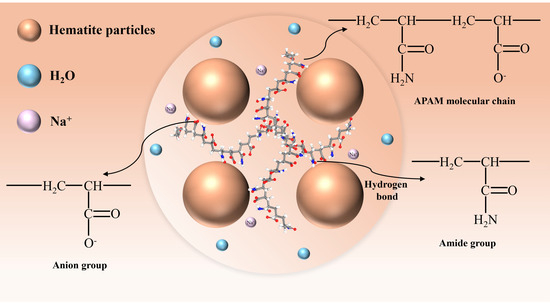
Graphical Abstract

1. Introduction

Hematite is a key iron ore resource, and its efficient recovery is critical for maintaining a stable raw material supply in the steel industry [1,2,3]. In industrial operations such as the filtration–thickening process at the Ansteel Group in China, ultrafine hematite particles (<10 μm) are commonly present in the filtrate. These particles settle very slowly and form weak flocs, leading to high suspended solids in recycled water, reduced recovery efficiency, and progressive accumulation in beneficiation circuits, which can further impair water quality and upstream grinding and flotation [4]. Although bulk hematite (Fe2O3) is not highly toxic, the accumulation of ultrafine particles can elevate iron concentrations and complicate tailings management, posing potential safety risks [5,6]. Therefore, achieving efficient flocculation and sedimentation of ultrafine hematite remains a major challenge, and understanding mineral–flocculant interactions is essential for process optimisation, resource utilisation, and safe concentrator operation [7,8,9,10].
Ultrafine hematite particles (<10 μm) present greater challenges for flocculation than coarser mineral systems. Their high specific surface area results in dense surface hydroxyl groups and strongly bound hydration layers, which hinder particle–particle contact and water release during settling [4]. Brownian motion dominates over gravity, causing slow settling and shear-sensitive flocs. Additionally, the surface charge is highly sensitive to the pH and solution chemistry, amplifying electrostatic repulsion and meaning flocculation behaviour is strongly dependent on polymer characteristics [11]. These features distinguish ultrafine hematite from other fine mineral systems and require targeted investigation under controlled conditions.
Flocculation–sedimentation, as a core step in fine mineral recovery, is governed by multiple factors, including mineral surface properties, flocculant types, and dosing conditions [12,13,14]. In recent years, extensive studies on hematite and other fine mineral systems have examined the effects of the flocculant species, slurry pH, concentration, and temperature on the flocculation performance [4,15,16]. Among various flocculants, anionic polyacrylamide (APAM) is widely employed in industrial beneficiation due to its strong bridging capability and interfacial adsorption affinity [17,18,19,20]. Existing studies have demonstrated that the physicochemical properties of flocculants fundamentally regulate the particle adsorption behaviour, floc structure, and settling kinetics, with the molecular weight being one of the most influential parameters affecting the APAM performance [21,22].
The influence of the APAM molecular weight on the flocculation of fine minerals has been reported for a range of mineral systems [23,24]. Moderate-molecular-weight APAM has been shown to promote effective interparticle bridging, enhance internal floc cohesion, and facilitate the formation of larger and relatively compact aggregates, thereby improving settling rates and reducing supernatant turbidity [25,26,27]. Such molecular weights may also optimise floc porosity and water-release behaviour, contributing to an improved thickening performance [28,29]. However, when the molecular weight becomes excessively high, polymer chains tend to adopt coiled conformations in solution, limiting effective chain extension and increasing local slurry viscosity. These effects can reduce adsorption efficiency, increase floc water retention, and ultimately deteriorate the sedimentation performance [30,31]. Moreover, variations in mineral surface charge, hydroxyl group abundance, and specific surface area can strongly modulate molecular-weight-dependent flocculation behaviour, leading to system-specific differences in the apparent optimal molecular weight [32,33]. Although fine mineral systems such as copper ores, ilmenite, and manganese ores have been investigated [34,35,36], systematic studies focusing on ultrafine hematite (<10 μm) remain limited [37,38]. In particular, the mechanistic linkages among polymer chain conformation, multipoint adsorption, and macroscopic settling behaviour are not yet fully resolved.
In industrial hematite beneficiation, alkaline conditions (pH ≈ 12) are common due to lime addition. Under these conditions, hematite surface hydroxyls deprotonate, yielding a negatively charged surface, while APAM carboxyl groups largely deprotonate to –COO, making the polymer strongly anionic [26]. Despite enhanced electrostatic repulsion, adsorption proceeds via coordination between carboxylates and surface Fe sites, and hydrogen bonding with surface hydroxyls and amide groups. These non-electrostatic mechanisms enable multipoint polymer attachment and interparticle bridging, shifting the dominant adsorption mechanism from electrostatic attraction to coordination- and hydrogen-bond-mediated interactions [39].
To elucidate the microscopic mechanisms underlying APAM molecular-weight effects, cross-scale research strategies have attracted increasing attention in recent years [40]. Molecular dynamics simulations (MDSs) enable atomic-scale examination of adsorption configurations, polymer conformations, hydrogen-bond networks, and intermolecular interactions between flocculants and mineral surfaces [41,42,43]. Owing to computational limitations in time and length scales, direct simulation of industrial APAM chains containing millions of monomer units remains infeasible, and shortened polymer segments are therefore employed to capture relative mechanistic trends [44]. To enhance mechanistic interpretation, integrating macroscopic experiments with microscopic simulations has become a widely adopted approach [45]. In this context, molecular observables such as polymer conformation descriptors, interfacial adsorption energy, functional-group coordination, and hydrogen-bond characteristics provide essential insights into how molecular-scale interactions regulate the floc structure and settling behaviour, while focusing on qualitative trends rather than quantitative equivalence.
Based on these considerations, this study investigates flocculation–sedimentation of ultrafine hematite (<10 μm) with APAM of different molecular weights under controlled laboratory conditions. We hypothesise that intermediate chain lengths favour extended, flexible conformations, enhancing surface contact and bridging, whereas shorter or excessively long chains reduce flocculation efficiency due to insufficient connectivity or coiling. This hypothesis is examined through macroscopic experiments (settling, turbidity, floc concentration, and morphology) and molecular-scale observations from MDS, providing mechanistic insight into the chain-length-dependent flocculation of ultrafine hematite under alkaline conditions and improving our understanding of solid–liquid separation in mineral beneficiation.

2. Materials and Methods

2.1. Materials and Reagents

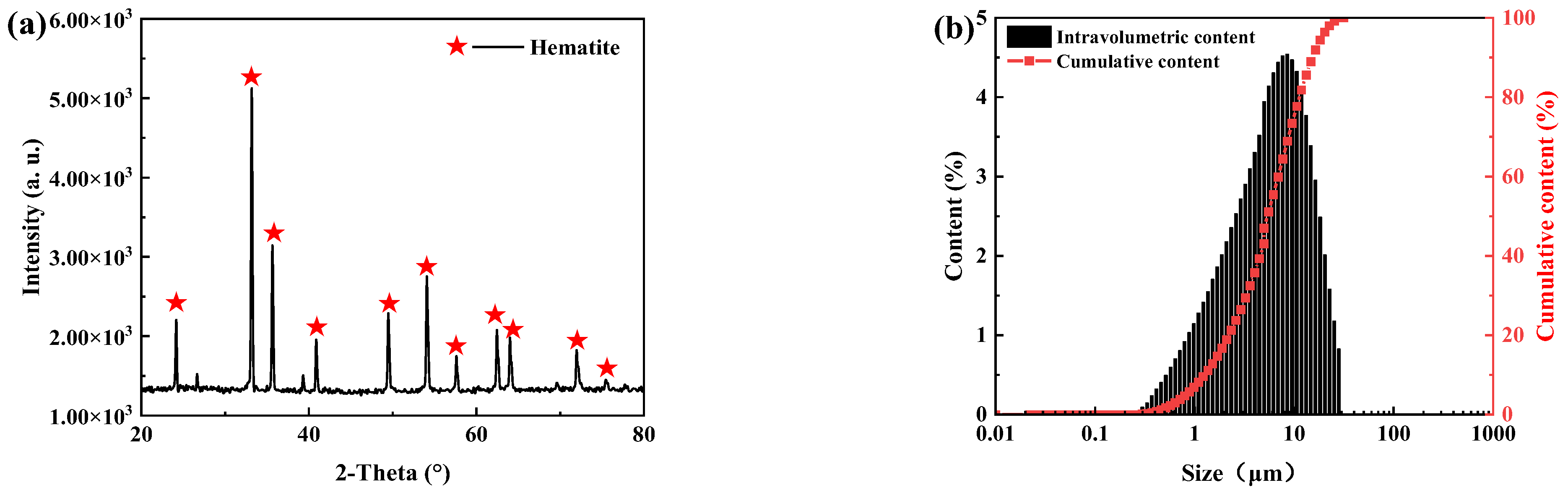
Ultrafine hematite samples were obtained from the overflow stream of the concentrate flocculation thickener at Ansteel Group, Liaoning, China. The raw material was further purified using shaking table separation followed by water-settling classification to ensure stable mineralogical properties for subsequent flocculation–sedimentation tests. The chemical compositions are summarised in Table 1, indicating that Fe2O3 is the predominant component, with only 1.26% SiO2. The XRD pattern was recorded using an X-ray diffractometer (XRD-7000, Shimadzu Corp., Kyoto, Japan) as shown in Figure 1a, confirming hematite as the sole detectable crystalline phase. Particle size distribution was measured using a laser particle size analyser (Mastersizer 3000, Malvern Panalytical Ltd., Malvern, UK) equipped with Hydro EV wet dispersion unit, and the data were processed using Mastersizer 3000 software (Malvern Panalytical Ltd., Malvern, UK) (Figure 1b). The particle size ranged from 0.3 to 20 μm with a median diameter (D50) of 5.36 μm. The sample density was measured as 5.02 g/cm3, averaged over three repeated tests using a pycnometer (AccuPyc II 1340, Micromeritics Instrument Corp., Norcross, GA, USA).
The flocculant used in this study was anionic polyacrylamide (APAM, analytically pure), supplied by Tianjin Komeo Chemical Reagent Co., Ltd., Tianjin, China. Five commercial APAM products with nominal molecular weights of 5, 7, 9, 11, and 13 million were selected to evaluate the influence of molecular weight on flocculation performance. Sodium hydroxide (NaOH) and hydrochloric acid (HCl), both analytically pure and purchased from Sinopharm Chemical Reagent Co., Ltd., Shanghai, China, were used to adjust the slurry pH. Deionised water was used for all flocculation–sedimentation experiments and related measurements.

2.2. Flocculation Tests

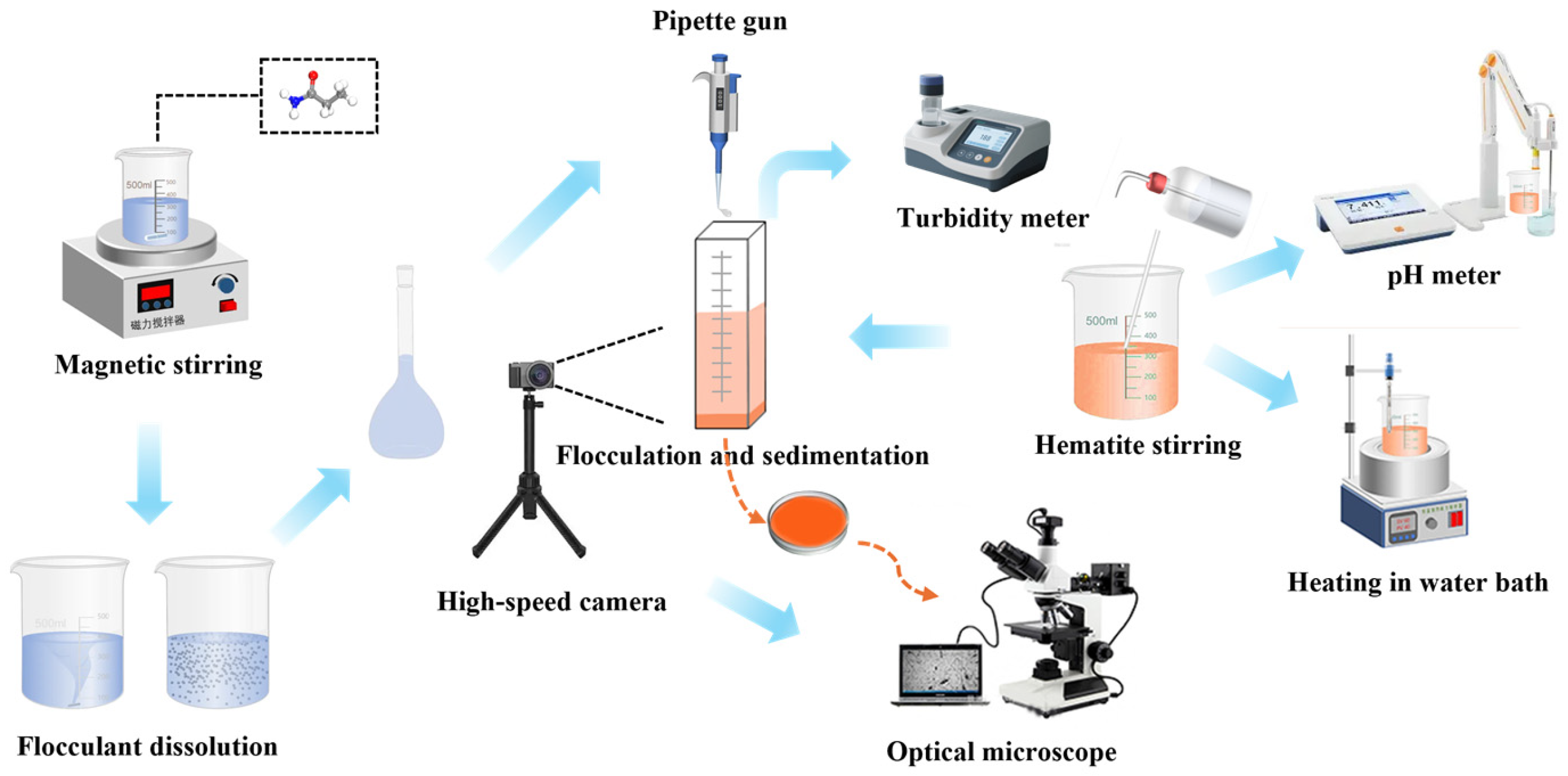
Figure 2 shows the laboratory-scale flocculation–sedimentation system, which comprises a flocculant preparation unit, a slurry mixing module, a flocculation–sedimentation column, and associated analytical instruments. The analysis system included a turbidimeter (WGZ-800AS, INESA Analytical Instrument Co., Ltd., Shanghai, China), an optical microscope (BA210-T, Motic Instruments Inc., Xiamen, China), a high-speed camera (i-SPEED 7, iX Cameras Ltd., Rochford, UK), and Image-Pro Plus software (version 6.0, Media Cybernetics Inc., Rockville, MD, USA) for floc morphology evaluation.
A 10 wt% hematite slurry was prepared and adjusted to pH 12 using NaOH, after which it was equilibrated in a thermostatic water bath maintained at 35 °C throughout the experiments. The pH and slurry concentration were determined based on industrial data from a hematite processing plant in Anshan, China, where the concentrate thickener feed typically exhibits a pH of approximately 12 due to CaO addition during flotation. Preliminary tests confirmed that pH 12 and a 10% solid concentration provided stable and representative flocculation–sedimentation conditions.
After conditioning at 600 rpm for 3 min, the slurry was transferred into a 250 mm acrylic settling column. APAM with different molecular weights (dosage: 100 g/t) was introduced using a micropipette and dispersed by five vertical strokes of a custom stirrer. It should be noted that a single flocculant dosage was employed in this study to focus specifically on the effect of the polymer molecular weight under controlled conditions, which allows for the systematic evaluation of chain conformation, adsorption behaviour, and bridging interactions without introducing confounding factors from varying doses. However, we acknowledge that the flocculation response is generally non-linear with respect to the dosage and that the observed “optimal” molecular weight may depend on this fixed dose, particle size, and slurry chemistry. Therefore, the conclusions drawn are specific to the experimental conditions and should not be generalised to other systems without further verification, consistent with observations reported by Grabsh et al. (2019) [46]. A high-speed camera continuously recorded the settling process for 10,000 s to capture the stratification behaviour and ensure reliable measurement of flocculation–sedimentation dynamics. Future studies may extend this approach to multiple dosages to construct a more comprehensive dosage–molecular-weight map for ultrafine hematite flocculation.

2.3. Supernatant Turbidity and Floc Concentration Tests

Turbidity was evaluated by withdrawing the clarified liquid from a position 150 mm above the reference mark and analysing it using a WGZ-800AS turbidimeter (Shanghai Xinrui Instrument Co., Ltd., Shanghai, China). The collected supernatant was placed in a quartz dish, allowed to equilibrate for 10 min, and then measured once the reading stabilised. For each operating condition, the reported turbidity corresponds to the average of three independent measurements.
The concentration of flocs was quantified by carefully transferring the settled aggregates into a pre-weighed 100 mL beaker, drying in a laboratory oven at 100 °C, and subsequently recording the mass [47]. The solid concentration was obtained according to Equation (1).
C = m 2 m 1 × 100 %
where C denotes the floc concentration and m1 and m2 represent the floc mass before and after drying, respectively.

2.4. Floc Morphology Observation and Image Analysis

Representative settled flocs were selected for microscopic characterisation. Using a small sampling spoon, the flocs were gently transferred onto glass slides, dispersed with anhydrous ethanol, and examined under a digital optical microscope to achieve an even spread of particles. Images of well-dispersed flocs were captured and processed in Image Pro Plus, where greyscaling, binarisation, automated segmentation, and subsequent statistical analysis were performed. To quantitatively describe the floc structure, the fractal dimension was employed as an analytical indicator [4]. It characterises the relationship between the projected area of a floc and its characteristic length, as expressed in Equation (2).
ln A = a L D f
Transforming Equation (2) by a logarithmic function yields Equation (3) as follows:
ln A = D f ln L + ln a
where A is the projected area of the floc in the vertical plane, Df is the fractal dimension of the floc, L is the characteristic length of the floc in the projected plane, and a is a specific coefficient.

2.5. Molecular Dynamics Simulation (MDS) Study

Molecular dynamics (MD) simulations were performed using the Materials Studio 8.0 platform (BIOVIA, San Diego, CA, USA) to examine how APAM molecules with different degrees of polymerisation interact with the hematite surface. Crystal structure information for hematite was obtained from the Inorganic Crystal Structure Database (ICSD) [48]. Consistent with previous computational and experimental evidence, the (0 0 1) surface was selected as the model interface because it is the predominant cleavage plane formed during ore breakage and therefore represents the most significant exposed facet in industrial mineral processing.
The hematite (0 0 1) slab was constructed and relaxed using the CASTEP module. Surface stability was verified through surface energy calculations, and the optimised configuration was obtained using the PBE functional within the GGA framework, with an energy cutoff of 380 eV. Charge-balancing Na+ ions were incorporated into the system, and their charges were determined via electrostatic potential (ESP) fitting.
APAM molecules with six polymerisation degrees—10, 20, 30, 40, 50, and 60 repeating units—were designed to represent the range typically encountered in flocculation applications. Each polymer structure was geometry-optimised in the DMol3 module using DFT with the PBE functional and a DNP basis set. Atomic partial charges were extracted from Mulliken population analysis and subsequently applied in the MD simulations.
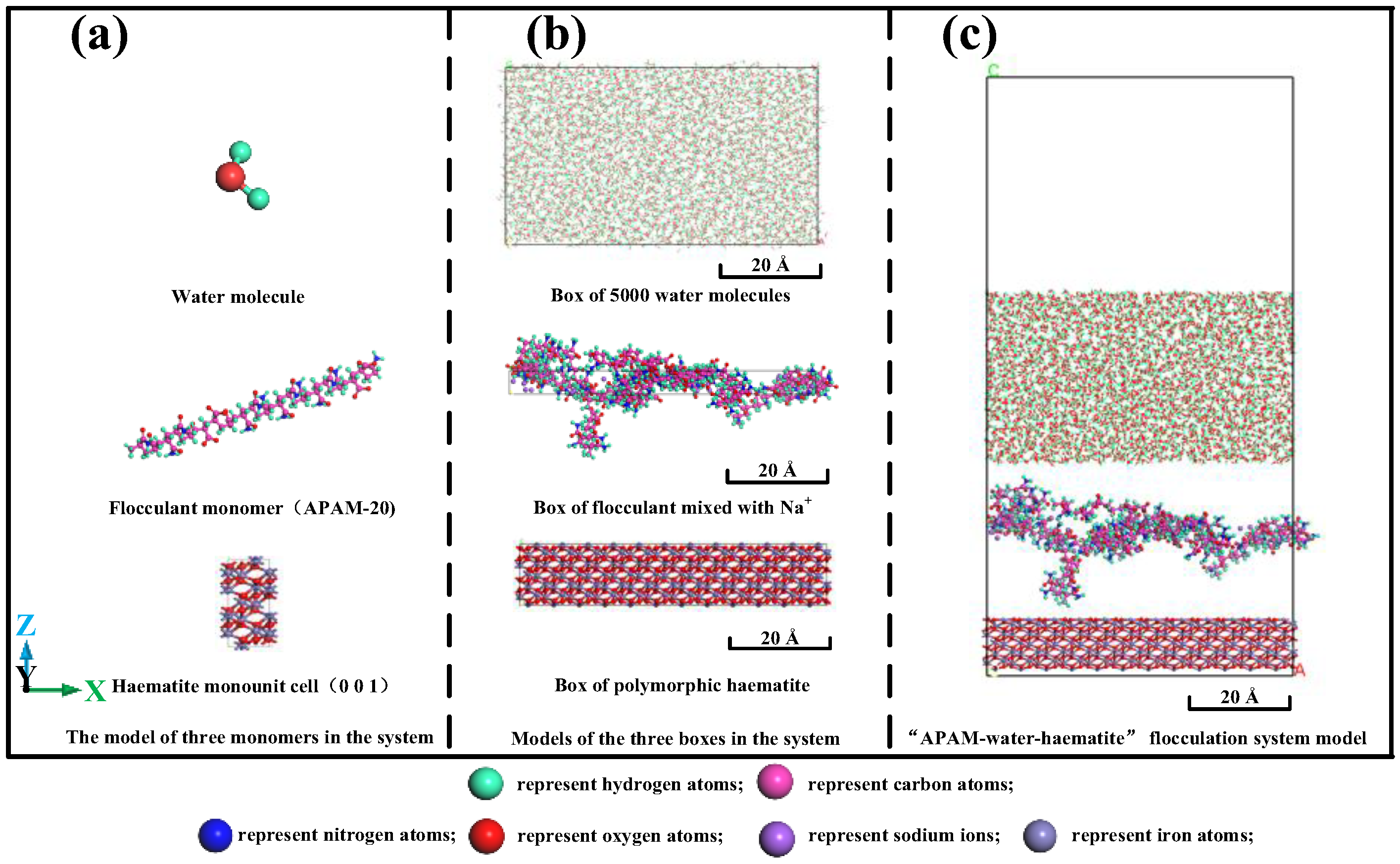
Water molecules and Na+ ions were also constructed and fully optimised using DMol3 to reproduce pulp-like ionic conditions. The final simulation system consisted of a hematite (0 0 1) slab, six APAM chains (each with one of the designated polymerisation degrees), 5000 water molecules, and Na+ ions. The simulation cell dimensions were set to 60 × 60 × 120 Å, with α = β = γ = 90°, providing sufficient vacuum spacing for adsorption and interfacial interactions, as illustrated in Figure 3.
All molecular dynamics calculations were conducted using the Forcite module and the COMPASS II force field, which reliably captures inorganic–organic interfacial behaviour. Before dynamic simulation, the system underwent energy minimisation using the following convergence thresholds: energy tolerance 2 × 10⁻⁵ kcal/mol, force tolerance 0.001 kcal/mol/Å, and displacement tolerance 1 × 10⁻⁵ Å. Electrostatic interactions were treated using the Ewald summation method, while van der Waals forces were computed with the atom-based approach using a 12.5 Å cutoff. Production simulations were carried out in the NVT ensemble with temperature regulated through the Andersen thermostat. A timestep of 1 fs was selected, and each run proceeded for 4 ns (4 × 10⁶ steps) for each of the six APAM polymerisation degrees.
To verify that the simulation system had reached a stable state, variations in total energy and temperature were monitored over the entire MD trajectory. Throughout the simulation, the interaction energy (Eint) between APAM molecules and the hematite surface was recorded in real time. A customised extraction script was employed to obtain these interfacial energy values, which were subsequently calculated according to Equation (4).
E int = E A - H - W E A E H E W
where Eint represents the interaction energy, EA-H-W represents the total energy of the system after flocculation and adsorption, and EA, EH, and EW represent the total energy of APAM, hematite, and water molecules in the system, respectively.
The hydrogen-bonding characteristics between APAM, water, and hematite were also analysed by measuring the distributions of bond numbers, bond lengths, and bond angles.

2.6. Correlation Strategy Between Experimental and Molecular Simulation Studies

In this study, physical experiments and MD simulations were combined to investigate the effect of APAM molecular weight on ultrafine hematite flocculation. Experiments employed APAM of 5, 7, 9, 11, and 13 million molecular weight, representing typical industrial-grade polymers and capturing macroscopic effects on bridging, adsorption, and floc structure formation. Due to computational constraints, MD simulations used chains with polymerisation degrees of 10, 20, 30, 40, 50, and 60. Although much shorter than industrial polymers, these chains effectively capture key microscopic trends, including chain extension, increased contact area, stronger adsorption, and enhanced hydrogen-bonding and ion-bridging interactions. Polymer physics principles indicate that molecular-weight effects exhibit scale invariance, meaning relative trends remain consistent across chain lengths. Consequently, the simulations reproduce the trend rather than the absolute molecular weight, providing mechanistic insight that complements experimental observations and ensuring cross-scale consistency.

3. Results and Discussions

3.1. Effect of APAM Molecular Weight on the Flocculation Performance of Hematite Ore

3.1.1. Analysis of Sedimentation Curves of Ultrafine Hematite

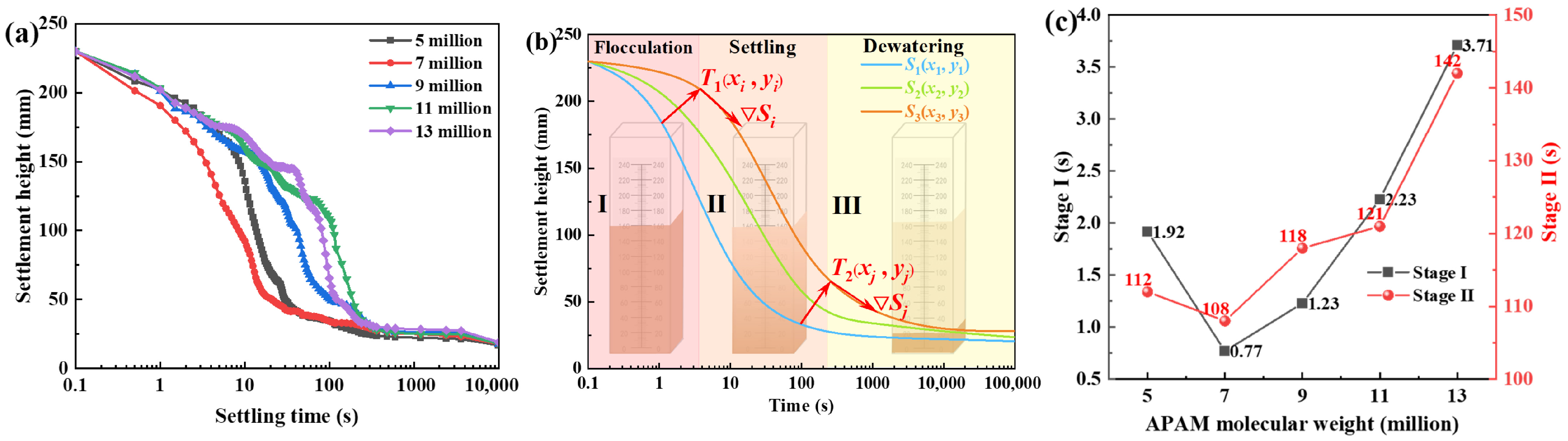
The influence of APAM molecular weight on the sedimentation behaviour and kinetic characteristics of ultrafine hematite was first examined, as illustrated in Figure 4.
As shown in Figure 4a, the molecular weight of APAM exerts a pronounced effect on the settling rate. As molecular weight increases, the settling velocity initially rises and then declines. The highest settling rate occurs at a molecular weight of seven million under the present experimental conditions (APAM dosage 100 g/t, pH 12, 10% solids). It should be noted that this molecular weight corresponds to the specific experimental conditions and may not represent a universal optimum. Beyond this value (≥9 million), the settling velocity decreases, indicating that excessively high-molecular-weight APAM is unfavourable for flocculation in the context of this specific dosage and slurry condition, and that it may not represent a universal optimum for ultrafine hematite. To further elucidate the effect of molecular weight on sedimentation dynamics, kinetic segmentation was performed on the settling curves, as shown in Figure 4b. By connecting the standard regular lines of the curves, the sedimentation process can be divided into three characteristic stages: (I) the flocculation stage, (II) the rapid settling stage, and (III) the compression–dewatering stage [47]. As presented in Figure 4c, the reaction times of both the first and second stages decrease initially and then increase with an increasing APAM molecular weight. The fastest kinetics for both stages occur at a molecular weight of seven million, with characteristic times of 0.77 s and 108 s, respectively.
Moreover, the influence of the APAM molecular weight is more pronounced in the flocculation stage than in the rapid settling stage, highlighting that the molecular weight primarily governs flocculation efficiency under the tested conditions, rather than universally determining the settling performance.

3.1.2. Analysis of Supernatant Turbidity and Floc Concentration

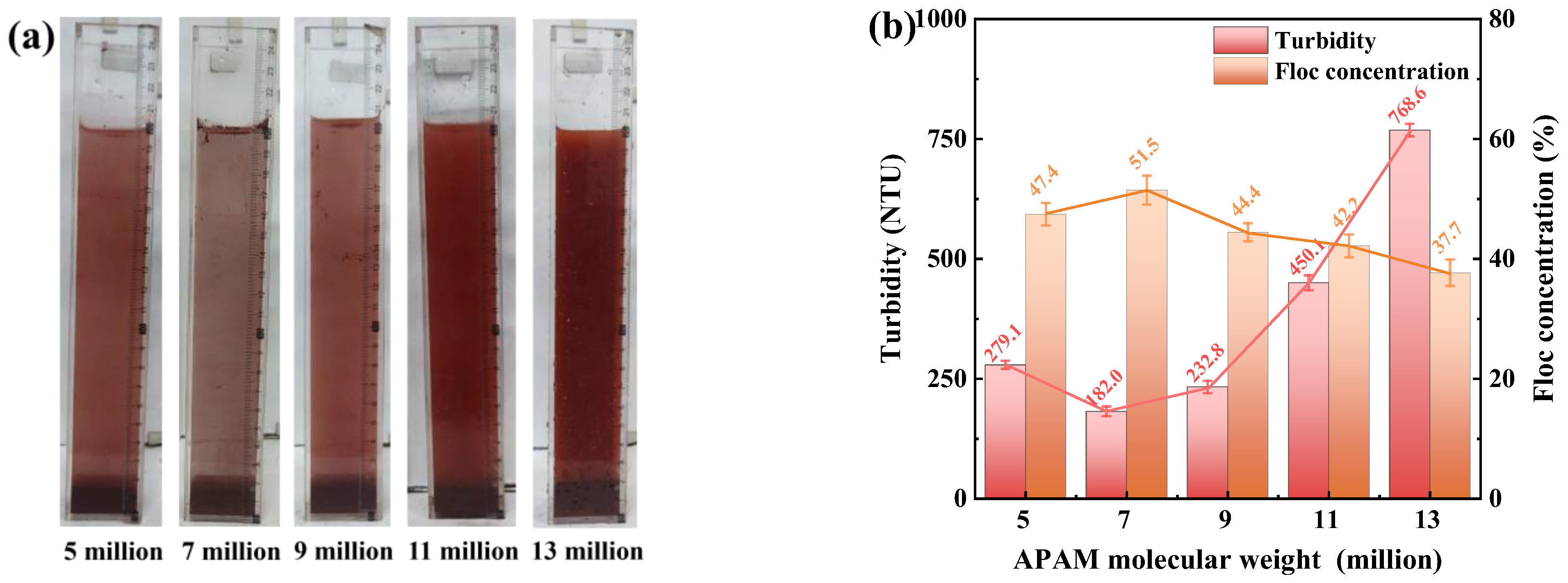
Building on the sedimentation-rate analysis, this section evaluates the supernatant turbidity and underflow floc concentration under different APAM molecular weights. As shown in Figure 5a, the APAM molecular weight exerts a pronounced influence on the flocculation–sedimentation behaviour of ultrafine hematite. The minimum supernatant turbidity observed at seven million is specific to the tested dosage and conditions, and it may shift with variations in polymer dosage, as the flocculation response is generally non-linear with respect to both the molecular weight and dose [46].
The quantitative results in Figure 5b show that supernatant turbidity decreases initially and then increases with molecular weight. The minimum turbidity (~182 NTU) represents a laboratory-comparative indicator, not an industrial benchmark. Molecular weights above nine million cause a sharp rise in turbidity, indicating ineffective aggregation of ultrafine particles and a stable suspension. Similarly, the underflow floc concentration increases with molecular weight, peaking at 51.5% at seven million, then declines. The reduction at higher molecular weights reflects an increased floc water content and decreased effective floc density, both of which hinder settling and dewatering, emphasising that multiple mechanisms contribute to performance decline, not chain curling alone.

3.1.3. Analysis of Floc Morphology and Fractal Dimensions

Following the evaluation of sedimentation performance, this section investigates the influence of the APAM molecular weight on floc morphology and structural compactness.
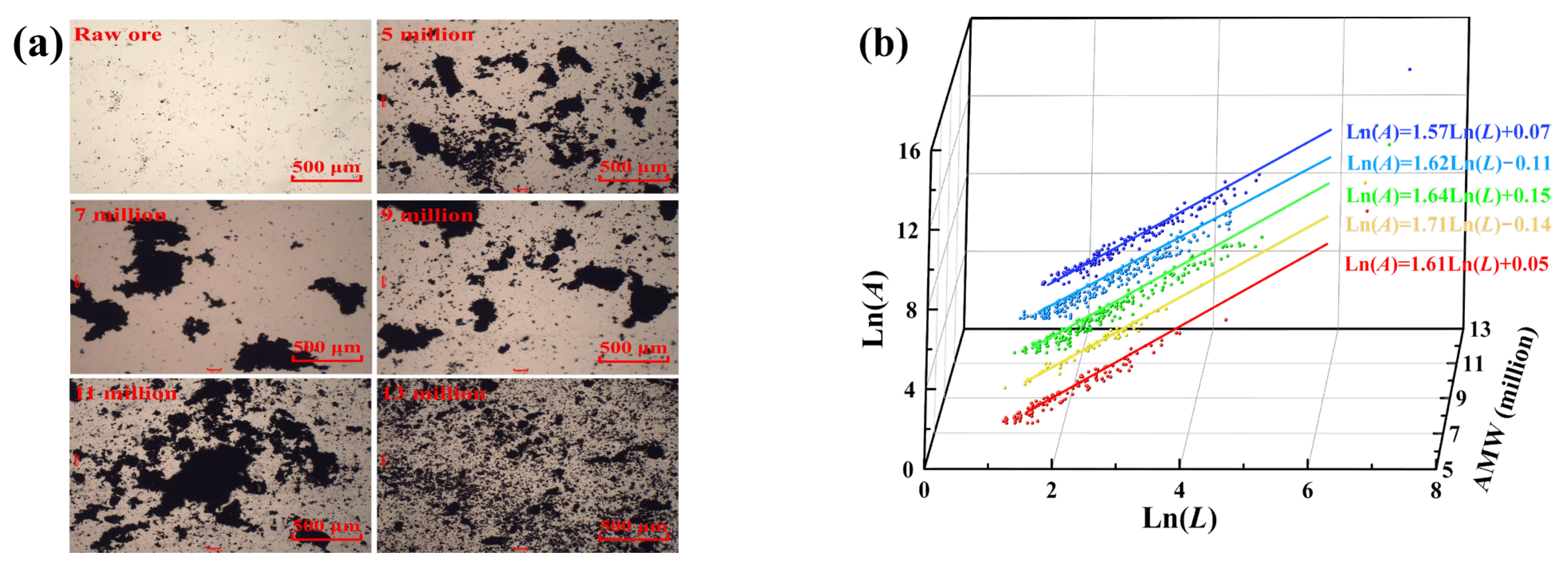
As shown in Figure 6a, flocs form readily after APAM addition compared with raw dispersed particles. With an increasing molecular weight, the average floc size first increases and then decreases, reaching a maximum of ~379.8 μm at seven million for the current dosage. This trend is dosage-dependent, and the floc size maximum may differ under other conditions. Further increases in molecular weight reduce the floc size, and small flocs (<100 μm) become more dominant at ≥9 million, especially at 13 million, likely contributing to higher supernatant turbidity.
The structural compactness of flocs was characterised using the fractal dimension (Df), as shown in Figure 6b. Df rises initially and then declines, peaking at 1.71 for seven million. It should be noted that Df reflects geometric compactness derived from 2D images and does not capture internal porosity, water retention, or mechanical strength; thus, it is a complementary, not comprehensive, descriptor of sedimentation performance. When molecular weight increases to 13 million, Df decreases to 1.57, suggesting that an excessively high molecular weight hinders compact floc formation and reduces floc density. The interpretation of flocculation behaviour is therefore based on a combination of settling kinetics, turbidity, floc concentration, and Df, rather than on Df alone.

3.2. Molecular Dynamics Study of APAM Molecular Weight on Flocculation Adsorption

3.2.1. Configuration and Distribution of the Modelled System

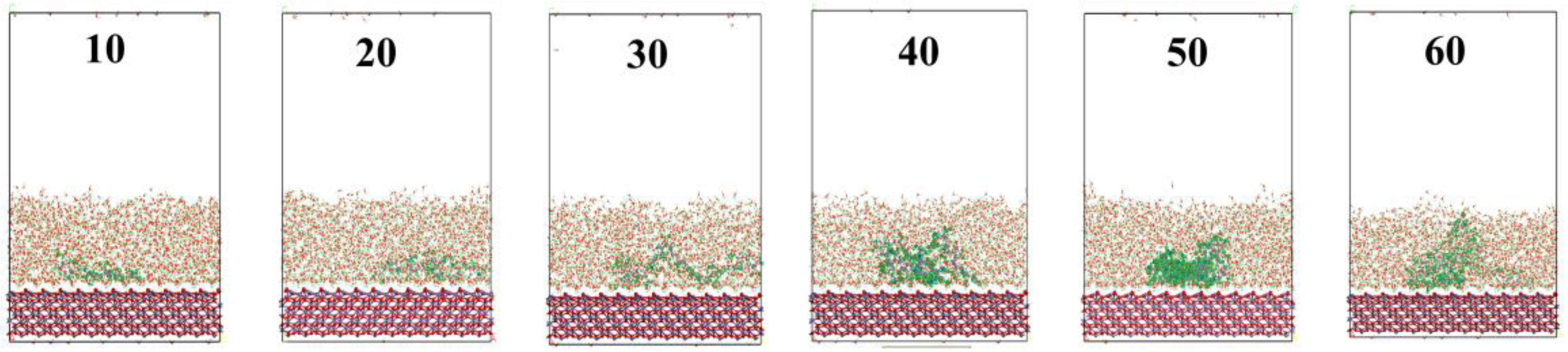
Figure 7 presents the spatial configurations of APAM chains with different degrees of polymerisation in the MD simulation. As the chain length increases, APAM progressively covers the hematite surface and exhibits noticeable coil formation. APAM with a polymerisation degree of 30 adopts the most favourable ring–tail equilibrium conformation, providing sufficient adsorption sites while maintaining optimal chain flexibility, which is beneficial for effective bridging flocculation.
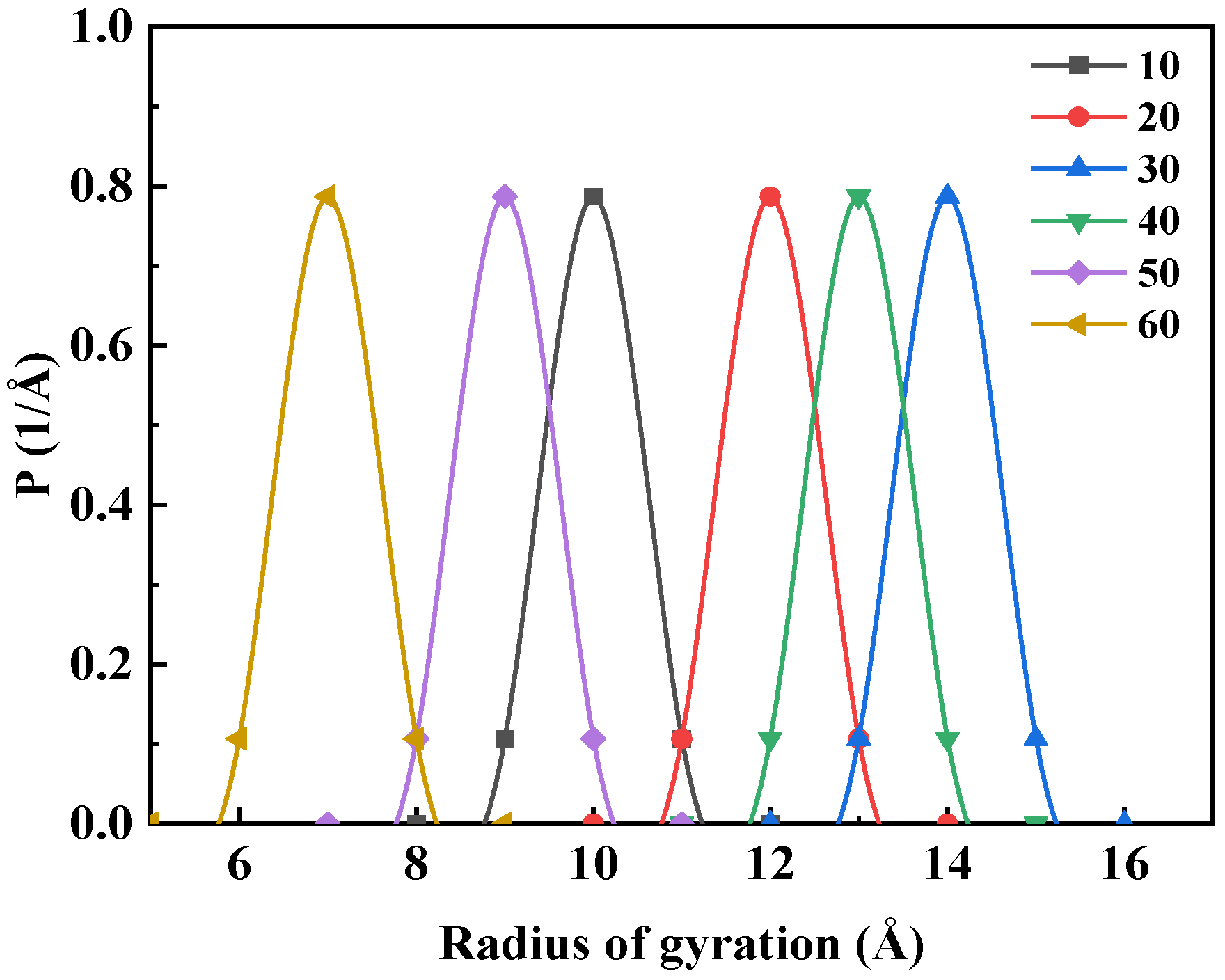
To further quantify the interfacial configurations, the radius of gyration (Rg) of APAM was analysed, as in Figure 8.
With the polymerisation degree (DP) increasing from 10 to 60, Rg first increases and then decreases, rising from 10 Å at DP 10 to a maximum of 14.25 Å at DP 30. At this point, the chain exhibits a balanced extended–flexible structure, enabling both multiple surface contacts and efficient interparticle bridging. When the polymerisation degree reaches 40~60, Rg decreases, indicating the onset of chain coiling, which may reduce the availability of effective adsorption segments.

3.2.2. Relative Concentration Distribution and RDF Analysis

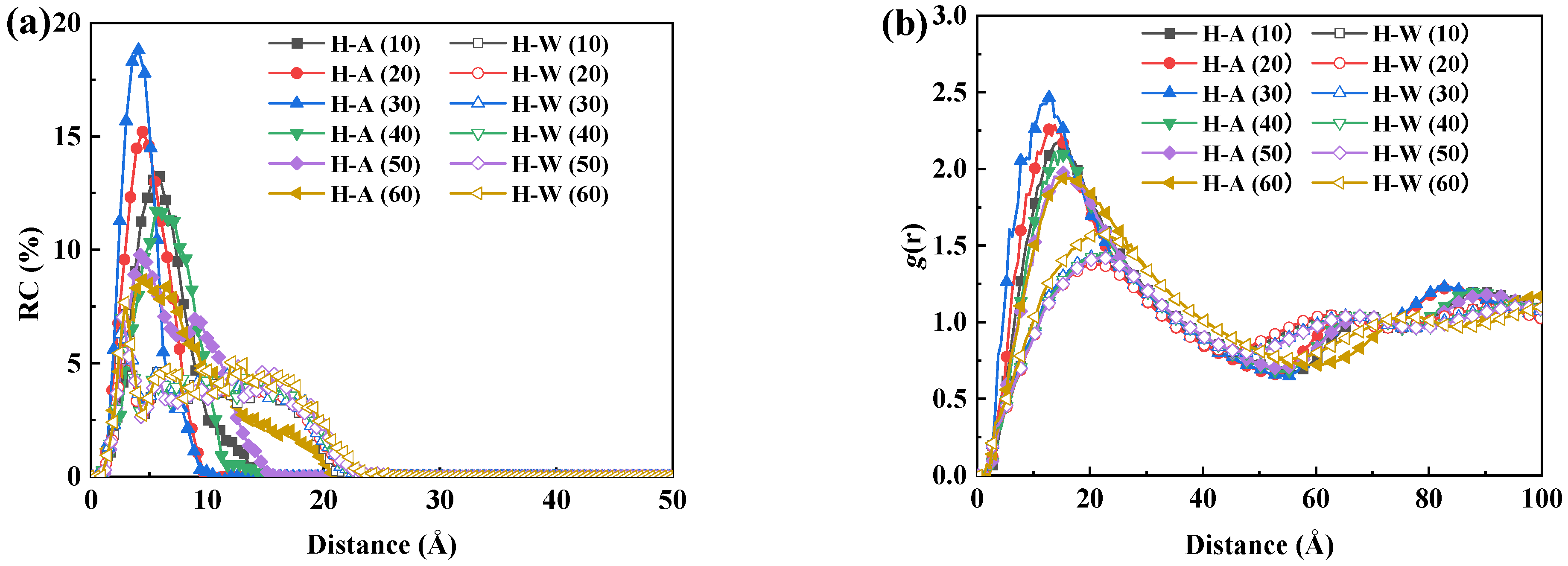
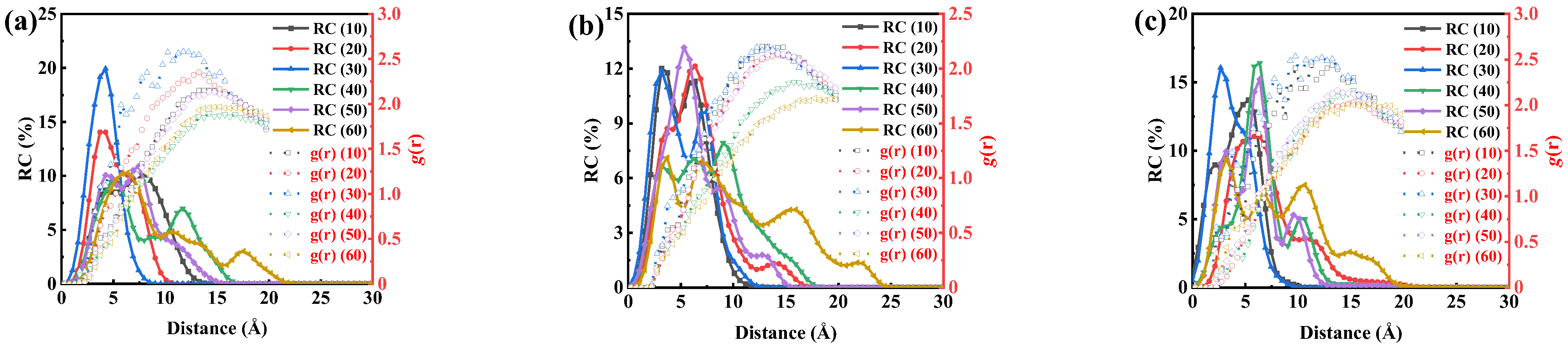
The relative concentration (RC) profiles of APAM and water molecules near the hematite surface are shown in Figure 9a. APAM with a polymerisation degree of 30 displays the most pronounced concentration peak in the interfacial region, indicating the strongest surface enrichment within the examined molecular-weight range.
The corresponding radial distribution functions are presented in Figure 9b. All systems exhibit a characteristic peak at approximately 10~20 Å, confirming that coordination between APAM carboxyl groups and surface Fe atoms is the dominant adsorption mechanism. The peak intensity reaches its maximum for the DP-30 system, with a value of about 2.5, demonstrating that this chain length forms the strongest coordination interactions with the hematite surface.

3.2.3. Interaction Energy Analysis of the Modelled System

Building on the analysis of adsorption configurations and interfacial binding strength, this section examines the adsorption energy and associated adsorption kinetics for APAM chains of different polymerisation degrees.
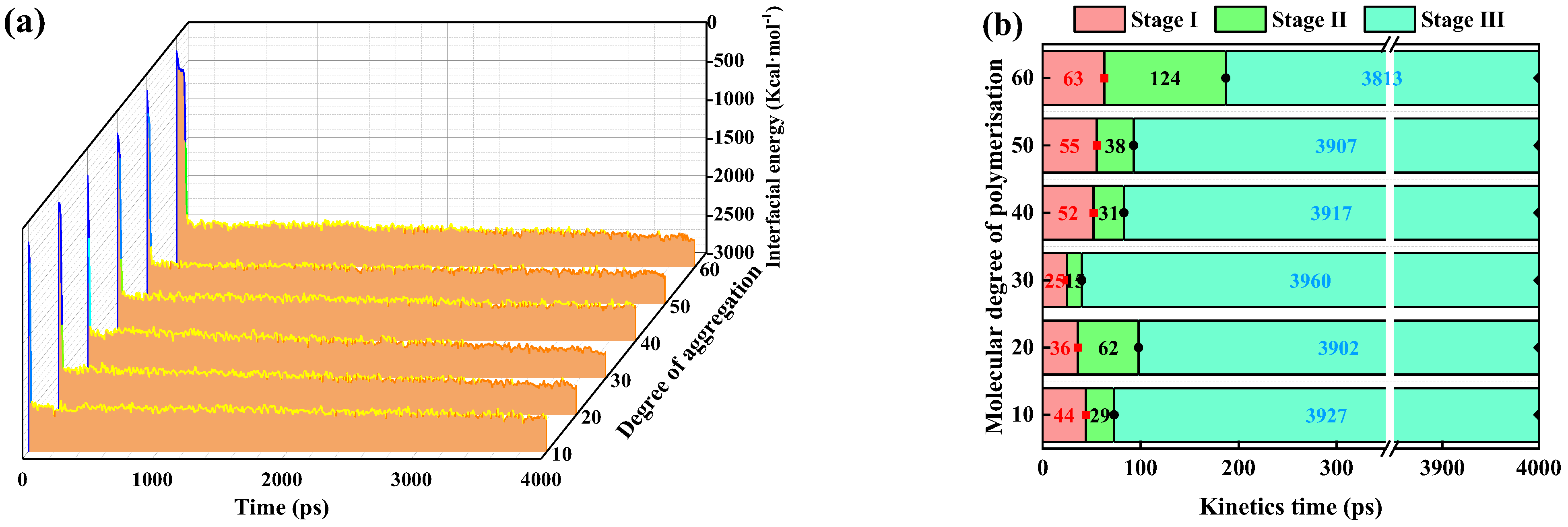
The adsorption-energy evolution for each system exhibits a clear three-stage pattern, as illustrated in Figure 10a. The initial stage (0~100 ps) is characterised by a near-zero energy plateau, corresponding to the diffusion of APAM in solution and its initial approach toward the hematite surface. This is followed by a rapid energy-decline stage (100~400 ps), during which pronounced adsorption occurs and the system energy drops sharply, indicating the establishment of strong interfacial interactions. Beyond 400 ps, the system enters a dynamic equilibrium stage, where adsorption and desorption strike a balance and the interaction energy fluctuates only slightly. The equilibrium adsorption energy reflects the stability of the adsorption system, with lower values implying a more stable interfacial configuration. Among all systems, the polymerisation degree of 30 yields the lowest equilibrium adsorption energy, suggesting the most favourable adsorption stability.
A quantitative comparison of the characteristic times for each stage is provided in Figure 10b. For the first stage, the duration decreases initially and then increases with an increasing polymerisation degree, with the shortest time observed for DP-30, indicating the most rapid chain extension in solution. In the second stage, DP-30 again exhibits the shortest duration (15 ps), demonstrating the fastest establishment of interfacial adsorption. In the final stage, the DP-30 system reaches a dynamic equilibrium earlier than the others, signifying that a moderate chain length markedly accelerates the overall flocculation–adsorption process.

3.2.4. Dominant Role of APAM Functional Groups in the Modelled System

As a widely used flocculant for hematite, APAM interacts with mineral surfaces primarily through its key functional groups: –NH2, –COO, and –COOH [49,50]. This section therefore examines the interfacial interaction characteristics of these groups within systems of different polymerisation degrees.
The results in Figure 11a show that the –NH2 group exhibits a pronounced relative-concentration peak at approximately 4 Å from the hematite surface. The corresponding radial distribution function g(r) also reaches its maximum at this position, indicating strong interfacial interactions. The peak is most prominent for the polymerisation degree of 30, demonstrating that –NH2 groups dominate the adsorption process under this chain length by forming dense hydrogen-bond networks with surface hydroxyls.
The distribution patterns for the –COO groups, presented in Figure 11b, reveal concentration and g(r) maxima at around 3.75 Å, slightly closer to the surface than those of –NH2. This suggests that their interaction with hematite is governed mainly by electrostatic attraction. Again, the most distinct peak occurs at the polymerisation degree of 30, confirming that a moderate chain length facilitates efficient anionic functional-group adsorption onto the positively charged sites of the hematite surface.
In contrast, the –COOH groups display peak heights in both relative concentration and g(r) comparable to the other two groups, but with more dispersed peak positions. This indicates weaker and less specific binding, implying that interfacial adsorption is dominated by –NH2 and –COO groups, while –COOH contributes only marginally to the overall interaction.

3.2.5. Intermolecular Hydrogen Bonding Characterisation of the Modelled System

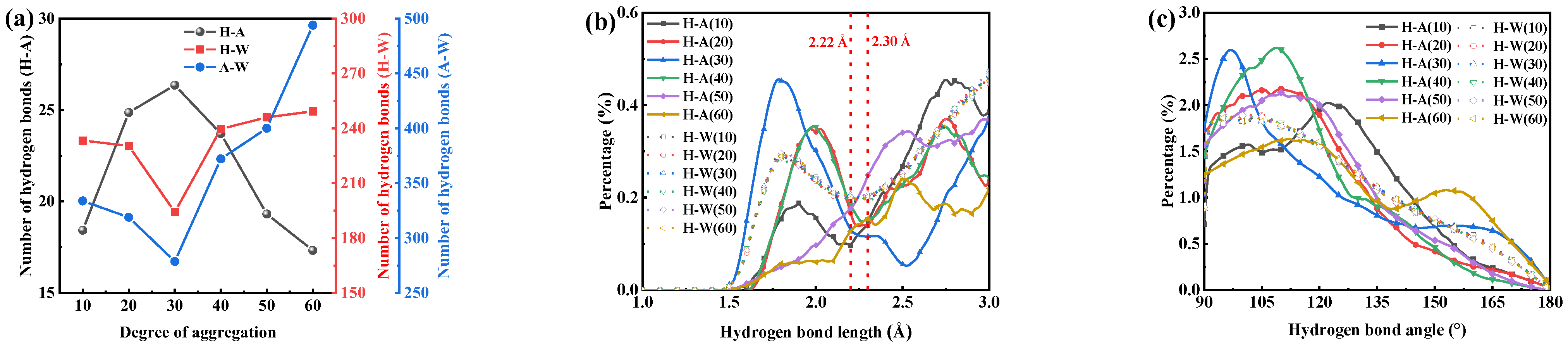
Given the dominant roles of –NH2 and –COO groups identified previously, hydrogen bonding is expected to be an essential interaction mechanism within APAM-based flocculation systems. This section therefore characterises hydrogen-bond formation among APAM molecules, water, and the hematite surface, as summarised in Figure 12.
The results indicate that the number of hydrogen bonds formed between hematite and APAM increases with the polymerisation degree and then decreases. The system with a polymerisation degree of 30 exhibits the highest number of interfacial hydrogen bonds, approximately 25~28, exceeding all other chain lengths. This confirms its superior hydrogen-bonding capability and is consistent with the lowest and most stable adsorption energy observed for this system in Section 3.2.3.
Hydrogen-bond length distributions further support this conclusion. Across all systems, bond lengths predominantly fall within 1.50~2.00 Å, slightly longer than the characteristic O–H···O bonds formed between water and the hematite surface, indicating comparatively stronger and more confined hydrogen bonding at the APAM–hematite interface. The polymerisation degree of 30 displays a particularly sharp peak near 1.75 Å, suggesting shorter and stronger hydrogen bonds than those in other systems.
Analysis of hydrogen-bond angles shows that APAM–hematite hydrogen bonds mainly lie within 90°~135°. Although the hematite–water system also exhibits angles in this range, the APAM-containing systems show a notably higher density of hydrogen bonds, reflecting stronger interfacial interactions. These findings reinforce that a moderate chain length maximises the hydrogen-bonding contribution to the overall adsorption and flocculation process.

3.3. Correlation and Mechanism Discussion Between Macro and Molecular Scales

The macroscopic flocculation performance of ultrafine hematite shows a non-monotonic dependence on APAM molecular weight under the tested dosage (100 g/t, pH 12, 10% solids). The maximum sedimentation rate, lowest supernatant turbidity, highest floc concentration, and densest floc structure are observed at seven million. Deviations from this intermediate molecular weight, either lower or higher, reduce settling efficiency, increase supernatant turbidity, and produce looser, less robust flocs. These results highlight that molecular weight primarily governs flocculation efficiency under the given experimental conditions.
Molecular dynamics simulations reveal that APAM chains with a polymerisation degree of 30 achieve an optimal balance between chain extension and flexibility, enabling sufficient surface adsorption, multi-point bridging, and strong hydrogen-bond formation. Relative concentration, radial distribution function, and interaction energy analyses confirm that this chain length promotes the most stable interfacial adsorption and efficient bridging. At higher polymerisation degrees, chain coiling, reduced adsorption segments, and increased floc water retention contribute to weaker, less dense flocs, while an insufficient chain length limits adsorption and bridging.
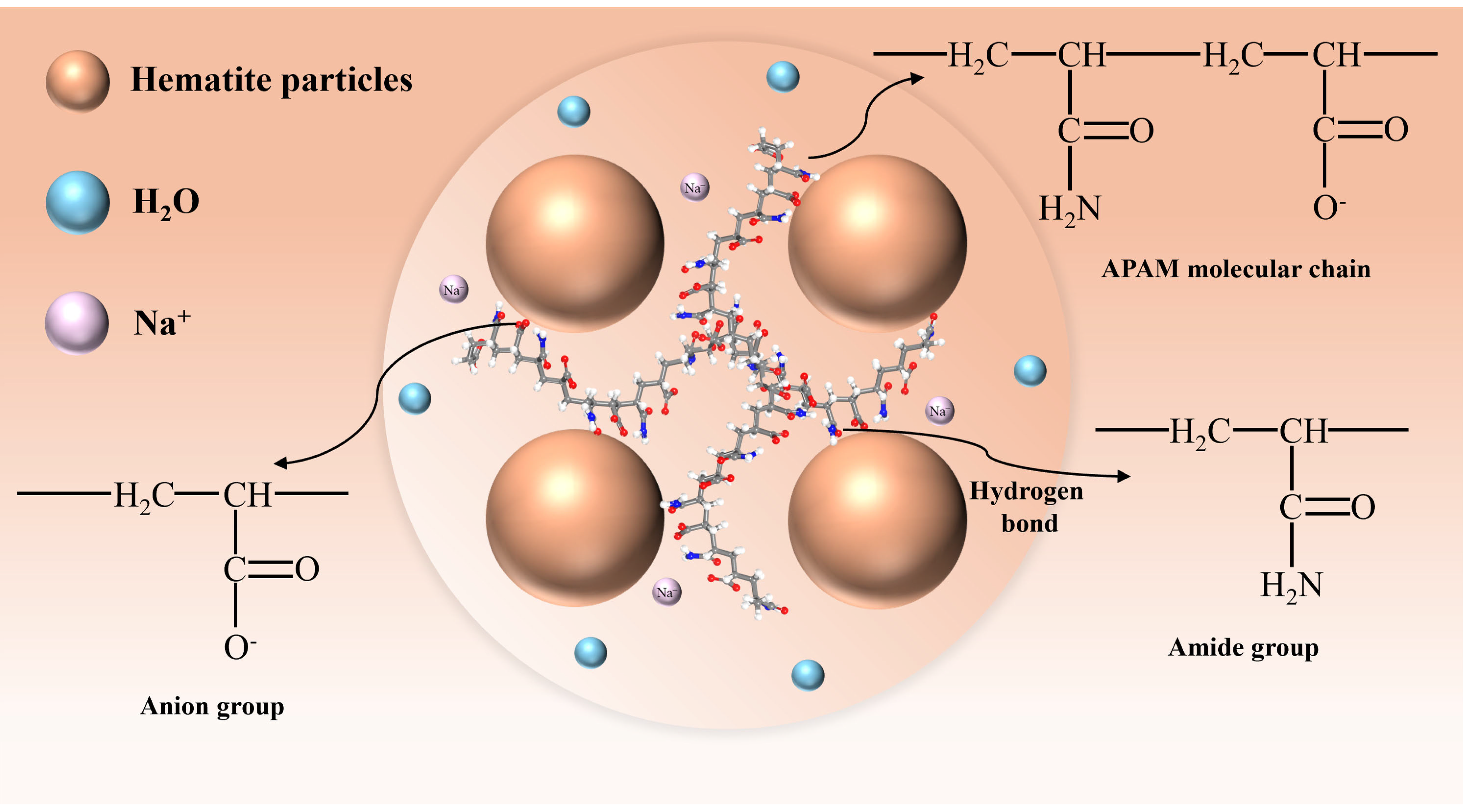
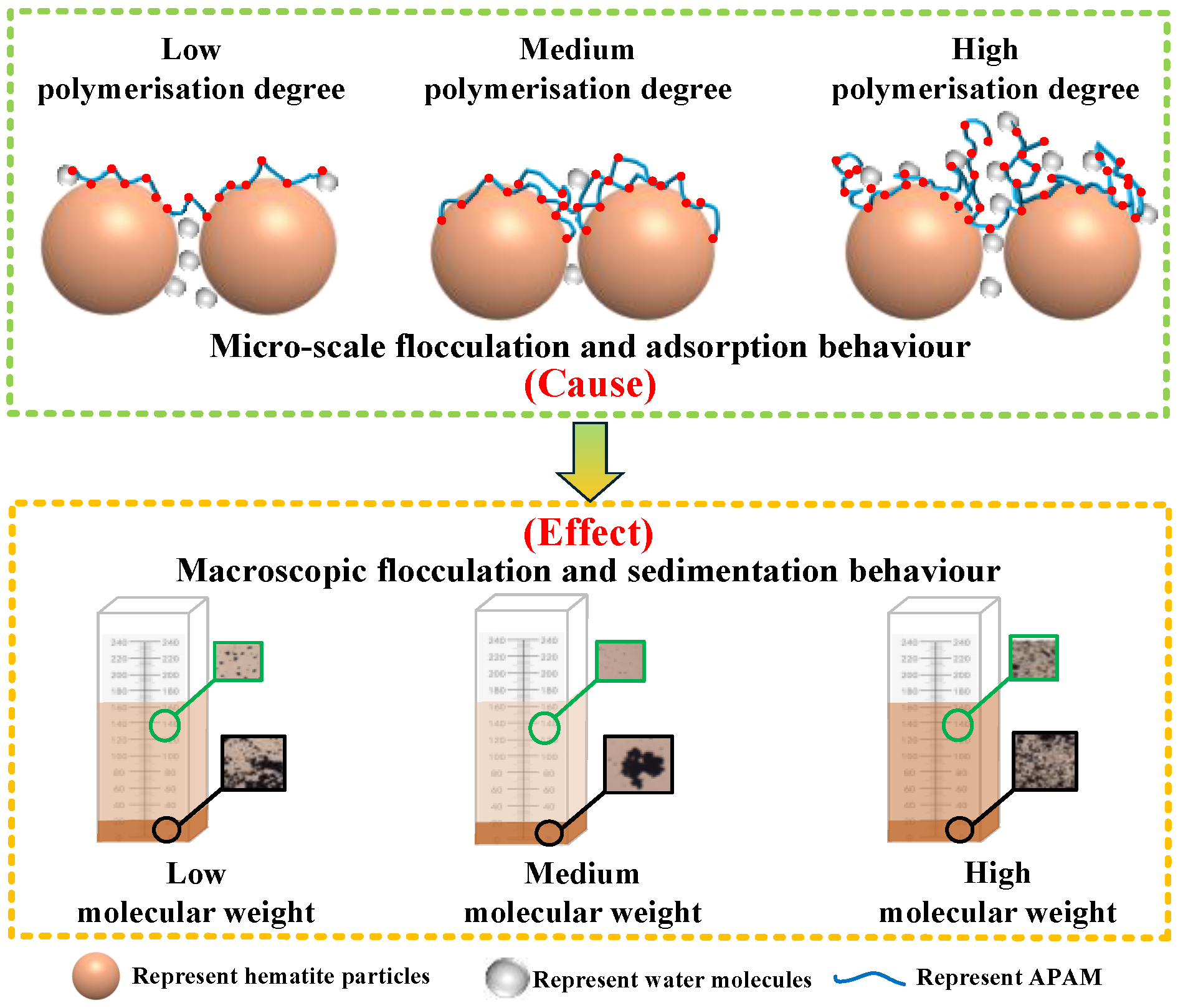
The combined macro- and molecular-scale analyses indicate that intermediate APAM chain lengths optimise surface coverage, adsorption, and bridging, while minimising excessive water retention, local viscosity effects, and structural fragility. The observed trends are qualitative and scale-invariant, providing a mechanistic understanding of floc formation, floc density, and settling behaviour in ultrafine hematite. Figure 13 schematically summarises the cross-scale mechanism, linking the APAM molecular weight, interfacial adsorption, hydrogen-bond networks, and floc structural evolution.

4. Conclusions

This study combined experiments and molecular dynamics simulations to investigate the influence of the APAM molecular weight on ultrafine hematite (−10 μm) flocculation, aiming to reveal the optimal molecular weight range and the underlying cross-scale mechanisms.
(1)
Macroscopic flocculation and sedimentation tests demonstrated that an intermediate APAM molecular weight (~7 million) produced the fastest settling, lowest supernatant turbidity, highest underflow concentration, and the largest, densest flocs. Molecular weights lower or higher than this optimal range led to slower settling, smaller flocs, and less compact structures, indicating the necessity of balancing the chain length for effective bridging and aggregation.
(2)
Molecular dynamics simulations revealed the microscopic origin of these observations. A polymerisation degree of 30 maximised polymer surface enrichment, coordination with hematite Fe atoms, and adsorption energy, promoting the formation of dense flocs and rapid sedimentation. Excessively long or short chains reduced the adsorption efficiency and bridging performance, highlighting the importance of chain conformation in flocculation.
(3)
Functional-group analysis confirmed that –NH2 and –COO were the dominant contributors to adsorption and bridging, forming stable hydrogen-bond networks with hematite surface hydroxyls. These interactions underpin the observed dependence of the flocculation performance on the polymer molecular weight and provide guidance for optimising APAM selection in ultrafine hematite processing.
Although this study elucidates the molecular-weight-dependent flocculation of ultrafine hematite, it is limited to one flocculant and specific conditions. Future work should extend the cross-scale approach to other minerals, explore different polymer architectures, and examine environmental factors, further refining mechanisms and guiding industrial flocculant selection and process optimisation.

Author Contributions

Conceptualization, S.Z. and Q.Z.; methodology, Z.K. and T.S.; software, Q.Z. and H.D.; validation, J.W. and Z.S.; formal analysis, Z.K., Z.S. and H.D.; investigation, S.Z.; resources, S.Z., Q.Z., Z.S., T.S. and B.C.; data curation, S.Z.; writing—original draft preparation, S.Z. and Z.K.; writing—review and editing, Q.Z. and B.C.; visualization, J.W. and H.D.; supervision, T.S.; project administration, T.S.; funding acquisition, Z.S., T.S. and B.C. All authors have read and agreed to the published version of the manuscript.

Funding

This work was funded by the State Key Laboratory of Mineral Processing Science and Technology (Grant No. BGRIMM-KJSKL-2024-04), the State Key Laboratory of Intelligent Optimized Manufacturing in Mining & Metallurgy Process (Grant No. BGRIMM-KZSKL-2022-11), and the National Natural Science Foundation of China (Grant Nos. 52204265 and 51974066). The APC was funded by the authors’ institutions.

Data Availability Statement

The data presented in this study are available from the corresponding author upon reasonable request. The data are not publicly available due to confidentiality restrictions.

Acknowledgments

The authors gratefully acknowledge the Department of Mineral Engineering at Northeastern University (Shenyang, China) for providing theoretical and experimental support.

Conflicts of Interest

The authors declare no conflict of interest.

References

  1. Kang, Z.; Shen, Y.; Cui, B.; Zhao, Q.; Lv, H.; Wu, M.; Meng, L. Mechanism and dynamic regulation of synergistic flocculation in multi-sized ultrafine hematite: Experimental characterization and kinetic modeling. Water Res. 2025, 285, 124066. [Google Scholar] [CrossRef] [Scilit] [PubMed]
  2. Shekhar Samanta, N.; Das, P.P.; Dhara, S.; Purkait, M.K. An overview of precious metal recovery from steel industry slag: Recovery strategy and utilization. Ind. Eng. Chem. Res. 2023, 62, 9006–9031. [Google Scholar] [CrossRef] [Scilit]
  3. Ogbezode, J.E.; Ajide, O.O.; Oluwole, O.O.; Ofi, O. Recent trends in the technologies of the direct reduction and smelting process of iron ore/iron oxide in the extraction of iron and steelmaking. In Iron Ores and Iron Oxides—New Perspectives; IntechOpen: London, UK, 2023. [Google Scholar]
  4. Kang, Z.; Shen, Y.; Cui, B.; Zhao, Q.; Zhao, S.; Han, C. Unraveling temperature-driven flocculation mechanisms in ultrafine hematite: An experimental and simulation study. J. Environ. Chem. Eng. 2025, 13, 116746. [Google Scholar] [CrossRef] [Scilit]
  5. Hu, S.; Xiong, X.; Li, X.; Chang, J.; Wang, M.; Xu, D.; Pan, A.; Zhou, W. Spatial distribution characteristics, risk assessment and management strategies of tailings ponds in China. Sci. Total Environ. 2024, 912, 169069. [Google Scholar]
  6. Hudson-Edwards, K.A.; Kemp, D.; Torres-Cruz, L.A.; Macklin, M.G.; Brewer, P.A.; Owen, J.R.; Franks, D.M.; Marquis, E.; Thomas, C.J. Tailings storage facilities, failures and disaster risk. Nat. Rev. Earth Environ. 2024, 5, 612–630. [Google Scholar] [CrossRef] [Scilit]
  7. Galvin, K.P. Process intensification in the separation of fine minerals. Chem. Eng. Sci. 2021, 231, 116293. [Google Scholar] [CrossRef] [Scilit]
  8. Mondal, A.; Singh, R.K.; Sinhamahapatra, A. Green and sustainable separation processes for environmental and chemical engineering. In Advances in Separation Sciences; Elsevier: Amsterdam, The Netherlands, 2025; pp. 457–479. [Google Scholar]
  9. Pavloudakis, F.; Roumpos, C.; Spanidis, P.-M. Sustainable mining and processing of mineral resources. Sustainability 2024, 16, 8393. [Google Scholar] [CrossRef] [Scilit]
  10. Ramdass, K.R.; Makwanda, N.; Mncwango, B.T. The use of productivity improvement tools at a mineral processing plant. In Proceedings of the 13th Annual International Conference on Industrial Engineering and Operations Management, IEOM Society International, Manila, Philippines, 7–9 March 2023. [Google Scholar]
  11. Choi, J.; Kim, S.B. Influence of pH and ionic strength on the floc-magnetic separation: Selective flocculation of fine iron ore. Results Eng. 2023, 20, 101441. [Google Scholar]
  12. Deng, Z.; Huang, D.; He, Q.; Chassagne, C. Review of the action of organic matter on mineral sediment flocculation. Front. Earth Sci. 2022, 10, 965919. [Google Scholar] [CrossRef] [Scilit]
  13. Zeng, G.; Zhu, Y.; Chen, W. A Brief Review of Micro-Particle Slurry Rheological Behavior in Grinding and Flotation for Enhancing Fine Mineral Processing Efficiency. Minerals 2023, 13, 792. [Google Scholar] [CrossRef] [Scilit]
  14. Hamraoui, L.; Bergani, A.; Ettoumi, M.; Aboulaich, A.; Taha, Y.; Khalil, A.; Neculita, C.M.; Benzaazoua, M. Towards a circular economy in the mining industry: Possible solutions for water recovery through advanced mineral tailings dewatering. Minerals 2024, 14, 319. [Google Scholar] [CrossRef] [Scilit]
  15. Cheng, K.; Wu, X.; Tang, H.; Zeng, Y. The flotation of fine hematite by selective flocculation using sodium polyacrylate. Miner. Eng. 2022, 176, 107273. [Google Scholar] [CrossRef] [Scilit]
  16. Xiao, T.; Zou, W.; Tian, C.; Hu, W.; Zhang, Z.; Xu, C.; Zhou, F. Investigating the performance and mechanism of a novel amphoteric chitosan-based flocculant to enhance kaolinite settling. Miner. Eng. 2025, 233, 109656. [Google Scholar] [CrossRef] [Scilit]
  17. Witham, M.I.; Grabsch, A.F.; Owen, A.T.; Fawell, P.D. The effect of cations on the activity of anionic polyacrylamide flocculant solutions. Int. J. Miner. Process. 2012, 114, 51–62. [Google Scholar] [CrossRef] [Scilit]
  18. Tankosić, L.; Sredić, S.; Tančić, P.; Nedić, Z. Flocculation study of natural quartz sample using anionic polyacrylamide. Contemp. Mater. 2020, 11, 112–121. [Google Scholar] [CrossRef] [Scilit]
  19. Bergani, A.; Taha, Y.; Ait-Khouia, Y.; Hakkou, R.; Benzaazoua, M. Enhancing flocculation and dewatering performance of fine phosphate tailings: A sustainable approach for water resources management. Sep. Purif. Technol. 2025, 359, 130377. [Google Scholar] [CrossRef] [Scilit]
  20. Xu, S.; Shi, J.; Sun, H.; Deng, J.; He, Z.; Ye, Z.; Wang, Y. Effects of a new synthetic Fe-PAM flocculants on filtration and consolidation of bentonite slurry. Constr. Build. Mater. 2024, 439, 137331. [Google Scholar] [CrossRef] [Scilit]
  21. Costine, A.; Cox, J.; Travaglini, S.; Lubansky, A.; Fawell, P.; Misslitz, H. Variations in the molecular weight response of anionic polyacrylamides under different flocculation conditions. Chem. Eng. Sci. 2018, 176, 127–138. [Google Scholar] [CrossRef] [Scilit]
  22. O’shea, J.-P.; Qiao, G.G.; Franks, G.V. Solid–liquid separations with a temperature-responsive polymeric flocculant: Effect of temperature and molecular weight on polymer adsorption and deposition. J. Colloid Interface Sci. 2010, 348, 9–23. [Google Scholar] [CrossRef] [Scilit]
  23. Dwari, R.; Angadi, S.; Tripathy, S. Studies on flocculation characteristics of chromite’s ore process tailing: Effect of flocculants ionicity and molecular mass. Colloids Surf. A Physicochem. Eng. Asp. 2018, 537, 467–477. [Google Scholar] [CrossRef] [Scilit]
  24. Taylor, M.L.; Morris, G.E.; Self, P.G.; Smart, R.S. Kinetics of adsorption of high molecular weight anionic polyacrylamide onto kaolinite: The flocculation process. J. Colloid Interface Sci. 2002, 250, 28–36. [Google Scholar] [CrossRef] [Scilit] [PubMed]
  25. Feng, L.; Zheng, H.; Gao, B.; Zhang, S.; Zhao, C.; Zhou, Y.; Xu, B. Fabricating an anionic polyacrylamide (APAM) with an anionic block structure for high turbidity water separation and purification. RSC Adv. 2017, 7, 28918–28930. [Google Scholar] [CrossRef] [Scilit]
  26. Li, J.; Zhou, W.; Cai, C.; Wang, S.; Zhu, J. Effect of agitation on the dissolution of APAM with different molecular weights and the equivalent diameter of coal slime settling floc with different particle sizes. Minerals 2023, 13, 204. [Google Scholar] [CrossRef] [Scilit]
  27. Zhao, D.; Song, J.; Xu, J.; Yu, S.; Liu, J.; Zhu, Y.; Gu, Z.; Liu, G. Behaviours and mechanisms of nanofiltration membrane fouling by anionic polyacrylamide with different molecular weights in brackish wastewater desalination. Desalination 2019, 468, 114058. [Google Scholar] [CrossRef] [Scilit]
  28. Qi, S.; Song, Y.; Zhou, S.; Zhang, J.; Peng, Y. Effect of ion type and molecular weight of polyacrylamide on dewatering performance of flotation clean coal. Physicochem. Probl. Miner. Process. 2025, 61, 204126. [Google Scholar] [CrossRef] [Scilit]
  29. Korhonen, M.H.J.; Sorvari, A.; Saarinen, T.; Seppälä, J.; Laine, J. Deflocculation of cellulosic suspensions with anionic high molecular weight polyelectrolytes. BioResources 2014, 9, 3550–3570. [Google Scholar] [CrossRef] [Scilit]
  30. Yue, T.; Wu, X.; Chen, X.; Liu, T. A study on the flocculation and sedimentation of iron tailings slurry based on the regulating behavior of Fe3+. Minerals 2018, 8, 421. [Google Scholar] [CrossRef] [Scilit]
  31. Wang, Y.-X.; Wang, Z.-F.; Chang, H.-T.; Wang, E.-B. Experimental investigation on sedimentation characteristics of coastal slurry by flocculation. Mar. Georesour. Geotechnol. 2025, 43, 1024–1036. [Google Scholar] [CrossRef] [Scilit]
  32. Khandaker, S.; Willott, J.D.; Webber, G.B.; Wanless, E.J. Adsorption of polyacrylamides on mineral oxides: Effect of solution pH and polymer molecular weight. Miner. Eng. 2024, 206, 108547. [Google Scholar] [CrossRef] [Scilit]
  33. Yeasmin, S.; Singh, B.; Kookana, R.S.; Farrell, M.; Sparks, D.L.; Johnston, C.T. Influence of mineral characteristics on the retention of low molecular weight organic compounds: A batch sorption–desorption and ATR-FTIR study. J. Colloid Interface Sci. 2014, 432, 246–257. [Google Scholar] [CrossRef] [Scilit]
  34. Mweene, L.; Subramanian, S. Selective dispersion-flocculation and flotation studies on a siliceous copper ore. Physicochem. Probl. Miner. Process. 2018, 54, 1282–1291. [Google Scholar]
  35. Guo, Q.Q.; Wang, X.F.; Li, L.; Li, D.G.; Zhu, W.X. Preparation and Application of High Molecular Weight Coagulant Made from Ilmenite Residues. Appl. Mech. Mater. 2012, 121, 1234–1238. [Google Scholar] [CrossRef] [Scilit]
  36. Brostow, W.; Lobland, H.E.H.; Pal, S.; Singh, R.P. Settling rates for flocculation of iron and manganese ore-containing suspensions by cationic glycogen. Polym. Eng. Sci. 2008, 48, 1892–1896. [Google Scholar] [CrossRef] [Scilit]
  37. Khangaonkar, P.R.; Subramani, K.J.B. Flocculation of hematite fines by anionic polyacrylamide polymers. Miner. Eng. 1993, 6, 765–774. [Google Scholar] [CrossRef] [Scilit]
  38. Eardley, J.C.; Ng, W.S.; Forbes, E.; Franks, G.V. Flocculation-flotation of ultrafine hematite from quartz using anionic polyacrylamide as a selective flocculant. Miner. Eng. 2025, 227, 109254. [Google Scholar] [CrossRef] [Scilit]
  39. Zhou, L.; Han, Y.; Li, W.; Zhu, Y. Study on polymer-bridging flocculation performance of ultrafine specular hematite ore and its high gradient magnetic separation behavior: Description of floc microstructure and flocculation mechanism. Sep. Purif. Technol. 2021, 2766, 119304. [Google Scholar] [CrossRef] [Scilit]
  40. Han, C.; Tan, Y.; Chu, L.; Song, W.; Yu, X. Flocculation and settlement characteristics of ultrafine tailings and microscopic characteristics of flocs. Minerals 2022, 12, 221. [Google Scholar] [CrossRef] [Scilit]
  41. Xiao, T.; Zou, W.; Tian, C.; Hu, W.; Zhang, Z.; Xu, C.; Zhou, F. Experimental investigation and molecular dynamics simulation on the effect of ionic strength and pH on kaolinite flocculation using a novel cationic chitosan-based flocculant. Chem. Eng. Sci. 2025, 319, 122262. [Google Scholar] [CrossRef] [Scilit]
  42. Quezada, G.R.; Jeldres, M.; Toro, N.; Robles, P.; Toledo, P.G.; Jeldres, R.I. Understanding the flocculation mechanism of quartz and kaolinite with polyacrylamide in seawater: A molecular dynamics approach. Colloids Surf. A Physicochem. Eng. Asp. 2021, 608, 125576. [Google Scholar] [CrossRef] [Scilit]
  43. Chang, Z.; Sun, C.; Kou, J.; Fu, G.; Qi, X. Experimental and molecular dynamics simulation study on the effect of polyacrylamide on bauxite flotation. Miner. Eng. 2021, 164, 106810. [Google Scholar] [CrossRef] [Scilit]
  44. Tang, X.; Wang, H.; Xiang, Z.; Zhang, S.; Yan, B.; Tan, X.; Zheng, H. Flocculation performance enhancement of organic polymer flocculants via adjusting cationic block length: Molecular structure and characteristics. Chem. Eng. Res. Des. 2022, 181, 253–265. [Google Scholar] [CrossRef] [Scilit]
  45. Li, B.; Shi, M.; Qin, S.; Zeng, C. Antibacterial mechanism of hydrophobic deep eutectic solvents-in-water nanoemulsion: Experimental and molecular dynamic simulation studies. J. Food Meas. Charact. 2025, 19, 3429–3443. [Google Scholar] [CrossRef] [Scilit]
  46. Grabsch, A.; Yahyaei, M.; Fawell, P. Number-sensitive particle size measurements for monitoring flocculation responses to different grinding conditions. Miner. Eng. 2020, 145, 106088. [Google Scholar] [CrossRef] [Scilit]
  47. Kang, Z.; Cui, B.; Shen, Y.; Zhao, Q.; Du, H.; Zhang, Y. Ultrafine hematite flocculation: In-depth analysis of multi-factor and multi-index coordinated optimisation. Process Saf. Environ. Prot. 2025, 198, 107211. [Google Scholar] [CrossRef] [Scilit]
  48. Wang, M.K.; Yang, P.-T.; Chuang, T.-J.; Ou, C.C.; Wang, S.L. Crystallization between (100) Goethite and (001) Orientation of Hematite—A Review. Clays Clay Miner. 2023, 71, 242–251. [Google Scholar] [CrossRef] [Scilit]
  49. Rivas, B.L.; Villegas, S.; Ruf, B. Synthesis of water-insoluble functional copolymers containing amide, amine, and carboxylic acid groups and their metal-ion-uptake properties. J. Appl. Polym. Sci. 2006, 102, 5232–5239. [Google Scholar] [CrossRef] [Scilit]
  50. Wiśniewska, M.; Chibowski, S.; Urban, T. Modification of the alumina surface properties by adsorbed anionic polyacrylamide—Impact of polymer hydrolysis. J. Ind. Eng. Chem. 2015, 21, 925–931. [Google Scholar] [CrossRef] [Scilit]
Figure 1. Physical and chemical properties of ultrafine hematite: (a) XRD pattern of hematite pure mineral; (b) particle size distribution curve of the test hematite ore samples [4].
Separations 13 00080 g001
Figure 2. Laboratory static flocculation–sedimentation platform.
Separations 13 00080 g002
Figure 3. Construction of molecular dynamics simulation system for flocculation and adsorption; (a) the model of three monomers in the system; (b) models of the three boxes in the system; (c) “APAM-water-haematite” flocculation system model [4].
Separations 13 00080 g003
Figure 4. Sedimentation behaviour and kinetic analysis of ultrafine hematite. (a) Sedimentation curve; (b) sedimentation kinetic model; (c) kinetic analysis.
Separations 13 00080 g004
Figure 5. Analysis of flocculation–sedimentation performance at different molecular weights: (a) flocculation–sedimentation efficiency; (b) supernatant turbidity and underflow concentration.
Separations 13 00080 g005
Figure 6. Morphology and structural analysis of flocs with different molecular weights: (a) floc morphology; (b) fractal dimension of flocs.
Separations 13 00080 g006
Figure 7. Schematic structure of adsorbed end states of APAM systems with different degrees of polymerisation.
Separations 13 00080 g007
Figure 8. Analysis of turning radius for different degrees of aggregation.
Separations 13 00080 g008
Figure 9. Analysis of hematite interface adsorption behaviour in systems with different aggregation degrees: (a) relative concentration; (b) radial distribution function (H denotes hematite, W denotes water molecules, A denotes APAM).
Separations 13 00080 g009
Figure 10. Adsorption energy at interfaces with different polymerisation degrees and adsorption kinetic analysis: (a) adsorption energy; (b) adsorption kinetics.
Separations 13 00080 g010
Figure 11. Analysis of the dominant role of functional groups for systems with different degrees of polymerisation: (a) –NH2-hematite; (b) –COO-hematite; (c) –COOH-hematite.
Separations 13 00080 g011
Figure 12. Hydrogen bonding properties of systems with different degrees of polymerisation: (a) number of hydrogen bonds; (b) hydrogen bond length; (c) hydrogen bond angle (H denotes hematite, W denotes water molecules, A denotes APAM).
Separations 13 00080 g012
Figure 13. Influence of APAM molecular weight and polymerisation degree on cross-scale flocculation of ultrafine hematite.
Separations 13 00080 g013
Table 1. Chemical composition of the test hematite ore sample [4].
CompositionFe2O3SiO2FeOAl2O3MgOK2OCaOTiO2MnO
Content/%96.711.260.120.950.540.170.150.060.04
Disclaimer/Publisher’s Note: The statements, opinions and data contained in all publications are solely those of the individual author(s) and contributor(s) and not of MDPI and/or the editor(s). MDPI and/or the editor(s) disclaim responsibility for any injury to people or property resulting from any ideas, methods, instructions or products referred to in the content.