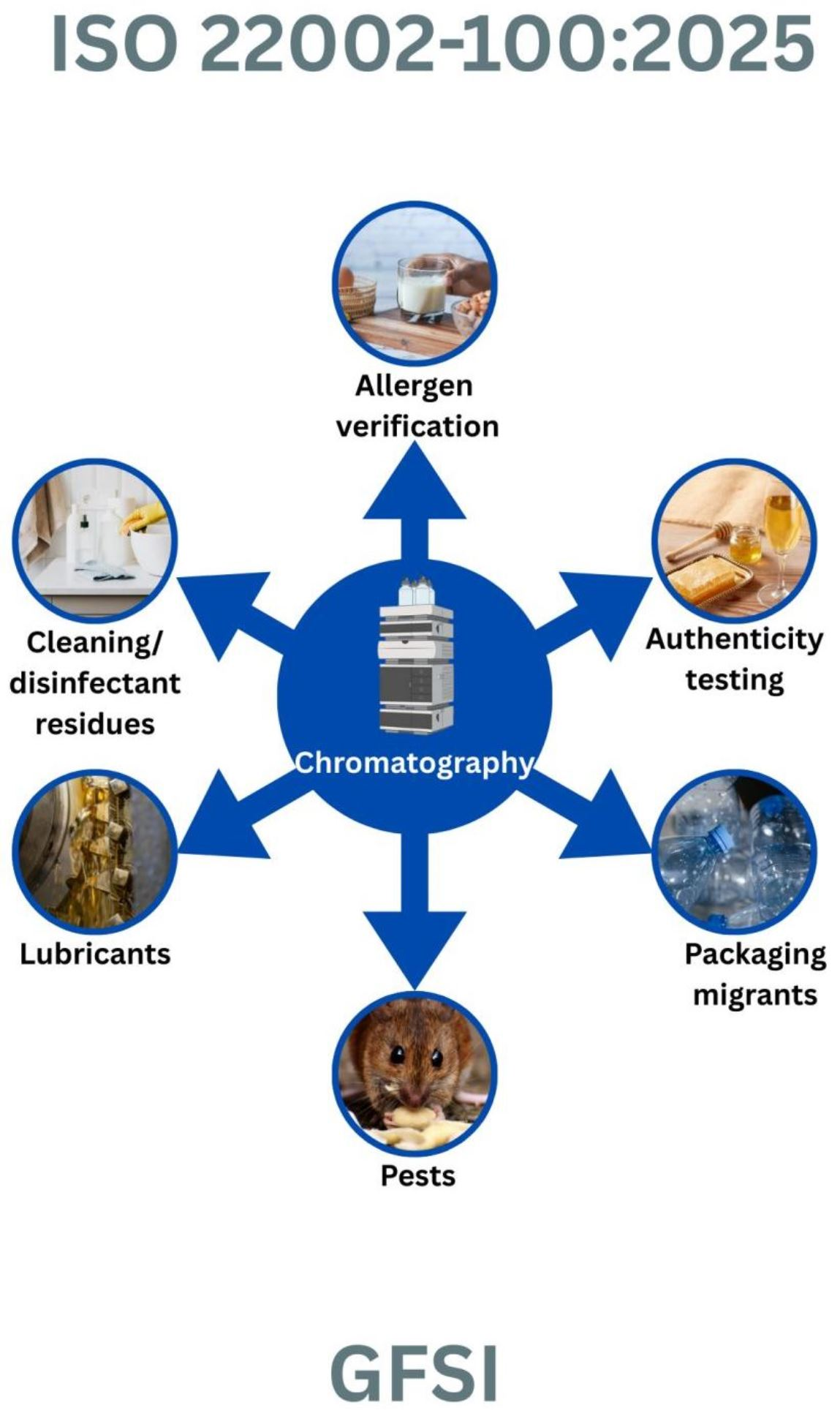

Chromatographic Applications Supporting ISO 22002-100:2025 Requirements on Allergen Management, Food Fraud, and Control of Chemical and Packaging-Related Contaminants



Abstract
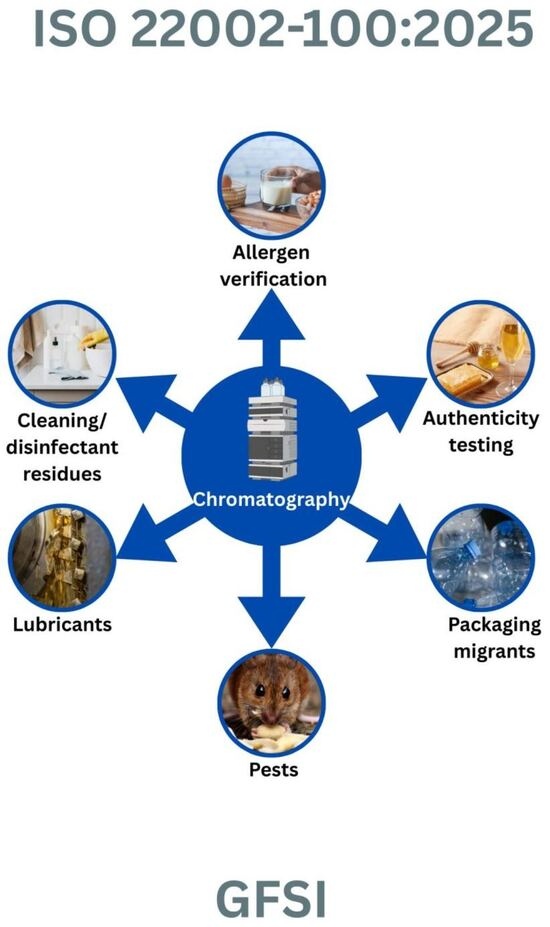
1. Introduction
- (a)
- allergen management, requiring validated analytical verification of cleaning and segregation procedures,
- (b)
- food fraud mitigation and authenticity verification, demanding vulnerability assessments supported by appropriate analytical verification methods; and
- (c)
- chemical contamination and packaging migration control, including non-intentionally added substances (NIASs), residues of cleaning and disinfection agents, technical fluids, lubricants, and pest control chemicals [1].
2. Chromatographic Methods Supporting Allergen Management
2.1. Regulatory and Traceability Context for Allergen Control
2.2. Immunochemical and Molecular Techniques for Allergen Detection
2.3. Chromatographic and Spectrometric Techniques in Allergen Management
2.4. Validation, Standardization, and Harmonization of Chromatographic Methods for Allergen Analysis
2.5. Targeted Chromatographic Applications for Individual Allergens
2.6. Simultaneous Chromatographic Determination of Multiple Food Allergens
3. Chromatographic Approaches for Food Fraud and Authenticity Control
3.1. Regulatory and Management System Standards Requirements for Food Fraud Control
3.2. Mitigation Strategies for Food Fraud Prevention
3.3. Chromatographic Strategies for Food Fraud Detection and Authenticity Assessment
3.4. Applications in Food Analysis
3.4.1. Overview Across Major Food Categories
3.4.2. Analytical Evidence from Individual Studies Across Food Matrices
4. Chromatographic Monitoring of Packaging Contaminants and Chemical Contamination in Food (Cleaning Agents, Disinfectants, Lubricants, and Pesticides Used for Pest Control)
4.1. Packaging-Related Chemical Contaminants
4.2. Cleaning and Disinfectant Agent Residues
4.3. Lubricant and Technical Fluid Contamination
4.4. Insecticide Residues from Indoor Pest Control

| Ref. | Class/Chemical Group | Target Analytes | Matrix | Analytical Technique(s) | Key Analytical Notes |
|---|---|---|---|---|---|
| Packaging-related chemical contaminants | |||||
| [164] | Multiple packaging-related migrants | Various emerging contaminants | Food contact materials | LC-MS/MS, GC-MS/MS, HRMS | Integration of targeted and untargeted approaches |
| [165] | Volatile and semi-volatile migrants | VOCs, SVOCs | Polypropylene containers → food simulants | GC×GC-TOF-MS | Reveals complex migration profiles |
| [166] | Bisphenols, phthalates, oligomeric NIAS | BPA/BPS, phthalates, oligomers | Infant food packaging | Targeted LC-MS/MS and suspect screening | Migration influenced by multilayer design and storage |
| [167] | Plasticizers | Phthalates, adipates, citrates | Various packaging plastics | GC | Migration dependent on fat content, temperature, contact time |
| [168] | Plasticizers | Phthalates | Packaging materials and foods | Microextraction and GC/LC | Improved preconcentration with reduced solvent use |
| [169] | Recycled plastic NIAS | Degradation and oxidation products | Recycled plastics | Non-target HRMS | Complex NIAS mixtures identified |
| [170] | Recycled material NIAS | Oxidation products, unknown migrants | Recycled plastics | HRMS, suspect screening | Supports identification of potentially hazardous NIAS |
| [171] | Isothiazolinone preservatives | Methylisothiazolinone, others | Food contact adhesives | LC-MS/MS | Selective quantification for routine compliance |
| [172] | Paper/cardboard migrants | Semi-volatile migrants | Fibre-based packaging | DI-SPME–GC-MS | Efficient screening under realistic contact conditions |
| [173] | Photoinitiators, bisphenols, plasticizers | Photoinitiators, bisphenols, phthalates, antioxidants, biocides | Paper and cardboard | GC-Orbitrap | Expanded non-targeted detection capabilities |
| [174] | NIAS (paper-based) | Multiple NIAS classes | Recycled paper/cardboard | LC-HRMS/MS | High-resolution profiling of packaging migrants |
| [175] | Mineral oil hydrocarbons (MOH) | MOSH/MOAH | Cocoa products contaminated via jute bags/recycled packaging | LC-GC | Supply-chain contribution demonstrated |
| [176] | Mineral oil hydrocarbons | MOSH/MOAH | Packaging migrants | On-line LC-GC | Improved fractionation and reduced interferences |
| [177] | Mineral oil hydrocarbons | MOSH/MOAH | Routine surveillance | LC-GC-FI (with N2 carrier) | Nitrogen as alternative carrier gas with acceptable performance |
| Cleaning and disinfectant agent residues | |||||
| [181] | Residual milk proteins and cleaning compound residues | Stainless-steel surfaces after CIP | SPE-RP-HPLC | Sensitive, reproducible quantification for CIP validation | Residual milk proteins and cleaning compound residues |
| [182] | Multiple QACs (e.g., BACs, DDACs) | Milk, yogurt, powdered dairy products | UHPLC-MS/MS | Low µg/kg detection, supports routine regulatory monitoring | Multiple QACs (e.g., BACs, DDACs) |
| [183] | N-(3-aminopropyl)-N-dodecylpropane-1,3-diamine | Dairy matrices | LC-MS/MS | High selectivity and sensitivity for non-quaternary biocides | N-(3-aminopropyl)-N-dodecylpropane-1,3-diamine |
| [184] | BACs and DDACs | Milk and dairy products | Multiresidue LC-MS/MS | EU-criteria-compliant performance for official control | BACs and DDACs |
| [185] | >100 biocidal actives: QACs, isothiazolinones, phenolics, etc. | Dairy products and slurry feed | LC-HRMS after acetate-buffered QuEChERS | LOQs 10 ng/g, full SANTE compliance, wide screening capability | >100 biocidal actives: QACs, isothiazolinones, phenolics, etc. |
| [186] | Representative disinfectant actives | Wash-water, wastewater, sanitation fluids (in-field) | Portable miniaturized LC | Low-solvent, rapid on-site screening, lower sensitivity than benchtop LC | Representative disinfectant actives |
| [187] | Quaternary and non-quaternary cationic substances | Cleaning-validation samples | Electromembrane extraction and RP-HPLC | Enhanced selectivity and sensitivity for trace residues | Quaternary and non-quaternary cationic substances |
| [188] | Multiple polar/ semi-polar analytes | Surface and rinse-water samples | LC with modified stationary phases | Improved selectivity using poly(dimethyldiphenylsiloxane)-nitrile phases | Multiple polar/ semi-polar analytes |
| [189] | Multiple disinfectant/antiseptic residues | Cleaning and sanitation samples | Magnetic SPE (functionalized nanoparticles) and HPLC–MS/MS | Efficient enrichment, reduced preparation time, high recovery | Multiple disinfectant/ antiseptic residues |
| [190] | Residues recovered from stainless-steel sampling | Stainless-steel surfaces (CIP validation) | Recovery testing and HPLC-based determination | Multi-step reconditioning improves reproducibility (>90% recovery) | Residues recovered from stainless-steel sampling |
| Lubricant and technical fluid contamination | |||||
| [194] | Lubricant-derived migrants from food contact materials | Lipid-like lubricant fractions | Food contact simulants, packaging systems | Normal-phase LC | Demonstrates migration of lubricant components into simulants, supports inclusion in routine monitoring. |
| [195] | Biodegradable lubricants | Polar degradation by-products | Ester-based biodegradable lubricants, residues in processing environments | LC-based chromatographic monitoring | Detects hydrolysis-derived low-MW compounds not captured by conventional residue methods. |
| [196] | Natural oil–based lubricants | Oxidation and transformation products | Lubricant residues in industrial settings | LC/MS | Monitors oxidative degradation pathways, highlights need for dedicated methods. |
| [197] | Mineral oil hydrocarbons (MOSH) | MOSH fractions | Foods exposed during harvesting, transport, storage | On-line HPLC-GC-FID | Shows transfer of MOSH to food, high relevance for fat-rich matrices. |
| [198] | Mineral oil hydrocarbons (MOSH) | MOSH fractions in edible oils | Edible oils, industrial fluids | Large-scale SPE and GC-FID | Enhances sensitivity and robustness for MOSH profiling in oils. |
| [199] | Lubricant additives and residues | Multi-class lubricant-related compounds | Incidental contamination events, equipment surfaces | Combined GC-MS/MS and LC-MS/MS | Supports source differentiation and profiling of additive signatures. |
| [200] | Ester-based lubricants | Oxidation, hydrolysis and tribological degradation products | Lubricants aged under thermal/ tribological stress | LC-ESI-MS | Distinguishes primary lubricant constituents from degradation by-products at trace levels. |
| [201] | Mineral oil hydrocarbons (MOSH/MOAH) | MOSH and MOAH fractions | Complex food and food contact matrices | Standardized LC–GC approaches | Enables selective determination, aligned with harmonized monitoring criteria. |
| [202] | Antioxidants and degradation markers | Lubricant-derived antioxidants, oxidative markers | Food contact materials and technical fluids | TLC and spray-MS | Provides rapid screening capability for lubricant- related contaminants. |
| Pesticide Residues from Indoor Pest Control | |||||
| [210] | Anticoagulant rodenticides | First- and second- generation anticoagulants | Contaminated food materials | HPLC-DAD, HPLC- fluorescence | Qualitative multi-residue screening in complex matrices |
| [211] | Anticoagulant rodenticides | Multiple rodenticides | Accidentally contaminated foods | Rapid LC-MS/MS | Short run times, reduced sample handling for routine control |
| [212] | Anticoagulant rodenticides (chiral) | Bromadiolone, difenacoum, brodifacoum stereoisomers | Biological matrices, contamination verification | Chiral LC-MS/MS | Enantiomer-specific quantification, differential persistence analysis |
| [213] | Neonicotinoids | Imidacloprid, acetamiprid, clothianidin and metabolites | Wine matrices | Direct-injection LC-MS/MS | Simultaneous multi-residue determination with minimal prep |
| [214] | Neonicotinoids | Imidacloprid | Leafy vegetables | Micellar-based microextraction and HPLC | Low-solvent extraction, selective imidacloprid determination |
| [215] | Organophosphates | Dimethoate, quinalphos, chlorpyrifos | Bean vegetables | Modified QuEChERS and GC-FTD | Quantitative screening for high-consumption crops |
| [216] | Organophosphates | Chlorpyrifos, trichlorfon | Aquaculture products (shrimp) | LC-MS/MS, GC-MS/MS | Low µg/kg detection, monitoring of illegal/off-label use |
| [217] | Organophosphates and pyrethroids | Malathion, λ-cyhalothrin | Zucchini | GC-NPD, GC-ECD | Optimized solvent extraction, dual-detector confirmation |
| [218] | Multiple insecticide classes | Fipronil, indoxacarb, avermectin, pyridaben | Beverages (tea, juices) | d-SPME and DLLME and HPLC-MS/MS | Trace-level (ng/L) preconcentration with minimal solvent |
| [219] | Neonicotinoids(multi-residue) | Multiple neonicotinoids | Fruit samples | Magnetic SPE (Ti-modified silica-PSA) and UPLC-HRMS | High clean-up efficiency, improved selectivity vs. conventional SPE |
| [220] | Various insecticides | Emamectin benzoate, spirotetramat, tolfenpyrad, fipronil | Green and red chilli | LC-MS/MS | Evaluation of washing/ processing effects, dehydration concentrates residues |
5. From Standards to Science: Integrating ISO 22002-100:2025 with GFSI Requirements Through Chromatographic Evidence
6. Conclusions
Author Contributions
Funding
Data Availability Statement
Conflicts of Interest
Abbreviations
| PRPs | Prerequisite programmes |
| NIAS | Non-intentionally added substances |
| HPLC | High-performance liquid chromatography |
| GC | Gas chromatography |
| GFSI | Global Food Safety Initiative |
| ED05 | Eliciting Dose for 5% of the allergic population |
| VITAL | Voluntary Incidental Trace Allergen Labelling |
| FAO | Food and Agriculture Organization |
| WHO | World Health Organization |
| RfDs | Health-based reference doses |
| ELISAs | Enzyme-linked immunosorbent assay |
| LFDs | Lateral flow devices |
| PCR | Polymerase chain reaction |
| LC-MS/MS | Liquid chromatography–tandem mass spectrometry |
| MRM | Multiple reaction monitoring |
| HRMS | High-resolution mass spectrometry |
| DIA | Data-independent acquisition |
| ESI | Ion-exchange chromatography with electrospray ionization |
| MALDI | Matrix-assisted laser desorption/ionization |
| SRM | Selected reaction monitoring |
| QC | Quality Control |
| AOAC | Association of Official Analytical Collaboration |
| CEN/TC 275/WG12 | European Committee for Standardization, Technical Committee 275—Food Analysis—Working Group 12: Food Allergens |
| iFAAM | Integrated Approaches to Food Allergen and Allergy Risk Management |
| CRMs | Certified reference materials |
| SPE | Solid-phase extraction |
| TLC | Thin-layer chromatography |
| IEC | Ion-exchange chromatography |
| DAS | Double Antibody Sandwich |
| LFIA | Lateral flow immunoassay |
| LOQ | Limit of Quantitation |
| LOD | Limit of Detection |
| UHPLC | Ultra-high-performance liquid chromatography |
| VACCP | Vulnerability Assessment and Critical Control Points |
| TACCP | Threat Assessment and Critical Control Points |
| VOC | Volatile organic compounds |
| HPTLC-MS | High-performance thin-layer chromatography coupled with mass spectrometry |
| EVOO | Extra virgin olive oil |
| LC-IRMS | Liquid chromatography–isotope ratio mass spectrometry |
| NMR | Nuclear Magnetic Resonance |
| PDO | Protected Designation of Origin |
| PGI | Protected Geographical Indication |
| CSIA | Compound-specific isotope analysis |
| IRMS | Isotope ratio mass spectrometry |
| MIR | Mid-Infrared |
| NIR | Near-Infrared |
| HS-SPME-GC-MS | Headspace solid-phase microextraction–gas chromatography–mass spectrometry |
| GC-C-IRMS | Gas chromatography–combustion–isotope ratio mass spectrometry |
| TGA | Thermogravimetric Analysis |
| TAG | Triacylglycerols |
| DAG | Diacylglycerols |
| UV | Ultraviolet |
| SFC-Q-TOF-MS | Supercritical fluid chromatography–quadrupole time-of-flight-mass spectrometry |
| RP-HPLC | Reversed-phase high-performance liquid chromatography |
| MALDI-TOF-MS | Matrix-assisted laser desorption/ionization–time-of-flight–mass spectrometry |
| UHPLC-ELSD/UV | Ultra-high-performance liquid chromatography–evaporative light scattering detection/ultraviolet detection |
| PCA | Principal Component Analysis |
| PLS-DA | Partial Least-Squares Discriminant Analysis |
| HMF | Hydroxymethylfurfural |
| HPLC-RID | High-performance liquid chromatography-refractive index detection |
| GC-FID | Gas chromatography-flame ionization detection |
| GC-IMS | GC-ion mobility spectrometry |
| HPLC-DAD | High-performance liquid chromatography with diode array detection |
| ICP-OES | Inductively Coupled Plasma—Optical Emission Spectrometry |
| ID | Identity document |
| FT-NIR | Fourier-transform NIR spectroscopy |
| MGO | Methylglyoxal |
| OPLS-DA | Orthogonal Partial Least Squares-Discriminant Analysis |
| GC-GC/TOF-MS | Comprehensive two-dimensional gas chromatography coupled with time-of-flight mass spectrometry |
| DI-SPME-GC-MS | Direct immersion–solid-phase microextraction–gas chromatography–mass spectrometry |
| MOSHs | Mineral oil saturated hydrocarbons |
| MOAHs | Mineral oil aromatic hydrocarbons |
| SVOCs | Semi-volatile organic compounds |
| BPA | Bisphenol A |
| BPS | Bisphenol S |
| MOHs | Mineral oil hydrocarbons |
| CIP | Cleaning-in-place |
| SPE-RP-HPLC | Solid-phase extraction combined with reversed-phase high-performance liquid chromatography |
| QACs | Quaternary ammonium compounds |
| BACs | Benzalkonium chlorides |
| DDACs | Dialkyl-dimethylammonium chlorides |
| QuEChERS | Quick Easy Cheap Effective Rugged Safe |
| SANTE | Directorate-General for Health and Food Safety of the European Commission |
| GC-FTD | Gas chromatography–flame thermionic detector |
| GC-NPD | Gas chromatography with nitrogen-phosphorus detection |
| GC-ECD | Gas chromatography–electron capture detector |
| DLLME | Dispersive liquid–liquid microextraction |
| PSA | Porous Silica |
| FSSC | Food Safety System Certification 22000 |
| BRCGS | British Retail Consortium Global Standards |
| IFS | International Featured Standards |
References
- ISO 22002-100:2025; Prerequisite Programmes on Food Safety—Part 100: Food, Feed and Packaging Supply Chain. 1st ed. ISO: Geneva, Switzerland, 2025.
- ISO/TS 22002-7:2025; Prerequisite Programmes on Food Safety—Part 7: Retail and Wholesale. 1st ed. ISO: Geneva, Switzerland, 2025.
- ISO 22000:2018; Food Safety Management Systems—Requirements for Any Organization in the Food Chain. 1st ed. ISO: Geneva, Switzerland, 2018.
- ISO 22003-1:2022; Food Safety—Part 1: Requirements for Bodies Providing Audit and Certification of Food Safety Management Systems. 1st ed. ISO: Geneva, Switzerland, 2022.
- Karageorgou, E.G.; Tzikas, Z. Regulatory Requirements as Control Measures: A HACCP-Based Model for Food Safety Compliance in the EU. J. Assoc. Greek Chem. 2025, 2, 44–51. [Google Scholar] [CrossRef]
- European Parliament and Council. Regulation (EU) No 1169/2011 of the European Parliament and of the Council of 25 October 2011 on the Provision of Food Information to Consumers; Annex II; EU: Brussels, Belgium, 2011. [Google Scholar]
- Millard, P.; Paine, S.; O’Hagan, S.; Hipkiss, J. Traceability of Allergenic Foods in the Food Chain. In Handbook of Food Allergen Detection and Control, 1st ed.; Woodhead Publishing: Cambridge, UK, 2025; pp. 19–40. [Google Scholar] [CrossRef]
- Crevel, R. Developing Food Allergen Management Thresholds. In Handbook of Food Allergen Detection and Control, 2nd ed.; Woodhead Publishing: Cambridge, UK, 2025; pp. 51–73. [Google Scholar]
- FAO; WHO. Risk Assessment of Food Allergens—Part 2: Review and Establish Threshold Levels in Foods for the Priority Allergens; Meeting Report, Food Safety and Quality Series No. 15; FAO/WHO: Rome, Italy, 2022. [Google Scholar]
- Lacorn, M.; Immer, U. Enzyme-Linked Immunosorbent Assays (ELISAs) for Detecting Allergens in Food. In Handbook of Food Allergen Detection and Control, 2nd ed.; Woodhead Publishing: Cambridge, UK, 2025; pp. 173–189. [Google Scholar] [CrossRef]
- Baumert, J.L.; Jayasena, S. Lateral Flow Devices for Detecting Allergens in Food. In Handbook of Food Allergen Detection and Control, 2nd ed.; Woodhead Publishing: Cambridge, UK, 2025; pp. 191–202. [Google Scholar] [CrossRef]
- Chen, Y.; Wang, P.; Wang, W.; Han, J.X. Optical Thin-Film Biochips for Detecting Allergens in Food. In Handbook of Food Allergen Detection and Control, 2nd ed.; Woodhead Publishing: Cambridge, UK, 2025; pp. 203–210. [Google Scholar] [CrossRef]
- Holzhauser, T.; Röder, M. Polymerase Chain Reaction (PCR) Methods for Detecting Allergens in Foods. In Handbook of Food Allergen Detection and Control, 2nd ed.; Woodhead Publishing: Cambridge, UK, 2025; pp. 211–227. [Google Scholar] [CrossRef]
- Hamilton, R.G. IgE Antibody-Based Analysis for Detecting Allergens in Food. In Handbook of Food Allergen Detection and Control, 2nd ed.; Woodhead Publishing: Cambridge, UK, 2025; pp. 229–249. [Google Scholar] [CrossRef]
- Johnson, P.; Downs, M.L. Mass Spectrometry for Analysis of Food Allergens. In Handbook of Food Allergen Detection and Control, 2nd ed.; Woodhead Publishing: Cambridge, UK, 2025; pp. 415–435. [Google Scholar]
- Monaci, L.; De Angelis, E.; Montemurro, N.; Pilolli, R. Comprehensive Overview and Recent Advances in Proteomics MS Based Methods for Food Allergens Analysis. TrAC Trends Anal. Chem. 2018, 106, 21–36. [Google Scholar] [CrossRef]
- Fæste, C.K.; Rønning, H.T.; Christians, U.; Granum, P.E. Liquid Chromatography and Mass Spectrometry in Food Allergen Detection. J. Food Prot. 2011, 74, 316–345. [Google Scholar] [CrossRef]
- Shin, J.H.; Reddy, Y.V.M.; Park, T.J.; Park, J.P. Recent Advances in Analytical Strategies and Microsystems for Food Allergen Detection. Food Chem. 2022, 371, 131120. [Google Scholar] [CrossRef] [PubMed]
- Zhang, Y.; Lei, S.; Zou, W.; Wang, L.; Yan, J.; Zhang, X.; Zhang, W.; Yang, Q. Research Progress on Detection Methods for Food Allergens. J. Food Compos. Anal. 2025, 137, 106906. [Google Scholar] [CrossRef]
- Croote, D.; Quake, S.R. Food Allergen Detection by Mass Spectrometry: The Role of Systems Biology. npj Syst. Biol. Appl. 2016, 2, 16022. [Google Scholar] [CrossRef]
- Hu, W.; Zhang, X.; Shen, Y.; Meng, X.; Wu, Y.; Tong, P.; Li, X.; Chen, H.; Gao, J. Quantifying Allergenic Proteins Using Antibody-Based Methods or Liquid Chromatography–Mass Spectrometry/Mass Spectrometry: A Review About the Influence of Food Matrix, Extraction, and Sample Preparation. Compr. Rev. Food Sci. Saf. 2024, 23, e70029. [Google Scholar] [CrossRef] [PubMed]
- Linacero, R.; Cuadrado, C. New Research in Food Allergen Detection. Foods 2022, 11, 1520. [Google Scholar] [CrossRef]
- Flanagan, S.; Hirst, B.; Miguel, S.J. Validation, Standardization, and Harmonization of Analytical Methods and Test Kits for Detecting Allergens in Food. In Handbook of Food Allergen Detection and Control, 2nd ed.; Woodhead Publishing: Cambridge, UK, 2025; pp. 251–264. [Google Scholar] [CrossRef]
- Holcombe, G.; Walker, M.J.; Singh, M.; Gray, K.; Cowen, S.; Ellison, S.L.R.; Rogers, A.; Balasundaram, A.; Burns, M.; Mills, E.N.C. Clinically and Industrially Relevant Incurred Reference Materials to Improve Analysis of Food Allergens, Milk, Egg, Almond, Hazelnut and Walnut. Food Chem. 2024, 434, 137391. [Google Scholar] [CrossRef]
- Downs, M.L. Milk as a Food Allergen. In Handbook of Food Allergen Detection and Control, 2nd ed.; Woodhead Publishing: Cambridge, UK, 2025; pp. 301–316. [Google Scholar]
- Qi, K.; Liu, T.; Yang, Y.; Zhang, J.; Yin, J.; Ding, X.; Qin, W.; Yang, Y. A Rapid Immobilized Trypsin Digestion Combined with Liquid Chromatography–Tandem Mass Spectrometry for the Detection of Milk Allergens in Baked Food. Food Control 2019, 102, 179–187. [Google Scholar] [CrossRef]
- Bianco, M.; Calvano, C.D.; Ventura, G.; Losito, I.; Cataldi, T.R.I. Determination of Hidden Milk Allergens in Meat-Based Foodstuffs by Liquid Chromatography Coupled to Electrospray Ionization and High-Resolution Tandem Mass Spectrometry. Food Control 2022, 131, 108443. [Google Scholar] [CrossRef]
- Ji, J.; Zhu, P.; Pi, F.; Sun, C.; Sun, J.; Jia, M.; Ying, C.; Zhang, Y.; Sun, X. Development of a Liquid Chromatography-Tandem Mass Spectrometry Method for Simultaneous Detection of the Main Milk Allergens. Food Control 2017, 74, 79–88. [Google Scholar] [CrossRef]
- Cucu, T.; De Muer, N.; Trashin, S.; De Meulenaer, B. Mechanisms Behind Matrix–Protein Interactions Influencing Receptor-Based and Chromatographic Detection of Food Allergens: A Case Study with a Fruit Based Snack. Food Control 2015, 47, 641–646. [Google Scholar] [CrossRef]
- Lamberti, C.; Acquadro, E.; Corpillo, D.; Giribaldi, M.; Decastelli, L.; Garino, C.; Arlorio, M.; Ricciardi, C.; Cavallarin, L.; Giuffrida, M.G. Validation of a Mass Spectrometry-Based Method for Milk Traces Detection in Baked Food. Food Chem. 2016, 199, 119–127. [Google Scholar] [CrossRef]
- Lock, S. Gluten Detection and Speciation by Liquid Chromatography Mass Spectrometry (LC-MS/MS). Foods 2014, 3, 13–29. [Google Scholar] [CrossRef] [PubMed]
- Scherf, K.A.; Poms, R.E. Recent Developments in Analytical Methods for Tracing Gluten. J. Cereal Sci. 2016, 67, 112–122. [Google Scholar] [CrossRef]
- Martinez-Aviño, A.; Moliner-Martinez, Y.; Molins-Legua, C.; Campins-Falcó, P. Colorimetric Analysis Platform Based on Thin Layer Chromatography for Monitoring Gluten Cross-Contamination in Food Industry. Food Chem. 2024, 448, 139025. [Google Scholar] [CrossRef]
- Zeng, J.; Ma, F.; Zhai, L.; Du, C.; Zhao, J.; Li, Z.; Wang, J. Recent Advance in Sesame Allergens: Influence of Food Processing and Their Detection Methods. Food Chem. 2024, 448, 139058. [Google Scholar] [CrossRef]
- Ma, X.; Li, H.; Zhang, J.; Huang, W.; Han, J.; Ge, Y.; Sun, J.; Chen, Y. Comprehensive Quantification of Sesame Allergens in Processed Food Using Liquid Chromatography-Tandem Mass Spectrometry. Food Control 2020, 107, 106744. [Google Scholar] [CrossRef]
- Li, J.; Kang, W.; Zhang, J.; Ge, Y.; Yu, N.; Chen, Y. Selection of Signature Peptide Biomarkers for the Sesame Allergens in Commercial Food Based on LC-MS/MS. Food Chem. 2025, 463, 141392. [Google Scholar] [CrossRef]
- Taylor, S.L.; Downs, M.L.; Baumert, J.L. Soybeans as a Food Allergen. In Handbook of Food Allergen Detection and Control, 2nd ed.; Woodhead Publishing: Cambridge, UK, 2025; pp. 343–368. [Google Scholar] [CrossRef]
- Chen, S.; Yang, C.; Downs, M. Targeted Mass Spectrometry Quantification of Total Soy Protein Residues from Commercially Processed Ingredients for Food Allergen Management. J. Proteom. 2021, 239, 104194. [Google Scholar] [CrossRef]
- Krager, J.; Baumert, J.L.; Downs, M.L. Quantification of Soy-Derived Ingredients in Model Bread and Frankfurter Matrices with an Optimized Liquid Chromatography–Tandem Mass Spectrometry External Standard Calibration Workflow. J. Food Prot. 2022, 85, 311–322. [Google Scholar] [CrossRef]
- Karimi, Z.; Campbell, K.; Kevei, Z.; Patriarca, A.; Koidis, A.; Anastasiadi, M. A Critical Review of Conventional and Emerging Technologies for the Detection of Contaminants, Allergens and Adulterants in Plant-Based Milk Alternatives. Curr. Res. Food Sci. 2025, 10, 101067. [Google Scholar] [CrossRef]
- Sakai, S.; Adachi, R.; Teshima, R. Detection and Control of Eggs as a Food Allergen. In Handbook of Food Allergen Detection and Control; Mills, E.N.C., Wichers, H.J., Eds.; Woodhead Publishing: Cambridge, UK, 2015; pp. 313–340. [Google Scholar] [CrossRef]
- Ma, X.; Liang, R.; Yang, X.; Gou, J.; Li, Y.; Lozano-Ojalvo, D. Simultaneous Separation of the Four Major Allergens of Hen Egg White. J. Chromatogr. B 2020, 1152, 122231. [Google Scholar] [CrossRef] [PubMed]
- Kiyota, K.; Yoshimitsu, M.; Uchida, K.; Kajimura, K. Development of a Liquid Chromatography–Tandem Mass Spectrometry Method for Simultaneous Quantification of Hen’s Egg White Allergens Gal d 1–4 in Fresh and Processed Eggs. Food Chem. 2021, 345, 128022. [Google Scholar] [CrossRef] [PubMed]
- Yang, S.; Chen, J.; Abdallah, M.F.; Lin, H.; Yang, P.; Li, J.; Zhang, R.; Li, Q.; Lu, P.; Liu, S.; et al. An Integrated Calibration Strategy for the Development and Validation of an LC-MS/MS Method for Accurate Quantification of Egg Allergens (Gal d 1–6) in Foods. Food Chem. 2024, 438, 137922. [Google Scholar] [CrossRef] [PubMed]
- Wong, G.W.K. Detection and Control of Fish, Shellfish, and Mollusks as Food Allergens. In Handbook of Food Allergen Detection and Control, 2nd ed.; Mills, E.N.C., Wichers, H.J., Eds.; Woodhead Publishing: Cambridge, UK, 2025; pp. 389–398. [Google Scholar]
- Sun, L.; Lin, H.; Li, Z.; Sun, W.; Wang, J.; Wu, H.; Ge, M.; Ahmed, I.; Pavase, T.R. Development of a Method for the Quantification of Fish Major Allergen Parvalbumin in Food Matrix via Liquid Chromatography–Tandem Mass Spectrometry with Multiple Reaction Monitoring. Food Chem. 2019, 276, 358–365. [Google Scholar] [CrossRef]
- Posada-Ayala, M.; Alvarez-Llamas, G.; Maroto, A.S.; Maes, X.; Muñoz-Garcia, E.; Villalba, M.; Rodríguez, R.; Perez-Gordo, M.; Vivanco, F.; Pastor-Vargas, C.; et al. Novel Liquid Chromatography–Mass Spectrometry Method for Sensitive Determination of the Mustard Allergen Sin a 1 in Food. Food Chem. 2015, 183, 58–63. [Google Scholar] [CrossRef]
- Chen, Y.; Wu, Y.J.; Deng, T.T. Detection and Control of Mustard and Sesame as Food Allergens. In Handbook of Food Allergen Detection and Control, 1st ed.; Mills, E.N.C., Wichers, H.J., Eds.; Woodhead Publishing: Cambridge, UK, 2015; pp. 391–408. [Google Scholar]
- Yang, S.; Sun, F.; Wu, X.; Huang, P.; Qu, J.; He, R.; Cui, Y.; Xi, J. Establishment of DAS-ELISA and Lateral Flow Immunochromatography for the Detection of Peanut Allergen Ara h 3 after Heat-Moisture Treatment. Food Chem. 2025, 472, 142910. [Google Scholar] [CrossRef]
- Downs, M.L.; Baumert, J.L.; Taylor, S.L.; Mills, E.N.C. Mass Spectrometric Analysis of Allergens in Roasted Walnuts. J. Proteom. 2016, 142, 62–69. [Google Scholar] [CrossRef]
- Fan, S.; Ma, J.; Liu, Z.; Ning, Y.; Cao, M.; Li, Q.; Zhang, Y. Determination of Egg and Milk Allergen in Food Products by Liquid Chromatography-Tandem Mass Spectrometry Based on Signature Peptides and Isotope-Labeled Internal Standard. Food Sci. Hum. Wellness 2023, 12, 728–736. [Google Scholar] [CrossRef]
- Torii, A.; Seki, Y.; Arimoto, C.; Hojo, N.; Iijima, K.; Nakamura, K.; Ito, R.; Yamakawa, H.; Akiyama, H. Development of a Simple and Reliable LC-MS/MS Method to Simultaneously Detect Walnut and Almond as Specified in Food Allergen Labelling Regulations in Processed Foods. Curr. Res. Food Sci. 2023, 6, 100444. [Google Scholar] [CrossRef]
- Parker, C.H.; Khuda, S.E.; Pereira, M.; Ross, M.M.; Fu, T.-J.; Fan, X.; Wu, Y.; Williams, K.M.; DeVries, J.; Pulvermacher, B.; et al. Multi-Allergen Quantitation and the Impact of Thermal Treatment in Industry-Processed Baked Goods by ELISA and Liquid Chromatography-Tandem Mass Spectrometry. J. Agric. Food Chem. 2015, 63, 10669–10680. [Google Scholar] [CrossRef]
- Boo, C.C.; Parker, C.H.; Jackson, L.S. A Targeted LC-MS/MS Method for the Simultaneous Detection and Quantitation of Egg, Milk, and Peanut Allergens in Sugar Cookies. J. AOAC Int. 2018, 101, 108–117. [Google Scholar] [CrossRef]
- Xiong, W.; Parker, C.H.; Boo, C.C.; Fiedler, K.L. Comparison of Allergen Quantification Strategies for Egg, Milk, and Peanut in Food Using Targeted LC–MS/MS. Anal. Bioanal. Chem. 2021, 413, 5755–5766. [Google Scholar] [CrossRef]
- Monaci, L.; Pilolli, R.; De Angelis, E.; Godula, M.; Visconti, A. Multi-Allergen Detection in Food by Micro High-Performance Liquid Chromatography Coupled to a Dual Cell Linear Ion Trap Mass Spectrometry. J. Chromatogr. A 2014, 1358, 136–144. [Google Scholar] [CrossRef] [PubMed]
- Gomaa, A.; Boye, J. Simultaneous Detection of Multi-Allergens in an Incurred Food Matrix Using ELISA, Multiplex Flow Cytometry and Liquid Chromatography Mass Spectrometry (LC-MS). Food Chem. 2015, 175, 585–592. [Google Scholar] [CrossRef]
- Bi, Y.; Liu, C.; Pan, F.; Peng, W.; Fang, X.; Che, H.; Tian, W. Allergenicity Risk in Animal-Based Food Proteins: Source, Dietary Factors Effect, Allergen Detection and Processing Modification Methods. Trends Food Sci. Technol. 2024, 153, 104726. [Google Scholar] [CrossRef]
- Planque, M.; Arnould, T.; Dieu, M.; Delahaut, P.; Renard, P.; Gillard, N. Advances in Ultra-High Performance Liquid Chromatography Coupled to Tandem Mass Spectrometry for Sensitive Detection of Several Food Allergens in Complex and Processed Foodstuffs. J. Chromatogr. A 2016, 1464, 115–123. [Google Scholar] [CrossRef]
- Stella, R.; Sette, G.; Moressa, A.; Gallina, A.; Aloisi, A.M.; Angeletti, R.; Biancotto, G. LC-HRMS/MS for the Simultaneous Determination of Four Allergens in Fish and Swine Food Products. Food Chem. 2020, 331, 127276. [Google Scholar] [CrossRef]
- New, L.S.; Stahl-Zeng, J.; Schreiber, A.; Cafazzo, M.; Liu, A.; Brunelle, S.; Liu, H.-F. Detection and Quantitation of Selected Food Allergens by Liquid Chromatography with Tandem Mass Spectrometry: First Action 2017.17. J. AOAC Int. 2020, 103, 570–583. [Google Scholar] [CrossRef]
- Gavage, M.; Van Vlierberghe, K.; Dieu, M.; Renard, P.; Arnould, T.; De Loose, M.; Gevaert, K.; Gillard, N.; Van Poucke, C. Development and Validation of a Quantitative Method for Multiple Allergen Detection in Food Using Concatemer-Based Isotope Dilution Mass Spectrometry. J. AOAC Int. 2022, 105, 1585–1595. [Google Scholar] [CrossRef]
- Heick, J.; Fischer, M.; Pöpping, B. First Screening Method for the Simultaneous Detection of Seven Allergens by Liquid Chromatography Mass Spectrometry. J. Chromatogr. A 2011, 1218, 938–943. [Google Scholar] [CrossRef]
- Pilolli, R.; De Angelis, E.; Monaci, L. Streamlining the Analytical Workflow for Multiplex MS/MS Allergen Detection in Processed Foods. Food Chem. 2017, 221, 1747–1753. [Google Scholar] [CrossRef] [PubMed]
- Torii, A.; Seki, Y.; Sasano, R.; Ishida, Y.; Nakamura, K.; Ito, R.; Iwasaki, Y.; Iijima, K.; Akiyama, H. Development of a Rapid and Reliable Method to Simultaneously Detect Seven Food Allergens in Processed Foods Using LC-MS/MS. Food Chem. X 2024, 23, 101558. [Google Scholar] [CrossRef] [PubMed]
- Planque, M.; Arnould, T.; Delahaut, P.; Renard, P.; Dieu, M.; Gillard, N. Development of a Strategy for the Quantification of Food Allergens in Several Food Products by Mass Spectrometry in a Routine Laboratory. Food Chem. 2019, 274, 35–45. [Google Scholar] [CrossRef] [PubMed]
- European Union. Regulation (EC) No 178/2002 of the European Parliament and of the Council of 28 January 2002 laying down the general principles and requirements of food law, establishing the European Food Safety Authority and laying procedures in matters of food safety. Off. J. Eur. Communities 2002, L 31, 1–24. [Google Scholar]
- European Union. Regulation (EU) 2017/625 of the European Parliament and of the Council of 15 March 2017 on official controls and other official activities performed to ensure the application of food and feed law, rules on animal health and welfare, plant health and plant protection products. Off. J. Eur. Union 2017, L 95, 1–142. [Google Scholar]
- Munekata, P.E.S.; Domínguez, R.; Pateiro, M.; Lorenzo, J.M. Introduction to food fraud. In Food Toxicology and Forensics; Galanakis, C.M., Ed.; Academic Press: Cambridge, MA, USA, 2021; pp. 1–30. [Google Scholar] [CrossRef]
- Kennedy, S.P. History of food fraud and development of mitigation requirements and standards. In Food Fraud: A Global Threat with Public Health and Economic Consequences; Hellberg, R.S., Everstine, K., Sklare, S.A., Eds.; Academic Press: Cambridge, MA, USA, 2021; pp. 9–22. [Google Scholar]
- Soon, J.M. Food fraud countermeasures and consumers: A future agenda. In Future Foods: Global Trends, Opportunities, and Sustainability Challenges; Academic Press: Cambridge, MA, USA, 2022; pp. 597–611. [Google Scholar] [CrossRef]
- Rezazade, F.; Summers, J.; Ong Lai Teik, D. A Holistic Approach to Food Fraud Vulnerability Assessment. Food Control 2022, 131, 108440. [Google Scholar] [CrossRef]
- European Commission. Report on EU Agri-Food Fraud Suspicions (iRASFF); European Commission: Brussels, Belgium, 2025. [Google Scholar]
- Everstine, K.D.; Chin, H.B.; Lopes, F.A.; Moore, J.C. Database of Food Fraud Records: Summary of Data from 1980 to 2022. J. Food Prot. 2024, 87, 100227. [Google Scholar] [CrossRef]
- Everstine, K.; Popping, B.; Gendel, S.M. Food fraud mitigation: Strategic approaches and tools. In Food Fraud: A Global Threat with Public Health and Economic Consequences; Hellberg, R.S., Everstine, K., Sklare, S.A., Eds.; Academic Press: Cambridge, MA, USA, 2021; pp. 23–43. [Google Scholar]
- Gendel, S.M. Preventing food fraud. In Present Knowledge in Food Safety: A Risk-Based Approach Through the Food Chain; Knowles, M.E., Anelich, L.E., Boobis, A.R., Popping, B., Eds.; Academic Press: Cambridge, MA, USA, 2023; pp. 260–265. [Google Scholar]
- Robson, K.; Dean, M.; Haughey, S.; Elliott, C. A Comprehensive Review of Food Fraud Terminologies and Food Fraud Mitigation Guides. Food Control 2021, 120, 107516. [Google Scholar] [CrossRef]
- Maritano, V.; Barge, P.; Biglia, A.; Comba, L.; Ricauda Aimonino, D.; Tortia, C.; Gay, P. Anticounterfeiting and Fraud Mitigation Solutions for High-Value Food Products. J. Food Prot. 2024, 87, 100251. [Google Scholar] [CrossRef]
- Gwenzi, W.; Makuvara, Z.; Marumure, J.; Simbanegavi, T.T.; Mukonza, S.S.; Chaukura, N. Chicanery in the Food Supply Chain! Food Fraud, Mitigation, and Research Needs in Low-Income Countries. Trends Food Sci. Technol. 2023, 136, 194–223. [Google Scholar] [CrossRef]
- Barrere, V.; Everstine, K.; Théolier, J.; Godefroy, S. Food Fraud Vulnerability Assessment: Towards a Global Consensus on Procedures to Manage and Mitigate Food Fraud. Trends Food Sci. Technol. 2020, 100, 131–137. [Google Scholar] [CrossRef]
- Spink, J.W. The GFSI Food Fraud Prevention Compliance Development & Requirements: A Ten-Year Review. Trends Food Sci. Technol. 2023, 138, 766–773. [Google Scholar] [CrossRef]
- Manning, L. Food defense: Types of threat, defense plans, and mitigation strategies. In Present Knowledge in Food Safety: A Risk-Based Approach Through the Food Chain; Knowles, M.E., Anelich, L.E., Boobis, A.R., Popping, B., Eds.; Academic Press: Cambridge, MA, USA, 2023; pp. 536–551. [Google Scholar] [CrossRef]
- Butler, F.; Luijckx, N.L.; Marvin, H.J.P.; Bouzembrak, Y.; Mojtahed, V. Role of Analytical Testing for Food Fraud Risk Mitigation—A Commentary on Implementation of Analytical Fraud Testing. Curr. Res. Food Sci. 2021, 4, 301–307. [Google Scholar] [CrossRef] [PubMed]
- Lees, M.; Reimann, L. Analytical Detection Methods and Strategies for Food Fraud. In Food Fraud: A Global Threat with Public Health and Economic Consequences; Hellberg, R.S., Everstine, K., Sklare, S.A., Eds.; Academic Press: Cambridge, MA, USA, 2021; pp. 45–67. [Google Scholar]
- Marín, X.; Grau-Noguer, E.; Gervilla-Cantero, G.; Ripolles-Avila, C.; Castillo, M. Emerging Technologies for Detecting Food Fraud: A Review of the Current Landscape in the 2020s. Trends Food Sci. Technol. 2025, 165, 105313. [Google Scholar] [CrossRef]
- Vinothkanna, A.; Dar, O.I.; Liu, Z.; Jia, A.-Q. Advanced Detection Tools in Food Fraud: A Systematic Review for Holistic and Rational Detection Method Based on Research and Patents. Food Chem. 2024, 446, 138893. [Google Scholar] [CrossRef]
- Lei, H.; Castanheira, I.; Guan, T. Advanced Techniques Against Food Fraud. Food Chem. 2025, 470, 142832. [Google Scholar] [CrossRef]
- Liang, C.; Xu, Z.; Liu, P.; Guo, S.; Xiao, P.; Duan, J.-A. Integrating Different Detection Techniques and Data Analysis Methods for Comprehensive Food Authenticity Verification. Food Chem. 2025, 463, 141471. [Google Scholar] [CrossRef]
- Jiménez-Carvelo, A.M.; Pérez-Castaño, E.; González-Casado, A.; Cuadros-Rodríguez, L. One Input-Class and Two Input-Class Classifications for Differentiating Olive Oil from Other Edible Vegetable Oils by Use of the Normal-Phase Liquid Chromatography Fingerprint of the Methyl-Transesterified Fraction. Food Chem. 2017, 221, 1784–1791. [Google Scholar] [CrossRef] [PubMed]
- Suman, M.; Cavanna, D.; Sammarco, G.; Lambertini, F.; Loffi, C. Fighting Food Frauds Exploiting Chromatography-Mass Spectrometry Technologies: Scenario Comparison Between Solutions in Scientific Literature and Real Approaches in Place in Industrial Facilities. TrAC Trends Anal. Chem. 2021, 142, 116305. [Google Scholar] [CrossRef]
- Sharma, R.; Nath, P.C.; Lodh, B.K.; Mukherjee, J.; Mahata, N.; Gopikrishna, K.; Tiwari, O.N.; Bhunia, B. Rapid and Sensitive Approaches for Detecting Food Fraud: A Review on Prospects and Challenges. Food Chem. 2024, 454, 139817. [Google Scholar] [CrossRef]
- Quintanilla-Casas, B.; Torres-Cobos, B.; Bro, R.; Guardiola, F.; Vichi, S.; Tres, A. The Volatile Metabolome—Gas Chromatography–Mass Spectrometry Approaches in the Context of Food Fraud. Curr. Opin. Food Sci. 2025, 61, 101235. [Google Scholar] [CrossRef]
- Sharma, N.; Anurag; Singh, H.; Sharma, A. Application of High-Performance Thin Layer Chromatography Mass Spectrometry (HPTLC MS) in Foodomics Authenticity. Talanta Open 2024, 9, 100315. [Google Scholar] [CrossRef]
- Lozano-Castellón, J.; Laveriano-Santos, E.P.; Abuhabib, M.M.; Pozzoli, C.; Pérez, M.; Vallverdú-Queralt, A.; Lamuela-Raventós, R.M. Proven Traceability Strategies Using Chemometrics for Organic Food Authenticity. Trends Food Sci. Technol. 2024, 147, 104430. [Google Scholar] [CrossRef]
- Ferreira, G.; Tucker, J.; Rakola, E.; Raszap Skorbiansky, S. Fraud in Organic Foods. In Food Fraud: A Global Threat with Public Health and Economic Consequences; Hellberg, R.S., Everstine, K., Sklare, S.A., Eds.; Academic Press: Cambridge, MA, USA, 2021; pp. 335–350. [Google Scholar]
- Koljančić, N.; Furdíková, K.; de Araújo Gomes, A.; Špánik, I. Wine Authentication: Current Progress and State of the Art. Trends Food Sci. Technol. 2024, 150, 104598. [Google Scholar] [CrossRef]
- Ma, Y.; Li, Y.; Shao, F.; Lu, Y.; Meng, W.; Rogers, K.M.; Sun, D.; Wu, H.; Peng, X. Advancing Stable Isotope Analysis for Alcoholic Beverages’ Authenticity: Novel Approaches in Fraud Detection and Traceability. Foods 2025, 14, 943. [Google Scholar] [CrossRef]
- Lin, S.; Salcido-Keamo, S. Fraud in Wine and Other Alcoholic Beverages. In Food Fraud: A Global Threat with Public Health and Economic Consequences; Hellberg, R.S., Everstine, K., Sklare, S.A., Eds.; Academic Press: Cambridge, MA, USA, 2021; pp. 233–247. [Google Scholar]
- Syposs, Z.; Knight, G. Fraud in Nonalcoholic Ready-to-Drink Products. In Food Fraud: A Global Threat with Public Health and Economic Consequences; Hellberg, R.S., Everstine, K., Sklare, S.A., Eds.; Academic Press: Cambridge, MA, USA, 2021; pp. 219–232. [Google Scholar]
- Wadood, S.A.; Boli, G.; Xiaowen, Z.; Hussain, I.; Yimin, W. Recent Development in the Application of Analytical Techniques for the Traceability and Authenticity of Food of Plant Origin. Microchem. J. 2020, 152, 104295. [Google Scholar] [CrossRef]
- Kennedy, S.P.; Gonzales, P.; Roungchun, J. Coffee and Tea Fraud. In Food Fraud: A Global Threat with Public Health and Economic Consequences; Hellberg, R.S., Everstine, K., Sklare, S.A., Eds.; Academic Press: Cambridge, MA, USA, 2021; pp. 139–150. [Google Scholar]
- Hoffman, J.M.; Lafeuille, J.-L.; Ragupathy, S.; Newmaster, S. Spice and Herb Fraud. In Food Fraud: A Global Threat with Public Health and Economic Consequences; Hellberg, R.S., Everstine, K., Sklare, S.A., Eds.; Academic Press: Cambridge, MA, USA, 2021; pp. 177–218. [Google Scholar]
- Faller, A.C.; Kesanakurti, P.; Arunachalam, T. Fraud in Grains and Cereals. In Food Fraud: A Global Threat with Public Health and Economic Consequences; Hellberg, R.S., Everstine, K., Sklare, S.A., Eds.; Academic Press: Cambridge, MA, USA, 2021; pp. 281–308. [Google Scholar]
- Lozano-Castellón, J.; López-Yerena, A.; Domínguez-López, I.; Siscart-Serra, A.; Fraga, N.; Sámano, S.; López-Sabater, C. Extra Virgin Olive Oil: A Comprehensive Review of Efforts to Ensure Its Authenticity, Traceability, and Safety. Compr. Rev. Food Sci. Food Saf. 2022, 21, 2639–2664. [Google Scholar] [CrossRef] [PubMed]
- Guillaume, C.; Miller, P.; Cantrill, R. Fraud in Fats and Oils. In Food Fraud: A Global Threat with Public Health and Economic Consequences; Hellberg, R.S., Everstine, K., Sklare, S.A., Eds.; Academic Press: Cambridge, MA, USA, 2021; pp. 151–175. [Google Scholar]
- García, N.; Schwarzinger, S. Honey Fraud. In Food Fraud: A Global Threat with Public Health and Economic Consequences; Hellberg, R.S., Everstine, K., Sklare, S.A., Eds.; Academic Press: Cambridge, MA, USA, 2021; pp. 309–334. [Google Scholar]
- Trifković, J.; Andrić, F.; Ristivojević, P.; Guzelmeric, E.; Yesilada, E. Analytical Methods in Tracing Honey Authenticity. J. AOAC Int. 2017, 100, 827–839. [Google Scholar] [CrossRef]
- Álvarez-Suárez, J.M.; Majtan, J. Beyond fraud: Functional authenticity as the next frontier in honey quality assurance. Food Control 2026, 181, 111762. [Google Scholar] [CrossRef]
- Lianou, A.; Papakonstantinou, M.; Nychas, G.-J.E.; Stoitsis, J. Fraud in meat and poultry products. In Food Fraud: A Global Threat with Public Health and Economic Consequences; Hellberg, R.S., Everstine, K., Sklare, S.A., Eds.; Academic Press: Cambridge, MA, USA, 2021; pp. 85–108. [Google Scholar]
- Silva, A.J.; Hellberg, R.S.; Hanner, R.H. Seafood fraud. In Food Fraud: A Global Threat with Public Health and Economic Consequences; Hellberg, R.S., Everstine, K., Sklare, S.A., Eds.; Academic Press: Cambridge, MA, USA, 2021; pp. 109–137. [Google Scholar]
- Gimonkar, S.; Van Fleet, E.E.; Boys, K.A. Dairy product fraud. In Food Fraud: A Global Threat with Public Health and Economic Consequences; Hellberg, R.S., Everstine, K., Sklare, S.A., Eds.; Academic Press: Cambridge, MA, USA, 2021; pp. 249–279. [Google Scholar] [CrossRef]
- Ferreira, M.M.; Marins-Gonçalves, L.; De Souza, D. An integrative review of analytical techniques used in food authentication: A detailed description for milk and dairy products. Food Chem. 2024, 457, 140206. [Google Scholar] [CrossRef] [PubMed]
- Abedini, A.; Salimi, M.; Mazaheri, Y.; Sadighara, P.; Alizadeh Sani, M.; Assadpour, E.; Jafari, S.M. Assessment of cheese frauds, and relevant detection methods: A systematic review. Food Chem. X 2023, 19, 100825. [Google Scholar] [CrossRef]
- Samanidou, V.; Karageorgou, E.; Kourti, P. The Role of HPLC in the Authenticity Control of Milk and Dairy Products. In Liquid Chromatography: Principles, Technology and Applications; Ramos, F., Ed.; Nova Science Publishers: Hauppauge, NY, USA, 2013; pp. 173–206. [Google Scholar]
- Joolaei Ahranjani, P.; Joolaei Ahranjani, P.; Dehghan, K.; Esfandiari, Z.; Ferrentino, G. Advances in Spectroscopic Techniques for the Detection of Cheese Adulteration: A Systematic Review. Food Chem. X 2025, 29, 102685. [Google Scholar] [CrossRef]
- Perini, M.; Bontempo, L. Liquid chromatography coupled to isotope ratio mass spectrometry (LC-IRMS): A review. Trends Anal. Chem. 2022, 147, 116515. [Google Scholar] [CrossRef]
- Liu, H.; Nie, J.; Liu, Y.; Wadood, S.A.; Rogers, K.M.; Yuan, Y.; Gan, R.-Y. A review of recent compound-specific isotope analysis studies applied to food authentication. Food Chem. 2023, 415, 135791. [Google Scholar] [CrossRef] [PubMed]
- van Leeuwen, K.A.; Prenzler, P.D.; Ryan, D.; Camin, F. Gas Chromatography-Combustion-Isotope Ratio Mass Spectrometry for Τraceability and Authenticity in foods and beverages. Compr. Rev. Food Sci. Food Saf. 2014, 13, 814–837. [Google Scholar] [CrossRef]
- Park, J.; Cho, Y.S.; Seo, D.W.; Choi, J.Y. An update on the sample preparation and analytical methods for synthetic food colorants in food products. Food Chem. 2024, 459, 140333. [Google Scholar] [CrossRef]
- Tzachristas, A.; Dasenaki, M.; Aalizadeh, R.; Thomaidis, N.S.; Proestos, C. LC-MS based metabolomics for the authentication of selected Greek white wines. Microchem. J. 2021, 169, 106543. [Google Scholar] [CrossRef]
- Geana, E.I.; Popescu, R.; Costinel, D.; Dinca, O.R.; Stefanescu, I.; Ionete, R.E.; Bala, C. Verifying the red wines adulteration through isotopic and chromatographic investigations coupled with multivariate statistic interpretation of the data. Food Control 2016, 62, 1–9. [Google Scholar] [CrossRef]
- Mac, H.X.; Pham, T.T.; Ha, N.T.T.; Nguyen, L.L.P.; Baranyai, L.; Friedrich, L. Current Techniques for Fruit Juice and Wine Adulterant Detection and Authentication. Beverages 2023, 9, 84. [Google Scholar] [CrossRef]
- Yeganeh-Zare, S.; Farhadi, K.; Amiri, S. Rapid detection of apple juice concentrate adulteration with date concentrate, fructose and glucose syrup using HPLC-RID incorporated with chemometric tools. Food Chem. 2022, 370, 131015. [Google Scholar] [CrossRef]
- Zhou, Q.; Li, G.; Ou-Yang, Z.; Yi, X.; Huang, L.; Wang, H. Volatile Organic Compounds Profiles to Determine Authenticity of Sweet Orange Juice Using Head Space Gas Chromatography Coupled with Multivariate Analysis. Foods 2020, 9, 505. [Google Scholar] [CrossRef]
- Cuevas, F.J.; Moreno-Rojas, J.M.; Ruiz-Moreno, M.J. Assessing a Traceability Technique in Fresh Oranges (Citrus sinensis L. Osbeck) with an HS-SPME-GC-MS Method: Towards a Volatile Characterisation of Organic Oranges. Food Chem. 2017, 221, 1930–1938. [Google Scholar] [CrossRef]
- Strojnik, L.; Stopar, M.; Zlatič, E.; Kokalj, D.; Naglič Gril, M.; Ženko, B.; Žnidaršič, M.; Bohanec, M.; Boshkovska, B.M.; Luštrek, M.; et al. Authentication of key aroma compounds in apple using stable isotope approach. Food Chem. 2019, 277, 766–773. [Google Scholar] [CrossRef]
- Steingass, C.B.; Langen, J.; Carle, R.; Schmarr, H.-G. Authentication of Pineapple (Ananas comosus [L.] Merr.) Fruit Maturity Stages by Quantitative Analysis of γ- and δ-Lactones Using Headspace Solid-Phase Microextraction and Chirospecific Gas Chromatography-Selected Ion Monitoring Mass Spectrometry (HS-SPME-GC-SIM-MS). Food Chem. 2015, 168, 496–503. [Google Scholar] [CrossRef]
- Ghaste, M.; Narduzzi, L.; Carlin, S.; Vrhovsek, U.; Shulaev, V.; Mattivi, F. Chemical Composition of Volatile Aroma Metabolites and Their Glycosylated Precursors That Can Uniquely Differentiate Individual Grape Cultivars. Food Chem. 2015, 188, 309–319. [Google Scholar] [CrossRef] [PubMed]
- Zappi, A.; Marassi, V.; Kassouf, N.; Giordani, S.; Pasqualucci, G.; Garbini, D.; Roda, B.; Zattoni, A.; Reschiglian, P.; Melucci, D. A Green Analytical Method Combined with Chemometrics for Traceability of Tomato Sauce Based on Colloidal and Volatile Fingerprinting. Molecules 2022, 27, 5507. [Google Scholar] [CrossRef]
- Kissoudi, M.; Sarakatsianos, I.; Samanidou, V. Isolation and purification of food-grade C-phycocyanin from Arthrospira platensis and its determination in confectionery by HPLC with diode array detection. J. Sep. Sci. 2018, 41, 975–981. [Google Scholar] [CrossRef] [PubMed]
- Papapetros, S.; Louppis, A.; Kosma, I.; Kontakos, S.; Badeka, A. Characterization and Differentiation of Botanical and Geographical Origin of Selected Popular Sweet Cherry Cultivars Grown in Greece. J. Food Compos. Anal. 2018, 72, 48–56. [Google Scholar] [CrossRef]
- Dinis, K.; Tsamba, L.; Jamin, E.; Camel, V. Untargeted Metabolomics-Based Approach Using UHPLC-HRMS to Authenticate Carrots (Daucus carota L.) Based on Geographical Origin and Production Mode. Food Chem. 2023, 423, 136273. [Google Scholar] [CrossRef]
- Lim, D.K.; Long, N.P.; Mo, C.; Dong, Z.; Cui, L.; Kim, G.; Kwon, S.W. Combination of mass spectrometry-based targeted lipidomics and supervised machine learning algorithms in detecting adulterated admixtures of white rice. Food Res. Int. 2017, 100, 814–821. [Google Scholar] [CrossRef]
- Xiao, R.; Ma, Y.; Zhang, D.; Qian, L. Discrimination of conventional and organic rice using untargeted LC-MS-based metabolomics. J. Cereal Sci. 2018, 82, 73–81. [Google Scholar] [CrossRef]
- Bönick, J.; Huschek, G.; Rawel, H.M. Determination of wheat, rye and spelt authenticity in bread by targeted peptide biomarkers. J. Food Compos. Anal. 2017, 58, 82–91. [Google Scholar] [CrossRef]
- Weesepoel, Y.; Heenan, S.; Boerrigter-Eenling, R.; Venderink, T.; Blokland, M.; van Ruth, S. Protocatechuic Acid Levels Discriminate Between Organic and Conventional Wheat from Denmark. Chimia 2016, 70, 360–363. [Google Scholar] [CrossRef]
- Du, Q.W.; Zhu, M.T.; Shi, T.; Luo, X.; Gan, B.; Tang, L.J.; Chen, Y. Adulteration detection of corn oil, rapeseed oil and sunflower oil in camellia oil by in situ diffuse reflectance near-infrared spectroscopy and chemometrics. Food Control 2021, 121, 107577. [Google Scholar] [CrossRef]
- Zhou, X.; Zhang, Q.; Chen, X.; Li, X.; Han, C. In-situ assessment of olive oil adulteration with soybean oil based on thermogravimetric-gas chromatography/mass spectrometry combined with chemometrics. Food Control 2021, 130, 108251. [Google Scholar] [CrossRef]
- Tian, H.; Wu, D.; Chen, B.; Yuan, H.; Yu, H.; Lou, X.; Chen, C. Rapid identification and quantification of vegetable oil adulteration in raw milk using a flash gas chromatography electronic nose combined with machine learning. Food Control 2023, 150, 109758. [Google Scholar] [CrossRef]
- Ratnasekhar, C.H.; Khan, S.; Rai, A.K.; Mishra, H.; Verma, A.K.; Lal, R.K.; Ananda Kumar, T.M.; Elliott, C.T. Rapid metabolic fingerprinting meets machine learning models to identify authenticity and detect adulteration of essential oils with vegetable oils: Mentha and Ocimum study. Food Chem. 2025, 471, 142709. [Google Scholar] [CrossRef]
- Zou, Z.; Wang, Q.; Li, M.; Zhen, J.; Yuan, D.; Zhang, Q.; Cui, Q.; Li, M.; Zhou, M.; Yin, S.; et al. Combination of gas chromatography-mass spectrometry and hyperspectral imaging for identification of adulterated Safflower seed oil. J. Food Compos. Anal. 2024, 135, 106593. [Google Scholar] [CrossRef]
- Aghili, N.S.; Rasekh, M.; Karami, H.; Azizi, V.; Gancarz, M. Detection of fraud in sesame oil with the help of artificial intelligence combined with chemometrics methods and chemical compounds characterization by gas chromatography–mass spectrometry. LWT 2022, 167, 113863. [Google Scholar] [CrossRef]
- Kozub-Pędrak, A.; Nikolaichuk, H.; Przykaza, K.; Sumara, A.; Pitucha, M.; Tomaszewska-Gras, J.; Fornal, E. LC-MS-based glyceride profiling of cold-pressed fruit seed oils for effective authenticity testing. Food Chem. 2025, 493, 146039. [Google Scholar] [CrossRef]
- Egido, C.; Saurina, J.; Sentellas, S.; Núñez, O. Honey fraud detection based on sugar syrup adulterations by HPLC-UV fingerprinting and chemometrics. Food Chem. 2024, 436, 137758. [Google Scholar] [CrossRef]
- Jakanovski, M.V.; Horvacki, N.M.; Dramićanin, A.M.; Radoičić, A.D.; Šegan, S.B.; Milojković-Opsenica, D.M. Organic acids as promising authenticity markers of Robinia pseudoacacia honey. J. Food Compos. Anal. 2025, 148, 108384. [Google Scholar] [CrossRef]
- Mostoles, D.; Egido, C.; Mara, A.; Sanna, G.; Sentellas, S.; Saurina, J.; Núñez, O. Potential of high-performance liquid chromatography with ultraviolet detection (HPLC-UV) fingerprints to assess the geographical production origin and authenticity of honey. Microchem. J. 2025, 209, 112669. [Google Scholar] [CrossRef]
- Duft, R.G.; Griffin, J.L.; Stead, D.A. MEATiCode: A comprehensive proteomic LC-MS/MS method for simultaneous species identification in meat authentication. Food Chem. 2025, 483, 144231. [Google Scholar] [CrossRef]
- Kang, C.; Zhang, Y.; Zhang, M.; Qi, J.; Zhao, W.; Gu, J.; Guo, W.; Li, Y. Screening of specific quantitative peptides of beef by LC-MS/MS coupled with OPLS-DA. Food Chem. 2022, 387, 132932. [Google Scholar] [CrossRef]
- Łuciuk, A.; Paszkowska, E.; Sumara, A.; Kozub-Pędrak, A.; Wielgosz, A.; Stachniuk, A.; Montowska, M.; Fornal, E. New approaches towards fish authentication: Pollock and hake differentiation by liquid chromatography high resolution mass spectrometry. Food Control 2025, 171, 111085. [Google Scholar] [CrossRef]
- Wang, X.; Liu, Y.; Zhu, S.; Bai, Y.; Li, C.; Guo, J. Authenticity of domestic animal milk: An identification strategy by supercritical fluid chromatography quadruple time-of-flight mass spectrometry. Food Chem. 2025, 480, 143940. [Google Scholar] [CrossRef]
- Nguyen, A.V.; Vu, A.T.N.; Deineka, V.I.; Deineka, L.A.; Da, T.K.T.L. Novel approach for determination of milk fat adulteration with non-milk fat by RP-HPLC. J. Food Compos. Anal. 2023, 121, 105419. [Google Scholar] [CrossRef]
- Barbu, I.M.; Lamers, R.-J.A.N.; Gerritsen, H.W.; Blokland, M.H.; Bremer, M.G.E.G.; Alewijn, M. Endogenous protein and peptide analysis with LC-MS/(MS): A feasibility study for authentication of raw-milk farmer’s cheese. Int. Dairy J. 2021, 117, 104990. [Google Scholar] [CrossRef]
- Kritikou, A.S.; Aalizadeh, R.; Damalas, D.E.; Barla, I.V.; Baessmann, C.; Thomaidis, N.S. MALDI-TOF-MS integrated workflow for food authenticity investigations: An untargeted protein-based approach for rapid detection of PDO feta cheese adulteration. Food Chem. 2022, 370, 131057. [Google Scholar] [CrossRef] [PubMed]
- Sun, H.; Lu, W.; Gao, B. Non-targeted detection of butter adulteration using pointwise UHPLC-ELSD and UHPLC-UV fingerprints with chemometrics. Food Chem. 2021, 356, 129604. [Google Scholar] [CrossRef]
- Silva, L.K.R.; de Jesus, J.C.; Onelli, R.R.V.; Conceição, D.G.; Santos, L.S.; Ferrão, S.P.B. Spectroscopy (MIR), chromatography (RP-HPLC) and chemometrics applied to soluble peptides to discriminate the geographic origin of coalho cheese. Biocatal. Agric. Biotechnol. 2023, 50, 102678. [Google Scholar] [CrossRef]
- European Parliament and Council. Regulation (EC) No 852/2004 on the Hygiene of Foodstuffs; European Parliament and Council: Brussels, Belgium, 2004. [Google Scholar]
- European Parliament and Council. Regulation (EC) No 1935/2004 on Materials and Articles Intended to Come into Contact with Food and Repealing Directives 80/590/EEC and 89/109/EEC; European Parliament and Council: Brussels, Belgium, 2004. [Google Scholar]
- European Commission. Commission Regulation (EU) No 10/2011 on Plastic Materials and Articles Intended to Come into Contact with Food; European Parliament and Council: Brussels, Belgium, 2011. [Google Scholar]
- GFSI. Chemicals in Food Hygiene—Volume 2: Cleaning Agents, Sanitisers and Disinfectants in Food Businesses: Detection of Traces and Human Risk Assessment Processes; GFSI—The Consumer Goods Forum: Levallois-Perret, France, 2019. [Google Scholar]
- Wrona, M.; Nerín, C. Analytical Approaches for Analysis of Safety of Modern Food Packaging: A Review. Molecules 2020, 25, 752. [Google Scholar] [CrossRef] [PubMed]
- Nerín, C.; Canellas, E.; Vera, P. Migration of packaging and labeling components and advances in analytical methodology supporting exposure assessment. In Present Knowledge in Food Safety, A Risk-Based Approach Through the Food Chain; Knowles, M.E., Anelich, L.E., Boobis, A.R., Popping, B., Eds.; Academic Press: London, UK, 2023; pp. 218–239. [Google Scholar] [CrossRef]
- Lestido-Cardama, A.; Barbosa-Pereira, L.; Sendón, R.; Bustos, J.; Paseiro Losada, P.; Rodríguez Bernaldo de Quirós, A. Chemical safety and risk assessment of bio-based and/or biodegradable polymers for food contact: A review. Food Res. Int. 2025, 202, 115737. [Google Scholar] [CrossRef]
- Spinei, M.; Oroian, M. Identification and quantification of intentionally and non-intentionally added substances occurring from biodegradable food packaging: A review. Food Res. Int. 2025, 218, 116880. [Google Scholar] [CrossRef]
- Rodríguez-Ramos, R.; Santana-Mayor, A.; Herrera-Herrera, A.V.; Socas-Rodríguez, B.; Rodríguez-Delgado, M.A. Recent advances in the analysis of plastic migrants in food. TrAC Trends Anal. Chem. 2024, 178, 117847. [Google Scholar] [CrossRef]
- Carrero-Carralero, C.; Escobar-Arnanz, J.; Ros, M.; Jiménez-Falcao, S.; Sanz, M.L.; Ramos, L. An untargeted evaluation of the volatile and semi-volatile compounds migrating into food simulants from polypropylene food containers by comprehensive two-dimensional gas chromatography-time-of-flight mass spectrometry. Talanta 2019, 195, 800–806. [Google Scholar] [CrossRef]
- Tang, C.; Gómez Ramos, M.J.; Heffernan, A.; Kaserzon, S.; Rauert, C.; Lin, C.-Y.; Mueller, J.F.; Wang, X. Evaluation and identification of chemical migrants leached from baby food pouch packaging. Chemosphere 2023, 340, 139758. [Google Scholar] [CrossRef] [PubMed]
- Bonini, M.; Errani, E.; Zerbinati, G.; Ferri, E.; Girotti, S. Extraction and gas chromatographic evaluation of plasticizers content in food packaging films. Microchem. J. 2008, 90, 31–36. [Google Scholar] [CrossRef]
- Kavalchuk, Y.; Shishov, A.; Pochivalov, A.; Safonova, E.; Bulatov, A. Primary alcohol-induced coacervation in alkyl polyglucoside micellar solution for supramolecular solvent-based microextraction and chromatographic determination of phthalates in baby food. Talanta 2024, 280, 126748. [Google Scholar] [CrossRef] [PubMed]
- Horodytska, O.; Cabanes, A.; Fullana, A. Non-intentionally added substances (NIAS) in recycled plastics. Chemosphere 2020, 251, 126373. [Google Scholar] [CrossRef]
- Lin, J.; Wu, W.-L.; Zhong, A.; Xian, Y.-P.; Zhong, H.-N.; Dong, B.; Liang, M.; Hu, J.-P.; Wu, Y.-N.; Yang, X.-F.; et al. Non-targeted analysis and risk assessment of intentionally and non-intentionally added substances migrating from the emerging biodegradable food contact material poly(butylene adipate-co-terephthalate)/modified starch blend film. Food Packag. Shelf Life 2023, 40, 101190. [Google Scholar] [CrossRef]
- Zhong, H.; Li, Z.; Chen, S.; Zeng, Y.; Zheng, J.; Zeng, Y.; Li, D. Simultaneous Quantitative Analysis of Six Isothiazolinones in Water-Based Adhesive Used for Food Contact Materials by High-Performance Liquid Chromatography–Tandem Mass Spectrometry (HPLC–MS/MS). Molecules 2019, 24, 3894. [Google Scholar] [CrossRef]
- Guan, W.; He, Y.; McClements, D.J.; Chen, J.; Ma, D. Risk assessment of migrants released from multilayer packaging materials: Direct immersion-solid-phase microextraction coupled to gas chromatography-mass spectrometry. Food Packag. Shelf Life 2024, 46, 101407. [Google Scholar] [CrossRef]
- Sapozhnikova, Y. Non-targeted screening of chemicals migrating from paper-based food packaging by GC-Orbitrap mass spectrometry. Talanta 2021, 226, 122120. [Google Scholar] [CrossRef]
- Blanco-Zubiaguirre, L.; Zabaleta, I.; Usobiaga, A.; Prieto, A.; Olivares, M.; Zuloaga, O.; Elizalde, M.P. Target and suspect screening of substances liable to migrate from food contact paper and cardboard materials using liquid chromatography-high resolution tandem mass spectrometry. Talanta 2020, 208, 120394. [Google Scholar] [CrossRef]
- Moret, S.; Conchione, C.; Vanini, R.; Barp, L. Mineral oil contamination along the cocoa supply chain: Impact of storage and transportation in jute bags and assessment of contamination transfer into cocoa powder and cocoa butter. Food Chem. 2025, 496, 146955. [Google Scholar] [CrossRef]
- Biedermann, M.; Munoz, C.; Grob, K. Update of on-line coupled liquid chromatography—gas chromatography for the analysis of mineral oil hydrocarbons in foods and cosmetics. J. Chromatogr. A 2017, 1521, 140–149. [Google Scholar] [CrossRef]
- Groschke, M.; Becker, R. Comparison of carrier gases for the separation and quantification of mineral oil hydrocarbon (MOH) fractions using online coupled high performance liquid chromatography-gas chromatography-flame ionisation detection. J. Chromatogr. A 2024, 1726, 464946. [Google Scholar] [CrossRef]
- Van Asselt, A.J.; Huellemeier, H.A.; Schuten, H.J.; Augustin, W. Is cleaning in place (CIP) ready for the future? —A critical assessment. Food Bioprod. Process. 2025, 154, 270–281. [Google Scholar] [CrossRef]
- Akhare, H.; Rajput, N.; Jadav, T.; Sengupta, P. Development of a comprehensive cleaning and detoxification approach for selected sodium-glucose cotransporter-2 inhibitors including establishment of highly sensitive analytical method for their simultaneous surface residue estimation. Microchem. J. 2025, 209, 112587. [Google Scholar] [CrossRef]
- Twomey, L.; Furey, A.; O’Brien, T.; Beresford, T.; O’Brien, B.; Gleeson, D. An evaluation of dairy product quality where chlorine-free cleaning is employed across the dairy processing chain from bacterial and chemical residue perspectives. Int. Dairy J. 2023, 146, 105739. [Google Scholar] [CrossRef]
- Kürzl, C.; Wohlschläger, H.; Schiffer, S.; Kulozik, U. Concentration, purification and quantification of milk protein residues following cleaning processes using a combination of SPE and RP-HPLC. MethodsX 2022, 9, 101695. [Google Scholar] [CrossRef]
- Li, J.; Yan, J.; Cao, Q.; Wu, D.; Lin, W.; Jin, M. Determination of residual 15 quaternary ammonium compounds in dairy products by dispersive solid-phase extraction purification with ultra-high performance liquid chromatography-tandem mass spectrometry. J. Chromatogr. A 2026, 1765, 466525. [Google Scholar] [CrossRef]
- Slimani, K.; Pirotais, Y.; Maris, P.; Abjean, J.-P.; Hurtaud-Pessel, D. Liquid chromatography–tandem mass spectrometry method for the analysis of N-(3-aminopropyl)-N-dodecylpropane-1,3-diamine, a biocidal disinfectant, in dairy products. Food Chem. 2018, 262, 168–177. [Google Scholar] [CrossRef] [PubMed]
- Slimani, K.; Féret, A.; Pirotais, Y.; Maris, P.; Abjean, J.-P.; Hurtaud-Pessel, D. Liquid chromatography-tandem mass spectrometry multiresidue method for the analysis of quaternary ammonium compounds in cheese and milk products: Development and validation using the total error approach. J. Chromatogr. A 2017, 1517, 86–96. [Google Scholar] [CrossRef] [PubMed]
- dos Santos, I.D.; Zomer, P.; Pizzutti, I.R.; Wagner, R.; Mol, H. Multi-residue determination of biocides in dairy products and slurry feed using QuEChERS extraction and liquid chromatography combined with high resolution mass spectrometry (LC-ESI-QOrbitrap™-MS). Food Chem. 2024, 457, 140117. [Google Scholar] [CrossRef] [PubMed]
- Cortés-Bautista, S.; Navarro-Utiel, R.; Ballester-Caudet, A.; Campíns-Falcó, P. Towards in field miniaturized liquid chromatography: Biocides in wastewater as a proof of concept. J. Chromatogr. A 2022, 1673, 463119. [Google Scholar] [CrossRef]
- Hakakzade, E.; Mollahosseini, A. Application of reusable flat-membrane in electro-membrane extraction for tamsulosin hydrochloride determination in cleaning validation samples of sterile production line equipment by RP-HPLC. Eur. J. Pharm. Sci. 2021, 161, 105793. [Google Scholar] [CrossRef] [PubMed]
- Prieto-Blanco, M.C.; Moliner-Martinez, Y.; Campíns-Falcó, P. Combining poly(dimethyldiphenylsiloxane) and nitrile phases for improving the separation and quantitation of benzalkonium chloride homologues: In-tube solid phase microextraction–capillary liquid chromatography–diode array detection-mass spectrometry for analyzing industrial samples. J. Chromatogr. A 2013, 1297, 226–230. [Google Scholar] [CrossRef] [PubMed]
- Zhang, M.; Lian, K.; Ai, L.; Kang, W.; Zhao, T. Simultaneous determination of 11 antiseptic ingredients in surface water based on polypyrrole decorated magnetic nanoparticles. RSC Adv. 2020, 10, 37473–37481. [Google Scholar] [CrossRef]
- Haidar Ahmad, I.A.; Tam, J.; Li, X.; Duffield, W.; Tarara, T.; Blasko, A. Cleaning verification: Exploring the effect of the cleanliness of stainless steel surface on sample recovery. J. Pharm. Biomed. Anal. 2017, 134, 108–115. [Google Scholar] [CrossRef]
- Lawate, S. Lubricants and Fluids for the Food Industry. In Lubricant Additives, 3rd ed.; CRC Press: Boca Raton, FL, USA, 2017; pp. 1–18. [Google Scholar]
- Gokarn, N.A.; Kiran, K.N. Role of Lubricants in Industry: A Review. J. ISAS 2023, 2, 69–83. [Google Scholar] [CrossRef]
- Moens, E. EHEDG Update: Production and Use of Food-Grade Lubricants. Trends Food Sci. Technol. 2003, 14, 157–162. [Google Scholar] [CrossRef]
- Schaefer, A.; Küchler, T.; Simat, T.J.; Steinhart, H. Migration of lubricants from food packagings: Screening for lipid classes and quantitative estimation using normal-phase liquid chromatographic separation with evaporative light scattering detection. J. Chromatogr. A 2003, 1017, 107–116. [Google Scholar] [CrossRef]
- Rudnick, L.R.; Erhan, S.Z. Natural Oils as Lubricants. In Synthetics, Mineral Oils, and Bio-Based Lubricants, 1st ed.; CRC Press: Boca Raton, FL, USA, 2005; pp. 1–8. [Google Scholar]
- Salih, N.; Salimon, J. A Review on New Trends, Challenges and Prospects of Ecofriendly Green Food-Grade Biolubricants. Biointerface Res. Appl. Chem. 2022, 12, 1185–1207. [Google Scholar] [CrossRef]
- Fiselier, K.; Grob, K. Determination of Mineral Oil Paraffins in Foods by On-Line HPLC–GC–FID: Lowered Detection Limit; Contamination of Sunflower Seeds and Oils. Eur. Food Res. Technol. 2009, 229, 679–688. [Google Scholar] [CrossRef]
- Li, B.; Wu, Y.; Liu, L.; Ouyang, J.; Ren, J.; Wang, Y.; Wang, X. Determination of Mineral Oil-Saturated Hydrocarbons (MOSH) in Vegetable Oils by Large Scale Off-Line SPE Combined with GC-FID. J. Am. Oil Chem. Soc. 2017, 94, 215–223. [Google Scholar] [CrossRef]
- Shang, D.; Park, G.; Brunswick, P.; van Aggelen, G.; Yang, C.; Kim, M. Combined Gas and Liquid Chromatography Tandem Mass Spectrometry Applications for Forensic Lubricant and Vegetable Oil Spill Identification. In Oil Spill Environmental Forensics Case Studies; Stout, S.A., Wang, Z., Eds.; Butterworth-Heinemann: Oxford, UK, 2018; pp. 117–130. [Google Scholar] [CrossRef]
- Kohler, M.; Heeb, N.V. Characterization of ageing products of ester-based synthetic lubricants by liquid chromatography with electrospray ionization mass spectrometry and by electrospray ionization (tandem) mass spectrometry. J. Chromatogr. A 2001, 926, 161–165. [Google Scholar] [CrossRef]
- Joint Research Centre (European Commission). Guidance on Sampling, Analysis and Data Reporting for the Monitoring of Mineral Oil Hydrocarbons in Food and Food Contact Materials, in the Frame of Commission Recommendation (EU) 2017/84; European Commission: Luxembourg, 2023; Available online: https://publications.jrc.ec.europa.eu/repository/handle/JRC133174 (accessed on 1 December 2025).
- Kreisberger, G.; Himmelsbach, M.; Buchberger, W.; Klampfl, C.W. Identification and semi-quantitative determination of anti-oxidants in lubricants employing thin-layer chromatography-spray mass spectrometry. J. Chromatogr. A 2015, 1383, 169–174. [Google Scholar] [CrossRef] [PubMed]
- Qi, Y.; Zhao, P. Synthetic Pyrethroid residues in food: Chemical behavior, analytical advances, and safety perspectives. Food Chem. 2025, 490, 145100. [Google Scholar] [CrossRef]
- Wang, Y.; Fu, Y.; Wang, Y.; Lu, Q.; Ruan, H.; Luo, J.; Yang, M. A comprehensive review on the pretreatment and detection methods of neonicotinoid insecticides in food and environmental samples. Food Chem. X 2022, 15, 100375. [Google Scholar] [CrossRef]
- Wang, Q.; Wang, F.; Huang, Z.; Zheng, J.; Liang, X.; Han, Y.; Ju, X.; Liu, X.; Zhang, H. Detection methods of diamide pesticides in food: Challenges and future directions. Food Chem. 2025, 493, 145760. [Google Scholar] [CrossRef]
- Aghris, S.; Tahiri Alaoui, O.; Laghrib, F.; Farahi, A.; Bakasse, M.; Saqrane, S.; Lahrich, S.; El Mhammedi, M.A. Extraction and determination of flubendiamide insecticide in food samples: A review. Curr. Res. Food Sci. 2022, 5, 401–413. [Google Scholar] [CrossRef]
- Liu, Y.; Ma, C.; Chen, M.; Hao, J.; Liu, W.; Yu, J. Hydrophobic deep eutectic solvent-based ferrofluid for the multi-residue analysis of pyrethroid insecticides in agricultural products: Facile pretreatment and MS-friendly detection. J. Chromatogr. A 2025, 1759, 466262. [Google Scholar] [CrossRef] [PubMed]
- Hai, X.; Niu, J.; Ren, T.; Fu, R.; Li, H.; Zhang, Y.; Guo, X.; Di, X. Rhamnolipids-based bio-supramolecular solvents as green and sustainable media for extraction of pyrethroid insecticides in water and food matrices. J. Chromatogr. A 2024, 1731, 465215. [Google Scholar] [CrossRef]
- Jaganmohanrao, L. Role of deep eutectic solvents as alternate solvents in the microextraction and estimation of pesticide, insecticide, fungicide residues and metal contaminants in tea (Camellia sinensis). Microchem. J. 2025, 208, 112515. [Google Scholar] [CrossRef]
- Gallocchio, F.; Basilicata, L.; Benetti, C.; Angeletti, R.; Binato, G. Multi-residue determination of eleven anticoagulant rodenticides by high-performance liquid chromatography with diode array/fluorimetric detection: Investigation of suspected animal poisoning in the period 2012–2013 in north-eastern Italy. Forensic Sci. Int. 2014, 244, 63–69. [Google Scholar] [CrossRef]
- Okoniewski, R.; Neely, S.; Denn, M.; Djatsa, A.; Tran, B.N. Rapid method for the detection of rodenticides in contaminated foods. J. Chromatogr. B 2021, 1186, 123005. [Google Scholar] [CrossRef]
- Fourel, I. Enantiomer fraction evaluation of the four stereoisomers of second-generation anticoagulant rodenticides in biological matrices with polysaccharide-based chiral selectors and liquid chromatography tandem mass spectrometry. J. Chromatogr. A 2022, 1676, 463209. [Google Scholar] [CrossRef]
- Berset, J.D.; Mermer, S.; Robel, A.E.; Walton, V.M.; Chien, M.L.; Field, J.A. Direct residue analysis of systemic insecticides and some of their relevant metabolites in wines by liquid chromatography–mass spectrometry. J. Chromatogr. A 2017, 1506, 45–54. [Google Scholar] [CrossRef] [PubMed]
- Bhamdare, H.; Pahade, P.; Bose, D.; Durgbanshi, A.; Carda-Broch, S.; Peris-Vicente, J. Evaluating the effectiveness of different household washing techniques for removal of insecticides from spinach and chickpea leaves by micellar liquid chromatography. J. Chromatogr. A 2024, 1730, 465043. [Google Scholar] [CrossRef] [PubMed]
- Parven, A.; Khan, M.S.I.; Prodhan, M.D.H.; Venkateswarlu, K.; Megharaj, M.; Meftaul, I.M. Human health risk assessment through quantitative screening of insecticide residues in two green beans to ensure food safety. J. Food Compos. Anal. 2021, 103, 104121. [Google Scholar] [CrossRef]
- Chang, H.-Y.; Yang, W.-C.; Xue, Y.-J.; Tsai, M.-Y.; Wang, J.-H.; Chang, G.-R. Phthalates and organophosphorus insecticide residues in shrimp determined by liquid/gas chromatography–tandem mass spectrometry and a health risk assessment. Mar. Pollut. Bull. 2019, 144, 140–145. [Google Scholar] [CrossRef] [PubMed]
- Lofty, H.M.; Abd El-Aziz, A.A.; Monir, H.H. Determination of insecticides malathion and lambda-cyhalothrin residues in zucchini by gas chromatography. Bull. Fac. Pharm. Cairo Univ. 2013, 51, 255–260. [Google Scholar] [CrossRef][Green Version]
- Bai, B.; Guo, Y.; Meng, S.; Gong, Y.; Bo, T.; Zhang, J.; Shen, D.; Fan, S.; Yang, Y. Determination of insecticide residues in beverages based on MIL-100(Fe) dispersive solid-phase microextraction in combination with dispersive liquid-liquid microextraction followed by HPLC-MS/MS. Food Chem. 2024, 453, 139660. [Google Scholar] [CrossRef]
- Pan, S.; Qiu, Q.; Li, X.; Huang, Y.; Shang, C.; Cao, X. An automated magnetic solid-phase extraction method for simultaneous determination of 22 nicotinic insecticides and fungicides in peach samples combined with ultra-high performance liquid chromatography-high resolution mass spectrometry. J. Food Compos. Anal. 2025, 139, 107160. [Google Scholar] [CrossRef]
- Sivasankari, S.; Suganthi, A.; Elaiyabharathi, T.; Shanmugam, P.S.; Renukadevi, P.; Veeranan, G.V.A.; Venkidusamy, M.; Palanisamy, K.; Pandi, T.; Venkatachalam, S. Study on impact of decontamination and processing methods on insecticide residues in green and red chilli (Capsicum annum L.) using LC-MS/MS. Food Control 2025, 169, 110999. [Google Scholar] [CrossRef]
- FSSC. FSSC 22000 Scheme Food Safety Management Certification Version 6; FSSC: Wageningen, The Netherlands, 2023. [Google Scholar]
- BRCGS. BRCGS Global Standard for Food Safety, Issue 9; BRCGS: London, UK, 2022. [Google Scholar]
- IFS Management GmbH. IFS Food Version 8: Standard for Auditing Product and Process Compliance in Relation to Food Safety and Quality; IFS Management GmbH: Berlin, Germany, 2023. [Google Scholar]
| Category | Allergen | Typical Food Sources |
|---|---|---|
| Cereals containing gluten | Wheat, rye, barley, oats | Bread, pasta, beer, breakfast cereals, malt-based products, sauces |
| Crustaceans | Shrimp, crab, lobster | Seafood dishes, sauces, soups |
| Eggs | Egg proteins (ovalbumin, ovomucoid) | Bakery products, mayonnaise, sauces, desserts |
| Fish | Cod, salmon, tuna | Processed fish products, ready meals, sauces |
| Peanuts | Groundnuts (peanuts) | Peanut butter, snacks, confectionery |
| Soybeans | Soy proteins (including lecithins) | Tofu, soy-based sauces, meat substitutes, processed foods |
| Milk | Casein, β-lactoglobulin | Milk, cheese, butter, yogurt, dairy-based desserts |
| Nuts | Tree nuts (almond, hazelnut, walnut, cashew, pistachio, Brazil nut, macadamia) | Confectionery, desserts, bakery products |
| Celery | Celery (root and stalk parts) | Soups, sauces, spice mixes, ready meals |
| Mustard | Mustard seeds | Condiments, dressings, processed foods |
| Sesame seeds | Sesame seeds and derived products (e.g., tahini, oil) | Bakery products, spreads, sauces |
| Sulphur dioxide/sulphites | Sulphur dioxide and sulphite preservatives (>10 mg/kg or L) | Dried fruits, wine, beer, processed vegetables |
| Lupin | Lupin flour and derived ingredients | Gluten-free products, bakery goods, pasta substitutes |
| Molluscs | Wheat, rye, barley, oats | Seafood dishes, mixed seafood products |
| Method | Principle | Performance Characteristics | Limitations | Typical Use |
|---|---|---|---|---|
| ELISA | Specific antigen–antibody binding | High sensitivity, good reproducibility, easy to perform | Possible cross-reactivity, limited multiplexing | Official controls, HACCP verification, compliance testing |
| LFIA | Immunochromatographic reaction on membrane strips | Rapid results, portable format, suitable for on-site use | Mainly qualitative or semi-quantitative | On-site regulatory screening, hygiene and labelling verification |
| PCR | Amplification of species-specific DNA sequences | High specificity for source identification | Does not directly measure allergenic proteins | Traceability and compliance with EU allergen labelling requirements |
| LC-MS/MS | Detection of allergen-derived peptides after digestion | High specificity and sensitivity, multi-target capability | High instrumentation cost, complex sample preparation | Confirmatory analysis in official control and reference laboratories |
| MALDI-MS | Direct ionization and mass analysis of peptides | Fast analysis, low solvent consumption | Limited quantitative performance | Pre-screening in regulatory monitoring programmes |
| Biochip-based biosensors (optical or electrochemical) | Biological recognition combined with signal transduction | Miniaturization potential, integration into portable systems | Requires frequent calibration and validation | Supportive tools for regulatory surveillance and risk assessment |
| Ref. | Allergen(s)/Target Proteins | Matrix | Analytical Technique(s) | Sample Preparation Conditions | Key Findings/Validation Notes |
|---|---|---|---|---|---|
| [25] | Milk proteins: Caseins, β-lactoglobulin, α-lactalbumin | Processed foods | LC-MS/MS | General extraction and peptide-level detection | Demonstrates need for highly sensitive and validated methods due to persistence of milk proteins after processing. |
| [26] | Milk peptides | Heat-treated and baked products | LC-MS/MS with immobilized trypsin | Rapid immobilized trypsin digestion enabling high peptide yield | High-throughput quantification, suitable for thermally processed matrices with efficient peptide release. |
| [27] | Hidden milk allergens | Multi-ingredient foods (e.g., meat products) | LC-ESI-HRMS | Standard protein extraction and HRMS profiling | Higher sensitivity and specificity than immunoassays, robust identification of hidden allergens in complex matrices. |
| [28] | β-lactoglobulin, αS1-casein, κ-casein, α-lactalbumin | Various food matrices | Multiplex LC-MS | Single-run multi-peptide quantification | Enables simultaneous determination of major milk allergens, high accuracy with reduced analysis time. |
| [29] | Milk proteins | Fruit-based or composite snacks | LC-MS/MS | Optimized digestion and solid-phase extraction and matrix-matched calibration | Highlights matrix interferences (polyphenols, pectins) reducing protein recovery, importance of tailored extraction strategies. |
| [30] | Milk proteins | Processed foods | LC-MS/MS | Optimized digestion and SPE and matrix-matched calibration | Detects milk < 5 mg/kg with high repeatability and recovery, suitable for confirmatory analysis and PRPs verification. |
| [31] | Gluten proteins (gliadins, glutenins) | Various cereal-based foods | General LC-MS/MS approach | Standard extraction and peptide profiling | Underscores need for sensitive/validated methods for gluten-free compliance due to very low reaction thresholds. |
| [32] | Gluten peptides, species differentiation (wheat, barley, rye) | Complex and processed cereal foods | LC-MS/MS | Robust extraction and peptide marker profiling | Capable of distinguishing cereal species, accurate quantification below the 20 mg/kg Codex gluten-free threshold. |
| [33] | Gluten peptides | Thermally processed foods | LC-MS/MS | Emphasis on peptide marker selection and matrix-matched calibration | Ensures reliable quantification in heat-treated matrices, highlights importance of optimized preparation and calibration to match matrix effects. |
| [34] | Gluten (qualitative/semiquantitative) | On-site hygiene verification | TLC and colorimetric readout | Simple extraction and TLC migration | Portable screening tool with low detection limits (approximately 0.12 mg), suitable for rapid cross-contamination monitoring in industrial settings. |
| [35] | Sesame allergens (2S albumins, 7S vicilin-like, 11S globulins) | Various sesame-containing foods | General chromatographic/MS context | Standard extraction and protein/peptide detection | Highlights high heat and digestion resistance of major sesame allergens, underscores analytical challenges in processed foods. |
| [36] | Sesame storage proteins | Thermally processed foods | LC-MS/MS | Peptide biomarker selection for heat-stable proteins | Demonstrates difficulty of detecting sesame in processed matrices due to allergen stability, supports need for MS-based confirmatory methods. |
| [37] | Sesame peptide biomarkers (e.g., Ses i 1) | Diverse food matrices (including baked/fried/ boiled) | LC-MS/MS (targeted) | Extraction and optimized signature peptide selection | High specificity/sensitivity even after extensive processing, improved inter-laboratory consistency using robust peptide markers. |
| [38] | Soy allergens (general) | — | — | — | Background reference describing the regulatory importance of soy allergens and the need for accurate detection due to widespread use of soy-derived ingredients. |
| [39] | Soy proteins: Gly m 4, Gly m 5 (β-conglycinin), Gly m 6 (glycinin) | Various soy- containing foods | LC-MS/MS (targeted) | Protein extraction and peptide-level detection | Demonstrates high processing stability of key soy allergens, supports the need for MS-based confirmation where immunoassays show reduced performance. |
| [40] | Total soy protein (via stable isotope-labelled peptides) | Bakery and meat model matrices | Targeted LC-MS/MS | Enzymatic digestion and isotope-labelled internal standards | Enables precise quantification at very low levels (approximately 10 ppm), robust across isolates, concentrates, roasted and hydrolysed soy flours. |
| [41] | Soy residues in plant-based beverages and dairy alternatives | Complex matrices with denatured proteins | LC-MS/MS | Optimized enzymatic digestion and external calibration | Reliable detection in matrices where ELISA underestimates due to denaturation, supports PRP verification and regulatory compliance. |
| [42] | Egg allergens (Gal d 1–4: ovomucoid, ovalbumin, ovotransferrin, lysozyme) | Various food products | — | — | Background reference describing major egg allergens, their heat/enzymatic stability, and analytical challenges in processed/composite foods. |
| [43] | Gal d 1–4 (major egg white proteins) | Egg-containing foods, purified fractions | Ion-exchange chromatography | Protein extraction and IEC purification | Enables purification of four major allergens in a single step with high recovery and preserved immunological activity, supports allergenicity evaluation and method validation. |
| [44] | Gal d 1–4 (major egg white proteins) | Raw and baked egg matrices | LC-MS/MS | Extraction and optimized digestion and calibration | Demonstrates influence of thermal processing on allergen detectability, quantification requires matrix-specific calibration for accuracy. |
| [45] | Gal d 1–4 (major egg white proteins) | Fresh and heat-treated egg- containing foods | LC-MS/MS | Targeted peptide quantification | Provides trace-level detection (<10 mg/kg) with high reproducibility, suitable for analytical verification under ISO 22002-100:2025. |
| [46] | Fish allergens (parvalbumin) | Various fish- containing foods | — | — | Background reference describing parvalbumin as the main fish allergen, its high stability, and the analytical difficulty posed by species homology and processing. |
| [47] | Fish allergens (β-parvalbumin) | Fish-based products (including processed foods) | LC-MS/MS (MRM) | Tryptic digestion and mild denaturants to improve peptide recovery | Achieves sensitive quantification (<0.1 µg/g) with high precision and linearity, robust method suitable for routine allergen monitoring and verification of labelling accuracy. |
| [48] | Mustard allergens (Sin a 1) | Complex processed foods (sauces, bakery products) | LC-MS/MS (SRM) | Extraction and targeted peptide quantification | Highly specific and sensitive for Sin a 1 in processed matrices, detects sub-ppm levels (approximately 0.25 ppm), suitable for allergen traceability and ISO 22002-100:2025 verification. |
| [49] | Mustard allergens | Thermally treated or acidic foods | ELISA and PCR-based assays | Standard immunochemical/ molecular techniques | Describes limitations of ELISA/PCR due to matrix interference and thermal effects, supporting the need for confirmatory LC-MS/MS methods in mustard detection. |
| [50] | Peanut allergens (Ara h 3) | Processed nut-containing foods | DAS-ELISA and LFIA | Standard immunochemical extraction | Achieves highly sensitive detection (39 ng/mL), maintains precision and specificity after heat–moisture treatment, useful for monitoring processing-induced changes in antigenicity. |
| Ref. | Allergen(s)/Target Proteins | Matrix | Analytical Technique(s) | Sample Preparation Conditions | Key Findings/Validation Notes |
|---|---|---|---|---|---|
| [51] | Milk, egg allergens | Composite and processed foods | LC-MS/MS with isotope-labelled internal standards | Extraction and unified digestion protocol | Accurate quantification of both allergen classes, detection < 1 mg/kg, excellent repeatability, demonstrates robust dual-allergen determination. |
| [52] | Nut allergens (walnut, almond proteins) | Diverse food matrices | LC-MS/MS (targeted) | Extraction and selection of 2S, 7S, 11S globulin peptides | High linearity (>0.999) and recoveries > 90%, demonstrates reliable simultaneous nut allergen identification and quantification. |
| [53] | Milk, egg, peanut allergens | Thermally processed foods | LC-MS/MS | Optimized extraction, enzymatic digestion, targeted peptide monitoring | LOQ ~5 mg/kg, enables simultaneous quantification of three priority allergens in complex heat-treated matrices. |
| [54] | Multiple allergens (milk, egg, peanut) | Processed foods | LC-MS/MS with matrix-matched calibration | Extraction, digestion, calibrants using allergen ingredients, isotope-labelled internal standards | Matrix-matched calibration significantly improves accuracy, strong reproducibility across matrices. |
| [55] | Multiple allergens (milk, egg, peanut) | Processed foods | LC-MS/MS and ELISA comparison | Standard extraction, peptide-based quantification | Good correlation with ELISA, suitable for verifying thermal processing effects and supporting allergen-labelling compliance. |
| [56] | Milk, egg, soy allergens | Baked food matrices | Micro-HPLC and dual-cell linear ion trap MS | Sonication-assisted extraction, tryptic digestion | Highly sensitive detection in baked matrices, LOD 0.1–2 µg/g, enhanced signal intensity due to optimized sonication, suitable for multi-allergen determination in thermally processed foods. |
| [57] | Casein, soy, gluten | Incurred cookies (baked products) | LC-MS and ELISA and multiplex flow cytometry | Extraction, digestion, multimethod comparison | Consistent detection across techniques, recoveries > 80% after baking, supports robustness of combined LC-MS with immunochemical tools for processed matrices. |
| [58] | Various food allergens including seafood proteins | Mixed food matrices | LC-MS/MS (reviewed approaches) | — | Review highlighting the expansion of multi-allergen LC-MS/MS strategies to additional allergenic protein groups (e.g., seafood), emphasizes potential for comprehensive allergen profiling. |
| [59] | Milk, egg, soy, peanut allergens | Processed foods (cookies, sauces, chocolate) | UHPLC-MS/MS | Extraction, enzymatic digestion, targeted peptide quantification | LOQ < 5 mg/kg, high linearity in incurred samples, reliable multi- allergen detection across different processed foods. |
| [60] | Milk, egg, soy, crustacean peptides | Fish and meat products | LC-HRMS | Extraction, digestion, high-resolution identification | Recoveries 80–95%, strong agreement with ELISA screening, robust simultaneous detection across mixed matrices. |
| [61] | Milk, egg, peanut, hazelnut allergens | Mixed food matrices | Quantitative LC-MS | Standard extraction, enzymatic digestion, use of internal standards | Demonstrated strong inter- laboratory reproducibility, suitable for harmonized multi-allergen verification protocols. |
| [62] | Milk, egg, peanut, hazelnut allergens | Various processed foods | LC-MS/MS | Generic extraction, digestion | High consistency across runs, confirms applicability of LC-MS/MS for harmonized multi-allergen determination. |
| [63] | Milk, egg, soy, hazelnut, peanut, walnut, almond | Incurred bread samples | LC-MS/MS | Unified extraction, digestion, single-run targeted MS | First demonstration of simultaneous detection of 7 allergens in one run, quantification range 10–1000 µg/g, feasibility of multiplex allergen LC-MS/MS established. |
| [64] | Multiple allergens | Processed foods | LC-MS/MS (enhanced conditions) | Optimized extraction, digestion, refined chromatographic setup | Improved peptide recovery vs. Ref. [60] and throughput, better performance in processed matrices, advances in multiplex method robustness. |
| [65] | Multiple allergens including gluten and crustacean proteins | Diverse processed food matrices | LC-HRMS | High-resolution identification, targeted quantification | Accurate simultaneous quantification, recoveries 70–110%, extended scope beyond classical priority allergens. |
| [66] | Multiple allergens including gluten and crustaceans | Mixed food products | LC-HRMS | Standardized extraction, HRMS acquisition | High accuracy across complex matrices, confirms HRMS suitability for expanded multi-allergen suites, aligns with needs for broad-spectrum verification. |
| Refs. | Food Category | Typical Fraud Mechanisms | Chromatographic/Analytical Approaches |
|---|---|---|---|
| [94,95] | Organic foods | Mislabelling of cultivation practices, substitution with conventional products | LC-MS/GC-MS fingerprints, multivariate chemometrics, compositional pattern recognition |
| [96,97,98] | Beverages (alcoholic) | Dilution, addition of exogenous alcohol, misrepresentation of origin/vintage | LC-MS/GC-MS profiling, trace-level markers, multi-isotope IRMS, combined chromatography–spectroscopy techniques |
| [99] | Beverages (non-alcoholic) | Counterfeiting, juice adulteration, undeclared additives | Targeted chromatographic assays, quality system-based verification, complementary spectroscopic screening |
| [100] | Plant-origin foods (general) | Substitution, dilution, misrepresentation of botanical/geographical origin | LC-MS/GC-MS, isotope ratio analysis, chemometric classification |
| [101,102] | Coffee, spices, herbs | Addition of fillers, undeclared plant materials, colorants, flavour enhancers | Chromatographic profiling, MS-based detection, spectroscopic markers, DNA assays |
| [103] | Grains and cereals | Varietal substitution, protein inflation, false origin/production claims | LC-MS/GC-MS, spectroscopic profiling, DNA assays, IRMS |
| [104,105] | Oils and fats | Blending with cheaper oils, misrepresentation of botanical/geographic origin | Fatty acid profiling, sterol analysis, MS-based fingerprints, chemometrics |
| [106,107,108] | Honey | Sugar-syrup dilution, false botanical or geographical origin, post-processing manipulation, loss of functional bioactive constituents | LC-IRMS, HRMS profiling, NMR fingerprinting, targeted and non-targeted LC-MS/GC-MS analysis |
| [109] | Meat and poultry | Species substitution, dilution, misrepresentation of production attributes | Chromatographic profiling, spectroscopic screening, DNA-based species authentication |
| [110] | Seafood | Species substitution, false origin/method of production, short-weighting | Molecular identification, LC-MS/GC-MS, elemental and isotope ratio markers |
| [111,114] | Milk | Water dilution, addition of foreign proteins/fats, false species origin | LC-MS/HPLC profiling of proteins and peptides, detection of nitrogen-rich adulterants |
| [112,115] | Cheese | Substitution with cheaper milk types, dilution, false PDO/PGI claims | LC-MS profiling, MIR/NIR/Raman spectroscopy, MS-assisted screening with chemometrics |
| Ref. | Food Category | Food Matrix | Fraud/Authenticity Objective | Analytical Technique(s) | Target Analytes/ Diagnostic Markers | Reported Analytical Performance |
|---|---|---|---|---|---|---|
| [120] | Beverages | White wine | Varietal and geographical origin | LC-MS metabolomics | metabolic profiles | Clear discrimination of Greek varieties, robust PCA/PLS-DA separation |
| [121] | Beverages | Red wine | Dilution, C4 sugar chaptalization, synthetic additives | Stable isotope ratio analysis (δ13C/δ18O) and LC/GC compositional profiling | isotopic ratios, HMF, sweeteners, anthocyanins | Differentiation of authentic/ suspicious/adulterated samples |
| [122] | Beverages | Wine and fruit juices | Dilution, syrup addition, substitution, mislabelling | LC/GC profiling and IRMS and chemometrics | multi-marker chemical signatures | Review evidence supporting multi-approach strategies |
| [123] | Beverages | Apple juice concentrate | Syrup adulteration | HPLC-RID and chemometrics | glucose/fructose ratio, maltose, sorbitol shifts | Detection ≥ 10% adulteration |
| [124] | Beverages | Citrus juices | Mandarin over- blending | HS-SPME-GC-MS VOC profiling | monoterpenes, esters, aldehydes | Clear PCA separation, detection ≥ 10% |
| [125] | Fruits | Oranges | Organic vs. conventional, cultivar/storage effects | HS-SPME-GC-MS | terpenes and esters | Distinct volatile profiles for organic fruit |
| [126] | Fruits | Apples | Synthetic vs. natural aroma | GC-C-IRMS | δ13C of 16 marker volatiles | Accurate detection of synthetic additions |
| [127] | Fruits | Pineapple | Maturity stage and logistic history | Chiral HS-SPME-GC-MS | γ-/δ-lactone enantiomers | Differentiation of air- vs. sea-freighted fruit |
| [128] | Fruits | Grapes | Cultivar identification | GC-MS and LC-MS | monoterpenes, norisoprenoids, glycosides | Stable cultivar- associated chemical profiles |
| [129] | Vegetables/processed food | Tomato sauce | Origin/brand traceability | GC-FID/GC-IMS and asymmetric flow field-flow fractionation | volatile and colloidal profiles | High discrimination with chemometrics |
| [130] | Vegetables/processed food | Blue confectionery | Verification of natural colourant claim | HPLC-DAD | C-phycocyanin (from Arthrospira platensis) | Validated method applied to commercial samples suitable for targeted verification of product claims |
| [131] | Vegetables | Sweet cherry | Botanical and geographical origin | HPLC sugars and GC-MS volatiles and ICP-OES minerals | multi-parameter profiles | >95% correct classification |
| [132] | Vegetables | Carrots | Geographical origin | Untargeted UHPLC-HRMS | region-specific metabolites | Strong origin discrimination, weaker for production mode |
| [133] | Cereals | Rice | Detection of adulterated admixtures | Targeted lipidomics (LC-MS based) and chemometric classification | lipid classes, molecular species | High accuracy classification of blends |
| [134] | Cereals | Rice | Organic vs. conventional | Untargeted LC-MS metabolomics | discriminant metabolites | Clear metabolic separation via PCA/PLS-DA |
| [135] | Cereals | Bread | Wheat/rye/spelt species ID | Targeted proteomics | species-unique peptides | Reliable detection of grain-type substitution |
| [136] | Cereals | Wheat | Organic vs. conventional | LC-based phenolic profiling | protocatechuic acid | Consistent differentiation across harvest years |
| [137] | Oils | Camellia oil | Seed oil adulteration | NIR spectroscopy and PLS-DA/PCA | lipid overtone absorption | >95% accuracy across mixtures |
| [138] | Oils | Olive oil | Soybean oil adulteration | TGA-GC-MS | thermal/volatile markers | Strong discrimination via temperature-resolved MS |
| [107] | Honey | Mixed botanical honeys | Syrup adulteration, floral origin | HPLC sugars, GC-MS/LC-MS volatiles, IRMS | δ13C/δ2H, sugar profiles | Strong adulteration detection, origin classification |
| [108] | Honey | Honey (general) | Functional degradation | LC-MS/LC quantification of phenolics, flavonoids, MGO | bioactive markers | Identifies heat/processing-induced loss of activity |
| [139] | Oils | Milk (oil adulteration) | Detection of added vegetable oils | Flash-GC and chemometrics | VOC profiles | High accuracy quantification despite matrix complexity |
| [140] | Essential oils | Mentha/ Ocimum | Adulteration with vegetable oils | FT-NIR and GC-MS/GC-FID and chemometrics | volatile chemical profiles | Detection at 3–30% adulteration |
| [141] | Seed oils | Safflower oil | Adulteration with multiple oils | GC-MS and hyperspectral imaging | sterols, fatty acids, and spectra | Fusion model improves discrimination |
| [142] | Seed oils | Sesame oil | Undeclared seed oil blends | GC-MS and chemometric classification | volatile and lignan markers | Sensitive detection of low-level adulteration |
| [143] | Seed oils | Fruit seed oils | Botanical identity and adulteration | LC-MS glyceride profiling | TAG/DAG compositional profiles | Clear separation of oil types, non-authentic profiles detectable |
| [144] | Honey | Honey (adulteration trials) | C3/C4 syrup addition | HPLC-UV carbohydrates and PCA/PLS-DA | mono/di/oligosaccharides | Clear grading across dilution levels |
| [145] | Honey | Robinia honey | Authentic vs. blended | HPLC organic acids | malic, citric, gluconic acids | Robust classification of authentic samples |
| [146] | Honey | Various origins | Geographical origin | Multiwavelength HPLC-UV | Spectral retention features | High accuracy regional discrimination |
| [147] | Meat | Multi-species meats | Species identification | LC-MS/MS proteomics (untargeted) | proteotypic peptides | Simultaneous detection in mixed/processed products |
| [148] | Meat | Beef | Species verification | Targeted LC-MS/MS peptides and chemometrics | bovine-specific peptides | Strong separation from non-beef matrices |
| [149] | Fish | Pollock vs. hake | Species identification | LC–HRMS protein-based analysis | species-specific peptide features | Accurate differentiation of closely related species |
| [150] | Dairy | Milk (multi-species) | Species authentication | SFC-Q-TOF-MS TAG profiling | TAG species | Clear species clustering (PCA/OPLS-DA) |
| [151] | Dairy | Milk/butter/cheese | Non-milk fat adulteration | RP-HPLC-RID TAG analysis | 3 diagnostic TAG peaks | Detects 1–2% palm oil, strong chemometric separation |
| [152] | Dairy | Farmer’s cheese | Authentic vs. industrial | LC-MS/MS peptides | endogenous peptide profiles | Distinguishes authentic/non-authentic samples |
| [153] | Dairy | PDO feta | Milk source adulteration | MALDI-TOF-MS | species-specific spectra | Rapid detection of non-sheep/goat milk |
| [154] | Dairy | Butter | Fat adulteration | UHPLC-ELSD and UHPLC-UV | pointwise chromatographic response profiles | Sensitive detection without markers |
| [155] | Dairy | Coalho cheese | Geographical origin | RP-HPLC peptides and MIR | peptide profiles and MIR spectral features | Accurate classification across 4 regions |
Disclaimer/Publisher’s Note: The statements, opinions and data contained in all publications are solely those of the individual author(s) and contributor(s) and not of MDPI and/or the editor(s). MDPI and/or the editor(s) disclaim responsibility for any injury to people or property resulting from any ideas, methods, instructions or products referred to in the content. |
© 2026 by the authors. Licensee MDPI, Basel, Switzerland. This article is an open access article distributed under the terms and conditions of the Creative Commons Attribution (CC BY) license.
Share and Cite
Karageorgou, E.G.; Ntereka, N.A.F.; Samanidou, V.F. Chromatographic Applications Supporting ISO 22002-100:2025 Requirements on Allergen Management, Food Fraud, and Control of Chemical and Packaging-Related Contaminants. Separations 2026, 13, 39. https://doi.org/10.3390/separations13010039
Karageorgou EG, Ntereka NAF, Samanidou VF. Chromatographic Applications Supporting ISO 22002-100:2025 Requirements on Allergen Management, Food Fraud, and Control of Chemical and Packaging-Related Contaminants. Separations. 2026; 13(1):39. https://doi.org/10.3390/separations13010039
Chicago/Turabian StyleKarageorgou, Eftychia G., Nikoleta Andriana F. Ntereka, and Victoria F. Samanidou. 2026. "Chromatographic Applications Supporting ISO 22002-100:2025 Requirements on Allergen Management, Food Fraud, and Control of Chemical and Packaging-Related Contaminants" Separations 13, no. 1: 39. https://doi.org/10.3390/separations13010039
APA StyleKarageorgou, E. G., Ntereka, N. A. F., & Samanidou, V. F. (2026). Chromatographic Applications Supporting ISO 22002-100:2025 Requirements on Allergen Management, Food Fraud, and Control of Chemical and Packaging-Related Contaminants. Separations, 13(1), 39. https://doi.org/10.3390/separations13010039