


Abstract
Gallic acid, a major phenolic compound in wine, significantly influences its sensory profile and health-related properties, making its accurate measurement essential for both enological and nutritional studies. In this context, a derivatization protocol for gallic acid using ethyl chloroformate (ECF) was developed and optimized for GC-MS analysis, with experimental conditions refined through a Box–Behnken Design (BBD). The BBD systematically investigated the effects of three critical reagent volumes: ethyl chloroformate, pyridine, and ethanol. This approach elucidated complex interactions and quadratic effects, leading to a predictive second-order polynomial model and identifying the optimal derivatization conditions for maximum yield (137 µL of ethyl chloroformate, 51 µL of pyridine, and 161 µL of ethanol per 150 µL of wine). The BBD-optimized GC-MS method was validated and successfully applied to quantify gallic acid in diverse commercial wine samples (white, red, conventional, natural). A key finding was the method’s wide dynamic range, enabling accurate quantification from 5 up to over 600 µg/mL without sample dilution. This work represents, to our knowledge, the first application of a BBD for optimizing the ethyl chloroformate derivatization of gallic acid, providing a robust, efficient, and widely applicable analytical tool for routine quality control and enological research.
Keywords:
gallic acid; ethyl chloroformate; derivatization; Box–Behnken design; GS-MS; wine analysis 1. Introduction
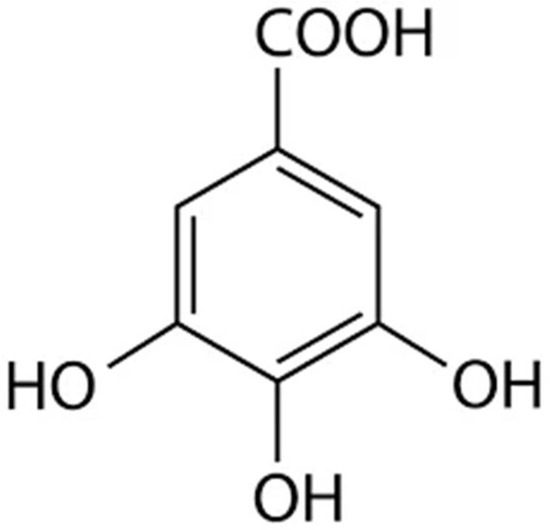
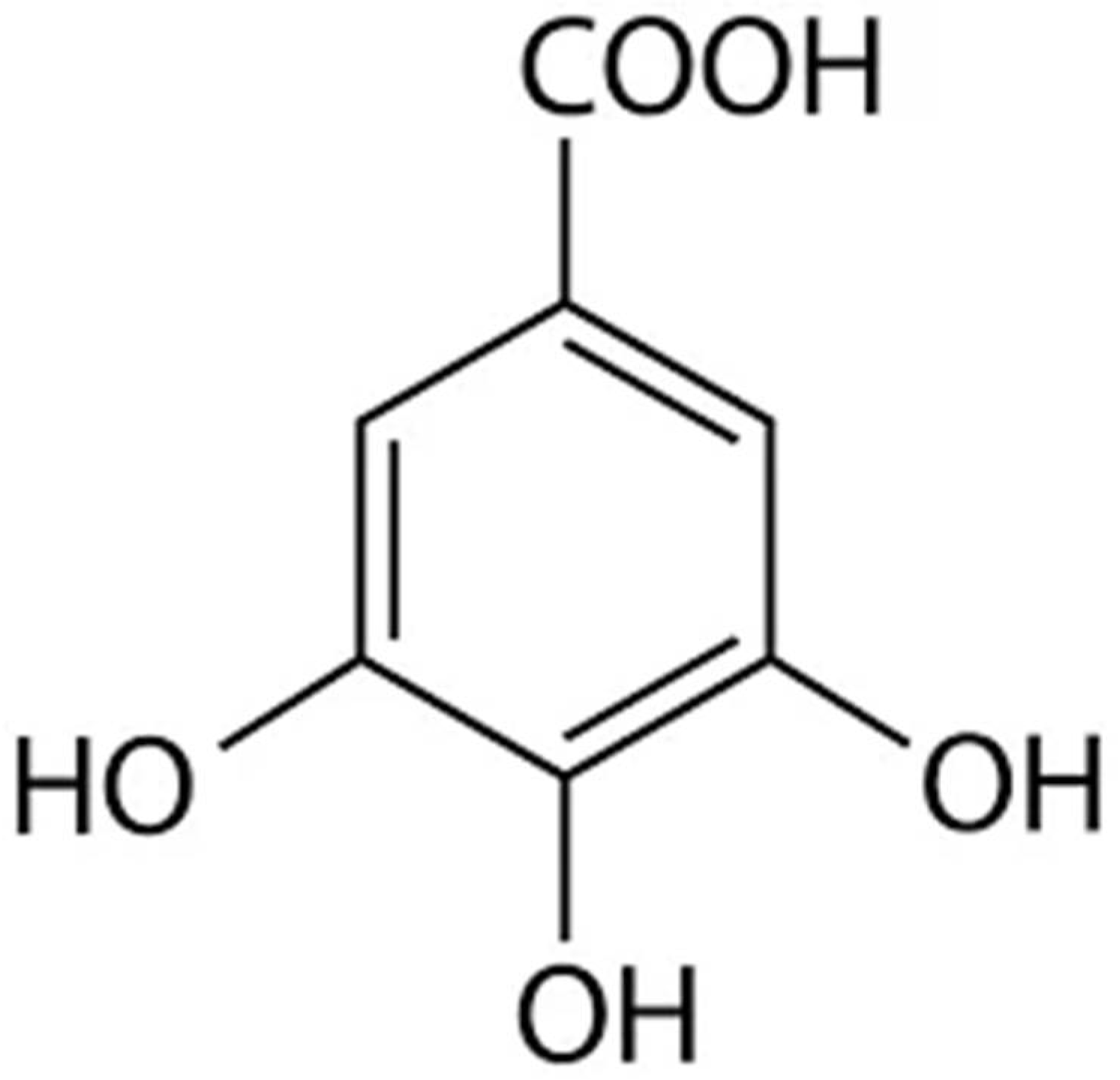
Gallic acid (3,4,5-trihydroxybenzoic acid) is a naturally occurring polyphenol abundantly found in grapes and wine (Figure 1). Its concentration in wine originates from the extraction of grape skins, seeds, and stems during vinification. Gallic acid contributes significantly to the sensory attributes, color stability, and aging potential of wines [1,2,3,4,5,6]. Moreover, it is recognized for a range of bioactive properties, including antioxidant, anti-inflammatory, antitumor, and antimicrobial activities [7,8,9,10].
Figure 1.
Gallic acid.
The gallate moiety also serves as a structural core in many biologically active phytochemicals [11,12]. While its biosynthesis is not fully elucidated, gallic acid is known to arise from the shikimic acid pathway, a central metabolic route for the production of aromatic secondary metabolites in plants and microorganisms [13].
Accurate quantification of gallic acid in wine is important for both enological quality control and assessment of its potential health benefits. To date, various analytical techniques have been employed for its detection [14,15,16,17]. The analysis of gallic acid is most frequently performed using reversed-phase liquid chromatography coupled with UV or MS detectors [18,19]. These methods offer the advantage of directly analyzing many compounds directly without the need for derivatization. However, GC-MS remains a powerful alternative, offering excellent chromatographic resolution and high sensitivity, provided that a suitable derivatization strategy is used to enhance the volatility and thermal stability of polar analytes.
In this context, ethyl chloroformate (ECF) has emerged as a versatile derivatizing agent for polar compounds due to its rapid reactivity with hydroxyl and carboxyl groups, often in a single-step procedure during extraction. ECF-based derivatization facilitates GC-MS analysis by enhancing analyte volatility, improving chromatographic resolution, and increasing detection sensitivity [20,21].
Compared with silylating agents such as trimethylsilyl (TMS) or tert-butyldimethylsilyl (TBDMS) derivatives—which typically require elevated temperatures, longer reaction times, and strictly anhydrous conditions and are more costly [22,23]—ECF derivatization offers a faster, room-temperature alternative. ECF derivatization is advantageous, as it allows simultaneous derivatization and liquid–liquid extraction in a single step directly from the aqueous sample matrix (like wine). This one-pot approach significantly simplifies sample preparation, reduces sample handling and potential analyte loss, and can be performed with reagents that are more tolerant of residual water compared with silylating agents, without compromising analytical performance. In previous GC analyses, gallic acid and other phenolic acids have been measured as chloroformate derivatives using a flame ionization detector (FID) [24]. While FID is robust and cost-effective, it lacks the advantages of mass spectrometry, particularly when analyzing complex matrices like wine. FID does not provide structural information or the ability to detect coeluting compounds, which limits confidence in analyte identification and prevents an assessment of the extent of derivatization. Although earlier studies have successfully applied ECF derivatization for GC-MS analysis of phenolic compounds such as resveratrol [25,26], gallic acid often remained undetected under similar protocols. This may be due to oxidative degradation or suboptimal reagent ratios, revealing a critical methodological gap.
To address this, we developed and validated a novel GC-MS method specifically optimized for the quantification of gallic acid in wine via ECF derivatization. The reaction involves ECF, ethanol, and pyridine, three reagents whose interactions are complex and difficult to optimize through conventional univariate approaches. To overcome this limitation, we employed a Box–Behnken Design (BBD), a response surface methodology, to systematically explore the synergistic and antagonistic effects among the reagents [27,28,29]. This approach enabled us to construct a predictive model, identify the optimal reaction conditions, and maximize the derivatization efficiency.
The optimized method was validated according to standard analytical performance criteria and applied to a range of commercial wine samples (white and red, conventional and natural), demonstrating its robustness and broad applicability.
2. Materials and Methods
2.1. Reagents and Standards
All solvents and reagents were of analytical grade. Gallic acid (≥98% purity), 3,4-dimethoxybenzoic acid (internal standard (IS), ≥99% purity), disodium tartrate dihydrate, L-malic acid, succinic acid, glycerol (87% v/v aqueous solution), ethanol (absolute, ≥99.8%), and tartaric acid were purchased from Merck KGaA, Darmstadt, Germany. Ultrapure water obtained from a Milli-Q system (Merck Millipore, Darmstadt, Germany) was used for all aqueous solutions.
Stock solutions of gallic acid (30 mg/mL) and the IS, 3,4-dimethoxybenzoic acid (30 mg/mL), were prepared individually by accurately dissolving the respective pure substances in ethanol [30]. These stock solutions were stored at −20 °C in the dark.
Calibration standards were prepared by diluting the gallic acid stock solution with a synthetic wine matrix [22]. The IS stock solution was also added to each calibration standard to a final concentration of (167 µg/mL). The synthetic wine matrix was prepared by dissolving disodium tartrate dihydrate (3 mg/mL), L-malic acid (4 mg/mL), and succinic acid (1 mg/mL) in ultrapure water. To this, glycerol (87% v/v solution, 7 µL/mL) and absolute ethanol (to achieve a final concentration of 13% v/v) were added. The pH of the matrix was adjusted to 3.5 using a 10% w/v aqueous tartaric acid solution, and the final volume was made up to 50 mL with ultrapure water.
2.2. Optimization of Derivatization Conditions Using a Box–Behnken Design (BBD)
To determine the optimal volumes of ECF, pyridine (Pyr), and ethanol (EtOH) for the derivatization of gallic acid, a Box–Behnken Design (BBD) was employed. Derivatization was performed at room temperature, as it is well established that ECF derivatization is rapid and exothermic [31]. The experimental design consisted of 15 runs, including three replicates at the center point, to estimate experimental variability (Table S1). Three factors were investigated, namely the volume of ECF (X1), the volume of Pyr (X2), and the volume of EtOH (X3), each at three coded levels (Table S1). The response variable (Y) was the peak area ratio of the derivatized gallic acid to the IS peak area obtained from the GC-MS chromatograms.
The experimental data were analyzed using response surface methodology and fitted to the following second-order polynomial model
where Y is the predicted response; X1, X2, and X3 are the coded levels of the factors; β0 is the model intercept; β1, β2, and β3 are the linear coefficients; β12, β13, and β23 are the interaction coefficients; β11, β22, and β33 are the quadratic coefficients; and ε represents the experimental error.
Y = β0 + β1X1 + β2X2 + β3X3 + β12X1X2 + β13X1X3 + β23X2X3 + β11X12 + β22X22 + β33X32 + ε
The statistical significance and adequacy of the model were evaluated using analysis of variance (ANOVA), the coefficient of determination (R2), and the adjusted R2. Response surface plots were generated to visualize the interactions between factors and to identify the optimal derivatization conditions. All statistical analyses, model fitting, and plot generation were performed using MATLAB software (R2023, MathWorks, Natick, MA, USA).
2.3. Optimized Extraction and Derivatization Procedure for Gallic Acid
The optimized derivatization procedure for gallic acid, established using the Box–Behnken Design described above, was performed as follows: to 150 µL of the wine sample, or a gallic acid standard solution prepared in a wine-like matrix, 25 µg of 3,4-dimethoxybenzoic acid (internal standard, IS) and 250 µg/mL L-ascorbic acid (as an antioxidant) were added. This mixture was then combined with 161 µL of absolute EtOH. Subsequently, 137 µL of ECF and 2 mL of n-hexane were added. The mixture was vigorously shaken on a vortex mixer for 30 s at room temperature. Pyr (51 µL) was then added dropwise, and the solution was further shaken for 5 min. After centrifugation, the upper organic layer (n-hexane) was collected, transferred to a new vial, and dried completely under a gentle stream of nitrogen gas. The dried residue was reconstituted in 150 µL of n-hexane prior to GC-MS analysis.
2.4. GC-MS Analysis
GC-MS analysis was performed using an Agilent system comprising a 7890B gas chromatograph and a 5977B quadrupole MS detector (Agilent Technologies, Santa Clara, CA, USA). Chromatographic separation was performed on an Agilent HP-5ms column (30 m × 0.25 mm i.d., 0.25 µm film thickness). The injection was splitless at 280 °C. The oven program started at 80 °C, increased to 300 °C at 20 °C/min, and held for 5 min. Helium carrier gas flowed at 1 mL/min. The MS operated at 70 eV ionization energy, with an ion source at 280 °C and a ~10−5 Torr vacuum. Analyses were conducted in TIC (m/z 50–650, 0.42 scans s−1) and SIM modes (m/z 165 and m/z 198 for IS and gallic acid, respectively). Linear retention indices were determined by co-injecting a homologous series of n-alkanes (C10–C40) under the same conditions. Peak homogeneity was confirmed via the “Review Peak Purity” feature.
2.5. Method Validation
The analytical method was validated for linearity, accuracy, precision, limit of detection (LOD), and limit of quantification (LLOQ).
Linearity and range: Calibration standards were prepared by spiking increasing concentrations of gallic acid into a wine-like matrix. For each calibration point, a 150 µL aliquot of the respective gallic acid standard in a wine-like matrix, containing 3,4-dimethoxybenzoic acid as an internal standard at a fixed concentration (167 µg/mL), was subjected to the ECF derivatization and extraction procedure as previously described. Calibration curves were constructed by plotting the peak area ratio of gallic acid to the IS against the gallic acid concentration over the range of 5–1000 µg/mL (nine calibration points). Linear regression analysis was applied, and the determination coefficient (R2) was calculated.
Accuracy and precision: Accuracy (expressed as % recovery) and intra-day precision (expressed as % coefficient of variation, CV) were evaluated by analyzing a commercial red wine sample spiked with gallic acid at two concentration levels: 50 µg/mL and 500 µg/mL (n = 5 replicates for each level on the same day). Unspiked wine samples were also analyzed to determine the endogenous gallic acid levels. Both spiked and unspiked samples underwent the full ECF derivatization and GC-MS analysis protocol. Accuracy was calculated using the formula: Recovery (%) = [(concentration found in spiked sample − concentration found in unspiked sample)/concentration added] × 100. Precision was determined from the % CV of the replicate measurements at each spiking level (n = 5 replicates).
Limit of detection (LOD) and limit of quantification (LLOQ): The LOD and LLOQ for gallic acid were experimentally determined. The LOD was established as the concentration yielding a signal-to-noise (S/N) ratio of approximately 3, and the LLOQ as the concentration yielding an S/N ratio ≥ 10. The S/N ratio was determined using the Agilent MassHunter workstation software’s automatic calculation based on peak height and baseline noise in a defined region near the analyte peak. The LLOQ was specifically verified by fortifying a white wine sample, previously confirmed to have undetectable endogenous gallic acid, with the analyte at a concentration of 5 µg/mL (the lowest point of the calibration curve). Five replicates (n = 5) of this fortified white wine sample were prepared and analyzed to assess the accuracy (as recovery%) and precision (as CV%) at the LLOQ.
2.6. Wine Analysis
A diverse set of twenty-four (n = 24) commercial wines was analyzed. This collection comprised sixteen (n = 16) red wines and eight (n = 8) white wines, sourced from various Italian regions and other producing countries, including different grape varieties and vintages. The selection included both conventionally produced wines (n = 13) and wines marketed or labelled as natural (n = 11).
For the quantification of gallic acid, an aliquot of 150 µL was taken from each wine sample. To this aliquot, the internal standard, 3,4-dimethoxybenzoic acid, was added to achieve a final concentration of 167 µg/mL. The samples were then subjected to the ECF derivatization and extraction procedure, followed by GC-MS analysis as detailed previously.
Statistical analyses were performed using MATLAB software (R2023, MathWorks, Natick, MA, USA). The Mann–Whitney U test was used to compare gallic acid concentrations between red and white wines. A p-value < 0.05 was considered statistically significant. Descriptive statistics, including the range, median, and mean, were calculated for each group.
3. Results and Discussion
3.1. Development of Gallic Acid Extraction and Derivatization Conditions
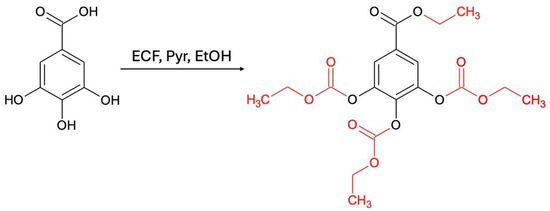
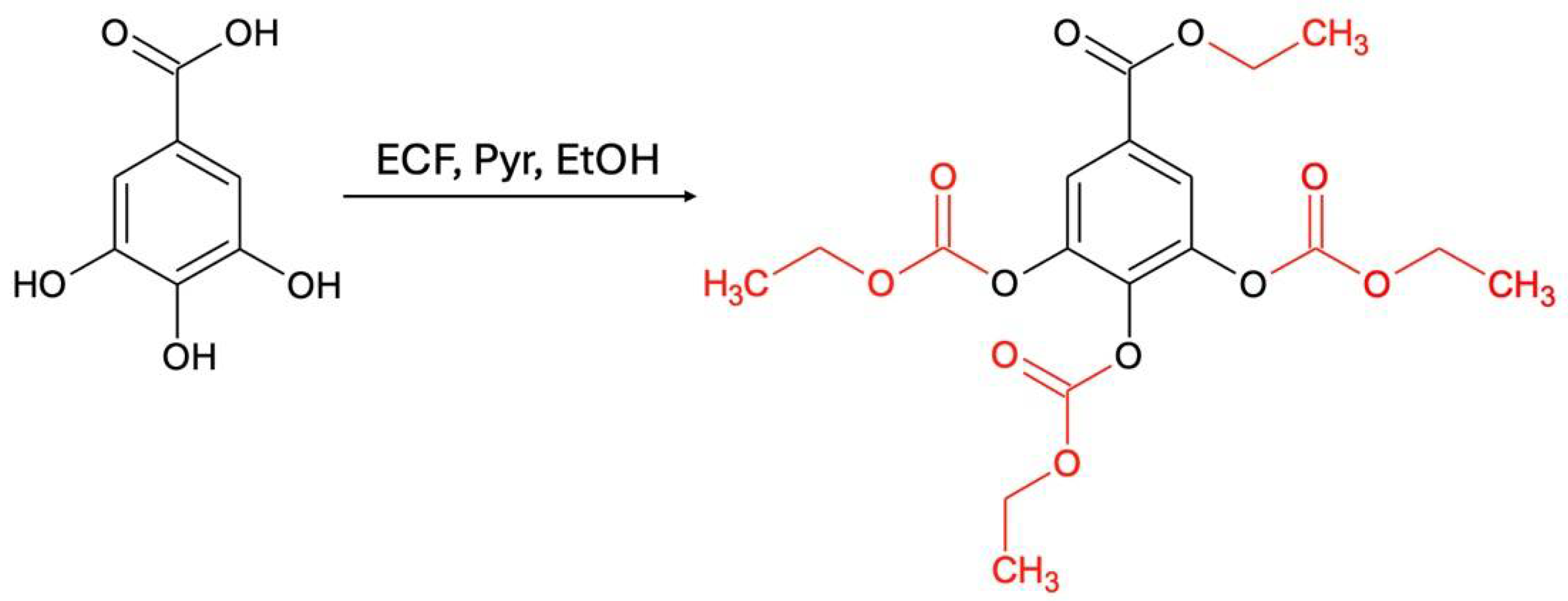
The development of an optimized protocol for the extraction and ECF derivatization of gallic acid for GC-MS analysis (Figure 2) was guided by a previously established method in our laboratory for resveratrol isomer quantification in wine [25].
Figure 2.
Derivatization of gallic acid with ethyl chloroformate in the presence of pyridine and ethanol. The carboxyl group of gallic acid is converted to an ethyl ester, while the hydroxyl groups undergo ethoxycarbonylation (highlighted in red).
Initial attempts involved subjecting aqueous gallic acid solutions in a 13% ethanol wine-like matrix to ECF derivatization in the presence of Pyr, EtOH, and 3,4-dimethoxybenzoic acid (IS) under strongly basic conditions (pH > 11), following the published ECF protocol. This approach, successful for other analytes including the IS, failed to produce detectable gallic acid peaks in the GC-MS chromatograms from these standard solutions. Interestingly, when this procedure was applied to actual wine samples, distinct (albeit low-abundance) gallic acid peaks were detected. This discrepancy suggested that gallic acid in the simple aqueous matrix might be undergoing degradation, potentially due to oxidation and polymerization promoted by the alkaline pH, and that wine might contain stabilizing factors absent in the standard solutions. We hypothesized that antioxidants naturally present in wine, such as ascorbic acid or other polyphenols, could play a critical role in preserving gallic acid’s integrity, as gallic acid’s three phenolic hydroxyl groups make it highly prone to oxidation in aqueous solutions, leading to various degradation products [32,33].
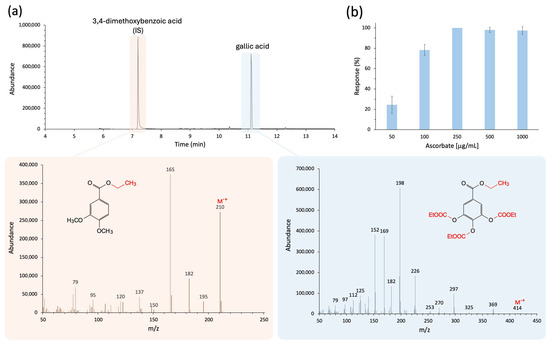
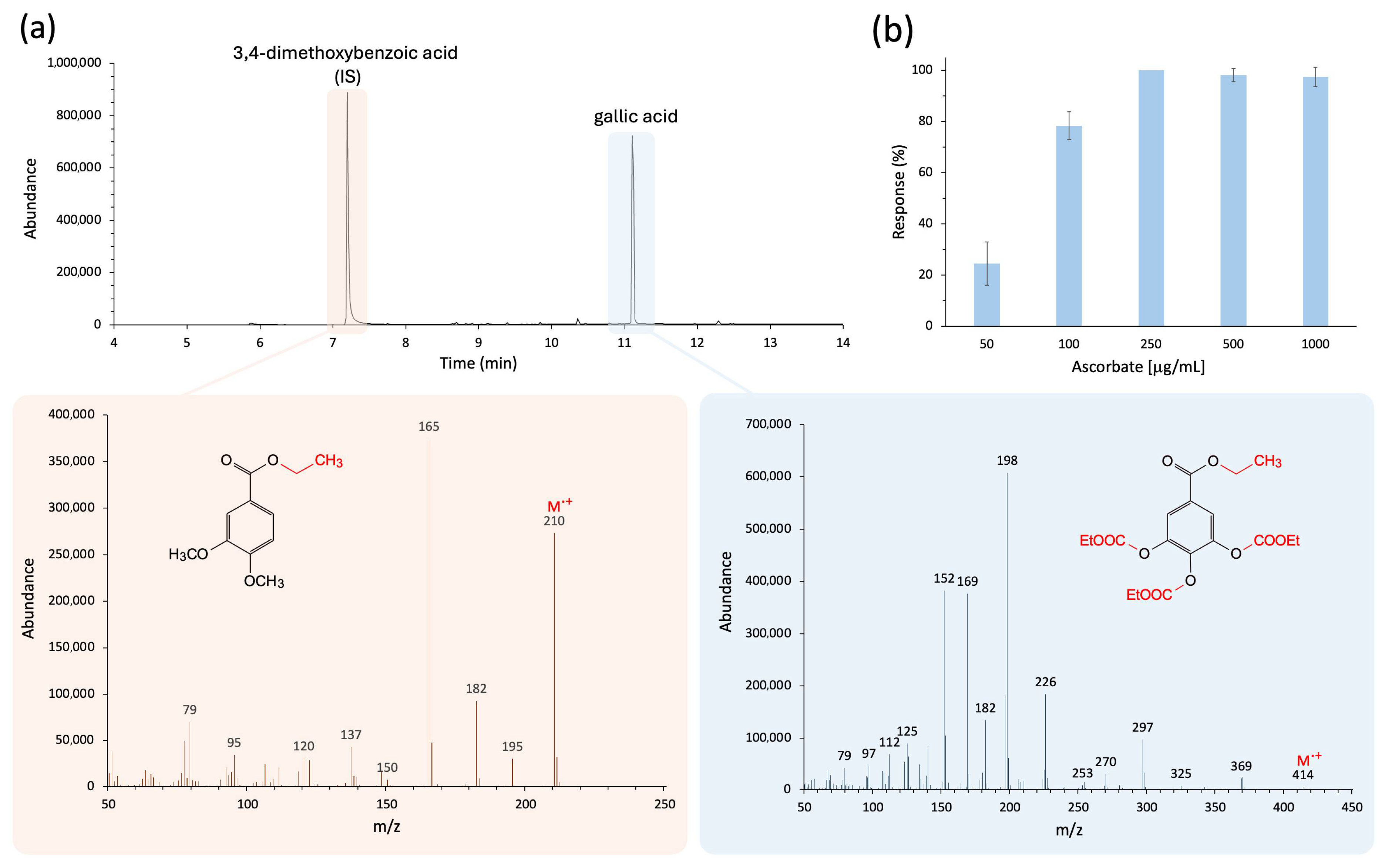
To test this hypothesis, ascorbate was added as an antioxidant to aqueous standard gallic acid solutions prior to extraction under the alkaline protocol. Notably, ascorbate addition resulted in clear gallic acid peaks in the GC-MS analyses, confirming that oxidation was a primary factor hindering detection in the initial trials (Figure 3a). Subsequent optimization determined that a minimum ascorbate concentration of 250 μg/mL was required to significantly enhance gallic acid recovery and ensure reproducibility (Figure 3b). Further investigation focused on the influence of pH. While alkaline conditions generally favor ECF derivatization, the high pH (>11) required by the standard protocol likely contributed to gallic acid degradation [34]. In strongly basic conditions, gallic acid’s phenolic hydroxyl groups deprotonate to form highly reactive phenolates. Although these phenolates are strong nucleophiles, favoring derivatization, they are simultaneously susceptible to oxidative degradation and polymerization, which ultimately reduces the derivatization efficiency. According to these considerations, we explored an alternative strategy: performing the extraction and derivatization starting from the natural pH of wine (average ~3.5) without the initial strong alkalinization step. Crucially, Pyr was added to the sample immediately after ECF, raising the pH to approximately 8 at the point of derivatization. This pH is sufficient for the ECF reaction to proceed effectively while minimizing the gallic acid degradation that occurs at higher pH values and avoiding side reactions like polymerization. At this reaction pH of ~8, gallic acid’s carboxylic acid group (pKa ~4.4) is almost fully deprotonated, facilitating efficient derivatization at this site. The phenolic hydroxyl groups (pKa values of 8.7, 11.4, and >13) remain predominantly protonated [35]. However, they can still react as weak nucleophiles. Pyridine plays an essential role, acting as a base to accept protons (forming pyridinium chloride) and thereby promoting the derivatization of gallic acid’s phenolic groups. Furthermore, pyridine acts as a nucleophilic catalyst by reacting with ECF to form a highly reactive N-ethoxycarbonylpyridinium salt. This activated intermediate can directly acylate the phenolic groups. For the carboxyl group, this N-ethoxycarbonylpyridinium salt (or ECF directly, facilitated by pyridine deprotonating the acid) converts it into a highly reactive mixed anhydride. This anhydride intermediate is then readily attacked by ethanol (present in excess) to form the stable ethyl ester (Figure 2) [26].
Figure 3.
(a) GC-MS chromatogram and mass spectra of ethyl chloroformate-derivatized standard gallic acid and 3,4-dimethoxybenzoic acid (IS). (b) Effect of ascorbic acid on the derivatization efficiency of gallic acid.
This moderated reactivity under mildly basic conditions (pH ~8) prevents the excessive side reactions seen with highly reactive phenolates at pH > 11, while still allowing effective derivatization via ECF. Furthermore, maintaining the sample at its natural acidity during initial handling and extraction, prior to the Pyr-induced pH shift for derivatization, preserves gallic acid’s integrity, eliminates the need for extensive buffering, and significantly streamlines the overall analytical method.
Once the optimal pH for the derivatization reaction was established, we proceeded to optimize the quantities of ECF, Pyr, and EtOH to maximize yield while using hexane as the extracting solvent. Preliminary tests were conducted with alternative solvents (e.g., dichloromethane) but they did not provide satisfactory results. Consequently, 2 mL of hexane was used in all optimization steps.
To determine the optimal quantities of ECF, Pyr, and EtOH, we employed a Box–Behnken design (BBD), a widely used response surface methodology approach [27]. BBD offers a cost-efficient approach to optimizing analytical procedures by reducing the number of experiments while accurately capturing the response surface’s curvature. Unlike full factorial designs, it enables a reliable estimation of quadratic interactions with fewer runs, making it ideal for complex processes like derivatization and extraction, where multiple factors influence the final response.
In this study, the BBD was designed with three factors, namely ECF (50, 100, 150 µL), Pyr (10, 50, 100 µL), and EtOH (100, 200, 300 µL), each investigated at the three indicated levels, with the center points included to estimate experimental variability (see Supplementary Materials, Table S1, for the full design, including coded and uncoded values). A full factorial design for this system would require 27 experiments, whereas the BBD efficiently reduced this to 15 experiments.
The response surface methodology was employed to elucidate the effects of these experimental variables—ECF, Pyr, and EtOH—on the derivatization of gallic acid. The experimental data were fitted to the following second-order polynomial equation to mathematically describe this relationship
where Y represents the predicted derivatization yield, and X1, X2, and X3 are the coded values for the levels of ECF, Pyr, and EtOH, respectively. To understand the influence and interplay of these factors, the model was used to generate response surface plots (Figure 4). Specifically, two-dimensional contour plots (Figure 4a) were constructed by varying two factors across their experimental range while holding the third factor at its intermediate value (coded as Level 0). This common approach provides a representative visualization of the interaction effects within the design space. The overall predicted response surface is shown in three dimensions in Figure 4b. On the basis of this model and these visualizations, the optimal conditions for derivatization were predicted to be 137 µL of ECF, 51 µL of Pyr, and 161 µL of EtOH. The statistical validity and predictive capability of this quadratic model (Table S2) were thoroughly assessed. Regression analysis yielded a high coefficient of determination (R2) of 0.971. The adjusted R2 value (0.919) was only slightly lower, indicating a good fit to the data without being overparameterized and suggesting excellent explanatory power for the observed variance. Further validation was provided by ANOVA (Table S3). The regression model was found to be highly significant (F-value: 18.7, p = 0.00244), demonstrating its capability to explain the relationship between the factors and the response. Furthermore, the Lack-of-Fit test was not significant (F-value: 2.951, p = 0.2633), suggesting that the quadratic model adequately describes the data within the experimental error. More specifically
- the linear effects of ECF (X1) (p = 0.00447) and EtOH (X3) (p = 0.0177) were statistically significant.
- All quadratic terms—ECF2 (X12) (p = 0.0163), Pyr2 (X22) (p = 0.00075), and EtOH2 (X32) (p = 0.000697)—were highly significant. This underlines the non-linear relationships between each factor and the derivatization yield, validating the choice of a quadratic model and indicating the presence of optimal levels for each reagent.
- The interaction term between ECF and EtOH (X1·X3) was also statistically significant (p = 0.00426), implying that the effect of ECF on derivatization efficiency is dependent on the level of EtOH, and vice versa.
- Conversely, the linear effect of Pyr (X2) (p = 0.791) and the other two-way interaction terms, ECF–Pyr (X1·X2) (p = 0.834) and Pyr–EtOH (X2·X3) (p = 0.503), were not statistically significant (p > 0.05).
Figure 4.
Box–Behnken Design response surfaces for gallic acid derivatization with ECF. (a) Two-dimensional response surface plots showing the interactive effects of pairs of factors on the predicted derivatization yield of gallic acid. For each plot, to best visualize the pairwise interaction, the third variable is held at its intermediate level: (left) Pyr vs. ECF with EtOH at 200 µL; (center) EtOH vs. ECF with Pyr at 50 µL; (right) EtOH vs. Pyr with ECF at 100 µL. (b) Three-dimensional response surface plot illustrating the predicted derivatization yield of gallic acid (color scale, response values) as a function of the volumes of ECF, Pyr, and EtOH. The black dots represent the actual experimental points evaluated in the Box–Behnken Design; the orange dot indicates the predicted optimal conditions (ECF = 137 µL, Pyr = 51 µL, EtOH = 161 µL) leading to the maximum derivatization yield.
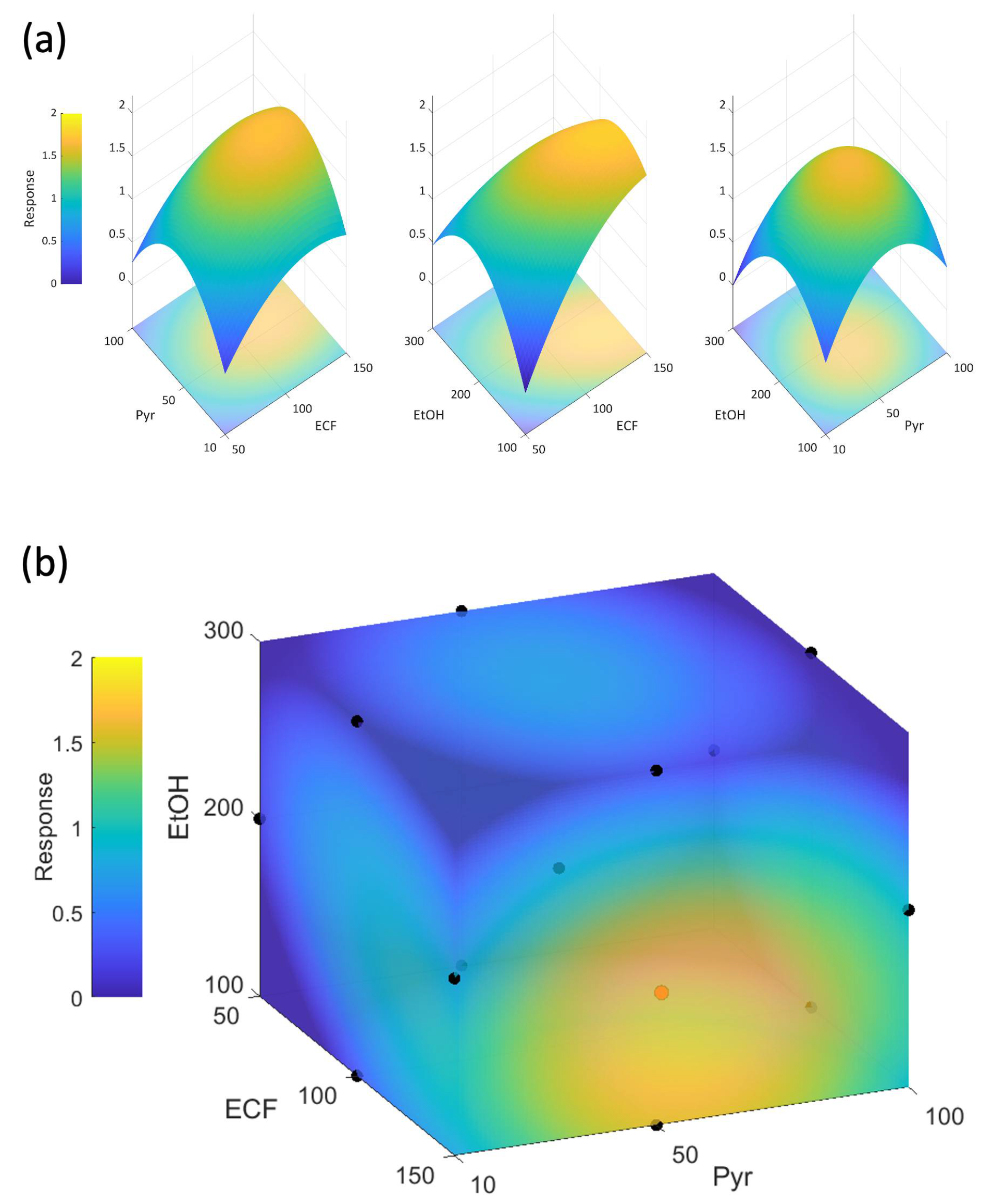
These ANOVA results indicate that ECF, Pyr, and EtOH all contribute significantly to the model describing the derivatization efficiency, although the nature of their individual term significances varies. For ECF and EtOH, both linear and quadratic contributions are important. For Pyr, while its direct linear effect is not significant, its highly significant quadratic term (X22) is critical, indicating its influence is primarily curvilinear, with an optimal concentration being key rather than a simple directional increase. The significant ECF·EtOH interaction highlights the need to consider these two factors jointly during optimization. The combination of a high R2, a minimal difference between R2 and adjusted R2, and these specific statistically significant ANOVA terms strongly supports the robustness and predictive accuracy of the optimization process.
It is worth noting the specific behaviors observed for ECF, Pyr, and EtOH based on the model.
ECF (X1): Increasing the ECF concentration generally enhanced the derivatization efficiency, as indicated by its significant positive linear term (p = 0.00447). The significant negative quadratic term (p = 0.0163) suggests that this effect plateaus or reaches an optimum.
Pyr (X2): The highly significant quadratic term for Pyr (X22) (p = 0.00075) explains why an optimal concentration (determined as 51 µL) exists. Deviations from this optimum, either by increasing or decreasing the Pyr concentration, likely reduce the derivatization efficiency, consistent with the non-significant linear term (p = 0.791).
EtOH (X3): EtOH exhibited a pronounced non-linear effect, consistent with its significant linear (p = 0.0177) and quadratic (p = 0.000697) terms. The model predicts an optimal concentration of 161 µL, where EtOH likely improves solubility and facilitates derivatization. Increasing EtOH beyond this optimum, such as towards the higher tested level of 300 µL within the BBD, leads to a predicted and observed decrease in yield. Furthermore, a separate experiment conducted with 400 µL of EtOH, a condition outside the BBD range, resulted in nearly no derivatization. This experimental observation is consistent with the trend predicted by the model, particularly its strong negative quadratic term for EtOH (X32), which indicates a rapid decline in yield at such high concentrations. This detrimental effect at higher EtOH concentrations is likely due to interference with the partitioning of the derivatized product into the organic phase (hexane) and/or excessive dilution of the reactants, thereby slowing the reaction rate. Thus, maintaining an optimal EtOH concentration is crucial, as exceeding it significantly compromises the derivatization efficiency.
3.2. Method Validation
The GC-MS method developed for the determination of gallic acid derivatized with ECF was validated in accordance with current analytical guidelines [36]. Method validation included the assessment of sensitivity, linearity, precision, accuracy, limit of detection (LOD), and lower limit of quantification (LLOQ).
Selectivity is a critical parameter in method validation and can be defined as the extent to which the analytical method can accurately determine the analyte of interest in the presence of other components, such as matrix constituents or structurally similar compounds. In this study, the use of GC-MS provided high selectivity for the determination of gallic acid derivatives.
Due to the potential presence of structurally related phenolic compounds in wine, the risk of interferences was evaluated.
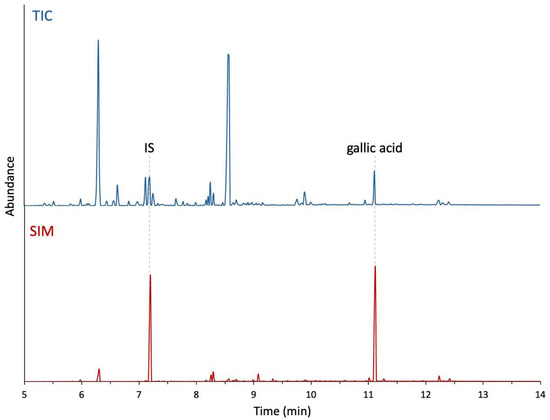
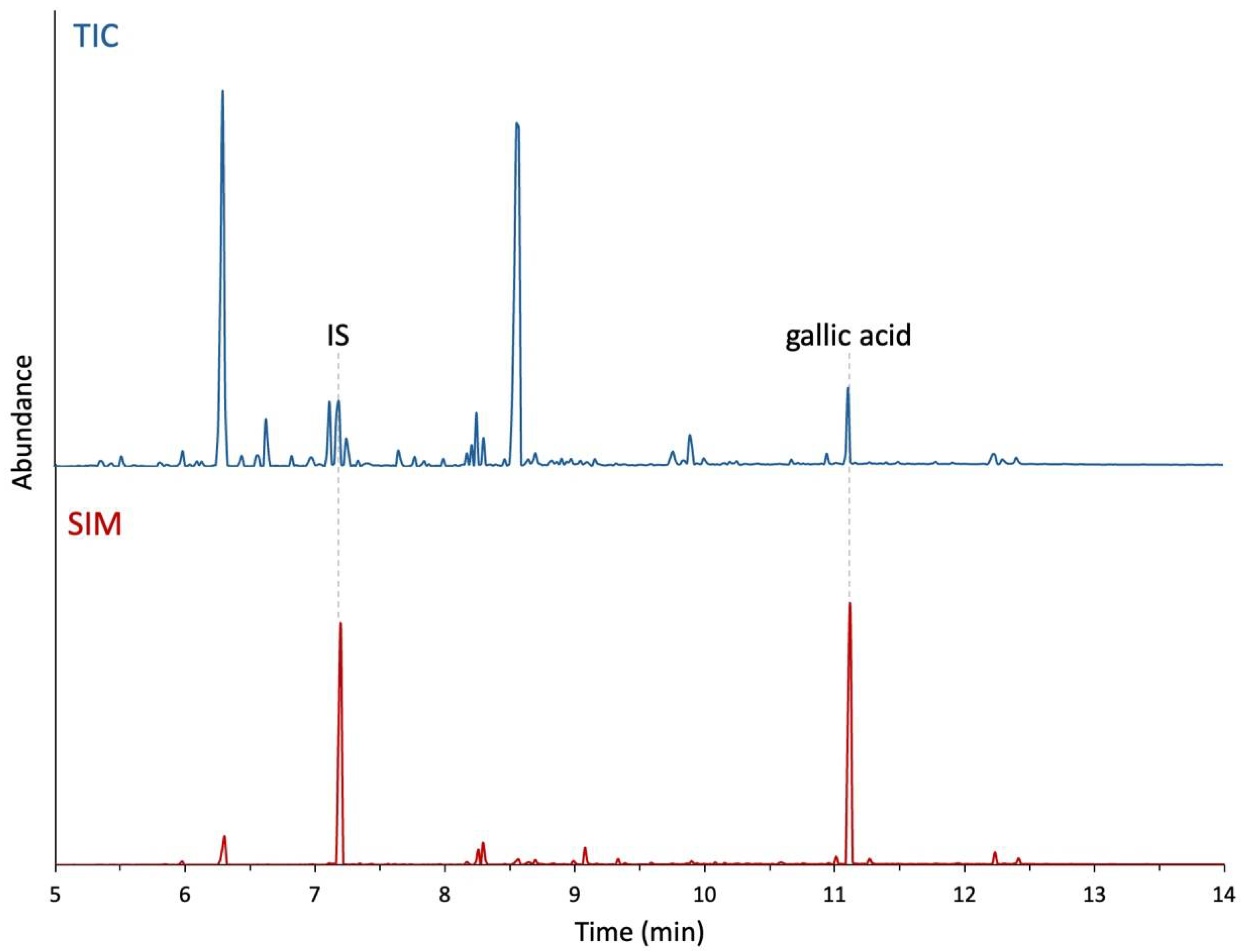
The total ion current (TIC) chromatogram of a red wine extract (Figure 5) revealed a well-resolved peak corresponding to the derivatized gallic acid with no evidence of coeluting species. The “Review Peak Purity” tool in the Agilent MSD Chemstation F.01.03.2357 software was used to confirm the spectral homogeneity of the analyte peak.
Figure 5.
GC-MS analysis of a red wine sample subjected to ECF extraction/derivatization. (Top) Total ion current (TIC) chromatogram displaying multiple components present in the derivatized extract. (Bottom) Selected ion monitoring (SIM) chromatogram showing the targeted detection of the derivatized gallic acid and internal standard (3,4-dimethoxybenzoic acid), demonstrating the method’s selectivity despite the complexity of the matrix.
In addition, selected ion monitoring (SIM) was employed to enhance specificity by targeting multiple characteristic ions of the analyte, thereby minimizing potential interference by the coeluting compounds. Quantification and confirmation were based on monitoring the ions at m/z 198, m/z 152, and m/z 169, selected according to the fragmentation pattern of derivatized gallic acid (Figure 3a).
To further confirm analyte identity, the relative abundances of the monitored ions from the derivatized gallic acid peak in an unspiked wine sample were compared with those from a pure derivatized gallic acid standard analyzed under identical chromatographic and mass spectrometric conditions. The characteristic ions and their typical relative abundances (base peak = 100%) for the derivatized gallic acid were m/z 198 (100%), 152 (69%), 169 (63%), 226 (30%), 182 (23%), 297 (17%), and 125 (14%). The ion ratios observed in the wine sample fell within predefined acceptable tolerance limits (generally ±20% relative deviation) when compared with the standard.
The ion ratio values for gallic acid in the wine samples consistently met this criterion, confirming the absence of significant coeluting interferences at the specific retention time. This combination of matching retention time, ion ratios, and the inherent selectivity of mass spectrometric detection supports the reliability of the method for unequivocal identification in complex matrices such as wine. In addition, the retention index was experimentally determined, and for the derivatized gallic acid, it was found to be 2450, which is consistent with the increased molecular weight and reduced polarity imparted by the ECF derivatization.
According to data in the literature, gallic acid is predominantly found in red wine, with concentrations varying widely from 7.8 to 126 µg/mL (The Phenol-Explorer database, release 3.6), significantly exceeding the levels typically observed in white wines, which are often more than 10 times lower or even undetectable. This difference primarily stems from the red winemaking process, which includes prolonged contact between the grape juice and the solid parts of the grape (skins and seeds), which are rich in gallic acid.
To ensure the method’s suitability across this broad concentration range, the linearity of the newly developed GC-MS method was evaluated using calibration standards prepared at nine concentration levels, ranging from 5 to 1000 µg/mL. Calibration curves were constructed by plotting the analyte-to-internal standard peak area ratios versus analyte concentrations, following the complete extraction and derivatization procedure. The resulting curves demonstrated excellent linearity, with the correlation coefficient R2 = 0.9991 (Table 1).
Table 1.
Method validation parameters for the GC-MS determination of ECF-derivatized gallic acid.
The LOD was experimentally determined to be 0.5 µg/mL, based on a signal-to-noise (S/N) ratio of approximately 3. The LLOQ was subsequently established at 5 µg/mL (S/N > 10). Validation of the LLOQ was specifically performed by fortifying a white wine sample (wine No. 19, Table 2), in which gallic acid was initially undetectable. This matrix was chosen for LLOQ assessment due to its typically lower phenolic content and the absence of endogenous gallic acid, facilitating an unambiguous evaluation of the method’s performance at very low concentrations. At this LLOQ in white wine, the method demonstrated good accuracy with a mean recovery of 102.4% and excellent precision with a CV of 8.45% (n = 5). To assess the method’s performance in a more complex matrix and at higher, more typical concentrations found in certain wine styles, accuracy and precision were further evaluated in a red wine sample. This red wine (wine No. 3, Table 2) contained a significant endogenous gallic acid level (217 µg/mL, n = 5, CV = 3.87%), providing a realistic challenge for the method’s selectivity and robustness. Fortification with 50 µg/mL of gallic acid yielded a mean recovery of 101.6% with a CV of 3.36% (n = 5). Similarly, fortification with 500 µg/mL resulted in a mean recovery of 101.0% with a CV of 4.56% (n = 5). The excellent recovery and precision observed in the red wine, despite its inherent complexity and high baseline analyte concentration, highlight the method’s capability to accurately quantify gallic acid across diverse wine types. Collectively, these findings indicate that the developed GC-MS method is sensitive, accurate, and precise. It is well suited for the determination of gallic acid in simpler matrices like white wine, even at low µg/mL levels approaching the LLOQ, and robust enough for reliable quantification in complex matrices like red wine, where gallic acid concentrations can be substantially higher.
Table 2.
Gallic acid content in a selection of red and white commercial wines.
3.3. Gallic Acid in Commercial Wines
Following comprehensive validation of the GC-MS method with ECF derivatization, its applicability was assessed by analyzing a selection of commercial red and white wines—both conventional and natural—for their gallic acid content. The results are summarized in Table 2.
As anticipated, a statistically significant difference was observed between red and white wines (Mann–Whitney U-value: 0.5, z-score: 3.85795, p-value: 0.00012). Red wines (n = 16) exhibited substantially higher gallic acid levels, ranging from 6 to 657 µg/mL (median: 59 µg/mL; mean: 142.2 µg/mL), whereas white wines (n = 8) showed negligible concentrations, from 0 to 6 µg/mL (median: 0.0 µg/mL; mean: 2 µg/mL).
This pronounced difference aligns with established enological principles: extended maceration during red winemaking facilitates greater extraction of phenolic compounds—including gallic acid—from grape skins, seeds, and stems. In contrast, white wines typically undergo minimal skin contact, leading to substantially lower phenolic content. These findings are consistent with literature reports, which describe red wines as the primary source of gallic acid, often exhibiting a broad concentration range [37,38].
While not the primary focus of this study, a comparison was also made between conventional wines and those designated as natural (based on their marketing or labelling). Natural wines are generally understood to be produced with minimal intervention, typically from organically or biodynamically farmed grapes, fermented with native yeasts, and with minimal or no added sulfites. Given increasing consumer interest, these wines (11 of 24 total samples) were included in the dataset, although substantial differences in gallic acid content compared with conventional wines were not initially expected. Within red wines, the comparison of conventional (n = 9) and natural (n = 7) subgroups revealed nuanced patterns. Conventional red wines showed gallic acid levels ranging from 27 to 371 µg/mL (median: 98 µg/mL; mean: 144 µg/mL), while natural reds spanned a wider range of 6 to 657 µg/mL (median: 34 µg/mL; mean: 139.9 µg/mL), indicating greater heterogeneity. The elevated mean in the natural red group was driven by one outlier—a 2021 Galician wine (Garnacha Tintorera, Mencía)—with an exceptionally high concentration (657 µg/mL). Excluding this sample, the adjusted mean and median for natural reds decreased to 53.7 µg/mL and 30.5 µg/mL (n = 6), respectively. This reinforces the trend toward lower gallic acid levels in natural reds compared with conventional ones, though the small sample size and variability preclude firm statistical conclusions.
The generally lower values in natural reds may reflect a combination of factors, including reduced sulfur dioxide usage (which may permit greater oxidative degradation of phenolics) and broader variability in maceration practices that do not consistently favor maximal extraction.
For white wines, both conventional (n = 4; all 0.0 µg/mL) and natural (n = 4; range: 0–6 µg/mL; median: 5 µg/mL; mean: 4 µg/mL) samples exhibited very low gallic acid content. The slightly higher median in natural whites may stem from minor differences in pre-fermentative skin contact or clarification protocols, though these are unlikely to be sensorially relevant at such low concentrations.
In summary, these results highlight the dominant influence of wine type (red vs. white) on gallic acid content. The conventional red wines in this cohort tended to have higher levels than natural reds, which displayed broader variability and, in most cases, lower concentrations. The exceptional outlier within natural reds highlights the diversity of natural winemaking practices, which can result in atypical phenolic profiles. Meanwhile, gallic acid levels in white wines remained uniformly low regardless of the production philosophy, consistent with minimal phenolic extraction during white wine vinification.
4. Conclusions
This study introduces a significant methodological innovation by successfully applying a Box–Behnken Design to systematically optimize the complex multi-parameter ECF derivatization of gallic acid. To the best of our knowledge, this represents a novel application of the BBD for elucidating the complex relationships of such a derivatization, where the efficiency is critically dependent on the interplay of ECF, Pyr, and EtOH. This experimental design not only identified the optimal reagent quantities but also highlighted the significant interactions and quadratic effects that govern the reaction, a crucial step for robust method development. While the BBD is highly efficient in reducing the number of required experiments, it does not include extreme factor levels by design, which may limit the exploration of edge-case behaviors or rare interactions. Nonetheless, it proved to be well-suited for defining a stable and practical working range in this context.
The BBD-optimized method then demonstrated exceptional capability in accurately quantifying gallic acid across a wide concentration spectrum in diverse commercial wine samples. Despite requiring a derivatization step—which adds some procedural complexity compared with direct HPLC methods—the GC-MS approach proved to be highly reproducible and practical. Once optimized, the derivatization can be performed rapidly, and the method benefits from the high sensitivity, specificity, and chromatographic resolution of GC-MS. Indeed, the method’s robustness and practical utility were highlighted by its ability to quantify gallic acid from levels approaching the LLOQ (as found in some white wines) to several hundred micrograms per milliliter (observed in certain red wines) without requiring sample dilution or multiple calibration strategies. This performance, particularly its wide dynamic range, confirms the suitability of the ECF derivatization/GC-MS approach for the inherent variability of wine samples. While variations in gallic acid content between wine types and individual samples are expected due to enological factors, the primary outcome of this study is the validation of the analytical method’s consistent performance across these differences. Its proven capacity to handle both very low and extremely high concentrations in real-world samples underlines its fitness for purpose in routine quality control, enological research, and comprehensive investigations of phenolic profiles across a broad array of wine styles.
Supplementary Materials
The following supporting information can be downloaded at https://www.mdpi.com/article/10.3390/separations12070183/s1. Table S1: Box–Behnken Design with uncoded and coded values. Table S2: Linear regression mode.; Table S3: ANOVA analysis.
Author Contributions
Conceptualization, A.B. (Alessandra Bonamore) and A.M.; methodology, A.B. (Alessandra Bonamore) and A.M.; software, R.P.; validation, S.B., C.C. and A.I.; formal analysis, R.P.; investigation, S.B., C.C. and A.I.; data curation, S.B., C.C., A.I. and R.P.; writing—original draft preparation, A.B. (Alessandra Bonamore) and A.M.; writing—review and editing, A.B. (Alessandra Bonamore), A.B. (Alberto Boffi) and A.M.; visualization, S.B., C.C., A.I. and R.P.; supervision, A.B. (Alessandra Bonamore) and A.M.; project administration, A.B. (Alessandra Bonamore) and A.M.; funding acquisition, A.B. (Alessandra Bonamore), A.B. (Alberto Boffi), and A.M. All authors have read and agreed to the published version of the manuscript.
Funding
This research received no external funding.
Data Availability Statement
The original contributions presented in this study are included in the article/Supplementary Materials. Further inquiries can be directed to the corresponding author.
Conflicts of Interest
The authors declare no conflicts of interest.
Abbreviations
The following abbreviations are used in this manuscript.
| ANOVA | Analysis of Variance |
| BBD | Box–Behnken Design |
| CV | Coefficient of Variation |
| ECF | Ethyl Chloroformate |
| EtOH | Ethanol |
| FID | Flame Ionization Detector |
| GC-MS | Gas Chromatography–Mass Spectrometry |
| IS | Internal Standard |
| LLOQ | Lower Limit of Quantitation |
| LOD | Limit of Detection |
| Pyr | Pyridine |
| SIM | Single Ion Monitoring |
| TIC | Total Ion Current |
References
- Wu, L.; Zhang, Y.; Prejanò, M.; Marino, T.; Russo, N.; Tao, Y.; Li, Y. Gallic acid improves color quality and stability of red wine via physico-chemical interaction and chemical transformation as revealed by thermodynamics, real wine dynamics and benchmark quantum mechanical calculations. Food Res. Int. 2024, 188, 114510. [Google Scholar] [CrossRef] [Scilit] [PubMed]
- Sterneder, S.; Stoeger, V.; Dugulin, C.A.; Liszt, K.I.; Di Pizio, A.; Korntheuer, K.; Dunkel, A.; Eder, R.; Ley, J.P.; Somoza, V. Astringent Gallic Acid in Red Wine Regulates Mechanisms of Gastric Acid Secretion via Activation of Bitter Taste Sensing Receptor TAS2R4. J. Agric. Food Chem. 2021, 69, 10550. [Google Scholar] [CrossRef] [Scilit]
- Gutiérrez-Escobar, R.; Aliaño-González, M.J.; Cantos-Villar, E. Wine Polyphenol Content and Its Influence on Wine Quality and Properties: A Review. Molecules 2021, 26, 718. [Google Scholar] [CrossRef] [Scilit] [PubMed]
- Wang, C.; Wang, C.; Tang, K.; Rao, Z.; Chen, J. Effects of Different Aging Methods on the Phenolic Compounds and Antioxidant Activity of Red Wine. Fermentation 2022, 8, 592. [Google Scholar] [CrossRef] [Scilit]
- Liu, Y.; Zhang, B.; He, F.; Duan, C.Q.; Shi, Y. The Influence of Prefermentative Addition of Gallic Acid on the Phenolic Composition and Chromatic Characteristics of Cabernet Sauvignon Wines. J. Food Sci. 2016, 81, C1669. [Google Scholar] [CrossRef] [Scilit] [PubMed]
- Javorský, J.; Král, M.; Šnirc, M.; Árvay, J.; Tremlová, B.; Dordević, D. Characterization of Moravian Wines by Selected Chemical Parameters. Separations 2021, 8, 89. [Google Scholar] [CrossRef] [Scilit]
- Sagdicoglu Celep, A.G.; Demirkaya, A.; Kondolot Solak, E. Antioxidant and anticancer activities of gallic acid loaded sodium alginate microspheres on colon cancer. Curr. Appl. Phys. 2022, 40, 30. [Google Scholar] [CrossRef] [Scilit]
- Keyvani-Ghamsari, S.; Rahimi, M.; Khorsandi, K. An update on the potential mechanism of gallic acid as an antibacterial and anticancer agent. Food Sci. Nutr. 2023, 11, 5856. [Google Scholar] [CrossRef] [Scilit]
- Hadidi, M.; Liñán-Atero, R.; Tarahi, M.; Christodoulou, M.C.; Aghababaei, F. The Potential Health Benefits of Gallic Acid: Therapeutic and Food Applications. Antioxidants 2024, 13, 1001. [Google Scholar] [CrossRef] [Scilit]
- Varzaru, I.; Untea, A.E.; Oancea, A.G.; Saracila, M.; Vlaicu, P.A. Bioactives in Berry Fruits with Emphasis on In Vitro Bioaccessibility for Human Nutrition. Separations 2024, 11, 286. [Google Scholar] [CrossRef] [Scilit]
- Wang, Y.; Wu, S.; Li, Q.; Lang, W.; Li, W.; Jiang, X.; Wan, Z.; Chen, J.; Wang, H. Epigallocatechin-3-gallate: A phytochemical as a promising drug candidate for the treatment of Parkinson’s disease. Front. Pharmacol. 2022, 13, 977521. [Google Scholar] [CrossRef] [Scilit] [PubMed]
- Tripathi, D.K.; Nagar, N.; Kumar, V.; Joshi, N.; Roy, P.; Poluri, K.M. Gallate Moiety of Catechin Is Essential for Inhibiting CCL2 Chemokine-Mediated Monocyte Recruitment. J. Agric. Food Chem. 2023, 71, 4990. [Google Scholar] [CrossRef] [Scilit]
- Bontpart, T.; Marlin, T.; Vialet, S.; Guiraud, J.L.; Pinasseau, L.; Meudec, E.; Sommerer, N.; Cheynier, V.; Terrier, N. Two shikimate dehydrogenases, VvSDH3 and VvSDH4, are involved in gallic acid biosynthesis in grapevine. J. Exp. Bot. 2016, 67, 3537. [Google Scholar] [CrossRef] [Scilit]
- Fernandes, F.H.A.; Salgado, H.R.N. Gallic Acid: Review of the Methods of Determination and Quantification. Crit. Rev. Anal. Chem. 2016, 46, 257. [Google Scholar] [CrossRef] [Scilit]
- Agatonovic-Kustrin, S.; Hettiarachchi, C.G.; Morton, D.W.; Razic, S. Analysis of phenolics in wine by high performance thin-layer chromatography with gradient elution and high resolution plate imaging. J. Pharm. Biomed. Anal. 2015, 102, 93. [Google Scholar] [CrossRef] [Scilit] [PubMed]
- Lingwan, M.; Masakapalli, S.K. A robust method of extraction and GC-MS analysis of Monophenols exhibited UV-B mediated accumulation in Arabidopsis. Physiol. Mol. Biol. Plants 2022, 28, 533. [Google Scholar] [CrossRef] [Scilit] [PubMed]
- Zhang, H.; Zhou, D.D.; Yang, F.Q.; Qian, Z.M.; Li, C.H.; Li, W.J.; Wang, S.P.; Wang, Y.T. Modulation of electroosmotic flow in capillary electrophoresis by plant polyphenol-inspired gallic acid/polyethyleneimine coatings: Analysis of small molecules. J. Chromatogr. B 2019, 1124, 7. [Google Scholar] [CrossRef] [Scilit] [PubMed]
- Wang, L.; Halquist, M.S.; Sweet, D.H. Simultaneous determination of gallic acid and gentisic acid in organic anion transporter expressing cells by liquid chromatography–tandem mass spectrometry. J. Chromatogr. B 2013, 937, 91. [Google Scholar] [CrossRef] [Scilit]
- Engström, M.T.; Pälijärvi, M.; Salminen, J.P. Rapid Fingerprint Analysis of Plant Extracts for Ellagitannins, Gallic Acid, and Quinic Acid Derivatives and Quercetin-, Kaempferol- and Myricetin-Based Flavonol Glycosides by UPLC-QqQ-MS/MS. J. Agric. Food Chem. 2015, 63, 4068. [Google Scholar] [CrossRef] [Scilit]
- Qiu, Y.; Su, M.; Liu, Y.; Chen, M.; Gu, J.; Zhang, J.; Jia, W. Application of ethyl chloroformate derivatization for gas chromatography–mass spectrometry based metabonomic profiling. Anal. Chim. Acta 2007, 583, 277. [Google Scholar] [CrossRef] [Scilit]
- Hušek, P. Chloroformates in gas chromatography as general purpose derivatizing agents. J. Chromatogr. B Biomed. Sci. Appl. 1998, 717, 57. [Google Scholar] [CrossRef] [Scilit]
- Francioso, A.; Laštovičková, L.; Mosca, L.; Boffi, A.; Bonamore, A.; Macone, A. Gas Chromatographic–Mass Spectrometric Method for the Simultaneous Determination of Resveratrol Isomers and 2,4,6-Trihydroxyphenanthrene in Red Wines Exposed to UV-Light. J. Agric. Food Chem. 2019, 67, 11752. [Google Scholar] [CrossRef] [Scilit]
- Sobolevsky, T.G.; Revelsky, A.I.; Miller, B.; Oriedo, V.; Chernetsova, E.S.; Revelsky, I.A. Comparison of silylation and esterification/acylation procedures in GC-MS analysis of amino acids. J. Sep. Sci. 2023, 26, 1474. [Google Scholar] [CrossRef] [Scilit]
- Citová, I.; Sladkovský, R.; Solich, P. Analysis of phenolic acids as chloroformate derivatives using solid phase microextraction–gas chromatography. Anal. Chim. Acta 2006, 573–574, 231. [Google Scholar] [CrossRef] [Scilit]
- Di Fabio, E.; Incocciati, A.; Palombarini, F.; Boffi, A.; Bonamore, A.; Macone, A. Ethylchloroformate Derivatization for GC–MS Analysis of Resveratrol Isomers in Red Wine. Molecules 2020, 25, 4603. [Google Scholar] [CrossRef] [Scilit]
- Incocciati, A.; Di Fabio, E.; Boffi, A.; Bonamore, A.; Macone, A. Rapid and Simultaneous Determination of Free Aromatic Carboxylic Acids and Phenols in Commercial Juices by GC-MS after Ethyl Chloroformate Derivatization. Separations 2022, 9, 9. [Google Scholar] [CrossRef] [Scilit]
- Ferreira, S.L.C.; Bruns, R.E.; Ferreira, H.S.; Matos, G.D.; David, J.M.; Brandão, G.C.; da Silva, E.G.P.; Portugal, L.A.; dos Reis, P.S.; Souza, A.S.; et al. Box-Behnken design: An alternative for the optimization of analytical methods. Anal. Chim. Acta 2007, 597, 79. [Google Scholar] [CrossRef] [Scilit]
- Demiray, H.; Dibek, M.E.; Özel, O. Optimization of betulinic and ursolic acids and phenolics extraction from endemic Rosa pisiformis using Box-Behnken design in relation to cytotoxic activities. Sci. Rep. 2025, 15, 1228. [Google Scholar] [CrossRef] [Scilit] [PubMed]
- Nardelli, V.; D’Amico, V.; Della Rovere, I.; Casamassima, F.; Marchesiello, W.M.V.; Nardiello, D.; Quinto, M. Box Behnken design-based optimized extraction of non-dioxin-like PCBs for GC-ECD and GC-MS analyses in milk samples. Emerg. Contam. 2020, 6, 303. [Google Scholar] [CrossRef] [Scilit]
- Park, Y.-R.; Lee, B.-S. Solubility of Gallic Acid in Single and Mixed Solvents. Separations 2024, 11, 36. [Google Scholar] [CrossRef] [Scilit]
- Opekar, S.; Kvíčala, J.; Moos, M.; Pejchal, V.; Šimek, P. Mechanism of Alkyl Chloroformate-Mediated Esterification of Carboxylic Acids in Aqueous Media. J. Org. Chem. 2021, 86, 16293. [Google Scholar] [CrossRef] [Scilit] [PubMed]
- Eslami, A.C.; Pasanphan, W.; Wagner, B.A.; Buettner, G.R. Free radicals produced by the oxidation of gallic acid: An electron paramagnetic resonance study. Chem. Cent. J. 2010, 4, 15. [Google Scholar] [CrossRef] [Scilit] [PubMed]
- Hostnik, G.; Tošović, J.; Štumpf, S.; Petek, A.; Bren, U. The influence of pH on UV/Vis spectra of gallic and ellagic acid: A combined experimental and computational study. Spectrochim. Acta Part A Mol. Biomol. Spectrosc. 2022, 267, 120472. [Google Scholar] [CrossRef] [Scilit]
- Friedman, M.; Jürgens, H.S. Effect of pH on the Stability of Plant Phenolic Compounds. J. Agric. Food Chem. 2000, 48, 2101. [Google Scholar] [CrossRef] [Scilit] [PubMed]
- Marino, T.; Galano, A.; Russo, N. Radical Scavenging Ability of Gallic Acid toward OH and OOH Radicals. Reaction Mechanism and Rate Constants from the Density Functional Theory. J. Phys. Chem. B 2014, 118, 10380. [Google Scholar] [CrossRef] [Scilit]
- The Fitness for Purpose of Analytical Methods. Available online: https://www.eurachem.org/images/stories/Guides/pdf/MV_guide_3rd_ed_V1_EN.pdf (accessed on 11 June 2025).
- Burns, J.; Gardner, P.T.; O’Neil, J.; Crawford, S.; Morecroft, I.; McPhail, D.B.; Lister, C.; Matthews, D.; MacLean, M.R.; Lean, M.E.J.; et al. Relationship among Antioxidant Activity, Vasodilation Capacity, and Phenolic Content of Red Wines. J. Agric. Food Chem. 2000, 48, 220. [Google Scholar] [CrossRef] [Scilit]
- Garcia-Viñola, V.; Ruiz-de-Villa, C.; Gombau, J.; Poblet, M.; Bordons, A.; Reguant, C.; Rozès, N. Simultaneous Analysis of Organic Acids, Glycerol and Phenolic Acids in Wines Using Gas Chromatography-Mass Spectrometry. Foods 2024, 13, 186. [Google Scholar] [CrossRef] [Scilit]

Disclaimer/Publisher’s Note: The statements, opinions and data contained in all publications are solely those of the individual author(s) and contributor(s) and not of MDPI and/or the editor(s). MDPI and/or the editor(s) disclaim responsibility for any injury to people or property resulting from any ideas, methods, instructions or products referred to in the content. |
© 2025 by the authors. Licensee MDPI, Basel, Switzerland. This article is an open access article distributed under the terms and conditions of the Creative Commons Attribution (CC BY) license (https://creativecommons.org/licenses/by/4.0/).