1. Introduction
The global petroleum depletion, the rising costs of petroleum extraction and the environmental effects of fossil fuel combustion prompt the scientific community to search for renewable sources of liquid fuels. An energy policy objective of the EU (Directive 2009/28/EC,
https://eur-lex.europa.eu/eli/dir/2009/28/oj/eng) is the pursuit for feedstock finding and technologies for renewable liquid fuels. The target shares for renewable energy sources in gross final energy consumption for 2020 are 15% for Belgium and 16% for Bulgaria, indicating similar levels in both countries [
1].
Major carbon-neutral and renewable energy sources are bioethanol, biodiesel (BD), biohydrogen, wind power, hydraulic power, photovoltaic, solar thermal energy, and geothermal energy [
2]. Among them, BD is of particular interest due to its high compatibility with current energy/chemical infrastructures. In fact, biofuels can be directly used through blending gasoline and diesel without any engine modifications.
In order to mitigate CO
2 emissions, bioethanol and BD have also received special attention as carbon-based fuels among various renewable energy technologies. Bioethanol and BD are produced via biochemical and chemical conversion routes, respectively, relying on fermentation of carbohydrates and transesterification of lipid-rich feedstocks. In contrast, thermochemical conversion via pyrolysis offers a complementary pathway with high feedstock tolerance, enabling the direct transformation of complex and heterogeneous biomass into biocrude oil, biochar and non-condensable gases. Nevertheless, high production costs and unstable feedstock supply remain widely reported challenges in biomass conversion into liquid fuels [
3]. In this context, swine manure (SM) represents a particularly attractive feedstock due to its stable availability from the rapidly expanding livestock farming industry. Additionally, intensive farming generates huge amounts of waste products that can overwhelm local ecosystems if they are left untreated prior to disposal [
4]. This is the case with SM slurries from large-scale feedlot operations. Thus, the pyrolytic conversion of SM into bio-oil, alongside the formation of biogas and char, can simultaneously reduce the amount of waste and produce a material suitable for upgrading to fuels and chemicals.
In the last decade a series of studies have been dedicated to the virtuous valorisation of SM, as an alternative for usage as a fertilizer [
5]. These studies are driven by the abundance of SM waste and by environmental regulations targeting the emissions it generates, including NH
3, NO
x, non-methane volatile organic compounds and particulate matter [
6]. Several techniques for SM treatment have been applied and appraised, including composting with aerobic/anaerobic digestion, hydrothermal liquefaction, and different types of pyrolysis, the latter offering direct access to liquid, solid and gaseous energy carriers. Pyrolysis as a thermochemical conversion technique for SM utilization is considered appropriate due to: (i) shorter conversion time is required compared to composting; (ii) reduced formation of non-biodegradable and toxic by-products; (iii) destruction of pathogens; and (iv) conversion into potentially value-added products [
7,
8].
Current conversion techniques aim to overcome the limitations of the existing technologies and to develop a reliable platform for BD synthesis. To maximize the recovery of energy-intensive and value-added products (BD, biochar, syngas) an integrated valorisation process of SM via transesterification and CO
2-assisted pyrolysis were suggested [
5,
9]. The economic and environmental benefits of SM derived BD were evaluated. The study particularly highlights the compatibility of the produced biofuels with existing fuels.
The main obstacle for the further use of BD is its inferior economic viability arising from the cost of raw materials (lipids). The raw materials account for 80–85% of total BD production cost [
10]. Therefore, cheap lipid feedstock offers an effective measure to increase the overall economic viability of BD production. Thus, BD from inedible lipid feedstocks has received considerable attention [
11]. However, according to Kwon et al. [
11], establishing a reliable platform for BD synthesis from inedible lipids is not easily realized due to the high content of free fatty acids (FAs) and impurities. To overcome these drawbacks, some authors [
5,
9] have proposed a sequence for “BD, biochar, syngas” preparation, starting with the extraction of “free lipids”, i.e., solvent-extractable lipids not chemically bound within the biomass matrix, followed by thermally induced transesterification. Subsequently, CO
2-assisted pyrolysis of the extracted solid residue is proposed as a valorisation step for biochar preparation.
Comparing the above cited studies with our research concerning SM pyrolytic valorisation [
12,
13] we realized that the sequence applied in this research was somewhat reverse as the target product in the experiments was the solid pyrolytic residue, i.e., biochar. SM was demonstrated to be a suitable precursor for the preparation of low-cost activated carbons through pyrolysis and subsequent physical activation by steam, as reported in our previous studies [
12,
13]. The resulting biochars were investigated in detail with respect to their physicochemical characteristics and adsorption performance. However, the aqueous/viscous liquid product, obtained as a by-product of the pyrolytic treatment, also appears to be a potentially valuable outcome. Although manure pyrolysis has been widely investigated, most published studies mainly address overall product yields, energy recovery, or biochar utilization, while the liquid fraction is often treated only in a limited or descriptive manner. To the best of our knowledge, a comprehensive characterization of SM-derived biocrude oils—covering detailed group-type composition down to individual compounds and a systematic discussion of the valorisation potential of the identified compound classes—remains scarce. Our previous work focused on the solid pyrolytic residue, the present study aims to complete the valorisation strategy by addressing the aqueous/viscous liquid fraction obtained from slow pyrolysis of SM. Consequently, the comprehensive exploitation of all products of SM slow pyrolysis may provide an approach towards an almost wasteless and sustainable treatment process.
The aim of the present study is to provide a detailed compositional characterization of biocrude oils obtained from the slow pyrolysis of SM at 500 °C, in order to evaluate their suitability for blending with BD and for further upgrading into renewable fuels and value-added chemical products.
2. Materials and Methods
2.1. SM Samples and Their Characteristics
Two SM samples were studied: de-watered SM cake (SMc); and solid product from SM anaerobic digestion (SMd). After oven-drying at 110 °C overnight, the samples were ground to <2 mm for further analysis and pyrolysis.
For the thermogravimetric analysis (TGA) of dried samples, a DuPont 951 TGA instrument was used to determine moisture (W
ad), volatile matter (VM
db), fixed carbon (Cfix
db) and ash (Ash
db) content. Elemental analysis of carbon (C), nitrogen (N), hydrogen (H), sulphur (S) and oxygen (O), determined by difference, was carried out with a Thermo Electron Flash EA1113 element analyser (Thermo Fisher Scientific) according to Stals et al. [
14] with BBOT (2,5-bis(5-tert-butyl-benzoxazol-2-yl)-thiophene, C
26H
26N
2O
2S, Sigma-Aldrich, USA) as calibration standard. Higher heating value (HHV) was calculated by the formula proposed by Channiwala and Parikh [
15].
2.2. SM Slow Pyrolysis
SM samples were pyrolyzed in an inert N
2 atmosphere in a lab-scale pyrolysis reactor, described in a previous study [
16,
17]. Briefly, the reactor was filled with approximately 70 g of dried SM sample and heated at a slow heating rate of 10 °C/min up to the target temperature, which was maintained isothermally for 1 h. Although pyrolysis temperatures between 300 and 800 °C have been reported in the literature for manure conversion [
7,
18,
19,
20,
21,
22,
23,
24], depending on the pyrolysis process and the targeted products, a temperature of 500 °C was selected in the present study based on preliminary experimental investigations and thermogravimetric analysis (TGA) of the SM samples. The TGA results were used to identify the main thermal degradation regions and to define an appropriate temperature window for slow pyrolysis. Based on these findings, pyrolysis experiments were initially evaluated at 400, 450 and 500 °C. The comparison of product yields, together with in-depth characterization of the obtained chars, indicated that pyrolysis at 500 °C ensured a more complete thermal conversion and a more efficient utilization of the manure feedstock at slow heating rate. Accordingly, the detailed compositional analysis of the liquid pyrolysis products was performed on the biocrude oils obtained at 500 °C.
2.3. Biocrude Oil Fractionation
The obtained liquid products of pyrolysis formed two distinct layers, a viscous bottom (biocrude oil) and an aqueous top layer. Similar phase separation behaviour has also been reported for other pyrolysis oils derived from manure-based feedstocks [
25,
26,
27,
28]. Both layers were separated by decantation and stored at room temperature. The biocrude oils were additionally dried at 70 °C under reduced pressure in a vacuum oven to constant weight and subsequently subjected to further analysis. The biocrude oils of SM pyrolysis have a tar-like appearance and a strong odour. The product exhibited very high apparent viscosity at room temperature, indicating poor pumpability and atomization without preheating and/or dilution.
For biocrude oil fractionation several protocols were considered [
28,
29,
30]. Since pyrolysis was used for converting SM into a tarry complex fluid suitable for use as a liquid fuel roughly similar in appearance to crude petroleum, the fractional analysis was focused on procedures relevant to petroleum heavy ends and coal liquids characterization. Our intention was to develop a separation protocol capable of isolating the heteroatom-containing compounds in enriched fractions. Especially organic nitrogenous compounds are of special concern, as their high content is a premise for decrease in fuel stability and catalysts poisoning [
4]. Hence, total N content of the pyrolysis oil is an important factor when applied in refining and blending.
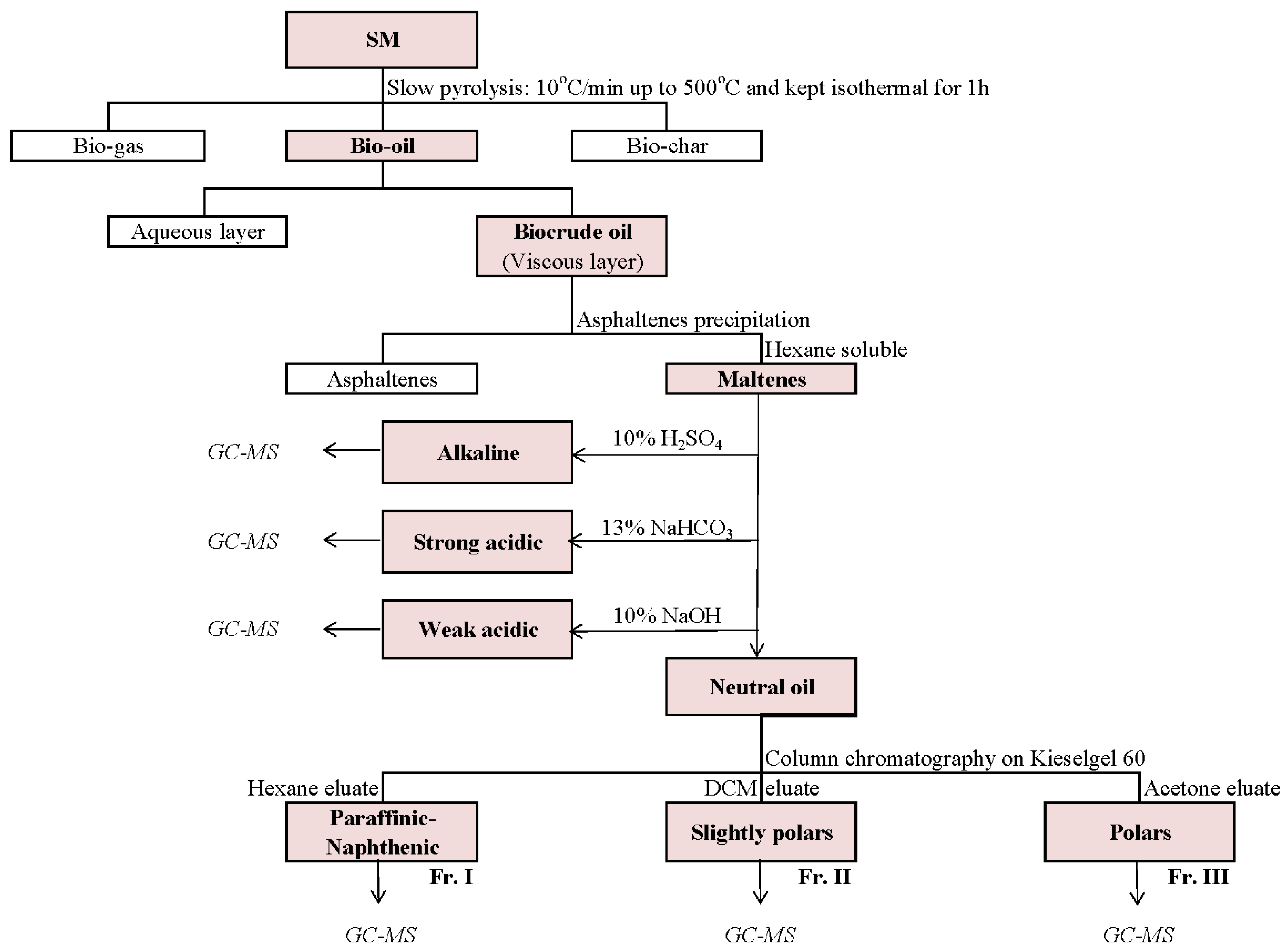
The separation protocol, presented in
Figure 1, was adopted from the acid–base separation scheme developed for fractionation of coal liquefaction products [
29]. In fact, the fractionation schemes proposed by Das and co-workers [
28] and the acid–base separation scheme developed for coal liquefaction products [
29] were both applied and compared in the present study. Despite procedural differences (mainly related to the stage at which asphaltenes are removed), both approaches yielded comparable compositional group distributions, confirming that the observed compositional trends reflect intrinsic properties of the SM-derived biocrude rather than method-induced artefacts. As no substantial differences were observed between the two fractionation approaches, further detailed analyses were performed only on the fractions obtained using the acid–base separation scheme developed for coal liquefaction products. Briefly, the procedure started by precipitation of asphaltenes in chilly
n-hexane (biocrude oil to solvent ratio of 1:10,
v/
v). The soluble fraction consisted of maltenes and was fractionated into: (1) an alkaline fraction applying a 10% H
2SO
4 extraction; (2) a strong acidic fraction using an extraction with 13% NaHCO
3; (3) a weak acidic fraction (an extraction with 10% NaOH was applied) and (4) residual part—neutral oils. Further, the neutral oils were fractionated on mini-columns (0.8 cm × 10 cm) containing Kieselgel 60 (Sigma-Aldrich, USA), 70–230 mesh ASTM: 0.1–0.3 g samples loaded Kieselgel were transferred on the top of the mini-columns and fractionation occurred according to their polarity into three sub-fractions, i.e., paraffinic–naphthenic (neutral, Fr. I), aromatic–slightly polar (Fr. II) and polar (Fr. III), using
n-hexane, dichloromethane (DCM) and acetone elution, respectively [
31].
2.4. GC–MS Study
All extracts and fractions were analyzed by GC–MS using a Trace GC Ultra-Gas chromatograph (Thermo Instruments): capillary column 30 m ZB 5-MSx 0.25 mm, df = 0.25 µm, (Phenomenex). Temperature programme used was: 3 min at 30 °C, 8 °C/min to 100 °C, 12 °C/min to 310 °C, hold time 5 min. Helium was used as a carrier gas at 85 kPa. A DSQ-mass spectrometer (Thermo Instruments): EI Spectra were obtained (ionization energy 70 eV) within a mass range of 33–480 Daltons at a scan rate of 0.4 s/scan. Homologous series are tracked by single ion monitoring (SIM) technique. Individual compounds were determined by comparison of mass spectra (MS) with literature and library spectra (NIST), comparison of GC retention times with those of synthetic standards or interpretation of mass spectra. For MS tracking Xcalibur software (version 1.4 SR1, Thermo Electron Corporation) was used. For the acquisition of quantitative data two internal standards, deuterated dodecane (nC12–d26) 200 µg/mL, and chrysene—d12, 0.5 µg/mL, were applied.
A set of m/z fragment ions was used for SIM tracking: n-alkanes—m/z 57; n-alkan-2-ones—m/z 58; n-alcohols—m/z 111; alkylbenzenes—m/z 92; linear FAMEs—m/z 74: nC14 (m/z 227) to nC28 (m/z 423). Degradation products of lignin, i.e., phenols/methoxy phenols—m/z 109, 121, and 181 and pyrolysis products of carbohydrates: cyclopentenones—m/z 112, 126, 140; steroids: sterenes—m/z 213, 215, 217, 229, 231, 255; steranes: m/z 217; steradienes: m/z 147, 255; ketosteranes—m/z 122, 124, 231; fecal sterols: m/z 215, 233; nitrogen containing compounds: amides—m/z 72; nitriles—m/z 110.
3. Results
The bulk characteristics and mass balance of pyrolysis of SM samples were described in Gonsalvesh et al. [
12], and therefore, for completeness, only the key observations relevant to the present study are briefly discussed below.
Both swine manure samples exhibited relatively high ash contents, amounting to 21.6 wt.% for SMc and 13.8 wt.% for SMd, which is a characteristic feature of manure-derived feedstocks and reflects their mineral-rich nature, most likely associated with the applied bedding material. The higher ash content observed for SMc indicates a greater contribution of inorganic constituents, which is expected to influence both the thermochemical conversion behaviour and the composition of the resulting pyrolysis products. Despite these differences, both materials were characterized by comparably high volatile matter contents, reaching 56.6 wt.% for SMc and 56.8 wt.% for SMd, confirming the substantial presence of organic matter and their suitability for thermochemical processing. Fixed carbon contents of 21.8 wt.% (SMc) and 24.0 wt.% (SMd) further support their potential for carbonaceous product formation.
Ultimate analysis revealed similar carbon contents for both samples, amounting to 38.6 wt.% for SMc and 37.2 wt.% for SMd, while hydrogen and nitrogen contents ranged between 4.7 and 4.2 wt.% and 2.9–2.0 wt.%, respectively. Sulphur was present in relatively low amounts, namely 0.8 wt.% for SMc and 0.6 wt.% for SMd. Noticeable differences were observed in the calculated oxygen content, which reached 31.4 wt.% for SMc and 42.2 wt.% for SMd. These values should be interpreted with caution, as oxygen was calculated by difference and is therefore strongly influenced by the ash and carbon contents [
12]. Additionally, SMd underwent anaerobic degradation prior to pyrolysis, a process known to modify the structure of organic matter and potentially contribute to the observed elemental differences. This is further reflected in the higher heating values (HHV) of the samples, which were calculated by the formulae of Channiwala [
15] as 15.3 MJ kg
−1 for SMc and 13.3 MJ kg
−1 for SMd [
12], indicating a lower energy density for the anaerobically treated material. Overall, the observed variations in bulk composition are expected to influence the distribution of oxygenated and heteroatom-containing compounds in the resulting biocrude oils, which is of direct relevance to the present study.
The product yields obtained from slow pyrolysis of SMc and SMd (
Table 1) demonstrate that both feedstocks produce substantial amounts of biocrude oil alongside biochar and non-condensable gases. Although SMc yields a higher total bio-oil fraction than SMd, both samples generate a significant viscous biocrude phase, confirming their suitability for liquid fuel-oriented valorisation. The observed differences in the distribution between viscous and aqueous bio-oil phases can be related to the pre-treatment history. In particular, the higher aqueous fraction obtained from SMc suggests a greater release of low-molecular-weight oxygenated compounds during pyrolysis, whereas the relatively higher viscous fraction in SMd indicates enrichment in heavier, less volatile components. The higher viscous biocrude yield and lower aqueous phase contribution observed for SMd may be associated with compositional changes induced by anaerobic degradation, which preferentially removes easily degradable polar components and enriches the residual organic matter in more hydrophobic precursors. These distinctions underline the importance of detailed compositional analysis of the viscous biocrude oils, which constitute the focus of the present work.
The fractionation results presented in
Table 2 indicate that the biocrude oils obtained from both SMc and SMd pyrolysis are composed of comparable proportions of maltenes and asphaltenes, confirming their heavy and complex nature. The relatively high asphaltene content (41.1–42.2%) is consistent with the observed tar-like appearance and high apparent viscosity of the biocrudes. Within the maltene fraction, neutral compounds dominate, accounting for more than half of the maltene extracts for both samples. However, noticeable differences are observed in the acidic subfractions. SMd-derived biocrude exhibits a higher contribution of acidic components, particularly weak acids, compared to SMc. Further neutral oil fractionation reveals differences in the distribution of fractions I–III between the two samples, indicating variations in the relative abundance of lighter and heavier neutral compounds. These differences highlight the effect of feedstock pretreatment on the chemical composition and fractionation behaviour of the resulting biocrude oils.
Pyrolysis oils can be considered as complex mixtures of organic compounds, characterized by a high water content (
Table 1) and strong acidity due to the presence of carboxylic acids. The high oxygen content of biocrude oil [
12] reflects poor stability, corrosiveness and prevents the direct blending with commercial fuels. Therefore, for SM further valorisation, an in-depth characterization of pyrolysis biocrude oils is of utmost importance. A GC–MS study has permitted to assess qualitatively and quantitatively the biocrude oils fractional compositions. The identified components in the fractions were grouped into series, i.e.,
n-alkenes/
n-alkanes, phenols, acids,
n-alkan-2-ones, cyclic hydrocarbons, amongst others, and their abundance in μg/g manure was given in
Table 3.
Table 4 summarizes the distribution of the identified and quantified FAs. Two sets were tracked, i.e., FAs and fatty acids methyl esters (FAMEs).
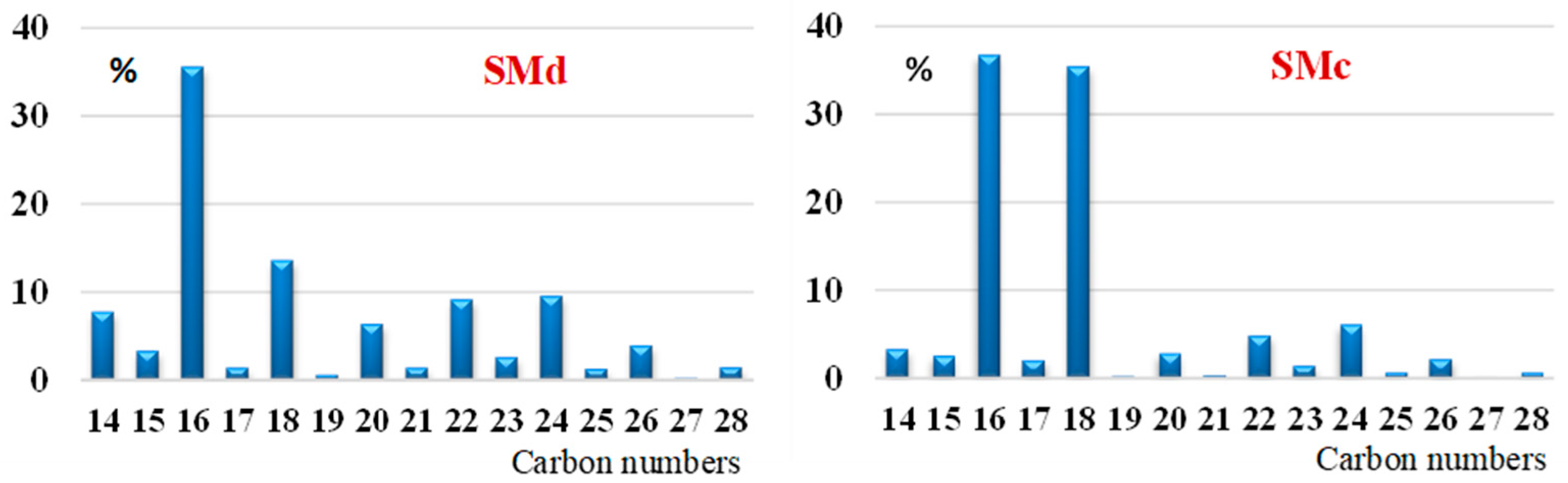
Figure 2 illustrates the distribution pattern of FAMEs present in the slightly polar fractions.
Apart from FAs (
Figure 2), other carbonyl containing compounds and phenols/methoxy phenols were identified and quantitatively determined. In our study we were also capable of identifying considerable amounts of steroids (
Table 3). Swine feces contain relatively high amounts of sterols that arise from the diet (i.e., sitosterol), intestinal sloughing of cells (i.e., cholesterol), and bacterial transformation of sterols (i.e., coprostanol) [
32,
33,
34]. In
Table 5 our results were compared with literature data for swine fecal sterols. Additionally, in
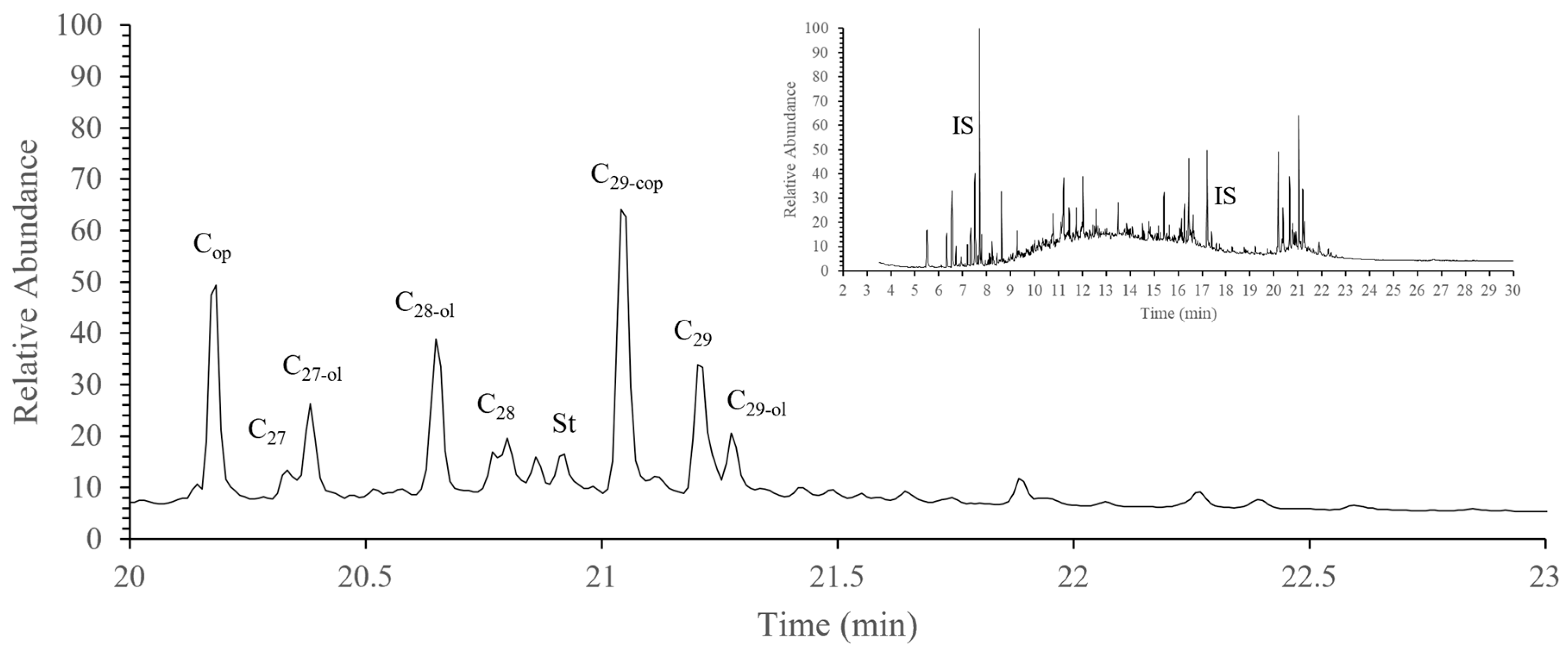
Figure 3 sterol/stanol distributions present in SMc polar fraction were visualized. For comparison, the same fecal sterol symbols were used as proposed by Jardé et al. [
34] for their evaluation in pig slurry contribution to soil organic matter amendment. In
Table 5 the systematic name, trivial name, formula, molecular mass of identified sterols/stanols are summarized and compared with published data [
32,
33].
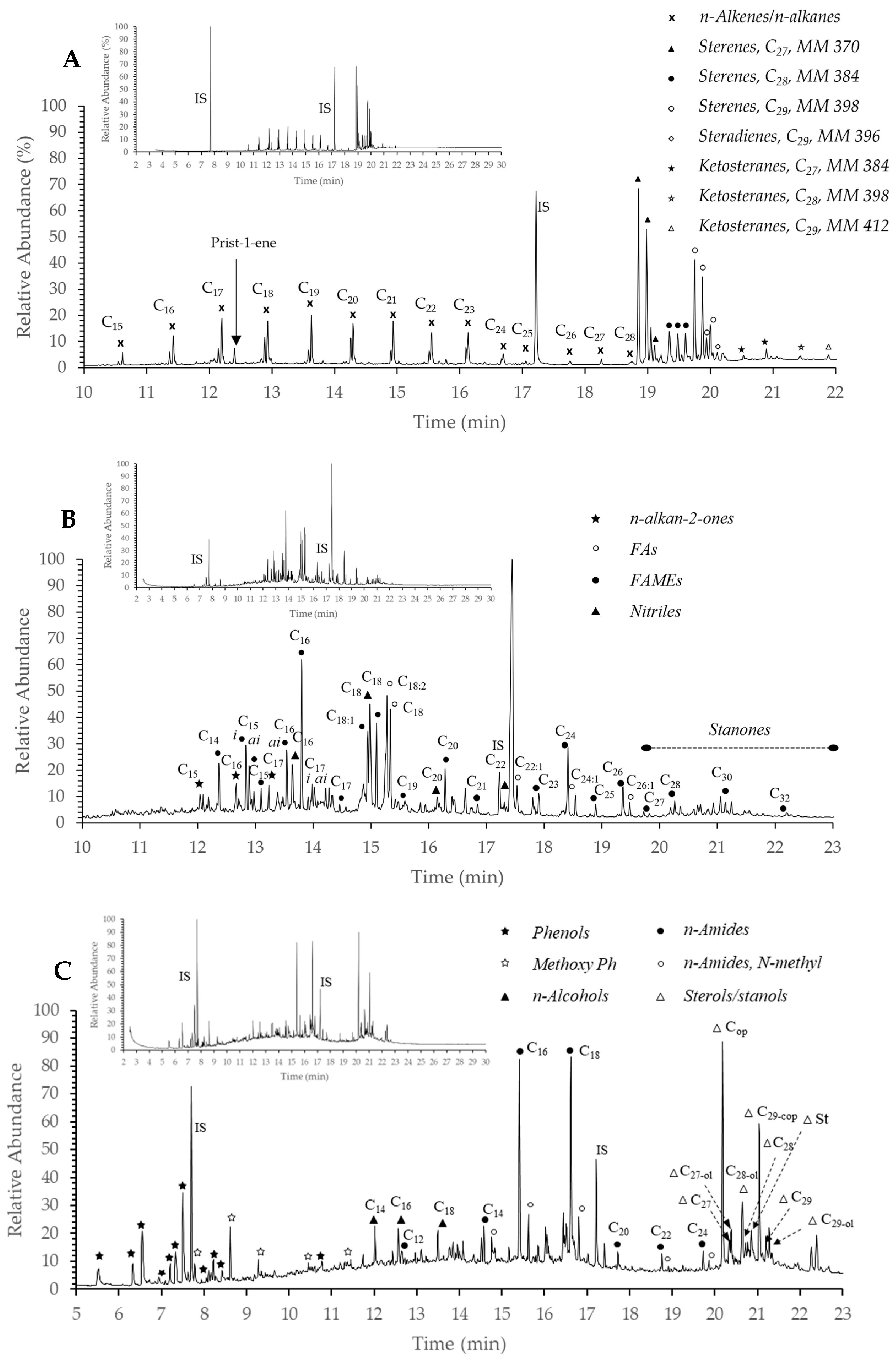
GC–MS chromatograms of neutral oil, i.e., (A) Fr. I (paraffinic–naphthenic), (B) Fr. II (slightly polar) and (C) Fr. III (polar) are visualized in
Figure 4.
The sum of all compositional groups, identified and quantified in the crude oils, were summarized in
Table 6. Therein, the amount of each compositional group, expressed as a fraction of the total quantified amounts (in %), was listed.
4. Discussion
According to the European Environmental Agency (EEA) definition of manure is “animal excreta collected from stables and barnyards with or without litter; used to enrich the soil”. In European legislation, there is no uniform definition for manure. While Regulation EC/1069/2009 on animal by-products defines manure as “any excrement and/or urine of farmed animals other than farmed fish, with or without litter”, being an organic fertilizer, the Nitrates Directive (Directive 91/676/EEC) defines manure from farmed animals as “waste products excreted by livestock: or a mixture of litter and waste products excreted by livestock, even in processed form” [
35]. Farmyard manure contains plant material (often straw), which is used as bedding for animals and adsorbent for the feces and urine.
Up to now different chemical methods have been used for compositional group analyses of SM and individual compound quantification. It was out of scope of this study to refer to all published literature on the topic. In this context we highly appreciate the study of Xiu et al. [
36] with data on the composition of biocrude oil obtained by the hydrothermal pyrolysis of SM. The authors have asserted that for oily products GC–MS, FTIR spectroscopy combined with elemental analysis could supply valuable information on the topic, a concept close to our vision for bio-oil characterization. It was clarified that the biocrude oils have comprised a very complex mixture of organic compounds with 6 to 28 carbon atoms in their chemical formula, mainly composed by aromatic hydrocarbons, alkenes, nitrogenous compounds, carboxylic acids, phenols, and their derivatives. In that study, all these species were identified by GC–MS but not quantified. In contrast, in our protocol all GC–MS detected compounds were identified and quantified and data were expressed in μg per g of manure subjected to slow pyrolysis.
To carry out an effective analysis of the various groups of organic species, an appropriate fractionation in “narrow” fractions enriched in different classes of organic compounds was required. This approach of “molecular marker” was firstly developed by petroleum organic geochemists and was used to distinguish the sources, transport and fate of various organic compounds in the environment [
37]. Because of their unique structure, “molecular markers” were indicative for their precursors. Nowadays, the technique is successfully applied to waste waters, sewage sludge in soils, waters and sediments pollution tracking.
The presence of homologous series in the biocrude oils after fractionation was demonstrated by compositional group analysis discussed in the following subsections.
4.1. Compositional Group of FAs and FAMEs
Palmitic (nC16), oleic (nC18:1, ω-9) and stearic (nC18) acids were main components of FAs. This predominance of C16 and C18 FAs is characteristic of biogenic lipid-derived feedstocks, as these chain lengths correspond to the most abundant FAs in biological membranes and storage lipids. During pyrolysis and subsequent derivatization, shorter-chain FAs are preferentially lost as volatile products, while longer chains are more susceptible to thermal cracking, resulting in the relative enrichment of C16–C18 species. Therefore, the observed distribution reflects both the biological origin of the lipids and the thermochemical transformation pathways.
All fractions obtained after separation were dominated by the FAs short homologues:
nC
14–
nC
20,
nC
16, and maximizing at
nC
18. In the case of FAMEs the ratio short (
nC
14–
nC
19) over long members (
nC
20–
nC
28) was altered by the anaerobic digestion: in SMs slightly polar fraction the ratio was 4.95, while for SMd this ratio considerably decreased to 2.21. The distribution pattern of FAMEs in the slightly polar fraction of biocrude oils was illustrated in
Figure 2. The input of mono-unsaturated FAs, i.e., oleic acid,
nC
18:1, ω-9, and di-unsaturated FAs, i.e., linoleic acid,
nC
18:2, ω-9,12) in the slightly polar fraction of biocrude oil of SMd was also appreciable (
Figure 4B).
In the slightly polar fraction of SMc biocrude oil only FAMEs were identified (
Table 4) while linear and unsaturated FAs were found in the weak and strong acid extracts from the biocrude oils of SMc and SMd.
Anaerobic digestion has converted organic residues into biogas and digestate, thus recycling materials and replacing energy from fossil fuels with renewable energy. Anaerobic digestion is used to stabilize organic matter to avoid phytotoxicity, greenhouse gases, odorous emissions and nutrient losses. In our study it was possible to compare compositional groups of biocrude oils from digested and de-watered SM cake. First, it should be emphasized that in the weak and strong acidic extracts only FAs were identified. As a result of SM digestion, a new series composed by long chain mono-unsaturated FAs with even carbon number has appeared (
nC
22:1, ω-9,
nC
24:1, ω-9 and
nC
26:1, ω-9, maximizing at erucic acid (
nC
24:1, ω-9) in the slightly polar fraction of SMd biocrude oil (
Table 4 and
Figure 4B). The formation of these long-chain mono-unsaturated FAs (
nC
22:1–
nC
26:1, ω-9) significantly influences the physicochemical profile of the digested biocrude oil. Their presence increases the proportion of high molecular weight lipids, thereby enhancing the oil’s hydrophobicity, viscosity and thermal stability [
38,
39,
40]. From a compositional standpoint, this shift results in a heavier and more cohesive oil matrix with improved lubricating characteristics, which may be beneficial for blending with BD or in applications where higher viscosity is desirable (e.g., marine fuels or lubricant additives). However, their elevated unsaturation degree also implies higher susceptibility to oxidative degradation during storage. Overall, the predominance of mid-chain and unsaturated FAs indicates that the lipid fraction of the obtained biocrude oils preserves molecular features comparable to conventional BD precursors. Such composition provides both energetic and functional potential—supporting conversion into methyl esters or use as co-feedstocks in BD blending. Consequently, the FA and FAME profile of the SM-derived biocrudes defines the balance between stability, viscosity, and reactivity, as well as the necessary extent of post-treatment or catalytic upgrading before their utilization as renewable fuel components.
From a quantitative point of view, the total amount of FAs and their methyl esters determined in both biocrude oils ranges from several tens to more than one hundred micrograms per gram of manure (
Table 6). While absolute values reported across the literature vary with feedstock and method, prior studies consistently describe manure-derived bio-oils as lipid-rich systems dominated by FAs and related oxygenates, supporting the interpretation that SM can serve as a secondary lipid feedstock [
28,
41,
42]. This aligns with the methodological guidance and ranges discussed in reviews on quantitative analysis of pyrolysis bio-oils [
43]. The notably higher FAs content in the digested sample (115 µg/g vs. 135 µg/g in SMc) is consistent with documented lipid transformations during anaerobic processing, where long-chain species tend to persist or reform under thermal treatment [
44,
45].
4.2. Compositional Group of Steroid Components
The significant contribution of steroid components (sterenes, sterols and stanols) to our SM biocrude oil samples was not a novelty, as stigmasterol and sitosterol are typical plant constituents used in animal feed [
34]. There were differences in the content and composition of fecal sterols among animals, and these variations were related to diet. In addition, some anaerobic bacteria in the gut of warm-blooded animals (e.g., species belonging to the genera Eubacterium, Clostridium, Bacteroides and Ruminococcus) are able to reduce sterols into stanols with isomeric configuration characteristics for each animal species [
46,
47]. Human and swine sterol distributions are dominated by coprostanol (
Table 6). The sterol profile of swine slurry is typically composed of campesterol, sitosterol, campestanol and sitosterol [
32,
33,
34].
From the identified sterols, stigmasterol and sitosterol were of plant origin. Coprostanol and 24-ethyl-coprostanol occurred in the largest concentrations among identified sterols in both SM samples (
Figure 3). Published data [
34] have shown that the 5β-stanol coprostanol is the most abundant sterol present in swine slurry, dominating the “sterol fingerprint.” In our study, sterols and stanols identifications were based on comparison of MS data with the Wiley Spectral Library and reference standards using MSD Chemstation (Agilent Technology, Santa Clara, CA, USA). In this way, we identified sterols with the provision that standards would be needed for unequivocal confirmation of the isomeric configurations.
For the two SM samples studied the ratios of the sums of FAs over steroids (S), FAs/S, were comparable, 8.9 for SMd and 11.7 for SMc, pointing out a slight preferential sterol accumulation in the digested sample SMd. As the fecal sterols amounts in the two SM samples were comparable (
Table 6), a possible explanation could be that FAs were more available or structurally amenable to degradation by bacteria during digestion. From the scope of the study, it was evident that steroids, i.e., sterenes, sterols and stanols, were not the main target but due to their significant presence they could not be neglected.
Beyond their compositional relevance, the presence of these steroid components provides important functional and environmental insights. Coprostanol and related stanols are well-established molecular markers for tracing manure-derived organic matter in soils and aquatic systems [
32,
34]. Their persistence under pyrolytic conditions indicates that part of the fecal biomarker signature is thermally stable, which could be advantageous for environmental source apportionment of pyrolyzed organic residues. In addition, several sterols and stanols are known to possess bioactive potential and physiological relevance, which has growing interest in their selective recovery from natural and waste-derived matrices. Such compounds may find future use as functional additives or precursors for nutraceutical and pharmaceutical applications, adding further value to the complex composition of biocrude oils. Therefore, the steroid fraction, though not predominant in quantity, represents an analytically and potentially valuable component of SM-derived biocrudes. Its presence highlights the dual relevance of these oils—as a renewable energy resource and as a matrix rich in trace bio-organic molecules of diagnostic and functional importance.
In the context of biofuel upgrading, sterols and stanols can also act as thermally stable aromatic precursors that contribute to the fixed carbon content and heating value of the biocrude oil. During catalytic hydrotreatment, these polycyclic structures may undergo partial deoxygenation to form substituted hydrocarbons, enhancing the aromatic fraction and energy density of the upgraded fuels [
48]. Such transformation pathways expand the potential role of the steroid fraction beyond that of a biomarker—positioning it as a structural reservoir for hydrocarbon generation in advanced bio-refining schemes.
In parallel, the recovery of sterols and stanols as co-products is gaining attention, since compounds such as β-sitosterol, stigmasterol and campesterol are precursors for the synthesis of steroidal pharmaceuticals (e.g., progesterone and corticoids), nutraceuticals and membrane-active additives [
49,
50]. Considering that the SM biocrudes contain up to 10–40% steroid components (
Table 6), targeted extraction of these molecules could improve the overall economic feasibility of the pyrolysis process by coupling fuel production with recovery of high-value chemicals
4.3. n-Alkene/n-Alkane Compositional Group
The
n-alkene/
n-alkane compositional group was dominant in biocrude oils, amounting to 133.4 μg/g (23.3% of all quantified species) for SMc (
Table 6,
Figure 4A). Hydrocarbon distribution curves were dominated by short chain members,
nC
15–
nC
20, responsible for a half of all
n-alkenes/
n-alkanes. In addition, the
n-alkene/
n-alkane distribution pattern was mimicked by
n-alkylbenzenes, though present in very low amounts. For SMd biocrude oil the hydrocarbons profile showed the same peculiarity as in the case of FAMEs: an increase in longer homologues,
nC
26–
nC
34, and an appearance of a vague maximum in the range
nC
29–
nC
33. As a result, for the SMd biocrude oil the portion of the longer members has increased to 20.3 rel. %, comparing to the hydrocarbons separation in SMc with only 5.4 rel.%.
n-Alkene/n-alkane distribution (i.e., short-chain (C15–C20), mid-chain (C21–C25) and long-chain (C26–C34) SMc biocrude oil) was strongly dominated by short-chain homologues, 61.9%, while in the digested SM sample, a decrease to 47.4% was observed. The ratio of short-/long-chain homologues of 1.62 for SMc dropped to 0.90 for digested manure SMd. Contributions of “odd” and “even” homologues were comparable as their ratios were about 1.00, i.e., 1.11 for SMc and 0.94 for SMd, respectively.
The higher abundance of hydrocarbons in SMc confirms that anaerobic digestion reduces the availability of aliphatic precursors, likely due to partial microbial degradation of lipids and carbohydrates prior to pyrolysis. Consequently, the SMc biocrude oil retains a larger fraction of thermally labile short- and mid-chain
n-alkanes and
n-alkenes (
nC
15–
nC
25), which fall within the diesel range hydrocarbons. These compounds enhance calorific value and improve the fuel characteristics of the biocrude oil. In contrast, SMd yields a lower hydrocarbon content but a higher proportion of long-chain members, resulting in a heavier, more viscous product with greater fixed-carbon content but lower volatility [
51,
52].
From a compositional standpoint, the balanced presence of odd and even alkanes suggests that both lipid- and carbohydrate-derived precursors contributed to hydrocarbon formation during pyrolysis. This dual origin is consistent with previous studies demonstrating that bio-oils exhibit a mixed hydrocarbon pattern combining paraffinic fragments from lipid cracking with alkenes generated through decarboxylation and dehydration reactions [
3]. The near parity between odd and even members also implies the occurrence of secondary cracking and hydrogen transfer reactions typical of slow pyrolysis, which smooth the molecular weight distribution and generate a broad spectrum of paraffinic and olefinic species.
Overall, the hydrocarbon fraction is a key contributor to the energy potential of the SM-derived biocrudes. Its higher yield and shorter-chain profile in SMc highlight the influence of feedstock pre-processing on product quality. The SMc oil, richer in volatile n-alkenes/n-alkanes, is better suited for blending or co-processing with petroleum fractions, whereas the SMd-derived oil, heavier and richer in long-chain species, may find applications in lubricant or wax production. Thus, the n-alkenes/n-alkanes group not only determines the physical behaviour of the biocrude oils but also provides a clear indication of their potential valorisation routes.
4.4. Compositional Group of Phenols/Methoxy Phenols
In both biocrude oils a variety of phenols/methoxy phenols were identified which were formed during SM pyrolysis and have closely similar structural features characteristic for plant tissues and debris. The different compounds obtained from lignocellulose pyrolysis can be associated with structural units in the lignin structure: p-hydroxyphenyl; guaiacyl (3-methoxy, 4-hydroxyphenyl); and syringyl (3,5-dimethoxy, 4-hydroxyphenyl). All these components were related to plant material (often straw) used as bedding for animals and for the feces and urine accumulation. Each compound in the compositional group of phenol/methoxy phenols was identified and quantified, though it was beyond the scope of this study to describe products of lignin pyrolysis as they have been already thoroughly described in the specialized literature. However, our separation protocol allowed determining the contribution of each compound to the pyrolysate (
Figure 4C). In
Table 6 the total amount of phenol/methoxy phenols was included with a contribution of 98.9 μg/g for SMd being of about a quarter of all identified compounds and constituted one of the main compositional groups in the pyrolysate of SMd.
During slow pyrolysis at 500 °C of SMd minor amounts of 2-cyclopentenones (C
nH
2n−4O, C
6–C
8 were formed (
Table 3). These compounds were pyrolysis products of bedding polysaccharides. Pyrolysis products of lignin and polysaccharides were also comprehensively described in the specialized literature [
53].
The significant presence of phenolic and methoxy-phenolic compounds in the SMd biocrude oil indicates that lignin-derived fragments are key contributors to its oxygenated fraction. These oxygenated aromatics increase the acidity and instability of the crude oil, leading to potential corrosion and polymerization during storage. However, they also enhance the oil’s reactivity, making it suitable for catalytic hydrodeoxygenation or hydrogen donor solvent upgrading, where phenolic moieties can be converted into valuable aromatic hydrocarbons [
48].
Concerning valorisation perspective, phenols and methoxy phenols represent important precursors for fine chemicals, resins and antioxidants. Guaiacol- and syringol-type derivatives are already exploited industrially as intermediates in the synthesis of pharmaceuticals and polymeric materials. Therefore, the phenolic fraction of the SM biocrude oils can be considered both a challenge, due to its oxygen content, and an opportunity for integrated recovery of high-value phenolic compounds.
The higher yield of phenolics in SMd suggests that anaerobic digestion promotes selective preservation of lignin-rich bedding residues, which subsequently contribute to the formation of these oxygenates during pyrolysis. This observation highlights the complex interaction between biological pretreatment and thermochemical conversion, influencing both the chemical diversity and upgrading potential of the final biocrude oils.
4.5. Compositional Group of Nitrogenous Compounds (Alkylnitriles and Alkyl Amides)
Generally, nitrogenous compounds were not abundant in the pyrolytic bio-oils from lignocellulosic biomass, but they were found in SM pyrolysates. Alkaline nitrogenous compounds have amounted up to 2.1 μg/g, as the only methyl quinoline in SMd was identified (
Table 3). A possible explanation for the low amount of alkaline nitrogenous compounds could be separation deficiency, low concentration or because nitrogen was incorporated in heavier non-volatile constituents (such as N-heterocycles) posing difficulties for GC–MS analysis.
In the slightly polar fraction of SMc biocrude oil (
Figure 4B)
n-nitriles (18.6 μg/g) and in polar fraction of SMd biocrude oil (
Figure 4C)
n-amides (11 μg/g) were identified (
Table 3). Alkyl nitriles were common components in the pyrolysate of SMc. Simoneit et al. [
54] have explained their presence by alkanoic acids pyrolysis and reaction with ammonia via dehydration of the amide intermediate at high temperature. From these data, the alkyl amides and alkyl nitriles in biocrude oils were suggested to be due to reactions of the COOH group in FAs with ammonium salts from amino acids, which is possibly from protein decomposition during pyrolysis. In the case of SM another source for ammonium, urine in the bedding, is to be expected. Thus, the alkyl amides and alkyl nitriles with an even-to-odd carbon preference were explained by the reactions of alkanoic acids with NH
3 according to the reaction scheme:
The detection of both nitriles and amides confirms that manure proteins and nitrogenous residues actively participate in thermochemical reactions during pyrolysis. This behaviour distinguishes SM-derived biocrudes from lignocellulosic ones, where nitrogen-containing species are almost absent. The coexistence of FAs and ammonium compounds promotes amide formation, while the elevated temperature facilitates dehydration to nitriles. Such species can influence the acidity and stability of the bio-oil but also serve as reactive intermediates in upgrading processes [
48].
Kim et al. [
55] in their study of microalgae bio-oil have obtained a considerable fraction of nitriles as nitrogenous compounds. They have claimed it as a positive outcome for the process of fuel production compared to other compounds, as homologues in the range C
12–C
16 of major nitriles were within diesel range and nitrile groups in nitrogenous compounds could be easily removed in the hydrotreating unit of existing petroleum refinery. They have suggested that the microalgae bio-oil could be used compatible for bio-diesel production in current refinery infrastructure, although fractions beyond the range of diesel should be separated and redirected to other applications. By analogy, these considerations are valid for SM pyrolytic biocrude oils, where nitrile-rich fractions could be valorised either through catalytic upgrading or chemical processing into surfactants and specialty nitrogenous-containing compounds. Although these compounds are often viewed as undesirable due to their potential to poison catalysts and to lower fuel quality, they also represent a source of functionalized intermediates for the synthesis of amines, amides, and nitrile-derived fine chemicals. Thus, efficient separation and selective upgrading could convert these compounds from contaminants into valuable co-products, improving the overall benefits of SM pyrolysis.
In general, the same homologue series are dominantly present in the pyrolysates of both SM samples studied. The main compositional groups in SM biocrude oils were FAs, hydrocarbons, steroids and phenols/methoxy phenols. The sequence was as follow: for SMc ~40% of steroids and comparable fractions of ~25% for
n-alkenes/
n-alkanes and FAs; and, for SMd FAs (31.0%) > phenols/methoxy phenols (26.6%) >
n-alkenes/
n-alkanes (10.8%) > steroids (10.6%) These compositional groups have contributed up to 79–93% of all identified components in the biocrude oils. Additionally, these amounts will increase by adding the fractions of other identified compounds, i.e., nitriles, amides, alkan-2-ones, alcohols and phenyl alkanoic acids making biocrude oils attractive as feedstock for fuel upgrading or for chemicals manufacturing. However, according to Jeong et al. [
42], the SM-derived biocrude oil was not particularly good as fuel due to the low yield and high water content. Therefore, co-pyrolysis or blending of SM with other biomass types is proposed as a viable strategy to enhance both yield and product quality.
5. Conclusions
Two swine manure samples, de-watered cake (SMc) and solid product from swine manure anaerobic digestion (SMd), were pyrolyzed at 500 °C. Initially, the pyrolysis process was designed for cheap adsorbent preparation, while in the present study the liquid by-products (biocrude oils) from slow pyrolysis were investigated as potential sources of renewable hydrocarbons and biofuel precursors. A fractionation scheme, adopted from petroleum heavy-end and coal-liquid analysis, was successfully applied to the biocrude oils to isolate enriched compositional groups and to evaluate their relative contribution to the total product yield.
The main compositional groups identified were fatty acids, n-alkenes/n-alkanes, steroids, phenols/methoxy phenols and nitrogenous compounds (nitriles/amides). Their relative distribution was as follows:
- -
for SMc: fatty acids (23.7%), n-alkenes/n-alkanes (23.3%) and steroids (40.7%);
- -
for SMd: fatty acids (31.0%), phenols/methoxy phenols (26.6%), n-alkenes/n-alkanes (10.8%) and steroids (10.6%).
These groups together accounted up to 79–93% of all identified compounds, confirming that the biocrude oils are chemically well-defined and suitable for targeted upgrading studies.
Significant compositional differences between the two oils were observed. SMd possessed a higher content of linear n-fatty acids and phenolics, while SMc was dominated by steroids and hydrocarbons. Anaerobic digestion promoted the formation of long-chain mono-unsaturated fatty acids (nC22:1–nC26:1, ω-9) and an enrichment in heavier hydrocarbon, nC26–nC34. Short-chain phenyl alkanoic acids (C8–C10, 42.6 μg/g) were detected only in SMd, whereas alkyl nitriles prevailed in SMc and alkyl amides in SMd. The ratio of fatty acids to steroids (FAs/S = 8.9–11.7) indicated a slightly higher sterol accumulation in the digested sample, reflecting the biological transformation processes occurring during anaerobic degradation. These compositional insights highlighted the contrasting origins and reactivities of the two biocrudes:
- -
SMc oil, rich in hydrocarbons and steroids, possesses higher energy content and potential for co-processing with petroleum fractions;
- -
SMd oil, enriched in oxygenated species, i.e., fatty acids and phenolics, offers good scenarios for catalytic upgrading and for recovery of fine chemicals as phenols, sterols and nitrile derivatives.
Despite the comprehensive compositional characterization achieved in this study, certain limitations should be acknowledged. The investigation was restricted to biocrude oils obtained under a single slow pyrolysis condition (500 °C), selected based on preliminary thermogravimetric analysis and optimization of solid product properties. Variations in heating rate, residence time and reaction atmosphere may therefore influence both product yield and molecular composition, and the reported profiles should be interpreted within this process framework. In addition, while GC–MS analysis enabled detailed characterization of volatile and semi-volatile fractions, high-molecular-weight, highly polar or thermally unstable species may remain partially unresolved. Future research should focus on expanding the process window and exploring upgrading strategies and targeted recovery of valuable compound classes to reduce oxygen and nitrogen contents, enhance fuel stability and compatibility with existing refinery infrastructure, and improve the overall energy efficiency and economic viability of manure-derived biocrude oils. Although the swine manure derived biocrude oils are not directly suitable as fuels due to their high oxygen and nitrogen content, this systematic study provides essential compositional data for optimizing manure pyrolysis. It demonstrates the feasibility of conversion of agricultural and manure residues into complex mixtures of renewable hydrocarbons, lipids and bioactive molecules. The findings contribute to the development of integrated waste-to-resource strategies that combine fuel production with recovery of high-value co-products, thus supporting sustainable and economically viable manure management.




 ,
,