Chemical Composition, Antioxidant, Analgesic, and Wound-Healing Effects of Pinus pinaster Aiton and Pinus halepensis Mill Needles: A Natural Approach to Pain and Oxidative Stress Management
 , , , ,
  and
and
Abstract
1. Introduction
2. Materials and Methods
2.1. Plant Material and Extraction
2.2. Identification of Phytochemicals
2.2.1. Chemical Analysis by Ultra-High-Performance Liquid Chromatography Coupled with Mass Spectrometry (UHPLC-MS)
2.2.2. Examination of Total Phenolic Content (TPC)
2.2.3. Examination of Total Flavonoid Content (TFC)
2.3. In Vitro Antioxidant Assays
2.3.1. 2,2-Diphenyl-1-Picrylhydrazyl Radical Assay (DPPH)
2.3.2. Azinobis (3-ethyl-benzothiazoline-6-sulfonic acid) Radical Scavenging Activity (ABTS Assay)
2.3.3. Total Antioxidant Capacity (TAC)
2.4. Pharmacological Investigations
2.4.1. Animal Protocol
2.4.2. Analgesic Effect of Pinus Needle Extracts
- Control group—received distilled water (vehicle).
- Standard drug group—received diclofenac sodium (50 mg/kg b. wt.).
- PPN low dose (D1)—100 mg/kg b. wt.
- PPN high dose (D2)—300 mg/kg b. wt.
- PAN low dose (D1)—100 mg/kg b. wt.
- PAN high dose (D2)—300 mg/kg b. wt.
2.4.3. Tail Immersion Experiment with Rats
2.4.4. Wound Healing Effect
Enrichment of Ointments with Pine Needle Extract
Burn Wound Induction
2.5. Statistical Analysis
3. Results and Discussion
3.1. Phenolic Screening of PPN and PAN Using HPLC-MS
3.2. Quantification of Total Flavonoid Content (TFC) and Total Polyphenol Content (TPC)
3.3. Antioxidant Effect of Pinus Needles Extract
3.4. Pharmacological Investigations
3.4.1. Analgesic Effect of Pine Needle Extract
3.4.2. Tail Immersion Experiment with Rats
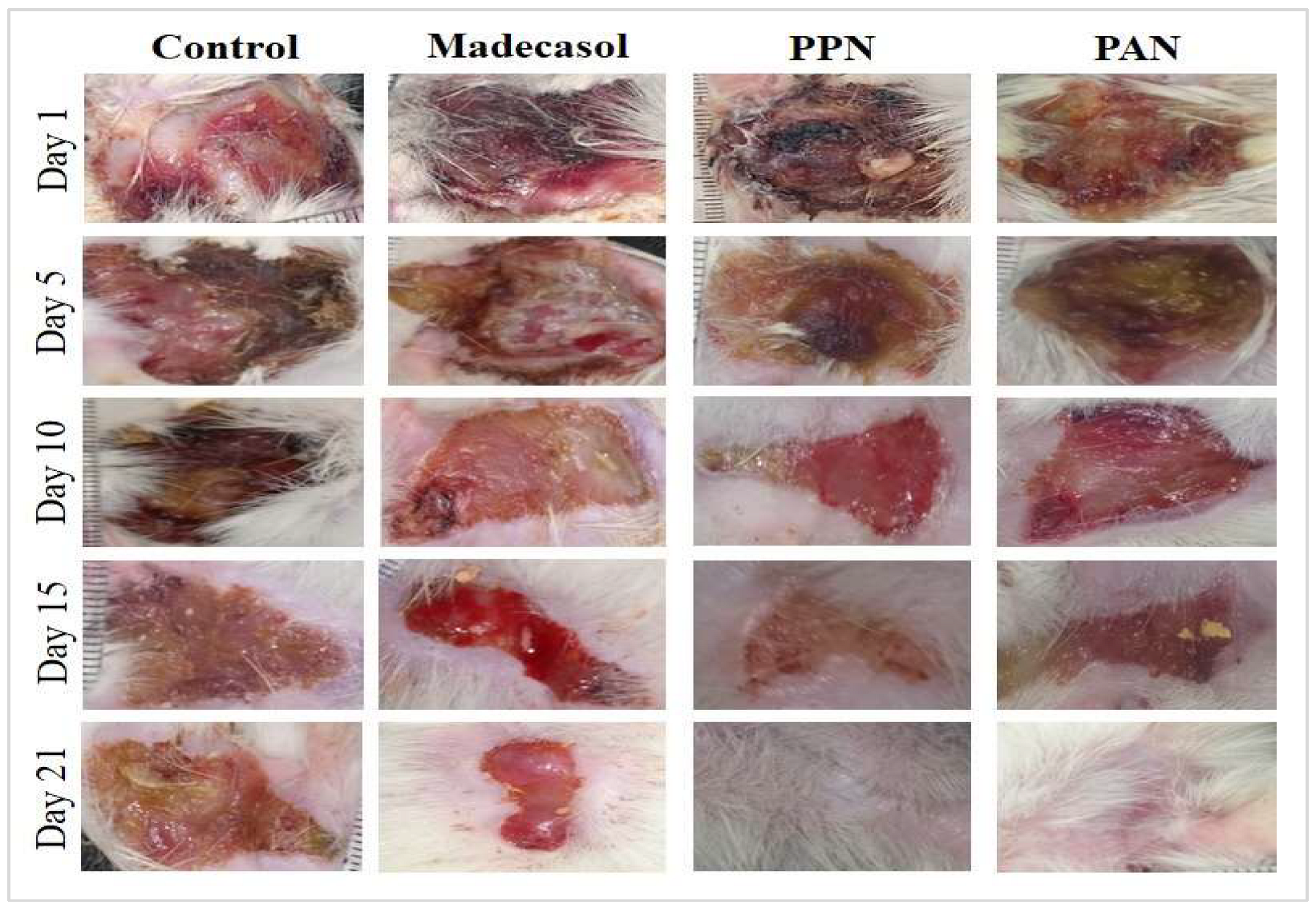
3.4.3. Wound Healing Effect
4. Conclusions
Author Contributions
Funding
Institutional Review Board Statement
Data Availability Statement
Acknowledgments
Conflicts of Interest
References
- Okafor, R.O.S.; Remi-Adewunmi, B.D.; Fadason, S.T.; Ayo, J.O.; Muhammed, S.M. Pathophysiologic mechanisms of pain in animals–A review. J. Vet. Med. Anim. Health 2014, 6, 123–130. [Google Scholar] [CrossRef]
- Meeus, M.; Nijs, J.; Hermans, L.; Goubert, D.; Calders, P. The role of mitochondrial dysfunctions due to oxidative and nitrosative stress in the chronic pain or chronic fatigue syndromes and fibromyalgia patients: Peripheral and central mechanisms as therapeutic targets? Expert Opin. Ther. Targets 2013, 17, 1081–1089. [Google Scholar] [CrossRef]
- Rokyta, R.; Holecek, V.; Pekárková, I.; Krejcová, J.; Racek, J.; Tre, L.; Yamamotová, A. Free radicals after painful stimulation are influenced by antioxidants and analgesics. Neuro Endocrinol. Lett. 2003, 24, 304–309. [Google Scholar]
- Elma, Ö.; Brain, K.; Dong, H.-J. The Importance of Nutrition as a Lifestyle Factor in Chronic Pain Management: A Narrative Review. J. Clin. Med. 2022, 11, 5950. [Google Scholar] [CrossRef] [PubMed]
- Esfahlan, A.J.; Lotfi, M.; Zamanzadeh, V.; Babapuor, J. Burn pain and patients’ responses. Burns 2010, 36, 1129–1133. [Google Scholar] [CrossRef] [PubMed]
- Hussain, Z.; Thu, H.E.; Rawas-Qalaji, M.; Naseem, M.; Khan, S.; Sohail, M. Recent developments and advanced strategies for promoting burn wound healing. J. Drug Deliv. Sci. Technol. 2022, 68, 103092. [Google Scholar] [CrossRef]
- Süntar, I. Importance of ethnopharmacological studies in drug discovery: Role of medicinal plants. Phytochem. Rev. 2020, 19, 1199–1209. [Google Scholar] [CrossRef]
- Jarić, S.; Kostić, O.; Mataruga, Z.; Pavlović, D.; Pavlović, M.; Mitrović, M.; Pavlović, P. Traditional wound-healing plants used in the Balkan region (Southeast Europe). J. Ethnopharmacol. 2018, 211, 311–328. [Google Scholar] [CrossRef]
- Kurose, K.; Okamura, D.; Yatagai, M. Composition of the essential oils from the leaves of nine Pinus species and the cones of three of Pinus species. Flavour Fragr. J. 2007, 22, 10–20. [Google Scholar] [CrossRef]
- Ejjabraoui, M.; Abdoul-Latif, F.M.; Eddabbeh, F.-E.; Ainane, A.; Shybat, Z.L.; Ainane, T. Chemical Study and Insecticidal Activity of Two Species of Moroccan Pinus: Pinus halepensis Mill. and Pinus pinaster Sol. 2021. Available online: https://pharmacologyonline.silae.it/files/archives/2021/vol2/PhOL_2021_2_A058_EJJABRAOUI.pdf (accessed on 1 January 2026).
- Bouasla, A.; Bouasla, I. Ethnobotanical survey of medicinal plants in northeastern of Algeria. Phytomedicine 2017, 36, 68–81. [Google Scholar] [CrossRef]
- Chohra, D.; Ferchichi, L. Ethnobotanical study of Belezma National Park (BNP) plants in Batna: East of Algeria. Acta Sci. Nat. 2019, 6, 40–54. [Google Scholar] [CrossRef]
- Senouci, F.; Ababou, A.; Chouieb, M. Ethnobotanical survey of the medicinal plants used in the Southern Mediterranean. Case study: The region of Bissa (Northeastern Dahra Mountains, Algeria). Pharmacogn. J. 2019, 11, 647–659. [Google Scholar] [CrossRef]
- Nazım, B.; Houarı, T.; Ismaıl, B. Ethnobotanical survey of some plants used in Tessala Region, Algeria. Curr. Perspect. Med. Aromat. Plants 2020, 3, 25–30. [Google Scholar] [CrossRef]
- Mahraz, M.A.; Idrissi, M.A.; Mzali, A.; El Mrayej, H.; Lfatouhi, A.; Salim, R.; Loukili, E.H.; Jghaoui, M.; Rais, Z.; Taleb, M. Ethnobotanical survey of medicinal and aromatic plants used in the treatment of skin burns in the Province of Sefrou of Morocco. Trop. J. Nat. Prod. Res. 2024, 8, 6487–6497. [Google Scholar] [CrossRef]
- Yuan, H.; Ma, Q.; Ye, L.; Piao, G. The traditional medicine and modern medicine from natural products. Molecules 2016, 21, 559. [Google Scholar] [CrossRef] [PubMed]
- Hickman, C. Pine fresh: The cultural and medical context of pine scent in relation to health—From the forest to the home. Med. Humanit. 2022, 48, 104–113. [Google Scholar] [CrossRef] [PubMed]
- Papp, N.; Purger, D.; Czigle, S.; Czégényi, D.; Stranczinger, S.; Tóth, M.; Dénes, T.; Kocsis, M.; Takácsi-Nagy, A.; Filep, R. The importance of pine species in the ethnomedicine of Transylvania (Romania). Plants 2022, 11, 2331. [Google Scholar] [CrossRef]
- Khan, S.W.; Khatoon, S. Ethnobotanical studies on useful trees and shrubs of Haramosh and Bugrote valleys in Gilgit northern areas of Pakistan. Pak. J. Bot. 2007, 39, 699–710. [Google Scholar]
- Alamgeer; Sharif, A.; Asif, H.; Younis, W.; Riaz, H.; Bukhari, I.A.; Assiri, A.M. Indigenous medicinal plants of Pakistan used to treat skin diseases: A review. Chin. Med. 2018, 13, 52. [Google Scholar] [CrossRef]
- Balodi, K.N.; Purohit, M.V.; Shridhar, V.; Arunachalam, K. Ethno-Medicinal Uses of Various Plants Species Among the Jaad Bhotiya Community of Uttarakhand, Western Himalaya. 2018. Available online: http://krepublishers.com/02-Journals/S-EM/EM-12-0-000-18-Web/S-EM-12-3-000-18-Abst-PDF/S-EM-12-03-189-18-558-Balodi-K-N/S-EM-12-03-189-18-558-Balodi-K-N-Tx[7].pmd.pdf (accessed on 27 December 2025).
- Tbatou, W.; Laaroussi, H.; Ousaaid, D.; Eto, B.; Lyoussi, B.; Ouaritini, Z.B. Sustainable Valorization of Bio-Valuable Compounds from Pinus By-Products: From Green Extraction Process to Potential Industrial Applications. Phytochem. Anal. 2025. Online ahead of print. [CrossRef]
- Kim, E.A.; Yang, J.-H.; Byeon, E.-H.; Kim, W.; Kang, D.; Han, J.; Hong, S.-G.; Kim, D.-R.; Park, S.-J.; Huh, J.-W. Anti-obesity effect of pine needle extract on high-fat diet-induced obese mice. Plants 2021, 10, 837. [Google Scholar] [CrossRef]
- Puente-Villegas, S.M.; Ticona, L.A.; Sánchez, Á.R.; Acebes, J.-L. Diterpenes of Pinus pinaster aiton with anti-inflammatory, analgesic, and antibacterial activities. J. Ethnopharmacol. 2024, 318, 117021. [Google Scholar] [CrossRef]
- Sharma, A.; Goyal, R.; Sharma, L. Potential biological efficacy of Pinus plant species against oxidative, inflammatory and microbial disorders. BMC Complement Altern. Med. 2015, 16, 35. [Google Scholar] [CrossRef]
- Dahmani, W.; Evariste, A.Z.L.; Elaouni, N.; Bouanani, N.; Mekhfi, H.; Bnouham, M.; Abdelkhaleq, L.; Sahpaz, S.; Ziyyat, A. Carob leaves: Phytochemistry, Antioxidant Properties, Vasorelaxant Effect and Mechanism of Action. J. Ethnopharmacol. 2024, 340, 119226. [Google Scholar] [CrossRef]
- Sahin, H.; Yalçın, Ö.U. Chemical Composition and Utilization of Conifer Needles-A Review. J. Appl. Life Sci. Int. 2017, 14, 1–11. [Google Scholar] [CrossRef]
- Ioannou, E.; Koutsaviti, A.; Tzakou, O.; Roussis, V. The genus Pinus: A comparative study on the needle essential oil composition of 46 pine species. Phytochem. Rev. 2014, 13, 741–768. [Google Scholar] [CrossRef]
- Süntar, I.; Tumen, I.; Ustün, O.; Keleş, H.; Akkol, E.K. Appraisal on the wound healing and anti-inflammatory activities of the essential oils obtained from the cones and needles of Pinus species by in vivo and in vitro experimental models. J. Ethnopharmacol. 2012, 139, 533–540. [Google Scholar] [CrossRef] [PubMed]
- Tbatou, W.; Aboulghazi, A.; Ghouizi, A.; El-Yagoubi, K.; Soulo, N.; Ouaritini, Z.; Badiaa, L. Phenolic screening, antioxidant activity and diuretic effect of Moroccan Pinus pinaster Bark extract. Avicenna J. Phytomed. 2024, 15, 1450–1465. [Google Scholar] [CrossRef]
- El-Hajjaji, M.A.; Fikri-Benbrahim, K.; Soulo, N.; Nouioura, G.; Laaroussi, H.; Ferreira-Santos, P.; Lyoussi, B.; Ouaritini, Z.B. Analgesic, Antioxidant, Anti-Inflammatory, and Wound-Treating Actions of Bitter Apricot Kernel Extract. Adv. Pharmacol. Pharm. Sci. 2024, 2024, 5574259. [Google Scholar] [CrossRef]
- Laaroussi, H.; Ferreira-Santos, P.; Genisheva, Z.; Bakour, M.; Ousaaid, D.; Teixeira, J.A.; Lyoussi, B. Unraveling the chemical composition, antioxidant, α-amylase and α-glucosidase inhibition of Moroccan propolis. Food Biosci. 2021, 42, 101160. [Google Scholar] [CrossRef]
- Kaushik, D.; Kumar, A.; Kaushik, P.; Rana, A.C. Analgesic and Anti-Inflammatory Activity of Pinus roxburghii Sarg. Adv. Pharmacol. Sci. 2012, 2012, 245431. [Google Scholar] [CrossRef]
- Pu, Z.; Chen, L.; Liu, H.; Deng, J.; Li, L.; Xiong, L.; Li, L. Optimization extraction process of Shenghua Decoction and evaluation of its analgesic effects. Results Chem. 2025, 13, 102017. [Google Scholar] [CrossRef]
- Anwar, M.A.; El Gedaily, R.A.; Salama, A.; Aboulthana, W.M.; Kandil, Z.A.; Abdel-dayem, S.I.A. Phytochemical analysis and wound healing properties of Malva parviflora L. ethanolic extract. J. Ethnopharmacol. 2025, 337, 118983. [Google Scholar] [CrossRef]
- Kang, Y.-H.; Howard, L.R. Phenolic composition and antioxidant activities of different solvent extracts from pine needles in Pinus species. J. Food Sci. Nutr. 2010, 15, 36–43. [Google Scholar] [CrossRef][Green Version]
- Yen, G.-C.; Duh, P.-D.; Huang, D.-W.; Hsu, C.-L.; Fu, T.Y.-C. Protective effect of pine (Pinus morrisonicola Hay.) needle on LDL oxidation and its anti-inflammatory action by modulation of iNOS and COX-2 expression in LPS-stimulated RAW 264.7 macrophages. Food Chem. Toxicol. 2008, 46, 175–185. [Google Scholar] [CrossRef]
- Aloui, F.; Baraket, M.; Jedidi, S.; Hosni, K.; Bouchnak, R.; Salhi, O.; Jdaidi, N.; Selmi, H.; Ghazghazi, H.; Khadhri, A.; et al. Chemical Composition, Anti-radical and Antibacterial Activities of Essential Oils from Needles of Pinus halepensis Mill., P. Pinaster Aiton., and P. Pinea L. J. Essent. Oil Bear. Plants 2021, 24, 453–460. [Google Scholar] [CrossRef]
- Tümen, İ.; Akkol, E.K.; Taştan, H.; Süntar, I.; Kurtca, M. Research on the antioxidant, wound healing, and anti-inflammatory activities and the phytochemical composition of maritime pine (Pinus pinaster Ait). J. Ethnopharmacol. 2018, 211, 235–246. [Google Scholar] [CrossRef]
- Park, Y.S.; Jeon, M.H.; Hwang, H.J.; Park, M.R.; Lee, S.-H.; Kim, S.G.; Kim, M. Antioxidant activity and analysis of proanthocyanidins from pine (Pinus densiflora) needles. Nutr. Res. Pract. 2011, 5, 281–287. [Google Scholar] [CrossRef] [PubMed]
- Uchida, K. 4-Hydroxy-2-nonenal: A product and mediator of oxidative stress. Prog. Lipid Res. 2003, 42, 318–343. [Google Scholar] [CrossRef] [PubMed]
- Trevisani, M.; Siemens, J.; Materazzi, S.; Bautista, D.M.; Nassini, R.; Campi, B.; Imamachi, N.; Andrè, E.; Patacchini, R.; Cottrell, G.S.; et al. 4-Hydroxynonenal, an endogenous aldehyde, causes pain and neurogenic inflammation through activation of the irritant receptor TRPA1. Proc. Natl. Acad. Sci. USA 2007, 104, 13519–13524. [Google Scholar] [CrossRef]
- Guedes, R.P. Efeito da Secção do Nervo Ciático, Como Modelo de dor Neuropática, Sobre Marcadores de Estresse Oxidativo e Defesas Antioxidantes na Medula Espinal de Ratos. 2007. Available online: https://lume.ufrgs.br/handle/10183/12225 (accessed on 21 June 2025).
- McCurdy, C.R.; Scully, S.S. Analgesic substances derived from natural products (natureceuticals). Life Sci. 2005, 78, 476–484. [Google Scholar] [CrossRef] [PubMed]
- Kurihara, T.; Nonaka, T.; Tanabe, T. Acetic acid conditioning stimulus induces long-lasting antinociception of somatic inflammatory pain. Pharmacol. Biochem. Behav. 2003, 74, 841–849. [Google Scholar] [CrossRef] [PubMed]
- Voilley, N. Acid-Sensing Ion Channels (ASICs): New Targets for the Analgesic Effects of Non-Steroid Anti-Inflammatory Drugs (NSAIDs). Curr. Drug Targets—Inflamm. Allergy 2004, 3, 71–79. [Google Scholar] [CrossRef]
- Hossain, M.M.; Ali, M.S.; Saha, A.; Alimuzzaman, M. Antinociceptive activity of whole plant extracts of Paederia foetida. Dhaka Univ. J. Pharm. Sci. 2006, 5, 67–69. [Google Scholar] [CrossRef]
- Udell, M.E.; Ni, J.; Martinez, A.G.; Mulligan, M.K.; Redei, E.E.; Chen, H. TailTimer: A device for automating data collection in the rodent tail immersion assay. PLoS ONE 2021, 16, e0256264. [Google Scholar] [CrossRef]
- Henneh, I.T.; Armah, F.A.; Ameyaw, E.O.; Biney, R.P.; Obese, E.; Boakye-Gyasi, E.; Adakudugu, E.A.; Ekor, M. Analgesic effect of Ziziphus abyssinica involves inhibition of inflammatory mediators and modulation of KATP channels, opioidergic and nitrergic pathways. Front. Pharmacol. 2021, 12, 714722. [Google Scholar] [CrossRef]
- Hosseindoost, S.; Rad, M.A.; Inanloo, S.H.; Rahimi, M.; Dehghan, S.; Orandi, A.; Dehpour, A.R.; Majedi, H. The analgesic effects of botulinum neurotoxin by modulating pain-related receptors; A literature review. Mol. Pain 2024, 20, 17448069241275099. [Google Scholar] [CrossRef]
- Filho, A.W.; Filho, V.C.; Olinger, L.; de Souza, M.M. Quercetin: Further investigation of its antinociceptive properties and mechanisms of action. Arch. Pharm. Res. 2008, 31, 713–721. [Google Scholar] [CrossRef] [PubMed]
- Cury, Y.; Picolo, G.; Gutierrez, V.P.; Ferreira, S.H. Pain and analgesia: The dual effect of nitric oxide in the nociceptive system. Nitric Oxide 2011, 25, 243–254. [Google Scholar] [CrossRef]
- Yeh, C.-T.; Yen, G.-C. Effects of Phenolic Acids on Human Phenolsulfotransferases in Relation to Their Antioxidant Activity. J. Agric. Food Chem. 2003, 51, 1474–1479. [Google Scholar] [CrossRef] [PubMed]
- Steffen, Y.; Schewe, T.; Sies, H. Epicatechin protects endothelial cells against oxidized LDL and maintains NO synthase. Biochem. Biophys. Res. Commun. 2005, 331, 1277–1283. [Google Scholar] [CrossRef]
- Zygmunt, M.; Chłoń-Rzepa, G.; Sapa, J.; Pawłowski, M. Analgesic activity of new 8-methoxy-1,3-dimethyl-2,6-dioxo-purin-7-yl derivatives with carboxylic, ester or amide moieties. Pharmacol. Rep. 2015, 67, 9–16. [Google Scholar] [CrossRef] [PubMed]
- Guo, S.; DiPietro, L.A. Factors Affecting Wound Healing. J. Dent. Res. 2010, 89, 219–229. [Google Scholar] [CrossRef] [PubMed]
- Cetin, E.O.; Yesil-Celiktas, O.; Cavusoglu, T.; Demirel-Sezer, E.; Akdemir, O.; Uyanikgil, Y. Incision wound healing activity of pine bark extract containing topical formulations: A study with histopathological and biochemical analyses in albino rats. Die Pharm.-Int. J. Pharm. Sci. 2013, 68, 75–80. [Google Scholar]


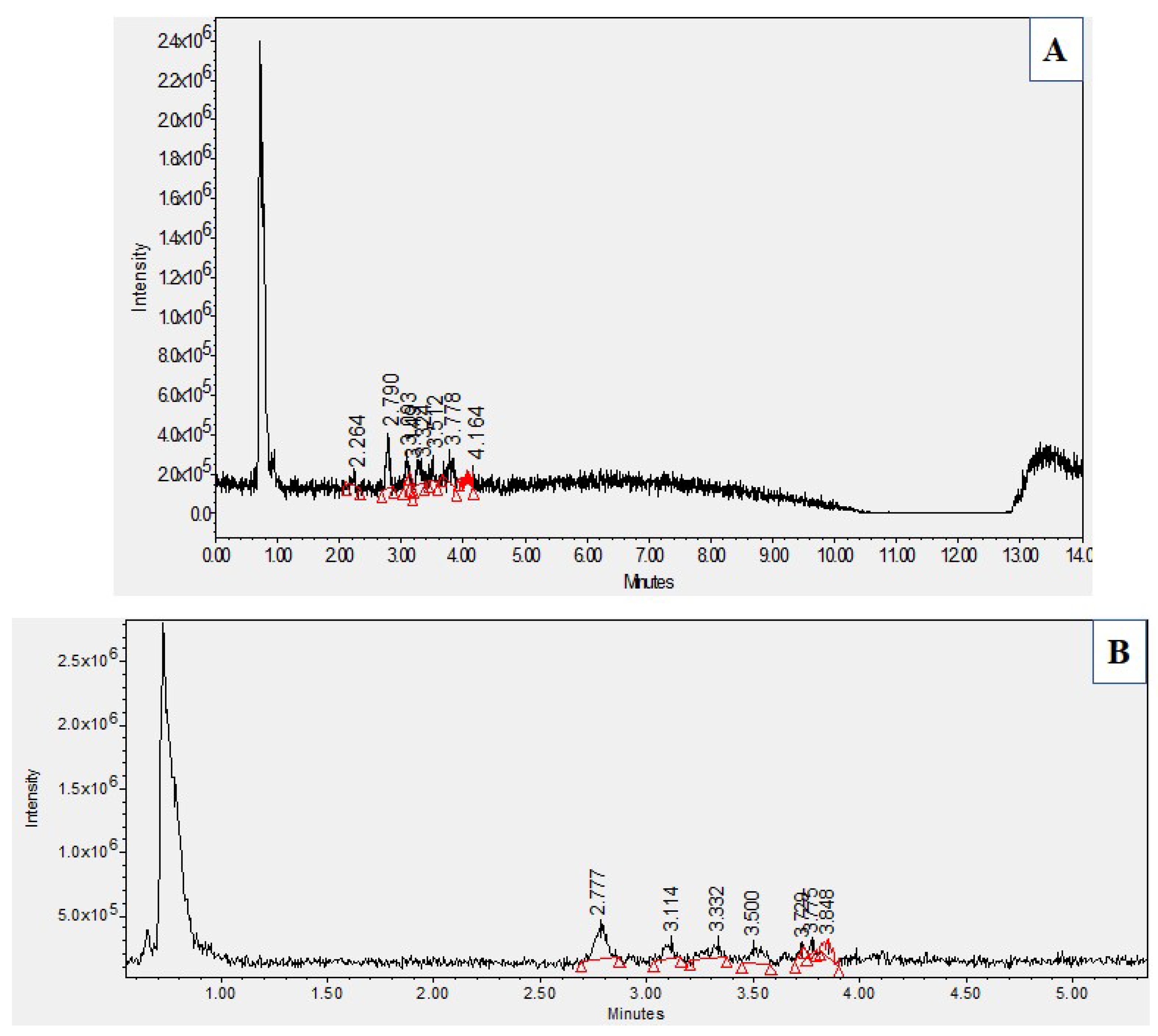
| No. | Tr (min) | Compounds | Class | [M − H] − (m/z) | Molecular Formula | Pinus halepensis | Pinus pinaster |
|---|---|---|---|---|---|---|---|
| 1 | 2.777 | p-O-Coumaroylquinic acid | Hydroxycinnamic acid | 337.21 | C16H18O8 | + | + |
| 2 | 3.332 | Narcissin | Flavonoid | 623.25 | C28H32O15 | + | + |
| 3 | 3.500 | Myricetin-3-O-glucoside | Flavonol glycoside | 479.28 | C21H20O12 | + | + |
| 4 | 3.729 | Laricitrin rutinoside | Flavonoid | 363.28, 364.0, 639.27 | C27H30O16 | + | − |
| 5 | 3.775 | Quercetin-3-O-galactoside and N.d | Flavonol glycoside | 463.29, 561.19 | C21H20O11 | + | + |
| 6 | 3.848 | Quercetin-3-O-glucoside and N.d | Flavonol glycoside | 463.33, 493.26 | C21H20O11 | + | + |
| 7 | 2.264 | Protocatechuic acid | Phenolic acid | 153.13 | C7H6O4 | − | + |
| 8 | 2.790 | p-O-Coumaroylquinic acid | Hydroxycinnamic acid | 337.17 | C16H18O8 | + | + |
| 9 | 3.149 | p-3-O-Coumaroylquinic acid | Hydroxycinnamic acid | 337.24 | C16H18O8 | + | + |
| 10 | 3.324 | 2-[3-hydroxy-1-(4-hydroxy-3-methoxyphenyl)-2-[2-hydroxy-4-(3-hydroxypropyl)phenoxy]propoxy]-6-(hydroxymethyl)oxane-3,4,5-trio | Lignan | 525.38 | C25H30O12 | − | + |
| 11 | 3.512 | Myricetin-3-O-glucoside | Flavonol glycoside | 479.25 | C21H20O12 | + | + |
| 12 | 3.778 | Prunin, Quercetin-3-O-glucoside | Flavonoid | 433.41, 463.29 | C15H12O5, C21H20O11 | − | + |
| TPC (GAE mg/g DM) | TFC (QE mg/g DM) | |
|---|---|---|
| PPN | 384.84 ± 0.84 | 109.44 ± 0.62 |
| PAN | 524.46 ± 2.11 *** | 111.64 ± 0.62 *** |
| Treatments | Dose (mg/kg b. wt.) | Protection % |
|---|---|---|
| Control | 0 | 0% |
| Diclofenac Sodium | 50 | 29.5% **** |
| PPN D1 | 100 | 28.6% **** |
| PPN D2 | 300 | 39.3% ****, ### |
| PAN D1 | 100 | 46.4% ****, #### |
| PAN D2 | 300 | 72.3% ****, #### |
| Treatment | 30 min | 60 min | 120 min |
|---|---|---|---|
| Control | 2.86 ± 0.56 | 97.31 ± 88.5 ++++ | 101.1 ± 90.6 |
| Diclofenac Sodium | 127.94 ± 81.38 **** | 150 ± 78 ****, +++ | 157.7 ± 87.6 **** |
| PPN D1 | 3.73 ± 1.55 *, #### | 181.67 ± 23.1 ****, ###, ++++ | 186.9 ± 22 ****, #### |
| PPN D2 | 9.33 ± 2.45 ***, #### | 236.33 ± 43.9 ****, ####, ++++ | 257.2 ± 43.9 ****, #### |
| PAN D1 | 10.58 ± 3.43 ***, #### | 189.63 ± 154.2 ****, ####, ++++ | 198 ± 162.7 ****, #### |
| PAN D2 | 28.69 ± 15.82 ***, #### | 289.67 ± 133.6 ****, ####, ++++ | 289.3 ± 127.8 ****, #### |
| Days | Control | Madecasol 1% | PPN 10% | PAN 10% |
|---|---|---|---|---|
| Percentage (%) of Wound Healing Effect | ||||
| Day 5 | 4 | 6 | 35 | 48 |
| Day 10 | 16 **** | 36 | 56 **** | 61 **** |
| Day 15 | 34 ****, #### | 57 ****, #### | 86 ****, #### | 85 ****, #### |
| Day 21 | 45 ****, #### | 71 ****, #### | 100 ****, #### | 100 ****, #### |
Disclaimer/Publisher’s Note: The statements, opinions and data contained in all publications are solely those of the individual author(s) and contributor(s) and not of MDPI and/or the editor(s). MDPI and/or the editor(s) disclaim responsibility for any injury to people or property resulting from any ideas, methods, instructions or products referred to in the content. |
© 2026 by the authors. Licensee MDPI, Basel, Switzerland. This article is an open access article distributed under the terms and conditions of the Creative Commons Attribution (CC BY) license.
Share and Cite
Tbatou, W.; Laaroussi, H.; Ishagh, B.; El Yagoubi, K.; Louis Evariste, A.Z.; Eto, B.; Lyoussi, B.; Benziane Ouaritini, Z. Chemical Composition, Antioxidant, Analgesic, and Wound-Healing Effects of Pinus pinaster Aiton and Pinus halepensis Mill Needles: A Natural Approach to Pain and Oxidative Stress Management. Processes 2026, 14, 369. https://doi.org/10.3390/pr14020369
Tbatou W, Laaroussi H, Ishagh B, El Yagoubi K, Louis Evariste AZ, Eto B, Lyoussi B, Benziane Ouaritini Z. Chemical Composition, Antioxidant, Analgesic, and Wound-Healing Effects of Pinus pinaster Aiton and Pinus halepensis Mill Needles: A Natural Approach to Pain and Oxidative Stress Management. Processes. 2026; 14(2):369. https://doi.org/10.3390/pr14020369
Chicago/Turabian StyleTbatou, Widad, Hassan Laaroussi, Beybeti Ishagh, Karima El Yagoubi, Akissi Zachée Louis Evariste, Bruno Eto, Badiaa Lyoussi, and Zineb Benziane Ouaritini. 2026. "Chemical Composition, Antioxidant, Analgesic, and Wound-Healing Effects of Pinus pinaster Aiton and Pinus halepensis Mill Needles: A Natural Approach to Pain and Oxidative Stress Management" Processes 14, no. 2: 369. https://doi.org/10.3390/pr14020369
APA StyleTbatou, W., Laaroussi, H., Ishagh, B., El Yagoubi, K., Louis Evariste, A. Z., Eto, B., Lyoussi, B., & Benziane Ouaritini, Z. (2026). Chemical Composition, Antioxidant, Analgesic, and Wound-Healing Effects of Pinus pinaster Aiton and Pinus halepensis Mill Needles: A Natural Approach to Pain and Oxidative Stress Management. Processes, 14(2), 369. https://doi.org/10.3390/pr14020369