1. Introduction
Medium-density fiberboard (MDF) is one of the most widely used engineered wood products because of its versatility, favorable mechanical properties, and relatively low production cost. These characteristics are largely achieved through the use of synthetic adhesives, particularly urea–formaldehyde (UF) resins, which remain the dominant bonding system for interior-grade MDF due to their excellent bonding performance, rapid curing, and economic advantages [
1,
2,
3,
4]. However, the same adhesive properties that make UF resins highly effective during manufacture become one of the main barriers to material recovery once MDF reaches the end of its service life, as they strongly bind wood fibers and hinder their separation during recycling.
Beyond limiting fiber recovery, UF resins also raise important environmental and human health concerns because they contain formaldehyde, a hazardous compound classified as a human carcinogen whose release should be minimized during waste management and recycling processes [
5,
6,
7]. Consequently, the development of technologies capable of separating wood fibers from cured UF resins has become increasingly relevant, not only to improve material recovery but also to reduce the environmental impacts associated with resin-bonded wood waste.
The increasing production of engineered wood products has intensified this challenge. Global MDF production exceeded 117 million m
3 in 2024 and is expected to continue growing over the coming years, driven primarily by the furniture and construction industries [
8,
9]. At the same time, approximately one-quarter of manufactured MDF becomes industrial waste during production, while increasing volumes of post-consumer panels are reaching the end of their service life [
10,
11]. This continuous growth is expected to substantially increase the amount of resin-bonded wood waste requiring appropriate end-of-life management. Consequently, recovering wood fibers from end-of-life panels represents one of the highest-value circular strategies because it preserves the value of the lignocellulosic resource while reducing landfill disposal and virgin raw material consumption. However, successful fiber recovery requires the degradation or removal of the cured UF resin that binds the wood fibers together.
Several approaches have been investigated to improve the recycling of resin-bonded wood panels, including mechanical recycling, thermochemical treatments, biological processes, and chemical recycling through hydrolysis. Among these alternatives, hydrolysis has emerged as one of the most promising pretreatment strategies because cured UF resins can be degraded under acidic, alkaline, hydrothermal, or steam-assisted conditions, facilitating wood fiber recovery. Previous studies have demonstrated the technical feasibility of hydrolysis for removing UF resins from MDF and have shown that treatment conditions strongly influence fiber quality, and the physical and mechanical performance of recycled boards [
12]. More recently, research has focused on improving the quality and reuse potential of secondary fibers recovered from manufacturing residues and post-consumer wood waste, highlighting their suitability as raw materials for new engineered wood products within a circular economy framework [
13]. Collectively, these studies demonstrate the technical feasibility of hydrolysis-based recycling while emphasizing the need to optimize processing conditions to facilitate industrial implementation.
Despite these advances, important knowledge gaps remain. Most published studies have evaluated individual hydrolysis treatments under controlled laboratory conditions using relatively homogeneous MDF materials. Consequently, limited information is available regarding the comparative performance of different hydrolysis strategies when applied to heterogeneous industrial wood waste representative of real manufacturing conditions. Likewise, although hydrolysis medium, treatment temperature, and reaction time have been widely investigated, considerably less attention has been paid to operational variables directly affecting process implementation, such as the solid-to-liquid ratio and the amount of material processed. Furthermore, relatively few studies have evaluated practical analytical approaches for monitoring UF resin removal during hydrolysis. These aspects are particularly relevant for facilitating process scale-up and supporting the transition from laboratory studies to industrial recycling applications. To the best of our knowledge, research specifically addressing hydrolysis-based recovery of wood fibers from UF-bonded MDF waste remains limited in Latin America. Existing regional studies have primarily focused on wood waste management and recycling initiatives rather than on resin removal and fiber recovery from end-of-life MDF panels [
14,
15]. This highlights the need for studies addressing regional waste streams, local industrial conditions, and technologies capable of supporting the implementation of circular economy strategies under regional conditions.
To address these knowledge gaps, this study evaluates hydrolysis-based UF resin removal using heterogeneous industrial wood waste generated by furniture manufacturing workshops located in the Parque Tecnológico Industrial del Cerro (PTIC), Montevideo, Uruguay. Unlike previous studies focused primarily on homogeneous MDF materials, the investigated residues included MDF, melamine-faced MDF, oriented strand board (OSB), and plywood, representing the diversity of resin-bonded wood products generated under real manufacturing conditions. In addition to comparing acid, alkaline, water, and steam-assisted hydrolysis, the study evaluates the influence of key operational variables, including the solid-to-liquid ratio, on resin removal efficiency and assesses the applicability of Total Kjeldahl Nitrogen (TKN) through comparison with elemental analysis as a practical analytical tool for monitoring UF resin degradation. By integrating heterogeneous industrial wood waste, evaluating operational parameters relevant to process implementation, and assessing TKN as a practical monitoring tool for UF resin removal, this study extends previous laboratory-scale research toward conditions that are more representative of industrial recycling applications.
Accordingly, the objective of this study was to evaluate and compare different hydrolysis strategies for removing urea–formaldehyde resins from heterogeneous resin-bonded industrial wood waste, evaluate the influence of key operational variables, including the solid-to-liquid ratio, on resin removal efficiency, and assess the applicability of TKN as a practical analytical tool for monitoring UF resin degradation and supporting the development of hydrolysis-based recycling strategies for resin-bonded wood waste within a circular economy framework.
2. Materials and Methods
2.1. Materials
2.1.1. Wood-Based Materials
Industrial wood waste was collected from furniture manufacturing workshops located within the (PTIC), Montevideo, Uruguay. PTIC is an industrial and technological park managed by the Municipality of Montevideo that promotes productive development, innovation, education, and sustainable employment. A weighing campaign conducted over approximately one month at the participating workshops indicated that approximately 300 kg of resin-bonded wood waste was generated weekly and subsequently disposed of at the municipal Felipe Cardoso landfill.
The evaluated materials comprised MDF, melamine-faced MDF, oriented strand board (OSB), plywood, and a mixed sample containing these materials. These products represent the most common resin-bonded wood waste generated by the participating workshops. Unlike previous studies that primarily evaluated homogeneous MDF materials, the present study included different engineered wood products to better represent the heterogeneous composition of industrial wood waste generated under real manufacturing conditions.
Because these materials differ in their manufacturing processes, resin composition, and adhesive content, they were evaluated separately to assess their response to the hydrolysis treatments.
The wood-based materials included in the experimental program are summarized in
Table 1.
2.1.2. Chemicals
Three hydrolysis media were evaluated during solvent-assisted hydrolysis: tap water, 0.1 M oxalic acid (H2C2O4), and 0.1 M sodium hydroxide (NaOH). Distilled water was used both for washing the recovered fibers after hydrolysis and as the reaction medium during steam-assisted hydrolysis.
The reagents employed for TKN analysis were those specified in the analytical protocol supplied by PanReac Química SLU [
16].
2.1.3. Equipment
Solvent-assisted hydrolysis experiments were carried out using a magnetic stirring hot plate (Wisd, Model MSH-20A, DAIHAN Scientific Co., Ltd., Wonju, Republic of Korea). Sample pH was monitored using a digital pH meter (Oakton, Model PH260), and sample masses were determined using an analytical balance (Precisa, Model 262SMA-FR).
Solid–liquid separation was performed by vacuum filtration using a Büchner funnel connected to a Kitasato flask and a vacuum pump (Millipore, Model XX5522050). Recovered fibers were dried in a laboratory oven (Memmert, Model UN75).
Steam-assisted hydrolysis was performed using a vertical laboratory autoclave operated under controlled temperature and pressure conditions.
Elemental analyses were performed using a Thermo Scientific Flash 2000 elemental analyzer at the Faculty of Chemistry, Universidad de la República, Uruguay.
Unless otherwise stated, all experimental work was carried out at the Environmental Engineering Laboratory of the Department of Environmental Engineering, Institute of Fluid Mechanics and Environmental Engineering (IMFIA), Faculty of Engineering, Universidad de la República, Uruguay.
2.2. Experimental Design and Hydrolysis Conditions
The experimental program evaluated two hydrolysis approaches for removing UF resin from resin-bonded wood panels:
- (i).
Solvent-assisted hydrolysis, using neutral, acidic, and alkaline aqueous media under controlled temperature and agitation;
- (ii).
steam-assisted hydrolysis, performed in a laboratory autoclave under controlled temperature and pressure conditions.
The solvent-assisted hydrolysis procedure was adapted from the methodology proposed by Lubis et al. [
17], whereas the steam-assisted hydrolysis followed the procedure described by Savov et al. [
12].
The experimental variables included wood-based panel type, physical form of the material, hydrolysis medium, sample mass, liquid mass, solid-to-liquid ratio (S/L ratio), treatment temperature, pressure, and reaction time. Throughout this study, the S/L ratio is expressed as the ratio between the dry mass of the wood sample and the mass of the hydrolysis medium.
Experimental activities were documented throughout the study, including treatment dates, operating conditions, tested materials, photographic records, and qualitative observations of the hydrolysis process.
The experimental design and operating conditions evaluated for solvent-assisted and steam-assisted hydrolysis are presented in
Table 2 and
Table 3, respectively.
All solvent-assisted hydrolysis treatments were performed at 80 ± 5 °C for 90 min under continuous magnetic stirring.
Steam-assisted hydrolysis experiments were performed in a laboratory autoclave under saturated steam conditions. The evaluated operating variables included treatment temperature, reaction time, wood-based material, and initial sample mass.
2.3. Solvent-Assisted Hydrolysis
Solvent-assisted hydrolysis experiments were carried out using tap water, 0.1 M oxalic acid, and 0.1 M sodium hydroxide as hydrolysis media. The experimental design and operating conditions are summarized in
Table 2.
For each treatment, the required amounts of wood material and hydrolysis medium were weighed according to the selected S/L ratio. The suspensions were then hydrolyzed under the operating conditions described above (80 ± 5 °C, 90 min, continuous magnetic stirring).
At the end of each treatment, the solid fraction was recovered by vacuum filtration, thoroughly washed with distilled water to remove soluble reaction products and residual chemicals, oven-dried to constant weight, and stored in sealed polyethylene bags until subsequent analyses.
2.4. Steam-Assisted Hydrolysis
Steam-assisted hydrolysis was performed in the laboratory autoclave under the conditions specified in
Table 3.
For each treatment, the required amounts of wood material and distilled water were introduced into the autoclave according to the selected experimental conditions. After completion of each hydrolysis cycle, the reactor was allowed to cool to room temperature before opening.
The treated material was recovered by vacuum filtration, thoroughly washed with distilled water, oven-dried to constant weight, and stored in sealed polyethylene bags until subsequent analyses.
2.5. Analytical Methods
The analytical strategy adopted in this study aimed to quantify the removal of UF resin from wood fibers after the different hydrolysis treatments. Although formaldehyde is one of the main components of UF resins, its direct determination was not considered appropriate for evaluating resin removal because it is a highly reactive intermediate that is rapidly transformed during hydrolysis. In addition, most analytical methods reported in the literature are designed to quantify free formaldehyde in air or aqueous solutions rather than residual UF resin remaining within wood fibers.
For this reason, resin removal was assessed indirectly through nitrogen determination. Because urea contains two nitrogen atoms and the natural nitrogen content of wood is very low (approximately 0.1%), the nitrogen remaining in the recovered fibers provides a reliable indicator of the residual UF resin. Consequently, the TKN method was selected to quantify resin removal, following the analytical approach previously applied by Lubis et al. [
17].
To independently verify the reliability of this analytical approach, elemental analysis was performed on the samples exhibiting the highest resin removal efficiencies, and the results obtained by both methods were subsequently compared.
2.5.1. Total Kjeldahl Nitrogen (TKN) Analysis
Urea–formaldehyde resin degradation was monitored indirectly through nitrogen determination. The nitrogen content of untreated and hydrolyzed wood samples was determined using the TKN method following the analytical protocol described by PanReac Química SLU [
16]. Because nitrogen remaining in the recovered wood fibers is directly associated with the residual UF resin, the TKN results were used to quantify resin removal according to Equations (1) and (2) [
12,
17].
The percentage of resin removal was calculated according to Equations (1) and (2).
where
Me is the mass of the extract solution (g),
Ne is the nitrogen concentration in the extract solution,
Ms is the initial mass of the resin-bonded wood sample subjected to hydrolysis (g), and
Nm is the nitrogen content of the original sample before treatment.
The percentage of resin removed based on the recovered wood fibers was calculated using Equation (2).
where
Mf is the mass of the recovered fibers after hydrolysis (g) and
Nf is the nitrogen content of the recovered fibers following the hydrolysis treatment.
2.5.2. Elemental Analysis
Selected samples representing the different hydrolysis treatments were analyzed using a Thermo Scientific Flash 2000 elemental analyzer to determine carbon, hydrogen, and nitrogen contents. The results were compared with those obtained by the TKN method to evaluate its applicability for monitoring UF resin removal.
2.5.3. Qualitative Formaldehyde Determination
Residual formaldehyde released during the hydrolysis treatments was qualitatively evaluated using Quantofix® Formaldehyde Test Strips (Macherey–Nagel, Germany), following the manufacturer’s instructions.
2.5.4. Mass Loss Determination
Mass loss associated with each hydrolysis treatment was determined by comparing the oven-dry mass of the wood samples before and after treatment.
3. Results
Unless otherwise specified, the resin removal percentages reported throughout this section were calculated based on the nitrogen content of the recovered wood fibers using Equation (2).
3.1. Overview of Hydrolysis Performance
The effectiveness of the evaluated hydrolysis treatments was assessed by determining the efficiency of UF resin removal under different experimental conditions. Resin removal was primarily quantified using the TKN method, whereas elemental analysis was performed to independently validate the results obtained for the best-performing treatments.
The following sections compare the influence of the hydrolysis medium, wood-based material, S/L ratio, treatment temperature, reaction time, and initial sample mass on UF resin removal efficiency and wood fiber recovery.
3.2. Solvent-Assisted Hydrolysis
The performance of solvent-assisted hydrolysis was first evaluated by comparing different hydrolysis media for UF resin removal from MDF samples. Nitrogen released during hydrolysis was initially determined from the hydrolysis effluent following the approach proposed by Lubis et al. [
17]. The corresponding nitrogen removal percentages are presented in
Table 4.
Among the evaluated hydrolysis media, 0.1 M oxalic acid exhibited the highest hydrolysis efficiency, achieving a nitrogen removal of 95% for chipped MDF. In comparison, sodium hydroxide and tap water removed 69% and 30% of the initial nitrogen, respectively. Conversely, nitrogen removal from plywood remained considerably lower under the evaluated experimental conditions.
To simplify the analytical procedure and ensure methodological consistency throughout the study, nitrogen removal was subsequently quantified from the recovered wood fibers rather than from the hydrolysis effluent. Under this approach, resin removal was calculated as the difference between the nitrogen content of the untreated sample and the residual nitrogen content measured in the recovered fibers according to Equation (2).
To verify the consistency of both analytical approaches, nitrogen removal was independently determined from the hydrolysis effluent and from the recovered wood fibers obtained after hydrolysis. The comparison between both methods is presented in
Table 5.
Both analytical approaches produced nearly identical resin removal percentages, differing by approximately one percentage point. This excellent agreement demonstrates that nitrogen determination performed directly on the recovered wood fibers provides a reliable estimate of UF resin removal while simplifying sample handling and analytical procedures.
Given the excellent agreement between both approaches, nitrogen determination in the recovered fibers was adopted for all subsequent analyses.
Once the analytical methodology had been validated, the selected hydrolysis medium was evaluated using different resin-bonded wood panels representative of industrial wood waste. The corresponding resin removal percentages obtained using 0.1 M oxalic acid are presented in
Table 6.
High resin removal efficiencies were obtained for all evaluated wood-based panels when oxalic acid was used as the hydrolysis medium. The mixed wood-based panel sample exhibited the highest resin removal (93%), followed by ground OSB (89%) and ground melamine-faced MDF (83%).
These results demonstrate that oxalic acid effectively promoted UF resin hydrolysis across different resin-bonded wood products, despite differences in panel composition and manufacturing processes. The consistently high removal efficiencies obtained for the different materials indicate that the treatment is suitable for heterogeneous industrial wood waste representative of real manufacturing conditions.
Following the selection of 0.1 M oxalic acid as the most effective hydrolysis medium, the influence of the S/L ratio on resin removal efficiency was evaluated. The corresponding results are presented in
Table 7.
A progressive decrease in resin removal efficiency was observed as the amount of hydrolysis medium decreased relative to the wood sample. The highest resin removal percentage (93%) was obtained at an S/L ratio of 1:100, whereas the lowest value (53%) was observed at an S/L ratio of 1:10.
These results suggest that the availability of hydrolysis medium plays a critical role in UF resin degradation. Increasing the S/L ratio substantially improved resin removal efficiency under the evaluated experimental conditions, identifying this operational variable as a key parameter for process optimization.
3.3. Steam-Assisted Hydrolysis
Steam-assisted hydrolysis was evaluated to determine the influence of treatment temperature, reaction time, initial sample mass, and wood-based material on UF resin removal efficiency. The experimental results obtained under the evaluated operating conditions are summarized in
Table 8.
The first series of experiments evaluated the combined influence of temperature and reaction time using chipped MDF as the reference material. Under the evaluated conditions, increasing the treatment temperature from 121 °C to 134 °C produced higher resin removal percentages, whereas extending the reaction time from 30 to 45 min resulted in only minor additional improvements.
The highest resin removal efficiency obtained within this experimental series corresponded to the treatment performed at 134 °C for 45 min, indicating that treatment temperature had a greater influence on UF resin degradation than reaction time under the evaluated operating conditions.
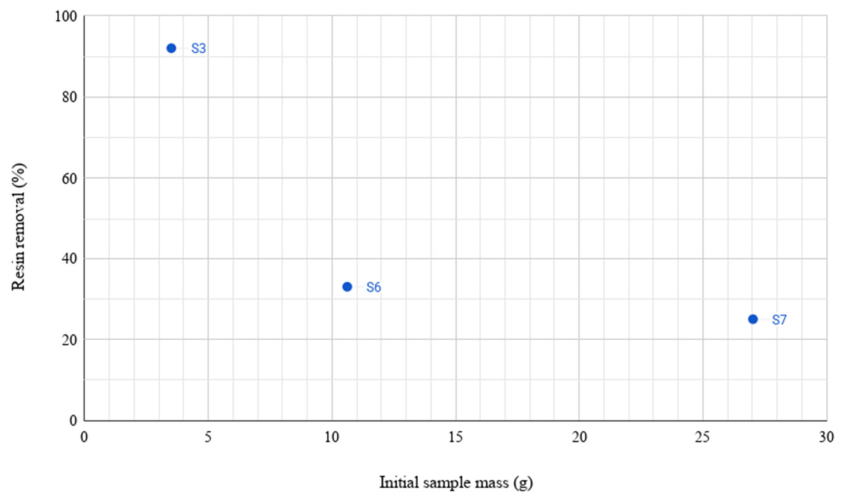
After defining the most favorable operating conditions, the influence of the initial sample mass was evaluated while maintaining constant treatment temperature and reaction time.
The corresponding results are presented in
Figure 1.
As the initial sample mass increased, resin removal efficiency progressively decreased. This behavior suggests that increasing the amount of material processed without proportionally modifying the hydrolysis conditions reduced the effectiveness of steam penetration and heat transfer throughout the sample, limiting UF resin degradation.
Although larger sample masses remain attractive from a practical perspective because they increase process throughput, the results indicate that reactor loading should be carefully optimized to avoid compromising resin removal efficiency.
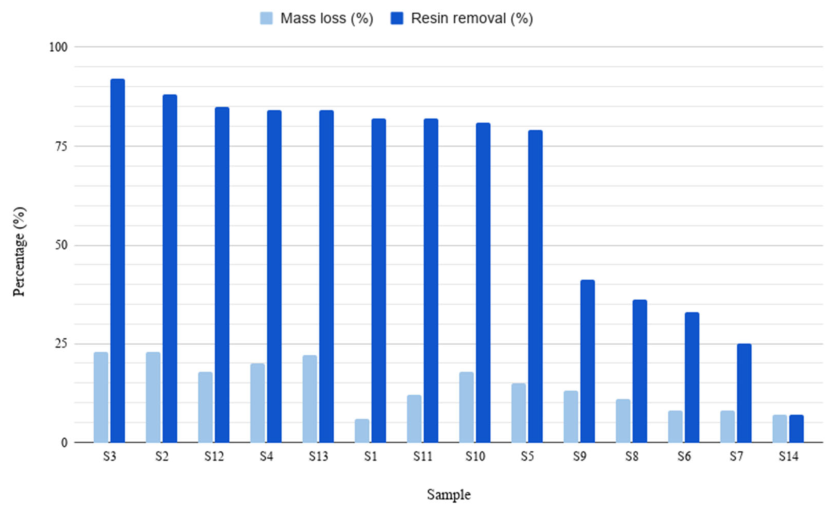
To complement the evaluation of the steam-assisted hydrolysis process, the mass loss experienced by the samples after treatment was also determined. The corresponding results are presented in
Table 9.
In general, samples exhibiting higher resin removal percentages showed greater mass losses after treatment. However, because wood components may also undergo slight degradation during hydrolysis, mass loss should be considered a complementary indicator of treatment effectiveness rather than a direct measurement of resin removal.
The relationship between resin removal efficiency and mass loss during steam-assisted hydrolysis is illustrated in
Figure 2.
A positive relationship was observed between both variables, indicating that treatments producing greater degradation of UF resin also resulted in higher mass losses. Nevertheless, the increase in mass loss was proportionally lower than the increase in resin removal, suggesting that the hydrolysis treatments primarily affected the adhesive phase while preserving most of the lignocellulosic structure of the recovered fibers.
This behavior is particularly relevant from a recycling perspective because it indicates that significant UF resin removal can be achieved without extensive degradation of the wood fibers.
3.4. Validation by Elemental Analysis
To independently verify the effectiveness of the hydrolysis treatments, elemental analysis was performed on the untreated MDF and on the two samples that exhibited the highest resin removal efficiencies according to the TKN method. These corresponded to MDF fibers recovered after solvent-assisted hydrolysis using 0.1 M oxalic acid (S/L ratio of 1:100) and MDF fibers recovered after steam-assisted hydrolysis at 134 °C for 30 min.
The elemental composition of the samples analyzed is presented in
Table 10.
The untreated MDF exhibited the highest nitrogen content (3.2%), whereas both hydrolysis treatments substantially reduced the nitrogen concentration in the recovered fibers. The lowest nitrogen content was obtained after solvent-assisted hydrolysis (0.2%), corresponding to a nitrogen removal of 93.75%, while steam-assisted hydrolysis reduced the nitrogen content to 0.6%, equivalent to a nitrogen removal of 81.25%.
These nitrogen removal percentages are in close agreement with the corresponding values previously obtained using the TKN method, confirming the consistency between both analytical approaches. The excellent agreement demonstrates that TKN provides a reliable estimate of UF resin removal from hydrolyzed wood fibers.
Considering its simplicity, lower analytical cost, and greater accessibility than elemental analysis, the TKN method represents a practical and reliable analytical alternative for monitoring UF resin removal during hydrolysis treatments, particularly in laboratory-scale studies where elemental analysis may not be readily available.
4. Discussion
The results obtained in this study demonstrate that both solvent-assisted and steam-assisted hydrolysis are effective pretreatment strategies for removing UF resin from resin-bonded wood waste. The following discussion compares these findings with previous studies, examines the influence of the evaluated operational variables, and highlights the implications of the proposed methodology for wood fiber recovery within a circular economy framework.
Although several studies have investigated the recycling of resin-bonded wood panels in Europe and Asia, relatively few studies addressing this topic have been reported in Latin America. One of the few documented examples is the work of Reyes Echeverría [
14], who proposed a recycling process for MDP waste generated by Madecentro Colombia S.A.S. The proposed methodology included waste characterization, quantification of the generated residues, and the development of a technological adaptation for recycling the material.
However, unlike the present study, the proposed process did not include a pretreatment stage aimed at removing the UF resin from the wood particles prior to recycling. Instead, the shredded material was directly reincorporated into the manufacture of new boards together with additional adhesive. Consequently, the UF resin originally present in the waste remained within the recycled product rather than being removed before reuse. Interestingly, Reyes Echeverría [
14] identified the removal of formaldehyde from the recovered wood particles as one of the main challenges for future research. In this context, the hydrolysis treatments evaluated in the present study directly address this limitation by incorporating a pretreatment stage specifically designed to degrade and remove UF resin before fiber recovery.
4.1. Performance of Hydrolysis Using Different Solvents
The results demonstrate that the hydrolysis medium plays a decisive role in the removal of UF resin from resin-bonded wood panels. Among the evaluated treatments, 0.1 M oxalic acid consistently exhibited the highest resin removal efficiency, achieving values close to 95% for chipped MDF. These findings are consistent with previous studies reporting that acidic media are considerably more effective than neutral or alkaline conditions for promoting the degradation of UF-bonded wood composites. In particular, Lubis et al. [
17] reported high resin removal efficiencies using oxalic acid under relatively mild operating conditions, supporting the effectiveness of acid-assisted hydrolysis for degrading UF-bonded wood materials.
According to Lubis et al. [
17], the removal of cured UF resins from MDF panels was considerably greater under acidic conditions than under neutral or alkaline conditions. The same study also reported that the extent of mass loss varied according to the hydrolysis reagent, with sulfuric acid producing the highest mass loss and oxalic acid resulting in a lower mass loss. These findings indicate that, although acidic conditions generally enhance UF resin removal, different acidic reagents may produce different levels of mass loss. Therefore, evaluating oxalic acid under the operating conditions investigated in the present study provides further insight into its performance for UF resin removal while considering the associated material loss.
The superior performance of oxalic acid is consistent with the acid-catalyzed hydrolysis of UF resins, in which methylene and methylene-ether linkages are progressively cleaved, facilitating resin degradation and fiber liberation. Efficient removal of residual UF resin is particularly relevant because residual cured resin has been shown to adversely affect the recycling and reconstitution of wood-based panels by interfering with the curing behavior and bonding performance of newly manufactured products [
18]. Consequently, maximizing resin removal prior to fiber reuse represents an important step toward improving the quality and recyclability of recovered wood fibers.
The lower resin removal efficiency observed for the tap water treatment may be explained by the limited hydrolytic capacity of water under the evaluated experimental conditions compared with acidic media. In the absence of a catalyst, hydrolysis proceeds more slowly, reducing the extent of UF resin degradation during the treatment period. Likewise, the lower performance of sodium hydroxide indicates that alkaline conditions were less effective than acidic conditions for promoting resin degradation under the operating conditions investigated in this study.
For plywood chips, the differences among the evaluated hydrolysis media were considerably smaller than those observed for MDF. This behavior should be interpreted considering the substantially lower UF resin content of plywood, which results in lower initial nitrogen concentrations and consequently reduces the sensitivity of nitrogen removal as an indicator of treatment efficiency. Therefore, although the calculated resin removal percentages were lower than those obtained for MDF, they still represent a substantial reduction in the residual nitrogen content of the material.
An additional contribution of this study is the comparison between the two analytical approaches used to quantify resin removal during solvent-assisted hydrolysis. Nitrogen removal determined from the hydrolysis effluent and that calculated from the recovered wood fibers produced nearly identical results, demonstrating that both methodologies provide reliable estimates of UF resin removal. However, determination based on the recovered fibers offers important practical advantages by simplifying sample handling and analytical procedures, making it particularly suitable for routine evaluation of hydrolysis treatments. Similar analytical approaches based on nitrogen determination and elemental characterization have recently been employed to evaluate residual resin in recycled fibers, further supporting the usefulness of nitrogen as an indicator of resin persistence after recycling treatments [
13].
The effectiveness of oxalic acid was further confirmed by its application to different resin-bonded wood materials. Resin removal percentages above 80% were obtained for melamine-faced MDF, OSB, and mixed wood waste, demonstrating that the proposed methodology is applicable to heterogeneous wood waste streams rather than only to homogeneous MDF samples. This finding is particularly relevant because industrial recycling systems rarely process a single wood product but instead handle heterogeneous mixtures of engineered wood residues. Recent studies have likewise emphasized that the origin and characteristics of secondary fibers strongly influence their properties and subsequent recycling potential, highlighting the importance of evaluating representative industrial wood waste rather than homogeneous laboratory-prepared materials [
13].
The influence of the S/L ratio further demonstrated the importance of process optimization. Although the highest resin removal was obtained at an S/L ratio of 1:100, a ratio of 1:50 achieved a comparable removal efficiency (88%) while requiring only half the solvent volume. From an industrial perspective, reducing solvent consumption represents an important practical advantage because it decreases reagent demand as well as the volume of hydrolysis effluent requiring subsequent treatment. Consequently, the selection of operating conditions should consider not only resin removal efficiency but also the environmental and economic implications associated with process implementation.
Overall, the results demonstrate that optimizing operational parameters is as important as selecting the appropriate hydrolysis medium. While previous studies have primarily focused on maximizing resin removal efficiency, the present work highlights the importance of simultaneously considering process performance, solvent consumption, and the characteristics of representative industrial wood waste. This broader perspective provides useful information for the future optimization and scale-up of solvent-assisted hydrolysis as a recycling strategy for resin-bonded wood waste.
4.2. Performance of Steam-Assisted Hydrolysis
Steam-assisted hydrolysis proved to be an effective alternative for removing UF resin from resin-bonded wood panels without the addition of chemical reagents. Among the evaluated operating conditions, treatment at 134 °C for 30 min consistently produced the highest resin removal efficiencies, particularly for MDF samples, demonstrating that elevated temperature plays a key role in promoting UF resin degradation within relatively short treatment times. Recent studies have highlighted the growing interest in thermo-hydrolytic treatments as sustainable alternatives for recovering fibers from resin-bonded wood waste, particularly because they reduce chemical consumption while facilitating fiber recovery [
19]. Within this context, the present results demonstrate that steam-assisted hydrolysis constitutes an effective chemical-free strategy for recovering wood fibers from resin-bonded panels.
In general, MDF exhibited higher resin removal percentages than plywood under comparable operating conditions. However, this comparison should be interpreted with caution because plywood contains substantially lower initial amounts of UF resin and, consequently, lower nitrogen concentrations. Therefore, although the maximum nitrogen removal obtained for plywood was approximately 41%, this value still represents a considerable reduction in the residual nitrogen associated with the original resin content.
The results obtained for ground wood-based panels further demonstrate the applicability of steam-assisted hydrolysis to different engineered wood products. Under the selected operating conditions (134 °C for 30 min), resin removal efficiencies above 80% were achieved for ground MDF, melamine-faced MDF, OSB, and mixed wood-based panels when the initial sample mass remained below approximately 5 g. These findings indicate that the proposed treatment can be successfully applied to heterogeneous wood waste streams, which are more representative of those generated during industrial furniture manufacturing than homogeneous laboratory-prepared materials. Similar observations have recently been reported by Xu et al. [
13], who highlighted the importance of evaluating representative secondary wood fibers obtained from mixed industrial and post-consumer wood waste.
Unlike the results reported by Savov et al. [
12], who observed little or no UF resin removal following steam-assisted treatment, the present study demonstrated that steam-assisted hydrolysis can effectively remove UF resin when appropriate operating conditions are employed. Although direct comparison between both studies is limited because the reactor loading used by Savov et al. was not reported, the present results clearly demonstrate that the initial sample mass strongly influences treatment efficiency. Consequently, differences in reactor loading may partially explain the discrepancies observed between both studies and highlight the importance of considering this operational parameter when comparing the performance of different steam-assisted hydrolysis processes.
A marked decrease in resin removal efficiency was observed as the initial sample mass increased. For chipped MDF treated at 134 °C for 30 min, samples weighing less than 5 g achieved resin removal efficiencies above 90%, whereas increasing the sample mass to 10.62 g and 27.02 g reduced the removal efficiency to 33% and 25%, respectively. A similar trend was observed for mixed wood-based panels, where increasing the initial sample mass from 3.27 g to 49.80 g reduced resin removal from 84% to less than 10%.
This reduction in treatment efficiency may be associated with mass transfer limitations during steam-assisted hydrolysis. As reactor loading increases, effective contact between steam and the resin-bonded wood particles becomes progressively less homogeneous, reducing the extent of UF resin degradation and consequently lowering resin removal efficiency. These observations demonstrate that reactor loading is a critical operational parameter that should be carefully optimized when considering future process scale-up. Although previous studies have primarily focused on treatment temperature, pressure, or residence time, the present results indicate that the amount of material processed per batch may be equally important for maximizing resin removal efficiency.
Mass loss followed the same general trend as nitrogen removal. Samples exhibiting higher resin removal efficiencies also showed greater mass losses, indicating that both parameters are closely associated with the degradation and extraction of UF resin during hydrolysis. Although a small fraction of the mass loss may be attributed to the degradation of wood components, the strong agreement between nitrogen removal and mass loss supports the effectiveness of steam-assisted hydrolysis for recovering wood fibers with substantially reduced resin content. Under the evaluated operating conditions, the measured mass loss can therefore be attributed primarily to the removal of UF resin during hydrolysis.
Overall, the present results demonstrate that steam-assisted hydrolysis should not be evaluated solely in terms of treatment temperature or residence time. Operational variables such as reactor loading play an equally important role in determining resin removal efficiency and should therefore be considered in future optimization and scale-up studies. This finding represents one of the principal contributions of the present work because it provides an explanation for the variability observed among previous studies and identifies an operational parameter that has received comparatively little attention in the literature. Future research should therefore focus on optimizing reactor loading together with the remaining operating conditions to facilitate the implementation of steam-assisted hydrolysis as a sustainable recycling technology for resin-bonded wood waste.
4.3. Validation of the TKN Method by Elemental Analysis
Elemental analysis served as an independent validation of the TKN methodology adopted throughout this study. Because nitrogen is primarily associated with UF resin rather than with wood itself, changes in nitrogen content provide a direct indication of resin removal during hydrolysis. Consequently, elemental analysis was not intended to replace the analytical methodology employed throughout the experimental program, but rather to verify the reliability of TKN as an indicator of residual UF resin.
Because elemental analysis requires specialized instrumentation and involves substantially higher analytical costs, it was performed only on a selected subset of samples. The analyzed materials included untreated MDF as the reference material together with the best-performing samples obtained from solvent-assisted and steam-assisted hydrolysis. The agreement between elemental analysis and the corresponding TKN results was subsequently used to assess the reliability of the proposed analytical methodology.
For solvent-assisted hydrolysis, the nitrogen removal percentage calculated from elemental analysis (93.75%) was in excellent agreement with the value previously obtained using the TKN method. The difference between both analytical approaches was approximately 1%, demonstrating that nitrogen determination by TKN provides an accurate estimate of UF resin removal under the evaluated experimental conditions.
A slightly larger difference was observed for steam-assisted hydrolysis. This discrepancy may be associated with the greater heterogeneity of the treated samples or with the intrinsic analytical characteristics of each technique. Nevertheless, the overall agreement between both analytical approaches confirms that nitrogen determination in recovered wood fibers constitutes a reliable indicator of residual UF resin following hydrolysis.
Recent studies evaluating recycled wood fibers have likewise employed elemental characterization to assess the chemical composition of recovered fibers and the persistence of resin-derived compounds, highlighting the relevance of nitrogen-based analytical approaches for monitoring recycling processes [
13]. In this context, the present study demonstrates that TKN provides comparable information while relying on instrumentation that is considerably more accessible than elemental analyzers.
Overall, the elemental analysis independently confirmed the reliability of the TKN methodology for estimating UF resin removal from hydrolyzed wood fibers. Considering its simplicity, lower analytical cost, and wider availability in environmental and wood science laboratories, TKN represents a practical analytical tool for monitoring hydrolysis performance and optimizing recycling treatments. More broadly, the proposed methodology provides an accessible analytical approach that may facilitate future studies on the circular valorization of resin-bonded wood waste, particularly in laboratories where elemental analyzers are not routinely available.
5. Conclusions
This study evaluated and compared solvent-assisted and steam-assisted hydrolysis as pretreatment strategies for removing UF resin from resin-bonded wood waste. The results demonstrated that both approaches are capable of recovering wood fibers with substantially reduced resin content while providing experimental evidence on the operational variables governing hydrolysis performance. Rather than proposing a new hydrolysis process, this work experimentally evaluated existing hydrolysis strategies using representative industrial wood waste generated by furniture manufacturing, thereby providing additional experimental evidence supporting their application within circular wood recycling systems.
Among the evaluated treatments, solvent-assisted hydrolysis using 0.1 M oxalic acid achieved the highest resin removal efficiencies, whereas steam-assisted hydrolysis proved to be an effective chemical-free alternative. The results further demonstrated that hydrolysis performance depends not only on the selected treatment but also on key operational parameters. In particular, the solid-to-liquid ratio significantly influenced solvent-assisted hydrolysis, whereas the initial sample mass (reactor loading) emerged as a critical parameter governing the efficiency of steam-assisted hydrolysis. These findings emphasize the importance of process optimization when considering future scale-up and industrial implementation.
From an analytical perspective, the excellent agreement between the TKN method and elemental analysis confirmed that nitrogen determination provides a reliable indicator of residual UF resin after hydrolysis. Considering its simplicity, lower analytical cost, and wider accessibility, the TKN method represents a practical analytical tool for monitoring resin removal during laboratory-scale hydrolysis studies, particularly in laboratories where elemental analyzers are not routinely available.
Although the proposed treatments proved effective under the evaluated laboratory conditions, the present study also demonstrated that hydrolysis performance is strongly influenced by operational variables such as reactor loading and solid-to-liquid ratio. Consequently, additional studies covering a broader range of operating conditions will be required before large-scale implementation. Future research should therefore focus on optimizing these parameters, evaluating process performance under pilot-scale conditions, and assessing the quality and reuse potential of the recovered fibers.
Overall, this study demonstrates that successful recovery of wood fibers from UF-bonded panels depends not only on selecting an appropriate hydrolysis strategy but also on optimizing key process variables and applying reliable analytical methods for monitoring resin removal. By integrating process evaluation with analytical validation, the present work contributes both methodological and operational knowledge that supports the future development of sustainable technologies for the circular recycling of resin-bonded wood waste.