Article

Cooperative Optimization Control Method for Vehicle-Charging Pile-Grid Based on Decentralized Holistic Sensing Graph-Based Estimation in Industrial Internet Environments


1
China Southern Power Grid Company Limited, Guangzhou 510663, China
2
China Southern Power Grid Digital Power Grid Technology (Guangdong) Co., Ltd., Guangzhou 510663, China
3
CSG Electric Power Research Institute Co., Ltd., Guangzhou 510663, China
4
College of Electrical Engineering and New Energy, China Three Gorges University, Yichang 443002, China
5
School of Electrical Engineering and Automation, Wuhan University, Wuhan 430072, China
*
Author to whom correspondence should be addressed.
Processes 2026, 14(15), 2502; https://doi.org/10.3390/pr14152502
Submission received: 24 June 2026 / Revised: 30 July 2026 / Accepted: 31 July 2026 / Published: 5 August 2026

Abstract

To address the dynamic communication topology switching, asynchronous perception information, and uncertainty caused by vehicle mobility in the cooperative control of a vehicle-charger pile-grid under industrial Internet environments, this paper proposes a cooperative optimal control method based on decentralized holistic sensing graph-based estimation. First of all, this method constructs a time-varying weighted directed graph by using decentralized holistic sensing data obtained from the industrial Internet to characterize the dynamic evolution of communication topologies in real time. Secondly, a distributed graph estimator relying solely on local perception information is designed, enabling each agent to predict online its neighbor set and link reliability over a short future horizon based on its own position, the motion trends of nearby objects, and historical link states. On this basis, the graph-based estimation results are embedded as a feedforward compensation term into the consensus control law, forming a predictive graph consensus control algorithm that enables the system to proactively adjust control inputs before topology switching occurs, achieving a paradigm shift from “passive response” to “active pre-compensation.” Meanwhile, an Age of Information (AoI)-aware event-triggered mechanism is introduced, where broadcasting is triggered when the state error exceeds a threshold or the AoI approaches its upper bound, significantly reducing communication load while ensuring control accuracy. Finally, simulations are conducted on a modified IEEE 33-bus distribution system comprising 61 agents (20 electric vehicles, eight charging stations, and 33 grid nodes). The results show that, compared to the event-triggered consensus method without prediction, the proposed method reduces the steady-state error by 40.1%, shortens the convergence time by 40.5%, and decreases the number of broadcasts by 36.5%. In a large-scale system with 169 agents, the proposed method still maintains the highest accuracy, the fastest convergence speed, and the lowest communication overhead, while meeting real-time computational requirements. This method can fully exploit the spatiotemporal redundancy of decentralized holistic sensing, offering a new solution for efficient, robust, and low-cost cooperative control of “vehicle–charger–grid” under industrial Internet environments.

1. Introduction

With the deep integration of the global energy transition and transportation electrification, the coordinated interaction among electric vehicles (EVs), charging stations, and the power grid—namely the “vehicle–station–grid” (VSG) system—has become a key component in building new-type power systems [1,2,3]. In this system, EVs can serve as flexible loads for demand response or deliver electricity back to the grid via vehicle-to-grid (V2G) technology, supporting ancillary services such as peak shaving, valley filling, and frequency regulation [4]. Yet the VSG system is fundamentally a heterogeneous, dynamic, and geographically dispersed cyber–physical system. Its coordinated control faces two inherent challenges: intermittent communication disconnections and rapid topology reconfiguration caused by vehicle mobility; and the asynchronicity, heterogeneity, and uncertainty of multi-source sensing data. Achieving efficient and robust distributed collaborative control under such dynamic conditions remains a pressing concern for both academia and industry.
The rapid development of the Industrial Internet of Things (IIoT) offers a new technical pathway to address the above challenges [5,6,7]. By deploying edge computing nodes, low-latency wireless communication networks, and ubiquitous sensing terminals, the IIoT enables real-time collection, transmission, and processing of massive heterogeneous data in the “vehicle–station–grid” system [8]. Distributed panoramic sensing technology, in particular, draws on multi-source sensing means including roadside units, onboard sensors, and charging station monitoring modules to achieve comprehensive, multi-granularity perception of vehicle pose, charging status, and grid load. This provides a rich data foundation for collaborative control [9,10]. However, enhanced sensing capability does not directly resolve the core challenge of collaborative control, namely how to maintain consistent decision-making among distributed nodes when communication topologies change dynamically [11].
Currently, academia has conducted extensive research on the collaborative control of mobile distributed systems such as “vehicle–station–grid” systems, which can be broadly categorized into three approaches [12,13,14]. The first is centralized optimal control, in which a central controller collects global information, computes control commands uniformly, and distributes them via broadcast [15]. Theoretically, this approach can achieve a globally optimal solution; however, in scenarios with a large number of vehicles and poor communication conditions, it suffers from inherent issues such as single-point failure, high computational load, and poor real-time performance, making it difficult to meet the reliability requirements of “vehicle–station–grid” systems [16]. The second is distributed consensus control based on fixed topologies, where each agent exchanges state information only with its neighbors and reaches global agreement through iteration. This approach offers good scalability and robustness, but its convergence and stability heavily depend on the connectivity assumption of the communication topology [17]. In practical scenarios where high-speed vehicle mobility causes frequent topology switching, traditional consensus algorithms often exhibit state oscillation or even divergence. The third encompasses switched-system and robust control methods, which model topology changes as switching among a finite number of modes or design controllers to suppress uncertain disturbances [18]. However, robust control methods tend to be conservative, trading convergence speed for robustness; switched-system methods require prior knowledge of all possible topology modes and their switching sequences, which is difficult to satisfy in practical scenarios where vehicles enter and exit arbitrarily. More critically, both of these approaches follow a “reactive” paradigm—they only adjust control after topology changes occur, and thus cannot fundamentally avoid oscillations triggered by abrupt state changes [19].
Meanwhile, advances in distributed panoramic sensing technology offer new possibilities for overcoming the above limitations. Traditional distributed control methods typically rely solely on state information transmitted via communication links, failing to fully exploit the spatiotemporal redundancy embedded in ubiquitous sensing data within industrial Internet environments [20]. For example, sensing data such as vehicle GPS trajectories, motion trends captured by roadside cameras, and occupancy status changes in charging stations actually contain predictive capabilities regarding future communication topology evolution. If such sensing information can be explicitly incorporated into control laws, enabling the system to “anticipate” topology changes, it could fundamentally shift the reactive control paradigm [21,22,23]. In recent years, a small number of studies have attempted to leverage sensing information for communication topology prediction, such as using Kalman filters to estimate the future positions of neighboring vehicles or employing reinforcement learning to learn link interruption patterns. However, most of these works treat sensing and control separately—i.e., a sensing module first predicts the topology, and the prediction results are then fed as independent inputs to a control module—lacking a theoretical framework for joint sensing–control optimization [24]. Furthermore, existing methods struggle to achieve a good balance between prediction accuracy and real-time performance, and they overlook the impact of sensing data timeliness itself on control decisions [25].
To address the above research gaps, this paper proposes a predictive collaborative optimal control method based on decentralized holistic sensing graph-based estimation. The core contributions of the proposed method are as follows:
(1)
Constructing a time-varying weighted directed graph to characterize the spatiotemporal evolution of the communication topology by utilizing decentralized holistic sensing data acquired by industrial Internet edge nodes.
(2)
Designing a distributed graph estimator that relies solely on local information, enabling each agent to predict its online neighbor relationships in the short-term future, and embedding the graph estimation result into the consensus control law as a feedforward compensation term, so that the system can actively adjust the control input before topology switching occurs, realizing the paradigm shift from “passive response” to “active pre-compensation”.
(3)
Introducing an Age of Information (AoI)-aware event-triggered mechanism to significantly reduce the communication load on the premise of guaranteeing control accuracy. Furthermore, the effectiveness of the proposed method is verified through typical dynamic scenarios of the improved IEEE 33-bus distribution system.
In order to provide a more rigorous comparison with the existing methods (periodic triggered consensus (PTC) method, robust consensus (RC) method and event-triggered consensus without prediction (ETC) method), the control laws, trigger rules and where AoI is considered in the three comparison methods are compared with the methods proposed in this paper, as shown in Table 1.

2. Decentralized Holistic Sensing Graph-Based Estimation Model of “Vehicle-Charging Pile-Grid” System

2.1. The System Model and Dynamic Equations

In this paper, the “Vehicle–Pile–Grid” cooperative control system is considered to consist of N agents, which are classified into three categories: the first category is electric vehicles, assuming there are N v in total; the second category is charging piles, assuming there are N c in total; and the third category is power grid nodes, assuming there are N g in total. The total number of the three types of agents satisfies the following:
N = N v + N c + N g
The continuous-time dynamics of each agent i are described by the following first-order integrator model, which is used to characterize the regulation process of charging power or frequency deviation:
x ˙ i ( t ) = u i ( t )
where x i ( t ) represents the state variable of agent i at time t, such as the expected charging power deviation of electric vehicles, the adjustable available power of charging piles, and the frequency deviation of power grid nodes; u i ( t ) represents the control input.
To accommodate practical physical constraints, such as power saturation and response rate limits, this paper incorporates state and input constraints as follows:
x i min x i ( t ) x i max
u i min u i ( t ) u i max
where x i min / x i max represents the minimum/maximum allowable value of the state variable; u i min / u i max represents the minimum/maximum rate limit of the control input.

2.2. The Communication Topology and Graph Estimation Model

In this paper, the information interaction among agents is described by the following time-varying weighted directed graph:
G ( t ) = ( V , ε ( t ) , A ( t ) )
where V = 1 , 2 , , N represents the set of nodes; ε ( t ) V × V represents the set of directed edges at time t; ( j , i ) ε ( t ) represents that node j can send information to node i; and A ( t ) = a i j ( t ) N × N represents the adjacency matrix, where a i j ( t ) represents the elements in the adjacency matrix.
Due to vehicle mobility, the communication topology may intermittently disconnect and reconfigure. For each agent i, based on local decentralized holistic sensing data, the graph structure within a future horizon Δ T can be estimated online, thereby obtaining the estimated adjacency matrix A ^ i ( t + τ ) , τ 0 , Δ T . In the distributed graph-based estimation, for agent i, its link reliability estimate for neighbor j at time t is as follows:
a ˙ i j ( t + τ ) = a i j ( t ) exp ( | p ˙ j ( t + τ ) p i ( t ) | 2 2 σ 2 ) Ψ i j ( τ ) a i j ( t ) = 1 , there   is   a   V 2 X   communication   link   between   i   and   j s i j ( t ) , i   and   j   are   within   physical   perception   range   but   there   is   no   V 2 X   link   0 , otherwise
p ˙ j ( t + τ ) = p j ( t ) + v j ( t ) τ
Ψ i j ( τ ) = max ( 0 , 1 τ / T max )
where p i ( t ) represents the position of agent i, which can be obtained from sensing data, such as GPS; p ˙ j ( t + τ ) represents the predicted future position of neighbor j based on motion trend; σ represents the standard deviation parameter of the communication range, which determines the rate where the link attenuates with distance; s i j ( t ) represents the physical proximity coefficient based on decentralized panoramic perception; Ψ i j ( τ ) represents the time decay factor; v j ( t ) represents the instantaneous velocity; and T max represents the maximum prediction horizon.
Under the decentralized holistic sensing framework introduced in this paper, the adjacency matrix element not only includes the neighbor state information directly received through the Vehicle-to-Everything (V2X) communication link, but also the spatial proximity information obtained by physical perception means such as roadside units (RSUs), on-board GPS and cameras. When two agents are within the physical perception range but have not yet established V2X communication, a i j ( t ) takes a small non-zero value (i.e., s i j ( t ) ) to reflect the proximity strength obtained from physical perception. Therefore, the graph estimator in Equation (6) can predict future topology changes based on physical perception information before the actual communication link is established, so as to realize feedforward pre-compensation.
The feedforward compensation term f i ( t ) can be computed from the estimated graph, as shown below:
f i ( t ) = j N i e s t ( t ) a ˙ i j ( t + Δ T ) ( x j ( t ) x i ( t ) )
where N i e s t ( t ) represents the set of neighbors that may exist at the prediction terminal time t + Δ T according to the estimated graph; Δ T represents the prediction step size.
It should be noted that the constant-velocity model (i.e., Equation (7)) is a reasonable approximation in high-speed cruising scenarios, but its prediction error increases under large vehicle maneuvering conditions. To enhance robustness, an acceleration estimation term can be introduced, or the predictive step size Δ T can be shortened to within 1.0 s to limit error accumulation. Furthermore, the Gaussian attenuation model in Equation (6) is a fitted approximation of offline measured link quality–distance data, and the actual channel attenuation may deviate from this model in urban canyon scenarios with severe occlusions. In this case, online correction based on measured signal strength can be adopted, or confidence intervals can be introduced into graph-based estimation to quantify model uncertainty. Additionally, for more accurate modeling, an S-shaped attenuation function can be adopted to reflect the nonlinear characteristics of the channel. In this paper, the piecewise linear approximation in Equation (8) is used to simplify the calculation, which is suitable for short-term prediction scenarios where Δ T ranges from 1 to 2 s.

2.3. The Predictive Graph Consensus Control Model

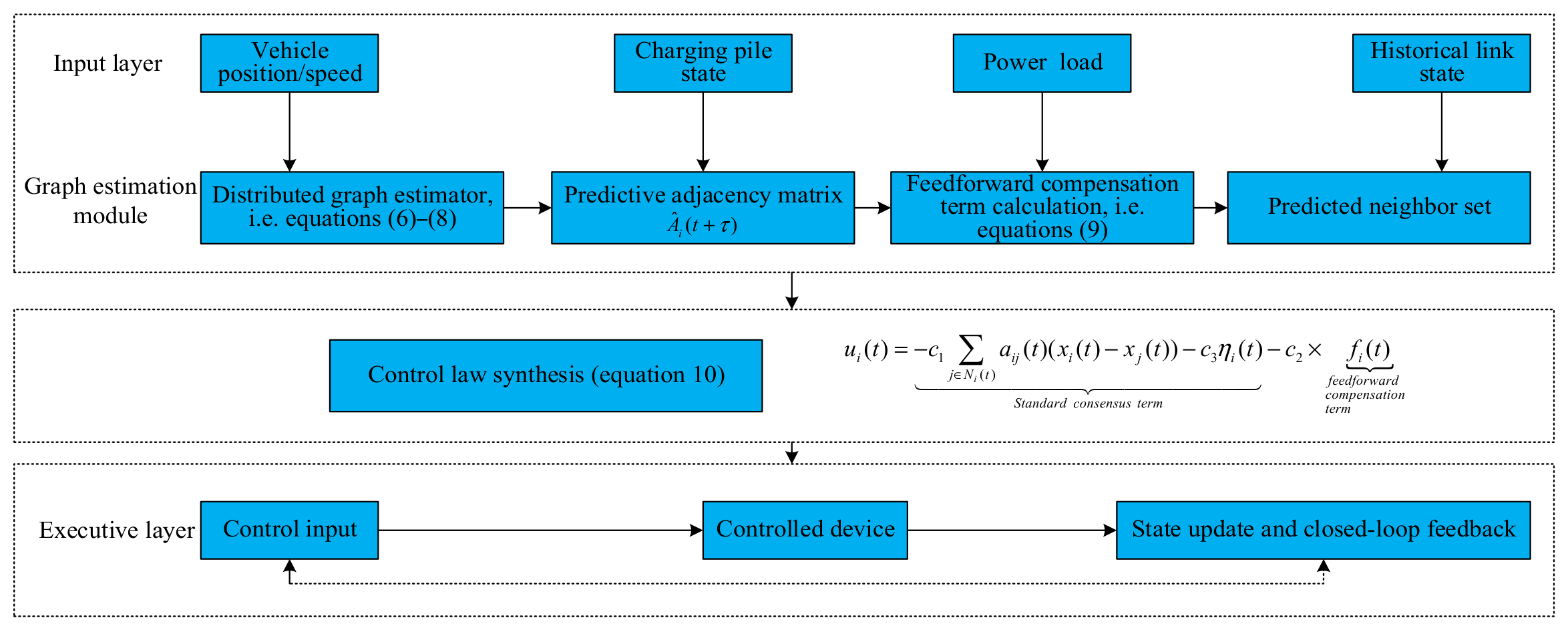
The control input u i ( t ) consists of a feedback term and a feedforward compensation term, which can be expressed as follows:
u i ( t ) = c 1 j N i ( t ) a i j ( t ) ( x i ( t ) x j ( t ) ) c 3 η i ( t ) S t a n d a r d   c o n s e n s u s   t e r m c 2 × f i ( t ) f e e d f o r w a r d   c o m p e n s a t i o n   t e r m
where c1, c2, c3 represent the adjustable gain coefficient; N i ( t ) represents the actual communication neighbor set, which can be determined by the current topology; and η i ( t ) represents the auxiliary variable introduced by the event-triggered mechanism.
The schematic diagram of control structure is shown in Figure 1.
The objective of this control model is to drive the states of all agents to reach consensus and suppress the oscillations caused by abrupt topological changes, which can be expressed as follows:
x i ( t ) x *
where x * represents the unweighted average or reference value.

2.4. The Event-Triggered Mechanism Based on Information Freshness Awareness

The AoI Δ i ( t ) is defined as the interval between the time t i l a s t when agent i last successfully received neighbor information and the current time t, which is shown as follows:
Δ i ( t ) = t t i l a s t
When the following triggering condition is satisfied, agent i broadcasts its current state x i ( t ) and resets the AoI Δ i ( t ) .
| | e i ( t ) | | 2 α i Δ i ( t ) + β i
| | e i ( t ) | | 2 = ( x i ( t ) x i ( t i l a s t ) ) 2
where e i ( t ) represents the local state change error; α i represents the adjustable threshold parameter, which can control the sensitivity to information staleness; and β i is the minimum triggering error.
After triggering, t i l a s t equals t, and the AoI Δ i ( t ) is reset to 0. The following auxiliary variable η i ( t ) is defined as a smoothed form of the triggering flag:
η ˙ i ( t ) = λ η i ( t ) + γ δ ( t t k )
where k is the triggering time; λ , γ represent the decay and gain coefficient; and δ ( ) is the Dirac function, representing the impulse excitation.

3. “Vehicle-Charging Pile-Grid” Collaborative Optimization Method Based on Decentralized Holistic Sensing Graph-Based Estimation

3.1. The Objective Function and Constraints

This paper formulates the overall collaborative optimization control problem of the “Vehicle-Charging Pile-Grid” as minimizing the following comprehensive cost function J min subject to dynamic equations and physical constraints, which is expressed as follows:
J min = lim T 1 T 0 T i = 1 N ( x i ( t ) x ¯ ( t ) ) 2 + ρ i = 1 N 1 t r i g g e r i ( t ) d t x ¯ ( t ) = 1 N i = 1 N x i ( t )
where x ¯ ( t ) represents the instantaneous average value; ρ represents the weight coefficient of the unit communication cost; and 1 t r i g g e r i ( t ) is the indicator function, which equals 1 when the agent i triggers a broadcast at time t, and 0 otherwise.
The system state constraints and control input constraints are
x i min x i ( t ) x i max u i min u i ( t ) u i max
The boundedness constraint of the AoI Δ i ( t ) is
Δ i ( t ) Δ max
where Δ max is the maximum AoI.

3.2. The Optimization Algorithm

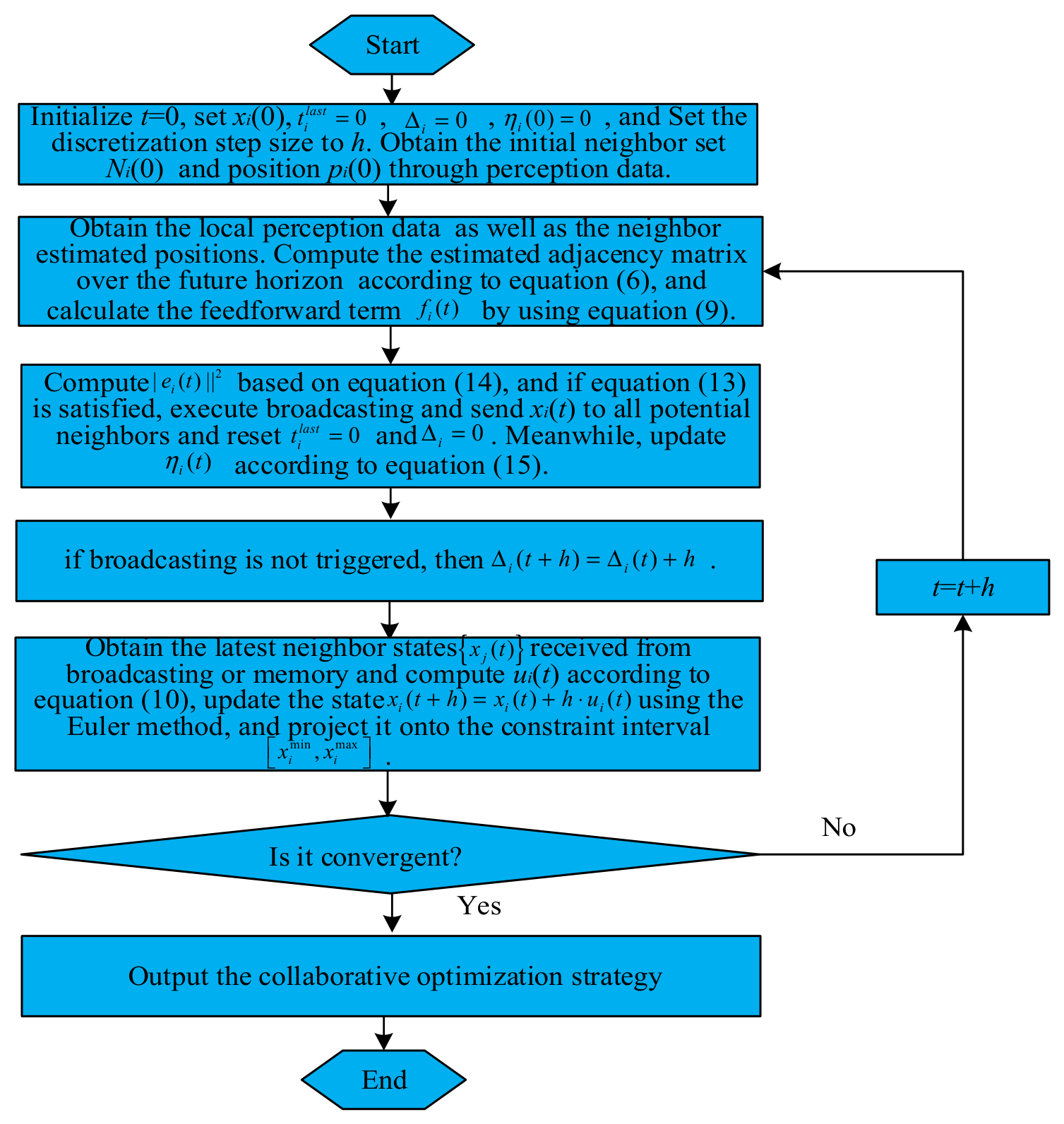
Since the “Vehicle-Charging Pile-Grid” collaborative optimization problem based on decentralized holistic sensing graph-based estimation studied in this paper exhibits decentralized, event-driven, and topologically time-varying characteristics, this paper adopts a distributed Event-Triggered Model Predictive Control (ET-MPC) framework [19], in which each agent i independently executes the following cyclic algorithm steps (i.e., each agent executes in parallel):
Step 1: Initialization. Initialize t = 0, set x i ( 0 ) , t i l a s t = 0 , Δ i = 0 , η i ( 0 ) = 0 , and set the discretization step size to h. Obtain the initial neighbor set N i ( 0 ) and position p i ( 0 ) through perception data.
Step 2: Perception and graph-based estimation. Obtain the local perception data including the self-state x i ( t ) , position p i ( t ) , velocity v i ( t ) , as well as the neighbor estimated positions p ^ j ( t ) acquired via broadcasting or environmental perception. Compute the estimated adjacency matrix A ^ i ( t + τ ) over the predictive step size Δ T according to Equation (6), and calculate the feedforward term f i ( t ) using Equation (9).
Step 3: Event-Triggered Detection. Compute | e i ( t ) | | 2 based on Equation (14), and if Equation (13) is satisfied, execute broadcasting and send x i ( t ) to all potential neighbors (including current actual neighbors and estimated neighbors), and reset t i l a s t = t and Δ i = 0 . Meanwhile, update η i ( t ) according to Equation (15).
Step 4: Information Freshness Update. If broadcasting is not triggered, then Δ i ( t + h ) = Δ i ( t ) + h .
Step 5: Control Input Computation. Obtain the latest neighbor states x j ( t ) received from broadcasting or memory and compute u i ( t ) according to Equation (10), update the state x i ( t + h ) = x i ( t ) + h u i ( t ) using the Euler method, and project it onto the constraint interval x i min , x i max .
Step 6: Check for convergence. If converged, the iteration terminates; otherwise, set t = t + h and return to Step 2.
The algorithm flow chart is shown in Figure 2.

4. Numerical Test and Analysis

4.1. Basic Data and Simulation Conditions

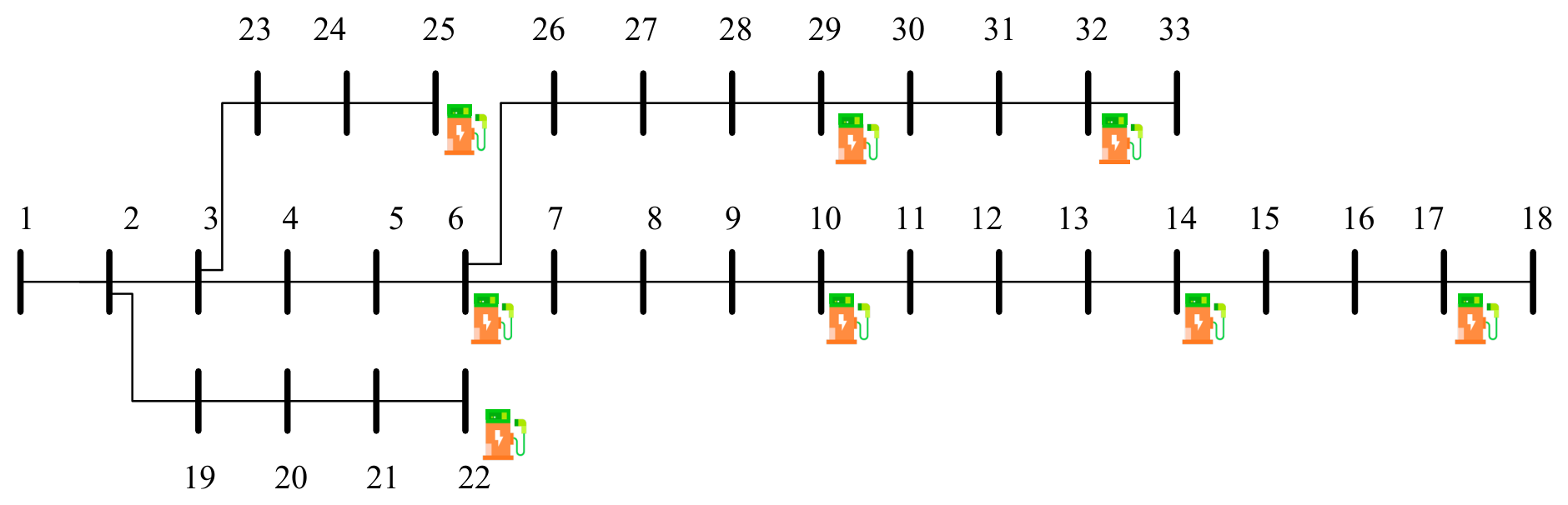
The simulation analysis of the proposed method is conducted based on a modified IEEE 33-bus distribution system. The system comprises 33 buses and eight charging stations located at buses 6, 10, 14, 17, 22, 25, 29, and 32. Multiple charging piles within each charging station are aggregated into a single agent, and the topology is illustrated in Figure 3. A total of 20 electric vehicles are distributed within the service area, with their initial positions randomly assigned across a 3 km × 2 km road network covering the distribution grid. The communication ranges are configured as follows: vehicle-to-vehicle (V2V) at 200 m, vehicle-to-charging-station (V2CS) at 150 m, while wired communication is adopted between grid buses. It is assumed that EV speeds vary randomly between 5 m/s and 15 m/s. To induce significant topological changes, the following events are introduced: Event 1 (t = 10 s): 5EVs (EV3, EV7, EV11, EV15, EV19) move out of the communication range of their nearest charging stations into a low-coverage area. Event 2 (t = 25 s): A platoon of six EVs (EV1, EV4, EV8, EV12, EV16, EV20) enters the service area and reconnects to the charging stations at buses 14 and 17. Event 3 (t = 40 s): The two charging stations at buses 22 and 25 temporarily lose communication due to interference (lasting 5 s). Event 4 (t = 55 s): The network recovers to a stable fully connected topology. The total simulation duration is set to 80 s. In this paper, the decay and gain coefficient λ , γ are set to 2.0 and 1.5. The feedback gain c1 is set to 2.2, the feedforward gain c2 is set to 0.9, and the event-triggered auxiliary gain c3 is set to 0.6. The adjustable threshold parameter α i is set to 0.4. The minimum triggering error β i is set to 0.008. The discretization step h is set to 0.05 s, the predictive step size Δ T is set to 1.5 s, and the maximum AoI Δ max is set to 1.2 s.
To demonstrate the superiority of the proposed method, the following four methods are compared:
(1)
PTC method [26]: Fixed broadcast period of 0.50 s. The control law contains only feedback terms, with no feedforward term or graph-based estimation.
(2)
RC method [27]: Robust control with a fixed broadcast period of 0.50 s, without prediction.
(3)
ETC method [28]: Uses the same event-triggering condition as the proposed method, but without graph-based estimation and feedforward compensation; only feedback control is included.
(4)
The proposed method: Incorporates decentralized panoramic-aware graph-based estimation, predictive feedforward terms, and information freshness-aware event-triggering.
All methods are evaluated under identical initial conditions, mobility patterns, and topology events.

4.2. Simulation Results and Analysis

Table 2 presents the comparative analysis results of the proposed method against the PTC, RC, and ETC methods. As shown in Table 1, the steady-state root mean square error (RMSE) of the proposed method is 1.27 kW, representing a 60.1% reduction compared to PTC (3.18 kW), a 54.0% reduction compared to RC (2.76 kW), and a 40.1% reduction compared to ETC (2.12 kW). This result indicates that by introducing a graph estimation-based predictive feedforward technique, the proposed method effectively suppresses state deviations caused by abrupt topological changes, ensuring highly consistent charging power adjustments across all agents after system convergence, thereby significantly improving the accuracy of vehicle–charger–grid coordinated control. Furthermore, the average convergence time of the proposed method is 9.4 s, compared to 24.6 s, 19.3 s, and 15.8 s for the PTC, RC, and ETC methods, respectively. Relative to PTC, the convergence time is reduced by 61.8%; relative to ETC, it is reduced by 40.5%. This is attributed to the distributed graph estimator’s anticipation of future neighbor sets, enabling proactive adjustment of control inputs before topological switches and avoiding the delay caused by repeated iterative corrections, and making it particularly suitable for dynamic scenarios with frequent vehicle arrivals and departures.
Meanwhile, the total number of broadcasts for the proposed method is 2816, far below the 9760 broadcasts of the periodic broadcasting methods PTC/RC, representing a 71.2% reduction. Compared with ETC, which also adopts event-triggered communication (4432 broadcasts), the proposed method further reduces broadcasts by 36.5%. This is because the proposed method not only incorporates an event-triggered mechanism but also adaptively adjusts the triggering threshold through AoI awareness, greatly reducing unnecessary communication during steady-state operation and thus significantly alleviating wireless channel pressure in industrial Internet environments. Finally, PTC and RC maintain a maximum AoI of 0.5 s due to fixed-period broadcasting, but this is achieved at the cost of substantial communication overhead. The proposed method, while ensuring control performance, constrains the maximum AoI to 0.96 s, which is lower than ETC’s 1.18 s, demonstrating that the proposed method more effectively avoids information staleness while achieving a superior balance between communication efficiency and information freshness.
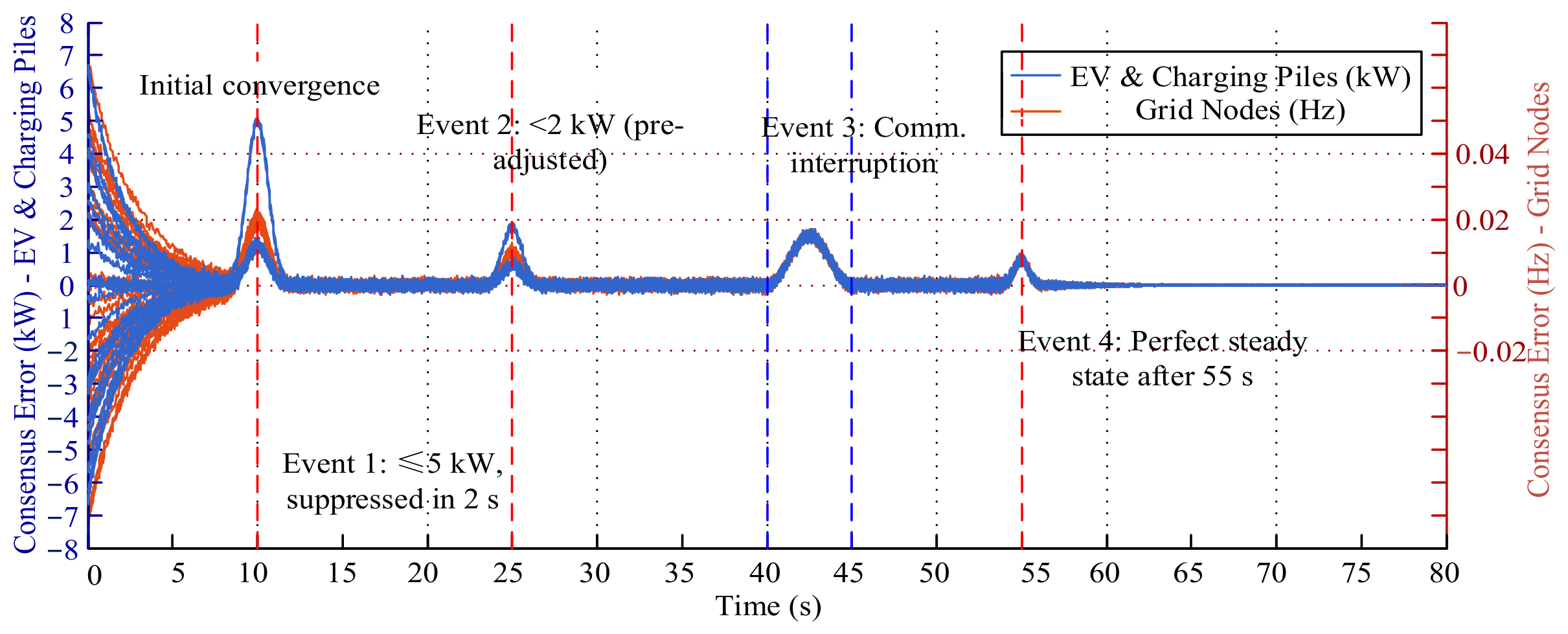
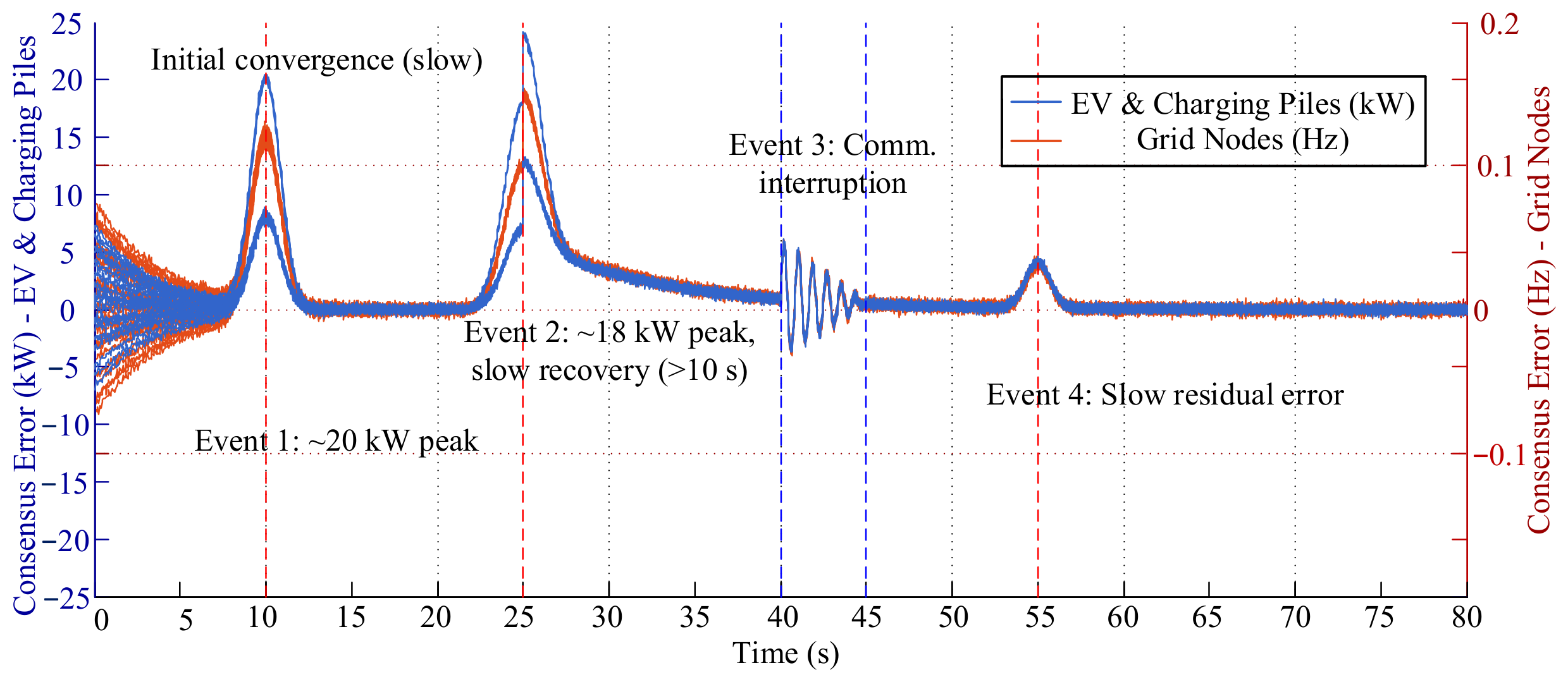
Figure 4 and Figure 5 show the consensus error evolution curves of all 61 agents (20 EVs, eight charging stations, 33 grid buses) under the proposed method and the PTC method, respectively. As seen in Figure 3 and Figure 4, during 0–10 s, the proposed method rapidly converges to near-zero error, whereas PTC converges noticeably more slowly, approaching zero only after approximately 15 s, demonstrating the advantage of the proposed method in efficient information exchange during the initial phase of the event-triggered mechanism. At t = 10 s, five EVs leave the communication range, causing sudden topological sparsification where some vehicles lose connection to charging stations and neighbors. The proposed method exhibits only a minor transient fluctuation of approximately 5 kW, which is suppressed within 2 s, while PTC produces a large spike of up to 20 kW with slow recovery. At t = 25 s, six EVs enter the service area as new vehicles and reconnect to charging stations. Thanks to the predictive feedforward and pre-regulation of the graph estimator, the proposed method shows fluctuations below 2 kW, while PTC produces a large spike with a recovery time exceeding 10 s, keeping the error elevated for an extended period. At t = 40~45 s, two charging stations lose communication due to interference; under the proposed method, the error remains smooth and oscillation-free, while PTC exhibits sustained oscillations with severely degraded dynamic performance. After t = 55 s, once all topological events have concluded, the proposed method enters a near-perfect steady state, while PTC still exhibits residual fluctuations and fails to fully converge. These results confirm that the proposed method, through decentralized holistic sensing graph-based estimation, predictive feedforward control, and the event-triggered mechanism, achieves collaborative control with small transient fluctuations, fast recovery, high steady-state accuracy, and low communication load.
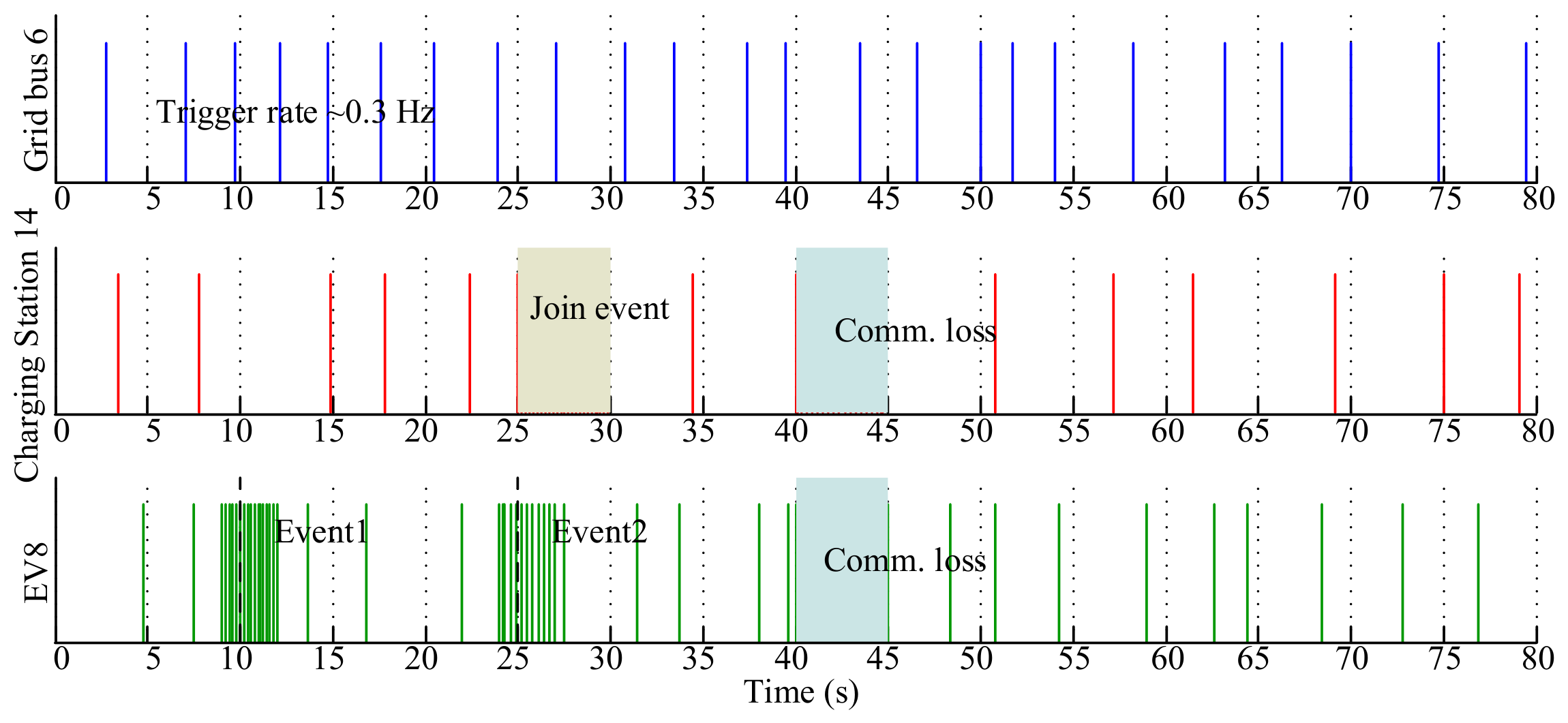
Figure 6 shows the event-triggering patterns of three representative agents under the proposed method: grid bus 6, charging station 14, and EV 8. As shown in Figure 5, grid bus 6 exhibits an extremely low triggering frequency of approximately 0.3 Hz. This is because grid buses experience slow state variations and do not require frequent broadcasting. Charging station 14 shows sparse triggering during normal periods, but its triggering frequency increases significantly during dynamic events such as the fleet joining at t = 25~30 s and the communication disruption at t = 40~45 s. This adaptive behavior ensures timely information updates when system states change abruptly, maintaining the accuracy of control decisions while conserving communication resources during steady-state periods. For EV 8, the triggering pattern is entirely determined by the joint condition of its state error and AoI, where broadcasting is triggered only when the error exceeds the threshold or the information age approaches the upper bound. Consequently, dense triggering occurs during Event 1 at t = 10 s, Event 2 at t = 25 s, and during the communication disruption, while the agent remains silent during other periods. This approach both avoids channel congestion caused by continuous broadcasting and ensures the timeliness of critical information.
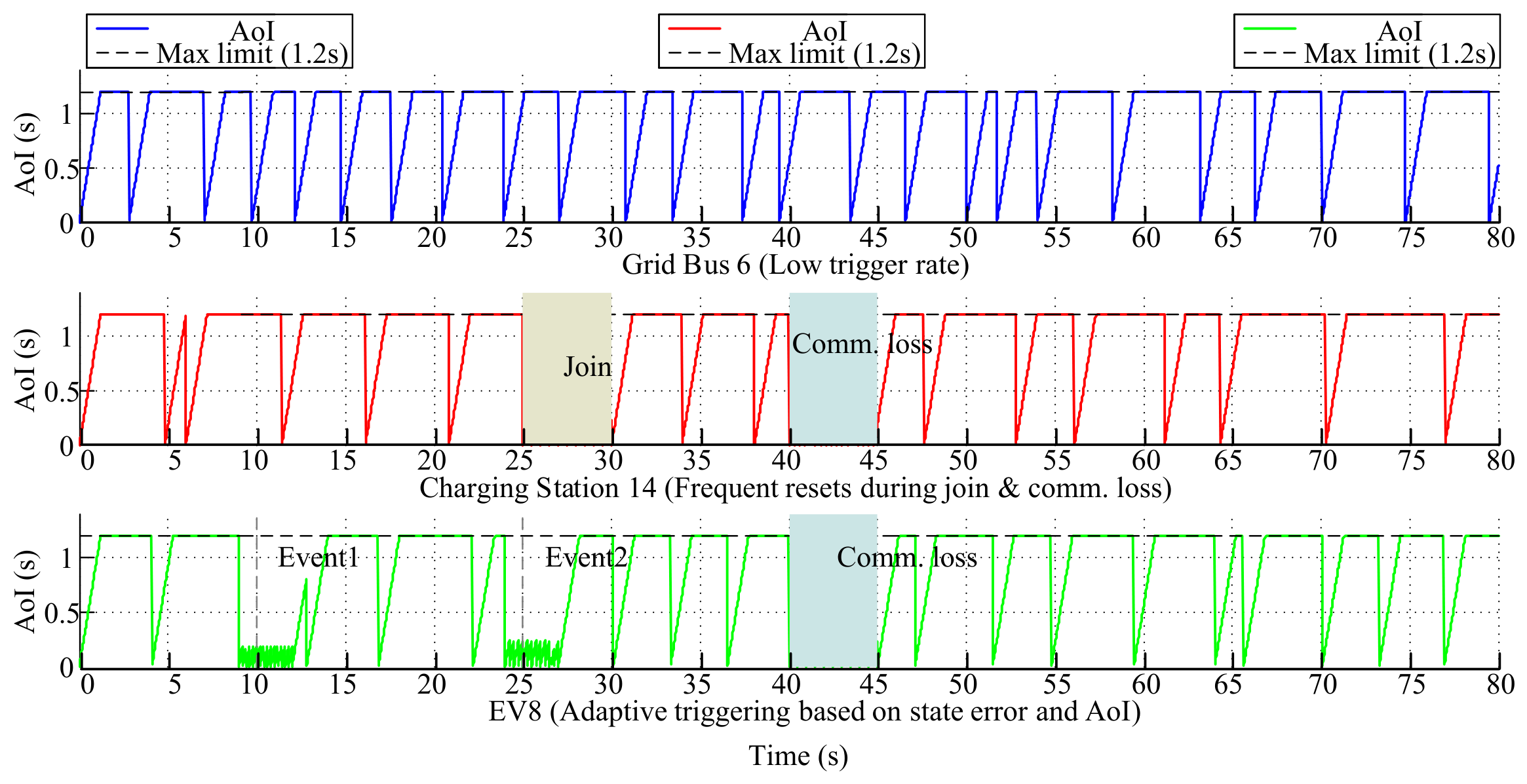
Figure 7 shows the AoI evolution curves for three representative agents under the proposed method: grid bus 6, charging station 14, and EV 8. As shown in Figure 6, the AoI of grid bus 6 exhibits a slow sawtooth pattern, resetting only when it approaches the upper bound (approximately 1.2 s). This is because its state changes slowly, and low-frequency triggering suffices to meet control requirements, thereby avoiding unnecessary communication while ensuring information does not become stale. For charging station 14, the AoI grows slowly during normal periods, similar to that of the grid node; however, during fleet joining (25~30 s) and communication disruption (40~45 s), the AoI frequently resets to zero (dense triggering), ensuring that information remains fresh at critical moments and demonstrating adaptive responsiveness to dynamic events. The AoI curve of EV 8 exhibits more irregular sawtooth patterns: it resets frequently (dense triggering) during Event 1, Event 2, and the communication disruption, while growing to near the upper bound before triggering during steady-state periods. This behavior is fully consistent with EV 8’s state-error-driven triggering pattern, confirming the effectiveness of the joint AoI–state-error-triggering mechanism.
Table 3 presents the sensitivity analysis results of the proposed method with respect to key parameters, i.e., predictive step size Δ T and the adjustable threshold parameter α i . As shown in Table 2, when the predictive step size Δ T increases from 0.5 s to 1.5 s, the steady-state RMSE decreases from 2.08 kW to 1.27 kW, and the broadcast count drops from 3325 to 2812, indicating simultaneous improvements in both accuracy and communication efficiency. This suggests that moderately extending the prediction window facilitates more accurate anticipation of topological changes. However, when the predictive step size Δ T is set too large (2.0 s), prediction errors increase and the broadcast count rebounds to 3124. Therefore, the default value of 1.5 s achieves the optimal trade-off. When the adjustable threshold parameter α i is set to 0.2, the system becomes highly sensitive to stale information, yielding the best steady-state RMSE (1.08 kW) but causing the broadcast count to surge to 4127. When the adjustable threshold parameter α i is set to 0.8, the broadcast count drops significantly to 1886, but the RMSE degrades to 2.03 kW. Consequently, the default value of 0.4 strikes a favorable balance between accuracy (1.27 kW) and communication load (2812 broadcasts).
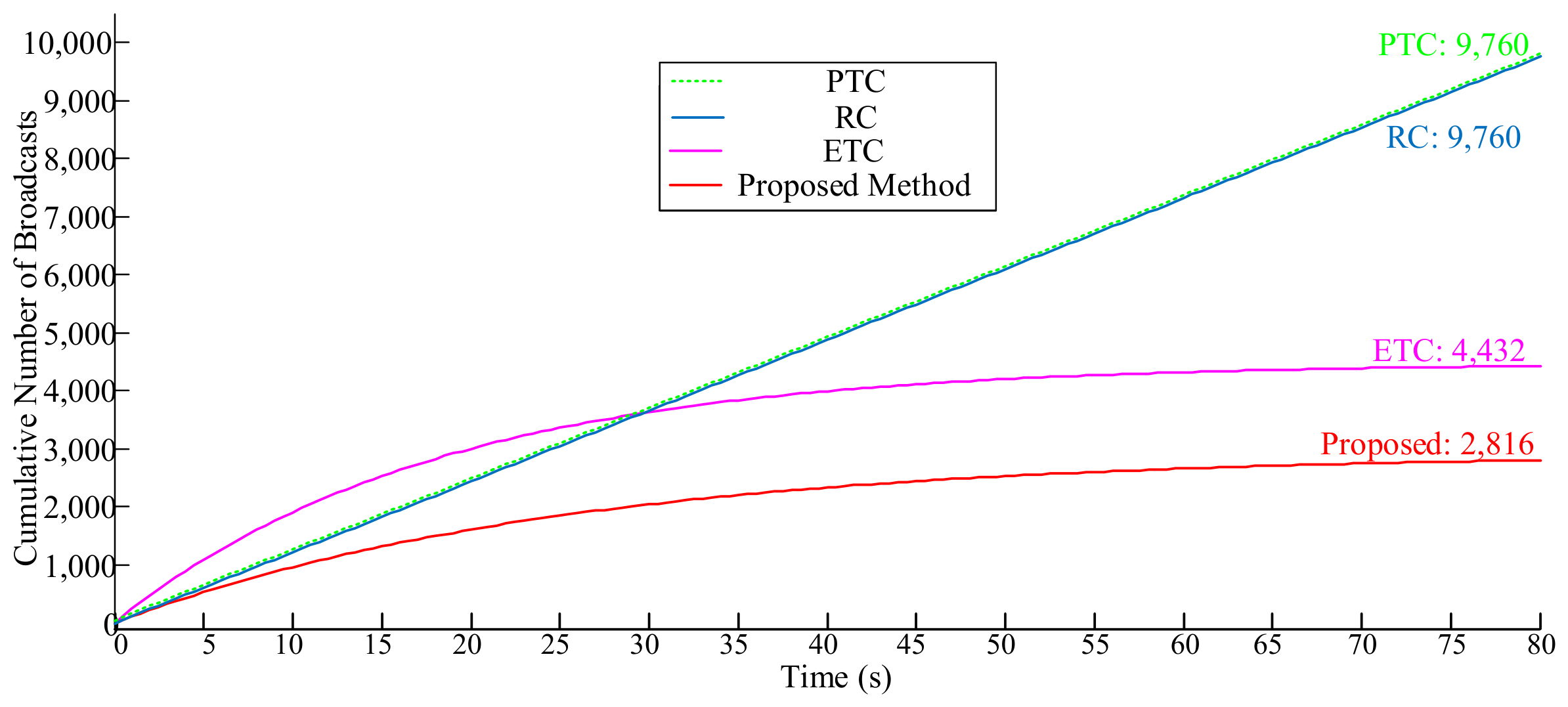
Figure 8 shows the comparison of cumulative broadcast counts over time between the proposed method and the PTC, RC, and ETC methods. As shown in Figure 7, the cumulative broadcast counts of PTC and RC grow strictly linearly with time, ultimately reaching 9760 broadcasts. Regardless of whether the system is in a dynamic event or steady-state phase, both methods broadcast at a fixed period (0.5 s), resulting in substantial redundant communication and severe resource waste. The cumulative curve of ETC grows relatively fast in the early stage and then gradually flattens, reaching 4432 broadcasts in total, which is approximately 55% fewer than the periodic methods. However, due to the lack of AoI awareness, ETC still triggers frequently in the steady-state phase owing to minor state fluctuations, leading to a noticeably higher broadcast count than the proposed method. The cumulative curve of the proposed method grows the slowest, becoming nearly horizontal in the steady-state phase after 60 s, where broadcasting becomes extremely sparse. The final cumulative count is only 2816 broadcasts, representing approximately a 71% reduction compared to the periodic methods and a 36% reduction compared to ETC. The primary reason is that the proposed method, through its AoI-aware mechanism, automatically reduces the broadcasting frequency during the steady-state phase, avoiding the excessive triggering caused by ETC’s lack of AoI constraints and thereby achieving “on-demand communication.”
Table 4 presents the scalability analysis of the proposed method against the PTC, RC, and ETC methods in a larger-scale system comprising 169 agents (120 EVs, 16 charging stations, and 33 grid buses). As shown in Table 3, the proposed method achieves a steady-state RMSE of 1.52 kW, significantly outperforming PTC (3.42 kW), RC (2.95 kW), and ETC (2.31 kW), with error reductions of 55.6%, 48.5%, and 34.2%, respectively, confirming that the proposed method maintains the highest consensus control accuracy even in large-scale systems. Furthermore, the convergence time of the proposed method is only 11.3 s, far faster than PTC (28.1 s), RC (22.4 s), and ETC (19.9 s), representing approximately 43% reduction compared to ETC and approximately 60% reduction compared to PTC. This is attributed to the graph estimation-based feedforward mechanism, which effectively accelerates information diffusion and consensus achievement in large-scale networks. Moreover, the total broadcast count of the proposed method is 7164, which is only 26.5% of that of PTC/RC and approximately 42% fewer than ETC (12,288). With the number of agents increased by nearly threefold, the proposed method still maintains the lowest communication load, demonstrating the superiority of the event-triggered and AoI-aware mechanisms in large-scale scenarios. Finally, the average per-agent per-step computation time of the proposed method is 1.9 ms, slightly higher than ETC (1.2 ms) but far below the control step size (50 ms), satisfying real-time requirements. The additional computational overhead primarily stems from graph-based estimation and feedforward computation, yet it yields substantial improvements in accuracy, convergence speed, and communication efficiency, making the overall trade-off more favorable.

5. Conclusions

This paper proposes a cooperative optimal control method based on decentralized holistic sensing graph-based estimation. The method constructs a time-varying weighted directed graph model driven by decentralized holistic sensing, and designs a distributed graph estimator that relies solely on local perception information. Each agent can predict its neighbor set online and link reliability over a short future horizon based on its own position, the motion trends of nearby objects, and historical link states. Furthermore, the graph-based estimation results are embedded as a feedforward compensation term into the consensus control law, enabling the system to proactively adjust control inputs before topology switching occurs, thereby achieving a paradigm shift from “passive response” to “active pre-compensation.” The effectiveness and robustness of the proposed method under dynamic topologies are validated through comprehensive simulations. Additionally, by incorporating an AoI constraint, broadcasting is triggered when the state error exceeds a threshold or the AoI approaches its upper bound, which ensures the timeliness of control information while significantly reducing communication load. This mechanism strikes a good balance between communication efficiency and control reliability. Finally, simulations are conducted on a modified IEEE-33 bus distribution system. In a typical scenario with 61 agents, compared to the PTC method, the proposed method reduces the steady-state error by 60.1%, shortens the convergence time by 61.8%, and decreases the total number of broadcasts by 71.2%; compared to the ETC method without prediction, it reduces the steady-state error by 40.1%, shortens the convergence time by 40.5%, and reduces broadcasts by 36.5%. In a large-scale system with 169 agents, the proposed method still maintains the highest accuracy, the fastest convergence speed, and the lowest communication overhead, while meeting real-time computational requirements.
However, the method proposed in this paper currently mainly targets typical scenarios with communication uncertainties and sensing noises, and has not yet considered adversarial scenarios with malicious cyberattacks (such as data injection, DoS attacks, etc.). Under the existing framework, the protection capability of the method against data injection attacks can be further enhanced by introducing a lightweight signature mechanism or a trusted execution environment, which will be an important direction of our future work.

Author Contributions

Conceptualization, K.L., X.Y., H.D., L.Z., C.L., S.W. and J.Z.; methodology, K.L., X.Y., H.D., L.Z., C.L., S.W. and J.Z.; validation, K.L., X.Y., H.D., L.Z., C.L., S.W. and J.Z.; software, K.L., X.Y., H.D., L.Z., C.L., S.W. and J.Z.; writing—original draft preparation, K.L., X.Y., H.D., L.Z., C.L., S.W. and J.Z. All authors have read and agreed to the published version of the manuscript.

Funding

This work was supported by the Science and Technology Leading Project of China Southern Power Grid Co., Ltd.: Research and Application of Wide-area Collaborative Real-time Interactive Regulation Technology for Energy Industry Internet (No. ZBKJXM20240180).

Data Availability Statement

The original contributions presented in this study are included in the article. Further inquiries can be directed to the corresponding author.

Conflicts of Interest

Author Kequan Lin was employed by the China Southern Power Grid Company Limited. Authors Xiaoli Yi, Haodong Du and Cong Lin were employed by the China Southern Power Grid Digital Power Grid Technology (Guangdong) Co., Ltd. Author Lei Zhuang was employed by the CSG Electric Power Research Institute Co., Ltd. The remaining authors declare that the research was conducted in the absence of any commercial or financial relationships that could be construed as a potential conflict of interest. The authors declare that this study received funding from the Science and Technology Leading Project of China Southern Power Grid Co., Ltd.: Research and Application of Wide-area Collaborative Real-time Interactive Regulation Technology for Energy Industry Internet (No. ZBKJXM20240180). The funder was not involved in the study design, collection, analysis, interpretation of data, the writing of this article or the decision to submit it for publication.

References

  1. Long, Y.; Guo, S.; Pei, X.; Yuan, S.; Jiang, W. Privacy-Preserving Dynamic Resource Allocation for Vehicle-Pile-Grid Systems Based Homomorphic Encryption. In Proceedings of the 2024 4th International Conference on Communication Technology and Information Technology (ICCTIT), Guangzhou, China, 27–29 December 2024; pp. 266–269. [Google Scholar] [CrossRef]
  2. Zhu, C. Research on Vehicle-pile-Grid Interconnection and Interaction Technology. In Proceedings of the 2023 9th International Conference on Electrical Engineering, Control and Robotics (EECR), Wuhan, China, 24–26 February 2023; pp. 256–261. [Google Scholar] [CrossRef]
  3. Tan, Z.; Guo, L.; Yan, M.; Huang, W.; He, X. Research on the cooperative optimization method for the integration of vehicle-pile-grid. In Proceedings of the 2025 International Conference on Electrical Drives, Power Electronics & Engineering (EDPEE), Athens, Greece, 26–28 March 2025; pp. 251–255. [Google Scholar] [CrossRef]
  4. Li, H.; Song, Y.; Tan, J.; Cui, Y.; Li, S.; Kang, Y.; Dong, H. Optimal urban EV charging station site selection and capacity determination considering comprehensive benefits of vehicle-station-grid. iEnergy 2024, 3, 162–174. [Google Scholar] [CrossRef]
  5. Huang, Q.; Wen, R.; Han, Y.; Li, C.; Zhang, Y. Intelligent Fault Identification for Industrial Internet of Things via Prototype-Guided Partial Domain Adaptation With Momentum Weight. IEEE Internet Things J. 2023, 10, 16381–16391. [Google Scholar] [CrossRef]
  6. Liu, B.; Feng, Q.; Zhong, L.; Chen, Y. Physical-Information-Functional Architecture for Internet of Things. IEEE Internet Things J. 2025, 12, 42456–42483. [Google Scholar] [CrossRef]
  7. Hu, J.; Sun, D.; Lu, W.; Dong, J.; Wu, H. Blockchain-Enabled Distributed Authentication Mechanism for Industrial Device Access. IEEE Trans. Ind. Inform. 2025, 21, 2819–2828. [Google Scholar] [CrossRef]
  8. Jagatheesaperumal, S.K.; Pham, Q.-V.; Ruby, R.; Yang, Z.; Xu, C.; Zhang, Z. Explainable AI Over the Internet of Things (IoT): Overview, State-of-the-Art and Future Directions. IEEE Open J. Commun. Soc. 2022, 3, 2106–2136. [Google Scholar] [CrossRef]
  9. Gardner, M.; Jia, Y.-B. Pose and Motion Estimation of Free-Flying Objects: Aerodynamics, Constrained Filtering, and Graph-Based Feature Tracking. IEEE Trans. Robot. 2022, 38, 3187–3202. [Google Scholar] [CrossRef]
  10. Gao, T.; Daamen, W.; Isufi, E.; Hoogendoorn, S.P. Bicycle Travel Time Estimation via Dual Graph-Based Neural Networks. IEEE Trans. Intell. Transp. Syst. 2026, 27, 1511–1524. [Google Scholar] [CrossRef]
  11. Liu, Y.; Wu, L.; Cai, X.; Shankar, M.R.B. Graph-Based Multi-Bounce Modeling and Channel Parameter Estimation for Indoor Sensing. IEEE Trans. Wirel. Commun. 2025, 24, 4219–4234. [Google Scholar] [CrossRef]
  12. Guo, X.; Chen, Y.; Wang, Y.; Wang, Z.; Han, Z.; Yuen, C. Fast and Robust Channel Estimation for HMIMO: A Graph-Based Wavenumber-Domain Approach. IEEE Trans. Wirel. Commun. 2025, 24, 9001–9017. [Google Scholar] [CrossRef]
  13. Li, H.; He, B.; Li, G.; Chen, Y.; Zhang, G. Graph-Based Element Deployment and Channel Estimation for IRS-Aided Wireless Communications. IEEE Wirel. Commun. Lett. 2025, 14, 3079–3083. [Google Scholar] [CrossRef]
  14. Yang, C.; Hu, M.; Zhai, G.; Zhang, X.-P. Graph-Based Denoising for Respiration and Heart Rate Estimation During Sleep in Thermal Video. IEEE Internet Things J. 2022, 9, 15697–15713. [Google Scholar] [CrossRef]
  15. Chen, X.; Di, Z.; Wu, W.; Wu, Q.; Shi, J.; Feng, Q. Detailed Routing Short Violation Prediction Using Graph-Based Deep Learning Model. IEEE Trans. Circuits Syst. II Express Briefs 2022, 69, 564–568. [Google Scholar] [CrossRef]
  16. Wang, F.; Wen, G.; Peng, Z.; Huang, T.; Yu, Y. Event-Triggered Consensus of General Linear Multiagent Systems With Data Sampling and Random Packet Losses. IEEE Trans. Syst. Man Cybern. Syst. 2021, 51, 1313–1321. [Google Scholar] [CrossRef]
  17. Ijaz, Z.; Noor-A-Rahim, M.; Pesch, D. Leader–Follower-Based Self-Triggered Consensus Control of Industrial Induction Motor Drives. IEEE Syst. J. 2022, 16, 5917–5927. [Google Scholar] [CrossRef]
  18. Cao, Y.; Yu, T.; Gong, X.; Yue, D.; Yu, J. Dynamic Event-Triggered Semi-Global Consensus for Linear Multi-Agent Systems with DoS Attack Under Input Saturation. In Proceedings of the 2025 8th International Conference on Intelligent Robotics and Control Engineering (IRCE), Kunming, China, 18–21 August 2025; pp. 270–275. [Google Scholar] [CrossRef]
  19. Wei, H.; Liu, C.; Shi, Y. A Robust Distributed MPC Framework for Multiagent Consensus With Communication Delays. IEEE Trans. Autom. Control 2024, 69, 7418–7432. [Google Scholar] [CrossRef]
  20. Chen, Y.; Li, S.; Yan, Y.; Liu, G. Distributed Periodic Event-Triggered Consensus of Second-Order Nonlinear Multiagent Systems With Switching Topologies. IEEE Syst. J. 2024, 18, 1821–1824. [Google Scholar] [CrossRef]
  21. Liu, K.; Sun, Z.-Y.; Li, J.-J.; Chen, C.-C. Distributed Robust Adaptive Consensus Control for Uncertain Nonlinear Multi-Agent Systems With Output Constraints. IEEE Trans. Autom. Sci. Eng. 2025, 22, 22807–22816. [Google Scholar] [CrossRef]
  22. Wang, J.; Zhang, H.; Wang, Z.; Fu, J.; Wang, W.; Meng, Q. Event-Triggered Leader-Following Consensus Control of Nonlinear Multiagent Systems With Generally Uncertain Markovian Switching Topologies. IEEE Trans. Syst. Man Cybern. Syst. 2024, 54, 4942–4954. [Google Scholar] [CrossRef]
  23. Wang, G.; Zuo, Z. Consensus Control of Multi-Agent Systems With Different State Constraints and Event-Triggered Communication. IEEE Trans. Circuits Syst. II Express Briefs 2024, 71, 817–821. [Google Scholar] [CrossRef]
  24. Liu, K.; Ji, Z. Dynamic Event-Triggered Consensus of General Linear Multi-Agent Systems With Adaptive Strategy. IEEE Trans. Circuits Syst. II Express Briefs 2022, 69, 3440–3444. [Google Scholar] [CrossRef]
  25. Zhao, G.; Wang, Y.; Fu, X. Hybrid Event-Triggered Consensus Tracking of Multi-Agent Systems With Discrete Control Update. IEEE Trans. Circuits Syst. II Express Briefs 2022, 69, 2206–2210. [Google Scholar] [CrossRef]
  26. Lin, N.; Ling, Q. Dynamic Periodic Event-Triggered Consensus Protocols for Linear Multiagent Systems With Network Delay. IEEE Syst. J. 2023, 17, 1204–1215. [Google Scholar] [CrossRef]
  27. Gao, H.; Liu, Y.; Rong, L.; Xie, X. Robust Consensus With Edge-Based Multiplicative Uncertainties via Recursive Channel Filters. IEEE Trans. Circuits Syst. II Express Briefs 2023, 70, 2550–2554. [Google Scholar] [CrossRef]
  28. He, W.; Li, S.; Ge, X.; Qian, F. Secure Fully Distributed Event-Triggered Consensus of Multi-Agent Systems Against Distributed Sequential Scaling Attacks. IEEE Trans. Ind. Inform. 2024, 20, 1764–1775. [Google Scholar] [CrossRef]
Figure 1. Schematic diagram of control structure.
Processes 14 02502 g001
Figure 2. Algorithm flow chart of the “Vehicle-Charging Pile-Grid” collaborative optimization method.
Processes 14 02502 g002
Figure 3. The modified IEEE 33-bus distribution system.
Processes 14 02502 g003
Figure 4. Evolution of consensus error under the proposed method.
Processes 14 02502 g004
Figure 5. Evolution of consensus error under PTC method.
Processes 14 02502 g005
Figure 6. Event-triggering patterns under the proposed method.
Processes 14 02502 g006
Figure 7. AoI evolution under the proposed method.
Processes 14 02502 g007
Figure 8. Cumulative broadcasts over time for four methods.
Processes 14 02502 g008
Table 1. Rigorous comparison with existing methods.
MethodControl LawTriggering RuleFeedforward Compensation TermAoI Perception
PTCFeedback termFixed period (0.5 s)NoNo
RCFeedback term + robust termFixed period (0.5 s)NoNo
ETCFeedback item + auxiliary itemEvent-triggering (state error-driven)NoNo
The proposed methodFeedback term + feedforward compensation term + auxiliary termEvent-triggering (state error or AoI)YesYes
Table 2. Average performance metrics of different methods.
MethodSteady-State
RMSE (kW)
Convergence
Time (s)
Total Broadcast
Times
Maximum AoI (s)
PTC method3.1824.697600.50
RC method2.7619.397600.50
ETC method2.1215.844321.18
The proposed method1.279.428160.96
Table 3. Sensitivity analysis of the proposed method.
Predictive Step
Size Δ T
The Adjustable
Threshold Parameter α i
Steady-State
RMSE (kW)
Total Broadcast
Times
Maximum
AoI (s)
0.5 s0.42.0833250.68
1.0 s0.41.6129760.85
1.5 s (default)0.41.2728120.96
2.00.41.1931241.14
1.5 s (default)0.21.0841270.62
1.5 s (default)0.61.5621481.18
1.5 s (default)0.82.0318861.20
Table 4. Scalability comparison of different methods.
MethodSteady-State
RMSE (kW)
Convergence
Time (s)
Total Broadcast
Times
Average Computation
Time per Agent (ms/step)
PTC method3.4228.127,0400.3
RC method2.9522.427,0400.5
ETC method2.3119.912,2881.2
The proposed method1.5211.371641.9
Disclaimer/Publisher’s Note: The statements, opinions and data contained in all publications are solely those of the individual author(s) and contributor(s) and not of MDPI and/or the editor(s). MDPI and/or the editor(s) disclaim responsibility for any injury to people or property resulting from any ideas, methods, instructions or products referred to in the content.