Data-Driven Quantification of Temperature-Induced Mechanical Property Variations in 5Cr–0.5Mo Steel Using Artificial Neural Networks




Abstract
1. Introduction
2. Materials and Methods
3. Results and Discussion
3.1. Quantitative Estimation
3.2. Model Interpretation Using the Index of Relative Importance (IRI)
3.3. Ten-Fold Cross-Validation
3.4. Graphical User Interface
4. Conclusions
Supplementary Materials
Author Contributions
Funding
Data Availability Statement
Conflicts of Interest
Abbreviations
| ANN | Artificial neural network |
| YS | Yield strength |
| UTS | Ultimate tensile strength |
| El | Elongation |
| RA | Reduction in area |
| IRI | Index of relative importance |
| GUI | Graphical user interface |
References
- Yang, J.; Yu, Y.; Ma, T.; Zhang, C.; Wang, Q. Evolution of energy and metal demand driven by industrial revolutions and its trend analysis. Chin. J. Popul. Resour. Environ. 2021, 19, 256–264. [Google Scholar] [CrossRef]
- Hinrichs, F.; Winkens, G.; Kramer, L.K.; Falcão, G.; Hahn, E.M.; Schliephake, D.; Eusterholz, M.K.; Sen, S.; Galetz, M.C.; Inui, H.; et al. A ductile chromium–molybdenum alloy resistant to high-temperature oxidation. Nature 2025, 646, 331–337. [Google Scholar] [CrossRef] [PubMed]
- Abe, F. Research and Development of Heat-Resistant Materials for Advanced USC Power Plants with Steam Temperatures of 700 °C and Above. Engineering 2015, 1, 211–224. [Google Scholar] [CrossRef]
- Mohapatra, J.N.; Bandyopadhyay, N.R.; Gunjan, M.K.; Mitra, A. Study of high-temperature ageing and creep on bainitic 5Cr–0.5Mo steel by magnetic NDE techniques. J. Magn. Magn. Mater. 2010, 322, 589–595. [Google Scholar] [CrossRef]
- Ishtiaq, M.; Kim, Y.-K.; Tiwari, S.; Lee, C.H.; Jo, W.H.; Sung, H.; Cho, K.-S.; Kang, S.-G.; Na, Y.-S.; Seol, J.B. Serration-induced plasticity in phase transformative stainless steel 316 L upon ultracold deformation at 4.2 K. Mater. Sci. Eng. A 2025, 921, 147591. [Google Scholar] [CrossRef]
- Saucedo-Muñoz, M.L.; Lopez-Hirata, V.M.; Dorantes-Rosales, H.J.; Villegas-Cardenas, J.D.; Rivas-Lopez, D.I.; Beltran-Zuñiga, M.; Ferreira-Palma, C.; Moreno-Palmerin, J. Phase Transformations of 5Cr-0.5Mo-0.1C Steel after Heat Treatment and Isothermal Exposure. Metals 2022, 12, 1378. [Google Scholar] [CrossRef]
- Xia, T.; Ma, Y.; Zhang, Y.; Li, J.; Xu, H. Effect of Mo and Cr on the Microstructure and Properties of Low-Alloy Wear-Resistant Steels. Materials 2024, 17, 2408. [Google Scholar] [CrossRef] [PubMed]
- Wang, R.-Z.; Gu, H.-H.; Zhu, S.-P.; Li, K.-S.; Wang, J.; Wang, X.-W.; Hideo, M.; Zhang, X.-C.; Tu, S.-T. A data-driven roadmap for creep-fatigue reliability assessment and its implementation in low-pressure turbine disk at elevated temperatures. Reliab. Eng. Syst. Saf. 2022, 225, 108523. [Google Scholar] [CrossRef]
- Gu, H.-H.; Wang, R.-Z.; Tang, M.-J.; Zhang, X.-C.; Tu, S.-T. Creep-fatigue reliability assessment for high-temperature components fusing on-line monitoring data and physics-of-failure by engineering damage mechanics approach. Int. J. Fatigue 2023, 169, 107481. [Google Scholar] [CrossRef]
- Ishtiaq, M.; Tiwari, S.; Nagamani, M.; Kang, S.-G.; Reddy, N.G.S. Data-Driven ANN-Based Predictive Modeling of Mechanical Properties of 5Cr-0.5Mo Steel: Impact of Composition and Service Temperature. Crystals 2025, 15, 213. [Google Scholar] [CrossRef]
- Asadzadeh, M.Z.; Bloder, B.; Raninger, P. Integrating artificial neural networks with a classical kinetic model for phase transformation predictions in steels. Materialia 2025, 41, 102424. [Google Scholar] [CrossRef]
- Jung, K.-H.; Kim, S.-J. Statistical and ANN Modeling of Corrosion Behavior of Austenitic Stainless Steels in Aqueous Environments. Materials 2025, 18, 4390. [Google Scholar] [CrossRef] [PubMed]
- Ishtiaq, M.; Tariq, H.M.R.; Reddy, D.Y.C.; Kang, S.-G.; Reddy, N.G.S. Prediction of Creep Rupture Life of 5Cr-0.5Mo Steel Using Machine Learning Models. Metals 2025, 15, 288. [Google Scholar] [CrossRef]
- Kusiak, J.; Kuziak, R. Modelling of microstructure and mechanical properties of steel using the artificial neural network. J. Mater. Process. Technol. 2002, 127, 115–121. [Google Scholar] [CrossRef]
- Guo, Z.; Sha, W. Modelling the correlation between processing parameters and properties of maraging steels using artificial neural network. Comput. Mater. Sci. 2004, 29, 12–28. [Google Scholar] [CrossRef]
- Kimura, K.; Taniuchi, Y.; Nojima, T.; Abe, F.; Sekido, K.; Watanabe, T.; Hongo, H.; Ohba, T.; Sawada, K.; Kushima, H.; et al. Data Sheets on the Elevated-Temperature Properties of 5Cr-0.5Mo Steel Tubes for Boilers and Heat Exchangers (STBA 25); National Institute for Materials Science: Ibaraki, Japan, 1992. [Google Scholar]
- JIS G 0567-1978; Method of High Temperature Tensile Test for Steels and Heat-Resistant Alloys. Japanese Standards Association (JSA): Tokyo, Japan, 1978.
- Sha, W.; Edwards, K. The use of artificial neural networks in materials science based research. Mater. Des. 2007, 28, 1747–1752. [Google Scholar] [CrossRef]
- Tipler, H.R.; Taylor, L.H.; Thomas, G.B.; Williamson, J.; Branch, G.D.; Hopkins, B.E. Effect of heattreatment variations on strength and ductility of Cr-Mo-V steels during creep at 550 °C. Met. Technol. 1975, 2, 206–219. [Google Scholar] [CrossRef]
- Williams, K.; Wilshire, B. Microstructural instability of 0.5 Cr 0.5 Mo 0.25 V creep-resistant steel during service at elevated temperatures. Mater. Sci. Eng. 1981, 47, 151–160. [Google Scholar] [CrossRef]
- Inoue, A.; Masumoto, T. Carbide reactions (M3C→M7C3→M23C6→M6C) during tempering of rapidly solidified high carbon Cr-W and Cr-Mo steels. Metall. Trans. A 1980, 11, 739–747. [Google Scholar] [CrossRef]
- Das, S.; Joarder, A. Effect of long-term service exposure at elevated temperature on microstructural changes of 5Cr-0.5Mo steels. Metall. Mater. Trans. A 1997, 28, 1607–1616. [Google Scholar] [CrossRef]
- Reddy, N.S.; Panigrahi, B.B.; Ho, C.M.; Kim, J.H.; Lee, C.S. Artificial neural network modeling on the relative importance of alloying elements and heat treatment temperature to the stability of α and β phase in titanium alloys. Comput. Mater. Sci. 2015, 107, 175–183. [Google Scholar] [CrossRef]
- Ishtiaq, M.; Yong, H.J.; Cho, K.-K.; Kang, S.-G.; Sung, J.; Reddy, N.S. Neural network approach for predicting and interpreting specific capacitance in heteroatom-doped graphene supercapacitors. Electrochim. Acta 2026, 557, 148490. [Google Scholar] [CrossRef]
- Singh, S.P.; Bhattacharya, S.; Sehgal, D.K. Evaluation of high temperature mechanical strength of Cr–Mo grade steel through small punch test technique. Eng. Fail. Anal. 2014, 39, 207–220. [Google Scholar] [CrossRef]



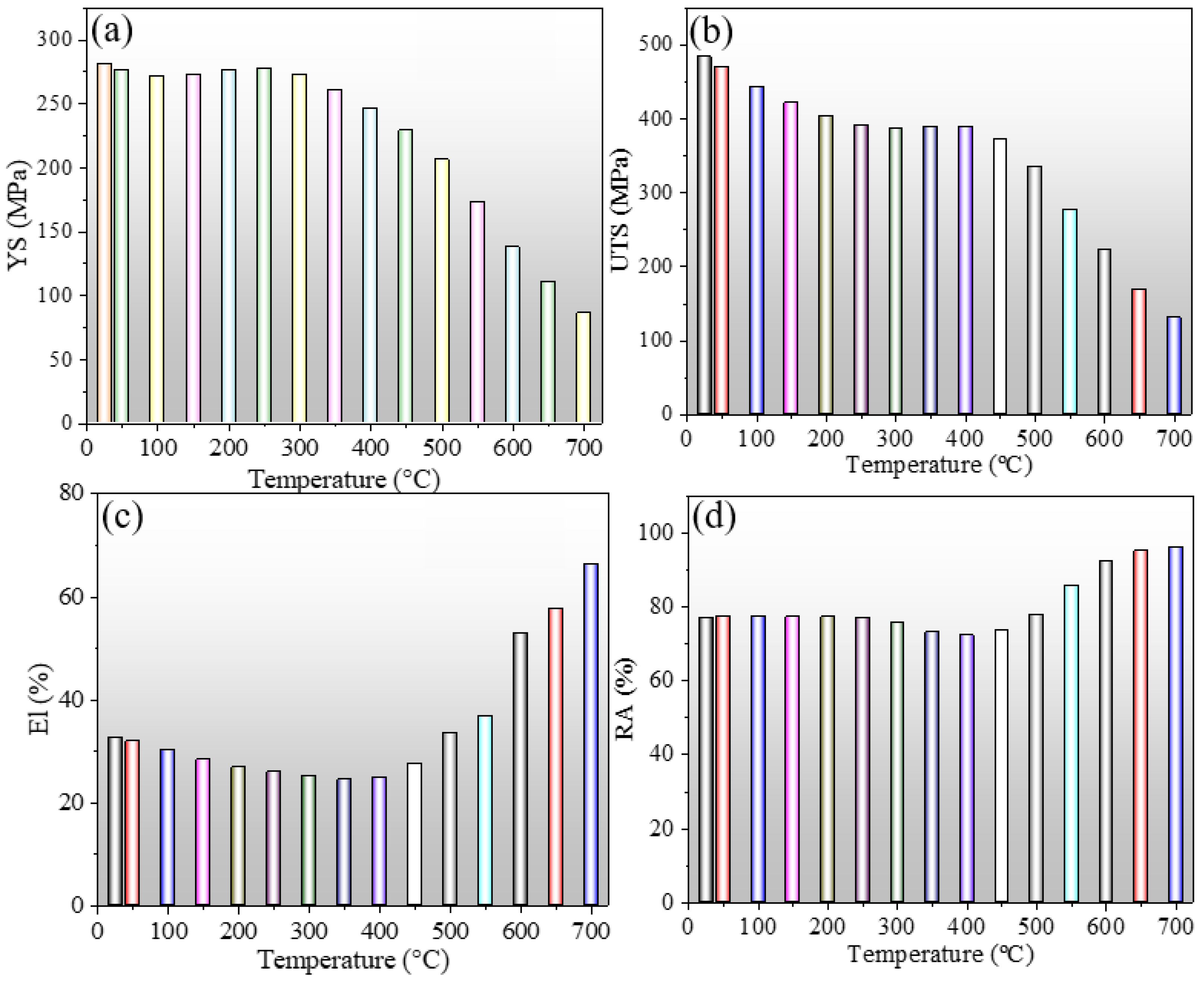
| Temperature (°C) | YS (MPa) | Diff. | UTS (MPa) | Diff. | El (%) | Diff. | RA (%) | Diff. |
|---|---|---|---|---|---|---|---|---|
| 25 | 281.46 | - | 483.46 | - | 32.60 | - | 77.01 | - |
| 50 | 276.32 | −5.14 | 469.65 | −13.81 | 31.97 | −0.63 | 77.21 | 0.20 |
| 100 | 271.59 | −4.73 | 443.75 | −25.90 | 30.24 | −1.73 | 77.36 | 0.15 |
| 150 | 272.85 | 1.26 | 421.27 | −22.48 | 28.29 | −1.95 | 77.26 | −0.11 |
| 200 | 276.15 | 3.30 | 403.03 | −18.24 | 26.81 | −1.48 | 77.19 | −0.07 |
| 250 | 277.13 | 0.98 | 390.74 | −12.29 | 25.97 | −0.84 | 77.08 | −0.11 |
| 300 | 272.45 | −4.68 | 386.66 | −4.08 | 25.26 | −0.71 | 75.82 | −1.26 |
| 350 | 260.90 | −11.55 | 389.85 | 3.14 | 24.40 | −0.86 | 73.11 | −2.71 |
| 400 | 246.07 | −14.83 | 388.77 | −1.08 | 24.87 | 0.47 | 72.22 | −0.89 |
| 450 | 228.85 | −17.22 | 373.22 | −15.55 | 27.60 | 2.73 | 73.69 | 1.47 |
| 500 | 205.88 | −22.97 | 335.43 | −37.79 | 33.41 | 5.81 | 77.94 | 4.25 |
| 550 | 173.36 | −32.52 | 277.00 | −58.43 | 36.76 | 3.35 | 85.64 | 7.70 |
| 600 | 137.55 | −35.81 | 221.93 | −55.07 | 52.99 | 16.23 | 92.39 | 6.75 |
| 650 | 110.07 | −27.48 | 169.34 | −52.59 | 57.77 | 4.78 | 95.10 | 2.71 |
| 700 | 85.73 | −24.34 | 130.41 | −38.93 | 66.22 | 8.45 | 96.18 | 1.08 |
| Exp. value at 450 °C | 238 | 382 | 27 | 74 | ||||
| Absolute error in prediction | 238 − 228.85 = 9.15 | 382 − 373.22 = 8.78 | 27 − 27.60 = −0.60 | 74 − 73.69 = 0.31 | ||||
| Percentage error | 3.84% | 2.29% | 2.22% | 0.42% | ||||
| Exp. value at 700 °C | 89 | 131 | 65 | 96 | ||||
| Absolute error in prediction | 89 − 85.73 = 3.27 | 131 − 130.41 = 0.59 | 65 − 66.22 = −1.22 | 96 − 96.18 = −0.18 | ||||
| Percentage error | 3.67% | 0.45% | 1.88% | 0.19% | ||||
Disclaimer/Publisher’s Note: The statements, opinions and data contained in all publications are solely those of the individual author(s) and contributor(s) and not of MDPI and/or the editor(s). MDPI and/or the editor(s) disclaim responsibility for any injury to people or property resulting from any ideas, methods, instructions or products referred to in the content. |
© 2026 by the authors. Licensee MDPI, Basel, Switzerland. This article is an open access article distributed under the terms and conditions of the Creative Commons Attribution (CC BY) license.
Share and Cite
Ishtiaq, M.; Hong, H.J.; Reddy, N.G.S. Data-Driven Quantification of Temperature-Induced Mechanical Property Variations in 5Cr–0.5Mo Steel Using Artificial Neural Networks. Processes 2026, 14, 2208. https://doi.org/10.3390/pr14132208
Ishtiaq M, Hong HJ, Reddy NGS. Data-Driven Quantification of Temperature-Induced Mechanical Property Variations in 5Cr–0.5Mo Steel Using Artificial Neural Networks. Processes. 2026; 14(13):2208. https://doi.org/10.3390/pr14132208
Chicago/Turabian StyleIshtiaq, Muhammad, Ha Jae Hong, and Nagireddy Gari Subba Reddy. 2026. "Data-Driven Quantification of Temperature-Induced Mechanical Property Variations in 5Cr–0.5Mo Steel Using Artificial Neural Networks" Processes 14, no. 13: 2208. https://doi.org/10.3390/pr14132208
APA StyleIshtiaq, M., Hong, H. J., & Reddy, N. G. S. (2026). Data-Driven Quantification of Temperature-Induced Mechanical Property Variations in 5Cr–0.5Mo Steel Using Artificial Neural Networks. Processes, 14(13), 2208. https://doi.org/10.3390/pr14132208