Article

A Leak Identification Method for Product Oil Pipelines Based on Flow Rate Balance: Principles and Applications

1
PipeChina Institute of Science and Technology, Tianjin 300450, China
2
National Engineering Laboratory for Pipeline Safety, China University of Petroleum-Beijing, Beijing 102249, China
*
Author to whom correspondence should be addressed.
Processes 2025, 13(8), 2459; https://doi.org/10.3390/pr13082459
Submission received: 18 June 2025 / Revised: 29 July 2025 / Accepted: 31 July 2025 / Published: 4 August 2025
(This article belongs to the Special Issue Design, Inspection and Repair of Oil and Gas Pipelines)

Abstract

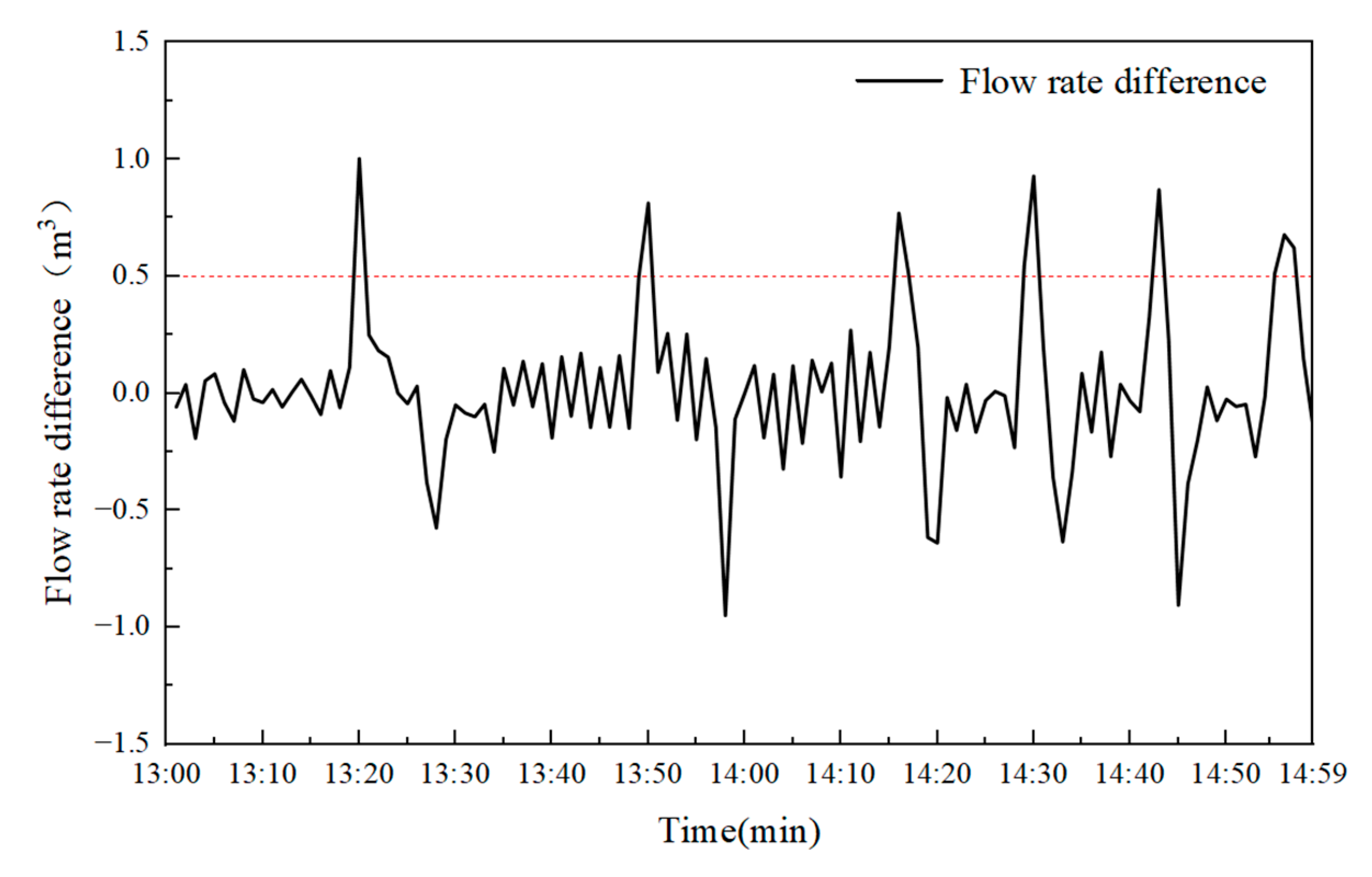
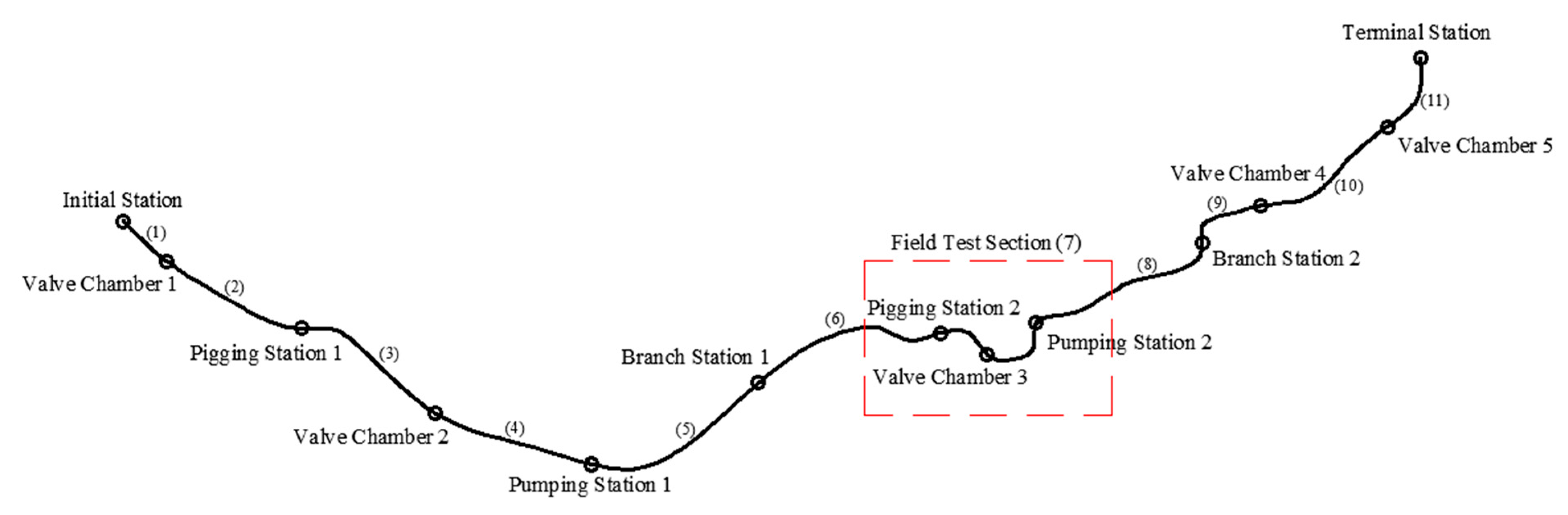
To address the data acquisition limitations of traditional flow balance methods that stem from insufficient flow rate measurements, this study establishes a pipeline flow calculation model based on the pressure data and proposes a pipeline leak identification approach for product oil pipelines. Firstly, field leak tests are designed and conducted on a product oil pipeline in East China by discharging oil in a valve chamber to simulate the leak process. Subsequently, combining the Bernoulli equation with the Leapienzon formula, a calculation model is established for flow rate prediction using the pressure data monitored at the stations and valve chambers along the pipeline. By analyzing the instantaneous flow rate changes at each pipeline section and pressure drops at each station and valve chamber, a dual-parameter collaborative threshold is set based on the flow balance principle, and leaks are identified when both parameters exceed the threshold simultaneously. Finally, the proposed flow rate calculation model and leak identification method are validated with respect to the field test data. The results show that the flow rate model yields a relative error as low as 0.48%, and the leak identification method accurately captured all six leak events in the field test, indicating very good stability and accuracy, with great potential for leak identification and alarm systems for product oil pipelines in engineering applications.
Keywords: product oil pipeline; leak identification; flow balance method; Leapienzon formula; flow rate calculation product oil pipeline; leak identification; flow balance method; Leapienzon formula; flow rate calculation