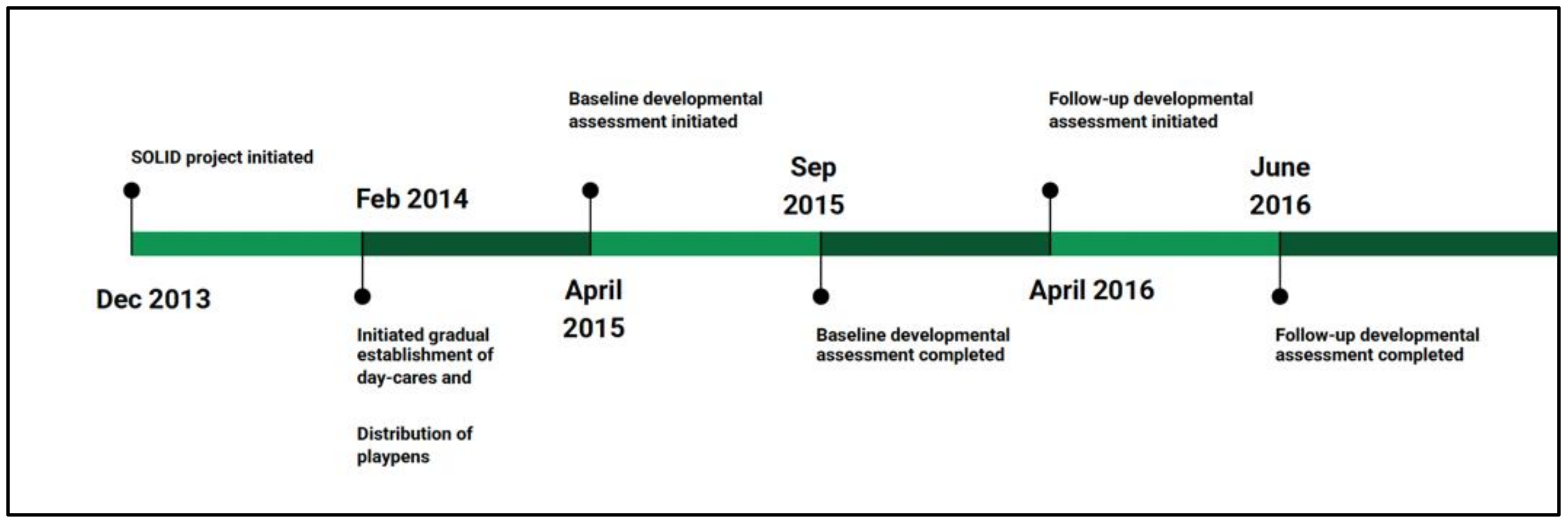
Does Long-Term Enrollment in Day-Care Maintain or Increase Early Developmental Gains—Findings from an Intervention Study in Rural Bangladesh
 , , ,
, , ,
Abstract
1. Introduction
2. Methods
3. Results
4. Discussion
5. Conclusions
Author Contributions
Funding
Institutional Review Board Statement
Informed Consent Statement
Data Availability Statement
Conflicts of Interest
References
- Bornstein, M.H.; Bradley, R.H. Socioeconomic Status, Parenting, and Child Development; Routledge: Oxfordshire, UK, 2014. [Google Scholar]
- Boivin, M.; Bierman, K.L. Promoting School Readiness and Early Learning: Implications of Developmental Research for Practice; Guilford Publications: New York, NY, USA, 2013. [Google Scholar]
- Black, M.M.; Walker, S.P.; Fernald, L.C.H.; Andersen, C.T.; DiGirolamo, A.M.; Lu, C.; McCoy, D.C.; Fink, G.; Shawar, Y.R.; Shiffman, J.; et al. Early childhood development coming of age: Science through the life course. Lancet 2017, 389, 77–90. [Google Scholar] [CrossRef] [Scilit]
- McCoy, D.C.; Peet, E.D.; Ezzati, M.; Danaei, G.; Black, M.M.; Sudfeld, C.R.; Fawzi, W.; Fink, G. Early childhood developmental status in low-and middle-income countries: National, regional, and global prevalence estimates using predictive modeling. PLoS Med. 2016, 13, e1002034. [Google Scholar] [CrossRef] [Scilit] [PubMed]
- Brown, T.W.; van Urk, F.C.; Waller, R.; Mayo-Wilson, E. Centre-based day care for children younger than five years of age in low-and middle-income countries. Cochrane Database Syst. Rev. 2014, 9, CD010543. [Google Scholar] [CrossRef] [Scilit] [PubMed]
- Nahar, B.; Hamadani, J.D.; Ahmed, T.; Tofail, F.; Rahman, A.; Huda, S.N.; Grantham-McGregor, S.M. Effects of psychosocial stimulation on growth and development of severely malnourished children in a nutrition unit in Bangladesh. Eur. J. Clin. Nutr. 2009, 63, 725. [Google Scholar] [CrossRef] [Scilit]
- Walker, S.P.; Wachs, T.D.; Gardner, J.M.; Lozoff, B.; Wasserman, G.A.; Pollitt, E. International Child Development Steering Group. Child development: Risk factors for adverse outcomes in developing countries. Lancet 2007, 369, 145–157. [Google Scholar] [CrossRef] [Scilit]
- Aboud, F.E.; Proulx, K.; Asrilla, Z. An impact evaluation of Plan. Indonesia’s early childhood program. Can. J. Public Health 2016, 107, e366–e372. [Google Scholar] [CrossRef] [Scilit]
- Kabay, S.; Wolf, S.; Yoshikawa, H. “So that his mind will open”: Parental perceptions of early childhood education in urbanizing Ghana. Int. J. Educ. Dev. 2017, 57, 44–53. [Google Scholar] [CrossRef] [Scilit]
- Nair, D.; Alonge, O.; Derakhshani Hamadani, J.; Sharmin Salam, S.; Islam, I.; Hyder, A.A. Developmental assessments during injury research: Is enrollment of very young children in crèches associated with better scores? Int. J. Environ. Res. Public Health 2017, 14, 1130. [Google Scholar] [CrossRef] [Scilit]
- Olakunle Alonge, D.B.; Wadhwaniya, S.; Agrawal, P.; Rahman, A.; Hoque, E.D.; Baset, K.; Salam, S.S.; Bhuiyan, A.; Islam, I.; Talab, A.; et al. Large-scale Evaluation of Interventions Designed to Reduce Childhood Drownings in Rural Bangladesh: A Before and After Cohort Study. Inj. Epidemiol. 2020, 7, 17. [Google Scholar] [CrossRef] [Scilit]
- Rydz, D.; Srour, M.; Oskoui, M.; Marget, N.; Shiller, M.; Birnbaum, R.; Majnemer, A.; Shevell, M.I. Screening for developmental delay in the setting of a community pediatric clinic: A prospective assessment of parent-report questionnaires. Pediatrics 2006, 118, e1178–e1186. [Google Scholar] [CrossRef] [Scilit]
- Hamadani, J.D.; Tofail, F.; Hilaly, A.; Huda, S.N.; Engle, P.; Grantham-McGregor, S.M. Use of Family Care Indicators and Their Relationship with Child Development in Bangladesh. J. Health Popul. Nutr. 2010, 28, 23–33. [Google Scholar] [CrossRef] [Scilit] [PubMed]
- Caldwell, B.M. Descriptive evaluations of child development and of developmental settings. Pediatrics 1967, 40, 46–54. [Google Scholar] [CrossRef] [Scilit]
- Barnett, W.S. Long-term effects of early childhood programs on cognitive and school outcomes. Future Child. 1995, 5, 25–50. [Google Scholar] [CrossRef] [Scilit]
- Watanabe, K.; Flores, R.; Fujiwara, J.; Tran, L.T.H. Early childhood development interventions and cognitive development of young children in rural Vietnam. J. Nutr. 2005, 135, 1918–1925. [Google Scholar] [CrossRef] [Scilit] [PubMed]
- Zelazo, P.D.; Lyons, K.E. The potential benefits of mindfulness training in early childhood: A developmental social cognitive neuroscience perspective. Child Dev. Perspect. 2012, 6, 154–160. [Google Scholar] [CrossRef] [Scilit]
- Walker, S.P.; Chang, S.M.; Vera-Hernández, M.; Grantham-McGregor, S. Early childhood stimulation benefits adult competence and reduces violent behavior. Pediatrics 2011, 127, 849–857. [Google Scholar] [CrossRef] [Scilit]
- Piek, J.P.; Dawson, L.; Smith, L.M.; Gasson, N. The role of early fine and gross motor development on later motor and cognitive ability. Hum. Mov. Sci. 2008, 27, 668–681. [Google Scholar] [CrossRef] [Scilit]
- Butcher, J.E.; Eaton, W.O. Gross and fine motor proficiency in preschoolers: Relationships with free play behaviour and activity level. J. Hum. Mov. Stud. 1989, 16, 27–36. [Google Scholar]
- Lubans, D.R.; Morgan, P.J.; Cliff, D.P.; Barnett, L.M.; Okely, A.D. Fundamental Movement Skills in Children and Adolescents. Sports Med. 2010, 12, 1019–1035. [Google Scholar] [CrossRef] [Scilit]
- Galindo, C.; Sheldon, S.B. School and home connections and children’s kindergarten achievement gains: The mediating role of family involvement. Early Child. Res. Q. 2012, 27, 90–103. [Google Scholar] [CrossRef] [Scilit]
- Obradović, J.; Yousafzai, A.K.; Finch, J.E.; Rasheed, M.A. Maternal scaffolding and home stimulation: Key mediators of early intervention effects on children’s cognitive development. Dev. Psychol. 2016, 52, 1409. [Google Scholar] [CrossRef] [Scilit]
- Jeong, J.; Pitchik, H.O.; Yousafzai, A.K. Stimulation interventions and parenting in low-and middle-income countries: A meta-analysis. Pediatrics 2018, 141, e20173510. [Google Scholar] [CrossRef] [Scilit]
- Venetsanou, F.; Kambas, A.; Giannakidou, D. Environmental factors affecting preschoolers’ motor development. Early Child. Educ. 2010, 37, 319–327. [Google Scholar] [CrossRef] [Scilit]
- Sarsour, K.S.M.; Jutte, D.; Nuru-Jeter, A.; Hinshaw, S.; Boyce, W.T. Family Socioeconomic Status and Child Executive Functions: The Roles of Language, Home Environment, and Single Parenthood. J. Int. Neuropsychol. Soc. 2011, 1, 120–132. [Google Scholar] [CrossRef] [Scilit]
- Lugo-Gil, J.; Tamis-LeMonda, C.S. Family resources and parenting quality: Links to children’s cognitive development across the first 3 years. Child Dev. 2008, 79, 1065–1085. [Google Scholar] [CrossRef] [Scilit] [PubMed]
- Kariger, P.; Frongillo, E.A.; Engle, P.; Britto, P.M.; Sywulka, S.M.; Menon, P. Indicators of Family Care for Development for Use in Multicountry Surveys. J. Health Popul. Nutr. 2012, 30, 472–486. [Google Scholar] [CrossRef] [Scilit]
- Hamadani, J.D.; Mehrin, S.F.; Tofail, F.; Hasan, M.I.; Huda, S.N.; Baker-Henningham, H.; Ridout, D.; Grantham-McGregor, S. Integrating an early childhood development programme into Bangladeshi primary health-care services: An open-label, cluster-randomised controlled trial. Lancet Glob. Health 2019, 7, e366–e375. [Google Scholar] [CrossRef] [Scilit]
- Jeong, J.; McCoy, D.C.; Fink, G. Pathways between paternal and maternal education, caregivers’ support for learning, and early child development in 44 low-and middle-income countries. Early Child. Res. Q. 2017, 41, 136–148. [Google Scholar] [CrossRef] [Scilit]
- Draper, C.E.; Achmat, M.; Forbes, J.; Lambert, E.V. Impact of a community-based programme for motor development on gross motor skills and cognitive function in preschool children from disadvantaged settings. Early Child Dev. Care 2012, 182, 137–152. [Google Scholar] [CrossRef] [Scilit]
- Burchinal, M.R.; Roberts, J.E.; Riggins, R., Jr.; Zeisel, S.A.; Neebe, E.; Bryant, D. Relating quality of center-based child care to early cognitive and language development longitudinally. Child Dev. 2000, 71, 339–357. [Google Scholar] [CrossRef] [Scilit]
- Peisner-Feinberg, E.S.; Burchinal, M.R.; Clifford, R.M.; Culkin, M.L.; Howes, C.; Kagan, S.L.; Yazejian, N. The relation of preschool child-care quality to children’s cognitive and social developmental trajectories through second grade. Child Dev. 2001, 72, 1534–1553. [Google Scholar] [CrossRef] [Scilit] [PubMed]
- Nores, M.; Barnett, W.S. Benefits of early childhood interventions across the world: (Under) Investing in the very young. Econ. Educ. Rev. 2010, 29, 271–282. [Google Scholar] [CrossRef] [Scilit]
- Britto, P.R.; Lye, S.J.; Proulx, K.; Yousafzai, A.K.; Matthews, S.G.; Vaivada, T.; Perez-Escamilla, R.; Rao, N.; Ip, P.; Fernald, L.C.; et al. Nurturing care: Promoting early childhood development. Lancet 2017, 389, 91–102. [Google Scholar] [CrossRef] [Scilit]


| Metrics | Baseline Assessment | Follow Up Assessment |
|---|---|---|
| Timeline | April–September 2015 | April to June 2016 |
| Age group | 9–17 months | 21 to 36 months |
| Screening tool | Ages and Stages questionnaire | Ages and Stages questionnaire |
| Average length of exposure at the time of assessment (days) | Playpen: 115.37 Day-care: 53.42 | Playpen: 443.35 Day-care: 389.93 |
| Variables (ASQ Domains) | Playpen (n = 438) | Day-Care (n = 466) | p Value | |||||||
|---|---|---|---|---|---|---|---|---|---|---|
| Mean | SD | Min | Max | Mean | SD | Min | Max | (Difference across Interventions | ||
| Raw scores | Communication | 89.26 | 22.07 | 0 | 120 | 86.61 | 23.31 | 0 | 120 | 0.08 |
| Gross motor | 83.41 | 23.32 | 5 | 120 | 79.66 | 23.57 | 0 | 120 | 0.016 * | |
| Fine motor | 76.87 | 16.93 | 20 | 120 | 75.55 | 16.75 | 20 | 120 | 0.237 | |
| Personal/Social | 81.54 | 19.12 | 15 | 120 | 78.51 | 20.4 | 5 | 120 | 0.022 * | |
| Problem solving | 72.12 | 18.4 | 10 | 115 | 72.66 | 18.4 | 0 | 115 | 0.653 | |
| TOTAL SCORE | 403.21 | 77.73 | 50 | 555 | 392.98 | 80.58 | 35 | 555 | 0.053 | |
| Z Scores | Communications | 0.31 | 0.65 | −2.09 | 1.34 | 0.24 | 0.68 | −2.15 | 1.34 | 0.119 |
| Gross motor | 0.3 | 0.71 | −2.36 | 1.73 | 0.22 | 0.69 | −1.91 | 1.73 | 0.062 | |
| Fine motor | 0.29 | 0.59 | −1.92 | 2.41 | 0.28 | 0.58 | −1.54 | 2.41 | 0.586 | |
| Personal/Social | 0.31 | 0.62 | −2.14 | 1.74 | 0.26 | 0.63 | −1.58 | 2.14 | 0.209 | |
| Problem solving | 0.26 | 0.65 | −2.11 | 1.6 | 0.31 | 0.61 | −1.77 | 1.80 | 0.195 | |
| TOTAL SCORE | 0.32 | 0.54 | −2.17 | 1.31 | 0.28 | 0.55 | −1.69 | 1.59 | 0.286 | |
| Controls | Sex (male, %) | 54.79 | 49.57 | 0.116 | ||||||
| Age | 25.09 | 1.93 | 21 | 30 | 25.14 | 1.99 | 21 | 30 | 0.743 | |
| FCI 1 | 3.61 | 1.06 | 1 | 7 | 3.38 | 1.11 | 0 | 7 | <0.001 *** | |
| Asset index | 0.06 | 1 | −2.72 | 3.70 | −0.02 | 1.02 | −3.56 | 2.88 | 0.187 | |
| Head Circumference | 46.05 | 3.03 | 42 | 49.9 | 45.70 | 1.32 | 40 | 51 | 0.033 * | |
| Mother’s weight | 51.74 | 10.07 | 35.1 | 89.4 | 49.69 | 9.17 | 35 | 76.8 | 0.480 | |
| Child’s weight | 11.02 | 1.73 | 7.9 | 26.2 | 10.74 | 1.41 | 6.3 | 17.5 | 0.004 ** | |
| Total exposure to intervention (days) 2 | 446.66 | 49.66 | 160 | 537 | 389.72 | 48.01 | 159 | 6490 | <0.001 *** | |
| Disability | 8.82 | 0.48 | 5 | 9 | 8.90 | 0.3 | 8 | 9 | 0.216 | |
| Variables | ASQ Domains, Coefficients (95% Confidence Intervals) | |||||
|---|---|---|---|---|---|---|
| Communication | Gross Motor | Fine Motor | Personal/Social | Problem Solving | Total Score | |
| Day-care (Yes) | 0.39 *** (0.175–0.601) | 0.31 * (0.01–0.60) | 0.10 (−0.14–0.34) | 0.19 ** (0.05–0.35) | 0.34 ** (0.13–0.56) | 0.31 *** (0.141–0.472) |
| Male | 0.06 (−0.024–0.144) | −0.12 ** (−0.21–−0.02) | 0.04 (−0.05–0.13) | 0.06 (−0.01–0.15) | 0.09 * (0.003–0.19) | 0.03 −0.04–0.10) |
| FCI | 0.16 *** (0.112–0.199) | 0.13 *** (0.09–0.17) | 0.09 *** (0.06–0.14) | 0.16 *** (0.13–0.19) | 0.155 *** (0.122–0.19) | 0.15 *** (0.13–0.18) |
| Asset index | −0.05 * (−0.089–−0.001) | −0.05 * (−0.09–−0.01) | −0.03 * (−0.07–−0.003) | −0.02 (−0.06–0.01) | −0.032 −0.07–0.005) | −0.04 ** −0.07–−0.01) |
| Child’s weight | 0.04 ** (0.009–0.065) | 0.04 ** (0.01–0.07) | 0.02 (−0.01–0.06) | 0.03 ** (0.001–0.06) | 0.017 (−0.012–0.05) | 0.03 ** (0.012–0.06) |
| Mother’s weight | 0.005 *** (0.002–0.007) | 0.004 ** (0.01–0.07) | 0.003 ** (0.001–0.006) | 0.003 *** (0.002–0.006) | 0.003 ** (0.001–0.005) | 0.004 *** (0.002–0.006) |
| Disability | 0.40 (0.295–0.496) | 0.27 *** (0.16–0.38) | 0.09 * (0.01–0.19) | 0.18 *** (0.09–0.28) | 0.28 *** (0.188–0.381) | 0.27 *** (0.19–0.36) |
| Constant | −5.28 *** (−6.371–−4.182) | −2.99 *** (−4.61–−1.38) | −1.83 ** (−3.03–−0.63) | −3.08 *** −4.34–−1.82) | −3.54 *** (−4.715–−2.374) | −3.61 *** −4.56–−268) |
| Variables | Change in ASQ Domains, Coefficients (95% Confidence Intervals) | |||||
|---|---|---|---|---|---|---|
| Communication | Gross Motor | Fine Motor | Personal/Social | Problem Solving | Total Score | |
| Day-care (Yes) | 0.007 (−0.437, 0.451) | 0.002 (−0.366, 0.371) | −0.28 (−0.753, 0.190) | 0.123 (−0.080, 0.326) | 0.091 (−0.220, 0.403) | −0.023 (−0.280, 0.233) |
| Male | 0.097 (−0.050, 0.245) | −0.019 (−0.161, 0.121) | 0.101 (−0.049, 0.25) | 0.072 (−0.069, 0.214) | 0.117 ** (−0.013, 0.247) | 0.083 (−0.042, 0.207) |
| FCI | −0.045 *** (−0.121, 0.030) | 0.046 * (−0.02, 0.119) | −0.038 *** (−0.110, 0.032) | −0.025 *** (−0.118, 0.067) | −0.047 *** (−0.11, 0.015) | −0.067 *** (−0.14, 0.006) |
| Asset index | 0.048 (−0.029, 0.125) | −0.001 (−0.086, 0.083) | 0.029 (−0.059, 0.118) | −0.015 (−0.099, 0.069) | −0.001 ** (−0.077, 0.0757) | 0.025 (−0.053, 0.103) |
| Child’s weight | 0.018 (−0.015, 0.052) | −0.001 (−0.042, 0.0401 | −0.0002 * (−0.027, 0.027) | −0.006 (−0.027, 0.015) | 0.009 (−0.009, 0.027) | 0.005 * (0.013, 0.02) |
| Mother’s weight | −0.02 ** (−0.079, 0.031) | −0.036 (−0.082, 0.009) | −0.019 * (−0.062, 0.023) | −0.0021 (−0.07, 0.030) | −0.016 (−0.058, 0.027) | −0.039 (−0.081, 0.002) |
| Disability | 0.056 *** (−0.117, 0.230) | −0.189 (−0.327, 0.051) | −0.183 (−0.332, 0.033) | −0.083 (−0.247, 0.082) | 0.04 ** (−0.125, 0.206) | −0.153 (−0.302, 0.003) |
| Constant | −1.06 (−3.182, 1.05) | 2.249 (0.103, 4.39) | 1.96 (0.133, 3.78) | 1.117 (−0.622, 2.857) | −0.418 (−2.03, 1.202) | 1.8335 (0.330, 3.336) |
| Observations Number of villages Adjusted R-square Rho | 903 146 0.017 0.25 | 903 146 0.0003 0.29 | 903 146 0.02 0.59 | 903 146 0.002 0.28 | 903 146 0.002 0.32 | 903 146 0.006 0.86 |
Publisher’s Note: MDPI stays neutral with regard to jurisdictional claims in published maps and institutional affiliations. |
© 2022 by the authors. Licensee MDPI, Basel, Switzerland. This article is an open access article distributed under the terms and conditions of the Creative Commons Attribution (CC BY) license (https://creativecommons.org/licenses/by/4.0/).
Share and Cite
Agrawal, P.; Nair, D.; Salam, S.S.; Islam, M.I.; Hamadani, J.D.; Alonge, O. Does Long-Term Enrollment in Day-Care Maintain or Increase Early Developmental Gains—Findings from an Intervention Study in Rural Bangladesh. Children 2022, 9, 929. https://doi.org/10.3390/children9070929
Agrawal P, Nair D, Salam SS, Islam MI, Hamadani JD, Alonge O. Does Long-Term Enrollment in Day-Care Maintain or Increase Early Developmental Gains—Findings from an Intervention Study in Rural Bangladesh. Children. 2022; 9(7):929. https://doi.org/10.3390/children9070929
Chicago/Turabian StyleAgrawal, Priyanka, Divya Nair, Shumona Sharmin Salam, Md Irteja Islam, Jena Derakhshani Hamadani, and Olakunle Alonge. 2022. "Does Long-Term Enrollment in Day-Care Maintain or Increase Early Developmental Gains—Findings from an Intervention Study in Rural Bangladesh" Children 9, no. 7: 929. https://doi.org/10.3390/children9070929
APA StyleAgrawal, P., Nair, D., Salam, S. S., Islam, M. I., Hamadani, J. D., & Alonge, O. (2022). Does Long-Term Enrollment in Day-Care Maintain or Increase Early Developmental Gains—Findings from an Intervention Study in Rural Bangladesh. Children, 9(7), 929. https://doi.org/10.3390/children9070929