Review

Growth Failure in Children with Congenital Heart Disease

by
Jihye Lee
1,2,*,
Teresa Marshall
3,
Harleah Buck
1,
Mulder Pamela
1 and
Sandra Daack-Hirsch
1
1
College of Nursing, The University of Iowa, Iowa City, IA 52242, USA
2
The Saban Research Institute, Children’s Hospital Los Angeles, Los Angeles, CA 90027, USA
3
Preventive and Community Dentistry, The University of Iowa, Iowa City, IA 52242, USA
*
Author to whom correspondence should be addressed.
Children 2025, 12(5), 616; https://doi.org/10.3390/children12050616

Submission received: 4 April 2025 / Revised: 5 May 2025 / Accepted: 8 May 2025 / Published: 9 May 2025
(This article belongs to the Section Pediatric Cardiology)

Abstract

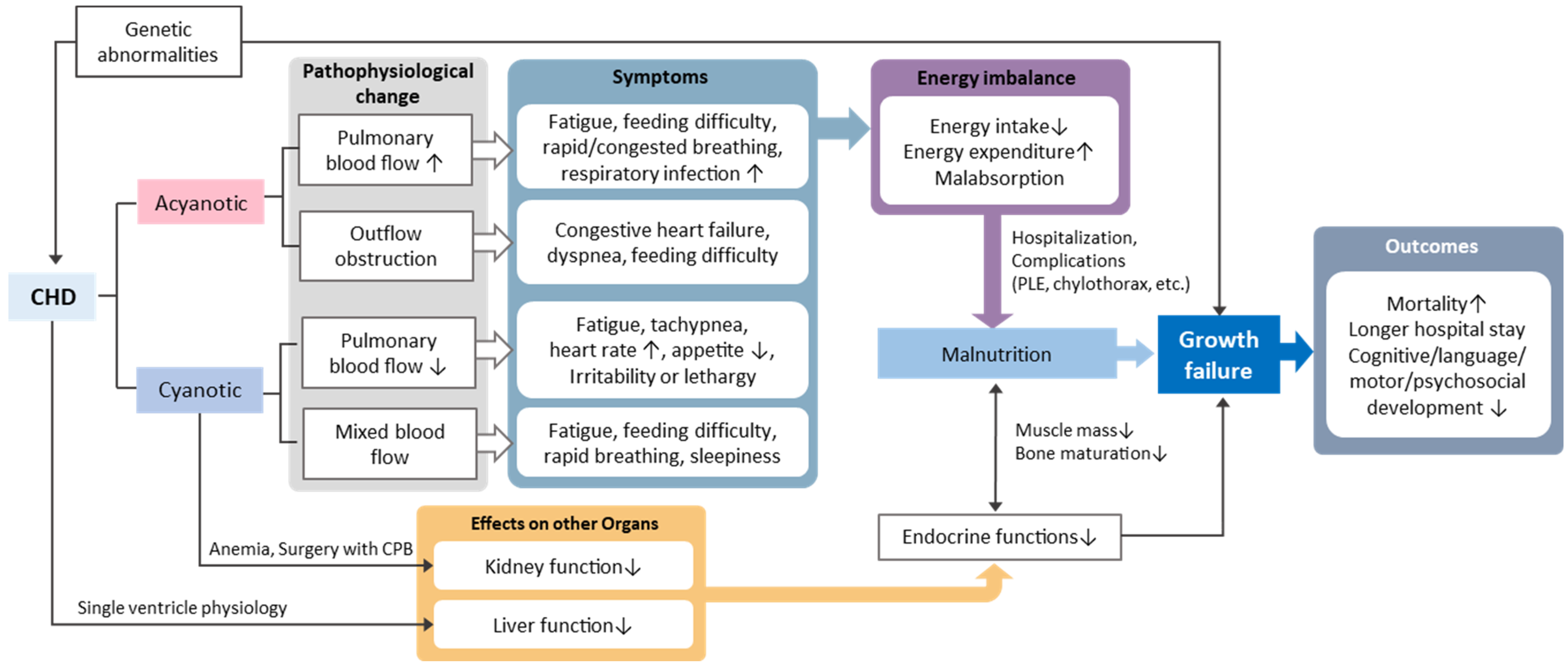
Background/Objectives: Growth failure is a common complication in children with congenital heart disease (CHD), yet its underlying mechanisms and consequences remain incompletely understood. This review aims to provide a comprehensive overview of growth failure in children with CHD and outline a framework of factors contributing to this condition. Methods: To lay the foundation for this narrative review, several databases were searched using broad search terms related to CHD and growth failure. Results: Growth failure is most pronounced during the first year of life, but often improves after achieving hemodynamic stability through surgical or medical interventions. However, children with complex conditions, such as single-ventricle physiology or multiple heart defects, may experience persistent growth impairment due to chronic disease effects. Specific features of CHD—cyanosis, pulmonary hypertension, and low cardiac output—can further hinder growth by disrupting endocrine function and impairing musculoskeletal development. Long-term use of medications and exposure to repeated diagnostic procedures also contribute to growth failure. Beyond physical effects, growth failure profoundly influences neurodevelopment, psychosocial well-being, and survival outcomes. Based on our review, we have developed a knowledge map to better understand the complexities of growth failure in children with CHD. Conclusions: A thorough understanding of the multifaceted contributors to growth failure in CHD is essential for identifying high-risk children and devising strategies to support optimal growth. Integrating this knowledge into clinical practice can improve long-term outcomes for children with CHD.
Keywords: congenital heart disease; growth; failure to thrive; malnutrition; developmental; review congenital heart disease; growth; failure to thrive; malnutrition; developmental; review