


Acceptability and Tolerability of Extended Reality Relaxation Training with and without Wearable Neurofeedback in Pediatric Migraine



Abstract
1. Introduction
2. Materials and Methods
2.1. Participants
2.2. Procedures
2.3. Measures
2.3.1. Baseline Measures
2.3.2. In-Clinic Post Experience Surveys
2.3.3. Home Trial Post Experience Survey
2.4. Analyses
3. Results
3.1. Participant Characteristics
3.2. In-Clinic Testing Results
3.3. Home Trial Results
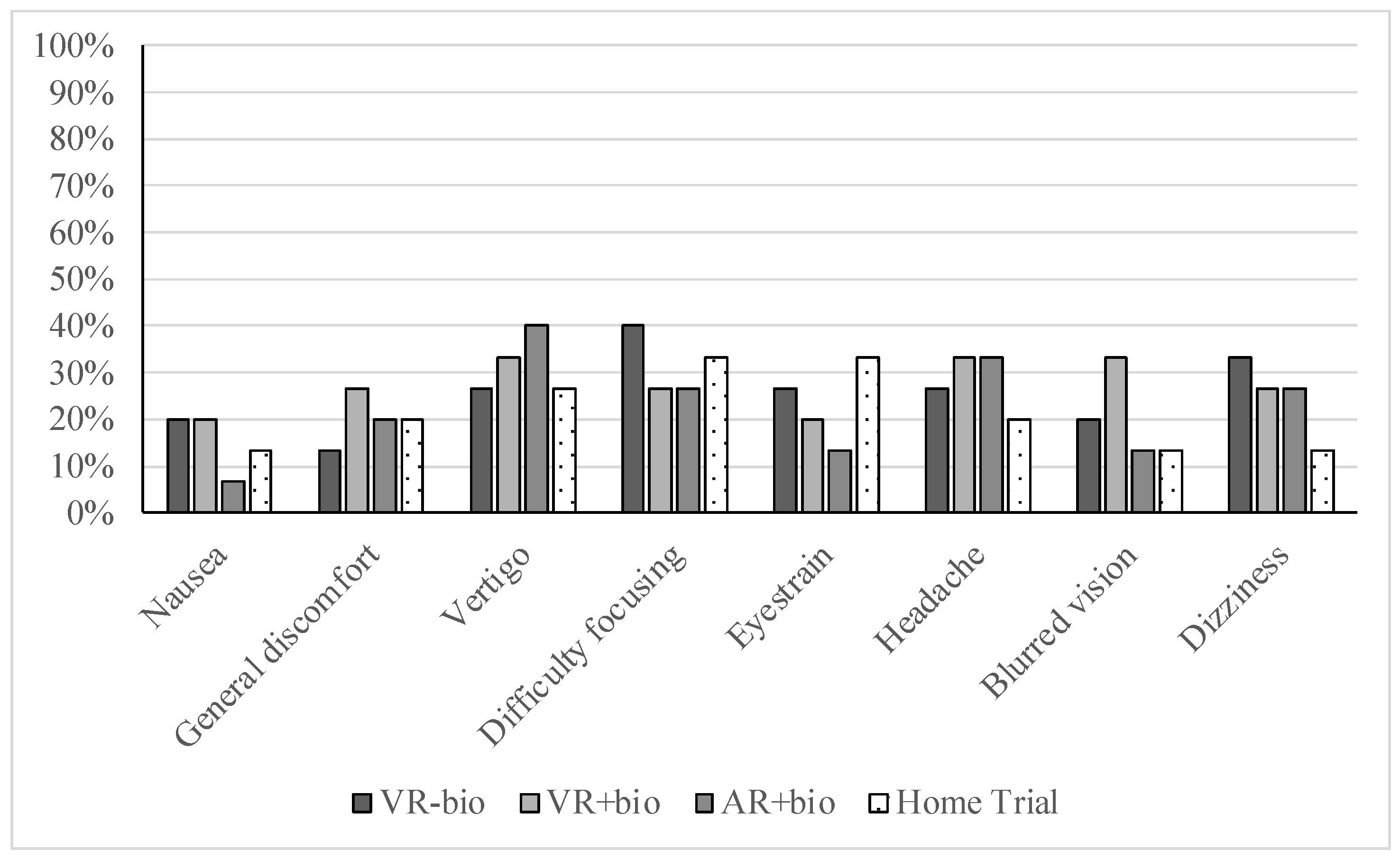
3.4. Side Effect Results
3.4.1. Side Effects during In-Clinic Testing
3.4.2. Side Effects during the Home Trial
4. Discussion
Author Contributions
Funding
Institutional Review Board Statement
Informed Consent Statement
Data Availability Statement
Conflicts of Interest
References
- Leonardi, M.; Grazzi, L.; D’Amico, D.; Martelletti, P.; Guastafierro, E.; Toppo, C.; Raggi, A. Global burden of headache disorders in children and adolescents 2007–2017. Int. J. Environ. Res. Public Health 2020, 18, 250. [Google Scholar] [CrossRef] [Scilit] [PubMed]
- Nieswand, V.; Richter, M.; Gossrau, G. Epidemiology of headache in children and adolescents-another type of pandemia. Curr. Pain Headache Rep. 2020, 24, 62. [Google Scholar] [CrossRef] [Scilit] [PubMed]
- Isensee, C.; Fernandez Castelao, C.; Kröner-Herwig, B. Developmental trajectories of paediatric headache—Sex-specific analyses and predictors. J. Headache Pain 2016, 17, 32. [Google Scholar] [CrossRef] [Scilit]
- Torres-Ferrús, M.; On behalf of School of Advanced Studies of European Headache Federation (EHF-SAS); Ursitti, F.; Alpuente, A.; Brunello, F.; Chiappino, D.; de Vries, T.; Di Marco, S.; Ferlisi, S.; Guerritore, L.; et al. From transformation to chronification of migraine, pathophysiological and clinical aspects. J. Headache Pain 2020, 21, 42. [Google Scholar] [CrossRef] [Scilit]
- Andreou, A.P.; Edvinsson, L. Mechanisms of migraine as a chronic evolutive condition. J. Headache Pain 2019, 20, 117. [Google Scholar] [CrossRef] [Scilit] [PubMed]
- Borkum, J.M. Brain energy deficit as a source of oxidative stress in migraine, a molecular basis for migraine susceptibility. Neurochem. Res. 2021, 46, 1913–1932. [Google Scholar] [CrossRef] [Scilit]
- Locher, C.; Kossowsky, J.; Koechlin, H.; Lam, T.L.; Barthel, J.; Berde, C.B.; Gaab, J.; Schwarzer, G.; Linde, K.; Meissner, K. Efficacy, safety, and acceptability of pharmacologic treatments for pediatric migraine prophylaxis, A systematic review and network meta-analysis. JAMA Pediatr. 2020, 174, 341–349. [Google Scholar] [CrossRef] [Scilit]
- Law, E.F.; Palermo, T.M.; Zhou, C.; Groenewald, C. Economic impact of headache and psychiatric comorbidities on healthcare expenditures among children in the United States: A retrospective cross-sectional study. Headache 2019, 59, 1504–1515. [Google Scholar] [CrossRef] [Scilit]
- Obermeier, V.; Murawski, M.; Heinen, F.; Landgraf, M.N.; Straube, A.; von Kries, R.; Ruscheweyh, R. Total health insurance costs in children with a migraine diagnosis compared to a control group. J. Headache Pain 2021, 22, 140. [Google Scholar] [CrossRef] [Scilit]
- Darling, K.E.; Benore, E.R.; Webster, E.E. Biofeedback in pediatric populations, a systematic review and meta-analysis of treatment outcomes. Transl. Behav. Med. 2020, 10, 1436–1449. [Google Scholar] [CrossRef] [Scilit]
- Meyer, B.; Keller, A.; Wöhlbier, H.-G.; Overath, C.H.; Müller, B.; Kropp, P. Progressive muscle relaxation reduces migraine frequency and normalizes amplitudes of contingent negative variation (CNV). J. Headache Pain 2016, 17, 37. [Google Scholar] [CrossRef] [Scilit] [PubMed]
- Stubberud, A.; Varkey, E.; McCrory, D.C.; Pedersen, S.A.; Linde, M. Biofeedback as prophylaxis for pediatric migraine, A meta-analysis. Pediatrics 2016, 138, e20160675. [Google Scholar] [CrossRef] [Scilit] [PubMed]
- Fisher, E.; Law, E.; Dudeney, J.; Eccleston, C.; Palermo, T.M. Psychological therapies (remotely delivered) for the management of chronic and recurrent pain in children and adolescents. Cochrane Database Syst. Rev. 2019, 4, CD011118. [Google Scholar] [CrossRef] [Scilit] [PubMed]
- Ms, R.R.R.; Ryan, J.L.; Hershey, A.D.; Powers, S.W.; Aylward, B.S.; Hommel, K.A. Treatment adherence in patients with headache, a systematic review. Headache 2014, 54, 795–816. [Google Scholar]
- Matsuzawa, Y.; Lee, Y.S.C.; Fraser, F. Barriers to behavioral treatment adherence for headache, An examination of attitudes, beliefs, and psychiatric factors. Headache 2018, 59, 19–31. [Google Scholar] [CrossRef] [Scilit]
- Prensky, M. Digital datives, digital Immigrants, Part 1. Horizon 2001, 9, 3–6. [Google Scholar]
- Martins, I.P.; Westerfield, M.; Lopes, M.; Maruta, C.; Gil-da-Cost, R. Brain state monitoring for the future prediction of migraine attacks. Cephalalgia 2020, 40, 255–265. [Google Scholar] [CrossRef] [Scilit]
- Tajerian, M.; Clark, J.D. Nonpharmacological interventions in targeting pain-related brain plasticity. Neural Plast 2017, 2017, 2038573. [Google Scholar] [CrossRef] [Scilit]
- Walker, J.E. QEEG-guided neurofeedback for recurrent migraine headaches. Clin. EEG Neurosci. 2011, 42, 59–61. [Google Scholar] [CrossRef] [Scilit]
- Eijlers, R.; Utens, E.M.W.J.; Staals, L.M.; de Nijs, P.F.A.; Berghmans, J.M.; Wijnen, R.M.H.; Hillegers, M.H.J.; Dierckx, B.; Legerstee, J.S. Systematic review and meta-analysis of virtual reality in pediatrics, effects on pain and anxiety. Anesth. Analg. 2019, 129, 1344–1353. [Google Scholar] [CrossRef] [Scilit]
- Won, A.S.; Bailey, J.; Bailenson, J.; Tataru, C.; Yoon, I.A.; Golianu, B. Immersive virtual reality for pediatric pain. Children 2017, 4, 52. [Google Scholar] [CrossRef] [Scilit] [PubMed]
- Li, A.; Montaño, Z.; Chen, V.J.; Gold, J.I. Virtual reality and pain management, current trends and future directions. Pain Manag. 2011, 1, 147–157. [Google Scholar] [CrossRef] [Scilit] [PubMed]
- Colloca, L.; Raghuraman, N.; Wang, Y.; Akintola, T.; Brawn-Cinani, B.; Colloca, G.; Kier, C.; Varshney, A.; Murthi, S. Virtual reality, physiological and behavioral mechanisms to increase individual pain tolerance limits. Pain 2020, 161, 2010–2021. [Google Scholar] [CrossRef] [Scilit] [PubMed]
- Bernaerts, S.; Bonroy, B.; Daems, J.; Sels, R.; Struyf, D.; Gies, I.; van de Veerdonk, W. Virtual reality for distraction and relaxation in a pediatric hospital setting, An interventional study with a mixed-methods design. Front. Digit Health 2020, 4, 866119. [Google Scholar] [CrossRef] [Scilit]
- Czajkowski, S.M.; Powell, L.H.; Adler, N.; Naar-King, S.; Reynolds, K.D.; Hunter, C.M.; Laraia, B.; Olster, D.H.; Perna, F.M.; Peterson, J.C.; et al. From ideas to efficacy, The ORBIT model for developing behavioral treatments for chronic diseases. Health Psychol. 2015, 34, 971–982. [Google Scholar] [CrossRef] [Scilit]
- Headache Classification Committee of the International Headache Society. The International Classification of Headache Disorders. Cephalalgia 2018, 38, 1–211. [Google Scholar]
- Hennink, M.; Kaiser, B.N. Sample sizes for saturation in qualitative research, A systematic review of empirical tests. Soc. Sci. Med. 2022, 292, 114523. [Google Scholar] [CrossRef] [Scilit]
- Harris, P.A.; Taylor, R.; Thielke, R.; Payne, J.; Gonzalez, N.; Conde, J.G. Research electronic data capture (REDCap)—A metadata-driven methodology and workflow process for providing translational research informatics support. J. Biomed. Inform. 2009, 42, 377–381. [Google Scholar] [CrossRef] [Scilit]
- Harris, P.A.; Taylor, R.; Minor, B.L.; Elliott, V.; Fernandez, M.; O’Neal, L.; McLeod, L.; Delacqua, G.; Delacqua, F.; Kirby, J.; et al. The REDCap consortium, Building an international community of software platform partners. J. Biomed. Inform. 2019, 95, 103208. [Google Scholar] [CrossRef] [Scilit]
- Pavlou, M.; Whitney, S.; Alkathiry, A.A.; Huett, M.; Luxon, L.M.; Raglan, E.; Godfrey, E.L.; Eva-Bamiou, D. The Pediatric Vestibular Symptom Questionnaire, A validation study. J. Pediatr. 2016, 168, 171–177. [Google Scholar] [CrossRef] [Scilit]
- Rosen, L.D.; Whaling, K.; Carrier, L.M.; Cheever, N.A.; Rokkum, J. The media and technology usage and attitudes scale, An empirical investigation. Comput. Hum. Behav. 2013, 29, 2501–2511. [Google Scholar] [CrossRef] [Scilit] [PubMed]
- Zhou, L.; Bao, J.; Setiawan, I.M.A.; Saptono, A.; Parmanto, B. The mHealth App Usability Questionnaire (MAUQ), Development and validation study. JMIR Mhealth Uhealth 2019, 7, e11500. [Google Scholar] [CrossRef] [Scilit]
- Tcha-Tokey, K.; Christmann, O.; Loup-Escande, E.; Richir, S. Proposition and validation of a questionnaire to measure the user experience in immersive virtual environments. Int. J. Virtual Real. 2016, 16, 33–48. [Google Scholar] [CrossRef] [Scilit]
- Sevinc, V.; Berkman, M.I. Psychometric evaluation of Simulator Sickness Questionnaire and its variants as a measure of cybersickness in consumer virtual environments. Appl. Ergon. 2020, 82, 102958. [Google Scholar] [CrossRef] [Scilit] [PubMed]
- Rosenthal, R. Parametric measures of effect size. In The Handbook of Research Synthesis; Cooper, H., Hedges, L.V., Eds.; Russell Sage Foundation: New York, NY, USA, 1994; pp. 231–244. [Google Scholar]
- Bougea, A.; Spantideas, N.; Chrousos, G.P. Stress management for headaches in children and adolescents, A review and practical recommendations for health promotion programs and well-being. J. Child Health Care 2018, 22, 19–33. [Google Scholar] [CrossRef] [Scilit]
- Shahrbanian, S.; Ma, X.; Aghaei, N.; Korner-Bitensky, N.; Moshiri, K.; Simmonds, M.J. Use of virtual reality (immersive vs. non immersive) for pain management in children and adults, A systematic review of evidence from randomized controlled trials. Eur. J. Exp. Biol. 2012, 2, 1408–1422. [Google Scholar]
- Czech, O.; Wrzeciono, A.; Rutkowska, A.; Guzik, A.; Kiper, P.; Rutkowski, S. Virtual reality interventions for needle-related procedural pain, fear and anxiety—A systematic review and meta-analysis. J. Clin. Med. 2021, 10, 3248. [Google Scholar] [CrossRef] [Scilit]
- Nilsson, S.; Finnström, B.; Kokinsky, E.; Enskär, K. The use of virtual reality for needle-related procedural pain and distress in children and adolescents in a paediatric oncology unit. Eur. J. Oncol. Nurs. 2009, 13, 102–109. [Google Scholar] [CrossRef] [Scilit]
- Jahn, K.; Langhagen, T.; Heinen, F. Vertigo and dizziness in children. Curr. Opin. Neurol. 2015, 28, 78–82. [Google Scholar] [CrossRef] [Scilit]
- Alghadir, A.H.; Anwer, S. Effects of vestibular rehabilitation in the management of a vestibular migraine, A review. Front. Neurol. 2018, 9, 440. [Google Scholar] [CrossRef] [Scilit]
- Martin, P.R.; MacLeod, C. Behavioral management of headache triggers: Avoidance of triggers is an inadequate strategy. Clin. Psychol. Rev. 2009, 29, 483–495. [Google Scholar] [CrossRef] [Scilit] [PubMed]
- Won, A.S.; Tataru, C.A.; Cojocaru, C.M.; Krane, E.J.; Bailenson, J.N.; Niswonger, S.; Golianu, B. Two virtual reality pilot studies for the treatment of pediatric CRPS. Pain Med. 2015, 16, 1644–1647. [Google Scholar] [CrossRef] [Scilit]
- Lüddecke, R.; Felnhofer, A. Virtual reality biofeedback in health, a scoping review. Appl. Psychophys Biofeedback 2022, 47, 1–15. [Google Scholar] [CrossRef] [Scilit] [PubMed]
- Blum, J.; Rockstroh, C.; Göritz, A.S. Heart rate variability biofeedback based on slow-paced breathing with immersive virtual reality nature scenery. Front. Psychol. 2019, 10, 2172. [Google Scholar] [CrossRef] [Scilit] [PubMed]
- Shiri, S.; Feintuch, U.; Weiss, B.N.; Pustilnik, B.A.; Geffen, B.T.; Kay, B.; Meiner, Z.; Berger, I. A virtual reality system combined with biofeedback for treating pediatric chronic headache—A pilot study. Pain Med. 2013, 14, 621–627. [Google Scholar] [CrossRef] [Scilit] [PubMed]
- Hsiao, F.-J.; Chen, W.-T.; Pan, L.-L.H.; Liu, H.-Y.; Wang, Y.-F.; Chen, S.-P.; Lai, K.-L.; Coppola, G.; Wang, S.-J. Dynamic brainstem and somatosensory cortical excitability during migraine cycles. J. Headache Pain 2022, 23, 21. [Google Scholar] [CrossRef] [Scilit] [PubMed]
- Bohil, C.J.; Alicea, B.; Biocca, F.A. Virtual reality in neuroscience research and therapy. Nat. Rev. Neurosci. 2011, 12, 752–762. [Google Scholar] [CrossRef] [Scilit]
- Zhang, Y.; Zhang, L.; Hua, H.; Jin, J.; Zhu, L.; Shu, L.; Xu, X.; Kuang, F.; Liu, Y. Relaxation degree analysis using frontal electroencephalogram under virtual reality relaxation scenes. Front. Neurosci. 2021, 15, 719869. [Google Scholar] [CrossRef] [Scilit]
- Pardini, S.; Gabrielli, S.; Dianti, M.; Novara, C.; Zucco, G.M.; Mich, O.; Forti, S. The role of personalization in the user experience, preferences and engagement with virtual reality environments for relaxation. Int. J. Environ. Res. Public Health 2022, 19, 7237. [Google Scholar] [CrossRef] [Scilit]

| Condition | Description | Hardware Used |
|---|---|---|
| (1) VR-bio: Immersive virtual reality relaxation training without use of a paired wearable sensor for biofeedback | Participants were instructed to relax and look all around (360 degrees) as desired while wearing a virtual reality headset. Virtual reality content included choice of: (a) an underwater scene; (b) a forest and waterfall scene; or (c) a beach scene. Audio of calming music and/or nature sounds, along with instruction in relaxed breathing, autogenic relaxation, or mindfulness, were simultaneously played through the headset. | (1) Pico G2 4K all-in-one virtual reality headset |
| (2) VR+bio: Immersive virtual reality with use of a paired wearable sensor for biofeedback | Participants were instructed to relax while wearing a virtual reality headset combined with a consumer electroencephalography (EEG) sensor headband. Virtual reality content included choice of: (a) a snow and streaming water scene; (b) a waterfall scene; or (c) a rainfall scene. Overlaid on the virtual reality imagery is a thin horizontal line representing the patient’s baseline EEG activity, along with a glowing firefly that moves up or down off the horizontal line depending on the user’s calmness level. Calmness level is calculated by an algorithm applied to near-real time brainwave frequency band data (delta, theta, low-alpha, high-alpha, low-beta, high-beta, low-gamma, and mid-gamma) from the single-channel EEG headband. Additionally, the virtual environment changes based on the brainwave data (e.g., rain stops, clouds clear, and a rainbow appears when brainwave data are interpreted to indicate success in sustaining reduced stress/calmness based on reduction in high beta/low gamma EEG activity). Audio instruction in relaxation strategies (relaxed breathing, autogenic relaxation, or mindfulness), along with calming music, is simultaneously played through the virtual reality headset. | (1) Pico G2 4K all-in-one virtual reality headset (2) Macrotellect Brainlink Lite EEG headband |
| (3) AR+bio: Augmented reality with use of a paired wearable sensor for biofeedback | Participants were instructed to wear the EEG headband while engaging with audio-visual content via an app on a tablet (iPad). Virtual content comprised the choice of (a) a butterfly scene; (b) a solar system scene; or (c) a flowers scene. This visual content viewed by users in the app is overlaid on top of live video input from the tablet’s camera. The virtual content changes depending on level of relaxation, based on processed calmness data from the EEG headband (e.g., flowers grow, the sun grows bigger and brighter, or butterflies start to hatch when brainwave data are interpreted to indicate success in sustaining reduced stress/calmness based on reduction in high beta/low gamma EEG activity). Audio instruction in relaxed breathing, autogenic relaxation, or mindfulness, along with calming music, is played as part of the content. | (1) Apple iPad tablet (2) Macrotellect Brainlink Lite EEG headband |
| Variable | Sample Value |
|---|---|
| Sex, n (%) | |
| Male | 7 (46.7%) |
| Female | 8 (53.3%) |
| Race, n (%) | |
| White | 14 (93.3%) |
| Black/African-American | 1 (6.7%) |
| Ethnicity, n (%) | |
| Not Hispanic or Latino | 14 (93.3%) |
| Hispanic or Latino | 1 (6.7%) |
| Age, M ± SD (min - max) | 12.9 ± 2.0 (10–17) |
| Grade in school, M ± SD (min – max) | 7.6 ± 2.1 (4–11) |
| Diagnoses, n (%) | |
| Chronic migraine without aura | 7 (46.7%) |
| Migraine without aura | 4 (26.7%) |
| Migraine with aura | 3 (20.0%) |
| Chronic migraine with aura | 1 (6.7%) |
| Technology ownership, n (%) | |
| Smartphone | 13 (86.7%) |
| Desktop computer | 8 (53.3%) |
| Tablet | 4 (26.7%) |
| Laptop | 4 (26.7%) |
| Game console | 2 (13.3%) |
| Wearable device | 2 (13.3%) |
| Prior experience with XR, n (%) | |
| No | 10 (66.7%) |
| Yes | 5 (33.3%) |
| Hours per day of technology use, M ± SD (min to max) | 6.87 ± 4.81 (0–21) |
| Item | VR-bio (M ± SD) | VR+bio (M ± SD) | AR+bio (M ± SD) | Overall (M ± SD) | Home Trial (M ± SD) |
|---|---|---|---|---|---|
| It was simple to use this system. | 4.33 ± 0.49 | 4.13 ± 0.35 | 4.00 ± 0.38 | 4.16 ± 0.42 | 4.09 ± 0.54 |
| The display quality was distracting. * | 2.13 ± 0.83 | 2.20 ± 0.94 | 2.60 ± 1.06 | 2.31 ± 0.95 | 2.36 ± 0.81 |
| I felt I controlled the situation. | 3.73 ± 0.80 | 3.40 ± 1.18 | 3.33 ± 0.82 | 3.49 ± 0.94 | 4.00 ± 0.63 |
| The experience gave me a sense of well-being. | 4.07 ± 0.59 | 3.73 ± 0.80 | 3.53 ± 0.74 | 3.78 ± 0.74 | 4.18 ± 0.74 |
| I enjoyed being in the virtual environment. | 4.33 ± 0.62 | 4.07 ± 0.80 | 3.73 ± 0.80 | 4.04 ± 0.77 | 4.55 ± 0.52 |
| I got tense in the virtual environment. * | 2.07 ± 0.80 | 2.07 ± 0.80 | 2.60 ± 0.91 | 2.24 ± 0.86 | 2.18 ± 0.98 |
| I feel confident I could learn skills using this type of program. | 3.80 ± 0.94 | 3.33 ± 0.82 | 3.13 ± 0.83 | 3.42 ± 0.89 | 3.64 ± 1.03 |
| I found this virtual environment was lame. * | 1.60 ± 0.83 | 2.07 ± 0.88 | 2.53 ± 1.19 | 2.07 ± 1.03 | 2.09 ± 0.70 |
| I liked the interface of this system. | 4.07 ± 0.88 | 3.80 ± 0.78 | 3.60 ± 0.83 | 3.82 ± 0.83 | 3.82 ± 0.40 |
| I would use the system again. | 4.33 ± 0.62 | 4.13 ± 0.74 | 3.40 ± 0.74 | 3.96 ± 0.80 | 4.27 ± 0.65 |
| The system would be useful for my health and well-being. | 4.00 ± 0.66 | 3.67 ± 0.90 | 3.53 ± 0.74 | 3.73 ± 0.78 | 3.91 ± 0.70 |
| Overall, I am satisfied with the system. | 4.47 ± 0.67 | 4.20 ± 0.56 | 3.60 ± 0.83 | 4.09 ± 0.76 | 4.27 ± 0.47 |
| Total acceptability score (mean of all items) | 4.11 ± 0.49 | 3.84 ± 0.57 | 3.51 ± 0.62 | 3.82 ± 0.60 | 3.94 ± 0.44 |
| Variable | r (95% CI) | p |
|---|---|---|
| Age | −0.17 (−0.63 to 0.37) | 0.54 |
| Sex | −0.43 (−0.76 to 0.14) | 0.14 |
| PVSQ Total Score | −0.43 (−0.77 to 0.11) | 0.11 |
| Hours per day of technology use | −0.17 (−0.63 to 0.38) | 0.55 |
| Technology Attitudes Scale Score | −0.44 (−0.09 to 0.78) | 0.10 |
| Technology Comfort Score | 0.22 (−0.33 to 0.66) | 0.43 |
Disclaimer/Publisher’s Note: The statements, opinions and data contained in all publications are solely those of the individual author(s) and contributor(s) and not of MDPI and/or the editor(s). MDPI and/or the editor(s) disclaim responsibility for any injury to people or property resulting from any ideas, methods, instructions or products referred to in the content. |
© 2023 by the authors. Licensee MDPI, Basel, Switzerland. This article is an open access article distributed under the terms and conditions of the Creative Commons Attribution (CC BY) license (https://creativecommons.org/licenses/by/4.0/).
Share and Cite
Connelly, M.; Boorigie, M.; McCabe, K. Acceptability and Tolerability of Extended Reality Relaxation Training with and without Wearable Neurofeedback in Pediatric Migraine. Children 2023, 10, 329. https://doi.org/10.3390/children10020329
Connelly M, Boorigie M, McCabe K. Acceptability and Tolerability of Extended Reality Relaxation Training with and without Wearable Neurofeedback in Pediatric Migraine. Children. 2023; 10(2):329. https://doi.org/10.3390/children10020329
Chicago/Turabian StyleConnelly, Mark, Madeline Boorigie, and Klanci McCabe. 2023. "Acceptability and Tolerability of Extended Reality Relaxation Training with and without Wearable Neurofeedback in Pediatric Migraine" Children 10, no. 2: 329. https://doi.org/10.3390/children10020329
APA StyleConnelly, M., Boorigie, M., & McCabe, K. (2023). Acceptability and Tolerability of Extended Reality Relaxation Training with and without Wearable Neurofeedback in Pediatric Migraine. Children, 10(2), 329. https://doi.org/10.3390/children10020329