


Abstract
Volatile Organic Compounds (VOCs) are important indicators of environmental pollution and metabolic activity, making their sensitive and selective detection highly relevant for applications in health monitoring and air quality assessment. Graphene, owing to its exceptional charge transport properties, large surface area, and tunable surface chemistry, is a promising candidate for advanced gas and VOCs sensing. Here we report chemoresistive sensors based on pristine graphene and graphene decorated with platinum (Pt), palladium (Pd), and gold (Au) nanoparticles toward both aromatic (benzene, toluene, and xylene) and non-aromatic (ethanol, methanol, and acetone) vapor compound detection. The detection is achieved at room temperature, and the results demonstrate that graphene functionalized with noble metal nanoparticles shows significant enhancements in sensitivity compared to pristine graphene, mainly against ethanol, toluene and xylene vapors for the Au–graphene sensors. A comparative study with Multi-Walled Carbon Nanotube (MWCNT) sensors decorated with the same type of nanoparticles revealed clear advantages of graphene, attributed to the microstructure and porous structure of graphene powders, which facilitate efficient charge transfer upon vapor adsorption.
1. Introduction
Volatile organic compounds (VOCs) constitute a major class of hazardous air pollutants released into the environment because of both industrial processes and everyday human activities [1]. In addition to industrial emissions, VOCs originate from common sources such as household cleaning products, painting, vehicle exhaust, tobacco smoke, and cooking [2]. Even at trace concentrations in the environment, they not only contribute to adverse environmental consequences, negatively impacting ecosystems and overall environmental health in general, but also impose significant risks to the health of humans and animals [3,4]. A prominent example is benzene, an aromatic VOC that is recognized as a carcinogen [5,6], and establishing a safe exposure limit for this compound is challenging.
Various countries and regions have developed their own regulatory frameworks and standards to address air quality and industrial emissions, including those related to VOCs. The American Conference of Governmental Industrial Hygienists (ACGIH) has set occupational exposure limits, specifying that the eight-hour time-weighted average (TWA) concentration of benzene indoors should not exceed 0.5 ppm, while for ethanol, the limit is 1000 ppm [2,7,8]. Similarly, the European Parliament, through a Council directive, has determined that the permissible limit for exposure to benzene is 1.6 parts per billion (ppb). In addition, the US Occupational Safety and Health Administration has defined Permissible Exposure Limits (PELs) for toluene and xylene, setting their eight-hour TWA concentrations at 10 ppm and 100 ppm, respectively [9].
VOCs can also serve as powerful analytical markers with significant practical applications. In the food industry, for example, the chemical profiles of VOCs emitted by products such as roasted coffee provide valuable information about origin, quality, and processing history [10]. Electronic noses, devices designed to mimic the human olfactory system, have been used to rapidly characterize and differentiate products based on their volatile signatures [11]. Beyond food, VOC emissions have been employed as non-invasive biomarkers for diverse pathologies, providing insights into disease states and enabling early detection [12,13]. For instance, specific VOC patterns in breath or biological samples have been associated with metabolic disorders, cancers, and infectious diseases.
Taken together, the dual significance of VOCs as both environmental hazards and informative chemical markers highlights the pressing need to develop efficient methods for the precise detection and monitoring of these vapors, involving the achievement of high sensitivity, excellent selectivity, low power consumption, cost-effectiveness, and reversibility. These sensors should be capable of accurately signaling elevated levels of specific pollutants to the general population or industrial workers (e.g., in petrochemical, agricultural, road construction, and landfill sites).
Most of the gas detection methods available are often associated with instruments which provide fairly accurate, selective gas readings with a high response time (from 5 to 40 min) such as Gas Chromatography–Mass Spectrometry (GC-MS) [14,15], Fourier Transform Infrared Spectroscopy (FTIR) and high-performance liquid chromatography (HPLC) mass spectrometry [16]. However, they sometimes involve the use of bulky equipment and sophisticated sampling and delivery, which require qualified personnel for operation, resulting in high costs and substantial maintenance requirements, typically designed for fixed chemical analysis in reference laboratories.
To overcome these limitations, various approaches have been developed to miniaturize gas detection devices, to improve their portability, cost of accessibility, and facility of use. The aim is to extend the reach of gas detection beyond the confines of traditional laboratories and enable field detection in various environments. Miniaturization efforts involve exploring novel materials and technologies.
Among the sophisticated materials utilized in gas sensing technologies, graphene [17,18,19] and multi-walled carbon nanotubes (MWCNTs) [20,21,22,23] are particularly notable due to their remarkable electronic and structural characteristics. Despite both materials demonstrating similarities as carbon-based nanostructures, their inherent differences in sensing mechanisms, performance features, and practical applications yield important insights for the enhancement of highly sensitive and selective detection systems, with graphene-based materials emerging as promising candidates for enhancing the sensitivity and responsiveness of gas sensors. Graphene’s unique electronic properties, large surface area, and sensitivity to molecular adsorption make it an attractive material for developing compact and efficient gas sensors [24,25]. As a result, ongoing research focuses on integrating graphene and its derivatives into sensor technology, paving the way for advancements in real-time, portable gas detection devices capable of addressing a wider array of applications, from industrial settings to environmental monitoring and personal safety.
However, the surface of pristine graphene lacks dangling bonds, which limits gas adsorption and practical sensing performance. Functionalization with polymers, metals, or other modifiers is therefore necessary to introduce active sites for analyte interaction [26,27]. These functional coatings act as trapping centers for target molecules, and upon adsorption, they induce localized changes in the electrical resistance of the graphene-based sensor. This occurs because adsorbed molecules act as either electron donors or acceptors, shifting the Fermi level of graphene and altering its carrier concentration. Consequently, the charge transfer between the analyte and the graphene surface modulates the conductivity, producing a measurable electrical signal proportional to the concentration of the target species [28].
Xia et al., 2018 [29], provided a comprehensive review of graphene/metal oxide hybrids, emphasizing their promising attributes for gas sensing applications. The authors noted that combining graphene with metal oxides (MOxs) results in enhanced sensing performance due to the synergistic effects between the two materials. Various MOxs, including SnO2, ZnO, and WO3, were discussed as effective materials in hybrid structures, demonstrating improved sensitivity and selectivity for gas detection. This review illustrates the versatility of graphene-based materials and their potential to outperform traditional sensing materials, such as MWCNTs, in specific applications.
In 2019, Piszter et al. [30] investigated the vapor sensing properties of graphene covered gold nanoparticles, revealing that smaller, dome-like gold nanoparticles exhibited greater sensitivity towards specific vapors, such as ethanol and 2-propanol. The research underscored the significance of graphene’s unique properties, which, when combined with gold nanoparticles, can lead to enhanced gas sensing capabilities through changes in conductivity induced by gas adsorption.
Most of the studies reporting the gas sensing performance of noble metal loaded graphene nanomaterials are centered on the detection of NO2, NH3 and H2 [17,31]. In contrast, this paper reports chemoresistive sensors based on pristine graphene and graphene decorated with platinum (Pt), palladium (Pd), and gold (Au) nanoparticles for detecting both aromatic (benzene, toluene, and xylene) and non-aromatic (ethanol, methanol, and acetone) VOCs. Furthermore, the metal NP decoration of graphene is implemented via sputtering, thus avoiding the use of solvents and achieving highly pure materials. The detection was performed at room temperature without any external heating for the deposited nanomaterials, contrary to conventional metal oxide sensors that require elevated operating temperatures [32]. The results demonstrate that graphene functionalized with noble metal nanoparticles shows significant enhancements in sensitivity compared to pristine graphene. A comparative study with multi-walled carbon nanotube (MWCNT) sensors decorated with the same nanoparticles revealed clear advantages of graphene. Au–graphene-based sensors exhibited higher sensitivity, particularly toward ethanol, toluene and xylene vapors.
2. Materials and Methods
2.1. Graphene Synthesis and Metal Decoration
The graphene powder referenced in this study was procured from Strem Chemicals Inc. (Newburyport, MA, USA) and is acknowledged as reference number 06-0235.
The graphene procured consisted of multilayer graphene powders with remarkable oxygen content, estimated at 8%, which significantly contributed to its improved dispersibility in various solvents and enhanced surface reactivity in interactions with gas molecules, thereby facilitating a broader range of potential applications in advanced materials science and nanotechnology.
The graphene powder that was employed in the experimental procedures was utilized in its original form without undergoing any additional modifications or treatments to alter its fundamental properties. To ensure the formation of a uniform and homogeneous suspension, a precise quantity of 10 mg of graphene was subjected to ultrasonication using a Bandelin electronic GmbH (Berlin, Germany) device, conducted in a volume of 10 mL of ethanol for one hour and operating at a high frequency of 35 kHz, which was crucial for preventing the agglomeration of the graphene particles during the process. Following this ultrasonication step, the resulting suspension was meticulously airbrushed onto the surface of commercial alumina transducers (containing silicates) sourced from Ceram Tech GmBH in Germany, ensuring that the interdigitated electrode regions were uniformly coated with thin films of graphene. During the airbrushing procedure, nitrogen was used as carrier gas. To preserve the integrity of the thin films, their electrical resistance was continuously monitored throughout the deposition process. This was achieved by connecting the alumina transducer to a multimeter, which allowed precise control over the deposition parameters. The room-temperature resistance of the deposited graphene, Au–graphene, Pt–graphene and Pd–graphene layers was typically about 30 kΩ, 7 kΩ, 20 kΩ and 9 kΩ respectively.
The deposition process was terminated immediately upon achieving the target resistance value of the material, resulting in the successful production of four distinct sets of samples incorporating pristine graphene.
In the subsequent step of the experimental protocol, the graphene sensors were subjected to a decoration process involving the application of metal nanoparticles, specifically those of palladium (Pd), platinum (Pt), and gold (Au), utilizing the sputtering technique as the method of choice for deposition. This is a solvent-free and straightforward method for decorating the surface of defective graphene with pure metal nanoparticles. The parameters for this sputtering process were meticulously optimized based on previous experience. They were adopted for the nominal deposition of 3 nm thick metal films, which should, in practice, result in the formation of metal nanoparticles of a few nm dispersed on the surface of graphene. For the deposition of palladium, the system was set to operate at a power level of 30 W for a duration of 20 s utilizing RF power, whereas for platinum, the power was also maintained at 30 W but for a reduced time of 10 s using DC power, and finally, for the deposition of gold nanoparticles, the same power level of 30 W was employed for an extended period of 20 s again using RF power. In both instances, the chamber pressure was rigorously maintained at a level of 0.1 Torr, and a carefully controlled flow of argon gas was introduced into the deposition chamber to facilitate the process. Additionally, the targets used for the sputtering process, specifically those for platinum and palladium, were of exceptionally high purity, exceeding 99.95%, thereby ensuring the quality and reliability of the deposited metal layers on the graphene sensors.
2.2. Characterization Techniques
The graphene-based sensors were characterized using Field Emission Scanning Electron Microscopy (FESEM) and EDX (energy-dispersive X-ray spectroscopy) analysis.
Morphological features of graphene, including surface continuity, crack formation, and nanoparticle distribution, were investigated using a Thermo Fisher Scientific™ Scios™ 2 DualBeam™ (Waltham, MA, USA) field emission scanning electron microscope. FESEM images were acquired at an accelerating voltage of 5 kV and an electron beam current of 50 pA over a range of magnifications. Depending on the required contrast, in-lens detectors (T1/T2) were employed to enhance surface topography and material contrast, while an Everhart–Thornley detector (ETD) was used for conventional secondary electron imaging. The A+B acquisition mode, corresponding to the summed signal from two detector segments, was applied to improve the signal-to-noise ratio, and frame integration was used when necessary to minimize charging or drifting effects. All imaging parameters, including the working distance, are indicated on the corresponding micrographs. Also, transmission electron microscopy of graphene flakes was performed in a JEOL JEM 2100F (Tokyo, Japan) TEM, operated at 200 kV.
In addition, an energy-dispersive X-ray (EDX) analysis was performed on the samples to confirm the presence of the different elements.
2.3. Gas Sensing Measurements
The developed sensors based on pristine graphene, Pd–graphene, Pt–graphene and Au–graphene were evaluated for the detection of volatile organic compounds (VOCs) including aromatic VOCs (benzene, toluene and xylene, 99.8% pure, sourced from Sigma Aldrich, St. Louis, MO, USA) and non-aromatic VOCs (ethanol, methanol and acetone, 99.5% pure, purchased from Sigma Aldrich). As highlighted earlier, these compounds pose risks to both human health and the environment. In all the measurements, two sensors per nanomaterial type were fabricated for all the VOC and non-VOC tests.
The vapors were generated using a dilution bench consisting of a chemical vaporization cell for the solvents and two flowmeters (Brook Instruments, Hatfield, PA, USA) to ensure precise and consistent concentrations of the tested vapors. Dry air was used for dilution and as carrier gas from Air Liquide (ZI Charguia, Tunisia). Vapor concentrations were controlled by adjusting the relative flow rates of the dry air carrier and the analyte vapor, allowing precise tuning of VOC concentrations. This setup was connected to a sensor cell with a volume of 40 , capable of housing up to six sensors simultaneously. Sensor resistance was measured using an Agilent HP 34972A multimeter (Santa Clara, CA, USA) at a fixed operating frequency of 50 Hz. Further details and a schematic representation of the setup employed for generating and delivering the vapors can be found elsewhere [33].
All measurements were performed at room temperature (25 °C, 65% R.H.) under a constant dry air flow rate of 100 /min, ensuring that the flow through the sensor chamber remained stable while only the analyte concentration was varied.
The sensor response was quantified as the normalized resistance variation, as outlined in the following equation:
where is the baseline resistance measured under the carrier gas (dry air), and is the resistance measured upon exposure to the aromatic or non-aromatic VOC. The sensor sensitivity was defined as the slope of the calibration curve giving sensor response (%) per vapor concentrations unit (ppm):
Sensitivity (%. × ppm−1) = change in sensor response/change in vapor concentration
3. Results
3.1. Material Characterization
FESEM
Field Emission Scanning Electron Microscopy (FESEM) was employed to investigate the surface morphology of pristine graphene and graphene decorated with noble metals (Au, Pt, and Pd).
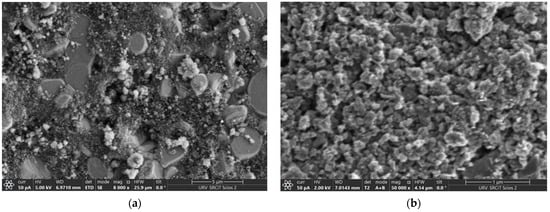
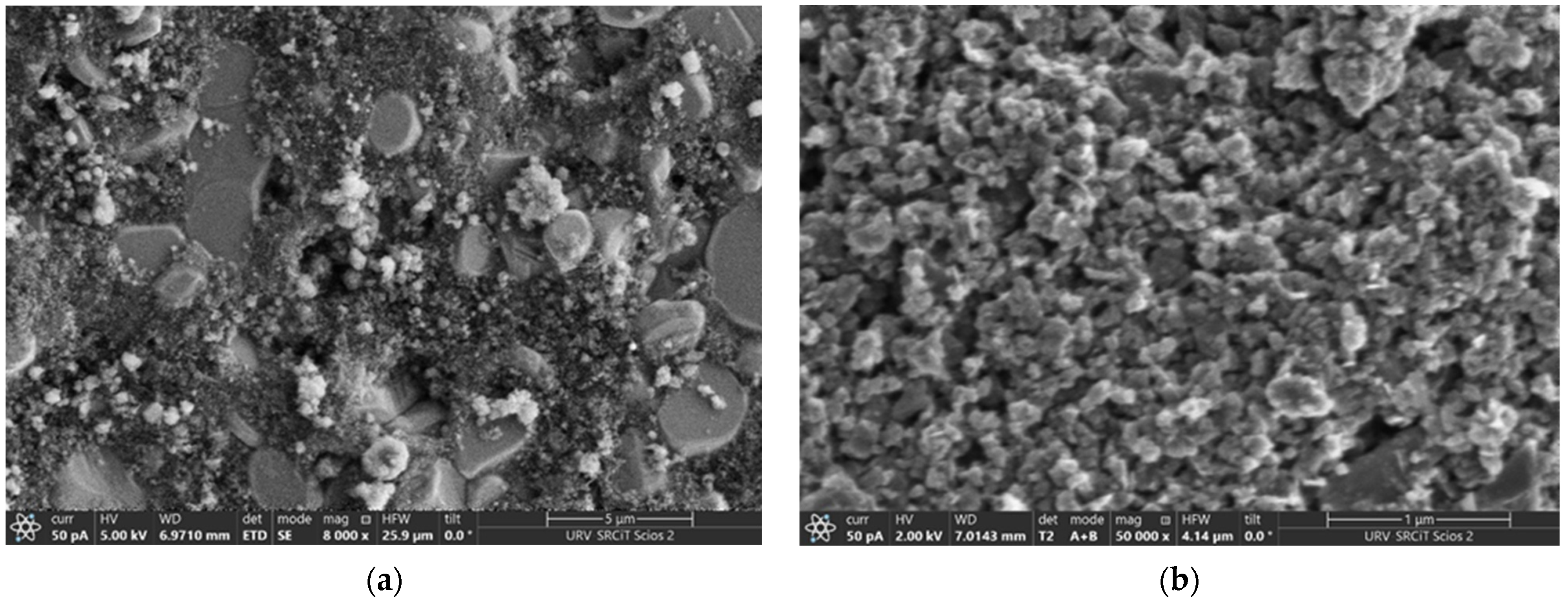
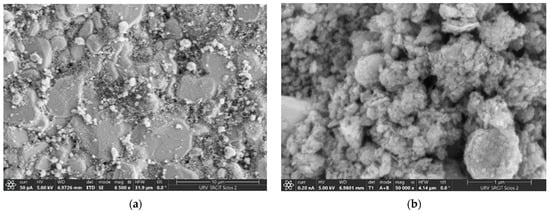
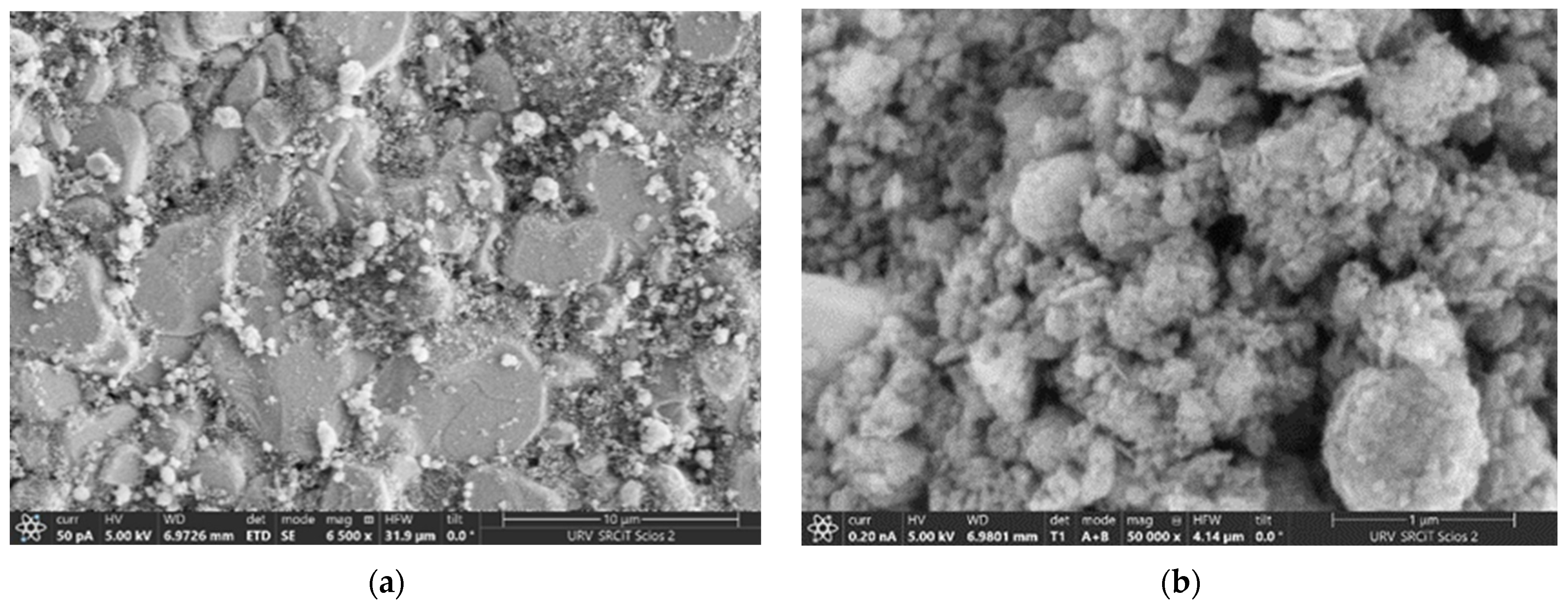
Figure 1 depicts the FESEM images of pristine graphene. The images clearly show a highly agglomerated and irregular surface morphology with non-uniform distribution across the sample. The structure exhibits significant porosity, characterized by numerous voids and interconnected gaps between clustered domains.
Figure 1.
FESEM images of pristine graphene at different magnifications using ETD (a) and T2 (b) detectors.
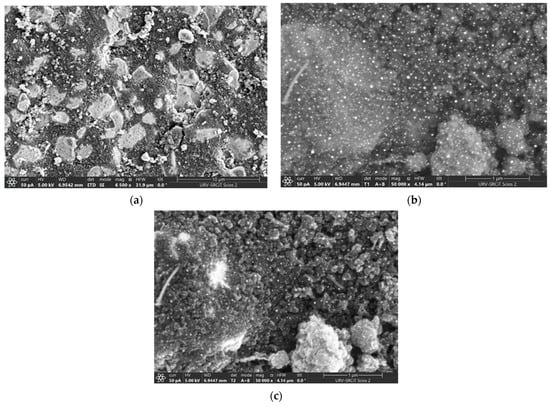
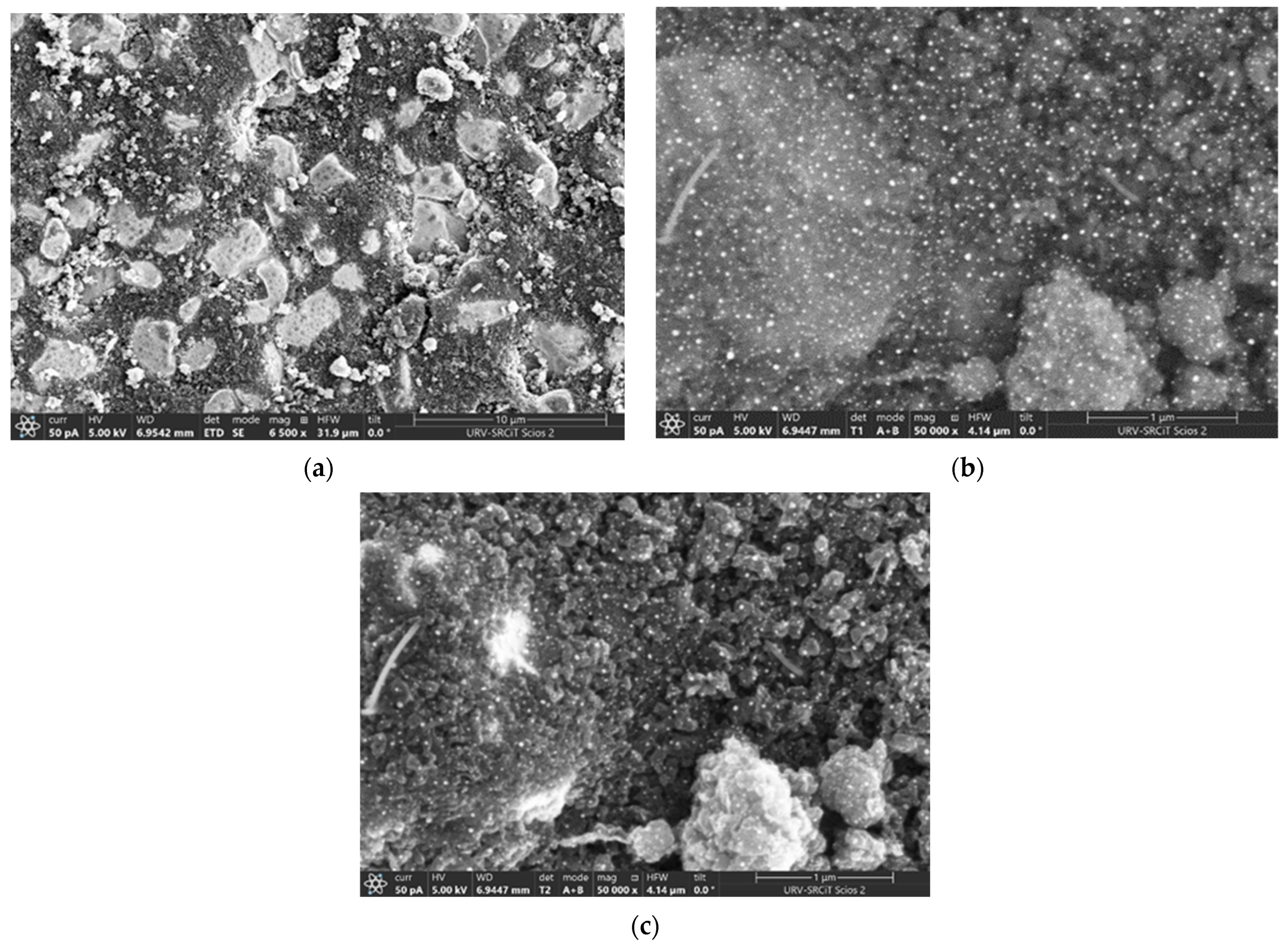
At low magnification, the Au nanoparticle-decorated graphene appears homogeneously distributed over the alumina substrate (Figure 2a). As the magnification increases (Figure 2b), small bright dots corresponding to higher-atomic-number materials were observed, which are identified as gold (Au) nanoparticles. The Au nanoparticles are relatively well dispersed across the graphene surface. Furthermore, Figure 2c highlights the highly porous morphology of the Au nanoparticle-decorated graphene layer, which is advantageous for gas sensing applications as increased surface area and porosity enhance gas molecule adsorption and diffusion. Furthermore, the morphology of pristine graphene was studied at higher magnification, employing transmission electron microscopy. The results (see Figure S4, Supplementary Materials) confirm that the graphene used possessed a two-dimensional, multi-layer morphology [34].
Figure 2.
FESEM images showing the morphology of Au nanoparticle-decorated graphene at different magnifications: (a) low-magnification image showing the overall morphology of the composite, (b) higher magnification revealing the distribution of Au nanoparticles on the graphene sheets, and (c) detailed view illustrating the dense decoration of Au nanoparticles on the graphene surface.
Elemental composition was analyzed using energy-dispersive X-ray spectroscopy (EDX) coupled to the FESEM system. Table 1 summarizes the elemental weight percentages. The results confirm that carbon is the primary constituent of the graphene layer, while oxygen and aluminum originate from the alumina substrate. The presence of gold (2.54 wt.%) in the decorated sample confirms the successful deposition of Au nanoparticles onto the graphene surface. The relatively high aluminum and oxygen signals are attributed to the thinness of the graphene layer, which allows X-ray signals from the underlying substrate to be detected. Overall, the EDX analysis verifies the effective decoration of graphene with gold nanoparticles within the active sensing area.
Table 1.
EDX results for Au nanoparticle-decorated graphene.
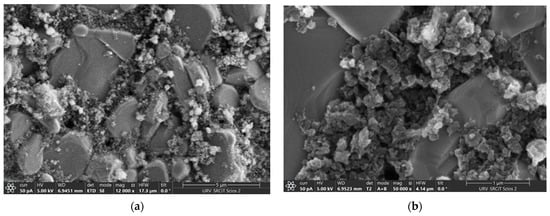
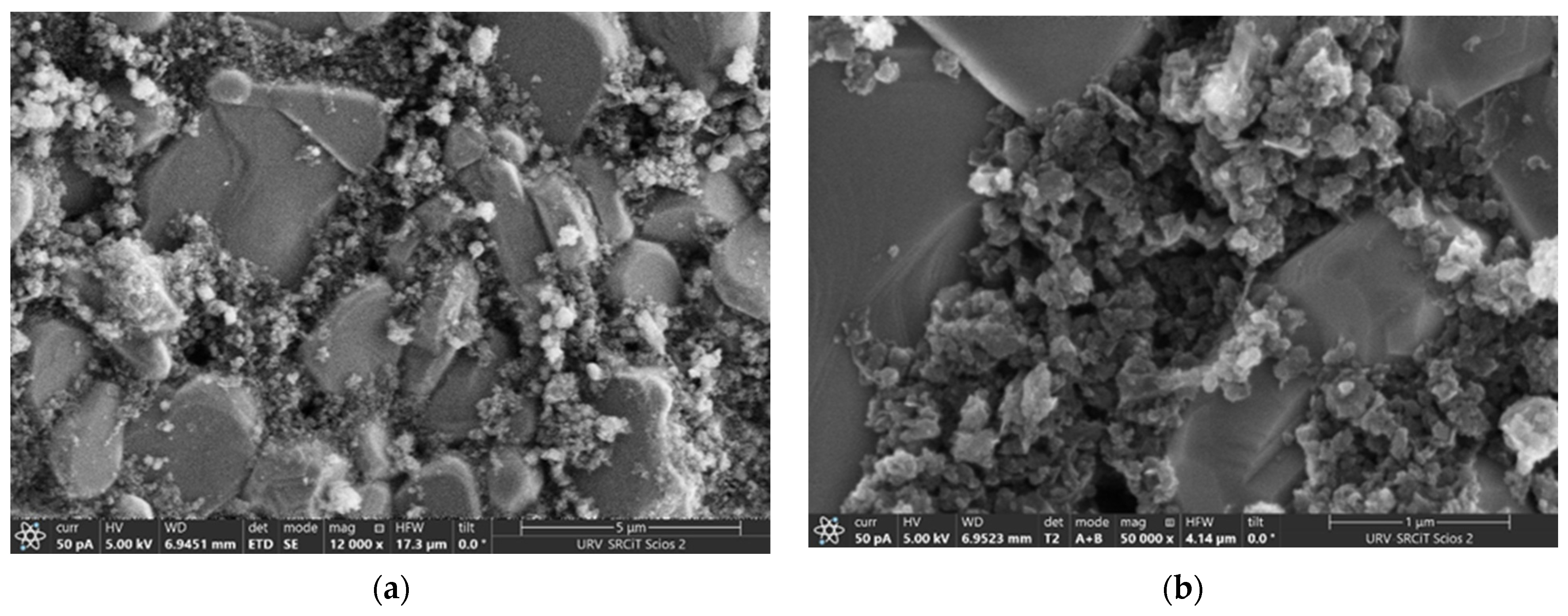
An equivalent analysis was performed for the platinum-decorated graphene sample. The FESEM images (Figure 3) show a porous morphology. However, the distribution of platinum nanoparticles is not clearly distinguishable across the surface at any magnification level.
Figure 3.
FESEM images showing the morphology of Pt nanoparticle-decorated graphene at different magnifications: (a) low-magnification image showing the overall morphology of the composite and (b) higher magnification, Pt-nanoparticles on the graphene sheets are not clearly distinguishable across the surface.
The elemental analysis (Table S1: Supplementary Materials) confirms the presence of platinum (4.02 wt.%). Carbon (55.48 wt.%) and oxygen (22.82 wt.%) remain the dominant elements, while aluminum (15.33 wt.%) and silicon (2.36 wt.%) are attributed to the alumina substrate.
The palladium-decorated graphene sample (Figure 4) also exhibits a porous and inhomogeneous morphology. Similarly, to the Pt-decorated sample, palladium nanoparticles are not clearly distinguishable across the surface at any magnification level, suggesting either fine dispersion below the detection limit of FESEM or partial embedding within the graphene matrix. EDX (see Figure S1, Supplementary Materials) is not sensitive enough for detecting Pd on the surface, indicating that this metal is at a concentration below 1 wt.%.
Figure 4.
FESEM images showing the morphology of Pd nanoparticle-decorated graphene at different magnifications: (a) low-magnification image showing the overall morphology of the composite, (b) higher magnification, Pd-nanoparticles on the graphene sheets are not clearly distinguishable across the surface.
3.2. Gas Sensing Results
3.2.1. Detection of Non-Aromatic VOC
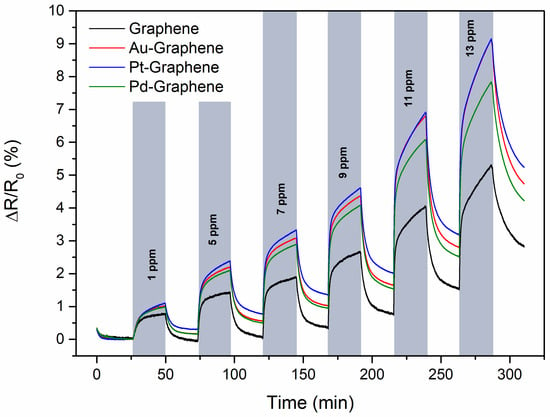
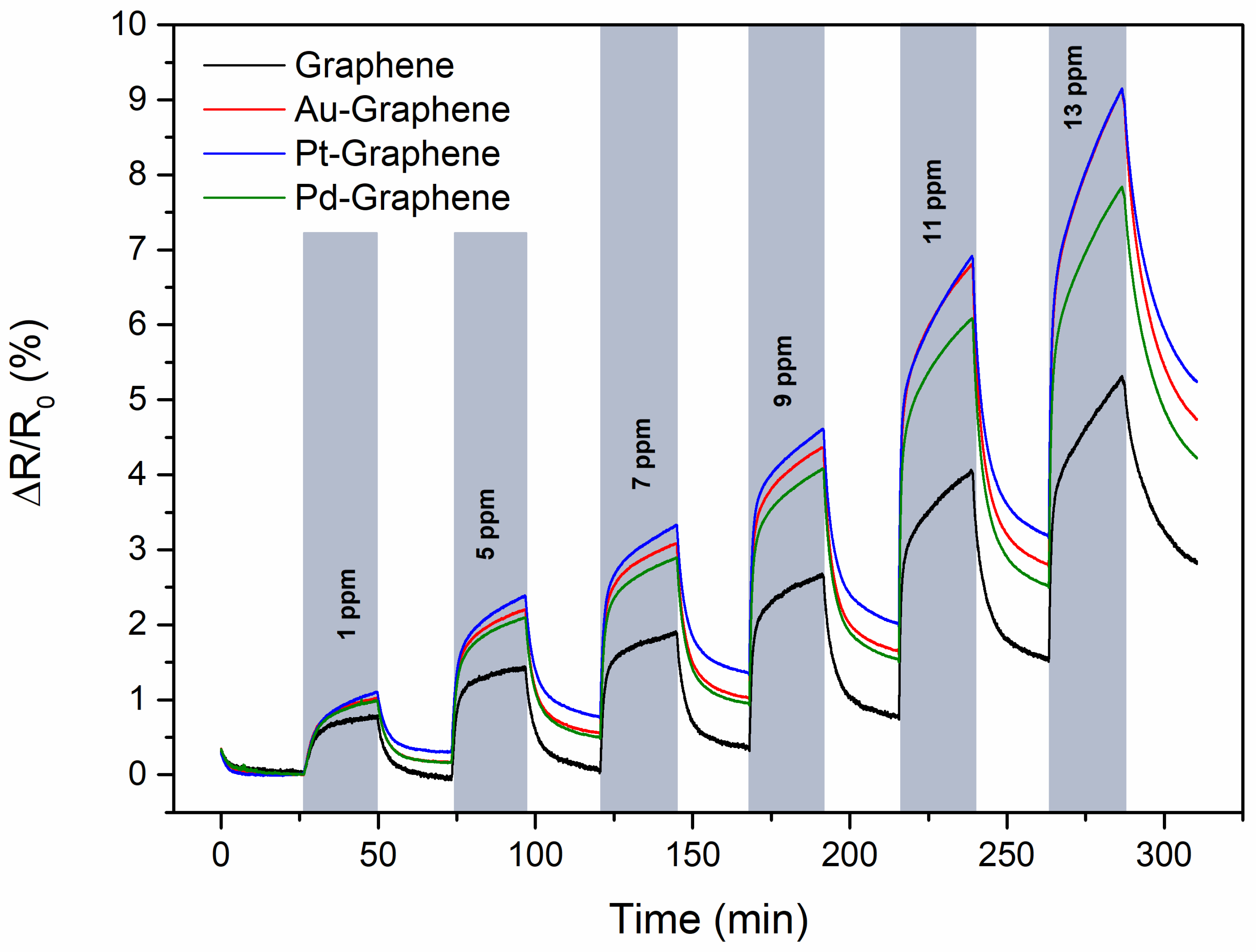
The results in Figure 5 show that graphene-based VOCs sensors exhibit notable response toward ethanol with a clear performance enhancement achieved through functionalization with noble metal nanoparticles. While pristine graphene shows a measurable resistance change (ΔR/R0) upon ethanol exposure, its sensitivity remains relatively limited. This behavior is generally attributed to weak physisorption of ethanol molecules and insufficient charge-transfer interactions at the graphene surface, as commonly reported in graphene-based chemoresistive sensors [35].
Figure 5.
Sensor response and recovery cycles for pulses of ethanol at increasing concentrations, as indicated.
The response and recovery times are defined as the time needed for reaching 90% of the maximum response value during an exposure and the time needed for reaching 10% of the maximum response value during a baseline recovery, respectively. Response and recovery times for ethanol are shown in the Supplementary Materials in Table S2. The presence of response drift suggests the presence of a chemisorption phenomenon, more evident for higher concentrations of the target species. In a practical application, this issue could be addressed by applying mild heating regularly to the sensors or by applying a baseline correction algorithm.
In contrast, graphene functionalized with noble metal nanoparticles such as platinum (Pt), palladium (Pd), and gold (Au) exhibits significantly higher response amplitudes across the investigated ethanol concentration range (1–13 ppm). This enhancement is primarily associated with the catalytic activity and electronic properties of noble metals, which introduce additional active adsorption sites and facilitate more efficient charge transfer between ethanol molecules and the modified graphene layer. Among the investigated materials, Au-decorated graphene demonstrates the highest sensitivity, which can be attributed to gold’s superior catalytic efficiency and high electron affinity, promoting stronger adsorption and enhanced electron exchange processes with ethanol molecules. Similar improvements in sensing performance through noble metal decoration of multiwalled carbon nanotubes have been widely reported in the literature [33].
Figure S2a,b (Supplementary Materials) show the graphene-based gas sensor response to methanol and acetone respectively. The sensitivity to methanol shows small differences among the sensors. Methanol is a small, highly volatile molecule with a relatively strong dipole moment (larger than ethanol), which allows it to interact efficiently with all sensor surfaces. As a result, the amount of methanol adsorbed on the different surfaces at room temperature is comparable, leading to the small differences observed in sensor responses. In contrast, acetone exhibits better sensitivity on graphene layers decorated with metal nanoparticles compared to pristine graphene. However, the same sensitivity is observed for the different metal nanoparticle-modified graphene layers (Table 2). The higher sensitivity is obtained for ethanol due to the stronger adsorption. The lowest concentration tested is 1 ppm for ethanol, which, combined with the very low noise levels observed in these responses (about 0.15% for Au–graphene at room temperature), indicates that the lower detection limit is in a range of about 150 ppb. This estimation of the limit of detection (LOD) considers that a meaningful response signal should be at least three times higher than the noise level experienced.
Table 2.
Sensitivity of different sensors for different vapors.
3.2.2. Detection of Aromatic VOCs
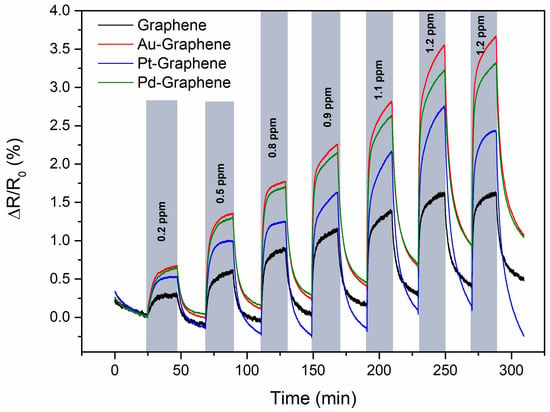
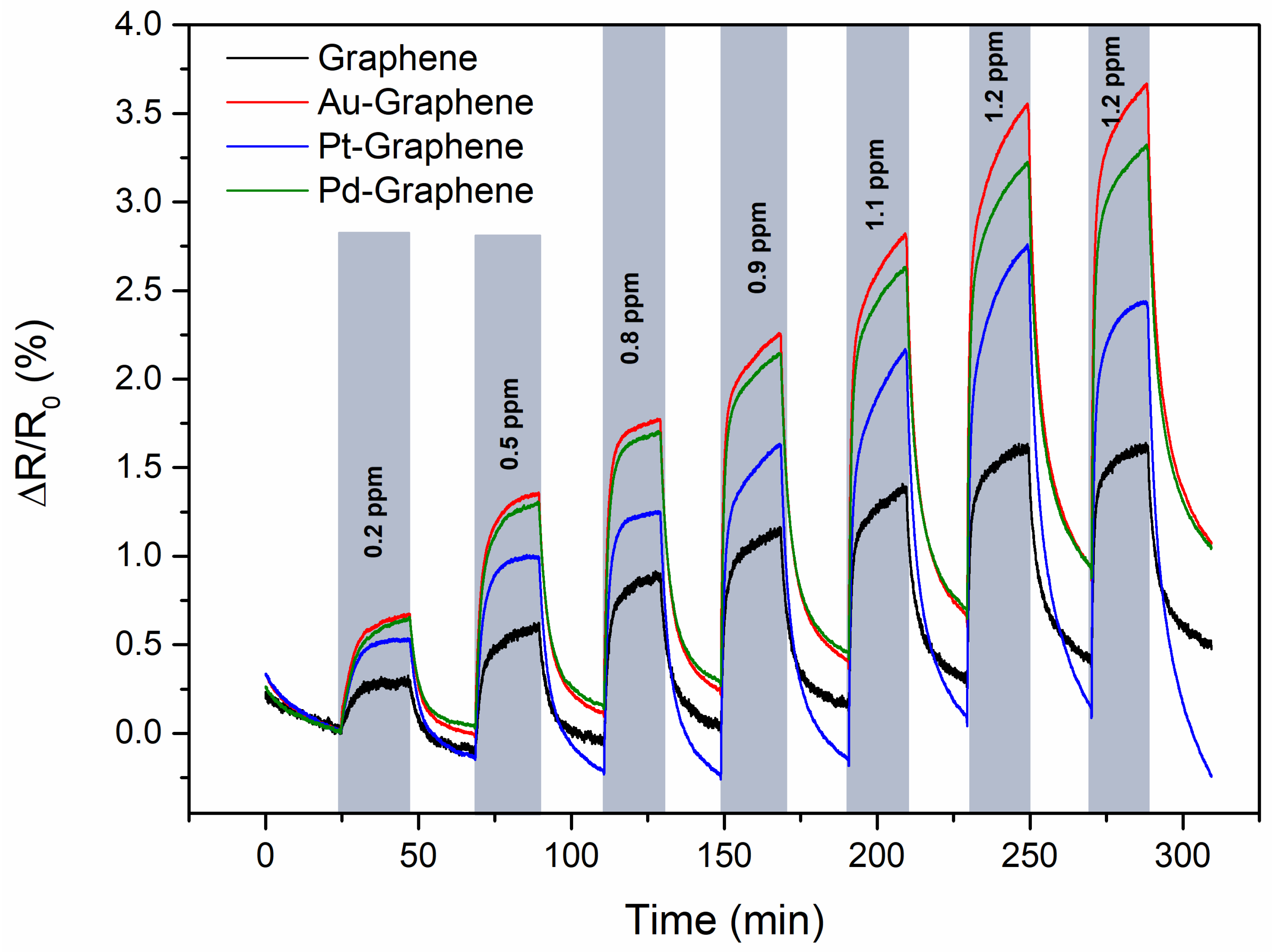
The results in Figure 6 show that graphene-based gas sensors exhibit notable response toward xylene vapors with a clear performance enhancement achieved through functionalization with noble metal nanoparticles. The signal drifts show a chemisorption phenomenon, and the recovery can be better achieved with external heating. This drift is more evident for higher concentrations of the target vapor.
Figure 6.
Sensor responses at different xylene concentrations for the developed sensors (xylene concentrations are indicated in the figure).
Moreover, the sensitivity of the developed sensors is higher for xylene compared to benzene and toluene (Figure S2c,d: Supplementary Materials and Table 2). In fact, several studies have shown that Pt-, Pd-, and Au-decorated multiwalled carbon nanotubes (MWCNTs) exhibit very limited or no sensitivity toward aromatic VOCs, in contrast with similarly decorated graphene-based materials, which display only weak but measurable responses. In particular, the works of Zanolli et al. [36] and Leghrib et al. [35] demonstrate that benzene and toluene only interact through weak physisorption with noble-metal nanoparticles on MWCNTs, resulting in negligible charge transfer and, consequently, an undetectable change in the nanotube conductivity. This behavior is consistent with DFT calculations showing that benzene forms only π–π and van der Waals interactions with Au-, Pt-, or Pd-modified CNTs, producing adsorption energies typically below 0.2 eV and adsorption distances above 3.3–3.8 Å values insufficient to perturb the electronic structure of MWCNTs to a detectable extent. In contrast, graphene decorated with the same noble metals exhibits a slightly stronger interaction with aromatic molecules due to its planar geometry, higher density of accessible adsorption sites, and reduced curvature-induced strain, enabling a modest but measurable sensor response.
The lowest concentration tested is 0.2 ppm for xylene, which, combined with the very low noise levels observed in these responses (about 0.15% for Au–graphene at room temperature), indicates that the lower detection limit is in a range of about 150 ppb. This estimation of the limit of detection (LOD) considers that a meaningful response signal should be at least three times higher than the noise level experienced. The adsorption mechanism behind shows a sensor response time and recovery time for xylene (see Table S2). The signal drift shows a chemisorption phenomenon, more evident for higher concentration of the target vapor, thus a slower recovery.
4. Discussion
Au-, Pt-, and Pd-decorated graphene-based gas sensors have demonstrated a notable increase in response (ΔR/R0), attributable to the spill-over effect and to an electronic sensitization effect. The former effect is characterized by the catalytic action of the noble metal interface, facilitating the dissociation of gases and the subsequent dispersion of charged gaseous ions on the anchoring substrate. The latter involves metal nanoparticles tuning the work function and electronic structure of graphene, favoring charge transfer between the graphene host and metal nanoparticles upon gas adsorption. These phenomena are enhanced by the presence of free electrons and the high conductivity of nanoparticles at the nanoscale [37,38]. The results of this study will demonstrate that graphene-based sensors decorated with metal nanoparticle exhibit sensitivity enhancement toward various VOCs, including both aromatic (benzene, toluene, and xylene) and non-aromatic (ethanol, methanol, and acetone) compounds.
Table 2 summarizes the sensitivity obtained from the slope of the calibration curves for the four sensors developed toward different VOCs after several experiments based on repeatability and reproducibility tests. The error bars in the calibration curves shown in Figure S3 were calculated as the mean +/− the standard deviation over replicate measurements performed with two replicates for all graphene sensors.
As an example, the calibration curves for xylene which exhibited the highest sensitivity are provided in the Supplementary Materials (Figure S3) for all sensors. Compared to bare graphene, graphene decorated with metallic nanoparticles shows enhanced sensing performance. The sensitivity has been improved for ethanol, acetone, benzene, toluene, and xylene. Indeed, graphene decorated with gold nanoparticles shows mainly two-fold sensitivity increases towards ethanol and xylene vapors, revealing an overall improvement when compared with the other graphene samples. This behavior could be interesting for multiplexing sensor configuration for selective vapor detection in complex environments.
Both graphene and multi-walled carbon nanotubes (MWCNTs) are widely recognized for their excellent gas sensing performance, primarily due to their large surface area and unique surface chemistry, which facilitate strong interactions with gas molecules. In previous work [36,39], the responses of MWCNT/Pd and MWCNT/Pt sensors to volatile organic compounds (VOCs) were investigated. It is well known that carbon nanotube films behave as mild p-type semiconductors; therefore, their interaction with reducing gases such as VOCs leads to an increase in electrical resistance [39]. The decorated MWCNT sensors demonstrated effective ethanol vapor detection at room temperature [30]. The mean sensitivity (slope of the calibration curve) of the decorated Au, Pd and Pt- multiwalled carbon nanotubes is shown in Table 3 [40].
Table 3.
Mean values of the sensitivity () to the different vapors tested for the decorated MWCNT sensors [40].
The sensing results analysis of the two nanomaterials (MWCNTs and graphene) differ due to their structural and electronic properties. The graphene used [18], with its two-dimensional multilayer (see Figure S4) and porous structure, offers uniform conductivity and a larger, more accessible surface area for vapor adsorption, leading to highly sensitive and stable responses. In contrast, MWCNTs, with their cylindrical geometry, provide distinct adsorption sites influenced by the number of walls, chirality, and defect density. These differences make MWCNTs more versatile for sensing a broader range of gases but often result in variable responses due to their structural heterogeneity. Furthermore, graphene generally exhibits lower noise levels and faster recovery times compared to MWCNTs, making it better suited for applications requiring precision and real-time monitoring. Moreover, the work function of oxygen-treated graphene and oxygen-treated MWCNT varies from 4.2 to 4.5 eV [32] and 4.9 to 5.1 eV [37], respectively. These values are very close to those of metals such as Pt, which is 4.8 eV; Au, which is 4.9 eV; and Pd, which is 4.95 eV [35]. Considering that the devices operate at room temperature, decoration with noble metal nanoparticles modulates the work function and electronic structure of graphene, leading to electronic sensitization effects. The fact that the differences in work function among the noble metals employed are small suggests the possibility of achieving very similar electronic sensitization effects. As a result, the sensitivity improvement observed for metal nanoparticle-loaded graphene is also very similar (i.e., a two-fold increase in sensitivity for the three noble metals studied). Strong hybridization between Au, Pt, or Pd nanoparticles and graphene charge carriers may alter the density of electronic states, thereby promoting the adsorption of gas molecules on the graphene surface. Additionally, the reduced local work function at the interfaces between graphene and noble metal nanoparticles may facilitate the transfer of electrons donated by adsorbed reducing species to the graphene. Therefore, the observed differences in gas sensing performance are attributed to an increased density of electronic states, which enhances gas adsorption, as well as to a reduced barrier height at the metal nanoparticle/graphene interfaces [41]. The decorated graphene sensors revealed clear advantages versus multiwall carbon nanotube sensors, mainly in the detection of aromatic VOCs due to the 2D microstructure and the porous structure of the graphene powders. Among the aromatic VOCs tested, xylene generates the highest responses, particularly in Au–graphene sensors operated at room temperature.
Table 4 presents a comparative summary of previously reported chemoresistive devices for detecting xylene vapors. Key performance parameters and operating conditions are reported. Overall, our Au–graphene sensors demonstrate competitive performance, with high sensitivity and low detection limits when operated at room temperature compared to other sensors operating at higher temperatures. This comparison highlights the effectiveness of the developed materials and provides a clear perspective on their potential for practical aromatic VOC sensing applications at room temperature.
Table 4.
Comparison of previously reported xylene detection performance employing resistive sensors.
5. Conclusions
This paper has discussed chemoresistive sensors based on pristine graphene and graphene decorated with platinum (Pt), palladium (Pd), and gold (Au) nanoparticles aimed at detecting both aromatic (benzene, toluene, and xylene) and non-aromatic (ethanol, methanol, and acetone) VOCs. Commercially available graphene powders without further treatment were used. The decoration process consisted of sputtering deposition of noble metal nanoparticles. The detection was achieved at room temperature, and the results demonstrate that graphene functionalized with noble metal nanoparticles shows significant enhancements in sensitivity compared to pristine graphene. Moreover, graphene decorated with gold nanoparticles show mainly two-fold sensitivity increases towards ethanol, toluene and xylene vapors. A comparative study with multi-walled carbon nanotube (MWCNT) sensors decorated with the same nanoparticles revealed clear advantages of graphene in detecting xylene with high sensitivity due to its two-dimensional electronic structure, which facilitates efficient charge transfer upon vapor adsorption. Given that sensors were operated at room temperature, the enhancement in sensitivity is mainly attributed to electronic sensitization effects that result from the decoration of graphene with noble metal nanoparticles.
Supplementary Materials
The following supporting information can be downloaded at https://www.mdpi.com/article/10.3390/chemosensors14050111/s1. Table S1: EDX spectrum results of Pt–graphene, Figure S1. EDX point analysis of Pd1, Figure S2. Sensor responses at different concentrations of gases (a) methanol, (b) acetone, (c) benzene and (d) toluene for the developed sensors (VOC concentrations are indicated in the figure). Table S2. The response time values (in seconds) and recovery time values (in seconds) for each sensor for the detection of ethanol and xylene respectively. Figure S3. Xylene calibration curves of graphene-based sensors. Figure S4. TEM micrograph of the graphene nanomaterial used.
Author Contributions
Conceptualization, J.C.-C., E.L. and A.A.; Data curation, S.B. and A.T.; Formal analysis, E.L. and A.A.; Investigation, S.B., A.T. and N.K.P.; Methodology, J.C.-C., E.L. and A.A.; Supervision, J.C.-C., E.L. and A.A.; Visualization, Writing—original draft, S.B. and A.T.; Writing—review and editing, J.C.-C., E.L. and A.A. All authors have read and agreed to the published version of the manuscript.
Funding
This work was financed by the ARESSE (Appui à la Recherche et l’Enseignement Supérieur dans le Secteur de l’Environnement)—Green Impact project (Funding number T1P1), funded by the European Union program entitled “Green Research of the Green & Sustainable Tunisia” for the Agence Nationale de la Promotion de la Recherche scientifique (ANPR, Tunisia) (Coordinator Pr. Abdelghani Adnane). E.L. is supported by the Catalan Institution for Research and Advanced Studies via the 2023 Edition of the ICREA Academia Award.
Institutional Review Board Statement
Not applicable.
Informed Consent Statement
Not applicable.
Data Availability Statement
The original contributions presented in this study are included in the article/Supplementary Material. Further inquiries can be directed to the corresponding author.
Conflicts of Interest
The authors declare no conflicts of interest.
References
- You, B.; Zhou, W.; Li, J.; Li, Z.; Sun, Y. A Review of Indoor Gaseous Organic Compounds and Human Chemical Exposure: Insights from Real-Time Measurements. Environ. Int. 2022, 170, 107611. [Google Scholar] [CrossRef] [Scilit] [PubMed]
- Tsai, W.-T. An Overview of Health Hazards of Volatile Organic Compounds Regulated as Indoor Air Pollutants. Rev. Environ. Health 2019, 34, 81–89. [Google Scholar] [CrossRef] [Scilit]
- Xiong, Y.; Du, K.; Huang, Y. One-Third of Global Population at Cancer Risk Due to Elevated Volatile Organic Compounds Levels. NPJ Clim. Atmos. Sci. 2024, 7, 54. [Google Scholar] [CrossRef] [Scilit]
- Mangotra, A.; Singh, S.K. Volatile Organic Compounds: A Threat to the Environment and Health Hazards to Living Organisms—A Review. J. Biotechnol. 2024, 382, 51–69. [Google Scholar] [CrossRef] [Scilit] [PubMed]
- Zonta, G.; Rispoli, G.; Malagù, C.; Astolfi, M. Overview of Gas Sensors Focusing on Chemoresistive Ones for Cancer Detection. Chemosensors 2023, 11, 519. [Google Scholar] [CrossRef] [Scilit]
- McMichael, A.J. Carcinogenicity of Benzene, Toluene and Xylene: Epidemiological and Experimental Evidence. IARC Sci. Publ. 1988, 85, 3–18. [Google Scholar]
- Mirzaei, A.; Leonardi, S.G.; Neri, G. Detection of Hazardous Volatile Organic Compounds (VOCs) by Metal Oxide Nanostructures-Based Gas Sensors: A Review. Ceram. Int. 2016, 42, 15119–15141. [Google Scholar] [CrossRef] [Scilit]
- California Code of Regulations, Title 8, Section 5155. Airborne Contaminants. Available online: https://www.dir.ca.gov/title8/5155.html (accessed on 1 May 2026).
- Mirzaei, A.; Kim, J.-H.; Kim, H.W.; Kim, S.S. Resistive-Based Gas Sensors for Detection of Benzene, Toluene and Xylene (BTX) Gases: A Review. J. Mater. Chem. C 2018, 6, 4342–4370. [Google Scholar] [CrossRef] [Scilit]
- Taiti, C.; Vivaldo, G.; Mancuso, S.; Comparini, D.; Pandolfi, C. Volatile Organic Compounds (VOCs) Fingerprinting Combined with Complex Network Analysis as a Forecasting Tool for Tracing the Origin and Genetic Lineage of Arabica Specialty Coffees. Sci. Rep. 2025, 15, 13709. [Google Scholar] [CrossRef] [Scilit]
- Matatagui, D.; Bahos, F.A.; Gràcia, I.; Horrillo, M.d.C. Portable Low-Cost Electronic Nose Based on Surface Acoustic Wave Sensors for the Detection of BTX Vapors in Air. Sensors 2019, 19, 5406. [Google Scholar] [CrossRef] [Scilit]
- Velusamy, P.; Su, C.-H.; Ramasamy, P.; Arun, V.; Rajnish, N.; Raman, P.; Baskaralingam, V.; Senthil Kumar, S.M.; Gopinath, S.C.B. Volatile Organic Compounds as Potential Biomarkers for Noninvasive Disease Detection by Nanosensors: A Comprehensive Review. Crit. Rev. Anal. Chem. 2023, 53, 1828–1839. [Google Scholar] [CrossRef] [Scilit]
- Pathak, A.K.; Swargiary, K.; Kongsawang, N.; Jitpratak, P.; Ajchareeyasoontorn, N.; Udomkittivorakul, J.; Viphavakit, C. Recent Advances in Sensing Materials Targeting Clinical Volatile Organic Compound (VOC) Biomarkers: A Review. Biosensors 2023, 13, 114. [Google Scholar] [CrossRef] [Scilit]
- Delgado-Rodríguez, M.; Ruiz-Montoya, M.; Giraldez, I.; López, R.; Madejón, E.; Díaz, M.J. Use of Electronic Nose and GC-MS in Detection and Monitoring Some VOC. Atmos. Environ. 2012, 51, 278–285. [Google Scholar] [CrossRef] [Scilit]
- Longo, V.; Forleo, A.; Giampetruzzi, L.; Siciliano, P.; Capone, S. Human Biomonitoring of Environmental and Occupational Exposures by GC-MS and Gas Sensor Systems: A Systematic Review. Int. J. Environ. Res. Public Health 2021, 18, 10236. [Google Scholar] [CrossRef] [Scilit]
- Gakhar, T.; Basu, S.; Hazra, A. Carbon-Metal Oxide Nanocomposites for Selective Detection of Toxic and Hazardous Volatile Organic Compounds (VOC)—A Review. Green Anal. Chem. 2022, 1, 100005. [Google Scholar] [CrossRef] [Scilit]
- Recum, P.; Hirsch, T. Graphene-Based Chemiresistive Gas Sensors. Nanoscale Adv. 2024, 6, 11–31. [Google Scholar] [CrossRef] [Scilit]
- Behi, S.; Casanova-Chafer, J.; González, E.; Bohli, N.; Llobet, E.; Abdelghani, A. Metal Loaded Nano-Carbon Gas Sensor Array for Pollutant Detection*. Nanotechnology 2022, 33, 195501. [Google Scholar] [CrossRef] [Scilit] [PubMed]
- Ghosh, R.; Aslam, M.; Kalita, H. Graphene Derivatives for Chemiresistive Gas Sensors: A Review. Mater. Today Commun. 2022, 30, 103182. [Google Scholar] [CrossRef] [Scilit]
- Consales, M.; Campopiano, S.; Cutolo, A.; Penza, M.; Aversa, P.; Cassano, G.; Giordano, M.; Cusano, A. Carbon Nanotubes Thin Films Fiber Optic and Acoustic VOCs Sensors: Performances Analysis. Sens. Actuators B Chem. 2006, 118, 232–242. [Google Scholar] [CrossRef] [Scilit]
- Mubeen, S.; Zhang, T.; Yoo, B.; Deshusses, M.A.; Myung, N.V. Palladium Nanoparticles Decorated Single-Walled Carbon Nanotube Hydrogen Sensor. J. Phys. Chem. C 2007, 111, 6321–6327. [Google Scholar] [CrossRef] [Scilit]
- Dilonardo, E.; Penza, M.; Alvisi, M.; Di Franco, C.; Rossi, R.; Palmisano, F.; Torsi, L.; Cioffi, N. Electrophoretic Deposition of Au NPs on MWCNT-Based Gas Sensor for Tailored Gas Detection with Enhanced Sensing Properties. Sens. Actuators B Chem. 2016, 223, 417–428. [Google Scholar] [CrossRef] [Scilit]
- Rohilla, R.; Prakash, J.; Dasgupta, K. Review of Carbon Nanotube/Graphene Nanosheet Chemiresistive Gas Sensors. ACS Appl. Nano Mater. 2025, 8, 23414–23465. [Google Scholar] [CrossRef] [Scilit]
- Schedin, F.; Geim, A.K.; Morozov, S.V.; Hill, E.W.; Blake, P.; Katsnelson, M.I.; Novoselov, K.S. Detection of Individual Gas Molecules Adsorbed on Graphene. Nat. Mater. 2007, 6, 652–655. [Google Scholar] [CrossRef] [Scilit]
- Varghese, S.S.; Varghese, S.H.; Swaminathan, S.; Singh, K.K.; Mittal, V. Two-Dimensional Materials for Sensing: Graphene and Beyond. Electronics 2015, 4, 651–687. [Google Scholar] [CrossRef] [Scilit]
- Timsorn, K.; Ellis, T.; Seekaew, Y.; Wongchoosuk, C. Metal/Metal Oxide Nanoparticles Decorated Carbon Nanomaterials-Based Gas Sensors: A Review. Micro Nanostruct. 2026, 209, 208406. [Google Scholar] [CrossRef] [Scilit]
- Basu, S.; Bhattacharyya, P. Recent Developments on Graphene and Graphene Oxide Based Solid State Gas Sensors. Sens. Actuators B Chem. 2012, 173, 1–21. [Google Scholar] [CrossRef] [Scilit]
- Singhal, A.V.; Charaya, H.; Lahiri, I. Noble Metal Decorated Graphene-Based Gas Sensors and Their Fabrication: A Review. Crit. Rev. Solid State Mater. Sci. 2017, 42, 499–526. [Google Scholar] [CrossRef] [Scilit]
- Xia, Y.; Li, R.; Chen, R.; Wang, J.; Xiang, L. 3D Architectured Graphene/Metal Oxide Hybrids for Gas Sensors: A Review. Sensors 2018, 18, 1456. [Google Scholar] [CrossRef] [Scilit]
- Piszter, G.; Kertész, K.; Molnár, G.; Pálinkás, A.; Deák, A.; Osváth, Z. Vapour Sensing Properties of Graphene-Covered Gold Nanoparticles. Nanoscale Adv. 2019, 1, 2408–2415. [Google Scholar] [CrossRef] [Scilit]
- Karaduman, I.; Er, E.; Çelikkan, H.; Erk, N.; Acar, S. Room-Temperature Ammonia Gas Sensor Based on Reduced Graphene Oxide Nanocomposites Decorated by Ag, Au and Pt Nanoparticles. J. Alloys Compd. 2017, 722, 569–578. [Google Scholar] [CrossRef] [Scilit]
- Białoruski, M.; Kumar, D.; Gołda-Cępa, M.; Piskorz, W.; Kotarba, A. Work Function of the Oxygen Functionalized Graphenic Surfaces—Integral Experimental and Theoretical Approach. Appl. Surf. Sci. 2022, 597, 153671. [Google Scholar] [CrossRef] [Scilit]
- Thamri, A.; Baccar, H.; Casanova-Chafer, J.; Mejri, M.B.; Llobet, E.; Abdelghani, A. Thiol-Amine Functionalized Decorated Carbon Nanotubes for Biomarker Gases Detection. Chemosensors 2021, 9, 87. [Google Scholar] [CrossRef] [Scilit]
- Behi, S.; Bohli, N.; Casanova-Cháfer, J.; Llobet, E.; Abdelghani, A. Metal Oxide Nanoparticle-Decorated Few Layer Graphene Nanoflake Chemoresistors for the Detection of Aromatic Volatile Organic Compounds. Sensors 2020, 20, 3413. [Google Scholar] [CrossRef] [Scilit]
- Leghrib, R.; Felten, A.; Demoisson, F.; Reniers, F.; Pireaux, J.-J.; Llobet, E. Room-Temperature, Selective Detection of Benzene at Trace Levels Using Plasma-Treated Metal-Decorated Multiwalled Carbon Nanotubes. Carbon 2010, 48, 3477–3484. [Google Scholar] [CrossRef] [Scilit]
- Zanolli, Z.; Leghrib, R.; Felten, A.; Pireaux, J.-J.; Llobet, E.; Charlier, J.-C. Gas Sensing with Au-Decorated Carbon Nanotubes. ACS Nano 2011, 5, 4592–4599. [Google Scholar] [CrossRef] [Scilit]
- Ago, H.; Kugler, T.; Cacialli, F.; Salaneck, W.R.; Shaffer, M.S.P.; Windle, A.H.; Friend, R.H. Work Functions and Surface Functional Groups of Multiwall Carbon Nanotubes. J. Phys. Chem. B 1999, 103, 8116–8121. [Google Scholar] [CrossRef] [Scilit]
- Rahmati, S.; Doherty, W.; Amani Babadi, A.; Akmal Che Mansor, M.S.; Julkapli, N.M.; Hessel, V.; Ostrikov, K. (Ken) Gold–Carbon Nanocomposites for Environmental Contaminant Sensing. Micromachines 2021, 12, 719. [Google Scholar] [CrossRef] [Scilit]
- Baccar, H.; Thamri, A.; Clément, P.; Llobet, E.; Abdelghani, A. Pt- and Pd-Decorated MWCNTs for Vapour and Gas Detection at Room Temperature. Beilstein J. Nanotechnol. 2015, 6, 919–927. [Google Scholar] [CrossRef] [Scilit]
- Thamri, A.; Baccar, H.; Struzzi, C.; Bittencourt, C.; Abdelghani, A.; Llobet, E. MHDA-Functionalized Multiwall Carbon Nanotubes for Detecting Non-Aromatic VOCs. Sci. Rep. 2016, 6, 35130. [Google Scholar] [CrossRef] [Scilit]
- Song, H.; Li, Q.; Wang, H.; Li, K. Gas Sensing Differences Depending on Various Noble Metals Decorated on Graphene: A Study on NH3 Response Mechanism. IEEE Sens. J. 2024, 24, 25215–25220. [Google Scholar] [CrossRef] [Scilit]
- Morsy, M.; Madbouly, A.I. Room Temperature Xylene Sensor Based on Co3O4/GF Hybrid. Sens. Actuators Phys. 2020, 305, 111921. [Google Scholar] [CrossRef] [Scilit]
- Wang, H.; Yuan, Z.; Li, J.; Zhang, R.; Meng, F. Fast-Response Xylene Gas Sensor Based on Pt-Modified Fe2(MoO4)3 Nano-Hollow Spheres Compounded on rGO. Sens. Actuators B Chem. 2025, 439, 137849. [Google Scholar] [CrossRef] [Scilit]
- Saggu, I.S.; Singh, L.; Kushvaha, S.S.; Singh, M.; Sharma, S. Dual Discrimination of Xylene and NO2 with UV-Boosted Recovery at Room Temperature Using SnSe2/MWCNT Composite-Based Sensors. ACS Appl. Electron. Mater. 2025, 7, 1645–1660. [Google Scholar] [CrossRef] [Scilit]
- Du, L.; Song, X.; Liang, X.; Liu, Y.; Zhang, M. Formation of NiCo2O4 Hierarchical Tubular Nanostructures for Enhanced Xylene Sensing Properties. Appl. Surf. Sci. 2020, 526, 146706. [Google Scholar] [CrossRef] [Scilit]
- Kim, H.M.; Shin, K.Y.; Mirzaei, A.; Oum, W.; Kim, E.B.; Moon, S.; Bharath, S.P.; Kim, S.S.; Kim, H.W. Ultrasensitive Detection of Xylene Gas by Cauliflower-like Au-TiO2 Core-Shell Nanoparticles. Sens. Actuators B Chem. 2024, 412, 135802. [Google Scholar] [CrossRef] [Scilit]
- Feng, C.; Wang, C.; Zhang, H.; Li, X.; Wang, C.; Cheng, P.; Ma, J.; Sun, P.; Gao, Y.; Zhang, H.; et al. Enhanced Sensitive and Selective Xylene Sensors Using W-Doped NiO Nanotubes. Sens. Actuators B Chem. 2015, 221, 1475–1482. [Google Scholar] [CrossRef] [Scilit]
- Dilonardo, E.; Alvisi, M.; Rossi, R.; Cassano, G.; Palo, F.D.; Palazzo, G.; Penza, M. Sensing Properties of MWCNTs Layers Electrodecorated with Metal Nanoparticles for Detection of Aromatic Hydrocarbon Compounds. MRS Adv. 2017, 2, 1009–1014. [Google Scholar] [CrossRef] [Scilit]

Disclaimer/Publisher’s Note: The statements, opinions and data contained in all publications are solely those of the individual author(s) and contributor(s) and not of MDPI and/or the editor(s). MDPI and/or the editor(s) disclaim responsibility for any injury to people or property resulting from any ideas, methods, instructions or products referred to in the content. |
© 2026 by the authors. Licensee MDPI, Basel, Switzerland. This article is an open access article distributed under the terms and conditions of the Creative Commons Attribution (CC BY) license.