


Abstract
Using orange peels as a biowaste, fluorescent N-CDs were prepared simply and rapidly through a one-step microwave-assisted method and urea as a nitrogen source. The synthesized N-CDs exhibited a high QY value of 47.12% compared to CDs prepared using different methods. Moreover, the N-CDs have good pH and thermal stability. N-CDs exhibited high sensitivity toward Fe(III), Hg(I), and Hg(II) ions with low LOD values of about 0.0555, 0.15379, and 0.02505 μM, respectively. This approach is hopeful for the large-scale formation of N-CDs and could encourage their utilization as fluorescent chemosensors due to their affordability, simplicity, high efficiency, and environmental friendliness.
1. Introduction
Xu et al. made the earliest discovery of carbon dots (CDs) in 2004 by accident during single-walled carbon nanotube purification; fluorescent nanoparticles were observed as byproducts [1]. This work has set the starting point for the preparation and study of CDs as a new kind of carbon-based nanomaterial. CDs are very small, their size being less than 10 nanometers, and have quasi-spherical shapes [2,3]. CDs have unique properties, including excellent photoluminescence, tunable fluorescence, low toxicity, good biocompatibility, chemical inertness, and an outstanding photoinduced electron transfer ability [1,4,5]. CDs are a novel class of zero-dimensional fluorescent nanomaterials that contain conjugated carbon nuclei with surface functional groups mostly composed of C, H, and O elements doped with heteroatoms [6,7,8]. Heteroatom doping of CDs involves the intentional incorporation of atoms such as nitrogen, sulfur, phosphorus, or boron into the carbon framework to tune their optical and electronic properties. This strategy is widely used because it can increase fluorescence intensity, change emission wavelength, improve charge transfer, and enhance surface reactivity, which makes CDs more effective for sensing and bioimaging [9]. Nitrogen doping introduces electron-rich N sites that create efficient radiative surface states and passivate defects, thereby reducing nonradiative recombination and enhancing quantum yield. It also modifies the electronic structure of the CDs, enhancing π–π* and n–π* transitions, which results in brighter, more efficient fluorescence [10]. CD precursors come from multi-resources, and the cost of preparation is less expensive. CDs can be synthesized using various techniques, primarily classified into top-down and bottom-up approaches [11]. Among these techniques, microwave-assisted synthesis is an increasingly common bottom-up technique for synthesizing CDs due to their rapid, energy-efficient, and versatile nature, where microwave radiation rapidly heats the precursor solution, inducing dehydration and carbonization to form CDs [12,13,14]. Additionally, it can yield a larger number of CDs in the same or sometimes shorter time compared to hydrothermal methods [11]. Microwave radiation offers homogeneous heating, resulting in a more uniform particle size and shape [15,16]. It commonly uses green precursors and prevents harsh chemicals, making it an environmentally economical and friendly approach [17]. The microwave-assisted method is direct, requiring less complicated equipment and is appropriate for development [18]. Microwave-assisted synthesis is well-known for its energy efficiency, speed, and capability to generate high-performance CDs with good optical features adequate for many applications, such as catalysis, sensing and bioimaging [19,20,21,22].
Detecting pollutants in aquatic environments, including heavy metals, is one of the most significant applications of CDs as superior fluorescent chemosensors due to their unique properties, and researchers are currently conducting many studies on this unique material and developing its properties in order to use it in several fields [23,24]. Ferric and mercury ions are highly significant in environmental and biological contexts because high levels can severely affect human health. Fe(III) is essential for oxygen transport and metabolism, but its excess can promote oxidative stress and tissue damage, while mercury is one of the most toxic heavy metals, capable of accumulating in vital organs, such as the brain, liver, and kidneys, and causing neurological, renal, and other systemic disorders. Because such ions can exist in natural water, food, and biological samples, their rapid and selective detection is crucial for environmental monitoring and public health protection. Sensitive analytical methods and fluorescent probes are therefore needed to monitor these species at low concentrations and to prevent long-term toxic exposure [25,26]. This study aims to prepare nitrogen-doped carbon dots (N-CDs) in a simple and effective way at the same time and use them to detect heavy metals in water with high sensitivity and avoid using dangerous organic solvents.
2. Experimental
2.1. Materials and Chemicals
Orange peels (from a local market, Jeddah, KSA), urea (99.50%), mercury(I) nitrate (98.00%), mercury(II) nitrate monohydrate (≥98%), sodium thiosulphate pentahydrate (≥99%), silver nitrate (≥99%), strontium chloride (≥99%), lead nitrate (≥99%), cadmium nitrate (≥98%), and iron(II) sulphate heptahydrate (≥98%) were purchased from BDH chemicals Ltd. (Poole, UK). Zinc sulfate heptahydrate (≥99%), lanthanum(III) nitrate hydrate (99.99%), sodium chromate (≥99%), magnesium chloride (≥98%), sodium fluoride (≥99%), and sodium hydroxide (≥99%) were purchased from Sigma Aldrich (Darmstadt, Germany). Copper(II) sulphate pentahydrate was purchased from Philip Harris (London, UK) (≥98%), nickel sulfate from Loba Chemie (Mumbai, India) (≥99%), and ferric chloride anhydrous (≥99%) from SRL (Mumbai, India). Hydrochloric acid (99.99%) was purchased from Honeywell (Seelze, Germany). All chemicals employed were of analytical grade and used as received without any further purification. Deionized water was obtained from the laboratory using a PURELAB instrument (Lane End, High Wycombe, UK) and used for all experiments.
2.2. Instrumentation and Characterization
A microwave oven from Nikai (20 Liter 700 W with Auto Menu Function|Model No. NMO515N8NX) (Yiwu, China) was used to synthesize the N-CDs. A UV-Visible spectrometer was obtained from Thermoscientific (Shelton, CT, USA) and was used for determining the maximum absorption peak of CDs, which reveals their electronic transition types and helps characterize their optical properties and structure. The photoluminescence (PL) emissions spectrum and quantitative detection of metal ions were obtained by a Cary Eclipse Fluorescence Spectrometer from Agilent (Santa Clara, CA, USA). For measuring the pH of solutions, a digital pH meter from Jenway (Stone, UK) was used. Fourier transform infrared (FTIR) spectra were recorded at room temperature using an FTIR spectrometer from Perkin Elmer Spectrum 100 (Shelton, CT, USA). The surface morphology of N-CDs was analyzed by transmission electron microscope (TEM) with a specimen quick-change holder (EM-11210SOCH) from JEOL Ltd. (Akishima, Tokyo, Japan), which provides direct visualization of the size, shape, dispersion, and crystallinity of N-CDs at the nanoscale. The elemental composition of N-CDs was analyzed by energy dispersive spectroscopy (EDS). A thermometer and a hot plate were used for thermal stability experiments. Deionized (DI) water was prepared in the laboratory using a PURELAB instrument (UK).
2.3. CDs Synthesis
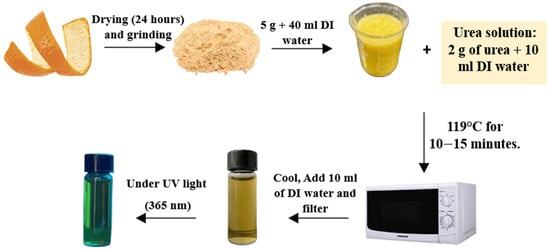
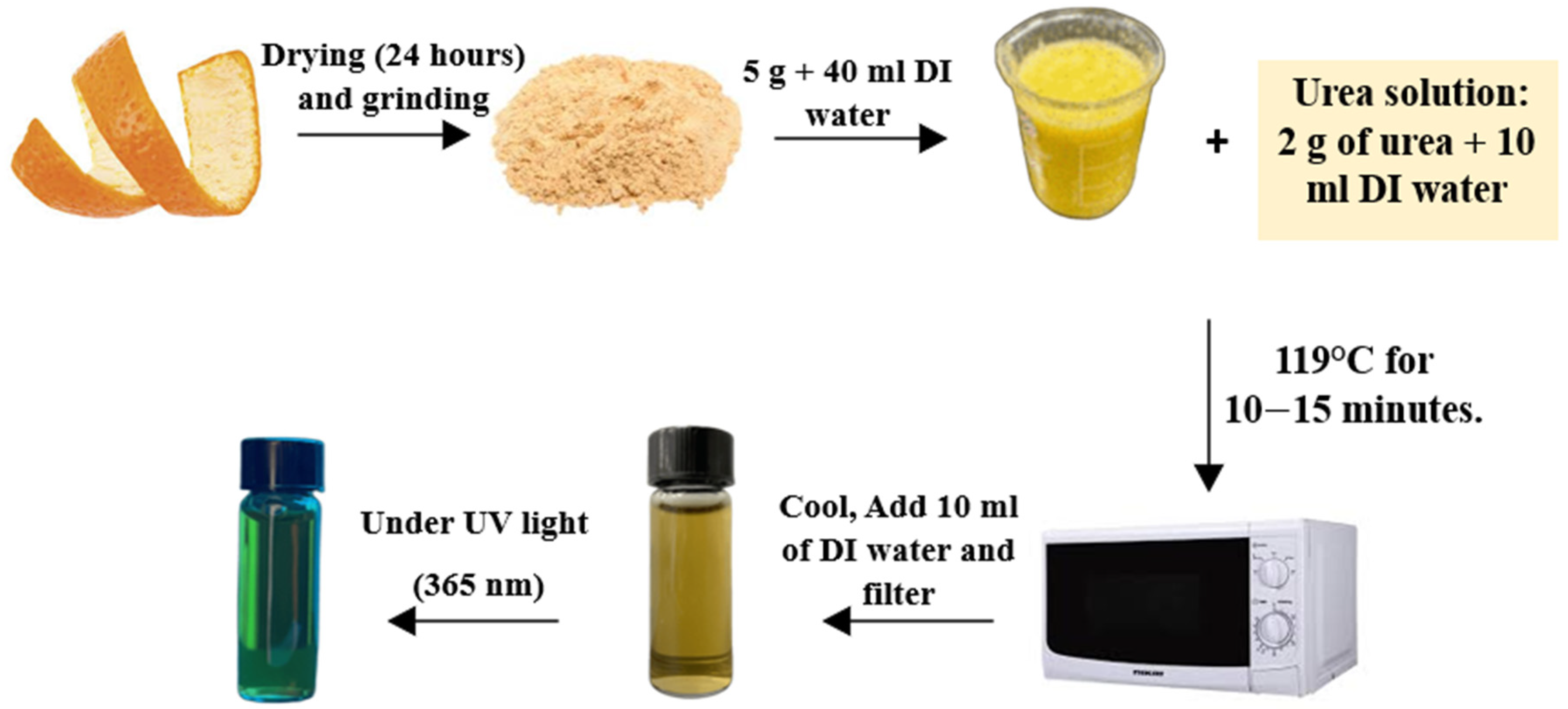
The fluorescent N-CDs were synthesized by microwave irradiation using orange peels and urea as a carbon source and a dopant, respectively. Doping with heteroatoms in particular was found to enhance the quantum yield (QY) and overall efficiency of the synthesized N-CDs. Nitrogen is considered as an effective dopant among the other dopants, such as sulfur, boron, phosphorus, and other metals. First, orange peels were dried at 50 °C in the oven and then powdered. A total of 5 g of the powder was mixed with 40 mL of DI water. Then, a urea solution was prepared by adding 2 g to 10 mL of DI water. Then mixed both the solutions and put in a microwave-safe container and heated in a microwave oven at ~119 °C for a range of 10–15 min. After allowing the product to cool at room temperature, 10 mL of DI was added and then filtered. Scheme 1 shows the preparation steps.
Scheme 1.
Synthesis of N-CDs from orange peels.
2.4. Fe(III), Hg(II), and Hg(I) Detection
The selectivity of Fe(III), Hg(II), and Hg(I) ions was performed by the addition of other metal ion solutions: (Na(I), Ag(I), Zn(II), Cr(VI), Fe(II), Cd(II), La(III), Pb(II), Cu(II), Ni(II), Sr(II), and Mg(II)) in same manner. Stock solutions (50 µM) were first prepared to evaluate the CDs’ selectivity for heavy metals, followed by standard solution preparation with different concentrations (5, 10, 50, 100, 150, 200, 400, 600, 800, and 1000 µM) of the selected heavy metal ions to investigate their interactions with N-CDs. All experiments were carried out at room temperature.
The relative fluorescence change and relative fluorescence intensity were calculated and Stern–Volmer and Benesi–Hildebrand models were employed. The equations are reported in our previous study [27].
2.5. Measurement of Fluorescence QY
The quantum yield (QY) of N-CDs was calculated by applying the following equation:
where:
= Quantum yield.
I = Intensity.
= Refractive index.
= Absorption.
R subscript represents the fluorescence reference of known quantum results.
Rhodamine-B (aqueous solution, ΦR = 0.31) was used as a standard. DI water was used as a solvent for the N-CDs (η = 1.33) measurements.
2.6. Stability of N-CDs
2.6.1. pH Stability
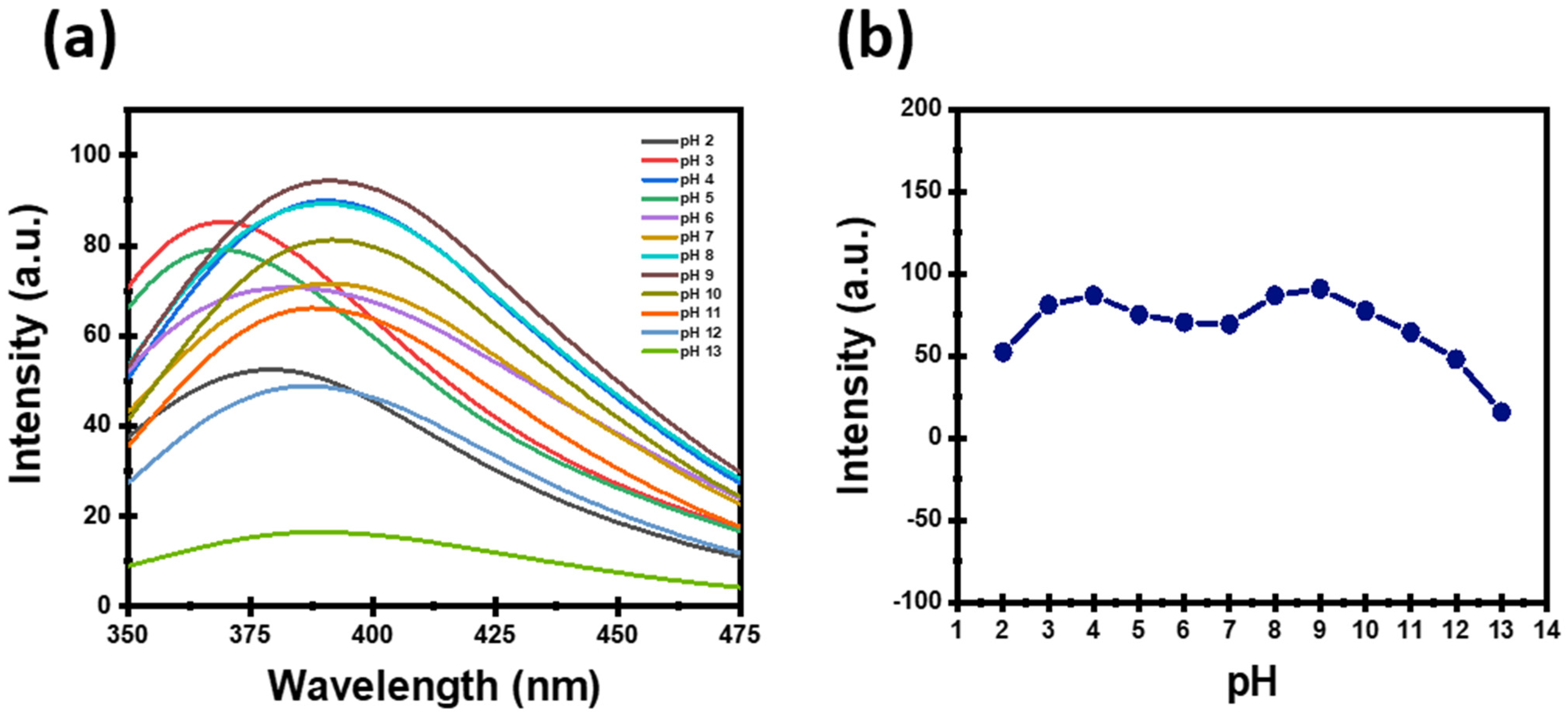
HCl and NaOH were used to prepare N-CDs solutions with different pH values (2.00 to 13.00). PL intensities were measured after 15.00 min.
2.6.2. Thermal Stability
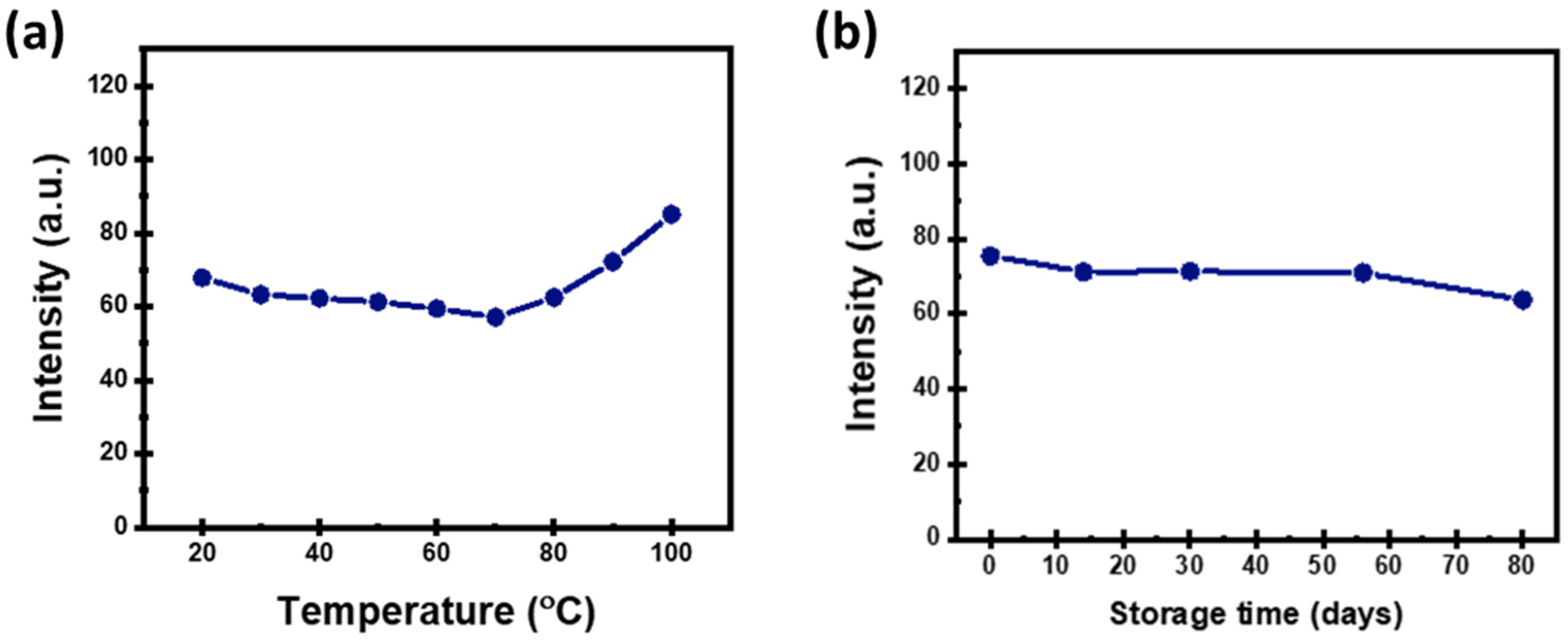
To evaluate thermal stability, the temperature of the N-CD solutions varied from 20 to 100 °C. PL intensity was measured immediately once the solutions reached each target temperature.
2.6.3. Storage Time Stability
N-CD solutions were stored in tightly closed containers at room temperature to prevent contamination, aggregation, or changes in properties.
2.7. Use of Fluoride as a Masking Agent for Fe(III) for Mercury Detection
Interference from Fe(III) in mercury measurements was suppressed by using fluoride as a selective masking agent. Before introducing Hg(II), 0.1 mM F− ions were added to the system, and the mixture was kept for 15 min to ensure the complete complexation of Fe(III) into a stable Fe-F complex.
2.8. Real Seawater Samples
Real sample analysis was carried out using seawater collected from Abhur beach, Jeddah, KSA and filtered through a 0.22 µm membrane and used without further treatment. Known amounts of Fe(III), Hg(I), and Hg(II) were spiked into the seawater to obtain final concentrations in the range of 200–1000 µM, while the concentrations of N-CDs and all other measurement conditions were kept identical to those used in the standard aqueous solution. After mixing and incubating for 15 min at room temperature, the PL intensities were measured, and the PL intensities at λem = 380 nm were plotted versus ion concentration to compare quenching behavior in standard and seawater media.
3. Results and Discussions
3.1. Composition and Structure of N-CDs
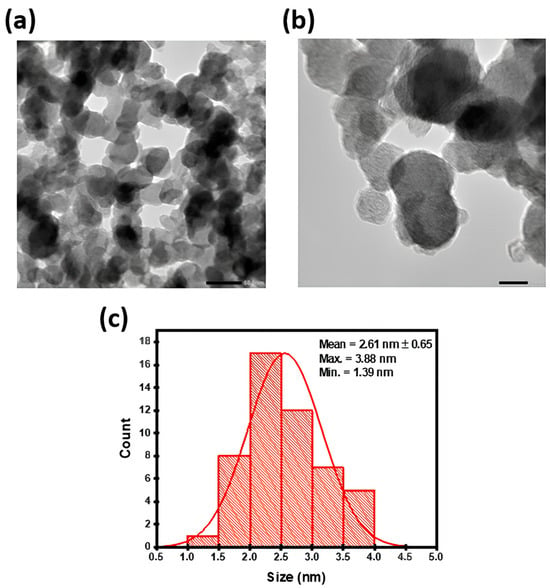
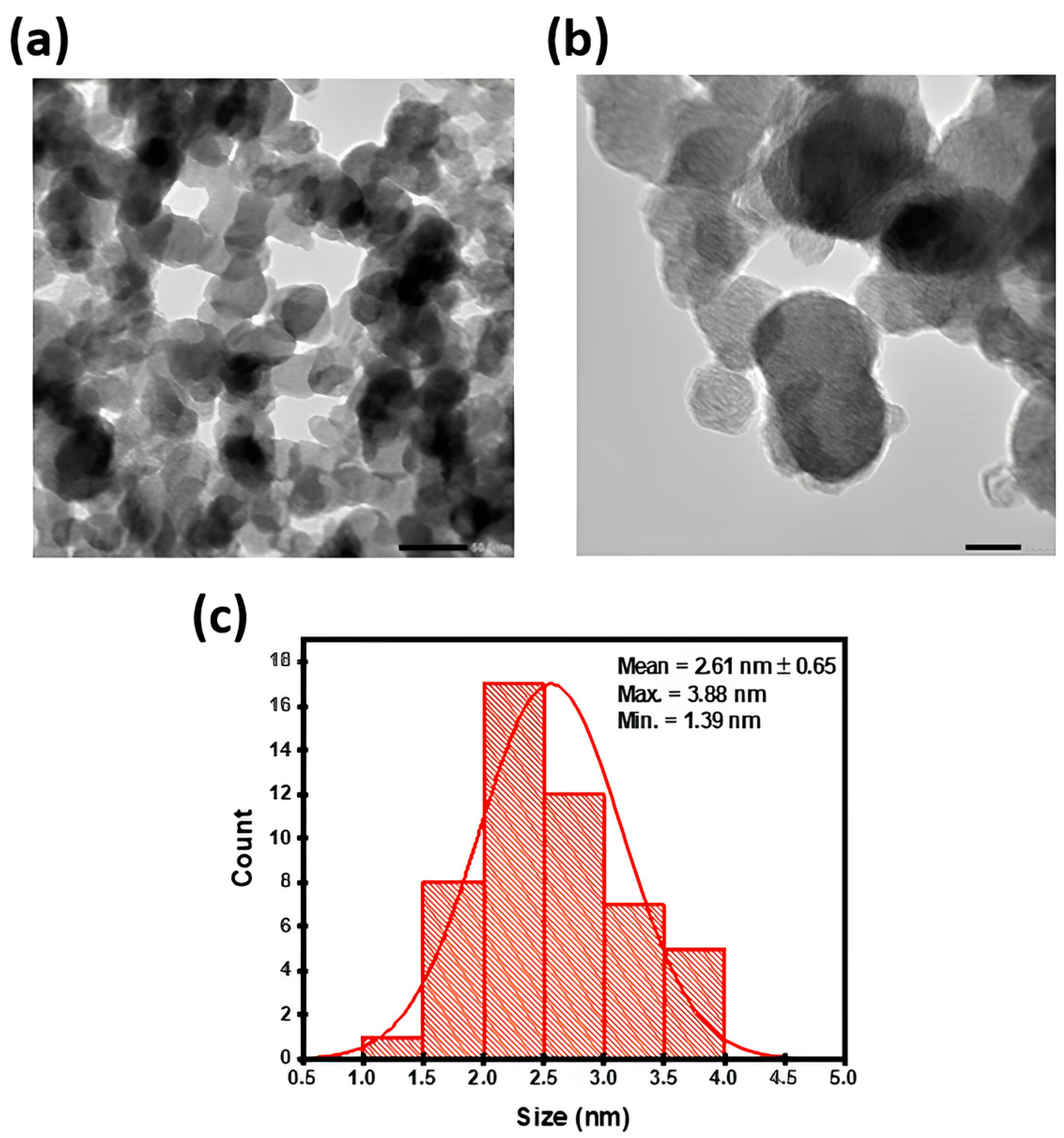
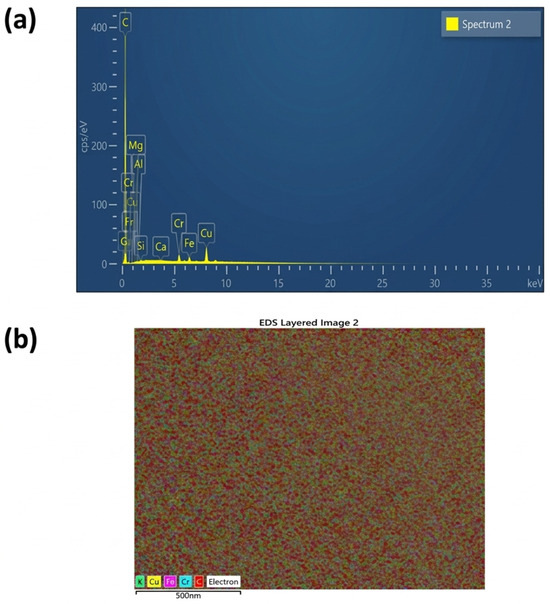
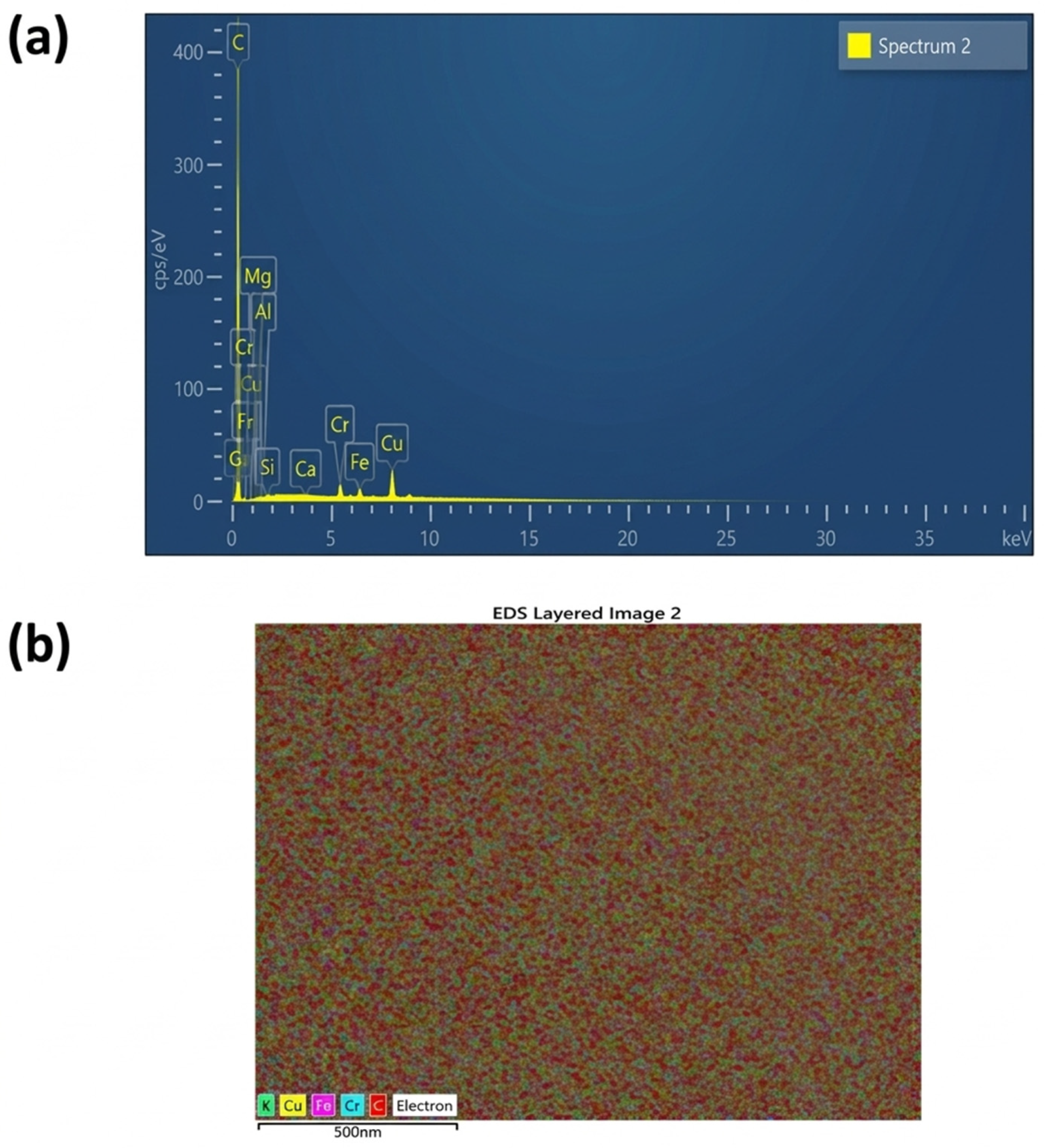
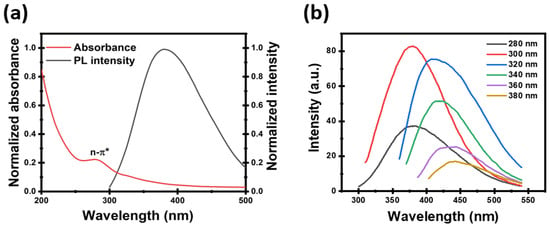
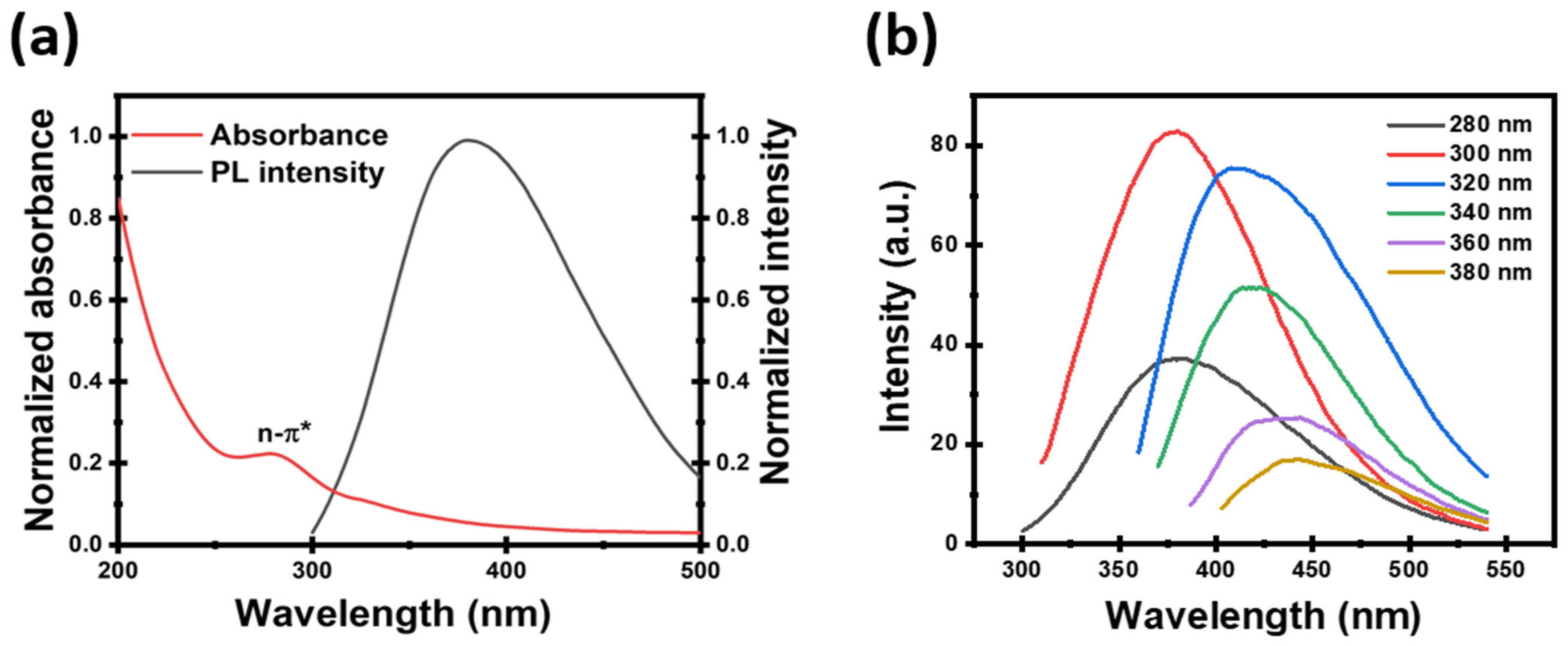
TEM analysis was employed to assess the particle size distribution (Figure 1) of the prepared N-CDs. The images demonstrated that the N-CDs possess an average diameter of 2.61 (0.65 nm). The size range extended from 1.39 nm to 3.88 nm, indicating a relatively narrow distribution and good uniformity. These results suggest that this synthetic procedure produces N-CDs with consistent dimensions, which is advantageous for applications requiring uniform nanomaterials. TEM analysis shows the aggregation of particles, and there are two possible origins and reasons that cause aggregation or clustering. This might occur during the preparation of N-CDs or as an artifact after solvent evaporation during CDs sample preparation for TEM analysis. The EDS spectrum in Figure 2a and map analysis in Figure 2b indicate that N-CDs are mainly composed of carbon (86.29 wt%), confirming their predominantly carbonaceous nature. Furthermore, trace amounts of metallic elements were detected, as shown in Table 1. The inorganic elements detected are primarily ascribed to the mineral composition of orange peels, encompassing key constituents such as Mg, Ca, Fe, Cu, and Si [28]. Although nitrogen appears in the FTIR spectra, it is sometimes undetectable in EDS spectra due to its low atomic number, which generates weak X-ray emissions readily absorbed by the detector window or surface contaminants. In addition, nitrogen requires a minimum concentration threshold (approximately 2.00 wt%) for reliable EDS detection, making its quantification inconsistent at trace levels in many samples [29]. EDS elemental mapping (Figure 2b) was performed to evaluate the spatial distribution of elements in the as-prepared N-CDs. The EDS map shows that C along with K, Cu, Fe, and Cr elements are dispersed throughout the mapped area (500 nm scale) with no noticeable elemental-rich domains or phase separation. This homogeneous distribution suggests the uniform incorporation of these elements on the N-CDs surface, supporting the formation of compositionally consistent N-CDs. Using UV-vis spectroscopy, the optical properties of the N-CDs were identified. The absorption spectra in Figure 3a illustrate a distinctive peak at 280 nm, confirming the typical range of 250–300 nm, which corresponds to a n–π* transition peak [30] and also displays the fluorescence intensity peak of N-CDs. Excitation-dependent emissions were demonstrated by the prepared N-CDs, suggesting that the fluorescent/luminescent wavelengths can be varied by differing the excitation wavelength. Figure 3b shows the emissions spectra of N-CDs, with different excitation wavelengths (from 280 to 380 nm).
Figure 1.
TEM images of the synthesized N-CDs at (a) 50 nm; (b) 20 nm and (c) Particle size distribution.
Figure 2.
(a) EDS elemental analysis and (b) mapping analysis of the prepared N-CDs.
Table 1.
EDS elemental analysis.
Figure 3.
(a) Absorption and PL intensity spectra; (b) emission PL intensity spectra at different exciting wavelengths.
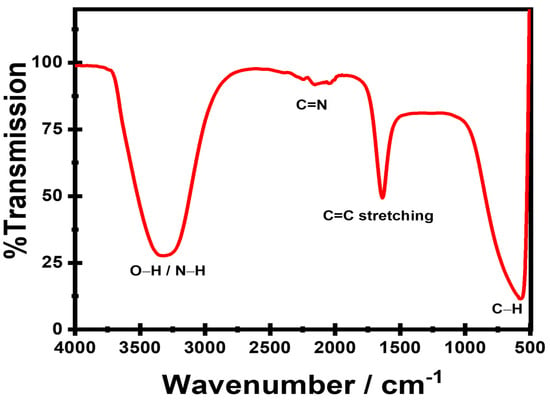
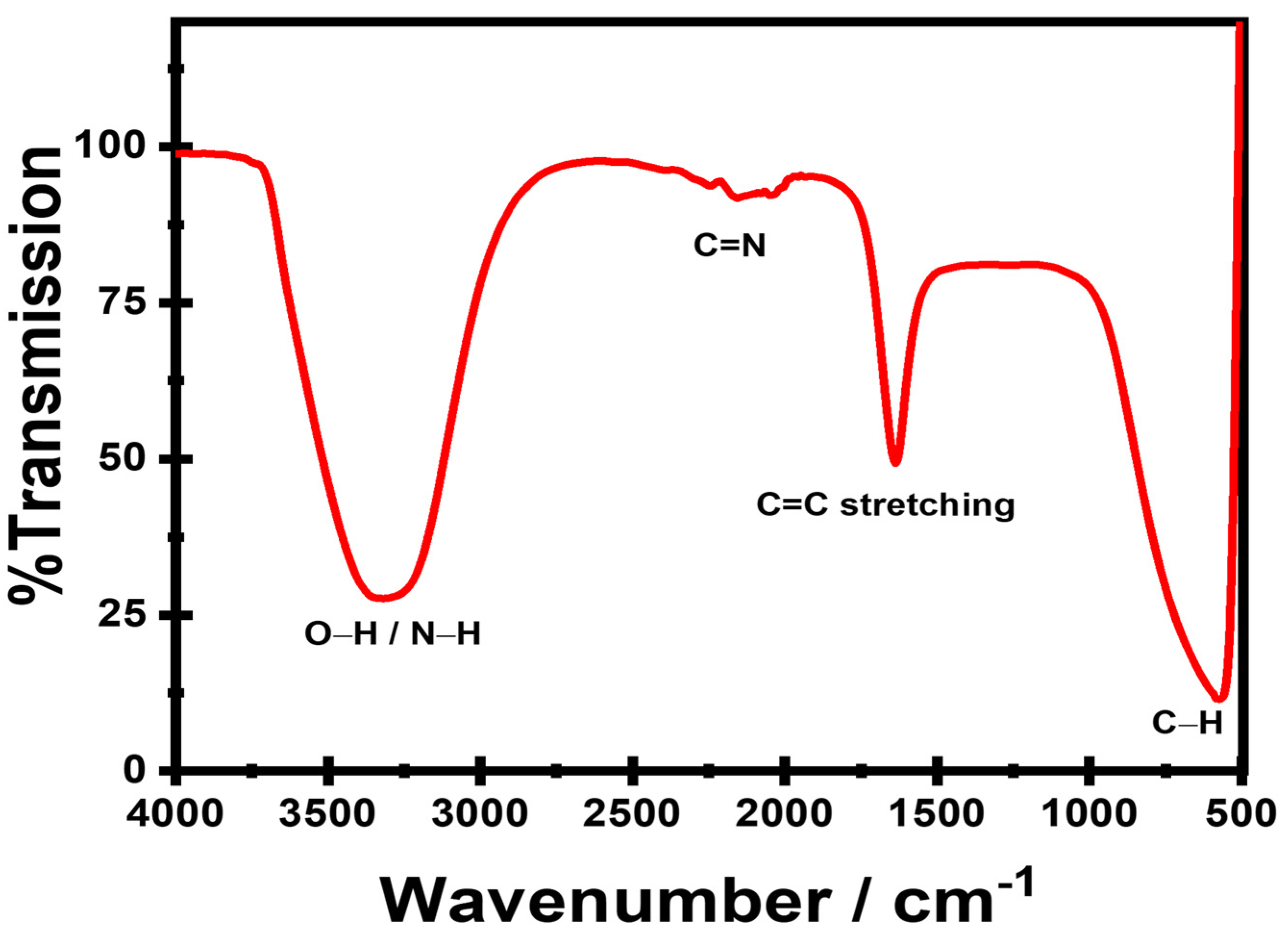
Figure 4 illustrates the FTIR spectra of the prepared N-CDs. There are four strong bands centered at 555 cm−1, 1620 cm−1, 2000–2200 cm−1, and 3300 cm−1. The strong band at 555 cm−1 is attributed to aromatic C-H out-of-plane bending or related skeletal vibrations. The sharp band at around 1620 cm−1 corresponds to C=C stretching. The peak in the range of 2000–2200 is related to C=N, indicative of imine or amide functionalities. The broad band at 3300 cm−1 is attributed to O-H/N-H stretching. These features confirm the presence of surface hydroxyl or amino groups, as well as nitrogen-containing moieties incorporated within a conjugated aromatic/carbonaceous framework [31,32].
Figure 4.
FTIR spectrum of N-CDs.
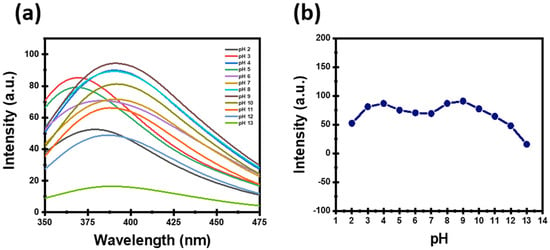
Figure 5a,b illustrates the N-CDs PL intensity spectra with different pH values. The curve in Figure 5a shows a red shift at 23.92 nm. This is primarily caused by modifications of the surface chemical states, specifically the protonation and deprotonation of N-CD surface functional groups [33]. At lower pH (acidic conditions), the protonation of surface amino groups and other functional groups occurs. This protonation alters the energy levels and electronic structure of N-CDs, stabilizing lower-energy emissive states and leads to a red shift (longer wavelength emission) of the fluorescence peak. At higher pH (basic conditions), the deprotonation of these groups occurs, which can blue-shift the emissions by destabilizing the lower-energy states and favoring higher-energy transitions [34]. Figure 5b demonstrates that the N-CDs PL intensity is relatively oscillatory and then starts to decrease at higher pH values (basic conditions).
Figure 5.
(a,b) PL intensity stability of N-CDs at different pH values.
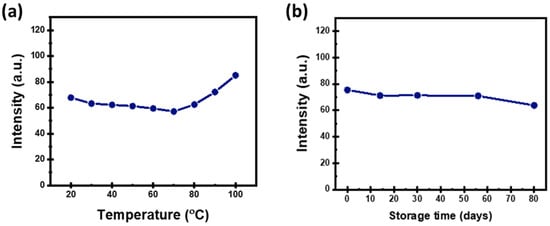
Temperature-dependent PL emissions spectra in the range of 20 to 100 °C are shown in Figure 6. Figure 6a shows that the N-CDs PL intensity is relatively stable until it reaches 80 °C, and then it begins to rise. N-CDs maintain their surface functional groups and core-shell structure in the range of 20–80 °C, leading to stable fluorescence, and the non-radiative pathways (such as vibrational relaxation) remain suppressed, preserving the emission PL intensity [35]. Figure 6b shows that the PL intensity of N-CDs that were stored for about 80 days has not changed significantly, proving that the synthesized N-CDs show a steady fluorescence performance. In this study, N-CDs retained 95% of their original PL intensity after one month and 85% after 80 days, indicating strong durability during storage.
Figure 6.
(a) Thermal stability and (b) storage time stability.
QY is another parameter that quantifies the efficiency of N-CDs. The N-CDs QY was calculated to be 47.12%. This value is significantly higher compared to biomass-derived N-CDs and proves the efficiency of the microwave-assisted approach. The QY obtained in this work compares favorably with previous studies, which used orange peels or related biomass precursors (Table 2). This high value suggests that the adopted method enables the effective surface passivation of N-CDs, which makes them appropriate for multi-applications in sensing and bioimaging.
Table 2.
Comparison of QY of CDs produced in previous studies and this work.
3.2. Heavy Metal Selectivity
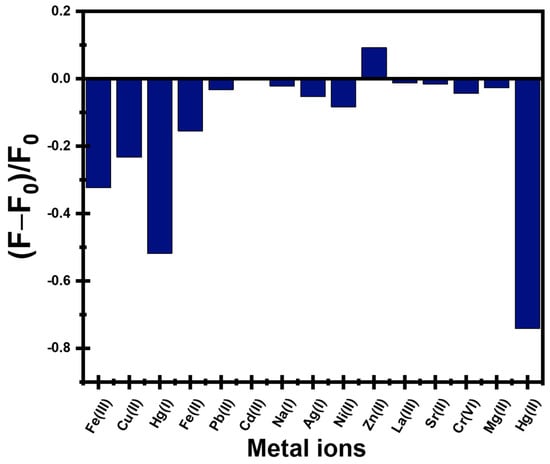
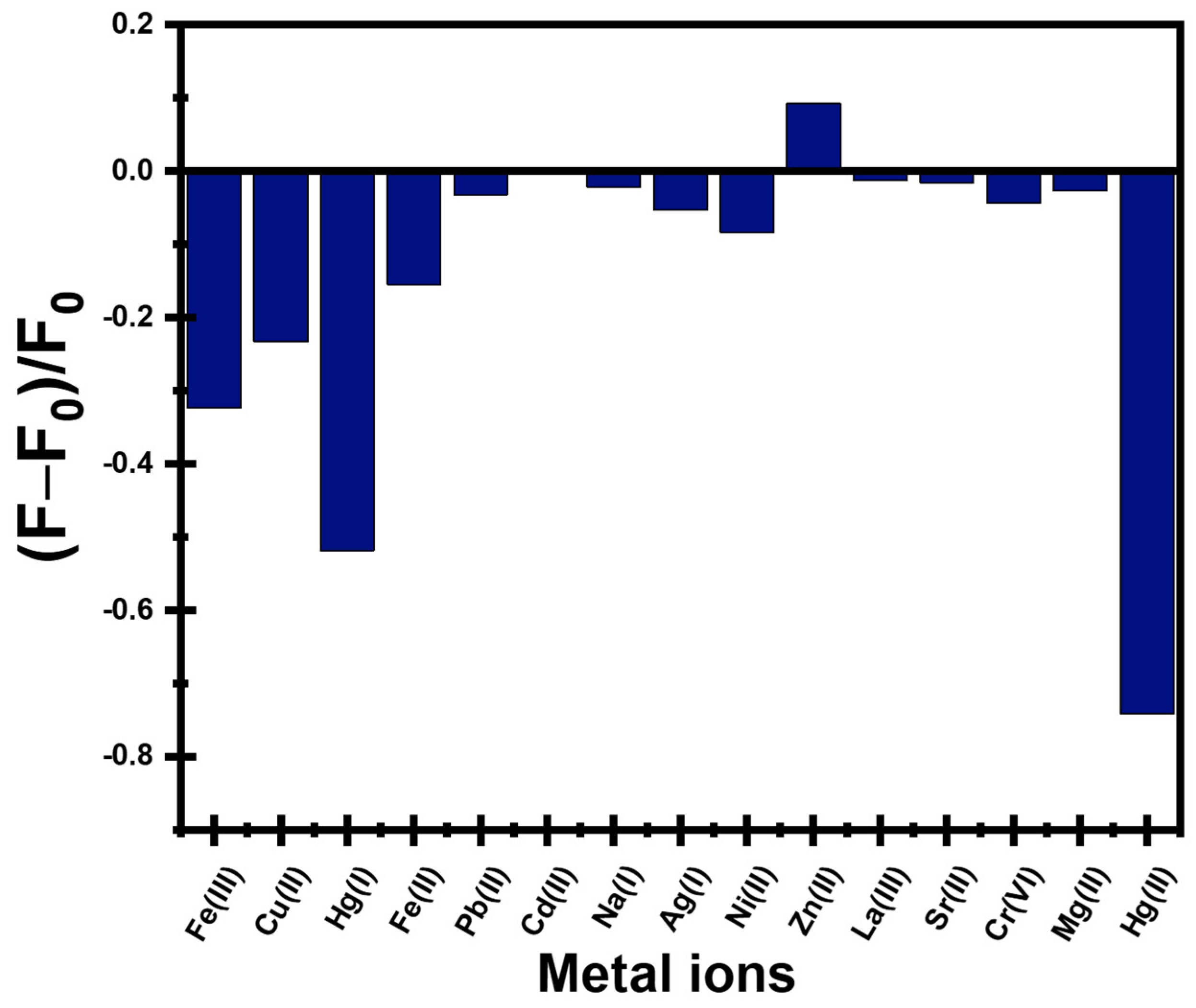
As displayed in Figure 7, the N-CDs PL intensity could be notably quenched by Hg(II), Hg(I), and Fe(III) compared with the other metal ions. The figure illustrates the fluorescence response of N-CDs in the presence of different metal ions at = 380 nm. This ratio (F − F0)/F0 is commonly used to quantify the relative change in the N-CDs PL intensity when metal ions are introduced. This value represents the fractional change in fluorescence and is particularly useful for comparing the sensitivity and selectivity of N-CDs with different metal ions. A negative value indicates fluorescence quenching (decrease in PL intensity), like Hg(II), Hg(I), and Fe(III) ions. The positive value indicates fluorescence enhancement (increase in PL intensity), though this is less common for heavy metal ion sensing with N-CDs [42]. Here, (F − F0)/F0 was calculated for each metal ion. As shown in Figure 7, Hg(II), Hg(I), and Fe(III) induced the most significant quenching, having values of −0.74122, −0.5176, and −0.3233, respectively, while other ions exhibited a minimal effect, confirming high selectivity toward Hg(I), Hg(II), and Fe(III).
Figure 7.
N-CDs fluorescence response in the presence of different metal ions.
3.2.1. Hg(I)
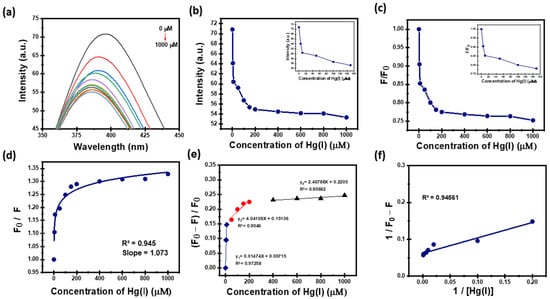
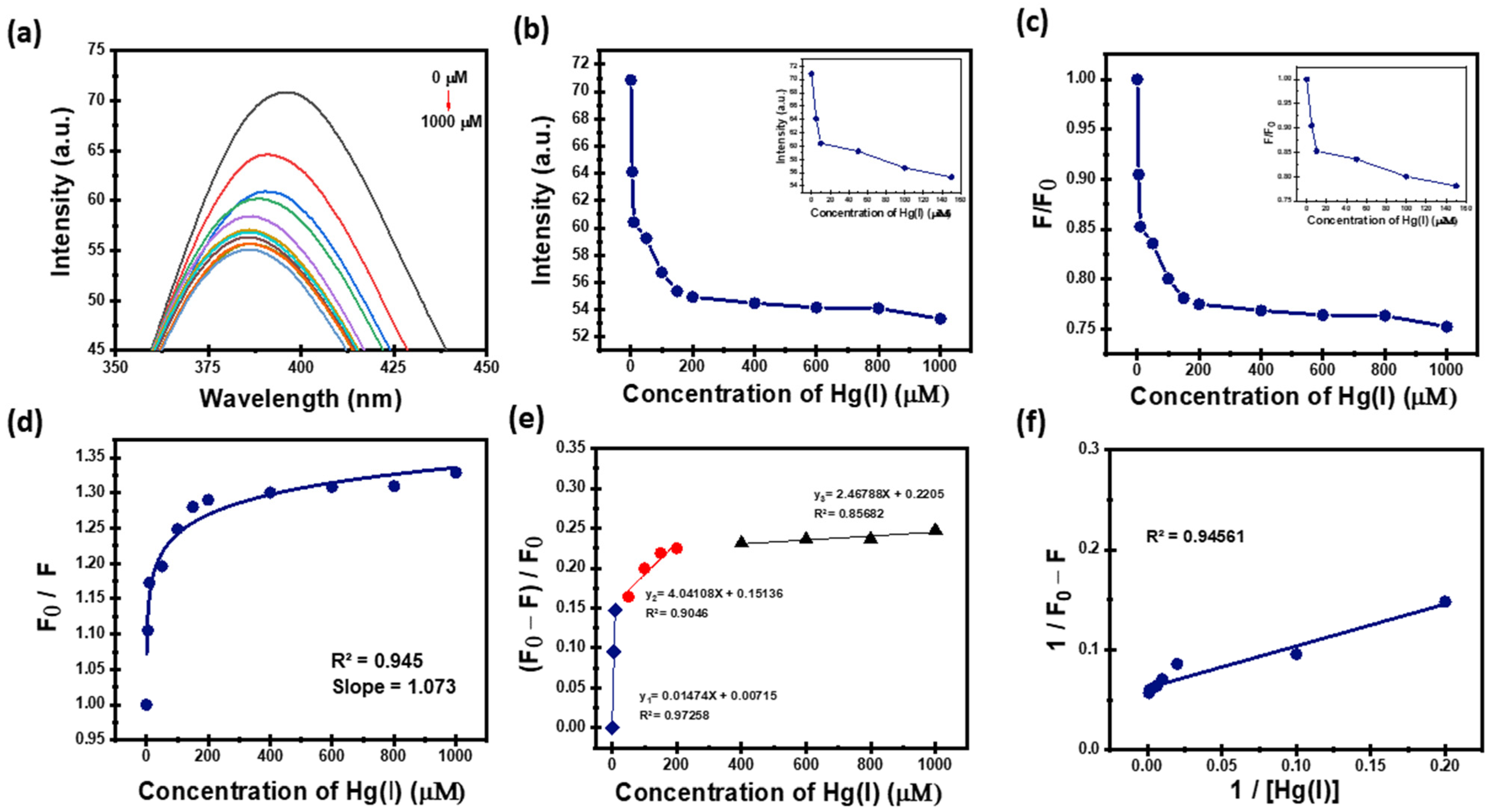
In Figure 8a,b, as the concentration of Hg(I) increases, the PL intensity appears to gradually decrease, and each color is related to a specific concentration between 0 and 5 μM. Figure 8c shows that the PL intensity ratio decreases with increasing concentration. The LOD was estimated to be 0.15379 μM, and the LOC was equal to 0.46603. Limit of detection (LOD) = 3.3 σ/s and limit of quantification (LOQ) = 10 σ/s, where σ and s are related to the blank sample’s standard deviation and slope of the Stern–Volmer plot, respectively. In Figure 8d, the upward curvature observed in the Stern–Volmer model of the Hg(I)-induced quenching of N-CD intensity indicates a deviation from the linear relationship.
Figure 8.
(a,b) The relationship between N-CDs PL intensity and Hg(I) concentration; (c) ratio of PL intensity to concentration (μM); (d) Stern–Volmer plot; (e) relationship between the quenching efficiency of CDs and Hg(I) concentration; (f) Benesi–Hildbrand plot.
Thus, the observed non-linear Stern–Volmer response shows the heterogenous nature of the N-CDs surface and multifaceted interaction with Hg(I), which enhances sensor sensitivity over a wide concentration range.
Figure 8e shows the relative fluorescence intensity in relation to the concentration plot with three linear regions. At low concentrations, there is typically high sensitivity, which often results in a steep linear segment in the plot. This can be attributed to: (1) abundant accessible binding sites on the N-CDs surface, allowing efficient quenching when Hg(I) is added; (2) the dominance of static quenching, where heavy metal ions coordinate rapidly with the functional groups on the surface, such as oxygen-containing moieties, forming nonfluorescent complexes. As Hg(I) concentration increases in the second linear region, a number of binding sites are occupied, leading to reduced accessibility. Finally, at very high concentrations, there is limited quenching accessibility, which can be attributed to the saturation of available sites and the diffusion effect and aggregation, which can further suppress quenching. The binding interaction between N-CDs and Hg(I) was evaluated using a linear Benesi–Hildebrand plot, shown in Figure 8f, where R2 = 0.945. This behavior indicates a 1:1 complex formation between Hg(I) and the surface binding sites of the N-CDs.
3.2.2. Fe(III)
As shown in Figure 9a,b, the PL intensity of N-CDs decreased with the addition of Fe(III) with increasing concentrations. The linear increase in the Stern–Volmer plot of F0-F versus the concentration of Fe(III) in Figure 9d indicates the concentration-dependent quenching of N-CDs PL intensity that follows the classical Stern–Volmer relationship:
where:
F0 and F: PL intensities in the absence and presence of Fe(III) ions, respectively. KSV: Stern–Volmer quenching constant.
Figure 9.
(a,b) The relationship between N-CDs PL intensity and Fe(III) concentration; (c) ratio of PL intensity to concentration (μM); (d) Stern–Volmer plot; (e) relationship between the quenching efficiency of CDs and Fe(III) concentration; (f) Benesi–Hildbrand plot.
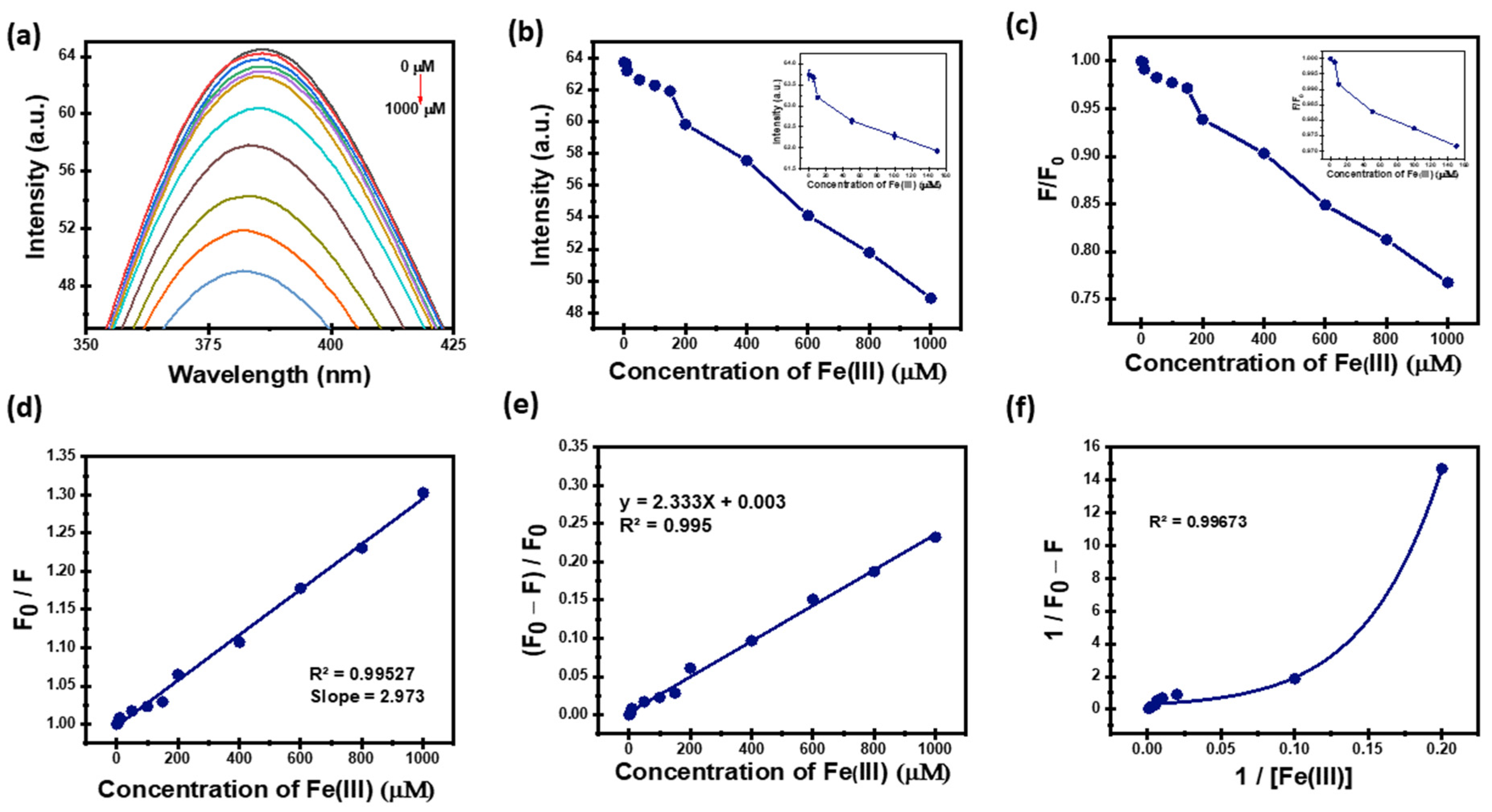
This linearity suggests that either dynamic quenching, where Fe(III) ions collide with excited-state N-CDs causing non-radiative relaxation, or static quenching through the generation of non-fluorescent ground-state complexes, predominates within the studied concentration range [43]. The lack of deviation from linearity implies the uniform accessibility of the fluorescence centers and absence of significant aggregation or complex quenching mechanisms. In Figure 9c, Fe(III) ions added to the N-CD solution leads to a clear concentration-dependent decrease in the F/F0 ratio, indicative of fluorescence quenching. N-CDs high selectivity toward Fe(III) ions is ascribed to the favorable and rapid chelation kinetics between Fe(III) and electron-donating sites on the N-CDs surface. This evidence ensures the suitability of CD-based sensors for the selective and sensitive detection of Fe(III) ions in aqueous environments. The LOD was estimated to be 0.0555 μM. LOD = 3.3 σ/s and LOQ equal to 0.16818. LOQ = 10 σ/s, where σ and s are related to the SD values of blank samples and the slope of the Stern–Volmer curve, respectively. This LOD is significantly lower than many developed Fe(III) sensors, which typically exhibit LODs in the range of 1.8–4.3 μM (Table 3), and in some highly sensitive sensors, it was about 0.19 μM [44]. The remarkably low LOD obtained in this study demonstrates high sensitivity of the presented approach, making it suitable for trace-level Fe(III) detection in environmental and drinking water samples. Furthermore, this detection capability is significantly lower than the World Health Organization’s (WHO’s) recommended guideline limit for Fe(III) in drinking water (5 μM), highlighting the potential of the developed sensor for practical applications.
In Figure 9e, the linear increase observed in the (F0 − F)/F0 versus concentration plot demonstrates the concentration-dependent quenching of N-CD fluorescence with Fe(III) ions. The linearity indicates that the binding sites on N-CDs are readily accessible and not saturated within the studied concentration ranges. Moreover, this proportional relationship reflects that each incremental addition of Fe(III) efficiently quenches fluorescence without significant interference from other processes, like aggregation or inner filter effects, at these concentrations. Figure 9f shows a Benesi–Hildbrand plot with 1:2 stoichiometry and an excellent correlation (R2 = 0.9965), indicating that fluorescence quenching is caused by a complex in which one fluorophore binds two quencher molecules. This implies a more complex interaction than simple 1:1 binding, likely involving stronger and multiple binding sites. The good fit confirms that this higher-order complex significantly contributes to the observed quenching [45].
3.2.3. Hg(II)
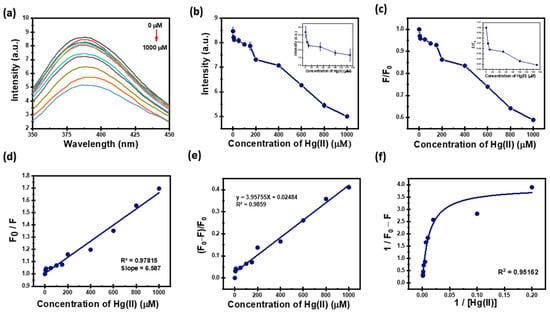
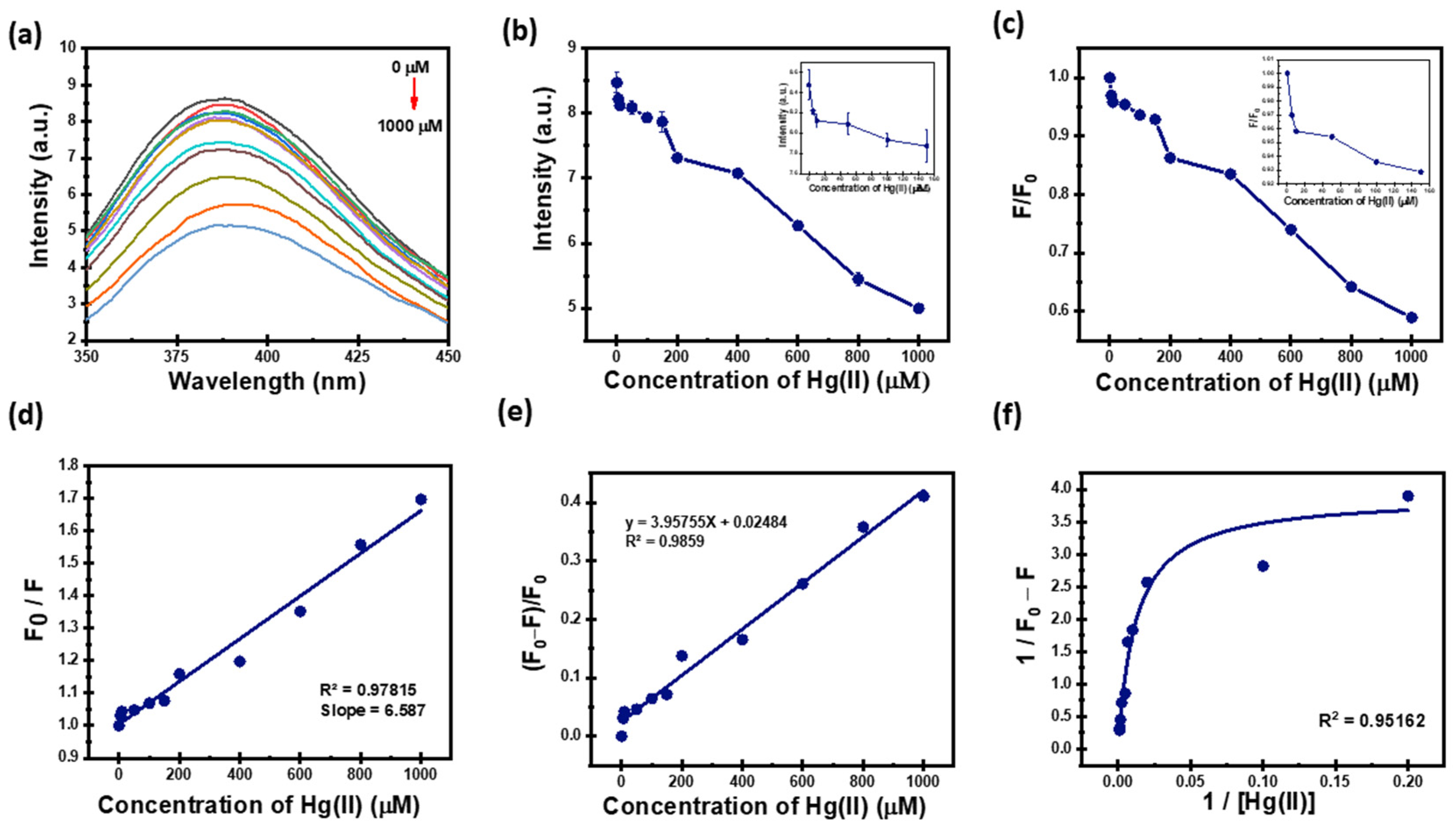
As illustrated in Figure 10a,b, the PL intensity of N-CDs gradually decreases as the concentration of Hg(II) ions increases. Figure 10d shows the Stern–Volmer relationship of F0/F as a function of Hg(II) concentration, which exhibits a strong linear relationship (R2 = 0.97815), indicating that the fluorescence quenching efficiency of N-CDs increases proportionally to Hg(II) concentration. This linearity is characteristic of a well-defined quenching process and supports the suitability of the prepared N-CDs for the detection of Hg(II) ions. In Figure 10e, the efficiency of the fluorescence quenching of N-CDs with the addition of Hg(II) ions was quantitatively evaluated by plotting the F/F0 versus Hg(II) concentration. A concentration-dependent decrease in F/F0 was observed with the increase in Hg(II) concentration, indicating efficient quenching by Hg(II) ions. It is estimated that the LOD is 0.02505 μM, and the LOQ is equal to 0.07592. This low LOD demonstrates the high sensitivity of the developed N-CDs as sensors for the detection of trace levels of Hg(II) in aqueous solutions. This is a lower value than most other reported carbon dot-based fluorescent sensors (Table 4) [46]. The quenching efficiency was analyzed quantitively to investigate how the N-CDs fluorescence is quenched by the addition of Hg(II) ions using the plot of (F0-F)/F0 versus. Hg(II) concentration is presented in Figure 10e. This plot exhibits an excellent linear relationship within the concentration range where R2 = 0.9859. The linearity indicates a direct proportional of Hg(II) ions quenching effect on N-CD intensity, enabling reliable quantification and suggesting a well-defined interaction mechanism between Hg(II) ions and the N-CDs surface. In Figure 10f, the B–H plot exhibits nonlinear behavior consistent with a 1:2 stoichiometry and a high correlation coefficient (R2 = 0.95), indicating that fluorescence quenching arises from the formation of a complex in which one fluorophore coordinates with two quencher molecules. This behavior suggests a more complex binding interaction and involves stronger and multiple binding sites on the fluorophore. Good fit supports the involvement of this higher-order complexation in governing the observed fluorescence quenching.
Figure 10.
(a,b) The relationship between N-CDs PL intensity and Hg(II) concentration; (c) ratio of fluorescence intensity to concentration (μM); (d) Stern–Volmer plot; (e) relationship between the quenching efficiency of CDs and Hg(II) concentration; (f) Benesi–Hildbrand plot.
Table 3.
Different sensors for Fe(III) detection.
Table 4.
Different sensors for Hg(II) detection.
3.3. Simultaneous Study of Hg(II) Detection in the Presence of Fe(III) Ions
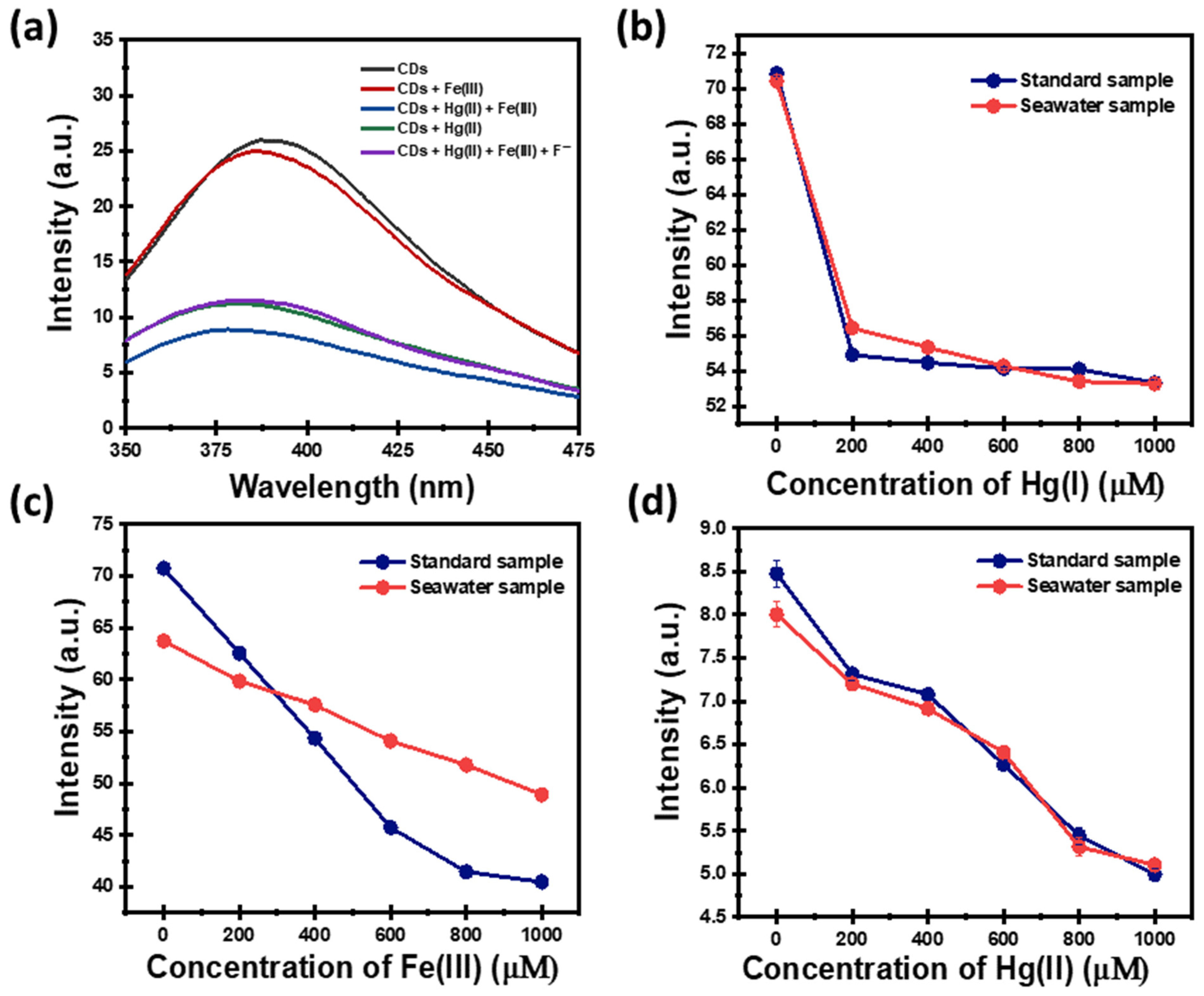
Figure 11a illustrates the influence of F− ions when employed as a masking agent on the PL intensity of the prepared N-CDs in Hg(II) detection in the presence of Fe(III) ions. N-CDs exhibit the highest PL intensity in the absence of metal ions. Upon the addition of Fe(III), the PL intensity decreases slightly, and this is attributable to partial quenching through coordination between Fe(III) and surface functional groups, as well as potential inner-filter effects. In contrast, Hg(II) alone causes a much more pronounced quenching effect, which is consistent with its stronger binding affinity and greater quenching efficiency toward N-CDs. In the simultaneous presence of Hg(II) and Fe(III), the fluorescence intensity reaches its lowest value, reflecting combined or competitive quenching and confirming that Fe(III) behaves as an interfering species in the optical determination of Hg(II). Upon the addition of F− to the N-CDs–Hg(II)–Fe(III) system, the partial recovery of fluorescence occurs, which is ascribed to the formation of stable Fe(III)–F− complexes that reduce the interaction of Fe(III) with the N-CDs surface.
Figure 11.
(a) Effect of F− masking agent on N-CDs PL intensity for Hg(II) and Fe (III) detection. Fluorescence response of the CDs toward (b) Hg(I); (c) Fe(III); (d) Hg(II) in standard aqueous solutions and spiked seawater samples.
3.4. Detection of Hg(I), Fe(III), and Hg(II) in Real Samples
To evaluate the practical applications of the prepared N-CDs, their performance toward Hg(I) was investigated in both standard solutions and spiked seawater samples (Figure 11b). Upon increasing the Hg(I) concentration, the PL intensity decreased for both standard and seawater samples; a slight further decrease was observed up to 1000 µM. The nearly overlapping curves for the standard and seawater samples indicate that the N-CDs retain comparable quenching behavior and sensitivity in the complex seawater matrix, demonstrating their suitability for Hg(I) determination in real environmental samples. As shown in Figure 11c, although the N-CDs exhibit slightly lower quenching efficiency in seawater compared with the standard solution, the overall trend and linearity are maintained, confirming their applicability for Fe(III) determination in real seawater samples. The fluorescence response of N-CDs toward Hg(II) was examined in both standard solutions and spiked seawater samples (Figure 11d). With increasing Hg(II) concentration, the PL intensity decreases gradually in the standard solution and in seawater, demonstrating clear concentration-dependent quenching behavior. The two curves almost overlap across the entire range, indicating that the sensor exhibits comparable sensitivity and linearity in real seawater.
4. Conclusions
This study reports a rapid, eco-friendly, microwave-assisted route for synthesizing N-CDs from orange peels and urea and achieved a high QY of 47.12%. The as-prepared N-CDs exhibit excellent sensitivity toward Fe(III), Hg(II), and Hg(I) ions, with low limits of detection that make them promising probes for trace heavy metal monitoring. In addition, their strong photostability, good aqueous solubility, and long-term storage stability suggest broad potential for integration into practical platforms, including fluorescence-based sensors and bioimaging applications.
Author Contributions
Conceptualization, S.B.K.; methodology, R.H.A. and L.R.A.; validation, E.M.B. and K.A.; formal analysis, R.H.A., G.A.K. and S.B.K.; investigation, K.A. and G.A.K.; resources, K.A. and S.B.K.; data curation, R.H.A. and E.M.B.; writing—original draft preparation, R.H.A.; writing—review and editing, E.M.B., K.A., L.R.A., G.A.K. and S.B.K.; supervision, E.M.B. and S.B.K.; funding acquisition, E.M.B. All authors have read and agreed to the published version of the manuscript.
Funding
This project was funded by KAU Endowment (WAQF), King Abdulaziz University, Jeddah, Saudi Arabia.
Institutional Review Board Statement
Not applicable.
Informed Consent Statement
Not applicable.
Data Availability Statement
The original contributions presented in this study are included in the article. Further inquiries can be directed to the corresponding author(s).
Acknowledgments
This project was funded by KAU Endowment (WAQF), King Abdulaziz University, Jeddah, Saudi Arabia. The authors, therefore, acknowledge with thanks WAQF and the Deanship of Scientific Research (DSR) for the technical and financial support.
Conflicts of Interest
Author Gul Aslam Khan was employed by the company Seismic Party 02 OGDCL. The remaining authors declare that the research was conducted in the absence of any commercial or financial relationships that could be construed as a potential conflict of interest.
References
- Cui, L.; Ren, X.; Sun, M.; Liu, H.; Xia, L. Carbon dots: Synthesis, properties and applications. Nanomaterials 2021, 11, 3419. [Google Scholar] [CrossRef] [Scilit] [PubMed]
- Liu, Y.; Huang, Z.; Wang, X.; Hao, Y.; Yang, J.; Wang, H.; Qu, S. Recent advances in highly luminescent carbon dots. Adv. Funct. Mater. 2025, 35, 2420587. [Google Scholar] [CrossRef] [Scilit]
- Kumar, S.; Gaur, J.; Kaushal, S.; Dalal, J.; Misra, M.; Kaur, H.; Kaur, S.; Kaur, N.; Singh, G.; Singh, G. An insight into synthesis, optical properties, and applications of green fluorescent carbon dots. Crystals 2025, 15, 320. [Google Scholar] [CrossRef] [Scilit]
- Pattnayak, S.; Sahoo, U.; Hota, G. Green synthesis of carbon dot-based materials for toxic metal detection and environmental remediation. In Handbook of Green and Sustainable Nanotechnology: Fundamentals, Developments and Applications; Springer: Berlin/Heidelberg, Germany, 2023; pp. 329–354. [Google Scholar] [CrossRef] [Scilit]
- Döring, A.; Ushakova, E.; Rogach, A.L. Chiral carbon dots: Synthesis, optical properties, and emerging applications. Light Sci. Appl. 2022, 11, 75. [Google Scholar] [CrossRef] [Scilit]
- Guo, L.; Ge, J.; Liu, W.; Niu, G.; Jia, Q.; Wang, H.; Wang, P. Tunable multicolor carbon dots prepared from well-defined polythiophene derivatives and their emission mechanism. Nanoscale 2016, 8, 2729–2734. [Google Scholar] [CrossRef] [Scilit]
- Travlou, N.A.; Giannakoudakis, D.A.; Algarra, M.; Labella, A.M.; Rodríguez-Castellón, E.; Bandosz, T.J. S-and N-doped carbon quantum dots: Surface chemistry dependent antibacterial activity. Carbon 2018, 135, 104–111. [Google Scholar] [CrossRef] [Scilit]
- Liu, Y.; Duan, W.; Song, W.; Liu, J.; Ren, C.; Wu, J.; Liu, D.; Chen, H. Red emission B, N, S-co-doped carbon dots for colorimetric and fluorescent dual mode detection of Fe3+ ions in complex biological fluids and living cells. ACS Appl. Mater. Interfaces 2017, 9, 12663–12672. [Google Scholar] [CrossRef] [Scilit]
- Verma, C.; Dubey, S.; Alfantazi, A.; Rhee, K.Y. Heteroatoms-doped carbon dots: Fundamental, properties, coordination bonding and corrosion protection. J. Ind. Eng. Chem. 2024, 133, 90–111. [Google Scholar] [CrossRef] [Scilit]
- Qi, H.; Qiu, L.; Zhang, X.; Yi, T.; Jing, J.; Sami, R.; Alanazi, S.F.; Alqahtani, Z.; Aljabri, M.D.; Rahman, M.M. Novel N-doped carbon dots derived from citric acid and urea: Fluorescent sensing for determination of metronidazole and cytotoxicity studies. RSC Adv. 2023, 13, 2663–2671. [Google Scholar] [CrossRef] [Scilit] [PubMed]
- Magesh, V.; Sundramoorthy, A.K.; Ganapathy, D. Recent advances on synthesis and potential applications of carbon quantum dots. Front. Mater. 2022, 9, 906838. [Google Scholar] [CrossRef] [Scilit]
- Nazar, M.; Hasan, M.; Wirjosentono, B.; Gani, B.A.; Nada, C.E. Microwave synthesis of carbon quantum dots from Arabica coffee ground for fluorescence detection of Fe3+, Pb2+, and Cr3+. ACS Omega 2024, 9, 20571–20581. [Google Scholar] [CrossRef] [Scilit]
- Rawat, J.; Sharma, H.; Dwivedi, C. Microwave-assisted synthesis of carbon quantum dots and their integration with TiO2 nanotubes for enhanced photocatalytic degradation. Diam. Relat. Mater. 2024, 144, 111050. [Google Scholar] [CrossRef] [Scilit]
- Qiu, H.; Yuan, F.; Wang, Y.; Zhang, Z.; Li, J.; Li, Y. Green-light-emitting carbon dots via eco-friendly route and their potential in ferric-ion detection and WLEDs. Mater. Adv. 2022, 3, 7339–7347. [Google Scholar] [CrossRef] [Scilit]
- Jorns, M.; Strickland, S.; Mullins, M.; Pappas, D. Improved citric acid-derived carbon dots synthesis through microwave-based heating in a hydrothermal pressure vessel. RSC Adv. 2022, 12, 32401–32414. [Google Scholar] [CrossRef] [Scilit]
- Kayani, K.F.; Ghafoor, D.; Mohammed, S.J.; Shatery, O.B.A. Carbon dots: Synthesis, sensing mechanisms, and potential applications as promising materials for glucose sensors. Nanoscale Adv. 2024, 7, 42–59. [Google Scholar] [CrossRef] [Scilit] [PubMed]
- de Medeiros, T.V.; Manioudakis, J.; Noun, F.; Macairan, J.-R.; Victoria, F.; Naccache, R. Microwave-assisted synthesis of carbon dots and their applications. J. Mater. Chem. C 2019, 7, 7175–7195. [Google Scholar] [CrossRef] [Scilit]
- Boakye-Yiadom, K.O.; Kesse, S.; Opoku-Damoah, Y.; Filli, M.S.; Aquib; Joelle, M.M.B.; Farooq, M.A.; Mavlyanova, R.; Raza, F.; Bavi, R.; et al. Carbon dots: Applications in bioimaging and theranostics. Int. J. Pharm. 2019, 564, 308–317. [Google Scholar] [CrossRef] [Scilit]
- Li, H.; Yan, X.; Kong, D.; Jin, R.; Sun, C.; Du, D.; Lin, Y.; Lu, G. Recent advances in carbon dots for bioimaging applications. Nanoscale Horiz. 2020, 5, 218–234. [Google Scholar] [CrossRef] [Scilit]
- Tracey, C.T.; Shavronskaya, D.O.; Shao, J.; Yang, H.; Krivoshapkin, P.V.; Krivoshapkina, E.F. Heterogeneous carbon dot catalysts for biodiesel production: A mini review. Fuel 2024, 362, 130882. [Google Scholar] [CrossRef] [Scilit]
- Reddy, B.; Dadigala, R.; Bandi, R.; Seku, K.; Shalan, A.E. Microwave-assisted preparation of a silver nanoparticles/N-doped carbon dots nanocomposite and its application for catalytic reduction of rhodamine B, methyl red and 4-nitrophenol dyes. RSC Adv. 2021, 11, 5139–5148. [Google Scholar] [CrossRef] [Scilit]
- Chahal, S.; Macairan, J.-R.; Yousefi, N.; Tufenkji, N.; Naccache, R. Green synthesis of carbon dots and their applications. RSC Adv. 2021, 11, 25354–25363. [Google Scholar] [CrossRef] [Scilit]
- Elmas, S.N.K.; Dincer, Z.E.; Erturk, A.S.; Bostanci, A.; Karagoz, A.; Koca, M.; Sadi, G.; Yilmaz, I. A novel fluorescent probe based on isocoumarin for Hg2+ and Fe3+ ions and its application in live-cell imaging. Spectrochim. Acta Part A Mol. Biomol. Spectrosc. 2020, 224, 117402. [Google Scholar] [CrossRef] [Scilit]
- Das, S.; Mishra, S.; Sahu, H. A review of activated carbon to counteract the effect of iron toxicity on the environment. Environ. Chem. Ecotoxicol. 2023, 5, 86–97. [Google Scholar] [CrossRef] [Scilit]
- Liu, H.; Xu, H.; Li, H. Detection of Fe3+ and Hg2+ ions by using high fluorescent carbon dots doped with S and N as fluorescence probes. J. Fluoresc. 2022, 32, 1089–1098. [Google Scholar] [CrossRef] [Scilit]
- Czech, A.; Zarycka, E.; Yanovych, D.; Zasadna, Z.; Grzegorczyk, I.; Kłys, S. Mineral content of the pulp and peel of various citrus fruit cultivars. Biol. Trace Elem. Res. 2020, 193, 555–563. [Google Scholar] [CrossRef] [Scilit] [PubMed]
- Alansari, R.H.; Bakhsh, E.M.; Altamimi, L.R.; Akhtar, K.; Khan, S.B. One-step microwave-assisted fabrication of carbon dots as efficient fluorescent chemosensors for Hg2+ and Fe3+ detection. Sensors 2025, 25, 7452. [Google Scholar] [CrossRef] [Scilit] [PubMed]
- Brima, E.; Mohamed, H. Distribution of minerals between orange juice and orange flesh in various cultivars. Czech J. Food Sci. 2021, 39, 419–425. [Google Scholar] [CrossRef] [Scilit]
- Castillo, V.C.G.; Limpoco, T.; Enriquez, E.P. Detection of nitrogen in layer-by-layer polymeric films by energy dispersive X-ray spectroscopy. Key Eng. Mater. 2022, 913, 87–97. [Google Scholar] [CrossRef] [Scilit]
- Sonsin, A.F.; Nascimento, S.M.S.; Albuquerque, I.M.B.; Silva, E.C.O.; Rocha, J.C.A.; Oliveira, R.S.; Barbosa, C.D.A.E.S.; Souza, S.T.; Fonseca, E.J.S. Temperature-dependence on the optical properties of chitosan carbon dots in the solid state. RSC Adv. 2021, 11, 2767–2773. [Google Scholar] [CrossRef] [Scilit]
- Feng, Z.; Li, Z.; Zhang, X.; Shi, Y.; Zhou, N. Nitrogen-doped carbon quantum dots as fluorescent probes for sensitive and selective detection of nitrite. Molecules 2017, 22, 2061. [Google Scholar] [CrossRef] [Scilit]
- Balakrishnan, T.; Ang, W.L.; Mahmoudi, E.; Mohammad, A.W.; Sambudi, N.S. Formation mechanism and application potential of carbon dots synthesized from palm kernel shell via microwave assisted method. Carbon Resour. Convers. 2022, 5, 150–166. [Google Scholar] [CrossRef] [Scilit]
- Egorova, M.; Tomskaya, A.; Smagulova, S.A. Optical properties of carbon dots synthesized by the hydrothermal method. Materials 2023, 16, 4018. [Google Scholar] [CrossRef] [Scilit]
- Liu, C.; Zhang, F.; Hu, J.; Gao, W.; Zhang, M. A mini review on pH-sensitive photoluminescence in carbon nanodots. Front. Chem. 2021, 8, 605028. [Google Scholar] [CrossRef] [Scilit]
- Zhang, Q.; Wang, R.; Feng, B.; Zhong, X.; Ostrikov, K. Photoluminescence mechanism of carbon dots: Triggering high-color-purity red fluorescence emission through edge amino protonation. Nat. Commun. 2021, 12, 6856. [Google Scholar] [CrossRef] [Scilit] [PubMed]
- Macairan, J.-R.; Jaunky, D.B.; Piekny, A.; Naccache, R. Intracellular ratiometric temperature sensing using fluorescent carbon dots. Nanoscale Adv. 2019, 1, 105–113. [Google Scholar] [CrossRef] [Scilit]
- Kundu, A.; Maity, B.; Basu, S. Orange pomace-derived fluorescent carbon quantum dots: Detection of dual analytes in the nanomolar range. ACS Omega 2023, 8, 22178–22189. [Google Scholar] [CrossRef] [Scilit]
- Han, L.; Guo, Y.; Zhang, H.; Wang, Z.; Zhang, F.; Wang, Y.; Li, X.; Wang, Y.; Ye, J. Preparation of carbon quantum dot fluorescent probe from waste fruit peel and its use for the detection of dopamine. RSC Adv. 2024, 14, 1813–1821. [Google Scholar] [CrossRef] [Scilit]
- Tolou-Shikhzadeh-Yazdi, S.; Shakibapour, N.; Hosseini, S.; Mokaberi, P.; Malaekeh-Nikouei, B.; Chamani, J. High-efficient synthesis of carbon quantum dots from orange pericarp as fluorescence turn-on probes for Ca2+ and Zn2+ ion detection and their application in trypsin activity characterization. Iran. J. Basic Med. Sci. 2023, 26, 190. [Google Scholar] [CrossRef] [Scilit]
- George, H.S.; Selvaraj, H.; Ilangovan, A.; Almutairi, B.O.; Sheit, M.K.; Sathishkumar, K. Microwave-assisted one-pot synthesis of carbon dots from biomass: Fe (III) ion sensing and in-situ methylene blue reduction catalytic activity. Desalin. Water Treat. 2024, 320, 100624. [Google Scholar] [CrossRef] [Scilit]
- George, H.S.; Selvaraj, H.; Ilangovan, A.; Chandrasekaran, K.; Kannan, V.R.; Parthipan, P.; Almutairi, B.O.; Balu, R. Green synthesis of biomass derived carbon dots via microwave-assisted method for selective detection of Fe3+ ions in an aqueous medium. Inorg. Chem. Commun. 2023, 157, 111348. [Google Scholar] [CrossRef] [Scilit]
- Zhao, Y.; Ji, X.; Liang, J.; Gao, Y.; Xing, H.; Song, Y.; Hou, J.; Yang, G. The fabrication of fluorescent sensor for Fe3+ detection and configurable logic gate operation based on N-doped carbon dots. J. Photochem. Photobiol. A Chem. 2024, 449, 115418. [Google Scholar] [CrossRef] [Scilit]
- Chen, C.; Lin, M.; Wan, C. Copper ion detection using green precursor-derived carbon dots in aqueous media. Chemosensors 2026, 14, 21. [Google Scholar] [CrossRef] [Scilit]
- Onishi, B.S.D.; Neto, A.N.C.; Ribeiro, S.J.L. Carbon dot-laponite hybrid nanocomposites as selective turn-off sensors for Hg2+ detection and photoluminescence quenching mechanism. ACS Omega 2024, 9, 51204–51212. [Google Scholar] [CrossRef] [Scilit] [PubMed]
- Liu, X.; Chen, Z.; Gao, R.; Kan, C.; Xu, J. A paper-based fluorescent and colorimetric portable device with smartphone application for Fe3+ sensing. J. Environ. Chem. Eng. 2022, 10, 107650. [Google Scholar] [CrossRef] [Scilit]
- Wang, R.; Yu, Z. Validity and reliability of Benesi-Hildebrand method. Acta Phys. Chim. Sin. 2007, 23, 1353–1359. [Google Scholar] [CrossRef] [Scilit]
- Tan, Q.; Li, X.; Wang, L.; Zhao, J.; Yang, Q.; Sun, P.; Deng, Y.; Shen, G. One-step synthesis of highly fluorescent carbon dots as fluorescence sensors for the parallel detection of cadmium and mercury ions. Front. Chem. 2022, 10, 1005231. [Google Scholar] [CrossRef] [Scilit]
- Chen, Y.; Sun, X.; Pan, W.; Yu, G.; Wang, J. Fe3+-sensitive carbon dots for detection of Fe3+ in aqueous solution and intracellular imaging of Fe3+ inside fungal cells. Front. Chem. 2020, 7, 911. [Google Scholar] [CrossRef] [Scilit]
- Hashemi, N.; Mousazadeh, M.H. Preparation of fluorescent nitrogen-doped carbon dots for highly selective on-off detection of Fe3+ ions in real samples. Opt. Mater. 2021, 121, 111515. [Google Scholar] [CrossRef] [Scilit]
- Wu, J.; Luo, Y.; Cui, C.; Han, Q.; Peng, Z. Carbon dots as multifunctional fluorescent probe for Fe3+ sensing in ubiquitous water environments and living cells as well as lysine detection via ‘on-off-on’ mechanism. Spectrochim. Acta Part A Mol. Biomol. Spectrosc. 2024, 309, 123840. [Google Scholar] [CrossRef] [Scilit]
- Dalal, C.; Garg, A.K.; Mathur, M.; Sonkar, S.K. Fluorescent polymer carbon dots for the sensitive–selective sensing of Fe3+ metal ions and cellular imaging. ACS Appl. Nano Mater. 2022, 5, 12699–12710. [Google Scholar] [CrossRef] [Scilit]
- Ma, Y.; Mao, L.; Cui, C.; Hu, Y.; Chen, Z.; Zhan, Y.; Zhang, Y. Nitrogen-doped carbon dots as fluorescent probes for sensitive and selective determination of Fe3+. Spectrochim. Acta Part A Mol. Biomol. Spectrosc. 2024, 316, 124347. [Google Scholar] [CrossRef] [Scilit]
- Deng, X.; Yang, H.; Gong, A.-J.; Huang, X.-M.; Li, L. Sensitive and selective chemosensor for Fe3+ detection using carbon dots synthesized by microwave method. Spectrochim. Acta Part A Mol. Biomol. Spectrosc. 2025, 334, 125907. [Google Scholar] [CrossRef] [Scilit] [PubMed]
- Yang, C.; Xu, G.; Hou, C.; Zhang, H. Ratiometric fluorescence nanoprobe based on nitrogen-doped carbon dots for Cu2+ and Fe3+ detection. Sci. Rep. 2025, 15, 6261. [Google Scholar] [CrossRef] [Scilit] [PubMed]
- Zhang, L.; Luo, W.; Chen, Y.; Zheng, J.; Cao, L.; Duan, L.; Tang, T.; Wang, Y. Green synthesis of boron-doped carbon dots from Chinese herbal residues for Fe3+ sensing, anti-counterfeiting, and photodegradation applications. J. Clean. Prod. 2023, 422, 138577. [Google Scholar] [CrossRef] [Scilit]
- Radhakrishnan, K.; Suriyaprakash, R.; Shunmugakani, S.; Saravanan, P.; Kumar, J.V.; Mythili, R.; Al-Sadoon, M.K.; Santhamoorthy, M. Sequential detection of Hg2+ and TNT using a nitrogen-doped polymeric carbon dots on–off–on fluorescence sensor. Polym. Adv. Technol. 2024, 35, e6608. [Google Scholar] [CrossRef] [Scilit]
- Zhang, S.; Yan, H.; Li, H.; Xu, T.; Li, H.; Wang, C.; Yang, Z.; Jia, X.; Liu, X. Carbon dots as specific fluorescent sensors for Hg2+ and glutathione imaging. Microchim. Acta 2023, 190, 224. [Google Scholar] [CrossRef] [Scilit]
- Li, Y.; Tang, L.; Zhu, C.; Liu, X.; Wang, X.; Liu, Y. Fluorescent and colorimetric assay for determination of Cu (II) and Hg (II) using AuNPs reduced and wrapped by carbon dots. Microchim. Acta 2022, 189, 10. [Google Scholar] [CrossRef] [Scilit]
- Mohandoss, S.; Ahmad, N.; Khan, M.R.; Velu, K.S.; Palanisamy, S.; You, S.; Kumar, A.J.; Lee, Y.R. Nitrogen and sulfur co-doped photoluminescent carbon dots for highly selective and sensitive detection of Ag+ and Hg2+ ions in aqueous media: Applications in bioimaging and real sample analysis. Environ. Res. 2023, 228, 115898. [Google Scholar] [CrossRef] [Scilit]
- Fang, S.; Zhang, L.; Zhao, Y.; Zhang, X.; Zhang, L.; Chen, L.; Yoon, J.; Liu, S. Insight into mercury ion detection in environmental samples and imaging in living systems by a near-infrared fluorescent probe. Sens. Actuators B Chem. 2024, 411, 135768. [Google Scholar] [CrossRef] [Scilit]
- Yang, Y.; Zou, T.; Wang, Z.; Xing, X.; Peng, S.; Zhao, R.; Zhang, X.; Wang, Y. The fluorescent quenching mechanism of N and S Co-doped graphene quantum dots with Fe3+ and Hg2+ ions and their application as a novel fluorescent sensor. Nanomaterials 2019, 9, 738. [Google Scholar] [CrossRef] [Scilit]
- Van Tam, T.; Hong, S.H.; Choi, W.M. Facile synthesis of cysteine–functionalized graphene quantum dots for a fluorescence probe for mercury ions. RSC Adv. 2015, 5, 97598–97603. [Google Scholar] [CrossRef] [Scilit]

Disclaimer/Publisher’s Note: The statements, opinions and data contained in all publications are solely those of the individual author(s) and contributor(s) and not of MDPI and/or the editor(s). MDPI and/or the editor(s) disclaim responsibility for any injury to people or property resulting from any ideas, methods, instructions or products referred to in the content. |
© 2026 by the authors. Licensee MDPI, Basel, Switzerland. This article is an open access article distributed under the terms and conditions of the Creative Commons Attribution (CC BY) license.