“Your Digital Doctor Will Now See You”: A Narrative Review of VR and AI Technology in Chronic Illness Management


Highlights
- Immersive VR/MR and AI-driven virtual agents can significantly enhance engagement, motivation, and emotional well-being in patients with chronic illnesses by providing adaptive, personalized, and interactive therapeutic experiences.
- Despite their promise, these technologies face notable challenges, including technical limitations (e.g., latency, system dependence), ethical concerns (e.g., data privacy, algorithmic bias), and psychosocial risks (e.g., emotional over-attachment or discomfort from overly human-like avatars).
- Integrating VR/MR and AI into a unified tool for chronic illness management requires patient-centered design, clinician oversight, and transparent governance frameworks to ensure safety, empathy, and accessibility.
- When implemented responsibly, these technologies can complement traditional therapy by reducing treatment burden, supporting self-management, and improving long-term adherence and quality of life for patients with chronic conditions.
Abstract
1. Introduction
1.1. The Current State of Chronic Illness Managment
1.2. Therapy and Rehabilitation Become Virtual
2. Methods
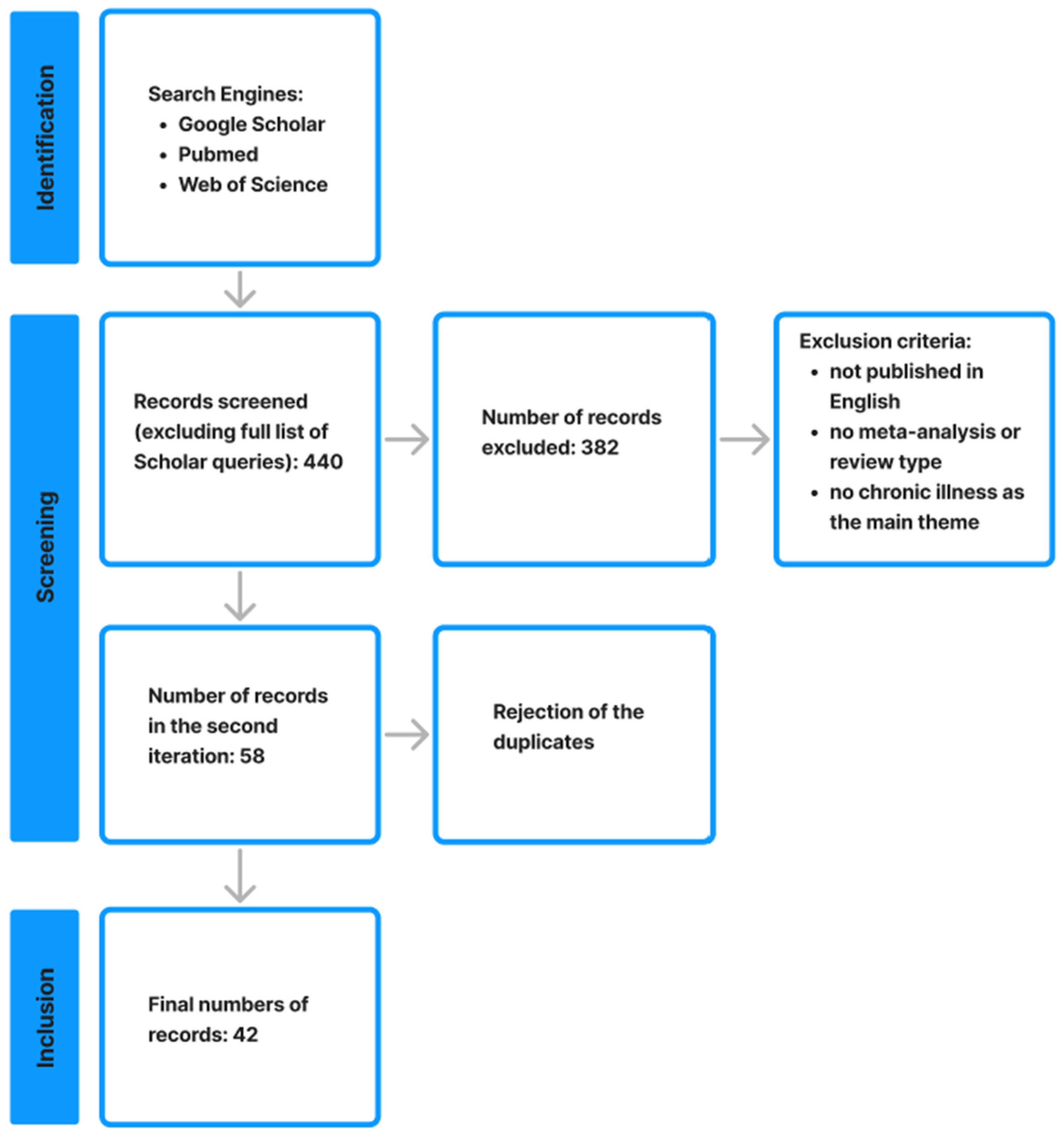
- “chatbot” + “chronic illness” + “review” (Google Scholar, n = 12,100; Pubmed, n = 33; Web of Science, n = 78),
- “chatbot” + “chronic illness” + “meta-analysis” (Google Scholar, n = 17,000; Pubmed, n = 1; Web of Science, n = 85),
- “mixed reality” + “chronic illness” + “review” (Google Scholar, n = 16,800; Pubmed, n = 21; Web of Science, n = 5),
- “mixed reality” + “chronic illness” + “meta-analysis” (Google Scholar, n = 17,000; Pubmed, n = 1; Web of Science, n = 2),
- “virtual reality” + “chronic illness” + “review” (Google Scholar, n = 18,000; Pubmed, n = 82; Web of Science, n = 54),
- “virtual reality” + “chronic illness” + “meta-analysis” (Google Scholar, n = 16,900; Pubmed, n = 24; Web of Science, n = 54).
3. Augmented, Virtual, and Mixed Reality: VR in Healthcare
3.1. Practical Implementation of VR for Maintaining Quality of Life
3.2. Challenges in Implementing VR in Chronic Illness Prevention, Therapy, and Enhancing the Quality of Life
4. AI-Influenced Revolution in VR Treatment Interventions
4.1. A Virtual Environment with a Virtual Therapist as a Way to Enhance Motivation to Complete the Session
4.2. Challenges in AI-Based Virtual Healthcare from a Technical and Social Perspective
5. Safe Implementation of AI/VR Technology in Tackling Chronic Illness
6. Discussion
- promise for short-term symptom relief, engagement, and self-management support,
- uneven evidence for durable clinical benefit and real-world deployment,
- design, ethical, and workflow requirements that determine whether these technologies reduce, rather than add to, the burden of living with chronic disease.
- lowering the cognitive and logistic effort of self-management (automated tracking, structured skills practice),
- improving readiness and confidence through experiential learning (VR rehearsal, safe exposure),
- Offering timely, personalized micro-interventions (motivational prompts, coping scripts) that can soften daily symptom impact. These align with population-health goals even when disease-progression endpoints take years to detect.
- Use chatbots/virtual agents to cover low-intensity support and coaching between the visits, with clear thresholds for human escalation and crisis protocols; prioritize modalities and devices that patients already own, reserve fully immersive VR for indications with strong engagement payoffs.
- Prefer cloud designs to avoid therapy interruption; instrument VR sessions with maximum duration guidance (e.g., 15–20 min), live therapist view, and simple exit gestures. Track and mitigate cybersickness risk.
- Keep avatar realism within a trust-promoting band; emphasize consistent prosody, turn-taking, and supportive nonverbal cues over lifelike appearance.
- Personalize “what” (goals, prompts, examples), not “who” the agent is; avoid over-anthropomorphizing. Log and audit motivational messaging aligned with validated CBT/MI scripts.
- Co-create with patients (and caregivers for pediatrics); prototype early to tune interaction burdens (voice vs. text), and publish technical details to enable replication.
7. Limitations
8. Conclusions
Author Contributions
Funding
Institutional Review Board Statement
Informed Consent Statement
Data Availability Statement
Acknowledgments
Conflicts of Interest
References
- Goodman, R.A.; Posner, S.F.; Huang, E.S.; Parekh, A.K.; Koh, H.K. Defining and measuring chronic conditions: Imperatives for research, policy, program, and practice. Prev. Chronic Dis. 2013, 10, E66. [Google Scholar] [CrossRef] [PubMed]
- Airhihenbuwa, C.O.; Tseng, T.-S.; Sutton, V.D.; Price, L. Global perspectives on improving chronic disease prevention and management in diverse settings. Prev. Chronic Dis. 2021, 18, E33. [Google Scholar] [CrossRef] [PubMed]
- Barrett, H.D.; Ortmann, W.; Dawson, L.; Saenz, A.; Reis, C.; Bolan, A. Public Health Ethics: Cases Spanning the Globe; Springer Nature: Cham, Switzerland, 2016. [Google Scholar]
- Schulman-Green, D.; Jaser, S.S.; Park, C.; Whittemore, R. A metasynthesis of factors affecting self-management of chronic illness. J. Adv. Nurs. 2016, 72, 1469–1489. [Google Scholar] [CrossRef] [PubMed]
- Schaink, A.K.; Kuluski, K.; Lyons, R.F.; Fortin, M.; Jadad, A.R.; Upshur, R.; Wodchis, W.P. A scoping review and thematic classification of patient complexity: Offering a unifying framework. J. Comorbidity 2012, 2, 1–9. [Google Scholar] [CrossRef]
- Sav, A.; King, M.A.; Whitty, J.A.; Kendall, E.; McMillan, S.S.; Kelly, F.; Hunter, B.; Wheeler, A.J. Burden of treatment for chronic illness: A concept analysis and review of the literature. Health Expect. Int. J. Public Particip. Health Care Health Policy 2015, 18, 312–324. [Google Scholar] [CrossRef]
- Rich, A.; Brandes, K.; Mullan, B.; Hagger, M.S. Theory of planned behavior and adherence in chronic illness: A meta-analysis. J. Behav. Med. 2015, 38, 673–688. [Google Scholar] [CrossRef]
- Nathan, D.M.; Davidson, M.B.; Defronzo, R.A.; Heine, R.J.; Henry, R.R.; Pratley, R.; Zinman, B. Long-term effects of lifestyle intervention or metformin on diabetes development and microvascular complications over 15 years of follow-up: The Diabetes Prevention Program Outcomes Study. Lancet Diabetes Endocrinol. 2015, 3, 866–875. [Google Scholar]
- Goldberg, R.B.; Aroda, V.R.; Bluemke, D.A.; Chapman, W.G.; Harrington, R.A.; Goff, D.C. Effects of long-term metformin and lifestyle interventions on cardiovascular events in the Diabetes Prevention Program and its Outcomes Study. Circulation 2022, 22, 1632–1641. [Google Scholar] [CrossRef]
- Pi-Sunyer, X. The look AHEAD trial: A review and discussion of its outcomes. Curr. Nutr. Rep. 2014, 3, 387–391. [Google Scholar] [CrossRef]
- Araújo-Soares, V.; Hankonen, N.; Presseau, J.; Rodrigues, A.; Sniehotta, F.F. Developing Behavior Change Interventions for Self-Management in Chronic Illness. Eur. Psychol. 2019, 24, 7–25. [Google Scholar] [CrossRef]
- Teh, J.J.; Pascoe, D.J.; Hafeji, S.; Parchure, R.; Koczoski, A.; Rimmer, M.P.; Khan, K.S.; Al Wattar, B.H. Efficacy of virtual reality for pain relief in medical procedures: A systematic review and meta-analysis. BMC Med. 2024, 22, 64. [Google Scholar] [CrossRef] [PubMed]
- Kenea, C.D.; Abessa, T.G.; Lamba, D.; Bonnechère, B. Immersive virtual reality in stroke rehabilitation: A systematic review and meta-analysis of its efficacy in upper limb recovery. J. Clin. Med. 2025, 14, 1783. [Google Scholar] [CrossRef] [PubMed]
- Griffin, A.C.; Xing, Z.; Khairat, S.; Wang, Y.; Bailey, S.; Arguello, J.; Chung, A.E. Conversational agents for chronic disease self-management: A systematic review. AMIA Annu. Symp. Proc. 2020, 2020, 504–513. [Google Scholar] [PubMed]
- Rosen, K.; Austin, J.; Bode, C. Lifestyle change for daily life with immersive virtual reality: A systematic scoping review of interventions for people with chronic- or life-threatening somatic conditions. Psychol. Health 2025. [Google Scholar] [CrossRef]
- Han, R.; Todd, A.; Wardak, S.; Partridge, S.R.; Raeside, R. Feasibility and Acceptability of Chatbots for Nutrition and Physical Activity Health Promotion Among Adolescents: Systematic Scoping Review with Adolescent Consultation. JMIR Hum. Factors 2023, 10, e43227. [Google Scholar] [CrossRef] [PubMed] [PubMed Central]
- Dang, H.A.; Tran, V.; Nguyen, L.M. Survey and analysis of hallucinations in large language models: Attribution to prompting strategies or model behavior. Front. Artif. Intell. 2025, 8, 1622292. [Google Scholar] [CrossRef]
- Busch, F.; Hoffmann, L.; Xu, L.; Zhang, L.J.; Hu, B.; García-Juárez, I.; Toapanta-Yanchapaxi, L.N.; Gorelik, N.; Gorelik, V.; Rodriguez-Granillo, G.A.; et al. Multinational attitudes toward AI in health care and diagnostics among hospital patients. JAMA Netw. Open 2025, 8, e2514452. [Google Scholar] [CrossRef]
- Salimparsa, M.; Sedig, K.; Lizotte, D.J.; Abdullah, S.S.; Chalabianloo, N.; Muanda, F.T. Explainable AI for Clinical Decision Support Systems: Literature review, key gaps, and research synthesis. Informatics 2025, 12, 119. [Google Scholar] [CrossRef]
- Khosravi, M.; Zare, Z.; Mojtabaeian, S.M.; Izadi, R. Artificial intelligence and decision-making in healthcare: A thematic analysis of a systematic review of reviews. Health Serv. Res. Manag. Epidemiol. 2024, 11, 23333928241234863. [Google Scholar] [CrossRef]
- Smith, V.; Warty, R.R.; Sursas, J.A.; Payne, O.; Nair, A.; Krishnan, S.; Vollenhoven, B. The effectiveness of virtual reality in managing acute pain and anxiety for medical inpatients: Systematic review. J. Med. Internet Res. 2020, 22, e17980. [Google Scholar] [CrossRef]
- Patsaki, I.; Dimitriadi, N.; Despoti, A.; Tzoumi, D.; Leventakis, N.; Roussou, G.; Papathanasiou, A.; Nanas, S.; Karatzanos, E. The effectiveness of immersive virtual reality in physical recovery of stroke patients: A systematic review. Front. Syst. Neurosci. 2022, 16, 880447. [Google Scholar] [CrossRef]
- Abbas, J.R.; O’Connor, A.; Ganapathy, E.; Isba, R.; Payton, A.; McGrath, B.; Tolley, N.; Bruce, I.A. What is Virtual Reality? A healthcare-focused systematic review of definitions. Health Policy Technol. 2023, 12, 100741. [Google Scholar] [CrossRef]
- Singh, S.; Kumar, P.; Chaudharya, H.; Khurana, R.; Shokeen, A. Augmented reality virtual reality care ceating ripple in the medical and pharmaceutical world. In Advances in Augmented Reality and Virtual Reality; Springer: Singapore, 2022; pp. 113–131. [Google Scholar] [CrossRef]
- Ammann-Reiffer, C.; Kläy, A.; Keller, U. Virtual reality as a therapy tool for walking activities in pediatric neurorehabilitation: Usability and user experience evaluation. JMIR Serious Games 2022, 10, e38509. [Google Scholar] [CrossRef] [PubMed]
- Matthie, N.S.; Giordano, N.A.; Jenerette, C.M.; Magwood, G.S.; Leslie, S.L.; Northey, E.E.; Webster, C.I.; Sil, S. Use and efficacy of virtual, augmented, or mixed reality technology for chronic pain: A systematic review. Pain Manag. 2022, 12, 859–878. [Google Scholar] [CrossRef] [PubMed]
- Xia, W.; Ding, J.; Yan, Y.; Chen, F.; Yan, M.; Xu, X. Effectiveness of Virtual Reality Technology in Symptom Management of Patients at the end of life: A Systematic Review and Meta-Analysis. J. Am. Med. Dir. Assoc. 2024, 25, 105086. [Google Scholar] [CrossRef]
- Riches, S.; Azevedo, L.; Bird, L.; Pisani, S.; Valmaggia, L. Virtual reality relaxation for the general population: A systematic review. Soc. Psychiatry Psychiatr. Epidemiol. 2021, 56, 1707–1727. [Google Scholar] [CrossRef]
- Sin, J.E.; Kim, A.R. Mixed Reality in Clinical Settings for Pediatric Patients and Their Families: A Literature Review. Int. J. Environ. Res. Public Health 2024, 21, 1185. [Google Scholar] [CrossRef]
- Pourmasoumi, M.; Pourmasoumi, S.; El-Gabalawy, R.; Mollard, R.; Askin, N.; Hardy, B.; Mackay, D. Evaluating the use of virtual reality for weight management: A systematic review and meta-analysis. Diabetes Obes. Metab. 2025. epub ahead of print. [Google Scholar] [CrossRef] [PubMed]
- Yang, J.; Li, Y.; Gao, D.; Xie, X.; Ji, W.; Gao, J. Effects of virtual reality technology on anxiety and depression in older adults with chronic diseases: A systematic review and meta-analysis of randomized controlled trials. Worldviews Evid. Based Nurs. 2025, 22, e12763. [Google Scholar] [CrossRef] [PubMed]
- Appel, L.; Appel, E.; Bogler, O.; Wiseman, M.; Cohen, L.; Ein, N.; Abrams, H.B.; Campos, J.L. Older adults with cognitive and/or physical impairments can benefit from immersive Virtual Reality experiences: A feasibility study. Front. Med. 2019, 6, 329. [Google Scholar] [CrossRef]
- Zhong, D.; Chen, L.; Feng, Y.; Song, R.; Huang, L.; Liu, J.; Zhang, L. Effects of virtual reality cognitive training in individuals with mild cognitive impairment: A systematic review and meta-analysis. Int. J. Geriatr. Psychiatry 2021, 36, 1829–1847. [Google Scholar] [CrossRef] [PubMed]
- Carbajal Galarza, M.; Chinchihualpa Paredes, N.O.; Abanto Perez, S.A.; Saposnik, G.; Lazo-Porras, M. Effectiveness of technology-based stroke interventions to improve upper limb functioning in low- and middle-income countries: A systematic review and meta-analysis. Top. Stroke Rehabil. 2025, 32, 723–743. [Google Scholar] [CrossRef] [PubMed]
- Nascimento, A.S.; Fagundes, C.V.; Mendes, F.A.D.S.; Leal, J.C. Effectiveness of Virtual Reality Rehabilitation in Persons with Multiple Sclerosis: A Systematic Review and Meta-analysis of Randomized Controlled Trials. Mult. Scler. Relat. Disord. 2021, 54, 103128. [Google Scholar] [CrossRef] [PubMed]
- Zhao, Q.; He, Y.; Wu, N.; Wang, L.; Dai, J.; Wang, J.; Ma, J. Non-Pharmacological Interventions to Improve Physical Function in Patients with End-Stage Renal Disease: A Network Meta-Analysis. Am. J. Nephrol. 2023, 54, 35–41. [Google Scholar] [CrossRef] [PubMed]
- Doherty, F.; Lynch, P.; Powell, P.; Monaghan, K. Feasibility and effectiveness of telerehabilitation on mobility and balance function in multiple sclerosis: A systematic review and meta-analysis. J. Neurol. Sci. 2024, 466, 123214. [Google Scholar] [CrossRef] [PubMed]
- Riches, S.; Jeyarajaguru, P.; Taylor, L.; Fialho, C.; Little, J.; Ahmed, L.; O’Brien, A.; van Driel, C.; Veling, W.; Valmaggia, L. Virtual reality relaxation for people with mental health conditions: A systematic review. Soc. Psychiatry Psychiatr. Epidemiol. 2023, 58, 989–1007. [Google Scholar] [CrossRef]
- Radovic, A.; Badawy, S.M. Technology Use for Adolescent Health and Wellness. Pediatrics 2020, 145, S186–S194. [Google Scholar] [CrossRef]
- Maheta, B.; Kraft, A.; Interrante, N.; Fereydooni, S.; Bailenson, J.; Beams, B.; Keny Christina Osborne, T.; Giannitrapani, K.; Lorenz, K. Using Virtual Reality to Improve Outcomes Related to Quality of Life Among Older Adults with Serious Illnesses: Systematic Review of Randomized Controlled Trials. J. Med. Internet Res. 2025, 27, e54452. [Google Scholar] [CrossRef]
- Goudman, L.; Jansen, J.; Billot, M.; Vets, N.; De Smedt, A.; Roulaud, M.; Rigoard, P.; Moens, M. Virtual reality applications in chronic pain management: Systematic review and meta-analysis. JMIR Serious Games 2022, 10, e34402. [Google Scholar] [CrossRef]
- Czech, O.; Kowaluk, A.; Ściepuro, T.; Siewierska, K.; Skórniak, J.; Matkowski, R.; Malicka, I. Effects of immersive virtual therapy as a method supporting the psychological and physical well-being of women with a breast cancer diagnosis: A randomized controlled trial. Curr. Oncol. 2024, 31, 6419–6432. [Google Scholar] [CrossRef]
- Kiper, P.; Przysiężna, E.; Cieślik, B.; Broniec-Siekaniec, K.; Kucińska, A.; Szczygieł, J.; Turek, K.; Gajda, R.; Szczepańska-Gieracha, J. Effects of immersive virtual therapy as a method supporting recovery of depressive symptoms in post-stroke rehabilitation: Randomized controlled trial. Clin. Interv. Aging 2022, 17, 1673–1685. [Google Scholar] [CrossRef] [PubMed]
- Qi, W.; Song, F.; Li, M.; Xie, M.; Liu, D.; Fang, F.; Bao, Y.; Guo, Z.; Sun, M. Synergistic effects of virtual reality and traditional treatment methods in the management of chronic obstructive pulmonary disease: A systematic review and meta-analysis of randomized controlled trials. PeerJ 2025, 13, e20047. [Google Scholar] [CrossRef] [PubMed] [PubMed Central]
- McGhee, W.R.G.; Doherty, C.J.; Graham-Wisener, L.; Fallis, R.; Stone, C.; Axiaq, A.; Dempster, M. Immersive virtual reality and psychological well-being in adult chronic physical illness: Systematic review. BMJ Support. Palliat. Care 2024, 14, 14–24. [Google Scholar] [CrossRef] [PubMed]
- Sánchez-Caballero, E.; Ortega-Donaire, L.; Sanz-Martos, S. Immersive virtual reality for pain and anxiety management associated with medical procedures in children and adolescents: A systematic review. Children 2024, 11, 975. [Google Scholar] [CrossRef]
- Matheve, T.; Bogaerts, K.; Timmermans, A. Virtual reality distraction induces hypoalgesia in patients with chronic low back pain: A randomized controlled trial. J. Neuroeng. Rehabil. 2020, 17, 55. [Google Scholar] [CrossRef]
- Gao, Y.; Spence, C. Enhancing presence, immersion, and interaction in multisensory experiences through touch and haptic feedback. Virtual Worlds 2025, 4, 3. [Google Scholar] [CrossRef]
- Kantha, P.; Lin, J.J.; Hsu, W.L. The Effects of Interactive Virtual Reality in Patients with Chronic Musculoskeletal Disorders: A Systematic Review and Meta-Analysis. Games Health J. 2023, 12, 1–12. [Google Scholar] [CrossRef] [PubMed]
- Krohn, M.; Rintala, A.; Immonen, J.; Sjögren, T. The Effectiveness of Therapeutic Exercise Interventions with Virtual Reality on Balance and Walking Among Persons with Chronic Stroke: Systematic Review, Meta-Analysis, and Meta-Regression of Randomized Controlled Trials. J. Med. Internet Res. 2024, 26, e59136. [Google Scholar] [CrossRef] [PubMed] [PubMed Central]
- Kwon, S.H.; Park, J.K.; Koh, Y.H. A systematic review and meta-analysis on the effect of virtual reality-based rehabilitation for people with Parkinson’s disease. J. Neuroeng. Rehabil. 2023, 20, 94. [Google Scholar] [CrossRef] [PubMed] [PubMed Central]
- Moreno, A.; Wall, K.J.; Thangavelu, K.; Craven, L.; Ward, E.; Dissanayaka, N.N. A systematic review of the use of virtual reality and its effects on cognition in individuals with neurocognitive disorders. Alzheimer’s Dement. 2019, 5, 834–850. [Google Scholar] [CrossRef]
- Plavoukou, T.; Staktopoulos, P.; Papagiannis, G.; Stasinopoulos, D.; Georgoudis, G. Virtual and augmented reality for chronic musculoskeletal rehabilitation: A systematic review and exploratory meta-analysis. Bioengineering 2025, 12, 745. [Google Scholar] [CrossRef] [PubMed]
- Preti, K.; Pinero, M.; Weitzman, M.; Malhotra, V. Virtual reality: Treating pain and anxiety. Am. Nurse J. 2024, 19, 42–46. [Google Scholar] [CrossRef] [PubMed]
- Liu, Y.; Du, Q.; Jiang, Y. The effect of virtual reality technology in exercise and lung function of patients with chronic obstructive pulmonary disease: A systematic review and meta-analysis. Worldviews Evid. Based Nurs. 2024, 21, 307–317. [Google Scholar] [CrossRef] [PubMed]
- Kang, X.; Zhang, Y.; Sun, C.; Zhang, J.; Che, Z.; Zang, J.; Zhang, R. Effectiveness of Virtual Reality Training in Improving Outcomes for Dialysis Patients: Systematic Review and Meta-Analysis. J. Med. Internet Res. 2025, 27, e58384. [Google Scholar] [CrossRef] [PubMed] [PubMed Central]
- Chong, H.J.; Kim, M.J.; Raszewski, R.; Jang, M.K. Metaverse technology use among patients undergoing hemodialysis: A systematic review and meta-analysis of randomized controlled trials. Appl. Nurs. Res. 2025, 84, 151983. [Google Scholar] [CrossRef] [PubMed]
- Zhang, Y.; Kamsin, A.; Natasha Ahmad Tajuddin, N.A.; Hasan, S.I. Effectiveness of virtual reality interventions in promoting healthy eating and physical activity among children: A systematic review. Digit. Health 2025, 11, 20552076251331794. [Google Scholar] [CrossRef]
- Rózsa, S.; Hargitai, R.; Láng, A.; Osváth, A.; Hupuczi, E.; Tamás, I.; Kállai, J. Measuring immersion, involvement, and attention focusing tendencies in the mediated environment: The applicability of the Immersive Tendencies Questionnaire. Front. Psychol. 2022, 13, 931955. [Google Scholar] [CrossRef]
- Al-Rasheed, A.; Alabdulkreem, E.; Alduailij, M.; Alduailij, M.; Alhalabi, W.; Alharbi, S.; Lytras, M.D. Virtual reality in the treatment of patients with overweight and obesity: A systematic review. Sustainability 2022, 14, 3324. [Google Scholar] [CrossRef]
- Yen, H.Y.; Chiu, H.L.; Huang, H.Y. Virtual reality-enhanced exergames for weight control: A systematic review and meta-analysis of randomized controlled trials: Techniques and Methods. Int. J. Obes. 2025, 49, 1667–1675. [Google Scholar] [CrossRef]
- Hess, C.W.; Rosenbloom, B.N.; Mesaroli, G.; Lopez, C.; Ngo, N.; Cohen, E.; Ouellette, C.; Gold, J.I.; Logan, D.; Simons, L.E.; et al. Extended reality (XR) in pediatric acute and chronic pain: Systematic review and evidence gap map. JMIR Pediatr. Parent. 2025, 8, e63854. [Google Scholar] [CrossRef]
- Orpin, J.; Rodriguez, A.; Harrop, D.; Mills, E.; Campbell, F.; Martin-Kerry, J.; Turner, J.; Horsman, J.; Painter, J.; Julian, M.; et al. Supportive use of digital technologies during transition to adult healthcare for young people with long-term conditions, focusing on Type 1 diabetes mellitus: A scoping review. J. Child Health Care 2025, 29, 204–221. [Google Scholar] [CrossRef] [PubMed] [PubMed Central]
- Iqbal, A.I.; Aamir, A.; Hammad, A.; Hafsa, H.; Basit, A.; Oduoye, M.O.; Anis, M.W.; Ahmed, S.; Younus, M.I.; Jabeen, S. Immersive technologies in healthcare: An in-depth exploration of virtual reality and augmented reality in enhancing patient care, medical education, and training paradigms. J. Prim. Care Community Health 2024, 15, 21501319241293311. [Google Scholar] [CrossRef] [PubMed]
- Prajapati, M.; Kumar, S. Virtual reality revolution in healthcare: A systematic review. Health Technol. 2025, 15, 231–242. [Google Scholar] [CrossRef]
- Qu, J.; Zhang, Y.; Tang, W.; Cheng, W.; Zhang, Y.; Bu, L. Developing a virtual reality healthcare product based on data-driven concepts: A case study. Adv. Eng. Inform. 2023, 57, 102118. [Google Scholar] [CrossRef]
- Wang, Y.; Li, C.; Qu, L.; Cai, H.; Ge, Y. Application and challenges of a metaverse in medicine. Front. Robot. AI 2023, 10, 1291199. [Google Scholar] [CrossRef]
- Bojić, L.; Matthes, J.; Samala, A.D.; Čabarkapa, M. The dual impact of virtual reality: Examining the addictive potential and therapeutic applications of immersive media in the metaverse. Inf. Commun. Soc. 2025. [Google Scholar] [CrossRef]
- Kim, H.; Kim, D.J.; Chung, W.H.; Park, K.-A.; Kim, J.D.K.; Kim, D.; Kim, K.; Jeon, H.J. Clinical predictors of cybersickness in virtual reality (VR) among highly stressed people. Sci. Rep. 2021, 11, 12139. [Google Scholar] [CrossRef]
- Pawełczyk, W.; Olejarz, D.; Gaweł, Z.; Merta, M.; Nowakowska, A.; Nowak, M.; Rutkowska, A.; Batalik, L.; Rutkowski, S. Understanding cybersickness and presence in seated VR: A foundation for exploring therapeutic applications of immersive virtual environments. J. Clin. Med. 2025, 14, 2718. [Google Scholar] [CrossRef]
- Weech, S.; Kenny, S.; Barnett-Cowan, M. Presence and cybersickness in virtual reality are negatively related: A review. Front. Psychol. 2019, 10, 158. [Google Scholar] [CrossRef]
- Toet, A.; Mioch, T.; Gunkel, S.N.; Niamut, O.; Van Erp, J.B. Assessment of presence in augmented and mixed reality: Presence in augmented and mixed reality. In Proceedings of the Conference on Human Factors in Computing Systems, CHI 2021, Virtual, 8–13 May 2021; ACM SigCHI: Yokohama, Japan, 2021. [Google Scholar]
- Maksatbekova, A.; Argan, M. Virtual reality’s dual edge: Navigating mental health benefits and addiction risks across timeframes. Curr. Psychol. 2025, 44, 6469–6480. [Google Scholar] [CrossRef]
- Geroimenko, V. (Ed.) Augmented and Virtual Reality in the Metaverse; Springer: Cham, Switzerland, 2024; ISBN 978-3-031-57746-8. [Google Scholar]
- Heyse, J.; Jonge, T.D.; Torres Vega, M.; Backere, F.D.; De Turck, F. A personalized virtual reality experience for relaxation therapy. In Proceedings of the 2019 Eleventh International Conference on Quality of Multimedia Experience (QoMEX), Berlin, Germany, 5–7 June 2019. [Google Scholar]
- Bell, I.H.; Pot-Kolder, R.; Rizzo, A.; Rus-Calafell, M.; Cardi, V.; Cella, M.; Ward, T.; Riches, S.; Reinoso, M.; Thompson, A.; et al. Advances in the use of virtual reality to treat mental health conditions. Nat. Rev. Psychol. 2024, 3, 552–567. [Google Scholar] [CrossRef]
- Kreft, W. (Ed.) Magia VR: O Technologii, Która Zmienia Nasze Umysły; Unicorn VR World sp. z o.o.: Warsaw, Poland, 2023; ISBN 978-83-970314-0-1. [Google Scholar]
- Mazzolenis, M.V.; Mourra, G.N.; Moreau, S.; Mazzolenis, M.E.; Cerda, I.H.; Vega, J.; Khan, J.S.; Thérond, A. The role of virtual reality and artificial intelligence in cognitive pain therapy: A narrative review. Curr. Pain Headache Rep. 2024, 28, 881–892. [Google Scholar] [CrossRef]
- Haque, M.D.R.; Rubya, S. An overview of chatbot-based mobile mental health apps: Insights from app description and user reviews. JMIR mHealth uHealth 2023, 11, e44838. [Google Scholar] [CrossRef]
- Ash, G.I.; Stults-Kolehmainen, M.; Busa, M.A.; Gaffey, A.E.; Angeloudis, K.; Muniz-Pardos, B.; Gregory, R.; Huggins, R.A.; Redeker, N.S.; Weinzimer, S.A.; et al. Establishing a global standard for wearable devices in sport and exercise medicine: Perspectives from academic and industry stakeholders. Sports Med. 2021, 51, 2237–2250. [Google Scholar] [CrossRef] [PubMed]
- Igwama, G.T.; Olaboye, J.A.; Maha, C.C.; Ajegbile, M. AI-powered predictive analytics in chronic disease management: Regulatory and ethical considerations. Int. J. Eng. Res. Adv. Dev. 2024, 20, 405–410. [Google Scholar]
- Hwang, M.; Zheng, Y.; Cho, Y.; Jiang, Y. AI Applications for Chronic Condition Self-Management: Scoping Review. J. Med. Internet Res. 2025, 27, e59632. [Google Scholar] [CrossRef] [PubMed] [PubMed Central]
- Li, J.; Li, Y.; Hu, Y.; Ma, D.C.F.; Mei, X.; Chan, E.A.; Yorke, J. Chatbot-delivered interventions for improving mental health among young people: A systematic review and meta-analysis. Worldviews Evid. Based Nurs. 2025, 22, e70059. [Google Scholar] [CrossRef] [PubMed]
- Uetova, E.; Hederman, L.; Ross, R.; O’Sullivan, D. Exploring the characteristics of conversational agents in chronic disease management interventions: A scoping review. Digit. Health 2024, 10, 20552076241277693. [Google Scholar] [CrossRef]
- Amil, S.; Da, S.-M.-A.-R.; Plaisimond, J.; Roch, G.; Sasseville, M.; Bergeron, F.; Gagnon, M.-P. Interactive conversational agents for perinatal health: A mixed methods systematic review. Healthcare 2025, 13, 363. [Google Scholar] [CrossRef]
- Ali, S.; Abdullah Armand, T.P.T.; Athar, A.; Hussain, A.; Ali, M.; Yaseen, M.; Joo, M.-I.; Kim, H.-C. Metaverse in healthcare integrated with explainable AI and blockchain: Enabling immersiveness, ensuring trust, and providing patient data security. Sensors 2023, 23, 565. [Google Scholar] [CrossRef]
- Kurniawan, M.H.; Handiyani, H.; Nuraini, T.; Hariyati, R.T.S.; Sutrisno, S. A systematic review of artificial intelligence-powered (AI-powered) chatbot intervention for managing chronic illness. Ann. Med. 2024, 56, 2302980. [Google Scholar] [CrossRef] [PubMed] [PubMed Central]
- Murala, D.K.; Panda, S.K.; Dash, S.P. MedMetaverse: Medical care of chronic disease patients and managing data using artificial intelligence, blockchain, and wearable devices: State-of-the-art methodology. IEEE Access 2023, 11, 138954–138965. [Google Scholar] [CrossRef]
- Bhamidipaty, V.; Bhamidipaty, D.L.; Guntoory, I.; Bhamidipaty, K.D.P.; Iyengar, K.P.; Botchu, B.; Botchu, R. Revolutionizing Healthcare: The Impact of AI-Powered Sensors. In Generative Artificial Intelligence for Biomedical and Smart Health Informatics; Wiley: Hoboken, NJ, USA, 2025; pp. 355–373. [Google Scholar]
- Laymouna, M.; Ma, Y.; Lessard, D.; Schuster, T.; Engler, K.; Lebouché, B. Roles, Users, Benefits, and Limitations of Chatbots in Health Care: Rapid Review. J. Med. Internet Res. 2024, 26, e56930. [Google Scholar] [CrossRef] [PubMed] [PubMed Central]
- Li, Y.-H.; Li, Y.-L.; Wei, M.-Y.; Li, G.-Y. Innovation and challenges of artificial intelligence technology in personalized healthcare. Sci. Rep. 2024, 14, 18994. [Google Scholar] [CrossRef] [PubMed]
- Si, Y.; Meng, Y.; Chen, X.; An, R.; Mao, L.; Li, B.; Bateman, H.; Zhang, H.; Fan, H.; Zu, J.; et al. Quality, safety, and disparity of an AI chatbot in managing chronic diseases: Simulated patient experiments. npj Digit. Med. 2025, 8, 574. [Google Scholar] [CrossRef] [PubMed]
- Ning, Y.; Teixayavong, S.; Shang, Y.; Savulescu, J.; Nagaraj, V.; Miao, D.; Mertens, M.; Ting, D.S.W.; Ong, J.C.L.; Liu, M.; et al. Generative artificial intelligence and ethical considerations in health care: A scoping review and ethics checklist. Lancet Digit. Health 2024, 6, e848–e856. [Google Scholar] [CrossRef]
- Bin Sawad, A.; Narayan, B.; Alnefaie, A.; Maqbool, A.; Mckie, I.; Smith, J.; Yuksel, B.; Puthal, D.; Prasad, M.; Kocaballi, A.B. A Systematic Review on Healthcare Artificial Intelligent Conversational Agents for Chronic Conditions. Sensors 2022, 22, 2625. [Google Scholar] [CrossRef] [PubMed] [PubMed Central]
- Kumar, Y.; Koul, A.; Singla, R.; Ijaz, M.F. Artificial intelligence in disease diagnosis: A systematic literature review, synthesizing framework and future research agenda. J. Ambient. Intell. Humaniz. Comput. 2023, 14, 8459–8486. [Google Scholar] [CrossRef]
- Pernencar, C.; Saboia, I.; Dias, J.C. How Far Can Conversational Agents Contribute to IBD Patient Health Care-A Review of the Literature. Front. Public Health 2022, 10, 862432. [Google Scholar] [CrossRef] [PubMed] [PubMed Central]
- Rudschies, C.; Schneider, I. Ethical, legal, and social implications (ELSI) of virtual agents and virtual reality in healthcare. Soc. Sci. Med. 2024, 340, 116483. [Google Scholar] [CrossRef]
- Peerbolte, T.F.; van Diggelen, R.J.A.; van den Haak, P.; Geurts, K.; Evers, L.J.W.; Bloem, B.R.; de Vries, N.M.; van den Berg, S.W. Conversational agents supporting self-management in people with a chronic disease: Systematic review. J. Med. Internet Res. 2025, 27, e72309. [Google Scholar] [CrossRef]
- Du, Y.; Yang, P.; Liu, Y.; Deng, C.; Li, X. Artificial intelligence in chronic disease self-management: Current applications and future directions. Front. Public Health 2025, 13, 1689911. [Google Scholar] [CrossRef] [PubMed]
- Rządeczka, M.; Sterna, A.; Stolińska, J.; Kaczyńska, P.; Moskalewicz, M. AI chatbots in mental health: Opportunities and ethical challenges. JMIR Ment. Health 2025, 12, e64396. [Google Scholar] [CrossRef] [PubMed]
- Zhang, Y.; Lu, X.; Luo, Y.; Zhu, Y.; Ling, W. Performance of Artificial Intelligence Chatbots on Ultrasound Examinations: Cross-Sectional Comparative Analysis. JMIR Med. Inform. 2025, 13, e63924. [Google Scholar] [CrossRef] [PubMed]
- Altom, D.S.; Awad Taha, A.I.; Mahmoud Hussein, A.A.A.; Ibrahim Elshiekh, M.A.; Abdelmajed, A.H.A.; Ibrahim, F.I.A.; Mohammed, S.M.A.; Tifoor, M.M.E.E. Artificial intelligence-based chatbots in chronic disease management: A systematic review of applications and challenges. Cureus 2025, 17, e81001. [Google Scholar] [CrossRef]
- Bramanti, A.; Corallo, A.; Clemente, G.; Greco, L.; Garofano, M.; Giordano, M.; Pascarelli, C.; Mitrano, G.; Di Palo, M.P.; Di Spirito, F. Exploring the role of voice assistants in managing noncommunicable diseases: A systematic review on clinical, behavioral outcomes, quality of life, and user experiences. Healthcare 2025, 13, 517. [Google Scholar] [CrossRef]
- Kashyap, N.; Sebastian, A.T.; Lynch, C.; Jansons, P.; Maddison, R.; Dingler, T.; Oldenburg, B. Engagement with Conversational Agent-Enabled Interventions in Cardiometabolic Disease Self-Management: Systematic Review. JMIR mHealth uHealth 2025, 13, e67913. [Google Scholar] [CrossRef] [PubMed] [PubMed Central]
- Łukasik, A.; Gut, A. From robots to chatbots: Unveiling the dynamics of human-AI interaction. Front. Psychol. 2025, 16, 1569277. [Google Scholar] [CrossRef]
- Kerth, J.-L.; Hagemeister, M.; Bischops, A.C.; Reinhart, L.; Dukart, J.; Heinrichs, B.; Eickhoff, S.B.; Meissner, T. Artificial intelligence in the care of children and adolescents with chronic diseases: A systematic review. Eur. J. Pediatr. 2025, 184, 83–97. [Google Scholar] [CrossRef]
- MacNeill, A.L.; Doucet, S.; Luke, A. Effectiveness of a mental health chatbot for people with chronic diseases: Randomized controlled trial. JMIR Form. Res. 2024, 8, e50025. [Google Scholar] [CrossRef]
- Mondal, R.S.; Bhuiyan, M.N.A.; Akter, L. Machine learning for chronic disease predictive analysis, early detection of chronic diseases to enable intervention and personalized care. Appl. IT Eng. 2024, 2, 1–11. [Google Scholar]
- Mahapatro, P.K.; Sreedhar, K.; Inusha, S.; Mahesh Babu, A.; Pulla, R. Enhanced health care system with chatbot and voicebot using deep learning. In Proceedings of the IEEE Wireless Antenna and Microwave Symposium (WAMS), Chennai, India, 5–8 June 2025. [Google Scholar] [CrossRef]
- Joshi, H. AI and chronic diseases: From data integration to clinical implementation. In Advances in Artificial Intelligence and Healthcare Systems; IGI Global: Hershey, PA, USA, 2024; pp. 17–35. [Google Scholar] [CrossRef]
- Zhang, S.; Song, J. A chatbot-based question and answer system for the auxiliary diagnosis of chronic diseases based on large language model. Sci. Rep. 2024, 14, 17118. [Google Scholar] [CrossRef] [PubMed]
- Shobana, G.; Jerlin, J.; Prakalya, J.S.; Sruthi, S.; Harinhishree, R.; Bharathkumar, R. AI-powered multilingual healthcare assistant: Voice and text-enabled medical chatbot. In Proceedings of the 3rd International Conference on Advancements in Electrical, Electronics, Communication, Computing and Automation (ICA-ECA), Coimbatore, India, 4–5 April 2025. [Google Scholar] [CrossRef]
- Mori, M.; MacDorman, K.; Kageki, N. The uncanny valley [from the field]. IEEE Robot. Autom. Mag. 2012, 19, 98–100. [Google Scholar] [CrossRef]
- Cihodaru-Ștefanache, Ș.; Podina, I.R. The uncanny valley effect in embodied conversational agents: A critical systematic review of attractiveness, anthropomorphism, and uncanniness. Front. Psychol. 2025, 16, 1625984. [Google Scholar] [CrossRef] [PubMed]
- Chu, M.D.; Gerard, P.; Pawar, K.; Bickham, C.; Lerman, K. Illusions of intimacy: Emotional attachment and emerging psychological risks in human-AI relationships. arXiv 2025, arXiv:2505.11649. [Google Scholar] [CrossRef]
- Ashrafi, N.; Schorlemmer, J.; Vona, F.; Kojic, T.; Hillmann, S.; Braytee, A.; Wang, Y.-K.; Kocaballi, B.; Moreira, C.; Möller, S.; et al. Emotionally adaptive virtual health assistants for enhanced social presence and trust. In Proceedings of the ACM International Conference on Intelligent Virtual Agents (IVA Adjunct’25), Berlin, Germany, 16–19 September 2025; pp. 1–7. [Google Scholar] [CrossRef]
- Feng, G.; Weng, F.; Lu, W.; Xu, L.; Zhu, W.; Tan, M.; Weng, P. Artificial intelligence in chronic disease management for aging populations: A systematic review of machine learning and NLP applications. Int. J. Gen. Med. 2025, 18, 3105–3115. [Google Scholar] [CrossRef]
- DeTore, N.R.; Balogun-Mwangi, O.; Eberlin, E.S.; Dokholyan, K.N.; Rizzo, A.; Holt, D.J. An artificial intelligence-based virtual human avatar application to assess the mental health of health care professionals: A validation study. J. Med. Ext. Real. 2024, 1, 215–226. [Google Scholar] [CrossRef]
- Robinson, C.L.; D’Souza, R.S.; Yazdi, C.; Diejomaoh, E.M.; Schatman, M.E.; Emerick, T.; Orhurhu, V. Reviewing the potential role of artificial intelligence in delivering personalized and interactive pain medicine education for chronic pain patients. J. Pain Res. 2025, 18, 923–929. [Google Scholar] [CrossRef]
- Khamaj, A. AI-enhanced chatbot for improving healthcare usability and accessibility for older adults. Alex. Eng. J. 2025, 116, 202–213. [Google Scholar] [CrossRef]
- Yan, W.; Geng, X.; Zhou, X. From Para-social Interaction to Attachment: The Evolution of Human-AI Emotional Relationships. J. Psychol. Sci. 2025, 48, 948–961. [Google Scholar] [CrossRef]
- Akif, A.; Qusar, M.M.A.S.; Islam, M.R. The impact of chronic diseases on mental health: An overview and recommendations for care programs. Curr. Psychiatry Rep. 2024, 26, 394–404. [Google Scholar] [CrossRef]
- Ge, L.; Hu, T. Gamifying intimacy: AI-driven affective engagement and human-virtual human relationships. Media Cult. Soc. 2025, 47, 1265–1278. [Google Scholar] [CrossRef]
- Morrin, H.; Nicholls, L.; Levin, M.; Yiend, J.; Iyengar, U.; DelGuidice, F.; Bhattacharyya, S.; MacCabe, J.; Tognin, S.; Twumasi, R. Delusions by Design: How Everyday AIs Might Be Fuelling Psychosis (and What Can Be Done About It); King’s College London: London, UK, 2025. [Google Scholar]
- Wodziński, M.; Rządeczka, M.; Szuła, A.; Sokół, M.; Moskalewicz, M. Visual Stereotypes of Autism Spectrum in DALL-E, Stable Diffusion, SDXL, and Midjourney. arXiv 2024, arXiv:2407.16292. [Google Scholar] [CrossRef]

Disclaimer/Publisher’s Note: The statements, opinions and data contained in all publications are solely those of the individual author(s) and contributor(s) and not of MDPI and/or the editor(s). MDPI and/or the editor(s) disclaim responsibility for any injury to people or property resulting from any ideas, methods, instructions or products referred to in the content. |
© 2026 by the authors. Licensee MDPI, Basel, Switzerland. This article is an open access article distributed under the terms and conditions of the Creative Commons Attribution (CC BY) license.
Share and Cite
Łukasik, A.; Celebudzka, M.; Gut, A. “Your Digital Doctor Will Now See You”: A Narrative Review of VR and AI Technology in Chronic Illness Management. Healthcare 2026, 14, 143. https://doi.org/10.3390/healthcare14020143
Łukasik A, Celebudzka M, Gut A. “Your Digital Doctor Will Now See You”: A Narrative Review of VR and AI Technology in Chronic Illness Management. Healthcare. 2026; 14(2):143. https://doi.org/10.3390/healthcare14020143
Chicago/Turabian StyleŁukasik, Albert, Milena Celebudzka, and Arkadiusz Gut. 2026. "“Your Digital Doctor Will Now See You”: A Narrative Review of VR and AI Technology in Chronic Illness Management" Healthcare 14, no. 2: 143. https://doi.org/10.3390/healthcare14020143
APA StyleŁukasik, A., Celebudzka, M., & Gut, A. (2026). “Your Digital Doctor Will Now See You”: A Narrative Review of VR and AI Technology in Chronic Illness Management. Healthcare, 14(2), 143. https://doi.org/10.3390/healthcare14020143