


Learning Mathematics of Financial Operations during the COVID-19 Era: An Assessment with Partial Least Squares Structural Equation Modeling

 ,
,  ,
, 
Abstract
1. Introduction
2. Theoretical Background
2.1. Impact of Video Tutorials on the Effectiveness
2.2. Impact of Video Tutorials on Autonomy
2.3. Moderating Effects
3. Materials and Methods
- Preliminary outside estimation of the latent variables scores through the linear combination of their manifest variables:where is the latent variable, ; is the manifest variable k of the latent variable i, ; is the estimated outer weight of the indicator ; is the specific observation, .
- Inner weights estimation of the latent variable, by using the factor weighting scheme and according to the sign of the correlations between latent variables:
- Internal estimation of latent variable scores by linear combination of their adjacent variables, by using the inner weights of the previous step:
- Outer weights estimation, which are calculated differently depending on whether the constructs are estimated in a formative or reflective mode:where is the error term from a multiple regression and is the error term from a bivariate regression.
4. Results
4.1. Measurement Model
4.2. Structural Model
4.3. Out-of-Sample Prediction
5. Discussion and Conclusions
Author Contributions
Funding
Institutional Review Board Statement
Informed Consent Statement
Data Availability Statement
Conflicts of Interest
References
- Sasidharan, S.; Dhillon, H.S.; Singh, D.H.; Manalikuzhiyil, B. COVID-19: Pan(info)demic. Turk. J. Anaesthesiol. Reanim. 2020, 48, 438–442. [Google Scholar] [CrossRef] [Scilit]
- Torjesen, I. Covid-19 will become endemic but with decreased potency over time, scientists believe. BMJ 2021, 372, n494. [Google Scholar] [CrossRef] [Scilit]
- Shamekh, A.; Mahmoodpoor, A.; Sanaie, S. COVID-19: Is it the black death of the 21st century? Health Promot. Perspect. 2020, 10, 166–167. [Google Scholar] [CrossRef] [Scilit] [PubMed]
- King, P.T.; Londrigan, S.L. The 1918 influenza and COVID-19 pandemics: The effect of age on outcomes. Respirology 2021, 26, 840–841. [Google Scholar] [CrossRef] [Scilit] [PubMed]
- Cucinotta, D.; Vanelli, M. WHO Declares COVID-19 a Pandemic. Acta Bio Med. Atenei Parm. 2020, 91, 157–160. [Google Scholar]
- Council of Ministers. Government Decrees State of Emergency to Stop Spread of Coronavirus COVID-19. 2020. Available online: https://www.lamoncloa.gob.es/lang/en/gobierno/councilministers/Paginas/2020/20200314council-extr.aspx (accessed on 5 August 2021).
- Sun, K.L. Brief Report: The Role of Mathematics Teaching in Fostering Student Growth Mindset. J. Res. Math. Educ. 2018, 49, 330–335. [Google Scholar] [CrossRef] [Scilit]
- Inglis, M.; Foster, C. Five Decades of Mathematics Education Research. J. Res. Math. Educ. 2018, 49, 462–500. [Google Scholar] [CrossRef] [Scilit]
- Carr, M.E. Student and/or Teacher Valuing in Mathematics Classrooms: Where Are We Now, and Where Should We Go? In Values and Valuing in Mathematics Education: Scanning and Scoping the Territory; Clarkson, P., Seah, W.T., Pang, J., Eds.; Springer International Publishing: Cham, Switzerland, 2019. [Google Scholar]
- Chirinda, B.; Ndlovu, M.; Spangenberg, E. Teaching Mathematics during the COVID-19 Lockdown in a Context of Historical Disadvantage. Educ. Sci. 2021, 11, 177. [Google Scholar] [CrossRef] [Scilit]
- O’Sullivan, C.; an Bhaird, C.M.; Fitzmaurice, O.; Ní Fhloinn, E. An Irish Mathematics Learning Support. Network (IMLSN) Report on Student Evaluation of Mathematics Learning Support: Insights from a Large Scale Multi-Institutional Survey; Technical Report for National Centre for Excellence in Mathematics and Science Teaching and Learning (NCE-MSTL): Limerick, Ireland, September 2014. [Google Scholar]
- Alabdulaziz, M.S. COVID-19 and the use of digital technology in mathematics education. Educ. Inf. Technol. 2021, 1–25. [Google Scholar] [CrossRef] [Scilit]
- Kalogeropoulos, P.; Roche, A.; Russo, J.; Vats, S.; Russo, T. Learning Mathematics From Home During COVID-19: Insights from Two Inquiry-Focussed Primary Schools. Eurasia J. Math. Sci. Technol. Educ. 2021, 17, em1957. [Google Scholar] [CrossRef] [Scilit]
- Almarashdi, H.; Jarrah, A.M. Mathematics Distance Learning amid the COVID-19 Pandemic in the UAE: High School Students’ Perspectives. Int. J. Learn. Teach. Educ. Res. 2021, 20, 292–307. [Google Scholar] [CrossRef] [Scilit]
- Fitzmaurice, O.; Fhloinn, E.N. Alternative mathematics assessment during university closures due to COVID-19. Ir. Educ. Stud. 2021, 40, 187–195. [Google Scholar] [CrossRef] [Scilit]
- Hodgen, J.; Taylor, B.; Jacques, L.; Tereshchenko, A.; Kwok, R.; Cockerill, M. Remote Mathematics Teaching during COVID-19: Intentions, Practices and Equity; UCL Institute of Education: London, UK, 2020. [Google Scholar]
- Rey Lopez, S.; Bruun, G.R.; Mader, M.J.; Reardon, R.F. The Pandemic Pivot: The Impact of COVID-19 on Mathematics and Statistics Post-Secondary Educators. Int. J. Cross-Discip. Subj. Educ. 2021, 12, 4369–4378. [Google Scholar]
- Karmila, D.; Putri, D.M.; Berlian, M.; Pratama, D.O.; Fatrima. The Role of Interactive Videos in Mathematics Learning Activities During the Covid-19 Pandemic. In Proceedings of the International Conference on Educational Sciences and Teacher Profession (ICETeP 2020), Bengkulu, Indonesia, 7 November 2020; Atlantis Press: Amsterdam, The Netherlands, 2021. [Google Scholar] [CrossRef] [Scilit]
- Chisadza, C.; Clance, M.; Mthembu, T.; Nicholls, N.; Yitbarek, E. Online and face-to-face learning: Evidence from students’ performance during the Covid-19 pandemic. Afr. Dev. Rev. 2021, 33, S114–S125. [Google Scholar] [CrossRef] [Scilit]
- Pócsová, J.; Mojžišová, A.; Takáč, M.; Klein, D. The Impact of the COVID-19 Pandemic on Teaching Mathematics and Students’ Knowledge, Skills, and Grades. Educ. Sci. 2021, 11, 225. [Google Scholar] [CrossRef] [Scilit]
- Borba, M.C. The future of mathematics education since COVID-19: Humans-with-media or humans-with-non-living-things. Educ. Stud. Math. 2021, 1–16. [Google Scholar] [CrossRef] [Scilit]
- Glass, J.; Sue, V. Student preferences, satisfaction, and perceived learning in an online mathematics class. MERLOT J. Online Learn. Teach. 2008, 4, 325–338. [Google Scholar]
- Hair, J.; Hult, G.; Ringle, C.; Sarstedt, M. A Primer on Partial Least Squares Structural Equation Modeling (PLS-SEM), 2nd ed.; Sage Publications: Southend Oaks, CA, USA, 2017. [Google Scholar]
- Hair, J.F.; Sarstedt, M.; Ringle, C.M.; Gudergan, S.P. Advanced Issues in Partial Least Squares Structural Equation Modeling; Sage Publications: Thousand Oaks, CA, USA, 2018. [Google Scholar]
- Nitzl, C. The use of partial least squares structural equation modelling (PLS-SEM) in management accounting research: Directions for future theory development. J. Account. Lit. 2016, 37, 19–35. [Google Scholar] [CrossRef] [Scilit]
- Wold, H. Estimation of principal components and related methods by iterative least squares. In Multivariate Analysis; Krishnaiah, P.R., Ed.; Academic Press: New York, NY, USA, 1966; pp. 391–420. [Google Scholar]
- Wold, H. Nonlinear iterative partial least squares (NIPALS) modeling: Some current developments. In Multivariate Analysis III; Krishnaiah, P.R., Ed.; Academic Press: New York, NY, USA, 1973; pp. 383–407. [Google Scholar]
- Hair, J.F.; Sarstedt, M.; Ringle, C.M.; Mena, J.A. An assessment of the use of partial least squares structural equation modeling in marketing research. J. Acad. Mark. Sci. 2012, 40, 414–433. [Google Scholar] [CrossRef] [Scilit]
- Sarstedt, M.; Ringle, C.M.; Smith, D.; Reams, R.; Hair, J.F. Partial least squares structural equation modeling (PLS-SEM): A useful tool for family business researchers. J. Fam. Bus. Strateg. 2014, 5, 105–115. [Google Scholar] [CrossRef] [Scilit]
- Avkiran, N.K. Rise of the Partial Least Squares Structural Equation Modeling: An Application in Banking. Handb. Healthc. Logist. 2018, 267, 1–29. [Google Scholar] [CrossRef] [Scilit]
- Romo-González, J.R.; Tarango, J.; Machin-Mastromatteo, J.D. PLS SEM, a quantitative methodology to test theoretical models from library and information science. Inf. Dev. 2018, 34, 526–531. [Google Scholar] [CrossRef] [Scilit]
- Hair, J.F.; Ringle, C.M.; Sarstedt, M. PLS-SEM: Indeed a Silver Bullet. J. Mark. Theory Pract. 2011, 19, 139–152. [Google Scholar] [CrossRef] [Scilit]
- Noetel, M.; Griffith, S.; Delaney, O.; Sanders, T.; Parker, P.; Cruz, B.D.P.; Lonsdale, C. Video Improves Learning in Higher Education: A Systematic Review. Rev. Educ. Res. 2021, 91, 204–236. [Google Scholar] [CrossRef] [Scilit]
- Commission of the European Communities. The eLearning Action Plan. Designing Tomorrow’s Education; Commission of the European Communities: Brussels, Belgium, 2001. [Google Scholar]
- Aelterman, N.; Vansteenkiste, M.; Haerens, L.; Soenens, B.; Fontaine, J.R.J.; Reeve, J. Toward an integrative and fine-grained insight in motivating and demotivating teaching styles: The merits of a circumplex approach. J. Educ. Psychol. 2019, 111, 497–521. [Google Scholar] [CrossRef] [Scilit]
- McNulty, J.A.; Hoyt, A.; Chandrasekhar, A.J.; Gruener, G.; Price, R., Jr.; Naheedy, R. A Three-year Study of Lecture Multimedia Utilization in the Medical Curriculum: Associations with Performances in the Basic Sciences. Med. Sci. Educ. 2011, 21, 29–36. [Google Scholar] [CrossRef] [Scilit]
- Ibarra-Sáiz, M.S.; Rodríguez-Gómez, G. Evaluating Assessment. Validation with PLS-SEM of ATAE Scale for the Analysis of Assessment Tasks. Relieve Rev. ELectrón. Investig. EVal. Educ. 2020, 26, 6. [Google Scholar]
- Mayer, R.E. Cognitive Theory of Multimedia Learning. In The Cambridge Handbook of Multimedia Learning; Cambridge University Press: Cambridge, UK, 2014; pp. 31–48. [Google Scholar]
- Lackmann, S.; Léger, P.-M.; Charland, P.; Aubé, C.; Talbot, J. The Influence of Video Format on Engagement and Performance in Online Learning. Brain Sci. 2021, 11, 128. [Google Scholar] [CrossRef] [Scilit]
- Homer, B.D.; Plass, J.L.; Blake, L. The effects of video on cognitive load and social presence in multimedia-learning. Comput. Hum. Behav. 2008, 24, 786–797. [Google Scholar] [CrossRef] [Scilit]
- Korving, H.; Hernández, M.; de Groot, E. Look at me and pay attention! A study on the relation between visibility and attention in weblectures. Comput. Educ. 2016, 94, 151–161. [Google Scholar] [CrossRef] [Scilit]
- Wang, J.; Antonenko, P.D. Instructor presence in instructional video: Effects on visual attention, recall, and perceived learning. Comput. Hum. Behav. 2017, 71, 79–89. [Google Scholar] [CrossRef] [Scilit]
- Ilioudi, C.; Giannakos, M.N.; Chorianopoulos, K. Investigating Differences among the Commonly Used Video Lecture Styles. CEUR Workshop Proc. 2013, 983, 21–26. [Google Scholar] [CrossRef] [Scilit]
- Al-Samarrie, H. A Scoping Review of Videoconferencing Systems in Higher Education: Learning Paradigms, Opportunities, and Challenges. Int. Rev. Res. Open Distrib. Learn. 2019, 20, 121–140. [Google Scholar]
- Moore, W.A.; Smith, A.R. Effects of video podcasting on psychomotor and cognitive performance, attitudes and study behaviour of student physical therapists. Innov. Educ. Teach. Int. 2012, 49, 401–414. [Google Scholar] [CrossRef] [Scilit]
- Koumi, J. Potent Pedagogic Roles for Video. Available online: http://association.media-and-learning.eu/portal/resource/potent-pedagogic-roles-video (accessed on 5 August 2021).
- Woolfitt, Z. The Effective Use of Videos in Medical Education. Acad. Med. 2015, 1, 45. [Google Scholar]
- Miner, S.; Stefaniak, J.E. Learning via video in higher education: An exploration of instructor and student perceptions. J. Univ. Teach. Learn. Pract. 2018, 15, 2. [Google Scholar]
- Means, B.; Toyama, Y.; Murphy, R.; Baki, M. The effectiveness of online and blended learning: A meta-analysis of the empirical literature. Teach. Coll. Rec. 2013, 115, 030303. [Google Scholar]
- Entwistle, N.; McArthur, J. Perceptions of assessment and their influences on learning. In Advances and Innovations in University Assessment and Feedback; Edinburgh UP: Edinburgh, UK, 2014. [Google Scholar]
- O’Donovan, B. How student beliefs about knowledge and knowing influence their satisfaction with assessment and feedback. High. Educ. 2016, 74, 617–633. [Google Scholar] [CrossRef] [Scilit]
- Moreno-Guerrero, A.J.; Aznar-Díaz, I.; Cáceres-Reche, P.; Alonso-García, S. E-learning in the teaching of mathematics: An educational experience in adult high school. Mathematics 2020, 8, 840. [Google Scholar] [CrossRef] [Scilit]
- Dede, C. Emerging influences of information technology on school curriculum. J. Curric. Stud. 2000, 32, 281–303. [Google Scholar] [CrossRef] [Scilit]
- Veerman, A.; Veldhuis-Diermanse, E. Collaborative learning through computer-mediated communication in academic education. Euro CSCL 2001, 2001, 625–632. [Google Scholar]
- Warni, S.; Aziz, T.A.; Febriawan, D. The use of technology in English as a foreign language learning outside the classroom: An insight into learner autonomy. LLT J. 2018, 21, 148–156. [Google Scholar]
- Poot, R.; de Kleijn, R.A.M.; van Rijen, H.V.M.; van Tartwijk, J. Students generate items for an online formative assessment: Is it motivating? Med. Teach. 2017, 39, 315–320. [Google Scholar] [CrossRef] [Scilit]
- Liaw, S.-S.; Huang, H.-M.; Chen, G.-D. Surveying instructor and learner attitudes toward e-learning. Comput. Educ. 2007, 49, 1066–1080. [Google Scholar] [CrossRef] [Scilit]
- Akugizibwe, E.; Ahn, J.Y. Perspectives for effective integration of e-learning tools in university mathematics instruction for developing countries. Educ. Inf. Technol. 2019, 25, 889–903. [Google Scholar] [CrossRef] [Scilit]
- García Pujals, A. The effect of formative assessment and instructional feedback on perception of learning, autonomy and motivation of German students of Spanish as a foreign language: A didactic proposal. Ph.D. Thesis, University of the Basque Country, Biscay, Spain, 14 June 2019. Available online: https://addi.ehu.es/handle/10810/35325 (accessed on 5 August 2021).
- Zhang, Y.G.; Dang, M.Y. Understanding Essential Factors in Influencing Technology-Supported Learning: A Model toward Blended Learning Success. J. Inf. Technol. Educ. Res. 2020, 19, 489–510. [Google Scholar] [CrossRef] [Scilit]
- Wongwatkit, C.; Panjaburee, P.; Srisawasdi, N.; Seprum, P. Moderating effects of gender differences on the relationships between perceived learning support, intention to use, and learning performance in a personalized e-learning. J. Comput. Educ. 2020, 7, 229–255. [Google Scholar] [CrossRef] [Scilit]
- Strelan, P.; Osborn, A.; Palmer, E. The flipped classroom: A meta-analysis of effects on student performance across disciplines and education levels. Educ. Res. Rev. 2020, 30, 100314. [Google Scholar] [CrossRef] [Scilit]
- Vo, H.M.; Zhu, C.; Diep, A.N. The effect of blended learning on student performance at course-level in higher education: A meta-analysis. Stud. Educ. Eval. 2017, 53, 17–28. [Google Scholar] [CrossRef] [Scilit]
- Van Alten, D.C.D.; Phielix, C.; Janssen, J.; Kester, L. Effects of flipping the classroom on learning outcomes and satisfaction: A metaanalysis. Educ. Res. Rev. 2019, 28, 1–18. [Google Scholar] [CrossRef] [Scilit]
- Spanjers, I.A.; Könings, K.; Leppink, J.; Verstegen, D.M.; de Jong, N.; Czabanowska, K.; van Merriënboer, J.J. The promised land of blended learning: Quizzes as a moderator. Educ. Res. Rev. 2015, 15, 59–74. [Google Scholar] [CrossRef] [Scilit]
- Müller, C.; Mildenberger, T. Facilitating Flexible Learning by Replacing Classroom Time with an Online Learning Environment: A Systematic Review of Blended Learning in Higher Education. Educ. Res. Rev. 2021, 34, 100394. [Google Scholar] [CrossRef] [Scilit]
- Valls Martínez, M.C.; Cruz Rambaud, S.; Muñoz Torrecillas, M.J.; Ramírez Orellana, A.; García Pérez, J. Presentaciones interactivas y videotutoriales en asignaturas de Finanzas y Contabilidad. In VII Memoria Sobre Innovación Docente en la University of Almería (Curso Académico 2012–2013); Universidad de Almería, Servicio de Publicaciones: Almería, Spain, 2014. [Google Scholar]
- Ringle, C.M.; Wende, S.; Becker, J.-M. SmartPLS 3; SmartPLS GmbH: Boenningstedt, Germany, 2015; Available online: http://www.smartpls.com (accessed on 5 August 2021).
- Davison, A.C.; Hinkley, D.V. Bootstrap Method and Their Application; Cambridge University Press: Cambridge, UK, 1997. [Google Scholar]
- Efron, B.; Tibshirani, R. Bootstrap Methods for Standard Errors, Confidence Intervals, and Other Measures of Statistical Accuracy. Stat. Sci. 1986, 1, 54–75. [Google Scholar] [CrossRef] [Scilit]
- Debashis, K. Bootstrap Methods and Their Application. Tecnnometrics 2000, 42, 216–217. [Google Scholar]
- Sarstedt, M.; Ringle, C.M.; Hair, J.F. Partial least squares structural equation modeling. In Handbook of Market Research; Homburg, C., Klarmann, M., Vomberg, A., Eds.; Springer: Cham, Switzerland, 2017. [Google Scholar]
- Henseler, J.; Hubona, G.; Ray, P.A. Using PLS path modeling in new technology research: Updated guidelines. Ind. Manag. Data Syst. 2016, 116, 2–20. [Google Scholar] [CrossRef] [Scilit]
- Henseler, J. On the convergence of the partial least squares path modeling algorithm. Comput. Stat. 2009, 25, 107–120. [Google Scholar] [CrossRef] [Scilit]
- Dijkstra, T.K.; Henseler, J. Consistent Partial Least Squares Path Modeling. MIS Q. 2015, 39, 297–316. [Google Scholar] [CrossRef] [Scilit]
- Henseler, J.; Ringle, C.M.; Sarstedt, M. A new criterion for assessing discriminant validity in variance-based structural equation modeling. J. Acad. Mark. Sci. 2015, 43, 115–135. [Google Scholar] [CrossRef] [Scilit]
- Hair, J.F.; Risher, J.J.; Sarstedt, M.; Ringle, C.M. When to use and how to report the results of PLS-SEM. Eur. Bus. Rev. 2019, 31, 2–24. [Google Scholar] [CrossRef] [Scilit]
- Reinartz, W.; Haenlein, M.; Henseler, J. An empirical comparison of the efficacy of covariance-based and variance-based SEM. Int. J. Res. Mark. 2009, 26, 332–344. [Google Scholar] [CrossRef] [Scilit]
- Faul, F.; Erdfelder, E.; Buchner, A.; Lang, A.-G. Statistical power analyses using G*Power 3.1: Tests for correlation and regression analyses. Behav. Res. Methods 2009, 41, 1149–1160. [Google Scholar] [CrossRef] [Scilit]
- Carmines, E.G.; Zeller, R.A. Reliability and Validity Assessment; Sage Publications: London, UK, 1979. [Google Scholar]
- Werts, C.E.; Linn, R.L.; Jöreskog, K.G. Interclass Reliability Estimates: Testing Structural Assumptions. Educ. Psychol. Meas. 1974, 34, 25–33. [Google Scholar] [CrossRef] [Scilit]
- Nunnally, J.; Bernstein, I.H. Psychometric Theory, 3rd ed.; McGraw-Hill: New York, NY, USA, 1994. [Google Scholar]
- Fornell, C.; Larcker, D.F. Evaluating structural equation models with unobservable variables and measurement error. J. Mark. Res. 1981, 18, 39–50. [Google Scholar] [CrossRef] [Scilit]
- Diamantopoulos, A.; Siguaw, J.A. Formative Versus Reflective Indicators in Organizational Measure Development: A Comparison and Empirical Illustration. Br. J. Manag. 2006, 17, 263–282. [Google Scholar] [CrossRef] [Scilit]
- Kock, N. One-Tailed or Two-Tailed P Values in PLS-SEM? Int. J. e-Collab. 2015, 11, 1–7. [Google Scholar] [CrossRef] [Scilit]
- Streukens, S.; Leroi-Werelds, S. Bootstrapping and PLS-SEM: A step-by-step guide to get more out of your bootstrap results. Eur. Manag. J. 2016, 34, 618–632. [Google Scholar] [CrossRef] [Scilit]
- Chin, X.W. The partial least squares approach to structural equation modeling. In Modern Methods for Business Research; Marcoulides, G., Ed.; Lawrence Erlbaum Associates: London, UK, 1998. [Google Scholar]
- Cohen, J. Statistical Power Analysis for the Behavioral Sciences, 2nd ed.; Routledge Academic: New York, NY, USA, 1988. [Google Scholar]
- Shmueli, G.; Ray, S.; Estrada, J.M.V.; Chatla, S.B. The elephant in the room: Predictive performance of PLS models. J. Bus. Res. 2016, 69, 4552–4564. [Google Scholar] [CrossRef] [Scilit]
- Busto, S.; Dumbser, M.; Gaburro, E. A Simple but Efficient Concept of Blended Teaching of Mathematics for Engineering Students during the COVID-19 Pandemic. Educ. Sci. 2021, 11, 56. [Google Scholar] [CrossRef] [Scilit]
- Anggraini, T.W.; Mahmudi, A. Exploring the students’ adversity quotient in online mathematics learning during the Covid-19 pandemic. J. Res. Adv. Math. Educ. 2021, 6, 221–238. [Google Scholar] [CrossRef] [Scilit]
- Cassibba, R.; Ferrarello, D.; Mammana, M.F.; Musso, P.; Pennisi, M.; Taranto, E. Teaching Mathematics at Distance: A Challenge for Universities. Educ. Sci. 2020, 11, 1. [Google Scholar] [CrossRef] [Scilit]
- Fakhrunisa, F.; Prabawanto, S. Online Learning in COVID-19 Pandemic: An Investigation of Mathematics Teachers’ Perception. In Proceedings of the 2020 The 4th International Conference on Education and E-Learning, Yamanashi, Japan, 6–8 November 2020; pp. 207–213. [Google Scholar]
- Hidayah, I.N.; Sa’Dijah, C.; Subanji, S. The students’ cognitive engagement in online mathematics learning in the pandemic Covid-19 era. In Proceedings of the 4th International Conference on Mathematics and Science Education (ICoMSE) 2020: Innovative Research in Science and Mathematics Education in The Disruptive Era, Malang, Indonesia, 25–26 August 2021. [Google Scholar]
- Libasin, Z.; Azudin, A.R.; Idris, N.A.; Rahman, M.S.A.; Umar, N. Comparison of Students’ Academic Performance in Mathematics Course with Synchronous and Asynchronous Online Learning Environments during COVID-19 Crisis. Int. J. Acad. Res. Prog. Educ. Dev. 2021, 10, 492–501. [Google Scholar]
- Mohammadi, M.K.; Mohibbi, A.A.; Hedayati, M.H. Investigating the challenges and factors influencing the use of the learning management system during the Covid-19 pandemic in Afghanistan. Educ. Inf. Technol. 2021, 26, 5165–5198. [Google Scholar] [CrossRef] [Scilit] [PubMed]
- Kamsurya, R. Learning Evaluation of Mathematics during the Pandemic Period COVID-19 in Jakarta. Int. J. Pedagog. Dev. Lifelong Learn. 2020, 1, ep2008. [Google Scholar] [CrossRef] [Scilit]
- Yohannes, Y.; Juandi, D.; Diana, N.; Sukma, Y. Mathematics Teachers’ Difficulties in Implementing Online Learning during the COVID-19 Pandemic. J. Hunan Univ. Nat. Sci. 2021, 48, 1–12. [Google Scholar]
- Wardani, E.R.; Mardiyana; Saputro, D.R.S. Online Mathematics Learning during the Covid-19 Pandemic. J. Phys. Conf. Ser. 2021, 1808, 012044. [Google Scholar] [CrossRef] [Scilit]
- ECLAC-UNESCO. Education in the Time of COVID-19. Available online: https://repositorio.cepal.org/bitstream/handle/11362/45905/1/S2000509_en.pdf (accessed on 5 August 2021).
- Lockee, B.B. Online education in the post-COVID era. Nat. Electron. 2021, 4, 5–6. [Google Scholar] [CrossRef] [Scilit]
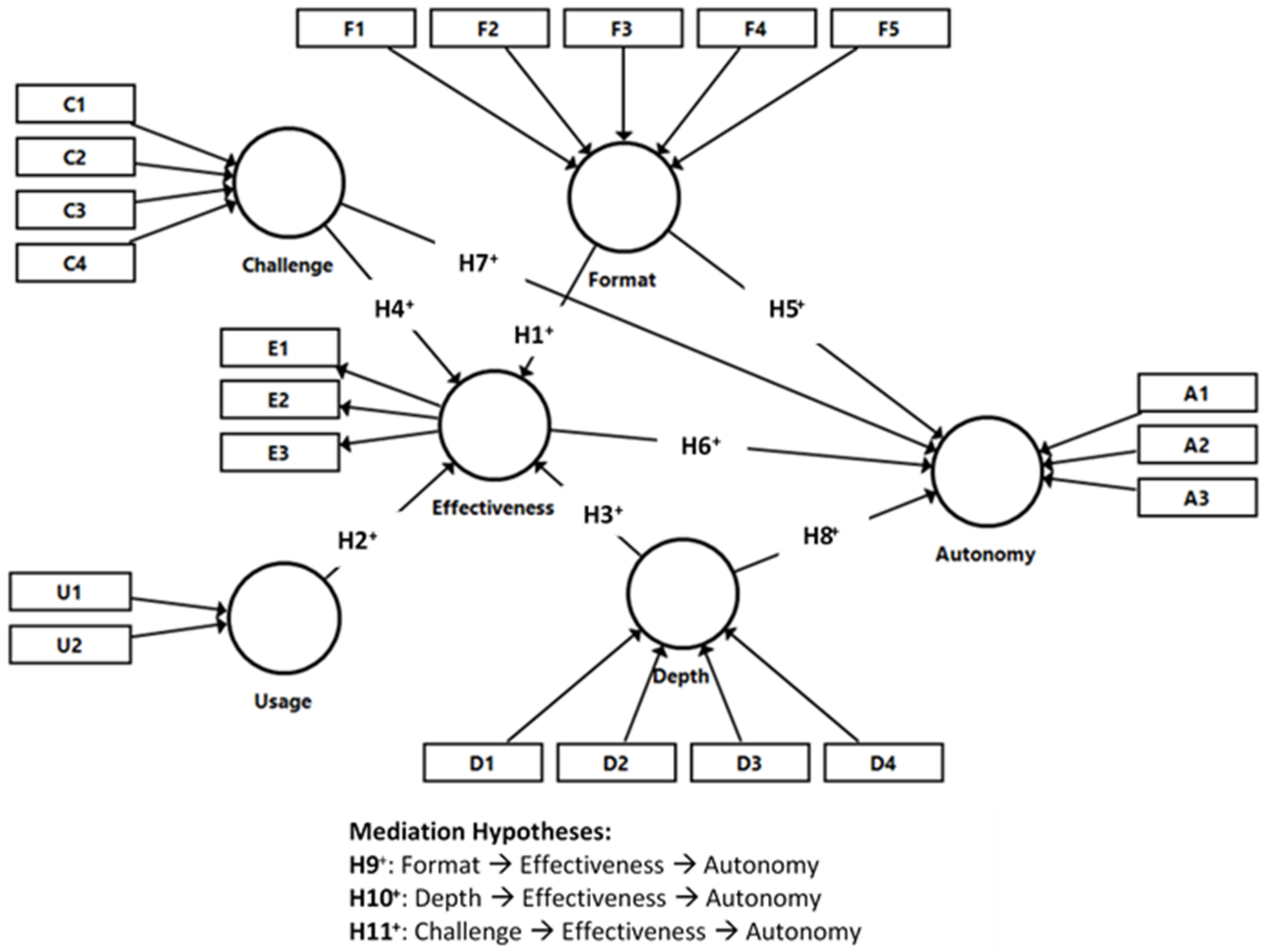

| Construct | Indicator | Description |
|---|---|---|
| Autonomy (Formative) | A1 | Video tutorials favour my autonomous learning |
| A2 | Video tutorials help me to manage my study time better | |
| A3 | Video tutorials allow me to solve doubts without the need to attend face-to-face tutorials | |
| Usage (Formative) | U1 | The time I have spent studying with the video tutorials has been sufficient and suitable |
| U2 | I feel that I have spent more time than my peers studying with the video tutorials | |
| Challenge (Formative) | C1 | Video tutorials help me to establish meaningful relationships between the different parts of the subject matter |
| C2 | Video tutorials help me to coordinate the activities to be developed to achieve effective learning of the concepts | |
| C3 | Video tutorials help me look for solutions or alternative perspectives | |
| C4 | Video tutorials help me to be more creative in finding solutions | |
| Effectiveness (Reflective) | E1 | Video tutorials help learn the subject |
| E2 | Video tutorials have helped me to know the subject better | |
| E3 | Video tutorials have helped me to save time in the study of the subject | |
| Depth (Formative) | D1 | Video tutorials help me use questioning and research methods |
| D2 | Video tutorials help me gain a deeper understanding of fundamental concepts and ideas | |
| D3 | Video tutorials help me to relate the fundamental concepts of the subject | |
| D4 | Video tutorials help me develop reflective and critical thinking | |
| Format (Formative) | F1 | I prefer video tutorials to be developed by several professors rather than a single professor |
| F2 | The extent of the subject matter covered in each video tutorial is adequate | |
| F3 | The length of each video tutorial is adequate | |
| F4 | I found the visual aspect (design, font size, etc.) of the video tutorials attractive and clear | |
| F5 | I found the explanations of the video tutorials to be clear and accurate |
| Value | Meaning |
|---|---|
| 1 | I fully disagree |
| 2 | I quite disagree |
| 3 | I disagree |
| 4 | Neither agree nor disagree (neutral) |
| 5 | I Agree |
| 6 | I quite agree |
| 7 | I fully agree |
| Construct | Indicator | Mean | Standard Deviation | Minimum | Maximum |
|---|---|---|---|---|---|
| Autonomy (Formative) | A1 | 4.982 | 1.395 | 1 | 7 |
| A2 | 4.766 | 1.571 | 1 | 7 | |
| A3 | 4.216 | 1.365 | 1 | 7 | |
| Usage (Formative) | U1 | 4.568 | 1.313 | 1 | 7 |
| U2 | 3.937 | 1.247 | 1 | 7 | |
| Challenge (Formative) | C1 | 4.943 | 1.262 | 1 | 7 |
| C2 | 4.811 | 1.346 | 1 | 7 | |
| C3 | 4.649 | 1.205 | 1 | 7 | |
| C4 | 4.423 | 1.399 | 1 | 7 | |
| Effectiveness (Reflective) | E1 | 5.144 | 1.321 | 1 | 7 |
| E2 | 4.901 | 1.342 | 1 | 7 | |
| E3 | 4.360 | 1.553 | 1 | 7 | |
| Depth (Formative) | D1 | 4.261 | 1.250 | 1 | 7 |
| D2 | 4.622 | 1.440 | 1 | 7 | |
| D3 | 5.054 | 1.184 | 2 | 7 | |
| D4 | 4.577 | 1.220 | 1 | 7 | |
| Format (Formative) | F1 | 4.342 | 1.679 | 1 | 7 |
| F2 | 5.036 | 1.287 | 2 | 7 | |
| F3 | 4.937 | 1.232 | 1 | 7 | |
| F4 | 5.622 | 1.163 | 3 | 7 | |
| F5 | 5.054 | 1.199 | 2 | 7 |
| Panel A. Reflective Construct (Effectiveness) | |||||||
| Panel A1. Outer Loadings | |||||||
| Indicator | Loading (λ) | CI 2.5% | CI 97.5% | p-Value | |||
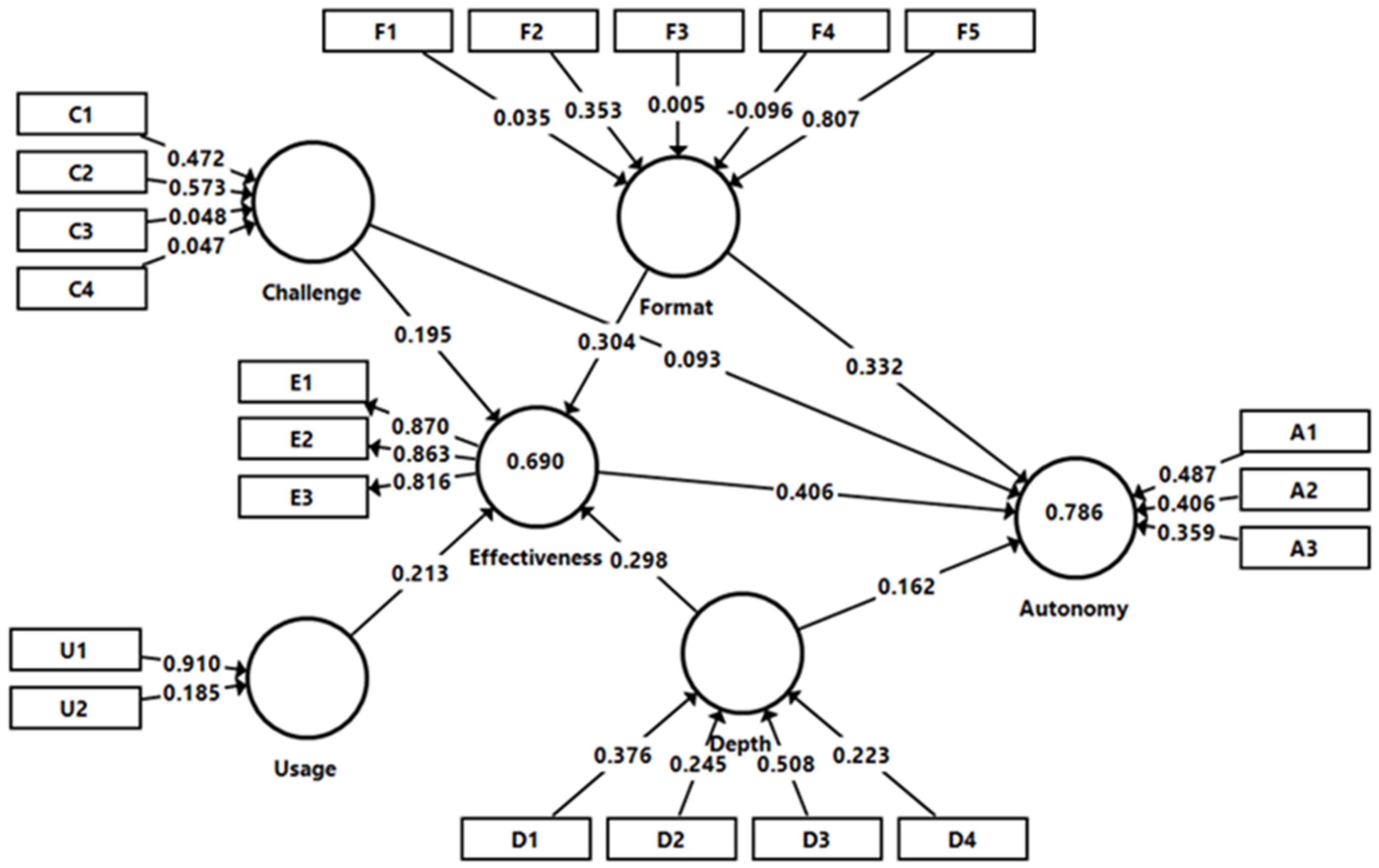
| E1 | 0.870 | 0.808 | 0.913 | 0.000 | |||
| E2 | 0.863 | 0.795 | 0.913 | 0.000 | |||
| E3 | 0.816 | 0.735 | 0.871 | 0.000 | |||
| Panel A2. Construct Reliability and Average Variance Extracted | |||||||
| Criterion | Value | CI 2.5% | CI 97.5% | p-Value | |||
| Cronbach’s Alpha | 0.807 | 0.734 | 0.860 | 0.000 | |||
| Dijkstra–Henseler’s Rho | 0.809 | 0.739 | 0.864 | 0.000 | |||
| Composite Reliability | 0.886 | 0.849 | 0.915 | 0.000 | |||
| AVE | 0.722 | 0.653 | 0.782 | 0.000 | |||
| Panel A3. Discriminant Validity (Fornell-Larcker Criterion) | |||||||
| Construct | Autonomy | Challenge | Depth | Effectiv. | Format | Usage | |
| Challenge | 0.739 | n.a. | |||||
| Depth | 0.751 | 0.751 | n.a. | ||||
| Effectiveness | 0.826 | 0.725 | 0.746 | 0.850 | |||
| Format | 0.784 | 0.693 | 0.649 | 0.696 | n.a. | ||
| Usage | 0.447 | 0.448 | 0.492 | 0.537 | 0.298 | n.a. | |
| Panel B. Formative Constructs | |||||||
| Construct | Indicator | VIF | Weight | CI 2.5% | CI 97.5% | t-Stat. | Loading |
| Autonomy | A1 | 1.67 | 0.487 *** | 0.316 | 0.644 | 5.746 | 0.878 ** |
| A2 | 1.36 | 0.406 *** | 0.250 | 0.569 | 4.966 | 0.766 ** | |
| A3 | 1.35 | 0.359 *** | 0.200 | 0.504 | 4.652 | 0.730 ** | |
| Usage | U1 | 1.19 | 0.910 *** | 0.647 | 1.059 | 8.386 | 0.986 ** |
| U2 | 1.19 | 0.185 ns | −0.189 | 0.546 | 0.983 | 0.556 ** | |
| Challenge | C1 | 1.77 | 0.472 *** | 0.245 | 0.680 | 4.261 | 0.876 ** |
| C2 | 1.95 | 0.573 *** | 0.354 | 0.763 | 5.540 | 0.919 ** | |
| C3 | 1.89 | 0.048 ns | −0.203 | 0.292 | 0.377 | 0.608 ** | |
| C4 | 2.04 | 0.047 ns | −0.202 | 0.298 | 0.367 | 0.646 ** | |
| Depth | D1 | 1.72 | 0.376 *** | 0.165 | 0.605 | 3.335 | 0.687 ** |
| D2 | 1.73 | 0.245 ** | 0.007 | 0.445 | 2.201 | 0.727 ** | |
| D3 | 1.69 | 0.508 *** | 0.312 | 0.728 | 4.788 | 0.807 ** | |
| D4 | 1.81 | 0.223 ** | 0.020 | 0.406 | 2.239 | 0.684 ** | |
| Format | F1 | 1.12 | 0.035 ns | −0.120 | 0.181 | 0.457 | 0.236 * |
| F2 | 1.58 | 0.353 *** | 0.084 | 0.593 | 2.686 | 0.744 ** | |
| F3 | 1.60 | 0.005 ns | −0.213 | 0.238 | 0.043 | 0.534 ** | |
| F4 | 1.35 | −0.096 ns | −0.291 | 0.099 | 0.955 | 0.388 ** | |
| F5 | 1.79 | 0.807 *** | 0.566 | 0.982 | 7.585 | 0.945 ** | |
| Panel A. Direct Effects | ||||||
| Path | t | CI 5% | CI 95% | f2 | VIF | |
| Challenge → Autonomy | 0.093 ns | 1.040 | −0.053 | 0.240 | 0.014 | 2.930 |
| Depth → Autonomy | 0.162 ** | 2.103 | 0.042 | 0.295 | 0.043 | 2.894 |
| Effectiveness → Autonomy | 0.406 *** | 3.522 | 0.228 | 0.609 | 0.266 | 2.909 |
| Format → Autonomy | 0.332 *** | 3.430 | 0.161 | 0.479 | 0.224 | 2.300 |
| Challenge → Effectiveness | 0.195 ** | 1.971 | 0.040 | 0.366 | 0.043 | 2.831 |
| Depth → Effectiveness | 0.298 *** | 3.238 | 0.137 | 0.439 | 0.106 | 2.680 |
| Format → Effectiveness | 0.304 *** | 3.485 | 0.168 | 0.455 | 0.142 | 2.096 |
| Usage → Effectiveness | 0.213 *** | 2.835 | 0.088 | 0.338 | 0.108 | 1.358 |
| Panel B. Indirect Effects | ||||||
| Effect | t | CI 5% | CI 95% | |||
| Challenge → Autonomy | 0.079 * | 1.546 | 0.013 | 0.180 | ||
| Depth → Autonomy | 0.121 *** | 2.522 | 0.047 | 0.202 | ||
| Format → Autonomy | 0.124 ** | 2.182 | 0.050 | 0.234 | ||
| Usage → Autonomy | 0.087 *** | 2.772 | 0.035 | 0.138 | ||
| Panel C. Total Effects | ||||||
| Effect | t | CI 5% | CI 95% | |||
| Challenge → Autonomy | 0.172 ** | 1.956 | 0.033 | 0.323 | ||
| Depth → Autonomy | 0.283 *** | 3.725 | 0.163 | 0.410 | ||
| Effectiveness → Autonomy | 0.406 *** | 3.522 | 0.228 | 0.609 | ||
| Format → Autonomy | 0.455 *** | 6.055 | 0.329 | 0.578 | ||
| Usage → Autonomy | 0.087 *** | 2.772 | 0.035 | 0.138 | ||
| Challenge → Effectiveness | 0.195 ** | 1.971 | 0.040 | 0.366 | ||
| Depth → Effectiveness | 0.298 *** | 3.238 | 0.137 | 0.439 | ||
| Format → Effectiveness | 0.304 *** | 3.485 | 0.168 | 0.455 | ||
| Usage → Effectiveness | 0.213 *** | 2.835 | 0.088 | 0.338 | ||
| Dependent Variable | R2 | Antecedents Variables | Path Coefficients | Correlations | Explained Variance |
|---|---|---|---|---|---|
| Autonomy | 0.786 | Challenge | 0.093 | 0.739 | 0.069 |
| Depth | 0.162 | 0.751 | 0.122 | ||
| Effectiveness | 0.406 | 0.826 | 0.336 | ||
| Format | 0.332 | 0.784 | 0.260 | ||
| Effectiveness | 0.690 | Challenge | 0.195 | 0.725 | 0.142 |
| Depth | 0.298 | 0.746 | 0.222 | ||
| Format | 0.304 | 0.696 | 0.212 | ||
| Usage | 0.213 | 0.537 | 0.114 |
| Panel A. Construct Prediction Summary | |||||||||
| Q2 | |||||||||
| Autonomy | 0.669 | ||||||||
| Effectiveness | 0.631 | ||||||||
| Panel B. Indicator Prediction Summary | |||||||||
| PLS | LM | PLS-LM | |||||||
| RMSE | MAE | Q2 | RMSE | MAE | Q2 | RMSE | MAE | Q2 | |
| A1 | 0.991 | 0.766 | 0.502 | 1.095 | 0.854 | 0.393 | −0.104 | −0.088 | 0.109 |
| A2 | 1.285 | 1.052 | 0.342 | 1.433 | 1.142 | 0.182 | −0.148 | −0.090 | 0.160 |
| A3 | 1.054 | 0.866 | 0.419 | 1.250 | 0.994 | 0.182 | −0.196 | −0.128 | 0.237 |
| E1 | 0.983 | 0.687 | 0.460 | 1.068 | 0.782 | 0.363 | −0.085 | −0.095 | 0.097 |
| E2 | 0.990 | 0.772 | 0.467 | 1.073 | 0.855 | 0.373 | −0.083 | −0.083 | 0.094 |
| E3 | 1.184 | 0.971 | 0.431 | 1.291 | 1.014 | 0.324 | −0.107 | −0.043 | 0.107 |
Publisher’s Note: MDPI stays neutral with regard to jurisdictional claims in published maps and institutional affiliations. |
© 2021 by the authors. Licensee MDPI, Basel, Switzerland. This article is an open access article distributed under the terms and conditions of the Creative Commons Attribution (CC BY) license (https://creativecommons.org/licenses/by/4.0/).
Share and Cite
Valls Martínez, M.d.C.; Martín-Cervantes, P.A.; Sánchez Pérez, A.M.; Martínez Victoria, M.d.C. Learning Mathematics of Financial Operations during the COVID-19 Era: An Assessment with Partial Least Squares Structural Equation Modeling. Mathematics 2021, 9, 2120. https://doi.org/10.3390/math9172120
Valls Martínez MdC, Martín-Cervantes PA, Sánchez Pérez AM, Martínez Victoria MdC. Learning Mathematics of Financial Operations during the COVID-19 Era: An Assessment with Partial Least Squares Structural Equation Modeling. Mathematics. 2021; 9(17):2120. https://doi.org/10.3390/math9172120
Chicago/Turabian StyleValls Martínez, María del Carmen, Pedro Antonio Martín-Cervantes, Ana María Sánchez Pérez, and María del Carmen Martínez Victoria. 2021. "Learning Mathematics of Financial Operations during the COVID-19 Era: An Assessment with Partial Least Squares Structural Equation Modeling" Mathematics 9, no. 17: 2120. https://doi.org/10.3390/math9172120
APA StyleValls Martínez, M. d. C., Martín-Cervantes, P. A., Sánchez Pérez, A. M., & Martínez Victoria, M. d. C. (2021). Learning Mathematics of Financial Operations during the COVID-19 Era: An Assessment with Partial Least Squares Structural Equation Modeling. Mathematics, 9(17), 2120. https://doi.org/10.3390/math9172120

