Statistical Indistinguishability in Multi-User Covert Communications Without Secret Information


Abstract
1. Introduction
- Structural covertness without secret pilots: We depart from the conventional secret pilot paradigm and demonstrate that robust covertness can be achieved in a fully public pilot environment. Even when Willie possesses complete individual channel state information (CSI), network-induced structural uncertainty enables covert communication without secrecy-based coordination.
- Optimal detection under structural uncertainty: We mathematically prove that, despite full CSI knowledge, Willie’s optimal detection strategy reduces to an energy detector due to the uncertainty in the active user subset. Based on this result, we derive a closed-form expression for the optimal transmit power that satisfies a given covertness constraint .
- Spatial dispersion as a fundamental security resource: We show that spatial dispersion among cooperative users amplifies the structural uncertainty observed at Willie. This geometric diversity increases the variance of aggregate interference, allowing Alice to increase her transmit power while maintaining the required level of covertness.
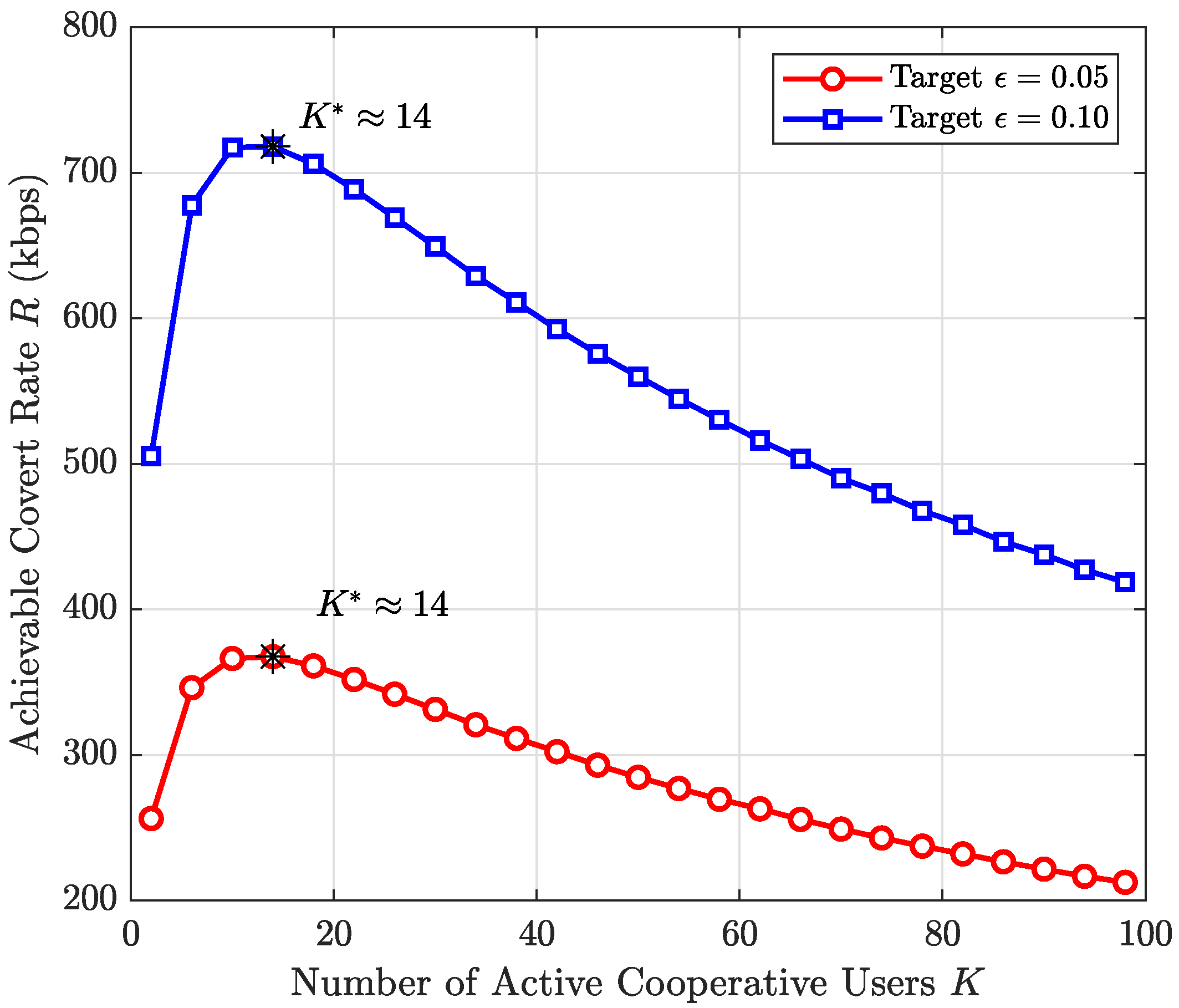
- Optimal active subset design: Through theoretical analysis and numerical evaluation, we identify an optimal number of active cooperative users that maximizes the covert rate. We further show that this optimal point is determined solely by the network geometry and remains invariant to the covertness requirement .
Comparison with Existing Uncertainty Mechanisms
2. System Model and Problem Formulation
2.1. Network Topology and Spatial Distribution
2.2. Covertness Metric: Detection Error Probability (DEP)
2.3. Proposed Communication Protocol
2.3.1. Structure of Channel Notation
- Superscript (x): The superscript denotes the frequency band over which the channel is estimated. For example, and correspond to the frequency bands and , respectively.
- Subscript (): The subscripts indicate the directional link associated with the pilot transmission. The first index y represents the transmitting node, while the second index z denotes the receiving node that estimates the channel.
- Examples: denotes the channel from Bob to user m estimated over band . Similarly, and represent the uplink channels from Alice and user m to Bob, respectively, measured over Alice’s frequency band .
2.3.2. Phase 1: Two-Way Channel Estimation
- Downlink estimation: Bob broadcasts pilot signals over all frequency bands . Alice and each cooperative user estimate their respective downlink channels, e.g., and . Since pilots are public, Willie also estimates his corresponding channels and .
- Uplink estimation: Each user transmits pilot signals back to Bob. Alice transmits over , while each transmits over both (for cooperation) and (for its own communication). Bob estimates the uplink channels , , and .
- Adversarial knowledge: Under the public pilot assumption, Willie also observes these uplink pilots and estimates and . Therefore, Willie is assumed to possess the full CSI of his own links.
2.3.3. Phase 2: Centralized Parameter Setting at Bob
2.3.4. Phase 3: Parameter Broadcast and Adversarial Awareness
2.3.5. Phase 4: Covert Data Transmission and Detection
2.4. Selection Uncertainty as a Covert Mechanism
2.5. Signal Model and Hypothesis Models
3. Mathematical Optimality of Energy Detection
3.1. Likelihood Ratio Test (LRT) and Sufficient Statistic
3.2. Sufficient Statistic and Fisher–Neyman Factorization
3.3. Monotonicity and Optimal Decision Rule
4. Covertness Analysis Without Secret Pilot
4.1. Mathematical Derivation of the Asymptotic Test Statistic
4.2. Statistical Modeling of Selection Uncertainty
4.2.1. Small-K Regime: Combinatorial Ambiguity and the Subset-Sum Structure
4.2.2. Large-K Regime: Gaussian Approximation of the Test Statistic
4.2.3. Robustness Against an Ideal Willie
5. Detection Error Probability
5.1. General DEP Formulation
5.2. Detection Performance in the Small-K Regime
5.3. Detection Performance in the Large-K Regime
5.3.1. False Alarm and Missed Detection Probabilities
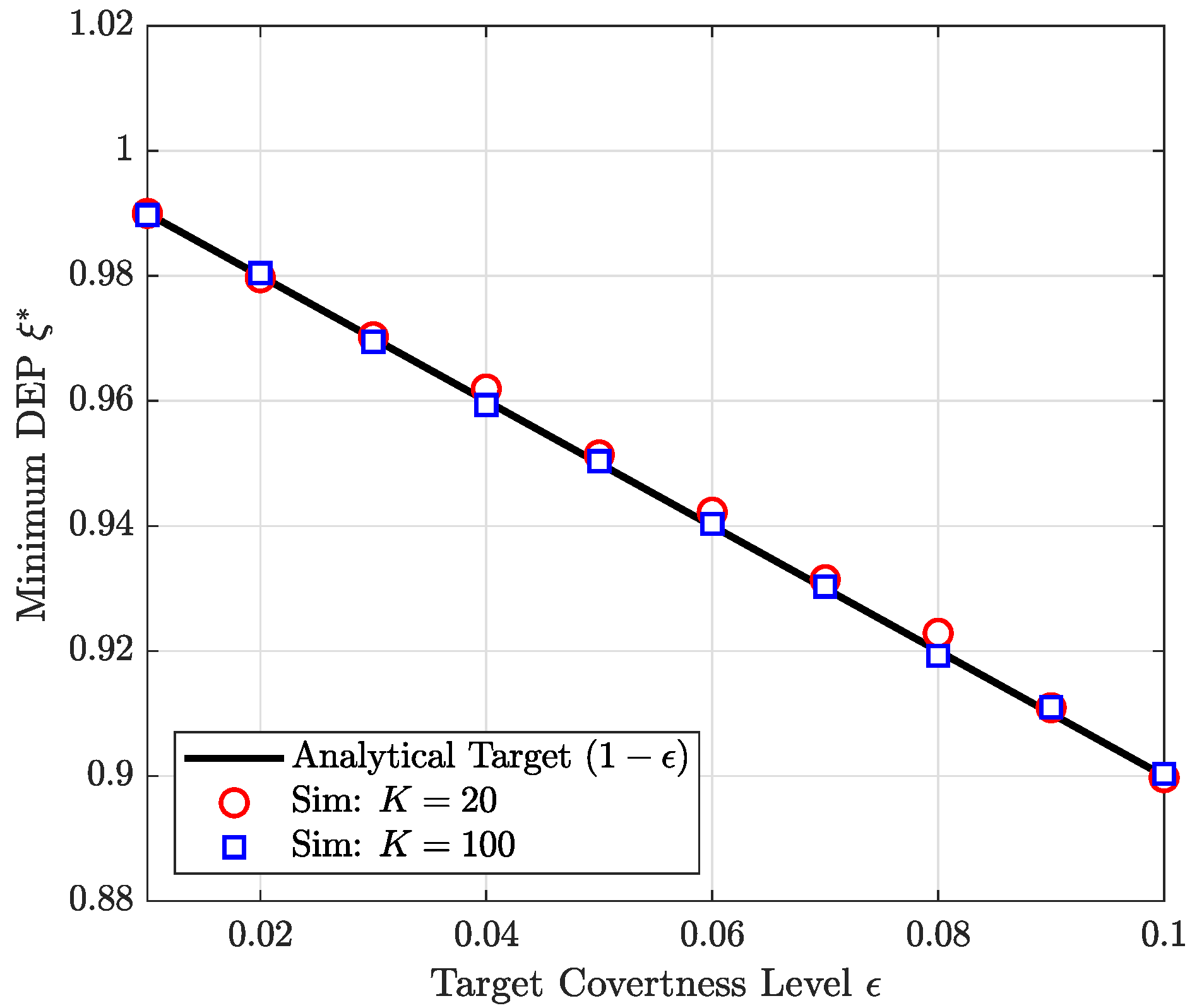
5.3.2. Optimal Threshold and Minimum DEP
5.4. Covertness Condition and Power Allocation
5.5. Maximum Achievable Covert Rate
6. Numerical Results and Discussion
6.1. Spatial Topology and Worst-Case Scenario Configuration
6.2. Path-Loss Model and Parameter Derivation
6.3. Performance Validation and Analysis
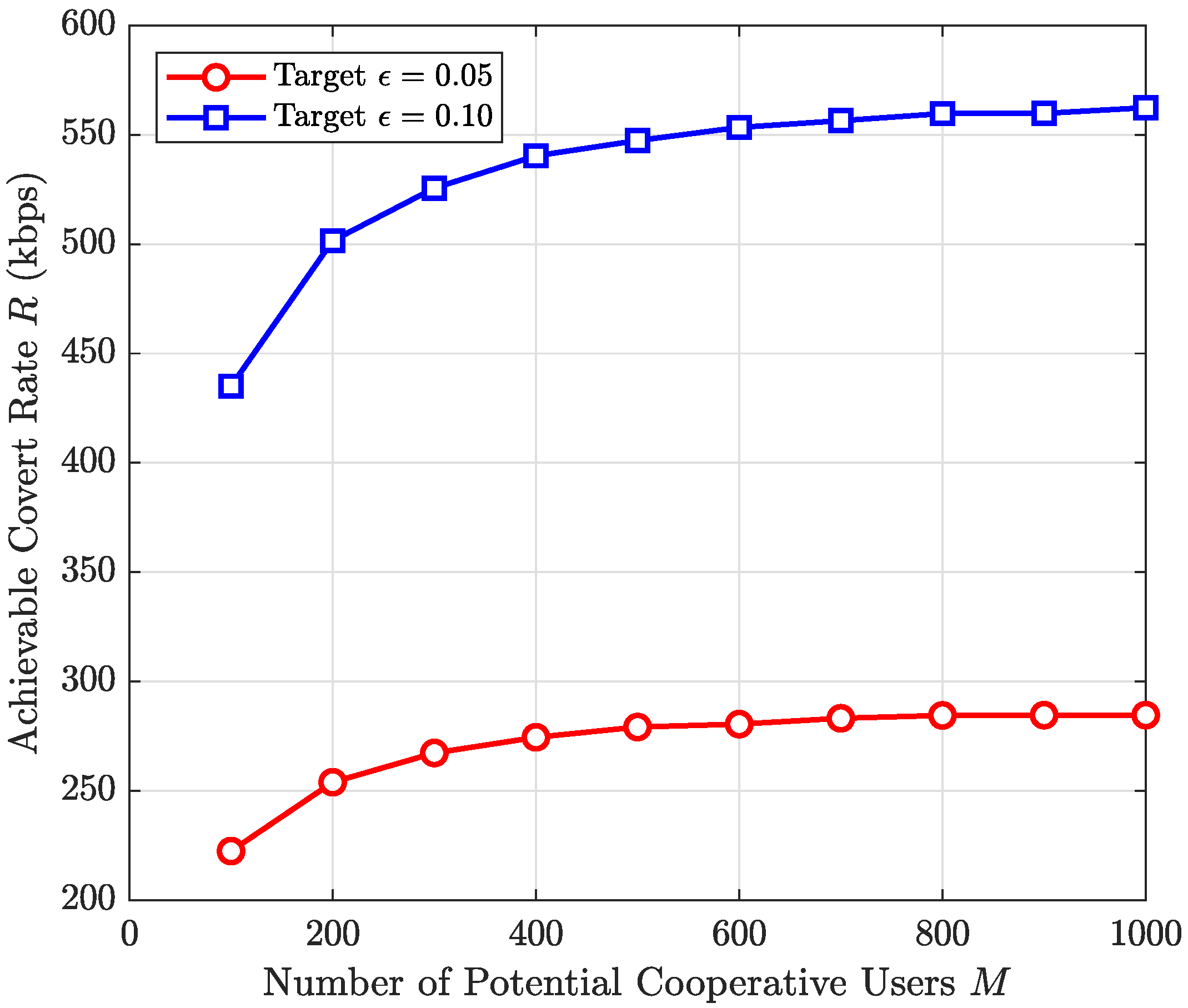
- Local interference suppression: A larger M enables more selective user activation at Bob. By ordering the selection metric and choosing the K smallest values, the effective interference power observed at Bob is reduced, resulting in an improved reception condition.
- Preservation of structural uncertainty: Although the interference at Bob is reduced, the selection-induced variance at Willie, , remains significant, because it depends on the statistical dispersion of the entire user population with respect to Willie.
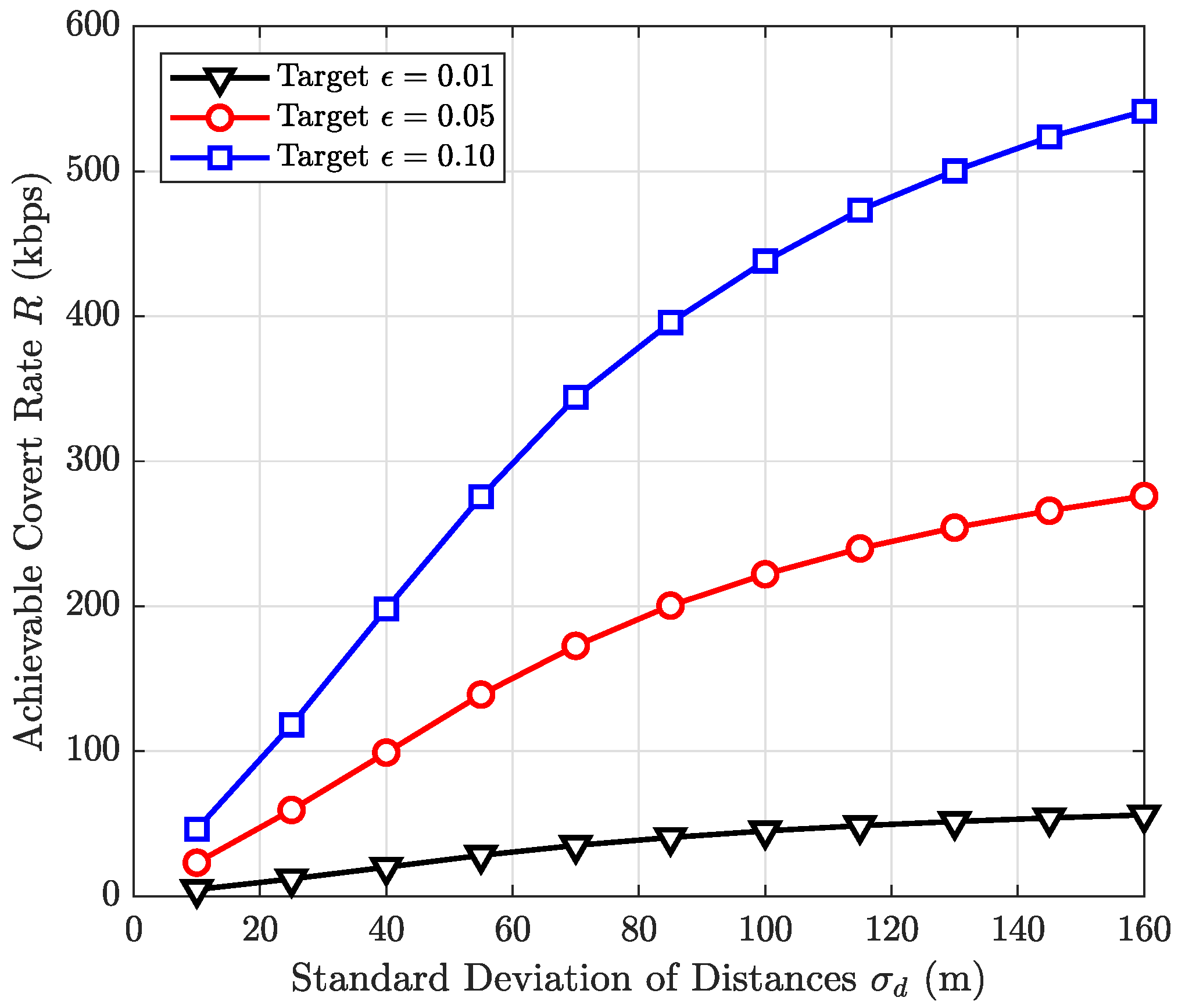
- Increase in structural uncertainty: Larger implies that CUs are more widely distributed around Willie. Due to the nonlinear path-loss relationship, moderate distance variations produce significant fluctuations in received power, thereby increasing .
- Expansion of the covert operating region: As spatial dispersion increases, the aggregate interference becomes more sensitive to subset selection, allowing Alice to employ a larger transmit power while maintaining the covertness constraint.
- Persistence under strict covertness constraints: Even under stringent requirements, e.g., , large spatial dispersion enables non-negligible covert rates, indicating that geometry-induced uncertainty remains effective without relying on secret pilot-based coordination.
- Security Gain (): In the low-K regime, increasing the number of active cooperative users enlarges the combinatorial selection space, which increases the structural variance . This allows Alice to transmit with higher power while satisfying the covertness constraint, and the resulting signal gain dominates the additional interference at Bob.
- Interference Penalty (): Beyond the optimal point, the aggregate interference at Bob grows faster than the security-driven transmit-power gain. Although the uncertainty at Willie continues to increase, the degradation in Bob’s received SINR dominates, leading to a reduction in the achievable covert rate.
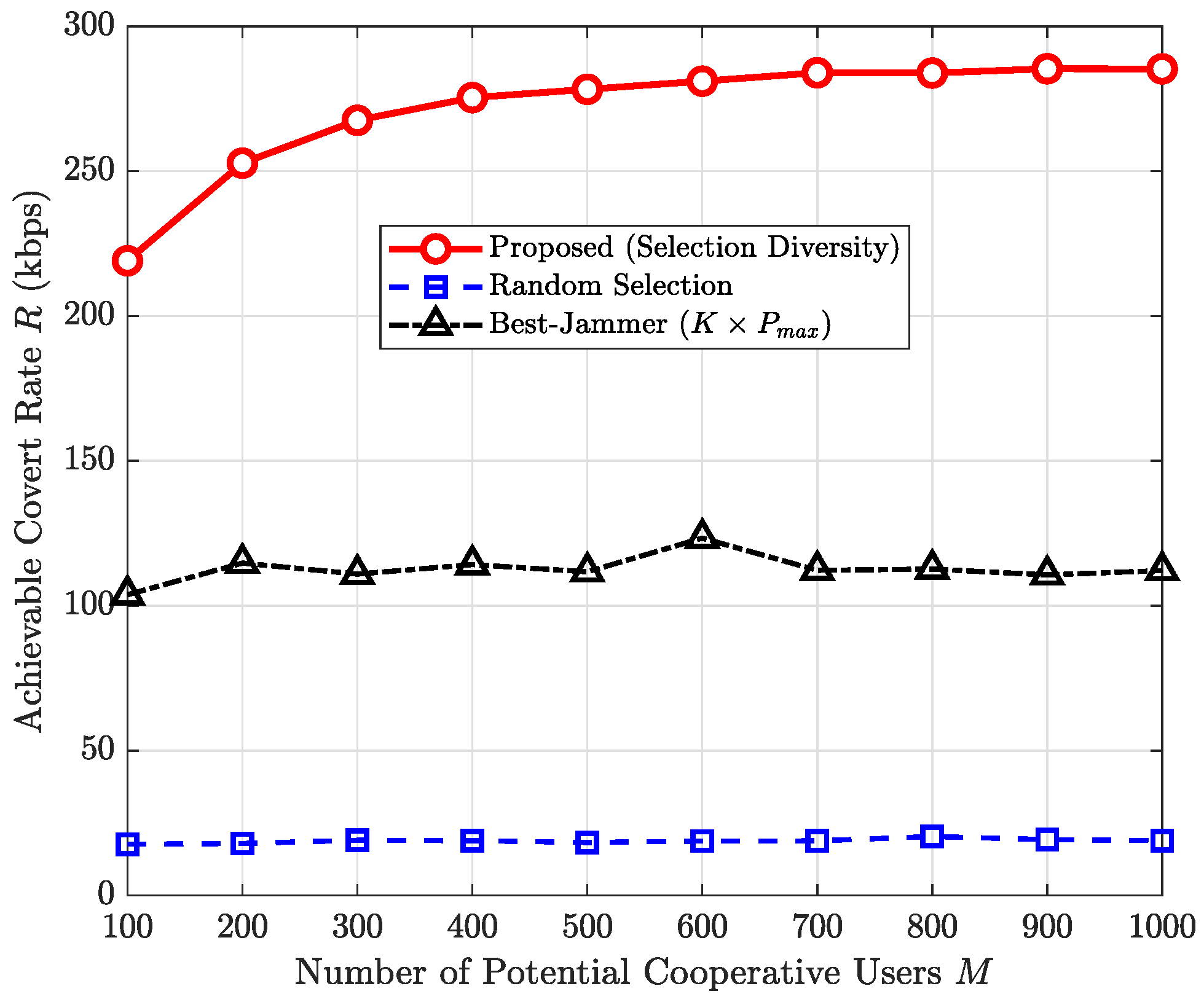
- Stability and scalability of the proposed scheme: The proposed method exhibits a smooth and monotonic increase in the achievable covert rate R as the number of cooperative users M increases. This behavior originates from the selection diversity gain. As the combinatorial search space grows, Bob can more reliably select a locally quiet subset that minimizes interference at the legitimate receiver while preserving high structural uncertainty at Willie.
- Volatility of single-user jamming: In contrast, the best-jammer baseline shows noticeable performance fluctuations across different values of M. This instability arises from the strong dependence on the spatial realization of a single jammer. Since the entire power budget is concentrated on one node, unfavorable geometric configurations (e.g., a jammer located close to Bob) can significantly degrade the received SINR, and no diversity mechanism exists to compensate for such cases.
- Inefficiency of random selection: The uniform random-selection baseline consistently achieves the lowest covert rate among the compared schemes. This result indicates that without intelligent subset selection, aggregate interference from multiple users primarily acts as performance degradation rather than a security resource. The comparison confirms that selection uncertainty, rather than mere interference accumulation, is the key factor enabling pilot-free covert communication.
7. Conclusions
Author Contributions
Funding
Data Availability Statement
Conflicts of Interest
References
- Jiang, Y.; Wang, L.; Chen, H.H.; Shen, X. Physical layer covert communication in B5G wireless networks: Its research, applications, and challenges. Proc. IEEE 2024, 112, 47–82. [Google Scholar] [CrossRef]
- Wyner, A.D. The wire-tap channel. Bell Syst. Tech. J. 1975, 54, 1355–1387. [Google Scholar] [CrossRef]
- Bash, B.A.; Goeckel, D.; Towsley, D. Limits of Reliable Communication with Low Probability of Detection on AWGN Channels. IEEE J. Sel. Areas Commun. 2013, 31, 1921–1930. [Google Scholar] [CrossRef]
- Bloch, M.R. Covert Communication Over Noisy Channels: A Resolvability Perspective. IEEE Trans. Inf. Theory 2016, 62, 2334–2354. [Google Scholar] [CrossRef]
- Wang, L.; Wornell, G.W.; Zheng, L. Fundamental Limits of Communication with Low Probability of Detection. IEEE Trans. Inf. Theory 2016, 62, 3493–3503. [Google Scholar] [CrossRef]
- Che, P.H.; Bakshi, M.; Chan, C.; Jaggi, S. Reliable Deniable Communication with Channel Uncertainty. In Proceedings of the 2014 IEEE Information Theory Workshop (ITW 2014), Hobart, TAS, Australia, 2–5 November 2014; pp. 30–34. [Google Scholar] [CrossRef]
- Arumugam, K.S.K.; Bloch, M.R. Keyless Covert Communication over Multiple-Access Channels. In Proceedings of the 2016 IEEE International Symposium on Information Theory (ISIT), Barcelona, Spain, 10–15 July 2016; pp. 2229–2233. [Google Scholar] [CrossRef]
- Lee, S.; Baxley, R.J.; Weitnauer, M.A.; Walkenhorst, B. Achieving Undetectable Communication. IEEE J. Sel. Top. Signal Process. 2015, 9, 1195–1205. [Google Scholar] [CrossRef]
- Shahzad, K.; Zhou, X.; Yan, S. Covert Communication in Fading Channels under Channel Uncertainty. In Proceedings of the 2017 IEEE 85th Vehicular Technology Conference (VTC Spring), Sydney, NSW, Australia, 4–7 June 2017; pp. 1–5. [Google Scholar] [CrossRef]
- Wang, J.; Tang, W.; Zhu, Q.; Li, X.; Rao, H.; Li, S. Covert Communication with the Help of Relay and Channel Uncertainty. IEEE Wirel. Commun. Lett. 2019, 8, 317–320. [Google Scholar] [CrossRef]
- Sobers, T.V.; Bash, B.A.; Guha, S.; Towsley, D.; Goeckel, D. Covert Communication in the Presence of an Uninformed Jammer. IEEE Trans. Wirel. Commun. 2017, 16, 6193–6206. [Google Scholar] [CrossRef]
- Li, K.; Kelly, P.A.; Goeckel, D. Optimal Power Adaptation in Covert Communication with an Uninformed Jammer. IEEE Trans. Wirel. Commun. 2020, 19, 3463–3473. [Google Scholar] [CrossRef]
- Zheng, T.X.; Yang, Z.; Wang, C.; Li, Z.; Yuan, J.; Guan, X. Wireless Covert Communications Aided by Distributed Cooperative Jamming over Slow Fading Channels. IEEE Trans. Wirel. Commun. 2021, 20, 7026–7039. [Google Scholar] [CrossRef]
- He, B.; Yan, S.; Zhou, X.; Jafarkhani, H. Covert Wireless Communication with a Poisson Field of Interferers. IEEE Trans. Wirel. Commun. 2018, 17, 6005–6017. [Google Scholar] [CrossRef]
- Lee, J.; Dinh, D.T.; Yeom, H.; Lee, S.H.; Ha, J. Multiuser Cooperation for Covert Communication under Quasi-Static Fading. IEEE Trans. Inf. Forensics Secur. 2023, 18, 4625–4639. [Google Scholar] [CrossRef]
- Lee, J.; Yeom, H.; Lee, S.H.; Ha, J. Channel Correlation in Multi-User Covert Communication: Friend or Foe? IEEE Trans. Inf. Forensics Secur. 2024, 19, 1469–1482. [Google Scholar] [CrossRef]
- Lee, J.; Yeom, H. Multi-User Covert Communication in Spatially Heterogeneous Wireless Networks. arXiv 2025, arXiv:2603.25549. [Google Scholar]
- Kay, S.M. Fundamentals of Statistical Signal Processing: Detection Theory; Prentice-Hall PTR: Hoboken, NJ, USA, 1998. [Google Scholar]
- Neyman, J.; Pearson, E.S. IX. On the Problem of the Most Efficient Tests of Statistical Hypotheses. Philos. Trans. R. Soc. Lond. Ser. A 1933, 231, 289–337. [Google Scholar] [CrossRef]
- Casella, G.; Berger, R.L. Statistical Inference, 2nd ed.; Duxbury Press: Pacific Grove, CA, USA, 2002. [Google Scholar]
- Hájek, J. Limiting Distributions in Simple Random Sampling from a Finite Population. Publ. Math. Inst. Hung. Acad. Sci. 1960, 5, 361–374. [Google Scholar]
- 3rd Generation Partnership Project (3GPP). Spatial Channel Model for Multiple Input Multiple Output (MIMO) Simulations (Release 18). Technical Report 25.996, 3GPP. 2024. Available online: https://portal.3gpp.org/desktopmodules/Specifications/SpecificationDetails.aspx?specificationId=1382 (accessed on 3 April 2026).
- Yang, X.; Zhang, R.; Yue, C.; Liu, Y.; Ooi, B.C.; Gao, Q.; Zhang, Y.; Yang, H. VeDB: A Software and Hardware Enabled Trusted Relational Database. Proc. ACM Manag. Data 2023, 1, 194:1–194:27. [Google Scholar] [CrossRef]



| Existing Approaches | Proposed Framework | ||
|---|---|---|---|
| (i) CSI Uncertainty [9,10] | Secret information | Secret pilots/secret codebook | Not required |
| Uncertainty source | Channel estimation error | Combinatorial subset ambiguity | |
| Willie’s CSI | Imperfect (by design) | Perfect (public pilots) | |
| Reducibility | Degrades with higher SNR or longer observation | Irreducible; independent of N | |
| Covertness basis | Information asymmetry via secrecy | Structural asymmetry via selection | |
| (ii) Independent Jammer [11,12,13] | Secret information | Secret coordination/pre-shared keys | Not required |
| Activation model | i.i.d. Bernoulli | (dependent) | |
| Active count K | Random (Poisson-Binomial) | Deterministic per realization | |
| Dependence | Independent across nodes | Sampling w/o replacement | |
| Covert constraint | Statistical (averaged over channel) | Instantaneous (per realization) | |
| (iii) Exact-K w/Secret Pilots [15,16,17] | Secret information | Secret pilot sequences (required) | Not required (public pilots) |
| Activation model | (same structure) | (same structure) | |
| Willie’s knowledge | unknown (secret pilots) | fully known | |
| Covertness origin | Hidden jammer-to-Willie channels | Combinatorial ambiguity of subsets | |
| If secret is leaked | Covertness collapses | Unaffected (no secret to leak) | |
| (iv) Stochastic Geometry [14] | Secret information | Secret codebook/hidden interferer identity | Not required |
| What is unknown | Where interferers are located | Which K-subset is active | |
| Network topology | Random (spatial PPP) | Fixed and known to Willie | |
| Randomness type | Spatial (continuous) | Combinatorial (discrete) | |
| Analytical tool | Campbell’s theorem/standard CLT | Hájek–Serfling CLT (finite pop.) |
| Parameter | Symbol | Value |
|---|---|---|
| System Bandwidth | W | 5 MHz |
| Transmit Power of CUs | 200 mW (23 dBm) | |
| Noise Power Spectral Density (W/Hz) | dBm | |
| Path-loss Exponent | 3.5 | |
| Reference Channel Gain | ||
| Total Potential Users | M | 1000 |
| Active User Count | K | 20 |
Disclaimer/Publisher’s Note: The statements, opinions and data contained in all publications are solely those of the individual author(s) and contributor(s) and not of MDPI and/or the editor(s). MDPI and/or the editor(s) disclaim responsibility for any injury to people or property resulting from any ideas, methods, instructions or products referred to in the content. |
© 2026 by the authors. Licensee MDPI, Basel, Switzerland. This article is an open access article distributed under the terms and conditions of the Creative Commons Attribution (CC BY) license.
Share and Cite
Lee, J.; Park, J.; Yun, S. Statistical Indistinguishability in Multi-User Covert Communications Without Secret Information. Mathematics 2026, 14, 1227. https://doi.org/10.3390/math14071227
Lee J, Park J, Yun S. Statistical Indistinguishability in Multi-User Covert Communications Without Secret Information. Mathematics. 2026; 14(7):1227. https://doi.org/10.3390/math14071227
Chicago/Turabian StyleLee, Jinyoung, Junguk Park, and Sangseok Yun. 2026. "Statistical Indistinguishability in Multi-User Covert Communications Without Secret Information" Mathematics 14, no. 7: 1227. https://doi.org/10.3390/math14071227
APA StyleLee, J., Park, J., & Yun, S. (2026). Statistical Indistinguishability in Multi-User Covert Communications Without Secret Information. Mathematics, 14(7), 1227. https://doi.org/10.3390/math14071227