Article

Moduli Spaces of Arrangements of 12 Projective Lines with a Sextic Point

1
Mathematics Department, Shamoon College of Engineering, Ashdod 7724501, Israel
2
Shamoon College of Engineering, Bar-Ilan University, Ramat Gan 5290002, Israel
3
School of Mathematical Sciences, East China Normal University, Shanghai 200241, China
4
Mathematics Department, Bar-Ilan University, Ramat Gan 5290002, Israel
5
School of Mathematics and Systems Science, Wuhan University of Science and Technology, Wuhan 430065, China
*
Author to whom correspondence should be addressed.
Mathematics 2026, 14(6), 1052; https://doi.org/10.3390/math14061052
Submission received: 27 January 2026 / Revised: 8 March 2026 / Accepted: 9 March 2026 / Published: 20 March 2026
(This article belongs to the Special Issue Computational Geometry: Theory, Algorithms and Applications)

Abstract

In this paper, we classify moduli spaces of arrangements of 12 lines with a sextic point. We show that these moduli spaces can consist of more than two connected components. We also present defining equations of arrangements whose moduli spaces are not irreducible, and after taking quotients by complex conjugation, we obtain potential Zariski pairs.

1. Introduction

A line arrangement A in CP 2 is a finite collection of projective lines. The complement of the union of lines in A is denoted by M ( A ) .
An essential topic in hyperplane arrangement theory is the relation between the topology of complements and the combinatorics of intersection lattices. For line arrangements, Jiang and Yau [1] showed that homeomorphism of the complement always implies lattice isomorphism. However, the converse is not true in general. In [2,3] the authors found a large class of line arrangements, called nice arrangements, whose intersection lattices determine the topology of the complements (see also [4,5,6]).
A Zariski pair is a pair of line arrangements that are lattice-isomorphic but have non-isomorphic fundamental groups of their complements. The first Zariski pair was constructed by Rybnikov [7]. On the other hand, Fan [8] and Garber et al. [9] proved that there is no Zariski pair for arrangements of up to eight real lines. This was extended to eight complex lines by Nazir and Yoshinaga [10], and to nine complex lines by Ye [11]. Recently, Amram et al. classified arrangements of 10 and 11 lines with a quintuple point [12,13,14] and found some “potential Zariski pairs”. (By a potential Zariski pair we mean a pair of lattice-isomorphic arrangements whose moduli space has more than one point; thus, by Randell’s theorem, they are not ruled out as Zariski pairs, but the actual computation of their fundamental groups is left for future work.)
For a complex line arrangement A , Randell’s lattice-isotopy theorem [15] and Cohen–Suciu’s theorem [16] imply that arrangements belonging to the same connected component of the moduli space, or to two complex conjugate components, cannot form a Zariski pair.
The classification of moduli spaces is carried out in three steps. First, we roughly classify intersection lattices according to the number of multiple points. Second, we distinguish cases by the relative position of the sextic point and other multiple points. Third, we write down defining equations involving parameters for each intersection lattice.
The study of moduli spaces of line arrangements with high-multiplicity points not only extends the classification of Zariski pairs but also provides concrete models for moduli spaces of curves with prescribed singularities. These spaces are closely related to the periods of K 3 surfaces and may admit interpretations in the context of decorated moduli spaces in theoretical physics, such as those arising in string compactifications or two-dimensional gravity (cf. [17,18]). In this paper we focus on arrangements of 12 lines with a sextic point and show that their moduli spaces can have multiple connected components, yielding new examples of potential Zariski pairs.
The paper is organized as follows. Section 2 collects preliminaries. Section 3 treats arrangements with a point of multiplicity 7 . Section 4 deals with arrangements containing a sextic point and at least one quadruple point. Section 5 considers sextic point arrangements without quadruple points. Section 6 summarizes the results and discusses broader connections.

2. Preliminaries

Let A = { L 1 , , L n } be a line arrangement in CP 2 . A singularity of L i is called a multiple point of A if its multiplicity is at least 3. The set
L ( A ) = i S L i | S { 1 , , n } ,
partially ordered by reverse inclusion, is the intersection lattice of A .
Definition 1.  
Two line arrangements A 1 and A 2 are lattice-isomorphic, denoted A 1 A 2 , if their intersection lattices are isomorphic, i.e., there exists a permutation ϕ of { 1 , , n } such that for every non-empty subset S { 1 , , n } ,
dim i S L i = dim j ϕ ( S ) H j ,
where L i A 1 , H j A 2 .
Definition 2.  
The moduli space of line arrangements with fixed lattice L ( A ) (or simply of A ) is
M A = B ( ( CP 2 ) * ) n | B A / P G L C ( 2 ) .
We denote by M A c the quotient of M A under complex conjugation.
Definition 3  
([7]). A pair of reduced plane curves C 1 , C 2 CP 2 is called a Zariski pair if there exist tubular neighbourhoods T ( C 1 ) , T ( C 2 ) and a homeomorphism h : T ( C 1 ) T ( C 2 ) with h ( C 1 ) = C 2 , but there is no homeomorphism f : CP 2 CP 2 with f ( C 1 ) = C 2 .
Definition 4  
([7]). Let k N . An arrangement A is of type C k if k is the minimum number of lines in A containing all points of multiplicity at least three.
Definition 5 
([7]). Let A be a line arrangement of type C 3 . It is called a simple C 3 arrangement if there exist three lines L 1 , L 2 , L 3 A containing all multiple points and one of the following holds:
1. 
L 1 L 2 L 3 , or
2. 
L 1 L 2 L 3 = and one of L 1 , L 2 , L 3 contains only one multiple point apart from the intersections with the other two lines.
Theorem 1  
([7]). If A is a simple C 3 arrangement, then M A is irreducible.
Theorem 2  
([7]). Let A = { L 1 , , L n } and assume L n passes through at most two multiple points. Set A = { L 1 , , L n 1 } . Then M A is irreducible whenever M A is irreducible.
An arrangement is called non-reductive if each of its lines passes through at least three multiple points; otherwise it is reductive. Denote by n r the number of intersection points of multiplicity r.
Lemma 1  
([19]). For an arrangement of k lines in CP 2 ,
k ( k 1 ) 2 = r 2 r ( r 1 ) n r 2 .
Theorem 3  
([19]). If n k = n k 1 = n k 2 = 0 , then
n 2 + 3 4 n 3 k + r 5 ( 2 r 9 ) n r .
Theorem 4  
([12]). Let A be an arrangement of n 9 lines. If there exists a multiple point of multiplicity n 4 , then M A is irreducible.
The following lemma is well known and facilitates computations.
Lemma 2.  
Let { L 1 , L 2 , L 3 } and { L 4 , L 5 , L 6 , L 7 , L 8 } be two pencils of lines intersecting at one point and intersecting transversally in 15 points. Then there exists an automorphism of the dual projective plane such that the eight lines are given by
Y = 0 , Y = Z , Y = t 1 Z , X = 0 , X = Z , X = t 2 Z , X = t 3 Z , X = t 4 Z .

3. Arrangements of 12 Lines with a Multiple Point of Multiplicity 7

Theorem 5.  
Let A be a non-reductive arrangement of 12 lines possessing a multiple point of multiplicity 7 . Then M A is irreducible.
Proof. 
If the multiplicity is 8 , irreducibility follows from Theorem 4. Assume the highest multiplicity equals 7. By Lemma 1 and Theorem 3,
54 26 n 7 9 4 ( n 3 + n 4 + n 5 + n 6 ) .
There are at least 15 n 7 multiple points of multiplicity < 7 ; hence 15 n 7 n 3 + n 4 + n 5 . Substituting gives n 7 54 95 < 1 , a contradiction. □

4. Arrangements with a Sextic Point and a Quadruple Point

Theorem 6.  
Let A be a non-reductive arrangement of 12 lines in CP 2 with a sextic point and n r = 0 for r 7 . Then n 6 = 1 , n 5 = 0 and n 4 1 .
Proof. 
From Lemma 1 and Theorem 3,
54 18 n 6 9 4 ( n 3 + n 4 + n 5 ) .
At least 13 n 6 multiple points have multiplicity < 6 , so 9 4 ( 13 n 6 ) 54 18 n 6 , yielding n 6 1 ; hence n 6 = 1 .
Similarly,
36 11 n 5 9 4 ( n 3 + n 4 ) , 9 4 ( 12 n 5 ) 36 11 n 5 ,
so n 5 1 . If n 5 = 1 and the quintuple point is not collinear with the sextic point, some line contains at most two multiple points—contradiction. If they are collinear, label L 12 as the line through both, and let L 1 L 5 L 12 be the sextic point and L 6 L 7 L 8 L 9 L 12 the quintuple point. Then each of L 10 , L 11 must pass through four intersection points of the form L i L j ( i = 1 , , 5 , j = 6 , 7 , 8 , 9 ), forcing some L i to have at most two multiple points—contradiction. Thus n 5 = 0 .
Now
36 6 n 4 9 4 n 3 , 9 4 ( 12 n 4 ) 36 6 n 4 ,
giving n 4 2 . If the sextic and quadruple points are not collinear, at least 12 triple points exist; hence n 4 1 . If n 4 = 2 and they are collinear, let L 1 L 5 L 12 be the sextic point and L 6 L 7 L 8 L 12 a quadruple point, with L 12 at infinity. Non-reductivity forces L 12 to contain at least three multiple points. If another quadruple point lies on L 12 , say L 9 L 10 L 11 L 12 , then each of L 9 , L 10 , L 11 must pass through at most four intersection points L i L j ( i = 1 , , 5 , j = 6 , 7 , 8 ), forcing some L i to have at most two multiple points—contradiction. If the third multiple point on L 12 is a triple point, a similar counting argument leads to the same contradiction. Therefore n 4 1 . □
Theorem 7.  
Let A be non-reductive with n 6 = n 4 = 1 and n r = 0 ( r 7 ). If the sextic and the quadruple point are not collinear, then M A = .
Proof. 
Let L 1 L 5 L 9 be the sextic point and L 6 L 7 L 8 L 12 the quadruple point, with L 12 at infinity. Then L 10 , L 11 must pass through at most two intersection points of the form L i L j ( i { 1 , , 5 , 9 } , j { 6 , 7 , 8 , 12 } ). This forces some L i to have at most two multiple points, contradicting non-reductivity. □
Example 1.  
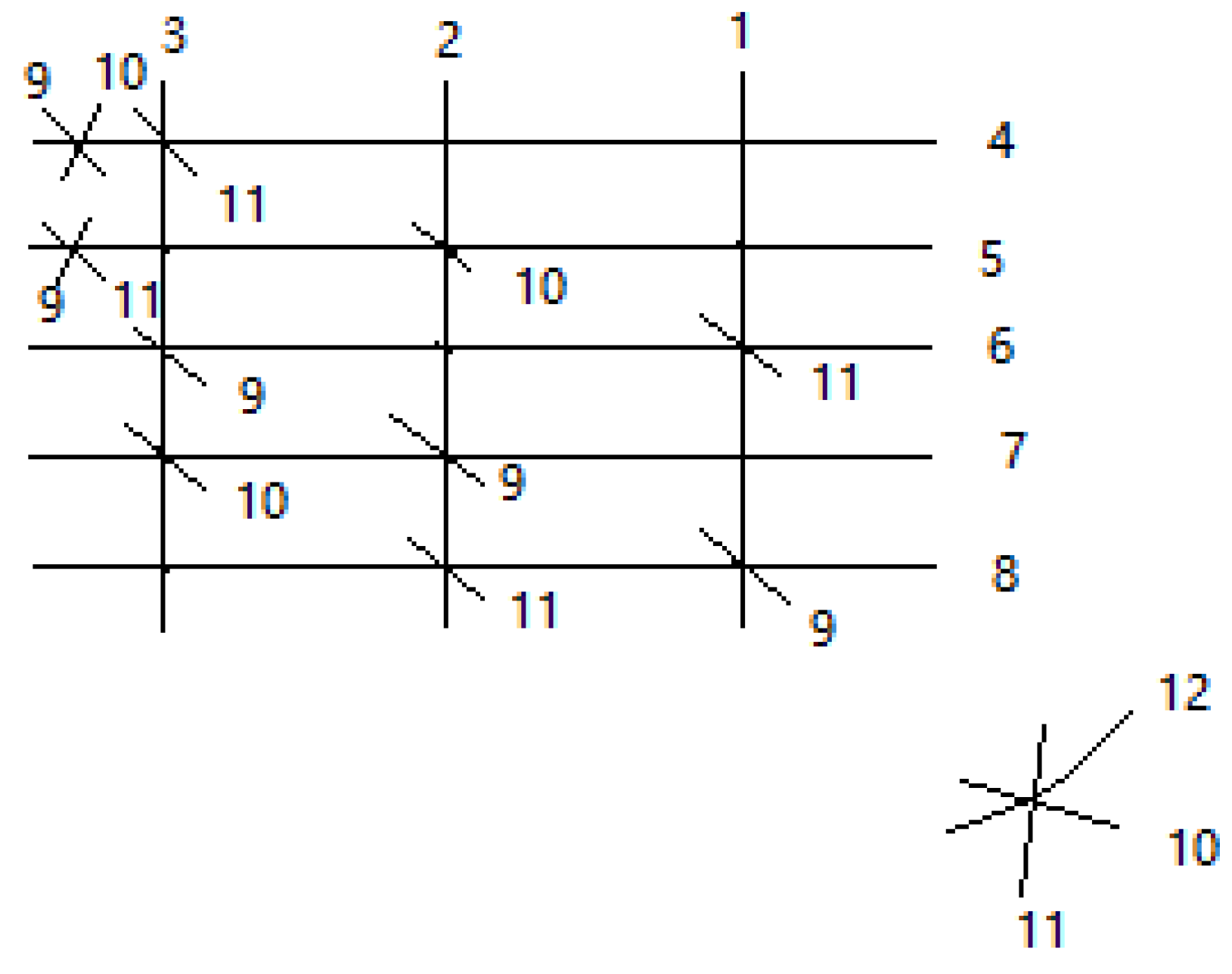
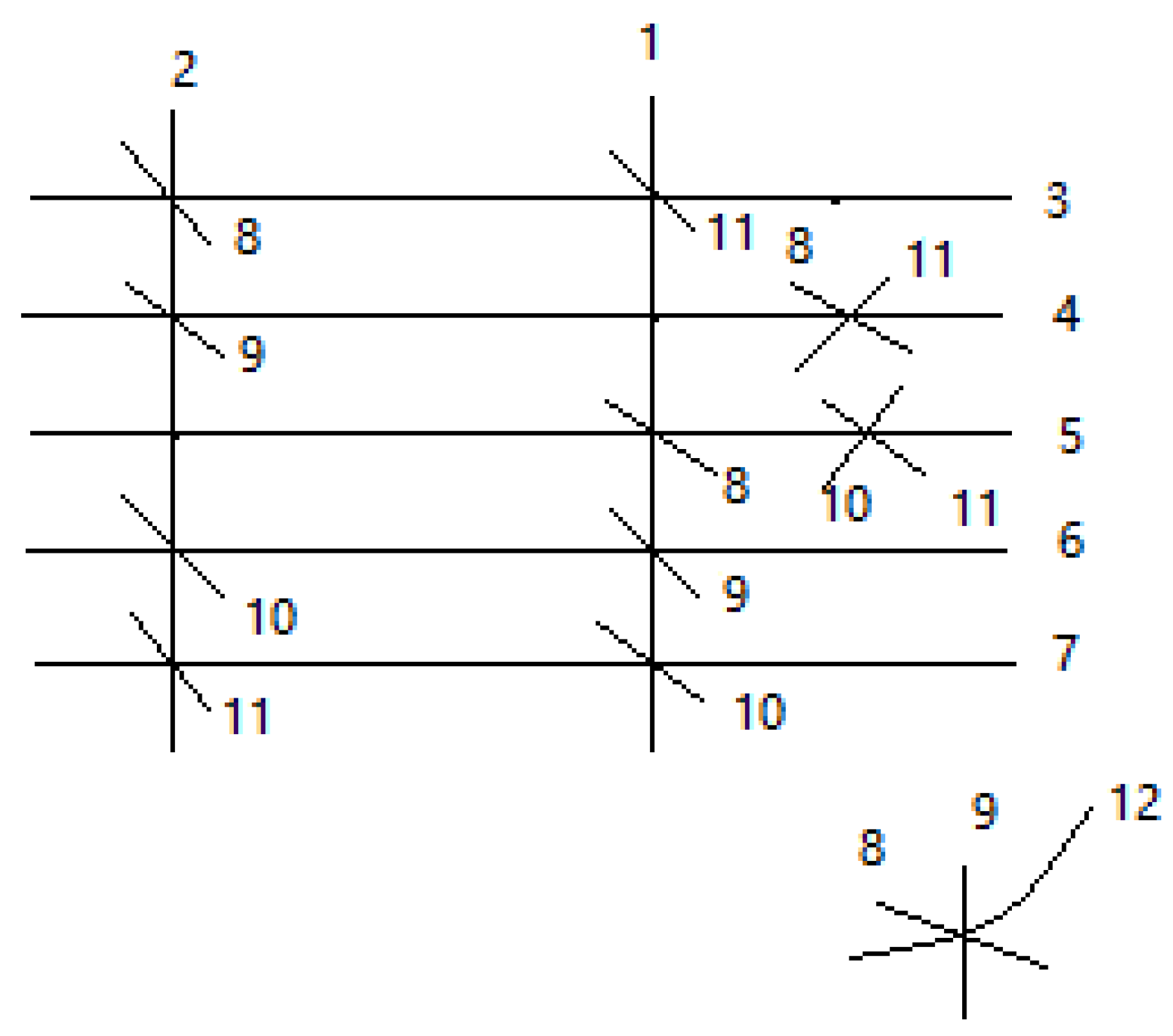
When the sextic and quadruple points are collinear (Figure 1), after computation we obtain the equation
X Y Z ( X Z ) ( Y Z ) ( Y t 1 Z ) ( X t 2 Z ) ( X t 3 Z ) ( X t 4 Z ) × [ X + ( t 3 t 4 ) Y t 3 Z ] [ X + ( t 4 t 2 ) Y t 4 Z ] [ X + ( 1 t 3 ) Y Z ] = 0 ,
where t 1 = t 1 1 t t 2 , t 2 = t 2 , t 3 = t , t 4 = 1 t and t satisfies t 3 + t 2 + t 1 = 0 . The moduli space M A consists of three points—a potential Zariski pair.

5. Arrangements with a Sextic Point and No Quadruple Point

First we bound the number of triple points.
Theorem 8.  
Let A be a non-reductive arrangement of 12 lines with one sextic point and such that all triple points lie on the six lines through the sextic point. Then 12 n 3 14 .
Proof. 
From Lemma 1 and Theorem 3,
n 2 + 3 n 3 + 6 n 4 + 10 n 5 + 15 n 6 = 66 , n 2 + 3 4 n 3 11 + n 5 + 3 n 6 .
Eliminating n 2 gives n 3 16 . Let L 1 L 6 be the sextic point. The remaining six lines each contain at least three triple points. Let a , b , c , d be the numbers among { L 7 , , L 12 } passing through 3 , 4 , 5 , 6 triple points respectively. If d 0 , one line would have six triple points, but it can intersect the other five lines in at most five points, so d = 0 .
If n 3 = 16 , the system
a + b + c + d = 6 , 3 a + 4 b + 5 c + 6 d = 32
has four solutions, all impossible by a similar counting argument. If n 3 = 15 , the system
a + b + c + d = 6 , 3 a + 4 b + 5 c + 6 d = 30
has six solutions, which is again impossible. Hence n 3 14 . Each of L 1 , , L 6 contains at least two triple points, so n 3 12 . □
Example 2.  
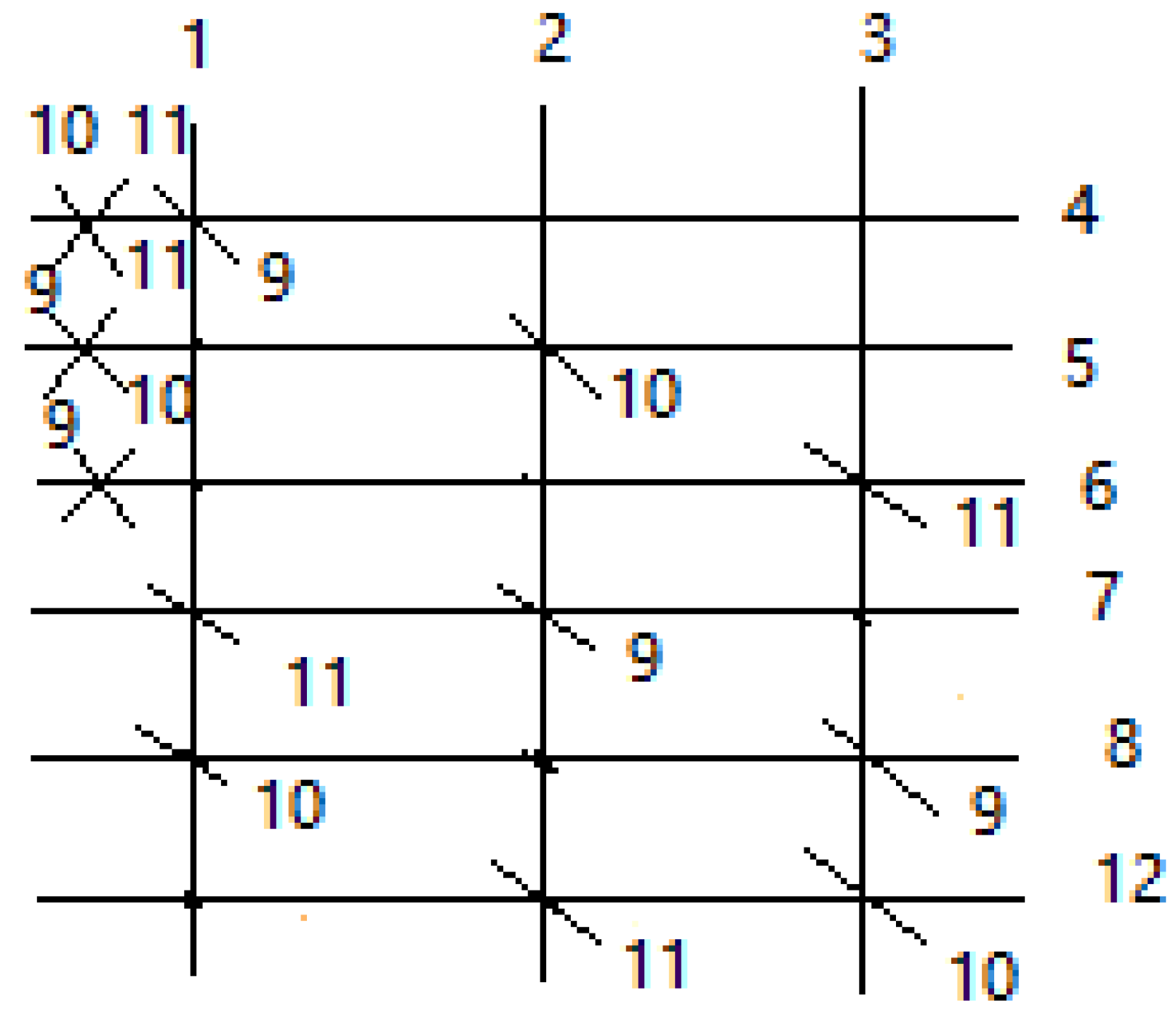
An arrangement with exactly 13 triple points, where L 1 L 2 L 3 is an extra triple point (Figure 2). Its equation is
X Y ( Y Z ) ( Y t 1 Z ) ( X Z ) ( X t 2 Z ) ( X t 3 Z ) ( X t 4 Z ) ( X t 5 Z ) × [ X + t 3 Y t 3 Z ] [ X + ( 1 t 4 ) Y Z ] [ X + ( t 5 t 3 ) Y t 5 Z ] = 0 ,
with t 1 = 1 1 2 t t 2 , t 2 = t t 2 + 1 2 t , t 3 = t , t 4 = 1 2 t , t 5 = 2 t t 2 and t 3 4 t 2 + 3 t + 1 = 0 . M A consists of three points—a potential Zariski pair.
Lemma 3.  
Let A = { L 1 , , L n } and suppose L n passes through at least two multiple points. Set A = { L 1 , , L n 1 } . Then M A (resp. M A c ) is either a point or empty whenever M A (resp. M A c ) is a point.
Proof. 
If M A contained two distinct points A , A ˜ , then after applying an element of P G L C ( 2 ) , we would have two distinct arrangements with the same A . Since L n is uniquely determined by the two multiple points it passes through, this would force A = A ˜ , a contradiction. □
Theorem 9.  
Let A be non-reductive with one sextic point and 14 triple points, all on the six lines through the sextic point. Then M A c is irreducible (in fact a single point).
Proof. 
Let L 1 L 6 be the sextic point. Exactly two of L 1 , , L 6 contain three triple points; the rest contain two. Let a , b , c be the numbers of lines among { L 7 , , L 12 } passing through 3 , 4 , 5 triple points respectively. Then
a + b + c = 6 , 3 a + 4 b + 5 c = 28 ,
so ( a , b , c ) = ( 1 , 0 , 5 ) or ( 0 , 2 , 4 ) . By symmetry we may assume that L 6 contains only two triple points and remove it. Then A = A { L 6 } is an 11-line arrangement with one quintuple point and 12 triple points, all in the pencil of the quintuple point. By [12] (Theorem 6.6), M A c is a single point. Lemma 3 then forces M A c to be a point (hence irreducible). □
Corollary 1.  
If A is non-reductive with n 6 = 1 , n 4 = 0 , and all triple points lie on the six lines through the sextic point, then n 3 > 13 implies that A cannot be part of a Zariski pair.
When n 3 13 , many configurations exist with M A having more than one point. We present three examples.
Example 3.  
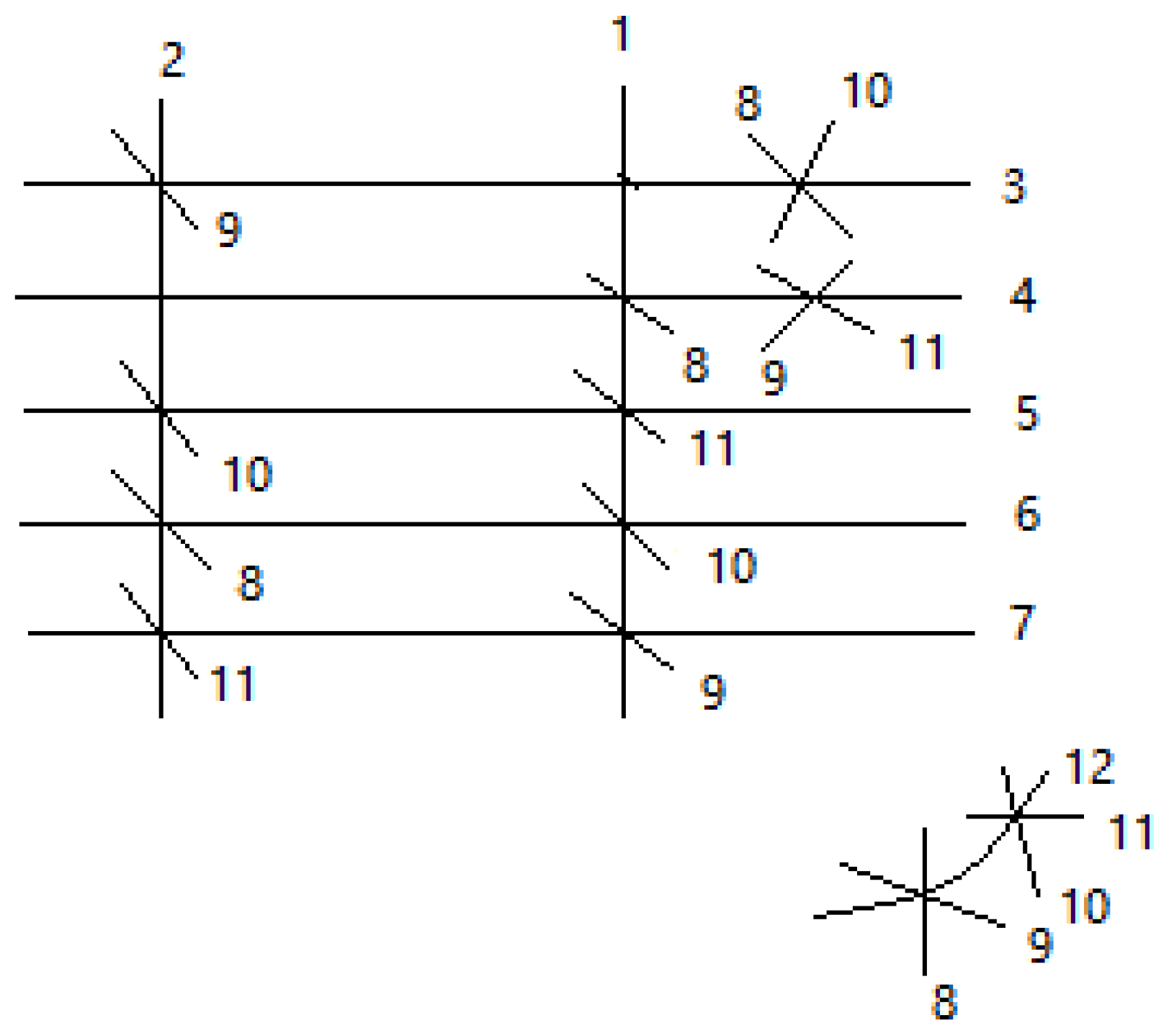
Thirteen triple points, all on the six lines (Figure 3). Equation:
X Y Z ( X Z ) ( Y Z ) ( X t 1 Z ) ( X t 2 Z ) ( X t 3 Z ) × [ X + ( t 2 1 ) Y t 2 Z ] [ X + ( t 2 t 1 ) Y t 2 Z ] ( X t 3 Y ) [ X + ( t 1 t 2 ) Y t 1 Z ] = 0 ,
with t 1 = 1 2 , t 2 = ± 1 2 , t 3 = 1 1 2 . M A consists of two points.
Example 4.  
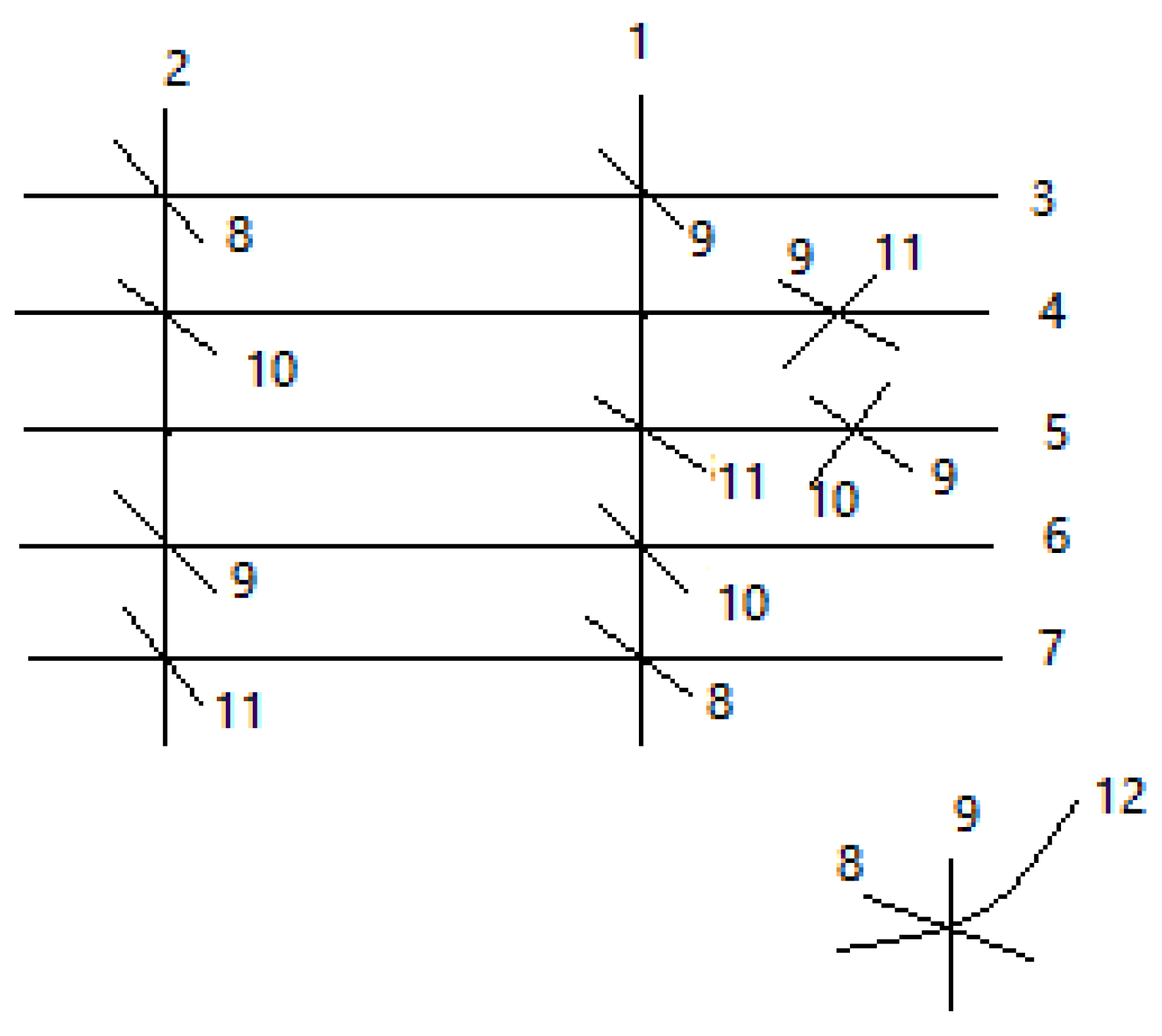
Twelve triple points, all on the six lines (Figure 4). Equation:
X Y Z ( X Z ) ( Y Z ) ( X t 1 Z ) ( X t 2 Z ) ( X t 3 Z ) ( X + t 2 Y t 2 Z ) × [ X + ( 1 t 2 ) Y Z ] ( X t 3 Y ) [ X + ( t 3 t 1 ) Y t 3 Z ] = 0 ,
with t 1 = t 2 4 t , t 2 = t , t 3 = t and t 2 5 t + 2 = 0 . M A consists of two points.
Example 5.  
Twelve triple points, all on the six lines (Figure 5). Equation:
X Y Z ( X Z ) ( Y Z ) ( X t 1 Z ) ( X t 2 Z ) ( X t 3 Z ) × [ X + ( 1 t 2 ) Y Z ] [ X + ( t 2 t 3 ) Y t 2 Z ] ( X t 1 Y ) [ X + t 3 Y t 3 Z ] = 0 ,
with t 1 = t 1 , t 2 = t , t 3 = t 1 t 2 and t 3 3 t 2 + 2 t 2 = 0 . M A consists of three points.

6. Conclusions

We have classified the moduli spaces of arrangements of 12 projective lines in CP 2 that contain a sextic point. The main results are:
  • For non-reductive arrangements with a sextic point and no points of multiplicity 7 , necessarily n 6 = 1 , n 5 = 0 and n 4 1 (Theorem 6).
  • When a sextic and a quadruple point coexist and are not collinear, the moduli space is empty (Theorem 7); when they are collinear, we constructed examples whose moduli spaces consist of three points, providing potential Zariski pairs (Example 1).
  • For arrangements with a sextic point and no quadruple point, 12 n 3 14 . For n 3 = 14 the quotient moduli space M A c is irreducible (a single point, Theorem 9). For n 3 = 12 or 13 we constructed examples where M A consists of two or three points (Examples 3–5), again yielding potential Zariski pairs.
These examples show that moduli spaces of 12-line arrangements with a sextic point can have multiple connected components, and the number of components depends on the combinatorial configuration.

Broader Connections

The configurations studied here are closely related to moduli spaces of sextic curves on K 3 surfaces. Recent work by Yu et al. [18] shows that moduli of sextic curves with ADE singularities correspond to period points in the moduli space of K 3 surfaces. Similarly, line arrangements appear in the study of moduli spaces of del Pezzo surfaces, where they are used to construct compactifications via K-stability [20]. Moreover, Guerville-Ballé [21] recently constructed arrangements of eleven lines whose moduli spaces consist of four connected components using the splitting polygon structure, complementing our results for twelve lines. The relation between line arrangements and Zariski pairs continues to be explored, as demonstrated by Bannai et al. [17] in the context of conic-line arrangements. Our explicit equations provide concrete models for such geometric structures and may admit interpretations in the context of decorated moduli spaces in two-dimensional gravity or as configurations of D-branes in string compactifications.
A summary of the main configurations and their properties is given in Table 1.

Author Contributions

Methodology, M.A., S.-L.T. and M.T.; Investigation, E.L. and X.-H.W.; Resources, M.A. and M.T.; Writing—original draft, E.L. and X.-H.W.; Writing—review and editing, M.A., E.L., S.-L.T., M.T. and X.-H.W.; Supervision, M.A., S.-L.T. and M.T.; Project administration, M.A., S.-L.T. and M.T.; Funding acquisition, M.A. All authors have read and agreed to the published version of the manuscript.

Funding

This research was supported by the ISF-NSFC joint research program of the first and third authors (grant No. 2452/17) and the NSFC grant (No. 12331001).

Informed Consent Statement

Not applicable.

Data Availability Statement

No new data were created or analyzed in this study.

Conflicts of Interest

The authors declare no conflicts of interest.

References

  1. Jiang, T.; Yau, S.S.T. Intersection lattices and topological structures of complements of arrangements in CP 2 . Ann. Sc. Norm. Super. Pisa Cl. Sci. 1998, 26, 357–381. [Google Scholar]
  2. Jiang, T.; Yau, S.S.T. Diffeomorphic types of the complements of arrangements of hyperplanes. Compos. Math. 1994, 92, 133–155. [Google Scholar]
  3. Wang, S.; Yau, S.S.T. Rigidity of differentiable structure for new class of line arrangements. Comm. Anal. Geom. 2005, 13, 1057–1075. [Google Scholar] [CrossRef]
  4. Wang, S.; Yau, S.S.T. Diffeomorphic types of the complements of arrangements in CP 3 , I: Point arrangements. J. Math. Soc. Japan 2007, 59, 423–447. [Google Scholar] [CrossRef]
  5. Wang, S.; Yau, S.S.T. The diffeomorphic types of the complements of arrangements in CP 3 , II. Sci. China Ser. A 2008, 51, 785–802. [Google Scholar] [CrossRef]
  6. Yau, S.S.T. Diffeomorphic types of complements of nice point arrangements in CP 1 . Sci. China Ser. A 2009, 52, 2774–2791. [Google Scholar] [CrossRef]
  7. Rybnikov, G. On the fundamental group of the complement of a complex hyperplane arrangement. Funct. Anal. Appl. 2011, 45, 137–148. [Google Scholar] [CrossRef]
  8. Fan, K. Direct product of free groups as the fundamental group of the complement of a union of lines. Michigan. Math. J. 1997, 44, 283–291. [Google Scholar] [CrossRef]
  9. Garber, D.; Teicher, M.; Vishne, U. π1 classification of real arrangements with up to eight lines. Topology 2003, 42, 265–289. [Google Scholar] [CrossRef]
  10. Nazir, S.; Yoshinaga, M. On the connectivity of the realization spaces of line arrangements. Ann. Sc. Norm. Super. Pisa Cl. Sci. 2012, 11, 921–937. [Google Scholar] [CrossRef]
  11. Ye, F. Classification of moduli spaces of arrangements of 9 projective lines. Pacific. J. Math. 2013, 265, 243–256. [Google Scholar] [CrossRef]
  12. Amram, M.; Cheng, G.; Teicher, M.; Xu, W.-Y. Moduli spaces of arrangements of 11 projective lines with a quintuple point. Turk. J. Math. 2015, 39, 618–644. [Google Scholar] [CrossRef]
  13. Amram, M.; Cohen, M.; Teicher, M.; Ye, F. Moduli spaces of ten line arrangements with double and triple points. arXiv 2013, arXiv:1306.6105v1. [Google Scholar] [CrossRef]
  14. Amram, M.; Teicher, M.; Ye, F. Moduli spaces of arrangements of 10 projective lines with quadruple points. Adv. Appl. Math. 2013, 3, 392–418. [Google Scholar] [CrossRef]
  15. Randell, R. Lattice isotopic arrangements are topologically isomorphic. P. Am. Math. Soc. 1989, 107, 555–559. [Google Scholar] [CrossRef]
  16. Cohen, D.C.; Suciu, A.I. The braid monodromy of plane algebraic curves and hyperplane arrangements. Comment. Math. Helv. 1997, 72, 285–315. [Google Scholar] [CrossRef]
  17. Bannai, S.; Tokunaga, H.; Yorisaki, E. The realization spaces of certain conic line arrangements of degree 7. J. Math. Soc. Japan 2025, 1, 1–29. [Google Scholar] [CrossRef]
  18. Yu, J.; Mukai, S.; Yamashita, M. Moduli spaces of sextic curves with simple singularities and their compactifications. arXiv 2005, arXiv:2505.16727. [Google Scholar]
  19. Hirzebruch, F. Singularities of algebraic surfaces and characteristic numbers. Contemp. Math. 1986, 58, 141–155. [Google Scholar]
  20. Zhao, J. Compactifications of moduli of del Pezzo surfaces via line arrangement and K stability. Canad. J. Math. 2024, 76, 2115–2135. [Google Scholar] [CrossRef]
  21. Guerville Ballé, B. On the nonconnectedness of moduli spaces of arrangements: The splitting polygon structure. Kyoto J. Math. 2025, 65, 153–170. [Google Scholar] [CrossRef]
Figure 1. Configurationof Example 1.
Mathematics 14 01052 g001
Figure 2. Configuration of Example 2.
Mathematics 14 01052 g002
Figure 3. Configuration of Example 3.
Mathematics 14 01052 g003
Figure 4. Configuration of Example 4.
Mathematics 14 01052 g004
Figure 5. Configuration of Example 5.
Mathematics 14 01052 g005
Table 1. Summary of 12-line arrangements with a sextic point.
Configuration n 6 n 4 n 3 Moduli SpaceIrreducible?Potential Zariski Pair?
quadruple (collinear)113 pointsNoYes
13 triple points (Example 2)10133 pointsNoYes
13 triple points (Example 3)10132 pointsNoYes
12 triple points (Example 4)10122 pointsNoYes
12 triple points (Example 5)10123 pointsNoYes
14 triple points (Theorem 9)10141 point (quotient)Yes (quotient)No
Disclaimer/Publisher’s Note: The statements, opinions and data contained in all publications are solely those of the individual author(s) and contributor(s) and not of MDPI and/or the editor(s). MDPI and/or the editor(s) disclaim responsibility for any injury to people or property resulting from any ideas, methods, instructions or products referred to in the content.