Article

Higher-Order Fuzzy Difference Equations: Existence, Stability, and Illustrative Numerical Examples

1
Mathematics Department, Faculty of Sciences, Umm Al-Qura University, Makkah 21955, Saudi Arabia
2
Department of Mathematics, Abdelhafid Boussouf University of Mila, Mila 43000, Algeria
*
Author to whom correspondence should be addressed.
Mathematics 2026, 14(6), 1051; https://doi.org/10.3390/math14061051
Submission received: 20 January 2026 / Revised: 9 March 2026 / Accepted: 17 March 2026 / Published: 20 March 2026
(This article belongs to the Special Issue Nonlinear Dynamics, Chaos, and Mathematical Physics)

Abstract

This paper examines the dynamics of positive solutions to a system of fuzzy difference equations, which provide effective tools for modeling dynamical systems with uncertain or imprecise parameters. The main objective is to establish the existence, uniqueness, and qualitative properties of positive solutions within a fuzzy framework. After recalling some fundamental notions from fuzzy set theory, we analyze the dynamics of the proposed system. The main results prove the existence of a unique positive fuzzy solution under suitable conditions and establish the boundedness, continuity, and convergence of the solutions. In particular, all solutions converge to a unique positive equilibrium point. Numerical experiments for ( l 1 , l 2 ) = ( 2 , 3 ) and ( l 1 , l 2 ) = ( 4 , 1 ) with uncertainty levels γ = 0.2 and γ = 0.8 illustrate the theoretical results and confirm the convergence toward the unique positive equilibrium.

1. Introduction

Understanding the dynamics of complex systems is a core objective in many disciplines, including the natural sciences, engineering, economics, and the social sciences (see, e.g., [1,2,3,4,5,6,7]). In this context, difference equations and dynamical systems play a central role, providing a rigorous and versatile mathematical framework for analyzing the evolution of processes over discrete time steps (see, e.g., [8,9,10,11,12]). A substantial body of research has demonstrated the capacity of difference equations to capture intricate dynamical behaviors, underscoring their importance as powerful tools in both theoretical and applied analysis (see, e.g., [13,14,15,16,17,18,19,20,21,22]).
The techniques developed in this paper are motivated by the need to analyze nonlinear dynamical systems subject to significant uncertainty, particularly those arising in environmental and biological contexts. While fuzzy difference equations provide an effective framework for handling ambiguity in system parameters and initial values, conventional approaches are often restricted to linear or low-order models and may fail to capture complex inter-variable dynamics. Unlike classical dynamical systems, where parameters and state variables are assumed to be precisely known, fuzzy dynamical systems explicitly incorporate uncertainty by representing these quantities as fuzzy numbers. This framework allows fuzzy systems to account for imprecision, ambiguity, and incomplete information inherent in many real-world processes, providing a more flexible and realistic approach for analyzing complex systems. Nevertheless, many existing fuzzy difference equation models remain limited to low-order formulations, which may not adequately capture long-term memory effects and intricate interactions among variables.
This paper addresses these limitations by introducing a higher-order mathematical model that captures intricate interactions among system variables while establishing a rigorous analytical framework. A key advantage of the fuzzy difference equation approach is its capacity to incorporate both long-range dependencies and the inherent uncertainties of complex dynamical systems. Higher-order formulations naturally embed memory effects and multi-step feedback mechanisms, enabling the representation of delayed interactions, which are essential in many real-world processes. At the same time, the fuzzy structure provides enhanced flexibility in representing imprecise initial values and uncertain system parameters, which frequently arise in biological, environmental, and ecological contexts. As a result, the integration of higher-order dynamics with fuzzy modeling provides a more comprehensive and realistic framework for analyzing complex systems under uncertainty. Our approach guarantees the existence and uniqueness of solutions and delivers a rigorous stability analysis. The adoption of the γ -cut representation is motivated by two primary advantages: it enables a mathematically rigorous treatment of fuzzy systems while maintaining computational tractability for numerical implementation.
In this context, numerical simulations play an important role in studying nonlinear dynamical systems, particularly when addressing real-world phenomena influenced by climate and environmental changes. Unlike purely analytical methods, simulations allow researchers to explore transient behaviors, parameter sensitivities, and long-term scenarios that may be difficult to analyze theoretically due to nonlinearity, delays, and uncertainties. For example, Hakim et al. [23] showed that numerical simulations of nonlinear models can help predict desertification risks associated with global warming and dust pollution, identifying thresholds beyond which ecosystems may shift from sustainability to degradation. Such simulation-based analyses provide useful insights into the interaction between environmental stressors and system resilience, complementing theoretical stability results. Motivated by these considerations, the present study combines rigorous theoretical analysis with supporting numerical simulations to illustrate how uncertainty and higher- order interactions influence system dynamics within the fuzzy framework.
Motivated by the extensive body of existing literature and the promising capabilities of fuzzy difference equations, this paper examines the dynamics of positive solutions for a particular system within this framework:
i 0 ,   M i + 1 = e 1 + e 2 N i l 1 + e 3 N i l 2 , N i + 1 = η 1 + η 2 M i l 1 + η 3 M i l 2 ,
where the sequences ( M i ) and ( N i ) consist of positive fuzzy numbers, while e j , and η j ,   j = 1 , 2 , 3 are likewise taken to be positive fuzzy numbers. The initial values are given by M j and N j , for j = 0 , , l = l 1 l 2 . This study aims to rigorously investigate the existence, boundedness, and asymptotic behavior of these solutions, thereby making a further contribution to the expanding body of knowledge in this field.
This paper addresses a significant gap in the study of uncertain dynamical systems by introducing a novel higher-order fuzzy difference equation model, representing a substantial advancement over conventional low-order formulations. By employing the γ -cut representation, we develop a rigorous analytical framework through which fundamental theoretical results—namely existence, uniqueness, boundedness, and asymptotic stability of positive solutions—are established. The accompanying numerical simulations validate the analytical findings and demonstrate the model’s capability to capture complex dynamical behaviors under varying uncertainty cuts and delay configurations. In particular, the simulations illustrate how uncertainty propagation, transient modulation, and convergence patterns can be systematically quantified within the proposed framework. Overall, the integration of higher-order dynamics with fuzzy modeling provides a mathematically robust and computationally tractable approach for analyzing nonlinear systems subject to uncertainty.
The remainder of this paper is structured as follows. Section 2 reviews essential preliminaries from fuzzy set theory and introduces the fundamental concepts related to fuzzy numbers and their γ -cut representations. Section 3 presents the formulation of a higher-order fuzzy difference equations system and investigates the fundamental properties of its solutions, including existence and uniqueness. Section 4 provides a comprehensive qualitative analysis of the system, examining the boundedness, continuity, and asymptotic stability of positive fuzzy solutions under suitable conditions. Section 5 presents numerical simulations employing the γ -cut approach for various delay coefficients and uncertainty cuts, illustrating and validating the theoretical results. Finally, Section 6 summarizes the main conclusions and outlines potential directions for future research.

State of the Art

In recent years, fuzzy set theory has attracted considerable attention from mathematicians and researchers. Originally introduced by Lotfi A. Zadeh [24], fuzzy set theory was later developed and extended by researchers such as Bhattacharya and Pal [25,26] and Diamond and Kloeden [27], the theory has found widespread applications across diverse mathematical disciplines, fundamentally reshaping the modeling and management of uncertainty. A notable application emerges in the context of difference equations, giving rise to fuzzy difference equations. By incorporating fuzzy initial values and fuzzy-valued solutions, these equations provide an effective and flexible framework for modeling and analyzing dynamical systems under uncertainty.
Integrating fuzzy set theory with difference equations is particularly appealing, as both approaches offer complementary capabilities for modeling uncertainty. A fuzzy difference equation is one in which the initial values are represented by fuzzy numbers, while the resulting solution forms a sequence of such numbers. Numerous studies have investigated the applications and implications of these equations across diverse domains. For example, Buckley [28], Umekken et al. [29], and collaborators examined the benefits of this framework in financial modeling, demonstrating its advantages over classical methods. Similarly, Deeba and Korvin [30], along with Deeba et al. [31], applied these equations to population genetics and cardiovascular system modeling, highlighting their flexibility and effectiveness in representing complex biological processes.
Recent developments in the theory of fuzzy difference equations have increasingly emphasized complex nonlinear models. Zhang et al. [32] studied a second- order fuzzy difference equation with quadratic terms, establishing rigorous conditions for boundedness, persistence, and convergence via generalized fuzzy division. In a related study, Zhang et al. [33] analyzed an exponential-type second-order fuzzy model, demonstrating the existence and global asymptotic behavior of its positive solutions. More recently, Gümüş et al. [34] extended the analysis of higher-order fuzzy difference equations, investigating the qualitative dynamics of positive solutions with nonlinearities and delayed feedback. More recently, Almoteri [35] investigated a two-dimensional nonlinear fuzzy difference system with logarithmic interactions between variables, establishing rigorous results concerning the existence, uniqueness, and boundedness of positive solutions through a characterization-based analytical framework. In a related contribution, Balegh [36] analyzed the qualitative dynamics of a system of fuzzy difference equations involving higher-order nonlinear power terms, focusing on the existence, boundedness, and long-term behavior of positive solutions under fuzzy initial conditions. Foundational contributions by Khastan and Alijani [37] on rational fuzzy systems, together with subsequent developments by Yalçınkaya et al. [38], the work in [39], and earlier research by Hatir et al. [40], have substantially advanced the understanding of fuzzy system dynamics under uncertainty. These studies have been particularly influential in analyzing global stability and long-term behavior.
In addition to the classical formulations of fuzzy difference equations, increasing attention has been devoted to distributed fuzzy systems, in which system dynamics and uncertainties are represented through interconnected fuzzy components or rule-based structures distributed across multiple subsystems. Such frameworks are particularly well-suited for modeling large-scale multivariable systems where complex interactions among components must be taken into account. For example, Gegov and Frank [41] investigated the decomposition of multivariable systems for the design of distributed fuzzy control schemes, reducing the strength of interactions among subsystems. Similarly, Sun et al. [42] developed parallel distributed fuzzy controllers for time-delay Takagi– Sugeno systems and established stability conditions based on Lyapunov theory and linear matrix inequalities. More recently, Ling et al. [43] studied distributed consensus control for discrete-time T–S fuzzy multi-agent systems, highlighting the effectiveness of distributed fuzzy strategies in coordinating the behavior of interconnected agents under uncertainty. Although the present study focuses on a coupled system of higher-order fuzzy difference equations, the analytical framework developed here may also provide useful insights into the qualitative behavior of distributed fuzzy dynamical structures.
While these contributions have significantly enriched the literature, many existing models remain structurally constrained, typically focusing on single scalar equations or low-order dynamics. In contrast, the present study introduces a fully coupled system of higher-order fuzzy difference equations, where mutual interactions among variables play a central role in the system’s dynamics. This framework not only generalizes previously studied structures but also allows a more comprehensive analysis of nonlinear behavior by incorporating dual feedback mechanisms and extended memory effects. By integrating rigorous theoretical analysis with extensive numerical simulations, the proposed model offers novel insights into the asymptotic stability and long-term persistence of fuzzy dynamical systems under complex uncertainties.

2. Foundational Principles and Terminology

This section provides an overview of the key concepts and definitions that will be utilized in the subsequent sections. These foundational notions are well-established in the literature (see, e.g., [27,44,45,46,47]).
Lemma 1
([44]). A fuzzy subset W : R [ 0 , 1 ] is called a fuzzy number if it satisfies the following properties:
(i) 
W is normal, i.e., there exists a point z 0 R such that W ( z 0 ) = 1 .
(ii) 
W is fuzzily convex, meaning that
W ( x z + ( 1 x ) y ) min { W ( z ) , W ( y ) } ,
for all x [ 0 ; 1 ] and z , y R .
(iii) 
W is upper semi-continuity on R .
(iv) 
W has compact support, i.e., the closure of the set z R : W ( z ) > 0 ¯ is a compact subset of R .
  • Let R F denote the space of all fuzzy numbers. For γ 0 , 1 and W R F , we denote γ -cut of the fuzzy number W by
W γ = y R , W ( y ) γ and W 0 = y R , W ( y ) 0 ¯ .
We call W 0 the support of the fuzzy number W, denoted by S u p p ( W ) . A fuzzy number W is said to be positive if S u p p ( W ) 0 , . We denote by R F + the space of all positive fuzzy numbers. When W is a positive real number, it is regarded as a trivial fuzzy number, since its γ -cut reduces to a single interval of the form, W γ = W , W , γ 0 , 1 . Let U , W be fuzzy numbers, U γ = U k 1 , γ , U k 2 , γ , W γ = W k 1 , γ , W k 2 , γ , γ 0 , 1 , and s > 0 . The operations of addition, scalar multiplication, and inversion are defined as follows:
  • U + W γ = U k 1 , γ + W k 1 , γ , U k 2 , γ + W k 2 , γ ,
  • s W γ = s W k 1 , γ , s W k 2 , γ .
  • The inverse of the γ -cut associated with a fuzzy number W is expressed as W γ 1 = 1 W k 2 , γ , 1 W k 1 , γ .
  • A real-valued fuzzy sequence is denoted by ( M i , i N ) .
Definition 1
([27]). Let U , W R F . The metric d ( U , W ) is defined as
d ( U , W ) = sup γ 0 ; 1 U k 1 , γ W k 1 , γ U k 2 , γ W k 2 , γ .
With this metric, ( R F , d ) forms a complete metric space.
Lemma 2
(Properties of Fuzzy Mapping, [44]). Let W be a fuzzy mapping. For each γ ( 0 , 1 ] , denote its γ-cut by W γ   = W k 1 , γ , W k 2 , γ , where W k 1 , γ and W k 2 , γ satisfy the following conditions:
  • W k 1 , γ is monotone non-decreasing and left-continuous, whereas W k 2 , γ is monotone non-increasing and right-continuous.
  • For all admissible arguments, W k 1 , γ does not exceed W k 2 , γ .
Lemma 3
([27]). Let ( M k ) be a sequence of positive fuzzy numbers. The sequence is said to converge to a fuzzy number M if and only if the distance d ( M k , M ) approaches zero as k . This convergence is denoted by M k k M .
By [45], we have the following lemma:
Lemma 4.
Let U , W R F and let U γ = U k 1 , γ , U k 2 , γ and W γ = W k 1 , γ , W k 2 , γ for all γ 0 ; 1 . Also, let Y R F with γ-cuts Y γ = Y k 1 , γ , Y k 2 , γ for all γ 0 ; 1 . Then m i n U , W = Y (respectively, M a x U , W = Y ) iff U k 1 , γ W k 1 , γ = Y k 1 , γ and U k 2 , γ W k 2 , γ = Y k 2 , γ (respectively, U k 1 , γ W k 1 , γ = Y k 1 , γ and U k 2 , γ W k 2 , γ = Y k 2 , γ ) .
Lemma 5
([48]). A sequence M i of positive fuzzy numbers is said to be eventually bounded and persistent if there exist U , W R F + and an integer i 0 N such that, M i U = U and M i W = W for i i 0 .
Lemma 6
(Continuity of Fuzzy Functions, [49]). Let h be a positive-valued function defined on R + l , which is continuous with respect to each argument. For any collection of fuzzy numbers W 1 , W 2 , , W l R F , we have, for all γ 0 ; 1 ,
h W 1 , W 2 , , W l γ = h W 1 γ , W 2 γ , , W l γ .
In the remainder of this section, we recall some basic results from the theory of difference equations that will be used in the subsequent analysis.
Lemma 7
([50]). Let I i ,   i = 1 , 2 , 3 , 4 , be real intervals, and let h i : I 1 l + 1 × I 2 l + 1 × I 3 l + 1 × I 4 l + 1 I i , i = 1 , 2 , 3 , 4 , be continuously differentiable functions. For any set of initial values M j 1 , M j 2 , N j 1 , N j 2 I 1 l + 1 × I 2 l + 1 × I 3 l + 1 × I 4 l + 1 ,   j = 0 , , l , the following system of difference equations
M i + 1 1 = h 1 M i 1 , , M i l 1 , M i 2 , , M i l 2 , N i 1 , , N i l 1 , N i 2 , , N i l 2 , M i + 1 2 = h 2 M i 1 , , M i l 1 , M i 2 , , M i l 2 , N i 1 , , N i l 1 , N i 2 , , N i l 2 , N i + 1 1 = h 3 M i 1 , , M i l 1 , M i 2 , , M i l 2 , N i 1 , , N i l 1 , N i 2 , , N i l 2 , N i + 1 2 = h 4 M i 1 , , M i l 1 , M i 2 , , M i l 2 , N i 1 , , N i l 1 , N i 2 , , N i l 2 ,
i = 0 , 1 , 2 , , admits a unique solution M j 1 , M j 2 , N j 1 , N j 2 , j l .
Lemma 8
([50]). A point M ¯ 1 , M ¯ 2 , N ¯ 1 , N ¯ 2 I 1 × I 2 × I 3 × I 4 is called an equilibrium point of system (2), if
M ¯ 1 = h 1 M ¯ 1 , , M ¯ 1 , M ¯ 2 , , M ¯ 2 , N ¯ 1 , , N ¯ 1 , N ¯ 2 , , N ¯ 2 , M ¯ 2 = h 2 M ¯ 1 , , M ¯ 1 , M ¯ 2 , , M ¯ 2 , N ¯ 1 , , N ¯ 1 , N ¯ 2 , , N ¯ 2 , N ¯ 1 = h 3 M ¯ 1 , , M ¯ 1 , M ¯ 2 , , M ¯ 2 , N ¯ 1 , , N ¯ 1 , N ¯ 2 , , N ¯ 2 , N ¯ 2 = h 4 M ¯ 1 , , M ¯ 1 , M ¯ 2 , , M ¯ 2 , N ¯ 1 , , N ¯ 1 , N ¯ 2 , , N ¯ 2 .
That is, M j 1 , M j 2 , N j 1 , N j 2 = M ¯ 1 , M ¯ 2 , N ¯ 1 , N ¯ 2 , for j 0 , is a solution of system (2). Equivalently, M ¯ 1 , M ¯ 2 , N ¯ 1 , N ¯ 2 is a fixed point of the vector mapping ( h 1 , h 2 , h 3 , h 4 ) .

3. System Dynamics of Fuzzy Difference Equation (1)

In this section, we analyze the dynamical behavior of the positive solutions to the fuzzy difference equation system (1). It is important to emphasize that not every fuzzy set qualifies as a fuzzy number; therefore, not every difference equation can be regarded as a fuzzy difference equation. This distinction introduces additional technical difficulties in establishing the existence and uniqueness of solutions. Our primary objective is to rigorously establish the existence and uniqueness of a positive solution to (1). A sequence of positive fuzzy numbers is said to constitute a solution of system (1) if and only if it satisfies the system together with the prescribed initial values.
Theorem 1.
Consider the difference equation system (1), where the parameters e j and η j , for j = 1 , 2 , 3 , are positive fuzzy numbers. For any collection of positive fuzzy initial values M j , N j , j = 0 , , l , system (1) admits a unique positive fuzzy solution M i , N i i 1 .
Proof. 
Assume that the initial fuzzy numbers M j , N j 0 are prescribed for j = 0 , , l . Define the sequences M i i 1 and N i i 1 recursively by system (1). We shall prove that this recursive scheme generates a well-defined fuzzy solution that exists uniquely. For this purpose, we investigate the corresponding γ -cuts for γ ( 0 , 1 ] , as detailed below:
i 0 , M i γ = M i , γ 1 , M i , γ 2 , N i γ = N i , γ 1 , N i , γ 2 ,
e j γ = e k 1 , γ j , e k 2 , γ j and η j γ = η k 1 , γ j , η k 2 , γ j , j = 1 , 2 , 3 .
Representing all fuzzy quantities in terms of their γ -cuts enables the derivation of the associated interval recurrence relations. Combining (3) and system (1) with Lemma 6, we obtain, for all i 0 ,
M i + 1 γ = M i + 1 , γ 1 , M i + 1 , γ 2 = e 1 + e 2 N i l 1 + e 3 N i l 2 γ = e 1 γ + e 2 γ N i l 1 γ + e 3 γ N i l 2 γ = e k 1 , γ 1 , e k 2 , γ 1 + e k 1 , γ 2 , e k 2 , γ 2 N i l 1 , γ 1 , N i l 1 , γ 2 + e k 1 , γ 3 , e k 2 , γ 3 N i l 2 , γ 1 , N i l 2 , γ 2 = e k 1 , γ 1 + e k 1 , γ 2 N i l 1 , γ 2 + e k 1 , γ 3 N i l 2 , γ 2 , e k 2 , γ 1 + e k 2 , γ 2 N i l 1 , γ 1 + e k 2 , γ 3 N i l 2 , γ 1 ,
N i + 1 γ = N i + 1 , γ 1 , N i + 1 , γ 2 = η 1 + η 2 M i l 1 + η 3 M i l 2 γ = η 1 γ + η 2 γ M i l 1 γ + η 3 γ M i l 2 γ = η k 1 , γ 1 , η k 2 , γ 1 + η k 1 , γ 2 , η k 2 , γ 2 M i l 1 , γ 1 , M i l 1 , γ 2 + η k 1 , γ 3 , η k 2 , γ 3 M i l 2 , γ 1 , M i l 2 , γ 2 = η k 1 , γ 1 + η k 1 , γ 2 M i l 1 , γ 2 + η k 1 , γ 3 M i l 2 , γ 2 , η k 2 , γ 1 + η k 2 , γ 2 M i l 1 , γ 1 + η k 2 , γ 3 M i l 2 , γ 1 .
Hence, we derive:
i 0 , M i + 1 , γ 1 = e k 1 , γ 1 + e k 1 , γ 2 N i l 1 , γ 2 + e k 1 , γ 3 N i l 2 , γ 2 , M i + 1 , γ 2 = e k 2 , γ 1 + e k 2 , γ 2 N i l 1 , γ 1 + e k 2 , γ 3 N i l 2 , γ 1 ,
i 0 , N i + 1 , γ 1 = η k 1 , γ 1 + η k 1 , γ 2 M i l 1 , γ 2 + η k 1 , γ 3 M i l 2 , γ 2 , N i + 1 , γ 2 = η k 2 , γ 1 + η k 2 , γ 2 M i l 1 , γ 1 + η k 2 , γ 3 M i l 2 , γ 1 ,
for all γ 0 ; 1 . Hence, (4) and (5) admit a unique positive solution M i , γ 1 , M i , γ 2 , N i , γ 1 , N i , γ 2 . This solution is uniquely determined by the initial values M j , γ 1 , M j , γ 2 , N j , γ 1 , N j , γ 2 for j = 0 , , l , and for every γ 0 ; 1 .
Subsequently, we demonstrate that M i , γ 1 , M i , γ 2 , N i , γ 1 , N i , γ 2 for all γ 0 ; 1 , where M i , γ 1 , M i , γ 2 , N i , γ 1 , N i , γ 2 denotes a solution of (4) and (5) with the initial values M j , γ 1 , M j , γ 2 , N j , γ 1 , N j , γ 2 for j = 0 , , l , determines the solution M i and N i of system (1) corresponding to the given initial fuzzy conditions M j and N j , for j = 0 , , l . To be precise, we obtain:
M i γ = M i , γ 1 , M i , γ 2 and N i γ = N i , γ 1 , N i , γ 2 ,
for γ 0 ; 1 and i l .
Conversely, assume that the initial values M j and N j , for j = 0 , , l , are positive fuzzy numbers and that they generate the corresponding solution sequences M i γ = M i , γ 1 , M i , γ 2 and N i γ = N i , γ 1 , N i , γ 2 for the system (1), with γ 0 ; 1 . Let e j and η j , j = 1 , 2 , 3 , be positive fuzzy numbers. For γ 1 < γ 2 , and in accordance with Lemma 2, we obtain:
0 < e k 1 , γ 1 j e k 1 , γ 2 j e k 2 , γ 2 j e k 2 , γ 1 j , 0 < η k 1 , γ 1 j η k 1 , γ 2 j η k 2 , γ 2 j η k 2 , γ 1 j , j = 1 , 2 , 3 , 0 < M v , γ 1 1 M v , γ 2 1 M v , γ 2 2 M v , γ 1 2 , 0 < N v , γ 1 1 N v , γ 2 1 N v , γ 2 2 N v , γ 1 2 , v = 0 , , l .
We now demonstrate, using mathematical induction, that
0 < M i , γ 1 1 M i , γ 2 1 M i , γ 2 2 M i , γ 1 2 , 0 < N i , γ 1 1 N i , γ 2 1 N i , γ 2 2 N i , γ 1 2 , i 0 .
From relation (6), it follows that condition (7) holds for all indices i = l , , 0 . Assume now that this condition holds for every i m , where m 1 , 2 , . Then, by applying systems (4) and (5) along with the bounds in (6) and the induction hypothesis for i m , we obtain:
M m + 1 , γ 1 1 = e k 1 , γ 1 1 + e k 1 , γ 1 2 N m l 1 , γ 1 2 + e k 1 , γ 1 3 N m l 2 , γ 1 2 e k 1 , γ 2 1 + e k 1 , γ 2 2 N m l 1 , γ 2 2 + e k 1 , γ 2 3 N m l 2 , γ 2 2 = M m + 1 , γ 2 1 , M m + 1 , γ 2 1 = e k 1 , γ 2 1 + e k 1 , γ 2 2 N m l 1 , γ 2 2 + e k 1 , γ 2 3 N m l 2 , γ 2 2 e k 2 , γ 2 1 + e k 2 , γ 2 2 N m l 1 , γ 2 1 + e k 2 , γ 2 3 N m l 2 , γ 2 1 = M m + 1 , γ 2 2 , M m + 1 , γ 2 2 = e k 2 , γ 2 1 + e k 2 , γ 2 2 N m l 1 , γ 2 1 + e k 2 , γ 2 3 N m l 2 , γ 2 1 e k 2 , γ 1 1 + e k 2 , γ 1 2 N m l 1 , γ 1 1 + e k 2 , γ 1 3 N m l 2 , γ 1 1 = M m + 1 , γ 1 2 ,
N m + 1 , γ 1 1 = η k 1 , γ 1 1 + η k 1 , γ 1 2 M m l 1 , γ 1 2 + η k 1 , γ 1 3 M m l 2 , γ 1 2 η k 1 , γ 2 1 + η k 1 , γ 2 2 M m l 1 , γ 2 2 + η k 1 , γ 2 3 M m l 2 , γ 2 2 = N m + 1 , γ 2 1 , N m + 1 , γ 2 1 = η k 1 , γ 2 1 + η k 1 , γ 2 2 M m l 1 , γ 2 2 + η k 1 , γ 2 3 M m l 2 , γ 2 2 η k 2 , γ 2 1 + η k 2 , γ 2 2 M m l 1 , γ 2 1 + η k 2 , γ 2 3 M m l 2 , γ 2 1 = N m + 1 , γ 2 2 , N m + 1 , γ 2 2 = η k 2 , γ 2 1 + η k 2 , γ 2 2 M m l 1 , γ 2 1 + η k 2 , γ 2 3 M m l 2 , γ 2 1 η k 2 , γ 1 1 + η k 2 , γ 1 2 M m l 1 , γ 1 1 + η k 2 , γ 1 3 M m l 2 , γ 1 1 = N m + 1 , γ 1 2 .
Consequently, condition (7) is confirmed. Moreover, using relations (6) and (7), we further obtain:
M 1 , γ 1 = e k 1 , γ 1 + e k 1 , γ 2 N l 1 , γ 2 + e k 1 , γ 3 N l 2 , γ 2 , N 1 , γ 1 = η k 1 , γ 1 + η k 1 , γ 2 M l 1 , γ 2 + η k 1 , γ 3 M l 2 , γ 2 , M 1 , γ 2 = e k 2 , γ 1 + e k 2 , γ 2 N l 1 , γ 1 + e k 2 , γ 3 N l 2 , γ 1 , N 1 , γ 2 = η k 2 , γ 1 + η k 2 , γ 2 M l 1 , γ 1 + η k 2 , γ 3 M l 2 , γ 1 ,
for all γ 0 ; 1 . Considering that e j , η j , M v and N v , for j = 1 , 2 , 3 , v = 0 , , l , all belong to R F + , it follows that e k 1 , γ j ,   e k 2 , γ j ,   η k 1 , γ j ,   η k 2 , γ j ,   M v , γ 1 ,   M v , γ 2 ,   N v , γ 1 and N v , γ 2 , for j = 1 ,   2 ,   3 ,   v = 0 , ,   l are left-continuous. It follows from relations (8), that the quantities M 1 , γ 1 , M 1 , γ 2 , N 1 , γ 1 , and N 1 , γ 2 inherit this left-continuity. By induction, we can straightforwardly demonstrate that M i , γ 1 , M i , γ 2 , N i , γ 1 , and N i , γ 2 remain left-continuous for i 0 .
To verify the compactness of γ 0 ; 1 M i , γ 1 , M i , γ 2 ¯ and γ 0 ; 1 N i , γ 1 , N i , γ 2 ¯ , it is sufficient to demonstrate that γ 0 ; 1 M i , γ 1 , M i , γ 2 ¯ and γ 0 ; 1 N i , γ 1 , N i , γ 2 ¯ are bounded. Given e j , η j , M v and N v , for j = 1 , 2 , 3 , v = 0 , , l belong to R F + , there exist positive constants π e j * , π * , e j , π η j * , π * , η j , π M v * , π * , M v , π N j * , π * , N j , for j = 1 , 2 , 3 , v = 0 , , l , such that:
e k 1 , γ j , e k 2 , γ j γ 0 ; 1 e k 1 , γ j , e k 2 , γ j ¯ π * , e j , π e j * , j = 1 , 2 , 3 , η k 1 , γ j , η k 2 , γ j γ 0 ; 1 η k 1 , γ j , η k 2 , γ j ¯ π * , η j , π η j * , j = 1 , 2 , 3 , M v , γ 1 , M v , γ 2 γ 0 ; 1 M v , γ 1 , M v , γ 2 ¯ π * , M v , π M v * , v = 0 , , l , N v , γ 1 , N v , γ 2 γ 0 ; 1 N v , γ 1 , N v , γ 2 ¯ π * , N j , π N j * , v = 0 , , l ,
for all γ 0 ; 1 . As a consequence of (8) and (9), we can easily deduce that:
M 1 , γ 1 , M 1 , γ 2 π * , e 1 + π * , e 2 π N l 1 * + π * , e 3 π N l 2 * , π e 1 * + π e 2 * π * , N l 1 + π e 3 * π * , N l 2 ,
N 1 , γ 1 , N 1 , γ 2 π * , η 1 + π * , η 2 π M l 1 * + π * , η 3 π M l 2 * , π η 1 * + π η 2 * π * , M l 1 + π η 3 * π * , M l 2 ,
for all γ 0 ; 1 . From this, it is evident that:
γ 0 ; 1 M 1 , γ 1 , M 1 , γ 2 π * , e 1 + π * , e 2 π N l 1 * + π * , e 3 π N l 2 * , π e 1 * + π e 2 * π * , N l 1 + π e 3 * π * , N l 2 , γ 0 ; 1 N 1 , γ 1 , N 1 , γ 2 π * , η 1 + π * , η 2 π M l 1 * + π * , η 3 π M l 2 * , π η 1 * + π η 2 * π * , M l 1 + π η 3 * π * , M l 2 .
Indeed, from (10), we can observe that γ 0 ; 1 M 1 , γ 1 , M 1 , γ 2 ¯ , γ 0 ; 1 N 1 , γ 1 , N 1 , γ 2 ¯ are compact. Moreover γ 0 ; 1 M 1 , γ 1 , M 1 , γ 2 ¯ is contained in the set 0 , + , as is γ 0 ; 1 N 1 , γ 1 , N 1 , γ 2 ¯ . By induction, this property can be extended to γ 0 ; 1 M i , γ 1 , M i , γ 2 ¯ , γ 0 ; 1 N i , γ 1 , N i , γ 2 ¯ , thereby establishing both their compactness and their inclusion in the interval 0 , + for all i 0 . Therefore, by leveraging (7) along with the positivity, left-continuity, and compactness of M i , γ 1 ,   M i , γ 2 , N i , γ 1 , and N i , γ 2 , we deduce that M i , γ 1 , M i , γ 2 and N i , γ 1 , N i , γ 2 generate sequences of positive fuzzy numbers ( M i ) and ( N i ) satisfying M i γ = M i , γ 1 , M i , γ 2 and N i γ = N i , γ 1 , N i , γ 2 for all γ 0 ; 1 , for i l .
Finally, to verify that the pair ( M i , N i ) indeed constitutes a solution of system (1) corresponding to the initial fuzzy values M j and N j , for j = 0 , , l , we proceed to demonstrate that:
M i + 1 γ = M i + 1 , γ 1 , M i + 1 , γ 2 = e k 1 , γ 1 + e k 1 , γ 2 N i l 1 , γ 2 + e k 1 , γ 3 N i l 2 , γ 2 , e k 2 , γ 1 + e k 2 , γ 2 N i l 1 , γ 1 + e k 2 , γ 3 N i l 2 , γ 1 = e 1 + e 2 N i l 1 + e 3 N i l 2 γ ,
N i + 1 γ = N i + 1 , γ 1 , N i + 1 , γ 2 = η k 1 , γ 1 + η k 1 , γ 2 M i l 1 , γ 2 + η k 1 , γ 3 M i l 2 , γ 2 , η k 2 , γ 1 + η k 2 , γ 2 M i l 1 , γ 1 + η k 2 , γ 3 M i l 2 , γ 1 = η 1 + η 2 M i l 1 + η 3 M i l 2 γ ,
for all γ 0 ; 1 . This confirms that ( M i , N i ) satisfies (1) with the given initial values M j and N j , for j = 0 , , l .
To demonstrate the uniqueness of the positive solution, we assume that there exists another solution ( M ¯ i , N ¯ i ) of system (1) with the same initial values M j and N j , for j = 0 , , l . Then, it can be shown that M ¯ i γ = M i , γ 1 , M i , γ 2 and N ¯ i γ = N i , γ 1 , N i , γ 2 for all γ 0 ; 1 , for i 0 . This directly implies that M ¯ i γ = M i γ and N ¯ i γ = N i γ for all γ 0 ; 1 , for i l . Therefore, we have established the uniqueness of the positive solution. This completes the proof. □
In the following, we examine the boundedness and persistence properties of the positive solution of system (1).
Theorem 2.
For system (1), assuming that the parameters e j and η j , for j = 1 , 2 , 3 , are positive fuzzy numbers, every positive solution ( M i , N i ) i is guaranteed to be both bounded and persistent.
Proof. 
Suppose that ( M i , N i ) is a solution of (1) with positive fuzzy values. An analysis of (4) and (5) reveals the following:
e k 1 , γ 1 M i , γ 1 , e k 2 , γ 1 M i , γ 2 , η k 1 , γ 1 N i , γ 1 , η k 2 , γ 1 N i , γ 2 , for i 0 and γ 0 ; 1 ,
then,
M i , γ 1 e k 1 , γ 1 , M i , γ 2 e k 2 , γ 1 = e k 1 , γ 1 , e k 2 , γ 1 ,
N i , γ 1 η k 1 , γ 1 , N i , γ 2 η k 2 , γ 1 = η k 1 , γ 1 , η k 2 , γ 1 ,
which implies that
M i e 1 = e 1 and N i η 1 = η 1 for i 0 .
Furthermore, as indicated by (11), we obtain:
L k 1 , γ = e k 1 , γ 1 + e k 1 , γ 2 η k 2 , γ 1 + e k 1 , γ 3 η k 2 , γ 1 , L k 2 , γ = e k 2 , γ 1 + e k 2 , γ 2 η k 1 , γ 1 + e k 2 , γ 3 η k 1 , γ 1 , L ˜ k 1 , γ = η k 1 , γ 1 + η k 1 , γ 2 e k 2 , γ 1 + η k 1 , γ 3 e k 2 , γ 1 , L ˜ k 2 , γ = η k 2 , γ 1 + η k 2 , γ 2 e k 1 , γ 1 + η k 2 , γ 3 e k 1 , γ 1 ,
where M i , γ 1 L k 1 , γ ,   M i , γ 2 L k 2 , γ ,   N i , γ 1 L ˜ k 1 , γ ,   N i , γ 2 L ˜ k 2 , γ for i 2 and γ 0 ; 1 . Applying (6) for γ 1 γ 2 , we get:
0 < L k 1 , γ 1 L k 1 , γ 2 L k 2 , γ 2 L k 2 , γ 1 , 0 < L ˜ k 1 , γ 1 L ˜ k 1 , γ 2 L ˜ k 2 , γ 2 L ˜ k 2 , γ 1 .
From (13), it is evident that L k 1 , γ , L k 2 , γ , L ˜ k 1 , γ and L ˜ k 2 , γ are left-continuous. Moreover, by combining (9) and (13), we obtain:
L k 1 , γ , L k 2 , γ π * , e 1 + π * , e 2 π η 1 * + π * , e 3 π η 1 * , π e 1 * + π e 2 * π * , η 1 + π e 3 * π * , η 1 ,
L ˜ k 1 , γ , L ˜ k 2 , γ π * , η 1 + π * , η 2 π e 1 * + π * , η 3 π e 1 * , π η 1 * + π η 2 * π * , e 1 + π η 3 * π * , e 1 ,
for all γ 0 ; 1 . Hence, it is evident that both γ 0 ; 1 L k 1 , γ , L k 2 , γ ¯ and γ 0 ; 1 L ˜ k 1 , γ , L ˜ k 2 , γ ¯ are compact. Since L k 1 , γ , L k 2 , γ , L ˜ k 1 , γ and L ˜ k 2 , γ are left-continuous, by (14), there exists fuzzy numbers L and L ˜ such that L γ = L k 1 , γ , L k 2 , γ and L ˜ γ = L ˜ k 1 , γ , L ˜ k 2 , γ . Utilizing (13), we then obtain:
M i L = L and N i L ˜ = L ˜ for i 2 .
Accordingly, by jointly applying the conditions given in (12) and (15), the proof is thus completed. □
We now turn our attention to the existence and uniqueness of a positive equilibrium for system (1). A pair of positive fuzzy numbers M ¯ , N ¯ is said to constitute an equilibrium of (1) if it satisfies the following relations M ¯ = e 1 + e 2 N ¯ + e 3 N ¯ ,   N ¯ = η 1 + η 2 M ¯ + η 3 M ¯ .
Theorem 3.
Assume that e j and η j , for j = 1 , 2 , 3 , are positive fuzzy numbers. Then, the following assertions hold for system (1):
i. 
System (1) admits a unique positive equilibrium point M ¯ , N ¯ .
ii. 
Every positive solution ( M i , N i ) i 1 of system (1) converges asymptotically to the unique positive equilibrium point M ¯ , N ¯ .
Proof. 
i. 
The dynamical behavior of system (1) is governed by the following equations:
M γ 1 = e k 1 , γ 1 + e k 1 , γ 2 N γ 2 + e k 1 , γ 3 N γ 2 , M γ 2 = e k 2 , γ 1 + e k 2 , γ 2 N γ 1 + e k 2 , γ 3 N γ 1 , N γ 1 = η k 1 , γ 1 + η k 1 , γ 2 M γ 2 + η k 1 , γ 3 M γ 2 , N γ 2 = η k 2 , γ 1 + η k 2 , γ 2 M γ 1 + η k 2 , γ 3 M γ 1 ,
for γ 0 ; 1 . Then, the positive solution M γ 1 , M γ 2 , N γ 1 , N γ 2 of system (16) is given by:
M γ 1 = e k 1 , γ 1 η k 2 , γ 1 + e k 1 , γ 2 + e k 1 , γ 3 η k 2 , γ 2 η k 2 , γ 3 + Δ 1 / 2 η k 2 , γ 1 , M γ 2 = e k 2 , γ 1 η k 1 , γ 1 + e k 2 , γ 2 + e k 2 , γ 3 η k 1 , γ 2 η k 1 , γ 3 + Δ 2 / 2 η k 1 , γ 1 , N γ 1 = e k 2 , γ 1 η k 1 , γ 1 e k 2 , γ 2 e k 2 , γ 3 + η k 1 , γ 2 + η k 1 , γ 3 + Δ 2 / 2 e k 2 , γ 1 , N γ 2 = e k 1 , γ 1 η k 2 , γ 1 e k 1 , γ 2 e k 1 , γ 3 + η k 2 , γ 2 + η k 2 , γ 3 + Δ 1 / 2 e k 1 , γ 1 ,
where
Δ 1 2 = e k 1 , γ 1 η k 2 , γ 1 + e k 1 , γ 2 + e k 1 , γ 3 η k 2 , γ 2 η k 2 , γ 3 2 + 4 e k 1 , γ 1 η k 2 , γ 1 η k 2 , γ 2 + η k 2 , γ 3 , Δ 2 2 = e k 2 , γ 1 η k 1 , γ 1 + e k 2 , γ 2 + e k 2 , γ 3 η k 1 , γ 2 η k 1 , γ 3 2 + 4 e k 2 , γ 1 η k 1 , γ 1 η k 1 , γ 2 + η k 1 , γ 3 .
Let ( M i , N i ) be a positive solution of system (1) such that M i γ = M i , γ 1 , M i , γ 2 , N i γ = N i , γ 1 , N i , γ 2 are satisfied. Then, from (4) and (5), we obtain:
M i , γ 1 i M γ 1 , M i , γ 2 i M γ 2 , N i , γ 1 i N γ 1 , N i , γ 2 i N γ 2 .
Hence, by examining (7) and (18) for γ 1 , γ 2 0 ; 1 with γ 1 γ 2 , we conclude that
0 < M γ 1 1 M γ 2 1 M γ 2 2 M γ 1 2 , 0 < N γ 1 1 N γ 2 1 N γ 2 2 N γ 2 .
Given that e k s , γ ( j ) and η k s , γ ( j ) , for j = 1 , 2 , 3 and s = 1 , 2 , are left-continuous, it follows from (16) that M γ ( 1 ) , M γ ( 2 ) , N γ ( 1 ) , and N γ ( 2 ) are also left-continuous. Furthermore, by considering (9) and (16), we derive:
M γ 2 M = π e 1 * π η 1 * + π e 2 * + π e 3 * π * , η 2 π * , η 3 + Δ ˜ / 2 π * , η 1 , N γ 2 N = π e 1 * π η 1 * π * , e 2 π * , e 3 + π η 2 * + π η 3 * + Δ ˜ / 2 π * , e 1 ,
Δ ˜ = π e 1 * π η 1 * + π e 2 * + π e 3 * π * , η 2 π * , η 3 2 + 4 π e 1 * π η 1 * π η 2 * + π η 3 * 1 2 . Therefore, from (9), (16) and (20), we derive
M γ 1 M = π * , e 1 + π * , e 2 + π * , e 3 N 1 , N γ 1 N = π * , η 1 + π * , η 2 + π * , η 3 M 1 ,
Hence, based on (20) and (21), we obtain M γ 1 , M γ 2 M , M and N γ 1 , N γ 2 N , N . Therefore, it follows that γ 0 ; 1 M γ 1 , M γ 2 M , M and γ 0 ; 1 N γ 1 , N γ 2 N , N . This implies that
γ 0 ; 1 M γ 1 , M γ 2 ¯ , γ 0 ; 1 N γ 1 , N γ 2 ¯ are compact and γ 0 ; 1 M γ 1 , M γ 2 ¯ 0 ; + , γ 0 ; 1 N γ 1 , N γ 2 ¯ 0 ; + .
Hence, taking into account relations (3), (16), (19) and (22), together with the left-continuity of M γ 1 , M γ 2 , N γ 1 and N γ 2 , we deduce that M γ 1 , M γ 2 and N γ 1 , N γ 2 define the fuzzy numbers M ¯ and N ¯ , respectively, satisfying M ¯ = e 1 + e 2 + e 3 N ¯ and N ¯ = η 1 + η 2 + η 3 M ¯ . Moreover, M ¯ γ = M γ 1 , M γ 2 and N ¯ γ = N γ 1 , N γ 2 for γ 0 ; 1 . Therefore, we conclude that ( M ¯ , N ¯ ) constitutes a positive equilibrium point of system (1).
Assume that there exists another positive equilibrium M ^ , N ^ of system (1). For γ ( 0 , 1 ] , denote M ^ γ 1 : 0 ; 1 0 ; + ,   M ^ γ 2 : 0 ; 1 0 ; + , N ^ γ 1 : 0 ; 1 0 ; + and N ^ γ 2 : 0 ; 1 0 ; + such that M ^ = e 1 + e 2 + e 3 N ^ ,   N ^ = η 1 + η 2 + η 3 M ^ , M ^ γ = M ^ γ 1 , M ^ γ 2 and N ^ γ = N ^ γ 1 , N ^ γ 2 for γ 0 ; 1 . Then, for all γ ( 0 , 1 ] , we obtain
M ^ γ 1 = e k 1 , γ 1 + e k 1 , γ 2 + e k 1 , γ 3 N ^ γ 2 , M ^ γ 2 = e k 2 , γ 1 + e k 2 , γ 2 + e k 2 , γ 3 N ^ γ 1 , N ^ γ 1 = η k 1 , γ 1 + η k 1 , γ 2 + η k 1 , γ 3 M ^ γ 2 , N ^ γ 2 = η k 2 , γ 1 + η k 2 , γ 2 + η k 2 , γ 3 M ^ γ 1 .
Consequently, M ^ γ 1 = M γ 1 , M ^ γ 2 = M γ 2 , N ^ γ 1 = N γ 1 and N ^ γ 2 = N γ 2 for γ 0 ; 1 . Hence, M ^ = M ¯ and N ^ = N ¯ . The proof of (i) is therefore complete.
ii. 
From relation (18) we obtain
lim i d M i , M ¯ = lim i sup γ 0 ; 1 M i , γ 1 M γ 1 M i , γ 2 M γ 2 = 0 , lim i d N i , N ¯ = lim i sup γ 0 ; 1 N i , γ 1 N γ 1 N i , γ 2 N γ 2 = 0 .
This completes the proof.
Remark 1.
The practical significance of our theoretical results is threefold. First, establishing the existence and uniqueness of solutions (Theorem 1) provides rigorous mathematical validation for the presence of positive solutions within the system and lays a solid theoretical foundation for subsequent numerical modeling. This verification is particularly crucial in higher-order nonlinear systems under fuzzy environments, where irregular solution behavior could otherwise obstruct meaningful physical or biological interpretation. Second, demonstrating the boundedness and continuity of solutions (Theorem 2) ensures that the model avoids singular or explosive behavior over time, thereby preserving realism in applications to environmental phenomena. This property guarantees that the solutions remain well-behaved across the entire temporal domain. Finally, proving convergence to a positive equilibrium (Theorem 3) underscores the system’s capacity to maintain stability despite climatic uncertainties. This convergence property significantly enhances the reliability of the model in long-term evolutionary simulations, ensuring that the system evolves toward a sustainable steady state independent of the initial values.

4. Methodological Framework and Flowcharts

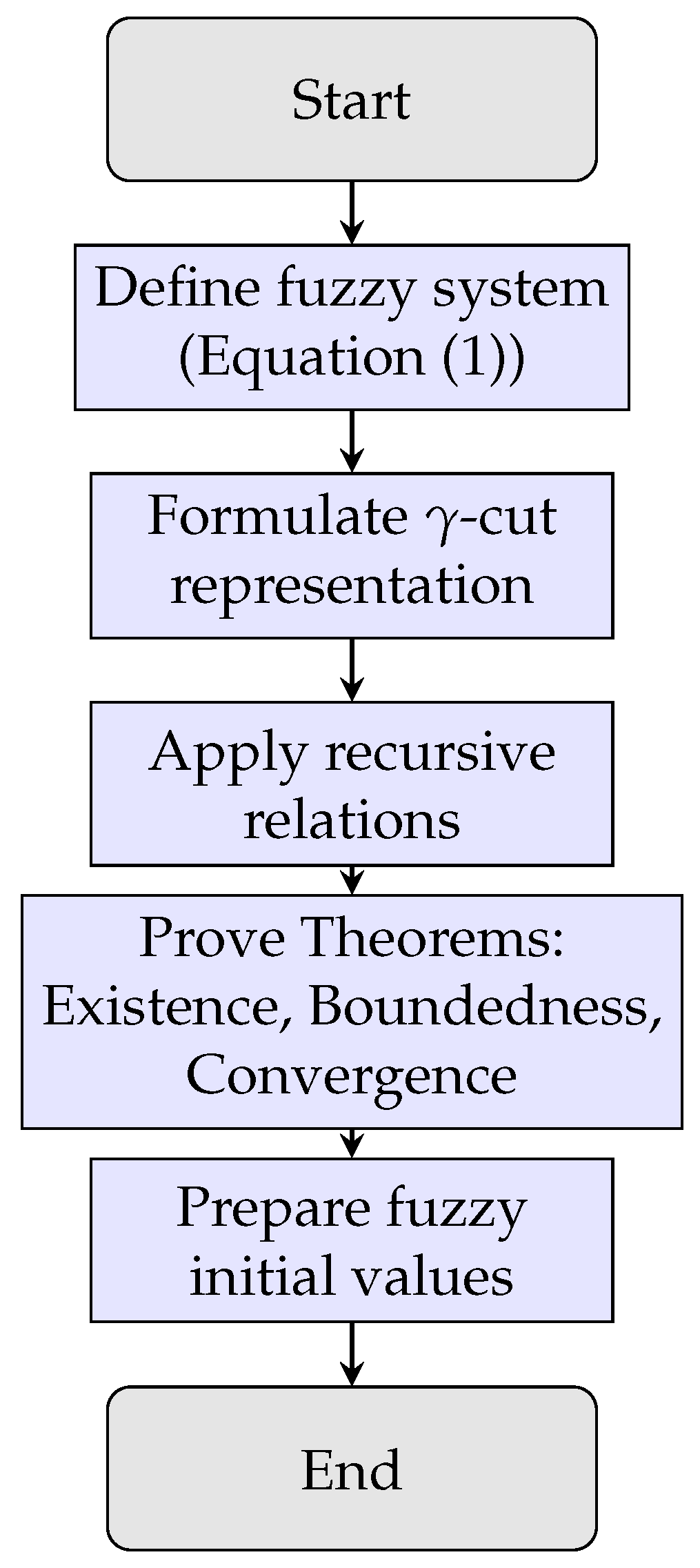
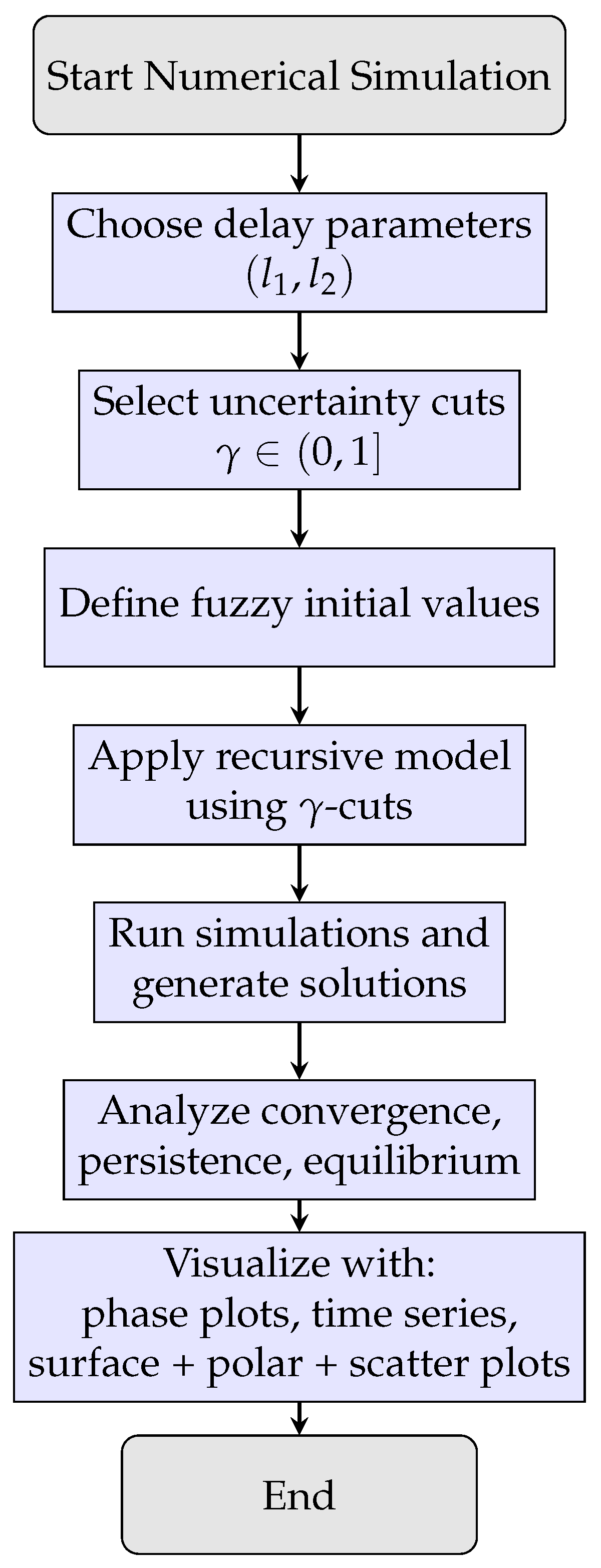
This section presents the methodological framework of the study through two complementary flowcharts. The first flowchart outlines the sequence of theoretical steps involved in analyzing the system of fuzzy difference equations, whereas the second illustrates the numerical simulation and visualization procedures used to validate the theoretical results. Together, these diagrams provide a clear and structured overview of the research workflow, encompassing model formulation, analytical investigation, and numerical interpretation.
The first flowchart (Chart 1) summarizes the principal stages of the theoretical development. It begins with the formulation of the fuzzy system, followed by the construction of its γ -cut representation, which transforms the fuzzy equations into a deterministic recursive structure. This transformation facilitates rigorous proofs of the existence, boundedness, and convergence of positive fuzzy solutions. The final stage consists of specifying initial values that are consistent with the established analytical framework.
The second flowchart (Chart 2) presents the procedure for conducting the numerical simulations. This process involves selecting appropriate delay parameters and uncertainty cuts, defining fuzzy initial values, and recursively computing the corresponding γ -cut trajectories. It culminates in the generation and interpretation of multiple graphical outputs—including phase-space diagrams, time-series plots, surface plots, polar charts, and scatter matrices—which serve to validate and complement the theoretical findings.

5. Numerical Validation of the Theoretical Results

This section presents numerical simulations aimed at validating the theoretical findings derived for system (1). The simulations employ the γ - cut representation of fuzzy numbers, which allows the transformation of the fuzzy difference system into a family of interval-valued difference equations. Interval arithmetic and iterative procedures are implemented following the standard frameworks introduced in [32,33,34], ensuring full consistency with the theoretical analysis. To demonstrate the validity of the analytical results, we provide examples obtained by solving system (1) for two distinct pairs of delay parameters, ( l 1 , l 2 ) = ( 2 , 3 ) and ( l 1 , l 2 ) = ( 4 , 1 ) , and for different levels of uncertainty, γ = 0.2 and γ = 0.8 . This approach highlights the dynamical behavior of the fuzzy solutions under varying degrees of uncertainty and memory depth, illustrating the correspondence between the theoretical predictions and their numerical counterparts.
To illustrate and validate the theoretical results, we provide numerical examples obtained by solving system (1) for two distinct pairs of delay parameters, namely l 1 , l 2 = ( 2 , 3 ) and l 1 , l 2 = ( 4 , 1 ) . The simulations are performed for different cuts of uncertainty characterized by the parameter γ , taking the values γ = 0.2 and γ = 0.8 . By analyzing the system’s response under these configurations, we aim to elucidate the dynamical behavior of the fuzzy solutions under varying degrees of uncertainty and memory depth.
Example 1.
Let us examine system (1) for the delay parameter set l 1 , l 2 = 2 , 3 , where the coefficients e j and η j , j = 1 , 2 , 3 , are defined as follows:
e 1 ( z ) = 1 2 z 2 , 2 z 4 1 2 6 z , 4 z 6   , η 1 ( z ) = 4 z 3 , 3 4 z 1 5 4 z , 1 z 5 4   , e 2 ( z ) = z 5 , 5 z 6 7 z , 6 z 7   , η 2 ( z ) = 2 z 7 , 7 2 z 4 9 2 z , 4 z 9 2   , e 3 ( z ) = 1 3 z 4 , 4 z 7 1 3 10 z , 7 z 10   , η 3 ( z ) = z 3 , 3 z 4 5 z , 4 z 5   .
The initial values of the system are specified in terms of fuzzy numbers, namely M 3 ,   M 2 ,   M 1 ,   M 0 ,   N 3 ,   N 2 ,   N 1 , and N 0 , respectively,
M 3 ( z ) = 5 2 z 0.50 , 0.20 z 0.60 5 2 1 z , 0.60 z 1.00   , N 3 ( z ) = 20 z 7 , 0.35 z 0.40 9 20 z , 0.40 z 0.45   , M 2 ( z ) = z 4 , 4.00 z 5.00 6 z , 5.00 z 6.00   , N 2 ( z ) = 10 3 z 2 , 0.60 z 0.90 4 10 3 z , 0.90 z 1.20   , M 1 ( z ) = 2 z 3 , 1.50 z 2.00 5 2 z , 2.00 z 2.50   , N 1 ( z ) = 10 11 2 z 1 , 0.50 z 1.05 4 11 8 5 z , 1.05 z 1.60   , M 0 ( z ) = 2 z 2.30 , 1.15 z 1.65 4.30 2 z , 1.65 z 2.15   , N 0 ( z ) = 2 z 5 , 2.50 z 3.00 7 2 z , 3.00 z 3.50   ,
From (23) and (24), we obtain:
e 1 γ = [ 2 + 2 γ , 6 2 γ ] , η 1 γ = [ 1 4 3 + γ , 1 4 5 γ ] , e 2 γ = [ 5 + γ , 7 γ ] , η 2 γ = [ 1 2 7 + γ , 1 2 9 γ ] , e 3 γ = [ 4 + 3 γ , 10 3 γ ] , η 3 γ = [ 3 + γ , 5 γ ] ,
M 3 γ = 0.20 + 0.40 γ , 1.00 0.40 γ , N 3 γ = 0.35 + 0.05 γ , 0.45 0.05 γ , M 2 γ = 4.00 + γ , 6.00 γ , N 2 γ = 0.60 + 0.30 γ , 1.20 0.30 γ , M 1 γ = [ 1.50 + 0.50 γ , 2.50 0.50 γ ] , N 1 γ = [ 0.50 + 0.55 γ , 1.60 0.55 γ ] , M 0 γ = [ 1.15 + 0.50 γ , 2.15 0.50 γ ] , N 0 γ = [ 2.50 + 0.50 γ , 3.50 0.50 γ ] ,
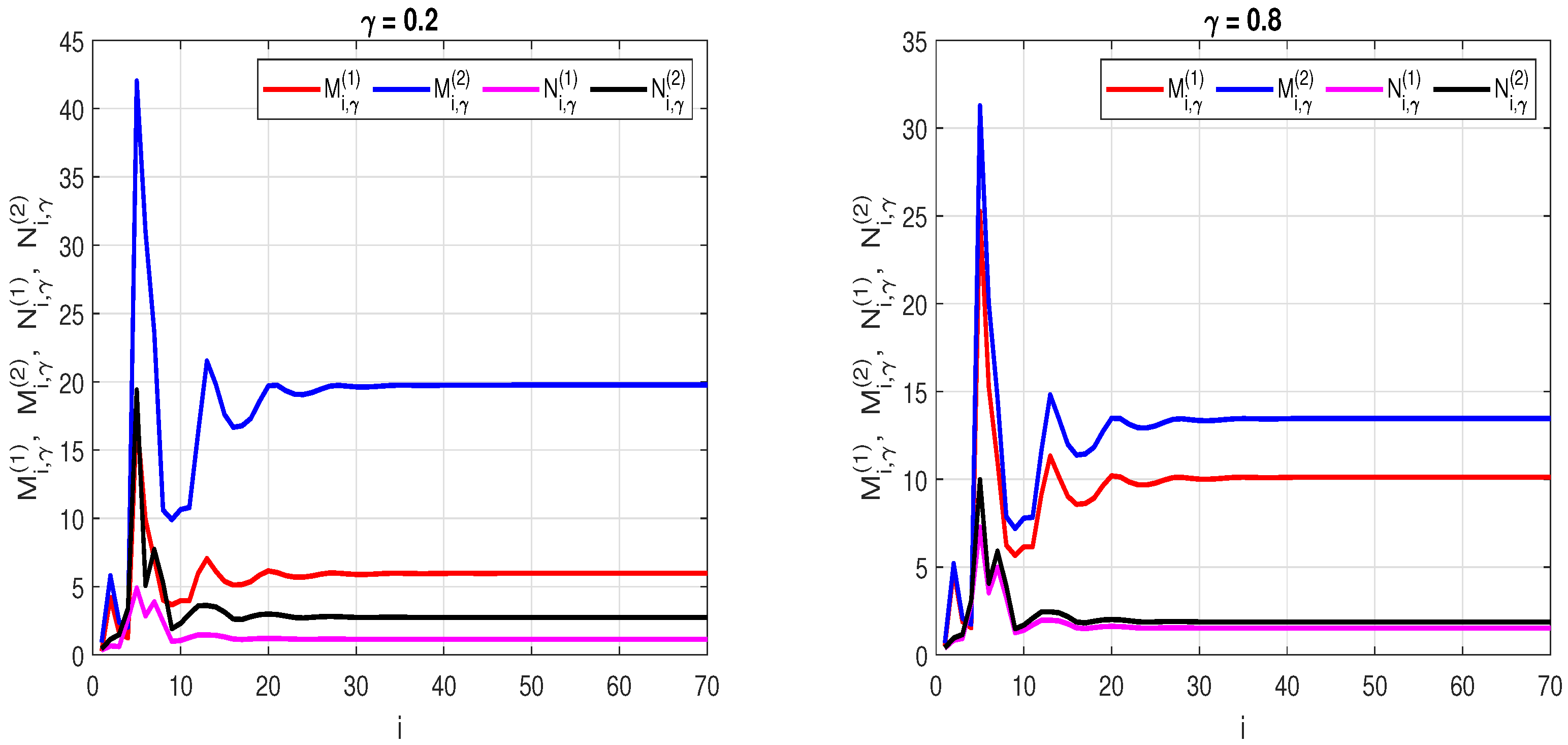
Figure 1 illustrates the evolution of the fuzzy solutions M i and N i under the configuration ( l 1 , l 2 ) = ( 2 , 3 ) for two cuts of uncertainty, γ = 0.2 and γ = 0.8 . These cases demonstrate the system’s temporal behavior under different uncertainty intensities. It is worth emphasizing that, although some initial fuzzy membership functions may attain zero at isolated boundary points of their supports, all corresponding γ-cut intervals remain strictly positive for every γ ( 0 , 1 ] . Consequently, the numerical solutions form nonnegative fuzzy sequences with strictly positive γ-cut interiors, fully satisfying the positivity assumptions required by the theoretical results.
Figure 1 presents the evolution of M i and N i for the selected values γ = 0.2 and γ = 0.8 . The upper and lower γ-cut bounds are displayed at each time step, illustrating both the convergence behavior and the evolution of uncertainty. For γ = 0.2 , the uncertainty band is initially wider, but it gradually contracts over time, indicating progressive stabilization of the system. In contrast, for γ = 0.8 , the fuzzy band is narrower from the outset, and convergence occurs more rapidly and within a more confined range, reflecting reduced ambiguity. These observations are consistent with the theoretical results on existence, boundedness, and asymptotic stability (Theorems 1–3). The numerical computations further allow the identification of the associated positive equilibrium points. For γ = 0.2 , the system converges to ( M ¯ 1 , M ¯ 2 , N ¯ 1 , N ¯ 2 ) = ( 6 , 20 , 1 , 3 ) , whereas for γ = 0.8 , the equilibrium shifts to ( M ¯ 1 , M ¯ 2 , N ¯ 1 , N ¯ 2 ) = ( 10 , 13.5 , 1.5 , 2 ) . These equilibrium values are obtained numerically by iterating the system until convergence. The trajectories shown in Figure 1 clearly approach these limits, providing strong numerical confirmation of the global convergence and asymptotic stability established in Theorem 2.
Example 2.
We now examine system (1) under the delay configuration l 1 , l 2 = 4 , 1 . The coefficients e j and η j ,   j = 1 , 2 , 3 are specified in (23), and the initial values are given by the fuzzy numbers M 4 ,   M 3 ,   M 2 ,   M 1 ,   M 0 ,   N 4 ,   N 3 ,   N 2 ,   N 1 , and N 0 , respectively,
M 4 ( z ) = 5 z 4 , 0.80 z 1.00 6 5 z , 1.00 z 1.20   , N 4 ( z ) = 2 z 3 , 1.50 z 2.00 5 2 z , 2.00 z 2.50   , M 3 ( z ) = z 0.92 , 0.92 z 1.05 1.18 z , 1.05 z 1.18   , N 3 ( z ) = z 0.11 , 0.11 z 0.22 0.33 z , 0.22 z 0.33   , M 2 ( z ) = 10 11 2 z 1 , 0.50 z 1.05 4 11 8 5 z , 1.05 z 1.60   , N 2 ( z ) = 3 z 0.30 , 0.10 z 0.13 0.64 4 z , 0.13 z 0.16   , M 1 ( z ) = z 0.67 , 0.67 z 0.79 0.91 z , 0.79 z 0.91   , N 1 ( z ) = z 0.34 , 0.34 z 0.45 0.56 z , 0.45 z 0.56   , M 0 ( z ) = 20 z 7 , 0.35 z 0.40 9 20 z , 0.40 z 0.45   , N 0 ( z ) = z 4 , 4.00 z 5.00 6 z , 5.00 z 6.00   ,
From (25), we obtain:
M 4 γ = 0.80 + 0.20 γ , 1.20 0.20 γ , N 4 γ = 1.50 + 0.50 γ , 2.50 0.50 γ , M 3 γ = 0.92 + 0.13 γ , 1.18 0.13 γ , N 3 γ = 0.11 + 0.11 γ , 0.33 0.11 γ , M 2 γ = 0.50 + 0.55 γ , 1.60 0.55 γ , N 2 γ = 0.10 + 0.03 γ , 0.16 0.03 γ , M 1 γ = [ 0.67 + 0.12 γ , 0.91 0.12 γ ] , N 1 γ = [ 0.34 + 0.11 γ , 0.56 0.11 γ ] , M 0 γ = [ 0.35 + 0.05 γ , 0.45 0.05 γ ] , N 0 γ = [ 4.00 + γ , 6.00 γ ] .
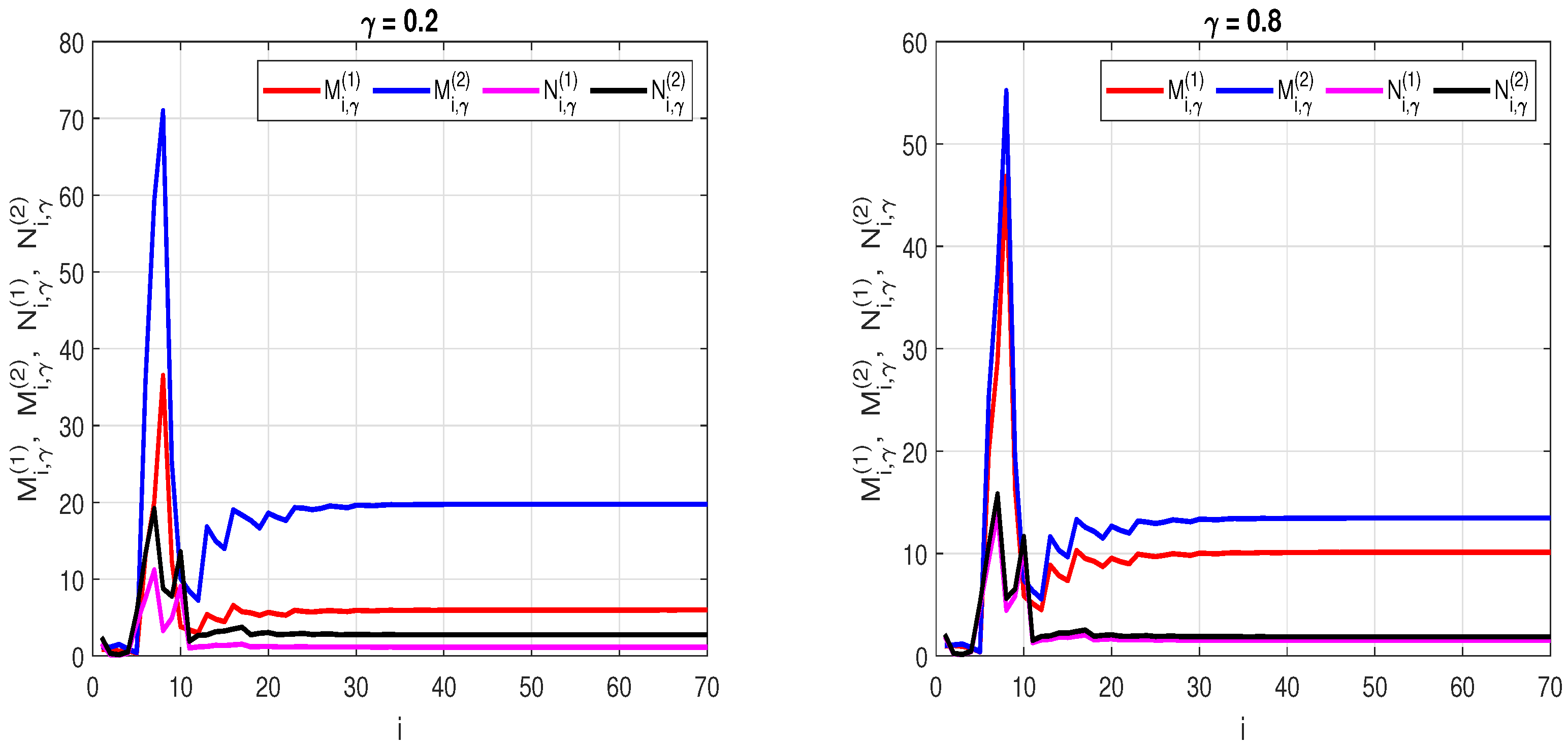
Figure 2 illustrates the resulting fuzzy solutions for the delay configuration ( l 1 , l 2 ) = ( 4 , 1 ) under the uncertainty cuts γ = 0.2 and γ = 0.8 , depicting the dynamical evolution of the sequences M i and N i with the prescribed fuzzy initial values. It is worth emphasizing that, although some initial fuzzy membership functions may vanish at isolated boundary points of their supports, all corresponding γ-cut intervals remain strictly positive for every γ ( 0 , 1 ] . Consequently, the numerical solutions constitute nonnegative fuzzy sequences with strictly positive γ-cut interiors, fully satisfying the positivity assumptions required by the theoretical results.
Figure 2 presents the fuzzy dynamics under the delay configuration ( l 1 , l 2 ) = ( 4 , 1 ) . Compared with Figure 1, the transient phase is noticeably longer, particularly for γ = 0.2 , indicating that the increased memory depth in M slows the convergence process. Although the system remains bounded and eventually stabilizes, the delay induces more pronounced oscillations during the early iterations. These observations highlight the significant influence of the delay structure on the rate of uncertainty reduction. For γ = 0.2 , the wider fuzzy band provides a clearer depiction of the transient dynamics, as the sequences exhibit stronger oscillations and a prolonged convergence phase. In contrast, γ = 0.8 yields a narrower uncertainty band and faster stabilization. While this confirms boundedness and eventual convergence, the early dynamical effects are less pronounced. Moreover, the numerical simulations enable the explicit determination of the corresponding positive equilibrium points. For γ = 0.2 , the computed equilibrium is ( M ¯ 1 , M ¯ 2 , N ¯ 1 , N ¯ 2 ) = ( 6 , 20 , 1 , 3 ) , whereas for γ = 0.8 , the equilibrium shifts to ( M ¯ 1 , M ¯ 2 , N ¯ 1 , N ¯ 2 ) = ( 10 , 13.5 , 1.5 , 2 ) . These values are obtained by iterating the system until convergence and are consistent with the theoretical prediction of a unique positive equilibrium. The trajectories displayed in Figure 2 clearly approach these limits, thereby providing concrete numerical confirmation of the asymptotic stability established in Theorem 2. It is worth emphasizing that the equilibrium points obtained in this example coincide with those reported in Example 1, despite the different delay configuration and initial conditions. This agreement is not accidental. The equilibrium of system (1) is determined exclusively by the system coefficients and does not depend on either the delay parameters or the admissible initial values. While the delays significantly influence the transient dynamics and the rate of convergence, they do not alter the location of the steady state. Since Theorem 2 guarantees the existence and uniqueness of a positive equilibrium, every positive solution necessarily converges to the same equilibrium point. The numerical simulations therefore illustrate the global attractivity of this unique steady state.
Remark 2.
We present two numerical examples to investigate the effect of varying the delay parameters l 1 and l 2 on the system’s dynamical behavior. Each example employs distinct fuzzy coefficients and initial conditions, allowing for a comprehensive evaluation of the model’s performance under diverse uncertainty scenarios. The numerical results demonstrate strong consistency with the theoretical predictions: all computed trajectories remain within the predicted bounds and converge to the positive equilibrium point established in Theorem 2. Notably, the observed fluctuations in the sequences M i and N i reflect the system’s structural sensitivity to fuzzy perturbations in the initial data. This highlights a key advantage of the fuzzy framework over classical deterministic models, namely, its ability to capture intrinsic uncertainty more effectively in many real-world applications.

6. Conclusions

In conclusion, this study presents a comprehensive analysis of higher-order fuzzy difference equations, focusing on the system defined in Equation (1). Through rigorous theoretical investigation, we established the existence, uniqueness, and boundedness of positive solutions under suitable conditions. Furthermore, we proved that all such solutions converge asymptotically to a unique positive equilibrium, demonstrating the system’s inherent stability and persistence.
These theoretical results are supported by detailed numerical simulations, which validate the analytical findings and illustrate the system’s dynamical behavior under varying delay parameters and γ -cuts. The simulations not only confirm boundedness and convergence but also reveal the structural sensitivity of the sequences to fuzzy perturbations in the initial data, providing deeper insight into system dynamics under uncertainty.
Several promising directions for future research emerge from this work. Extensions to multidimensional fuzzy systems, incorporation of variable or state-dependent delays, and exploration of fractional-order dynamics represent natural theoretical developments. The integration of environmental or climate-related drivers offers meaningful applied extensions. Moreover, the proposed methodology can be adapted to real-world problems such as ecological modeling, economic forecasting under uncertainty, and robust control of complex dynamical systems. These potential applications further highlight the relevance of fuzzy mathematics in interdisciplinary scientific and engineering research.

Author Contributions

Methodology, H.A. and A.G.; Software, H.A.; Formal analysis, H.A.; Data curation, A.G.; Writing—original draft, A.G.; Writing—review & editing, H.A. and A.G.; Supervision, A.G.; Funding acquisition, H.A. All authors have read and agreed to the published version of the manuscript.

Funding

This research received no external funding.

Data Availability Statement

The original contributions presented in this study are included in the article. Further inquiries can be directed to the corresponding author.

Conflicts of Interest

The authors declare no conflict of interest.

References

  1. Elaydi, S. An Introduction to Difference Equations; Springer: New York, NY, USA, 2005. [Google Scholar]
  2. Grove, E.A.; Ladas, G. Periodicities in Nonlinear Difference Equations; Chapman and Hall/CRC: New York, NY, USA, 2005. [Google Scholar]
  3. Kocic, V.L.; Ladas, G. Global Behavior of Nonlinear Difference Equations of Higher Order with Applications; Kluwer Academic Publishers: Dordrecht, The Netherlands, 1993. [Google Scholar]
  4. Kulenovic, M.R.S.; Ladas, G. Dynamics of Second Order Rational Difference Equations with Open Problems and Conjectures; Chapman Hall-CRC: New York, NY, USA, 2002. [Google Scholar]
  5. Balegh, M.; Zemmouri, I. Markov-switching threshold stochastic volatility models with regime changes. AIMS Math. 2024, 9, 3895–3910. [Google Scholar] [CrossRef]
  6. Zemmouri, I. On Markov-switching asymmetric log GARCH models: Stationarity and estimation. Filomat 2023, 37, 9879–9897. [Google Scholar]
  7. Althagafi, H. Dynamics of difference systems: A mathematical study with applications to neural systems. AIMS Math. 2025, 10, 2869–2890. [Google Scholar] [CrossRef]
  8. Zemmouri, I. M-estimation in periodic threshold GARCH models: Consistency and asymptotic normality. Miskolc Math. Notes 2025, 26, 229–242. [Google Scholar] [CrossRef]
  9. Zemmouri, I. On the Markov-switching autoregressive stochastic volatility processes. SeMA J. 2023, 81, 413–427. [Google Scholar] [CrossRef]
  10. Cavicchioli, M.; Zemmouri, I. (Bi)spectral analysis of Markov switching bilinear time series. Stat. Methods Appl. 2025. [Google Scholar] [CrossRef]
  11. Cavicchioli, M.; Zemmouri, I. On the existence of stationary threshold bilinear processes. Stat. Pap. 2024, 65, 3739–3767. [Google Scholar] [CrossRef]
  12. Cavicchioli, M. Trend in Markov Switching VAR Models. In Statistics for Innovation II; di Bella, E., Gioia, V., Lagazio, C., Zaccarin, S., Eds.; SIS 2025; Italian Statistical Society Series on Advances in Statistics; Springer: Cham, Switzerland, 2025. [Google Scholar] [CrossRef]
  13. Althagafi, H. Stability analysis of biological rhythms using three-dimensional systems of difference equations with squared terms. J. Appl. Math. Comput. 2025, 71, 3211–3232. [Google Scholar] [CrossRef]
  14. Elsayed, E.M.; Din, Q.; Al-Rakhami, F.A.; Seyam, N.M. Dynamics and expressions of solutions of fourth-order rational systems of difference equations. Int. J. Anal. Appl. 2024, 22, 163. [Google Scholar] [CrossRef]
  15. Althagafi, H. Solving a system of nonlinear difference equations with bilinear dynamics. AIMS Math. 2024, 9, 34067–34089. [Google Scholar] [CrossRef]
  16. Elsayed, E.M.; Aloufi, B.S.; Moaaz, O. The behavior and structures of solution of fifth-order rational recursive sequence. Symmetry 2022, 14, 641. [Google Scholar] [CrossRef]
  17. Elsayed, E.M.; Alzahrani, F.; Alayachi, H.S. Global attractivity and the periodic nature of third order rational difference equation. J. Comput. Anal. Appl. 2017, 237, 1230–1241. [Google Scholar]
  18. Ghezal, A.; Balegh, M.; Zemmouri, I. Solutions and local stability of the Jacobsthal system of difference equations. AIMS Math. 2024, 9, 3576–3591. [Google Scholar] [CrossRef]
  19. Ghezal, A. Note on a rational system of (4k+4)-order difference equations: Periodic solution and convergence. J. Appl. Math. Comput. 2023, 69, 2207–2215. [Google Scholar] [CrossRef]
  20. Ghezal, A.; Zemmouri, I. Higher-order system of p-nonlinear difference equations solvable in closed-form with variable coefficients. Bol. Soc. Paran. Mat. 2022, 41, 1–14. [Google Scholar] [CrossRef]
  21. Kara, M. Investigation of the global dynamics of two exponential-form difference equation systems. Electron. Res. Arch. 2023, 31, 6697–6724. [Google Scholar] [CrossRef]
  22. Simşek, D.; Oğul, B.; Çınar, C. Solution of the rational difference equation xn + 1 = xn−17/(1 + xn−5.xn−11). Filomat 2019, 33, 1353–1359. [Google Scholar] [CrossRef]
  23. Hakeem, E.; Jawad, S.; Ali, A.H.; Kallel, M.; Neamah, H.A. How mathematical models might predict desertification from global warming and dust pollutants. MethodsX 2025, 14, 103259. [Google Scholar] [CrossRef]
  24. Zadeh, L.A. Fuzzy sets. Inf. Control 1965, 8, 338–353. [Google Scholar] [CrossRef]
  25. Bhattacharya, A.; Pal, M. Optimization in business strategy as a part of sustainable economic growth using clique covering of fuzzy graphs. Soft Comput. 2021, 25, 7095–7118. [Google Scholar] [CrossRef]
  26. Bhattacharya, A.; Pal, M. Fifth sustainable development goal gender equality in India: Analysis by mathematics of uncertainty and covering of fuzzy graphs. Neural Comput. Appl. 2021, 33, 15027–15057. [Google Scholar] [CrossRef]
  27. Diamond, P.; Kloeden, P. Metric Spaces of Fuzzy Sets; World Scientific: Singapore, 1994. [Google Scholar]
  28. Buckley, J.J. The fuzzy mathematics of finance. Fuzzy Sets Syst. 1987, 21, 257–273. [Google Scholar] [CrossRef]
  29. Umekken, S.A.; Can, E.; Barak, M.A. Fuzzy difference equations in finance. Int. J. Sci. Innov. Math. Res. 2014, 2, 729–735. [Google Scholar]
  30. Deeba, E.; De Korvin, A. Analysis by fuzzy difference equations of a model of CO2 level in blood. Appl. Math. Lett. 1999, 12, 33–40. [Google Scholar] [CrossRef]
  31. Deeba, E.; De Korvin, A.; Koh, E.L. A fuzzy difference equation with an application. J. Differ. Equ. Appl. 1996, 2, 365–374. [Google Scholar] [CrossRef]
  32. Zhang, Q.; Ouyang, M.; Pan, B.; Lin, F. Qualitative analysis of second-order fuzzy difference equation with quadratic term. J. Appl. Math. Comput. 2023, 69, 1355–1376. [Google Scholar] [CrossRef]
  33. Zhang, Q.; Zhang, W.; Lin, F.; Li, D. On dynamic behavior of second-order exponential-type fuzzy difference equation. Fuzzy Sets Syst. 2021, 419, 169–187. [Google Scholar] [CrossRef]
  34. Gümüş, M.; Yalçinkaya, İ.; Tollu, D.T. Dynamic analysis of high-order fuzzy difference equation. J. Appl. Math. Comput. 2025, 71, 1285–1308. [Google Scholar] [CrossRef]
  35. Almoteri, Y. On the existence and uniqueness of two-dimensional nonlinear fuzzy difference equations with logarithmic interactions. Mathematics 2025, 13, 3532. [Google Scholar] [CrossRef]
  36. Balegh, M. Dynamical analysis of a system of fuzzy difference equations with power terms. Int. J. Dyn. Control 2025, 13, 364. [Google Scholar] [CrossRef]
  37. Khastan, A.; Alijani, Z. On the new solutions to the fuzzy difference equation xn + 1 = A + B/xn. Fuzzy Sets Syst. 2019, 358, 64–83. [Google Scholar] [CrossRef]
  38. Yalçinkaya, I.; El-Metwally, H.; Tollu, D.T.; Ahmad, H. On the fuzzy difference equation zn + 1 = A + B/zn−m. Math. Not. 2023, 113, 292–302. [Google Scholar] [CrossRef]
  39. Yalçinkaya, I.; El-Metwally, H.; Bayram, M.M.; Tollu, D.T. On the dynamics of a higher-order fuzzy difference equation with rational terms. Soft Comput. 2023, 27, 10469–10479. [Google Scholar] [CrossRef]
  40. Hatir, E.; Mansour, T.; Yalcinkaya, I. On a fuzzy difference equation. Util. Math. 2014, 93, 135–151. [Google Scholar]
  41. Gegov, A.E.; Frank, P.M. Decomposition of multivariable systems for distributed fuzzy control. Fuzzy Sets Syst. 1995, 73, 329–340. [Google Scholar] [CrossRef]
  42. Sun, C.-H.; Wang, W.-J.; Lin, W.-W. Linear control and parallel distributed fuzzy control design for T-S fuzzy time-delay system. Int. J. Fuzzy Syst. 2007, 9, 229–235. [Google Scholar] [CrossRef]
  43. Ling, X.; Xu, H.; Weng, W.; Zhu, F. Distributed consensus control for discrete-time T–S fuzzy multiple-agent systems based on an unknown input observer. Sensors 2024, 24, 8149. [Google Scholar] [CrossRef]
  44. Bede, B. Mathematics of Fuzzy Sets and Fuzzy Logic; Springer: New York, NY, USA, 2013. [Google Scholar]
  45. Klir, G.; Yuan, B. Fuzzy Sets and Fuzzy Logic: Theory and Applications; Prentice Hall PTR: Upper Saddle River, NJ, USA, 1995. [Google Scholar]
  46. Negoita, C.V.; Ralescu, D. Applications of Fuzzy Sets to Systems Analysis; Birkhäuser: Basel, Switzerland, 1975. [Google Scholar]
  47. Wu, C.; Zhang, B. Embedding problem of noncompact fuzzy number space E. Fuzzy Sets Syst. 1999, 105, 165–169. [Google Scholar] [CrossRef]
  48. Papaschinopoulos, G.; Papadopoulos, B.K. On the fuzzy difference equation xn+1=A+B/xn. Soft Comput. 2002, 6, 456–461. [Google Scholar] [CrossRef]
  49. Papaschinopoulos, G.; Stefanidou, G. Boundedness and asymptotic behavior of the solutions of a fuzzy difference equation. Fuzzy Sets Syst. 2003, 140, 523–539. [Google Scholar] [CrossRef]
  50. Wang, C.C.; Su, X.; Liu, P.; Hu, X.; Li, R. On the dynamics of a five-order fuzzy difference equation. J. Nonlinear Sci. Appl. 2017, 10, 3303–3319. [Google Scholar] [CrossRef]
Chart 1. Flowchart of the theoretical development process.
Mathematics 14 01051 ch001
Chart 2. Flowchart of the numerical simulation and analysis process.
Mathematics 14 01051 ch002
Figure 1. Displays the fuzzy solution of system (1) corresponding to the delay parameters l 1 , l 2 = 2 , 3 and γ 0.2 , 0.8 .
Mathematics 14 01051 g001
Figure 2. Displays the fuzzy solution of system (1) corresponding to the delay parameters l 1 , l 2 = 4 , 1 and γ 0.2 , 0.8 .
Mathematics 14 01051 g002
Disclaimer/Publisher’s Note: The statements, opinions and data contained in all publications are solely those of the individual author(s) and contributor(s) and not of MDPI and/or the editor(s). MDPI and/or the editor(s) disclaim responsibility for any injury to people or property resulting from any ideas, methods, instructions or products referred to in the content.