1. Introduction
Fractional differential equations now constitute a vital modeling approach for describing intricate systems characterized by memory effects and hereditary behavior within various fields such as physics, engineering, biology, and finance [
1,
2,
3]. In contrast to traditional integer-order differential models, fractional-order operators naturally account for non-local interactions and extended temporal dependencies. This makes them particularly suitable for representing processes like anomalous diffusion, viscoelastic responses, and other phenomena where past states significantly influence current dynamics. In recent years, considerable progress has been made in the theoretical analysis of fractional differential equations, particularly regarding solution existence, uniqueness, and stability across various classes [
4,
5,
6]. Extensive research has been conducted on equations incorporating diverse fractional operators—including Riemann–Liouville, Caputo, and Hadamard derivatives—subject to a wide range of boundary and initial conditions [
7,
8,
9].
A notable development in this domain is tempered fractional calculus, which incorporates an exponential tempering factor into traditional fractional operators [
10,
11]. This adjustment retains the non-local nature of fractional derivatives while reducing the slow algebraic decay typical of conventional models, thereby offering more accurate representations of systems exhibiting tempered power-law memory [
12,
13].
The tempered fractional framework has proven valuable in applications where the influence of past states decays exponentially at large times, such as in finance, geophysics, and turbulent flows [
14]. Recent studies have begun to investigate the qualitative properties of tempered fractional differential equations, including well-posedness and numerical approximations.
Within the broad context of fractional dynamics, implicit differential equations present distinctive analytical challenges, as the highest-order derivative is defined implicitly by the unknown function itself. This characteristic often leads to nonlinear and non-local formulations that resist conventional solution methods [
15]. The analysis of such implicit fractional equations has attracted significant interest, leading to the application of diverse fixed point theorems and measure theoretic methodologies to prove existence and stability under various assumptions [
16,
17]. A substantial body of recent literature has expanded the scope of these models by integrating retarded and advanced arguments, nonlocal conditions, and integral boundary terms [
18,
19]. Specific studies in this evolving field include the examination of implicit neutral-tempered fractional equations with mixed delays [
20,
21], the analysis of systems featuring nonlocal conditions in weighted function spaces [
22], and the exploration of implicit fractional difference equations [
23]. Further contributions involve models based on the AB-Caputo derivative [
24] and other advanced configurations [
25]. Building upon this foundation, recent advancements have also addressed more generalized fractional frameworks, such as the investigation of existence and Ulam stability for
k-generalized
-Hilfer fractional problems [
26]. Additionally, the study of continuity properties for the fractional derivative in time-fractional semilinear pseudo-parabolic systems [
27] highlights the ongoing effort to understand the analytical behavior of complex fractional models. Collectively, this work underscores the increasing sophistication and practical importance of implicit fractional models.
From an applied standpoint, the class of implicit neutral-tempered fractional Volterra–Fredholm integro-differential equations considered in this work is motivated by models arising in viscoelasticity, control theory, and neural dynamics. In viscoelastic materials, tempered Caputo fractional derivatives provide an accurate description of hereditary stress–strain behavior, where long-range memory effects persist but decay exponentially over time. The presence of Volterra-type integral terms reflects history-dependent material responses, while Fredholm-type integrals account for spatially distributed or global interactions. Moreover, neutral structures with retarded and advanced arguments naturally occur in systems involving delayed feedback and anticipation effects, such as transmission lines and neural networks with predictive mechanisms. These modeling considerations demonstrate that the proposed mathematical framework is not only theoretically significant but also well suited for the analysis of complex real-world systems characterized by memory, delay, and nonlocal effects.
However, a significant research gap remains regarding implicit neutral fractional differential equations that simultaneously incorporate tempered derivatives and mixed integral operators of Volterra and Fredholm types in a unified model. While individual aspects—such as implicit structures [
5], neutral terms [
20], and integral operators [
9,
28]—have been studied separately, their combined analysis remains largely unexplored.For instance, recent work on weak solutions for fractional Langevin equations involving two fractional orders in Banach spaces [
29] demonstrates the relevance of functional-analytic techniques for handling fractional models in abstract spaces, yet the incorporation of mixed integral operators and advanced-delayed structures introduces additional layers of complexity. Neutral equations, where the derivative appears with a delayed argument, are essential for modeling systems with propagation delays, such as in neural networks and transmission lines. The inclusion of both Volterra (history-dependent) and Fredholm (global) integral operators further allows the modeling of distributed past effects and global constraints simultaneously. However, the coupling of these features with the non-local and tempered fractional derivative introduces significant mathematical complexities, particularly in establishing the existence of solutions under nonlocal and advanced-retarded boundary conditions. To address these challenges, methodologies from the theory of nonlinear integral equations in abstract spaces [
30] provide a robust foundation for analyzing the operator structures that arise in such composite problems.
Inspired by this unresolved issue and drawing on techniques from [
5,
12,
20], this research aims to examine a new category of implicit neutral Caputo tempered fractional differential equations that include combined Volterra–Fredholm integral operators and involve both advanced and delayed arguments. Specifically, we intend to
- 1.
Frame the problem in a suitable Banach space setting, considering both historical and advanced segments.
- 2.
Derive sufficient criteria for solution existence using the Kuratowski measure of noncompactness [
31], Darbo’s fixed point theorem [
32], and key properties of tempered fractional calculus [
10,
33].
- 3.
Additionally, the solution map’s continuity guarantees that trajectories vary only slightly under small perturbations in initial conditions or system parameters—a fundamental property for assessing stability.
In this paper, we study existence, uniqueness, and stability properties for the following implicit neutral fractional integro-differential equation of Volterra–Fredholm type:
where
is the Caputo-tempered fractional derivative of order
,
,
,
is a given function,
is a given function,
are integral kernels,
, and
. We denote by
the element of
defined by
The paper is arranged as follows: In
Section 2, we provide some notations, definitions, and auxiliary results used throughout the work.
Section 3 presents existence and uniqueness results for problem (
1) based on Banach’s contraction principle and Schauder’s fixed point theorem, along with a demonstrative example. A similar problem in Banach spaces is also treated in
Section 3 using Darbo’s fixed point theorem and the Kuratowski measure of noncompactness, followed by an analysis of Ulam–Hyers–Rassias stability and corresponding application results for problem (
19).
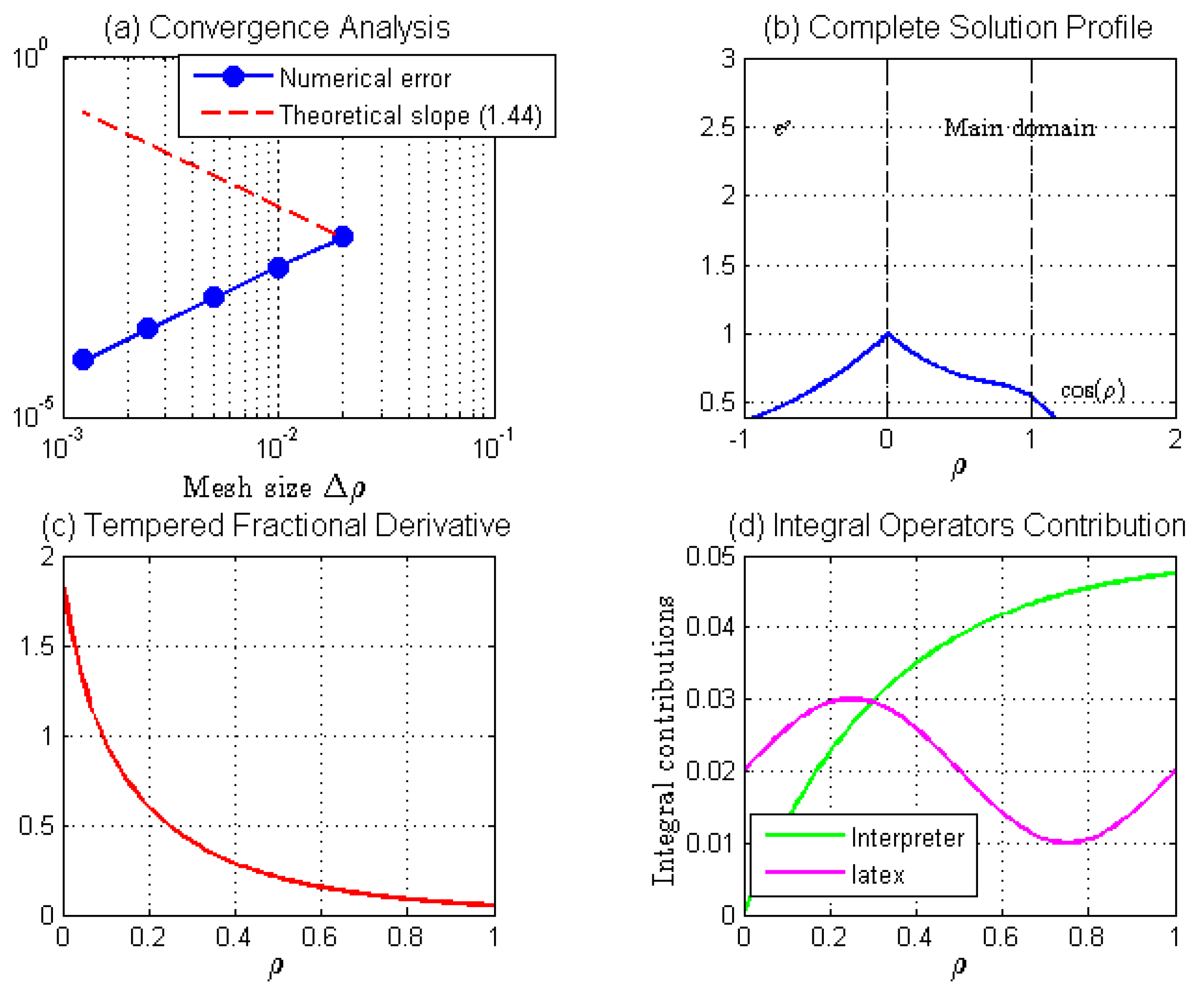
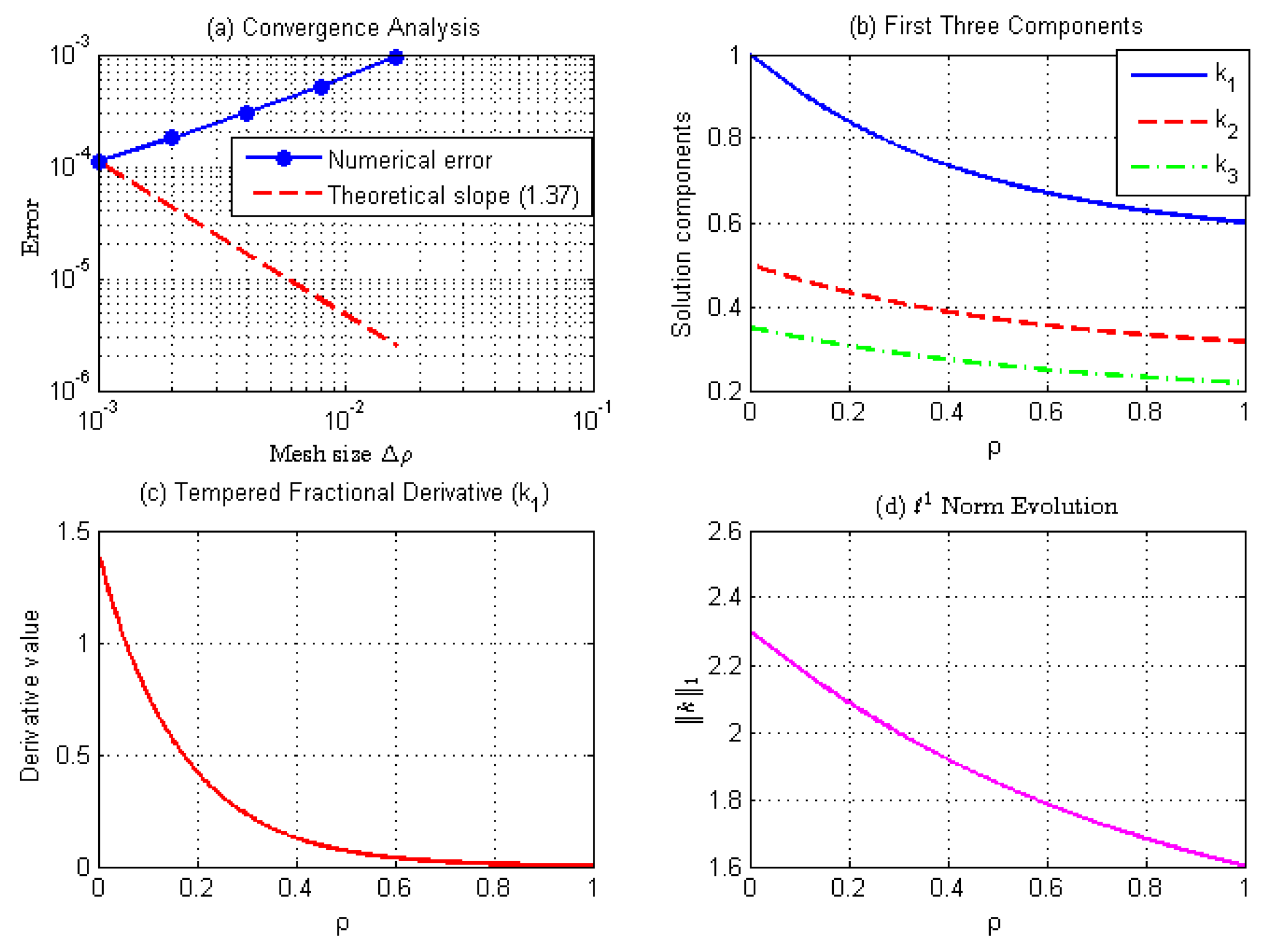
Section 4 is devoted to numerical simulations of the proposed problems. Finally,
Section 5 provides conclusions and suggests directions for future research.
2. Preliminaries
This section introduces the foundational mathematical framework, notations, and preliminary concepts that will be utilized throughout this investigation. Our analysis is conducted within a Banach space, denoted by
. Consider a fixed interval
. The space of all continuous functions defined on the compact set
and taking values in a Banach space
E, equipped with the supremum norm, forms a Banach space denoted by
.
Additionally, we need specific Banach spaces for functions defined on delayed initial intervals and advanced terminal intervals. For a given non-negative constant
, the space is defined as
Correspondingly, for a positive constant
, we define
For the comprehensive interval, let
be the Banach space with the norm
We also require the space of Bochner integrable functions, denoted by
, with the norm
For the integral kernels, we consider the space of continuous functions under appropriate boundedness conditions.
Now, define the function space
as
This space
is a Banach space when endowed with the norm
Definition 1 ([
10,
11,
14])
. For a prescribed function belonging to the space and a fixed tempering coefficient , the Riemann–Liouville-tempered fractional integral of order is formally defined by the following representation:where refers to the classical Riemann–Liouville fractional integral, defined byWe observe that when , the tempered form simplifies to its classical Riemann–Liouville counterpart. Definition 2. Let be a real number satisfying , where β is a positive integer, and let be a non-negative constant. The Riemann–Liouville-tempered fractional derivative of a function with respect to the variable ρ is defined aswhere denotes the classical Riemann–Liouville fractional derivative operator. Definition 3. Given parameters and satisfying for some and , the Caputo-tempered fractional derivative of a function is expressed asEquivalently, it can be written in integral form aswhere represents the classical Caputo fractional derivative. Lemma 1 ([
10])
. For a constant C, we have Obviously,
Moreover,
is no longer equal to zero, which is different from
.
Lemma 2 ([
10,
14])
. Assume where with . The sequential application of the tempered Caputo derivative and the tempered Riemann–Liouville integral is governed by specific, well-defined compositional rules:and for , Definition 4 ([
31])
. Consider a Banach space X and denote by the collection of all bounded subsets of X. The Kuratowski measure of noncompactness is a functionthat assigns to each bounded subset a non-negative real number, defined as follows:for . This measure satisfies the following properties for and : if and only if is compact.
.
implies .
.
.
.
Lemma 3. The set is taken as a subset of the function space Υ. Whenever is both bounded and equicontinuous, the ensuing attributes are satisfied:
- (a)
The mapping is continuous on the interval . Moreover, the measure of noncompactness of in Υ
satisfies - (b)
For any collection of functions , the measure of noncompactness of the set of their integrals is bounded by the integral of the measures:where for each ρ in the domain φ.
We recall several fundamental fixed point theorems that will be employed in our analysis:
Theorem 1 (Banach’s Fixed Point Theorem [
34])
. Let X be a Banach space and a contraction mapping, i.e., there exists such thatThen possesses a unique fixed point in X. Theorem 2 (Schauder’s Fixed Point Theorem [
34])
. Let X be a Banach space and let be a subset of X that is nonempty, bounded, closed, and convex. If is a continuous operator such that the image is relatively compact in X, then there exists an element satisfying . Theorem 3 (Darbo’s Fixed Point Theorem [
32])
. Consider a Banach space X and let be nonempty, closed, bounded, and convex. Assume is a continuous operator and let denote the Kuratowski measure of noncompactness on X. If there exists a constant such that the inequalityFor any subset , if the given condition is satisfied, then the operator has a fixed point in . Lemma 4. For the integral operators present in our main problem, we have the following estimates:
Consider the Volterra integral operator . If satisfies a Lipschitz condition in its third argument, that is, if there exists a function such thatthen Similarly, for the Fredholm integral operator , if there exists such thatthen Lemma 5. If is a bounded and equicontinuous set, the noncompactness measure of the related Volterra integral operator can be determined as follows:For the Fredholm integral operator,where .