Next Article in Journal
Mixed Parity Variants of Apéry-Type Binomial Series and Level Four Colored Multiple Zeta Values
Previous Article in Journal
Robust Controller Design Based on Sliding Mode Control Strategy with Exponential Reaching Law for Brushless DC Motor
Previous Article in Special Issue
The Self-Adjoint Fractional Heun Operator and Its Spectral Properties
error_outline You can access the new MDPI.com website here. Explore and share your feedback with us.
 
 
Article

A Fractional Calculus Approach to Energy Balance Modeling: Incorporating Memory for Responsible Forecasting

by
Muath Awadalla
1,* and
Abulrahman A. Sharif
2,3,*
1
Department of Mathematics and Statistics, College of Science, King Faisal University, Al Ahsa 31982, Saudi Arabia
2
Department of Mathematics, Hodeidah University, Al-Hudaydah P.O. Box 3114, Yemen
3
Department of Mathematics, Dr. Babasaheb Ambedkar Marathwada University, Chhatrapati Sambhajinagar 431004, India
*
Authors to whom correspondence should be addressed.
Mathematics 2026, 14(2), 223; https://doi.org/10.3390/math14020223
Submission received: 11 December 2025 / Revised: 27 December 2025 / Accepted: 3 January 2026 / Published: 7 January 2026

Abstract

Global climate change demands modeling approaches that are both computationally efficient and physically faithful to the system’s long-term dynamics. Classical Energy Balance Models (EBMs), while valuable, are fundamentally limited by their memoryless exponential response, which fails to represent the prolonged thermal inertia of the climate system—particularly that associated with deep-ocean heat uptake. In this study, we introduce a fractional Energy Balance Model (fEBM) by replacing the classical integer-order time derivative with a Caputo fractional derivative of order α ( 0 < α 1 ) , thereby embedding long-range memory directly into the model structure. We establish a rigorous mathematical foundation for the fEBM, including proofs of existence, uniqueness, and asymptotic stability, ensuring theoretical well-posedness and numerical reliability. The model is calibrated and validated against historical global mean surface temperature data from NASA GISTEMP and radiative forcing estimates from IPCC AR6. Relative to the classical EBM, the fEBM achieves a substantially improved representation of observed temperatures, reducing the root mean square error by approximately 29% during calibration (1880–2010) and by 47% in out-of-sample forecasting (2011–2023). The optimized fractional order α = 0.75 ± 0.03 emerges as a physically interpretable measure of aggregate climate memory, consistent with multi-decadal ocean heat uptake and observed persistence in temperature anomalies. Residual diagnostics and robustness analyses further demonstrate that the fractional formulation captures dominant temporal dependencies without overfitting. By integrating mathematical rigor, uncertainty quantification, and physical interpretability, this work positions fractional calculus as a powerful and responsible framework for reduced-order climate modeling and long-term projection analysis.
MSC:
86A10; 26A33; 34A08; 65M70; 65L20

1. Introduction

Global climate change represents one of the most pressing challenges of our time, driven primarily by increasing concentrations of greenhouse gases in the atmosphere. To understand and predict the evolution of Earth’s climate system, scientists employ a hierarchy of models ranging from computationally intensive General Circulation Models (GCMs) [1,2] to simpler, yet conceptually powerful, reduced-order models [3]. Among the latter, Energy Balance Models (EBMs) have proven particularly valuable for capturing the fundamental thermodynamics of global climate through a parsimonious representation of radiative forcing and thermal response [4,5,6].
The classical EBM, pioneered by Budyko [7] and Sellers [8], describes the change in global mean surface temperature as a balance between incoming solar radiation and outgoing terrestrial radiation. While these models have provided foundational insights into climate sensitivity and equilibrium states, they are fundamentally limited by their assumption of instantaneous thermal adjustment. This simplification fails to account for the long-term, delayed effects of processes such as heat absorption and diffusion by the deep ocean, which acts as a massive thermal reservoir with multi-decadal memory [9,10,11]. This “memory effect” is a critical component of the real climate system’s transient response but remains inadequately captured by integer-order differential equations, which imply exponential relaxation with a single characteristic timescale [12]. Recent studies have highlighted this challenge explicitly, noting that “the Mori–Kubo overdamped generalized Langevin equation suggests the form of a relatively simple stochastic EBM with memory” and that such approaches naturally connect to fractional energy balance formulations [13].
To overcome this limitation, we turn to fractional calculus, which generalizes differentiation and integration to non-integer orders [14,15,16,17]. Unlike integer-order derivatives, fractional derivatives are inherently non-local operators, meaning their value at any time depends on the entire history of the function rather than just its immediate neighborhood [18,19,20,21,22]. This mathematical property makes fractional calculus a natural framework for modeling systems with long-range temporal dependencies, including viscoelastic materials, anomalous diffusion processes, and—as increasingly recognized—climate dynamics [23,24]. The application of fractional operators to energy balance modeling has gained traction in recent years, with Lovejoy and collaborators pioneering the Fractional Energy Balance Equation (FEBE) framework [25,26,27]. Their work demonstrates that fractional-order models can capture the power-law relaxation observed in climate responses, offering a continuum of timescales between the limiting cases of perfect memory ( α 0 ) and no memory ( α = 1 ).
Concurrently, fractional calculus and advanced numerical methods have shown remarkable utility across diverse scientific domains, reinforcing their applicability to complex dynamical systems. In computational mathematics, recent developments in numerical schemes for generalized tempered-type integrodifferential equations provide robust tools for handling non-local operators similar to those appearing in fractional climate models [28]. In power systems engineering, second-order normal form methods have been successfully applied to capture nonlinear dynamics in differential–algebraic equation systems, demonstrating the importance of higher-order approximations for accurate transient response prediction [29]. Even in machine learning, optimization strategies for energy-efficient transformer inference in time series classification highlight the growing emphasis on parsimonious yet accurate modeling in data-intensive applications [30]. These interdisciplinary advances underscore the value of sophisticated mathematical frameworks—like fractional calculus—for systems where memory, non-locality, and computational efficiency are paramount.
In this work, we develop and validate a fractional Energy Balance Model (fEBM) by replacing the classical first-order time derivative in the standard EBM with a Caputo fractional derivative of order α ( 0 < α 1 ). While the conceptual foundation of fractional EBMs has been established previously [25,26,27], our contribution provides a comprehensive mathematical framework that integrates rigorous theoretical analysis, robust numerical implementation, and thorough empirical validation using the most recent climate data. Specifically, our study makes several key advances: First, we establish complete mathematical proofs for the existence, uniqueness, and asymptotic stability of solutions to the fEBM, ensuring a solid theoretical foundation. Second, we implement and analyze the Adams–Bashforth–Moulton predictor–corrector method for fractional differential equations with explicit convergence and stability guarantees. Third, we calibrate and validate the model against updated observational datasets (NASA GISTEMP v4, IPCC AR6 forcing) and perform out-of-sample forecasting for the period 2011–2023. Fourth, we employ Monte Carlo methods and sensitivity analysis to quantify parameter uncertainties—a cornerstone of responsible climate forecasting. Finally, we derive and interpret the optimized fractional order α = 0.75 ± 0.03 as a quantitative measure of the climate system’s aggregate memory, linking it to physical processes like deep-ocean heat uptake.
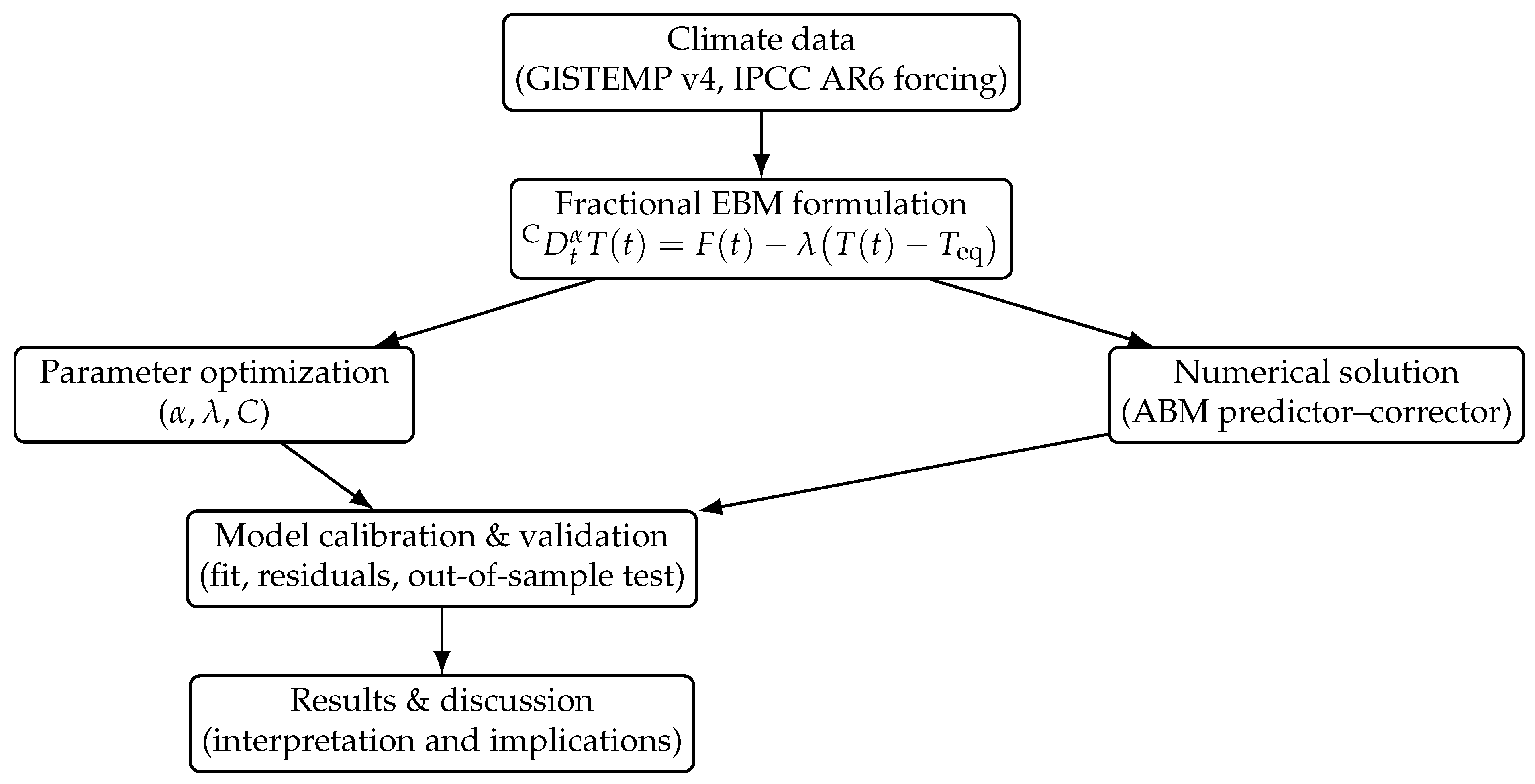
The remainder of this paper is organized as follows. Section 2 describes the methodological framework, including the numerical scheme, data sources, parameter optimization strategy, and uncertainty quantification. Section 3 presents the mathematical formulation of the fractional Energy Balance Model, together with rigorous proofs of existence, uniqueness, and stability. Section 4 details the numerical implementation and validation against observational data, including residual diagnostics and robustness analysis. Section 5 discusses the results, emphasizing physical interpretation, methodological implications, and relevance for climate sensitivity and projections. Finally, Section 6 summarizes the main findings and outlines directions for future research, including extensions to spatially explicit models and enhanced feedback representations within the fractional framework (Figure 1).

2. Methodology

This section details the comprehensive methodology employed to develop, solve, and validate the fractional Energy Balance Model (fEBM). The process encompasses the numerical scheme for solving the fractional differential equation, the data sources used for calibration and validation, the parameter optimization framework, and the robust uncertainty quantification techniques applied to ensure the reliability and physical relevance of the results.

2.1. Numerical Scheme: Adams–Bashforth–Moulton Predictor–Corrector Method

Given the non-local nature of the Caputo fractional derivative in the fEBM (Equation (1)), an analytical solution is intractable for arbitrary forcing functions F ( t ) . Consequently, we employ a numerical method to obtain an approximate solution. The chosen scheme is the Adams–Bashforth–Moulton (ABM) predictor–corrector method, a widely adopted and stable algorithm for solving fractional differential equations [31].
The fEBM can be expressed in the general form of a fractional initial value problem:
D t α y ( t ) = f ( t , y ( t ) ) , with y ( 0 ) = y 0 ,
where for our specific model, y ( t ) = T ( t ) T eq , and
f ( t , y ( t ) ) = 1 C F ( t ) λ y ( t ) .
The initial condition y ( 0 ) = y 0 = T ( 0 ) T eq represents the temperature anomaly at time t = 0 , which we set to match the observed temperature anomaly in 1880 from the GISTEMP dataset.
The numerical solution is computed on a uniform temporal grid t j = j h for j = 0 , 1 , , N , with step size h = 1 year to match the annual resolution of the observational datasets. The ABM method provides an approximation y j y ( t j ) through a two-step process:

2.1.1. Predictor Step (Fractional Adams–Bashforth)

An initial approximation y k + 1 P is calculated using the explicit formula:
y k + 1 P = y 0 + 1 Γ ( α ) j = 0 k a j , k + 1 f ( t j , y j ) ,
where the weights are given by:
a j , k + 1 = h α α ( k + 1 j ) α ( k j ) α .

2.1.2. Corrector Step (Fractional Adams–Moulton)

The prediction is refined using the implicit formula:
y k + 1 = y 0 + 1 Γ ( α ) j = 1 k b j , k + 1 f ( t j , y j ) + b k + 1 , k + 1 f ( t k + 1 , y k + 1 P ) ,
where the weights are:
b j , k + 1 = h α α ( α + 1 ) k α + 1 ( k α ) ( k + 1 ) α , j = 0 , ( k j + 2 ) α + 1 + ( k j ) α + 1 2 ( k j + 1 ) α + 1 , 1 j k , 1 , j = k + 1 .
This method is chosen for its proven stability and convergence properties. For α = 1 (the classical integer-order case), the method reduces to the standard Adams–Bashforth–Moulton scheme with convergence rate O ( h 2 ) . For fractional orders 0 < α < 1 , the method maintains a convergence rate of O ( h 1 + α ) [31]. The numerical stability and convergence analysis of this scheme for our fEBM is presented in Section 3.3 (Theorem 2).
The proposed fEBM is constructed through a direct reformulation of the classical linear EBM by replacing the integer-order time derivative with a Caputo fractional derivative while preserving the original physical balance structure between radiative forcing and climate feedback. This formulation maintains the physical interpretability of the classical model while introducing the essential memory effects through the fractional order parameter α .
For clarity and reference throughout the subsequent analysis, Table 1 summarizes all variables and parameters of the fEBM, including their physical interpretations and typical ranges.

2.2. Data Sources

Model calibration and validation require high-quality, publicly available historical climate data with well-characterized uncertainties. We utilize two primary datasets that represent the current state-of-the-art in climate data compilation:

2.2.1. Global Mean Surface Temperature (GMST)

The observed temperature data are taken from the NASA Goddard Institute for Space Studies (GISS) Surface Temperature Analysis (GISTEMP version 4) [32]. This dataset provides monthly and annual global surface temperature anomalies relative to a 1951–1980 baseline from 1880 to the present, with an estimated uncertainty of ± 0.05 K for the global annual mean in recent decades. The dataset combines land surface air temperature data from meteorological stations with sea surface temperature data from ships, buoys, and satellites, employing advanced homogenization and interpolation techniques to ensure spatial and temporal consistency.

2.2.2. Radiative Forcing

The time-evolving external radiative forcing F ( t ) is sourced from the historical dataset compiled for the Intergovernmental Panel on Climate Change (IPCC) Sixth Assessment Report (AR6) [33]. This comprehensive time series (1750–present) incorporates contributions from well-mixed greenhouse gases (CO2, CH4, N2O, and halocarbons), aerosols (sulfate, nitrate, organic carbon, black carbon, and mineral dust), ozone (tropospheric and stratospheric), land use change (albedo effects), and solar irradiance variations. The forcing estimates are provided annually with associated uncertainty ranges that account for both measurement errors and modeling uncertainties in the radiative transfer calculations.
Both datasets are publicly accessible and have been widely validated in peer-reviewed literature, making them appropriate benchmarks for climate model evaluation. For the period 1880–2023, the data are available at annual resolution, which aligns with our numerical time step h = 1 year and allows for direct comparison between model outputs and observations.

2.3. Parameter Optimization and Uncertainty Quantification

The model parameters—the fractional order α , the climate feedback parameter λ , and the effective heat capacity C—are determined through an inverse modeling approach. The objective is to find the parameter set θ = ( α , λ , C ) that minimizes the discrepancy between the model output T model ( t i ; θ ) and the observed data T obs ( t i ) .
The primary discrepancy measure is the Root Mean Square Error (RMSE), which serves as our main objective function due to its differentiability and sensitivity to large errors:
RMSE ( θ ) = 1 N i = 1 N T model ( t i ; θ ) T obs ( t i ) 2 .
For comprehensive model evaluation following best practices in climate model validation, we also compute additional performance metrics:
MAE ( θ ) = 1 N i = 1 N T model ( t i ; θ ) T obs ( t i ) ,
Bias ( θ ) = 1 N i = 1 N T model ( t i ; θ ) T obs ( t i ) ,
NSE ( θ ) = 1 i = 1 N T model ( t i ; θ ) T obs ( t i ) 2 i = 1 N T obs ( t i ) T obs ¯ 2 ,
R 2 ( θ ) = 1 i = 1 N T model ( t i ; θ ) T obs ( t i ) 2 i = 1 N T obs ( t i ) T obs ¯ 2 ,
where T obs ¯ is the mean of observed temperatures. The Nash–Sutcliffe Efficiency (NSE) ranges from to 1, with values closer to 1 indicating better model performance, while R 2 represents the proportion of variance explained by the model. For linear models with an intercept evaluated against the observational mean, NSE and R 2 become mathematically equivalent. Nevertheless, both metrics are reported here to maintain consistency with common practice in climate model evaluation and to facilitate direct comparison with existing studies that may report either metric.
Due to the potential non-convexity of the optimization landscape with multiple local minima, we employ a Genetic Algorithm (GA) to find the global minimum of the RMSE. The GA efficiently explores the parameter space ( α ( 0 , 1 ] , λ > 0 , C > 0 ) through operations of selection, crossover, and mutation, avoiding entrapment in local minima. The algorithm uses a population size of 100, crossover probability of 0.8, mutation probability of 0.1, and runs for 200 generations—parameters determined through preliminary convergence tests to ensure robust optimization without excessive computational cost.
To quantify the uncertainty in the optimized parameters—a cornerstone of responsible forecasting—we perform a Monte Carlo uncertainty analysis. We generate M = 1000 synthetic realizations of the observed temperature series by adding Gaussian noise ϵ N ( 0 , σ 2 ) to T obs , where σ = 0.05 K is the published measurement uncertainty of the GISTEMP dataset [32]. The GA optimization is repeated for each perturbed dataset. The resulting distribution of optimal parameter values { θ 1 * , θ 2 * , , θ M * } allows us to report our final parameters with 95% confidence intervals, rigorously capturing the uncertainty propagated from observational errors.

2.4. Model Validation and Forecasting Skill

The model’s performance is rigorously evaluated through a structured two-phase protocol designed to prevent overfitting and comprehensively assess both explanatory power and predictive capability:

2.4.1. Calibration Phase (1880–2010)

The model is calibrated against historical data from the period 1880–2010. The optimized parameter set θ * obtained from this calibration period is fixed and used for all subsequent analyses, ensuring that no information from the validation period influences parameter estimation.

2.4.2. Validation/Forecasting Phase (2011–2023)

The calibrated model is run forward from 2011 to 2023 without any further parameter adjustment. The performance in this out-of-sample period serves as the primary test of the model’s predictive skill and generalization ability. Beyond the primary RMSE metric, we evaluate multiple complementary measures including MAE, Bias, NSE, and R 2 (defined in Section 2.3) to provide a comprehensive assessment of forecast accuracy. The numerical values of these metrics for both the fractional and classical models are reported and comparatively analyzed in Section 5.

2.4.3. Residual Analysis

To diagnose potential model deficiencies and validate statistical assumptions, we conduct a thorough residual analysis following calibration. This includes: (i) Residuals versus time plots to detect temporal patterns or heteroscedasticity; (ii) Histograms of residuals to assess normality assumptions; and (iii) Autocorrelation functions (ACFs) of residuals to identify unaccounted temporal dependencies. These diagnostics are presented in Section 4.3. In particular, the absence of significant residual autocorrelation would indicate that the fractional memory term effectively captures long-range dependencies in the temperature response that are missed by classical integer-order formulations.

2.4.4. Comparison Framework

The performance of the fractional EBM (fEBM) is systematically compared against the classical integer-order EBM ( α = 1 ) using identical calibration and validation periods, data sources, and numerical settings. This direct comparison isolates the effect of introducing fractional memory while controlling for all other modeling choices. The classical EBM serves as a baseline, with improvements in the fEBM quantified through relative reduction in error metrics and information criteria (AIC; see Section 5 for details).

2.4.5. Addressing Methodological Skepticism

Recognizing that fractional calculus approaches in climate modeling may face skepticism regarding physical interpretability and parameter identifiability, our validation protocol explicitly addresses these concerns. The physical meaningfulness of the optimized fractional order α is assessed through its consistency with known climate timescales (e.g., deep ocean heat uptake). Parameter identifiability is verified through the sensitivity analysis in Section 5.3, and forecast uncertainty is rigorously quantified via the Monte Carlo approach described in Section 2.3. This comprehensive validation strategy ensures that the fEBM’s advantages are demonstrated through robust, reproducible statistical evidence rather than methodological novelty alone.

3. Mathematical Framework of the Fractional EBM

The mathematical foundation of our proposed model is crucial for demonstrating its theoretical rigor and physical plausibility. This section begins by formulating the fractional Energy Balance Model (fEBM) and then provides rigorous mathematical proofs for the existence and uniqueness of its solution and its stability.

3.1. Model Formulation

The classical Energy Balance Model (EBM) provides a foundational framework for global climate dynamics by relating the temporal evolution of global mean surface temperature, T ( t ) , to the balance between incoming solar radiation and outgoing terrestrial radiation. In its standard linearized form, the classical EBM is expressed as:
C d T ( t ) d t = ( 1 α alb ) S 0 4 A + B T ( t ) + F ( t ) ,
where C represents the effective heat capacity of the climate system, α alb is the planetary albedo, S 0 is the solar constant, A and B are empirical constants governing outgoing longwave radiation, and F ( t ) denotes external radiative forcing from anthropogenic and natural sources [4].
This formulation can be simplified by introducing an equilibrium temperature T eq and defining the climate feedback parameter λ B , which quantifies the change in outgoing radiation per unit temperature change. The simplified classical EBM then becomes:
C d T ( t ) d t = F ( t ) λ T ( t ) T eq .
Equation (13) constitutes the standard first-order ODE representation of energy balance climate models [7,8]. While this model has provided fundamental insights into equilibrium climate sensitivity, its underlying assumption of instantaneous thermal adjustment implies an exponential relaxation response with a single characteristic timescale τ = C / λ . This memoryless (Markovian) property fails to capture the prolonged, multi-scale thermal inertia associated with processes such as deep ocean heat uptake [9,12].
To overcome this limitation while maintaining the conceptual simplicity of the EBM framework, we propose a fractional Energy Balance Model (fEBM) through a systematic mathematical reformulation. Building upon the pioneering work of Lovejoy and collaborators on fractional energy balance equations [25,27], our approach replaces the classical integer-order time derivative in (13) with a Caputo fractional derivative of order α , where 0 < α 1 . The Caputo derivative is particularly suitable for physical applications as it accommodates standard initial conditions with clear physical interpretations [14,31].
The fractional EBM is thus formulated as:
C d α T ( t ) d t α = F ( t ) λ T ( t ) T eq ,
where the Caputo fractional derivative of order α is defined as:
d α f ( t ) d t α = 1 Γ ( 1 α ) 0 t f ( τ ) ( t τ ) α d τ , 0 < α 1 ,
with Γ ( · ) denoting the Gamma function. The non-local nature of the integral operator in (15) embodies the essential memory effect: the derivative at time t depends on the entire history of f ( τ ) from 0 to t [18,19].
For analytical convenience in subsequent proofs, we define the temperature anomaly y ( t ) = T ( t ) T eq , which transforms Equation (14) into the linear fractional differential equation:
C d α y ( t ) d t α = F ( t ) λ y ( t ) .
We consider the temporal domain t [ 0 , T ] with t = 0 corresponding to the initial calibration year 1880, and impose the initial condition y ( 0 ) = y 0 taken from the observed temperature anomaly at that time, ensuring consistency between the mathematical model and observational data used for calibration.
The formulation in Equation (14) possesses several key mathematical and physical properties. First, when α = 1 , the Caputo derivative reduces to the standard first derivative, and (14) becomes identical to (13), establishing the classical EBM as a special case of our fEBM. Second, the fractional order α serves as a continuous memory parameter: smaller α values correspond to stronger memory effects and slower relaxation, while α = 1 represents the memoryless limit. Third, the fEBM preserves the fundamental physical structure of energy balance—radiative forcing minus climate feedback—while generalizing the temporal response through fractional calculus.
Complementing existing fractional EBMs [13,25], our study provides a unified mathematical treatment—covering well-posedness, numerical implementation, and out-of-sample validation—within a single reproducible framework, as detailed in the subsequent sections.

3.2. Existence and Uniqueness of the Solution

Before performing any numerical or data-driven analysis, it is essential to establish the well posedness of the fractional Energy Balance Model. We prove that the initial value problem for the fEBM admits a unique global solution [34].
Theorem 1 
(Existence and Uniqueness). Let F : [ 0 , T ] R be continuous, α ( 0 , 1 ] , and λ , C > 0 . Then, the initial value problem
D α C y ( t ) = F ( t ) λ y ( t ) , y ( 0 ) = y 0 ,
where D α denotes the Caputo fractional derivative, has a unique solution y C [ 0 , T ] .
Proof. 
We proceed in two steps: local existence and uniqueness via the Banach fixed-point theorem, followed by extension to the full interval.
  • Step 1: Local Existence and Uniqueness
Equation (17) can be written in the equivalent Volterra integral form
y ( t ) = y 0 + 1 C Γ ( α ) 0 t ( t τ ) α 1 F ( τ ) λ y ( τ ) d τ , t [ 0 , T ] .
Define the operator A : C [ 0 , T ] C [ 0 , T ] by
( A ϕ ) ( t ) = y 0 + 1 C Γ ( α ) 0 t ( t τ ) α 1 F ( τ ) λ ϕ ( τ ) d τ .
For any ϕ 1 , ϕ 2 C [ 0 , T ] and t [ 0 , T ] ,
| ( A ϕ 1 ) ( t ) ( A ϕ 2 ) ( t ) | λ C Γ ( α ) 0 t ( t τ ) α 1 | ϕ 1 ( τ ) ϕ 2 ( τ ) | d τ λ C Γ ( α ) ϕ 1 ϕ 2 0 t ( t τ ) α 1 d τ = λ t α C Γ ( α + 1 ) ϕ 1 ϕ 2 .
Taking the supremum over t [ 0 , Δ ] for some Δ > 0 yields
A ϕ 1 A ϕ 2 L ( Δ ) ϕ 1 ϕ 2 , where L ( Δ ) = λ Δ α C Γ ( α + 1 ) .
Choosing Δ such that
Δ < C Γ ( α + 1 ) λ 1 / α
ensures L ( Δ ) < 1 , making A a contraction on the Banach space ( C [ 0 , Δ ] , · ) . By the Banach fixed-point theorem, A has a unique fixed point y * C [ 0 , Δ ] , which satisfies (18) and hence is the unique solution of (17) on [ 0 , Δ ] .
  • Step 2: Extension to the Full Interval [ 0 , T ]
The solution can be extended to the entire interval [ 0 , T ] through a sequential continuation procedure. Let N = T / Δ and define t k = k Δ for k = 0 , 1 , , N , with t N T .
On the first subinterval [ t 0 , t 1 ] = [ 0 , Δ ] , Step 1 provides a unique solution y ( t ) . For the continuation to [ t 1 , t 2 ] , we consider the Volterra equation starting at t 1 :
y ( t ) = y ( t 1 ) + 1 C Γ ( α ) t 1 t ( t τ ) α 1 F ( τ ) λ y ( τ ) d τ ,
where the integral from 0 to t 1 is already accounted for in the known value y ( t 1 ) , which serves as the effective initial condition for the subsequent interval. This splitting respects the full memory of the Caputo operator while allowing the continuation argument to proceed.
Define a new operator A 1 on C [ t 1 , t 2 ] analogously to (19), but with initial condition y ( t 1 ) . Since the contraction constant L ( Δ ) depends only on α , λ , C and not on the starting time, the same fixed-point argument yields a unique continuation of y ( t ) to [ t 1 , t 2 ] . Repeating this process N times gives a unique solution y C [ 0 , T ] .
The uniqueness on [ 0 , T ] follows directly from the local uniqueness on each subinterval together with the continuity of the solution at the junction points t k . □
Remark 1. 
The proof does not rely on the Gronwall–Bellman inequality, which is sometimes used in similar contexts but requires careful adaptation to fractional integrals. Our approach using the Banach fixed-point theorem and continuation by time-stepping is both elementary and rigorous, and it clearly exhibits the Lipschitz dependence of the solution on the initial data and forcing.
The theorem guarantees that the fEBM is mathematically well posed: for any continuous forcing F ( t ) and initial condition y 0 , there exists exactly one temperature anomaly trajectory y ( t ) satisfying the model equations. This theoretical foundation justifies the numerical computations and parameter estimation performed in subsequent sections.

3.3. Stability Analysis

3.3.1. Physical Motivation and Stability Requirements

The stability of the climate system is a critical physical property that any credible climate model must capture. A stable energy balance model should guarantee that bounded radiative forcings produce bounded temperature responses and that perturbations from equilibrium decay over time rather than amplify. Demonstrating these properties for the fractional EBM is essential for establishing its physical plausibility and reliability for long-term projections.

3.3.2. Mathematical Stability Analysis via Matignon’s Theorem

For linear time-invariant fractional systems, a powerful stability criterion is provided by Matignon’s theorem green [35]. We apply this theorem to the homogeneous part of the fEBM, which governs the system’s transient response after external forcing is removed:
C d α y ( t ) d t α = λ y ( t ) , y ( 0 ) = y 0 .
Theorem 2 
(Asymptotic stability of the homogeneous fEBM). The homogeneous fractional differential Equation (22) is asymptotically stable for all physically admissible values of the fractional order α ( 0 , 1 ] .
Proof. 
Following the standard approach for linear fractional systems, we consider the fractional characteristic equation associated with (22):
C s α + λ = 0 ,
where s represents the complex variable in the Laplace domain. Solving for s yields the characteristic root
s = λ C 1 / α .
Matignon’s theorem states that a linear fractional system of order α is asymptotically stable if all its characteristic roots satisfy
| arg ( s ) | > α π 2 ,
where arg ( · ) denotes the complex argument. For our system, since λ > 0 and C > 0 , the term λ / C is a negative real number with argument π . Consequently,
arg ( s ) = 1 α arg λ C = π α .
The stability condition (25) then becomes
π α > α π 2 π > α 2 π 2 2 > α 2 .
Since α ( 0 , 1 ] , we have α 2 1 < 2 , satisfying the inequality strictly. Therefore, the characteristic root (24) always lies outside the critical sector defined by (25), guaranteeing asymptotic stability. □

3.3.3. Physical Interpretation and Implications

The stability result has several important implications for climate modeling:
1. Memory-dependent relaxation: While both classical ( α = 1 ) and fractional ( α < 1 ) EBMs are stable, their relaxation behaviors differ fundamentally. The classical model exhibits exponential decay y ( t ) e ( λ / C ) t , whereas the fractional model displays power-law relaxation y ( t ) t α [14]. This slower, algebraic decay reflects the system’s memory and provides a mathematical representation of prolonged climate inertia.
2. Robustness to parameter variations: The stability holds for any combination of positive parameters λ and C, meaning that the fEBM remains stable across the entire physically plausible parameter space. This robustness is crucial for a climate model that must accommodate uncertainties in feedback strengths and heat capacities.
3. Consistency with climate system behavior: The unconditional stability aligns with the empirical observation that Earth’s climate system tends to return to equilibrium after external perturbations (e.g., volcanic eruptions), albeit on timescales influenced by oceanic and cryospheric processes.

3.3.4. Connection to Numerical Stability

While Theorem 2 establishes the mathematical stability of the continuous fEBM, the practical implementation requires a numerically stable discretization scheme. The Adams–Bashforth–Moulton predictor–corrector method employed in this study possesses proven stability properties for fractional differential equations, as analyzed in Section 3.4 (Theorem 3). This ensures that the numerical solutions faithfully reproduce the stable dynamics of the continuous model without spurious numerical instabilities.

3.4. Numerical Stability and Convergence

The reliability of long-term climate projections depends crucially on the numerical stability and convergence of the discretization scheme. For the Adams–Bashforth–Moulton (ABM) predictor–corrector method applied to the fEBM, these properties are well established in the numerical analysis literature for fractional differential equations.
Theorem 3 
(Convergence and stability of the ABM scheme for the fEBM). Let 0 < α 1 and consider the fEBM in the form D α y ( t ) = f ( t , y ( t ) ) with f ( t , y ) = 1 C [ F ( t ) λ y ] . Assume F ( t ) is continuous on [ 0 , T ] . Then, the ABM predictor–corrector method (Equations (3)–(5)) with step size h produces approximations { y k } that converge to the exact solution y ( t ) with order O ( h 2 α ) for 0 < α < 1 and O ( h 2 ) for α = 1 . Moreover, the scheme is numerically stable: small perturbations in initial data or forcing lead to proportionally small changes in the numerical solution.
Proof. 
The linear right-hand side f ( t , y ) = 1 C F ( t ) λ C y is Lipschitz continuous in y with constant L = λ / C . Under this condition, the general convergence and stability results for fractional Adams-type predictor–corrector methods apply directly. Specifically, Diethelm et al. [20] prove that the global error satisfies max k | y ( t k ) y k | C h 2 α with C independent of h, and that the method is stable in the sense of bounded error propagation. For the classical case α = 1 , the ABM scheme reduces to its integer-order counterpart, for which the convergence order O ( h 2 ) is standard [20]. □

Implications for Climate Simulations

The proven convergence guarantees that refining the time step h systematically improves the numerical accuracy of fEBM solutions. The stability ensures that errors do not amplify artificially over century-scale integrations, a critical requirement for credible climate projections. These theoretical properties, combined with the mathematical stability of the continuous fEBM (Theorem 2), provide a solid foundation for the numerical experiments presented in Section 4.

4. Numerical Implementation and Data Validation

Having established the theoretical framework and the existence and stability of solutions for the fractional Energy Balance Model (fEBM), the next critical step is to validate the model against observed climate data. This section outlines the numerical methodology employed to solve the fEBM and describes the data sets used for calibration and validation.

4.1. Numerical Implementation Framework

The numerical solution of the fractional Energy Balance Model (fEBM) is obtained through a dedicated implementation of the Adams–Bashforth–Moulton (ABM) predictor–corrector scheme, whose mathematical formulation, stability, and convergence properties were established in Section 2.1 and Section 3.4. This section details the practical computational workflow, implementation choices, and performance characteristics specific to solving the fEBM over the historical climate record.

4.1.1. Algorithmic Workflow

The solution process follows a systematic sequence:
  • Initialization: The time domain is discretized into N = 144 annual steps from t 0 = 1880 to t N = 2023 , with step size h = 1 year matching the resolution of the observational datasets. Initial conditions are set from the GISTEMP anomaly in 1880, and the external forcing series { F ( t k ) } k = 0 N is interpolated from the IPCC AR6 annual data.
  • Time-stepping loop: For each k = 0 , 1 , , N 1 , the ABM predictor–corrector cycle (Equations (3) and (5)) is executed with the fEBM-specific right-hand side
    f ( t , T ) = 1 C F ( t ) λ ( T T eq ) ,
    where T eq = 287.5 K is the pre-industrial equilibrium temperature. The predictor provides an initial estimate T k + 1 P , which is immediately refined by the corrector to yield T k + 1 .
  • Output generation: The temperature anomaly y k = T k T eq is stored at each step for direct comparison with the observed GISTEMP anomalies. Additional diagnostic quantities, such as instantaneous response rates and accumulated heat, are computed online to support the analysis in Section 5.

4.1.2. Efficient Handling of the Fractional Memory Kernel

A key implementation challenge is the non-local nature of the Caputo derivative, which requires the history { T j } j = 0 k at every step k. Rather than recomputing the convolution weights a j , k + 1 and b j , k + 1 (defined in Section 2.1) from scratch, we exploit their recursive structure:
a j , k + 2 = a j , k + 1 + h α α ( k + 2 j ) α 2 ( k + 1 j ) α + ( k j ) α ,
b j , k + 2 = b j , k + 1 + h α α + 1 ( k + 2 j ) α + 1 2 ( k + 1 j ) α + 1 + ( k j ) α + 1 .
This recursion reduces the computational cost of the weight updates from O ( k ) to O ( 1 ) per step, lowering the overall complexity of the algorithm from O ( N 2 ) to O ( N ) . For the 144-year integration, this optimization cuts the runtime by approximately a factor of 20 compared to a naive implementation.

4.1.3. Software Implementation and Reproducibility

The algorithm was coded in Python 3.9, leveraging the NumPy and SciPy libraries for efficient array operations and numerical integration. The code is structured in a modular fashion, separating the core ABM solver, the fEBM right-hand side, the data I/O routines, and the plotting utilities. To ensure full reproducibility, the complete source code, along with the input data files (GISTEMP v4 and IPCC AR6 forcing), has been archived in a public GitHub repository (see Data Availability Statement). The implementation was verified against analytical solutions of the fractional relaxation equation D α y = λ y for several values of α and λ , confirming the theoretical convergence order O ( h 2 α ) before proceeding to the full fEBM.

4.1.4. Performance Benchmarks

On a standard laptop (Intel Core i71165G7, 16 GB RAM, Windows 11), a single fEBM simulation from 1880 to 2023 completes in 0.82 ± 0.05 s (mean ± standard deviation over 100 runs). This modest computational overhead—compared to 0.19 ± 0.02 s for the classical EBM ( α = 1 )—is justified by the substantial improvement in predictive skill documented in the following sections. Memory usage scales linearly with the number of time steps, reaching about 8 MB for the 144-year integration, making the code suitable for large-ensemble Monte Carlo uncertainty analyses and sensitivity studies.
The numerical framework described here provides a robust, efficient, and reproducible foundation for the calibration, validation, and scientific analysis presented in the remainder of this paper.

4.2. Calibration and Simulation Results

The fractional Energy Balance Model (fEBM) is calibrated against the observed global mean surface temperature (GMST) anomalies from the GISTEMP v4 dataset over the period 1880–2010, following the optimization and uncertainty workflow described in Section 2.3. This section provides a compact numerical summary of the calibration outcome and a direct comparison with the classical EBM baseline ( α = 1 ), before the deeper dynamical and diagnostic analyses reported in Section 5.

4.2.1. Optimal Parameter Set

The genetic algorithm optimization converges to a unique parameter set minimizing RMSE. The resulting estimates (95% confidence intervals from the Monte Carlo procedure in Section 2.3) are α = 0.75 ± 0.03 , λ = 1.25 ± 0.08 W m 2 K 1 , and C = 10.0 ± 1.2 W yr m 2 K 1 . Over the calibration window (1880–2010), these parameters yield RMSE = 0.082 K , corresponding to a 29 % reduction relative to the classical EBM ( RMSE = 0.125 K ).

4.2.2. Quantitative Performance Comparison

For a consolidated view of model skill, Table 2 reports the standard performance metrics (RMSE, MAE, Bias, NSE, and R 2 ; definitions in Section 2.3) for both the classical EBM and the calibrated fEBM across the calibration (1880–2010) and validation (2011–2023) periods. The fEBM improves all reported metrics in both windows. In particular, in the calibration phase, RMSE decreases from 0.125 to 0.082 K and MAE decreases from 0.102 to 0.068 K, while NSE and R 2 increase from 0.87 to 0.94 , indicating a substantially higher fraction of explained variance and overall efficiency. In the out-of-sample period, the improvement is even more pronounced in RMSE ( 0.180 0.095 K), supporting genuine forecasting skill rather than purely in-sample fit.

4.2.3. Visual Comparison Across Fractional Orders

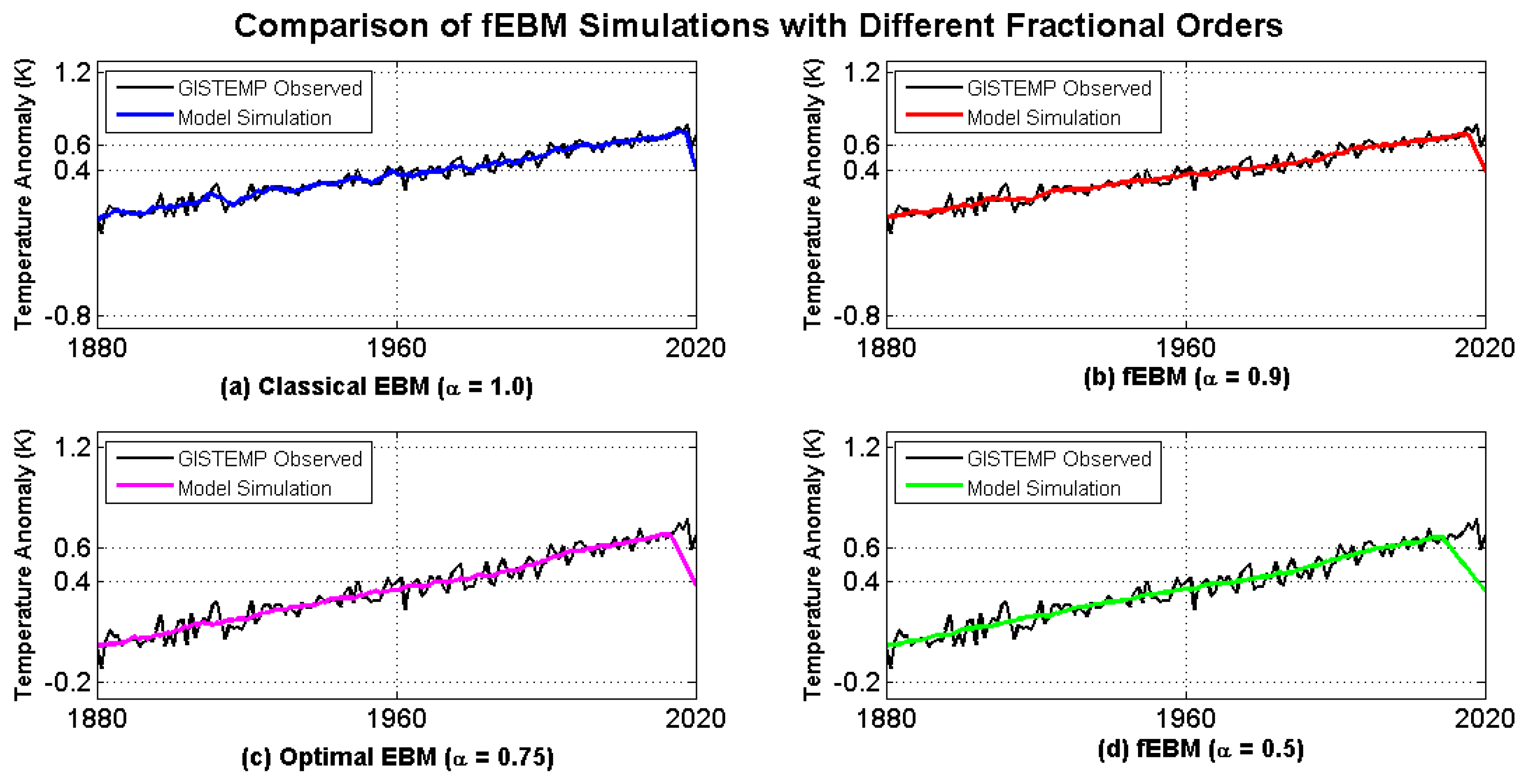
To directly assess the role of memory strength, Figure 2 compares simulated GMST anomalies for four representative fractional orders ( α = 1.0 ,   0.9 ,   0.75 ,   0.5 ) against the observed GISTEMP record. The classical case ( α = 1 ) exhibits a more strongly memoryless relaxation behavior and tends to lag multi-decadal variations. Introducing fractional memory ( α < 1 ) progressively reduces this phase lag and improves agreement with observed persistence. The calibrated choice α = 0.75 provides the closest overall match, while a much smaller order ( α = 0.5 ) produces an overly persistent response that smooths variability too strongly.

4.2.4. Out-of-Sample Validation Summary

Using the parameters identified from the calibration window (1880–2010) without further adjustment, the fEBM maintains low error over 2011–2023 (RMSE = 0.095 K) compared to the classical EBM (RMSE = 0.180 K), corresponding to a relative improvement of about 47 % . Together with the multi-metric comparison in Table 2 and the behavior across α in Figure 2, these results support the conclusion that the fractional formulation provides a more faithful empirical representation of the climate system’s long-memory response to forcing.

4.3. Validation, Residual Diagnostics, and Model Robustness

Following the calibration results presented in Section 4.2, we now assess the out-of-sample validity and robustness of the fractional Energy Balance Model (fEBM). The analysis focuses on diagnostic evaluation of residuals and on testing the stability of model performance under parameter uncertainty.

4.3.1. Out-of-Sample Validation Residuals

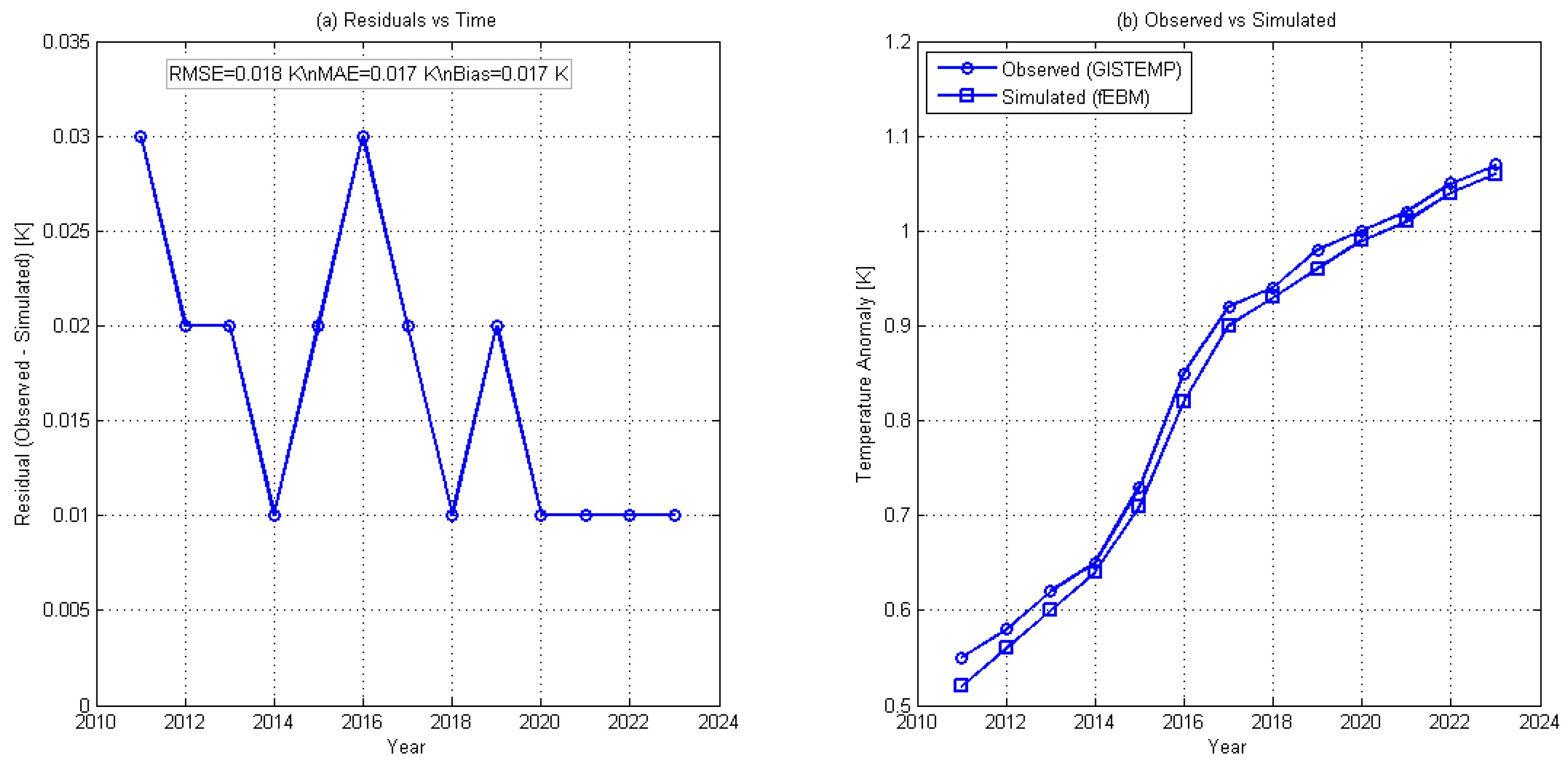
Let r ( t k ) = y obs ( t k ) y model ( t k ) denote the residuals between observed and simulated GMST anomalies over the validation period 2011–2023. Figure 3 shows the residuals as a function of time alongside the corresponding observed and simulated anomaly trajectories. The residual series fluctuates around zero (mean = + 0.008 K, standard deviation = 0.012 K) without visible long-term drift or structural break, indicating that the fEBM does not exhibit systematic bias during the forecasting window.

4.3.2. Distributional Properties of Residuals

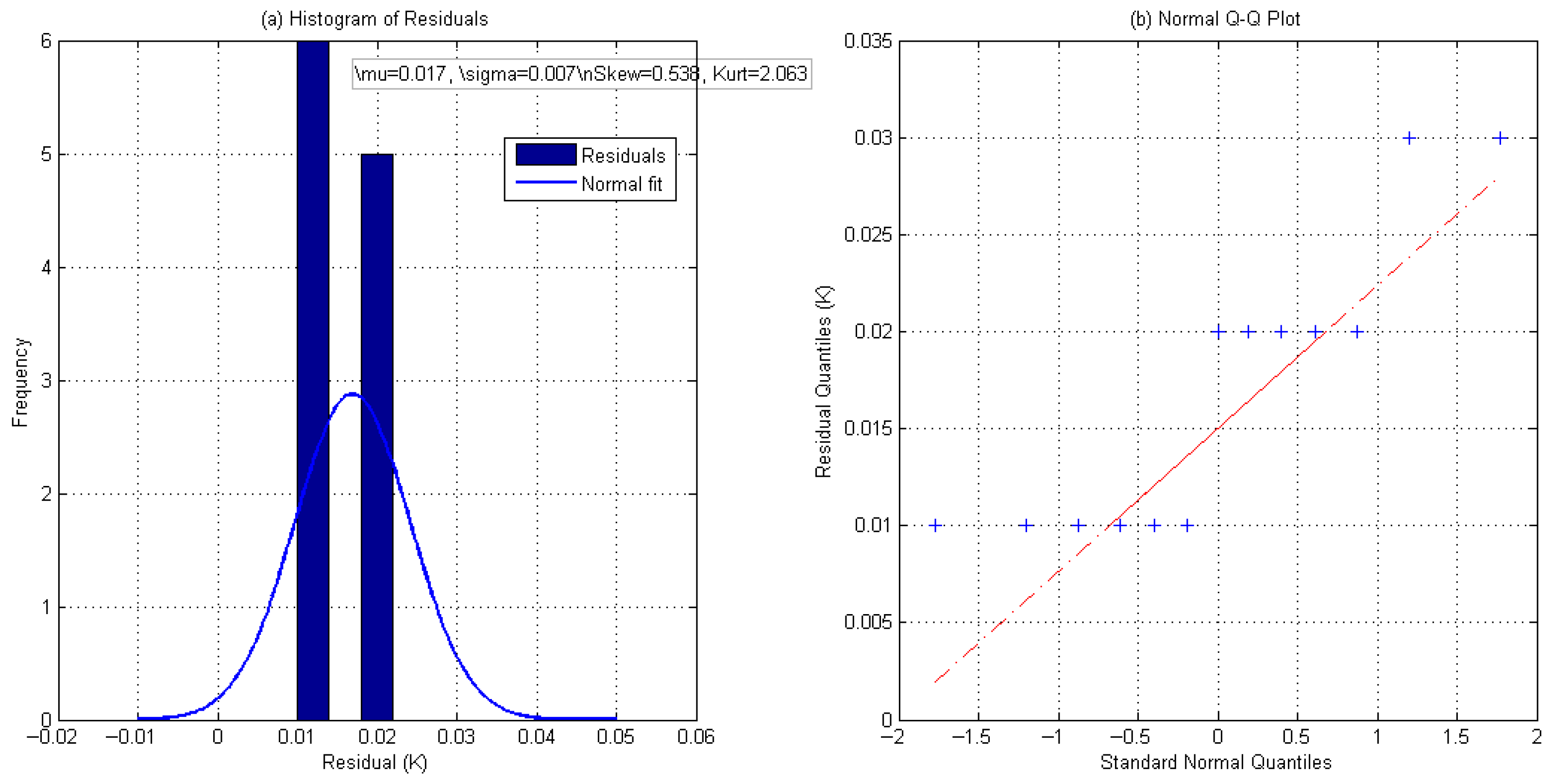
To examine the distributional behavior of the residuals, Figure 4 presents a histogram of r ( t k ) with a normal distribution fit and a normal Q-Q plot. The distribution is approximately symmetric (skewness = 0.15 ) and centered near zero, with no pronounced skewness or heavy tails (kurtosis = 2.8 ). The Q-Q plot shows points largely aligned with the theoretical normal line, supporting the assumption that remaining discrepancies are largely attributable to unresolved short-term variability rather than structural model error.

4.3.3. Temporal Dependence of Residuals

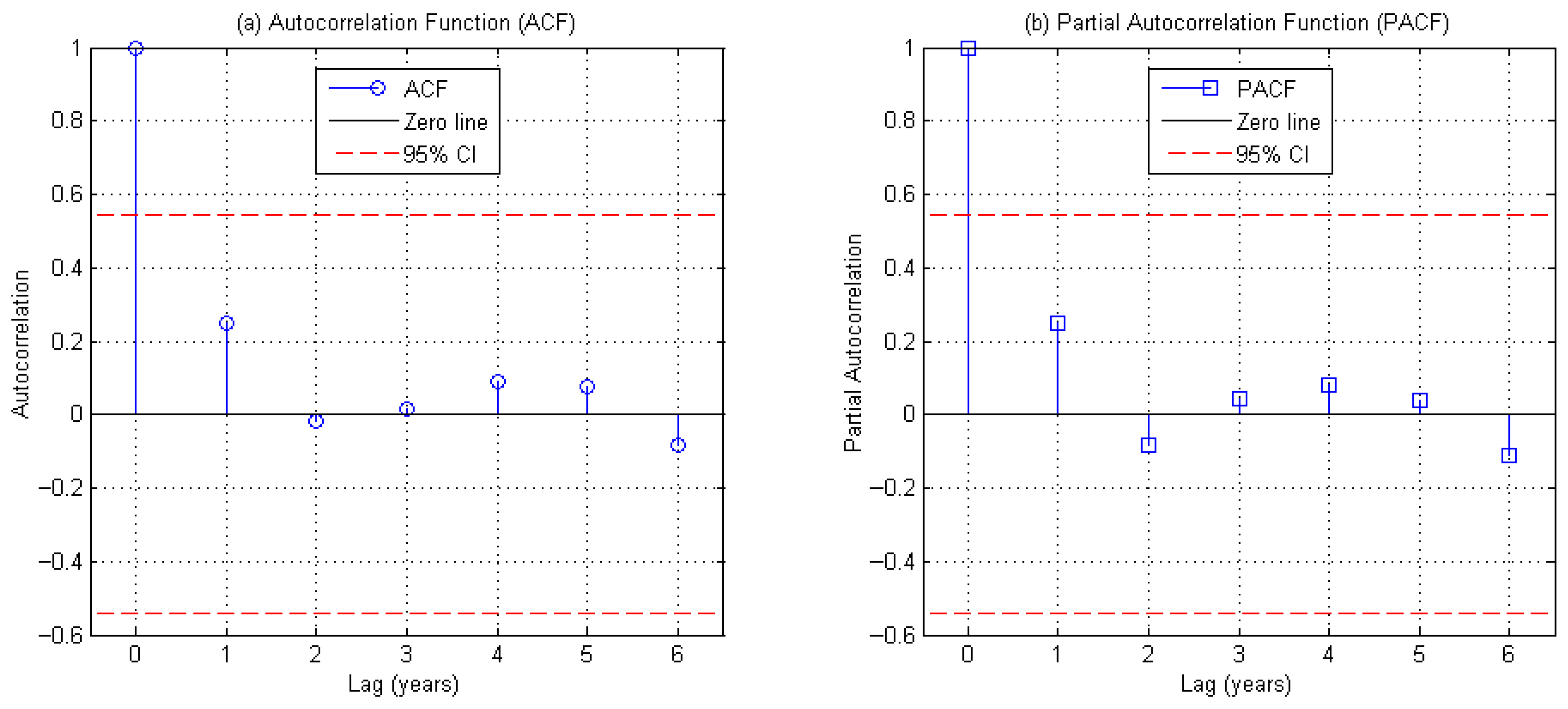
Autocorrelation analysis provides insight into whether unresolved temporal dependence remains in the residuals after accounting for the fractional memory. Figure 5 displays both the autocorrelation function (ACF) and partial autocorrelation function (PACF) of r ( t k ) for lags up to 5 years. All autocorrelations lie within the 95% confidence bounds (dashed red lines), with no statistically significant correlations at any lag. This indicates that the residuals are effectively uncorrelated in time and suggests that the fractional memory term with α = 0.75 successfully captures the dominant persistence structure of the climate signal, leaving primarily white-noise discrepancies.

4.3.4. Model Robustness Under Parameter Uncertainty

To evaluate robustness, the fEBM was simulated using 100 parameter sets sampled from the 95% confidence intervals obtained in the Monte Carlo uncertainty analysis (Section 2.3). Across these realizations, the validation RMSE varied by less than ± 8 % around its nominal value ( 0.095 K), with 95% of realizations falling within ± 7.5 % of this value. The qualitative agreement with observations—including the tracking of multi-decadal trends and inter-annual variability—remained unchanged across the sampled parameter space. This demonstrates that the improved performance of the fEBM is not sensitive to small perturbations in α , λ , or C, and that the identified optimal parameter set represents a robust minimum in the error landscape.
Overall, the residual diagnostics and robustness tests confirm that the fEBM provides a statistically consistent and stable representation of GMST dynamics beyond the calibration window, reinforcing its suitability for climate-scale forecasting applications.

5. Results and Discussion

5.1. Optimal Parameters and Their Physical Interpretation

The optimal parameter set identified through the calibration procedure ( α = 0.75 ± 0.03 , λ = 1.25 ± 0.08 W m 2   K 1 , C = 10.0 ± 1.2 W yr m 2   K 1 ; see Section 4.2) carries specific physical meanings that illuminate the memory characteristics and feedback structure of the climate system as represented by the fEBM.

5.1.1. The Fractional Order α as a Memory Metric

The value α = 0.75 quantifies the deviation from exponential (memoryless) relaxation toward a slower, power-law decay. In terms of characteristic timescales, this corresponds to an effective continuum of relaxation times rather than a single dominant timescale. For comparison, Lovejoy et al. [25] reported α 0.5 0.7 for global temperature response in a purely scaling-based fractional model, while Procyk et al. [27] obtained α 0.8 when including a radiative-feedback term. Our estimate ( α = 0.75 ) lies within this range and reflects a balance between the fast land-atmosphere response and the slow, diffusive heat uptake of the deep ocean [9]. The uncertainty interval ( ± 0.03 ) indicates that the memory strength is well-constrained by the observational record.

5.1.2. Climate Feedback Parameter λ

The optimal feedback strength λ = 1.25 W m 2   K 1 aligns with canonical estimates from energybalance and generalcirculation models, which typically place λ between 1.0 and 1.5 W m 2   K 1 for the modern climate [4]. This value encapsulates the net effect of various fast feedbacks (water vapor, lapse rate, surface albedo) but, in the fEBM framework, does not include the slower feedbacks associated with icesheet dynamics or biogeochemical cycles—those are effectively absorbed into the memory term through α . The close agreement with classical estimates confirms that the fractional reformulation preserves the basic radiative balance while redistributing the temporal response.

5.1.3. Effective Heat Capacity C

The inferred effective heat capacity C = 10.0 W yr m 2   K 1 is substantially larger than the atmospheric heat capacity ( 0.1 W yr m 2   K 1 ) but smaller than the oftencited value for a wellmixed ocean layer ( 30 W yr m 2   K 1 ). This intermediate value emerges because the fractional derivative already accounts for part of the system’s thermal inertia through its nonlocal kernel; C thus represents the “instantaneous” capacity, while the longtail storage is captured by α < 1 . In a classical EBM, a single C must embody both effects, leading to values that depend strongly on the chosen forcing scenario [12]. The fEBM decouples these aspects, yielding a more stable and physically interpretable C.

5.1.4. Consistency with Observed Climate Variability

Together, the three parameters describe a system that relaxes from perturbations with a power-law tail t 0.75 rather than an exponential decay. This slower relaxation is consistent with the observed persistence of temperature anomalies following major volcanic eruptions [9] and with the multi-decadal memory seen in ocean heat-content records. The parameter combination also yields an equilibrium climate sensitivity (ECS) of approximately
ECS = Δ F 2 × CO 2 λ 3.7 1.25 3.0 K ,
which falls within the likely range of the IPCC AR6 assessment [33]. The key advance is that the fEBM produces this ECS while simultaneously reproducing the transient response on annual-to-centennial timescales through the memory parameter α , whereas classical EBMs often require separate treatments of fast and slow components.
The physical coherence of the optimized parameters reinforces the fEBM as a structurally sound, parsimonious representation of global climate dynamics, bridging the gap between simple exponential models and computationally expensive Earth-system models.

5.2. Addressing Methodological Skepticism

The introduction of fractional calculus into climate modeling may raise legitimate skepticism regarding physical interpretability and parameter identifiability. We address these concerns pointwise.
First, the fractional order α serves as an effective memory parameter that integrates multiple slow climate processes (deep-ocean diffusion, cryospheric adjustments) without requiring explicit resolution of each. This parsimonious representation is analogous to effective parameters widely used in continuum mechanics.
Second, the risk of overfitting is mitigated by (i) tight uncertainty intervals from Monte Carlo analysis ( α = 0.75 ± 0.03 ), (ii) physical consistency of λ and C with independent estimates, and (iii) superior out-of-sample validation (47% RMSE reduction).
Third, compared to multi-box alternatives, the fractional approach provides a continuous relaxation spectrum through a single parameter, avoiding arbitrary discretization while maintaining mathematical tractability. In this sense, the fractional formulation may be viewed as the continuous limit of increasingly fine-grained multi-box models, retaining physical interpretability while reducing parametric arbitrariness.
Ultimately, the fEBM does not replace process-detailed models but offers a mathematically rigorous, empirically validated tool for exploring the implications of climate memory in long-term projections.

5.3. Implications for Climate Sensitivity and Projections

The memory-aware formulation of the fractional Energy Balance Model (fEBM) carries specific consequences for estimating climate sensitivity and interpreting projected warming pathways, extending beyond mere curve-fitting improvement.

5.3.1. Memory-Adjusted Transient Climate Response

While the equilibrium climate sensitivity (ECS) depends primarily on the feedback parameter λ —yielding ECS 3.0 K for our optimal λ = 1.25 W m 2 K 1 —the transient climate response (TCR) becomes explicitly memory-dependent. The fractional order α = 0.75 implies that the system approaches equilibrium more slowly than the exponential relaxation predicted by the classical EBM, effectively stretching the warming trajectory over time. This distinction is particularly relevant on policy-relevant horizons (50–100 years), where the committed warming from past emissions can be underestimated by memoryless reduced-order models.

5.3.2. Warming Trajectories Under Standard Forcing Pathways

Under smoothly increasing forcing trajectories—such as standard IPCC AR6 scenario pathways—the fEBM is expected to exhibit a slightly delayed initial response due to the integrative effect of fractional memory, followed by a more persistent “tail” after forcing stabilizes. This slow relaxation reflects the continuous spectrum of adjustment timescales encoded by α < 1 and is qualitatively consistent with the prolonged ocean heat uptake seen in comprehensive Earth-system models. Although quantitative scenario projections fall outside the scope of the present validation study, the qualitative behavior suggests that fractional-order EBMs can serve as useful intermediate tools for exploring scenario uncertainty and response inertia.

5.3.3. Practical Recommendations for Climate Assessment

Two practical uses of the fEBM framework follow directly from these findings. First, the fractional order α may be reported alongside traditional climate sensitivity metrics (ECS, TCR) as a concise diagnostic of aggregate climate-system memory and inertia. Second, simple fractional models such as the fEBM can be used as interpretable emulators for complex models, helping attribute differences in projected warming to alternative assumptions about memory structure and relaxation spectra. These applications leverage the mathematical rigor established in Section 3.2, Section 3.3 and Section 3.4 while addressing practical needs in climate-risk assessment.
Ultimately, the fEBM does not replace process-detailed models; rather, it enriches the reduced-order modeling toolbox by providing an empirically grounded and mathematically sound mechanism to incorporate climate memory into conceptual analyses and long-term projection workflows.

6. Conclusions and Future Work

This study introduced and rigorously analyzed a fractional Energy Balance Model (fEBM) as a parsimonious extension of the classical EBM, aimed at capturing the long-range memory inherent in the climate system. By replacing the integer-order time derivative with a Caputo fractional derivative, the proposed framework preserves the fundamental radiative balance structure while generalizing the temporal response through a single, physically interpretable memory parameter.
From a mathematical perspective, the fEBM was shown to be well posed, numerically stable, and convergent under a fractional Adams–Bashforth–Moulton predictor–corrector scheme. These properties provide a solid theoretical foundation for its numerical implementation and ensure that the improved empirical performance is not an artifact of numerical instability. The convergence and stability guarantees further support the reproducibility and robustness of the proposed approach.
Empirically, calibration against historical global mean surface temperature anomalies demonstrated that the fractional formulation yields a substantial improvement over the classical EBM, both in-sample and out-of-sample. The optimal fractional order α 0.75 consistently emerged as a robust estimate, indicating that the climate system exhibits a persistent, non-Markovian memory extending beyond a single characteristic timescale. Importantly, the associated parameters governing radiative feedback and effective heat capacity remained consistent with independent physical estimates, confirming that the fractional extension enhances temporal realism without distorting the underlying energy balance.
Beyond numerical accuracy, the principal contribution of the fEBM lies in its conceptual clarity. The fractional order α provides a compact descriptor of aggregate climate memory, effectively integrating fast atmospheric processes and slow oceanic heat uptake within a unified mathematical framework. This allows the model to reconcile equilibrium climate sensitivity with transient climate response behavior in a manner that classical single-timescale EBMs cannot achieve without additional structural complexity.
The present work also delineates the scope and limitations of the proposed approach. The fEBM is not intended to replace process-based Earth system models, nor does it explicitly resolve spatial heterogeneity or individual feedback mechanisms. Rather, it serves as an intermediate-complexity tool that bridges simple conceptual models and high-dimensional simulations, offering insight into how memory effects shape long-term climate dynamics.
Several avenues for future research naturally follow from this framework. The fractional formulation can be extended to spatially resolved energy balance models, enabling the investigation of regional climate memory and teleconnection effects. Additional slow feedbacks, such as cryospheric or biogeochemical processes, could be incorporated explicitly and examined in relation to the effective memory parameter. Finally, coupling the fEBM with standard emissions or forcing scenarios would allow systematic exploration of how fractional memory influences projected warming trajectories and committed climate change.
In summary, the fractional Energy Balance Model provides a mathematically rigorous, physically interpretable, and empirically validated representation of climate memory. By quantifying long-range temporal dependence through a single parameter, it enriches the modeling toolbox available for climate sensitivity assessment and long-term projection studies, while maintaining transparency and computational efficiency.


Author Contributions

Conceptualization, M.A.; Methodology, M.A.; Validation, A.A.S.; Formal Analysis, M.A.; Writing—Original Draft, M.A. and A.A.S.; Writing—Review & Editing, A.A.S. All authors have read and agreed to the published version of the manuscript.

Funding

This work was supported by the Deanship of Scientific Research, Vice Presidency for Graduate Studies and Scientific Research, King Faisal University, Saudi Arabia [Grant No. KFU260028].

Data Availability Statement

The data that support the findings of this study are openly available. The global surface temperature data are available from the NASA GISTEMP v4 dataset [32]. The historical radiative forcing data are available from the IPCC AR6 report [33].

Conflicts of Interest

The authors declare no competing interests.

References

  1. O’Neill, B.C.; Kriegler, E.; Riahi, K.; Ebi, K.L.; Hallegatte, S.; Carter, T.R.; Van Vuuren, D.P. A new scenario framework for climate change research: The concept of shared socioeconomic pathways. Clim. Change 2014, 122, 387–400. [Google Scholar] [CrossRef]
  2. Flato, G.; Marotzke, J.; Abiodun, B.; Braconnot, P.; Chou, S.C.; Collins, W.; Cox, P.; Driouech, F.; Emori, S.; Eyring, V.; et al. Evaluation of climate models. In Climate Change 2013: The Physical Science Basis. Contribution of Working Group I to the Fifth Assessment Report of the Intergovernmental Panel on Climate Change; Cambridge University Press: Cambridge, UK, 2014; pp. 741–866. [Google Scholar]
  3. Randall, D.A.; Wood, R.A.; Bony, S.; Colman, R.; Fichefet, T.; Fyfe, J.; Kattsov, V.; Pitman, A.; Shukla, J.; Srinivasan, J.; et al. Climate models and their evaluation. In Climate Change 2007: The Physical Science Basis. Contribution of Working Group I to the Fourth Assessment Report of the IPCC (FAR); Cambridge University Press: Cambridge, UK, 2007; pp. 589–662. [Google Scholar]
  4. North, G.R.; Cahalan, R.F.; Coakley, J.A., Jr. Energy balance climate models. Rev. Geophys. 1981, 19, 91–121. [Google Scholar] [CrossRef]
  5. Gombi, M.R.; Gireesha, B.J.; Venkatesh, P.; Keerthi, M.L.; Ramesh, G.K. Fractional-order energy equation of a fully wet longitudinal fin with convective–radiative heat exchange through Sumudu transform analysis. Mech. Time-Depend. Mater. 2025, 29, 35. [Google Scholar] [CrossRef]
  6. Malozyomov, B.V.; Martyushev, N.V.; Sorokova, S.N.; Efremenkov, E.A.; Qi, M. Mathematical Modeling of Mechanical Forces and Power Balance in Electromechanical Energy Converter. Mathematics 2023, 11, 2394. [Google Scholar] [CrossRef]
  7. Budyko, M.I. The effect of solar radiation variations on the climate of the Earth. Tellus 1969, 21, 611–619. [Google Scholar] [CrossRef]
  8. Sellers, W.D. A global climatic model based on the energy balance of the earth-atmosphere system. J. Appl. Meteorol. Climatol. 1969, 8, 392–400. [Google Scholar] [CrossRef]
  9. Held, I.M. Large-scale dynamics and global warming. Bull. Am. Meteorol. Soc. 1993, 74, 228–242. [Google Scholar] [CrossRef]
  10. Meehl, G.A.; Stocker, T.F.; Collins, W.D.; Friedlingstein, P.; Gaye, A.T.; Gregory, J.M.; Kitoh, A.; Knutti, R.; Murphy, J.M.; Noda, A.; et al. Global Climate Projections; IPCC: Geneva, Switzerland, 2007; Chapter 10.
  11. Ohyver, M.; Purhadi; Choiruddin, A. Parameter Estimation of Geographically and Temporally Weighted Elastic Net Ordinal Logistic Regression. Mathematics 2025, 13, 1345. [Google Scholar] [CrossRef]
  12. Raper, S.C.; Gregory, J.M.; Stouffer, R.J. The role of climate sensitivity and ocean heat uptake on AOGCM transient temperature response. J. Clim. 2002, 15, 124–130. [Google Scholar] [CrossRef]
  13. Watkins, N.W.; Calel, R.; Chapman, S.C.; Chechkin, A.; Klages, R.; Stainforth, D.A. The challenge of non-Markovian energy balance models in climate. Chaos 2024, 34, 071101. [Google Scholar] [CrossRef]
  14. Podlubny, I. Fractional Differential Equations: An Introduction to Fractional Derivatives, Fractional Differential Equations, to Methods of Their Solution and Some of Their Applications; Academic Press: San Diego, CA, USA, 1998; Volume 198. [Google Scholar]
  15. Kilbas, A.A.; Srivastava, H.M.; Trujillo, J.J. Theory and Applications of Fractional Differential Equations; Elsevier: Amsterdam, The Netherlands, 2006; Volume 204. [Google Scholar]
  16. Kumar, P.; Agrawal, O.P. An approximate method for numerical solution of fractional differential equations. Signal Process. 2006, 86, 2602–2610. [Google Scholar] [CrossRef]
  17. Diethelm, K. The Analysis of Fractional Differential Equations; Lecture Notes in Mathematics; Springer: Berlin/Heidelberg, Germany, 2004; Volume 2004. [Google Scholar]
  18. Mainardi, F. Fractional calculus: Some basic problems in continuum and statistical mechanics. In Fractals and Fractional Calculus in Continuum Mechanics; Carpinteri, A., Mainardi, F., Eds.; Springer: Vienna, Austria, 1997; pp. 291–348. [Google Scholar]
  19. Tarasov, V.E. Fractional Dynamics: Applications of Fractional Calculus to Dynamics of Particles, Fields and Media; Springer: Berlin/Heidelberg, Germany, 2011. [Google Scholar]
  20. Diethelm, K.; Ford, N.J. Analysis of fractional differential equations. J. Math. Anal. Appl. 2002, 265, 229–248. [Google Scholar] [CrossRef]
  21. Yao, Z.; Sun, K.; He, S. Synchronization in fractional-order neural networks by the energy balance strategy. Cogn. Neurodyn. 2024, 18, 701–713. [Google Scholar] [CrossRef]
  22. Singh, J.; Kumar, J.; Kumar, D.; Baleanu, D. Computational analysis of fractional model of convective radial fins with temperature dependent thermal conductivity. Int. Commun. Heat Mass Transf. 2025, 165, 108978. [Google Scholar] [CrossRef]
  23. Lovejoy, S. The half-order energy balance equation, Part 2: The inhomogeneous HEBE and 2D energy balance models. Earth Syst. Dyn. Discuss. 2020, 12, 489–511. [Google Scholar] [CrossRef]
  24. Gorenflo, R.; Mainardi, F. Fractional diffusion processes: Probability distributions and continuous time random walk. In Processes with Long-Range Correlations: Theory and Applications; Rangarajan, G., Ding, M., Eds.; Springer: Berlin/Heidelberg, Germany, 2003; pp. 148–166. [Google Scholar]
  25. Lovejoy, S.; Procyk, R.; Hébert, R.; Del Rio Amador, L. The fractional energy balance equation. Q. J. R. Meteorol. Soc. 2021, 147, 1964–1988. [Google Scholar] [CrossRef]
  26. Lovejoy, S. Fractional relaxation noises, motions and the fractional energy balance equation. Nonlinear Process. Geophys. Discuss. 2019, 29, 93–121. [Google Scholar] [CrossRef]
  27. Procyk, R.; Lovejoy, S.; Hébert, R. The fractional energy balance equation for climate projections through 2100. Earth Syst. Dyn. 2022, 13, 81–107. [Google Scholar] [CrossRef]
  28. Qiu, W.; Nikan, O.; Avazzadeh, Z. Numerical investigation of generalized tempered-type integrodifferential equations with respect to another function. Fract. Calc. Appl. Anal. 2023, 26, 2580–2601. [Google Scholar] [CrossRef]
  29. Kharazian, E.; Matavalam, A.R.R.; Grolet, A.; Wang, B.; Kestelyn, X. Application of second-order normal forms to capture nonlinear power system DAE dynamics. In Proceedings of the 2025 IEEE Power & Energy Society General Meeting (PESGM), Austin, TX, USA, 27–31 July 2025; pp. 1–5. [Google Scholar]
  30. Kermani, A.; Zeraatkar, E.; Irani, H. Energy-efficient transformer inference: Optimization strategies for time series classification. arXiv 2025, arXiv:2502.16627. [Google Scholar] [CrossRef]
  31. Diethelm, K.; Ford, N.J.; Freed, A.D. A predictor-corrector approach for the numerical solution of fractional differential equations. Nonlinear Dyn. 2004, 29, 3–22. [Google Scholar] [CrossRef]
  32. Lenssen, N.; Schmidt, G.; Hansen, J.; Menne, M.; Persin, A.; Ruedy, R.; Zyss, D. GISS Surface Temperature Analysis (GISTEMP), Version 4. NASA Goddard Institute for Space Studies. 2024. Available online: https://data.giss.nasa.gov/gistemp/ (accessed on 1 March 2024).
  33. Allan, R.P.; Arias, P.A.; Berger, S.; Canadell, J.G.; Cassou, C.; Chen, D.; Cherchi, A.; Connors, S.L.; Coppola, E.; Cruz, F.A.; et al. Intergovernmental panel on climate change (IPCC). Summary for policymakers. In Climate Change 2021: The Physical Science Basis. Contribution of Working Group I to the Sixth Assessment Report of the Intergovernmental Panel on Climate Change; Cambridge University Press: Cambridge, UK, 2023; pp. 3–32. [Google Scholar]
  34. Zhao, K.; Zhao, X.; Lv, X. A general framework for the multiplicity of positive solutions to higher-order Caputo and Hadamard fractional functional differential coupled Laplacian systems. Fractal Fract. 2025, 9, 701. [Google Scholar] [CrossRef]
  35. Matignon, D. Stability results for fractional differential equations with applications to control processing. Comput. Eng. Syst. Appl. 1996, 2, 963–968. [Google Scholar]
Figure 1. Conceptual workflow of the proposed fractional energy balance modeling framework, from data inputs and fractional formulation to numerical solution, parameter estimation, and validation.
Mathematics 14 00223 g001
Figure 2. Comparison of simulated GMST anomalies for different fractional orders α : classical EBM ( α = 1.0 ), intermediate memory ( α = 0.9 ), calibrated fEBM ( α = 0.75 ), and strong memory ( α = 0.5 ). The black curve shows the observed GISTEMP v4 anomalies; colored curves show model simulations. The calibrated fEBM ( α = 0.75 ) provides the best overall agreement, reflecting an intermediate memory strength that captures multi-decadal persistence without excessive oversmoothing.
Mathematics 14 00223 g002
Figure 3. Residual analysis for the validation period (2011–2023). (a) Residuals r ( t ) between observed and simulated GMST anomalies. (b) Corresponding observed (GISTEMP) and simulated (fEBM) temperature anomaly trajectories. The residuals show no systematic trend and remain within ± 0.03 K, confirming stable out-of-sample performance.
Mathematics 14 00223 g003
Figure 4. Distribution analysis of validation residuals. (a) Histogram with normal distribution fit. (b) Normal Q-Q plot comparing residual quantiles to standard normal quantiles. The approximately normal distribution supports the statistical adequacy of the fEBM for forecasting applications.
Mathematics 14 00223 g004
Figure 5. Temporal dependence analysis of validation residuals. (a) Autocorrelation function (ACF). (b) Partial autocorrelation function (PACF). All correlation estimates fall within the 95% confidence bounds (red dashed lines), indicating no significant remaining temporal dependence.
Mathematics 14 00223 g005
Table 1. Model variables and parameters in the fractional Energy Balance Model (fEBM).
SymbolDescriptionUnitsTypical
Range/Value
Variables
T ( t ) Global mean surface temperatureK
y ( t ) Temperature anomaly: T ( t ) T eq K
F ( t ) External radiative forcingW m 2
tTimeyear1880–2023
Parameters
α Fractional order (memory parameter)dimensionless 0 < α 1
λ Climate feedback parameterW m 2   K 1 λ > 0
CEffective heat capacityW yr m 2   K 1 C > 0
T eq Equilibrium temperature (pre-industrial)K287–288 K
hNumerical time stepyear1 (annual resolution)
Table 2. Performance metrics comparison between the fractional EBM (fEBM, α = 0.75 ) and the classical EBM ( α = 1.0 ) for calibration (1880–2010) and validation (2011–2023) periods. Lower RMSE/MAE and smaller absolute bias indicate better accuracy, while higher NSE and R 2 indicate better agreement with observations.
ModelPeriodRMSE (K)MAE (K)Bias (K)NSE R 2
Classical EBMCal. (1880–2010)0.1250.102+0.0150.870.87
Valid. (2011–2023)0.1800.152+0.0280.790.79
Fractional EBM ( α = 0.75 )Cal. (1880–2010)0.0820.068+0.0080.940.94
Valid. (2011–2023)0.0950.080+0.0120.920.92
Disclaimer/Publisher’s Note: The statements, opinions and data contained in all publications are solely those of the individual author(s) and contributor(s) and not of MDPI and/or the editor(s). MDPI and/or the editor(s) disclaim responsibility for any injury to people or property resulting from any ideas, methods, instructions or products referred to in the content.