1. Introduction
Earthquakes, as one of the most destructive natural hazards, pose persistent threats to human life, critical infrastructure, and socio-economic development due to their sudden occurrence and high uncertainty. Despite significant advances in seismic monitoring and observational technologies, accurately predicting the timing, location, and magnitude of earthquakes remains a major unresolved challenge in Earth sciences [
1]. In this context, earthquake forecasting has become an important research focus and plays a critical role in seismic ground motion zonation and the development of seismic design standards.
To mitigate earthquake risks, seismic zonation has been widely implemented at national, regional, and urban scales, providing a scientific basis for engineering design by classifying seismic hazard levels across different regions. In China, the seismic zoning map released in 1977 introduced the concept of basic seismic intensity, defined as the maximum intensity expected within a 100-year period, which has since guided the seismic design of industrial and civil structures. The development of seismic zonation maps relies fundamentally on long-term earthquake forecasting, in which seismic regions and belts are delineated to evaluate and predict future seismic activity trends.
Seismic hazard assessment constitutes the core methodology of seismic zonation, among which Probabilistic Seismic Hazard Analysis has become the dominant framework worldwide. However, persistent debates remain regarding its reliability [
2]. In recent years, several destructive earthquakes have occurred in regions previously classified as low hazard, resulting in severe casualties and economic losses [
3]. Representative examples include the 2011
Mw 9.0 Tōhoku earthquake in Japan and the 2008
Mw 8.0 Wenchuan earthquake in China [
4,
5]. These events reveal that traditional hazard assessment methods may underestimate extreme events, highlighting the need for complementary approaches capable of capturing the evolution of seismic activity trends.
Traditional earthquake forecasting methods are primarily founded on statistical seismology models and empirical relationships, such as Omori’s law and the Epidemic-Type Aftershock Sequence (ETAS) model. These approaches are capable of extracting spatiotemporal characteristics from earthquake catalogs and constructing probabilistic seismicity forecasting frameworks [
6,
7]. Ebrahimian et al. [
8,
9] proposed a probabilistic forecasting framework based on a Bayesian spatio-temporal ETAS model. By incorporating Bayesian inference and Markov Chain Monte Carlo simulation techniques, their framework enables adaptive updating of seismicity forecasts as new earthquake events become available. Compared with conventional maximum likelihood estimation approaches, the proposed method simultaneously accounts for both the uncertainty in ETAS model parameters and the stochasticity of future seismic sequences, thereby improving the robustness and reliability of short-term seismicity forecasting. In addition, smoothed seismicity models have been extensively employed in long-term earthquake forecasting and have demonstrated promising performance in regional forecasting experiments [
10,
11].
Despite their strong physical interpretability and rigorous theoretical foundations, statistical seismicity models generally rely on linear or weakly nonlinear assumptions. Consequently, their capability in characterizing the highly nonlinear evolutionary behavior and multi-scale spatiotemporal coupling characteristics of seismic activity remains limited. In contrast, data-driven approaches exhibit stronger capability in extracting nonlinear relationships and hidden spatiotemporal patterns from large-scale seismic datasets, thereby providing new opportunities for earthquake forecasting research.
With the rapid advancement of artificial intelligence techniques, recurrent neural networks (RNN) and Long Short-Term Memory (LSTM)-based frameworks have attracted increasing attention in seismic forecasting owing to their superior capability in modeling long-term temporal dependencies in time-series data. Berhich et al. [
12] proposed an attention-based LSTM framework for predicting the timing, magnitude, and location of large earthquakes using the Japan earthquake catalog spanning 1900–2021. Their results demonstrated that the proposed framework achieved significantly improved prediction performance compared with conventional empirical scenarios, highlighting the considerable potential of deep learning approaches for large-earthquake forecasting.
Asim et al. [
13] employed multiple machine learning approaches, including Pattern Recognition Neural Networks (PRNN), RNN, Random Forest (RF), and Linear Programming Boost (LPBoost), to predict earthquakes with magnitudes ≥ 5.5 in the Hindukush region using eight seismicity indicators derived from historical earthquake catalogs. Their results demonstrated that machine learning models can effectively capture nonlinear relationships between seismicity indicators and earthquake occurrence, thereby providing encouraging performance in earthquake forecasting applications. These findings further suggest that machine learning methods possess strong capability in identifying hidden patterns embedded in complex seismic sequences.
Nevertheless, the majority of previous studies have mainly concentrated on temporal forecasting while paying relatively limited attention to the spatial migration characteristics of seismic activity. To address this issue, Yousefzadeh et al. [
14] proposed a spatiotemporally explicit earthquake forecasting framework based on Deep Neural Networks (DNNs), Support Vector Machines (SVMs), Decision Trees (DTs), and Shallow Neural Networks (SNNs). Their study introduced a spatial parameter termed “Fault Density,” derived from Kernel Density Estimation and Bivariate Moran’s I statistics, to characterize the spatial correlations between active faults and seismic activity. The results demonstrated that incorporating spatial parameters can significantly improve forecasting performance, particularly for high-magnitude earthquakes.
Although deep learning frameworks exhibit enhanced nonlinear fitting capability and strong feature extraction performance, their prediction accuracy remains highly dependent on data quality, catalog completeness, feature engineering strategies, and network architecture design. Wu et al. [
10] applied an adaptively smoothed seismicity model to the eastern Tibetan Plateau for long-term probabilistic forecasting of earthquakes with
M ≥ 5.0, and found that models based on longer input catalogs yield improved performance due to the increased number of earthquake samples. Similarly, Mousavi et al. [
15] emphasized that more complete earthquake catalogs can significantly enhance the performance of both statistical and physics-based forecasting methods, as well as artificial intelligence-based approaches. Furthermore, Zhang et al. [
16] proposed an end-to-end machine learning-based workflow for high-precision earthquake location, enabling the efficient and automated construction of high-quality earthquake catalogs from continuous seismic data. These findings collectively highlight the importance of high-quality and long-duration earthquake catalogs for improving forecasting reliability, and further motivate the adoption of advanced data-driven methods capable of capturing the nonlinear characteristics of seismic activity.
Recent studies have highlighted the critical roles of data completeness and methodological advancement in improving earthquake forecasting performance. With the rapid development of dense seismic networks and automated data processing techniques, earthquake catalogs have become increasingly comprehensive and accurate, providing a robust foundation for advanced analyses [
15,
17,
18,
19]. In this context, machine learning approaches have been widely introduced into earthquake forecasting due to their strong capabilities in nonlinear modeling and pattern recognition [
15,
18,
19,
20,
21,
22,
23,
24]. In particular, Zhang et al. [
20] proposed a fully convolutional network model that uses spatial maps of the logarithm of past released seismic energy as input to forecast future earthquakes. Applied to California, the model achieved predictive performance comparable to an enhanced ETAS model, while offering improved computational efficiency. Similar conclusions were reported by Stockman et al. [
21], further demonstrating the potential of neural networks in earthquake forecasting. Moreover, Liu et al. [
22] attempted to incorporate more comprehensive spatiotemporal prior knowledge into DNNs, with the aim of improving the prediction accuracy of earthquake magnitude and epicenter location. Despite these advances, most existing studies focus on individual methods, with limited attention to the complementarity between different approaches. In particular, the joint characterization of temporal evolution and spatial migration of seismic activity remains insufficiently explored, highlighting the need for integrated frameworks that combine multiple modeling paradigms.
China is located in one of the most seismically active regions in the world, characterized by a complex tectonic setting and frequent earthquake hazards. After decades of development, a multi-level earthquake forecasting framework has been established, encompassing long-term, intermediate-term, and short-term predictions [
25,
26]. Among the major seismic zones in China, the North-South Seismic Belt is one of the most active regions for strong earthquakes, exhibiting pronounced spatiotemporal patterns and staged seismic activity. This makes it an ideal natural laboratory for investigating seismic activity trend forecasting.
Motivated by the above considerations, this study investigates seismic activity trends in the North-South Seismic Belt using historical earthquake catalog data. A hybrid framework integrating Wiener filtering and artificial neural networks is proposed to jointly analyze temporal evolution and spatial migration. Specifically, Wiener filtering is employed to characterize the linear temporal evolution of seismic activity, while artificial neural networks are used to capture nonlinear spatiotemporal patterns. Based on this framework, a coupled spatiotemporal forecasting approach is developed. Compared with existing studies, the main contributions of this work are threefold: (1) seismic activity trends are systematically characterized from both temporal and spatial perspectives, overcoming the limitations of single-dimensional analyses; (2) the complementary advantages of linear filtering and nonlinear learning are integrated to improve forecasting reliability; and (3) a sliding time window-based feature extraction strategy is proposed to enhance model stability and robustness. The proposed framework provides new insights for seismic hazard assessment and offers a useful reference for seismic zonation and disaster risk mitigation.
2. Fundamental Principles of Seismic Activity Trend Forecasting
Earthquake occurrence is influenced by multiple stochastic factors and exhibits pronounced randomness in both temporal and spatial distributions. Nevertheless, seismic activity within the same seismic belt often shows a certain degree of correlation. By analyzing the correlation characteristics of earthquake time series, the intrinsic relationships among seismic events can be revealed, providing a basis for seismic activity trend forecasting. In this study, the Wiener filtering method and artificial neural networks are employed to identify the evolutionary patterns of seismic activity and to conduct forecasting of seismic activity trends.
2.1. Principles of Wiener Filtering-Based Seismic Activity Trend Forecasting
Filtering techniques constitute a fundamental component of signal analysis and processing and play a key role in extracting reliable information from noisy observations. With the advancement of automated systems and control theory, time series analysis has evolved beyond traditional signal transmission applications toward broader domains, including forecasting and information extraction. Wiener [
27] systematically investigated the correlation structure and spectral characteristics of stationary stochastic processes and established the theoretical foundation of Wiener filtering and prediction by proposing methods to extract useful signals from noisy sequences.
Earthquake occurrences exhibit distinct characteristics across different magnitude levels, and early earthquake catalogs often suffer from incomplete records of moderate and small events. Previous studies have shown that large earthquakes (
M ≥ 7.0) are typically preceded by several events with magnitudes ≥ 5.6 [
28]. Based on this observation, a time series of earthquakes with magnitudes ≥ 6.0 is selected in this study to characterize the correlation with large earthquakes (
M ≥ 7.0). During the forecasting process, the time series of earthquakes with magnitudes ≥ 7.0 is extrapolated iteratively, enabling simultaneous estimation of the potential occurrence time and intensity of future events. Therefore, the problem can be formulated within a unified framework that combines filtering and prediction.
The earthquake sequence
can be represented using parameters related to either the earthquake magnitude
or the seismic energy release
. In this study, the cube root of seismic energy,
, is adopted. Compared with
, the quantity
increases more rapidly with increasing magnitude, thereby enhancing the contrast between large and small earthquakes. As a result, using
as the intensity measure improves the signal-to-noise ratio by emphasizing large events while suppressing smaller ones. Accordingly, the earthquake sequence is defined as:
where
is the total length of the earthquake time series, and
denotes the maximum magnitude occurring within each year.
The sequence is transformed into a zero-mean stochastic process
as follows:
where
is the mean value of the sequence
.
The process
can be decomposed into two components:
where
represents the sequence of large earthquakes (signal), and
corresponds to the sequence of moderate and small earthquakes (noise).
The objective is to determine a filtering prediction operator
such that, when
is input into the system, the output
approximates the future value of the signal
, where
denotes the prediction horizon. The Wiener filtering-based prediction framework is illustrated in
Figure 1. For the earthquake sequence, this can be expressed as:
Thus, seismic activity trend forecasting can be formulated as the problem of determining an optimal operator
that minimizes the mean square error between the predicted output and the future signal. The input–output relationship of the system is given by:
where
is the impulse response function of the Wiener filtering system, also referred to as the kernel of the operator
.
The problem therefore reduces to solving for the kernel function
. Under the minimum mean square error criterion,
satisfies the following integral equation:
where
is the cross-correlation function between
and
, and
is the autocorrelation function of
.
These correlation functions are defined as:
Since and are known, the correlation functions and can be computed using Equations (8) and (9). Substituting the solution of Equation (7) into Equation (6) yields the predicted values of future seismic activity.
In this study, a multi-origin extrapolation strategy is employed to evaluate the effectiveness of the Wiener filtering method for seismic activity trend forecasting. During the extrapolation process, a portion of the earthquake time series is withheld as a validation dataset, and predictions are generated from multiple starting points. The predicted results are then compared with the corresponding observed data for validation. In addition, cross-comparison among predictions from different starting points is conducted to assess consistency and enhance the reliability of the results.
2.2. Principles of Artificial Neural Network-Based Seismic Activity Trend Forecasting
Driven by the dynamic motion of the mantle asthenosphere, tectonic plates undergo continuous movement and interaction. Tectonic earthquakes resulting from these plate dynamics account for more than 90% of global seismic activity. The inherent complexity of this geodynamic process introduces pronounced nonlinearity and significant uncertainty into earthquake occurrence. Seismic activity trend forecasting can be viewed as a process of identifying underlying patterns in earthquake sequences and extrapolating them into the future, which is conceptually analogous to the pattern recognition capability of artificial neural networks. As highly adaptive nonlinear dynamical systems, artificial neural networks can learn from large volumes of data to extract latent relationships and evolutionary patterns, enabling effective modeling and prediction of complex nonlinear processes. This aligns well with the objective of analyzing earthquake sequences to uncover intrinsic correlations and forecast future seismic activity trends. Therefore, artificial neural network-based methods provide a promising approach for seismic activity trend forecasting.
A multilayer feedforward neural network consists of an input layer, one or more hidden layers, and an output layer. The input layer receives external data, while the hidden layers, composed of interconnected neurons, perform nonlinear transformations through activation functions. The connections between neurons are characterized by weights, which are iteratively adjusted during training. Although multiple hidden layers can be employed, a single hidden layer is commonly adopted in practical applications due to its balance between model complexity and computational efficiency. The output layer produces the final prediction results, which are determined by the network architecture, activation functions, and connection weights.
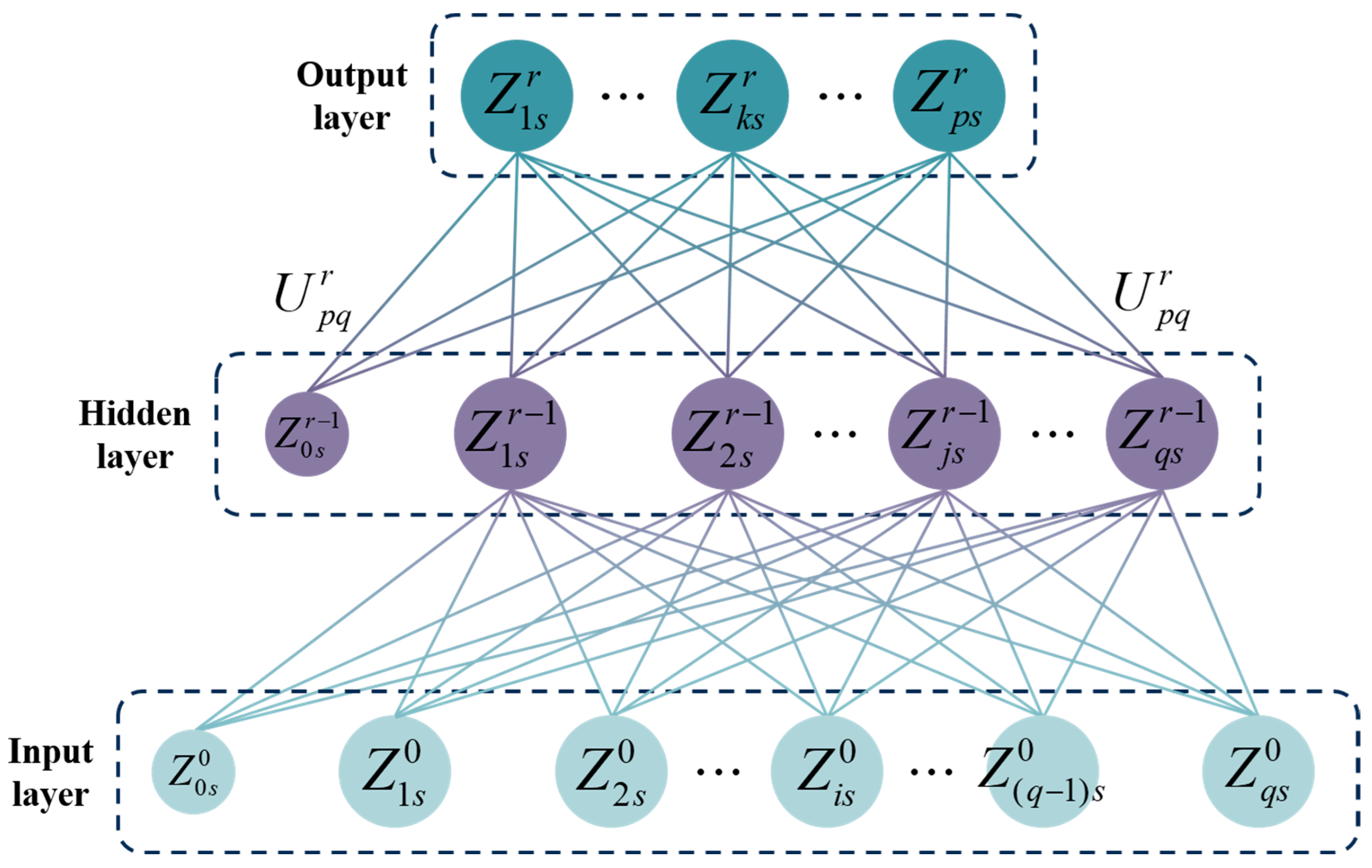
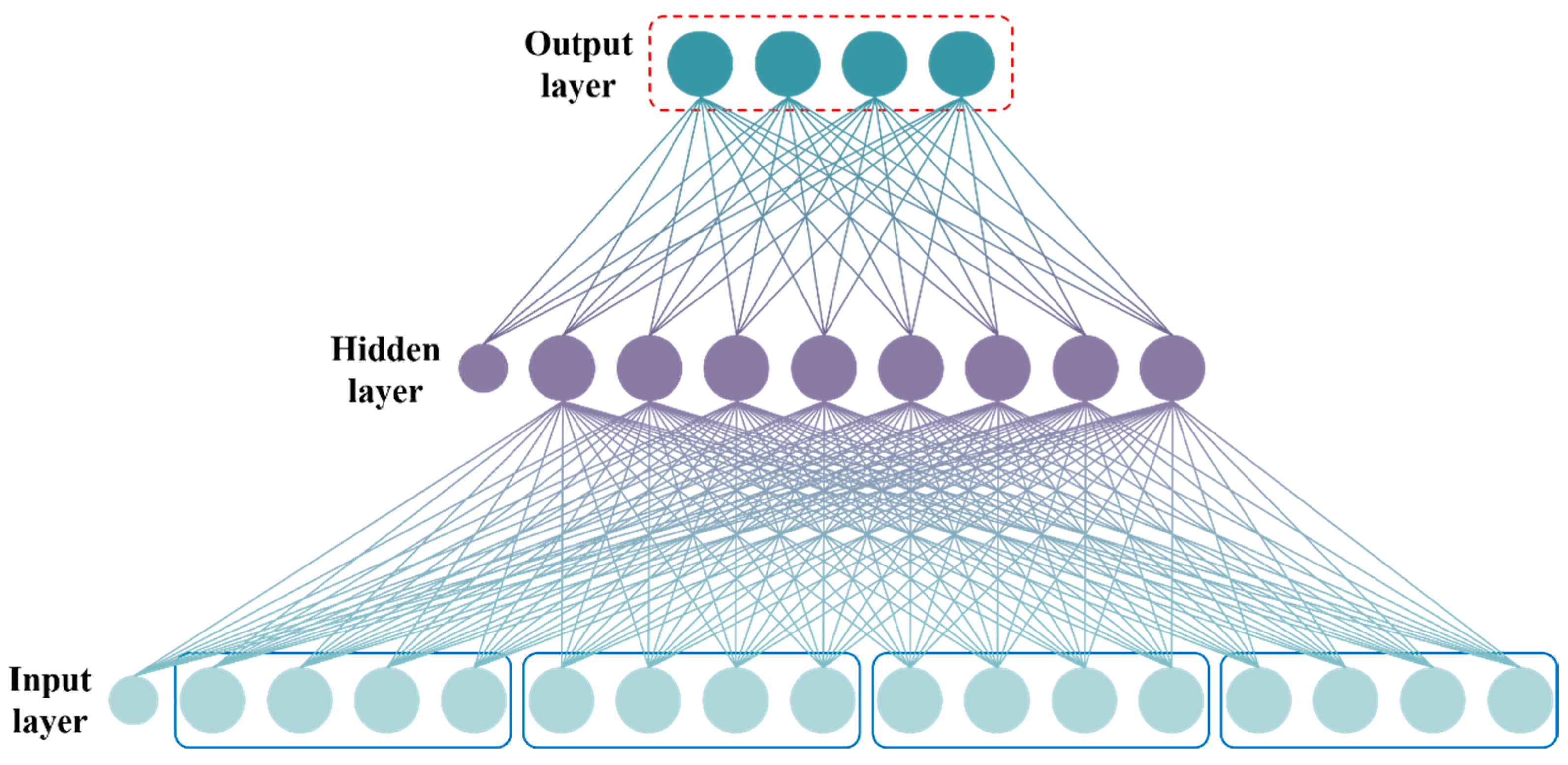
The backpropagation neural network, one of the most widely used feedforward architectures, is trained through forward and backward propagation. In the forward propagation stage, input signals pass through the network to generate predictions. In the backward propagation stage, the prediction error is propagated backward to update the network weights, progressively reducing the error and improving model accuracy. In this study, a two-layer backpropagation neural network is adopted, and its architecture is illustrated in
Figure 2.
The output of each neuron can be expressed as:
where
denotes the output of the
p-th neuron in the
r-th layer for sample
;
represents the output of the
q-th neuron in the (
r − 1)-th layer (for
, it corresponds to the input of sample
);
is the connection weight between the
q-th neuron in the (
r − 1)-th layer and the
p-th neuron in the
r-th layer; and
is the number of neurons in the (
r − 1)-th layer.
The error
between the network output and the target output is defined as:
where
is the desired output of the
p-th neuron in the output layer for sample
,
is the corresponding network output, and
is the number of neurons in the output layer.
The weights
are updated using the gradient descent method to minimize the error function. The update rule is given by:
where
is the learning rate, typically chosen within the range (0, 1).
By substituting Equation (10) into Equation (11), the weight update can be derived as:
where the propagated error term
is defined as:
To accelerate convergence, a momentum term is introduced into the weight update at the
k-th iteration:
where
is the momentum coefficient, typically selected within the range 0.2–0.4.
During training, the network weights are initialized with nonzero random values within the range of ±1.0. The training samples, consisting of input–output pairs, are sequentially fed into the network, and the weights are updated iteratively after each sample. A full pass through all samples constitutes one training epoch. The training process continues until the loss function converges to a predefined tolerance or the maximum number of epochs is reached.
From a methodological perspective, the Wiener filtering and artificial neural network approaches can be interpreted within a unified predictive framework for seismic activity trend forecasting. The Wiener filtering method formulates the problem as an optimal linear estimation of stochastic processes under the minimum mean square error criterion, yielding a filtering operator that maps observed sequences to future signals. This framework is effective in capturing the global temporal evolution of seismic activity. In contrast, the artificial neural network approach treats earthquake forecasting as a nonlinear function approximation problem. Through backpropagation-based learning, the network establishes a mapping between input and output sequences, enabling the representation of nonlinear relationships and spatiotemporal dependencies in seismic activity. Accordingly, Wiener filtering can be regarded as a linear operator derived analytically, whereas the artificial neural network represents a nonlinear operator learned from data. This formulation provides a unified basis for integrating linear and nonlinear modeling approaches in seismic activity trend forecasting.
3. Seismic Activity Trend Forecasting for the North-South Seismic Belt
The North-South Seismic Belt is a major seismically active zone extending across mainland China, generally oriented in a north-south direction. It spans approximately 24–37° N latitude and 102–107° E longitude, extending from Yunnan Province through western Sichuan and eastern Gansu to Ningxia. This belt has hosted the majority of historical earthquakes with magnitudes ≥ 8.0 in mainland China, including the 1920 Haiyuan earthquake (
Mw 8.5) and the 2008 Wenchuan earthquake (
Mw 8.0). Its seismic activity is closely associated with major fault systems, including the Longmenshan, Haiyuan, Liupanshan, and Anninghe faults, among others. Characterized by frequent seismic activity and large-magnitude events, this region represents one of the most seismically hazardous tectonic belts in China. It has also been designated as a target region for earthquake forecast testing under the Collaboratory for the Study of Earthquake Predictability (CSEP) project [
29].
In the early years, earthquake catalogs were manually compiled and documented in specialized volumes. The first modern seismological monitoring station in China was established in 1930. Since then, China’s seismic observation system has undergone rapid and substantial development. At present, the China Earthquake Administration has established a dense nationwide seismic monitoring network comprising 18,296 stations. Five key earthquake early-warning regions have been developed, including North China, the North–South Seismic Belt, the southeastern coastal area, the central Tianshan region of Xinjiang, and Lhasa in Tibet. These efforts have enabled intensified deployment in critical areas (with an average station spacing of approximately 13 km) and effective coverage in general regions (with an average spacing of approximately 47 km), thereby significantly enhancing the national capacity for earthquake monitoring and early warning. The large volume of observational data is systematically archived and shared through the National Earthquake Data Center.
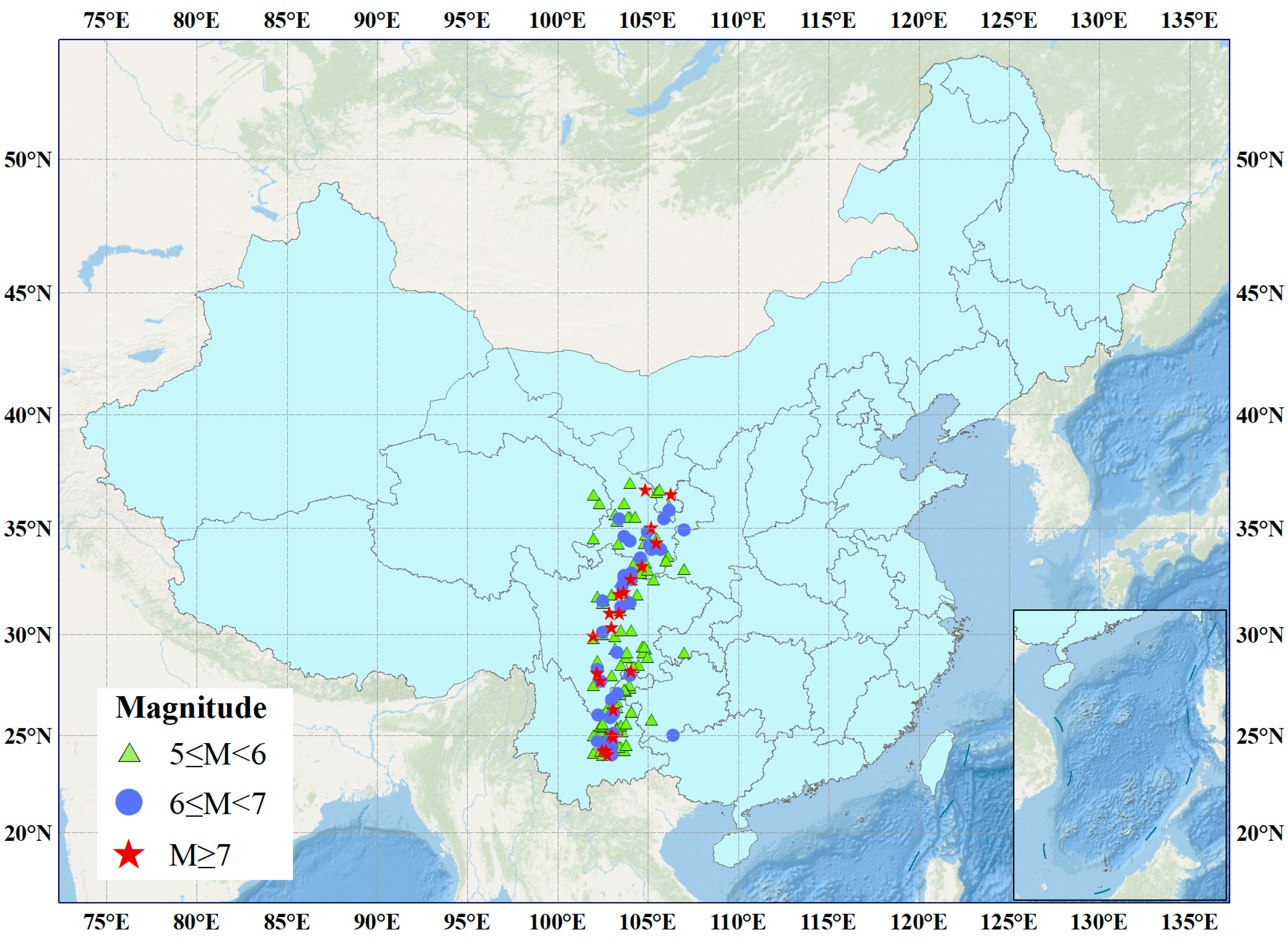
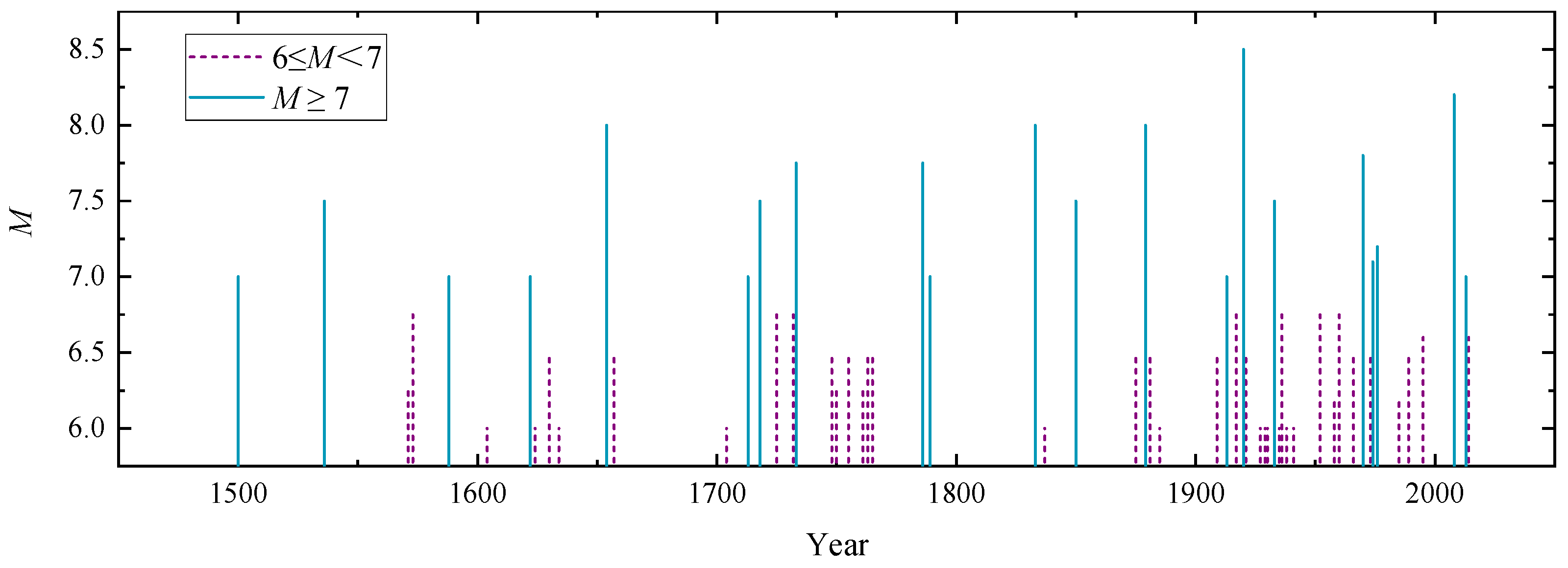
The earthquake catalog covering approximately 530 years (1500–2026) shows that earthquakes with magnitudes ≥ 7.0 occurred in 22 years within the North-South Seismic Belt, including 5 years with events ≥ 8.0. In several cases, multiple large earthquakes occurred within the same year, indicating clustered seismic activity. Over the past century, seismic activity has exhibited a pattern of staged intensification, with 8 years recording earthquakes ≥ 7.0, including 2 years with events ≥ 8.0. In this study, the spatiotemporal evolution of annual maximum earthquake magnitudes in the North-South Seismic Belt from 1500 to 2026 is statistically analyzed. The spatial distribution of earthquakes with magnitudes ≥ 5.0 is presented in
Figure 3, the temporal characteristics of earthquakes ≥ 6.0 are shown in
Figure 4, and the catalog of earthquakes ≥ 7.0 is summarized in
Table 1.
3.1. Wiener Filtering-Based Seismic Activity Trend Forecasting for the North-South Seismic Belt
In this study, seismic activity is modeled as a discrete-time stochastic process based on historical earthquake records, with an annual time step. The cube root of seismic energy, derived from earthquake magnitude, is adopted as an amplitude indicator to characterize earthquake intensity, thereby constructing the seismic activity time series. The sequence of earthquakes with magnitudes ≥ 6.0 is defined as the input signal, while the sequence of earthquakes with magnitudes ≥ 7.0 is treated as the output response. Wiener filtering is then employed to establish the optimal linear relationship between input and output under the minimum mean square error criterion. In this study, earthquake catalogs comprising events with magnitudes ≥ 6.0 are employed to forecast the timing and spatial distribution of earthquakes with magnitudes ≥ 7.0. This approach inherently targets the prediction of events of magnitude ≥ 7.0, which pose significant threats to human life and property. Early identification of seismic hazards, coupled with appropriate mitigation measures, can effectively reduce earthquake-induced risks and associated losses.
To capture the time-varying characteristics of seismic activity and perform forecasting, a multi-origin extrapolation strategy is adopted. Multiple starting points are selected to construct prediction models based on historical data, enabling the analysis of seismic activity trends in the North-South Seismic Belt. During the extrapolation process, earthquake records following each starting point are truncated and used as independent validation samples. Model performance is evaluated by comparing predicted results with corresponding observations. In addition, consistency and discrepancies among predictions from different starting points are analyzed to assess model robustness across multiple temporal scales, thereby improving the reliability of seismic activity trend forecasting.
3.1.1. Results of Wiener Filtering-Based Seismic Activity Trend Forecasting
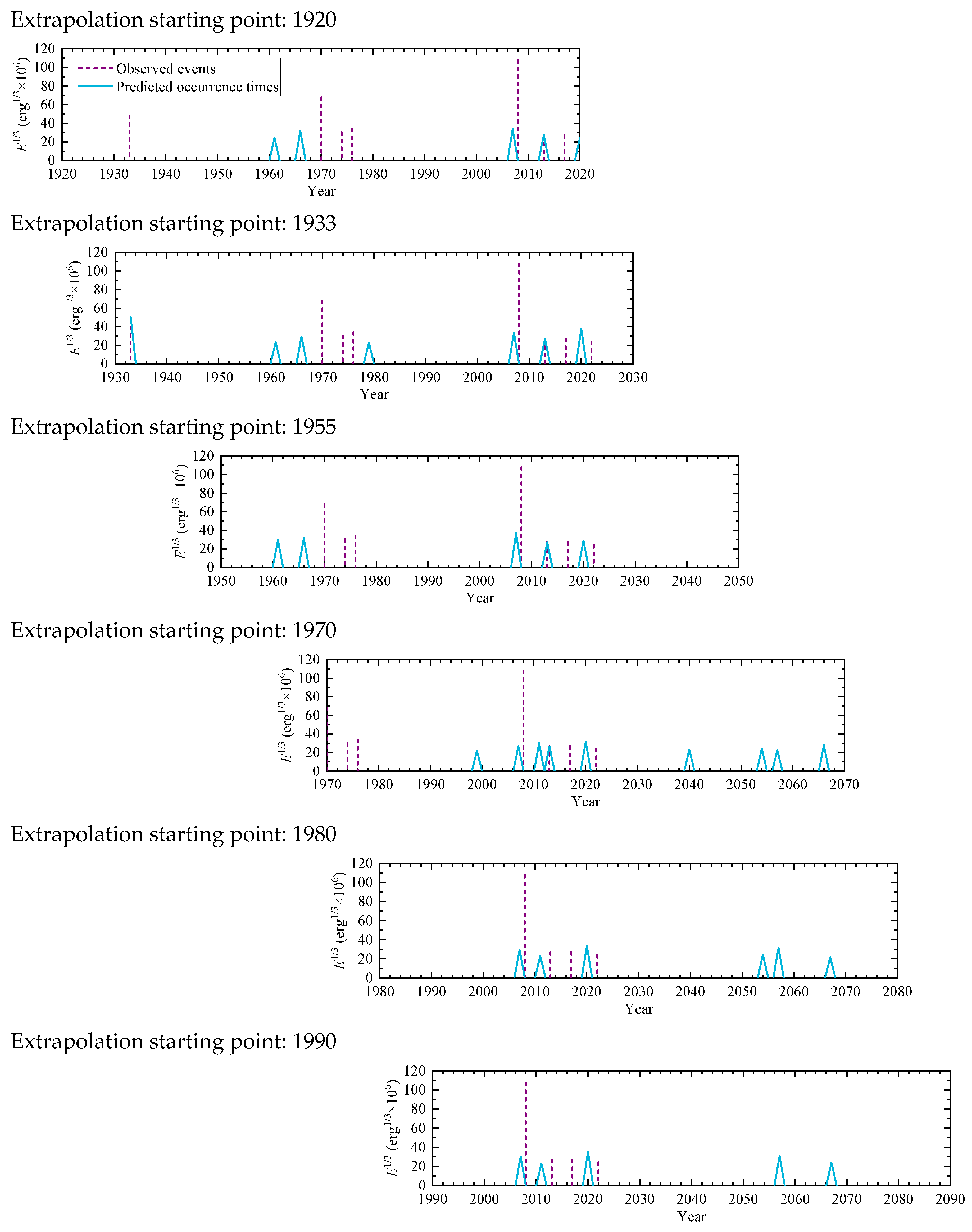
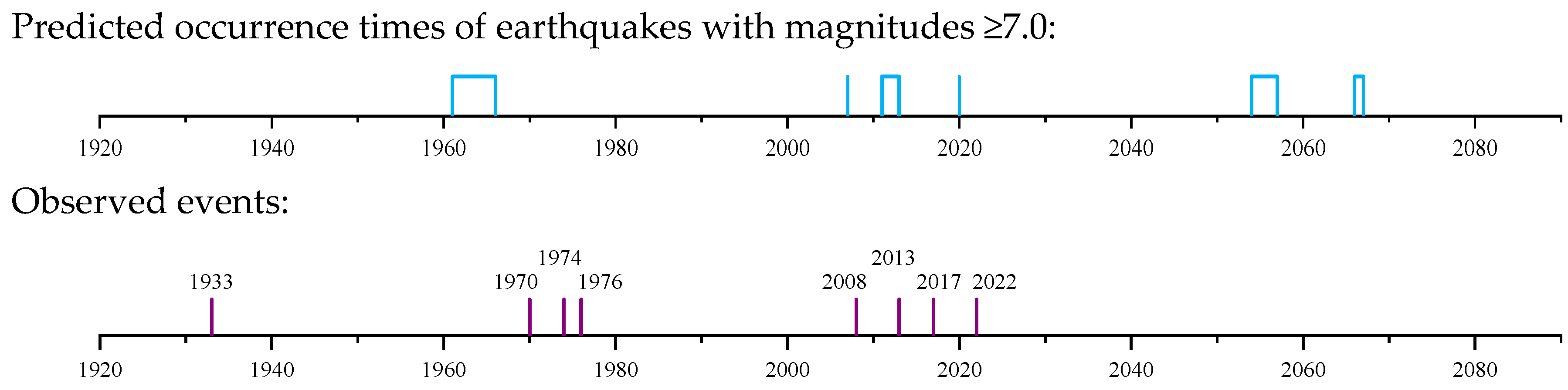
The years 1920, 1933, 1955, 1970, 1980, and 1990 are selected as extrapolation starting points. The Wiener filtering method is then applied to predict the time series of potential seismic activity in the North-South Seismic Belt over the next century. The results are presented in
Figure 5, where the peaks represent the predicted occurrence times of earthquakes with magnitudes ≥ 7.0, and the dashed lines denote the corresponding observed events.
A comparative analysis of the results obtained from different starting points shows that the predicted time series consistently exhibit pronounced peaks or peak clusters within similar time intervals, indicating strong robustness of the model under varying historical data conditions. By grouping temporally overlapping or adjacent peaks, six potential centennial-scale active periods of large earthquakes are identified. Specifically:
A peak cluster is observed during 1961–1966, followed by a sequence of strong earthquakes, including the 1970 Mw 7.8 Tonghai earthquake, the 1974 Mw 7.1 Daguan earthquake, and the 1976 Mw 7.2 Songpan–Pingwu earthquake. This suggests that the model effectively captures subsequent phases of intensified seismic activity.
A distinct peak appears around 2007, corresponding closely to the 2008 Mw 8.0 Wenchuan earthquake, indicating a high degree of temporal agreement.
A peak cluster occurs during 2011–2013, consistent with the 2013 Mw 7.0 Ya’an earthquake.
A peak around 2020 corresponds to the 2017 Mw 7.0 Jiuzhaigou earthquake. In addition, the 2022 Mw 6.9 Menyuan earthquake (37.8° N, 101.3° E) suggests that this period remains seismically active.
Two future peak clusters are identified during 2054–2057 and 2066–2067, representing potential periods of intensified seismic activity that warrant further attention.
Recent destructive earthquakes, including the 2008 Wenchuan, 2013 Ya’an, and 2017 Jiuzhaigou events, are all located near the predicted peaks or peak clusters. The deviation between predicted and observed occurrence times of earthquakes with magnitudes ≥ 7.0 is generally within approximately three years, with a root mean square error (RMSE) of 2.3 years and a coefficient of determination (R2) of 0.987, demonstrating that the proposed method possesses reasonable capability in the temporal prediction of strong earthquakes. Furthermore, by incorporating newly available earthquake data and performing multi-origin cross-validation, the model exhibits good stability and consistency in identifying major active periods. Nevertheless, due to the inherently nonlinear and stochastic nature of seismic processes, the results are more suitable for medium- to long-term trend identification rather than precise time prediction.
For spatial analysis, the distribution of seismic activity in the North-South Seismic Belt is simplified into a latitude–time series, and Wiener filtering combined with multi-origin extrapolation is applied to predict potential earthquake locations. The results show that the predicted latitudes are generally inconsistent with observed earthquake locations, with significant deviations in certain cases and overall unstable performance. Even with the incorporation of additional data, no substantial improvement is achieved, indicating that the Wiener filtering method has inherent limitations in spatial prediction. Therefore, alternative approaches are required to effectively capture the spatial evolution of seismic activity in seismic zonation studies.
3.1.2. Sensitivity Analysis of Wiener Filtering-Based Predictions
This section investigates the sensitivity of seismic activity time prediction to the length of the time series and the selection of threshold magnitude, with the aim of systematically evaluating the applicability and reliability of the Wiener filtering method.
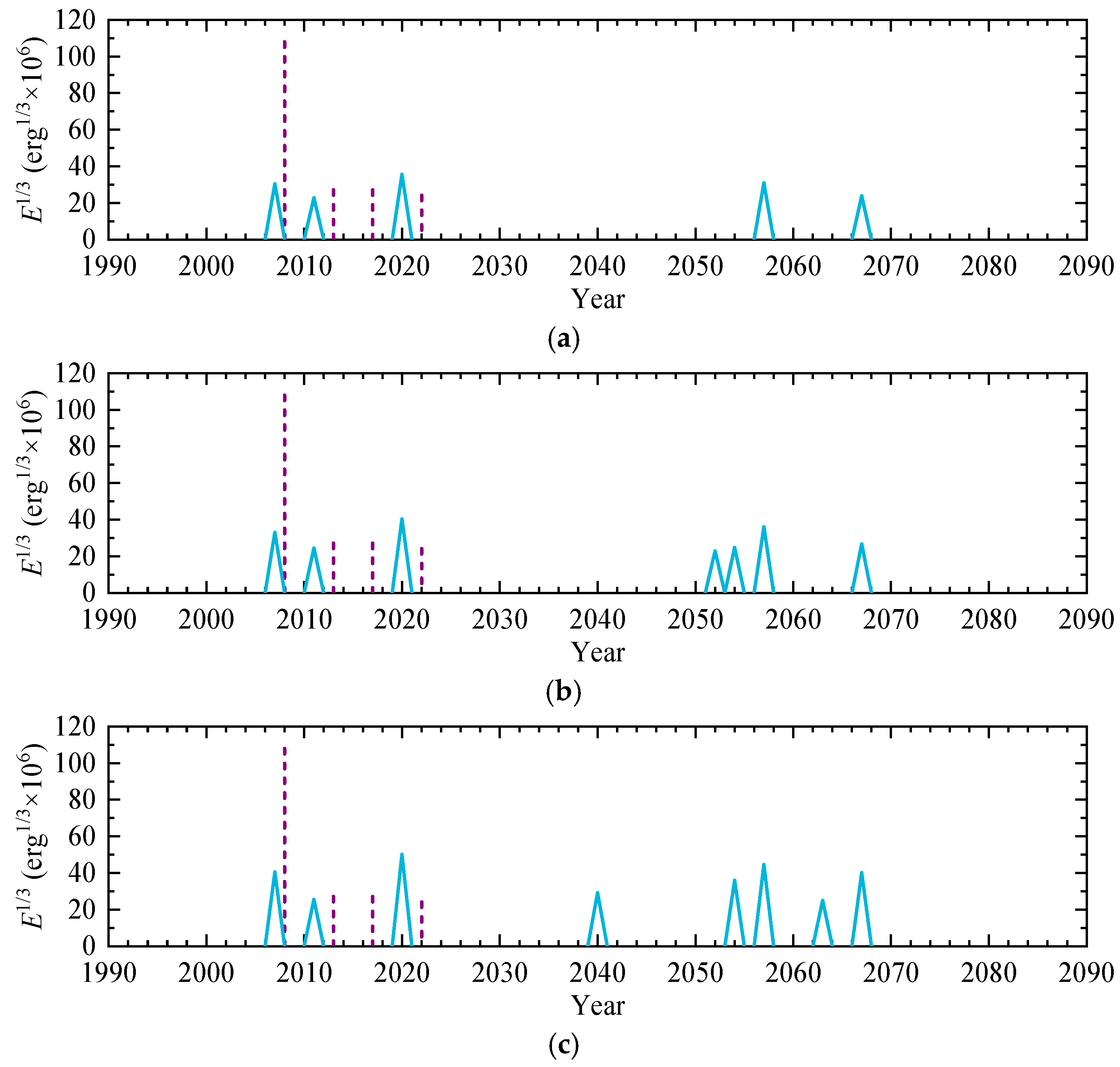
In general, longer earthquake catalogs provide more reliable and stable estimates of the autocorrelation characteristics of seismic activity. However, as the time span increases, historical records become increasingly incomplete due to limitations in documentation, which may introduce uncertainty into the analysis. Therefore, a robust forecasting method should exhibit limited sensitivity to the length of the input time series. To evaluate this effect, earthquake sequences with magnitudes ≥ 6.0 over three time spans (1500–2016, 1622–2016, and 1713–2016) are considered. Extrapolations are performed from the years 1920, 1933, 1955, 1970, 1980, and 1990 to predict the occurrence times of earthquakes with magnitudes ≥ 7.0 over the next century. Taking the results from the 1990 starting point as an example, a comparison of predictions based on different time series lengths is shown in
Figure 6.
The results indicate that extrapolations based on time series of approximately 500, 400, and 300 years all exhibit several prominent peaks, primarily concentrated in the periods 1961–1966, 2007, 2011–2013, 2020, 2054–2057, and 2066–2067. However, the number and distribution of these peaks show a clear dependence on the length of the time series. Specifically, the number of peaks obtained from extrapolation based on the ~500-year time series is smaller than that derived from the ~400-year and ~300-year time series. This suggests that shorter time series tend to produce more dispersed and fluctuating peaks, whereas longer time series can effectively smooth random disturbances and better capture the overall evolutionary characteristics of seismic activity. As the length of the time series increases, the prediction results gradually converge and exhibit improved consistency, indicating reduced sensitivity to uncertainty. Therefore, longer time series (e.g., ~500 years) provide greater reliability for long-term seismic activity trend forecasting.
In addition to time series length, the choice of threshold magnitude also influences prediction results. Early earthquake catalogs often contain incomplete records of moderate and small events; therefore, different threshold magnitudes may introduce varying levels of uncertainty. To assess this effect, earthquake data since 1500 are analyzed using three magnitude thresholds (
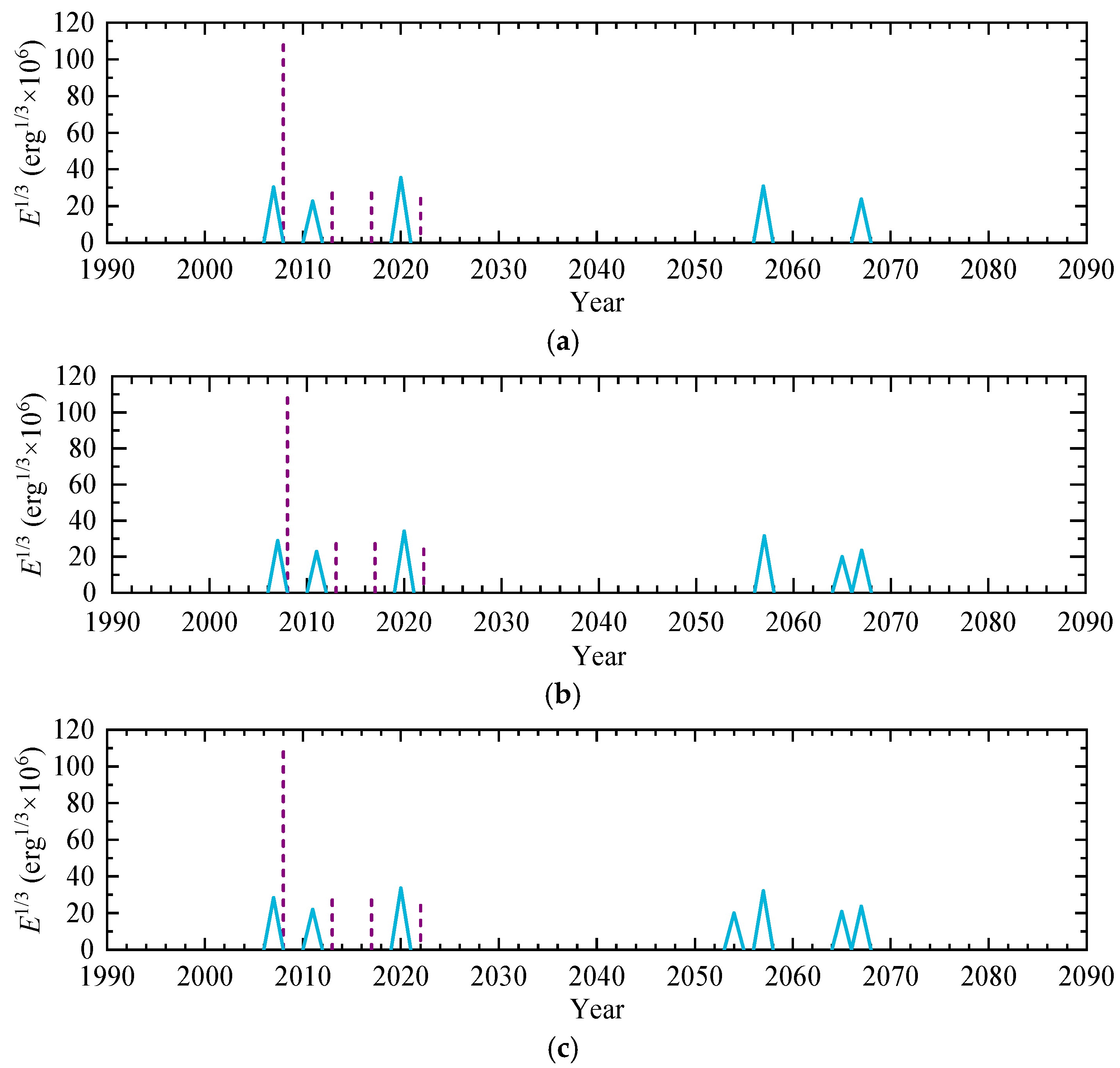
M ≥ 6.0, ≥5.5, and ≥5.0), and extrapolations are performed from the same set of starting years (i.e., 1920, 1933, 1955, 1970, 1980, and 1990). A comparison of results from the 1990 starting point is presented in
Figure 7.
The results show that the predicted occurrence times of earthquakes with magnitudes ≥ 7.0 are generally consistent across different threshold magnitudes, particularly for the periods 1961–1966, 2007, 2011–2013, and 2020, which correspond well with the occurrence of observed strong earthquakes in 1970, 1974, 1976, 2008, 2013, and 2017. However, as the threshold magnitude increases, the predictions become more stable, characterized by fewer peaks and more concentrated temporal distributions. This can be attributed to the higher completeness and reliability of large-magnitude earthquake records, whereas smaller events are more prone to omissions. Consequently, higher threshold magnitudes (e.g., M ≥ 6.0) yield more robust and reliable predictions.
In summary, both the length of the time series and the selection of threshold magnitude have a significant impact on prediction stability. Longer time series and higher threshold magnitudes effectively reduce the influence of random disturbances and improve model robustness. Under these conditions, the Wiener filtering method demonstrates good applicability for seismic activity trend forecasting and provides a reliable basis for regional strong-earthquake hazard analysis.
3.2. Artificial Neural Network-Based Seismic Activity Trend Forecasting for the North-South Seismic Belt
Reliable forecasting of seismic activity trends requires effective management of the inherent complexity of earthquake prediction, for which artificial intelligence provides powerful tools for data-driven analysis and decision support. In recent years, rapid advances in artificial neural network techniques have helped overcome the limitations of traditional knowledge-based expert systems, particularly in terms of knowledge acquisition and representation. In this context, artificial neural networks offer a promising approach for learning latent patterns embedded in historical earthquake catalogs and capturing the nonlinear evolution of seismic activity. Accordingly, this study employs artificial neural network-based methods to investigate the applicability and reliability of seismic activity trend forecasting in the North-South Seismic Belt.
In artificial neural networks, multiple hidden layers can be employed to approximate complex nonlinear functions. Although increasing the network depth theoretically enhances its representation capability, excessively deep architectures may lead to overfitting, increase training difficulty, and hinder convergence, particularly when the available dataset is limited. Therefore, a two-layer artificial neural network is adopted to model and characterize the fluctuation patterns of seismic activity. The number of neurons in the input layer also plays a critical role in model performance. An insufficient number of input neurons may result in information loss, preventing the network from fully capturing the underlying features of the input data. Conversely, an excessive number of input neurons may introduce redundant information and increase computational complexity. Hence, an appropriate selection of input layer size is essential for improving training efficiency and prediction accuracy. In this study, multiple network architectures, including 16–8–4 and 12–8–4, were systematically evaluated for their performance in seismic activity trend forecasting. When the number of input neurons is set to 16, the network incorporates information from nearly 200 years of earthquake catalog data, thereby effectively capturing the underlying patterns of seismic activity. Accordingly, the network employs a 16–8–4 architecture, with 16, 8, and 4 neurons in the input, hidden, and output layers, respectively. A schematic illustration of the network architecture is presented in
Figure 8.
3.2.1. Training and Validation of the Artificial Neural Network Model
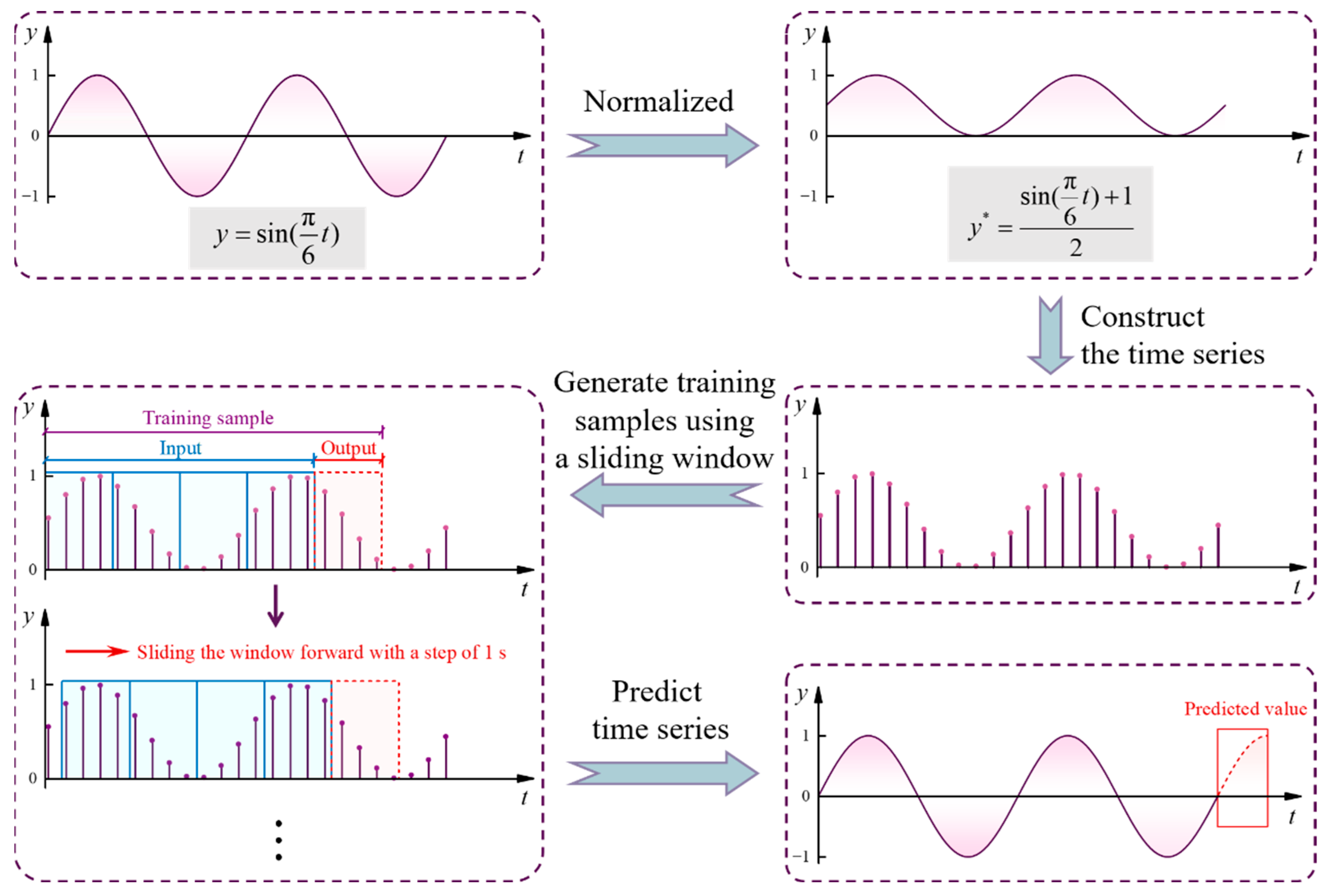
To provide an initial assessment of the learning and extrapolation capabilities of the artificial neural network, a sinusoidal function y = sin(πt/6) with a period of T = 12 s is adopted as a benchmark signal. Since the inputs to the artificial neural network are required to lie within the range of 0–1, the function values are normalized using the transformation (y + 1)/2, and a corresponding time series is constructed with a time step of 1 s. It should be noted that this test is not intended to replicate the characteristics of real seismic time series, which are inherently non-stationary, non-periodic, and sparse. Instead, the sinusoidal function serves as a simplified and controlled example to verify that the network can effectively capture general temporal patterns and achieve stable convergence under idealized conditions. More importantly, the effectiveness of the proposed method for seismic activity trend forecasting is primarily evaluated using real earthquake catalog data from the North–South Seismic Belt. Through retrospective validation and multi-origin extrapolation, the model performance is assessed under realistic conditions, which better reflect the non-stationary and complex nature of seismic activity.
The training samples are generated using a sliding time window approach. Specifically, a window length of 4 s is adopted, with four consecutive windows (16 s) used as the input and the subsequent window (4 s) as the output, forming one training sample. The first sample is constructed starting from
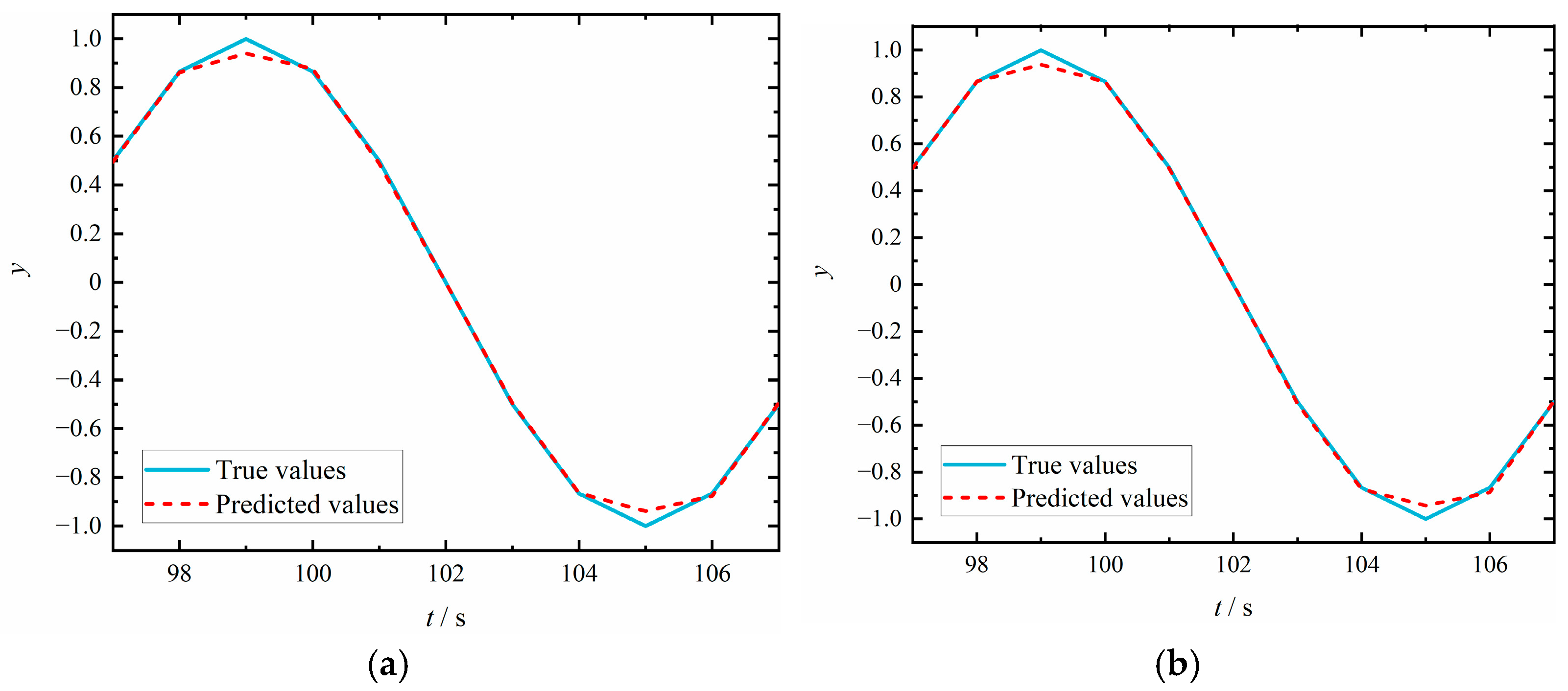
t = 0, and subsequent samples are generated by sliding the window forward with a step size of 1 s. Based on this dataset, a 16–8–4 artificial neural network is employed to learn the temporal characteristics of the sinusoidal sequence. Extrapolation is then performed under two scenarios: (i) preserving the original sample order and (ii) randomly shuffling the sample order. The validation procedure is illustrated in
Figure 9, and a comparison between predicted and true values is shown in
Figure 10.
The results show that, under both sample processing strategies, the extrapolation error is ≤0.03, demonstrating the high predictive accuracy of the artificial neural network model. With sufficient training, the network effectively captures the intrinsic temporal features of the time series, enabling stable extrapolation and accurate prediction. These findings provide a reliable methodological basis for subsequent seismic activity trend forecasting.
To further evaluate the general applicability of the proposed framework, earthquake data from other tectonically active regions were additionally employed for training and validation of the artificial neural network model. The Japan subduction zone, located at the convergent boundary of the Pacific Plate, the Philippine Sea Plate, and the Eurasian Plate, represents one of the most tectonically complex and seismically active regions worldwide. Owing to its intense plate interactions, frequent occurrence of large-magnitude earthquakes, and relatively complete historical earthquake catalog, the region provides an important natural laboratory for investigating seismic activity trend forecasting. In this study, the historical earthquake catalog covering the period from 1498 to 1987 was used to forecast the seismic activity trend of the Japan subduction zone. The prediction results indicate that the probability of earthquakes with magnitudes greater than 7.0 occurring during the period 1988–2017 reached approximately 0.975, implying a persistently elevated level of seismic hazard in the region during this interval. Subsequent seismic events exhibit a certain degree of consistency with the forecast results. The 2011 Tōhoku earthquake (Mw 9.0) triggered the Fukushima Daiichi nuclear disaster and caused catastrophic social and economic consequences. According to official statistics, the event resulted in 19,533 fatalities and direct economic losses estimated at 16–25 trillion Japanese yen. In addition, the 1995 Kobe earthquake (Mw 7.3) caused 6434 deaths, destroyed approximately 108,000 buildings, and generated direct economic losses approaching 100 billion USD. Furthermore, earthquakes with magnitudes exceeding 8.0 also occurred in 1994 and 2003, further reflecting the persistently high seismic activity of the region.
3.2.2. Results of Artificial Neural Network-Based Forecasting
In this study, a 16–8–4 artificial neural network is developed to learn from historical earthquake data in the North-South Seismic Belt since 1500 and to extract the underlying evolutionary patterns of seismic activity. Based on this model, spatiotemporal forecasting of seismic activity trends is conducted.
To construct input features for the artificial neural network, a sliding time window approach is adopted to transform the raw earthquake catalog into structured time-series data. Considering the sparsity and temporal variability of seismic events, a window length of 30 years is selected to ensure sufficient statistical representation within each interval. The window is advanced with a step size of 10 years, thereby generating overlapping segments that preserve temporal continuity while increasing the number of training samples. Within each time window, the maximum earthquake magnitude is extracted as the representative feature to characterize the intensity of seismic activity. This choice is motivated by the fact that large-magnitude events dominate seismic hazard and are more relevant for trend forecasting. In cases where no earthquake occurs within a given window, a constant value (e.g., M = 4.0) is assigned to maintain the continuity of the time series and avoid missing data.
To ensure numerical stability and facilitate network training, all input features are normalized into the range of [0, 1] using a Min–Max scaling scheme. For magnitude-based features, the normalization is defined as (M − 4)/10. The adoption of Min–Max normalization is motivated by its ability to preserve the relative distribution of the data while ensuring compatibility with the activation functions used in the neural network. Compared with Z-score standardization, this approach avoids amplifying the influence of extreme values, which is particularly important given the non-stationary and sparse nature of seismic data.
Based on the constructed time series, artificial neural network training samples are generated using a sliding window of length 4, where four consecutive windows (16 data points) are used as input and the subsequent window (4 data points) is used as output. Samples are generated sequentially with a step size of 1. This configuration allows the model to incorporate information spanning nearly 200 years of seismic activity, thereby capturing long-term temporal dependencies and underlying evolutionary patterns.
To evaluate the reliability and robustness of the proposed method, a retrospective validation strategy is adopted. The earthquake catalog is truncated at multiple years (1990, 1980, 1970, 1960, and 1950), and only data prior to each truncation point are used for training. Predictions are then generated for the truncated periods and compared with observed data. Model performance across different temporal scales is assessed through cross-comparison of these results.
The learning rate
α controls the magnitude of parameter updates during the training process. An appropriate learning rate can improve training efficiency while ensuring model convergence. In contrast, excessively large or small learning rates may lead to degraded model performance or unstable training. Typically,
α is selected within the range of 0 to 1. In this study, a sensitivity analysis of the learning rate was conducted, and, in combination with commonly adopted values,
α = 0.2 and
α = 0.3 were ultimately selected to comparatively analyze the seismic activity trend forecasting results for the North–South Seismic Belt. The comparison between predicted and observed time series is presented in
Table 2, and the prediction results with 2000 as the starting point are shown in
Table 3.
The results indicate that, for learning rates of 0.2 and 0.3, the maximum deviation between predicted and observed values is approximately 0.5, demonstrating a reasonable level of accuracy in temporal prediction. To reduce the influence of randomness arising from weight initialization and iterative optimization, multiple independent prediction runs are averaged to improve result stability. For a forecasting starting point of 2000, the predicted values are 7.7 and 7.9 for learning rates of 0.2 and 0.3, respectively. Although a Mw 7.0 earthquake occurred in Jiuzhaigou in 2017, combined analysis with Wiener filtering results suggests that earthquakes with magnitudes ≥ 7.0 may still occur in the region in the coming years. It should be noted, however, that these results are derived from statistical modeling and should be interpreted as indicative of long-term trends rather than precise predictions.
For spatial prediction, the latitudes of earthquakes with magnitudes ≥ 6.0 are organized into a time series, and artificial neural network-based forecasting is performed using the same sliding window strategy. A 30-year window is adopted, with the latitude corresponding to the maximum magnitude selected as the feature value. If multiple candidates exist, the value is determined based on the north-south migration pattern; if no event occurs, the value is set to 0. Latitude values are normalized by dividing by 100. The time series is constructed using a 5-year step size starting from 1500. Training samples are generated in the same manner as for temporal prediction, and retrospective validation is conducted using multiple truncation periods. The comparison between predicted and observed latitude sequences is presented in
Table 4, and the prediction results for the 2000 starting point are shown in
Table 5.
The results presented in
Table 4 and
Table 5 indicate that certain differences exist between the predicted and observed values under different forecasting starting points. Nevertheless, the prediction errors remain within an acceptable range. The mean error between the predicted and observed latitudes is 0.79°, with a coefficient of determination of 0.913. For the 1990 starting point, the predicted latitudes are 29.4° and 29.5° for learning rates of 0.2 and 0.3, respectively, which show reasonable agreement with the 2008 Wenchuan earthquake (31.0° N, 103.4° E) and the 2013 Ya’an earthquake (30.3° N, 103.0° E). Although the extrapolation in this study is based on the latitude sequence corresponding to the maximum magnitude within each sliding time window, the above events exhibit a certain degree of consistency with the predicted results in terms of spatial distribution. This suggests that the proposed method has a certain capability in capturing the spatial migration characteristics of seismic activity.
Overall, the artificial neural network model effectively characterizes seismic activity trends in the North-South Seismic Belt and improves the stability of spatial prediction, partially compensating for the limitations of the Wiener filtering method. The results further indicate that earthquakes with magnitudes ≥ 7.0 are more likely to occur within the latitude range of 30.5–33.0° N in the near future, with an estimated probability of 0.957. It should be emphasized that the available earthquake catalog spans only slightly more than 500 years, resulting in limited training samples. In addition, the validation period remains relatively short, constraining the assessment of model robustness. Therefore, this study constitutes a preliminary exploration of artificial neural network-based spatial prediction of seismic activity trends, and the results are still subject to inherent uncertainties.
4. Conclusions
Based on the earthquake catalog of the North–South Seismic Belt spanning 1500–2026, this study systematically investigated the temporal and spatial characteristics of seismic activity trends using Wiener filtering and artificial neural network approaches. The results indicate that seismic activity in the North–South Seismic Belt exhibits pronounced stage-wise evolution, clustering behavior, and multi-scale temporal variability, reflecting the complex tectonic background and active fault systems of the region. Historical earthquake records demonstrate that strong earthquakes are not randomly distributed in time, but instead tend to occur during concentrated active periods, highlighting the intrinsic temporal clustering characteristics of regional seismicity. Multi-origin extrapolation using Wiener filtering consistently identified several major active periods of strong earthquakes, including 1961–1966, 2007, 2011–2013, and 2020, as well as potential future active periods during 2054–2057 and 2066–2067. Retrospective validation showed that the deviation between predicted and observed occurrence times of earthquakes with magnitudes ≥ 7.0 is generally within approximately three years, with a root mean square error of 2.3 years and a coefficient of determination (R2) of 0.987, indicating reasonable capability in temporal trend prediction. Sensitivity analyses further demonstrated that longer time series (~500 years) and higher threshold magnitudes (≥6.0) contribute to improved model stability and consistency. These findings provide important insights into the long-term evolution patterns and clustering characteristics of seismicity in the North–South Seismic Belt. Nevertheless, owing to the inherently nonlinear, stochastic, and non-stationary nature of seismic processes, the proposed framework is more suitable for medium- to long-term trend identification rather than deterministic prediction of earthquake occurrence time and location. Moreover, the Wiener filtering approach exhibits limited capability in characterizing spatial variability, highlighting the necessity of incorporating complementary nonlinear approaches.
The artificial neural network model demonstrated good capability in capturing nonlinear temporal and spatial patterns of seismic activity. The prediction results remained within an acceptable range, with a mean latitude prediction error of 0.79° and an R2 value of 0.913, indicating reasonable agreement between predicted and observed spatial distributions. Compared with Wiener filtering, the artificial neural network model exhibited superior performance in spatial prediction and showed enhanced capability in characterizing the migration behavior of seismic activity. The results further suggest that strong earthquakes (M ≥ 7.0) are more likely to occur within the latitude range of 30.5–33.0° N in the near future, with an estimated probability of 0.957. This finding is generally consistent with the historically active seismic segments of the North–South Seismic Belt and further reflects the non-uniform spatial distribution and migration characteristics of regional seismicity. Consequently, the proposed framework may provide useful insights into the seismotectonic characteristics and potential seismic hazard of the studied region. However, due to the limited length of the available earthquake catalog and the inherent sparsity of large-magnitude seismic events, uncertainties remain in the spatial prediction results. Future studies should therefore incorporate longer earthquake catalogs, additional geophysical information, and more advanced benchmark models to further improve forecasting robustness and reliability.
The comparative analyses indicate that Wiener filtering performs well in characterizing the global temporal evolution of seismic activity and achieves relatively high accuracy in predicting the occurrence time of strong earthquakes. However, its capability in spatial prediction remains limited because it cannot effectively characterize the nonlinear migration characteristics of seismic activity. In contrast, the artificial neural network model exhibits stronger capability in capturing nonlinear relationships and spatial distribution patterns, particularly with respect to the migration behavior of seismic activity, although its temporal prediction performance is relatively less stable than that of Wiener filtering. By integrating the complementary strengths of the two approaches, the proposed hybrid framework demonstrates improved performance in both temporal and spatial prediction tasks. These findings highlight the potential advantages of combining linear and nonlinear modeling strategies and suggest that hybrid forecasting frameworks may provide a more robust and reliable approach for seismic activity trend forecasting. Nevertheless, more systematic quantitative comparisons, particularly through formal ablation studies and benchmarking analyses against representative statistical and deep learning models, are still required and will be considered in future work.