A Hybrid AI Approach for Intelligent Group Buying and Digital Marketing Strategy Optimization Based on Machine Learning and Evolutionary Algorithms
 , ,
, ,
Abstract
1. Introduction
2. Literature Analysis
3. Problem Statement and Objectives
4. Materials and Methods
4.1. Mathematical Model
4.2. Methodology for Conducting Numerical Experiments
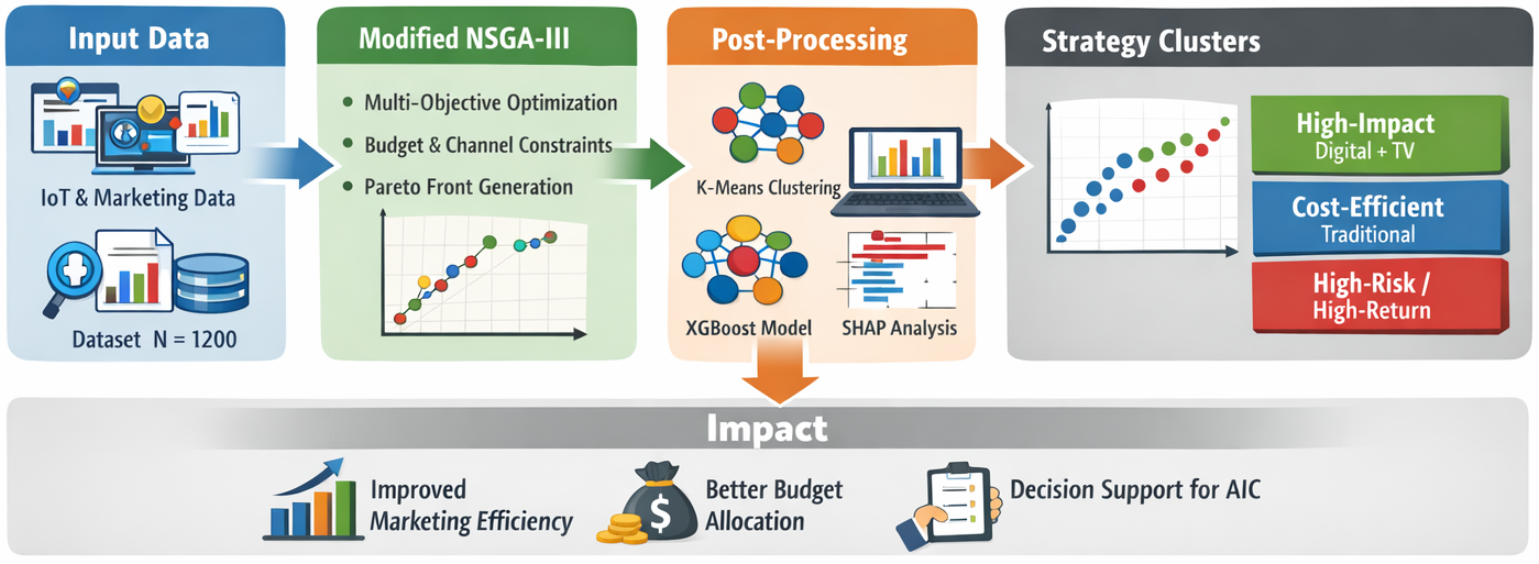
| Algorithm 1. Multi-objective optimization based on the Pareto frontier approach. |
| 1: procedure OPTIMIZE_MARKETING_STRATEGIES 2: Input: 3: channels ← {Digital, TV, Radio, Print, Events} 4: params ← {e_k, c_k, s_k} ∀k ∈ channels (Effectiveness, coverage, cost) 5: bounds ← [l_k, u_k] ∀k ∈ channels (Lower/upper bounds) 6: constraints ← {g_1,...,g_6} (Budget and channel limits) 7: ref_dirs ← Das-Dennis(3, 12) (3D reference directions) 8: 9: #Phase 1: Multi-objective optimization 10: algorithm ← NSGA-III( 11: pop_size = 100, 12: ref_dirs = ref_dirs, 13: sampling = LHS(), 14: crossover = SBX(prob = 0.9, η = 20), 15: mutation = PM(η = 20) 16: 17: results ← minimize(problem, algorithm, termination(‘n_gen’, 50)) 18: P ← non_dominated_sorting(results.F) (Extract Pareto front) 19: 20: #Phase 2: Solution analysis 21: clusters ← KMeans(n_clusters = 5).fit(P) 22: silhouette ← calculate_silhouette(P, clusters) 23: top_solutions ← rank_by_composite(P) (Eq. (0.6f1 + 0.4f2)/(f3 + 0.1)) 24: 25: #Phase 3: SHAP interpretation 26: model ← XGBoost().fit(P, composite_scores) 27: shap_values ← KernelSHAP(model).explain(P) 28: 29: Output: {P, clusters, top_solutions, shap_values} 30: end procedure |
4.3. Evaluation Protocol
5. Results
6. Discussion
- Improvements in the composite performance metric are statistically significant (p < 0.01)
- Improvements in hypervolume and diversity metrics are also statistically significant (p < 0.01)
7. Conclusions
Author Contributions
Funding
Data Availability Statement
Conflicts of Interest
References
- Omarkhanova, Z.M.; Niyazbekova, S.U.; Varzin, V.V.; Kerimkhulle, S.Y.; Nurekenova, E.S. Financial provision of the agro-industrial complex of Kazakhstan: Problems and solutions. In Sustainable Agriculture: Circular to Reconstructive; Springer Nature: Singapore, 2022; Volume 2, pp. 27–32. [Google Scholar]
- Tsapova, O.; Zhailaubayeva, S.; Kendyukh, Y.; Smolyaninova, S.; Abdulova, O. Industry Specifics and Problems of Digitalization in the Agro-industrial Complex of the Republic of Kazakhstan. J. Knowl. Econ. 2024, 16, 9492–9511. [Google Scholar] [CrossRef]
- Smagulova, S.; Yermukhanbetova, A.; Akimbekova, G.; Yessimzhanova, S.; Razakova, D.; Nurgabylov, M.; Zhakupova, S. Prospects for digitalization of energy and agro-industrial complex of Kazakhstan. Int. J. Energy Econ. Policy 2022, 12, 198–209. [Google Scholar] [CrossRef]
- Chaffey, D. Digital Marketing: Strategy, Implementation and Practice; Pearson: London, UK, 2022. [Google Scholar] [CrossRef]
- Kannan, P.K.; Li, H.A. Digital marketing: A framework, review and research agenda. Int. J. Res. Mark. 2017, 34, 22–45. [Google Scholar] [CrossRef]
- Kolodnik, D. Evaluation of digital marketing management in companies. Digit. Transform. 2024, 30, 14–21. [Google Scholar] [CrossRef]
- Kolchanov, V.B. Digitalization of Marketing: Trends and Prospects. In State and Business. Digital Economy Ecosystem; Russian Presidential Academy of National Economy: Moscow, Russia; Public Administration, North-West Institute of Management: Saint-Petersburg, Russia, 2019; pp. 44–49. [Google Scholar]
- Soldatova, N.F. The Impact of Marketing Digitalization on the Effectiveness of Management Innovations. Issues Innov. Econ. 2022, 12, 167–178. [Google Scholar]
- Krasyuk, I.A.; Kolgan, M.V. Directions and forms of marketing organization in the context of digitalization. Pract. Mark. 2019, 7, 3–9. [Google Scholar]
- Suslov, E.Y.; Minaev, D.V. Systematization of the phenomena of digitalization of marketing: Concept and example of implementation. Manag. Consult. 2021, 4, 64–80. [Google Scholar] [CrossRef]
- Tang, Y.C.; Chang, C.T. Multicriteria decision-making based on goal programming and fuzzy analytic hierarchy process: An application to capital budgeting problem. Knowl.-Based Syst. 2012, 26, 288–293. [Google Scholar] [CrossRef]
- Abedi, V.S. Allocation of advertising budget between multiple channels to support sales in multiple markets. J. Oper. Res. Soc. 2017, 68, 134–146. [Google Scholar] [CrossRef]
- Benali, F.; Bodénès, D.; De Runz, C.; Labroche, N. An enhanced R-NSGA-II for multiple brands advertising campaign allocation problem. In Proceedings of the 2021 IEEE 33rd International Conference on Tools with Artificial Intelligence (ICTAI), Washington, DC, USA, 1–3 November 2021; IEEE: New York, NY, USA, 2021; pp. 1306–1310. [Google Scholar]
- Khettabi, I.; Benyoucef, L.; Amine Boutiche, M. Sustainable multi-objective process planning in reconfigurable manufacturing environment: Adapted new dynamic NSGA-II vs New NSGA-III. Int. J. Prod. Res. 2022, 60, 6329–6349. [Google Scholar] [CrossRef]
- Lin, M.C.; Teng, J.Y. A Fuzzy Multicriteria Grade Cluster Analysis for the Budget Allocation of Tourism and Leisure Resources. Am. J. Ind. Bus. Manag. 2013, 3, 488–496. [Google Scholar]
- Chen, S.P.; Chang, C.W. Measuring the efficiency of university departments: An empirical study using data envelopment analysis and cluster analysis. Scientometrics 2021, 126, 5263–5284. [Google Scholar] [CrossRef]
- Saura, J.R. Using data sciences in digital marketing: Framework, methods, and performance metrics. J. Innov. Knowl. 2021, 6, 92–102. [Google Scholar] [CrossRef]
- Jadhav, G.G.; Gaikwad, S.V.; Bapat, D. A systematic literature review: Digital marketing and its impact on SMEs. J. Indian Bus. Res. 2023, 15, 76–91. [Google Scholar] [CrossRef]
- Thatikonda, R.; Ponnala, J.; Thatikonda, R.; Yendluri, D.K.; Kempanna, M.; Ananthan, B. Optimizing Digital Marketing Strategies Through Search Engine Optimization. In Proceedings of the 2024 IEEE International Conference on Contemporary Computing and Communications (InC4), Bangalore, India, 15–16 March 2024; IEEE: New York, NY, USA, 2024; Volume 1, pp. 1–6. [Google Scholar]
- Herman, B.; Saleh, W.; Mursalat, A. Optimization of Digital Marketing in Improving Marketing Performance. Almana J. Manaj. Bisnis 2024, 8, 387–399. [Google Scholar]
- Sanbella, L.; Van Versie, I.; Audiah, S. Online marketing strategy optimization to increase sales and e-commerce development: An integrated approach in the digital age. Startupreneur Bus. Digit. (SABDA J.) 2024, 3, 54–66. [Google Scholar] [CrossRef]
- Andayani, D.; Madani, M.; Agustian, H.; Septiani, N.; Ming, L.W. Optimizing Digital Marketing Strategies through Big Data and Machine Learning: Insights and Applications. J. Comput. Sci. Technol. Appl. 2024, 1, 104–110. [Google Scholar] [CrossRef]
- Nikolajeva, A.; Teilans, A. Machine Learning Technology Overview In Terms Of Digital Marketing And Personalization. ECMS 2021, 125, 130. [Google Scholar]
- Wang, C. Efficient customer segmentation in digital marketing using deep learning with swarm intelligence approach. Inf. Process. Manag. 2022, 59, 103085. [Google Scholar] [CrossRef]
- Sánchez-Camacho, C.; San-Emeterio, B.M.; Carranza, R.; Feijoo, B. Mapping two decades of evolution of artificial intelligence and machine learning in digital marketing and digital promotion to determine the current direction: A systematic review using bibliometrics. J. Electron. Commer. Res. 2025, 26, 1–33. [Google Scholar]
- Cui, G.; Wong, M.L.; Lui, H.K. Machine learning for direct marketing response models: Bayesian networks with evolutionary programming. Manag. Sci. 2006, 52, 597–612. [Google Scholar] [CrossRef]
- Pereira, P.J.; Cortez, P.; Mendes, R. Multi-objective grammatical evolution of decision trees for mobile marketing user conversion prediction. Expert Syst. Appl. 2021, 168, 114287. [Google Scholar] [CrossRef]
- Esmaelnezhad, D.; Bahmani, J.; Babgohari, A.Z.; Taghizadeh-Yazdi, M.; Nazari-Shirkouhi, S. A fuzzy hybrid approach to analyze digital marketing strategies towards tourism industry. Int. J. Tour. Policy 2023, 13, 463–480. [Google Scholar] [CrossRef]
- Kumar, A.; Jhalani, D.; Kanojiya, A. Hybrid Marketing Best Practices. In Proceedings of the Enhancing Productivity in Hybrid Mode: The Beginning of a New Era, Online, 29–31 May 2023. [Google Scholar]
- Ishibuchi, H.; Imada, R.; Setoguchi, Y.; Nojima, Y. Performance comparison of NSGA-II and NSGA-III on various many-objective test problems. In Proceedings of the 2016 IEEE Congress on Evolutionary Computation (CEC), Vancouver, BC, Canada, 24–29 July 2016; IEEE: New York, NY, USA, 2016; pp. 3045–3052. [Google Scholar]
- Mosa, M.A. Optimizing text classification accuracy: A hybrid strategy incorporating enhanced NSGA-II and XGBoost techniques for feature selection. Prog. Artif. Intell. 2025, 14, 275–299. [Google Scholar] [CrossRef]
- Vesikar, Y.; Deb, K.; Blank, J. Reference point based NSGA-III for preferred solutions. In Proceedings of the 2018 IEEE Symposium Series on Computational Intelligence (SSCI), Bangalore, India, 18–21 November 2018; IEEE: New York, NY, USA, 2018; pp. 1587–1594. [Google Scholar]
- Yadav, D.; Ramu, P.; Deb, K. Finding robust solutions for many-objective optimization using NSGA-III. In Proceedings of the 2023 IEEE Congress on Evolutionary Computation (CEC), Chicago, IL, USA, 1–5 July 2023; IEEE: New York, NY, USA, 2023; pp. 1–8. [Google Scholar]
- Ramraj, S.; Uzir, N.; Sunil, R.; Banerjee, S. Experimenting XGBoost algorithm for prediction and classification of different datasets. Int. J. Control Theory Appl. 2016, 9, 651–662. [Google Scholar]




| Comparison Criterion | NSGA-II | NSGA-III | Applicability Analysis |
|---|---|---|---|
| Convergence at m = 5 | Local optima (dominance of random solutions) | Global convergence (systematic search) | According to [30] (3045–3052), for m ≥ 4, NSGA-III demonstrated 18–22% better coverage of the solution space than NSGA-II. |
| Solution distribution | Clustering in narrow regions of the frontier | Uniform hyperplane coverage | According to [30] (3045–3052); [31] (20), NSGA-III provides 35–37% better distribution (spatial metric) for m = 5 than NSGA-II. |
| Limitations | Effective only for m ≤ 3 | Optimal for 3 ≤ m ≤ 15 | For m = 5, the density of reference directions in NSGA-III should be ≥12 partitions, according to [30] (3045–3052). |
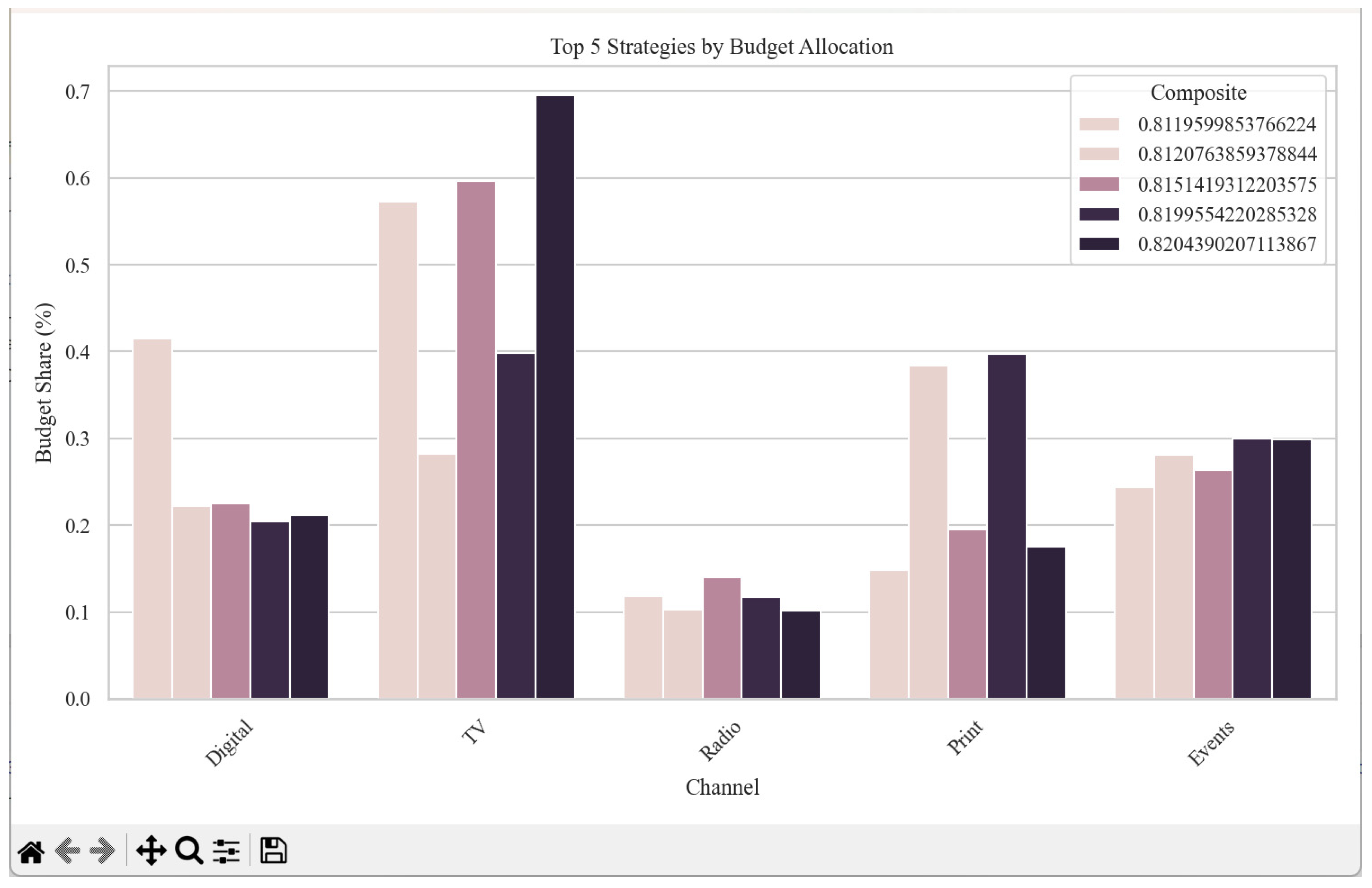
| Digital (%) | TV (%) | Radio (%) | Print (%) | Events (%) | Efficiency | Coverage | Cost | Composite | Cluster |
|---|---|---|---|---|---|---|---|---|---|
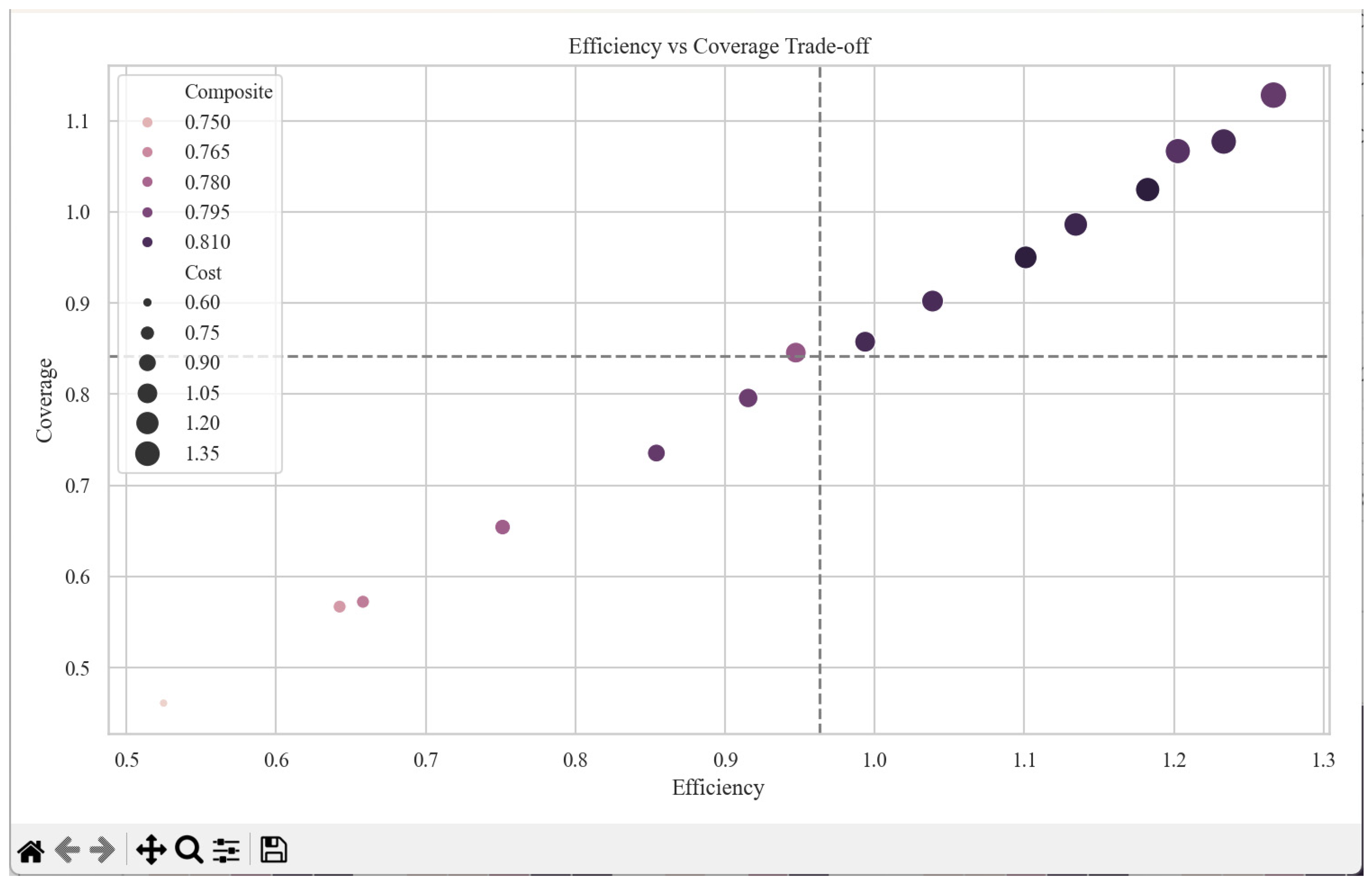
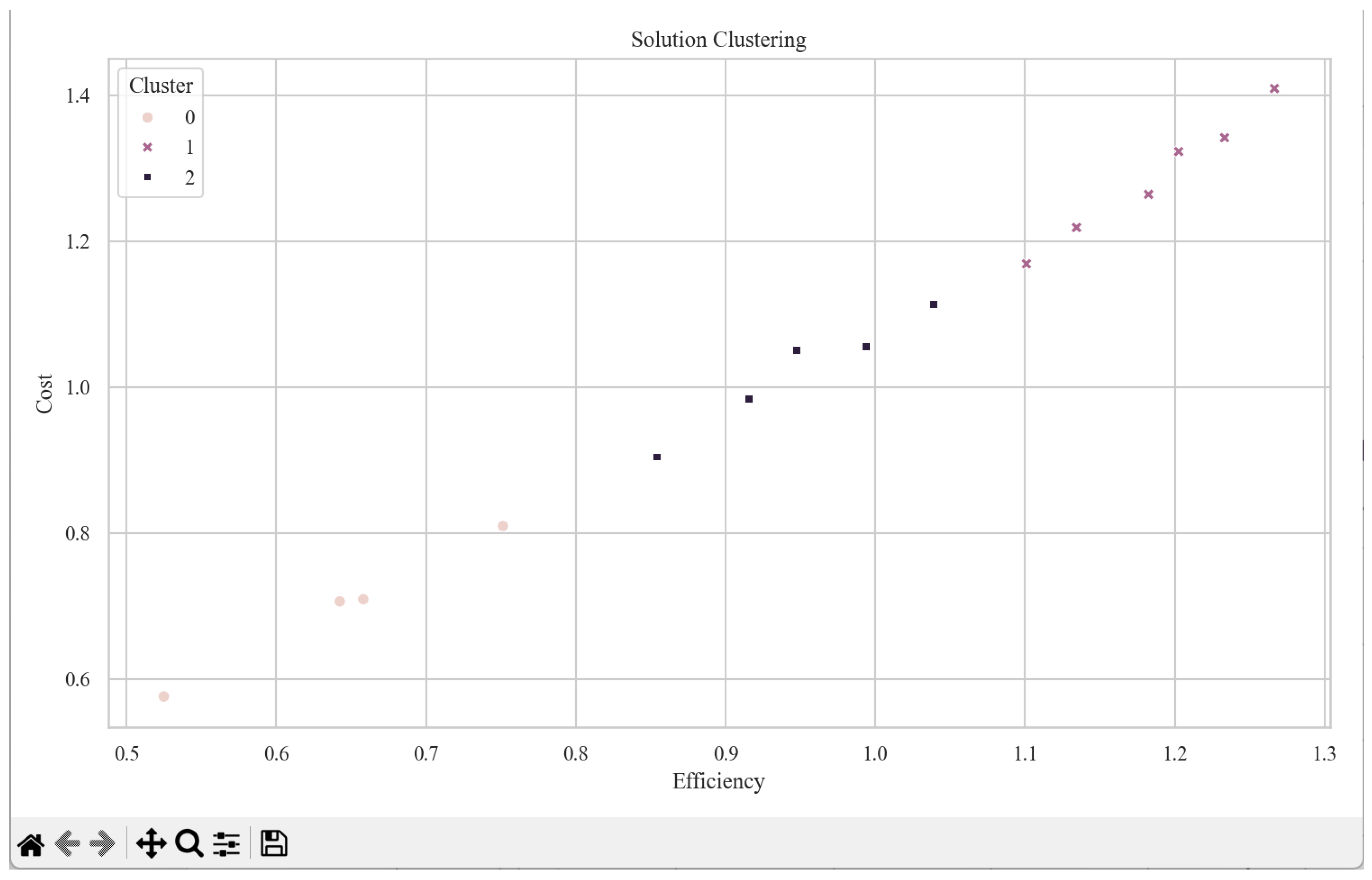
| 20.41 | 39.82 | 11.74 | 39.77 | 29.99 | 1.101 | 0.950 | 1.169 | 0.820 | 1 |
| 21.14 | 69.52 | 10.17 | 5.50 | 29.85 | 1.182 | 1.024 | 1.264 | 0.820 | 1 |
| 22.48 | 59.70 | 13.96 | 19.51 | 26.37 | 1.134 | 0.986 | 1.219 | 0.815 | 1 |
| 22.21 | 28.26 | 10.29 | 38.39 | 28.11 | 0.994 | 0.857 | 1.057 | 0.812 | 2 |
| 41.51 | 57.24 | 11.87 | 14.85 | 24.40 | 1.233 | 1.077 | 1.342 | 0.812 | 1 |
Disclaimer/Publisher’s Note: The statements, opinions and data contained in all publications are solely those of the individual author(s) and contributor(s) and not of MDPI and/or the editor(s). MDPI and/or the editor(s) disclaim responsibility for any injury to people or property resulting from any ideas, methods, instructions or products referred to in the content. |
© 2026 by the authors. Licensee MDPI, Basel, Switzerland. This article is an open access article distributed under the terms and conditions of the Creative Commons Attribution (CC BY) license.
Share and Cite
Abildaeva, Z.; Uskenbayeva, R.; Kalpeyeva, Z.; Kassymova, A.; Dauitbayeva, A.; Asselkhan, A. A Hybrid AI Approach for Intelligent Group Buying and Digital Marketing Strategy Optimization Based on Machine Learning and Evolutionary Algorithms. Mathematics 2026, 14, 1755. https://doi.org/10.3390/math14101755
Abildaeva Z, Uskenbayeva R, Kalpeyeva Z, Kassymova A, Dauitbayeva A, Asselkhan A. A Hybrid AI Approach for Intelligent Group Buying and Digital Marketing Strategy Optimization Based on Machine Learning and Evolutionary Algorithms. Mathematics. 2026; 14(10):1755. https://doi.org/10.3390/math14101755
Chicago/Turabian StyleAbildaeva, Zhansaya, Raissa Uskenbayeva, Zhuldyz Kalpeyeva, Aizhan Kassymova, Aigul Dauitbayeva, and Adranova Asselkhan. 2026. "A Hybrid AI Approach for Intelligent Group Buying and Digital Marketing Strategy Optimization Based on Machine Learning and Evolutionary Algorithms" Mathematics 14, no. 10: 1755. https://doi.org/10.3390/math14101755
APA StyleAbildaeva, Z., Uskenbayeva, R., Kalpeyeva, Z., Kassymova, A., Dauitbayeva, A., & Asselkhan, A. (2026). A Hybrid AI Approach for Intelligent Group Buying and Digital Marketing Strategy Optimization Based on Machine Learning and Evolutionary Algorithms. Mathematics, 14(10), 1755. https://doi.org/10.3390/math14101755