1. Introduction
With increasing emphasis on sustainability in geotechnical engineering, fibre reinforcement of soils presents a potentially more sustainable approach for enhancing mechanical performance while reducing reliance on conventional stabilisation methods. Fibre inclusion improves shear strength, ductility, and volumetric stability, making it suitable for applications such as slope stabilisation, foundations, and retaining structures, where improved mechanical behaviour can lead to safer and more efficient designs.
Previous research has shown that fibre inclusions improve soil strength and deformation characteristics, particularly in clayey soils. Fibres enhance shear strength and modify stress–strain behaviour, with reported changes in failure mode and volumetric response under triaxial loading [
1,
2,
3]. Laboratory and numerical studies also indicate that the benefits of reinforcement depend on fibre content. Moderate fibre additions typically maximise strength and ductility, while excessive reinforcement may reduce mechanical performance [
4,
5].
Existing work has primarily focused on experimental evaluation of fibre-reinforced soils, with limited numerical investigations examining the combined influence of fibre dosage and confining stress. Although numerous experimental studies have demonstrated that fibre reinforcement improves the shear strength and deformation behaviour of soils, most investigations have focused primarily on laboratory testing under limited confining pressures. While laboratory tests provide valuable insight into strength improvement mechanisms, numerical modelling offers the ability to isolate individual parameters and systematically examine their influence under controlled conditions. Finite element modelling can complement experimental studies by evaluating how reinforcement levels interact with stress state to influence deformation behaviour and shear strength.
Consequently, the combined influence of fibre dosage and confining stress on the mechanical response of fibre-reinforced clay remains insufficiently explored, particularly within numerical modelling frameworks. In particular, the interaction between fibre content and confining pressure in fibreglass-reinforced kaolin clay remains insufficiently investigated. Numerical modelling provides an effective framework for isolating these effects and evaluating stress–strain behaviour under controlled loading conditions. Using finite element analysis, it is possible to investigate how different reinforcement levels influence peak deviator stress and volumetric strain across a range of confining pressures. Such analysis can help clarify whether the optimal fibre content remains constant or varies with the stress state. Therefore, this study applies finite element modelling to evaluate the interaction between fibre content and confining pressure in fibreglass-reinforced kaolin clay under triaxial loading conditions.
This study investigates the influence of fibreglass fibres on the mechanical performance of kaolin clay under varying confining pressures using finite element simulations. The objectives are to quantify changes in peak deviator stress, volumetric strain, and deformation characteristics and to identify optimal fibre content for different confinement levels. The results provide insights into the behaviour of fibre-reinforced soils for practical geotechnical applications. This study focuses on the application and interpretation of a mathematical constitutive model within a finite element framework rather than the development of new analytical formulations.
2. Research Methodology
For this study, white kaolin clay reinforced with fibreglass fibres was chosen to investigate the influence of fibre inclusion on soil behaviour. Material parameters for both unreinforced and fibre-reinforced specimens were derived from laboratory triaxial shear tests, primarily following the data reported by [
6]. These parameters, summarised in
Table 1, were incorporated into the numerical simulations using a Mohr–Coulomb constitutive model within the Sigma/W load–deformation framework of GeoStudio 2024 (Seequent Limited, Calgary, AB, Canada). The elastic modulus values presented in
Table 1 represent the secant modulus at 50% strength. This software was selected due to its established application in geotechnical finite element analysis, its validated implementation of continuum constitutive models, and its suitability for simulating stress–strain behaviour under controlled confining pressures consistent with triaxial testing conditions. A smooth interface condition was assumed to replicate ideal boundary conditions with minimal end restraint, and a four-node element type was adopted for the finite element discretization. Fibre contents of 0% (control), 1%, 1.5%, 2%, and 3% by dry weight were modelled to examine reinforcement effects under consistent loading conditions. All models assumed a void ratio of 0.3, dilation angle set to zero, unit weight of 15.7 kN/m
3, and Poisson’s ratio of 0.35, representing dense or over-consolidated soil conditions typical of compacted subgrades, embankments, and other geotechnical applications.
The material parameters used in the numerical model were selected to represent the composite behaviour of fibre-reinforced soil based on experimentally derived values reported by [
6]. These parameters therefore reflect calibrated macroscopic properties representing homogenised composite behaviour, rather than predictive micro-mechanical modelling of individual fibres. While a direct graphical comparison between the numerical results and the original experimental stress–strain curves is not presented, the adopted parameters and resulting trends are consistent with the reported experimental behaviour. The objective of the simulation was to reproduce general trends and evaluate their response under varying confining pressures, rather than to perform detailed calibration against specific test curves.
Although Sigma/W is widely used for slope stability and seepage analyses, it also provides a robust finite element framework for stress–deformation modelling using continuum constitutive laws. Its selection in this study is justified by the adoption of a Mohr–Coulomb material model, for which all required parameters were directly derived from triaxial test data. More advanced platforms, such as PLAXIS and ABAQUS, offer enhanced constitutive formulations but require additional input parameters and calibration procedures that are not available within the present dataset. Furthermore, the study emphasises the comparative assessment of fibre content under controlled conditions rather than the high-fidelity simulation of complex soil behaviour; therefore, Sigma/W represents a suitable and efficient modelling framework for the intended analysis.
Simulations were carried out using the Sigma/W module of GeoStudio 2024, which employs finite element analysis (FEA) to solve load–deformation problems. In FEA, the soil mass is divided into discrete elements linked at nodes, and the governing equations are solved iteratively to evaluate the mechanical response under applied loads [
7].
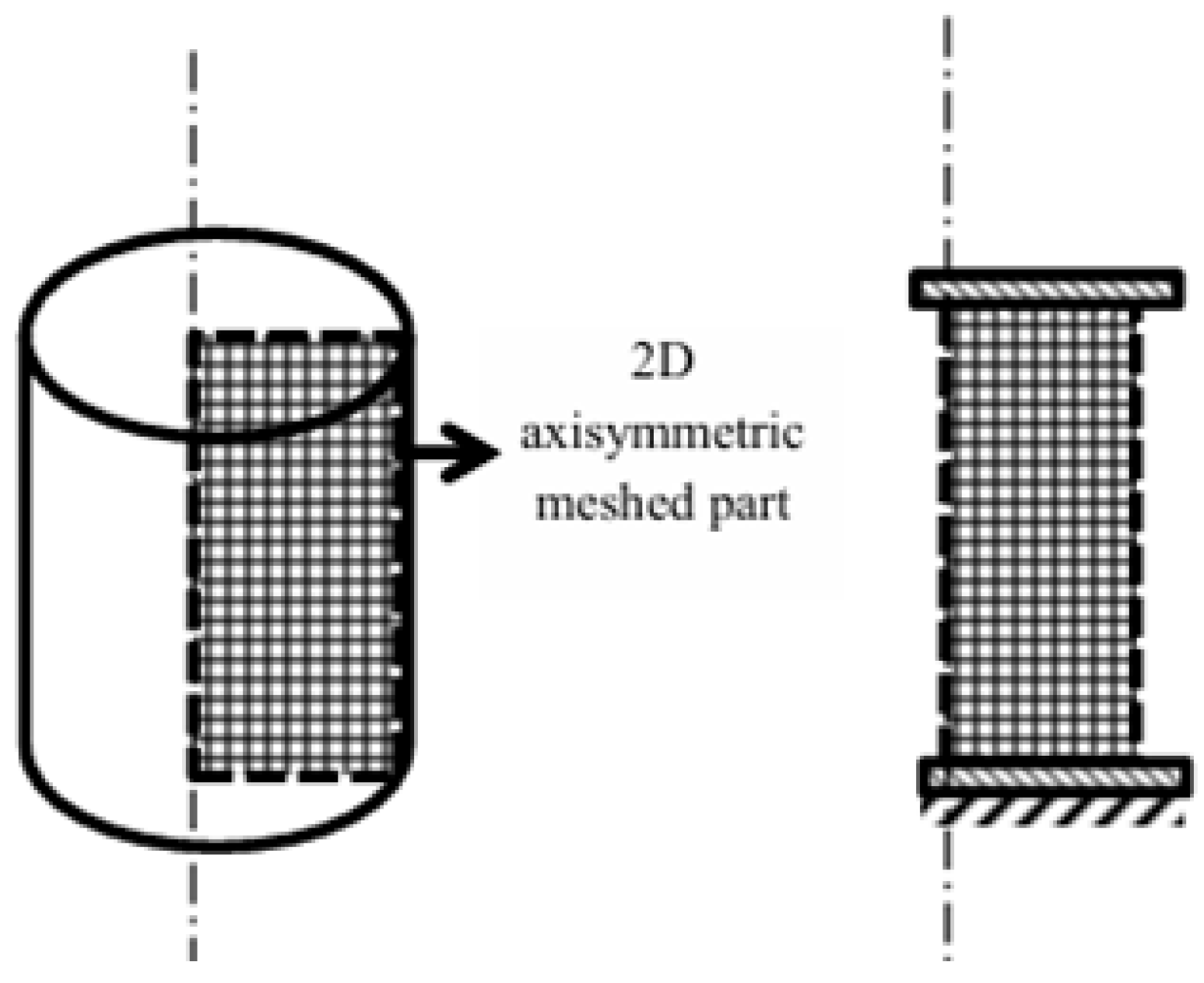
A two-dimensional axisymmetric model was constructed to represent a vertical section of a cylindrical triaxial specimen (
Figure 1). This configuration balances computational efficiency with geometric fidelity and realistic boundary conditions, reflecting the axisymmetric nature of standard triaxial loading.
where σ
1 is the major principal stress and σ
3 is the confining pressure. These constitutive relationships form the theoretical basis of the finite element simulations conducted within the Sigma/W framework.
The simulation process was divided into two sequential phases to maintain numerical stability and accurately capture triaxial behaviour.
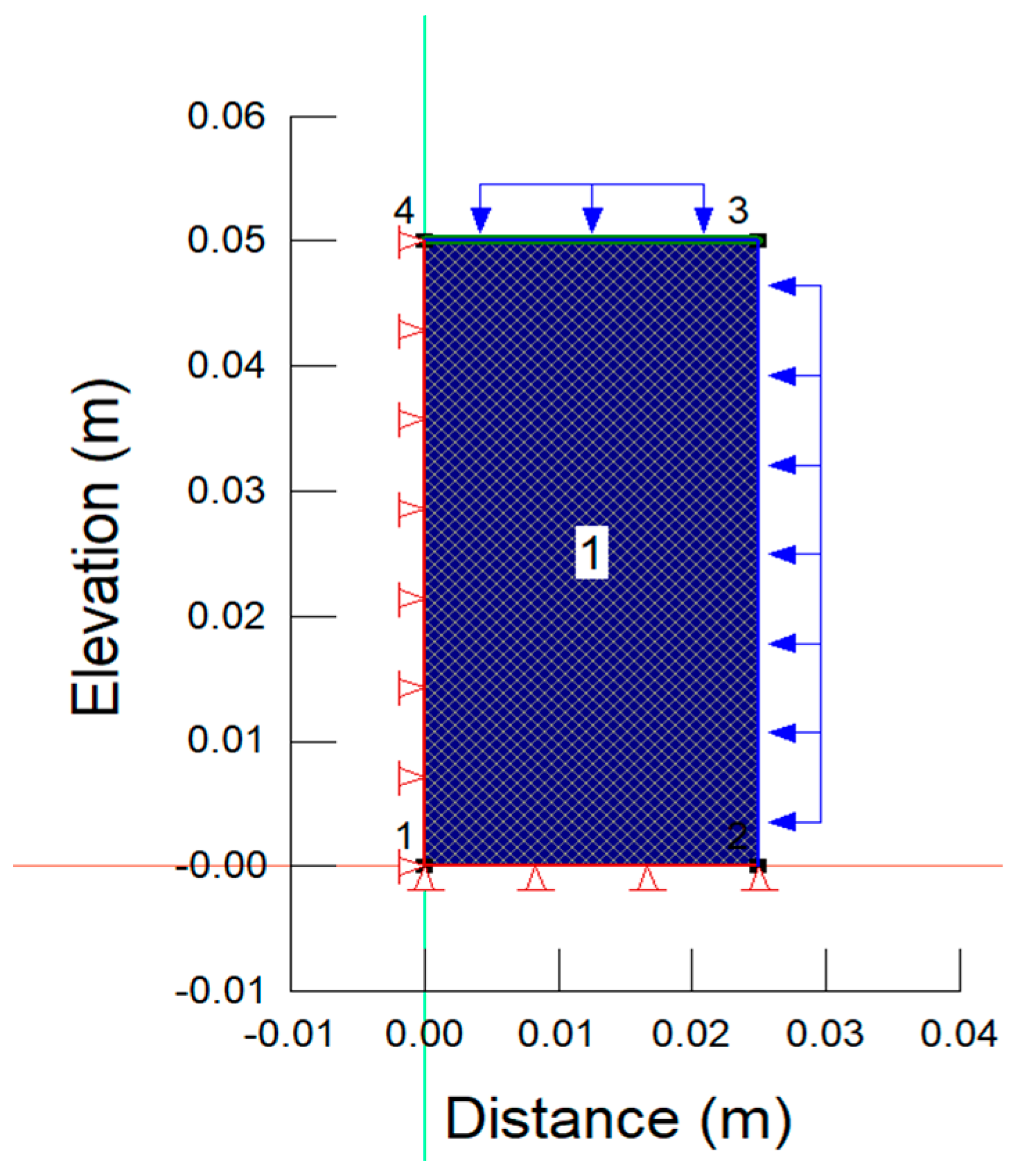
Initially, isotropic elastic properties (
Table 2) were assigned to the specimen while applying confining pressure (
Figure 2). This phase allowed the model to reach stress equilibrium without inducing plastic deformation or artificial stress concentrations, effectively simulating the consolidation stage observed in physical tests.
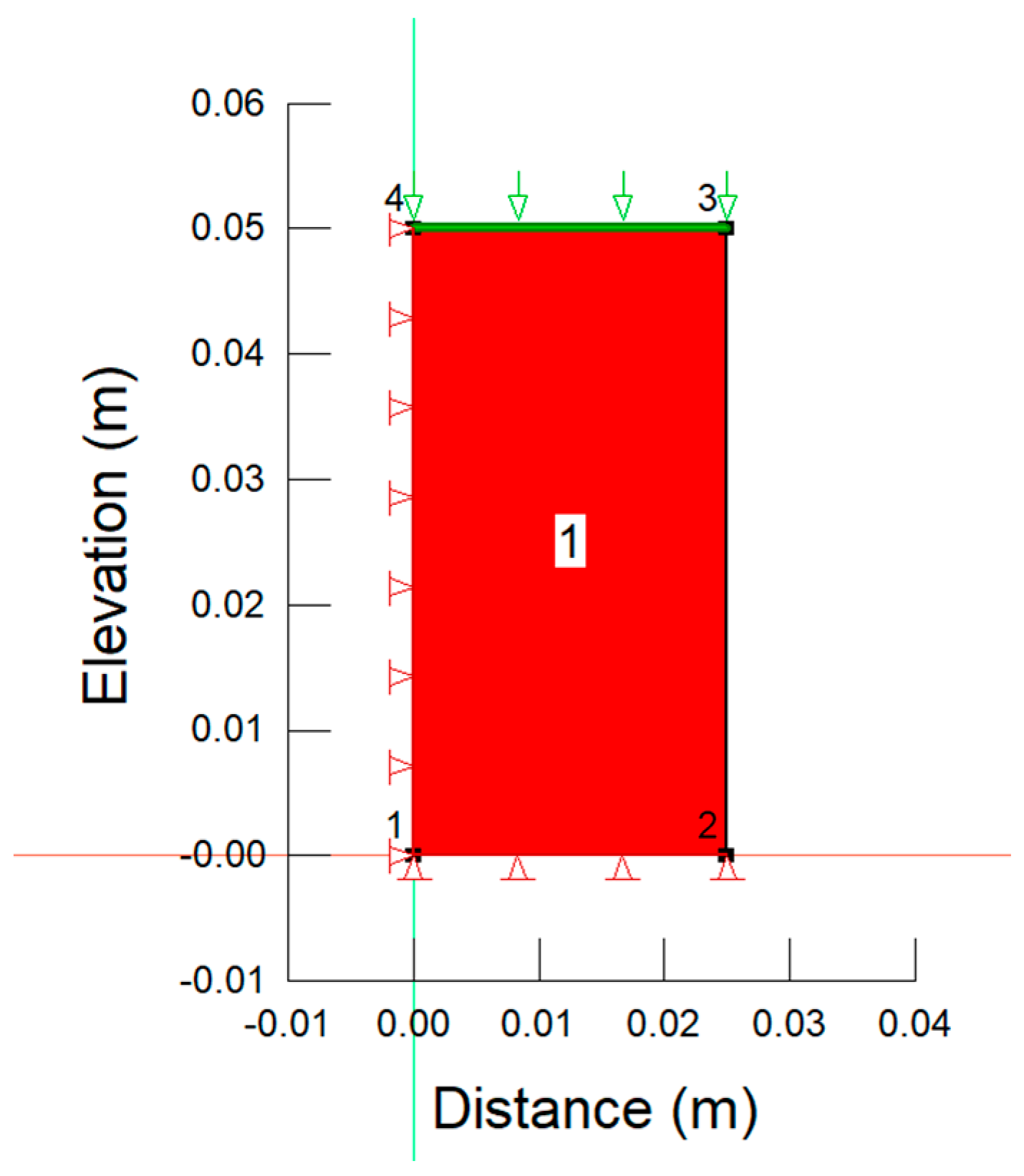
Once the confining pressure was established, the material properties were updated to the Mohr–Coulomb parameters corresponding to each fibre content. Axial compression was then applied to simulate shear loading (
Figure 3). This two-phase procedure ensured stable numerical performance and faithful replication of laboratory triaxial test conditions for both unreinforced and fibre-reinforced soils. Convergence was controlled using displacement and force tolerances within the solver, with iterative equilibrium achieved at each load step. Default convergence criteria within Sigma/W were adopted, resulting in stable and consistent numerical responses across all simulations.
Furthermore, the Mohr–Coulomb model was adopted due to its simplicity and widespread use in geotechnical analysis, where parameters are derived from standard laboratory testing. It is acknowledged that fibre-reinforced soils exhibit non-linear and strain-hardening behaviour, which is not explicitly captured by the elastic–perfectly plastic formulation. However, the model provides a suitable first-order approximation for assessing macroscopic strength and volumetric trends, and its limitations are considered in the interpretation of results. The study is deterministic in nature, focusing on parametric trends based on calibrated material properties rather than statistical variability.
A formal mesh sensitivity analysis was beyond the scope of the present study; however, mesh density was selected based on established practice and produced stable, consistent results across all simulations. This represents a limitation and may influence the quantitative results. The use of four-node elements and a structured mesh ensured stable numerical performance and consistent stress–strain responses across simulations. It is acknowledged that mesh refinement may influence localised deformation behaviour, and this represents a limitation of the present analysis.
3. Results and Analysis
The following section presents the outcomes of the numerical simulations, focusing on the mechanical behaviour of fibre-reinforced soils under different confining pressures. The following results present the deviator stress–axial strain and volumetric strain–axial strain responses for fibre-reinforced soils under confining pressures of 50, 100, 200, and 500 kPa. These results illustrate the influence of fibre content on both shear strength and volumetric compressibility under triaxial loading.
4. Deviator Stress vs. Axial Strain
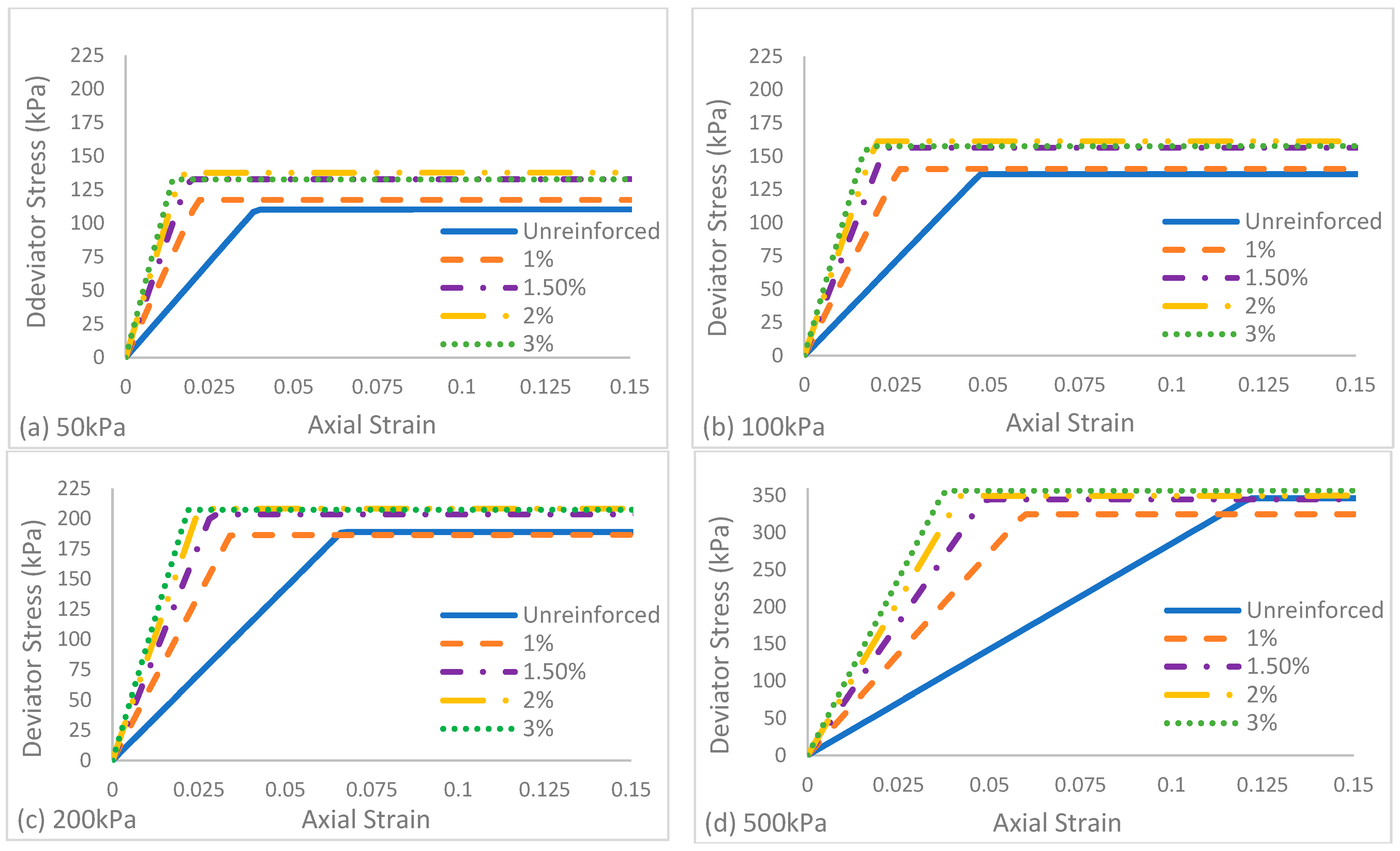
Figures illustrating the deviator stress vs. axial strain for fibre-reinforced soils under confining pressures of 50, 100, 200, and 500 kPa are presented in
Figure 4. These graphs show the influence fibre content has on soil strength across a variety of confining pressures.
At 50 and 100 kPa, the soil with 2% fibre content achieved the highest peak deviator stress. Increasing the confining pressure from 50 to 100 kPa raised the overall peak deviator stress across all fibre contents, displaying the strengthening effect of confinement.
At higher confining pressures, the trend shifts. Under 200 kPa, the simulation with 3% fibre content reached the maximum peak deviator stress, surpassing the 2% simulation. A similar outcome was observed at 500 kPa, where the 3% reinforcement again produced the highest deviator stress improvement, confirming that higher fibre contents provide improved performance under elevated confinement.
Overall, the results indicate that fibre reinforcement consistently enhances soil strength, with observed trends indicating that the most effective fibre content varies with confining pressure. At lower pressures, 2% is more effective, while 3% provides better performance under higher pressures.
5. Volumetric Strain vs. Axial Strain
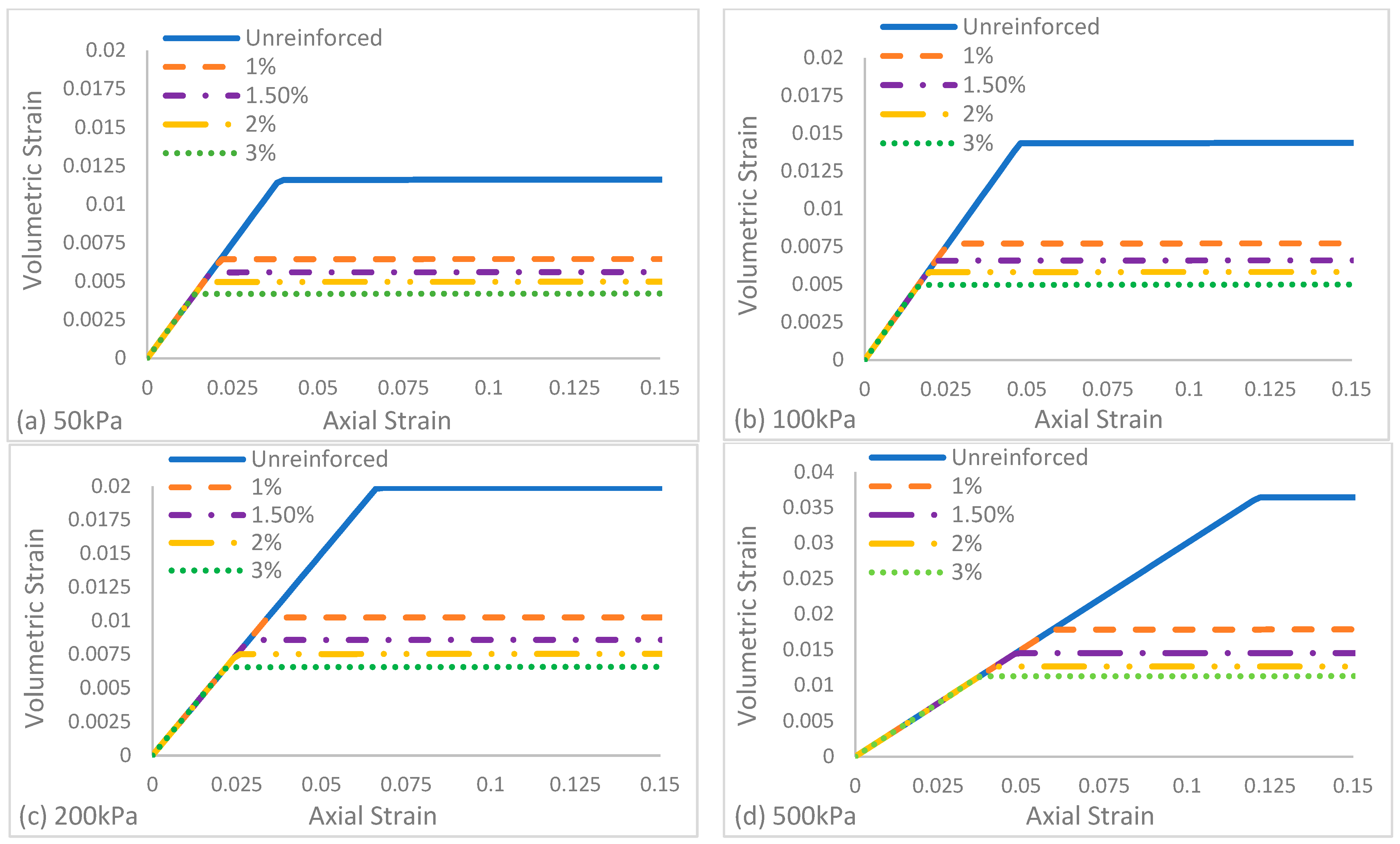
Figure 5 presents the volumetric strain–axial strain response of fibre-reinforced soils under confining pressures of 50, 100, 200, and 500 kPa. These results highlight the influence of fibre content on volumetric compressibility during triaxial loading.
At 50 and 100 kPa, the unreinforced soil exhibited the greatest volumetric compression, while specimens with 3% fibre content showed the lowest. This trend reflects the increased stiffness associated with fibre inclusion, resulting in reduced computed volumetric strains in the model.
At higher confining pressures of 200 and 500 kPa, the overall volumetric compression decreased compared to lower pressures, but the relative trend among fibre contents remained largely consistent. In all cases, unreinforced soil exhibited the highest contraction, whereas increased fibre content corresponded to reduced volumetric strain.
The volumetric strain–axial strain responses reflect the linear elastic–perfectly plastic nature of the Mohr–Coulomb model, with constant Poisson’s ratio and zero dilation angle. The constant Poisson’s ratio assumption applies only to the elastic regime and does not govern post-yield volumetric behaviour, which is controlled by the plastic model formulation. As such, the results show simplified behaviour, with volumetric strain stabilising after yielding.
Overall, the results indicate that fibre reinforcement reduces volumetric strain in the model across all confining pressures, with 3% fibre content consistently showing the lowest values. However, increasing the confining pressure beyond 200 kPa does not significantly alter the relative trend between fibre contents.
6. Discussion
The numerical simulations confirm that fibreglass fibre reinforcement effectively enhances the shear strength of soils. This improvement is consistent with laboratory observations [
9,
10]. Fibres have been shown in experimental studies to bridge microcracks and resist tensile stresses, thereby delaying failure and increasing ductility. It should be noted that this mechanism is not explicitly simulated in the present continuum model but is used here to support interpretation of th e observed macroscopic trends. The present finite element model does not explicitly simulate crack formation or discrete fibre interactions; instead, it captures the macroscopic strength enhancement through equivalent composite material properties.
Confining pressure plays a key role in modulating reinforcement effectiveness. At lower pressures (50–100 kPa), a 2% fibre content produces the largest gains in peak deviator stress while maintaining limited volumetric compression. At elevated pressures (200–500 kPa), a 3% fibre content slightly outperforms 2%, providing higher strength and further reducing compressibility. These trends highlight the interaction between confinement and fibre reinforcement. While fibres improve load transfer and particle interlock, the natural strength gains from confinement reduce the marginal benefit of additional fibres, consistent with [
11].
The existence of an optimal fibre content is commonly attributed to the interaction between fibre distribution and the surrounding soil structure. At moderate fibre contents, fibres are sufficiently distributed within the soil to mobilise tensile resistance and improve stress transfer between particles. However, excessive fibre inclusion may lead to fibre clustering or reduced soil–soil contact, which can limit the efficiency of load transfer. Consequently, moderate reinforcement levels often produce the greatest strength enhancement. This behaviour has been widely reported in previous experimental studies and provides a plausible explanation for the trends observed in the present numerical results.
The numerical results also demonstrate the influence of fibre content on volumetric strain. Increasing fibre dosage consistently limits volumetric compression, supporting previous observations that fibres restrain particle rearrangement at peak loads [
12,
13]. Moreover, the reduction in volumetric strain becomes more pronounced under higher confining pressures, indicating a synergistic effect between lateral stress and fibre reinforcement, as reported by [
5].
The Mohr–Coulomb model employed in this study successfully captures the general trends in stress–strain behaviour and volumetric response, including the increase in apparent shear strength and reduction in compressibility with increasing fibre content, commonly associated with enhanced cohesion in fibre-reinforced soils, as reported in [
14]. However, as an elastic–perfectly plastic formulation, the model does not account for strain hardening or softening, which affects the quantitative prediction of peak strength and post-peak behaviour. In particular, the simulated stress–strain curves tend to exhibit a relatively abrupt transition at peak stress, which may not fully represent the gradual yielding, strain hardening, or post-peak softening observed in laboratory experiments on fibre-reinforced soils [
15]. Consequently, although the numerical results suggest a transition from brittle to more ductile behaviour with increasing fibre content, this effect is only indirectly captured through modified strength parameters and reduced volumetric strain, rather than through explicit simulation of progressive failure mechanisms. This may lead to slight overestimation of peak strength and underestimation of post-peak deformation capacity, especially at higher fibre contents where fibre pull-out and interaction effects become increasingly important. Furthermore, the assumption of isotropic and homogeneous behaviour neglects the influence of fibre orientation and distribution, which can induce anisotropic stiffness and strength in real materials, potentially leading to discrepancies under certain loading conditions. In addition, the continuum representation of fibre-reinforced soil as an equivalent composite material does not explicitly model micro-mechanical processes such as fibre bridging, interfacial debonding, or pull-out resistance, which are key contributors to ductility and energy dissipation, as highlighted in previous experimental studies [
12,
13]. These simplifications may also influence the accuracy of volumetric strain predictions, particularly under higher confining pressures where fibre–soil interaction is more pronounced [
5]. Therefore, while the model provides an efficient and widely accepted framework for capturing macroscopic strength trends, the results should be interpreted as an approximation of overall behaviour, and more advanced constitutive or discrete modelling approaches may be required to fully represent the complex mechanisms governing fibre–soil interaction. Furthermore, the model does not explicitly capture strain localisation or shear band development, as no deformed mesh analysis was conducted. As a result, failure mechanisms are interpreted based on stress–strain response rather than direct observation of localised deformation patterns.
From a practical perspective, fibre reinforcement offers a sustainable alternative to chemical stabilisers. Fibreglass fibres improve mechanical performance without introducing toxic additives, making them suitable for applications such as road subgrades, slope stabilisation, and shallow foundations [
2,
10,
16], with recent studies also highlighting the potential of natural and bio-enhanced fibre systems for sustainable soil stabilisation [
17]. The numerical results provide guidance for design: lower fibre contents are sufficient under light confinement, while higher contents are beneficial for heavily confined soils requiring improved volumetric stability.
In addition, the present study focuses on peak strength and volumetric response, and does not evaluate energy absorption capacity or toughness, which are important indicators of fibre reinforcement performance. Future work could incorporate energy-based analysis to provide a more comprehensive assessment of ductility and post-peak behaviour.
7. Conclusions
The key conclusions of the paper are as follows:
Finite element simulations calibrated against experimental data indicate that fibreglass reinforcement increases peak deviator stress by roughly 3–20%, depending on confining pressure and fibre content. The strengthening effect is more pronounced at lower confining pressures, suggesting that fibre mobilisation interacts strongly with the effective stress state.
Fibre inclusion also reduces volumetric compressibility. Specimens with 3% fibre content exhibit the smallest volumetric strains, indicating better control of deformation and improved stability under axial loading.
Increasing confining pressure elevates peak deviator stresses across all reinforcement levels. However, the relative benefit of fibre reinforcement diminishes slightly at higher pressures, reflecting a transition from cohesion-dominated behaviour at low confinement to friction-dominated behaviour at higher confinement.
The influence of fibre dosage is stress-dependent. At low confining pressures, 2% fibre content gives the largest relative strength increase, whereas at higher pressures, 3% fibres perform better by combining strength gains with reduced volumetric strain. The results suggest that the most effective fibre content is stress-dependent rather than fixed, within the assumptions of the adopted modelling approach.
Overall, the results indicate that fibre reinforcement enhances soil strength within the framework of the adopted material model, with observed trends suggesting that the most effective fibre content varies with confining pressure.