Article

RBFNN-Based Secure Tracking Control for a Class of Strict-Feedback Nonlinear Systems with Asymmetric Output Constraints and Its Application to UAVs

1
School of Electrical Engineering, Hebei University of Science and Technology, Shijiazhuang 050018, China
2
School of Sciences, Hebei University of Science and Technology, Shijiazhuang 050018, China
3
Basic Courses Department, Shijiazhuang Institute of Railway Technology, Shijiazhuang 050041, China
4
School of Engineering, The University of Edinburgh, Edinburgh EH8 9YL, UK
*
Author to whom correspondence should be addressed.
Mathematics 2026, 14(10), 1753; https://doi.org/10.3390/math14101753
Submission received: 7 March 2026 / Revised: 29 April 2026 / Accepted: 8 May 2026 / Published: 20 May 2026
(This article belongs to the Special Issue Computational Approaches to Control Systems: Methods and Applications)

Abstract

This paper investigates a tracking control problem for a class of strict-feedback nonlinear systems with time delays, asymmetric output constraints, and deception attacks on the controller. First, by introducing a new error conversion technology, any nonzero and bounded initial state is converted to zero, which not only solves the overshoot/oscillation problem of the output during the constraint switching phase but also unifies the control design of constrained and unconstrained systems. Second, a barrier function with asymmetric output constraints is designed, which converts the problem of satisfying the tracking control of nonlinear systems under output constraints into one of ensuring the boundedness. In addition, radial basis function neural networks (RBFNNs) are utilized to handle both unknown uncertain terms and deception attacks simultaneously. By utilizing the new asymmetric delayed barrier function error together with an RBFNN technique, the tracking error is ultimately uniformly bounded, regardless of the presence or absence of output constraints. Finally, the superiority of the proposed strategy is verified through its simulation on an unmanned aerial vehicle (UAV) system.

1. Introduction

Most practical systems are inevitably subject to various operational constraints. For example, when UAVs travel along a desired trajectory, they must maintain a certain pitch angle to avoid obstacles. The output constraint problem of nonlinear systems has garnered widespread attention in numerous fields [1,2,3,4,5,6,7,8]. For such problems, in controller design, the optimal control [9] achieves optimal tracking for a continuous-time boiler turbine system with asymmetric constraints. Ref. [10] ensures that the system state always satisfies the predetermined bounds, while the tube-based model predictive control (MPC) scheme is found in [11]. However, these methods often come with a significant online computational burden or can only be applied to linear systems. In contrast, methods based on barrier functions (BF) and barrier Lyapunov functions (BLF) not only require less computation but can also address the output constraint problems of nonlinear systems. Therefore, it has attracted new research [12,13,14,15,16,17,18,19,20,21,22].
In the majority of existing studies, constraints can be divided into static and time-varying. Static constraints based on barrier functions can be found in [23,24,25,26]. However, static constraints are difficult to apply to complex scenarios. In [27,28,29], time-varying constraints are addressed, but the lower bound must be negative in [27]. Meanwhile, ref. [28] relaxes the requirement of the output constraints in [27], which allows the lower bound of the output to be positive. The time-varying constraint functions in [29] can be directly defined by users, but their first and second derivatives need to be continuous and bounded. It should be noted that in the aforementioned work, the values of the upper and lower bounds of the constraints must be known. This inevitably increases the computational burden. Additionally, the constraints exist throughout the entire operation of the system, and the control scheme cannot be directly applied to the constraint-free case without switching.
In general, asymmetric constraints can be categorized as undelayed and delayed. Research on undelayed asymmetric constraints can be found in [5,30,31,32,33], and research delayed asymmetric constraints can be found in [14,34,35]. In [32,33], a unified state feedback control scheme is proposed for nonlinear systems subject to asymmetric output constraints, which can be applied to scenarios with or without constraints, without the need to modify or switch its structure. It should be noted that the problem of the delay constraint is not considered in [32,33]. To cope with the delay constraint problem, a novel adaptive tracking control scheme is proposed in [14], even if the initial state constraints are not satisfied. However, the transformation function in [14] is non-smooth, which can easily cause output overshoot or oscillation during the switching phase of the constraints. Compared with [14], the constraint switching in [34] is smoother, but it fails to extend it to the control problem under cyber attacks. Thus, it is necessary to propose a strategy for handling such delay constraints, regardless of whether constraints exist. In [36,37], neural networks are used to solve disturbance problems, but the response speed is slow. In [38], the unknown parameter is estimated in finite time through event-triggered and convex optimization, but attacks are not considered; in [39], all uncertainties are compensated for by an adaptive strategy, but the strategy is not extended to n dimensions ( n 3 ). Overall, addressing issues of asymmetric constraints, time delays, and disturbances in tracking control remains a core problem that needs to be solved.
Inspired by the above research, this paper aims to propose a control strategy for strict-feedback nonlinear systems with delayed asymmetric constraints, multiplicative attacks, additive attacks, and disturbances, such that the tracking error of the system output to the reference trajectory achieves ultimately uniform bounds.The contributions of this paper are as follows:
(1)
Compared with [14,40], the error transformation function constructed in this article has two advantages: first, by introducing an exponential term, it ensures the smoothness of the transition phase before the constraint is activated; second, by introducing the parameter b, the transition speed when the constraint is activated can be flexibly adjusted.
(2)
Barrier function is constructed based on error transformation function, which not only satisfies the delayed asymmetric constraints but also allows the controller to be applicable regardless of the presence of delay constraints, without changing its structure.
(3)
Different from existing studies [9,10,11,33], the upper and lower output constraint boundaries are not known. In this paper, the proposed strategy only assumes the existence of constraint boundaries. It makes the control algorithm require less computation and makes it easier to generalize to more application scenarios.
This paper is organized as follows: Some preliminaries are provided, and error shifting function and BFs are constructed in Section 1. Then, the controller design and stability analysis are presented in Section 2. Numerical examples performed are presented in Section 3, verifying the superiority of the proposed control scheme. Finally, the paper is concluded in Section 4.

2. Problem Formulation and Preliminaries

In this paper, we consider the following strict-feedback nonlinear systems:
ξ ˙ i = φ i ( ξ ¯ i ) ξ i + 1 + ψ i ( ξ ¯ i ) + d i ( ξ ¯ i , t ) , i = 1 , , n 1 ξ ˙ n = φ n ( ξ ¯ n ) κ ( t , t κ ) u + χ ( t , t χ ) + ψ n ( ξ ¯ n ) + d n ( ξ ¯ n , t ) y = ξ 1
where ξ i = [ ξ i 1 , , ξ i d ] T R d , i = 1 , , n , denote system states, ξ ¯ i = [ ξ 1 , , ξ i ] T R i d is the state vector; u = [ u 1 , , u d ] T R d represent control input; φ i ( · ) R d × d , ψ i ( · ) R d are unknown smooth nonlinear functions; d i ( ξ ¯ i , t ) represents any possible bounded exogenous perturbations and meets | d i ( ξ i , t ) | d ¯ i with d ¯ i being a known nonnegative constant; the multiplicative attack signal κ ( t , t κ ) and additive attack signal χ ( t , t χ ) are continuous time-varying deception attack signals that attempt to disrupt the normal controller u, with starting instants t κ and t χ , respectively.
The systems subject to time-varying output constraints are defined by
(1)
For t [ 0 , t s ) , y k ( t ) is unconstrained;
(2)
For t [ t s , ) , y k Ω 1 k : = { ( t , y k ) + × C l k ( t ) < y k < C h k ( t ) } .
Here, t s R is the time instant when output must begin to conform to the constraints; C l k ( t ) and C h k ( t ) represent the lower and upper asymmetric constraints of output y k ( t ) , respectively; some or all of them may not exist in some time intervals, where it can be considered as .
Control Objective: For the strict-feedback nonlinear systems subject to delay asymmetric constraints, the aim is to design a new neural network tracking control scheme such that the reference trajectory y r k ( t ) should be tracked by the system output y k ( t ) , meaning the tracking error is UUB.
The following assumptions and lemmas are needed.
Assumption 1 ([32]).
 The constraint functions C l k ( t ) , C h k ( t ) and the desired trajectory y r k ( t ) are all piecewise differentiable, and their first derivatives are bounded but unknown. Specifically, there exist unknown finite positive constants C ¯ l k , C ¯ h k , and y ¯ r k such that | C ˙ l k | < C ¯ l k , | C ˙ h k | < C ¯ h k , and | ( f ˙ y r k + f y ˙ r k ) | < y ¯ r k . In addition, there exist positive constants ϵ ̲ 0 and ϵ ¯ 0 such that the desired trajectory y r k ( t ) satisfies y r k ( t ) Ω d : = { ( t , y r k ) + × C l k ( t ) + ϵ ̲ 0 y r k C h k ( t ) ϵ ¯ 0 } .
Assumption 2 ([20]).
 The control coefficients φ i ( ξ ¯ i ) , i = 1 , , n are unknown and time-varying but bounded away from zero, i.e., there exist certain unknown constants φ ̲ i and φ ¯ i such that 0 < φ ̲ i | | φ i ( ξ ¯ i ) | | φ ¯ i < . In general, it is further assumed that all of the signs of φ i ( ξ ¯ i ) are positive.
Assumption 3 ([41]).
 The unknown multiplicative attack signal κ ( t , t k ) and additive attack signal χ ( t , t k ) are both boundaries. In other words, the positive scalars κ ̲ , κ ¯ and χ ¯ exist such that κ ̲ | | κ ( t , t k ) | | κ ¯ , and | | χ ( t , t k ) | | χ ¯ .
Remark 1.
Assumption 1 means the output is time-varying, asymmetric, and bounded; many practical systems do indeed satisfy it. In order to accomplish specific tasks, the output (roll angle, yaw angle, pitch angle) of the UAV must be restricted within a safe range. In the simulation in our paper, 2 sin ( 2 t ) < ξ 1 k < 1 + 0.1 sin ( 4 t ) ; Assumptions 2 and 3 lose no generality.
Lemma 1 ([42]).
 On a compact set Ω U R l , radial basis function neural networks can realize online approximation for any continuous function F ( U ) , and the approximation accuracy can meet any preset requirement. Its approximation relationship can be expressed as F ¯ ( U ) = W * T η ( U ) + ε . Let ω i = W i * 2 , i = 1 , , n , where ω i is an unknown constant. The definitions and properties of each parameter in the above expression are as follows:
(1) 
Input and structural parameters: U R l represents the input vector of the neural network; q > 1 is the number of network basis functions, corresponding to the weight vector W T = [ W 1 , W 2 , , W g ] T R q and the basis function vector η ( U ) = [ η 1 ( U ) , η 2 ( U ) , , η q ( U ) ] T R g , and the basis function vector satisfies the norm constraint η ( U ) 2 q .
(2) 
Form of basis functions: Each basis function η i ( U ) ( i = 1 , , q ) adopts a Gaussian function structure, and its specific form is η i ( U ) = exp ( U k i ) T ( U k i ) l i 2 where k i is the center parameter of the Gaussian function, and l i is its width parameter.
(3) 
Approximation error property: ε ( U ) denotes the error generated during the approximation process, and this error satisfies the boundedness condition | ε ( U ) | ε N (where ε N is a positive constant). Furthermore, the error ε ( U ) can be adjusted to a minimal value by selecting the ideal weight vector W * . The definition of this ideal weight vector is W * = arg min W R g sup U Ω U F ¯ ( U ) W T η ( U ) , which is the weight vector that minimizes the “maximum deviation between the function F ¯ ( U ) and the neural network output W T η ( U ) ” on the compact set Ω U .

2.1. Error Shifting Function

To address the delay output constraint problem, the following transformation function is proposed:
f ( t ) = 1 t s t t s n + 2 exp t 2 n 2 b 2 n , 0 t < t s 1 , t t s
with t s > 0 being a prespecified regulation time. When t t s , there are constraints on the output, which can weaken the transient performance; n is the system order and b is a positive constant.
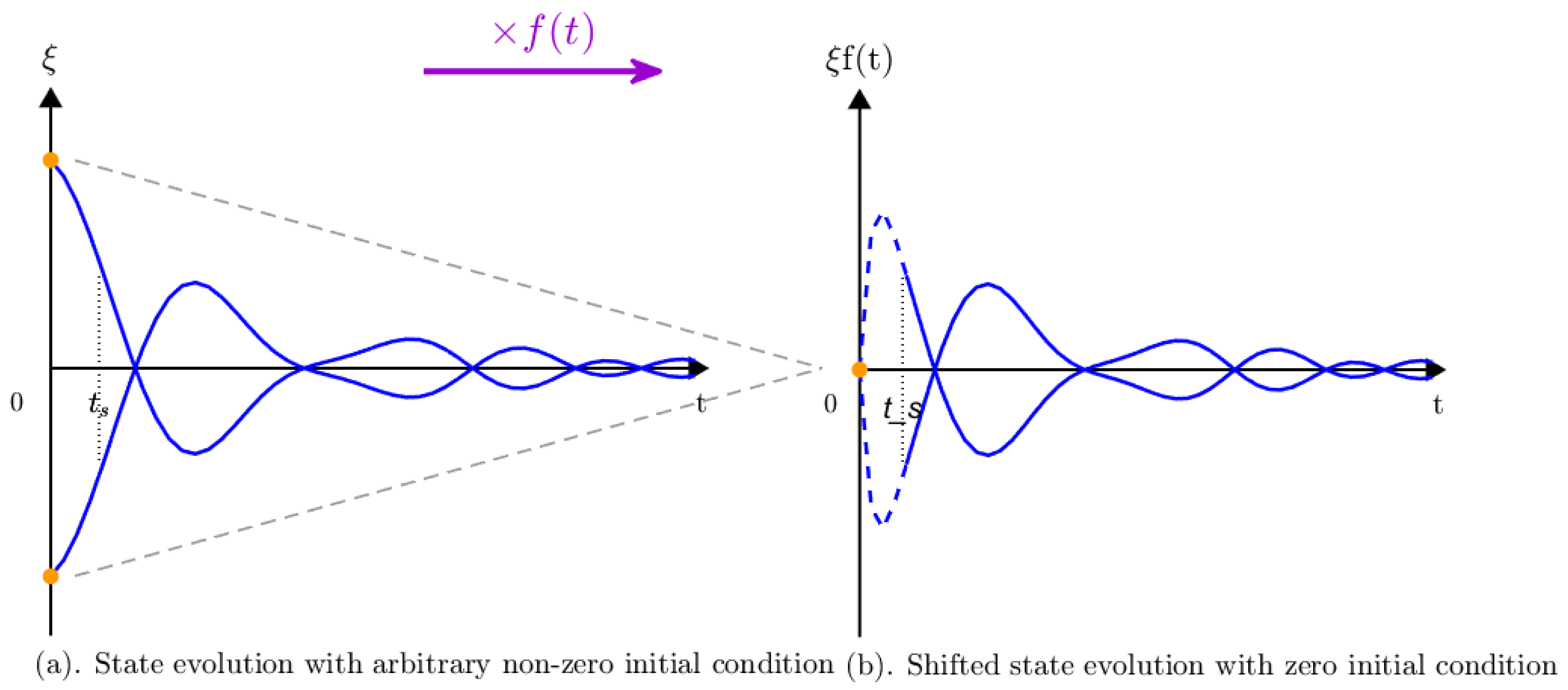
The novel error shifting function can convert any nonzero and bounded initial state into zero, as shown in Figure 1:
Remark 2.
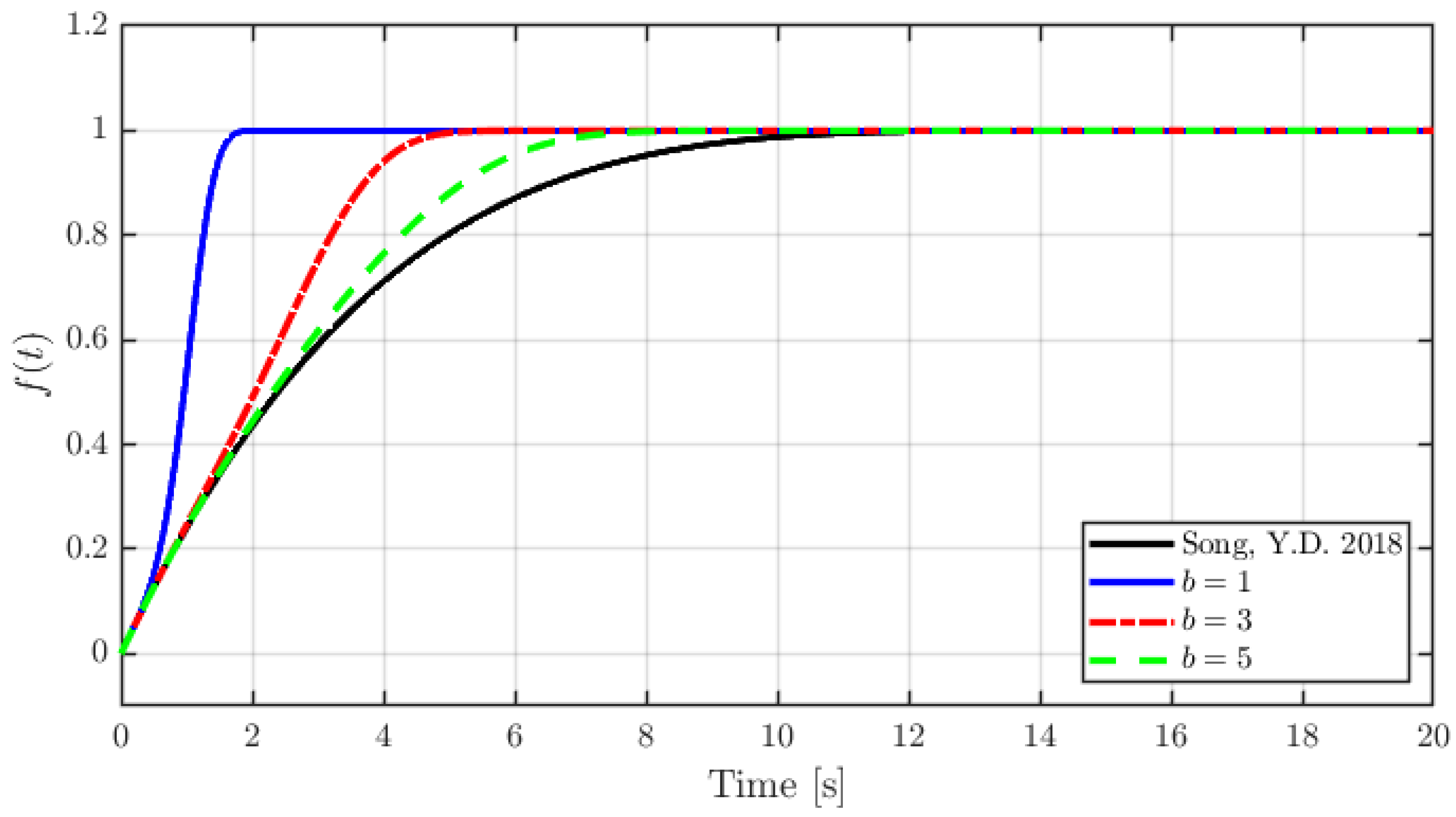
Compared with [40], the error transformation function proposed in this paper has two distinct advantages: first, by introducing the exponential term exp t 2 n 2 b 2 n , the proposed error transformation function can transition more smoothly when the constraint is activated; second, by introducing parameter b, the transition rate of the constraint can be flexibly adjusted, as shown in Figure 2.
Lemma 2 ([14]).
 As shown in (2), the proposed error shifting function f ( t ) has the following key properties:
(1) 
f ( t ) is monotonically increasing for t [ 0 , t s ] ; for any t 0 , f ( t ) [ 0 , 1 ] and f ( 0 ) = 0 ;
(2) 
f ( t ) attains its maximum value of 1 at t = t s , and remains 1 for t t s ;
(3) 
f ( i ) ( t ) , i = 0 , 1 , , n + 1 , are C n i + 1 and boundary for t [ 0 , ) .

2.2. Barrier Function

To address the problem of delay asymmetric constraints, based on the error shifting function (2), a class of BFs is introduced as follows:
H ( f x k , C l k , C h k ) = P ( f x k ) f x k C l K + Q ( f x k ) C h k f x k + R ( f x k ) x k { ξ 1 k , y r k } , k = 1 , , d
with the initial condition ξ 1 k ( 0 ) Ω 1 k ,where P ( f x k ) , Q ( f x k ) and R ( f x k ) satisfy the following criteria: for x k , (1) P ( f x k ) < 0 , 0 < d P d x k < + ; (2) Q ( f x k ) > 0 , 0 < d Q d x k < + ; and (3) 0 < d R d x k < + , lim x k + = R ¯ , lim x k = R ̲ with R ¯ and R ̲ being constants.
Remark 3.
Compared with the barrier function in [32], in this work, a novel unified BF is proposed. The error transformation function f ( t ) is introduced to solve the time-delay problem. When t [ 0 , t s ) , f ( t ) [ 0 , 1 ) , and f x k is numerically smaller than the original output x k . If x k C h k , f x k < x k , Q ( f x k ) C h k f x k is bounded. If x k C l k , f x k < x k , P ( f x k ) f x k C l k is bounded. So, we obtain H ( · ) , which remains bounded on t [ 0 , t s ) . On the other hand, when t t s , f ( t ) = 1 and f x k = x k . At this time, there are constraints. The novel unified BF allows the controller to be applicable regardless of the presence of delay constraints, without changing its structure.
Lemma 3 ([32]).
 For any ξ 1 k ( 0 ) Ω 1 k , H ( f x k , C l k , C h k ) , x k { ξ 1 k , y r k } , has the following properties:
lim C l k H ( f x k , C l k , C h k ) = Q ( f x k ) C h k f x k + R ( f x k ) lim C h k + H ( f x k , C l k , C h k ) = P ( f x k ) f x k C l k + R ( f x k ) lim C l k C h k + H ( f x k ) = R ( f x k )
Therefore, it holds that the absence of either C l k or C h k , does not affect the normal preservation of the remaining constraints. For any x k Ω 1 k , the external constraints C l k and C h k are not violated as long as H ( f x k , C l k , C h k ) is bounded. Moreover, the nonlinear BF H ( f x k , C l k , C h k ) , will be reduced to R ( f x k ) when both C l k and C h k do not exist.
Lemma 4 ([32]).
 Even if the system (1) is potentially affected by delay asymmetric constraints, the constructed barrier function H ( f x k , C l k , C h k ) can always maintain the controllability of the original system.
Proof. 
Taking the derivative of x k { ξ 1 k , y r k } with respect to (w.r.t.) time yields
H ˙ ( f x k , C l k , C h k ) = μ 1 ( f x k ) ( f ˙ x k + f x ˙ k ) + μ 2 ( f x k ) C ˙ l k μ 3 ( f x k ) C ˙ h k
where μ 1 ( f x k ) = d P d x k ( f x k C l k ) f P ( f x k ) ( f x k C l k ) 2 + d Q d x k ( C h k f x k ) + Q ( f x k ) ( C h k f x k ) 2 + d R d x k , μ 2 ( f x k ) = P ( f x k ) ( f x k C l k ) 2 , μ 3 ( f x k ) = Q ( f x k ) ( C h k f x k ) 2 .
If constraints are not violated, then C l k < ξ 1 k < C h k holds, and we can readily obtain that μ 1 ( ξ 1 k ) > 0 for ξ 1 k ( C l k , C h k ) , which ensures that the gain term μ 1 ( ξ 1 k ) of subsystem (5) is always not equal to zero, further implying that the original system can always remain controllable. □

2.3. Error Analysis

To proceed, for the sake of promoting the development of the adaptive tracking control framework, the tracking error β i , i = 1 , , n is defined as follows:
β 1 = ξ 1 y r β i = ξ i ϑ i 1 , i = 2 , , n
with ϑ i being the virtual controller to be designed later.
Subsequently, to address the problem of delay asymmetric output constraints, on the basis of barrier function (3) and Lemma 2, a new error z i , i = 1 , , n is defined as follows:
z 1 = H ( f ξ 1 ) H ( f y r ) z i = ξ i ϑ i 1 , i = 2 , , n
Lemma 5 ([32]).
 If constraints are not violated, then z 1 k = 0 if and only if β 1 k = 0 .
Proof. 
In accordance with (3) and (7), the following can be expressed:
z 1 k = P ( f ξ 1 k ) f ξ 1 k C l k P ( f y r k ) f y r k C l k + Q ( f ξ 1 k ) C h k f ξ 1 k Q ( f y r k ) C h k f y r k + R ( f ξ 1 k ) R ( f y r k )
It is readily verified that z 1 k = 0 when β 1 k = 0 if z 1 k are bounded and the initial condition is satisfied for any. To prove that z 1 k = 0 only when β 1 k = 0 , we take the derivative of z 1 k w.r.t. ξ 1 k and then have z 1 k ξ 1 k = μ 1 ( ξ 1 k ) > 0 for x 1 k ( C l k , C h k ) . Therefore, we can draw the conclusion that z 1 k = 0 if and only if β 1 k = 0 . □

3. Main Results

In this section, based on the above lemmas and assumptions, we derive the core control scheme and complete the stability analysis.
The virtual control laws ϑ i , actual controller u, and adaptation laws ω ^ ˙ i are designed as
ϑ i = m i z i K i , i = 1 , , n 1
u = 1 κ ̲ m n z n K n
ω ^ ˙ i = γ i 4 a i 2 z i 2 q i h i ω ^ i , i = 1 , , n
where a i , γ i , h i , m i , and m n are designed positive constants. In addition, the adaptive law can be adjusted by adjusting a i , γ i , and h i . The details of K i and K n will be shown later.
Now, we summarize the main result of this technical note as follows.
Theorem 1.
Consider the nonlinear systems (1), with the control scheme given in (10) and (11). Suppose that Assumptions 1–3 hold. The tracking error of the output y ( t ) and the reference y r ( t ) are ensured to be ultimately uniformly bounded (UUB). Moreover, even if the initial output constraint is violated, the output y ( t ) = ξ 1 ( t ) of the resulting closed-loop system obeys the delayed asymmetric output constraints in t s , i.e., C l ( t ) < y ( t ) = ξ 1 ( t ) < C h ( t ) ( t t s ) . All the internal signals in the closed-loop system are ensured to be bounded.
Proof. 
Step 1: Construct the Lyapunov function:
V 1 = 1 2 z 1 2 + 1 2 γ 1 ω ˜ 1 2
where ω ˜ 1 = ω 1 ω ^ 1 represents the estimation error. Differentiating (12) obtains
V ˙ 1 = z 1 z ˙ 1 1 γ 1 ω ˜ 1 ω ^ ˙ 1 = z 1 ( H ˙ ( f ξ 1 ) H ˙ ( f y r ) ) 1 γ 1 ω ˜ 1 ω ^ ˙ 1
For
H ˙ ( f ξ 1 ) = μ 1 ( f ξ 1 ) f ˙ ξ 1 + f ξ ˙ 1 + μ 2 ( f ξ 1 ) C ˙ l μ 3 ( f ξ 1 ) C ˙ h = μ 1 ( f ξ 1 ) f ˙ ξ 1 + f ( φ 1 ξ 2 + ψ 1 + d 1 ) + μ 2 ( f ξ 1 ) C ˙ l μ 3 ( f ξ 1 ) C ˙ h = μ 1 ( f ξ 1 ) f ˙ ξ 1 + f ( φ 1 z 2 + φ 1 ϑ 1 + ψ 1 + d 1 ) + μ 2 ( f ξ 1 ) C ˙ l μ 3 ( f ξ 1 ) C ˙ h ;
similarly,
H ˙ ( f y r ) = μ 1 ( f y r ) ( f ˙ y r + f y ˙ r ) + μ 2 ( f y r ) C ˙ l μ 3 ( f y r ) C ˙ h
Substituting (14) and (15) into (13), we obtain
V ˙ 1 = z 1 μ 1 f ξ 1 f ˙ ξ 1 + f φ 1 z 2 + φ 1 ϑ 1 + ψ 1 + d 1 + μ 2 f ξ 1 C ˙ l μ 3 f ξ 1 C ˙ h μ 1 f y r f ˙ y r + f y ˙ r μ 2 f y r C ˙ l + μ 3 f y r C ˙ h 1 γ 1 ω ˜ 1 ω ^ ˙ 1
Based on Lemma 1, we choose
μ 1 ( f ξ 1 ) f ψ 1 + μ 1 ( f ξ 1 ) f d 1 = W 1 * T η 1 ( U 1 ) + ε 1 ;
then,
V ˙ 1 = z 1 μ 1 f ξ 1 f ˙ ξ 1 + f φ 1 z 2 + f φ 1 ϑ 1 + μ 2 f ξ 1 C ˙ l μ 3 f ξ 1 C ˙ h μ 1 f y r f ˙ y r + f y ˙ r μ 2 f y r C ˙ l + μ 3 f y r C ˙ h + z 1 W 1 * T η 1 ( U 1 ) + z 1 ε 1 1 γ 1 ω ˜ 1 ω ^ ˙ 1
Based on Young’s inequality, Lemma 1, Assumptions 1 and 2, and adaptation laws (11), we have
z 1 μ 2 ( f ξ 1 ) μ 2 ( f y r ) C ˙ l + μ 3 ( f y r ) μ 3 ( f ξ 1 ) C ˙ h α 1 z 1 2 μ 2 ( f ξ 1 ) μ 2 ( f y r ) 2 + μ 3 ( f y r ) μ 3 ( f ξ 1 ) 2 + C ¯ l 2 + C ¯ h 2 4 α 1
z 1 μ 1 ( f y r ) ( f ˙ y r + f y ˙ r ) α 1 z 1 2 μ 1 ( f y r ) 2 + y ¯ r 2 4 α 1
z 1 μ 1 ( f ξ 1 ) f ˙ ξ 1 φ ̲ 1 c 1 z 1 2 μ 1 2 ( f ξ 1 ) f ˙ 2 ξ 1 2 + 1 4 φ ̲ 1 c 1
z 1 μ 1 ( f ξ 1 ) f φ 1 z 2 φ ̲ 2 c 2 f 2 z 1 2 μ 1 2 ( f ξ 1 ) z 2 2 + φ ¯ 1 2 4 φ ̲ 2 c 2
z 1 W 1 η 1 U 1 + ε 1 1 4 a 1 2 z 1 2 ω 1 q 1 + a 1 2 + 1 4 z 1 2 + ε N 2
h 1 γ 1 ω ˜ 1 ω ^ 1 h 1 2 γ 1 ω 1 2 h 1 2 γ 1 ω ˜ 1 2
where c 1 and c 2 are positive control design parameters. Based on (19)–(24), Equation (18) can be rewritten as
V ˙ 1 z 1 μ 1 ( f ξ 1 ) f φ 1 ϑ 1 + φ ̲ 1 K 1 + α 1 z 1 2 Φ 1 + φ ̲ 2 c 2 f 2 z 1 2 μ 1 2 ( f ξ 1 ) z 2 2 + Γ 1 + 1 4 z 1 2 h 1 2 γ 1 ω ˜ 1 2
where K 1 = c 1 z 1 μ 1 ( f ξ 1 ) f ˙ 2 ξ 1 2 , Γ 1 = 1 4 φ ̲ 1 c 1 + φ ¯ 1 2 4 φ ̲ 2 c 2 + y ¯ r 2 + C ¯ l 2 + C ¯ h 2 4 α 1 + ε N 2 + a 1 2 + h 1 2 γ 1 ω 1 2 and Φ 1 = μ 2 ( f ξ 1 ) μ 2 ( f y r ) 2 + μ 3 ( f y r ) μ 3 ( f ξ 1 ) 2 + μ 1 2 ( f y r ) . Since K 1 , Γ 1 and Φ 1 are both calculated, we design the following virtual controller:
ϑ 1 = m 1 z 1 K 1
with m 1 denoting the positive parameter. Then,
z 1 μ 1 ( f ξ 1 ) f φ 1 ϑ 1 = m 1 z 1 2 μ 1 ( f ξ 1 ) f φ 1 z 1 μ 1 ( f ξ 1 ) f φ 1 K 1 m 1 z 1 2 μ 1 ( f ξ 1 ) f φ ̲ 1 z 1 μ 1 ( f ξ 1 ) f φ ̲ 1 K 1
Substituting (27) into (25) yields
V ˙ 1 m 1 μ 1 ( f ξ 1 ) f φ ̲ 1 z 1 2 + 1 4 z 1 2 h 1 2 γ 1 ω ˜ 1 2 + φ ̲ 2 c 2 z 1 2 μ 1 2 ( f ξ 1 ) z 2 2 + α 1 Φ 1 z 1 2 + Γ 1
Step i ( 2 i n 1 ): At the current i th step, it should be noted that β i = ξ i ϑ i 1 and ϑ i 1 denotes a function of ξ i 1 , y r ( i 1 ) , ω ^ i 1 , f ( i 1 ) , C l ( i j ) and C h ( i j ) with j = 1 , 2 , , i 1 , where ξ ¯ i 1 = [ ξ 1 , ξ 2 , , ξ i 1 ] T , y ¯ r ( i 1 ) = [ y r , , y r ( i 1 ) ] T , ω ^ ¯ i 1 = [ ω ^ 1 , , ω ^ i 1 ] T , f ¯ ( i 1 ) = [ f , , f ( i 1 ) ] T , C ¯ l ( i j ) = [ C l , , C l ( i j ) ] T and C ¯ h ( i j ) = [ C h , , C h ( i j ) ] T with j = 1 , 2 , , i 1 . Ergo, we can derive
ϑ ˙ i 1 = j = 1 i 1 ϑ i 1 ξ j φ j ξ j + 1 + ψ j + d j + Γ ϑ i 1
Γ ϑ i 1 = j = 0 i 1 ϑ i 1 y r ( j ) y r ( j + 1 ) + j = 1 i 1 ϑ i 1 ω ^ j ω ^ ˙ j + j = 1 i 1 ϑ i 1 f ( j ) f ( j + 1 ) + j = 1 i 1 p = 0 i j ϑ i 1 C l ( p ) C l ( p + 1 ) + j = 1 i 1 p = 0 i j ϑ i 1 C h ( p ) C h ( p + 1 )
Construct the following Lyapunov function:
V i = V i 1 + 1 2 z i 2 + 1 2 γ i ω ˜ i 2
where ω ˜ i = ω i ω ^ i represents the estimation error. We can calculate the derivative of z i w.r.t. time as
z ˙ i = ξ ˙ i ϑ ˙ i 1 = φ i ξ ¯ i ξ i + 1 + ψ i ξ ¯ i + d i ξ ¯ i , t j = 1 i 1 ϑ i 1 ξ j φ j ξ ¯ j ξ j + 1 + ψ j ξ ¯ j + d j ξ ¯ j , t + Γ ϑ i 1
Based on Lemma 1, we choose
ψ i ξ ¯ i + d i ξ ¯ i , t j = 1 i 1 ϑ j 1 ξ j ψ j ξ ¯ j + d j ξ ¯ j , t = W i * T η i U i + ε i ;
then,
V ˙ i = V ˙ i 1 + z i φ i ξ ¯ i ξ i + 1 z i j = 1 i 1 ϑ i 1 ξ j φ j ξ ¯ j ξ j + 1 + Γ ϑ i 1 + z i W i * T η i U i + z i ε i 1 γ i ω ˜ i ω ^ ˙ i = V ˙ i 1 + z i φ i ξ ¯ i z i + 1 + φ i ξ ¯ i ϑ i z i j = 1 i 1 ϑ i 1 ξ j φ j ξ ¯ j ξ j + 1 + Γ ϑ i 1 + z i W i * T η i U i + z i ε i 1 γ i ω ˜ i ω ^ ˙ i
Based on Young’s inequality, Lemma 1, Assumptions 1 and 2, and adaptation laws (11), we have
z i φ i ξ ¯ i z i + 1 φ ̲ i + 1 c i + 1 z i + 1 2 z i 2 + φ ¯ i 2 4 φ ̲ i + 1 c i + 1
z i Γ ϑ i 1 φ ̲ i c i z i 2 Γ ϑ i 1 2 + 1 4 φ ̲ i c i
z i j = 1 i 1 ϑ i 1 ξ j φ j ξ j + 1 φ ̲ i c i z i 2 j = 1 i 1 ϑ i 1 ξ j 2 ξ j + 1 2 + j = 1 i 1 φ ¯ j 2 4 φ ̲ i c i
z i W i η i U i + ε i 1 4 a i 2 z i 2 ω i q i + a i 2 + 1 4 z i 2 + ε N 2
h i γ i ω ˜ i ω ^ i h i 2 γ i ω i 2 h i 2 γ i ω ˜ i 2
where c i and c i + 1 are positive parameters. Accordingly, we can get
V ˙ i m 1 μ 1 ( f ξ 1 ) f φ ̲ 1 z 1 2 + 1 4 z 1 2 h 1 2 γ 1 ω ˜ 1 2 + α 1 Φ 1 z 1 2 + Γ 1 + j = 2 i 1 m i φ ̲ j z j 2 + 1 4 z j 2 h j 2 γ j ω ˜ j 2 + Γ j + z i φ i ϑ i + φ ̲ i K i + Γ i + φ ̲ i + 1 c i + 1 z i + 1 2 z i 2 + 1 4 z i 2 h i 2 γ i ω ˜ i 2
where K i = c i z i z i 1 2 + c i z i j = 1 i 1 ϑ i 1 ξ j 2 ξ j + 1 2 + c i z i Γ ϑ i 1 2 , Γ i = 1 4 φ ̲ i c i + j = 1 i 1 φ ¯ j 2 4 φ ̲ i c i + φ ¯ i 2 4 φ ̲ i + 1 c i + 1 + ε N 2 + a i 2 + h i 2 γ i ω i 2 . Since K i and Γ i are both calculated, we design the following virtual controller:
ϑ i = m i z i K i
with m i denoting the positive parameter. Then,
z i φ i ϑ i = m i z i 2 φ i z i φ i K i m i z i 2 φ ̲ i z i φ ̲ i K i
Substituting (42) into (40),
V ˙ i m 1 μ 1 ( f ξ 1 ) f φ ̲ 1 z 1 2 j = 2 i m j φ ̲ j z j 2 + φ ̲ i + 1 c i + 1 z i + 1 2 z i 2 + α 1 Φ 1 z 1 2 + j = 1 i 1 4 z j 2 h j 2 γ j ω ˜ j 2 + Γ j
Step n:
Construct the following Lyapunov function:
V n = V n 1 + 1 2 z n 2 + 1 2 γ n ω ˜ n 2
where ω ˜ n = ω n ω ^ n represents the estimation error. We can calculate the derivative of z n w.r.t. time as
z ˙ n = ξ ˙ n ϑ ˙ n 1 = φ n ξ ¯ n κ ( t , t k ) u + χ ( t , t χ ) + ψ n ξ ¯ n + d n ξ ¯ n , t j = 1 n 1 ϑ n 1 ξ j φ j ξ ¯ j ξ j + 1 + ψ j ξ ¯ j + d j ξ ¯ j , t + Γ ϑ n 1
Based on Lemma 1, we choose
ψ n ξ ¯ n + d n ξ ¯ n , t + φ n ξ ¯ n χ t , t χ j = 1 n 1 ϑ n 1 ξ j ψ j ξ ¯ j + d j ξ ¯ j , t = W n * T η n U n + ε n ;
then,
V ˙ n = V ˙ n 1 + z n z ˙ n ω ˜ n ω ^ ˙ n m 1 μ 1 ( f ξ 1 ) f φ ̲ 1 z 1 2 j = 2 n 1 m j f φ ̲ j z j 2 + φ ̲ n c n z n 2 z n 1 2 + α 1 Φ 1 z 1 2 + j = 1 n 1 1 4 z j 2 h j 2 γ j ω ˜ j 2 + Γ j + z n f φ n ξ ¯ n κ ( t , t k ) u z n j = 1 n 1 ϑ i 1 ξ j φ j ξ ¯ j ξ j + 1 + Γ ϑ n 1 + z n W n T η n U n + z n ε n 1 γ i ω ˜ i ω ^ ˙ i
Based on Young’s inequality, Lemma 1, Assumptions 1 and 2, and adaptation laws (11), we have
z n j = 1 n 1 ϑ n 1 ξ j φ j ξ j + 1 φ ̲ n c n z n 2 j = 1 n 1 ϑ n 1 ξ j 2 ξ j + 1 2 + j = 1 n 1 φ ¯ j 2 4 φ ̲ n c n
z n Γ ϑ n 1 φ ̲ n c n z n 2 Γ ϑ n 1 2 + 1 4 φ ̲ n c n
z n W n * T η n U n + ε n 1 4 a n 2 z n 2 ω n q n + a n 2 + 1 4 z n 2 + ε N 2
h n γ n ω ˜ n ω ^ n h n 2 γ n ω n 2 h n 2 γ n ω ˜ n 2
where c n is positive parameter. Accordingly, we can get
V ˙ n m 1 μ 1 ( f ξ 1 ) f φ ̲ 1 z 1 2 j = 2 n 1 m j φ ̲ j z j 2 + α 1 Φ 1 z 1 2 + j = 1 n 1 4 z j 2 h j 2 γ j ω ˜ j 2 + Γ j + z n φ n κ t , t k u + φ ̲ n K n
where K n = c n z n z n 1 2 + c n z n + c n z n j = 1 n 1 ϑ n 1 ξ j 2 ξ j + 1 2 + c n z n Γ ϑ n 1 2 , Γ n = 1 + j = 1 n 1 φ ¯ j 2 4 φ ̲ n c n + ε N 2 + a n 2 + h n 2 γ n ω n 2 . Since K n and Γ n are both calculated, the controller is designed as
u = 1 κ ̲ m n z n K n
with m n denoting the positive parameter. Then,
z n φ n κ t , t k u = m n z n 2 φ n z n φ n K n m n z n 2 φ ̲ n z n φ ̲ n K n
V ˙ n m 1 μ 1 ( f ξ 1 ) f φ ̲ 1 z 1 2 j = 1 n ( m j φ ̲ j z j 2 ) + γ 1 Φ 1 z 1 2 + j = 1 n 1 4 z j 2 h j 2 γ j ω ˜ j 2 + Γ j μ V n + ν
where μ = min m 1 μ 1 φ ̲ 1 f , m i φ ̲ i , 1 4 , h 1 2 γ 1 , h i 2 γ i i = 2 , 3 , , n , ν = j = 1 n Γ i + γ 1 Φ 1 z 1 2 , and we can infer from (55) that
0 V n ( t ) v μ + V n ( 0 ) v μ e μ t
1 2 z 1 2 V n ( t ) v μ + V n ( 0 ) v μ e μ t
| z 1 | 2 v μ + 2 V n ( 0 ) v μ e μ t
When t , | z 1 | 2 ν μ , and the tracking error can be made arbitrarily small by adjusting μ and ν , satisfying the UUB tracking of the output y ( t ) to y r ( t ) .
V ˙ n ι j = 1 n z j 2 + ν
where l = min m j μ ̲ j φ ̲ j f , m j φ ̲ j f j = 2 , 3 , , n . For the sake of convenience, we denote z = z 1 , z 2 , , z n T and β = β 1 , β 2 , , β n T ; then, Equation (59) can be reconstructed as follows:
l z T z + V ˙ n ν
By means of integrating (60) and utilizing the fact that V n is bounded, we can get
lim T v 1 T v 0 T v z T z d t ν ι
and we note that
lim T v 1 T v 0 T v β T β d t = lim T v 1 T v 0 T v z T z d t
Similarly, we can further obtain
lim T v 1 T v t s T v z T z d t = lim T v 1 T v 0 T v z T z d t
According to (61)–(63), one has
lim T v 1 T v 0 T v β i 2 d t lim T v 1 T v 0 T v β T β d t ν ι
The above analysis indicates that ν is a key parameter affecting the mean-square tracking error and virtual tracking errors. If a sufficiently small ν is chosen, the value of β i will decrease accordingly.
From the boundedness of V ( t ) , it follows that z i and ω ˜ i are bounded. Combining z i = f ( t ) β i , β i = ξ i ϑ i 1 , and the virtual controller ϑ i = m i z i K i (where K i is bounded), we can conclude that ξ i and ϑ i are bounded. The actual controller u = 1 κ ̲ ( m n z n K n ) , and since z n , K n , and κ ̲ are bounded, u is bounded. In summary, all closed-loop signals such as ξ i , u, ω ^ i , and z 1 are uniformly bounded. □

4. Numerical Simulation

In order to attest the efficacy of the proposed control framework in this section, we give an emblematic application example. The attitude control of the quadrotor UAV is described in [43] and a some of the parameters are designed as (65)
x ˙ 1 , 1 = x 1 , 2 x ˙ 1 , 2 = l 1 x 2 , 2 x 3 , 2 l 2 Ω r x 2 , 2 l 3 x 1 , 2 + b 1 u φ + d φ ˙ ( t ) x ˙ 2 , 1 = x 2 , 2 x ˙ 2 , 2 = l 4 x 1 , 2 x 3 , 2 l 5 Ω r x 1 , 2 l 6 x 2 , 2 + b 2 u θ + d θ ˙ ( t ) x ˙ 3 , 1 = x 3 , 2 x ˙ 3 , 2 = l 7 x 1 , 2 x 2 , 2 l 8 x 3 , 2 + b 3 u ψ + d ψ ˙ ( t )
where x = ( φ , φ ˙ , θ , θ ˙ , ψ , ψ ˙ ) , u = u φ , u θ , u ψ T denotes the input vector. b 1 = d q I x , b 2 = d q I y , b 3 = 1 I z , l 1 = I y I z I x , l 2 = I r I x , l 3 = k φ I x , l 4 = I z I x I y , l 5 = I r I y , l 6 = k θ I y , l 7 = I x I y I z , l 8 = k ψ I z , Ω r = ω 1 ω 2 + ω 3 ω 4 . The quadrotor physical parameters are shown in Table 1.
The φ , θ , and ψ denote the roll, pitch, and yaw angles, respectively. ( I x , I y , I z ) denote the body inertia; ( k φ , k θ , k ψ ) denote aerodynamic coefficients; J r , b, k, d q denote rotor inertia, thrust factor, drag factor, and the distance from the quadcopter’s center of mass to the rotor shaft, respectively; and ω i for i ranging from 1 to 4 denotes the angular velocity of each rotor i, respectively.
Our control goal is to make the reference trajectory y r = [ φ r , θ r , ψ r ] T should be tracked by the system output y = [ φ , θ , ψ ] T .
Define the following vector to represent the attitude of the UAV: ξ 1 = [ φ , θ , ψ ] T , ξ 2 = [ φ ˙ , θ ˙ , φ ˙ ] T . Then, the attitude control system of the UAV can be rewritten as
ξ ˙ 1 = ξ 2 ξ ˙ 2 = g 2 κ u + χ + ψ 2 + d 2 y = ξ 1
where g 2 = d I x 0 0 0 d I y 0 0 0 1 I z , ψ 2 = l 1 θ ˙ ψ ˙ l 2 Ω r θ ˙ l 3 φ ˙ l 4 φ ˙ θ ˙ l 5 Ω r φ ˙ l 6 θ ˙ l 7 φ ˙ θ ˙ l 8 ψ ˙ , d 2 = d φ ( t ) d θ ( t ) d ψ ( t ) = 0.5 sin ( 2 t ) 0.5 cos ( 2 t ) 0.2 sin ( 3 t ) .
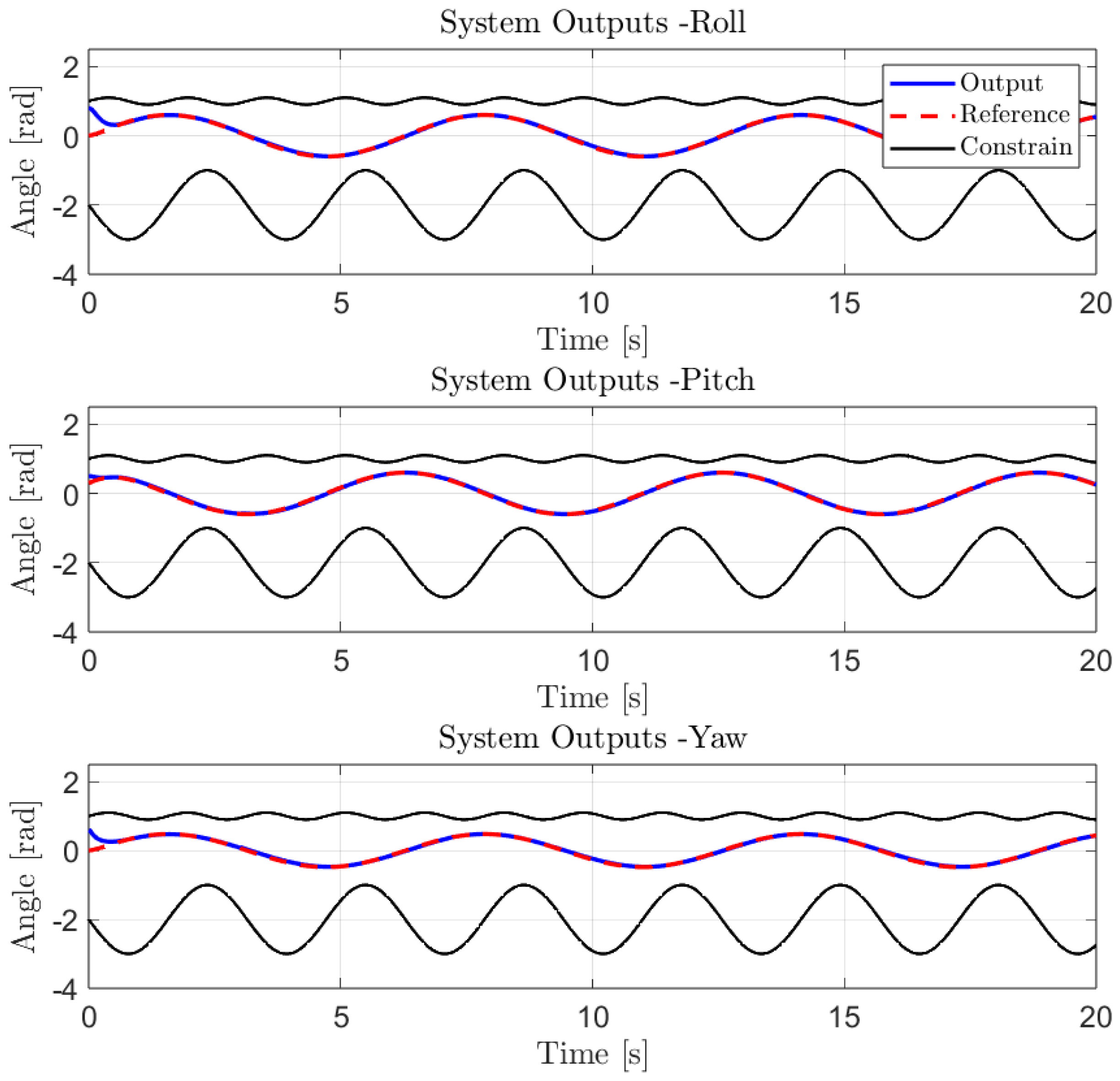
The parameter selection is determined as follows: The initial state of Case I is ξ ( 0 ) = 0.8 , 0.5 , 0.6 T , and the initial state of Case II is ξ ( 0 ) = 1.2 , 1.33 , 1.5 T . The upper bound of the output constraint is C h k ( t ) = 1 + 0.1 sin ( 4 t ) , the lower bound of the output constraint is C l k ( t ) = 2 sin ( 2 t ) . The multiplicative deception attack signals κ ( t , t κ ) = diag 0.01 + 0.01 sin ( 20 t ) , 0.01 + 0.3 sin ( 30 t ) , 0.01 + 0.03 sin ( 20 t ) , and the additive deception attack signals χ ( t , t χ ) = [ χ φ , χ θ , χ ψ ] T = [ 50.0 sin ( 4 t ) , 60.0 sin ( 3 t ) , 70.0 sin ( 3 t ) ] T ; there are the multiplicative deception attack and the additive deception attack on the controller when t κ = 7.0 s and t χ = 3.0 s , respectively. The reference signal is selected as y r = [ ( 0.3 + 0.3 tanh ( 2.0 t ) ) sin t , ( 0.3 + 0.3 tanh ( 2.0 t ) ) cos t , ( 0.3 + 0.3 tanh ( 2.0 t ) ) 0.8 sin t ] T . The output should be constrained in 2 sin ( 2 t ) < ξ 1 k < 1 + 0.1 sin ( 4 t ) after t s = 10   s . The design parameters are selected as m 1 = 3.0 , m 2 = 2.0 .
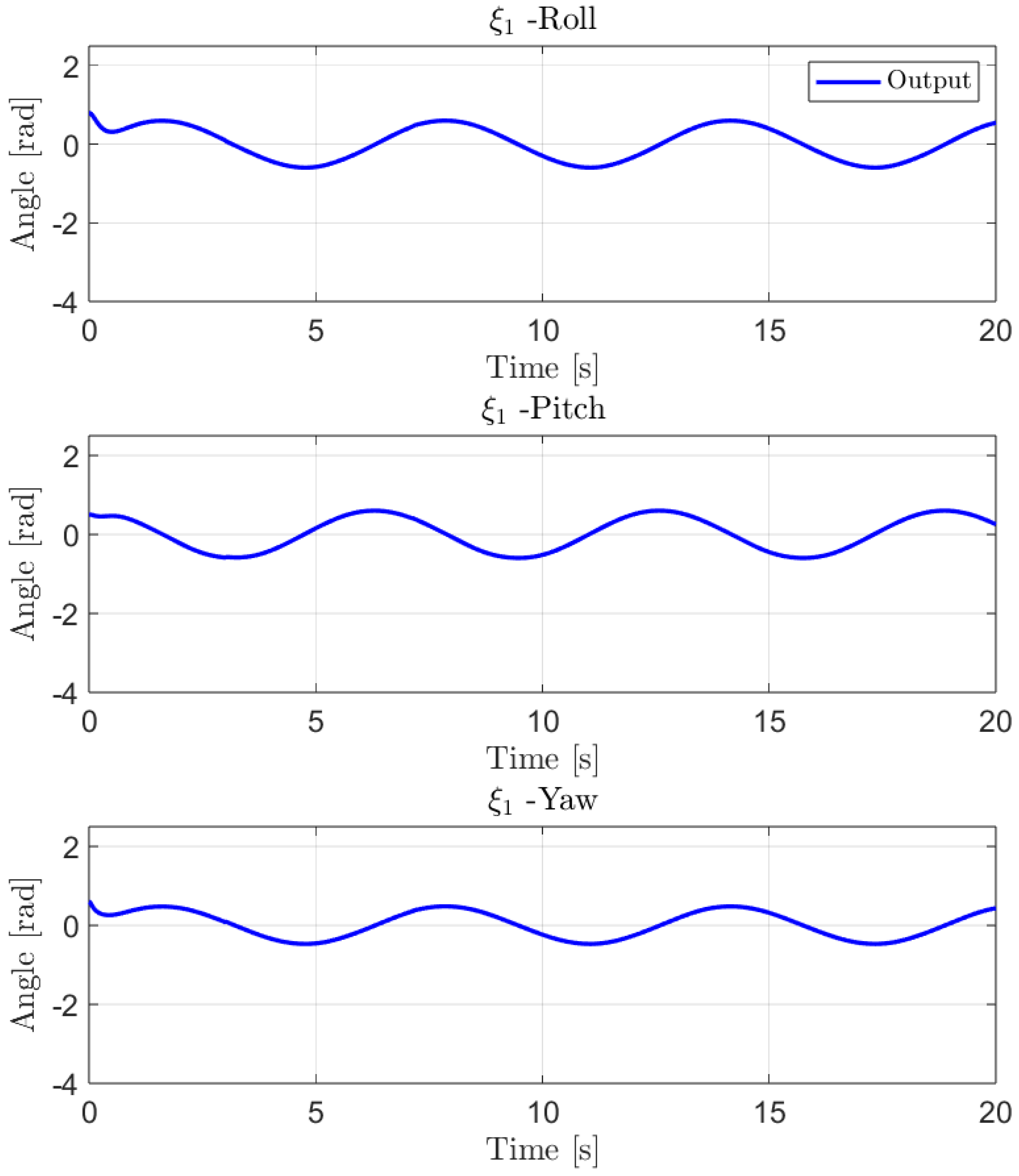
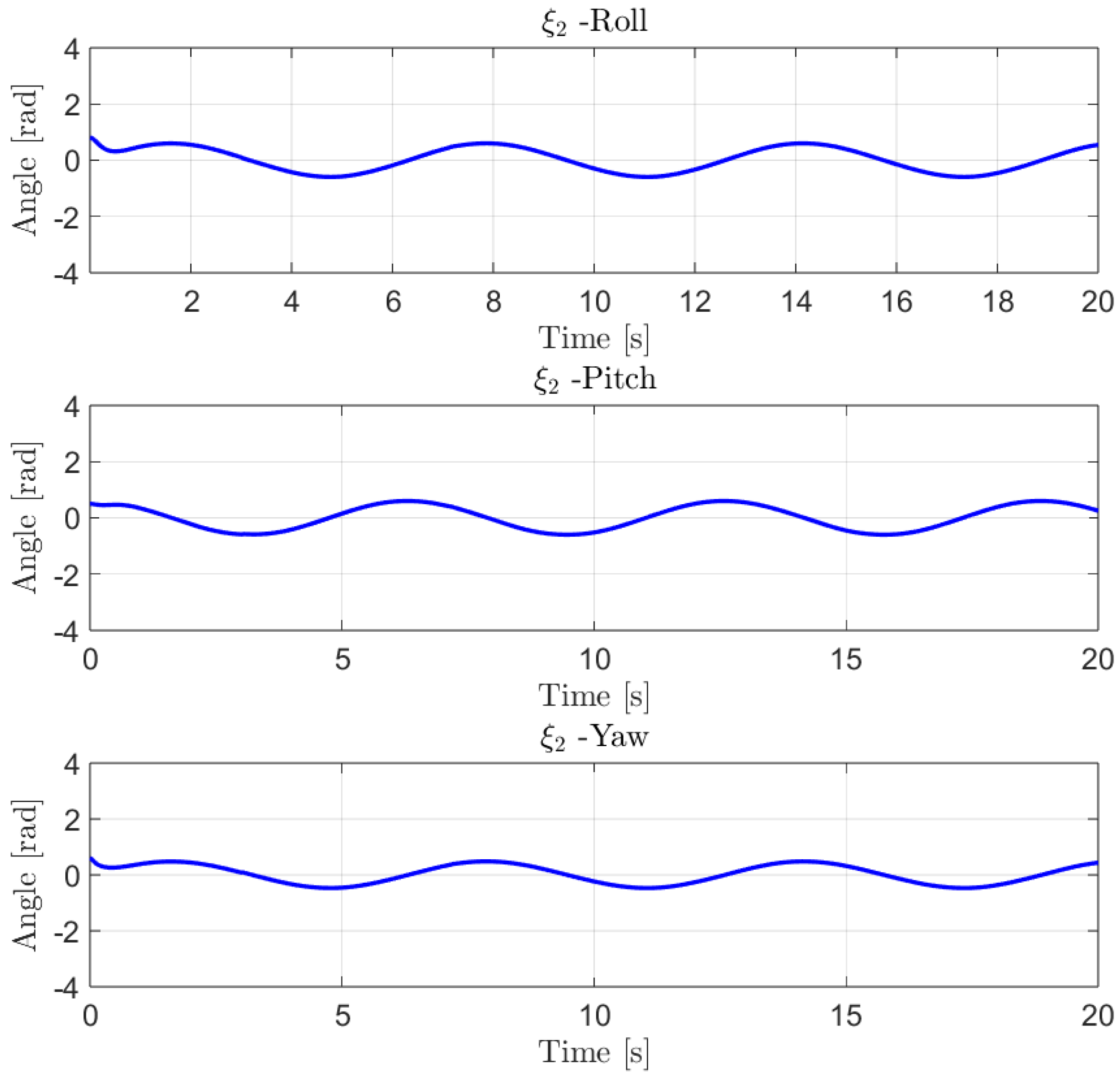
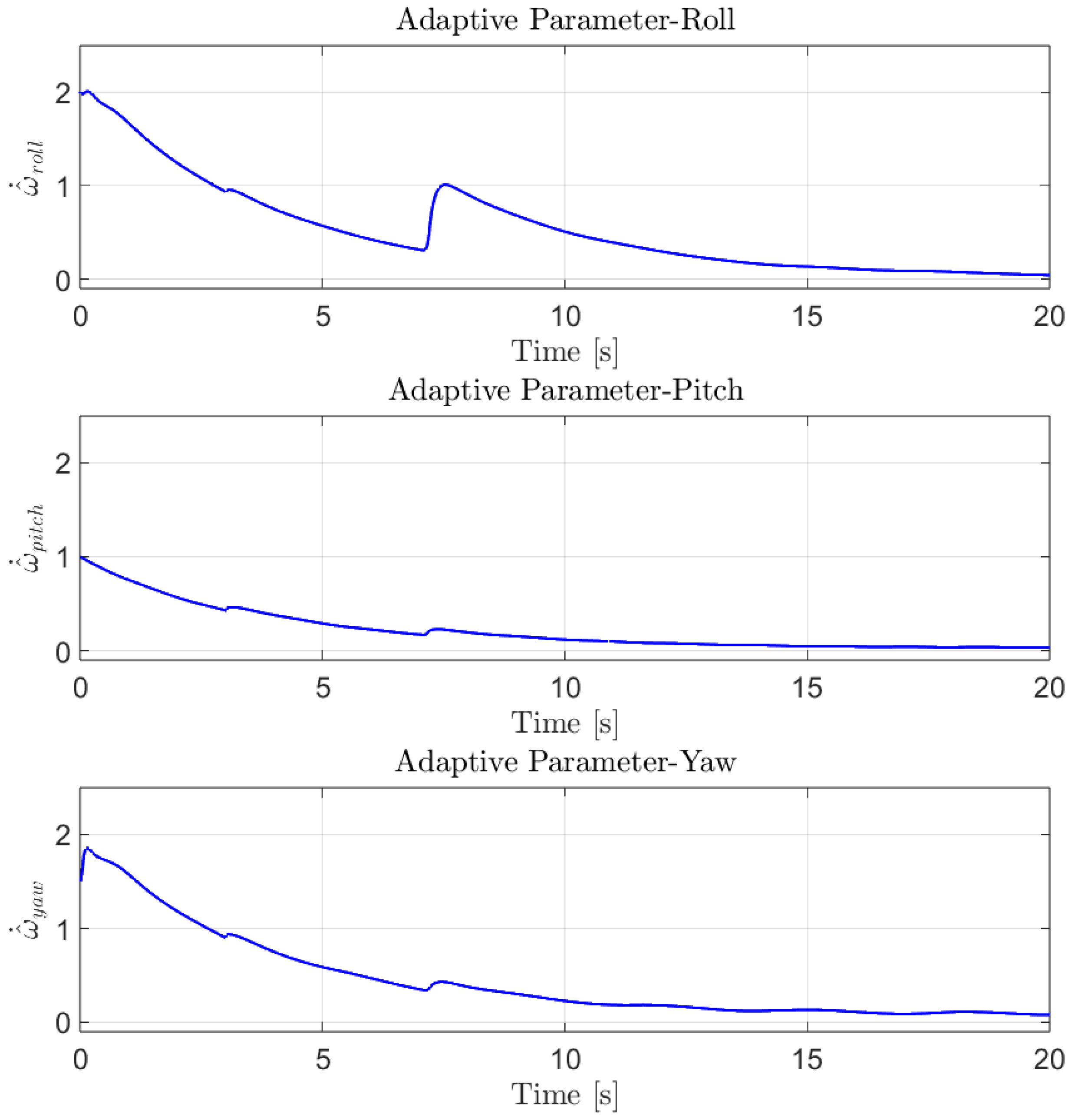
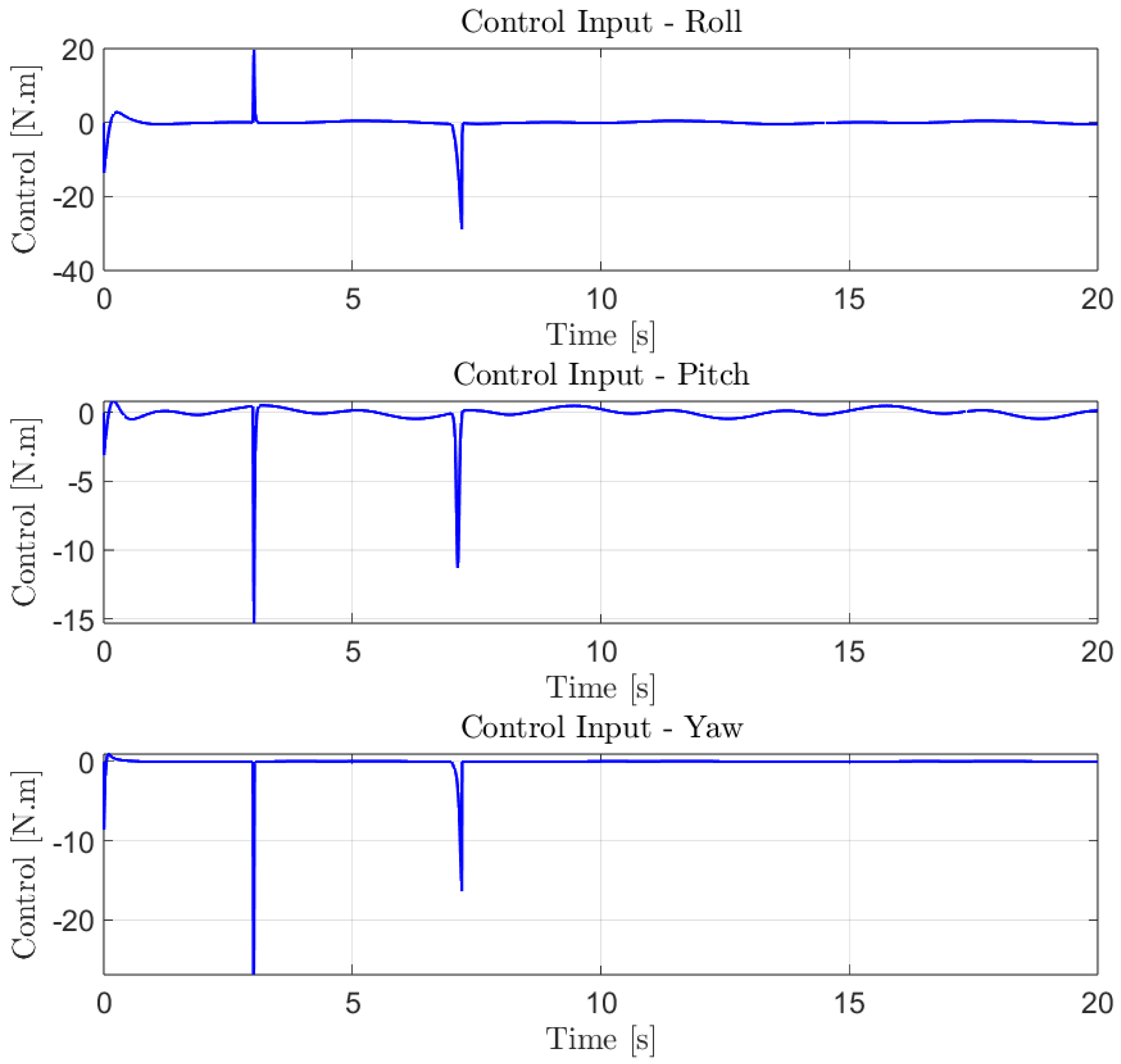
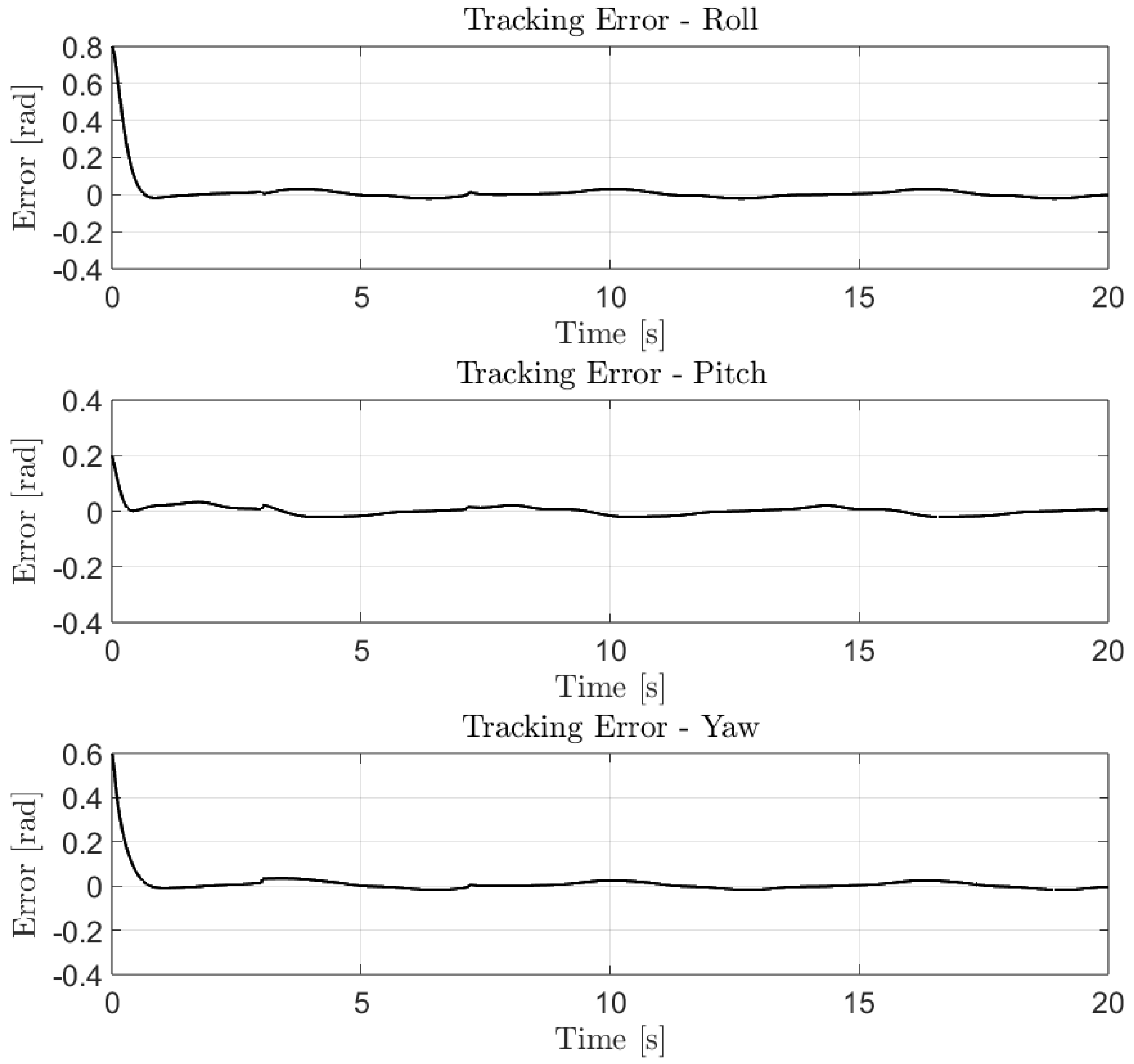
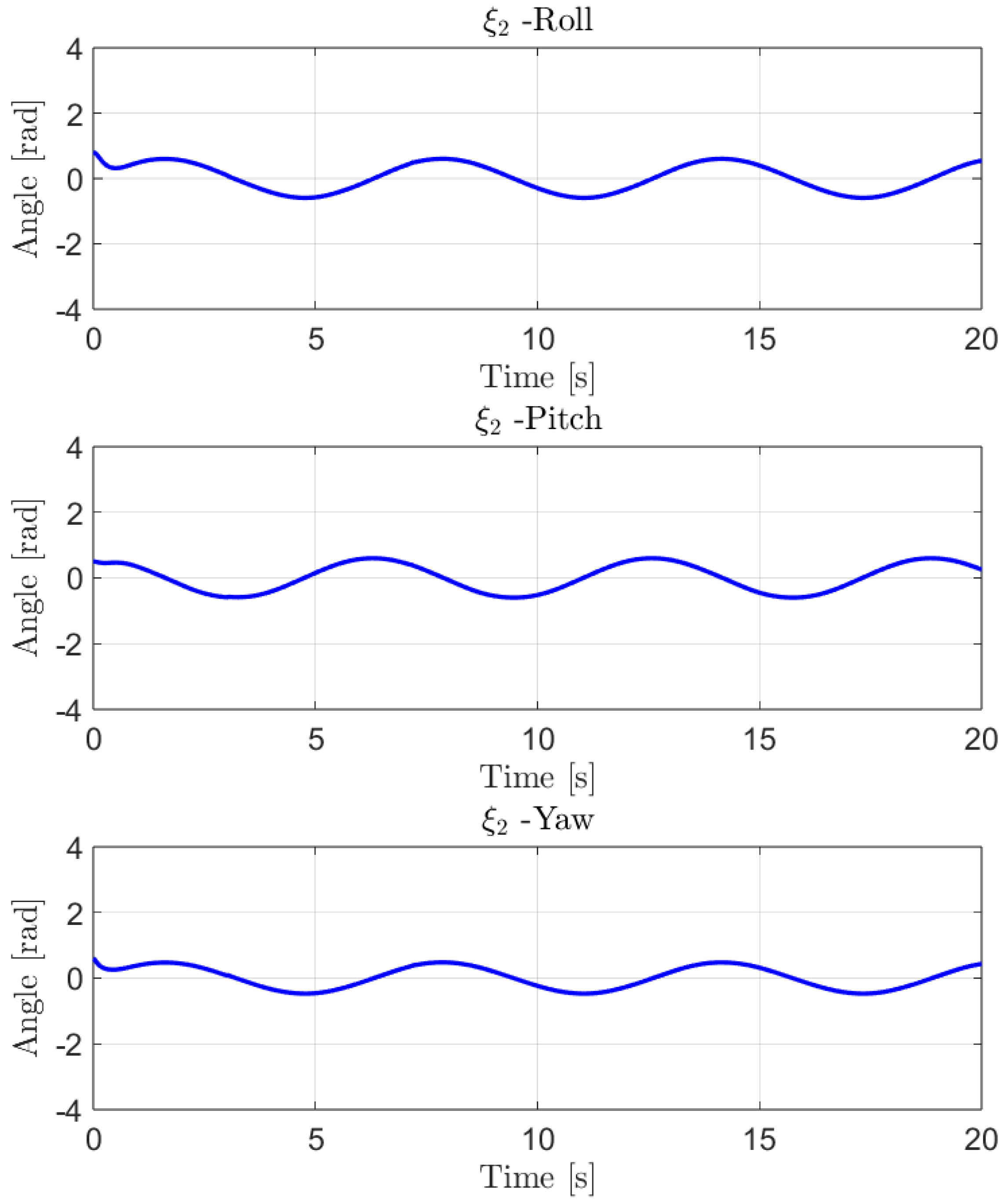
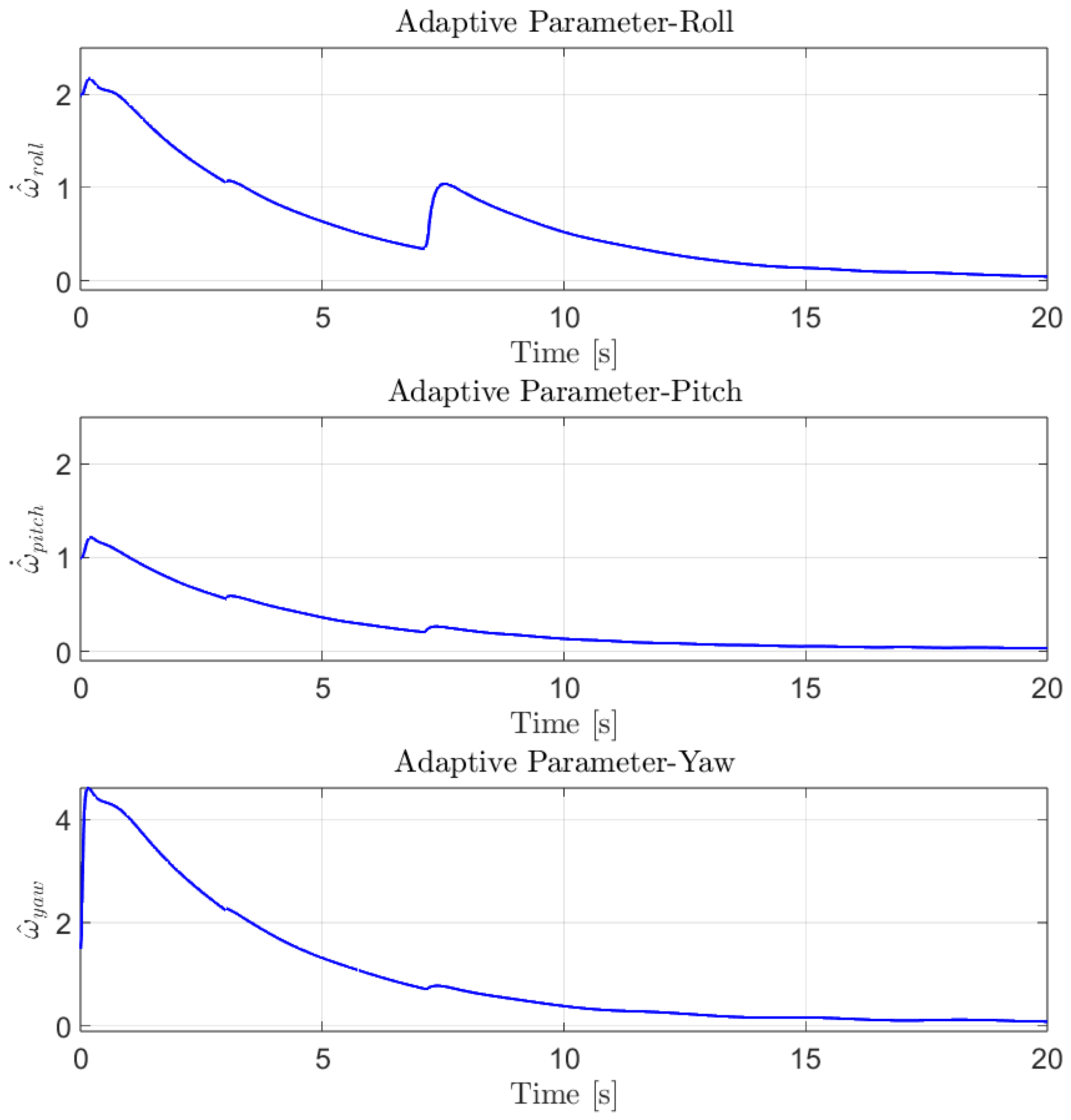
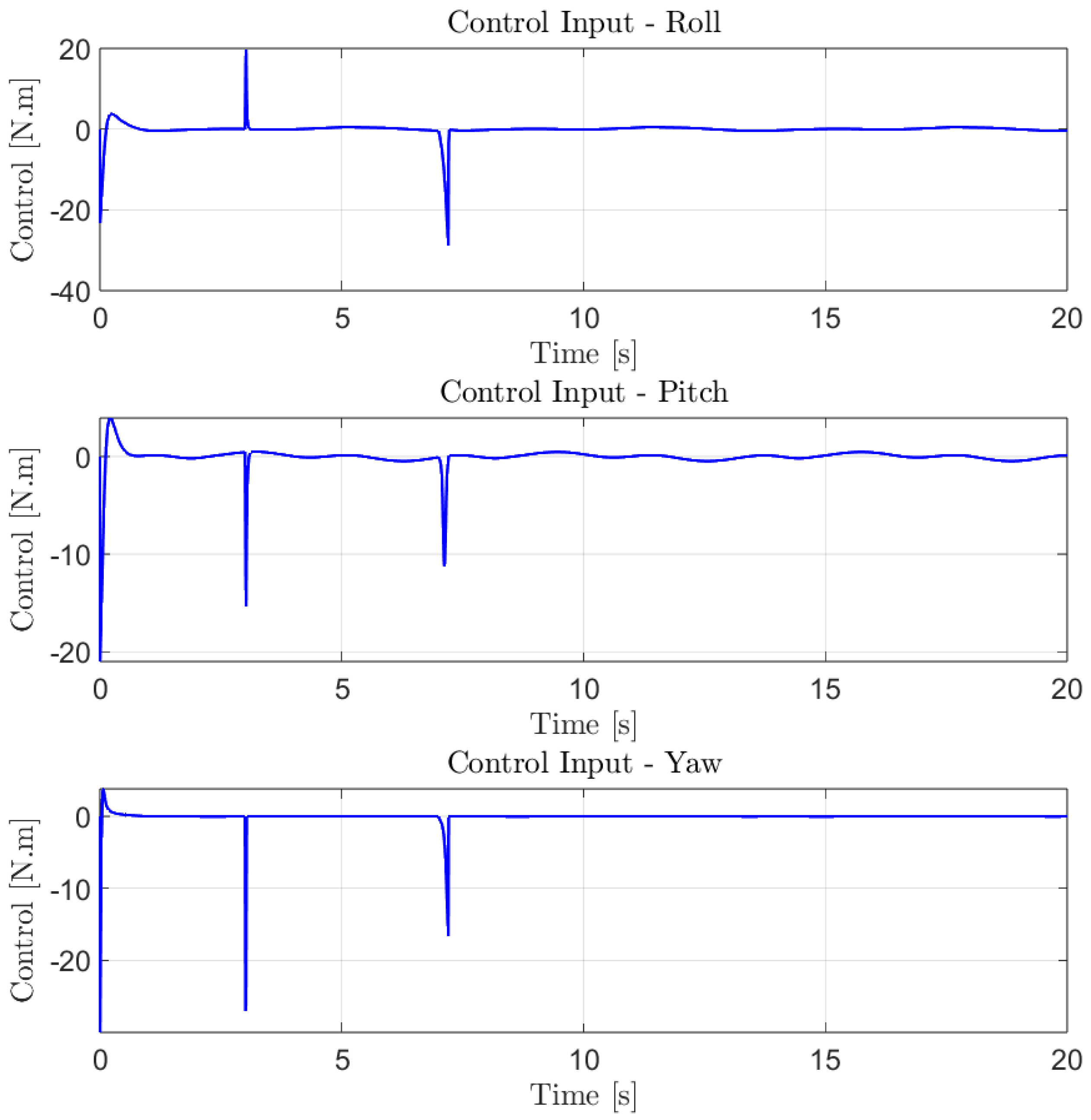
Case I: The output conforms to the constraint conditions initially and are free of restraint for t [ 0 , t s ) . When t t s , the output obeys the corresponding constraints. The simulation results are presented in Figure 3, Figure 4, Figure 5, Figure 6, Figure 7 and Figure 8. Figure 3 and Figure 4 describe the profile of the state ξ 1 , ξ 2 under Case I. It can be seen that all signals in the closed-loop systems are UUB. The control of the adaptive laws ω ^ ˙ and input are shown in Figure 5 and Figure 6 under Case I. It is observed that the adaptive and controller show good performance under the multiplicative attack at 7 s and additive attack at 3 s. Figure 7 illustrates the tracking error under Case I. Figure 8 presents the trajectories of y and y r . We can observe that good tracking performance can be derived.
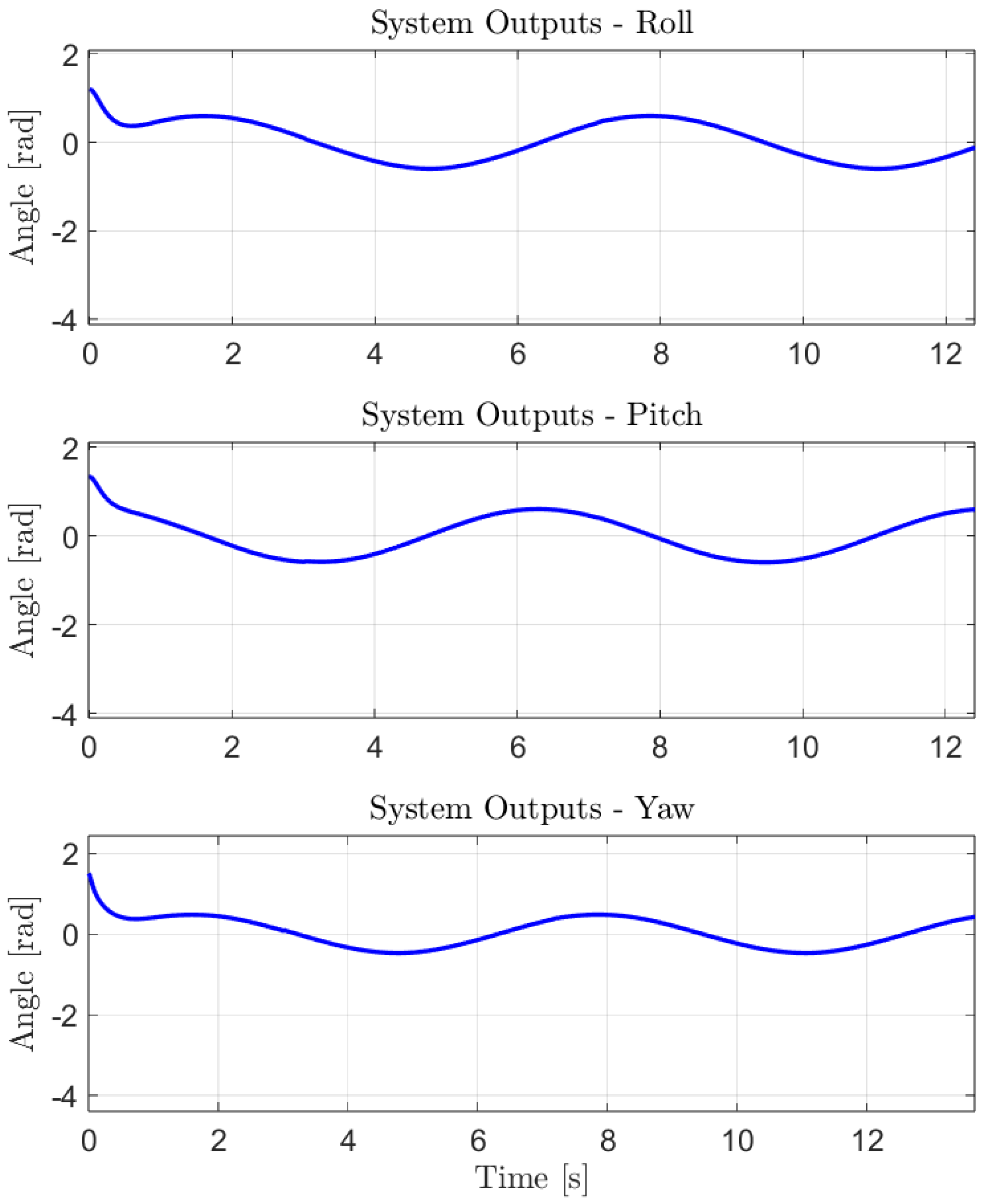
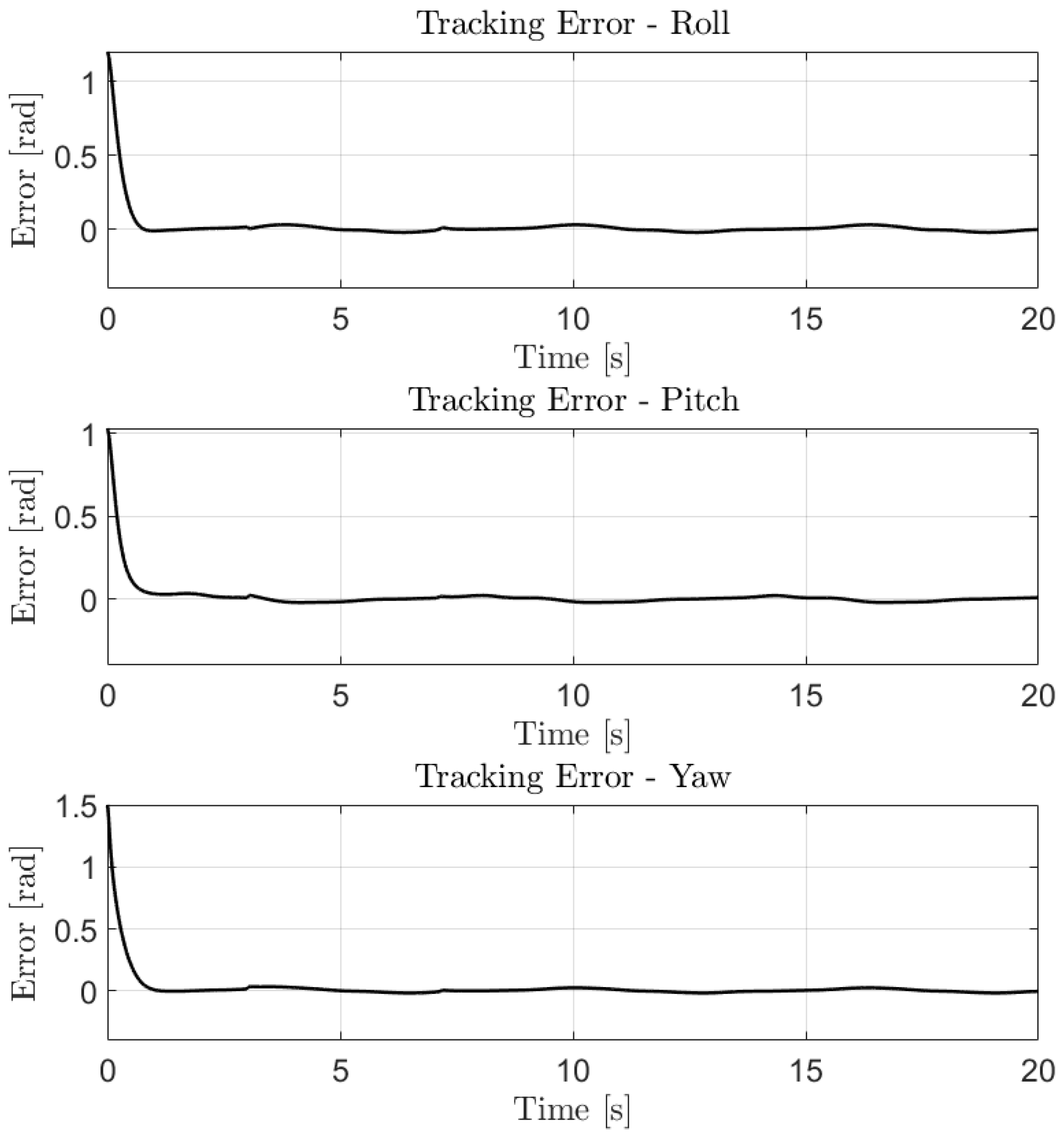
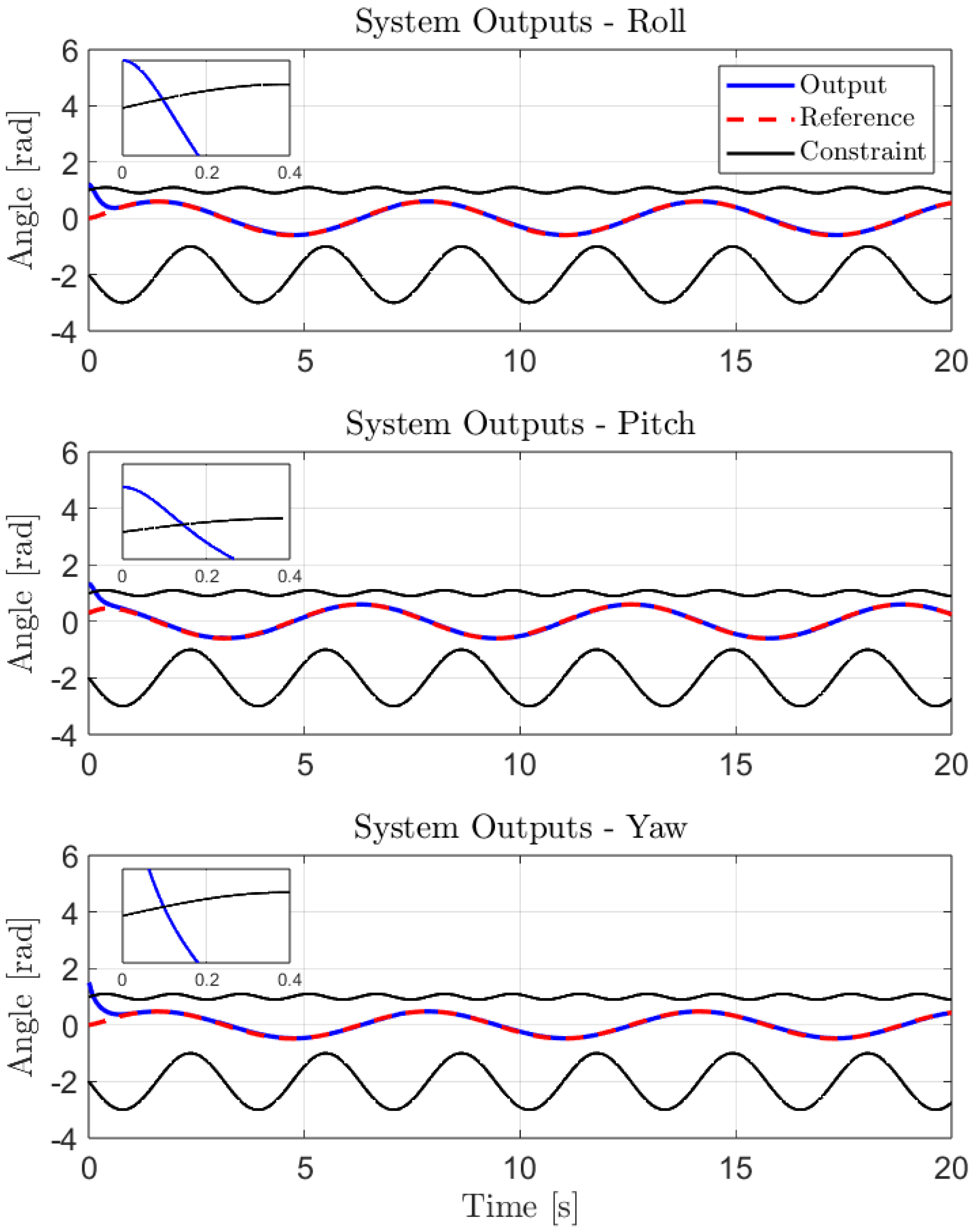
Case II: The output restrictions are not obeyed at the initial time instant. The simulation results are presented in Figure 9, Figure 10, Figure 11, Figure 12, Figure 13 and Figure 14. Figure 9 and Figure 10 describe the profile of the state ξ 1 , ξ 2 under Case II. It can be seen that all signals in the closed-loop systems are UUB. The control input and the adaptive laws ω ^ ˙ are shown in Figure 11 and Figure 12 under Case II. It is observed that the adaptive and controller show good performance under the multiplicative attack at 7 s and additive attack at 3 s. Figure 13 illustrates the profile of tracking error under II. Figure 14 presents the trajectories of y and y r . We can observe that good tracking performance can be derived and the system output y satisfies its restriction condition whether the initial constraint conditions are observed or not.
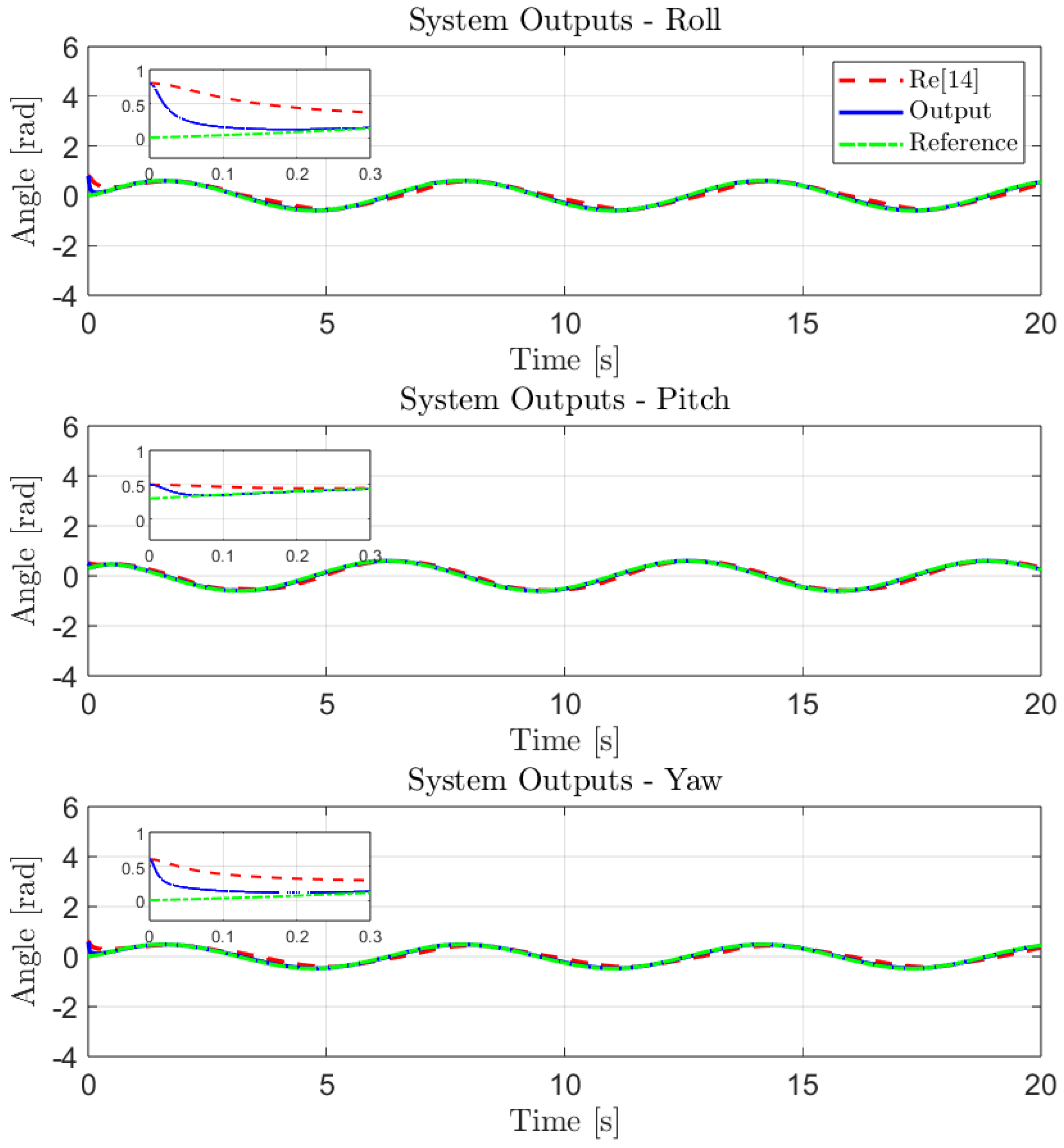
(i): To further verify the superiority of the proposed strategy in this paper, comparative simulations with [14] under Case II are shown in Figure 15. As shown in Figure 15, the controllers (9)–(11) have faster convergence and higher control accuracy.
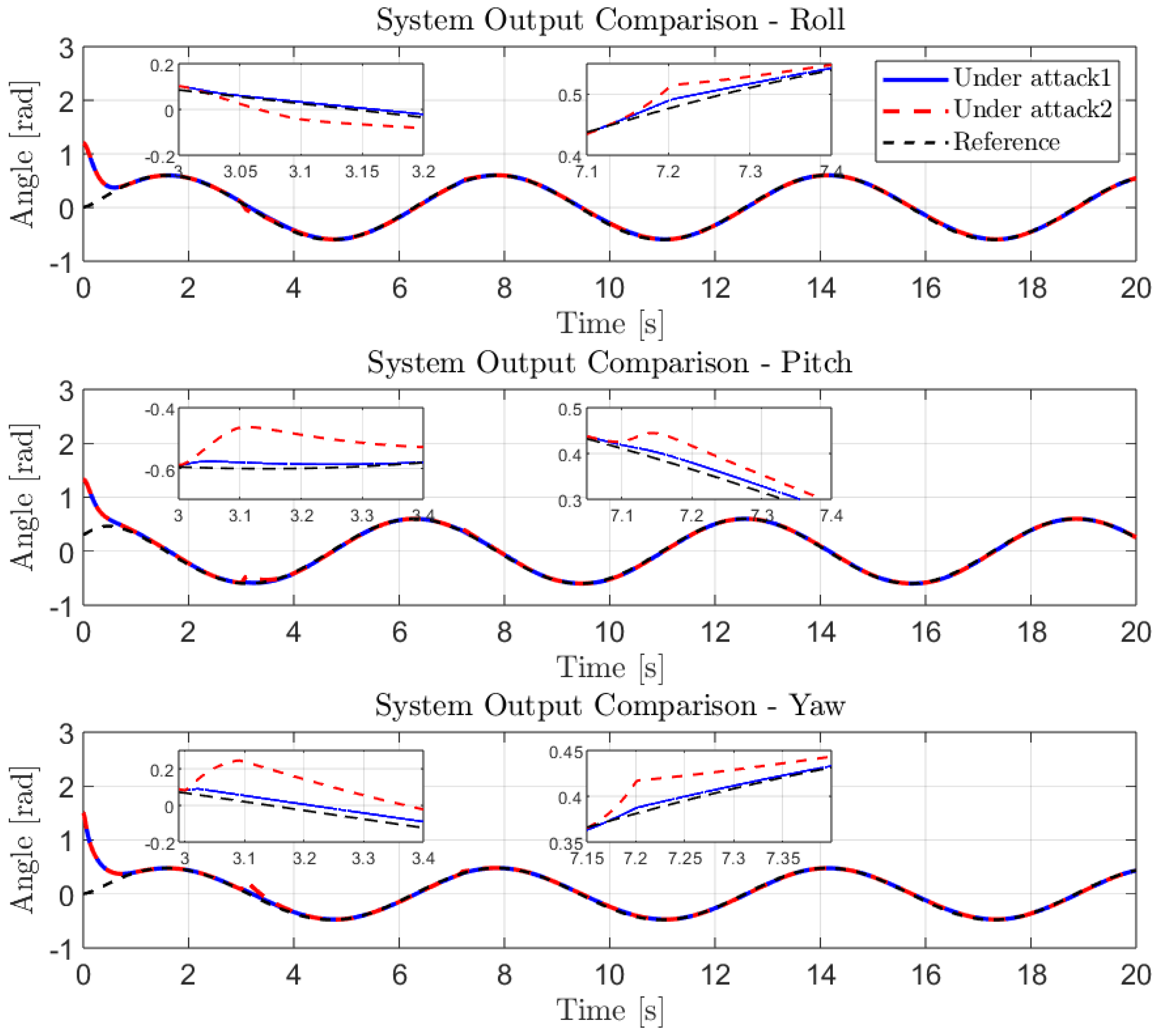
(ii): To further verify the anti-interference of the proposed strategy, different intensity attacks are designed for comparison in Case II. The multiplicative deception attack signals are κ 1 ( t , t κ ) = diag 0.01 + 0.01 sin ( 20 t ) , 0.01 + 0.3 sin ( 30 t ) , 0.01 + 0.03 sin ( 20 t ) , κ 2 ( t , t κ ) = diag 0.01 + 0.01 sin ( 20 t ) , 0.01 + 0.3 sin ( 30 t ) , 0.01 + 0.03 sin ( 20 t ) , and the additive deception attack signals are χ 1 ( t , t χ ) = [ χ φ , χ θ , χ ψ ] T = [ 50.0 sin ( 4 t ) , 60.0 sin ( 3 t ) , 70.0 sin ( 3 t ) ] T , χ 2 ( t , t χ ) = [ χ φ , χ θ , χ ψ ] T = [ 100.0 sin ( 4 t ) , 150.0 sin ( 3 t ) , 180.0 sin ( 3 t ) ] T , which attack the controller when t κ = 7.0   s and t χ = 3.0   s , respectively. The simulation results are shown in Figure 16. The tracking performance can be ensured under different attacks in a straightforward manner.
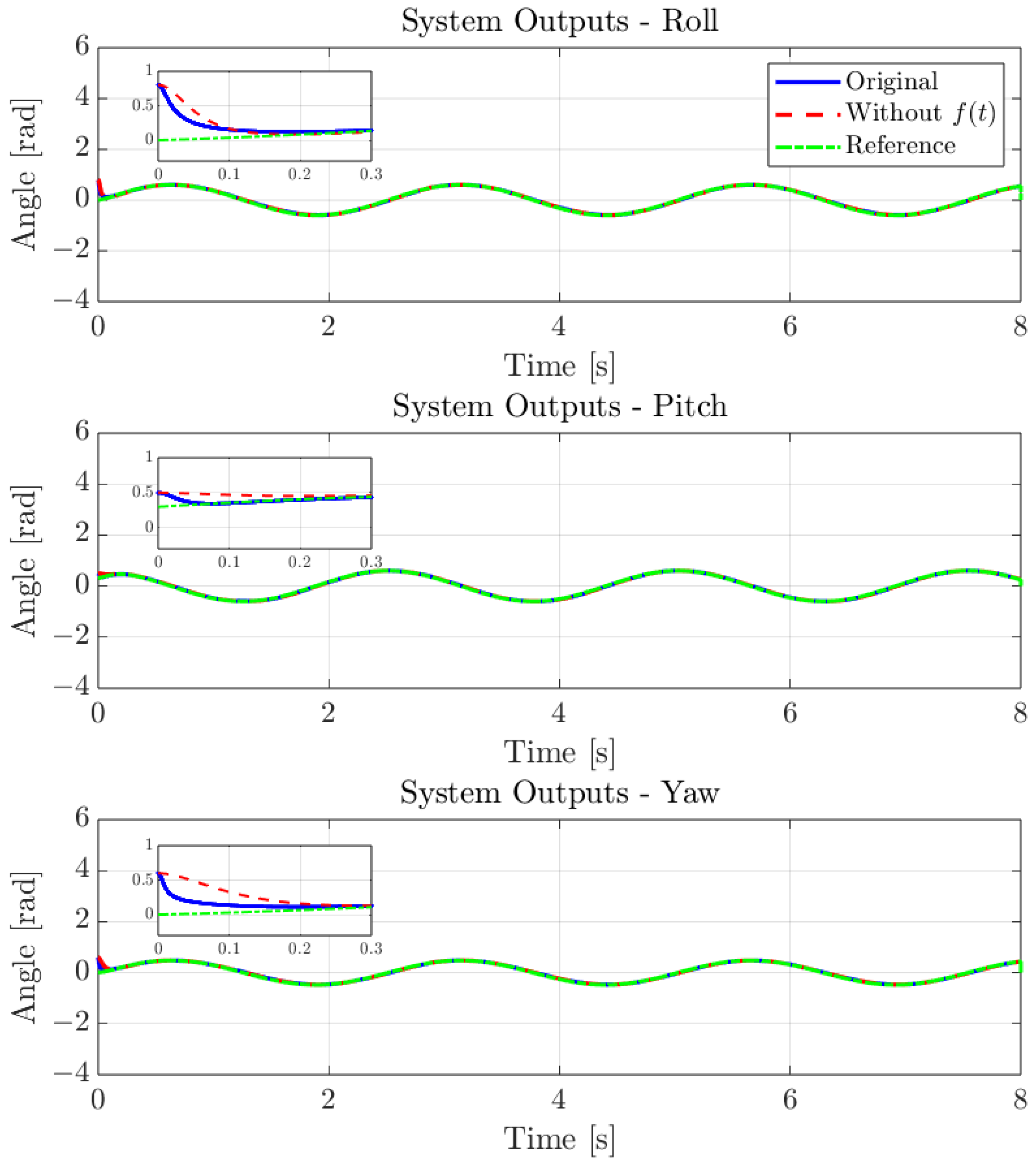
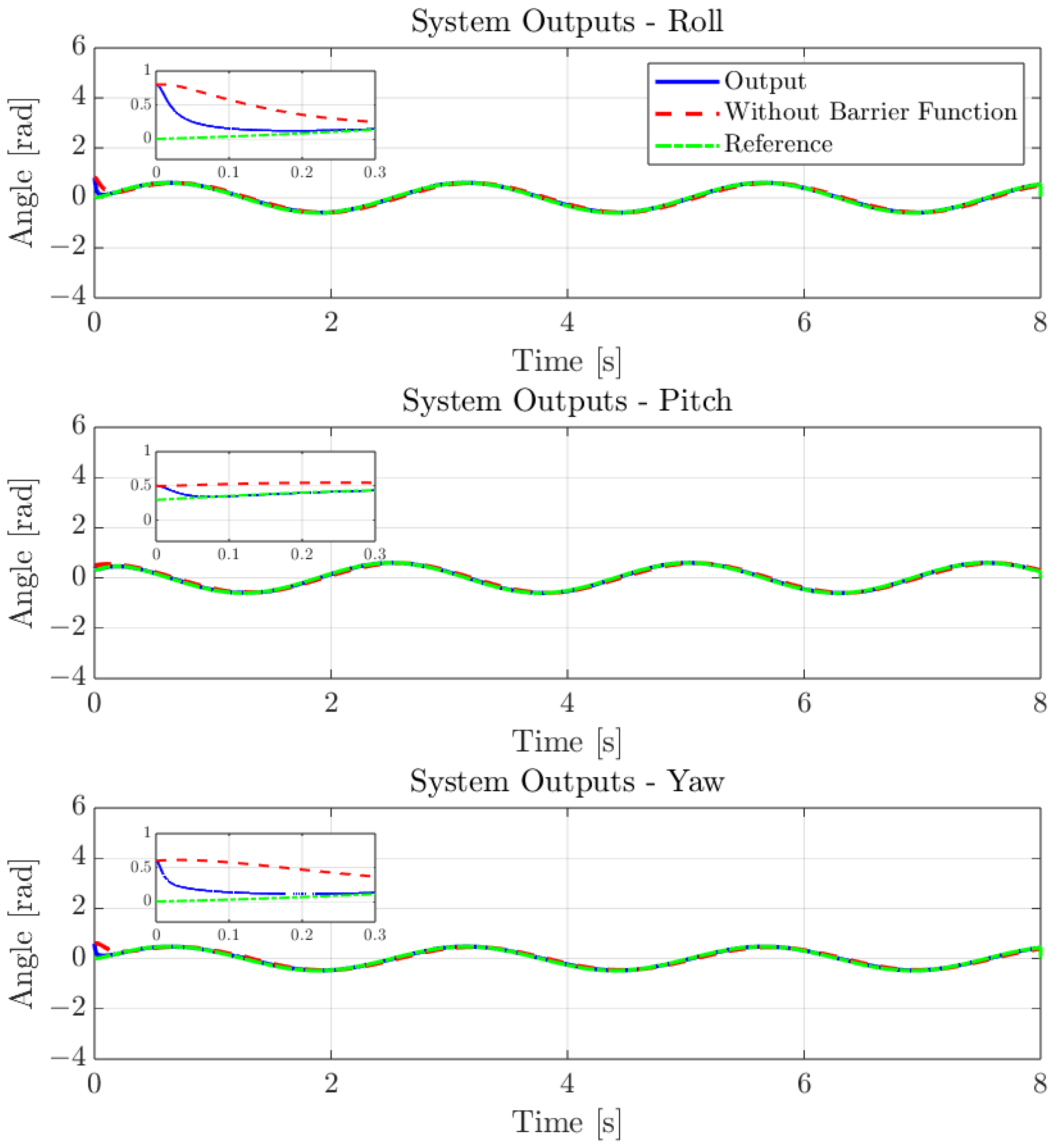
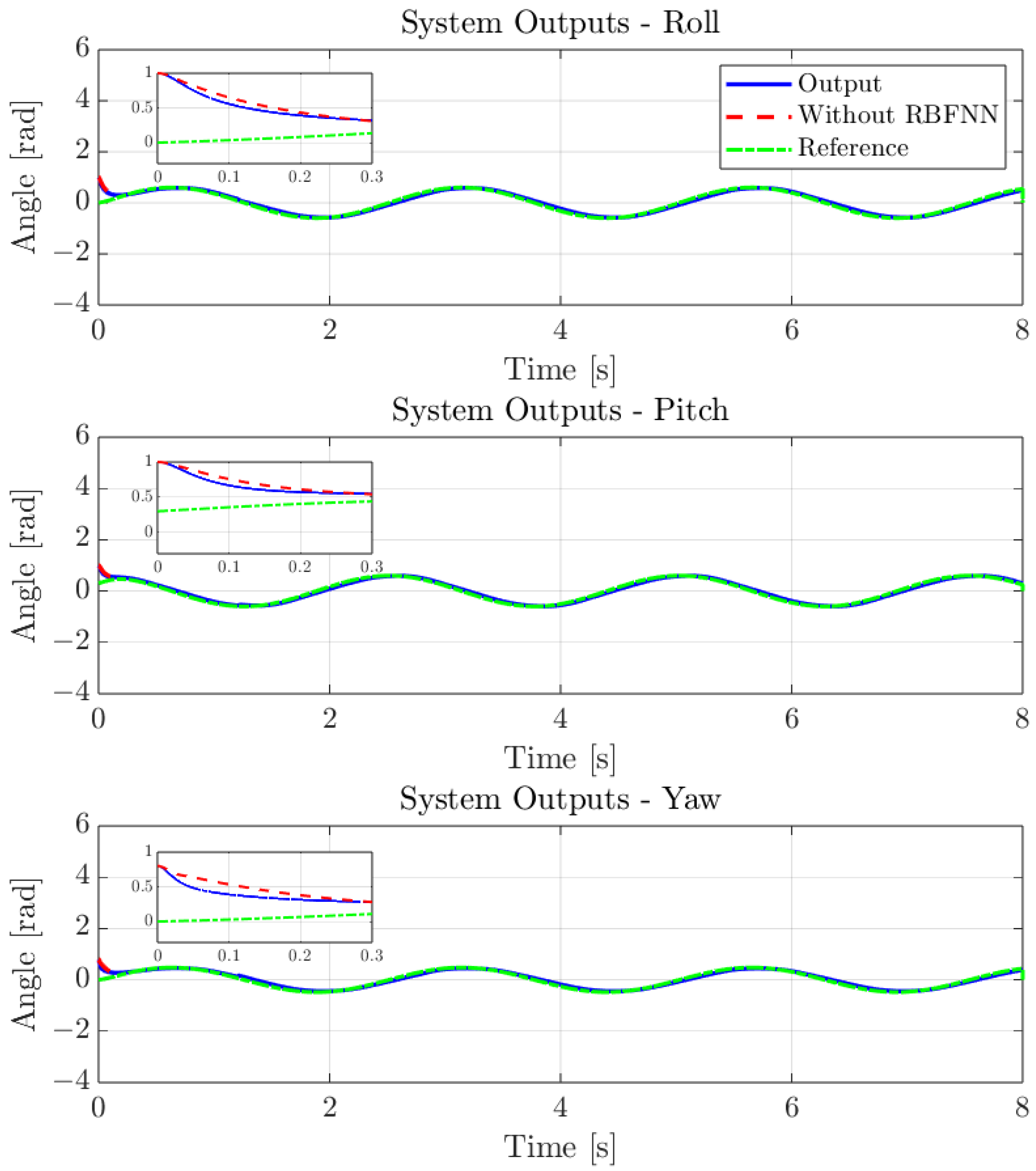
(iii): In order to quantify the impact of each module in the proposed controller, the ablation experiments are carried out, and those without f, without BF, and without RBFNN are shown in Figure 17, Figure 18 and Figure 19, respectively.
In addition, the convergence time and root mean square (RMS) are employed to evaluate the capability. Compared with the method without f, the roll, pitch, and yaw channel convergence times were reduced by 29.33 % , 79.12 % , and 21.22 % , respectively. Compared with the method without BF, the roll, pitch, and yaw channel convergence times were reduced by 29.41 % , 98.11 % , and 45.35 % , respectively; Compared with the method without RBFNN, the roll, pitch, and yaw channel convergence times were reduced by 28.09 % , 7.07 % , and 50.58 % , respectively. For the control accuracy of the control strategy with f ( t ) , BF and RBFNN improved it by 66.04 % , 88.93 % , and 16.45 % , respectively, based on the mean square error. The results show that the proposed method outperforms the other method in terms of tracking performance.

5. Conclusions

In this work, a unified output feedback control method is proposed for strict-feedback nonlinear systems subject to delay asymmetric output constraints, deception attacks, and disturbances. Specifically, by introducing a novel error shifting function and designing a novel barrier function, the issue of delay asymmetric output constraints is effectively addressed, and the designed controller is applicable regardless of the presence or absence of delay asymmetric constraints, without the need for changes or switching. A key advantage lies in that the method does not require knowledge of the maximum and minimum values of constraint functions, which effectively lowers the threshold for algorithm design and brings convenience to practical implementations. The effectiveness of the proposed control scheme has been illustrated using an unmanned aerial vehicle application example.
However, there are also some limitations. The proposed strategies are only applicable to multiplicative and additive deception attacks; other types of attacks have not been considered. The scheme is only applicable to strict-feedback nonlinear systems. Future work will focus on extending the method to complex stealthy attacks, optimizing real-time performance, and validating it on real-world systems. The methodology can be integrated with machine learning models, IDS/SIEM software, digital twin platforms, and reinforcement learning to enhance its applicability and impact.

Author Contributions

Conceptualization, L.Z., N.L. and K.C.; Methodology, L.Z., M.J. and J.L. (Jiyong Lu); Investigation, M.J. and N.L.; Data curation, J.L. (Jiahao Li), N.L., J.L. (Jiyong Lu) and K.C.; Writing—original draft, M.J.; Visualization, J.L. (Jiahao Li); Supervision, L.Z.; Funding acquisition, L.Z. All authors have read and agreed to the published version of the manuscript.

Funding

The Science and Technology Project of Hebei Education Department: QN2023052.

Data Availability Statement

The original contributions presented in this study are included in the article.

Conflicts of Interest

The authors declare no conflicts of interest.

References

  1. Ding, Y.P.; Yin, C.W.; Riaz, S. A novel PT-SMC based resilient control of cyber-physical robotic system under malicious-threats. ISA Trans. 2025, 167, 256–267. [Google Scholar] [CrossRef]
  2. Yuan, H.; Yuan, Y.; Xia, Y.Q. Differential pursuit-evasion game strategy design for spacecrafts under electromagnetic interference attack: Theory and semiphysical experiment. IEEE ASME Trans. Mechatron. 2025, 31, 698–707. [Google Scholar] [CrossRef]
  3. Wu, L.; Liu, F.; Wang, Y.; Liu, C.; Liu, Q.; Xu, Y. Event-triggered observer-based load frequency control for cyber-physical power systems with electric vehicles under hybrid attacks. Control Eng. Pract. 2025, 165, 106600. [Google Scholar] [CrossRef]
  4. Thangavel, K.; Sabatini, R.; Gardi, A.; Ranasinghe, K.; Hilton, S.; Servidia, P.; Spiller, D. Artificial intelligence for trusted autonomous satellite operations. Prog. Aerosp. Sci. 2023, 144, 100960. [Google Scholar] [CrossRef]
  5. Qin, C.; Jiang, K.; Wang, Y.; Zhu, T.; Wu, Y.; Zhang, D. Event-triggered H control for unknown constrained nonlinear systems with application to robot arm. Appl. Math. Model. 2025, 144, 116089. [Google Scholar] [CrossRef]
  6. Xia, K.; Lee, S.; Son, H. Adaptive control for multi-rotor UAVs autonomous ship landing with mission planning. Aerosp. Sci. Technol. 2020, 96, 105549. [Google Scholar] [CrossRef]
  7. Wu, J.; Luo, C.; Min, G.; McClean, S. Formation control algorithms for multi-UAV systems with unstable topologies and hybrid delays. IEEE Trans. Veh. Technol. 2024, 73, 12358–12369. [Google Scholar] [CrossRef]
  8. Zhang, J.H.; Xiang, J.W.; Li, D.C.; Yang, G.; Di, W.C.; Zhang, L.G.; Tu, Z. Anti-disturbance for ST-VTOL UAV via sliding mode control with enhanced observer. Drones 2025, 9, 843. [Google Scholar] [CrossRef]
  9. Zhang, J.; Yang, D.; Zhang, H.; Wang, Y.; Zhou, B. Dynamic event-based tracking control of boiler turbine systems with guaranteed performance. IEEE Trans. Autom. Sci. Eng. 2024, 21, 4272–4282. [Google Scholar] [CrossRef]
  10. Li, Y.; Liu, Y.; Tong, S. Observer-based neuro-adaptive optimized control of strict-feedback nonlinear systems with state constraints. IEEE Trans. Neural Netw. Learn. Syst. 2022, 33, 3131–3145. [Google Scholar] [CrossRef]
  11. Schwenkel, L.; Köhler, J.; Müller, M.A.; Allgöwer, F. Model predictive control for linear uncertain systems using integral quadratic constraints. IEEE Trans. Autom. Control 2023, 68, 355–368. [Google Scholar] [CrossRef]
  12. Santhi, T.M.; Srinivasan, K. An edge–cloud sparse autoencoder based cyber attack detection and measurement reconstruction for industrial cyber–physical systems. Measurement 2026, 259, 119673. [Google Scholar] [CrossRef]
  13. Canonico, R.; Sperlì, G. Industrial cyber-physical systems protection: A methodological review. Comput. Secur. 2023, 135, 103531. [Google Scholar] [CrossRef]
  14. Cuan, Z.; Ding, D.W. Adaptive tracking control of state-constrained uncertain nonlinear cyber-physical systems against deception attacks. Automatica 2025, 179, 112430. [Google Scholar] [CrossRef]
  15. Xiong, Y.; Niu, B.; Wang, X.; Zhao, X.; Jiang, Y.; Guo, B. Disturbance observer-based adaptive resilient control strategy for uncertain nonlinear CPSs with unknown sensor and actuator deception attacks. J. Frankl. Inst. 2025, 362, 107941. [Google Scholar] [CrossRef]
  16. Zhang, L.; Zhao, Z.; Ma, Z.; Zhao, N. Prescribed performance adaptive neural event-triggered control for switched nonlinear cyber–physical systems under deception attacks. Neural Netw. 2024, 179, 106586. [Google Scholar] [CrossRef]
  17. He, J.; Guo, X.; Chen, Z.; Ren, J. Adaptive distributed impulsive synchronization control for multi-agent systems under switching deception attacks on dual channels. IEEE Trans. Netw. Sci. Eng. 2025, 12, 2797–2809. [Google Scholar] [CrossRef]
  18. Wang, Y.; Rong, N.; Yu, Y.; Ding, S. Dynamic event-triggered resilient robust model predictive control for vehicle platooning under deception attacks. Commun. Nonlinear Sci. Numer. Simul. 2025, 152, 109469. [Google Scholar] [CrossRef]
  19. Cuan, Z.; Ren, Y.; Ding, D.W. Adaptive intrusion tolerant control for a class of uncertain nonlinear cyber–physical systems with full-state constraints. Automatica 2024, 166, 111728. [Google Scholar] [CrossRef]
  20. Zhang, J.X.; Yang, G.H. Prescribed performance fault-tolerant control of uncertain nonlinear systems with unknown control directions. IEEE Trans. Autom. Control 2017, 62, 6529–6535. [Google Scholar] [CrossRef]
  21. Lu, L.; Xiao, Q.H.; Zhou, S.K.; Wang, X.H.; Meng, Y.H. Physical modeling and data-driven hybrid control for quadrotor-robotic-arm cable-suspended payload systems. Drones 2026, 10, 51. [Google Scholar] [CrossRef]
  22. Kharrat, M.; Mercorelli, P. Neural network-based adaptive finite-time control for pure-feedback stochastic nonlinear systems with full state constraints, actuator faults, and backlash-like hysteresis. Mathematics 2026, 14, 30. [Google Scholar] [CrossRef]
  23. Zhang, H.G.; Liu, Y.; Wang, Y.C. Observer-based finite-time adaptive fuzzy control for nontriangular nonlinear systems with full-state constraints. IEEE Trans. Cybern. 2021, 51, 1110–1120. [Google Scholar] [CrossRef]
  24. Zhao, K.; Song, Y. Removing the feasibility conditions imposed on tracking control designs for state-constrained strict-feedback systems. IEEE Trans. Autom. Control 2019, 64, 1265–1272. [Google Scholar] [CrossRef]
  25. Liu, Y.J.; Tong, S.C. Barrier Lyapunov functions-based adaptive control for a class of nonlinear pure-feedback systems with full state constraints. Automatica 2016, 64, 70–75. [Google Scholar] [CrossRef]
  26. Dinh, V.V.; Mai, D.H.; Duong, M.D.; Dao, Q.T. Prescribed performance function based sliding mode control of opposing pneumatic artificial muscles to enhance safety. J. Appl. Sci. Eng. 2024, 27, 2117–2126. [Google Scholar] [CrossRef]
  27. Cao, Y.; Wen, C.; Song, Y. A unified event-triggered control approach for uncertain pure-feedback systems with or without state constraints. IEEE Trans. Cybern. 2021, 51, 1262–1271. [Google Scholar] [CrossRef] [PubMed]
  28. Zhao, K.; Chen, L.; Meng, W.; Zhao, L. Unified mapping function-based neuroadaptive control of constrained uncertain robotic systems. IEEE Trans. Cybern. 2023, 53, 3665–3674. [Google Scholar] [CrossRef]
  29. Zhang, Y.; Pang, K.L.; Chen, J.N.; Li, K.; Hua, C.C. Adaptive control for nonlinear systems with both tracking error constraints and full-state constraints: A universal constraint approach. IEEE Trans. Autom. Control 2025, 71, 1326–1333. [Google Scholar] [CrossRef]
  30. Zhao, L.; Liu, G. Adaptive finite-time attitude tracking control for state constrained rigid spacecraft systems. IEEE Trans. Circuits Syst.-II Express Briefs 2021, 68, 3552–3556. [Google Scholar] [CrossRef]
  31. Xiao, Y.; Yang, Y.; Ye, D.; Zhao, Y. Scaling-transformation-based attitude tracking control for rigid spacecraft with prescribed time and prescribed bound. IEEE Trans. Aerosp. Electron. Syst. 2025, 61, 433–442. [Google Scholar] [CrossRef]
  32. Shao, Z.; Wang, Y.; Luo, D.; Song, Y. A unified approach for tracking control of MIMO nonlinear systems under unknown control directions and irregular constraints. IEEE Trans. Autom. Sci. Eng. 2024, 21, 6845–6854. [Google Scholar] [CrossRef]
  33. Zhao, K.; Song, Y.; Chen, C.L.P.; Chen, L. Control of nonlinear systems under dynamic constraints: A unified barrier function-based approach. Automatica 2020, 119, 109102. [Google Scholar] [CrossRef]
  34. Wang, C.; Wang, A.; Chen, Q.; Yu, J.; Liu, X. Fuzzy adaptive asymptotic tracking control for uncertain nonlinear systems with full-state constraints of arbitrary time. Appl. Math. Comput. 2025, 514, 129814. [Google Scholar] [CrossRef]
  35. Zhong, G.X.; Wang, L.Y.; Long, Y.; Li, J.; Zhang, Z.X.; Zhao, X.Q. Finite-time adaptive tracking control for uncertain nonlinear systems. Eur. J. Control 2025, 86, 101410. [Google Scholar] [CrossRef]
  36. Duong, M.D.; Nguyen, V.T.; Dao, Q.T. Adaptive control using radial basis function neural networks for pneumatic artificial muscle systems. Int. J. Online Biomed. Eng. 2024, 20, 109–123. [Google Scholar] [CrossRef]
  37. Buscarino, A.; Fortuna, L.; Frasca, M.; Rizzo, A. Dynamical network interactions in distributed control of robots. Chaos An. Interdiscip. J. Nonlinear Sci. 2006, 16, 015116. [Google Scholar] [CrossRef]
  38. Li, J.J.; Sun, Z.Y.; Wang, Z.; Chen, C.C. A new adaptive designated-time control for uncertain nonlinear systems with output constraint and its application in electromechanical systems. ISA Trans. 2025, 167, 1671–1679. [Google Scholar] [CrossRef] [PubMed]
  39. Sun, Z.Y.; Ren, S.; Wang, Z.; Chen, C.C. Designated-time fault-tolerant stabilization for planar nonlinear systems with unknown time-varying powers and deferred constraints. Automatica 2026, 186, 112852. [Google Scholar] [CrossRef]
  40. Song, Y.D.; Zhou, S. Tracking control of uncertain nonlinear systems with deferred asymmetric time-varying full state constraints. Automatica 2018, 98, 314–322. [Google Scholar] [CrossRef]
  41. Jin, X.; Haddad, W.M. An adaptive control architecture for leader-follower multiagent systems with stochastic disturbances and sensor and actuator attacks. In Proceedings of the 2018 Annual American Control Conference (ACC); IEEE: New York, NY, USA, 2018; pp. 980–985. [Google Scholar] [CrossRef]
  42. Zhang, J.; Niu, B.; Wang, D.; Wang, H.; Duan, P.; Zong, G. Adaptive neural control of nonlinear nonstrict feedback systems with full-state constraints: A novel nonlinear mapping method. IEEE Trans. Neural Netw. Learn. Syst. 2023, 34, 999–1007. [Google Scholar] [CrossRef] [PubMed]
  43. Bey, O.; Chemachema, M. Finite-time event-triggered output-feedback adaptive decentralized echo-state network fault-tolerant control for interconnected pure-feedback nonlinear systems with input saturation and external disturbances: A fuzzy control-error approach. Inf. Sci. 2024, 669, 120557. [Google Scholar] [CrossRef]
Figure 1. The role of the shifting function f ( t ) .
Mathematics 14 01753 g001
Figure 2. The response of f ( t ) with different b values and in Ref. [40].
Mathematics 14 01753 g002
Figure 3. The trajectory of ξ 1 of Case I.
Mathematics 14 01753 g003
Figure 4. The trajectory of ξ 2 of Case I.
Mathematics 14 01753 g004
Figure 5. The adaptive law of Case I.
Mathematics 14 01753 g005
Figure 6. The control input of Case I.
Mathematics 14 01753 g006
Figure 7. The evolution of tracking error β 1 of Case I.
Mathematics 14 01753 g007
Figure 8. The output y and reference output y r of Case I.
Mathematics 14 01753 g008
Figure 9. The trajectory of ξ 1 of Case II.
Mathematics 14 01753 g009
Figure 10. The trajectory of ξ 2 of Case II.
Mathematics 14 01753 g010
Figure 11. The adaptive law of Case II.
Mathematics 14 01753 g011
Figure 12. The control input of Case II.
Mathematics 14 01753 g012
Figure 13. The evolution of tracking error β 1 under Case II.
Mathematics 14 01753 g013
Figure 14. The output y and reference output y r of Case II.
Mathematics 14 01753 g014
Figure 15. Case II: i. the output y and reference output y r with and without constraints [14].
Mathematics 14 01753 g015
Figure 16. Case II: ii. the reference output y r and output y under attack 1 and attack 2.
Mathematics 14 01753 g016
Figure 17. Case II: iii. The control output comparison: with f ( t ) vs. without.
Mathematics 14 01753 g017
Figure 18. Case II: iii. The control output comparison: with BF vs. without.
Mathematics 14 01753 g018
Figure 19. Case II: iii. The control output comparison: with RBFNN vs. without.
Mathematics 14 01753 g019
Table 1. Quadrotor physical parameters.
Parameter(s)Value(s)
d q 0.205 cm
J q 2.8 × 10 5 kg m
I x , I y 9.3 × 10 2 kg m
I z 8.2 × 10 2 kg m
K φ , K θ 5.56 × 10 3 N m s/rad
K ψ 6.35 × 10 3 N m s/rad
Ω r 100 rad/s
Disclaimer/Publisher’s Note: The statements, opinions and data contained in all publications are solely those of the individual author(s) and contributor(s) and not of MDPI and/or the editor(s). MDPI and/or the editor(s) disclaim responsibility for any injury to people or property resulting from any ideas, methods, instructions or products referred to in the content.