1. Introduction
It has been over a decade since the Truth and Reconciliation Commission of Canada released its 94 Calls to Action, yet despite some progress in some areas, there is still a long way to go. In the field of education, educators and administrators still feel unprepared and unqualified to Indigenize their curriculum, pedagogy, and leadership. Some teachers are concerned that the Indigenous content they teach may be examined and perceived critically as inaccurate when taught by someone who is non-Indigenous (
Ianniciello, 2014). Additionally, educators may experience pushback from community members and families who resist decolonizing and Indigenizing education efforts.
In rural contexts, reconciliation is not theoretical (
Epp, 2008). Land-based industries shape everything from economics to identities, and social divisions can run deep. While reconciliation is needed across Canada, rural places offer unique contexts with not only distinct challenges but also opportunities for supporting reconciliation (
Banack & Pohler, 2023;
Canadian Rural Revitalization Foundation, 2024).
This study explores the impact of a professional workshop series focused on decolonization and reconciliation not only on teachers and staff in a rural Manitoba school division, but also on parents and communities. Mountain View School Division (MVSD) is located on Treaty 2 and Treaty 4 lands, the original lands of the Anishinaabek, Ininiwak, and Dakota Peoples and the homeland of the Red River Métis Nation. MVSD lies in the Parkland Region, an area characterized by fertile farmland, woods, lakes, and escarpments. For Indigenous communities in the region, it includes painful histories of displacement, broken treaties, and land theft (
Belshaw et al., 2018;
Morgan, 2025). Its 16 schools serve approximately 3100 students in seven distinct communities.
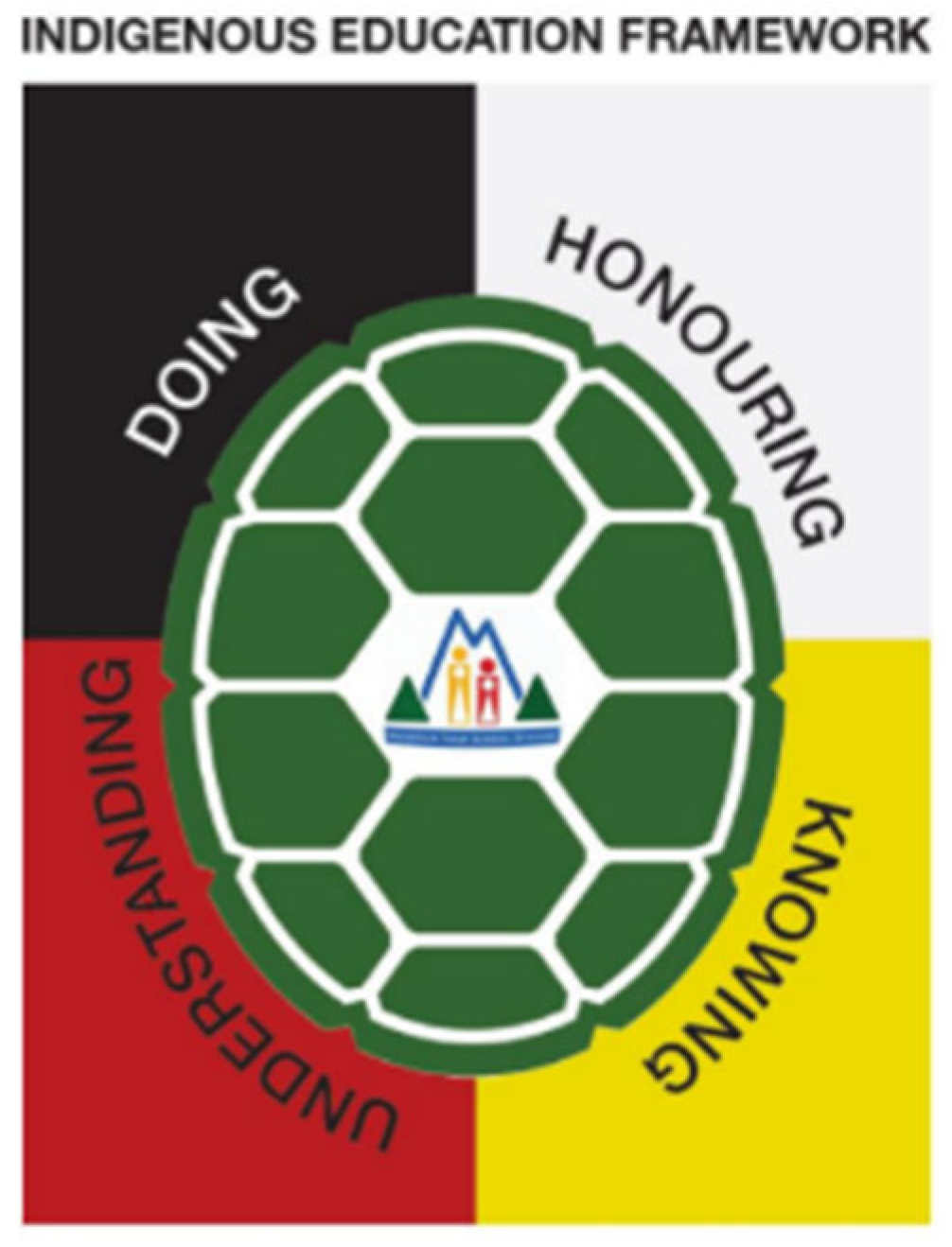
Mountain View School Division (MVSD), recognizing the critical importance of embracing Indigenous perspectives and outcomes for all students, has long been dedicated to fostering Indigenous education within its school communities. Umbay Nagamon (Come Sing) was the outcome of 10 years of the school division staff working together and planning a way to understand and embrace Indigenous education and a path to reconciliation. In 2018, in conjunction with its Indigenous Education Steering Committee, MVSD developed a framework for Indigenous education in 2018 (See
Figure 1). That framework, which acknowledges a growing Indigenous student population and gap in Indigenous academic achievement, helped to establish a vision for the way forward and led to the development of the Umbay Nagamon initiative, which was funded by the Province of Manitoba through its Teachers’ Idea Fund and commenced in 2021.
The framework recognizes the harms done through residential schooling and lifts up education as a key component of reconciliation. Its purpose is to help Indigenous students achieve their educational goals by honoring and understanding Indigenous culture, language and ways of knowing, being and doing. In the words of the late Senator Murray Sinclair, former Chairman of the Truth and Reconciliation Commission, it is crucial to ensure Indigenous students know the answers to four vitally important questions: “Where do I come from, Where am I going, Why am I here, and most importantly, Who am I?” (
Sinclair, 2015). The framework led to the conception of the Umbay Nagamon project.
Reconciliation requires centering Indigenous perspectives, learning and unlearning, and truth-telling from multiple perspectives (
Battiste, 2019;
Hilton, 2021). One of the key components of the MVSD framework was professional development opportunities for staff, designed to enhance their understanding of Indigenous cultures, histories, traditions, and perspectives, and to empower them to better support all students, including Indigenous learners. Thus, after much consultation and careful planning, the powerful journey of Umbay Nagamon, “Come Sing”, emerged, focusing not only on educating school division staff but also parents and the wider community. Umbay Nagamon was first and foremost a call to action for each individual it reached to become more informed and use their new knowledge of Indigenous histories and culture to promote a more equitable and just space for all. A main objective was to provide a platform for participants to explore their place within reconciliation by first acknowledging the truths of Canada’s history, particularly regarding the experiences of Indigenous peoples. Its aim was to provide space for participants to confront uncomfortable truths, engage in open dialogue about the impacts of colonization and systemic injustices, and thus develop an understanding of their own roles in the reconciliation journey. Understanding Canada’s true history and its impact on Indigenous peoples is essential for building empathy, dismantling stereotypes, and fostering meaningful relationships between Indigenous and non-Indigenous communities. Empowering educators to provide safe and brave spaces for their students to learn Indigenous knowledge, cultures and histories is a key step in the journey towards reconciliation. As
Louie (
2024) noted building relationships is an essential part of reconciliation and was an integral part in the design of the Umbay Nagamon project.
2. Umbay Nagamon and Research Methodologies
The Umbay Nagamon Workshop is organized into a session where both participants and leaders sit together, tell stories of identity and past experiences, sing, share, and learn about Indigenous cultures. When participants enter the workshop, they are invited to join a circle already populated by many of the Umbay Nagamon workshop leaders. Participants move in and sit among the leaders Knowledge Keepers and Elders. When everyone is seated, the workshop begins with an opening drum song—“a powerful symbol of the heartbeat of Mother Earth, the first heartbeat experienced by all humans in utero” (
Spence et al., 2024, p. 12). The workshop leaders invite all participants to share in their storytelling, singing, and learning. The stories emerge as the group works from person to person around the circle and includes Knowledge Keepers, Elders, leaders, and participants. The process of working around the circle from participant to leader and back to participant helps everyone to hear their own voice within that of a community and to appreciate each distinct voice as part of the larger collection that makes up Manitoban society. The workshop continues with singing and drumming led by Indigenous facilitators. Participants learn from the workshop leaders, Knowledge Keepers and Elders. The experience of learning about Indigenous cultures, experiences, residential schools, and the Calls to Action within the community created within the circle is peaceful, accepting, and affirming. The workshop is a safe and brave space where participants can be vulnerable, ask questions, and be open to learning.
While ownership and enactment of Umbay Nagamon are roles that lie solely with MVSD, the project leaders enlisted the help of Brandon University researchers to capture the story and the impact of this initiative. Brandon University had previously worked extensively with the division and with some of the facilitators. All Umbay Nagamon facilitators are Indigenous from multiple backgrounds. All university researchers are non-Indigenous, and one student research assistant who collaborated with us is Indigenous. Careful attention was paid to principles of OCAP and ethics, with ownership, control, access, and possession being maintained by the Mountain View School Division side and defined roles emphasizing that support came from the university researchers, but leadership of Umbay Nagamon remained with the Umbay Nagamon and MVSD side. Brandon University Ethics Research Committee granted approval for this project (23169) on 29 May 2023.
We employed an exploratory community-engaged case-study approach to the research. Specifically, our study aimed to answer the following: (1) How is Umbay Nagamon (Come Sing) being carried out at Mountain View School Division? (2) How do the people and process of Umbay Nagamon inspire the work of reconciliation? (3) What are the impacts on teachers, teacher practices, and students? As we explored this area, however, an important finding emerged, namely the impact of the workshop series on and perceived by the facilitators who carried out this vitally important, yet emotionally challenging work. A final area of exploration was the impact of Umbay Nagamon on the community.
The Umbay Nagamon project employed a mixed-methods approach, combining quantitative and qualitative data collection methods, through a community-based participatory approach in which research partners in MVSD and Brandon University researchers collectively identified questions and methods of evaluation. Participants in the Umbay Nagamon project were MVSD teachers and staff, workshop facilitators, and MVSD administrators, as well as parents and community members. For the scope of this article, we focused mainly on findings related to Grade 5/6 teachers, workshop facilitators and MVSD administrators.
The qualitative data analysis included two distinct processes for survey data and interview data. Survey data were analyzed using a hand sorting procedure in a large group that included both Umbay Nagamon facilitators and researchers. Once each of the comments had been placed into a theme by an individual member of the team, we implemented a group process where we worked collaboratively to rationalize our individual work into a series of collective themes. Although the large group size and large number of data strips made the process seem somewhat unwieldly, it spurred thoughtful and engaged discussion among all participants as we struggled together to interpret the comments and to make meaning from the data.
The facilitator interview data were analyzed by members of the university research team using an intercoder agreement process to triangulate the results. Two or more of the research team members coded each interview independently. Then, we met together on Zoom and read the transcript aloud to discuss and debate our individual coding results until we reached an agreement about how the data should be coded. Each of these collaborative approaches ensured that a diversity of perspectives and insights were considered during the analysis (
Saldaña, 2014).
Quantitative data sources included pre (2021) and post (2024) surveys containing seven Likert scale (1–4) and open-ended questions administered to Grade 5/6 teachers before and after their participation in Umbay Nagamon. These data were anonymous. The pre survey (n = 35) established baseline data; the identical post survey (n = 26) measured changes following the participants’ participation in the Umbay Nagamon project. The surveys assessed participants’ comfort levels with incorporating Indigenous knowledge, histories and cultures in the curriculum, familiarity with Indigenous knowledge and perspectives, awareness of the 94 Calls to Action and Truth and Reconciliation, as well as their exposure to Indigenous cultures. Using EXCEL, a descriptive data analysis was conducted to summarize the quantitative data, to compare patterns, central tendencies, and spread within the pre and post data. Independent two-sample T-tests were used to indicate the significance of any differences between the pre and post survey means. Open-ended questions allowed participants to share their personal reflections and experiences related to Indigenous education, reconciliation, and their roles in these processes. These statements were triangulated with the quantitative findings.
At each of the workshops, participants were requested to write a commitment/aspiration for reconciliation on a small diamond-shaped piece of paper. These were named ‘star blanket statements’ and subsequently interwoven into a series of star blankets. These statements were collaboratively analyzed, and themes developed. While analysis of these statements is not part of this paper, some statements are included in the discussion section.
In addition, after year three, an invitation to participate in individual interviews lasting 30–60 min and conducted using digital platforms (either Microsoft Teams or Zoom) was sent to everyone (11) involved in administering and facilitating the Umbay Nagamon project. Five Umbay Nagamon facilitators and three MVSD administrators (two of whom also were Umbay Nagamon facilitators) agreed to participate. The semi-structured interviews focused on the nature of participants’ involvement with Umbay Nagamon, memories from early workshops and perceptions of how they have changed over time, strengths and challenges of the project, personal, professional, and community impact, personal insights, and strategies for self-care.
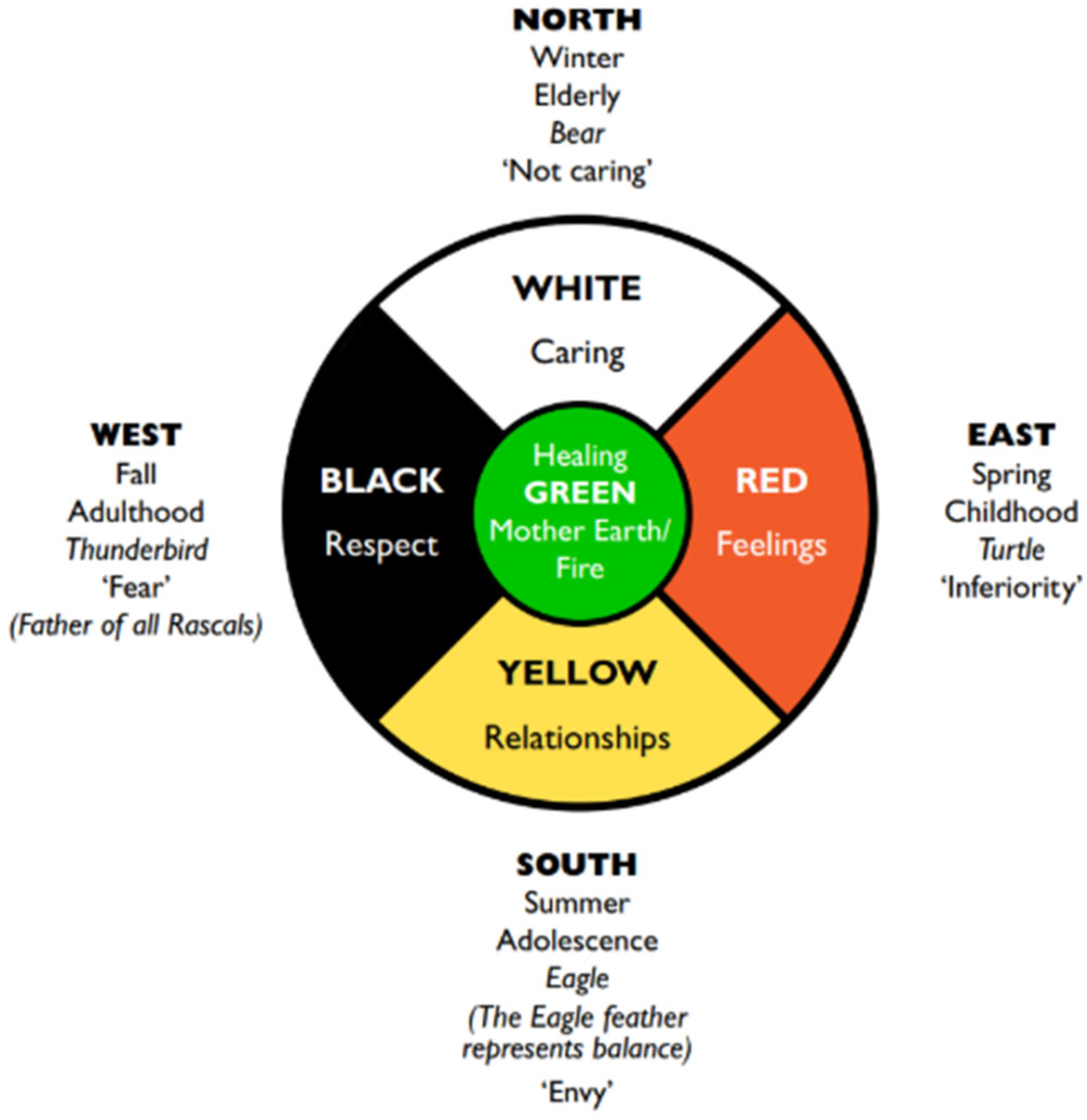
The Medicine Wheel teachings form the foundation of the MVSD framework for Indigenous Education. Although there are many different teachings of the Medicine Wheel, all emphasize principles of holistic growth, balance, and an interconnection between multiple dimensions of development. The Cree Medicine Wheel (
Figure 2) is a paradigm for understanding individual journeys of growth, learning and development, and collective social change (
Wenger-Nabigon, 2010).
We used the Medicine Wheel teachings as a way to explore and interpret the findings of our study.
3. Results
3.1. Impact of Umbay Nagamon on Grade 5/6 Teachers
The quantitative data were limited to pre and post surveys administered to Grade 5/6 teachers. This group was selected because it was a primary focus of the Umbay Nagamon project in its first three years. The pre survey (
n = 34, participation rate = 97%) was administered immediately prior to the first Umbay Nagamon workshop. The post survey (
n = 26, participation rate 65%) was completed 2.5 years into the project’s duration. Participants were asked to rate their levels of agreement with each of seven statements (See
Table 1) on a Likert scale where 1 = strongly disagree, 2 = disagree, 3 = agree, and 4 = strongly agree. The open-ended questions allowed participants to share their personal reflections and experiences related to Indigenous education, reconciliation, and their roles in these processes.
Descriptive analysis of pre and post surveys indicated increases in teacher agreement from 62% to 94% that they had knowledge of the history of Indigenous Peoples, and from 62% to 73% with regard to familiarity with Protocols and Traditions of Indigenous Peoples. Agreement with the statement I had the opportunity to examine and read the 94 TRC Calls to Action increased from 66% to 83.5%; familiarity with Truth and Reconciliation initiatives in MVSD increased from 67% to 83.5%. In addition, agreement levels rose from 80% to 89% with regard to the opportunity to implement one or more of the TRC Calls to Action into their workplace or community. The largest increases in agreement were seen in teachers’ pre and post responses to the statements I am comfortable teaching students about decolonization and residential schools, where agreement rose from 72% to 100%, and I am comfortable in incorporating Indigenous perspectives into the curriculum (62% to 94%).
Although the majority of respondents were the same for both surveys, some turnover occurred, and, as the surveys were anonymous, there was no means to pair the pre and post data. In addition, completion of the surveys was voluntary, resulting in different completion rates for each survey. Thus, independent t-tests were conducted on the pre and post survey data. Both these factors are acknowledged as limitations to the data.
Inferential analysis, conducted using Microsoft Excel, indicated significant positive changes in the means of each of the seven categories (See
Table 1). The means of the pre survey in the seven categories ranged between 2.1 and 2.8 on a 4-point Likert scale. The post survey means ranged from 2.7 to 3.4. Five of the categories in the post survey scored an average mean of over 3. The greatest increases over the course of Umbay Nagamon were in teachers’
comfort levels in teaching students about colonization and residential schools, incorporating Indigenous perspectives into the classroom and
their prior knowledge of the history of Indigenous people. Other categories with means over 3 were
teachers’ opportunities to examine the TRC Calls to Action and
awareness of TRC initiatives in their district.
Integration of quantitative findings with the qualitative findings was conducted by relating the means of the seven Likert-scale questions to the open-ended comments of the participants and indicated that responses to the open-ended questions on the survey substantiated the quantitative results. In addition, teachers focused heavily on Umbay Nagamon’s impact on them personally as well as their professional practice in the classroom, and the consequent impact on students. This finding is important, as the Umbay Nagamon project focused on educating teachers so that their classroom practice would subsequently impact their students.
3.1.1. Impact on Personal and Professional Knowledge
Many teachers’ responses indicated that, for perhaps the first time, they were being exposed to a side of Canadian history that had been ignored in their own education: Non-Indigenous teachers noted, for example, “I am learning the side that was never taught” and “I more aware of the history and language”. Through these learnings and the reflective practices that the workshops encouraged, several teachers observed that as their knowledge of Indigenous histories and the inter-generational traumas that colonization and residential schools have perpetuated increased, they were amidst confronting their own biases and their ways of being. One teacher noted: “[Umbay Nagamon] has made me feel more respectful, understanding, humble and honest”. Another observed: “I feel more connected to not only the history but also to the land where I live”. The impact of Umbay Nagamon was not only noted by settler teachers. Some Indigenous teachers also talked about their own lack of knowledge of Indigenous cultures and traditions. One teacher reflected: “It hits home and I want to learn about my family’s Indigenous history and culture so I have more empathy and understanding of it”.
3.1.2. Impact on Immersing Indigenous Content into Curricula and Classrooms
Teachers appreciated the examples and the resources the workshops provided on how to introduce Indigenous history and tradition into their lessons and observed that attending the workshops also helped them be more successful in inclusive practices. One teacher noted: “I feel much more comfortable implementing Indigenous teachings into my everyday lessons because of these workshops. I feel more inclined to familiarize myself with things like Treaties and Truth and Reconciliation. I’m a better teacher because of it [Umbay Nagamon]”.
3.1.3. Impact on Students
Teachers shared that furthering their understanding of Indigenous history and current realities in the Canadian context has provided the knowledge, and importantly, the impetus to increase student awareness. One teacher noted “my students have a more educated, open, and humble teacher who has the tools and support to help them learn understand and support Truth and Reconciliation ideals. As I learn, my students learn more each day about history, protocols, and traditions”.
In conclusion, survey results indicate that the Umbay Nagamon initiative has increased teacher knowledge and understanding of past and current Indigenous history and of the TRC Calls to Action, which has positively impacted their confidence in incorporating Indigenous perspectives into their classrooms and their willingness to do so. Professional development initiatives such as Umbay Nagamon benefit not only the teachers but also a generation of students.
3.2. People and Processes of Umbay Nagamon
The interviews with workshop facilitators illuminated in depth how the people and processes inspired the work of reconciliation. Twelve themes emerged. While our focus is on the four most prevalent themes of Support, Impact, Learning and Emotions, we also include a brief description of the remaining eight. The four described in more detail were chosen because they were the most common themes, and because they deepen understanding about the weight carried by Umbay Nagamon facilitators.
3.2.1. Theme One—Support
The dominant theme of support was prevalent in all interviews. Facilitators were concerned primarily about the need to support the human beings engaged in Umbay Nagamon. They frequently expressed concern for the well-being of fellow team members, and reserved particular worry for the Elders and Knowledge Keepers who, despite being vulnerable due to past traumas, generously offered their personal life experiences and painful memories during each circle. This care was tangible for one person on the receiving end who observed: “I’ve never been treated with such respect… that’s something that I was unable to find here in my community… is the appreciativeness and… the respect, for me”. Displaying personal insight, facilitators included themselves in the roster of those needing support, recognizing the difficulty of engaging in such emotionally difficult work. Umbay Nagamon team members expressed their appreciation of supports the school division provided to the team, including time to debrief after sessions and attending healing ceremonies. “The thing that we can do, yes, being mindful of the needs of the team and how to support them? Because they carry so much every time they walk away from a workshop. It’s heavy and… so, giving them permission to slow down and finding opportunities for them to access supports when and, and not even when needed, but before they’re needed”.
Providing access to requested Knowledge Keepers, Elders and Indigenous ceremonies outside the team challenged division personnel as they navigated western systems of funding and balanced those with the moral imperative to support team members in culturally appropriate ways. This is of critical importance to the team: “I have people with similar roles that are friends of mine throughout the province, and they burn out every two or three years because then you don’t see the change… So, I’m just so grateful, for (individual names) who understand that Indigenous peoples need a family dynamic, they need support and they need allies on the outside to say that this is OK and that… they fully trust”. All facilitators shared a concern about the sustainability of Umbay Nagamon and linked its potential longevity to the multiple forms of support required to maintain the wellness of its facilitators.
3.2.2. Theme Two—Impact
While team members anticipated that their work would be challenging, no one fully anticipated the intensity of the emotional outpourings that occurred during the sessions and the impact that would have on the team. One team member shared: “…Right from that first circle, the importance of the work being done. It was visible, palpable and you feel it. You could see it and that was very empowering. It gave me the strength… to continue on doing this work because it’s hard work and we’ve opened up a lot of people”. There was a weight they each felt after circles that was attributed to feeling the emotions expressed by participants, often so strong that the team learned to spread themselves out among participants in the circle and keep boxes of tissue nearby. The impact on division schools, where the Indigenous curriculum support team began to be invited into schools that had previously been closed to Indigenous teachings, was evident. For non-Indigenous divisional leaders, Umbay Nagamon had profound impact on the conversations they had with their family members, as they processed their new learnings and profound sense of responsibility to engage in acts of reconciliation in their personal circles.
3.2.3. Theme Three—Learning
As is common in other educational research, facilitators of Umbay Nagamon reflected on how much they had learned through facilitating the sessions. While confident in their own roles, they reported learning from observing the skilled facilitation by others on the team. Educators learned from social workers how to handle adults with emotions, and social workers learned from educators how to deliver a great deal of information in a short amount of time. The Knowledge Keepers learned the impact of personal disclosures, noting that the level of safety they felt within each workshop defined the levels and depths at which they shared. Finally, the entire team learned the power of music for emotional release. A leader stated: “I have learned to just settle down… just really trying hard to lead them in a good way. It’s tough work. We bear witness to people’s emotions and trauma all the time. Like it’s tough … now that we’re in year three… I just want to get our team through… I never thought it was going to be this hard”. Division leaders learned to trust that the workshops, individually and collectively, could only progress at the speed of learning and team capacity. Division leaders also talked about the impact of Umbay Nagamon on their own learning: “I’ve learned that I can have quite the voice now… my commitment to reconciliation was that when I hear things that I know to not be true, or that I would view as being racist comments or otherwise, that I would speak up. So people are getting tired of me speaking up, but that’s OK… So yeah,… I will listen, but I will listen to educate. And it’s not just in my environment where I do my work. It’s in the environment where I live and play too. So yeah, it doesn’t stop at the doorstep of where I work”. Individuals indicated that they each needed to do their own personal self-work, as unresolved hurt and trauma that surfaced or were triggered during sessions impacted their ability to fulfill their leadership roles. Facilitators expressed a shared insight that there is a real urgency for this work to be done and that they were impatient with the slow rate at which change occurs. Nevertheless, there was a shared feeling that the sessions were serving as a catalyst for further engagement with participants, something that could lead to profound and accelerated impacts.
3.2.4. Theme Four—Emotions
As mentioned earlier, facilitators feel the power of the emotions in the group. For Indigenous facilitators, there is an additional trauma of hearing others discuss issues that have been commonplace in one’s own history but have remained relatively undiscussed and or unknown in settler populations. The content of the stories that are shared by Elders and Knowledge Keepers is often difficult to hear; facilitators feel their pain and have been surprised by their impact: “What I wasn’t expecting is how emotional I was going to be”. Introducing the TRC Calls to Action and recognizing that the majority of participants have never read them, in addition to losing a core member of the team to a violent death, are traumatizing experiences. As leaders, they are repeatedly exposed to the inequitable impacts of violence through witnessing, and in some cases reliving, personal experiences. “I had no idea that people were going to react the way they were and the feedback we were going to get. Just like how powerful the circle is by itself, in itself. The circle is so powerful and like people are emotionally involved even before we start. Like you know, in the introductions and things like that. It’s like, wow”. Positive emotions were also generated for facilitators: “This strengthened me. I walk in the community in a better way now, knowing that I’m a representative of reconciliation”. There is a fatigue settling in for facilitators that threatens the sustainability of Umbay Nagamon. Compassion fatigue occurs when people are repeatedly exposed to vicarious incidents of violence. Over time, it is possible to become numb and become less responsive to others’ pain. Importantly, an impact of vicarious trauma and compassion fatigue is to have insufficient emotional energy left for the joyful parts of life. The intense emotions generated through Umbay Nagamon circles need to have somewhere to go. If they are not voiced, shared and released by the facilitators, these negative experiences will impact individual health. The impacts are cumulative; they do not go away and they have physical manifestations.
3.2.5. Remaining Eight Themes
A brief description of the remaining eight themes—roles, care, leadership, circle, Elders and Knowledge Keepers, gifts, relationships, and balance—provides a glimpse into the processes of Umbay Nagamon and the complexity of the facilitators’ experiences.
Their individual roles, as part of the Umbay Nagamon facilitation team or in their supportive administrative positions, produced a feeling of responsibility at divisional and community levels, shifting over time and impacting their individual identity.
An ethic of care reverberated through the facilitator interviews. They expressed care and concern for the Knowledge Keepers and Elders, for the team and session participants, and for themselves as key players in Umbay Nagamon.
Leadership surfaced throughout the interviews through talk of strategic planning, embedded structure, advocacy and active listening; administrative leaders were motivated to be responsive and not take control.
Umbay Nagamon facilitators spoke of the sacredness of the circle, reflected in the seating arrangement during the sessions, the format used for individual sharing, and recognized as a catalyst for producing strong and unpredictable emotions that necessitate skilled facilitation.
Within the Umbay Nagamon narrative, Knowledge Keepers and Elders are singled out as essential team members who deserve sensitive care and both emotional and financial support.
The Umbay Nagamon team functions as a tight unit that depends on recognizing each other’s gifts, honoring lived experiences, demonstrating understanding, emotional and interpersonal intelligence, and listening to the wisdom that comes with experience.
Personal and professional relationships within the team and larger community are at the core of why facilitators join, participate and remain engaged with Umbay Nagamon.
Achieving balance was difficult for Umbay Nagamon facilitators, as tensions may exist or develop between Indigenous and settler participants, between Indigenous and western traditions, and between emotional and cognitive factors that compete for attention, when doing such challenging work. For example, tensions may arise due to differences between Indigenous cultural requirements (such as attending a funeral or wake) and western system allowances (such as limited time off, or only permitting family members to take time off, or not providing transportation).
These themes provide a small sample of the findings from our facilitator interviews. Through our conversations, we gained insight into their strength, passion and commitment to their work, but also into their exhaustion, impatience and pain. Caring for the facilitators as they confide in one another, including the Elders and Knowledge Keepers, is a moral imperative of reconciliation, the foundations of which are justice, compassion, forgiveness and healing. The individuals interviewed are in their positions as facilitators because of historical injustices and they cannot be left alone to shoulder the process of being catalysts for change. In order for initiatives such as Umbay Nagamon to be sustained, the weight of facilitation and leadership must be acknowledged and supported.
3.3. Community-Based Impact
In Canada’s past, education was used by colonial forces to perpetrate genocide on Indigenous Peoples through residential schools which stripped children of language, culture, and identity (
Truth and Reconciliation Commission of Canada, 2015). Today, formal systems of education are attempting to move in the opposite direction, decolonizing curricula and pedagogy, teaching the truth of colonial history, Indigenizing classroom spaces, and supporting students to reclaim identities and languages. However, students do not exist in a vacuum. At the end of the day, they go home to families and communities where adult learning has not always kept pace. Non-Indigenous parents and community members can remain ignorant at best, and resistant or hostile at worst, making “moves to innocence” (
Tuck & Yang, 2012) to resist hearing uncomfortable truths and being held accountable for current inequities. Tuck and Yang provide examples of such moves to innocence, where non-Indigenous people position themselves as innocent in relation to past and ongoing injustices towards Indigenous Peoples. They use examples such as settlers finding a long-lost Indigenous relative and then claiming Indigenous identity or substituting knowledge and recognition of injustices (decolonizing the mind) for concrete actions towards justice (returning land). Other examples of rhetorical moves to innocence include personal dissociation (i.e., ‘the past wasn’t my fault’), historical determinism, (i.e., ‘progress happened’), supremacy ideology (i.e., ‘God chose us’), intent vs. impact (i.e., ‘they meant well’), or “fictimization” (i.e., ‘we are the true victims’) (
Enns, 2021). However, education remains a key tool in fostering social change (
Sinclair, 2023). One facilitator of Umbay Nagamon shared about this resistance:
There’s still lots of pushback, right? Especially in the community piece. I mean, educators, they’re getting it slowly, slowly, slowly. Right? And there’s some people who will never get it. The community is the tougher work, because there’s so much racism. Especially in the rural.
In Canada and elsewhere where colonialism has been a shaping force, rural places are undergoing significant changes that carry implications for both education and decolonization. In contexts marked by economic loss, population aging, shrinking infrastructure and services, youth out-migration, limited resources, and climate change (Innovation, Science, and
Economic Development Canada [ISEDC], 2024), there are distinct challenges and opportunities for decolonization and reconciliation efforts. Rural places on the Canadian prairies experience higher levels of racism (
Denis, 2007;
Green, 2006;
Lam et al., 2023;
MacDonald, 2021;
Phillips-Beck et al., 2020;
Schick, 2014). Mountain View School Division is located in a rural area with a high settler population as well as several Indigenous communities. A residential school in the community operated from 1957 to 1988, with a search for unmarked graves beginning in 2021. Small rural communities may reinforce existing power relationships, social surveillance, resistance and settler attachments to land, giving an imperative for an initiative like Umbay Nagamon in this particular place and context. As another facilitator noted:
In a school division where the division office is located in the same community where a residential school once stood, where knowledge of children’s bodies under the ground are shared by Knowledge Keepers and Elders in the community, and where farmers have generations of history on the land and “don’t want to hear”, this is not an easy place for an initiative like Umbay Nagamon to take root.
Speaking of the giving of this gift, one Knowledge Keeper and Elder shared: “This is just my time and my place to be here”. And through the consistent gifts of those dedicated to this education, the structure of Umbay Nagamon itself became a microcosm of reconciliation at the community level. One facilitator described it well: “That structure is extremely powerful beyond the conversation that we have, which is powerful. That way of being together. We don’t do that as a community very often, and so I think that it really gets you on a different path of thinking and being with others”.
It is rare that a school division views the scope of their task as supporting the development of their students within their community context. Yet this is what the Umbay Nagamon project has contributed. Workshops were not limited only to students, staff, and teachers, but were also opportunities extended to the broader community. Not only does this employ a holistic approach to supporting students, but it also promotes authentic involvement with parents, grandparents, extended family members, and communities more broadly, allowing for consideration of contextual realities that impact students (
Manitoba Education and Early Childhood Learning, 2022).
Umbay Nagamon became a catalyst for learning within the community. One participant shared that it had been the first time they had listened to an Elder describe their experiences firsthand. One facilitator shared: “There’s way more conversations in our community that happen and, I think that’s really vital to changing our community”, and another said: “We are having these conversations. That wasn’t there before. Another shared: “I have had family members that have gone [to a Umbay Nagamon workshop]. My husband went this spring. He came home and he was telling me all of his stories… he was, just, he was just amazed. Just amazed”.
This study focuses mainly on teacher and community learning and attitudes. As the community learns and grows, that learning passes to their students, not only by adding Indigenous knowledge to the curriculum, but also by embedding culture and history within the classroom and everyday life. Sometimes that integration occurred in direct ways, like the administrator who made the commitment to speak to her daughter more about reconciliation after she attended Umbay Nagamon. Other times, it was indirect, through the creation of a transformed community environment that rippled down to benefit students. One facilitator shared that “it is impacting community members in that transformative way, and that impacts your students”. This was echoed by a participant as well, who noted “they [workshop participants] also take that learning and apply it to their life and their workplaces and they are in positions to be able to make an influence”.
While the focus of schools and school divisions remains on K-12 students, this more holistic approach was of a benefit, and was in line with former Grand Chief of Manitoba Dave Courchene, who said: “We must commit ourselves to help develop healthy societies for all the peoples who live upon this land” (as cited in the
Manitoba Education and Early Childhood Learning’s (
2022, p. 8) Indigenous Education Policy Framework).
4. Discussion
Education for reconciliation is a process (
Marom & Rattray, 2019), and one that people enter with different backgrounds, lived experiences, and levels of knowledge and comfort. Umbay Nagamon was shown to move people farther along this continuum, acting as a powerful impetus for both learning and reconciliation. However, it was not without challenges. Like many small rural communities, in this community, existing power relationships, resistance and settler attachments to land were evident. A small but vocal segment of the community voiced comments that attempted to whitewash history and deny past injustices to Indigenous Peoples, which only reemphasizes the need for decolonizing education.
Although the people entering this learning process were at different places in their knowledge and understanding of Indigenous culture and history, they were brought together into the same workshop. This may result in tension and struggles for participants due to the different levels of understanding and backgrounds (
Sykes & Gachago, 2018), along with heavy emotional labor for the facilitators (
Tupper & Mitchell, 2022), who must remain ‘on’ to stay attuned to everyone’s starting place, while helping participants move towards a better place without causing harm to others in the group. This is no easy balance, and when coupled with pushback at multiple levels (
Wotherspoon & Milne, 2021), it can lead to discouragement and exhaustion. The facilitator interviews showed their sense of calling to this work, an acknowledgement of the heavy emotional labor it brought, and a great deal of care and concern for their colleagues sharing this burden. At times, they cancelled workshops in communities where they felt the pushback made it unsafe for the Elders, Knowledge Keepers, and/or facilitators. Nevertheless, their consistent efforts were not without fruit—surveys showed significant increases in levels of understanding, knowledge, and comfort.
The word ‘reconciliation’ can be contested because, for many Indigenous Peoples, reconciliation means going back to something that was once strong. With this definition, reconciliation is not possible because the relationship between colonial Canada and Indigenous Peoples was never equitable. However, when defined as an action, reconciliation becomes a process and therefore is possible (
Chrona, 2022). This second definition is present in many of the responses of participants. Many of the comments and commitments from participants are echoed in the
Indigenous Education Framework for Manitoba, Mamàhtawisiwin: The Wonder We Are Born With (
Manitoba Education and Early Childhood Learning, 2022). It is encouraging that the curricular commitments of teachers and community members are so well aligned with the priorities set by those involved in developing the framework.
To further understand the impact of Umbay Nagamon, we can use existing theories of social change or learning and development to interpret and explain the data we collected. However, selecting a theory is no easy task, as there are significant differences between Indigenous and Western theories:
Indigenous peoples think their ancestors are mostly right; Western thought assumes their ancestors are mostly wrong or underdeveloped. Indigenous peoples believe in unified and interdependent theories; Western theories like to break things down. Indigenous peoples believe in expansive concepts of time and space; Western theories focus on one lifespan. Indigenous peoples believe all relationships matter; Western theories think only human relationships, or subsets of human relationships, matter.
The following interpretations of Umbay Nagamon findings are explained using the teachings from
Wenger-Nabigon’s (
2010) article on the Cree Medicine Wheel:
Beginning in the East, ability to identify and express emotions, reduce stress through sharing and laughter, and understanding and accepting ourselves helps deal with feelings of inferiority, shame, anger, and inequality. In Umbay Nagamon we could see that emotions played a large role for both participants and facilitators, that the relational focus of the workshop provided space for that sharing and laughter, and that it allowed for increased understanding and feelings of comfort for teaching Indigenous content. This could be seen in survey results and also in comments such as, “[I commit to] To open my heart with understanding and curiosity to grow and learn. To share and accept. Be open to new ideas and share personal stories. To know everyone including myself has stories that are valuable and need to be shared in a safe and caring space to let everyone grow together for our life’s journey on Mother Earth”.
Moving to the South quadrant of the Medicine Wheel, values and identity are learned, along with deepened relationships with self, family, and community. In a life-cycle, the south correlates with adolescence. In the case of learning, it moves us away from the idea that we can accomplish or achieve without effort and instead teaches patience, self-awareness, quietness, and reflection. Even though Umbay Nagamon was only one step of a reconciliation journey, it nevertheless encouraged people to think about their own identities and positionality, reminding them that the journey towards reconciliation is one that may take time. Many participants came away from the workshop with stated commitments to continue this journey. A beautiful example of this commitment is “I commit to continue my journey of learning more about my Indigenous neighbors so that our community can be a great representation of what it means to be progressing on the road of reconciliation”.
The West is about respect, humility, assuming responsibility, and finding one’s place. Resentment, imbalances, and community problems are addressed here, and the method of addressing them is by recognizing our place and learning and earning respect. This respect was mentioned by many of the participants, such as, “I am committed to teach our children to respect, honor and value our differences so that we don’t repeat the events of the past. So that we are able to move towards living in a society where everyone can share in a sense of welcoming and belonging”. In fact, the word “respect” appeared 25 times in the star blanket comments, even once appearing as the only word written, written all in caps. For many teachers, Umbay Nagamon resulted in steps towards assuming responsibility for using their classrooms and schools to further reconciliation and take action.
Finally, the North direction is one of caring, movement, and the power to change. Caring for oneself and caring for others are connected, and as caring increases, fear decreases. For many non-Indigenous educators, fear is a significant barrier to teaching Indigenous content or using Indigenous pedagogies (
Carroll et al., 2020). To reduce this fear,
Nabigon and Mawhiney (
1996) write that “caring is more than a feeling. It is action” (p. 25). This is evident in the work of Umbay Nagamon, because as relationships and understanding deepened, so did willingness to engage and teach for reconciliation. When participants heard the stories of Knowledge Keepers and Elders and were invited to care, they could move through their fear into a place of caring and towards meaningful change. This could be seen in the pre and post survey data, where comfort levels increased, but also in comments like “I commit to becoming more informed about Indigenous perspectives, & to not be afraid to teach these perspectives in class”.
4.1. Limitations
This was an exploratory community-engaged case study situated in a small community in rural Manitoba and focused on a specific intervention. As such, findings are not generalizable to a wider population, and the case cannot be replicated. However, we hope we have provided sufficient in-depth information that evokes a sense of shared experience and allows readers to evaluate the relevance of findings to other contexts.
It was a mixed-methods study collecting in-depth qualitative data and quantitative data from a Likert scale survey. The authors acknowledge that the quantitative sample was relatively small and that because the pre and post surveys were anonymized and had unequal completion rates, a paired sample t-test could not be conducted. However, triangulation of qualitative survey responses allowed cross-verification of the quantitative findings.
4.2. Conclusions
The effects of colonization are far-reaching and impact both Indigenous and non-Indigenous populations. Following the inspiration of Carole Shankaruk, a local knowledge keeper, and guided by the wisdom and guidance of Elder Bev Harvey, a residential school survivor, one school division in Manitoba, Canada, decided to extend its resources to educating the whole community, offering reconciliation circles and workshops to local businesses, police, child and family service workers, and many others. This paper has described an introduction to this initiative, grounding it in place, relationships, and the need for reconciliation in rural places. We have described the impact on teachers as well as the weight carried by those facilitating and leading this initiative. In response to many teachers who state that they feel unprepared to Indigenize their teaching practice, this demonstrates one example of an approach that can be taken in response, showing increased teacher knowledge and comfort levels.
It is important to remember that identity is at the center of the Cree Medicine Wheel. It is a place of healing. What Medicine Wheel teachings offer that many western theories of development lack is that the Medicine Wheel can be applied to both the healing of a community and an individual, whereas western theories focus on the individual and their own development. Within a context like Mountain View School Division, where stories of children’s bodies under former residential school grounds are still told, healing must address both individuals and the broader community. This is one of the gifts that Umbay Nagamon offered—resources, time, and expertise given not only to teachers and staff, but to the broader community as well. This is in line with Indigenous theories of holistic development, such as Cindy Blackstock’s Breath of Life Theory (
Blackstock, 2009), in which she points out that when the community and cultural context are balanced with “relational worldview principles” (
Cross, 1997) otherwise known as the four domains of the Medicine Wheel, then positive outcomes for children increase (
Blackstock, 2011).
The work of reconciliation is ongoing. Umbay Nagamon provides an example of what is possible through bringing together people from both Indigenous and non-Indigenous backgrounds, providing space for sharing and expressing emotions, building and deepening relationships, reflection, finding one’s place, and an ethic of care. Umbay Nagamon was able to reduce fear, affirm identity, and ultimately contribute to healing. However, it was not without cost, as the facilitators shared the weight of their calling to this work, concern for the emotional heaviness and need for support. For policymakers and administrators, Umbay Nagamon is a reminder that such initiatives require a personal approach, dedicated individuals, and support at all levels. The story of Umbay Nagamon is a celebration of the highest levels of commitment from the individuals who envisioned it, facilitated it and supported it. It is also a strong reminder that such work is challenging, deeply personal, and draws much from the inner strength of those involved.



 ,
,