Review

Learner Agency in Online and Hybrid Higher Education: A Self-Determination Theory and Cognitive Load Theory Perspective


by
Maggie Katherine Hartnett
* and
Jean Jacoby
Centre for Education Transformation, Massey University, Palmerston North 4410, New Zealand
*
Author to whom correspondence should be addressed.
Educ. Sci. 2026, 16(9), 1541; https://doi.org/10.3390/educsci16091541 (registering DOI)

Submission received: 7 August 2026 / Revised: 10 September 2026 / Accepted: 16 September 2026 / Published: 18 September 2026

Abstract

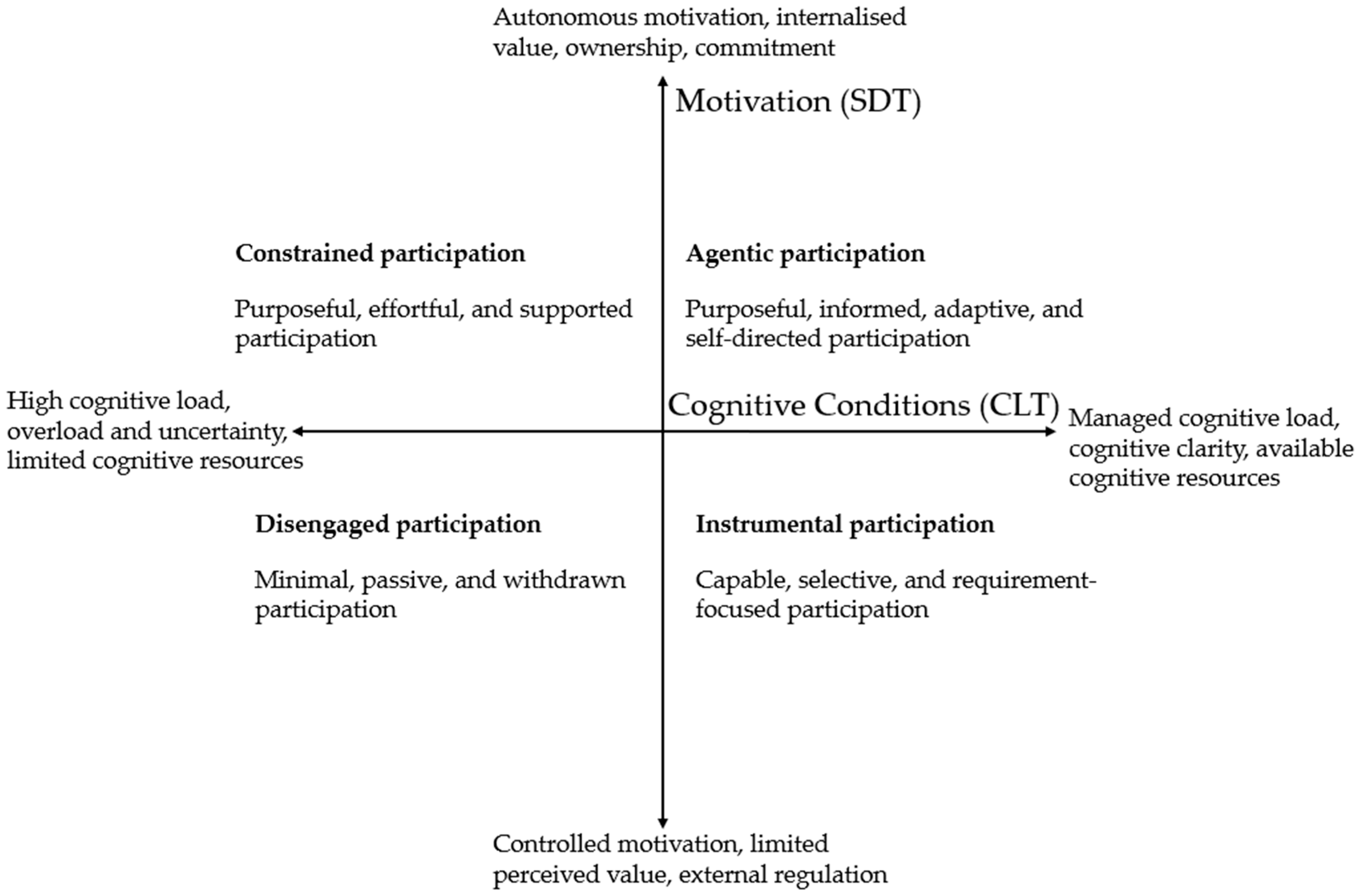
Online and hybrid learning are now an established part of higher education, yet questions remain about what constitutes quality in these learning environments. This conceptual article argues that learner agency provides a useful lens for understanding quality in online and hybrid higher education. Learner agency is conceptualised as students’ capacity to act purposefully within the opportunities and constraints of a learning environment and is positioned as situated, relational and pedagogically mediated rather than as a fixed individual characteristic. The article draws on Self-Determination Theory and Cognitive Load Theory to develop an integrated account of the motivational and cognitive conditions that support learner agency. Self-Determination Theory explains how autonomy, competence and relatedness shape learners’ willingness to participate purposefully, while Cognitive Load Theory explains how learning environments can preserve or deplete the cognitive resources needed for informed action. Integrating these perspectives provides a fuller account of the conditions that support learner agency. The article translates this integrated perspective into six design considerations for agency-supportive online and hybrid learning and argues that learner agency offers a useful framework for learning design and quality enhancement in higher education. Quality online and hybrid learning, it concludes, depends on the extent to which learning environments support students to participate as capable, connected and responsible learners.
Keywords: learner agency; online learning; hybrid learning; Self-Determination Theory; Cognitive Load Theory; educational quality; higher education learner agency; online learning; hybrid learning; Self-Determination Theory; Cognitive Load Theory; educational quality; higher education