Well-Being After Graduation from At-Risk Educational Frameworks: The Mediating Role of Basic Psychological Needs in Emerging Adulthood

Abstract
1. Introduction
1.1. Emerging Adulthood Among Young Adults at Risk
1.2. Negative Life Events and Mental Well-Being Among At-Risk Young People
1.3. Self-Determination Theory and Basic Psychological Needs
1.4. Multidimensional Mental Well-Being
1.5. The Present Study
2. Materials and Methods
2.1. Participants
2.2. Measures
2.2.1. Mental Well-Being
2.2.2. Negative Life Events
2.2.3. Psychological Needs Satisfaction
2.3. Procedure
2.4. Data Analysis
3. Results
3.1. Descriptive Statistics and Preliminary Analyses
3.2. Mediation Analyses
4. Discussion
5. Conclusions
Author Contributions
Funding
Institutional Review Board Statement
Informed Consent Statement
Data Availability Statement
Acknowledgments
Conflicts of Interest
References
- Anda, R. F., Felitti, V. J., Bremner, J. D., Walker, J. D., Whitfield, C., Perry, B. D., Dube, S. R., & Giles, W. H. (2006). The enduring effects of abuse and related adverse experiences in childhood. European Archives of Psychiatry and Clinical Neuroscience, 256(3), 174–186. [Google Scholar] [CrossRef] [PubMed]
- Arnett, J. J. (2000). Emerging adulthood: A theory of development from the late teens through the twenties. American Psychologist, 55(5), 469–480. [Google Scholar] [CrossRef]
- Arnett, J. J. (2014). Emerging adulthood: The winding road from the late teens through the twenties (2nd ed.). Oxford University Press. [Google Scholar] [CrossRef]
- Baumeister, R. F., & Leary, M. R. (1995). The need to belong: Desire for interpersonal attachments as a fundamental human motivation. Psychological Bulletin, 117(3), 497–529. [Google Scholar] [CrossRef]
- Buri, J. R. (2018). Negative life events scale for students (NLESS). College Student Journal, 52(3), 361–367. [Google Scholar]
- Compas, B. E. (1987). Stress and life events during childhood and adolescence. Clinical Psychology Review, 7(3), 275–302. [Google Scholar] [CrossRef]
- Copeland, W. E., Keen, R., Tong, G., & Shanahan, L. (2024). Negative life events and emotional symptoms from ages 2 to 30 years. JAMA Network Open, 7(8), e2429448. [Google Scholar] [CrossRef] [PubMed]
- Deci, E. L., & Ryan, R. M. (2000). The “what” and “why” of goal pursuits: Human needs and the self-determination of behavior. Psychological Inquiry, 11(4), 227–268. [Google Scholar] [CrossRef]
- Faul, F., Erdfelder, E., Buchner, A., & Lang, A.-G. (2009). Statistical power analyses using G*Power 3.1: Tests for correlation and regression analyses. Behavior Research Methods, 41(4), 1149–1160. [Google Scholar] [CrossRef] [PubMed]
- Felitti, V. J., Anda, R. F., Nordenberg, D., Williamson, D. F., Spitz, A. M., Edwards, V., & Marks, J. S. (1998). Relationship of childhood abuse and household dysfunction to many of the leading causes of death in adults: The adverse childhood experiences (ACE) study. American Journal of Preventive Medicine, 14(4), 245–258. [Google Scholar] [CrossRef] [PubMed]
- Gagné, M. (2003). The role of autonomy support and autonomy orientation in prosocial behavior engagement. Motivation and Emotion, 27(3), 199–223. [Google Scholar] [CrossRef]
- Grant, K. E., Compas, B. E., Stuhlmacher, A. F., Thurm, A. E., McMahon, S. D., & Halpert, J. A. (2003). Stressors and child and adolescent psychopathology: Moving from markers to mechanisms of risk. Psychological Bulletin, 129(3), 447–466. [Google Scholar] [CrossRef] [PubMed]
- Greeson, J. K. P. (2013). Foster youth and the transition to adulthood: The theoretical and conceptual basis for natural mentoring. Emerging Adulthood, 1(1), 40–51. [Google Scholar] [CrossRef]
- Guay, F. (2022). Applying self-determination theory to education: Regulation types, psychological needs, and autonomy-supporting behaviors. Canadian Journal of School Psychology, 37(1), 75–92. [Google Scholar] [CrossRef]
- Hair, J. F., Black, W. C., Babin, B. J., & Anderson, R. E. (2010). Multivariate data analysis (7th ed.). Pearson Prentice Hall. [Google Scholar]
- Hammen, C. (2005). Stress and depression. Annual Review of Clinical Psychology, 1, 293–319. [Google Scholar] [CrossRef] [PubMed]
- Hayes, A. F. (2022). Introduction to mediation, moderation, and conditional process analysis: A regression-based approach (3rd ed.). Guilford Publications. [Google Scholar]
- Howard, J. L., Bureau, J., Guay, F., Chong, J. X., & Ryan, R. M. (2021). Student motivation and associated outcomes: A meta-analysis from self-determination theory. Perspectives on Psychological Science, 16(6), 1300–1323. [Google Scholar] [CrossRef] [PubMed]
- Jackson, B., Holland, M. L., Smye, V., Lowe, S., & Sadler, L. S. (2025). “Finally my turn to write my story”: A convergent mixed methods study exploring the perceptions and experiences of emerging adults who aged out of foster care in Canada. PLoS ONE, 20(12), e0338574. [Google Scholar] [CrossRef] [PubMed]
- Jankowiak, B., Soroko, E., Kuryś-Szyncel, K., Jaskulska, S., Hill, C. T., Sawaumi, T., Sanz-Barbero, B., Vives-Cases, C., Neves, S., Inagaki, T., Lee, J., & Watanabe, Y. (2025). Building bridges between Arnett’s and Havighurst’s theories: New developmental tasks in emerging adulthood across six countries. Emerging Adulthood, 13(3), 503–518. [Google Scholar] [CrossRef]
- Keyes, C. L. M. (1998). Social well-being. Social Psychology Quarterly, 61(2), 121–140. [Google Scholar] [CrossRef] [PubMed]
- Keyes, C. L. M. (2002). The mental health continuum: From languishing to flourishing in life. Journal of Health and Social Behavior, 43(2), 207–222. [Google Scholar] [CrossRef]
- Lamers, S. M. A., Westerhof, G. J., Bohlmeijer, E. T., ten Klooster, P. M., & Keyes, C. L. M. (2011). Evaluating the psychometric properties of the mental health continuum–short form (MHC-SF). Journal of Clinical Psychology, 67(1), 99–110. [Google Scholar] [CrossRef] [PubMed]
- LaNoue, M. D., George, B. J., Helitzer, D. L., & Keith, S. W. (2020). Contrasting cumulative risk and multiple individual risk models of the relationship between adverse childhood experiences (ACEs) and adult health outcomes. BMC Medical Research Methodology, 20, 239. [Google Scholar] [CrossRef] [PubMed]
- Martela, F., Lehmus-Sun, A., Parker, P. D., Pessi, A. B., & Ryan, R. M. (2023). Needs and well-being across Europe: Basic psychological needs are closely connected with well-being, meaning, and symptoms of depression in 27 European countries. Social Psychological and Personality Science, 14(5), 501–514. [Google Scholar] [CrossRef]
- Martinez-Maireles, D. (2025). The impact of teacher self-efficacy and self-regulated learning on school dropout. Form@re—Open Journal Per La Formazione in Rete, 25(2), 302–315. [Google Scholar] [CrossRef]
- Masten, A. S. (2001). Ordinary magic: Resilience processes in development. American Psychologist, 56(3), 227–238. [Google Scholar] [CrossRef] [PubMed]
- Matud, M. P., Ibáñez, I., Hernández-Lorenzo, D. E., & Bethencourt, J. M. (2023). Gender, life events, and mental well-being in emerging adulthood. International Journal of Social Psychiatry, 69(6), 1432–1443. [Google Scholar] [CrossRef] [PubMed]
- Maxwell, S. E., & Cole, D. A. (2007). Bias in cross-sectional analyses of longitudinal mediation. Psychological Methods, 12(1), 23–44. [Google Scholar] [CrossRef] [PubMed]
- Mersky, J. P., Topitzes, J., & Reynolds, A. J. (2013). Impacts of adverse childhood experiences on health, mental health, and substance use in early adulthood: A cohort study of an urban, minority sample in the U.S. Child Abuse & Neglect, 37(11), 917–925. [Google Scholar] [CrossRef] [PubMed]
- Nicita, A., Fumia, A., Caparello, C., Meduri, C. F., Filippello, P., & Sorrenti, L. (2025). Goal achievement and academic dropout among Italian university students: The mediating role of academic burnout. European Journal of Investigation in Health, Psychology and Education, 15(1), 3. [Google Scholar] [CrossRef] [PubMed]
- Ryan, R. M., & Deci, E. L. (2017). Self-determination theory: Basic psychological needs in motivation, development, and wellness. Guilford Press. [Google Scholar]
- Ryff, C. D. (1989). Happiness is everything, or is it? Explorations on the meaning of psychological well-being. Journal of Personality and Social Psychology, 57(6), 1069–1081. [Google Scholar] [CrossRef]
- Slemp, G. R., Field, J. G., Ryan, R. M., Forner, V. W., Van den Broeck, A., & Lewis, K. J. (2024). Interpersonal supports for basic psychological needs and their relations with motivation, well-being, and performance: A meta-analysis. Journal of Personality and Social Psychology, 127(5), 1012–1037. [Google Scholar] [CrossRef] [PubMed]
- Stone, A. L., Becker, L. G., Huber, A. M., & Catalano, R. F. (2012). Review of risk and protective factors of substance use and problem use in emerging adulthood. Addictive Behaviors, 37(7), 747–775. [Google Scholar] [CrossRef] [PubMed]
- Sulimani-Aidan, Y., & Melkman, E. (2022). Future orientation among at-risk youth in Israel. Health & Social Care in the Community, 30(4), 1483–1491. [Google Scholar] [CrossRef] [PubMed]
- Vansteenkiste, M., & Ryan, R. M. (2013). On psychological growth and vulnerability: Basic psychological need satisfaction and need frustration as a unifying principle. Journal of Psychotherapy Integration, 23(3), 263–280. [Google Scholar] [CrossRef]
- Vansteenkiste, M., Ryan, R. M., & Soenens, B. (2020). Basic psychological need theory: Advancements, critical themes, and future directions. Motivation and Emotion, 44, 1–31. [Google Scholar] [CrossRef]
- Weinstein, N., & Ryan, R. M. (2011). A self-determination theory approach to understanding stress incursion and responses. Stress and Health, 27(1), 4–17. [Google Scholar] [CrossRef]
- Wood, D., Crapnell, T., Lau, L., Bennett, A., Lotstein, D., Ferris, M., & Kuo, A. (2018). Emerging adulthood as a critical stage in the life course. In N. Halfon, C. B. Forrest, R. M. Lerner, & E. M. Faustman (Eds.), Handbook of life course health development (pp. 123–143). Springer. [Google Scholar] [CrossRef] [PubMed]


| Variable | M | SD | 1 | 2 | 3 | 4 | 5 | 6 | 7 | 8 | 9 |
|---|---|---|---|---|---|---|---|---|---|---|---|
| 1. Age | 20.66 | 1.94 | - | ||||||||
| 2. Gender | - | - | −0.07 | - | |||||||
| 3. Negative Life Events | - | - | −0.02 | −0.06 | - | ||||||
| 4. Autonomy | 4.49 | 0.90 | −0.04 | 0.04 | −0.14 * | - | |||||
| 5. Competence | 4.57 | 1.04 | 0.02 | −0.05 | −0.16 * | 0.81 *** | - | ||||
| 6. Relatedness | 4.74 | 0.86 | −0.02 | 0.02 | −0.20 ** | 0.70 *** | 0.78 *** | - | |||
| 7. Emotional WB | 3.69 | 1.17 | −0.02 | 0.06 | −0.12 * | 0.59 *** | 0.63 *** | 0.55 *** | - | ||
| 8. Social WB | 3.19 | 1.18 | 0.13 * | −0.01 | −0.13 * | 0.48 *** | 0.58 *** | 0.53 *** | 0.74 *** | - | |
| 9. Psychological WB | 3.61 | 1.13 | 0.01 | 0.02 | −0.08 | 0.64 *** | 0.69 *** | 0.65 *** | 0.80 *** | 0.77 *** | - |
| Panel A—Negative Life Events predicting the mediators | |||
| Predictor | B (SE) | 95% CI | |
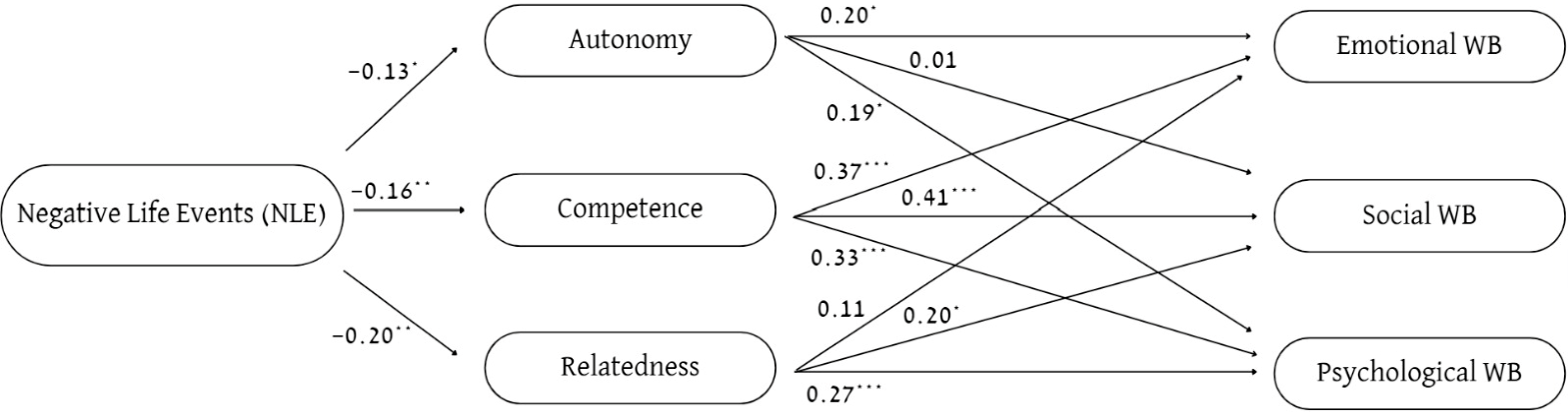
| Negative life events → Autonomy | −0.024 (0.011) * | [−0.045, −0.002] | |
| Negative life events → Competence | −0.033 (0.013) ** | [−0.058, −0.008] | |
| Negative life events → Relatedness | −0.033 (0.011) ** | [−0.054, −0.013] | |
| Panel B—Final outcome models | |||
| Predictor | Emotional WB B (SE) [95% CI] | Social WB B (SE) [95% CI] | Psychological WB B (SE) [95% CI] |
| NLE (direct effect) | −0.003 (0.011) [−0.025, 0.019] | −0.004 (0.012) [−0.028, 0.019] | 0.012 (0.010) [−0.007, 0.032] |
| Autonomy | 0.264 (0.110) * [0.048, 0.480] | 0.011 (0.116) [−0.218, 0.241] | 0.235 (0.096) * [0.046, 0.424] |
| Competence | 0.413 (0.109) *** [0.199, 0.628] | 0.462 (0.116) *** [0.234, 0.689] | 0.355 (0.095) *** [0.168, 0.543] |
| Relatedness | 0.153 (0.106) [−0.057, 0.363] | 0.265 (0.113) * [0.043, 0.488] | 0.349 (0.093) *** [0.166, 0.533] |
| Age | −0.010 (0.029) [−0.068, 0.048] | 0.077 (0.031) * [0.016, 0.138] | 0.011 (0.026) [−0.039, 0.062] |
| Gender | 0.158 (0.109) [−0.058, 0.374] | 0.034 (0.116) [−0.194, 0.263] | 0.070 (0.096) [−0.119, 0.258] |
| R2 | 0.423 | 0.363 | 0.524 |
| Predictor | Emotional WB B (SE) [95% CI] | Social WB B (SE) [95% CI] | Psychological WB B (SE) [95% CI] |
|---|---|---|---|
| Total effect | −0.028 (0.014) [−0.056, −0.001] | −0.029 (0.014) * [−0.057, −0.001] | −0.017 (0.014) [−0.044, 0.010] |
| Direct effect | −0.003 (0.011) [−0.025, 0.019] | −0.004 (0.012) [−0.028, 0.019] | 0.012 (0.010) [−0.007, 0.032] |
| Total indirect | −0.025 * [−0.043, −0.010] | −0.024 * [−0.041, −0.011] | −0.029 * [−0.046, −0.012] |
| Indirect via autonomy | −0.006 * [−0.015, −0.000] | −0.000 [−0.008, 0.007] | −0.006 [−0.013, 0.000] |
| Indirect via competence | −0.014 ** [−0.027, −0.003] | −0.015 ** [−0.030, −0.004] | −0.012 ** [−0.023, −0.003] |
| Indirect via relatedness | −0.005 [−0.019, 0.002] | −0.009 * [−0.023, −0.001] | −0.012 ** [−0.023, −0.004] |
Disclaimer/Publisher’s Note: The statements, opinions and data contained in all publications are solely those of the individual author(s) and contributor(s) and not of MDPI and/or the editor(s). MDPI and/or the editor(s) disclaim responsibility for any injury to people or property resulting from any ideas, methods, instructions or products referred to in the content. |
© 2026 by the authors. Licensee MDPI, Basel, Switzerland. This article is an open access article distributed under the terms and conditions of the Creative Commons Attribution (CC BY) license.
Share and Cite
Amitay, Y.; Sommerfeld, E. Well-Being After Graduation from At-Risk Educational Frameworks: The Mediating Role of Basic Psychological Needs in Emerging Adulthood. Educ. Sci. 2026, 16, 1095. https://doi.org/10.3390/educsci16071095
Amitay Y, Sommerfeld E. Well-Being After Graduation from At-Risk Educational Frameworks: The Mediating Role of Basic Psychological Needs in Emerging Adulthood. Education Sciences. 2026; 16(7):1095. https://doi.org/10.3390/educsci16071095
Chicago/Turabian StyleAmitay, Yael, and Eliane Sommerfeld. 2026. "Well-Being After Graduation from At-Risk Educational Frameworks: The Mediating Role of Basic Psychological Needs in Emerging Adulthood" Education Sciences 16, no. 7: 1095. https://doi.org/10.3390/educsci16071095
APA StyleAmitay, Y., & Sommerfeld, E. (2026). Well-Being After Graduation from At-Risk Educational Frameworks: The Mediating Role of Basic Psychological Needs in Emerging Adulthood. Education Sciences, 16(7), 1095. https://doi.org/10.3390/educsci16071095