

The Associations Between Instructional Leadership Skills, Practice, Self-Efficacy, and Professional Well-Being for Early Learning and K-12 Leaders in the United States


Abstract
1. Introduction
2. Conceptual Framework
2.1. Instructional Leadership Across K-12 and Early Childhood Settings
2.2. Leadership Skills to Support Instructional Leadership Practice
2.3. Instructional Leadership Capacity and Self-Efficacy
2.4. Instructional Leadership Practice and Well-Being
2.5. Linking Self-Efficacy, Instructional Leadership Practice, and Well-Being
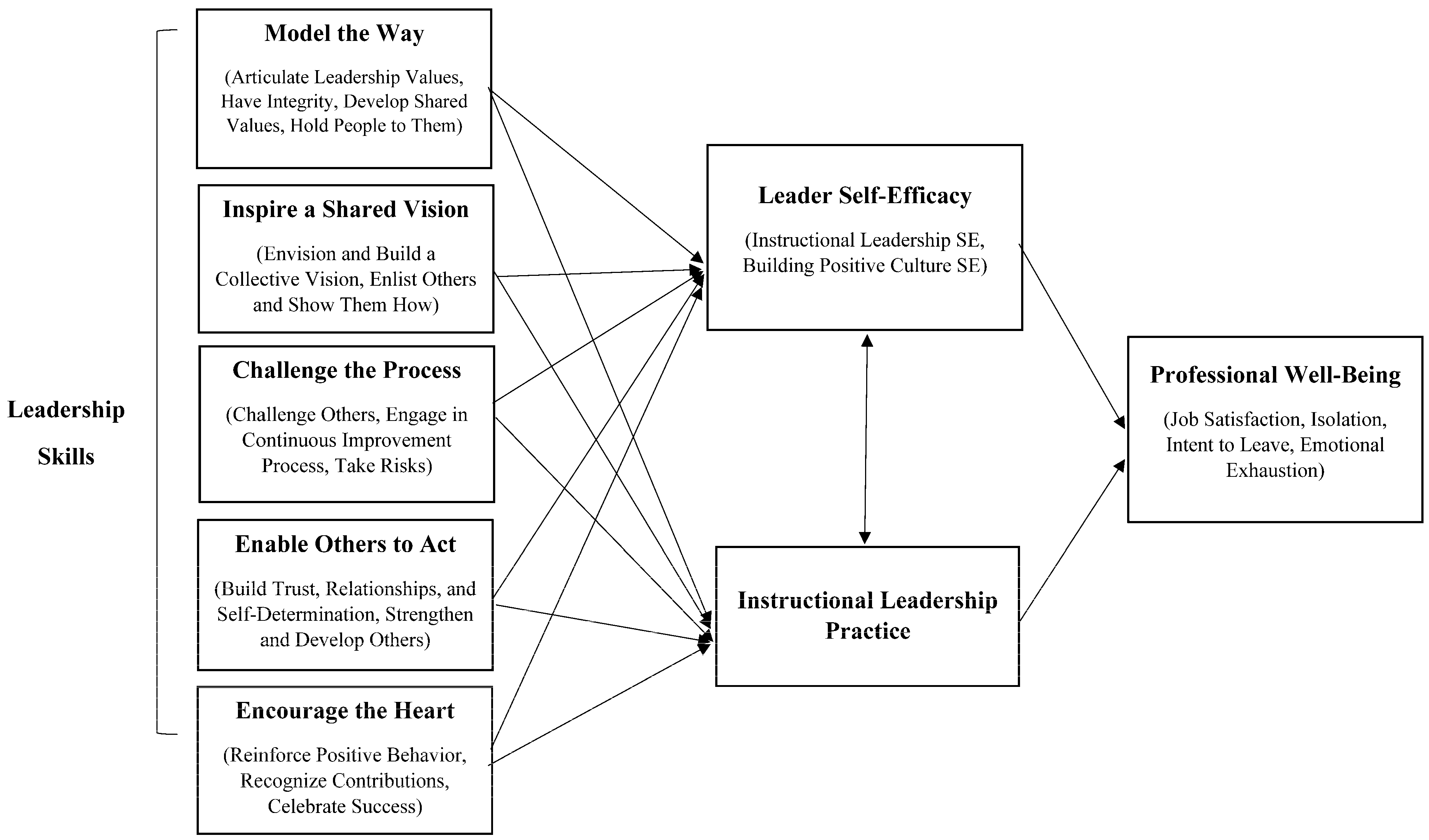
2.6. Testing a Model of Instructional Leadership Skills, Practice, Self-Efficacy, and Professional Well-Being
3. Method
4. Measures
Analytical Approach
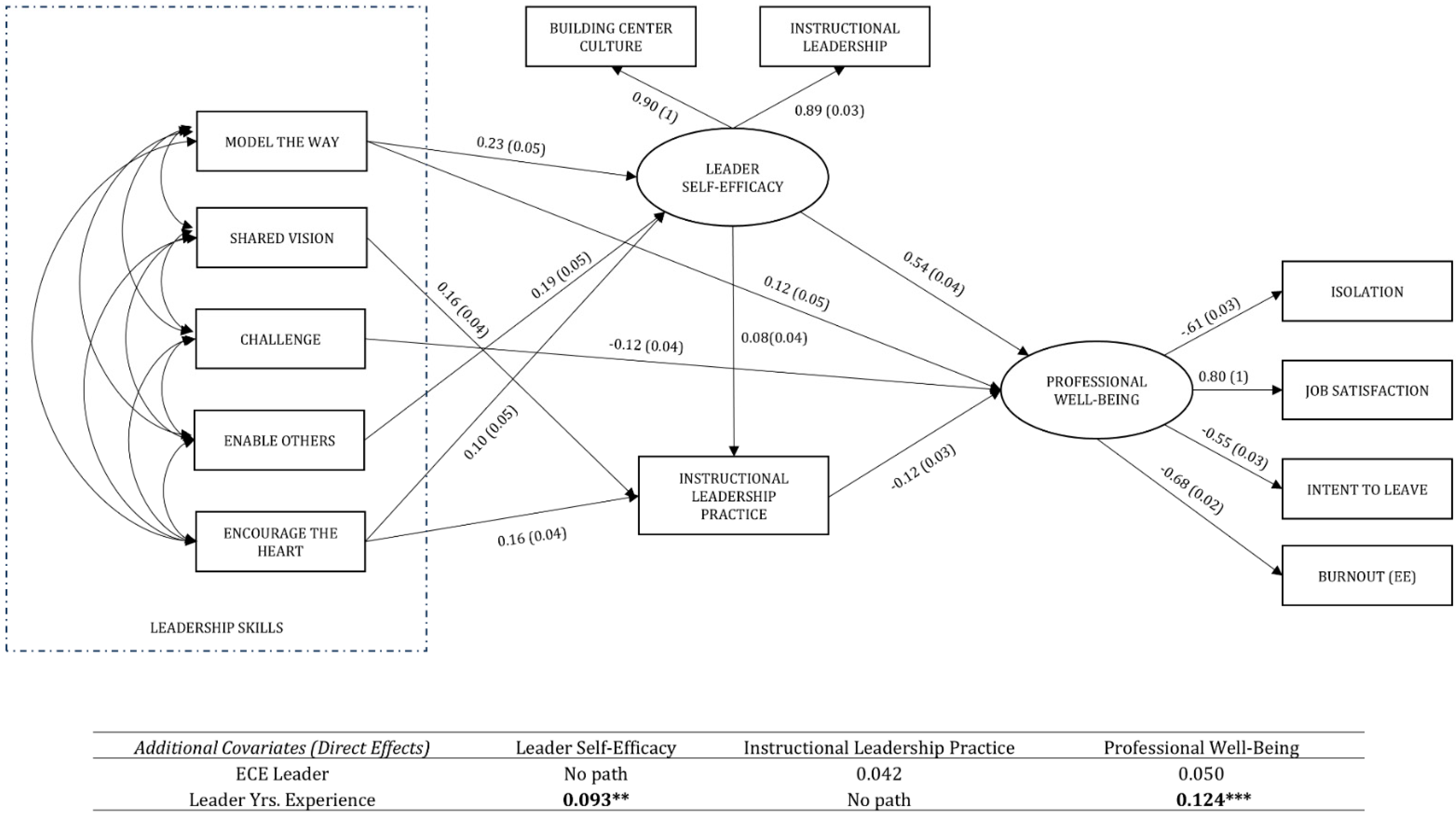
5. Results
6. Discussion
6.1. Implications for Policy and Practice
6.2. Limitations
7. Conclusions
Author Contributions
Funding
Data Availability Statement
Conflicts of Interest
Appendix A. Measures

| Construct | Subscales | Instruments | Instrument Characteristics | Psychometric Properties |
|---|---|---|---|---|
| Leadership Skills | Model the Way Inspire a Shared Vision Challenge the Process Enable Others to Act Encourage the Heart | Leadership Practices Inventory Self Report [LPI Self] (Posner & Kouzes, 1988) | This framework contains five subscales: Model the Way, Inspire a Shared Vision, Challenge the Process, Enable Others to Act, and Encourage the Heart. Each subscale has six items, with a total of 30 items across subscales on a 10-point scale: almost never (1) to almost always (10). | Model Subscale: α = 0.79 Inspire Subscale: α = 0.87 Challenge Subscale: α = 0.86 Enable Subscale: α = 0.82 Encourage Subscale: α = 0.89 Prior Studies α = 0.78–0.95 (Malone et al., 2021) |
| Instructional Leadership Practice | Teacher and Principal Survey (U.S. Department of Education, National Center for Education Statistics, 2021) and the TALIS 2018 Principal Questionnaire (Organization for Economic Co-operation and Development [OECD], 2018). | Leaders were asked how often, weekly, they engage in the following activities: (a) leadership tasks and meetings; (b) curriculum and teaching-related tasks and meetings; (c) student/child interactions; (d) Parent/guardian interactions; (e) interactions with the local and regional community, businesses, and industry; and (f) other. Responses of “other” consisted of the following activities: covering classrooms/teaching, coaching and mentoring, staff development, building relationships with other centers/sites, fundraising (grant writing), building maintenance, and cooking and cleaning. Responses were summed on a scale from 1 (I never or almost never do this) to 6 (I almost always do this). | α = 0.75 | |
| Leader Self-Efficacy | Instructional Leadership SE (IL SE) Building Positive Culture SE (PCC SE) | Adapted from the Principal Self-Efficacy Scale [PSES] (Tschannen-Moran & Gareis, 2004) | The instructional leadership self-efficacy scale consists of two subscales: a) efficacy in building a positive center culture and b) efficacy in instructional leadership, which were adapted from the Principal Self-Efficacy Scale’s [PSES] (Tschannen-Moran & Gareis, 2004) “Efficacy for Moral Leadership” and “Efficacy for Instructional Leadership” dimensions respectively. Each subscale has five items, with a total of 10 items across subscales on a 9-point scale. The scale of responses ranges from “None at all” (1) to “A Great Deal” (9). | Test/Retest Reliability IL SE: 0.89/0.89 PCC SE: 0.90/0.85 (Kwon et al., 2026). Current Study: IL SE: α = 0.90 PCC SE: α = 0.86 |
| Professional Well-Being | Job satisfaction | TALIS 2018 Principal Survey (Organization for Economic Co-operation and Development [OECD], 2018) | 6 items adapted from the OECD’s TALIS 2018 principal survey that ask participants about their feelings toward their current school, job, and chosen profession. Participants were asked to rate how true each statement was of their work on a 5-point scale: 1 (strongly disagree) to 5 (strongly agree). | α = 0.85 α = 0.73 Internal consistency (0.89 to 0.94) and test–retest reliability (r = 0.73). Current study, α = 0.86 |
| Intent to leave Isolation | Organizational Commitment Questionnaire (Meyer et al., 1993) UCLA Loneliness Scale for work settings (Dussault & Thibodeau, 1997; Russell et al., 1978, 1980) | 4 items from the OCQ that ask participants to indicate how likely it is that they would leave their school or the teaching profession in the next year on a scale of 1 (definitely not) to 6 (definitely). 10-item measure that asks participants about their feelings of loneliness and social isolation on a 4-point scale: 1 (never) to 4 (often) | ||
| Emotional Exhaustion | (MBI-ES; Maslach et al., 1996) | Adapted 4-item Emotional Exhaustion subscale of the Maslach Burnout Inventory that asks participants about feelings of being emotionally overextended and exhausted by their work on a scale of 0 (never) to 6 (every day). | α = 0.88 |
References
- Achinstein, B. (2002). Conflict amid community: The micropolitics of teacher collaboration. Teachers College Record, 104(3), 421–455. [Google Scholar] [CrossRef]
- Aleman, E., Jr. (2009). Leveraging conflict for social justice: How “leadable” moments can transform school culture. Journal of Cases in Educational Leadership, 12(4), 1–16. [Google Scholar] [CrossRef]
- Baker, E. L., & Murphy, S. A. (2022). Delegation: A core leadership skill. Journal of Public Health Management and Practice, 28(4), 430–432. [Google Scholar] [CrossRef] [PubMed]
- Bandura, A. (1993). Perceived self-efficacy in cognitive development and functioning. Educational Psychologist, 28(2), 117–148. [Google Scholar] [CrossRef] [PubMed]
- Bandura, A. (1997). Self-efficacy: The exercise of control. Freeman. [Google Scholar]
- Bass, B. M. (1985). Leadership: Good, better, best. Organizational Dynamics, 13(3), 26–40. [Google Scholar] [CrossRef]
- Bauer, S. C., & Silver, L. (2018). The impact of job isolation on new principals’ sense of efficacy, job satisfaction, burnout and persistence. Journal of Educational Administration, 56(3), 315–331. [Google Scholar] [CrossRef]
- Berkovich, I., & Eyal, O. (2015). Educational leaders and emotions: An international review of empirical evidence 1992–2012. Review of Educational Research, 85(1), 129–167. [Google Scholar] [CrossRef]
- Bloom, G., Castagna, C., Moir, E., & Warren, B. (2005). Blended coaching: Skills and strategies to support principal development. Corwin. [Google Scholar]
- Bosire, J. P. O., Gallagher, K. C., Garrett, A. L., & Babchuk, W. (2023). Early childhood leadership well-being: A phenomenological examination of workplace stress and supports. Journal of Early Childhood Research, 21(4), 412–425. [Google Scholar] [CrossRef]
- Boyce, J., & Bowers, A. J. (2018). Toward an evolving conceptualization of instructional leadership as leadership for learning: Meta-narrative review of 109 quantitative studies across 25 years. Journal of Educational Administration, 56(2), 161–182. [Google Scholar] [CrossRef]
- Brauckmann, S., & Pashiardis, P. (2011). A validation study of the leadership styles of principals in different educational contexts: Evidence from Germany and Cyprus. International Journal of Educational Management, 25(1), 11–32. [Google Scholar]
- Brown, C. P., Reyes, P., McKenzie, L. C., DeMatthews, D. E., & Woulfin, S. L. (2024). Principals’ instructional leadership and support needs in prekindergarten and kindergarten: A case study in Texas. AERA Open, 10(1), 1–20. [Google Scholar] [CrossRef]
- Bryk, A. S., Gomez, L. M., Grunow, A., & LeMahieu, P. G. (2015). Learning to improve: How America’s schools can get better at getting better. Harvard Education Press. [Google Scholar]
- Bryk, A. S., & Schneider, B. (2002). Trust in schools: A core resource for improvement. Russell Sage Foundation. [Google Scholar]
- Cansoy, R., & Parlar, H. (2018). Examining the relationship between school principals’ instructional leadership behaviors, teacher self-efficacy, and collective teacher efficacy. International Journal of Educational Management, 32(4), 550–567. [Google Scholar] [CrossRef]
- Centers for Disease Control and Prevention. (2018). Well-being concepts. Available online: https://www.cdc.gov/hrqol/wellbeing.htm (accessed on 5 April 2025).
- Chen, C., & Yin, H. (2025). Investigating the relationship between instructional leadership and teacher well-being: A moderated mediation analysis of PISA 2022. International Journal of Educational Research, 133, 102699. [Google Scholar] [CrossRef]
- Collie, R. J., Malmberg, L.-E., Martin, A., Sammons, P., & Morin, A. J. S. (2020). Examination of teachers’ workplace demands and resources: Links with work-related well-being. Frontiers in Psychology, 11, 626. [Google Scholar] [CrossRef] [PubMed]
- Costello, A. B., & Osborne, J. W. (2005). Best practices in exploratory factor analysis: Four recommendations for getting the most from your analysis. Practical Assessment, Research and Evaluation, 10(7), 1–9. [Google Scholar]
- Council of Chief State School Officers. (2008). Educational leadership policy standard: ISLLC 2008 as adopted by the national policy board for educational administration. Available online: http://www.ccsso.org/Documents/2008/Educational_Leadership_Policy_Standards_2008.pdf (accessed on 6 June 2025).
- DeMatthews, D., Carrola, P., Reyes, P., & Knight, D. (2021). School leadership burnout and job-related stress: Recommendations for district administrators and principals. The Clearing House: A Journal of Educational Strategies, Issues and Ideas, 94(4), 159–167. [Google Scholar] [CrossRef]
- Doromal, J. B., & Markowitz, A. J. (2023). Following the leader: Associations between leader support and teacher retention in child care settings. Early Childhood Research Quarterly, 65, 250–260. [Google Scholar] [CrossRef]
- Douglass, A. (2017). Leading for change in early care and education: Cultivating leadership from within. Teachers College Press. [Google Scholar]
- Douglass, A. (2018). Redefining leadership: Lessons from an early education leadership development initiative. Early Childhood Education Journal, 46(4), 387–396. [Google Scholar] [CrossRef]
- Douglass, A., Kirby, G., & Malone, L. (2023, May). Theory of change of early care and education leadership for quality improvement. Early Childhood Snapshot, OPRE Report #2023-097. Office of Planning, Research, and Evaluation, Administration for Children & Families, U.S. Department of Health and Human Services. [Google Scholar]
- Doyle Fosco, S. L. (2022). Educational leader wellbeing: A systematic review. Educational Research Review, 37, 100487. [Google Scholar] [CrossRef]
- Doyle Fosco, S. L., Brown, M. A., & Schussler, D. L. (2023). Factors affecting educational leader wellbeing: Sources of stress and self-care. Educational Management Administration & Leadership, 53(3), 582–601. [Google Scholar] [CrossRef]
- Dussault, M., & Thibodeau, S. (1997). Professional isolation and performance at work of school principals. Journal of School Leadership, 7(5), 521–536. [Google Scholar] [CrossRef]
- Federici, R. A., & Skaalvik, E. M. (2011). Principal self-efficacy and work engagement: Assessing a Norwegian principal self-efficacy scale. Social Psychology of Education, 14, 575–600. [Google Scholar] [CrossRef]
- Federici, R. A., & Skaalvik, E. M. (2012). Principal self-efficacy: Relations with burnout, job satisfaction and motivation to quit. Social Psychology of Education, 15, 295–320. [Google Scholar] [CrossRef]
- Ford, T. G., Amirault, C., Chapman, S., Domitrovich, C., & Lloyd-Jones, B. (2025a). It starts at the top: Investing in healthy leaders, leadership, and ECE workplaces. Young Children, 80(3), 20–27. [Google Scholar]
- Ford, T. G., Kwon, K., Lavigne, A., & McHugh, T. (2024). Testing a holistic framework of early care and education and K–12 leaders’ working conditions and well-being. AERA Open, 10(1), 1–18. [Google Scholar] [CrossRef]
- Ford, T. G., Kwon, K., Lavigne, A., & McHugh, T. (2025b). The working conditions and well-being of early childhood leaders in the U.S. Early Childhood Education Journal, 53, 1435–1450. [Google Scholar] [CrossRef]
- Ford, T. G., Lavigne, A., Fiegener, A., & Si, S. (2020). Understanding district support for leader development and success in the accountability era: A review of the literature using social- cognitive theories of motivation. Review of Educational Research, 90(2), 264–307. [Google Scholar] [CrossRef]
- Ford, T. G., Olsen, J. J., Khojasteh, J., Ware, J. K., & Urick, A. (2019). Effects of leader support for teacher psychological needs on teacher burnout, commitment, and intent to leave. Journal of Educational Administration, 57(6), 615–634. [Google Scholar] [CrossRef]
- Ford, T. G., Su-Keene, E., Wilson, A., & Kwon, K. (2025c). Leading well: How working conditions shape early childhood leaders’ sleep quality and well-being. Advance online publication. Educational Management, Administration, and Leadership. [Google Scholar] [CrossRef]
- Fuller, E. J., Young, M. D., Richardson, S., Pendola, A., & Winn, K. M. (2018). The prek-8 school leader in 2018: A 10-year study. National Association of Elementary School Principals. Available online: https://www.naesp.org/sites/default/files/NAESP%2010-YEAR%20REPORT_2018.pdf (accessed on 5 June 2025).
- Gibbs, L. (2024). Cultivating leadership in early childhood education and care: Trouble, complexity and promise. Routledge. [Google Scholar] [CrossRef]
- Grissom, J. A., Egalite, A. J., & Lindsay, C. A. (2021). What great principals really do. Educational Leadership, 78(7), 21–25. [Google Scholar]
- Grissom, J. A., & Loeb, S. (2011). Triangulating principal effectiveness: How perspectives of parents, teachers, and assistant principals identify the central importance of managerial skills. American Educational Research Journal, 48(5), 1091–1123. [Google Scholar] [CrossRef]
- Hakanen, J. J., Bakker, A. B., & Schaufeli, W. B. (2006). Burnout and work engagement among teachers. Journal of School Psychology, 43(6), 495–513. [Google Scholar] [CrossRef]
- Hallinger, P. (2010). Developing instructional leadership. In Developing successful leadership (pp. 61–76). Springer. [Google Scholar]
- Hallinger, P. (2011). Leadership for learning: Lessons from 40 years of empirical research. Journal of Educational Administration, 49(2), 125–142. [Google Scholar] [CrossRef]
- Hallinger, P., Gümüş, S., & Bellibaş, M. Ş. (2020). ‘Are principals instructional leaders yet?’ A science map of the knowledge base on instructional leadership, 1940–2018. Scientometrics, 122(3), 1629–1650. [Google Scholar] [CrossRef]
- Hallinger, P., & Murphy, J. (1985). Assessing the instructional management behavior of principals. Elementary School Journal, 86(2), 217–247. [Google Scholar] [CrossRef]
- Hall-Kenyon, K. M., Bullough, R. V., MacKay, K. L., & Marshall, E. E. (2014). Preschool teacher well-being: A review of the literature. Early Childhood Education Journal, 42(3), 153–162. [Google Scholar] [CrossRef]
- Hesbol, K. A. (2019). Principal self-efficacy and learning organizations: Influencing school improvement. International Journal of Educational Leadership Preparation, 14(1), 33–51. [Google Scholar]
- Hitt, D. H., & Tucker, P. D. (2016). Systematic review of key leader practices found to influence student achievement: A unified framework. Review of Educational Research, 86(2), 531–569. [Google Scholar] [CrossRef]
- Honig, M. I., & Rainey, L. (2020). Supervising principals for instructional leadership: A teaching and learning approach. Harvard Education Press. [Google Scholar]
- Jeon, L., Charlot-Swilley, D., Varghese, C. A., Li, S., & Byun, S. (2025). Leading the way: Strategies for fostering organizational well-being in early childhood education. Young Children, 80(3), 28–34. [Google Scholar]
- Karakus, M., Toprak, M., & Chen, J. (2026). Demystifying the impact of educational leadership on teachers’ subjective well-being: A bibliometric analysis and literature review. Educational Management Administration & Leadership, 54(2), 363–387. [Google Scholar] [CrossRef]
- Kirby, G., Douglass, A., Lyskawa, J., Jones, C., & Malone, L. (2021). Understanding leadership in early care and education: A literature review. (OPRE Report 2021-02). Office of Planning, Research, and Evaluation, Administration for Children & Families, U.S. Department of Health and Human Services. [Google Scholar]
- Klevering, N., & McNae, R. (2018). Making sense of leadership in early childhood education: Tensions and complexities between concepts and practices. Journal of Educational Leadership, Policy and Practice, 33(1), 5–17. [Google Scholar] [CrossRef]
- Kline, R. B. (2015). Principles and practice of structural equation modeling (4th ed.). Guilford Press. [Google Scholar]
- Kochanek, J. R. (2005). Building trust for better schools: Research-based practices. Corwin Press. [Google Scholar]
- Kouzes, J. M., & Posner, B. Z. (2010). The five practices of exemplary leadership (2nd ed.). John Wiley & Sons. [Google Scholar]
- Kouzes, J. M., & Posner, B. Z. (2017). A coach’s guide to developing exemplary leaders: Making the most of the leadership challenge and the leadership practices inventory (LPI). John Wiley & Sons. [Google Scholar]
- Kwon, K., Ford, T. G., Cheema, C., Kile, M., Wang, H., Tsotsoros, J., Randall, K., Lloyd-Jones, B., Castle, S., Jang, S., Jung, Y. J., Lee, H., Kim, S. G., Sorrels, B., Wang, L., Horm, D. M., & Jang, W. (2026). Head Start staff well-being: Early impact results from a cluster randomized control trial (RCT) of the Happy Teacher Wellness Intervention. Early Childhood Research Quarterly, 76, 74–86. [Google Scholar] [CrossRef]
- Kwon, K., Ford, T. G., Jeon, L., Malek-Lasater, A. D., Ellis, N. D., Randall, K., Kile, M. S., & Salvatore, A. (2021). Testing a holistic conceptual framework for early childhood teacher well-being. Journal of School Psychology, 86, 178–197. [Google Scholar] [CrossRef] [PubMed]
- Liu, P., Thien, L. M., Song, H., & Wang, X. (2025). The effects of instructional leadership on teacher well-being: The mediating roles of professional learning community and teacher self-efficacy. Educational Studies, 51(4), 638–660. [Google Scholar] [CrossRef]
- Louis, K. S., & Kruse, S. D. (1995). Professionalism and community: Perspectives on reforming urban schools. SAGE Publications Ltd. [Google Scholar]
- Mahfouz, J. (2020). Principals and stress: Few coping strategies for abundant stressors. Educational Management Administration & Leadership, 48(3), 440–458. [Google Scholar] [CrossRef]
- Malone, L., Albanese, S., Jones, C., Xue, Y., Kirby, G., & Douglass, A. (2021). Compendium of existing measures for understanding leadership in early care and education (OPRE Report 2021-220). Office of Planning, Research, and Evaluation, Administration for Children and Families, U.S. Department of Health and Human Services. [Google Scholar]
- Markowitz, A. J., Doromal, J. B., & Yabiku, T. Y. (2026). Links among early childhood leadership, teacher-child interaction quality, and teacher retention. Early Childhood Research Quarterly, 74, 117–135. [Google Scholar] [CrossRef]
- Maslach, C., Jackson, S. E., & Leiter, M. P. (1996). Maslach burnout inventory manual. Consulting Psychologists Press. [Google Scholar]
- McCormick Center for Early Childhood Leadership. (2003). Leadership transitions: What do directors experience? McCormick Center for Early Childhood Leadership Publications. Available online: https://digitalcommons.nl.edu/mccormickcenter-pubs/46 (accessed on 9 September 2024).
- McKay, A., MacDonald, K., & Longmuir, F. (2024). The emotional intensity of educational leadership: A scoping review. International Journal of Leadership in Education, 28, 673–695. [Google Scholar] [CrossRef]
- Meyer, J. P., Allen, N. J., & Smith, C. A. (1993). Commitment to organizations and occupations: Extension and test of a three-component conceptualization. Journal of Applied Psychology, 78(4), 538–551. [Google Scholar] [CrossRef]
- Organization for Economic Co-operation and Development (OECD). (2018). Teaching and learning international survey (TALIS): Principal questionnaire. Available online: http://www.oecd.org/education/school/TALIS-2018-MS-Principal-Questionnaire-ENG.pdf (accessed on 12 December 2025).
- Özdemir, S., Sezgin, F., Kılınç, A. Ç., Erdoğan, O., & Turan Bora, H. (2024). Unveiling the associations between principal self-efficacy, openness to change and transformational leadership: The mediating role of well-being. Journal of Educational Administration, 62(5), 528–544. [Google Scholar] [CrossRef]
- Posner, B. Z., & Kouzes, J. M. (1988). Development and validation of the leadership practices inventory. Educational and Psychological Measurement, 48(2), 483–496. [Google Scholar] [CrossRef]
- Russell, D., Peplau, L. A., & Cutrona, C. E. (1980). The revised UCLA loneliness scale: Concurrent and discriminant validity evidence. Journal of Personality and Social Psychology, 39(3), 472–480. [Google Scholar] [CrossRef] [PubMed]
- Russell, D., Peplau, L. A., & Ferguson, M. L. (1978). Developing a measure of loneliness. Journal of Personality Assessment, 42(3), 290–294. [Google Scholar] [CrossRef] [PubMed]
- Ryan, R. M., & Deci, E. L. (2017). Self-determination theory: Basic psychological needs in motivation, development, and wellness. Guilford Press. [Google Scholar] [CrossRef]
- Sebastian, J., Allensworth, E., Wiedermann, W., Hochbein, C., & Cunningham, M. (2019). Principal leadership and school performance: An examination of instructional leadership and organizational management. Leadership and Policy in Schools, 18(4), 591–613. [Google Scholar] [CrossRef]
- Sheng, Z., Wolff, L., Kilmer, L., & Yager, S. (2017). School administration manager: Redefining the principal’s role as an instructional leader. Journal of School Leadership, 27(1), 119–142. [Google Scholar] [CrossRef]
- Skaalvik, C. (2020). School principal self-efficacy for instructional leadership: Relations with engagement, emotional exhaustion and motivation to quit. Social Psychology of Education, 23(2), 479–498. [Google Scholar] [CrossRef]
- Skaalvik, C. (2023). Emotional exhaustion and job satisfaction among Norwegian school principals: Relations with perceived job demands and job resources. International Journal of Leadership in Education, 26(1), 75–99. [Google Scholar] [CrossRef]
- Snodgrass Rangel, V. (2018). A review of the literature on principal turnover. Review of Educational Research, 88(1), 87–124. [Google Scholar] [CrossRef]
- Su-Keene, E. J., DeMatthews, D. E., & Keene, A. C. (2024). Principal work stress and its relationship with mental health, sleep quality, and leadership self-efficacy: An exploratory mixed-methods approach. Leadership and Policy in Schools, 25, 108–126. [Google Scholar] [CrossRef]
- Tschannen-Moran, M., & Gareis, C. R. (2004). Principals’ sense of efficacy: Assessing a promising construct. Journal of Educational Administration, 42(5), 573–585. [Google Scholar] [CrossRef]
- Tschannen-Moran, M., & Gareis, C. R. (2007). Cultivating principals’ self-efficacy: Supports that matter. Journal of School Leadership, 17(1), 89–114. [Google Scholar] [CrossRef]
- Uline, C. L., Tschannen-Moran, M., & Perez, L. (2003). Constructive conflict: How controversy can contribute to school improvement. Teachers College Record, 105(5), 782–816. [Google Scholar] [CrossRef]
- U.S. Department of Education, National Center for Education Statistics. (2021). National Teacher and Principal Survey. National Center for Education Statistics.
- Wang, C., Huang, X., Siklander, S., & Xu, P. (2025). Unlocking the relationship between instructional leadership, psychological well-being, and teacher job crafting. International Journal of Educational Management, 39(5), 1156–1176. [Google Scholar] [CrossRef]
- Wang, F. (2025). Emotional well-being of school principals: Exploring enhancement and risk factors. Journal of Educational Administration, 63(3), 224–238. [Google Scholar] [CrossRef]
- Wang, F., Pollock, K., & Hauseman, C. (2023). Time demands and emotionally draining situations amid work intensification of school principals. Educational Administration Quarterly, 59(1), 112–142. [Google Scholar] [CrossRef]
- Weick, K. E. (1984). Small wins: Redefining the scale of social problems. American Psychologist, 39(1), 40–49. [Google Scholar] [CrossRef]
- Yildirim, F., & Sait Dinc, M. (2019). Factors influencing burnout of the principals: A pilot study in Flemish schools of Belgium. Economic Research, 32(1), 3538–3553. [Google Scholar] [CrossRef]


| Categories | K-12 | ECE |
|---|---|---|
| (n = 632) | (n = 405) | |
| M or % (SD) | M or % (SD) | |
| Leader Characteristics | ||
| Female | 65.9% | 96.8% |
| Leaders by School/Center Type | ||
| ECE: Childcare Center (non-profit) | -- | 48.9% |
| ECE: Childcare Center (for-profit) | -- | 37.8% |
| ECE: Head Start/Early Head Start | -- | 12.8% |
| K-12: Public School (traditional) | 73.3% | -- |
| K-12: Public School (charter) | 7.9% | -- |
| K-12: Private School (religious) | 12.5% | -- |
| K-12: Private School (non-sectarian) | 4.8% | -- |
| K-12 Full-Time Virtual School (charter, district, or private) | 1.1% | -- |
| Leader Race | ||
| Asian or Pacific Islander | 0.65% | 1.3% |
| Black or African American | 11.9% | 12.9% |
| Hispanic or Latinx | 6.4% | 7.9% |
| Multiracial or Biracial | 2.7% | 1.1% |
| Native American or Alaskan Native | 1.3% | 0.79% |
| White or Caucasian | 77% | 76% |
| Leader Age (in years) | 50.51(7.84) | 51.46(10.3) |
| Prior Experience | ||
| As Educational Leader (number of years) | 14.91% (8.43) | 19.81 (10.87) |
| School/Center Characteristics | ||
| Rural center/school | 27.1% | 24.6% |
| Suburban center/school | 43.9% | 49.4% |
| Urban center/school | 29% | 26.1% |
| School SES | ||
| Mostly low SES | 40.6% | 32.1% |
| Mostly middle SES | 21.7% | 24.3% |
| Mostly high SES | 9.9% | 10.1% |
| Mixed SES | 27.7% | 33.4% |
| Leadership Skills | ||
| LPI: Model the Way Subscale (6–60) | 51.26 (5.65) | 50.97 (6.34) |
| LPI: Shared Vision Subscale (6–60) | 48.26 (7.83) | 47.44 (8.78) |
| LPI: Challenge the Process Subscale (6–60) | 48.93 (7.03) | 47.96 (8.07) |
| LPI: Enable Others Subscale (6–60) | 53.16 (4.72) | 52.61 (5.79) |
| LPI: Encourage the Heart (6–60) | 50.14 (7.35) | 50.48 (7.63) |
| Endogenous Variables: Instructional Leadership Practice, Self-Efficacy, and Professional Well-being | ||
| Instructional Leadership Practice (4–36) | 21.97 (4.45) | 22.36 (4.80) |
| Leadership Self-Efficacy: Instructional Leadership (5–45) | 36.77 (6.11) | 37.49 (5.65) |
| Leadership Self-Efficacy: Building Center Culture (5–45) | 37.98 (5.14) | 38.11 (5.41) |
| Job Satisfaction (1–5) | 4.21 (0.77) | 4.31 (0.73) |
| Intent to Leave (4–20) | 10.11 (4.12) | 8.51 (4.03) |
| Isolation (1–4) | 1.97 (0.58) | 1.99 (0.61) |
| Emotional Exhaustion (0–6) | 3.18 (1.55) | 2.95 (1.69) |
| 1 | 2 | 3 | 4 | 5 | 6 | 7 | 8 | 9 | 10 | 11 | |
|---|---|---|---|---|---|---|---|---|---|---|---|
| 1. LPI Skills: Model the Way | ----- | ||||||||||
| 2. LPI Skills: Shared Vision Subscale | 0.77 ** | ----- | |||||||||
| 3. LPI Skills: Challenge the Process | 0.77 ** | 0.86 ** | ----- | ||||||||
| 4. LPI: Skills: Enable Others | 0.76 ** | 0.67 ** | 0.71 ** | ----- | |||||||
| 5. LPI Skills: Encourage the Heart | 0.76 ** | 0.71 ** | 0.67 ** | 0.71 ** | ----- | ||||||
| 6. Instructional Leadership Practice | 0.30 ** | 0.30 ** | 0.29 ** | 0.28 ** | 0.31 ** | ----- | |||||
| 7. LSE: Instructional Leadership | 0.37 ** | 0.33 ** | 0.33 ** | 0.35 ** | 0.36 ** | 0.21 ** | ----- | ||||
| 8. LSE: Building Center Culture | 0.44 ** | 0.35 ** | 0.35 ** | 0.43 ** | 0.39 ** | 0.18 ** | 0.81 ** | ----- | |||
| 9. PWB: Job Satisfaction | 0.22 ** | 0.15 ** | 0.13 ** | 0.19 ** | 0.19 ** | 0.05 | 0.44 ** | 0.40 ** | ----- | ||
| 10. PWB: Intent to Leave | −0.05 | −0.03 | −0.00 | −0.07 * | −0.03 | 0.03 | −0.20 ** | −0.17 ** | −0.47 ** | ----- | |
| 11. PWB: Isolation | −0.22 ** | −0.16 ** | −0.13 ** | −0.23 ** | −0.19 ** | −0.05 | −0.41 ** | −0.38 ** | −0.46 ** | 0.33 ** | ----- |
| 12. PWB: Emotional Exhaustion | −0.13 ** | −0.10 ** | −0.10 ** | −0.08 * | −0.11 ** | 0.07 * | −0.31 ** | −0.26 ** | −0.54 ** | 0.40 ** | 0.42 ** |
| Path (Direct Effects) | β | SE | p |
| Instructional Leadership Practice ON | |||
| Leader Self-Efficacy | 0.083 | 0.035 | 0.019 |
| Shared Vision | 0.158 | 0.042 | 0.000 |
| Encourage the Heart | 0.160 | 0.042 | 0.000 |
| ECE Leader | 0.042 | 0.029 | 0.144 |
| Leader Self-Efficacy ON | |||
| Model the Way | 0.228 | 0.053 | 0.000 |
| Enable Others | 0.187 | 0.050 | 0.000 |
| Encourage the Heart | 0.103 | 0.048 | 0.032 |
| Years of Experience as a Leader | 0.093 | 0.031 | 0.002 |
| Professional Well-Being ON | |||
| Instructional Leadership Practice | −0.120 | 0.033 | 0.000 |
| Leader Self-Efficacy | 0.544 | 0.035 | 0.000 |
| Model the Way | 0.119 | 0.050 | 0.019 |
| Challenge | −0.115 | 0.048 | 0.017 |
| ECE Leader | 0.050 | 0.032 | 0.122 |
| Years of Experience as a Leader | 0.124 | 0.032 | 0.000 |
| Path (Indirect Effects) | β | SE | p |
| Instructional Leadership Practice ON | |||
| Model the Way | 0.018 | 0.007 | 0.040 |
| Enable Others | 0.016 | 0.006 | 0.044 |
| Encourage the Heart | 0.008 | 0.003 | 0.115 |
| Years of Experience as a Leader | 0.007 | 0.002 | 0.062 |
| Professional Well-Being ON | |||
| Leader Self-Efficacy | −0.010 | 0.000 | 0.058 |
| Model the Way | 0.122 | 0.003 | 0.000 |
| Shared Vision | −0.018 | 0.000 | 0.009 |
| Enable Others | 0.100 | 0.003 | 0.000 |
| Encourage the Heart | 0.036 | 0.002 | 0.186 |
| ECE Leader | −0.005 | 0.004 | 0.175 |
| Years of Experience as a Leader | 0.050 | 0.001 | 0.003 |
| Path (Total Effects) | β | SE | p |
| Instructional Leadership Practice ON | |||
| Leader Self-Efficacy | 0.083 | 0.035 | 0.020 |
| Model the Way | 0.019 | 0.007 | 0.040 |
| Shared Vision | 0.158 | 0.024 | 0.000 |
| Enable Others | 0.015 | 0.026 | 0.044 |
| Encourage the Heart | 0.169 | 0.026 | 0.000 |
| ECE Leader | 0.403 | 0.276 | 0.144 |
| Years of Experience as a Leader | 0.007 | 0.002 | 0.062 |
| Leader Self-Efficacy ON | |||
| Model the Way | 0.228 | 0.042 | 0.000 |
| Enable Others | 0.187 | 0.046 | 0.000 |
| Encourage the Heart | 0.103 | 0.031 | 0.032 |
| Years of Experience as a Leader | 0.093 | 0.015 | 0.002 |
| Professional Well-Being ON | |||
| Instructional Leadership Practice | −0.120 | 0.004 | 0.000 |
| Leader Self-Efficacy | 0.544 | 0.005 | 0.000 |
| Model the Way | 0.241 | 0.005 | 0.000 |
| Shared Vision | −0.019 | 0.000 | 0.009 |
| Challenge | −0.115 | 0.003 | 0.018 |
| Enable Others | 0.100 | 0.003 | 0.000 |
| Encourage the Heart | 0.035 | 0.002 | 0.186 |
| ECE Leader | 0.044 | 0.040 | 0.167 |
| Years of Experience as a Leader | 0.174 | 0.002 | 0.000 |
| Covariances | Estimate | SE | p |
| Model the Way WITH | |||
| Shared Vision | 0.772 | 0.012 | 0.000 |
| Challenge | 0.766 | 0.013 | 0.000 |
| Enable Others | 0.763 | 0.013 | 0.000 |
| Encouraging the Heart | 0.758 | 0.013 | 0.000 |
| ECE Leader | −0.024 | 0.031 | 0.441 |
| Years of Experience as a Leader | 0.090 | 0.031 | 0.004 |
| Shared Vision WITH | |||
| Challenge | 0.858 | 0.008 | 0.000 |
| Enable Others | 0.668 | 0.017 | 0.000 |
| Encourage the Heart | 0.710 | 0.015 | 0.000 |
| ECE Leader | −0.049 | 0.031 | 0.114 |
| Years of Experience as a Leader | 0.062 | 0.031 | 0.044 |
| Challenge WITH | |||
| Enable Others | 0.704 | 0.015 | 0.000 |
| Encourage the Heart | 0.673 | 0.017 | 0.000 |
| ECE Leader | −0.064 | 0.030 | 0.040 |
| Years of Experience as a Leader | 0.057 | 0.031 | 0.067 |
| Enable Others WITH | |||
| Encourage the Heart | 0.713 | 0.015 | 0.000 |
| ECE Leader | −0.052 | 0.031 | 0.095 |
| Years of Experience as a Leader | 0.073 | 0.031 | 0.019 |
| Encourage the Heart WITH | |||
| ECE Leader | 0.021 | 0.031 | 0.484 |
| Years of Experience as a Leader | 0.118 | 0.031 | 0.000 |
| ECE Leader WITH | |||
| Years of Experience as a Leader | 0.244 | 0.029 | 0.000 |
Disclaimer/Publisher’s Note: The statements, opinions and data contained in all publications are solely those of the individual author(s) and contributor(s) and not of MDPI and/or the editor(s). MDPI and/or the editor(s) disclaim responsibility for any injury to people or property resulting from any ideas, methods, instructions or products referred to in the content. |
© 2026 by the authors. Licensee MDPI, Basel, Switzerland. This article is an open access article distributed under the terms and conditions of the Creative Commons Attribution (CC BY) license.
Share and Cite
Ford, T.G.; Wilson, A.; Kwon, K.-A.; Lynn, L. The Associations Between Instructional Leadership Skills, Practice, Self-Efficacy, and Professional Well-Being for Early Learning and K-12 Leaders in the United States. Educ. Sci. 2026, 16, 1094. https://doi.org/10.3390/educsci16071094
Ford TG, Wilson A, Kwon K-A, Lynn L. The Associations Between Instructional Leadership Skills, Practice, Self-Efficacy, and Professional Well-Being for Early Learning and K-12 Leaders in the United States. Education Sciences. 2026; 16(7):1094. https://doi.org/10.3390/educsci16071094
Chicago/Turabian StyleFord, Timothy G., Alison Wilson, Kyong-Ah Kwon, and Laci Lynn. 2026. "The Associations Between Instructional Leadership Skills, Practice, Self-Efficacy, and Professional Well-Being for Early Learning and K-12 Leaders in the United States" Education Sciences 16, no. 7: 1094. https://doi.org/10.3390/educsci16071094
APA StyleFord, T. G., Wilson, A., Kwon, K.-A., & Lynn, L. (2026). The Associations Between Instructional Leadership Skills, Practice, Self-Efficacy, and Professional Well-Being for Early Learning and K-12 Leaders in the United States. Education Sciences, 16(7), 1094. https://doi.org/10.3390/educsci16071094