


Abstract
Writing-intensive courses help undergraduate students develop disciplinary knowledge and communication skills, yet many students, particularly first-generation college students and those writing in a second language, enter these courses with low confidence and high writing anxiety. Writing self-efficacy, or students’ beliefs about their ability to succeed as writers, is associated with motivation and academic success, but less is known about how instructional practices shape its development. This qualitative study examined how students experienced instructional practices in a writing-intensive public health course and how these experiences influenced writing self-efficacy. Data were collected through a focus group with six undergraduate students and analyzed using a deductive thematic approach guided by Bandura’s four sources of self-efficacy. Students identified scaffolded assignments, opportunities for revision, and explanatory feedback as key facilitators of writing self-efficacy. Supportive classroom relationships, including proactive instructor outreach and consistent feedback, also appeared to foster confidence. Barriers included linguistic challenges, limited academic role models, and negative experiences with writing support services. These findings suggest writing self-efficacy may develop through the interaction of structured instructional practices and supportive classroom environments.
1. Introduction
Writing-intensive courses occupy a complex space in undergraduate education. Designed to develop students’ disciplinary knowledge and communication skills simultaneously, these courses offer powerful opportunities for intellectual growth. Yet for many students, they also represent sources of anxiety and frustration. Writing is one of the most difficult skills to master, and despite decades of pedagogical innovation in writing instruction, persistent challenges remain. Students frequently enter writing-intensive courses with low confidence, heightened anxiety, and patterns of disengagement that can undermine their learning (Abd Rahim et al., 2016; Aunurrahman, 2019; Martinez et al., 2011; Stewart et al., 2015). These challenges can be especially acute for first-generation college (first-gen) students and those writing in a second or foreign language (Koh et al., 2022; Putra et al., 2024; Wahyuni et al., 2019).
Importantly, these experiences are not only individual but are also shaped by broader inequalities in access to the expectations and skills that are valued in academic writing. Drawing on Pierre Bourdieu, students enter writing-intensive courses with varying levels of familiarity with these expectations, shaped by their prior educational and social experiences (Bourdieu, 1977). Those who have had greater exposure to these forms of knowledge and communication may navigate writing tasks with more confidence, while others must learn these expectations as they go, which can contribute to increased anxiety and may be associated with lower confidence. These affective dimensions of writing development have profound implications for students’ success, both in individual courses and across their academic careers.
1.1. The Role of Self-Efficacy in Writing Development
Central to these affective dimensions is the concept of writing self-efficacy: students’ beliefs about their capacity to succeed as writers. Self-efficacy has long been identified as a vital determinant of academic performance (Hayat et al., 2020; Holloway & Watson, 2002; Mitchell et al., 2019). Albert Bandura’s theory of self-efficacy posits that people’s beliefs in their abilities are derived from four main sources: mastery experiences, vicarious experiences, social persuasion, and emotional states (Bandura, 1977). Among these, mastery experiences—the direct experiences one gains when attempting the behavior of interest—are purported to be the most influential. Witnessing others succeed at the target behavior (vicarious experiences), receiving positive encouragement from others (social persuasion), and maintaining a positive and motivated state of mind (emotional states) also collectively shape one’s self-efficacy (Bandura, 1977).
Over the past three decades, educational research has consistently underscored the strong connection between self-efficacy and heightened motivation, improved learning outcomes, and enriched learning experiences in higher education (Urdan & Pajares, 2006). Educational programs intentionally designed with self-efficacy theory at their core have demonstrated success in improving learning and increasing student self-efficacy (Van Dinther et al., 2011). Yet despite being a reliable predictor and mediator of academic performance, motivation, and learning, self-efficacy may remain an underutilized factor in the design and delivery of university courses (Van Dinther et al., 2011).
1.2. First-Generation College Students and Writing Self-Efficacy
Self-efficacy affects not only a student’s ability to learn in the classroom but also their capacity to navigate the broader college experience, including accessing financial aid, utilizing campus resources, and developing academic networks. These navigation challenges are especially pronounced for first-gen college students—those for whom neither parent completed a four-year college degree. First-gen students are navigating not only imposter syndrome but also cultural and social factors that impact how and whether they ask for help (Durney, 2023). Bourdieu’s (1986) concepts of habitus (i.e., the way people perceive and respond to the social world based on their personal characteristics and behaviors) and cultural capital offer a useful theoretical lens for understanding these dynamics. First-gen students often enter university with forms of cultural capital (i.e., the non-financial assets that help people succeed in society) that differ from those typically valued in academic contexts. Their habitus may also not align with the implicit norms of higher education. These misalignments can compound feelings of not belonging and reinforce lower writing self-efficacy.
First-gen students face more challenges than their continuing-generation peers across multiple domains. They are often lower-income (Engle & Tinto, 2008; Pascarella et al., 2004), have lower grade point averages (Chen, 2005; Ishitani, 2006), and experience reduced graduation rates compared to their continuing-generation counterparts (Choy, 2001; Engle & Tinto, 2008). Research has also shown that first-gen students report a lower sense of belonging on campus, which affects their comfort and willingness to utilize available academic resources such as writing centers, tutoring services, and office hours (Jehangir, 2010; Means & Pyne, 2017; Stebleton et al., 2014). Perhaps most relevant to the present study, first-gen students often experience greater writing anxiety and lower writing self-efficacy than continuing-generation students (Kuh et al., 2006; Terenzini et al., 1996), making the development of writing confidence particularly critical for this population. These compounding challenges underscore the importance of understanding how instructional practices in writing-intensive courses are experienced by first-gen students and how these experiences shape their development as writers and their beliefs in their own capabilities.
1.3. The Limits of Outcome-Focused Research
Much of the existing research on writing instruction has focused on measurable outcomes: the quality of student texts, the effectiveness of particular pedagogical interventions, or the development of discrete writing skills (Allagui, 2024; Graham et al., 2024; Miller et al., 2015). While this work has generated valuable insights, it often overlooks the subjective, lived experiences that shape how students engage with writing instruction and develop their sense of self-efficacy. When we examine only what students produce, we miss the critical question of how students experience the instructional practices designed to support them. We fail to capture the ways that classroom experiences accumulate to shape students’ sense of themselves as writers.
1.4. The Present Study
This study took a different approach, using a qualitative approach to examine students’ experiences of learning, struggle, and success in a writing-intensive course, using thematic analysis to identify patterns across students. Rather than assuming that instructional practices had uniform effects, this research explored how diverse students experienced the same pedagogical practices (e.g., scaffolding large assignments, having in-class work days, exemplars, and detailed rubrics), how these experiences unfolded over time, and how they contributed to the development of writing self-efficacy. By centering student voices and attending to the complexity of their experiences, this study aimed to deepen our understanding of what it means to learn to write and how instructional practices can better support that learning.
This research question emerged after several semesters of teaching this course and observing the fear students expressed toward writing and receiving feedback. Over time, assignments were modified to be more approachable and writing was explicitly framed as a skill that develops through time and practice rather than as an innate talent. These changes seemed to ease student anxiety, which encouraged continued refinement of this approach. Low-stakes in-class work sessions were added where students could receive immediate, informal feedback from the instructor or the teaching assistant (TA), along with opportunities to revise and resubmit work after implementing feedback. While these pedagogical adjustments seemed beneficial, as an educator committed to improving learning outcomes for all students—particularly those who are historically underserved in higher education—the goal was to move beyond impressions and systematically examine how students actually experienced these instructional practices and whether they contributed to the development of writing self-efficacy.
The research was guided by the following objective: To examine students’ accounts of learning in a writing-intensive class to understand how instructional practices are experienced and how these experiences contribute to students’ development of writing self-efficacy. Given that the majority of students in the course were first-gen college students and many were non-native English speakers, this research paid particular attention to how these populations experienced writing instruction and developed confidence as writers. Rather than assuming that pedagogical modifications had their intended effects, this study sought to understand students’ perspectives on what helped, what hindered, and how their beliefs about themselves as writers evolved throughout the semester.
2. Materials and Methods
2.1. Research Design
This qualitative study used focus groups as the primary method of data collection and a deductive thematic analytic approach to examine patterns across students’ experiences, guided by Bandura’s four sources of self-efficacy. All data were collected during the spring semester of 2023 (January–May) at a public, four-year, medium-sized university with very high undergraduate enrollment. It is classified as a Hispanic (HSI), Minority (MSI), and Asian American and Native American Pacific Islander (AANAPISI) serving institution. The Institutional Review Board (IRB) deemed this study exempt from full IRB approval as the identity of the students could not be readily identified and it constituted research that only involved interviews (#UCM2022-190). To ensure the absence of coercion, the recruitment and data collection processes were conducted by an independent researcher, not the professor of the course.
2.2. Participants
The participants in this study were selected from an upper-level undergraduate public health course titled Health Communication, offered by the Department of Public Health. This course typically enrolls 30–60 students and comprises majority of public health majors and minors. To be eligible for participation in this study, students had to be enrolled in the course and at least 18 years old. In this particular semester, the course had 25 students, out of which 6 voluntarily agreed to participate in the study. See Table 1 below for a description of the sample.
Table 1.
Sample Descriptives.
2.3. Course Description
For context, public health is a broad field that works to improve the health of groups of people. It includes preventing disease and monitoring and modifying the social, physical, economic, and political environment to improve the health of the public. It is not clinical healthcare, which works on a patient-by-patient basis.
This Health Communication course covers the science and practice of communicating in the context of public health. It equips students with the necessary skills to strategically communicate to improve public health outcomes. As such, it is crucial that students develop the ability to write clearly and accurately, as effective written and oral communication is essential in the field. The accrediting agency for public health, the Council on Education for Public Health, lists communication as a core competency students must master before earning a bachelor’s in public health. Three of the six competencies describe communication—orally, in writing, and to non-specialist audiences.
- Communicate public health information orally;
- Communicate public health information in writing;
- Communicate public health information to a non-specialist audience through a medium other than standard narrative writing: e.g., social media posts, videos, PSAs, brochures, blogs, podcasts, etc. (Council on Education for Public Health, 2024).
The course assignments were designed to be writing-intensive and incorporated ample scaffolding to accommodate varying writing abilities. Students were expected to concentrate on specific writing skills such as concision or clarity and make use of campus resources such as the Writing Center, which is open to any student for consultation. Detailed rubrics, exemplars, and feedback were provided to enable students to refine their drafts and enhance their work with each submission. The writing assignments progressed in difficulty—beginning with a simple summary of an article and ending with a formal two-page policy brief targeted towards a lawmaker.
2.4. Data Collection Procedures
This study employed focus groups as the sole method of data collection in order to reduce the power imbalance inherent in researcher-participant interactions and because they are well-suited to exploring personal and shared experiences of specific pedagogical interventions. Focus groups also capitalize on group interaction to generate richer, more nuanced data than individual interviews alone (Creswell & Poth, 2016). This naturally aligns with Bandura’s concept of vicarious experiences and allows students to have peer-to-peer exchanges during the discussions.
A focus group was conducted after the course was complete and final grades were submitted. Moderators were trained and practiced research assistants who had previous experience leading focus groups. Each student participant provided voluntary informed consent prior to the focus group commencing. The focus group took place in a small, private conference room. All students were provided food, beverages, notepads, pens, and a printed list of the focus group questions.
The focus group questions were adapted from Arcelay-Rojas (2018), who used focus groups to explore sources of self-efficacy in Puerto Rican preservice teachers. This protocol was selected because of its fit with our own objectives. First, their study shares fundamental methodological alignment with this research: both investigate self-efficacy development through the lived experiences of learners in educational settings. Second, the study’s emphasis on experiences rather than self-assessment aligned with our research objective. Their focus group questions prompted participants to describe concrete experiences, identify challenges and successes, reflect on resources and strategies, and discuss influential relationships—all of which generated rich, story-based data necessary for understanding how instructional practices are actually experienced by students. Minimal modifications were made to their questions, such as adjusting language to refer to “writing” instead of “teaching.”
See Appendix A for the list of focus group questions. The discussions were audio recorded (using a Zoom H1n), transcribed utilizing Otter.ai, and reviewed for accuracy by several researchers.
2.5. Data Analysis
The transcripts were analyzed using a deductive thematic analytic approach in Dedoose (v.10.2). After several rounds of readings and familiarizing with the data, the most relevant statements were manually highlighted and portions deemed irrelevant for this exploration were removed (i.e., creating abridged transcripts). This made the transcripts more focused and easier to analyze.
As the aim was to understand students’ perspectives on what pedagogical strategies facilitated their learning process, what hindered learning, and how their beliefs about themselves as writers evolved throughout the semester, the codes centered on the self-efficacy theory constructs and these facilitators and barriers for learning. This approach allowed for connecting common threads across students’ experiences while examining the meaning students attached to their experiences as individual learners.
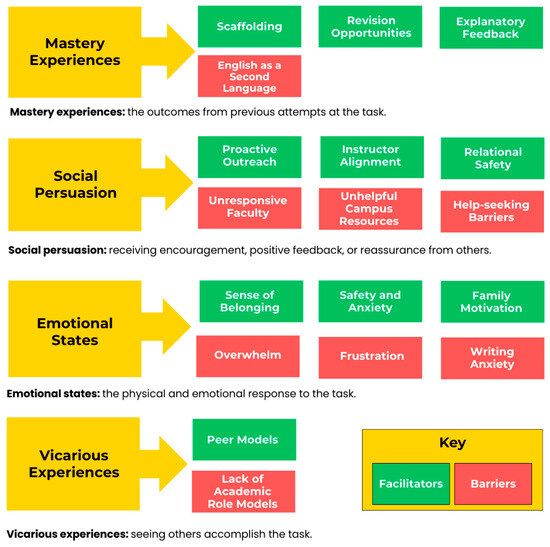
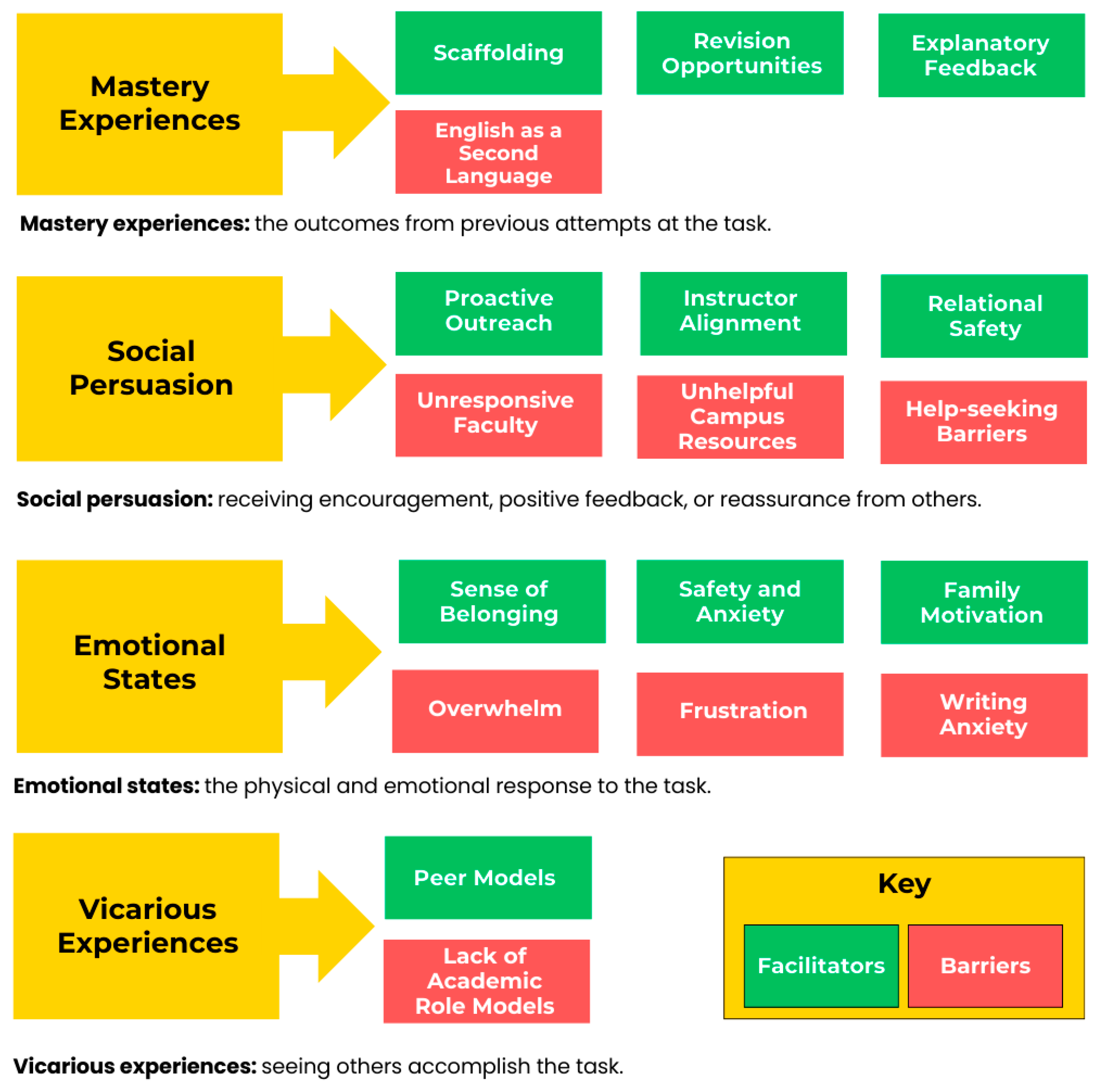
The following domains are to deductively analyze and code each student’s narrative individually—see Table 2. Subsequently, the coded transcripts were compared across the students’ experiences to summarize the data—see Figure 1 for visual representations of the results. Ultimately, the six domain codes resulted in 48 individual codes, which were deemed an appropriate number of codes and domains according to Friese (2014).
Table 2.
Domains and Example Codes.
Figure 1.
Facilitators and barriers of students’ writing self-efficacy development.
3. Results
3.1. Mastery Experiences
Mastery experiences appeared to have a significant impact on the development of writing self-efficacy. When describing the instructional practices that supported their development as writers and learners, students described the scaffolded sequence of assignments which built writing skills progressively, opportunities to revise their writing, and clear expectations and explanatory feedback.
3.1.1. Facilitators to Mastery Experiences
Scaffolded Assignment Sequences
‘The previous assignments helped us build onto our skills … the summary, the research article, the labs … definitely prepared us for that last assignment.’(Priya)
Students described the instructional strategy of scaffolded assignments as central to confidence development. Earlier assignments prepared them for later ones, which enabled them to practice skills over time rather than requiring complex writing tasks without preparation. Priya’s account reveals that the scaffolded sequence did not merely organize content delivery; it created cumulative opportunities for students to experience incremental success. The structure removed the expectation that students arrive already knowing how to write at an academic level. From a Bourdieuian perspective, scaffolded sequencing also begins to address inequities rooted in cultural capital (Bourdieu, 1977). Continuing-generation students often enter higher education already possessing the academic habitus—or the dispositions, linguistic practices, and implicit knowledge of institutional expectations—that first-gen students have not yet had the opportunity to develop (Bourdieu, 1977).
Time and Pacing
‘We had a week to do the first part and a week to do the second part. So, we actually got the experience of actually reading what we needed and using the skills we needed.’(Marco)
Marco’s reflection highlights that adequate time between assignments was not simply a logistical convenience but a structural instructional practice that made genuine skills development possible. He contrasted this with other courses where writing felt rushed, suggesting that the time pressure in those contexts prevented the kind of deliberate practice necessary for learning to occur. The course design here signaled to students that their development mattered and was intentionally designed to support their learning.
Bandura identifies mastery experiences as the most efficacious when they involve genuine engagement with the target behavior rather than superficial performance (Bandura, 1977). Rushed assignments deny students the opportunity to fully engage, thereby limiting the depth of mastery experiences available to them. Bourdieu’s concept of habitus is also instructive here: academic writing practices require time to become internalized (Bourdieu, 1977). Compressed timelines disproportionately disadvantage those who lack prior familiarity with institutional writing norms.
Revision and Resubmission Opportunities
‘Instead of just putting our grade as a ‘fail’ … she gave us feedback and then gave us that next class to actually work on it and fix it.’(Kelly)
‘Having that opportunity to correct it was definitely top tier.’(Marco)
The opportunity to revise and resubmit work was described as one of the most impactful instructional strategies for improving self-efficacy for writing. This benefited not only struggling students but also high achievers who simply made mistakes along the way. Kelly and Marco’s accounts reveal that the opportunity to revise and resubmit fundamentally reframed the meaning of failure in the course. This reframing appeared to sustain students’ motivation and willingness to engage with feedback rather than disengage from it.
This instructional practice directly supports Bandura’s model of self-efficacy. When failure is final, it provides no opportunity for corrective mastery experiences necessary to (re)build efficacy beliefs. From a Bourdieuian perspective, revision opportunities are particularly significant for first-gen students whose prior educational experiences may have been characterized by high-stakes, one-shot assessments that rewarded already-formed academic capital rather than its development (Bourdieu, 1977). Growth-oriented assessment structures therefore serve as a redistribution function, expanding access to mastery experiences for students who arrive with less academic capital in their pockets.
Feedback as Evidence of Growth
‘On my first assignment I had 30 comments, but on the last assignment I didn’t get as many comments, so I feel like I did a better job at my writing.’(Marco)
Marco interpreted the decreasing volume of instructor comments not merely as a grading outcome but as tangible, visible evidence of his own development. This self-generated reading of feedback as a progress indicator suggests that students actively construct narratives of growth from the instructional data available to them. The decrease in comments served as a concrete, legible marker of improvement that Marco could point to as proof of his own capability. This illustrates Bandura’s (1977) argument that mastery experiences are most powerful when they provide clear evidence of progress. Feedback density functioned here as an informal but meaningful performance metric.
Explanatory Feedback and Transfer
‘They told you why this needs to be fixed. So then, you actually learn and it sticks with you more.’(Kelly)
‘I found it really helpful to get the feedback and take that and fix it myself … If I had to write a report for another class, I would look out for those things.’(Jamil)
Kelly and Jamil both describe a qualitative difference between corrective and explanatory feedback. Corrective feedback fixes a problem for the student; explanatory feedback equips the student to fix it themselves and to recognize similar problems in future writing contexts. Jamil’s explicit reference to applying lessons learned across courses indicates that explanatory feedback supported not only immediate skills correction but the internalization of writing skills more broadly.
From Bandura’s perspective, this kind of instructional feedback supports the development of one’s capacity to monitor and improve one’s own performance independently (self-regulatory efficacy). Bourdieu’s concept of habitus is particularly highlighted here: the goal of explanatory feedback is to support the internalization of academic writing dispositions so they become part of the students’ habitus rather than remaining external rules to be applied consciously (Bourdieu, 1977). For first-gen students who have had fewer opportunities to develop these dispositions through prior academic socialization, explanatory feedback serves as a mechanism of cultural capital acquisition and a high-impact instructional strategy.
3.1.2. Barriers to Mastery Experiences
Language as a Structural Barrier
‘I feel like it’s quite difficult to know what words to use, exactly … It’s still challenging to find the right vocab words and synonyms.’(Marco)
‘I usually think in my first language which is Arabic. Whatever it is in English, it’s the opposite in Arabic … S’s, it’s impossible to make sure that every s is there. So, I will try to use Grammarly, but they’re not 100% correct.’(Jamil)
‘I start writing on Grammarly because my grammar is horrible … I don’t speak English around my family or anything like that. So sometimes, my English is very basic … I have to go look at the thesaurus for help.’(Alexandra)
Marco, Jamil, and Alexandra each describe language not as a minor inconvenience but as a persistent structural constraint on their academic writing. Their experiences reveal that multilingual students must simultaneously manage content knowledge, disciplinary conventions, and linguistic production. This is a cognitive load that monolingual students do not face to the same degree. Alexandra’s reference to her home language environment further illustrates how linguistic development is shaped by conditions outside the university entirely, conditions neither she nor the institution have control over.
Persistent language difficulties represent a sustained source of negative mastery experiences. These repeated encounters with tasks that feel beyond one’s current capability can erode self-efficacy over time. Bourdieu’s framework adds structural depth to this analysis, describing how linguistic capital is unequally distributed across social fields. Academic English represents a specific form of linguistic capital that multilingual students from non-English speaking households are systematically less positioned to possess upon entry to higher education. Their struggles with vocabulary, grammar, and syntax are therefore not individual deficits but predictable outcomes of a system that values a particular linguistic habitus without providing equitable pathways to its acquisition (Bourdieu, 1977).
3.2. Vicarious Experiences
Vicarious experiences, or observing others sharing similar experiences, appeared to play a more limited role in students’ descriptions of self-efficacy development compared to other sources. Although some discussed being inspired by their friends or favorite authors, many described how they did not have “anyone to look up to” as academic role models, as described below. This may be exacerbated by the fact that every student was a first-gen college student.
3.2.1. Barriers to Vicarious Experiences
Absence of Academic Role Models
‘I honestly feel like I don’t have role models. I am the oldest and everyone else is younger than me and my parents and [cousins] didn’t go to college. I’m the first for everyone. I feel like I don’t have anyone to look up to and everyone’s looking up to me.’(Kelly)
‘My siblings are all scattered around … [and] they’re [studying] totally different subjects. Their writing styles are way different. I feel like I don’t have help from family. My dad doesn’t know AMA. It’s challenging that I don’t have someone that can help me do my essays.’(Marco)
Kelly and Marco both articulated a sense of absence of models who have successfully navigated higher education. Their experiences reflect how student identity and background context shape the resources available to them as learners. In both cases, being first-gen meant entering higher education without the familial knowledge or lived experience that many of their peers may take for granted. Kelly’s inversion of the role model dynamic, noting that others look to her rather than the reverse, reveals the additional burden carried by first-gen students. They must pioneer pathways without the guidance of those who have traveled before them, while simultaneously serving as models for those who will follow. Marco’s reference to his father’s unfamiliarity with AMA citation style is particularly instructive. It located the gap not in general intelligence or motivation but in the specific academic conventions that higher education takes for granted.
Bandura identifies vicarious experience as a key source of self-efficacy. When such models are absent, students are denied a critical mechanism through which belief in their own capability is constructed. Bourdieu’s concept of social reproduction clarifies why this absence is structurally predictable rather than incidental (Bourdieu, 1977). Higher education systems reproduce advantage by rewarding the cultural capital and habitus of dominant groups. The absence of academic role models is therefore not a personal misfortune, but a systemic consequence of educational structures that have historically excluded working-class and first-gen families from participation in higher education. Understanding students’ identities and contexts is thus central to the analysis of writing self-efficacy.
3.2.2. Facilitators to Vicarious Experiences
Peer Exemplars in the Classroom
‘I found it really helpful when [after] the first draft [the professor] pulled up three examples from the class. It was nice to see how they were laid out and what they were covering in their issue briefs … As many questions as I asked, I couldn’t really picture [what the assignment was supposed to look like] in my head. So, it was nice to see like other people’s examples … and for [the professor] to point out the good things that they did. It really helps with expectations.’(Jennifer)
Jennifer’s account reveals that the use of peer exemplars addressed a specific and otherwise unmet need: the capacity to visualize what successful academic writing looks like in practice. Her observation that she could not “picture” the assignment despite repeated questioning suggests that verbal or written descriptions of expectations alone were insufficient. Seeing concrete examples from peers made the target legible.
This instructional strategy appears to activate Bandura’s mechanism of vicarious experience by integrating peer modeling into the classroom itself. Crucially, the use of peer rather than expert exemplars maximizes the perceived similarity between model and observer. From a Bourdieuian perspective, this practice also functions as a form of institutional redistribution of cultural capital. Continuing-generation students may enter higher education already possessing mental models of what academic writing looks like, drawn from family members or prior educational experiences (Bourdieu, 1977). For first-gen students who lack these internalized models, the explicit classroom display of exemplars compensates for an unequal distribution of academic cultural capital, making visible what the institution otherwise assumes students already know.
3.3. Social Persuasion
Social persuasion emerged as the strongest and most universally cited source of self-efficacy across all six students, manifesting both as a powerful facilitator and, when absent, a significant barrier. Students consistently emphasized relational conditions as central to their writing development: a non-judgmental classroom environment, relational safety, and visible alignment between the professor and teaching assistant. When these conditions were present, students reported greater willingness to seek help, take risks in their writing, and implement feedback—all of which contributed directly to self-efficacy growth. When absent, as described in students’ comparisons to other courses, social persuasion collapsed entirely, leaving students without the guidance necessary to improve.
3.3.1. Facilitators to Social Persuasion
Proactive Instructor Outreach
‘In this class, [the professor and TA] reached out to me, and that was great, because I felt like I was getting a little more confident because they were coming to me instead of me reaching out.’(Marco)
‘Since we’re a small class, we get the feedback and help we actually want from a professor.’(Marco)
Marco’s account reveals that the conventional expectation of student-initiated help-seeking disadvantages introverted or socially anxious students. His experience is also shaped by his identity and context as a first-gen student, for whom the norms of academic self-advocacy may not have been modeled or practiced prior to entering college. When the instructor reversed this dynamic by initiating contact, the emotional burden of help-seeking was removed, and confidence became an outcome of the interaction rather than a prerequisite for it. His reference to class size further suggests that proactive outreach is not simply a matter of instructor disposition but a structural possibility enabled by institutional conditions.
From Bandura’s perspective, proactive outreach functions as a direct delivery mechanism for social persuasion. This mechanism is particularly consequential for students whose identity and context place them at a greater distance from the assumed norms of academic culture. Bourdieu’s concept of habitus also helps explain why some students may be more accustomed to approaching authority figures for guidance. In institutional cultures that assume student-initiated help-seeking, this habitus gap systematically disadvantages those who have not been socialized into the norm of academic self-advocacy. Proactive outreach by instructors disrupts this reproduction of disadvantage by removing the need for students to already possess the social capital required to seek help in the first instance (Bourdieu, 1977).
Instructor-Teaching Assistant Alignment
‘They communicate a lot with each other. If the [TA] didn’t know she [would say] ‘let me ask’ so they’re able to give the same feedback.’(Kelly)
‘I’ve had other classes where I go to the office hours with the TA and they give me feedback. Then I go to the professor and they correct their TA’s feedback … So, for them to really know each other well and what they expect from us was great because if I went with [TA] or if I went with [the professor], they helped me in the same way.’(Marco)
Kelly and Marco both identified consistency between instructor and teaching assistant (TA) feedback as foundational to their willingness to act on guidance. Marco’s description of contradictory feedback in other courses reveals its consequences: students who receive conflicting messages are effectively left without reliable guidance and disengage from the revision process entirely. Consistency, by contrast, doubles the available sources of trustworthy support without introducing confusion.
According to Bandura, credibility of the persuasive source is central to the efficacy-building potential of social persuasion (Bandura, 1977). Contradictory feedback undermines source credibility and therefore diminishes the persuasive force of encouragement or feedback. Additionally, navigating contradictory feedback requires a sophisticated understanding of academic fields and their internal hierarchies which is a form of institutional capital that first-gen students are less likely to possess (Bourdieu, 1977).
Relational Safety and Personal Recognition
‘[They are] my only public health professors that have taken the time to learn my name and learn a little bit about me.’(Priya)
‘You feel like they want to help and they’re not going to judge you for what you write on paper.’(Kelly)
‘Since I knew [the professor and TA] from last semester, I wasn’t scared to ask for help and email [them]. That helped me improve my writing just having that confidence to know I can ask them for help because it does make an impact having that close relationship.’(Jennifer)
Priya, Kelly, and Jennifer each describe relational safety as a precondition for academic risk-taking. Priya’s observation that name recognition was rare among her professors suggests that the affective dimensions of the instructor-student relationship are routinely neglected in higher education. Jennifer’s account is particularly insightful: her prior relationship with the professor directly lowered the social risk of help-seeking, which she explicitly connected to improvements in her writing. Relational safety here was not only emotionally pleasant, it was also academically influential.
Social persuasion is most effective when it occurs within relationships characterized by trust and credibility. Relational safety creates the conditions under which persuasion is most likely to be received and internalized. Bourdieu’s concept of symbolic capital is also relevant here (Bourdieu, 1977). In institutional fields, recognition confers a form of symbolic legitimacy that shapes students’ sense of their right to participate. For first-gen students who may already experience a sense of not belonging in higher education, instructor recognition functions as an institutional signal that their presence is legitimate and their development is valued. The absence of such recognition, as in Priya’s comparison to other professors, communicates the opposite.
3.3.2. Barriers to Social Persuasion
Institutional Writing Support
‘I felt like they (writing center staff) didn’t really understand the assignment. They didn’t know what to look for … every professor likes everything different. So that’s why I always go to the professor or the TA.’(Kelly)
‘I felt like it was rushed and they wanted to get it over with … It was a 10-page paper and I feel like she got bored of it.’(Marco)
‘With STEM professors, even if you email them, they won’t care … They will throw everything on the TAs and sometimes the TAs will get 20 emails and they’re not able to respond before the assignment is due.’(Jamil)
‘My professors don’t give a … damn. When we’re trying to learn or trying to pass a class, they’re just there to grade your paper and they don’t care … We look more on the grades, and they look more on the paycheck.’(Jamil)
Kelly, Marco, and Jamil each describe institutional support structures that failed to deliver meaningful guidance. The writing center’s lack of course-specific knowledge, its rushed sessions, and its surface-level feedback rendered it not merely unhelpful but actively discouraging. Jamil’s characterization of STEM faculty as transactional reveals a perception of institutional indifference that eroded his motivation to seek help at all. These are not isolated disappointments but systematic failures of institutional support that disproportionately affect students who most depend on those structures.
Institutional support failures represent a collapse of social persuasion at the structural level. When the sources of guidance available to students are unreliable, generic, or indifferent, the social persuasion mechanism through which self-efficacy is built becomes inaccessible. Bourdieu’s theory of social reproduction suggests that institutional support structures nominally available to all students in practice serve those who already possess the cultural capital to navigate them effectively (Bourdieu, 1977). Students who know how to ask the right questions, identify the right resources, and persist through unhelpful encounters are better positioned to extract value from imperfect support systems. First-gen students are disproportionately harmed when those systems fail because they already have fewer alternative resources to draw upon.
3.4. Emotional States
3.4.1. Barriers to Emotional States
Anxiety, Overwhelm, and Inadequate Scaffolding
‘I don’t know where to start or when to start. So, sometimes I just sit there not knowing what to write.’(Priya)
‘I had this one professor [who had us write] a 10-page paper and he didn’t give us anything. He just said: ‘It’s a research review and this is your example.’ No rubric. No information. He just said it’s 10 pages and just pick a topic. That’s it.’(Alexandra)
Priya and Alexandra described emotional states that functioned as barriers to engagement rather than motivational signals. Priya’s paralysis was not a product of disengagement but of overwhelm: the absence of a clear entry point into the writing process. Alexandra’s experience illustrates how inadequate instructional scaffolding directly produces this state. Without rubrics, guidance, or structured expectations, the cognitive and emotional burden of task interpretation fell entirely on the students, creating conditions in which anxiety was the rational response.
Physiological and emotional arousal are an important source of self-efficacy information. High anxiety signals to students that a task exceeds their capability. Instructional practices that fail to scaffold complex tasks therefore not only increase cognitive load but actively suppress self-efficacy through the emotional response they produce. Bourdieu’s framework adds a structural layer to this case. The implicit assumption that students can independently interpret open-ended, unscaffolded assignments reflects an institutional habitus oriented toward students who already possess the academic capital to do so. For first-gen students, the absence of explicit guidance is not a neutral pedagogical choice, it is a structural barrier that reproduces the advantages of those who arrive already knowing what is expected.
Compounding Linguistic and Emotional Barriers
‘I had to give a concise explanation of what HIV is, I had to make it visually pleasing, and I’m already struggling with the writing part so adding the visual piece, you’re making it impossible.’(Jamil)
‘When it comes to grammar, it’s a complete disaster.’(Jamil)
‘I don’t see the shame of using it (Chat GPT). However, sometimes, it’s looked down upon … When I’m using some of these paraphrasing tools, it’s not degrading the material, it’s more explaining the complicated words into more common words that I will be able to understand in my own vocabulary.’(Jamil)
Jamil’s accounts reveal how compounding task demands interact with pre-existing linguistic vulnerability to produce a state of sustained emotional distress. His experiences cannot be understood apart from his identity as a multilingual student. His catastrophic framing (“impossible,” “complete disaster”) reflects not temporary frustration but a deeply compromised sense of self-efficacy in which effort itself feels futile. His defensive justification of AI tool use is particularly interesting. The anticipated stigma added an additional emotional burden of shame to an already overwhelming cognitive load. This illustrates how institutional norms around academic integrity can function as an additional source of distress for multilingual students who rely on language assistance tools.
Negative emotional arousal is among the most corrosive influences on self-efficacy as it simultaneously diminishes confidence and undermines the capacity to engage in the mastery experiences through which confidence is rebuilt (Bandura, 1977). Bourdieu’s concept of linguistic capital explains how academic institutions value particular forms of language use (Bourdieu, 1977). Students who do not possess this capital face not only practical writing difficulties but the symbolic violence of institutional norms that implicitly mark their linguistic practices as deficient. Jamil’s use of AI tools as accessibility technology and his anticipation of stigma for doing so illustrate how institutional norms are designed within and for a dominant linguistic habitus. Attending explicitly to student identity is necessary to understand why the same instructional strategies may produce different affective experiences across students.
3.4.2. Facilitators to Emotional States
Belonging and Instructor Recognition
‘You felt included. You felt like you actually belonged in the class.’(Marco)
‘She got us Rice Krispies if it was your birthday.’(Priya)
‘The only reason professors have known me in the past is because I’ve gone up to them.’(Priya)
Marco and Priya describe a classroom environment in which belonging was actively constructed rather than passively assumed. Priya’s contrast between instructor-initiated recognition is particularly significant: in most of her courses, visibility required her to already possess the confidence and cultural familiarity to approach authority figures. In this course, that burden was reversed. Small gestures communicated to students that their presence as individuals was recognized and valued.
Students who feel safe and valued are better positioned to engage in the risk-taking that academic writing requires. Bourdieu’s concept of symbolic capital again suggests that feeling recognized confers a form of legitimacy and shapes students’ sense of their right to occupy academic space. Instructor-initiated recognition may function as a counter-symbolic act that redistributes institutional legitimacy to students whose social backgrounds have not historically been valued by academic institutions (Bourdieu, 1977).
Non-Judgmental Support and Revision Opportunities
‘[They] want to help you and they’re not going to judge you for what you wrote on paper.’(Kelly)
‘We could resubmit it, which I thought was very helpful, because that way, we’re not stressing about our grade.’(Kelly)
‘If you’re providing feedback, and then the students are not able to resubmit it … I might be discouraged to submit it again. I’m not gonna waste my time.’(Jamil)
Kelly and Jamil both identified revision opportunities as both a practical mechanism for grade improvement but also as a signal of institutional investment in student growth. Kelly’s observation that resubmission opportunities reduced grade-related stress illustrates how assessment design shapes emotional states. When grades are final, students may focus on grade protection rather than learning. When revision is possible, focus shifts to development. Jamil’s articulation of the alternative, that he would disengage entirely if feedback were not actionable, reveals the motivational stakes of assessment design.
Growth-oriented assessment structures create a virtuous cycle in which emotional safety enables engagement, engagement produces mastery experiences, and mastery experiences build self-efficacy that sustains further engagement. Revision-based assessment represents a structural intervention in the reproduction of academic inequality. It redistributes opportunities for success away from those who already possess the academic capital to perform well on the first attempts and toward those who are still in the process of acquiring it.
Family Obligation as Motivational Capital
‘I have set an example for my siblings since I am the first one to go to college. My parents are doing everything they can. What inspires me is I have to be good for them in order to succeed in life.’(Jennifer)
‘Everyone is looking up to me. So, you gotta figure it out.’(Kelly)
Jennifer and Kelly both described family obligation as both an additional burden and a source of sustained motivation. Their accounts suggest that for first-gen students, the stakes of academic success extend beyond individual achievement to encompass family honor, sacrifice, and aspiration. This theme sits at the heart of the student identity and context domain. The identities that Jennifer and Kelly carry into the classroom are not separate from their academic experiences but constitutive of them. Understanding their motivation requires understanding who they are and where they came from.
The dispositions, values, and orientations that first-gen students bring from their family backgrounds constitute a form of cultural capital, while not recognized by academic institutions, function as a powerful motivational resource within academic practice. Jennifer and Kelly’s accounts suggest that institutional support structures that acknowledge and validate students’ familial contexts, rather than treating them as irrelevant to academic performance, may better serve the motivational realities of first-gen student populations.
‘I still don’t like writing, but it’s also not too scary. I know how to approach it based on all the experiences that I had.’(Jennifer)
Jennifer’s reaction captures the realistic outcome of the course’s affective environment. Writing did not become a source of intrinsic joy, but it became approachable. For first-gen, non-native English-speaking students navigating profound structural barriers, the affective environment created by belonging, non-judgmental support, growth-oriented grading, and family motivation was not supplementary to learning. It was the foundation that made learning possible. According to Bandura, the goal of self-efficacy development is not the elimination of challenge but the cultivation of the belief that challenges are manageable. Jennifer’s words reflect precisely this: not confidence that writing is easy, but confidence that it is approachable.
4. Discussion
This study examined how students in a writing-intensive course experienced instructional practices and how those experiences shaped writing self-efficacy. Grounded in Bandura’s self-efficacy theory, the findings suggest that writing efficacy does not develop from skill acquisition alone but may emerge through the interaction between structured instructional practices and relational pedagogy. While prior scholarship has emphasized scaffolding and feedback as central mechanisms supporting writing development, the present findings underscore how relational conditions shape the impact of those practices. Students’ narratives revealed that scaffolded assignments, revision opportunities, and explicit expectations became meaningful within classroom environments characterized by proactive outreach, non-judgmental support, and alignment between the professor and teaching assistant across instruction, feedback, and grading. In this context, relational pedagogy was integral to instruction; it functioned as the condition that enabled mastery experiences to translate into confidence. This finding extends prior work by suggesting that instructional practices alone may be insufficient; rather, their effectiveness may depend on the relational conditions in which they are embedded (Eppler-Wolff & Martin, 2021).
Given that all participants were first-gen college students and the majority were non-native English speakers, the classroom appeared to serve as both a site of writing development and a source of academic guidance, while also fostering a sense of belonging. Student identity and context were therefore central to the analysis of instructional effectiveness. The same instructional practices were experienced differently depending on students’ linguistic backgrounds and prior experiences with academic culture, underscoring that pedagogy does not operate independently of the identities students bring into the classroom. These findings can also be interpreted through a sociological lens, where students’ experiences reflect broader inequalities in access to the forms of knowledge and communication valued in academic settings. Students who have had fewer opportunities to develop familiarity with these expectations may rely more heavily on classroom structures and relationships to navigate them. In this way, the course may have functioned not only as a site of skill development but also as a space where students began to acquire forms of academic familiarity that are often assumed but not explicitly taught (Bourdieu, 1977).
The lack of family role models appeared to limit opportunities for vicarious experiences, which Bandura identified as a key source of self-efficacy. One potential solution, well supported in the literature, is to incorporate peer review into writing assignments. This strategy provides students with opportunities to collaboratively build academic capital. However, as described by MacArthur, in order to implement this method effectively, students need to be properly trained in the peer review process (MacArthur et al., 2015). Another limitation of high enrollment numbers is the limited ability to develop the relationships between faculty and students. Although the importance of the trusting relationship is also well-documented, instructors may not be able to individually check in with 60 or more students in a 75 min class period. Instructors should prioritize setting a positive tone and establishing a safe learning environment where students are free from judgement and feel comfortable embracing the writing process.
Scaffolded assignments and iterative revision operated as a form of universal design for learning (UDL) by embedding structured support within the course for all students, thereby broadening access to mastery experiences across ability levels rather than positioning revision as remedial. Although linguistic challenges persisted, writing was described as becoming “less scary,” indicating growth in self-efficacy in this context. Collectively, these findings suggest that confidence in writing may emerge through the interaction of structured instructional practices, relational support, and institutional conditions. This may begin to disrupt the process of social reproduction instilled by higher education by providing every student the opportunity to construct their academic capital by going through the revision process.
The experiences of non-native English speakers in this study align with and extend prior research on linguistic barriers to writing self-efficacy. Lichtinger (2018) found that Arabic-speaking students writing in Hebrew demonstrated significantly lower self-efficacy for spelling and timely submission of papers compared to native speakers (Lichtinger, 2018). Our findings similarly suggest that writing in a non-native language may inflict additional cognitive and emotional burden on the learning process. Students described thinking in their first language while writing in English, leading to persistent grammar challenges and highlighting how the demand for conciseness in public health writing compounded these language-based difficulties. Students, like Jamil, entered the classroom already seeing themselves as deficient, expecting to struggle, and blaming themselves for their frustrations and confusion. Yet these same students brought rich linguistic and cultural capital to their work, capital that the institution failed to recognize or value. Bourdieu describes this as symbolic violence—a phenomenon where students blame themselves for their academic struggles rather than recognize that the educational system was not designed for them (Bourdieu, 1977). These dynamics illustrate how student identity, particularly linguistic background, shaped how students understood themselves as learners within the institution more broadly.
Our findings diverge from Lichtinger’s (2018) recommendation to “assign more term papers” as a strategy for improvement. Students in the present study described the value not in more writing assignments, but in more scaffolded, iterative engagement with fewer assignments. As Ekholm et al. (2018) suggest, instructors maintaining a growth mindset about writing skills can encourage students to embrace the learning process, but special considerations are required for non-native speakers (Ekholm et al., 2018). Sanders-Reio et al. (2014) found that apprehension about grammar specifically predicted lower performance on class papers, recommending fewer writing assignments with more opportunities for drafts and revisions to build self-efficacy, an approach that aligns with students’ descriptions of what facilitated their development in the present study (Sanders-Reio et al., 2014).
Our findings must also be considered in relation to course enrollment. The relational continuity, individualized outreach, and revision cycles described by students were enabled by the relatively small size of the course. Such conditions are considerably more difficult to sustain in larger, high-enrollment classes. If relationally supported revision and universal design are central to writing self-efficacy development for first-gen students, then class size becomes an equity issue, as enrollment levels shape students’ access to feedback, relational continuity, and sustained revision. Enrollment levels directly shape students’ access to the four sources of self-efficacy identified by Bandura: mastery experiences (through timely feedback and revision opportunities), vicarious experiences (through peer examples and TA-professor modeling), social persuasion (through individualized guidance and proactive outreach), and emotional states (through belonging fostered by being known by name). Large classes may structurally limit students’ access to these sources, particularly for the students who need them most.
This study offers meaningful insights into the writing experiences of first-gen college students, but its findings should be interpreted within the context of its design. A key strength is the use of qualitative methods, which allowed students to articulate their experiences in their own words, surfacing nuanced emotional states, such as the double-edged pressure of family obligation, that quantitative measures might have missed. The inclusion of direct student voices also lends credibility to the themes identified. However, the study’s limitations temper the generalizability of its findings. The sample was drawn from a single course at one institution, meaning the results may reflect local curricular conditions rather than broader patterns in first-gen student writing development. The sample size was also small, and participants were self-selected in the sense that they completed the course—students who withdrew or struggled most may not be represented. Due to the small sample size, our results cannot be extrapolated to the general tendency, but we hope they can be used to motivate further investigations into how social reproduction operates across contexts and institutions. Finally, because the data relied on self-report, students’ reflections on their own motivation and anxiety are subject to the usual concerns about recall and social desirability. Future research might address these limitations by drawing on larger, more diverse samples across multiple institutional contexts and by pairing self-report data with longitudinal measures of writing development.
5. Conclusions
Despite these limitations, the findings carry important implications for writing instruction, particularly for first-gen and linguistically diverse student populations. They suggest that self-efficacy may develop not only through skill-building or supportive relationships in isolation, but through their integration. Together, these findings suggest that writing self-efficacy is not simply an individual attribute but may be shaped by instructional design, relational pedagogy, and institutional context. When institutions assign large enrollment to writing-intensive courses, they constrain the very conditions under which self-efficacy develops, such as the individualized feedback, the instructor-student relationships, and the low-stakes collaborative work that our findings suggest matter for first-gen students. Class size, in this sense, is not merely a logistical concern but an equity issue.
We propose instructional strategies to support first-gen students; however, these approaches are limited if they are not grounded in students’ lived experiences and the broader structural processes shaping them. Attending to those structural processes and advocating for the institutional conditions that make relational pedagogy possible may be as important as any individual intervention.
Author Contributions
Conceptualization, L.K.C. and K.A.C.; methodology, L.K.C.; software, L.K.C.; validation, K.A.C. and S.S.; formal analysis, L.K.C.; writing—original draft preparation, L.K.C.; writing—review and editing, K.A.C. and S.S.; visualization, S.S.; supervision, L.K.C. All authors have read and agreed to the published version of the manuscript.
Funding
This research received no external funding.
Institutional Review Board Statement
The study was conducted in accordance with the Declaration of Helsinki, and approved by the Institutional Review Board of University of California, Merced (protocol code #UCM2022-190, 18 December 2022).
Informed Consent Statement
Informed consent was obtained from all subjects involved in the study.
Data Availability Statement
The qualitative data (focus group transcripts) are not publicly available in order to protect the privacy and confidentiality of the student participants. Participants were assured that their responses would remain confidential and would not be shared beyond the research team. Public availability of the transcripts could risk the re-identification of participants, particularly given the small sample size. Data may be made available from the corresponding author upon reasonable request and subject to ethical approval.
Conflicts of Interest
The authors declare no conflicts of interest.
Appendix A
Focus Group Questions
- Describe your experience writing in this course.
- How did you feel during the first writing assignments offered in this class?
- How do you feel now about the latest writing assignments in this class?
- What challenges do you face when writing?
- Which aspects of writing are the most challenging for you?
- How do you start your writing process?
- Which resources do you use during the writing process?
- What resources would help you improve your writing?
- How likely are you to actually use these resources?
- What strategies can you identify that you have applied satisfactorily to your writing in this class?
- How would you describe the feedback you have received from your professor, teaching assistant, and undergraduate reader in this class?
- Who do you identify as role models and as an influence in the way you write?
Note. Focus group questions are adapted from Arcelay-Rojas (2018) with permission.
References
- Abd Rahim, S., Jaganathan, P., & Tengku Mahadi, T. S. (2016). An Investigation on the effects of writing anxiety on readiness of writing among low proficiency undergraduates. International Journal of Language Education and Applied Linguistics, 5, 11–18. [Google Scholar] [CrossRef] [Scilit]
- Allagui, B. (2024). A scaffolding intervention to improve self-efficacy in source-based argumentative writing. Frontiers in Psychology, 15, 1454104. [Google Scholar] [CrossRef] [Scilit] [PubMed]
- Arcelay-Rojas, Y. A. (2018). Using focus groups to explore sources of self-efficacy in Puerto Rican preservice teachers. Journal of Educational Research and Practice, 8(1), 121–135. [Google Scholar] [CrossRef] [Scilit]
- Aunurrahman, A. (2019). Exploring writing anxiety of the EFL university students in Pontianak Indonesia. Indonesian Journal of English Language Teaching and Applied Linguistics, 4(1), 109–119. [Google Scholar] [CrossRef] [Scilit]
- Bandura, A. (1977). Self-efficacy: Toward a unifying theory of behavioral change. Psychological Review, 84(2), 191–215. [Google Scholar] [CrossRef]
- Bourdieu, P. (1986). The forms of capital. In Handbook of theory and research for the sociology of education (pp. 241–258). Greenwood Press. [Google Scholar]
- Bourdieu, P., Passeron, J. C., & Nice, R. (1977). Education, society and culture. Sage Publications, 1(1), 15–29. [Google Scholar]
- Chen, X. (2005). First-generation students in postsecondary education: A look at their college transcripts. U.S. Department of Education, National Center for Education Statistics.
- Choy, S. P. (2001). Students whose parents did not go to college: Postsecondary access, persistence, and attainment. In The condition of education. National Center for Education Statistics, US Department of Education, Office. [Google Scholar]
- Council on Education for Public Health. (2024). Accreditation criteria, standalone baccalaureate programs. Council on Education for Public Health. [Google Scholar]
- Creswell, J. W., & Poth, C. N. (2016). Qualitative inquiry and research design: Choosing among five approaches. Sage Publications. [Google Scholar]
- Durney, E. (2023). The impact of independence: A look at first-generation college student writers’ help-seeking behaviors. Brigham Young University. Available online: https://www.proquest.com/dissertations-theses/impact-independence-look-at-first-generation/docview/3110360685/se-2 (accessed on 15 March 2026).
- Ekholm, E., Zumbrunn, S., & DeBusk-Lane, M. (2018). Clarifying an elusive construct: A systematic review of writing attitudes. Educational Psychology Review, 30(3), 827–856. [Google Scholar] [CrossRef] [Scilit]
- Engle, J., & Tinto, V. (2008). Moving beyond access: College success for low-income, first-generation students. Pell Institute for the Study of Opportunity in Higher Education. Available online: https://eric.ed.gov/?id=ED504448 (accessed on 15 March 2026).
- Eppler-Wolff, N., & Martin, A. (2021). Creating safe schools by building safe relationships. International Journal of Applied Psychoanalytic Studies, 18(3), 300–306. [Google Scholar] [CrossRef] [Scilit]
- Friese, S. (2014). Methods and methodologies for qualitative data analysis. Digital Repository of Technische Universität Berlin. [Google Scholar] [CrossRef]
- Graham, S., Collins, A. A., & Ciullo, S. (2024). Evidence-based recommendations for teaching writing. Education 3-13, 52(7), 979–992. [Google Scholar] [CrossRef] [Scilit]
- Hayat, A. A., Shateri, K., Amini, M., & Shokrpour, N. (2020). Relationships between academic self-efficacy, learning-related emotions, and metacognitive learning strategies with academic performance in medical students: A structural equation model. BioMed Central Medical Education, 20(1), 76. [Google Scholar] [CrossRef] [Scilit]
- Holloway, A., & Watson, H. E. (2002). Role of self-efficacy and behaviour change. International Journal of Nursing Practice, 8(2), 106–115. [Google Scholar] [CrossRef] [Scilit]
- Ishitani, T. T. (2006). Studying attrition and degree completion behavior among first-generation college students in the United States. The Journal of Higher Education, 77(5), 861–885. [Google Scholar] [CrossRef] [Scilit]
- Jehangir, R. (2010). Stories as knowledge: Bringing the lived experience of first-generation college students into the academy. Urban Education, 45(4), 533–553. [Google Scholar] [CrossRef] [Scilit]
- Koh, J., Farruggia, S. P., Back, L. T., & Han, C.-W. (2022). Self-efficacy and academic success among diverse first-generation college students: The mediating role of self-regulation. Social Psychology of Education, 25(5), 1071–1092. [Google Scholar] [CrossRef] [Scilit]
- Kuh, G. D., Kinzie, J. L., Buckley, J. A., Bridges, B. K., & Hayek, J. C. (2006). What matters to student success: A review of the literature (Vol. 8). National Postsecondary Education Cooperative.
- Lichtinger, E. (2018). Gap between self-efficacy and college students’ writing skills. Journal of College Reading and Learning, 48(2), 124–137. [Google Scholar] [CrossRef] [Scilit]
- MacArthur, C. A., Philippakos, Z. A., & Ianetta, M. (2015). Self-regulated strategy instruction in college developmental writing. Journal of Educational Psychology, 107(3), 855–867. [Google Scholar] [CrossRef] [Scilit]
- Martinez, C. T., Kock, N., & Cass, J. (2011). Pain and pleasure in short essay writing: Factors predicting university students’ writing anxiety and writing self-efficacy. Journal of Adolescent & Adult Literacy, 54(5), 351–360. [Google Scholar] [CrossRef] [Scilit]
- Means, D. R., & Pyne, K. B. (2017). Finding my way: Perceptions of institutional support and belonging in low-income, first-generation, first-year college students. Journal of College Student Development, 58(6), 907–924. [Google Scholar] [CrossRef] [Scilit]
- Miller, L. C., Russell, C. L., Cheng, A.-L., & Skarbek, A. J. (2015). Evaluating undergraduate nursing students’ self-efficacy and competence in writing: Effects of a writing intensive intervention. Nurse Education in Practice, 15(3), 174–180. [Google Scholar] [CrossRef] [Scilit]
- Mitchell, K. M., McMillan, D. E., & Rabbani, R. (2019). An exploration of writing self-efficacy and writing self-regulatory behaviours in undergraduate writing. The Canadian Journal for the Scholarship of Teaching and Learning, 10(2), 1–20. [Google Scholar] [CrossRef] [Scilit]
- Pascarella, E. T., Pierson, C. T., Wolniak, G. C., & Terenzini, P. T. (2004). First-generation college students: Additional evidence on college experiences and outcomes. The Journal of Higher Education, 75(3), 249–284. [Google Scholar] [CrossRef] [Scilit]
- Putra, I. K. J. P., Padmadewi, N. N., & Ratminingsih, N. M. (2024). Students’ writing anxiety in learning english as a foreign language. The Art of Teaching English as a Foreign Language (TATEFL), 5(1), 11–20. [Google Scholar] [CrossRef] [Scilit]
- Sanders-Reio, J., Alexander, P. A., Reio, T. G., Jr., & Newman, I. (2014). Do students’ beliefs about writing relate to their writing self-efficacy, apprehension, and performance? Learning and Instruction, 33, 1–11. [Google Scholar] [CrossRef] [Scilit]
- Stebleton, M. J., Soria, K. M., & Huesman, R. L., Jr. (2014). First-generation students’ sense of belonging, mental health, and use of counseling services at public research universities. Journal of College Counseling, 17(1), 6–20. [Google Scholar] [CrossRef] [Scilit]
- Stewart, G., Seifert, T. A., & Rolheiser, C. (2015). Anxiety and self-efficacy’s relationship with undergraduate students’ perceptions of the use of metacognitive writing strategies. Canadian Journal for the Scholarship of Teaching and Learning, 6(1), 4. [Google Scholar] [CrossRef] [Scilit]
- Terenzini, P. T., Springer, L., Yaeger, P. M., Pascarella, E. T., & Nora, A. (1996). First-generation college students: Characteristics, experiences, and cognitive development. Research in Higher Education, 37(1), 1–22. [Google Scholar] [CrossRef] [Scilit]
- Urdan, T., & Pajares, F. (2006). Self-efficacy beliefs of adolescents. IAP. [Google Scholar]
- Van Dinther, M., Dochy, F., & Segers, M. (2011). Factors affecting students’ self-efficacy in higher education. Educational Research Review, 6(2), 95–108. [Google Scholar] [CrossRef] [Scilit]
- Wahyuni, D. W. D., Oktavia, W. O. W., & Marlina, L. M. L. (2019). Writing anxiety among Indonesian EFL college students: Levels, causes, and coping strategies. Lingua Cultura, 13(1), 67–74. [Google Scholar] [CrossRef] [Scilit]

Disclaimer/Publisher’s Note: The statements, opinions and data contained in all publications are solely those of the individual author(s) and contributor(s) and not of MDPI and/or the editor(s). MDPI and/or the editor(s) disclaim responsibility for any injury to people or property resulting from any ideas, methods, instructions or products referred to in the content. |
© 2026 by the authors. Licensee MDPI, Basel, Switzerland. This article is an open access article distributed under the terms and conditions of the Creative Commons Attribution (CC BY) license.