Article

Bridging the Digital Divide Among Higher Education Faculty: The Role of University Type and Faculty ICT Expertise


by
Diego Vergara
1,*,
Antonio del Bosque
1,
Pablo Fernández-Arias
1,
Georgios Lampropoulos
1,2,3 and
Álvaro Antón-Sancho
1
1
Technology, Instruction and Design in Engineering and Education Research Group (TiDEE.rg), Facultad de Ciencias y Artes, Universidad Católica de Ávila (UCAV), Calle Canteros s/n, 05005 Ávila, Spain
2
Department of Applied Informatics, School of Information Sciences, University of Macedonia, 54636 Thessaloniki, Greece
3
Department of Education, School of Education, University of Nicosia, Nicosia 2417, Cyprus
*
Author to whom correspondence should be addressed.
Educ. Sci. 2026, 16(4), 579; https://doi.org/10.3390/educsci16040579
Submission received: 21 January 2026 / Revised: 25 March 2026 / Accepted: 3 April 2026 / Published: 6 April 2026
(This article belongs to the Section Higher Education)

Abstract

This study examines how university type (public vs. private) and disciplinary background influence the adoption of Information and Communication Technologies (ICT) and self-perceived digital competence among university professors in Latin America. Identifying institutional and disciplinary disparities is essential in the context of accelerated digital transformation in higher education. The sample comprised 1114 professors from public and private universities, and data was collected using a validated instrument measuring ICT valuation, frequency of use, and perceived digital competence. Multivariate analyses were conducted to assess differences by institutional type and disciplinary field. The results show significant differences in ICT valuation, usage frequency, and perceived digital competence across university types and disciplines. Professors from private universities reported higher digital preparedness, while disciplinary areas displayed distinct ICT adoption patterns. Although ICT use increased across all groups during the pandemic, the digital gap between public and private institutions narrowed but was not fully eliminated. These findings support the development of targeted professional training, strategic resource allocation, and institutional policies, particularly in public universities, to enhance digital competence and promote sustainable ICT integration, contributing to educational equity and progress toward Sustainable Development Goals.

1. Introduction

Education stakeholders have made enormous efforts in recent years to integrate information and communication technology (ICT) tools and innovative teaching approaches into classrooms (Abaci et al., 2021; Trust & Whalen, 2020). This ongoing transition toward digitally enhanced learning environments has brought both challenges and opportunities, encouraging educators to develop new pedagogical strategies and strengthen their digital literacy (Abaci et al., 2021; Bond, 2020; Ferri et al., 2020; Hodges et al., 2020). The growing incorporation of digital technologies has significantly influenced teaching and learning practices in higher education, shaping how professors design, deliver, and assess instruction in increasingly technology-rich contexts.
Digital technologies constitute essential elements of online and blended education, which have become increasingly prominent across all educational levels (Simonson et al., 2019; Clark & Mayer, 2016; Gómez-Poyato et al., 2022). In this context, ICT can be regarded as cognitive learning tools that support teaching and learning by enabling access to and sharing of educational resources, providing ubiquitous learning opportunities, offering evaluation mechanisms, and facilitating interaction and communication among educational stakeholders regardless of time and place (Batra & Kumar, 2022; Hu & Li, 2017; Jonassen, 2000; Simonson & Schlosser, 2009; Wallace, 2003). Due to their potential to enrich the educational process (Liesa-Orús et al., 2020; Saif et al., 2022), ICT tools are now widely used in both K–12 and higher education contexts (Sormunen et al., 2021). ICT tools can be categorized into (Figure 1): (a) tools that distribute learning material and resources, (b) tools that facilitate communication and dissemination of information among educational stakeholders, (c) tools that enable real-time interactions through reactions and feedback, and (d) tools that assist in administering courses by monitoring, evaluating, and documenting the educational process (Boonmoh et al., 2021; Garrote-Jurado et al., 2014; Peres & Pimenta, 2011).
In recent years, higher education faculty have become increasingly familiar with adopting and using ICT tools in their classrooms, leading to notable improvements in their digital skills (Esteve-Mon et al., 2020; Jorge-Vázquez et al., 2021). The lack of structured training programs, adequate pedagogical approaches, and knowledge of technological innovations has long been identified as a challenge for educators, requiring them to enhance their digital competence and technical expertise through self-directed learning and professional development (Bingimlas, 2009; Guillén-Gámez & Mayorga-Fernández, 2020; Núñez-Canal et al., 2022; Schildkamp et al., 2020). Moreover, variations in digital competence are influenced by multiple factors, including socio-economic background, educational level, geographic region, course type, disciplinary nature, and personal characteristics (Anushalalitha, 2023; Baggott La Velle et al., 2003).
In higher education, courses involving students’ hands-on experiences and requiring their active participation and physical presence present unique challenges for the integration of digital technologies. Consequently, research has increasingly focused on analyzing the factors that influence the teaching and learning of applied courses (Asgari et al., 2021; Khan & Abid, 2021; M. Park et al., 2021). Within this context, numerous studies have examined the factors that affect the use and frequency of use of ICT tools, as well as professors’ attitudes toward and perceptions of these technologies (Antón-Sancho et al., 2023; Gómez-Poyato et al., 2022; Guillén-Gámez & Mayorga-Fernández, 2020; Liesa-Orús et al., 2020; Núñez-Canal et al., 2022). Gender (Basantes-Andrade et al., 2020; García-Holgado et al., 2019; Vergara et al., 2023b), habits (Vergara et al., 2023a), age and experience (Cabero-Almenara et al., 2021; Antón-Sancho et al., 2023), ICT knowledge and training, digital skills (Jorge-Vázquez et al., 2021; Vyortkina & Elsawy, 2024), student engagement (Salas-Pilco et al., 2022), educational materials and resources, technological infrastructure (Quispe-Prieto et al., 2021), the digital divide (García-Martín & García-Sánchez, 2022), digital stress and digital generation (Antón-Sancho et al., 2023) have all been identified as variables influencing professors’ use of digital technologies in university teaching.
To provide a more precise understanding of the factors influencing the adoption of digital technologies in higher education, it is important to recognize that such adoption is strongly conditioned by geographical context. In Latin America, where this study is situated, access to digital technologies remains highly unequal (Kazemikhasragh & Buoni-Pineda, 2022). Moreover, a widespread lack of training in digital competence among university faculty continues to hinder the effective integration of these technologies, restricting their use primarily to basic teaching applications such as class presentations or document sharing (Arias-Ortiz et al., 2020). As a result, the implementation of digital technologies in Latin American universities is generally considered weak and uneven across different teaching and learning activities (Quiroga-Parra et al., 2017).
The literature reports the existence of gender gaps in the frequency of use of digital technologies in higher education, being, in general, greater among males (Basantes-Andrade et al., 2020). This gap occurs with different intensity according to the professors’ area of knowledge, with technical education being the area in which it is most intense (García-Holgado et al., 2019). Age is also an explanatory factor in the use of digital technologies, with younger professors being the ones who use them the most, in general (Cabero-Almenara et al., 2021). This is to be expected, because younger professors are digital natives or, at least, it is very likely that they have received more training in digital competence than older ones (Antón-Sancho et al., 2023). However, this age gap again depends on the area of knowledge, being more intense among engineering professors than in other areas (Vergara et al., 2022).
The literature is mainly concerned with the analysis of socio-demographic factors, such as gender or age, that explain the frequency of use of digital technologies. However, it is to be expected that there are explanatory variables of an academic nature. In fact, as has been explained, the area of knowledge conditions the gender and age gaps in the use of these technologies (García-Holgado et al., 2019; Vergara et al., 2022), although there is no work in the preceding literature that systematically deals with the analysis of this variable. As there are quality, policy, and standards differences among public and private universities (Ngoc et al., 2023; Yas et al., 2024) and it can also influence students’ and teachers’ experiences with ICT tools (Espinoza et al., 2024; Maheshwari, 2024; Rasyid & Nuriyah, 2023), it is expected that the university type can condition the reception of teaching digital technologies, at least in the Latin American region. Indeed, it has been shown that Latin American private universities are better prepared in terms of technical equipment, spaces, and human resources linked to the digitization of teaching than public universities (Ivenicki, 2021). This is mainly since private universities receive a higher proportion of online students than public universities in the region. In any case, this means that professors at private universities are, in general, more experienced in the use of technologies and are more prepared for an abrupt digitalization process such as that generated by the pandemic (Martín-Cuadrado et al., 2021).
Although numerous studies have examined the factors influencing the use of digital technologies and ICT tools in higher education, certain academic dimensions remain underexplored. In particular, the combined influence of professors’ disciplinary field and university type (public or private) on ICT adoption has received limited attention. This study seeks to address this gap by analyzing how these factors affect the use of digital technologies among higher education professors. Using a validated questionnaire, the research adopts a quantitative approach and statistical analysis based on the ICT classification proposed by Garrote-Jurado et al. (2014). The study also aligns with Sustainable Development Goal (SDG) 4 on quality education, specifically target 4.3, which emphasizes ensuring equitable access to quality technical and professional training by 2030. Achieving this goal requires promoting digital integration in universities and enhancing faculty members’ technopedagogical competence.

2. Materials and Methods

2.1. Research Design

The main objective of this research is to analyze the use of different digital teaching tools among Latin American university professors. A secondary objective is to examine whether significant differences exist between professors employed in public and private universities. Specifically, the following specific objectives are sought: (i) to analyze the self-concept of digital competence of Latin American professors and their assessment of the didactic use of ICT, and whether there are differences in this regard between private and public universities; (ii) to analyze whether, within each type of university (private and public) the distribution of the responses has been similar or not in the different areas of knowledge of the professors; (iii) to study how the COVID-19 pandemic has influenced the frequency of use by professors of the different ICT tools for teaching use (interaction, communication, distribution, and administration and evaluation); and (iv) to identify differences between private and public universities in the way in which this influence of the pandemic has occurred (i.e., to identify whether the increase in ICT use has been significantly higher or lower in one type of university or the other).
The areas of knowledge considered here are in line with the International Standard Classification of Education (ISCED), established by the United Nations Educational, Scientific and Cultural Organization (UNESCO, 2012), where the area of Education has been integrated within the area of Social Sciences: (i) Humanities (specifically, philology, literature, art, history, and philosophy); (ii) Sciences (specifically, mathematics, physics, chemistry, and natural sciences); (iii) Health Sciences (specifically, medicine, nursing and veterinary); Social Sciences (specifically, geography, sociological and political sciences, legal sciences, economics, communication, education, pedagogy, and psychology); and (iv) Engineering and Architecture (which covers technical education; hereafter, Engineering).
To this end, a quantitative, descriptive and correlational research has been carried out, based on the statistical analysis of the responses given by a sample of Latin American university professors to a standardized questionnaire. The sample was selected through a non-probabilistic convenience sampling process, asking all registered attendees at a training session given by the authors on the didactic use of ICT in higher education to respond to the questionnaire. This training session, lasting two hours and repeated every 15 days between January and June 2023, was carried out in the form of a master class and had the following objectives: (i) to present the basic concepts of the didactic use of ICT in higher education; (ii) to explain the classification of ICT according to its possible didactic uses; and (iii) to show examples of the application of ICT in different areas of knowledge in higher education.
The questionnaire was sent to the attendees after the training session to ensure that all of them, regardless of their previous experience, had homogeneous knowledge about the use of ICT in higher education and its classifications. Attendees responded voluntarily, freely, and anonymously to the questionnaire, and no personal information that could lead to the identification of the participant was requested. In addition, participants were informed of the objective of the treatment of their responses. Thus, the inclusion criteria in the study were: being a practicing university professor at a university in the Latin American and Caribbean region, and having attended the training session given by the authors.
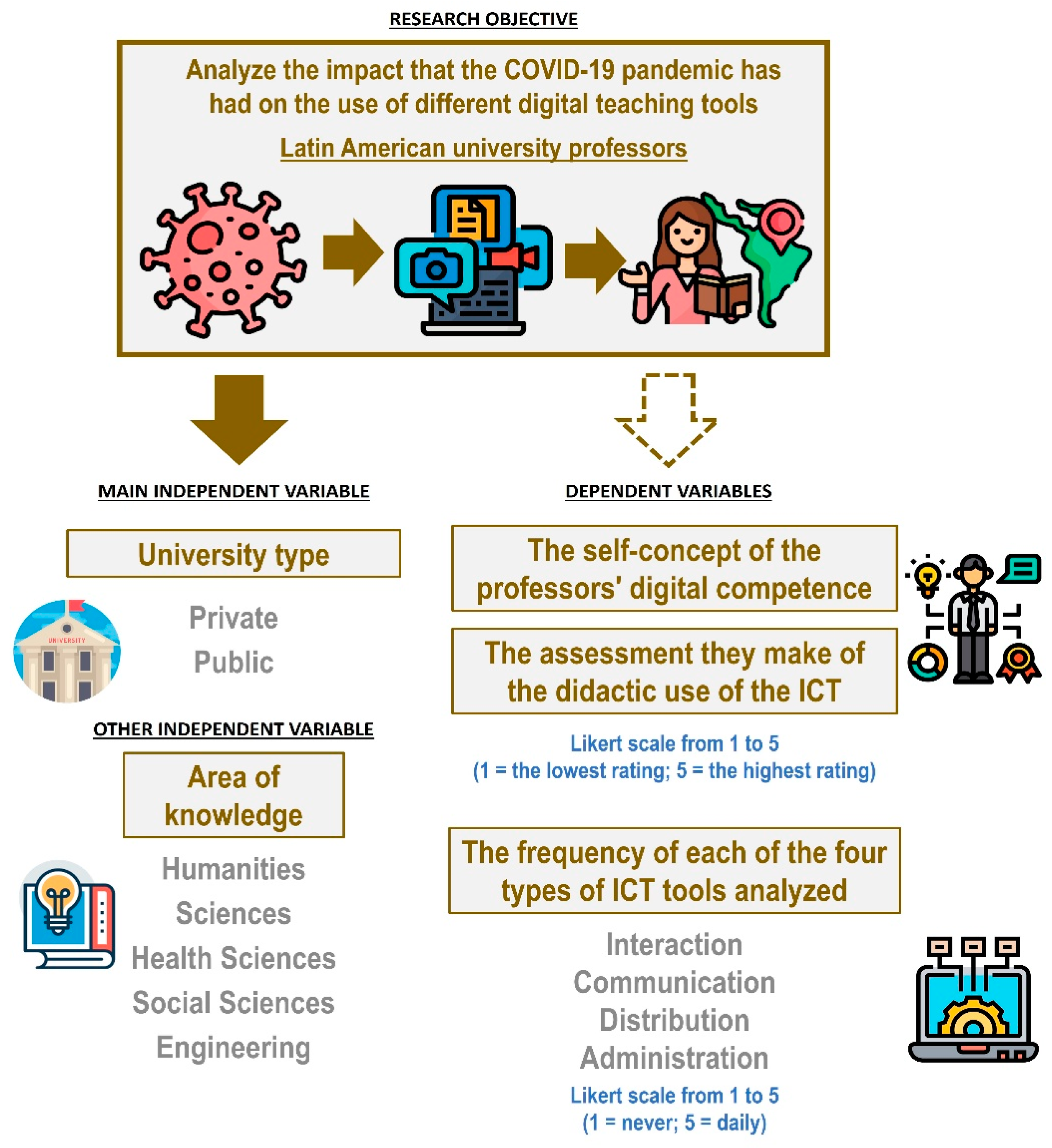
The main independent variable of the study is the university type of the participants, which is a dichotomous variable with private or public values (Figure 2). The secondary variable is the area of knowledge, which is nominally polytomous (with values Humanities, Sciences, Health Sciences, Social Sciences, and Engineering).
Likewise, 6 dependent variables are considered, all of them quantitative and measured on Likert scales from 1 to 5. The first two measures, respectively, the self-concept of the professors’ digital competence and the assessment they make of the didactic use of the ICT, on a scale from 1 (lowest rating) to 5 (highest rating). The last four variables measure the frequency of each of the four types of ICT tools analyzed (interaction, communication, distribution, and administration), both before and after the pandemic, on a scale with the possible values 1 (never), 2 (one to three times a month), 3 (three times a month to once a week), 4 (several times a week, but not daily) and 5 (daily).

2.2. Instrument

The questionnaire consists of 11 questions, all of them Likert type from 1 to 5. The first 4 allow to measure the self-concept of digital competence (specifically, they ask to assess knowledge about technical, pedagogical aspects, communicative potential, and ethical aspects of the use of ICT). The next 3 measure the assessment of the didactic use of ICT (specifically, in terms of the following three dimensions: its impact on the academic performance of students, their motivation, and the promotion of inclusivity). The last four questions ask to assess the frequency of ICT use before and after the pandemic for each of the 4 ICT families analyzed (interaction, communication, distribution of materials, and administration and evaluation). The questionnaire used has been validated in terms of the construct through an Exploratory Factor Analysis (Antón-Sancho et al., 2023). The factor analysis allows us to identify the families of questions 1 to 4 as measuring the self-concept of digital competence (first dependent variable) and the family of questions 5 to 7 as measuring the assessment of the didactic use of ICT (second dependent variable). with factor loadings greater than 0.70. The rest of the questions measure one dependent variable each.

2.3. Statistical Analysis

The Pearson independence test has been used to verify that the participants are homogeneously distributed according to the type of university, private or public. Likewise, to strengthen the validation of the instrument used, the Confirmatory Factor Analysis statistics have been computed, which allows confirming the theoretical model described in the Exploratory Factor Analysis (Vergara et al., 2023a). The internal reliability of the responses has also been checked using Cronbach’s alpha parameters. To analyze the responses, the bilateral t-test was used to compare the average responses of professors from private and public universities, and the multifactor analysis of variance (MANOVA) test was used to compare the average responses by areas of knowledge and types of subjects. universities. All hypothesis contrast tests have been carried out with Welch’s correction without assuming equality of variances. The significance level used is 0.05.

3. Results

3.1. Participants

Of the 1436 attendees registered for the training session, a total of 1114 responded to the questionnaire. All responses received were validated, in the sense that they were complete. Therefore, the final number of participants was 1114 (534 males and 580 females). Of them, 563 works in private universities (50.54% of the total) and 551 work in public universities (49.46% of the total). The distribution of participants by university type is homogeneous (chi-square = 0.1296, p-value = 0.7192). In both private and public universities, most of the participants (around 50%) are specialists in Social Sciences or Engineering, with the other areas being more minority (Table 1). Regarding the distribution of participants by areas of knowledge, there are no significant differences between private and public universities (chi-square = 7.8652, p-value = 0.0966).

3.2. Validation of the Instrument

The CFA confirms that the responses fit the distribution of two families found by the factor analysis (Vergara et al., 2023a). Indeed, the incremental fit indices are suitable (AGFI = 0.9293; NFI = 0.9095; TLI = 0.8352; CFI = 0.9128; IFI = 0.9073), and the absolute fit indices are also good (GFI = 0.9993; RMSEA = 0.0000; AIC = 17.4140). Also, Cronbach’s alpha parameters allow us to assume that the distribution of responses in the two families considered (digital competence and ICT assessment) has internal consistency: 0.8280 for the self-concept of digital competence and 0.8000 for the assessment of ICT tools.

3.3. Self-Concept of Digital Competence and ICT Assessment

The participants have an intermediate concept (between 3 and 4 out of 5) of their digital competence (specifically, 3.66 out of 5). Despite this, their assessment of the educational use of ICT is high (above 4 out of 5), specifically 4.21 out of 5. Furthermore, there are no significant differences between the mean ratings of these two variables (self-concept of digital competence and assessment of ICT), as shown by the t-test statistics (Table 2).
However, the distribution of these average ratings according to the participants’ area of knowledge is different in private and public universities (Table 3). Specifically, in public universities, Humanities professors have the best self-concept of digital competence, while in private universities it is held by Science and Engineering professors, with Humanities and Health Sciences professors having the worst self-concept they have. Specifically, in private universities, professors of Humanities and of Health Sciences are those who give the lowest average rating to the didactic use of ICT (Table 3). On the other hand, in public universities, professors of Humanities and of Health Sciences are the ones who give the best assessments, and those of Sciences, Engineering, and Social Sciences are the worst.

3.4. Impact of the Pandemic on the Frequency of ICT Use

The COVID-19 pandemic has caused a significant increase in the frequency of use of all types of ICT tools among participants (Table 4). Specifically, the greatest increases occur in the families of tools that were least used before the pandemic, which are communication and evaluation (Table 4).
The increase in the use of ICT after the pandemic has caused a gap between professors at private and public universities regarding the use of ICT. Indeed, while before the pandemic there were no significant differences between private and public universities (Table 5), after the pandemic, professors at public universities use communication and distribution tools more frequently than professors at private universities (Table 6).

4. Discussion

4.1. From Self-Perception to Systemic Convergence: University Faculty’s Digital Competence and ICT Appraisal

Regarding the self-concept of digital competences, most of the participating professors were positive toward the use of ICT in educational settings and highly valued it despite them having an intermediate concept of their digital skills. No major differences were observed between the professors’ assessment of ICT and their self-concept of digital competences regardless of their university being either public or private. These results are in line with those of the literature which highlight that due to the unprecedented circumstances, most professors developed their digital skills to an intermediate or above level to cope with the changes despite the lack of appropriate and sufficient training which led to most of them either using specified tools or the ones that they were familiar with prior to the pandemic (Jorge-Vázquez et al., 2021; Náñez Alonso et al., 2024).
However, beyond this descriptive interpretation, these findings can also be understood from an organizational and systemic perspective. The relatively homogeneous perception of ICT across university types suggests that the pandemic acted as a global accelerator of digital competence acquisition, reducing initial disparities and promoting a baseline level of digital literacy among faculty (Ávila Sánchez et al., 2022). This aligns with the notion that crisis-driven digitalization processes can temporarily compensate for structural inequalities, although not necessarily eliminate them (García-Martín & García-Sánchez, 2022).

4.2. Disciplinary Differences in ICT Adoption

When considering the professors’ areas of knowledge in relation to their ICT assessment and their self-concept of digital competences, differences were revealed. More specifically, professors of Social Sciences and Engineering in private universities showcased a more positive assessment of ICT in comparison to professors from public universities. On the contrary, professors at private universities whose areas of knowledge are within the fields of Humanities and Health Sciences had a less favorable perspective of ICT assessment when compared to professors at public universities. These results show that technical education professors have a greater predisposition to the use of digital technologies, as suggested in García-Holgado et al. (2019), although there it is only proved that the gender gap is greater among technical education professors. Therefore, the results of García-Holgado et al. (2019) are extended here.
From a cultural and epistemological perspective, these differences may be explained by the intrinsic characteristics of each disciplinary field. Engineering and Sciences are traditionally more aligned with technological environments and digital tools, which facilitates ICT integration in teaching practices. In contrast, Humanities and Health Sciences may rely more heavily on interpretative, experiential, or practice-based approaches that require specific adaptations for effective digital implementation (León-Díaz et al., 2026). This implies that ICT adoption is not solely determined by access or training, but also by disciplinary culture and pedagogical traditions.
Simultaneously, professors from both private and public universities had a similar positive attitude when assessing ICT in education. Despite these facts, it is worth noting that most professors from all knowledge areas positively evaluated the integration and use of ICT tools in educational settings. These findings further expand those of existing studies which have highlighted that despite the lack of training, professors could improve their digital skills through their own effort and more frequently use ICT tools after the pandemic and particularly those whose area of knowledge is within the fields of Sciences and Health Sciences as well as in Social Sciences and Engineering.
Nevertheless, this generalized positive perception should be interpreted with caution, as favorable attitudes do not necessarily translate into effective or pedagogically meaningful use of ICT. Previous research has emphasized the gap between perceived digital competence and actual instructional integration, highlighting the importance of structured training and institutional support (Márquez-Baldó et al., 2025; S.-W. Park et al., 2025).

4.3. Institutional Differences Between Public and Private Universities

When looking into the differences between the self-concept of digital competences between professors of public and private universities in relation to their area of knowledge, some differences were also evident. Particularly, professors, whose area of knowledge is within the fields of Humanities and Health sciences and teach at private universities, had a lower self-concept of their digital skills in comparison with the professors who teach in public universities. On the other hand, professors from private universities whose area of knowledge is within the fields of Sciences and Social Sciences had a higher self-concept of digital competence than those who tenure in public universities. No major differences were observed between engineering faculty of public and private universities. The professors’ intermediate self-concept of their digital skills was evident in both public and private universities.
These differences can be further interpreted through institutional and organizational mechanisms. Private universities in Latin America often benefit from more flexible governance structures, greater autonomy in decision-making, and more agile resource allocation processes, which may facilitate the adoption of digital technologies and innovation in teaching (Ivenicki, 2021; Martín-Cuadrado et al., 2021). In contrast, public universities are frequently subject to more rigid administration and budgetary constraints, which can limit the speed and scope of digital transformation despite large-scale efforts.
Additionally, differences in professional development opportunities may play a key role. Faculty in private institutions may have greater access to continuous training programs, incentives for innovation, and institutional support structures, which are recognized as key drivers of ICT integration (Schildkamp et al., 2020). These organizational conditions contribute to differentiated trajectories in digital competence development across university types.

4.4. Impact of the Pandemic on ICT Use

Although professors were already using ICT tools in their classes prior to the pandemic, many of the professors, who integrated ICT means during the pandemic, continued using them even after it. As a result, all types of ICT tools, that are tools for interaction, communication, distribution, and evaluation, showcased an increase in the frequency of use, with communication, evaluation, and interaction tools having a more significant increase than that of the distribution tools which were already widely used prior to the pandemic. This is in line with the results of other recent studies (Antón-Sancho et al., 2023). Additionally, these results further validate those of the literature which have highlighted that the frequency of using ICT tools as an educational means has increased after the pandemic with studies reported that female professors use ICT tools more frequently than male professors after the pandemic (Pérez Echeverría et al., 2025). Nonetheless, to fully capitalize on digital technologies in educational settings, the digital competences of educational stakeholders should be further developed.
From a broader perspective, these findings reinforce the idea that the pandemic functioned as a catalyst for digital transformation in higher education, accelerating processes that would otherwise have taken years to consolidate (Bond, 2020; Hodges et al., 2020). However, this rapid transition was largely reactive rather than strategic, which may explain the persistence of gaps in digital competence and the uneven quality of ICT integration.

4.5. Post-Pandemic Digital Gap and Implications for Research

Notice that, although there were no major differences between faculty of private and public universities regarding the frequency of using ICT tools prior to the pandemic, differences were observed after the pandemic. This has led to a gap in terms of digital skills and technology-enhanced learning among faculty of private and public universities. More specifically, although an increase in the frequency of using ICT tools is observed, this increase is more drastic for professors at public universities and particularly, in the use of ICT tools for communication and distribution. As a result, after the pandemic public university faculty use ICT tools more frequently to distribute material and resources and communicate than the faculty of private universities. These results are in line with those of the existing literature which showcases significantly greater increase in ICT use in professors of private universities in comparison to those of public universities (Antón-Sancho et al., 2023). Likewise, the results obtained confirm that private universities in the region are better prepared to assume a digitalization process, as indicated by Martín-Cuadrado et al. (2021). Finally, the greater experience of professors at private universities observed in the specialized literature (Ivenicki, 2021) seems to lead to greater receptivity to the use of digital technologies, not only in the teaching activities where they are most used, but in all of them.
These results suggest that the pandemic produced a partial convergence in ICT use between public and private universities, although underlying structural differences remain. From a research perspective, this highlights the importance of incorporating institutional variables and contextual factors into the analysis of digital competence, moving beyond purely individual-level approaches (Albats et al., 2022; Aldogiher et al., 2025).
Furthermore, these findings open new avenues for research in digital education, particularly in relation to the design of differentiated digital transformation strategies that consider both institutional type and disciplinary culture. Future studies should also explore the long-term sustainability of the observed increase in ICT use, as well as its impact on teaching quality and student learning outcomes.

4.6. Limitations of the Study

Despite the contributions of this study, several limitations should be acknowledged to contextualize the results. First, the use of a non-probabilistic convenience sampling method may limit the generalizability of the results. Although the sample size is considerable, participants were recruited from a training session on ICT, which may introduce a self-selection bias toward faculty more interested or engaged in digital technologies.
Second, the study relies on self-reported measures of digital competence and ICT use, which may not fully reflect actual performance. As highlighted in previous research, perceived competence can differ from real digital skills (Cabero-Almenara et al., 2021). Moreover, ICT use was measured in terms of reported frequency rather than objective usage data, which may introduce reporting biases. In addition, as all variables were collected from the same respondents, using the same instrument and at a single point in time, the study may be subject to common method variance, which could inflate the observed relationships between variables. Future research should incorporate complementary approaches, such as performance-based assessments, learning analytics, or system-generated data, as well as multi-method or longitudinal designs, to obtain a more accurate and robust evaluation of digital competence and technology use in higher education.
Third, the cross-sectional design of the study prevents establishing causal relationships between variables. While differences between university types and disciplinary areas have been identified, longitudinal approaches would be necessary to examine their evolution over time and the sustainability of ICT integration. Furthermore, given the non-experimental design of the study and its reliance on self-reported data, the findings should be interpreted as indicative rather than explanatory. Consequently, the results do not support causal inferences or strong policy-level recommendations and should instead be understood as a basis for further investigation.
Fourth, the focus on the Latin American context, although relevant due to existing structural inequalities, may limit the transferability of the findings to other educational systems with different institutional and technological conditions (Kazemikhasragh & Buoni-Pineda, 2022).
Finally, although key variables such as university type and area of knowledge have been considered, other relevant factors (such as institutional digital strategies, infrastructure availability, or prior training experiences) were not included. Future research should incorporate these dimensions to provide a more comprehensive understanding of ICT adoption in higher education.

5. Conclusions

This study aimed to analyze the use of ICT tools and the self-concept of digital competence among Latin American university professors, as well as examining differences according to institutional type and disciplinary area. The findings show that professors generally report a positive attitude toward ICT and an intermediate level of digital competence, regardless of whether they belong to public or private universities. However, relevant differences emerge when considering disciplinary areas and institutional contexts. Faculty from Engineering and Social Sciences tend to demonstrate a more favorable perception and higher levels of ICT use, while variations between public and private universities suggest the influence of institutional factors on digital adoption. Additionally, the results indicate that the COVID-19 pandemic acted as a catalyst for the increased use of ICT tools in higher education, with a sustained use of communication, interaction, and evaluation tools beyond the emergency context.
This study contributes to the literature by providing empirical evidence on the digital divide in higher education within the Latin American context, considering both institutional type and disciplinary area simultaneously. Unlike previous research focused on isolated variables, this work adopts a multidimensional approach that integrates organizational and disciplinary perspectives. Furthermore, the findings emphasize the role of institutional and contextual factors in shaping digital competence and ICT adoption, supporting the need to move beyond individual-level analyses toward more systemic and context-sensitive interpretations. In this sense, the study also contributes to the achievement of Sustainable Development Goal 4 (SDG 4—Quality Education), particularly in relation to promoting inclusive and equitable access to quality education through the effective integration of digital technologies in higher education systems.
The results suggest the potential value of promoting digitalization strategies in higher education institutions, particularly in contexts characterized by structural inequalities. These may include fostering continuous training in digital competencies, improving access to technological resources, and encouraging pedagogical innovation adapted to disciplinary contexts. However, these implications should be interpreted with caution, as the non-experimental design of the study and its reliance on self-reported data limit the possibility of establishing causal relationships or formulating strong policy-level recommendations. Future research should incorporate longitudinal and multi-method approaches, including objective measures of ICT use and digital competence, to better understand the evolution and impact of digital transformation in higher education, as well as the role of institutional strategies, infrastructure, and socio-economic factors. From this perspective, advancing digital competence and reducing institutional gaps in ICT adoption may represent a key pathway toward strengthening higher education systems in alignment with SDG 4 targets.

Author Contributions

Conceptualization, D.V. and Á.A.-S.; methodology, D.V., P.F.-A. and Á.A.-S.; validation, D.V. and Á.A.-S.; formal analysis, Á.A.-S.; investigation, D.V., P.F.-A. and Á.A.-S.; resources, D.V., A.d.B., P.F.-A., G.L. and Á.A.-S.; data curation, D.V., A.d.B., P.F.-A. and Á.A.-S.; writing—original draft preparation, D.V., A.d.B., P.F.-A., G.L. and Á.A.-S.; writing—review and editing, D.V., A.d.B., P.F.-A., G.L. and Á.A.-S.; visualization, D.V., A.d.B., P.F.-A. and Á.A.-S.; supervision, D.V. and Á.A.-S. All authors have read and agreed to the published version of the manuscript.

Funding

This research received no external funding.

Institutional Review Board Statement

Ethical review and approval were waived for this study because, at the time the surveys were conducted, a formal Ethics Committee had not yet been established at the authors’ university. Nevertheless, the study was carried out in full accordance with the ethical principles of the Declaration of Helsinki.

Informed Consent Statement

Informed consent was obtained from all subjects involved in the study.

Data Availability Statement

The data that supports the findings of the studies depicted in this paper will be made available upon reasonable request to the corresponding author.

Conflicts of Interest

The authors declare no conflicts of interest.

References

  1. Abaci, S., Robertson, J., Linklater, H., & McNeill, F. (2021). Supporting school teachers’ rapid engagement with online education. Educational Technology Research and Development, 69(1), 29–34. [Google Scholar] [CrossRef] [Scilit]
  2. Albats, E., Alexander, A. T., & Cunningham, J. A. (2022). Traditional, virtual, and digital intermediaries in university–industry collaboration: Exploring institutional logics and bounded rationality. Technological Forecasting and Social Change, 177, 121470. [Google Scholar] [CrossRef] [Scilit]
  3. Aldogiher, A., Halim, Y. T., El-Deeb, M. S., Maree, A. M., & Kamel, E. M. (2025). The impact of digital teaching technologies (DTTs) in Saudi and Egyptian universities on institutional sustainability: The mediating role of change management and the moderating role of culture, technology, and economics. Sustainability, 17(5), 2062. [Google Scholar] [CrossRef] [Scilit]
  4. Antón-Sancho, Á., Fernández-Arias, P., & Vergara-Rodríguez, D. (2023). Impact of the COVID-19 pandemic on the use of ICT tools in science and technology education. Journal of Technology and Science Education, 13(1), 130. [Google Scholar] [CrossRef] [Scilit]
  5. Anushalalitha, T. (2023). Precovid, covid and post covid classes and online engineering. In Artificial intelligence and online engineering (pp. 533–546). Springer. [Google Scholar] [CrossRef] [Scilit]
  6. Arias-Ortiz, E., Escamilla, J., López, A., & Peña, L. (2020). COVID-19: Digital technologies in higher education—What do professors think? Inter-American Development Bank. [Google Scholar] [CrossRef] [Scilit]
  7. Asgari, S., Trajkovic, J., Rahmani, M., Zhang, W., Lo, R. C., & Sciortino, A. (2021). An observational study of engineering online education during the COVID-19 pandemic. PLoS ONE, 16(4), e0250041. [Google Scholar] [CrossRef] [Scilit] [PubMed]
  8. Ávila Sánchez, G. A., Venegas Mejía, V. L., Palacios Garay, J. P., Jara Nunayalle, J. d. R., Jaramillo Zavala, J. B., & Fernández Zavaleta, R. F. (2022). Digital competence of the university student in times of COVID-19. International Journal of Health Sciences, 6(S4), 6467–6475. [Google Scholar] [CrossRef] [Scilit]
  9. Baggott La Velle, L., McFarlane, A., & Brawn, R. (2003). Knowledge transformation through ICT in science education: A case study in teacher-driven curriculum development. British Journal of Educational Technology, 34(2), 183–199. [Google Scholar] [CrossRef] [Scilit]
  10. Basantes-Andrade, A., Cabezas-González, M., & Casillas-Martín, S. (2020). Digital competences relationship between gender and generation of university professors. International Journal on Advanced Science Engineering Information Technology, 10(1), 205–211. [Google Scholar] [CrossRef] [Scilit]
  11. Batra, S., & Kumar, S. (2022). Amalgamation of ICT in education during COVID-19. Research Review International Journal of Multidisciplinary, 7(2), 71–74. [Google Scholar] [CrossRef] [Scilit]
  12. Bingimlas, K. A. (2009). Barriers to the successful integration of ICT in teaching and learning environments: A review of the literature. EURASIA Journal of Mathematics, Science and Technology Education, 5(3), 235–245. [Google Scholar] [CrossRef] [Scilit]
  13. Bond, M. (2020). Schools and emergency remote education during the COVID-19 pandemic: A living rapid systematic review. Asian Journal of Distance Education, 15(2), 191–247. [Google Scholar]
  14. Boonmoh, A., Jumpakate, T., & Karpklon, S. (2021). Teachers’ perceptions and experience in using technology for the classroom. Computer-Assisted Language Learning Electronic Journal, 22(1), 1–24. [Google Scholar]
  15. Cabero-Almenara, J., Guillén-Gámez, F. D., Ruiz-Palmero, J., & Palacios-Rodríguez, A. (2021). Digital competence of higher education professor according to DigCompEdu. Education and Information Technologies, 26, 4691–4708. [Google Scholar] [CrossRef] [Scilit]
  16. Clark, R. C., & Mayer, R. E. (2016). E-learning and the science of instruction. John Wiley & Sons. [Google Scholar]
  17. Espinoza, O., Corradi, B., González, L., Sandoval, L., McGinn, N., & Vera, T. (2024). Segmentation in higher education in Chile: Massification without equality. Higher Education Quarterly, 78(3), 536–550. [Google Scholar] [CrossRef] [Scilit]
  18. Esteve-Mon, F. M., Llopis-Nebot, M. Á., & Adell-Segura, J. (2020). Digital teaching competence of university teachers: A systematic review. IEEE Revista Iberoamericana de Tecnologías del Aprendizaje, 15(4), 399–406. [Google Scholar] [CrossRef] [Scilit]
  19. Ferri, F., Grifoni, P., & Guzzo, T. (2020). Online learning and emergency remote teaching: Opportunities and challenges. Societies, 10(4), 86. [Google Scholar] [CrossRef] [Scilit]
  20. García-Holgado, A., Camacho-Díaz, A., & García-Peñalvo, F. J. (2019). Engaging women into STEM in Latin America: W-STEM project. In Proceedings of the seventh international conference on technological ecosystems for enhancing multiculturality (TEEM’19) (pp. 232–239). ACM. [Google Scholar] [CrossRef] [Scilit]
  21. García-Martín, J., & García-Sánchez, J.-N. (2022). The digital divide of know-how and use of digital technologies in higher education. International Journal of Environmental Research and Public Health, 19(6), 3358. [Google Scholar] [CrossRef] [Scilit]
  22. Garrote-Jurado, R., Pettersson, T., Regueiro Gómez, A., & Scheja, M. (2014, November 24–28). Classification of the features in learning management systems. XVII Scientific Convention on Engineering and Architecture, Havana, Cuba. [Google Scholar]
  23. Gómez-Poyato, M. J., Eito-Mateo, A., Mira-Tamayo, D. C., & Matías-Solanilla, A. (2022). Digital skills, ICTs and students’ needs. Education Sciences, 12(7), 443. [Google Scholar] [CrossRef] [Scilit]
  24. Guillén-Gámez, F. D., & Mayorga-Fernández, M. J. (2020). Quantitative-comparative research on digital competence. Education and Information Technologies, 25(5), 4157–4174. [Google Scholar] [CrossRef] [Scilit]
  25. Hodges, C. B., Moore, S., Lockee, B. B., Trust, T., & Bond, M. A. (2020). The difference between emergency remote teaching and online learning. Educause Review, 27(1), 1–9. [Google Scholar]
  26. Hu, M., & Li, H. (2017, June 27–29). Student engagement in online learning: A review. 2017 International Symposium on Educational Technology (ISET), Hong Kong, China. [Google Scholar] [CrossRef] [Scilit]
  27. Ivenicki, A. (2021). Digital lifelong learning and higher education. Ensaio: Avaliação e Políticas Públicas em Educação, 29(111), 360–377. [Google Scholar] [CrossRef] [Scilit]
  28. Jonassen, D. H. (2000). Computers as mindtools for schools. Prentice Hall. [Google Scholar]
  29. Jorge-Vázquez, J., Náñez, S. L., Fierro, W. R., & Pacheco, S. (2021). Assessment of digital competencies of university faculty. Education Sciences, 11(10), 637. [Google Scholar] [CrossRef] [Scilit]
  30. Kazemikhasragh, A., & Buoni-Pineda, M. V. (2022). Financial inclusion and education. Review of Development Economics, 26(3), 1785–1797. [Google Scholar] [CrossRef] [Scilit] [PubMed]
  31. Khan, Z. H., & Abid, M. I. (2021). Distance learning in engineering education. International Journal of Electrical Engineering & Education, 63, 138–157. [Google Scholar] [CrossRef] [Scilit]
  32. León-Díaz, F., Boude, O., & Vargas-Sánchez, A. (2026). Pedagogical mediation with ICT for the development of critical thinking in primary education: A systematic review. Thinking Skills and Creativity, 60, 102085. [Google Scholar] [CrossRef] [Scilit]
  33. Liesa-Orús, M., Latorre-Cosculluela, C., Vázquez-Toledo, S., & Sierra-Sánchez, V. (2020). The technological challenge facing higher education professors. Sustainability, 12(13), 5339. [Google Scholar] [CrossRef] [Scilit]
  34. Maheshwari, G. (2024). Factors influencing students’ intention to adopt and use ChatGPT. Education and Information Technologies, 29(10), 12167–12195. [Google Scholar] [CrossRef] [Scilit]
  35. Martín-Cuadrado, A. M., Lavandera-Ponce, S., Mora-Jaureguialde, B., Sánchez-Romero, C., & Pérez-Sánchez, L. (2021). Working methodology with public universities in Peru. Education Sciences, 11(7), 351. [Google Scholar] [CrossRef] [Scilit]
  36. Márquez-Baldó, L., Orellana, N., Almerich, G., & Suárez-Rodríguez, J. (2025). Attitude toward ICT integration for teachers. Validation of a multidimensional scale. Computers in Human Behavior Reports, 20, 100786. [Google Scholar] [CrossRef] [Scilit]
  37. Náñez Alonso, S., Jorge-Vazquez, J., Arias, L., & del Nogal, N. (2024). What factors are limiting financial inclusion and development in Peru? Empirical evidence. Economies, 12(4), 93. [Google Scholar] [CrossRef] [Scilit]
  38. Ngoc, N. M., Hieu, V. M., & Tien, N. H. (2023). Impact of accreditation policy on quality assurance activities. International Journal of Public Sector Performance Management, 10, 1–15. [Google Scholar] [CrossRef] [Scilit]
  39. Núñez-Canal, M., de las Mercedes de Obesso, M., & Pérez-Rivero, C. A. (2022). New challenges in higher education. Technological Forecasting and Social Change, 174, 121270. [Google Scholar] [CrossRef] [Scilit]
  40. Park, M., Park, J. J., Jackson, K., & Vanhoy, G. (2021). Online engineering education under COVID-19. International Journal of Multidisciplinary Perspectives in Higher Education, 5(1), 160–166. [Google Scholar] [CrossRef] [Scilit]
  41. Park, S.-W., Lee, S.-B., & Sung, K.-J. (2025). Toward sustainable integration of digital technology in physical education: A teacher-centered TAM–TPACK framework for instructional design. Sustainability, 17(23), 10476. [Google Scholar] [CrossRef] [Scilit]
  42. Peres, P., & Pimenta, P. (2011). Teorias e práticas de b-learning. Edições Sílabo. [Google Scholar]
  43. Pérez Echeverría, M. P., Cabellos, B., & Pozo, J.-I. (2025). The use of ICT in classrooms: The effect of the pandemic. Education and Information Technologies, 30(10), 14069–14093. [Google Scholar] [CrossRef] [Scilit]
  44. Quiroga-Parra, D. J., Torrent-Sellens, J., & Murcia-Zorrilla, C. P. (2017). Uses of ICT in Latin America. Ingeniare. Revista Chilena de Ingeniería, 25(2), 289–305. [Google Scholar] [CrossRef] [Scilit]
  45. Quispe-Prieto, S., Cavalcanti-Bandos, M. F., Caipa-Ramos, M., Paucar-Caceres, A., & Rojas-Jiménez, H. H. (2021). A systemic framework to evaluate student satisfaction. Systems, 9(1), 15. [Google Scholar] [CrossRef] [Scilit]
  46. Rasyid, F., & Nuriyah, W. A. (2023, September 2). Teachers’ competence in digital literacy. International Conference on Education (pp. 413–422), Kediri, Indonesia. [Google Scholar]
  47. Saif, S. M., Ansarullah, S. I., Ben Othman, M. T., Alshmrany, S., Shafiq, M., & Hamam, H. (2022). Impact of ICT in modernizing the global education industry. Sustainability, 14(11), 6884. [Google Scholar] [CrossRef] [Scilit]
  48. Salas-Pilco, S. Z., Yang, Y., & Zhang, Z. (2022). Student engagement in online learning. British Journal of Educational Technology, 53(3), 593–619. [Google Scholar] [CrossRef] [Scilit]
  49. Schildkamp, K., Wopereis, I., Kat-De Jong, M., Peet, A., & Hoetjes, I. (2020). Building blocks of instructor professional development. Journal of Professional Capital and Community, 5(3/4), 281–293. [Google Scholar] [CrossRef] [Scilit]
  50. Simonson, M., & Schlosser, L. A. (2009). Distance education: Definition and glossary of terms (3rd ed.). Information Age Publishing. [Google Scholar]
  51. Simonson, M., Zvacek, S. M., & Smaldino, S. (2019). Teaching and learning at a distance (7th ed.). Information Age Publishing. [Google Scholar]
  52. Sormunen, M., Heikkilä, A., Salminen, L., Vauhkonen, A., & Saaranen, T. (2021). Learning outcomes of digital learning interventions. Computers, Informatics, Nursing, 40(3), 154–164. [Google Scholar] [CrossRef] [Scilit]
  53. Trust, T., & Whalen, J. (2020). Should teachers be trained in emergency remote teaching? Journal of Technology and Teacher Education, 28(2), 189–199. [Google Scholar] [CrossRef] [Scilit]
  54. UNESCO Institute for Statistics. (2012). International standard classification of education: ISCED 2011. UNESCO-UIS. Available online: http://uis.unesco.org (accessed on 20 November 2025).
  55. Vergara, D., Antón-Sancho, Á., Dávila, L. P., & Fernández-Arias, P. (2022). Virtual reality as a didactic resource. Computer Applications in Engineering Education, 30, 1086–1101. [Google Scholar] [CrossRef] [Scilit]
  56. Vergara, D., Antón-Sancho, Á., & Fernández-Arias, P. (2023a). Engineering professors’ habits: Didactic use of ICT. Education and Information Technologies, 29, 7487–7517. [Google Scholar] [CrossRef] [Scilit]
  57. Vergara, D., Antón-Sancho, Á., & Fernández-Arias, P. (2023b). Gender gaps in the impact of the pandemic on the use of ICT. Review of Education, 11(3), e3439. [Google Scholar] [CrossRef] [Scilit]
  58. Vyortkina, D., & Elsawy, A. M. (2024). A systematic professional development framework. In EDULEARN24 Proceedings (pp. 4655–4665). IATED. [Google Scholar] [CrossRef] [Scilit]
  59. Wallace, R. M. (2003). Online learning in higher education. Education, Communication & Information, 3(2), 241–280. [Google Scholar] [CrossRef] [Scilit]
  60. Yas, H., Aburayya, A., & Shwedeh, F. (2024). Education quality and standards. In Artificial intelligence in education (pp. 563–572). Springer Nature. [Google Scholar] [CrossRef] [Scilit]
Figure 1. Categories of Information and Communication Technology (ICT) Tools Used in Higher Education.
Education 16 00579 g001
Figure 2. Structure of the Main Variables Considered in the Study.
Education 16 00579 g002
Table 1. Distribution of participants by area of knowledge, in private and public universities.
Area of KnowledgePrivate Universities (%)Public Universities (%)
Humanities19.315.9
Sciences16.515.1
Health Sciences10.111.6
Social Sciences27.133.8
Engineering26.823.6
TOTAL100.0100.0
Table 2. Self-concept of digital competence and ICT assessment among professors in public and private universities.
Private Public t Statisticp-Value
Digital competence3.663.650.580.56
ICT assessment4.214.210.090.93
Table 3. Self-concept of digital competence and ICT assessment by area of knowledge in public and private universities.
Self-Concept of Digital CompetenceICT Assessment
PrivatePublicPrivatePublic
Humanities3.513.853.984.38
Sciences3.803.544.254.26
Health Sciences3.153.424.204.41
Social Sciences3.763.594.314.04
Engineering3.793.784.254.20
MANOVA18.1119.84
p-value<0.05<0.05
Table 4. Frequencies of use (out of 5) of ICT tools before and after the pandemic and statistics of the bilateral t-test for comparison of means.
Before COVID-19After
COVID-19
Increase (%)tp
Interaction2.823.8436.17−28.89<0.05
Communication2.663.7540.98−30.03<0.05
Distribution3.313.8716.92−19.17<0.05
Evaluation2.713.7237.27−26.90<0.05
Table 5. Frequencies of use (out of 5) of ICT tools before the pandemic in both private and public universities and statistics of the bilateral t-test for comparison of means.
PrivatePublictp
Interaction2.842.810.520.60
Communication2.722.601.800.07
Distribution3.303.33−0.490.62
Evaluation2.742.681.040.30
Table 6. Frequencies of use (out of 5) of ICT tools after the pandemic in both private and public universities and statistics of the bilateral t-test for comparison of means.
PrivatePublictp
Interaction3.843.830.260.80
Communication3.703.80−3.09<0.05
Distribution3.833.90−2.63<0.05
Evaluation3.743.701.020.31
Disclaimer/Publisher’s Note: The statements, opinions and data contained in all publications are solely those of the individual author(s) and contributor(s) and not of MDPI and/or the editor(s). MDPI and/or the editor(s) disclaim responsibility for any injury to people or property resulting from any ideas, methods, instructions or products referred to in the content.