1. Introduction
Recent years have seen a significance rise in students’ use of off-campus learning resources—namely, online courses, YouTube explanatory videos, digital learning platforms, and private lessons. This tendency is particularly evident in STEM (science, technology, engineering, and mathematics) subjects, where the need for in-depth understanding of complex material as well as the need for being able to practice and internalize abstract terms makes autonomous and off-campus study complementary mechanisms for acquiring knowledge of the material markedly common. An essential question arises regarding the role of frontal instruction in the digital era: Do students utilize external resources because they prefer flexible autonomous learning or are they compelled to do so due to deficiencies in the frontal instruction offered on campus?
Improving the quality of on-campus instruction is not merely a pedagogical goal but a fundamental component of Sustainable Development Goal 4 (SDG 4), which seeks to ensure inclusive and equitable quality education. Strengthening the traditional classroom model contributes to the long-term sustainability of higher education institutions by maintaining their social and educational value in an increasingly digitalized world.
The recent literature emphasizes that digital transformation in higher education extends beyond merely adopting technology; it represents a comprehensive paradigm shift in universities’ pedagogical models, hybrid learning integration, and strategic expansion (
Zhukabayeva et al., 2025). Digital and hybrid models significantly enhance educational accessibility, flexibility, and personalized learning trajectories (
Tang et al., 2025). However, their successful implementation requires a clear logical framework to overcome practical and psychological dilemmas among faculty and students (
Tang et al., 2025). Consequently, understanding how students perceive on-campus versus hybrid or digital formats is crucial for effectively balancing these traditional and modern educational strategies (
Zhukabayeva et al., 2025).
Understanding the motives underlying the use of off-campus learning is critical for institutions of higher education, as the practical implications of each scenario are radically different:
Scenario A: Authentic preference—If this reflects students’ authentic preference for autonomous online learning, the conclusion is that it is necessary to adapt pedagogical models integrating more hybrid or online learning, and that efforts should be made to develop quality digital resources. In this case, the utilization of external resources reflects a cultural shift and the preferences of a new generation of learners.
Scenario B: Compensatory learning—If, however, the utilization of external resources stems from frustration and dissatisfaction with teaching on campus, the conclusion should be completely different: It is then necessary to improve the quality of frontal instruction, the clarity and depth of explanations, the physical infrastructure, and the personal attitude of students. In this case, the utilization of external resources is a symptom of a problem that merits treatment and not a trend that should be complied with.
Most existing studies examined the efficacy of online learning versus frontal learning (
Means et al., 2013), the motivation for taking online courses, or usage patterns of digital resources (
Rapchak et al., 2015). Few, however, have tried to empirically discern between the two theoretical options: autonomous complementary learning versus compensatory learning under need frustration.
The current study seeks to fill this gap through empirical examination of the association between students’ perceptions of the quality of frontal instruction and their preference for off-campus learning. The study focuses on engineering students at Ariel University and is based on a mixed methods approach that combines qualitative analysis of students’ perceptions with a quantitative model allowing examination of the associations between these perceptions and their preference for external learning. Specifically, this study is guided by two central research questions: (1) What are the perceived pedagogical and structural deficiencies in on-campus STEM instruction that drive students to utilize external learning resources? and (2) How does the intensity of students’ criticism regarding on-campus instruction relate to their declared preference for off-campus learning?
To address these questions, the main empirical logic of the study-serving as our overarching hypothesis-is as follows: If students who criticize the quality of frontal teaching show a higher preference for off-campus studies, this means that they truly prefer autonomous learning (Scenario A). In contrast, if students who criticize the quality of teaching show a lower preference for external learning, this means that they still ascribe value to frontal teaching and desire its improvement, but utilize external resources for compensatory reasons (Scenario B).
2. Theoretical Framework
The current study is based on several theoretical frameworks that make it possible to distinguish between two off-campus study options:
Self-determination theory and needs frustration—self-determination theory (
Deci & Ryan, 2000) identifies three basic psychological needs whose satisfaction is an essential prerequisite for autonomous motivation and well-being:
Autonomy—The sense of choosing and controlling one’s actions;
Competence—The sense of being able to efficiently and successfully complete tasks;
Relatedness—The sense of connection to others and of belonging.
The theoretical framework discerns between two states of motivation:
Autonomous motivation—When basic needs are met, one acts from a sense of true interest, intrinsic values, and free choice. In the academic context, students with autonomous motivation may utilize external learning resources in a desire to reach deeper or more extensive understanding or in search of other points of view—even when provided with effective frontal teaching.
Controlled motivation—When basic needs are frustrated, one acts from a sense of external pressure, anxiety, or a need to avoid negative outcomes. In the academic context, when frontal teaching does not support self-efficacy (unclear explanations, lack of depth), frustrates the need for connection (unavailable lecturers, crowded classrooms), or restricts autonomy, students are compelled to utilize external resources even if they do not choose to do so.
Vansteenkiste and Ryan (
2013) showed that needs frustration leads to negative results: a decline in well-being, anxiety, and compensatory behaviors. In the current study, off-campus learning may be such a compensatory behavior.
The constructive alignment model and clarity of instruction
Biggs and Tang (
2011) developed the constructive alignment model, which posits that quality learning occurs when learning goals are aligned with teaching methods and evaluation tests. Incompatibility between these components generates a sense of frustration and a lack of clarity, i.e., frustration of the need for efficacy, leading students to search for external resources to provide the necessary alignment.
Hattie (
2009) conducted a synthesis of over 800 meta-analyses and found that clarity of instruction is one of the elements that most influences student achievements, with an effect size of d = 0.75. This includes structured explanations, clear lesson structure, and providing suitable examples and analogies. When this clarity is absent, the need for efficacy is frustrated and students are compelled to seek alternative explanations.
Active learning in STEM
Freeman et al. (
2014) conducted a meta-synthesis of 225 studies and showed that active learning significantly improves students’ achievements, more than traditional lectures. They found that 55% more students fail courses when subjected to passive teaching than in active learning. This finding indicates that students may utilize external resources when teaching in class is passive and does not support their sense of efficacy.
The proposed model: Two theoretical tracks.
Based on these settings, the current study suggests a distinction between two tracks:
Track A: Autonomous complementary learning
The first theoretical pathway, Track A, conceptualizes off-campus study as a form of autonomous complementary learning. In this framework, frontal instruction effectively satisfies students’ basic psychological needs, fostering a sense of competence and autonomy. Consequently, the motivation to utilize external resources stems from an autonomous desire to attain a deeper, more extensive understanding of the subject matter or to explore alternative pedagogical perspectives. Within this track, students perceive on-campus teaching as effective and high-quality, yet they proactively choose to supplement it with additional materials to enrich their learning experience. From an empirical standpoint, this track is characterized by either a positive correlation or the absence of a significant link between the perceived quality of instruction and the preference for off-campus learning, as the use of external tools is an elective addition rather than a necessity.
Track B: Compensatory learning under need frustration
In contrast, Track B describes a trajectory of compensatory learning driven by need frustration. In this scenario, frontal instruction is perceived as deficient, failing to provide the necessary clarity, depth, or support, thereby frustrating students’ basic psychological needs for efficacy and relatedness. This environment generates controlled motivation, where students feel compelled to seek external resources as a reactive strategy to avoid academic failure and bridge instructional gaps. Unlike the autonomous track, the utilization of off-campus tools here functions as a temporary coping mechanism for perceived inadequacies in the classroom. The empirical forecast for this track posits a negative relationship between student criticism of teaching and their preference for external learning; a stronger critique reflects a continued valuation of the frontal model and a desire for its improvement, rather than a genuine preference for digital or private alternatives.
Table 1 summarizes the differences between the two tracks:
3. Literature Review
3.1. Definition of the Concept: Off-Campus Learning
In this study, off-campus learning refers to any learning activity that does not take place within the formal setting of institutional instruction and does not constitute a formal part of the study program. This includes online courses on platforms such as Coursera or Udemy, explanatory videos on YouTube, private lessons, self-practice books, and professional forums. In recent years, there has been a dramatic rise in the availability and utilization of these resources, further enhanced by the COVID-19 pandemic and the extensive switch to online learning (
Hodges et al., 2020).
3.2. Students’ Perceptions of Teaching Quality
The research literature indicates that students’ perceptions of teaching quality significantly impact their academic engagement, achievements, and satisfaction with learning. (
Ramsden, 2003) identified six main principles typical of effective teaching at institutions of higher education: support of students’ learning, knowledge and clarity of explanations, individual compatibility and addressing various needs, timely and appropriate feedback, clear learning goals, and encouraging student independence and control of their learning.
Hattie (
2009) conducted a synthesis of over 800 meta-analyses and found that clarity of instruction is one of the elements that has the most influence on student achievements, with an effect size of d = 0.75. This includes structured explanations, clear lesson structure, and providing suitable examples and analogies. When this clarity is missing, students must seek alternative explanations.
Biggs and Tang (
2011) developed the constructive alignment model, which posits that effective learning occurs when learning goals are aligned with teaching methods and evaluation tests. Lack of compatibility between these components may generate a sense of frustration and lack of clarity, causing students to seek external resources to provide the necessary alignment.
Regarding STEM subjects,
Freeman et al. (
2014) conducted a meta-synthesis of 225 studies and showed that active learning significantly improves students’ achievements compared to traditional lectures. They found that 55% more students fail courses when they receive passive teaching than with active learning. This finding indicates that students may utilize external resources when teaching in class is passive and does not encourage practice and internalization of the material.
Kember (
2004) examined students’ perceived workload and found that when students perceive teaching in class as inefficient or unfocused they experience a greater workload and must invest more time in studying independently to catch up. This might lead to a sense of burnout and a decline in motivation.
Quality of teaching in STEM subjects
Research on STEM subjects indicates unique challenges.
Seymour and Hewitt (
1997) analyzed why students forsake their studies of STEM subjects and found that one main reason is unsatisfactory teaching, particularly in basic courses. Students described lecturers who were unavailable, did not provide good explanations, or did not display interest in students’ success.
Prince (
2004) reviewed the literature on active learning in engineering and found strong evidence that students need opportunities for practice, feedback, and internalization of the material by solving problems. When frontal teaching focuses only on conveying theory with insufficient practice, students are compelled to utilize external resources to receive these opportunities.
Streveler et al. (
2008) identified threshold concepts in engineering that require attentive in-depth teaching. They showed that when students do not understand these concepts in class they turn to online videos or private teachers who can present the material from another angle.
3.3. Class Size and Study Environment
Class size and the physical environment were found to significantly impact the learning experience.
Cuseo (
2007) reviewed the literature on the effect of class size on student learning and found that in large classes (more than 50 students) instructor–student interactions drop, engagement and the likelihood of active participation decrease, instructors find it hard to provide personal attention, and there is more noise and distractions.
Monk and Ibrahim (
1984) found a positive association between smaller class size and academic achievements, particularly in math and science. They explained this by the instructor’s ability to identify difficulties among specific students and to adapt the teaching accordingly.
Earthman (
2004) examined the effect of the classroom’s physical environment on learning and found that elements such as noise, crowding, temperature, and furniture quality significantly affect concentration ability and satisfaction with learning. When these conditions are suboptimal, students prefer to study at home or in quieter locations.
3.4. Instructor–Student Relations and Academic Engagement
Pascarella and Terenzini (
2005) conducted a comprehensive review covering 20 years of research on the effect of higher education on students and found that one of the elements that most effects student success is interaction with instructors. This interaction includes availability, encouragement, personal interest in the student’s progress, and creating a supportive atmosphere.
Chickering and Gamson (
1987) identified seven principles of effective teaching in higher education, of which three are directly related to relationships: encouraging connections between students and instructors, developing cooperation between students, and providing rapid feedback. When these principles are not implemented, students might feel alienated and unsupported, limiting their motivation to participate in lessons.
Tinto (
1993) developed a student integration theory arguing that academic and social integration in the academic institution is critical for success and perseverance. When instructor–student relations are deficient, there is more chance of alienation and dropout.
Autonomous and self-regulated learning
The research literature on self-regulated learning provides a framework for understanding the elements motivating students to study autonomously. An important distinction is that self-regulated learning can be motivated by autonomous motivation (a true desire to learn) or controlled motivation (the need to compensate for deficient teaching).
Zimmerman (
2002) defined self-regulated learning as a process where learners actively initiate and direct their thoughts, feelings, and behaviors to attain learning goals. He identified three phases: forethought, performance and follow-up, and self-reflection.
Pintrich (
2000) developed a socio-cognitive model of self-regulated learning that stresses the role of motivation, cognitive and meta-cognitive strategies, and the academic relationship. He argued that students with high levels of self-regulation are more able to deal with deficient teaching by seeking alternative resources and developing autonomous learning strategies.
Boekaerts et al. (
2000) emphasized the importance of intrinsic motivation and self-efficacy in autonomous learning. They showed that when students feel that they can attain success through independent efforts, they are more inclined to utilize external learning resources and put time and effort into studying outside the classroom.
Deci and Ryan (
2000) developed the self-determination theory that distinguishes between intrinsic and extrinsic motivation. According to this theory, intrinsically motivated learning occurs when the activity itself is enjoyable and satisfactory, while externally motivated learning is generated by external elements such as grades or requirements. In the current study, it is important to discern whether off-campus learning stems from intrinsic motivation (a real desire to study independently) or extrinsic motivation (the need to make up for inadequate teaching).
Flexibility and availability of online learning resources
The benefits of online learning resources have been researched extensively.
Garrison and Kanuka (
2004) examined the transformative potential of blended learning and stressed the advantages of flexible time and place, the ability to repeatedly access study material, and individual adjustment of the learning pace. They argued that blended learning can combine the benefits of frontal teaching with those of online learning.
Rapchak et al. (
2015) examined students’ usage patterns of videotaped lectures and found that students use them mainly: (a) to restudy material before exams; (b) to better understand topics that were not understood in class; (c) to learn at their own pace; and (d) when they had missed a lesson. These findings indicate that online resources are used for complementary purposes rather than as an alternative.
Kay and Kletskin (
2012) conducted a systematic survey of studies on using videos in higher education and found that students particularly appreciate the ability to pause, rewind, and rewatch parts they did not understand. This is not possible in traditional frontal lectures.
3.5. Learning Through Alternative Perspectives
Mayer (
2002) developed the Cognitive Theory of Multimedia Learning that explains how people learn better when information is presented in different manners and from various angles. He showed that a combination of verbal explanations, figures, animations, and examples helps students construct deeper mental models.
Koedinger et al. (
2013) investigated the “expertise reversal effect” and showed that strategies that work for beginners don’t always work for the more advanced, and vice versa. Therefore, an instructor’s single-track approach might not suit all students. The availability of alternative sources allows students to find the explanation style that meets their needs.
Chi et al. (
1981) showed that experts and novices understand problems completely differently and therefore need different explanations. A student who does not understand a certain explanation might be able to grasp the same topic when explained by someone else who uses other analogies, examples, or structures.
3.6. Effect of the COVID-19 Pandemic on Learning Patterns
The COVID-19 pandemic generated a dramatic change in learning patterns and in perceptions of online learning.
Hodges et al. (
2020) distinguished between “planned online learning” and “emergency remote teaching” and emphasized that people’s experience during the pandemic does not always reflect the true potential of online learning.
Aristovnik et al. (
2020) examined the influence of the sudden transition to online learning among students around the world and found that while some students appreciated the flexibility, many reported difficulties involving issues of concentration, receiving instructors’ help, and their sense of separation from the academic community. These findings indicate the importance of frontal interactions, irrespective of the availability of online resources.
The sudden shift to online environments highlighted both significant opportunities for flexible learning and critical challenges regarding student engagement (
Adedoyin & Soykan, 2023). In particular, both faculty and students have reported that while digital platforms offer convenience, they often lack the interactive depth required for complex problem-solving in STEM disciplines (
Almahasees et al., 2021).
3.7. Gaps Between Theory and Practice in Academic Teaching
The research literature indicates significant gaps between what is known about good teaching and the actual situation in academic classrooms.
Hora and Ferrare (
2013) examined over 200 lessons in STEM subjects at large research universities and found that despite calls to embrace active learning most lessons are still based on traditional lectures with very little interaction.
Henderson et al. (
2011) identified obstacles to implementing pedagogic change in higher education, including the limited incentives instructors are given to invest in their teaching, the lack of pedagogic training, the departmental culture that prefers research to teaching, and the need for more resources and institutional support. These inadequacies might explain why students utilize external resources although ways of improving teaching are proposed in this study.
Recent studies emphasize that the transition to digital platforms must involve deliberate pedagogical redesign rather than simply transferring traditional passive lectures to an online format (
Yusuf et al., 2025).
3.8. Empirical Indicators for Distinguishing Between the Tracks
The model suggests that the main way of distinguishing between the two tracks is by examining the association between students’ perceptions of the quality of teaching on campus and their preference for off-campus learning (
Table 2):
The primary indicator for distinguishing between these two tracks lies in the nature of the association between students’ criticism of instruction and their preference for external resources. If the link is found to be positive or nonexistent, it suggests that students who criticize the teaching do not reduce their preference for external learning, thereby indicating an independent preference for off-campus alternatives. Conversely, if the link is negative, it indicates that students who are more critical of on-campus instruction actually exhibit a lower preference for external resources; in this case, the criticism serves as a call for pedagogical improvement rather than a genuine desire to replace the frontal model with alternatives.
3.9. Research Gap and the Current Study’s Importance
Past research has established the growing reliance on digital learning platforms and off-campus educational tools, often attributing this shift to the flexibility and convenience they offer modern students (
Najjar et al., 2025). However, a critical research gap exists regarding the deeper psychological and pedagogical drivers that compel students, particularly in STEM fields, to seek these external resources when on-campus instruction is already provided (
Ersozlu & Barkatsas, 2024). While the existing literature recognizes the challenges of on-campus STEM instruction, it frequently fails to explore whether the move toward external platforms is an authentic preference or a compensatory help-seeking behavior resulting from unmet psychological needs, such as a lack of instructional clarity or academic belonging (
Sarkar & Rebello, 2025;
Won & Chang, 2024). Addressing this gap through the lens of self-determination theory is crucial, as identifying the true motives behind students’ educational choices—whether autonomous or compensatory—provides essential insights for understanding academic persistence and motivation (
Guiffrida et al., 2013;
Müller & Louw, 2004). Ultimately, understanding these underlying mechanisms allows higher education institutions to strategically improve frontal instruction, thereby ensuring the pedagogical sustainability and relevance of the on-campus experience in an increasingly digital world (
Wardat & AlAli, 2025).
4. Materials and Methods
The current study employs an exploratory mixed-methods design that combines qualitative and quantitative analysis.
Schoonenboom and Johnson (
2017) stress the benefits of the mixed approach for research in education, as it makes it possible to combine the thorough grasp offered by qualitative analysis with the generality and statistical precision of quantitative analysis. In the context of the current study, the mixed methods approach allows identifying central themes in students’ perceptions and examining their associations in a structured manner.
4.1. Path Analysis
Path analysis was chosen as the most appropriate statistical method for investigating the research hypotheses for several reasons: First, the method allows simultaneous examination of multiple associations between the independent variables (identified themes) and the dependent variable (preference for off-campus learning), while controlling for shared effects and making it possible to identify the most unique and significant associations.
Second, path analysis allows a model of correlations between independent variables originating from the same open-ended question, reflecting their shared theoretical association. It is anticipated that variables deriving from the same question are related, and the model takes this into account. Third, the method allows evaluation of general model fit through customary measures (CFI, TLI, NFI, RMSEA, CMIN/DF), indicating that the proposed theoretical structure fits the empirical data (
Cui et al., 2015;
Franklin et al., 2014). The path analysis was conducted using AMOS 29.
4.2. Initial Sample
The participants in this study were recruited utilizing a purposive convenience sampling method (
Etikan et al., 2016). This specific non-probability sampling approach is highly appropriate for exploratory studies that need to target a distinctly defined sub-population, which in the context of this study were undergraduate students actively enrolled in STEM departments (
Stratton, 2021).
The survey was distributed via Google Forms to students at Ariel University. It included two open-ended questions:
What do you think should be done to improve on-campus teaching, so that there will be no need for off-campus instruction?
Does your attendance of classes depend on your ability to complete the course material using additional off-campus learning resources?
In addition, the survey included one closed-ended Likert-type question, with answers ranging from 1 (completely disagree) to 5 (completely agree): I prefer off-campus instruction over on-campus instruction (Q45).
Given the exploratory nature of the study, the questionnaire consisted of direct, open-ended questions rather than a complex psychometric scale, prioritizing authentic qualitative responses (
Patton, 2014). Consequently, a formal quantitative pilot study was not conducted, as the instrument relied on high face validity which is a standard and accepted approach for exploratory qualitative data collection (
Creswell & Creswell, 2017).
A total of 118 fully completed questionnaires were collected. Of all respondents, 75.9 percent were male and 24.1% female. The age distribution of the respondents was as follows: 19–26 (61%), 27–43 (37.2%), and eight respondents did not report their age. The distribution across academic departments was: Industrial Engineering and Management, 31.4% (n = 37); Mechanical and Mechatronics Engineering, 2.5% (n = 3); Civil Engineering, 38.1% (n = 45); Electrical and Electronics Engineering, 16.9% (n = 20); and Chemical Engineering, 6.8% (n = 8). Five respondents did not report their department affiliation.
4.3. Analysis
To ensure rigor and transparency in the qualitative phase, the coding procedure was conducted by two independent researchers. An initial coding scheme was developed based on a review of 20% of the open-ended responses. Inter-coder reliability was assessed, yielding an average agreement rate of 93% (Cohen’s Kappa = 0.90). This highly stringent threshold was intentionally pursued to ensure maximum rigor and mitigate potential reliability issues associated with the relatively small sample size (
O’Connor & Joffe, 2020). Disagreements were resolved through discussion until a full consensus was reached.
Regarding the quantitative modeling, the use of path analysis with a sample size of N = 118 is statistically justified because the model utilizes only manifest (observed) variables rather than complex latent constructs (
Wolf et al., 2013). This keeps the ratio of the sample size to the number of estimated parameters well within acceptable thresholds (
Wolf et al., 2013). The integration of dichotomous variables as exogenous predictors is an established and valid approach in path analysis (
Kline, 2015). Finally, the reported perfect fit indices (CFI = 1, RMSEA = 0) are not due to a saturated model, but rather a direct mathematical consequence of the chi-square statistic (CMIN) being lower than the model’s degrees of freedom (
Kline, 2015). Because the CMIN/DF ratio is less than 1 (0.86 and 0.43 for the respective models), the non-centrality parameter calculation defaults to zero, mathematically forcing the RMSEA estimate to exactly 0 and the CFI to exactly 1 (
Kline, 2015).
The data were analyzed using a mixed-methods research design (
Schoonenboom & Johnson, 2017). First, the open-ended responses were examined manually, and central themes were identified through an iterative qualitative coding process. Each theme was then transformed into a binary variable, where a value of 1 indicated the presence of the theme in the respondent’s answer and a value of 0 indicated its absence. This specific methodological step, often referred to as ‘quantitizing’ in mixed-methods research (
Sandelowski et al., 2009), formed the critical bridge between the two phases of our exploratory sequential design. It allowed the inductively derived qualitative themes to function directly as manifest exogenous variables within the subsequent quantitative path analysis model.
Next, an empirical path model was specified. Correlations were constructed between variables derived from the same open-ended question, reflecting their shared conceptual and contextual origins. The themes extracted from the first open-ended question are presented in
Table 3. These themes should be understood as indicating perceived deficiencies in on-campus teaching, rather than as direct expressions of preference for off-campus learning. In the same manner,
Table 4 presents the themes derived from the second open-ended question. These themes likewise reflect students’ perceptions of shortcomings in the on-campus learning experience that motivate the use of off-campus learning resources.
Path analysis was used to test goodness-of-fit assessment. The fit indices used were CFI, NFI, TLI, RMSEA, and the ratio CMIN/DF. Acceptable fit are CFI, TLI, NFI > 0.95, RMSEA < 0.05 (
Franklin et al., 2014), CMIN/DF < 2 (
Cui et al., 2015).
5. Results
5.1. Qualitative Analysis of the First Open-Ended Question (Q1)
Qualitative analysis of the first open-ended question focused on students’ perceptions of what should be improved in on-campus teaching in order to reduce their reliance on off-campus learning resources. The analysis revealed several recurring themes, each reflecting a perceived deficiency or unmet need within the on-campus learning environment. Selected illustrative quotations are presented to exemplify each theme.
Time efficiency (Q1.1)—Many respondents emphasized inefficiencies in the use of time during on-campus instruction, describing off-campus resources as more accessible and better aligned with their individual schedules. Students noted that external learning materials are often “more available and sometimes easier to understand,” and that they “fit my schedule.” One respondent explained that, in some cases, external platforms are capable of “delivering the entire course faster and more easily than studying it on campus.” These responses indicate that perceived inefficiencies in time management during on-campus teaching motivate students to seek supplementary learning options.
Lack of focus and conciseness (Q1.2)—Another prominent theme related to insufficient focus and continuity in classroom instruction. Respondents described on-campus teaching as frequently interrupted and insufficiently concise. For example, one student noted that off-campus learning allows studying “without students’ questions interrupting the flow,” while others referred to the need for “sharpening the material” and “more focused learning of specific topics.” These statements suggest that disruptions and lack of instructional focus in the classroom lead students to rely on off-campus resources to achieve more streamlined learning.
Insufficient depth and learning enhancement (Q1.3)—Several respondents reported that on-campus teaching does not always provide sufficient depth or clarity, requiring additional learning resources to fully understand the material. One student stated that “they do not teach properly, and additional instruction is required in order to understand and practice the material.” Others described off-campus explanations as “more in-depth, clear, and simple,” allowing for “additional understanding of the material and flexibility in the learning process.” This theme reflects a perceived gap between instructional expectations and actual classroom delivery.
Need for alternative instructional perspectives (Q1.4)—Some respondents emphasized the importance of receiving explanations from alternative perspectives. Students suggested that their grasp of the material could be improved if it would be presented differently than in the classroom. For instance, respondents noted that “someone who explains from another perspective can lead to a deeper understanding,” and that alternative viewpoints are often “more clear and comprehensible.” These responses imply that a single instructional approach in the classroom may not meet the diverse learning needs of students.
No perceived advantage of off-campus learning (Q1.5)—A small group of respondents explicitly reported that they did not perceive any advantage in off-campus learning. One student argued that learning from online courses is “poor and should complement frontal teaching rather than replace it,” while another stated that off-campus learning has “only disadvantages,” although it is often unavoidable. These responses highlight a critical stance toward off-campus learning and reinforce the centrality of on-campus instruction in students’ perceptions.
Reliance on peers (Q1.6)—Some respondents pointed to peers and social connections as a key factor in their learning experience. Statements such as “only the friends I study with” and “the advantage is the friends” suggest that peer support compensates for instructional inadequacies in formal teaching settings. This theme reflects the role of informal learning networks in addressing perceived shortcomings in on-campus instruction.
Insufficient personal attention (Q1.7)—Several students emphasized the lack of personal attention and individualized support in the classroom. Respondents contrasted on-campus teaching with tutors or online platforms that teach “with motivation and a desire for students to succeed,” offering personal guidance, assistance with difficulties, and attention to detail. These responses indicate that insufficient individualized support within on-campus teaching encourages students to seek alternative learning platforms.
Inconvenience and travel burden (Q1.8)—Finally, respondents highlighted logistical difficulties associated with attending on-campus classes, particularly travel and commuting. Students referred to “maximum use of time and sparing the need to travel” and described off-campus learning as “more convenient, without wasting time on transportation.” This theme underscores how structural and logistic constraints of on-campus learning contribute to students’ reliance on off-campus resources.
Overall, the qualitative findings indicate that students’ use of off-campus learning resources stems primarily from perceived deficiencies of on-campus teaching, including issues related to time efficiency, instructional focus, depth, personalization, and logistic constraints. These themes provide the conceptual foundation for the subsequent quantitative modeling.
5.2. Qualitative Analysis of the Second Open-Ended Question (Q2)
Qualitative analysis of the second open-ended question focused on students’ perceptions of elements within on-campus teaching that affect their attendance and reliance on off-campus learning resources. The analysis revealed several interrelated themes, all pointing to structural, pedagogical, and interpersonal shortcomings of the on campus learning environment. Selected illustrative quotations are presented to demonstrate each theme.
Unclear connection to practical application (Q2.1)—Several respondents expressed frustration with the predominance of theoretical content that is insufficiently connected to practical application. Students described the instruction as consisting of “a lot of theory that does not translate into practice” and emphasized that learning is “theoretical rather than practical.” These responses indicate a perceived gap between academic content and its applied relevance, which may reduce students’ engagement with on-campus classes.
Insufficient depth of instruction (Q2.2)—Another recurring theme concerned the lack of depth and clarity in on-campus teaching. Respondents noted that instruction often prioritizes covering material over fostering understanding. One student referred to “unclear learning and rushing to cover the syllabus instead of understanding,” while another observed that instructors “speak too generally.” These accounts suggest that superficial coverage of material undermines meaningful learning experiences in the classroom.
Insufficient practice and exercises (Q2.3)—Many students highlighted the absence of adequate opportunities for practice. Respondents pointed to a “lack of practice hours” and noted that “the material taught in class is not sufficiently practiced.” This theme reflects dissatisfaction with the balance between theoretical instruction and hands-on application, reinforcing students’ reliance on off-campus resources for skill development and reinforcement.
Poor teaching quality (Q2.4)—Perceptions of poor teaching quality emerged as a dominant and pervasive theme. Students described instructors as on a “low level,” being “unclear and unprepared for questions,” or lacking focus. These statements indicate that deficiencies in pedagogical competence and instructional preparedness play a central role in shaping negative perceptions of on-campus teaching.
Slow pace of instruction and excessive interruptions (Q2.5)—Some respondents emphasized that the pace of on-campus instruction is often too slow, partly due to frequent interruptions. One student referred to “endless questions by students, especially those sitting in the front rows,” while another noted that “classes are sometimes too slow.” These responses suggest that classroom dynamics may hinder efficient progress through course material, negatively affecting students’ learning experiences.
Inadequate instructor–student relations (Q2.6)—Several students reported negative interpersonal experiences with instructors and teaching assistants. Respondents described “disrespect by lecturers and instructors” and a sense that “lecturers do not care about students.” Such perceptions point to strained instructor–student relationships, which may diminish students’ motivation to attend and engage in on-campus classes.
Overcrowded classrooms (Q2.7)—Class size was also identified as a significant issue. Students reported that “the number of students in class, especially in civil engineering, does not allow providing explanations to all those who ask questions,” and referred more generally to “classes that are too large.” This theme reflects structural constraints that limit interaction and individualized support in the classroom.
Noise and lack of concentration during class (Q2.8)—Finally, respondents described environmental factors that interfere with concentration during on-campus instruction. Students mentioned “lack of concentration in class,” environmental noise, limited space, and uncomfortable seating. One respondent noted that recorded lectures allow them to replay sections multiple times to compensate for in-class distractions. These accounts highlight how physical and environmental conditions in classrooms affect learning quality.
Overall, the qualitative findings that concern the second question emphasize that students’ attendance and engagement with on-campus teaching are influenced by a combination of pedagogical quality, instructional design, interpersonal relations, and structural conditions. Together, these themes further support the conclusion that reliance on off-campus learning resources arises primarily from perceived inadequacies in the on-campus learning environment, rather than from a fundamental preference for off-campus instruction.
6. Quantitative Analysis Process
Following the quantitizing of the qualitative themes, a path analysis was conducted using AMOS 29 software to empirically test the hypothesized relationships (
Hair et al., 2019;
Kline, 2015). The binary variables representing the extracted themes were modeled as manifest exogenous predictors, while the students’ reported preference for off-campus learning served as the endogenous outcome variable (
Collier, 2020;
Kline, 2015). Age was integrated into the model as a continuous covariate to account for demographic variance (
Kline, 2015). The model parameters were estimated to identify significant direct effects, and the overall structural model was systematically evaluated using established goodness-of-fit indices, including CFI, TLI, NFI, RMSEA, and the Chi-square to degrees of freedom ratio (CMIN/DF) (
Dash & Paul, 2021;
Kline, 2015).
Quantitative Results
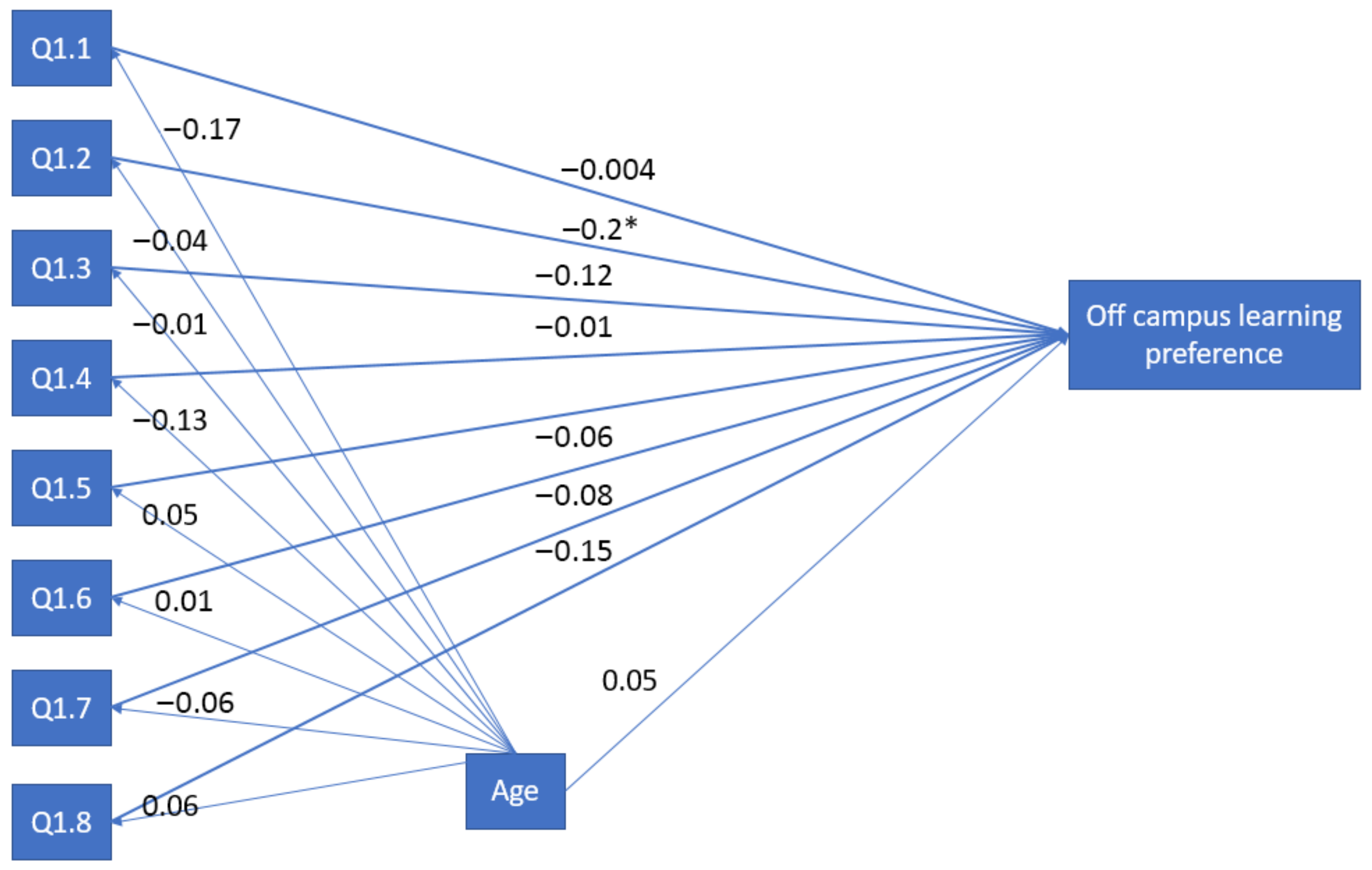
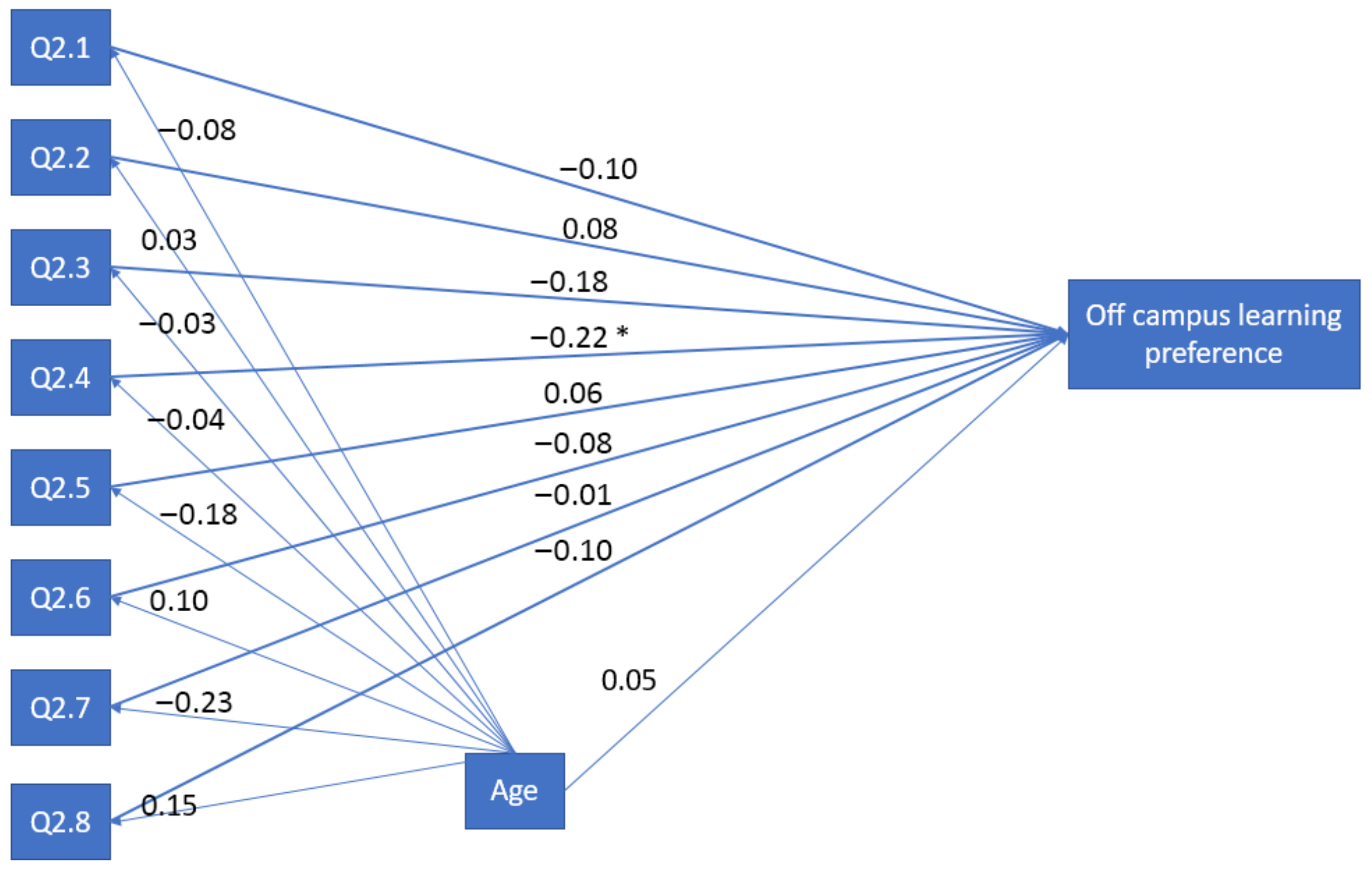
Figure 1 and
Figure 2 present the first and second path models, respectively, together with the standardized coefficients. Age was modeled as an exogenous background variable with direct paths to all observed variables, to account for age-related variance across students’ perceptions and off-campus learning preferences. Gender was also examined as a background variable. As it did not contribute meaningfully to the model and showed no significant association with off-campus learning preference (Q45), it was not included in the final path models. Age was included as a continuous background variable representing students’ academic and life stage, which may shape their perceptions and learning behaviors in a diffuse manner. Gender, although examined, was not theoretically central to the research question and did not contribute to the specification of the path models.
In the first model, only one theme was significantly associated with off-campus learning preference (Q45). Specifically, the theme reflecting a lack of focus and conciseness in on-campus instruction (Q1.2) exhibited a statistically significant negative relationship with Q45. None of the other themes derived from the first open-ended question showed a significant association with off-campus learning preference.
In the second model, a significant association with Q45 emerged only for the most prevalent theme—poor teaching quality (Q2.4). This theme was also negatively related to off-campus learning preference, whereas no other themes derived from the second open-ended question demonstrated statistically significant relationships with the outcome variable.
7. Discussion
The findings of the current study highlight a complex and nuanced relationship between students’ perceptions of on-campus teaching and their attitudes toward off-campus learning. Importantly, the results suggest that off-campus learning is not perceived by students as a preferred alternative to on-campus instruction, but rather as a compensatory mechanism that becomes necessary when certain deficiencies are experienced in the on-campus learning environment.
Finally, the study underscores the value of integrating qualitative insights with quantitative modeling. The mixed-methods approach made it possible to uncover latent meanings behind statistical associations that could otherwise be misinterpreted. Future research should further examine how specific pedagogical improvements within on-campus teaching environments influence students’ reliance on external learning resources, ideally using longitudinal designs to capture changes over time.
7.1. Needs Frustration and Controlled Motivation
These findings are exactly compatible with the predictions of the self-determination theory in general and of the need’s frustration model in particular (
Deci & Ryan, 2000;
Vansteenkiste & Ryan, 2013). The two models examined in the current study identified two main elements that showed a negative association with the preference for external learning:
Lack of focus and conciseness in teaching (Q1.2)—This theme reflects frustration of the need for efficacy. Students who experienced unfocused teaching with constant interruptions reported a sense of inefficiency and deficient understanding of the study material. Nonetheless, the negative association with the preference for external learning indicates that these students did not reject frontal teaching. Their criticism does not reflect a desire to switch to autonomous learning but rather a call for improvement of the existing instruction. This finding is particularly significant because the first open-ended question asked students to describe the advantages of off-campus learning. Nevertheless, even when students described how external resources provide them with “more focused and concise teaching”, they did not display a general preference for external learning. This means that they wanted the frontal teaching to have focus and conciseness.
Poor teaching quality (Q2.4)—This was the most common theme in the study (reported by 63 of the 118 respondents) and it too displayed a significant negative association with the preference for external learning. This theme reflects frustration of multiple needs: frustration of the need for efficacy (instructors do not prepare sufficiently, do not explain clearly), frustration of the need for connection (lack of interest in students’ success), and at times also frustration of the need for autonomy (strict teaching that does not take varied needs into account).
The surprising finding is that students who experienced and displayed the sharpest criticism of the quality of teaching showed a lower preference for external learning. If they would have rejected frontal teaching and happily switched to online learning we would have seen a positive or nonexistent link. The negative link attests that they still ascribed major value to effective frontal teaching and that their utilization of external resources is a temporary coping strategy rather than an authentic choice. These findings suggest a dynamic of controlled motivation, though further causal research is needed. Students are compelled to utilize external resources not due to an intrinsic desire but rather due to the need to avoid failure, close gaps, and achieve the necessary level of comprehension for exams—while still preferring to see an improvement in frontal teaching.
7.2. Lack of Support for the Autonomous Learning Track
Notably, none of the themes identified in the study showed a significant positive association with the preference for external learning. Thus, no evidence was found that students who appreciate certain aspects of teaching (or do not criticize it) develop a greater preference for autonomous learning. If the option of autonomous complementary learning was dominant, we would expect to find positive associations—for instance, that students who seek “alternative perspectives” (Q1.4) or who “appreciate time-related flexibility” would show a greater preference for external learning. But this did not happen. The only theme close to this logic was “external learning has no perceived advantage” (Q1.5), but it too showed no significant association. The conclusion is that the overall picture is consistent: Off-campus learning serves as a compensatory mechanism and not as a preferred alternative.
The present findings are consistent with recent work highlighting students’ growing reliance on external platforms that provide applied, data-driven learning tools alongside formal academic instruction. For example,
Wadmany and Davidovitch (
2025) refer to verita.co.il as an external course platform used by students to acquire practical skills in areas such as SQL and Excel (
Eckhaus, 2024), reflecting a broader trend toward complementary off-campus learning environments that respond to pragmatic academic and professional needs.
7.3. The Sustainability of the On-Campus Model
These findings carry significant implications for the sustainability of higher education institutions in the digital age. A sustainable educational model relies not only on technological advancement but on the continued relevance and perceived value of the physical campus. Our results suggest that if institutions fail to address instructional deficiencies, the ‘campus experience’ may become unsustainable as students increasingly rely on external, private, and digital alternatives to fulfill their pedagogical needs. Revitalizing frontal instruction through clarity, focus, and personal interaction is therefore essential for maintaining the long-term resilience and viability of traditional academic frameworks.
7.4. Theoretical Implications
The current study expands self-determination theory to a unique context: the choice between different learning platforms. While the focus of previous studies was when do students invest efforts in their studies (
Pintrich, 2000;
Zimmerman, 2002), the current study examines when do students choose where to learn. The findings show that this choice is not only a function of personal preference or technological availability, but mainly of the extent to which frontal instruction satisfies needs. Namely, the decision “to learn at home from videos” versus “to learn in the classroom” is not a free choice so long as classroom teaching does not meet the basic needs. This insight is important because it positions the quality of frontal teaching—and not only students’ preferences or technological benefits—as a key variable for understanding the use of digital resources.
7.5. Practical Implications for Institutions of Higher Education
The findings of the current study have clear meaningful practical implications:
Academic institutions should not interpret the rise in use of external resources as indication that frontal teaching has become outdated or irrelevant. On the contrary—the students themselves show that they appreciate frontal teaching and continue to attach major value to it. The message is not “let’s switch to digital”, but rather “let’s improve the quality”.
- 2.
Focusing on the quality of teaching.
Based on the themes identified in the study, there are distinct fields for improvement:
Focus and conciseness: There is a need to reduce distractions in class, ensure that time is utilized efficiently, and prevent unnecessary disruptions. This might require better class management and structured planning of lessons.
Clarity and depth: There is a need to ensure that explanations are clear, that enough examples are given, and that the material is explained in sufficient depth. Pedagogical training of instructors in STEM subjects is critical.
Constructive alignment: There is a need to generate a clear alignment between learning goals, teaching methods, and evaluation. Students must understand why they are studying and how this is linked to exams.
Personal attention: Even in large classes, ways of connecting with students should be found—by holding office hours, online forums, smaller exercise units, or using technology for questions and feedback.
Active learning: Switching from passive lectures to active learning—practice, discussions, solving problems in real time—can reduce the need for external resources.
- 3.
Infrastructure and study conditions.
The findings also indicate the need to improve physical conditions:
Smaller classes or splitting up into smaller groups for exercises.
Improving classroom quality: noise, crowding, and inadequate furniture—all have an impact on learning.
Physical availability: reducing the need for lengthy traveling or providing flexible study options to supplement effective frontal teaching.
- 4.
Wisely integrating digital means.
The findings do not indicate that “digital is bad”—rather than digital should complement and not replace. Institutions can:
Videotape lectures and allow students to review the study material.
Provide good quality digital resources that complement teaching.
Use technology for practice and rapid feedback.
But all this must be done alongside and not instead of improving the quality of frontal teaching.
- 5.
Evaluation and recognition of teaching.
Institutions must incentivize instructors to invest efforts in their teaching:
Recognition of excellent teaching through academic promotion.
Ongoing pedagogical training, particularly in STEM subjects.
Feedback and teaching evaluation systems that lead to real improvement.
8. Research Limitations and Future Directions
Notwithstanding its contribution, this study has several limitations that must be acknowledged. First, regarding sample representativeness, the focus on engineering students at a single university in Israel may limit the generalizability of the findings to other disciplines, institutions, or cultural contexts. Given these constraints, the current findings should be regarded as exploratory, providing a preliminary theoretical and empirical framework that requires further validation through larger, multi-institutional datasets. Furthermore, the study did not account for additional variables that might influence the utilization of off-campus resources, such as students’ individual autonomous learning abilities, socioeconomic backgrounds, or varying levels of access to technology.
The dependent variable—preference for off-campus learning—was measured using a single item, and our theoretical conclusions are based on a limited number of significant associations within the models. Consequently, the scope of our generalizations must be moderated; these findings should be interpreted with caution and viewed strictly through the lens of an exploratory study, serving as a foundation for more comprehensive future investigations.
Crucially, because this study was designed as an exploratory investigation, central constructs such as ‘needs frustration’ and ‘controlled motivation’ were not pre-defined or measured a priori using validated psychometric instruments. Instead, these concepts emerged inductively and were inferred indirectly from the qualitative data. While this approach allowed for an authentic exploration of students’ perceptions, it inherently limits the quantitative robustness of the theoretical claims regarding these specific psychological states.
These limitations provide fertile ground for several directions for future research. Future studies should employ intervention-based and longitudinal designs to examine how specific pedagogical improvements—such as instructor training or reduced class sizes—impact student motivation and reliance on external resources over time. To enhance the model’s external validity, inter-institutional and multicultural research is needed to determine whether these dynamics remain consistent across different countries and academic environments. Additionally, investigating the long-term professional outcomes of students who rely primarily on external learning could offer critical insights into the efficacy of this compensatory strategy.
Methodologically, future work should build upon these exploratory findings by utilizing established, validated psychometric instruments to directly measure and quantify “needs frustration” and “controlled motivation” within STEM instruction. Finally, complementing these quantitative efforts with in-depth qualitative research, such as interviews, would allow for a more nuanced understanding of the subjective experiences and psychological processes that drive students toward off-campus instruction.
9. Conclusions
In summary, this study examined whether off-campus learning reflects students’ authentic preferences or constitutes a compensatory response to instructional deficiencies. The findings suggest initial support for the compensatory scenario and emphasize that students still ascribe essential value to frontal instruction. The main insight for institutions of higher education is that on-campus instruction should not be replaced but rather improved by making efforts to enhance focus, clarity, depth, and physical conditions. Thus, the study proposes a new theoretical framework based on needs frustration and controlled motivation that allows deep understanding of learning choices in the digital era.
Ultimately, restoring the value of the campus experience is essential for institutional resilience. A sustainable university model must provide unique added value that digital platforms cannot replicate—specifically, high-quality, focused, and interactive frontal instruction that meets students’ psychological and academic needs.