Exploring How Holistic Teaching and Institutional Support Relate to Community College STEM Students’ Momentum and Self-Efficacy in Career-Relevant Competencies


Abstract
1. Introduction
2. Relevant Literature
2.1. Student Momentum and Career-Relevant Competencies in Community College STEM Contexts
2.2. Classroom Teaching Practices and Student Outcomes in STEM
2.3. Institutional Support and Student Outcomes in STEM
3. Theoretical Framework
4. Methods
4.1. Study Context and Research Design
4.2. Participants and Data Collection
4.3. Measures
4.3.1. Key Independent Variables
4.3.2. Main Dependent Variables
4.3.3. Mediating Variables
4.4. Data Analysis
4.4.1. Preparation and Descriptive Analysis
4.4.2. Confirmatory Factor Analysis
4.4.3. Multi-Group SEM
5. Findings
5.1. Confirmatory Factor Analysis Findings
5.2. Results of Measurement Invariance Tests
5.3. Results of Structural Invariance Tests
5.4. Results of Final Multi-Group SEM
6. Discussion, Implications, Limitations, and Conclusions
6.1. Discussion
6.2. Implications
6.3. Limitations
6.4. Conclusions
Author Contributions
Funding
Institutional Review Board Statement
Informed Consent Statement
Data Availability Statement
Acknowledgments
Conflicts of Interest
Abbreviations
| STEM | Science, Technology, Engineering, and Mathematics |
| CFA | Confirmatory Factor Analysis |
| SEM | Structural Equation Modeling |
| MLR | Maximum Likelihood with Robust Standard Errors |
| FIML | Full Information Maximum Likelihood |
| CFI | Comparative Fit Index |
| TLI | Tucker–Lewis Index |
| RMSEA | Root Mean Square Error of Approximation |
| SRMR | Standardized Root Mean Square Residual |
References
- Adelman, C. (1999). Answers in the toolbox: Academic intensity, attendance patterns, and bachelor’s degree attainment. U.S. Department of Education, Office of Educational Research and Improvement. [Google Scholar]
- Anderson, J. C., & Gerbing, D. W. (1988). Structural equation modeling in practice: A review and recommended two-step approach. Psychological Bulletin, 103(3), 411–423. [Google Scholar] [CrossRef]
- Attewell, P., Heil, S., & Reisel, L. (2012). What is academic momentum? And does it matter? Educational Evaluation and Policy Analysis, 34(1), 27–44. [Google Scholar] [CrossRef]
- Bahr, P. R., Jackson, G., McNaughtan, J., Oster, M., & Gross, J. (2017). Unrealized potential: Community college pathways to STEM baccalaureate degrees. The Journal of Higher Education, 88(3), 430–478. [Google Scholar] [CrossRef]
- Bandura, A. (1997). Self-efficacy: The exercise of control (Vol. 11). Freeman. [Google Scholar]
- Bartolomé, L. I. (1994). Beyond the methods fetish: Toward a humanizing pedagogy. Harvard Educational Review, 64(2), 173–195. [Google Scholar] [CrossRef]
- Bronfenbrenner, U. (1979). The ecology of human development: Experiments by nature and design. Harvard University Press. [Google Scholar]
- Chen, F. F. (2007). Sensitivity of goodness of fit indexes to lack of measurement invariance. Structural Equation Modeling, 14(3), 464–504. [Google Scholar] [CrossRef]
- Cheung, G. W., & Rensvold, R. B. (2000). Assessing extreme and acquiescence response sets in cross-cultural research using structural equations modeling. Journal of Cross-Cultural Psychology, 31(2), 187–212. [Google Scholar] [CrossRef]
- Coburn, C. E. (2004). Beyond decoupling: Rethinking the relationship between the institutional environment and the classroom. Sociology of Education, 77(3), 211–244. [Google Scholar] [CrossRef]
- Cohen, R., & Kelly, A. M. (2018). Community college chemistry coursetaking and STEM academic persistence. Journal of Chemical Education, 96(1), 3–11. [Google Scholar] [CrossRef]
- Concha, J. B., Umucu, E., Duarte-Gardea, M., Gonzalez, A. L., Solis, G. R., Loya, A. M., O’Dell, L. E., & Mathew, R. (2024). Hispanic-serving institutions contributing to the training and diversity of the public health and health care workforce. American Journal of Public Health, 114(S6), S472–S477. [Google Scholar] [CrossRef]
- Crisp, G., & Cruz, I. (2009). Mentoring college students: A critical review of the literature between 1990 and 2007. Research in Higher Education, 50(6), 525–545. [Google Scholar] [CrossRef]
- da Silva Cardoso, E., Dutta, A., Chiu, C. Y., Johnson, E. T., Kundu, M., & Chan, F. (2013). Social-cognitive predictors of STEM career interests and goal persistence in college students with disabilities from racial and ethnic minority backgrounds. Rehabilitation Research, Policy, and Education, 27(4), 271–284. [Google Scholar] [CrossRef]
- Deil-Amen, R. (2006). To teach or not to teach “social” skills: Comparing community colleges and private occupational colleges. Teachers College Record, 108(3), 425–456. [Google Scholar] [CrossRef]
- Deil-Amen, R. (2011). Socio-academic integrative moments: Rethinking academic and social integration among two-year college students in career-related programs. The Journal of Higher Education, 82(1), 54–91. [Google Scholar] [CrossRef]
- Doran, E. (2023). Toward a new understanding of Hispanic-serving community colleges. Community College Review, 51(2), 285–305. [Google Scholar] [CrossRef]
- Drake, J. K. (2011). The role of academic advising in student retention and persistence. About Campus, 16(3), 8–12. [Google Scholar] [CrossRef]
- Enders, C. K., & Bandalos, D. L. (2001). The relative performance of full information maximum likelihood estimation for missing data in structural equation models. Structural Equation Modeling, 8(3), 430–457. [Google Scholar] [CrossRef]
- Evermann, J. (2010). Multiple-group analysis using the SEM package in the R system. Structural Equation Modeling, 17(4), 677–702. [Google Scholar] [CrossRef]
- Felder, R. M., & Brent, R. (1996). Navigating the bumpy road to student-centered instruction. College Teaching, 44(2), 43–47. [Google Scholar] [CrossRef]
- Fosnacht, K., Sarraf, S., Howe, E., & Peck, L. K. (2017). How important are high response rates for college student surveys? The Review of Higher Education, 40(2), 245–265. [Google Scholar] [CrossRef]
- Freeman, S., Eddy, S. L., McDonough, M., Smith, M. K., Okoroafor, N., Jordt, H., & Wenderoth, M. P. (2014). Active learning increases student performance in science, engineering, and mathematics. Proceedings of the National Academy of Sciences, 111(23), 8410–8415. [Google Scholar] [CrossRef]
- Gasiewski, J. A., Eagan, M. K., Garcia, G. A., Hurtado, S., & Chang, M. J. (2012). From gatekeeping to engagement: A multicontextual, mixed-method study of student academic engagement in introductory STEM courses. Research in Higher Education, 53(2), 229–261. [Google Scholar] [CrossRef]
- Gay, G. (2018). Culturally responsive teaching: Theory, research, and practice (3rd ed.). Teachers College Press. [Google Scholar]
- Grillo, M. C., & Leist, C. W. (2013). Academic support as a predictor of retention to graduation: New insights on the role of tutoring, learning assistance, and supplemental instruction. Journal of College Student Retention: Research, Theory & Practice, 15(3), 387–408. [Google Scholar] [CrossRef]
- Hatcher, L., & O’Rourke, N. (2013). A step-by-step approach to using SAS for factor analysis and structural equation modeling (2nd ed.). SAS Institute. [Google Scholar]
- Herrera, F. A., Rodríguez-Operana, V. C., Kovats Sánchez, G., Cerrillos, A., & Márquez, B. (2022). “It was hard, and it still is…”: Women of color navigating HSI STEM transfer pathways. AERA Open, 8, 1–15. [Google Scholar] [CrossRef]
- Hora, M. T. (2019). Beyond the skills gap: Preparing college students for life and work. Harvard Education Press. [Google Scholar]
- Hora, M. T., & Lee, C. (2021). Does industry experience increase the teaching of “soft” skills in community college classrooms? New Directions for Community Colleges, 2021(195), 65–79. [Google Scholar] [CrossRef]
- Hu, L. T., & Bentler, P. M. (1999). Cutoff criteria for fit indexes in covariance structure analysis: Conventional criteria versus new alternatives. Structural Equation Modeling: A Multidisciplinary Journal, 6(1), 1–55. [Google Scholar] [CrossRef]
- Jenson, R. J., Petri, A. N., Day, A. D., Truman, K. Z., & Duffy, K. (2011). Perceptions of self-efficacy among STEM students with disabilities. Journal of Postsecondary Education and Disability, 24(4), 269–283. [Google Scholar]
- Jöreskog, K. G., & Sörbom, D. (1996). LISREL 8: User’s reference guide. Scientific Software International. [Google Scholar]
- Kaplan, D. (2009). Structural equation modeling: Foundations and extensions (Vol. 10). SAGE. [Google Scholar]
- Kisker, C. B., Cohen, A. M., & Brawer, F. B. (2023). The American community college. John Wiley & Sons. [Google Scholar]
- Kline, R. B. (2023). Principles and practice of structural equation modeling (5th ed.). The Guilford Press. [Google Scholar]
- Komarraju, M., Musulkin, S., & Bhattacharya, G. (2010). Role of student–faculty interactions in developing college students’ academic self-concept, motivation, and achievement. Journal of College Student Development, 51(3), 332–342. [Google Scholar] [CrossRef]
- Ladson-Billings, G. (1995). But that’s just good teaching! The case for culturally relevant pedagogy. Theory Into Practice, 34(3), 159–165. [Google Scholar] [CrossRef]
- Lent, R. W., Brown, S. D., & Hackett, G. (1994). Toward a unifying social cognitive theory of career and academic interest, choice, and performance. Journal of Vocational Behavior, 45(1), 79–122. [Google Scholar] [CrossRef]
- Lent, R. W., Brown, S. D., & Hackett, G. (2000). Contextual supports and barriers to career choice: A social cognitive analysis. Journal of Counseling Psychology, 47(1), 36–49. [Google Scholar] [CrossRef]
- Li, C. H. (2016). Confirmatory factor analysis with ordinal data: Comparing robust maximum likelihood and diagonally weighted least squares. Behavior Research Methods, 48, 936–949. [Google Scholar] [CrossRef]
- Myran, S. P., & Sylvester, P. J. (2021). Community college workforce development and student self-efficacy. Community College Journal of Research and Practice, 45(8), 590–607. [Google Scholar] [CrossRef]
- Nora, A. (1990). Campus-based aid programs as determinants of retention among Hispanic community college students. The Journal of Higher Education, 61(3), 312–331. [Google Scholar] [CrossRef]
- Núñez, A. M. (2022). Creating cultures of student success: Insights from Hispanic-Serving Institution computer science departments. Change: The Magazine of Higher Learning, 54(5), 44–51. [Google Scholar] [CrossRef]
- Núñez, A. M. (2023). Examining organizational behavior of Hispanic-Serving Institution computer science departments: Toward servingness and equity in the field. Journal of Women and Minorities in Science and Engineering, 29(2), 129–156. [Google Scholar] [CrossRef]
- Packard, B. W. L. (2012). Effective outreach, recruitment, and mentoring into STEM pathways: Strengthening partnerships with community colleges. In J. B. Labov, & S. Olson (Eds.), Community colleges in the evolving STEM education landscape: Summary of a summit (pp. 57–80). National Academies Press. [Google Scholar]
- Perez, E. J. (2023). The life cycle of STEMM intervention programs: From adoption to institutionalization [Doctoral dissertation, University of California]. Available online: https://www.proquest.com/docview/2866297364?pq-origsite=gscholar&fromopenview=true&sourcetype=Dissertations%20&%20Theses (accessed on 1 January 2025).
- Porter, S. R., & Umbach, P. D. (2006). Student survey response rates across institutions: Why do they vary? Research in Higher Education, 47(2), 229–247. [Google Scholar] [CrossRef]
- R Core Team. (2020). R: A language environment for statistical computing. The R Foundation for Statistical Computing. Available online: https://www.r-project.org (accessed on 1 January 2025).
- Reyes, M. E. (2011). Unique challenges for women of color in STEM transferring from community colleges to universities. Harvard Educational Review, 81(2), 241–263. [Google Scholar] [CrossRef]
- Rodriguez, J., Fox, H., & McCambly, H. (2016). Work-based learning as a pathway to postsecondary and career success: Insights on equity and outcomes (Insights on Equity and Outcomes. Issue 18). Office of Community College Research and Leadership. [Google Scholar]
- Rodriguez, S. L., Cunningham, K., & Jordan, A. (2016). What a scientist looks like: How community colleges can utilize and enhance science identity development as a means to improve success for women of color. Community College Journal of Research and Practice, 41(4–5), 232–238. [Google Scholar] [CrossRef]
- Roksa, J., Jenkins, D., Jaggars, S. S., Zeidenberg, M., & Cho, S. W. (2009). Strategies for promoting gatekeeper course success among students needing remediation: Research report for the Virginia community college system. Community College Research Center, Teachers College, Columbia University. [Google Scholar]
- Rosseel, Y. (2012). lavaan: An R package for structural equation modeling. Journal of Statistical Software, 48(2), 1–36. [Google Scholar] [CrossRef]
- Rosseel, Y., Jorgensen, T., & De Wilde, L. (2025). lavaan: Latent Variable Analysis (R package version 0.6-20) [Computer software]. Available online: https://CRAN.R-project.org/package=lavaan (accessed on 1 January 2025).
- Sax, L. J., Gilmartin, S. K., Lee, J. J., & Hagedorn, L. S. (2008). Using web surveys to reach community college students: An analysis of response rates and response bias. Community College Journal of Research and Practice, 32(9), 712–729. [Google Scholar] [CrossRef]
- Seymour, E., & Hewitt, N. M. (1997). Talking about leaving: Why undergraduates leave the sciences. Westview Press. [Google Scholar]
- Villegas, A. M., & Lucas, T. (2002). Preparing culturally responsive teachers: Rethinking the curriculum. Journal of Teacher Education, 53(1), 20–32. [Google Scholar] [CrossRef]
- Wang, X. (2015). Course-taking patterns of community college students beginning in STEM: Using data mining techniques to reveal viable STEM transfer pathways. Research in Higher Education, 57(5), 544–569. [Google Scholar] [CrossRef]
- Wang, X. (2017). Toward a holistic theoretical model of momentum for community college student success. In M. B. Paulsen (Ed.), Higher education: Handbook of theory and research (pp. 259–308). Springer. [Google Scholar] [CrossRef]
- Wang, X. (2020). On my own: The challenge and promise of building equitable STEM transfer pathways. Harvard Education Press. [Google Scholar]
- Wang, X. (2024a). Delivering on the promise: Equity-driven reform in community colleges. Harvard Education Press. [Google Scholar]
- Wang, X. (2024b). Paving community college student pathways for equitable STEM education. National Academies of Sciences, Engineering, and Medicine. Available online: https://nap.nationalacademies.org/resource/28268/Paving-Community-College-Student-Pathways-for-Equitable-STEM-Education.pdf (accessed on 1 January 2025).
- Wang, X., Sun, N., Lee, S. Y., & Wagner, B. (2017). Does active learning contribute to transfer intent among 2-year college students beginning in STEM? The Journal of Higher Education, 88(4), 593–618. [Google Scholar] [CrossRef]



| Total | Institution A | Institution B | Institution C | ||||||
|---|---|---|---|---|---|---|---|---|---|
| N a | % | N a | % | N a | % | N a | % | ||
| Total | 1258 | 247 | 141 | 870 | |||||
| Race/ethnicity | Students of Color | 853 | 67.81 | 104 | 42.11 | 85 | 60.28 | 664 | 76.32 |
| White Students | 405 | 32.19 | 143 | 57.89 | 56 | 39.72 | 206 | 23.68 | |
| Gender | Man | 641 | 50.95 | 137 | 55.47 | 76 | 53.90 | 428 | 49.20 |
| Woman | 545 | 43.32 | 97 | 39.27 | 55 | 39.01 | 393 | 45.17 | |
| Non-Binary | 72 | 5.72 | 13 | 5.26 | 10 | 7.09 | 49 | 5.63 | |
| Transgender | 76 | 6.04 | 11 | 4.45 | 11 | 7.80 | 54 | 6.21 | |
| International Students | 131 | 10.41 | 20 | 8.10 | 18 | 12.77 | 93 | 10.69 | |
| DACA Recipients | 50 | 3.97 | 5 | 2.02 | 9 | 6.38 | 36 | 4.14 | |
| Financially Dependent | 685 | 54.45 | 114 | 46.15 | 56 | 39.72 | 515 | 59.20 | |
| Low-Income Students b | 462 | 36.72 | 95 | 38.46 | 61 | 43.26 | 306 | 35.17 | |
| First-Generation Students | 776 | 61.69 | 146 | 59.11 | 97 | 68.79 | 533 | 61.26 | |
| Adult Students | 431 | 34.26 | 101 | 40.89 | 72 | 51.06 | 258 | 29.66 | |
| Full-Time Students | 809 | 64.31 | 160 | 64.78 | 82 | 58.16 | 567 | 65.17 | |
| Employed | 776 | 61.69 | 179 | 72.47 | 93 | 65.96 | 504 | 57.93 | |
| Served in U.S. Armed Forces, Reserves, or National Guard | 56 | 4.45 | 6 | 2.43 | 10 | 7.09 | 40 | 4.60 | |
| Been in Foster Care | 25 | 1.99 | 5 | 2.02 | 1 | 0.71 | 19 | 2.18 | |
| Single Parents | 70 | 5.56 | 15 | 6.07 | 21 | 14.89 | 34 | 3.91 | |
| Have Diagnosed Disability | 247 | 19.63 | 72 | 29.15 | 23 | 16.31 | 152 | 17.47 | |
| English as First Language | 928 | 73.77 | 198 | 80.16 | 115 | 81.56 | 615 | 70.69 | |
| Been Incarcerated in Jail or Prison or a Juvenile Facility | 34 | 2.70 | 8 | 3.24 | 8 | 5.67 | 18 | 2.07 | |
| Access to Transportation | 1169 | 92.93 | 236 | 95.55 | 131 | 92.91 | 802 | 92.18 | |
| Variable Name | Description |
|---|---|
| Exogenous Variables | |
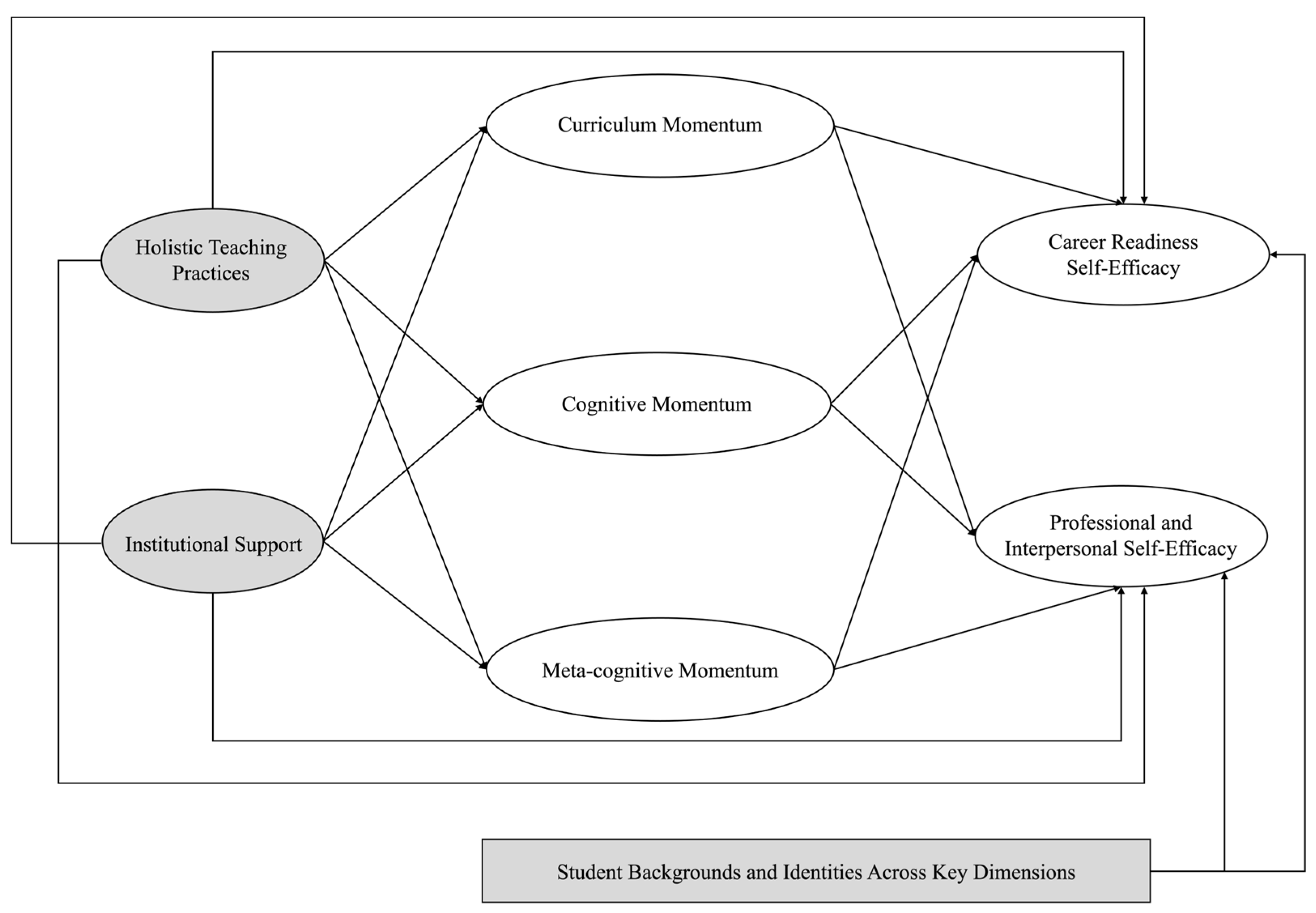
| Holistic Teaching Practices | How helpful to your learning are your instructors’ grading practices or policies? a How helpful to your learning are your instructors’ attendance expectations or policies? a How helpful are your instructors in pointing you to resources or services that support your success in classes? a How supported do you feel as a whole person in your classes? a |
| Institutional Support | Reflecting on your experience at the college, how much do you feel … welcomed on this campus? b supported at your college? b connected to your college? b safe at your college? b that you have a person or place to turn to if you have questions or concerns? b that faculty are understanding of students’ unique life circumstances? b that faculty are fair and unbiased in their treatment of individual students? b |
| Mediating Variable | |
| Curriculum Momentum | How clear are you about the next course(s) you should take? a How informed do you feel about what course(s) you need to take each semester? a How likely are you to continue enrolling until you reach your main goal? a |
| Cognitive Momentum | How much do your learning experiences through coursework help you … have a clear understanding of course content? a develop knowledge and expertise in the topics covered? a develop your problem-solving skills? a refine your critical thinking? a prepare you for your field or occupation of interest? a |
| Meta-Cognitive Momentum | How often do you use the following approaches? Preparing for class by reading assigned text and other learning materials ahead of time c Planning your activities in order to do your best work (e.g., identifying best places to study; managing time to ensure timely completion of academic tasks) c Monitoring your academic progress and making corrections/adjustments when needed c Determining and prioritizing important tasks c Learning from prior experiences, knowledge, and errors c |
| Endogenous Variables: Self-Efficacy in Career-Relevant Competencies | |
| Career Readiness Self-Efficacy | In light of your future career and education, how confident are you about each of the following? Be well prepared for a job in your intended field a Go through a hiring process and secure a job in your field a Meet the needs of an employer in your intended field a Have gained the necessary skills to be successful in your field a Develop a clear career plan to promote your professional advancement a Know if/what further education may be required to meet long-term goals a Successfully pursue further education (including transfer to a bachelor’s degree program) a |
| Professional and Interpersonal Self-Efficacy | In light of your future career and education, how confident are you about each of the following? Work collaboratively with others to complete a given task a Come up with creative solutions to problems or challenges a Know who and where to go if you need help to solve complex problems a Effectively give a presentation individually and collaboratively a Effectively share your ideas out loud a Write clearly and effectively to communicate information a Effectively handle criticism and constructive feedback a |
| Covariates | |
| Race/Ethnicity | What race/ethnicity best describes you? 1 = Students of Color ● African American or Black ● Middle Eastern or North African or Arab or Arab American ● Southeast Asian ● American Indian or Alaskan Native ● Indigenous ● Hispanic or Latinx/Latina/Latino or Chicanx/Chicana/Chicano ● Pacific Islander or Native Hawaiian ● Other Asian or Asian American ● Other (please specify) ● Prefer not to answer 2 = White or Caucasian |
| DACA | Are you a recipient of the DACA (Deferred Action for Childhood Arrivals) program? d |
| Gender | What is your gender? 1 = Man; 2 = Woman; 3 = Non-Binary |
| Transgender | Are you transgender? d |
| Financially Dependent | Are you considered financially dependent on your parent(s) or legal guardian(s)? |
| Low-Income | Considering income from all sources, are you considered as low-income? d e |
| First-Generation | Are you a first-generation student? d |
| Adult Students | Are you an adult student? d |
| Full-Time Status | Are you full-time student? d |
| Employment Status | Are you employed? d |
| Veteran | Are you currently or have you ever served in the U.S. Armed Forces, Reserves, or National Guard? d |
| Foster | Have you ever been in foster care? d |
| Single Parents | Are you a single parent with at least one dependent child? d |
| Disability | Do you have a documented or diagnosed disability? d |
| English as the First Language | Is English your first or primary language? d |
| Been Incarcerated in Jail or Prison or a Juvenile Facility | Have you ever been incarcerated in jail or prison or a juvenile facility? [Incarceration means serving a term in prison or jail.] d |
| Access to Transportation | Do you have access to transportation (via own car/carpooling, public transportation, riding a bike, etc.) to and from your college? d |
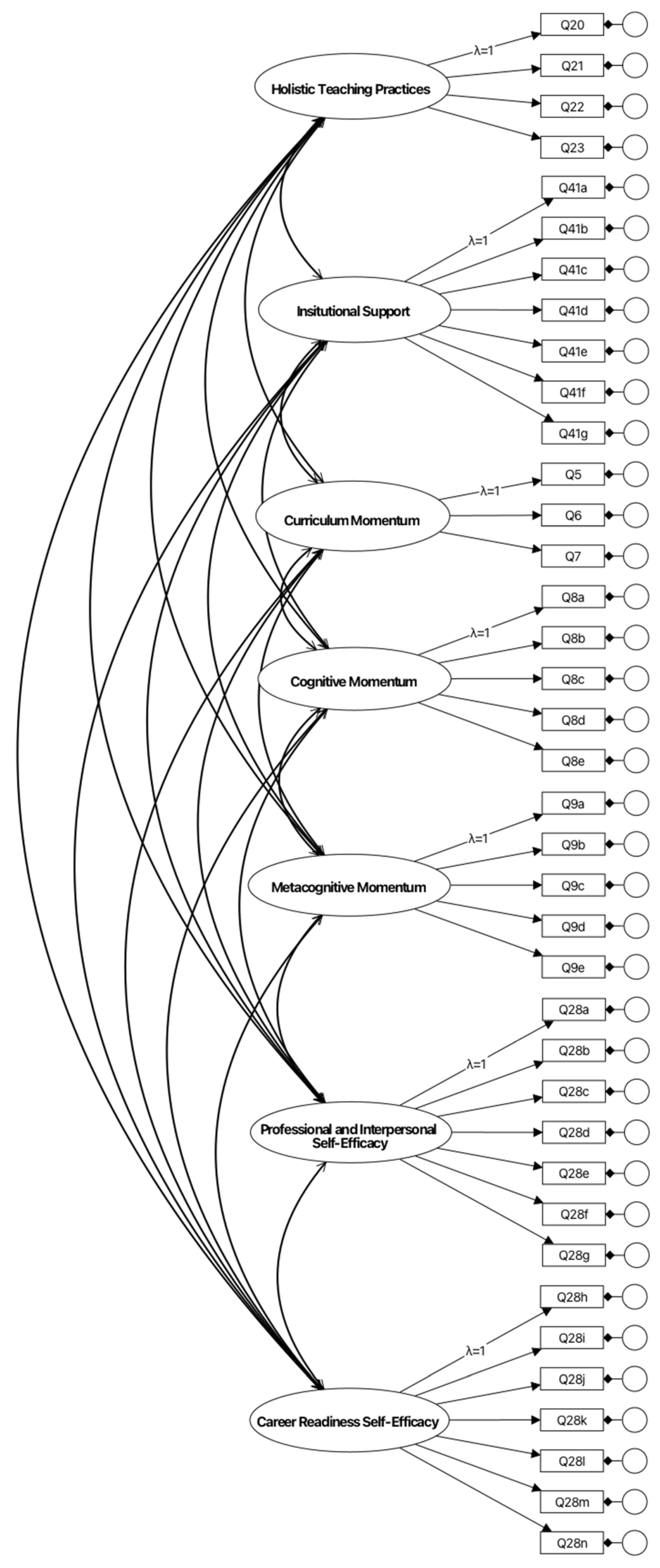
| Factors and Indicators | Unstd. | SE | Std.All | |
|---|---|---|---|---|
| Holistic Teaching Practices | ||||
| How helpful to your learning are your instructors’ grading practices or policies? a | 1.000 | 0.627 | 0.670 | |
| How helpful to your learning are your instructors’ attendance expectations or policies? a | 0.893 | *** | 0.047 | 0.555 |
| How helpful are your instructors in pointing you to resources or services that support your success in classes? a | 1.073 | *** | 0.058 | 0.713 |
| How supported do you feel as a whole person in your classes? a | 1.339 | *** | 0.066 | 0.824 |
| Institutional Support | ||||
| Reflecting on your experience at the college, how much do you feel … | ||||
| welcomed on this campus? b | 1.000 | 0.755 | 0.774 | |
| supported at your college? b | 1.168 | *** | 0.033 | 0.862 |
| connected to your college? b | 1.256 | *** | 0.043 | 0.788 |
| safe at your college? b | 0.739 | *** | 0.033 | 0.616 |
| that you have a person or place to turn to if you have questions or concerns? b | 1.154 | *** | 0.049 | 0.737 |
| that faculty are understanding of students’ unique life circumstances? b | 1.083 | *** | 0.043 | 0.759 |
| that faculty are fair and unbiased in their treatment of individual students? b | 0.912 | *** | 0.041 | 0.688 |
| Curriculum Momentum | *** | |||
| How clear are you about the next course(s) you should take? a | 1.000 | *** | 0.608 | 0.592 |
| How informed do you feel about what course(s) you need to take each semester? a | 1.075 | *** | 0.054 | 0.632 |
| How likely are you to continue enrolling until you reach your main goal? a | 0.714 | *** | 0.056 | 0.574 |
| Cognitive Momentum | ||||
| How much do your learning experiences through coursework help you … | ||||
| have a clear understanding of course content? a | 1.000 | 0.571 | 0.775 | |
| develop knowledge and expertise in the topics covered? a | 1.150 | *** | 0.038 | 0.822 |
| develop your problem-solving skills? a | 1.093 | *** | 0.049 | 0.727 |
| refine your critical thinking? a | 1.071 | *** | 0.052 | 0.687 |
| prepare you for your field or occupation of interest? a | 1.171 | *** | 0.062 | 0.681 |
| Meta-Cognitive Momentum | ||||
| How often do you use the following approaches? | ||||
| Preparing for class by reading assigned text and other learning materials ahead of time c | 1.000 | 0.572 | 0.561 | |
| Planning your activities in order to do your best work (e.g., identifying best places to study; managing time to ensure timely completion of academic tasks) c | 1.207 | *** | 0.059 | 0.734 |
| Monitoring your academic progress and making corrections/adjustments when needed c | 0.984 | *** | 0.058 | 0.680 |
| Determining and prioritizing important tasks c | 0.949 | *** | 0.064 | 0.706 |
| Learning from prior experiences, knowledge, and errors c | 0.821 | *** | 0.056 | 0.644 |
| Career Readiness Self-Efficacy | ||||
| In light of your future career and education, how confident are you about each of the following? | ||||
| Be well prepared for a job in your intended field a | 1.000 | 0.848 | 0.833 | |
| Go through a hiring process and secure a job in your field a | 1.173 | *** | 0.033 | 0.855 |
| Meet the needs of an employer in your intended field a | 1.112 | *** | 0.031 | 0.882 |
| Have gained the necessary skills to be successful in your field a | 1.080 | *** | 0.030 | 0.846 |
| Develop a clear career plan to promote your professional advancement a | 1.018 | *** | 0.035 | 0.781 |
| Know if/what further education may be required to meet long-term goals a | 0.767 | *** | 0.034 | 0.635 |
| Successfully pursue further education (including transfer to a bachelor’s degree program) a | 0.659 | *** | 0.033 | 0.544 |
| Professional and Interpersonal Self-Efficacy | ||||
| In light of your future career and education, how confident are you about each of the following? | ||||
| Work collaboratively with others to complete a given task a | 1.000 | 0.627 | 0.672 | |
| Come up with creative solutions to problems or challenges a | 0.924 | *** | 0.040 | 0.704 |
| Know who and where to go if you need help to solve complex problems a | 1.076 | *** | 0.053 | 0.721 |
| Effectively give a presentation individually and collaboratively a | 1.189 | *** | 0.050 | 0.688 |
| Effectively share your ideas out loud a | 1.152 | *** | 0.051 | 0.694 |
| Write clearly and effectively to communicate information a | 0.897 | *** | 0.047 | 0.661 |
| Effectively handle criticism and constructive feedback a | 0.856 | *** | 0.049 | 0.629 |
| Model | Chi-Square | df | Δχ2 (Δdf) | p | CFI | ΔCFI | TLI | RMSEA | ΔRMSEA | SRMR |
|---|---|---|---|---|---|---|---|---|---|---|
| All three institutions (N = 1258) | 1993.164 | 635 | 0.956 | 0.951 | 0.038 | 0.042 | ||||
| Institution A (N = 247) | 1190.868 | 635 | 0.909 | 0.899 | 0.052 | 0.064 | ||||
| Institution B (N = 141) | 931.552 | 635 | 0.926 | 0.918 | 0.050 | 0.068 | ||||
| Institution C (N = 870) | 1689.195 | 635 | 0.954 | 0.949 | 0.040 | 0.044 | ||||
| Multi-Group Analysis: Institution | ||||||||||
| Configural model | 3811.615 | 1905 | 0.943 | 0.937 | 0.044 | 0.051 | ||||
| Metric invariance model | 3888.985 | 1967 | 67.7 (62) | 0.290 | 0.942 | 0.001 | 0.938 | 0.043 | 0.001 | 0.053 |
| Scalar invariance model | 4041.961 | 2029 | 154.6 (62) | 0.000 | 0.939 | 0.003 | 0.937 | 0.044 | 0.001 | 0.053 |
| Model | Chi-Square | df | Δχ2 (Δdf) | p | CFI | ΔCFI | TLI | RMSEA | ΔRMSEA | SRMR |
|---|---|---|---|---|---|---|---|---|---|---|
| All three institutions (N = 1258) | 3194.381 | 1286 | 0.936 | 0.932 | 0.033 | 0.043 | ||||
| Institution A (N = 247) | 2080.420 | 1286 | 0.856 | 0.845 | 0.048 | 0.064 | ||||
| Institution B (N = 141) | 1868.064 | 1286 | 0.830 | 0.817 | 0.056 | 0.075 | ||||
| Institution C (N = 870) | 2699.042 | 1286 | 0.936 | 0.931 | 0.033 | 0.047 | ||||
| Multi-Group Analysis: Institution | ||||||||||
| Configural model | 6933.025 | 4014 | 0.904 | 0.901 | 0.040 | 0.056 | ||||
| All Path coefficient constrained-equal model | 6992.116 | 4086 | 63.6.0 (72) | 0.750 | 0.904 | 0.000 | 0.903 | 0.039 | 0.001 | 0.057 |
| Estimate | Std.Err | Std.All | 95% CI | p (>|z|) | |||
|---|---|---|---|---|---|---|---|
| Direct Effect | |||||||
| Outcome | Predictor | ||||||
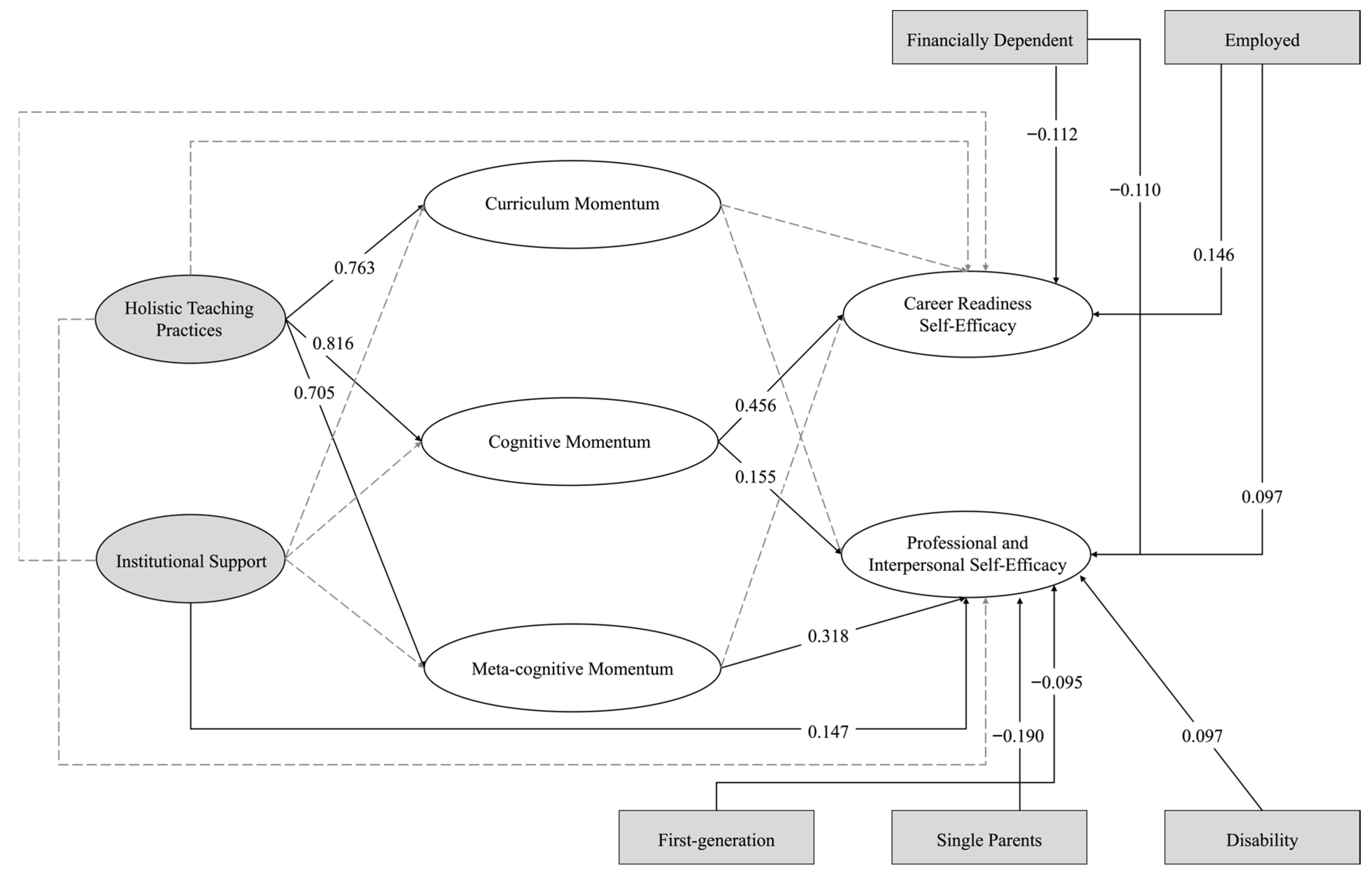
| Curriculum Momentum | Holistic Teaching Practices | 0.763 | *** | 0.199 | 0.768 | [0.373, 1.152] | 0.000 |
| Institutional Support | −0.029 | 0.144 | −0.035 | [−0.313, 0.254] | 0.838 | ||
| Cognitive Momentum | Holistic Teaching Practices | 0.816 | *** | 0.161 | 0.915 | [0.501, 1.131] | 0.000 |
| Institutional Support | −0.083 | 0.114 | −0.111 | [−0.306, 0.139] | 0.464 | ||
| Meta-Cognitive Momentum | Holistic Teaching Practices | 0.705 | *** | 0.149 | 0.685 | [0.414, 0.997] | 0.000 |
| Institutional Support | −0.161 | 0.102 | −0.185 | [−0.361, 0.038] | 0.113 | ||
| Career Readiness Self-Efficacy | Curriculum Momentum | 0.160 | 0.105 | 0.117 | [−0.046, 0.367] | 0.128 | |
| Cognitive Momentum | 0.456 | *** | 0.102 | 0.299 | [0.256, 0.656] | 0.000 | |
| Meta-cognitive Momentum | 0.078 | 0.066 | 0.059 | [−0.051, 0.208] | 0.235 | ||
| Holistic Teaching Practices | 0.192 | 0.175 | 0.141 | [−0.150, 0.535] | 0.271 | ||
| Institutional Support | 0.108 | 0.068 | 0.094 | [−0.026, 0.242] | 0.113 | ||
| Professional and Interpersonal Self-Efficacy | Curriculum Momentum | 0.083 | 0.076 | 0.079 | [−0.066, 0.232] | 0.273 | |
| Cognitive Momentum | 0.155 | * | 0.077 | 0.132 | [0.003, 0.307] | 0.045 | |
| Meta-cognitive Momentum | 0.318 | *** | 0.053 | 0.312 | [0.214, 0.421] | 0.000 | |
| Holistic Teaching Practices | 0.214 | 0.129 | 0.204 | [−0.039, 0.468] | 0.098 | ||
| Institutional Support | 0.147 | ** | 0.050 | 0.166 | [0.050, 0.244] | 0.003 | |
| Predictor → Outcome | Mediator | ||||||
| Holistic Teaching Practices → Career Readiness Self-Efficacy | Curriculum Momentum | 0.122 | 0.081 | 0.087 | [−0.037, 0.282] | 0.133 | |
| Cognitive Momentum | 0.372 | *** | 0.096 | 0.264 | [0.183, 0.561] | 0.000 | |
| Meta-cognitive Momentum | 0.055 | 0.045 | 0.039 | [−0.033, 0.144] | 0.221 | ||
| Holistic Teaching Practices → Professional and Interpersonal Self-Efficacy | Curriculum Momentum | 0.064 | 0.056 | 0.063 | [−0.046, 0.173] | 0.257 | |
| Cognitive Momentum | 0.127 | * | 0.062 | 0.126 | [0.005, 0.248] | 0.041 | |
| Meta-cognitive Momentum | 0.224 | *** | 0.051 | 0.223 | [0.125, 0.323] | 0.000 | |
| Institutional Support → Career Readiness Self-Efficacy | Curriculum Momentum | −0.005 | 0.023 | −0.004 | [−0.050, 0.040] | 0.838 | |
| Cognitive Momentum | −0.038 | 0.050 | −0.033 | [−0.137, 0.061] | 0.451 | ||
| Meta-cognitive Momentum | −0.013 | 0.012 | −0.011 | [−0.036, 0.010] | 0.283 | ||
| Institutional Support → Professional and Interpersonal Self-Efficacy | Curriculum Momentum | −0.002 | 0.012 | −0.003 | [−0.026, 0.021] | 0.836 | |
| Cognitive Momentum | −0.013 | 0.017 | −0.016 | [−0.047, 0.021] | 0.455 | ||
| Meta-cognitive Momentum | −0.051 | 0.031 | −0.063 | [−0.113, 0.010] | 0.104 | ||
| Estimate | Std.Err | Std.All | 95% CI | p(>|z|) | |||
| Outcome | Covariates | ||||||
| Career Readiness Self-Efficacy | Race/Ethnicity | 0.072 | 0.049 | 0.044 | [−0.024, 0.168] | 0.141 | |
| International Students | −0.006 | 0.073 | −0.002 | [−0.149, 0.137] | 0.932 | ||
| DACA Recipient | −0.040 | 0.108 | −0.007 | [−0.252, 0.171] | 0.707 | ||
| Gender | −0.010 | 0.038 | −0.008 | [−0.084, 0.064] | 0.782 | ||
| Transgender | 0.032 | 0.098 | 0.008 | [−0.161, 0.224] | 0.748 | ||
| Financially Dependent | −0.112 | * | 0.050 | −0.069 | [−0.210, −0.014] | 0.025 | |
| Low-Income | 0.008 | 0.043 | 0.005 | [−0.077, 0.093] | 0.856 | ||
| First-Generation | 0.008 | 0.043 | 0.005 | [−0.077, 0.092] | 0.857 | ||
| Adult Student | −0.047 | 0.053 | −0.028 | [−0.151, 0.057] | 0.376 | ||
| Full-Time Status | −0.024 | 0.044 | −0.014 | [−0.111, 0.063] | 0.591 | ||
| Employed | 0.146 | ** | 0.045 | 0.080 | [0.057, 0.234] | 0.001 | |
| Veteran | −0.097 | 0.101 | −0.019 | [−0.295, 0.100] | 0.334 | ||
| Foster | 0.080 | 0.166 | 0.014 | [−0.245, 0.406] | 0.628 | ||
| Single Parents | −0.061 | 0.087 | −0.018 | [−0.231, 0.109] | 0.484 | ||
| Disability | −0.027 | 0.058 | −0.015 | [−0.142, 0.087] | 0.639 | ||
| English as First Language | 0.052 | 0.050 | 0.026 | [−0.046, 0.150] | 0.300 | ||
| Been Incarcerated in Jail or Prison or a Juvenile Facility | 0.031 | 0.121 | 0.007 | [−0.205, 0.268] | 0.794 | ||
| Have Access to Transportation | −0.048 | 0.078 | −0.012 | [−0.201, 0.105] | 0.537 | ||
| Professional and Interpersonal Self-Efficacy | Race/Ethnicity | 0.028 | 0.034 | 0.022 | [−0.040, 0.095] | 0.421 | |
| International Students | 0.016 | 0.051 | 0.007 | [−0.084, 0.116] | 0.755 | ||
| DACA Recipient | −0.152 | 0.087 | −0.034 | [−0.324, 0.019] | 0.082 | ||
| Gender | 0.027 | 0.027 | 0.026 | [−0.026, 0.081] | 0.315 | ||
| Transgender | −0.039 | 0.070 | −0.013 | [−0.177, 0.098] | 0.575 | ||
| Financially Dependent | −0.110 | ** | 0.035 | −0.088 | [−0.178, −0.042] | 0.001 | |
| Low-Income | 0.014 | 0.031 | 0.011 | [−0.047, 0.074] | 0.654 | ||
| First-Generation | −0.095 | ** | 0.031 | −0.074 | [−0.155, −0.034] | 0.002 | |
| Adult Student | 0.060 | 0.038 | 0.047 | [−0.014, 0.133] | 0.113 | ||
| Full-Time Status | 0.000 | 0.031 | 0.000 | [−0.061, 0.062] | 0.994 | ||
| Employed | 0.097 | ** | 0.032 | 0.070 | [0.035, 0.160] | 0.002 | |
| Veteran | 0.033 | 0.081 | 0.008 | [−0.125, 0.192] | 0.680 | ||
| Foster | 0.020 | 0.124 | 0.004 | [−0.222, 0.262] | 0.872 | ||
| Single Parents | −0.190 | ** | 0.058 | −0.073 | [−0.304, −0.075] | 0.001 | |
| Disability | 0.097 | * | 0.040 | 0.070 | [0.019, 0.174] | 0.015 | |
| English as First Language | 0.054 | 0.034 | 0.034 | [−0.014, 0.122] | 0.118 | ||
| Been Incarcerated in Jail or Prison or a Juvenile Facility | 0.064 | 0.095 | 0.018 | [−0.122, 0.250] | 0.503 | ||
| Have Access to Transportation | −0.047 | 0.058 | −0.015 | [−0.160, 0.066] | 0.417 | ||
Disclaimer/Publisher’s Note: The statements, opinions and data contained in all publications are solely those of the individual author(s) and contributor(s) and not of MDPI and/or the editor(s). MDPI and/or the editor(s) disclaim responsibility for any injury to people or property resulting from any ideas, methods, instructions or products referred to in the content. |
© 2026 by the authors. Licensee MDPI, Basel, Switzerland. This article is an open access article distributed under the terms and conditions of the Creative Commons Attribution (CC BY) license.
Share and Cite
Zhu, X.; Wang, X.; Nadila, A. Exploring How Holistic Teaching and Institutional Support Relate to Community College STEM Students’ Momentum and Self-Efficacy in Career-Relevant Competencies. Educ. Sci. 2026, 16, 317. https://doi.org/10.3390/educsci16020317
Zhu X, Wang X, Nadila A. Exploring How Holistic Teaching and Institutional Support Relate to Community College STEM Students’ Momentum and Self-Efficacy in Career-Relevant Competencies. Education Sciences. 2026; 16(2):317. https://doi.org/10.3390/educsci16020317
Chicago/Turabian StyleZhu, Xiwei, Xueli Wang, and Aikebaier Nadila. 2026. "Exploring How Holistic Teaching and Institutional Support Relate to Community College STEM Students’ Momentum and Self-Efficacy in Career-Relevant Competencies" Education Sciences 16, no. 2: 317. https://doi.org/10.3390/educsci16020317
APA StyleZhu, X., Wang, X., & Nadila, A. (2026). Exploring How Holistic Teaching and Institutional Support Relate to Community College STEM Students’ Momentum and Self-Efficacy in Career-Relevant Competencies. Education Sciences, 16(2), 317. https://doi.org/10.3390/educsci16020317