


Abstract
To date, it remains unclear how students position themselves within the tension between participation, achievement, and body norms in physical education (PE), as well as what role participatory structures play in this process. This paper, therefore, investigates the intersection of these dimensions by examining students’ experiences of participation in PE settings characterized by a high degree of diversity. Theoretically, the study is grounded in concepts of participatory and diversity-sensitive didactics, which serve as analytical frameworks for examining school practices. Semi-structured qualitative interviews were conducted with secondary school students across different grade levels. The data were analyzed using structured qualitative content analysis, yielding five main categories: moments of participation, self-positioning, understanding of the body, understanding of performance, and performance requirements. These categories are illustrated and interrelated through three exemplary student portraits. The findings indicate that participation in PE is a dynamic and negotiated process, shaped by teachers’ orientations and students’ agency, social dynamics, and prevailing body and performance norms. While some students benefit from inclusive practices, others encounter structural and symbolic barriers. The study highlights the potential of participatory, diversity-sensitive, and sensitizing teaching to foster agency, challenge exclusionary norms, and enable meaningful engagement for all students. These insights contribute to current debates on diversity, inclusion, and democratic education in PE.
1. Introduction
With global demands for inclusion and acceptance of diversity (e.g., Appelbaum, 2002), educational institutions and their staff face the challenge of ensuring the intersubjective recognition of each individual in their unique life situation (Prengel, 2019). In this respect, a power-critical perspective on diversity is gaining prominence in contemporary pedagogical discourse, as it emphasizes a reflective engagement with “differences that influence the chances of participation in social systems” (Rulofs, 2014, p. 8) and calls for recognition of subjective positions and perspectives (Andersen & Hill Collins, 2020). In particular, the examination of ‘systems of difference’ (Mecheril, 2008) has moved into pedagogical focus. While these considerations are relevant across all educational contexts, schools occupy a particularly central position, as they are tasked with preparing all adolescents for self-determined and active participation in the society (of tomorrow) (Biesta, 2022). Anyone committed to the ideal of equal opportunities (Appelbaum, 2002) must therefore ensure that contemporary schools engage deeply with the issue of diversity.
When considering diversity in schools, the subject of physical education (PE) stands out in particular interest. In PE, diversity becomes directly visible and tangible for all those involved due to its inherent focus on (physical) action and the body (Giese & Hoffmann, 2024; Fitzgerald, 2005; Ruin & Meier, 2017). PE holds considerable potential to shape how young people experience their own bodies and those of their peers (Barker et al., 2023). However, research involving both students and teachers shows that children and adolescents from marginalized groups often encounter disadvantages, fear, and experiences of shame resulting from their perceived ‘otherness’ (Bartsch et al., 2021; Böhlke, 2020; Brink & Block, 2024; Fitzgerald, 2005; Müller & Böhlke, 2023; Ruin et al., 2023; Zimlich & Reuter, 2024). In many cases, such experiences hinder participation in educational processes, thereby diminishing the educational potential of PE, impeding personal development, and fostering environments that may invite exclusion and discrimination. In addition, PE teachers frequently report feeling insufficiently prepared to address diversity in their classes (Hutzler et al., 2019), and negative attitudes toward diversity among PE teachers are reinforced by firmly established subject-specific cultural norms regarding body and performance as key elements of PE, which carry a high potential for social exclusion (Ruin & Meier, 2017). This is closely linked to established social constructions of ability in PE practices (Evans & Penney, 2008) that frame deviations from the norm as a problem for (PE) teachers.
A lack of sensitivity to diversity in PE thus perpetuates problematic, sometimes discriminatory norms, such as ableist attitudes, and is closely associated with an increase in negative experiences among students and a lack of appreciation for their specific concerns and perspectives (e.g., Giese & Grenier, 2025). This is particularly evident when students lack subjective experiences of acceptance, being valued, and belonging (Spencer-Cavaliere & Watkinson, 2010). Consequently, students’ personal development may be hindered, processes of social disintegration may be reinforced, and equitable access to the educational potential of PE cannot be guaranteed.
Against this backdrop, some authors argue for a reform of subject didactics at the level of sport-pedagogical theory in order to promote ’performance equity‘ in PE, in which the voices and perspectives of potentially excluded students are recognized (Giese & Hoffmann, 2024). Fundamentally, a distinction can be made between narrow and broad conceptions of performance. A narrow conception relies on standardized norms and sorting, which tends to accentuate difference and undermine equality, and often fails to realize the potential of diversity because it emphasizes competition and outperformance while neglecting students’ individuality and subjectivity. In contrast, a broader, diversity-sensitive understanding of performance opens valuable opportunities to experience both equality and difference (Meier, 2023). The central challenge, therefore, is to reconcile performance, achievement and performance assessment with diversity in PE, particularly since the perspective of students in diverse learning groups on body and performance in PE remains largely unknown.
Regarding participation of students in learning groups characterized by high diversity, some students (e.g., those with disabilities) take part in PE for the very first time. In the present study, participation is understood as extending beyond mere physical presence to encompass active engagement in the entire learning process (Hastie et al., 2022). In this sense, the concept of democratic education appears especially relevant, as it is conceived as a cross-sectional task and is therefore highly significant for the subject of PE (Barth & Große Prues, 2025). In recent years, there has been a growing emphasis on participation and student-centered approaches in school-based sport and PE in schools (Brooks & Magnusson, 2006). A widely used model in the German-speaking context is Eikel’s (2007), which differentiates between three levels of democratic education: co-determination and decision-making, co-speech and negotiation, and co-design and active engagement. Recent studies have explored opportunities for participation and engagement in PE (Kreinbucher-Bekerle & Ruin, 2025; Stringfellow et al., 2024) as well as in extracurricular activities (Kreinbucher-Bekerle & Mikosch, 2023). Yet, little is known about participation in the sense of democratic education in relation to diversity and inclusion (Jenssen, 2018). Addressing this gap is essential in order to meet the diverse needs of learners, especially in learning groups characterized by a high degree of diversity (Ruin, 2023). Consequently, sensitivity to diversity becomes relevant in two respects at the teaching level: first, to ensure recognition and participation for all students through equitable access to movement and sport-related educational processes; And second, to foster diversity sensitivity itself as an educational objective by sensitizing learners to diversity and to unequal opportunities for participation in and beyond PE (Ruin, 2023).
Against this backdrop, the aim of the present study is to investigate participation in PE in the sense of democratic education. The study examines how students perceive participation in relation to diversity in PE, particularly where body and performance-related norm-orientations risk hindering participation for some students. As outlined above, existing research has provided valuable insights into the intersectionality of diversity, body, and performance, yet little is known about how students themselves position and perceive their experiences within this constellation.
2. Materials and Methods
2.1. Research Approach
This study adopts a qualitative research approach with secondary school students to explore how they experience participation, social belonging, body norms, and performance expectations in PE. Rather than aiming to represent an objective reality through a representative sample, the purpose was to identify structural patterns as well as case-specific nuances in students’ individual meaning-making. The data presented in this article stem from the broader research project DUBS (2020–2023), which aimed to collaboratively develop guiding principles for diversity-sensitive and diversity-sensitizing PE in the sense of inclusive education. Drawing on Prengel’s (2019) notion of inclusion as the intersubjective recognition of all learners in their respective life situations, the project is grounded in an educational approach that places the acknowledgement of heterogenous experiences at its center. The overall research design incorporated both student and teacher perspectives to capture inclusion as a reciprocal process of recognition among all actors, while the present article focuses specifically on students’ voices and examines their views, experiences, and needs within the context of diversity and inclusive education.
The following questions guided the research process: (1) How does participation manifest from students’ perspectives in PE settings characterized by diversity? (2) How do students make sense of their self-positioning within the social structure of the class, and what relevance do body and performance norms hold in this process?
Given the study’s focus on participation, diversity, and body norms, reflexivity was a central component of the research process. The three authors share similar sociocultural positions: they identify as white, non-disabled, and embody normative body types with professional backgrounds in sport and movement pedagogy, inclusive education and diversity-sensitive and sensitizing didactics. These positionalities provided valuable contextual knowledge of PE practices but also carried normative assumptions about participation, performance, and equity that required explicit reflection. To address potential bias, the research team engaged in structured reflexive discussions throughout the research process, critically examining how their own embodied experiences and interpretative frameworks might shape analytical decisions. Beyond these sociocultural positions, the interview context itself entailed inherent power asymmetries between adult researchers and the participating minors. The research team was aware that children, particularly younger students or those with limited linguistic resources, may perceive adult interviewers as authority figures, which can influence how freely they articulate critical, personal, or culturally sensitive experiences. To address these issues, instances of adult scaffolding were documented in the interview transcripts and discussed reflexively during the coding process, and the affected passages were interpreted with caution. This attention to power dynamics, communication asymmetries, and the co-construction of data reflects a broad commitment to conducting ethically sensitive and critically reflexive research with children.
2.2. Sample and Data Collection
A purposeful sampling strategy was used to capture diverse inclusive school contexts in the Austrian tradition. In Austria, PE is a practical school subject that forms part of the national curriculum and aims to foster not only motor competences but also personal and social development. This curricular framing provides an important backdrop for the present study, as it shapes both the pedagogical expectations and the normative understandings of participation, body, and performance within PE.
Three schools (N = 3) were selected based on (a) institutional diversity (school type, regional location, socio-economic composition) and (b) their willingness to collaborate within participatory research design. Diversity dimensions considered a priori included gender identities, age, cultural and linguistic backgrounds, prior sports and movement experiences, and individual educational needs.
Within each school, PE teachers acted as gatekeepers and were asked to invite students from learning groups already characterized by heterogenous backgrounds. Although teacher involvement may introduce selection bias, voluntary participation was emphasized, and teachers were encouraged to include students with a wide range of experiences. The final sample comprised forty (N = 40) students aged ten to fourteen years (M = 11.65; SD = 1.15) from ten (N = 10) learning groups. The study was conducted in accordance with the Declaration of Helsinki and received a positive vote from the Ethics Committee of the University of Graz. Because all participants were minors, written informed consent was obtained from both students and their parents or legal guardians. Students also received age-appropriate information about confidentiality and their right to withdraw at any time. Data were collected through semi-structured interviews (Flick, 2018), conducted either in person at the schools or via the Big Blue Button video platform. Five (N = 5) interviewers conducted the interviews. To ensure consistency, all interviewers received a standardized briefing on the interview guideline, ethical procedures and sensitive communication strategies due to the interviewee’s diverse living environments.
The interview guide covered three thematic areas aligned with the theoretical framework: (1) Participation in PE classes, (“) feelings of belonging, exclusion, and group dynamics, and (3) conceptualizations of body and performance. Example questions included:
- “If you had to describe how you feel in PE with one word, what would you say? Can you explain why you chose the word?”
- “What does it mean for you to “perform” or “achieve something” in PE?”
- How do you feel about the assessment of performance in PE? Would you prefer it to be different? How?”
The interviews lasted between 9 and 27 min (M = 16.25; SD = 4.40), were audio-recorded with consent, transcribed verbatim, anonymized, and imported into MaxQDA for further analysis. Some interviewees were accompanied by a support person to facilitate communication when necessary. A summary of sample characteristics is presented in Table 1.
Table 1.
Key characteristics of the interviewees.
2.3. Data Analysis
Data were analyzed using structured qualitative content analysis (Kuckartz & Rädiker, 2023). The main categories were developed deductively along the theoretical framework, integrating scholarship on democratic participation in education (e.g., Eikel, 2007), diversity-sensitive didactics (e.g., Ruin, 2023), research on belonging and social dynamics (Spencer-Cavaliere & Watkinson, 2010), and body norms (Beltrán-Carrillo et al., 2018) and performance expectations in PE (Meier, 2023). The resulting deductive categories were:
- Moments of participation
- Self-positioning in the social structure
- Conceptualizations of the body
- Understanding of performance
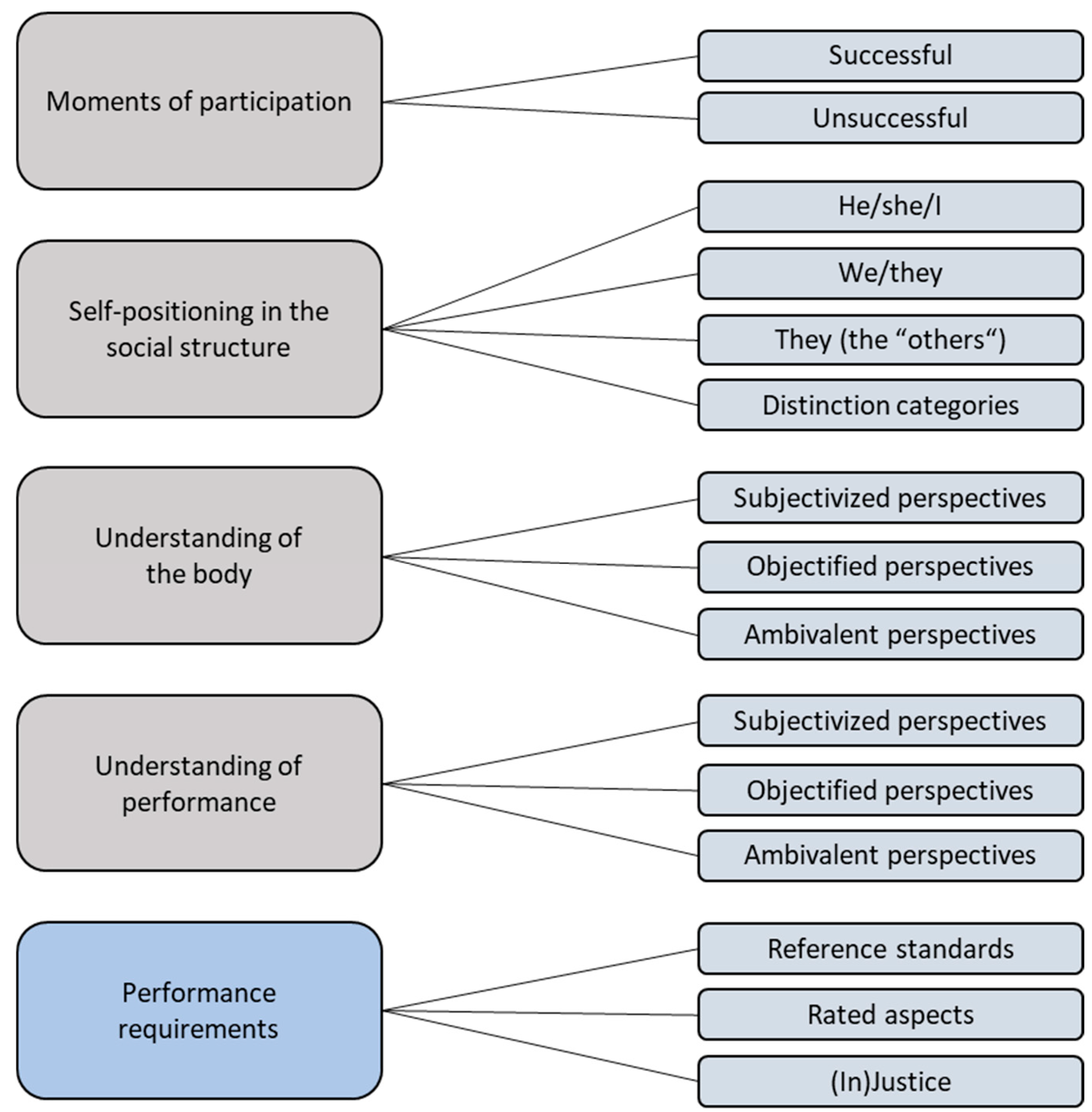
In addition to these deductively derived categories, one further main category. Performance requirements emerged inductively during the open coding process. Within each main category, subcategories were developed inductively through an open coding process. All three authors independently coded the transcripts to generate preliminary codes. Coding discrepancies were discussed in team meetings and resolved through consensual validation (Kuckartz & Rädiker, 2023). The alignment of interpretations was ensured through continuous peer debriefing and iterative refinement of the code system. The analysis focused on identifying overarching patterns as well as case-specific nuances in students’ narratives, focusing on how they interpret and experience participation, position themselves socially, and relate to body and performance norms. The resulting category system consisted of five main categories with corresponding inductive subcategories, which are summarized in Figure 1.
Figure 1.
Category system with five main categories and relevant subcategories.
To offer a clearer understanding of how the data were interpreted, the complete category system, along with illustrative anchor examples, can be found in Table 2 below.
Table 2.
Main- and subcategories with anchor examples.
3. Results
To capture the complexity of individual participation experiences in PE lessons, the results are presented in two steps. First, the main categories derived from the interview analysis are systematically outlined, illustrating how individual experiences are situated within broader patterns and structural contexts. Second, three detailed student portraits provide nuanced insights into subjective perspectives, highlighting the diverse ways students experience participation, social belonging and exclusion in PE.
3.1. Findings Across the Sample by Categories
The following presents the main categories that emerged from the analysis of the interviews. These categories structure the reconstruction of students’ diverse experiences and reveal patterns of participation, exclusion, and social positioning in PE classes. The resulting category system offers a comprehensive analytical framework for understanding students’ subjective experiences, enabling the identification of both shared and intersecting social structures—such as established norms and social hierarchies—and recognition of individual case-specific nuances.
3.1.1. Moments of Participation
The first main category Moments of Participation, captures specific situations in which students experience participation in PE as either successful or unsuccessful. This category primarily serves to identify the conditions and circumstances under which opportunities for participation arise or are denied for students. It focuses on the associated conditions, actions, and emotions facilitating a nuanced understanding of factors that foster or hinder participation from the students’ perspectives.
The interviews reveal that (non)participation is a central dimension of students’ experiences in PE. From their perspective, participation is not merely determined by formal structures or teacher directives but is shaped by everyday social negotiation, group dynamics, and the attitudes of all participants.
Some students report feeling motivated when able to actively contribute to lessons, for example, by influencing the selection of games or activities (e.g., School 1, Lisa, pos. 28). Such instances of agency—though often limited to co-determination and decision-making levels Eikel (2007)—appear to enhance motivation, enjoyment, and a sense of ownership.
Conversely, other students describe limited agency, where decisions are predominantly dictated by teachers and their role is: “[…] we just do what the teacher says” (School 3, Yusuf, pos. 30). Some do not necessarily perceive this limitation negatively, regarding it as a given, but nonparticipation also manifests in experiences of exclusion, disinterest, or demotivation, such as when classmates “just sit on the bench on the side and don’t join in” (School 3, Taher, pos. 36).
Relating these descriptions of participation opportunities to other categories (self-positioning, understanding of body and performance requirements) reveals that participation in PE is shaped by social dynamics, body-related norms, and perceived fairness of performance expectations. Students considered athletic or high achieving tend to experience greater participation opportunities, while others (may) feel marginalized or pressured.
Two key insights emerge: first, participation opportunities primarily occur within established structures (e.g., choices are often limited to competitive, sport-based games) and usually remain at the level of decision-making. These opportunities are more accessible to those students who conform to prevailing norms and fit within existing structures. Second, those conforming students often hold social positions within the PE class that afford them decision-making power; interestingly, some seem content without choice, as the existing system benefits them (e.g., Yusuf). In contrast, students marginalized due to their ‘otherness’ experience a compounded lack of participation, even when formal opportunities exist.
3.1.2. Self-Positioning
Self-positioning in the social structure as a main category addresses how students locate themselves within the social dynamics of the PE context. This includes references to the self as direct positioning within the social context, like “I’m almost one of the best in the class […]” (School 3, Yusuf, pos. 97). In addition, it encompasses the perceived affiliation with a particular group, for example “us” and “the boys” (School 3, Anna, pos. 30). And it also involves the construction of ’others’, meaning the separation of those who are identified as different (from oneself) in the learning group, like: “Yusuf, who is more of a sportsman” (School 3, Florian, pos. 33). Certain distinctions stand out as particularly significant in these construction processes, where students position themselves in terms of feelings of social belonging and exclusion. Prominently, differentiations are made in reference to one’s sportiness or athleticism. Obviously, students create a link between being sporty and participating in PE like Lea does in the following exemplary quote: […] they don’t like physical activity and PE at all, but I’m this kind of a sporty girl “(school 2, Lea, Pos. 46). Further, body composition is used as category of difference, either referring to the own body or to others’ ones: “I’m a bit, let’s say bigger, I’ve got actually a few kilograms more than some others in the class […]” (School 2, Felix, pos. 30). In line with these body-related distinctions gender appears to be an important category of difference which is either problematized: “[…] just because a few boys do more sport than the other girls don’t mean that the girls are worse at sport than the boys” (School 3, Anna, pos. 36), or the gender division tends to be overcome: “[…] I think it’s cool that […] we also have PE lessons with the boys, and I think that’s something different” (School 1, Lisa, pos. 28).
Further, the behavior in terms of inappropriate behavior seems to be a characteristic of difference, for instance, when a student gets annoyed about ’certain people’ in her class (School 2, Kim, pos. 21–24).
The results clearly show the intersection between the own positioning and body- and performance-related norms in physical education in connection with gender stereotypes and ableist ideas. Regarding the research question, it becomes clear how the student’s own positioning in the social structure in PE is determined against the backdrop of multi-layered, interwoven categories of differentiation that are reproduced in PE. The material shows that body-related norms, which are implicitly linked to ideas of performance, play a prominent role in this respect.
3.1.3. Understanding of the Body
Thirdly, the Understanding of the Body as a main category examines students’ perceptions and interpretations of the body in PE. The general question of whether the body plays a significant role in PE lessons was affirmed by nearly all respondents. When asked to elaborate on this role, a variety of perspectives on the body are opened. These differentiate between objectified perspectives (external or normative views), subjectivized perspectives (personal feelings and experiences) and ambivalent perspectives (mixed or contradictory attitudes).
From an objectified perspective, the body is often viewed as the functional basis for movement in general (e.g., School 3, Imani, pos. 54), or as an object of training, such as performing push-ups to improve fitness (e.g., School 2, Flora, pos. 73). These objectified views are frequently linked to standardized ideals of trained, athletic, and capable bodies. Notably, deviations from these norms are often highlighted, particularly in relation to gender stereotypes: “[…] in our class, the girls are not all that strong” (School 3, Yusuf, pos. 89); or in relation to body weight: “[…] there are also some, how should I say this, I don’t know, heavy people and some skinny people and yes, for the people who are a bit heavier we sometimes find it difficult, they find it hard to breathe and so on, that was the case with me too” (School 3, Taher, pos. 38). These examples illustrate how social distinctions are prominently expressed through the body.
From a subjectivized perspective, emotional and affective aspects of the body are emphasized, as demonstrated in the following quote: “[…] most people feel as if they are not good enough or something, just because they are a bit bigger” (School 3, Anna, pos. 38). This highlights how the category Understanding of the Body reveals the significant influence of objectified perspectives and the strong orientation of social actors toward body-related norms in PE. At the same time, these norms are accompanied by subjective, often emotionally charged physical experiences.
Ambivalent perspectives on the body also emerge in this context. For instance, Anna acknowledges certain objectified ideas about the body but simultaneously distances herself from the dominant interpretation of these perspectives (e.g., equating being sporty with being “good”): “There are sporty girls who really like doing sport and a few who don’t like it that much and don’t like (…) running so fast, which I don’t think is a bad thing in itself” (School 3, Anna, pos. 34).
This category thus underscores the tensions between prevailing hegemonic body norms and subjective interpretations of meaning, as well as individual physical experiences. Within this framework, democratic participation in PE involves navigating these tensions while finding, defining, and negotiating one’s own position.
3.1.4. Understanding of Performance
The fourth main category, Understanding of Performance, examines how students conceptualize and experience performance in PE. In the interviews, performance is closely tied to notions of the body, encompassing both objectified and subjectivized perspectives.
On the one hand, performance is understood as a measurable product and a means of achieving specific goals (e.g., School 2, Kevin, pos. 51). This perspective is strongly associated with physical attributes such as “endurance” and “strength” (School 2, Hussain, pos. 65), as well as motor skills like the “basketshot” (School 2, Ismael, pos. 66). It is striking that performance in such an understanding is not only linked to physical abilities and skills, but is also used to establish social hierarchies: “The person who is better than you, you have to get to them first, and the person who is below you, it’s no use being as good as them. And that’s just the principle that they don’t understand, if you don’t fight to get up there, then you’ll just fall further down and you just must have that in your blood […]” (School 3, Yusuf, pos. 120). This quote vividly illustrates how hegemonic performance standards are often applied unquestioningly in PE. Yusuf treats these standards as if they were natural laws, leaving no room for debate about what constitutes “good” or “bad” performance. He bases his own behavior on these standards and evaluates others accordingly, ultimately reinforcing social hierarchies. As a result, an unavoidable and seemingly natural order of inequality emerges.
On the other hand, performance is also conceptualized in a more subjective manner in the interviews. Here, the emphasis is placed on individual improvement, regardless of the initial performance level (e.g., School 1, Maria, pos. 55), and on “cooperation” (School 1, Lisa, pos. 55). These moments reveal instances where the hegemonic understanding of performance described above is challenged or deconstructed. In many cases, this shift is attributed to explicit efforts by teachers to address alternative perspectives on performance, or to criticism from students when teachers fail to do so.
The interviews further highlight that, for the students, performance in PE is closely intertwined with how their performance is assessed by teachers. This connection underscores the significant role educators play in shaping students’ perceptions of performance and in either reinforcing or challenging dominant norms.
3.1.5. Performance Requirements
In line with the understanding of performance in the fifth main category, Performance Requirements focuses on students’ experiences with the criteria of performance assessment in PE. This category encompasses reference standards such as personal, peer, or teacher expectations, specific assessed elements, and perceptions of fairness or (un)fairness within evaluation procedures. Students rarely refer to standardized norms applied by teachers but emphasize individualized approaches, noting that “[…] teachers try, for example, to do simpler exercises or to do them differently so that they [less sporty students] can do them more easily” (School 2, Martin, pos. 69–70). Additionally, active involvement and prosocial behaviors are valued aspects in assessments (e.g., School 2, Lea, Pos. 72), with emphasis placed on “at least trying” (School 1, Lisa, pos. 61). These reflections highlight teachers’ visible efforts to move beyond narrow athletic performance standards toward more inclusive evaluation practices that acknowledge student diversity. However, it should be noted that the participating teachers—likely those more attuned to diversity issues—may represent a positive selection bias owing to their willingness to grant access for interviews.
Despite these efforts, transparency in assessment is not always apparent to students. For example, Ben described a “some kind of test” at the end of the year that “somehow assesses” performance (School 3, Ben, pos. 45), a process sometimes accompanied by perceptions of unfair grading Some students feel that they think they were “[…] simply graded too hard” (School 3, Anna, Pos. 57), whereas others believe that grades might occasionally be waived (School 1, Marlene, pos. 39). Regardless, this category underscores students’ perceptions, that performance expectations from the school institution are primarily reflected through assessment practices. Tensions emerge particularly around body and performance understanding: even when teachers actively distance themselves from athletic norms in assessment, those norms remain significant for the students. This reflects the co-construction of teaching and highlights how often unchallenged physical practices perpetuate hegemonic body and performance standards that reinforce social hierarchies. Consequently, addressing these dominant norms through democratic negotiation processes is critical, emphasizing the vital role democratic participation in PE could play in fostering equity and inclusion.
3.2. Portraits
To provide a deeper understanding of how the categories intertwine, three exemplary portraits are presented. These were selected to capture diverse and contrasting perspectives in PE. Anna offers a reflective and inclusive viewpoint, critically engaging with normative expectations; Felix represents a more performance-oriented and normative stance, reproducing common discourses of ability and gender and Marta, whose voice is mediated and fragmentary due to language barriers, illuminates the often-overlooked experiences of students with special educational needs and limited participation in PE. Each portrait begins by describing the interview situation, followed by context, followed by the students’ individual perspectives in PE and their subjective experiences, structured according to the established category system (Table 2).
3.2.1. Portrait of Anna
Anna is 11 years old and attends coeducational PE classes at School 2. At first reserved during her interview, she gradually became thoughtful and open, providing insightful reflections on her experiences in PE. Although Anna describes herself as “not particularly athletic” (School 3, Anna, pos. 28), she genuinely enjoys PE lessons, calling them “really quite great” (ibid., Pos. 20). While she has rarely been the target of negative comments about her body or performance, she is acutely aware of how some classmates—especially those who are “bigger” or “can’t run as fast or aren’t as flexible”—are sometimes devalued, ridiculed, or told to “try harder” (ibid., pos. 20, 32). She notes that such remarks, whether from peers or teachers, can undermine students’ self-esteem and leave them feeling “not good enough” (ibid., pos. 38). Anna emphasizes the importance of recognizing every student’s individual value (ibid., pos. 38). Being sensitive to the effects that normative body and performance expectations have, she’s critical regarding the pressure that often accompanies PE lessons for those who do not comply to the norm: “It’s just not as much fun when someone always has to hear ‘do better’ or ‘try harder’” (ibid., pos. 40). For her, fairness, togetherness, and the opportunity to participate matter more than performance and competition pressure. She points out that excessive pressure can discourage participation (ibid., pos. 22). telling example Anna offers is her observation of a high performing classmate whose focus on winning leads to social isolation: f “[…] it’s always about his team winning […]” resulting in “[…] almost no one wanting to be on a team with him anymore […]” (ibid., pos. 22)., especially among those peers perceived as less athletic. Anna interprets as evidence that an overemphasis on competition can undermine social relationships and diminish motivation. Moreover, she reflects critically on team selection, moving from a preference for playing only with close friends toward valuing fair team composition that offers everyone the chance to participate—a principle she regards as “unfair” (ibid., pos. 62), when violated. Challenging gender stereotypes, Anna insists that girls are just as capable and enthusiastic about sports as boys: “[…] Just because a few boys do more sports than the other girls, that doesn’t mean that girls are worse in sports than boys” (ibid., pos. 20). From her critical stance she advocates for an empathetic, inclusive, and appreciative PE environment where all students—regardless of body type, gender identity, sexual orientation or athletic ability—feel accepted and able to participate without fear of judgment or exclusion. She calls for fairness, social interaction, and participation to take precedence over pressure and competition, remaining acutely aware of how a narrow focus on performance can undermine both enjoyment and social cohesion in PE.
3.2.2. Portrait of Felix
Felix is 13 years old and attends (coeducational) PE classes in the 7th grade at School 1. He describes himself as an avid soccer player who participates in a club team and when it comes to soccer, he is “always there” (School 1_Felix, pos. 28). Unlike Anna, Felix is “ambitious” in PE (ibid., pos. 36) and strives to “be at the forefront” (ibid., pos. 36). In his view, PE at school is there to “stay physically fit” and to “let off steam at school and also have fun” (ibid., item 24). Overall, he considers PE to be “cool” (ibid., item 26) and “almost always very fun” (ibid., pos. 20). However, he identifies one significant limitation: the need to accommodate less athletic or less sporty students during lessons. While he emphasizes his understanding for the fact that children are different and that this must be taken into account in the classroom (“some are just a little bigger, others are not, some like sports, others don’t”, ibid., pos. 20) he criticizes that “then we just have to tailor our program to them” (ibid., pos. 20). Regarding the construction of the “others”, it is striking that two lines of differentiation appear to be significant for him: gender and physical fitness. In terms of gender, he emphasizes that “[…] girls generally don’t like the lessons, because—I just know that, because they always say so […]” (ibid., pos. 38). But there are also “[…] a few boys who say they don’t think the lessons are that great […]”. Regarding physical fitness he reports that those “[…] who are physically fitter […] say that the lessons suit them well” (ibid., pos. 38). Physical fitness, however, emerges as the primary category of differentiation in Felix’s view. Against this background, he emerges that joyful participation in lessons is possible for those whom he characterizes as fit and better at playing, referring to the teacher’s classification (ibid., pos. 22). Participation appears to be most successful when the PE teacher “[…] usually lets those play who are better at playing […]” (ibid) and gives separate tasks to those who are not that good—which they carry out with moderate success, in Felix’s opinion. Thus, for Felix, athleticism goes hand in hand with participation and freedom, whereas the others (especially those he describes as the “slightly bigger” ones; ibid., pos. 26) often are identified as a hindrance for a successful PE lesson. Apparently, for Felix, the deviating body becomes a symbol of unsportsmanlike behavior and a lack of motivation to participate in class. He describes the lessons and the teacher’s behavior as good whenever those who are different are either given special tasks (see above) or when their non-participation due to lack of interest—according to Felix’s assessment, this seems to affect girls in particular—is more or less tolerated (ibid., pos. 57). Ultimately, Felix’s perspective suggests that participation in PE is largely reserved for fit, able-bodied, and predominantly male students. This view highlights the implicit exclusionary dynamics within PE lessons, where physical fitness and athletic ability are prioritized, often at the expense of inclusivity.
3.2.3. Portrait of Marta
Marta is 13 years old and in year 7 at school 2. She identifies as female and, according to her teacher, has special educational needs (unspecified) that are supported by assistants in certain subjects. However, it remains unclear whether this support extends to PE lessons. The assistant who primarily supports Marta and participated in the interview is not present during PE. From Marta’s perspective, PE is important “so that we become healthy” (School 2, Marta, pos. 47). Conducting the interview proved challenging due to difficulties in communication and Marta’s tendency to provide short, simple answers. These challenges were likely related to her special educational needs. Additionally, the interview situation was distinct from others, as Marta’s assistant was present and frequently intervened, often answering questions intended for Marta. At times, the assistant even posed questions to Marta herself. This dynamic makes it difficult to distinguish Marta’s own opinions from the assistant’s interpretations. Such dynamics, evident in the interview, may also manifest in PE lessons, where Marta appears to be only partially granted the opportunity to speak or make decisions for herself, with others stepping in for the sake of simplicity. These dynamics are illustrated by Marta’s fragmentary responses during the interview, such as “hitting the ball hard …not so hard…” (ibid., Pos. 85), then explained by the assistant in her interpretative words: “So she would like them [the other kids] to be a bit more attentive” (School 2, Marta’s assistant, pos. 86). Despite these challenges, Marta’s case offers valuable insights into PE participation, even if these are only hinted at. Marta was selected for a case vignette because, according to her teachers, she does not enjoy participating in PE—a perspective that contrasts with many other interviewees, who consider PE one of their favorite subjects. When asked about her feelings toward PE, Marta responded simply, “Not so [good]” (School 2, Marta, pos. 56). Her assistant then intervened, stating, “Marta, you often don’t even want to participate. You just sit down and do nothing” (School 2, Marta’s assistant, pos. 57). However, the assistant also noted that Marta enjoys physical activity during breaks, saying, “Well, but when we’re outside during the break, you like to run around” (ibid., pos. 23). Marta confirmed this, adding, “Mhm, but not in the sports hall [where PE les-sons take place]” (School 2, Marta, pos. 24). When asked why she is reluctant to participate in PE, Marta explained that she prefers “watching a bit from the side” because “it’s a bit difficult because they [the boys] are so rough” (ibid., pos. 78). She also mentioned an incident where “they also broke my locker…” and emphasized, “…you can’t do that!” (ibid., pos. 106). When asked how she deals with such situations, Marta stated that the boys “should be more careful” but admitted, “I don’t say anything, because they are boys who know what mistakes they have made” (ibid., pos. 92). The assistant confirmed that Marta often exhibits withdrawn and disengaged behavior in various situations. It is possible that instances of bullying or rough behavior contribute to her reluctance to participate in PE lessons. Marta’s case provides a perspective of a student who does not see herself as athletic and is likely not perceived as such by her peers. She appears to occupy a marginalized position on the periphery of social activity in PE, highlighting the exclusionary dynamics that can exist in such settings.
4. Discussion
This study provides valuable insights into the complex interplay between diversity, participation, and conceptualizations of body and performance in PE, particularly within diverse learning environments. By analyzing students’ experiences through five main categories—Moments of Participation, Self-positioning, Understanding of the Body, Understanding of Performance, and Performance Requirements—and complementing these with three detailed student portraits (Anna, Felix, and Marta), the discussion reveals both recurring patterns and individual nuances in how students navigate PE. The three student portraits offer contrasting perspectives that illuminate the multifaceted ways students experience participation, social belonging, body and performance in PE. Anna’s inclusive and empathetic perspective highlights the potential to act as critical agents in advancing diversity-sensitive practices. Felix’s performance-oriented stance illustrates the power of established ability regimes (Fitzgerald, 2005; Ruin et al., 2023) and underscores the challenges of addressing exclusionary norms while balancing the diverse needs of students. Marta’s disengagement demonstrates the importance of attending to social dynamics to ensure psychological safety and support for all participants, exposing the delicate balance between empowerment and incapacitation (Szczupał, 2017). Collectively, these portraits underscore the need for a paradigm shift in PE, from traditional practices grounded in hegemonic understandings of body and performance toward more inclusive and participatory approaches. Encouraging students to engage in ongoing dialogue, practice agency, and participate in joint decision-making with peers may help reduce the reproduction of power structures and contribute to greater equity (Gerdin, 2025). Students should be supported in critically reflecting on positionality, power and how these intersect with established understandings of body and performance (Beltrán-Carrillo et al., 2018).
Findings related to the first research question, which concerns participation opportunities for all students, emphasize the central role of agency in fostering meaningful participation (Reeve & Shin, 2020; Wilkinson & Penney, 2021). Students who are granted decision-making opportunities, such as choosing activities or setting individual learning goals, report greater motivation and enjoyment. However, students also described many of these decision-making processes as superficial. Conversely, a lack of agency, where students feel confined to passive roles, often leads to disinterest and disengagement, especially among those who deviate from dominant norms. Athletic or high-performing students thus tend to experience broader participation opportunities, whereas others feel marginalized. Anna’s reflections underscore the importance of fairness and inclusion, critiquing practices such as inequitable team selection and excessive performance pressure, that discourages less athletic students. Felix perceives participation tied to athleticism, revealing how normative expectations can reinforce exclusionary practices. Marta’s sense of withdrawal, shaped by fear of bullying and lack of safety, highlights the necessity of addressing social dynamics and building supportive environments for all students in terms of active contribution to the learning process (Curran & Standage, 2017; Patall, 2024).
These findings can be further interpreted through Eikel’s (2007) framework of democratic participation in schools, which is equally relevant to PE. Eikel (2007) distinguishes several levels of participation: formal involvement in decision-making (for instance, voting on activities), dialogue and negotiation, assuming responsibility for specific tasks (like organizing stations or leading groups), and finally to the structural embedding of participation through institutional mechanisms such as class councils or participatory teaching methods. Genuine participation, according to Eikel (2007), requires continuous engagement at all these levels, both individually and institutionally. The data suggest that from students’ perspectives, such authentic participation is rare, deeper sustained forms of involvement are almost absent. The development of a survey instrument derived from Eikel’s levels of democratic participation could provide a valuable tool for critically examining participation opportunities in PE (Kreinbucher-Bekerle & Ruin, 2025).
The second research question explores how self-positioning, body and performance conceptualizations affect participation opportunities. The findings reveal how students navigate social hierarchies and group dynamics in PE. Their self-perceptions and constructions of ‘others’ are shaped by factors such as athletic ability, body composition, behavior, and gender. These dichotomous categorizations reproduce what Mecheril (2008) terms ‘orders of difference’, reinforcing mechanisms of inclusion and exclusion. Felix’s differentiation between ’fit’ and ’less fit’ students along with his perception of girls as less interested in PE highlight the persistence of gendered and body-related stereotypes. In contrast, Anna challenges these assumptions, advocating equal recognition of girls’ athletic abilities. Marta’s experiences further expose how rough peer interactions can drive withdrawal, particularly for students with special educational needs. These findings underscore the need to foster a culture of respect and care in PE, where all students feel valued and where taken-for-granted norms become subjects of democratic reflection. A supportive motivational climate appears crucial to promoting engagement in this regard (Mastagli et al., 2022; Milton et al., 2025).
The findings regarding students’ understanding of body and performance reveal a dual orientation. On one side, objectifying perspectives—such as viewing the body as an instrument performance or performance as a quantifiable outcome—reflect conventional norms that emphasize physical ability and achievement (Evans & Penney, 2008). On the other side, subjectivizing perspectives prioritize personal experience, emotional engagement, and individual progress. Anna’s critical observations on the pressure to conform to normative expectations highlight the adverse effects of hegemonic ideals on self-esteem, motivation, and democratic participation. Felix, by contrast, reproduces these norms, equating athleticism with freedom and belonging, while perceiving less athletic peers as impediments. His position exemplifies how adherence to narrow understandings of body and performance (Ruin & Meier, 2017) can make PE exclusionary. Marta’s fragmented statements suggest that such normative expectations contribute to her disengagement by amplifying her sense of being an ‘outsider’. These findings point to the necessity of challenging traditional norms and adopting pedagogical approaches that value multiple forms of ability and embodiment.
Results related to performance requirements emphasize the importance of transparent and inclusive assessment practices in PE. Many students appreciate when effort and engagement are prioritized over athletic ability, as this approach fosters inclusivity. Anna, for example, values teachers who reward commitment, while Felix supports individualized tasks for less athletic peers but also perceives their disengagement as acceptable. However, inconsistent assessment criteria and a lack of transparency often produce feelings of injustice among students. Marta’s experiences further illustrate how unclear grading practices and limited support can intensify feelings of exclusion. These findings indicate that PE teachers should establish clear, consistent, and inclusive assessment criteria (Hollibaugh, 2023) that accommodate diverse abilities and experiences. Notably, few students mentioned having any participatory role in grading processes, suggesting an underexplored dimension of participation in PE (Krijgsman et al., 2017).
Limitations
Several limitations should be considered when interpreting the findings. First, the study draws on a small, regionally bounded sample, which restricts the transferability of the results beyond the specific social and cultural context. Second, the online interview format, while facilitating flexible access, may have reduced the depth and embodied immediacy that in-person encounters typically afford. Third, the brevity of some interviews limited opportunities for more nuanced exploration of individual experiences. This became particularly evident when students were accompanied by an assistant teacher due to linguistic or educational support needs. In one case, frequent intervention—such as answering on behalf of the student or offering interpretive suggestions—reflected both limited German language proficiency and potential psychosocial vulnerabilities. Such dynamics illustrate the complexities of conducting research with minors and highlight how meanings can be co-constructed in interviews involving hierarchical relationships. Furthermore, despite the research team’s structured reflexive engagement throughout data collection and analysis (see Positionality section), certain limitations related to the researchers’ sociocultural backgrounds persist. The interviewers shared positionalities as white, non-disabled adults with professional experience in sport and movement education may have subtly shaped interactional dynamics and interpretive processes. These influences cannot be fully mitigated, even with systematic reflexivity, and may have contributed to the inadvertent reproduction of normative assumptions regarding bodies and participation.
5. Conclusions
This study demonstrates that active participation in PE constitutes a dynamic and negotiated process, shaped by students’ agency, social relationships, and perceptions of fairness in practices and decision-making. Such participation is grounded in varying degrees of orientation toward hegemonic ideals of athleticism, physical ability, and performance standards. While some students benefit from these normative orientations through opportunities for co-determination and inclusive participation, others encounter obstacles such as limited voice, exclusion, or inflexible structures, particularly those who diverge from dominant norms. Although the findings of this study stem from a specific sample within a national context, they align with international research highlighting body- and performance-related normative orientations in PE and their influence on students’ social positioning. Within this framework, the study underscores the broader necessity of fostering student agency, addressing social dynamics, critically examining restrictive body and performance-related norms, and adopting transparent, inclusive assessment practices in PE. The results significantly contribute to understanding how entrenched normative orientations and social hierarchies relate to students’ opportunities for participation in PE. The importance attributed to these interconnections is unequivocal, revealing that the relationships between norms and participation vary markedly depending on one’s individual positioning and perspective. Hence, democratic education that explicitly engages with these issues represents a valuable and necessary step toward diversity-sensitive PE. By challenging exclusionary norms and promoting meaningful engagement for all students, PE can more effectively realize its potential as a space that nurtures not only physical development but also social inclusion, personal growth, and democratic participation. In such a learning environment, students do not merely comply with the teachers’ instructions and ‘just do what the teacher says’ but actively reflect on and discuss their actions and their broader implications. In this way, this study contributes to ongoing discourse on diversity, inclusion, and democratic education in PE, emphasizing the creation of learning contexts that recognize, value and empower all students.
Author Contributions
Conceptualization, B.S., C.K.-B. and S.R.; methodology, S.R.; software, B.S.; validation, B.S., C.K.-B. and S.R.; formal analysis, B.S., C.K.-B. and S.R.; investigation, S.R. and C.K.-B.; resources, B.S., C.K.-B. and S.R.; data curation, B.S., C.K.-B. and S.R.; writing—original draft preparation, B.S., C.K.-B. and S.R.; writing—review and editing, B.S., C.K.-B. and S.R.; visualization, B.S.; supervision, S.R.; project administration, B.S. and C.K.-B.; funding acquisition, S.R. All authors have read and agreed to the published version of the manuscript.
Funding
This research was funded by Bildung Tomorrow, Austria. The APC was funded by the University of Graz.
Institutional Review Board Statement
The study was conducted in accordance with the Declaration of Helsinki and approved by the Ethics Committee of the University of Graz (39/123/63 ex 20/21, 12 August 2021).
Informed Consent Statement
Written informed consent was obtained from all interviewees and their legal guardians.
Data Availability Statement
Data is available upon reasonable request to the corresponding author.
Acknowledgments
The authors wanted to thank the former research team for their contribution in conducting and analyzing parts of the interviews.
Conflicts of Interest
The authors declare no conflicts of interest.
References
- Andersen, M. L., & Hill Collins, P. (Eds.). (2020). Race, class, and gender: Intersections and inequalities (10th ed.). Cengage. [Google Scholar]
- Appelbaum, P. M. (2002). Multicultural and diversity education: A reference handbook. ABC-CLIO. [Google Scholar]
- Barker, D., Varea, V., Bergentoft, H., & Schubring, A. (2023). Body image in physical education: A narrative review. Sport, Education and Society, 28(7), 824–841. [Google Scholar] [CrossRef]
- Barth, D., & Große Prues, P. (2025). Demokratiebildung als querschnittsaufgabe: Fachdidaktische zugänge, perspektiven und potenziale (1st ed.). Wochenschau Verlag Dr. Kurt Debus GmbH. [Google Scholar]
- Bartsch, F., Wagner, I., & Rulofs, B. (2021). Students from refugee backgrounds in physical education: A survey of teachers’ perceptions. European Physical Education Review, 27(4), 854–870. [Google Scholar] [CrossRef]
- Beltrán-Carrillo, V. J., Devís-Devís, J., & Peiró-Velert, C. (2018). The influence of body discourses on adolescents’ (non)participation in physical activity. Sport, Education and Society, 23(3), 257–269. [Google Scholar] [CrossRef]
- Biesta, G. J. J. (2022). World-centred education: A view for the present. Routledge, Taylor and Francis Group. [Google Scholar]
- Brink, C., & Block, M. (2024). Navigating middle school physical education with a physical disability: Personal experiences and challenges. European Journal of Adapted Physical Activity, 17, 8. [Google Scholar] [CrossRef]
- Böhlke, N. (2020). Psychosoziale normalitätsanforderungen im schulsport. Exemplarische ableitungen aus erkenntnissen zu Sichtweisen jugendlicher mit einer zugeschriebenen psychischen Störung. Leipziger Sportwissenschaftliche Beiträge, 61(1), 195–210. [Google Scholar] [CrossRef]
- Brooks, F., & Magnusson, J. (2006). Taking part counts: Adolescents’ experiences of the transition from inactivity to active participation in school-based physical education. Health Education Research, 21(6), 872–883. [Google Scholar] [CrossRef]
- Curran, T., & Standage, M. (2017). Psychological needs and the quality of student engagement in physical education: Teachers as key facilitators. Journal of Teaching in Physical Education, 36(3), 262–276. [Google Scholar] [CrossRef]
- Eikel, A. (2007). Demokratische partizipation in der schule. In A. Eikel, & G. Haan (Eds.), Demokratische partizipation in der schule. Ermöglichen, fördern, umsetzen (pp. 7–41). Wochenschau-Verlag. [Google Scholar]
- Evans, J., & Penney, D. (2008). Levels on the playing field: The social construction of physical ‘ability’ in the physical education curriculum. Physical Education & Sport Pedagogy, 13(1), 31–47. [Google Scholar] [CrossRef]
- Fitzgerald, H. (2005). Still feeling like a spare piece of luggage? Embodied experiences of (dis)ability in physical education and school sport. Physical Education & Sport Pedagogy, 10(1), 41–59. [Google Scholar] [CrossRef]
- Flick, U. (2018). An introduction to qualitative research (6th ed.). Sage. [Google Scholar]
- Gerdin, G. (2025). ‘Level the playing field’—pupils’ experiences of inclusion and social justice in physical education and health. Sport, Education and Society, 30(4), 397–412. [Google Scholar] [CrossRef]
- Giese, M., & Grenier, M. (2025). “…it’s so funny to just throw off the blind girl” subjective experiences of barriers in physical education with visually impaired students—An emancipatory bad practice approach. Frontiers in Sports and Active Living, 7, 1515458. [Google Scholar] [CrossRef] [PubMed]
- Giese, M., & Hoffmann, T. (2024). Die ausgeschlossenen? “Leistungsgerechtigkeit” im inklusiven sportunterricht: Eine ableismkritische analyse aus behinderten- und inklusionspädagogischer perspektive. German Journal of Exercise and Sport Research, 54(4), 552–562. [Google Scholar] [CrossRef]
- Hastie, P. A., Stringfellow, A., Johnson, J. L., Dixon, C. E., Hollett, N., & Ward, K. (2022). Examining the concept of engagement in physical education. Physical Education and Sport Pedagogy, 27(1), 1–18. [Google Scholar] [CrossRef]
- Hollibaugh, C. (2023). Grading strategies in physical education. Strategies, 36(5), 9–14. [Google Scholar] [CrossRef]
- Hutzler, Y., Meier, S., Reuker, S., & Zitomer, M. (2019). Attitudes and self-efficacy of physical education teachers toward inclusion of children with disabilities: A narrative review of international literature. Physical Education and Sport Pedagogy, 24(3), 249–266. [Google Scholar] [CrossRef]
- Jenssen, A. R. (2018). Inclusion and democratic values in physical education. Association for Teacher Education in Europe, 42, 206–219. [Google Scholar]
- Kreinbucher-Bekerle, C., & Mikosch, J. (2023). Students’ perspectives on school sports trips in the context of participation and democratic education. Children, 10(4), 709. [Google Scholar] [CrossRef]
- Kreinbucher-Bekerle, C., & Ruin, S. (2025). Entwicklung und erprobung eines fragebogens zu beteiligungsmöglichkeiten von schüler:innen im sportunterricht (BEM-SU-S). German Journal of Exercise and Sport Research, 55, 566–577. [Google Scholar] [CrossRef]
- Krijgsman, C., Vansteenkiste, M., Van Tartwijk, J., Maes, J., Borghouts, L., Cardon, G., Mainhard, T., & Haerens, L. (2017). Performance grading and motivational functioning and fear in physical education: A self-determination theory perspective. Learning and Individual Differences, 55, 202–211. [Google Scholar] [CrossRef]
- Kuckartz, U., & Rädiker, S. (2023). Qualitative content analysis: Methods, practice and software (2nd ed.). SAGE. [Google Scholar]
- Mastagli, M., Van Hoye, A., Hainaut, J.-P., & Bolmont, B. (2022). The role of an empowering motivational climate on pupils’ concentration and distraction in physical education. Journal of Teaching in Physical Education, 41(2), 311–321. [Google Scholar] [CrossRef]
- Mecheril, P. (2008). “Kompetenzlosigkeitskompetenz”. Pädagogisches Handeln unter Einwanderungsbedingungen. In Interkulturelle Kompetenz und pädagogische Professionalität (pp. 15–34). VS Verlag für Sozialwissenschaften. [Google Scholar] [CrossRef]
- Meier, S. (2023). Leisten, leistung, leistungsbewertung in einem diversitätssensiblen sportunterricht. In S. Meier (Ed.), Leistung und Diversität im schulsport (pp. 111–130). Springer Fachmedien Wiesbaden. [Google Scholar] [CrossRef]
- Milton, D., Appleton, P. R., Quested, E., Bryant, A., & Duda, J. L. (2025). Examining the mediating role of motivation in the relationships between teacher-created motivational climates and quality of engagement in secondary school physical education. PLoS ONE, 20(1), e0316729. [Google Scholar] [CrossRef] [PubMed]
- Müller, J., & Böhlke, N. (2023). Physical education from LGBTQ+ students’ perspective. A systematic review of qualitative studies. Physical Education and Sport Pedagogy, 28(6), 601–616. [Google Scholar] [CrossRef]
- Patall, E. A. (2024). Agentic engagement: Transcending passive motivation. Motivation Science, 10(3), 222–233. [Google Scholar] [CrossRef]
- Prengel, A. (2019). Pädagogik der Vielfalt: Verschiedenheit und Gleichberechtigung in interkultureller, feministischer und integrativer Pädagogik. Springer Fachmedien Wiesbaden. [Google Scholar] [CrossRef]
- Reeve, J., & Shin, S. H. (2020). How teachers can support students’ agentic engagement. Theory Into Practice, 59(2), 150–161. [Google Scholar] [CrossRef]
- Ruin, S. (2023). Vielfalt im schulsport—Zum anspruch einer diversitätssensiblen fachdidaktik. In G. Stibbe, & S. Ruin (Eds.), Sportdidaktik und schulsport: Zentrale Themen einer diversitätssensiblen fachdidaktik (pp. 53–77). Hofmann. [Google Scholar]
- Ruin, S., Haegele, J. A., Giese, M., & Baumgärtner, J. (2023). Barriers and challenges for visually impaired students in PE—An interview study with students in Austria, Germany, and the USA. International Journal of Environmental Research and Public Health, 20(22), 7081. [Google Scholar] [CrossRef]
- Ruin, S., & Meier, S. (2017). Body and performance in (inclusive) PE settings—An examination of teacher attitudes. International Journal of Physical Education, 54(3), 11–23. [Google Scholar] [CrossRef]
- Rulofs, B. (2014). “Diversität” und “diversitätsmanagement”. Auslegungen der konzepte für die entwicklung von sportorganisa-tionen. In DOSB [Deutscher Olympischer Sportbund] (Ed.), Expertise. “diversität, inklusion, integration und interkulturalität—Leitbegriffe der politik, sportwissenschaftliche diskurse und empfehlung für den DOSB und die dsj” (pp. 7–13). DOSB. [Google Scholar]
- Spencer-Cavaliere, N., & Watkinson, E. J. (2010). Inclusion understood from the perspectives of children with disability. Adapted Physical Activity Quarterly, 27(4), 275–293. [Google Scholar] [CrossRef]
- Stringfellow, A., Wang, C., Farias, C. F. G., & Hastie, P. A. (2024). The development of an “Engagement in Physical Education” scale. Frontiers in Sports and Active Living, 6, 1460267. [Google Scholar] [CrossRef]
- Szczupał, B. (2017). Incapacitation as a mean of protecting the dignity of the persons with disabilities in the view of convention on the rights of persons with disabilities. Psycho-Educational Research Reviews, 6(1), 1–9. [Google Scholar]
- Wilkinson, S. D., & Penney, D. (2021). Setting policy and student agency in physical education: Students as policy actors. Sport, Education and Society, 26(3), 267–280. [Google Scholar] [CrossRef]
- Zimlich, M., & Reuter, C. (2024). Perspectives of students with intellectual disabilities on inclusive physical education in Germany. European Journal of Adapted Physical Activity, 17, 9. [Google Scholar] [CrossRef]
Disclaimer/Publisher’s Note: The statements, opinions and data contained in all publications are solely those of the individual author(s) and contributor(s) and not of MDPI and/or the editor(s). MDPI and/or the editor(s) disclaim responsibility for any injury to people or property resulting from any ideas, methods, instructions or products referred to in the content. |
© 2025 by the authors. Licensee MDPI, Basel, Switzerland. This article is an open access article distributed under the terms and conditions of the Creative Commons Attribution (CC BY) license (https://creativecommons.org/licenses/by/4.0/).


