Cultural Diversity in Spanish Educational Policy (1970–2025): From Assimilation to Intercultural Inclusion


Abstract
1. Introduction
2. Materials and Methods
2.1. Research Design
2.2. Data Sources and Sampling
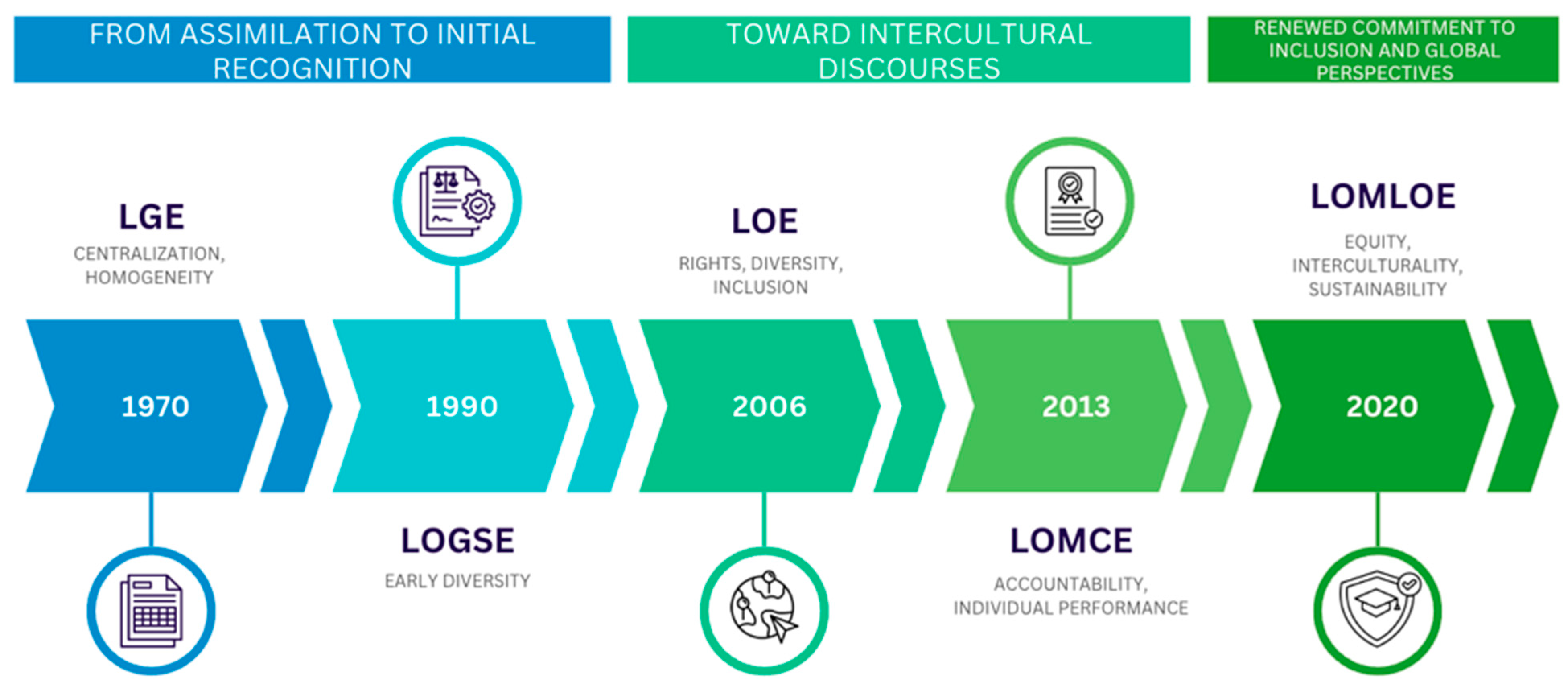
- Ley General de Educación (LGE, 1970);
- Ley Orgánica de Ordenación General del Sistema Educativo (LOGSE, 1990);
- Ley Orgánica de Educación (LOE, 2006);
- Ley Orgánica para la Mejora de la Calidad Educativa (LOMCE, 2013);
- Ley Orgánica de Modificación de la LOE (LOMLOE, 2020).
- -
- Focused on Spain or contrasted Spanish and European policies;
- -
- Offered explicit analysis of how legislation/curriculum addresses cultural/linguistic diversity;
- -
- Engaged explicitly with interculturality or intercultural education in this context.
2.3. Analytical Framework
- (a)
- Conceptualization of cultural and linguistic diversity: how diversity is defined or implied (as a problem, as a right, as a resource).
- (b)
- Curricular integration: the extent to which intercultural principles are embedded in curricular goals, competences and subject content.
- (c)
- Implementation mechanisms: measures proposed for operationalization, such as teacher training, provision of resources, or evaluation frameworks.
2.4. Procedure and Data Collection
2.5. Criteria for Rigor and Trustworthiness
3. Results
3.1. From Assimilation to Initial Recognition of Diversity (1970–1990s)
Due to the shortcomings of its economic development and the vicissitudes of its political evolution, the State at various times abandoned its responsibilities in this area, leaving them in the hands of private individuals or institutions, in the name of the so-called principle of subsidiarity. Thus, until recent times, education was more a privilege of a few than a right of all.(p. 4)
3.2. Toward Intercultural Discourses (2000s–2013)
(b) Education in respect for fundamental rights and freedoms, equality of rights and opportunities […], and equal treatment and non-discrimination for persons with disabilities.(c) Education in the exercise of tolerance and freedom within the democratic principles of coexistence, as well as in the prevention and peaceful resolution of conflicts.(e) Education for peace, respect for human rights, communal life, social cohesion, and cooperation and solidarity among peoples.(g) Education in respect for and recognition of Spain’s linguistic and cultural plurality, and of interculturality as an enriching element of society.
Students are the center and the raison d’être of education. Learning in school must aim to form autonomous, critical individuals with independent thinking. […] Every student shall receive the attention that makes education the main instrument of social mobility, helping to overcome economic and social barriers and fostering realistic aspirations and ambitions for all.
3.3. Renewed Commitment to Inclusion and Global Perspectives (2020–2025)
The most appropriate means for individuals to fully develop their capacities, build their personality, shape their own identity, and configure their understanding of reality […] for society, it constitutes the most suitable means to transmit and, at the same time, renew the culture and the body of knowledge and values that sustain it, to draw upon all its sources of wealth, to foster democratic coexistence and respect for individual differences, to promote solidarity and prevent discrimination, with the ultimate aim of achieving the necessary social cohesion.
4. Discussion
5. Conclusions
Funding
Data Availability Statement
Conflicts of Interest
Abbreviations
| LGE | Ley General de Educación |
| LOGSE | Ley Orgánica de Ordenación General del Sistema Educativo |
| LOE | Ley Orgánica de Educación |
| LOMCE | Ley Orgánica para la Mejora de la Calidad Educativa |
| LOMLOE | Ley Orgánica de Modificación de la LOE |
References
- Aguado, T. (2003). Pedagogía intercultural [Intercultural pedagogy]. McGraw-Hill. [Google Scholar]
- Aguado, T. (2011). El enfoque intercultural en la búsqueda de buenas prácticas escolares [The intercultural approach in the search for good school practices]. Revista Latinoamericana de Inclusión Educativa, 5(2), 23–42. [Google Scholar]
- Angelini, M. L., Diamanti, R., & Aguilar-Moya, R. (2024). Predictive factors for difficulty in simulation methodology in teacher education. Simulation & Gaming, 55(3), 502–526. [Google Scholar] [CrossRef]
- Azagra Ros, J., & Chorén Rodríguez, P. (2007). Actividad y territorio: Un siglo de cambios [Activity and territory: A century of changes] (F. J. Goerlich Gisbert, & M. Mas Ivars, Eds.). Fundación BBVA. Available online: https://www.fbbva.es/wp-content/uploads/2017/05/dat/DE_2007_IVIE_actividad_y_territorio.pdf (accessed on 11 December 2025).
- Álvarez-Rementería, M., Darretxe, L., & Gaintza, Z. (2022). Historia legislativa de la respuesta educativa a la diversidad en el Estado español: Desde la Ley Moyano hasta la LOMLOE [Legislative history of the educational response to diversity in the Spanish state: From the Moyano Law to the LOMLOE]. Foro Educacional, 38, 155–183. [Google Scholar] [CrossRef]
- Banks, J. A. (2004). Introduction: Democratic citizenship education in multicultural societies. In J. A. Banks (Ed.), Diversity and citizenship education: Global perspectives (pp. 3–15). Jossey-Bass. [Google Scholar]
- Banks, J. A. (2008). Diversity, group identity, and citizenship education in a global age. Educational Researcher, 37(3), 129–139. [Google Scholar] [CrossRef]
- Bel Blanca, Y. (2017). Retos formativos del profesorado en un contexto intercultural. Estudio empírico en la Ciudad Autónoma de Ceuta [Teachers’ training challenges in an intercultural context: An empirical study in the Autonomous City of Ceuta] [Doctoral thesis, Universidad de Granada]. [Google Scholar]
- Bernabé Villodre, M. M. (2013). Legislación educativa española e interculturalidad: Cambios necesarios [Spanish educational legislation and interculturality: Necessary changes]. Hekademos, 13, 65–75. [Google Scholar]
- Besalú, X., & López, B. (Eds.). (2011). Interculturalidad y ciudadanía: Red de Escuelas Interculturales [Interculturality and citizenship: Network of intercultural schools]. Wolters Kluwer España. [Google Scholar]
- Byram, M. (1997). Teaching and assessing the intercultural communicative competence. Multilingual Matters. [Google Scholar]
- Colectivo Ioé. (2006). Inmigración, género y escuela. Exploración de los discursos del profesorado y del alumnado [Immigration, gender and school: Exploring teachers’ and students’ discourses]. Colectivo Ioé. [Google Scholar]
- Constitución Española. (1978). Constitución Española [Spanish constitution]. Boletín Oficial del Estado, 311, 29313–29424. Available online: https://www.boe.es/buscar/pdf/1978/BOE-A-1978-31229-consolidado.pdf (accessed on 11 December 2025).
- Council of Europe. (2001). Common European framework of reference for languages: Learning, teaching, assessment. Council of Europe Publishing. Available online: https://rm.coe.int/common-european-framework-of-reference-for-languages-learning-teaching/16802fc1bf (accessed on 11 December 2025).
- Council of Europe. (2008). White paper on intercultural dialogue: “Living together as equals in dignity”. Council of Europe Publishing. Available online: https://www.coe.int/t/dg4/intercultural/source/white%20paper_final_revised_en.pdf (accessed on 11 December 2025).
- Council of Europe. (2020). Common European framework of reference for languages: Learning, teaching, assessment—Companion volume. Council of Europe Publishing. Available online: https://rm.coe.int/common-european-framework-of-reference-for-languages-learning-teaching/16809ea0d4 (accessed on 11 December 2025).
- Council of Europe. (2021). Reference framework of competences for democratic culture: Teacher reflection tool. Council of Europe Publishing. Available online: https://rm.coe.int/reference-framework-of-competences-for-democratic-culture-teacher-refl/1680a526ac (accessed on 11 December 2025).
- Dassetto, F. (2006). Identidades e interacciones en los nuevos marcos sociales [Identities and interactions in the new social frameworks]. Revista CIDOB d’Afers Internacionals, 73–74, 21–37. [Google Scholar]
- Dietz, G. (2008). El paradigma de la diversidad cultural: Tesis para el debate educativo [The cultural diversity paradigm: Theses for the educational debate]. In Conferencias magistrales del IX congreso nacional de investigación educativa. Consejo Mexicano de Investigación Educativa, A.C. Available online: https://seminarioinclusioneducativa.wordpress.com/wp-content/uploads/2017/09/paradigma-de-la-diversidad-cultural-1.pdf (accessed on 11 December 2025).
- Echeita, G., & Ainscow, M. (2011). La educación inclusiva como derecho: Marco de referencia y pautas de acción para el desarrollo de una revolución pendiente [Inclusive education as a right: A framework of reference and guidelines for action to develop a long-overdue revolution]. Tejuelo, 12, 26–46. [Google Scholar]
- Essomba, M. À. (2012). Inmigración, sociedad y educación en la UE. Hacia una política educativa de plena inclusion [Immigration, society and education in the EU: Towards an educational policy of full inclusion]. Cultura y Educación, 24(2), 137–148. [Google Scholar] [CrossRef]
- Etxeberría, F., & Elosegui, K. (2010). Integración del alumnado inmigrante: Obstáculos y propuestas [Integration of immigrant students: Obstacles and proposals]. Revista Española de Educación Comparada, 16, 235–263. [Google Scholar]
- European Parliament and Council of the European Union. (2006). Recommendation on key competences for lifelong learning (2006/962/EC). Official Journal of the European Union, L 394, 10–18. [Google Scholar]
- Fernández Tilve, M. D., & Malvar Méndez, M. L. (2021). LOMLOE: ¿Un avance hacia la educación inclusiva? [LOMLOE: A step forward towards inclusive education?]. Dirección y Liderazgo Educativo, 10, 22–25. [Google Scholar]
- Fundación Entreculturas. (2009). Aulas que cambian el mundo. Educamos en red para la solidaridad y la justicia [Classrooms that change the world: Educating in networks for solidarity and justice]. Interculturalidad: Claves para Entendernos, 2, 1–16. [Google Scholar]
- Giménez, C. (2012). Pluralismo, multiculturalismo e interculturalidad: ¿Qué significa “intercultural” cuando hablamos de “educación intercultural”? [Pluralism, multiculturalism and interculturality: What does “intercultural” mean when we talk about “intercultural education”?]. In L. Díe (Ed.), Aprendiendo a ser iguales. Manual de educación intercultural (pp. 48–65). CeiMigra. [Google Scholar]
- González Plasencia, Y. (2022). El futuro de la interculturalidad en educación primaria según la LOMLOE: Análisis desde la enseñanza de ELE [The future of interculturality in primary education under the LOMLOE: An analysis from the teaching of Spanish as a foreign language (ELE)]. Cultura, Lenguaje y Representación, 28, 103–120. [Google Scholar] [CrossRef]
- Grañeras, M., Llamelas, R., Segalerva, A., Vázquez, E., Gordo, J. L., & Molinuevo, J. (1997). Catorce años de investigación sobre desigualdades en la educación [Fourteen years of research on inequalities in education]. Centro de Investigación y Documentación Educativa. [Google Scholar]
- Leiva, J. J. (2008). Interculturalidad, gestión de la convivencia y diversidad cultural en la escuela: Un estudio de las actitudes del profesorado [Interculturality, coexistence management and cultural diversity in school: A study of teachers’ attitudes]. Revista Iberoamericana de Educación, 46(2), 1–14. [Google Scholar] [CrossRef]
- Leiva, J. J. (2012). La formación en educación intercultural del profesorado y la comunidad educative [Intercultural education training for teachers and the educational community]. Revista Electrónica de Investigación y Docencia (REID), 8–31. Available online: https://dialnet.unirioja.es/servlet/articulo?codigo=5472621 (accessed on 11 December 2025).
- LGE. (1970). Ley 14/1970, de 4 de agosto, General de Educación y Financiamiento de la Reforma Educativa (LGE). Boletín Oficial del Estado, 187. Available online: https://www.boe.es/boe/dias/1970/08/06/pdfs/A12525-12546.pdf (accessed on 11 December 2025).
- LODE. (1985). Ley Orgánica 8/1985, de 3 de julio, reguladora del Derecho a la Educación (LODE). Boletín Oficial del Estado, 159. Available online: https://www.boe.es/buscar/pdf/1985/BOE-A-1985-12978-consolidado.pdf (accessed on 11 December 2025).
- LOE. (2006). Ley Orgánica 2/2006, de 3 de mayo, de Educación (LOE). Boletín Oficial del Estado, 106. Available online: https://www.boe.es/buscar/pdf/2006/BOE-A-2006-7899-consolidado.pdf (accessed on 11 December 2025).
- LOGSE. (1990). Ley Orgánica 1/1990, de 3 de octubre, de Ordenación General del Sistema Educativo (LOGSE). Boletín Oficial del Estado, 238. Available online: https://www.boe.es/boe/dias/1990/10/04/pdfs/A28927-28942.pdf (accessed on 11 December 2025).
- LOMCE. (2013). Ley Orgánica 8/2013, de 9 de diciembre, para la Mejora de la Calidad Educativa (LOMCE). Boletín Oficial del Estado, 295. Available online: https://www.boe.es/boe/dias/2013/12/10/pdfs/BOE-A-2013-12886.pdf (accessed on 11 December 2025).
- LOMLOE. (2020). Ley Orgánica 3/2020, de 29 de diciembre, por la que se modifica la Ley Orgánica 2/2006, de 3 de mayo, de Educación (LOMLOE). Boletín Oficial del Estado, 340. Available online: https://www.boe.es/boe/dias/2020/12/30/pdfs/BOE-A-2020-17264.pdf (accessed on 11 December 2025).
- López Melero, M. (2006). Cultura de la diversidad, cultura de la inclusión: Educar para construir una escuela sin exclusions [Culture of diversity, culture of inclusion: Educating to build a school without exclusions]. In Actas de las XVI jornadas municipales de psicopedagogía “L’escola que inclou” (Collecció Hort de Trenor, Vol. 18, pp. 11–52). Ajuntament de Torrent. [Google Scholar]
- Moreno Vargas-Machuca, M. J. (2010). La interculturalidad en Educación Primaria [Interculturality in primary education]. Hekademos: Revista Educativa Digital, 7, 115–132. [Google Scholar]
- Neubauer, A., Álvarez Pavón, S., & Nicolás Ruiz, M. Á. (2022). La diversidad sociocultural y lingüística en el desarrollo curricular: Un estudio comparado en España, Finlandia e Irlanda [Sociocultural and linguistic diversity in curriculum development: A comparative study in Spain, Finland and Ireland]. Revista Española de Educación Comparada, 41, 65–83. [Google Scholar] [CrossRef]
- Neubauer, A., & Fernández-Aragón, C. (2025). La competencia global en el currículo de la educación obligatoria española: Un análisis documental de la LOMLOE [Global competence in the Spanish compulsory education curriculum: A documentary analysis of the LOMLOE]. Educación XX1, 28(2), 355–376. [Google Scholar] [CrossRef]
- Nowell, L. S., Norris, J. M., White, D. E., & Moules, N. J. (2017). Thematic analysis: Striving to meet the trustworthiness criteria. International Journal of Qualitative Methods, 16, 1–13. [Google Scholar] [CrossRef]
- OECD. (2023). Equity and inclusion in education: Finding strength through diversity. OECD Publishing. [Google Scholar] [CrossRef]
- Ortiz Díaz, N. (2009). La riqueza de la diversidad [The richness of diversity]. Hekademos: Revista Educativa Digital, 2(2), 71–84. [Google Scholar]
- Pascual, M. R. (2011). La interculturalidad desde la óptica docente en las aulas de los centros educativos: ¡Aprendemos a convivir con respeto y alegría! [Interculturality from a teaching perspective in educational settings: We learn to live together with respect and joy!]. In F. Sabio Ramos (Ed.), Tendiendo Puentes hacia la Interculturalidad—Ponencias (pp. 117–124). DEDiCA. [Google Scholar]
- Peñalva, A. (2009). Análisis de la diversidad cultural en la legislación educativa Española [Analysis of cultural diversity in Spanish educational legislation]. Migraciones, 26, 85–114. [Google Scholar]
- Royal Decree 126/2014. (2014). Real Decreto 126/2014, de 28 de febrero, por el que se establece el currículo básico de la Educación Primaria [Royal Decree 126/2014, of 28 February, establishing the basic curriculum for Primary Education]. Boletín Oficial del Estado (BOE), 52. Available online: https://www.boe.es/buscar/pdf/2014/BOE-A-2014-2222-consolidado.pdf (accessed on 11 December 2025).
- Royal Decree 1105/2014. (2014). Real Decreto 1105/2014, de 26 de diciembre, por el que se establece el currículo básico de la Educación Secundaria Obligatoria y del Bachillerato [Royal Decree 1105/2014, of 26 December, establishing the basic curriculum for Compulsory Secondary Education and the Baccalaureate]. Boletín Oficial del Estado (BOE), 3. Available online: https://www.boe.es/buscar/pdf/2015/BOE-A-2015-37-consolidado.pdf (accessed on 11 December 2025).
- Royal Decree 157/2022. (2022). Real Decreto 157/2022, de 1 de marzo, por el que se establecen la ordenación y las enseñanzas mínimas de la Educación Primaria [Royal Decree 157/2022, of 1 March, establishing the organization and minimum teaching requirements for Primary Education]. Boletín Oficial del Estado (BOE), 52. Available online: https://www.boe.es/buscar/pdf/2022/BOE-A-2022-3296-consolidado.pdf (accessed on 11 December 2025).
- Royal Decree 217/2022. (2022). Real Decreto 217/2022, de 29 de marzo, por el que se establece la ordenación y las enseñanzas mínimas de la Educación Secundaria Obligatoria [Royal Decree 217/2022, of 29 March, establishing the organization and minimum teaching requirements for Compulsory Secondary Education]. Boletín Oficial del Estado (BOE), 76. Available online: https://www.boe.es/buscar/pdf/2022/BOE-A-2022-4975-consolidado.pdf (accessed on 11 December 2025).
- Royal Decree 243/2022. (2022). Real Decreto 243/2022, de 5 de abril, por el que se establecen la ordenación y las enseñanzas mínimas del Bachillerato [Royal Decree 243/2022, of 5 April, establishing the organization and minimum teaching requirements for the Baccalaureate]. Boletín Oficial del Estado (BOE), 82. Available online: https://www.boe.es/buscar/pdf/2022/BOE-A-2022-5521-consolidado.pdf (accessed on 11 December 2025).
- Salinas, J. (2015). Una aproximación a la historia de la escolarización de las gitanas y gitanos españoles (2ª parte: Siglos XX y XXI) [An approach to the history of the schooling of Spanish Roma (Part 2: 20th and 21st centuries)]. Revista Cabás, 14, 96–126. [Google Scholar]
- Serrano, N., & Fundación Secretariado Gitano. (2012). Historia de la educación intercultural en España: La experiencia del pueblo gitano [History of intercultural education in Spain: The experience of the Roma people]. In L. Díe (Ed.), Aprendiendo a ser iguales—Manual de educación intercultural (pp. 182–197). CeiMigra. [Google Scholar]
- Shuali, T. (2008). Inmigración e integración: Políticas educativas para la diversidad cultural en Europa [Immigration and integration: Educational policies for cultural diversity in Europe] [Doctoral thesis, Universitat de València]. [Google Scholar]
- Shuali, T., Tenreiro, V., Carmona, C., Simó, M., Aneas, A., Bekerman, Z., Bar, A., Neubauer, A., & Casino, A. M. (2023). Addressing educational needs of teachers in the EU for inclusive education in a context of diversity. Volume 4: Towards intercultural and democratic competent teachers in the EU: Key findings from literature and practice and recommendations for policymakers (INNO4DIV project). Publications Office of the European Union. [Google Scholar] [CrossRef]
- Silver, C., & Lewins, A. (2014). Using software in qualitative research: A step-by-step guide (2nd ed.). SAGE. [Google Scholar]
- Stemler, S. (2001). An overview of content analysis. Practical Assessment, Research & Evaluation, 7(17), 1–9. [Google Scholar]
- Suárez Relinque, C., del Moral Arroyo, G., & González Fernández, M. T. (2013). Consejos prácticos para escribir un artículo cualitativo publicable en Psicología [Practical advice for writing a publishable qualitative article in Psychology]. Psychosocial Intervention, 22(1), 71–79. [Google Scholar] [CrossRef][Green Version]
- Tárraga, R., & Aparisi, J. A. (2012). El profesorado ante la educación intercultural [Teachers in the face of intercultural education]. In L. Díe (Ed.), Aprendiendo a ser iguales. Manual de educación intercultural (pp. 128–145). CeiMigra. [Google Scholar]
- Tuts, M. (2007). Las lenguas como elementos de cohesión social. Del multilingüismo al desarrollo de habilidades para la comunicación intercultural [Languages as elements of social cohesion: From multilingualism to the development of skills for intercultural communication]. Revista de Educación, 343, 35–54. [Google Scholar]
- UNESCO. (2006). Guidelines on intercultural education. UNESCO. Available online: https://unesdoc.unesco.org/ark:/48223/pf0000147878 (accessed on 11 December 2025).
- UNESCO. (2022). Reimagining our futures together: A new social contract for education. UNESCO. Available online: https://unesdoc.unesco.org/ark:/48223/pf0000379381 (accessed on 11 December 2025).
- Vázquez, R., & Porto, Á. S. (2020). Cross-curricular teaching, citizenship and values education: From LOGSE (1990) to LOMLOE (2020). Innovación Educativa, 30, 113–125. [Google Scholar] [CrossRef]
- Verdeja, M. (2017). Atención a la diversidad cultural del alumnado: Un recorrido por leyes de educación de Ámbito Español. Revista Internacional de Educación para la Justicia Social, 6(1), 367–382. [Google Scholar] [CrossRef][Green Version]


| Period | Conceptualization of Diversity | Curriculum | Implementation | Policy Implementation Gap |
|---|---|---|---|---|
| 1970–1990 (LGE → LOGSE) | Gradual move from an assimilationist view of difference to initial public recognition. | Diversity remains implicit: a contextual condition rather than an organizing principle. | Compensatory logics and targeted supports prevail; schools are not yet reimagined as intrinsically plural. | Schooling remains largely homogenizing, with diversity addressed mainly through remedial measures. Little explicit guidance or structural support provided for working with emerging plurality. |
| 2000–2013 (LOE → LOMCE) | Explicit intercultural discourse (LOE) later contested by performance-centered arrangements (LOMCE). | Competency turn opens space for intercultural learning, but assessment of intercultural outcomes remains blurred. | Underdeveloped teacher professional development and evaluation tools; inclusive aims are only partially realized. | Intercultural and inclusive aims coexist with limited teacher-training, and under LOMCE accountability risks undermining equity and reinforcing segregation. |
| 2020–2025 (LOMLOE + RDs 157/2022, 217/2022, 243/2022) | Rights-based inclusion; diversity anchored in citizenship and non-discrimination. | Competence-based curriculum makes dialogue, mediation, and non-discrimination assessable across stages. | Impact hinges on school-level curriculum making, sustained professional development, and equity monitoring (presence, participation, achievement). | LOMLOE provides a strong rights-based and competence-oriented framework, yet effective implementation depends on schools’ capacity, resources and equity-focused monitoring. Without support, objectives remain largely rhetorical. |
Disclaimer/Publisher’s Note: The statements, opinions and data contained in all publications are solely those of the individual author(s) and contributor(s) and not of MDPI and/or the editor(s). MDPI and/or the editor(s) disclaim responsibility for any injury to people or property resulting from any ideas, methods, instructions or products referred to in the content. |
© 2025 by the author. Licensee MDPI, Basel, Switzerland. This article is an open access article distributed under the terms and conditions of the Creative Commons Attribution (CC BY) license (https://creativecommons.org/licenses/by/4.0/).
Share and Cite
Torrijos-Martí, I. Cultural Diversity in Spanish Educational Policy (1970–2025): From Assimilation to Intercultural Inclusion. Educ. Sci. 2025, 15, 1699. https://doi.org/10.3390/educsci15121699
Torrijos-Martí I. Cultural Diversity in Spanish Educational Policy (1970–2025): From Assimilation to Intercultural Inclusion. Education Sciences. 2025; 15(12):1699. https://doi.org/10.3390/educsci15121699
Chicago/Turabian StyleTorrijos-Martí, Isabel. 2025. "Cultural Diversity in Spanish Educational Policy (1970–2025): From Assimilation to Intercultural Inclusion" Education Sciences 15, no. 12: 1699. https://doi.org/10.3390/educsci15121699
APA StyleTorrijos-Martí, I. (2025). Cultural Diversity in Spanish Educational Policy (1970–2025): From Assimilation to Intercultural Inclusion. Education Sciences, 15(12), 1699. https://doi.org/10.3390/educsci15121699