1. Introduction
Physiotherapy is vital in modern healthcare, addressing diverse musculoskeletal, neurological, and cardiorespiratory needs across the lifespan. The growing demand for physiotherapy services is a global trend driven by advancements in healthcare, with an emphasis on non-invasive treatments, and ageing populations in many regions (
Childs et al., 2021). This trend is particularly pronounced in developed societies, such as Singapore, a city-state with one of the world’s fastest-ageing populations (
World Bank, 2024). As the proportion of older adults increases, the prevalence of chronic conditions and the need for rehabilitation services are expected to rise, further highlighting the critical role of physiotherapy in addressing healthcare challenges (
Jette, 2021). As demand for physiotherapy services continues to rise, entry-level training programmes have expanded to meet workforce needs. However, this growth presents significant challenges, particularly in securing adequate clinical placements. The increased intake of students highlights the need for a well-trained physiotherapy workforce, especially in specialised areas such as cardiorespiratory physiotherapy (
Dhir et al., 2023). Placements in this field often occur only in acute hospital settings, which are resource-intensive and scarce in availability, further complicating the training process. This contrasts with musculoskeletal and neurological placements, where subacute or community settings offer greater flexibility and capacity for care (
Rodger et al., 2008). The constrained supply of acute hospital placements heightens the importance of ensuring that students entering these placements are well-prepared to succeed (
Dhir et al., 2023).
Clinical placement education (CPE) is a cornerstone of undergraduate physiotherapy training. It gives students essential opportunities to apply theoretical knowledge, develop clinical reasoning skills, and cultivate professional behaviours (
Alexanders et al., 2020;
Rodger et al., 2008;
World Physiotherapy, 2023). Ensuring the effectiveness of CPE is particularly crucial in cardiorespiratory physiotherapy, where the acute care setting demands a high level of competence and adaptability (
Dhir et al., 2023). International standards emphasise that CPE forms a substantial part of physiotherapy curricula worldwide, typically accounting for up to one-third of the training content (
Alexanders et al., 2020). Before students can embark on CPE, they must demonstrate their foundational knowledge and competence, typically assessed through rigorous pre-clinical education. This stage is crucial for developing the essential technical skills and theoretical understanding necessary for clinical practice.
The relationship between academic and clinical performance can be conceptually understood through established educational frameworks, such as Bloom’s taxonomy (
Seddon, 1978) and Miller’s Pyramid of Clinical Competence (
Miller, 1990). Bloom’s Taxonomy delineates progressive cognitive domains from “remembering” to “understanding” to higher-order processes such as “applying”, “analysing”, and “evaluating”. Similarly, Miller’s Pyramid describes the development of clinical competence from “knows” (knowledge) and “know how” (understanding) to “shows how” (application in controlled settings) and “does” (performance in practice). These models suggest that strong academic knowledge (“knows”) does not automatically translate into competent clinical performance (“shows how” and “does”), as clinical settings require additional professional and interpersonal attributes that extend beyond theoretical mastery.
While pre-clinical assessments focus on academic performance and technical knowledge, they may insufficiently evaluate the behavioural and situational competencies that define real-world practice. Clinical placements, by contrast, assess a broader range of attributes, including the integration of learning with practical work, professionalism, effective communication, problem-solving, teamwork, and adaptability—skills vital for thriving in dynamic healthcare settings (
Dalton et al., 2012). These competencies are essential for success in real-world healthcare settings but are often underrepresented in pre-clinical assessments. Understanding this theoretical and practical gap provides the rationale for investigating how pre-clinical academic performance relates to later clinical outcomes.
Recognising this gap, it is essential to explore whether performance in pre-clinical modules can predict clinical success. Therefore, this study aimed to (1) evaluate the performance of entry-level physiotherapy students in academic assessments and clinical placement, (2) compare academic and clinical performance across genders, and (3) examine the correlations between academic and clinical performance in cardiorespiratory physiotherapy.
2. Materials and Methods
This retrospective cohort study was conducted between December 2024 and March 2025. Ethical approval was obtained from the University’s Institutional Review Board (RECAS-0463). The study involved two consecutive graduating cohorts (2023–2024) of an entry-level Bachelor of Science (Physiotherapy) programme in Singapore. The Institutional Review Board approved an opt-out consent approach, as the research involved minimal risk, utilised anonymised existing data, and did not involve any intervention or change to students’ academic progression. Recruitment emails were sent to all eligible students, informing them of the study purpose, the voluntary nature of participation, and the confidentiality of data. Students were given 14 days to decline participation via email. Those who did not opt out were included in the anonymised dataset. Following the opt-out period, assessment data were retrieved from secure institutional records and fully anonymised before analysis. Only de-identified, aggregate data were used, ensuring participants’ privacy and data confidentiality.
2.1. Participants and Sample Size
The assessment data of participants were included if they completed studies of the cardiorespiratory physiotherapy modules between 2020 and 2022 and underwent clinical placements in cardiorespiratory physiotherapy between 2022 and 2024. The data were excluded if participants withdrew from the programme or had not yet completed their studies, including any required core coursework subjects and corresponding clinical placements, at the time of data analysis. This ensured that the retrospective study would not influence the academic performance of such students.
This study investigated the impact of module assessment performance on clinical placement outcomes among two cohorts of physiotherapy students using the sample size estimation formula with an effect size (
Cohen, 2013). A sample size of 348 participants was targeted for the study. This sample size was calculated using a small to moderate effect size (Cohen’s d = 0.3), a significance level of 0.05, and a power of 0.8, resulting in a minimum of 174 participants per cohort.
2.2. Curriculum Structure, Modules and Assessments
This accredited 4-year entry-level Bachelor of Science Physiotherapy Programme consisted of eleven trimesters of study, an individual honours thesis, and 30 weeks (6 weeks per placement block and equivalent to 1200 h) of CPE in 5 clinical areas of physiotherapy: cardiorespiratory, musculoskeletal, neurological, intermediate and long-term care, and elective.
The cardiorespiratory physiotherapy pre-clinical coursework consisted of two modules: Cardiopulmonary Physiotherapy and Critical Care Physiotherapy, which were spread across Years 2 and 3 of the curricula.
Table 1 depicts the siting of the cardiorespiratory physiotherapy modules and clinical placement blocks. Each cardiorespiratory physiotherapy module consisted of two written assessments, comprising 40-question multiple-choice (MCQ) quizzes, and a practical examination.
Table 2 describes the assessment structure and objectives of the assessment type, and
Table 3 summarises the pre-clinical assessments with the mapped competencies. The written assessments evaluated students’ knowledge of theoretical anatomy, physiology, and pathophysiology as they pertain to cardiorespiratory physiotherapy. Additionally, it tested their ability to identify appropriate physiotherapy assessments, interventions and clinical reasoning skills. The written assessments accounted for 60% of the modules’ weightage. The remaining 40% was scored through the practical examination, conducted by licensed physiotherapists, using a detailed mark scheme made available to students from the start of the module. In this scheme, 38% of the marks were allocated to physiotherapy examination, 16% to clinical reasoning, 38% to treatment and evaluation, and 8% to professional conduct and communication. Before the practical exam, students were briefed on its structure and marking schemes. This practical examination was also a compulsory hurdle for passing the module. Students who met the passing standard in pre-clinical coursework were then eligible to progress into the corresponding clinical placements.
All clinical placements were integrated towards the end of the four-year programme. Students were assigned to clinical placements, where they spent six weeks full-time immersed in the clinical environment, practising under the supervision of a clinical educator. The details of the clinical educators were not disclosed at the time of allocation, and they were only informed that students had met the minimum required standards in their pre-clinical coursework, without being provided with specific results. The Clinical Competency and Reasoning Assessment (CCRA) appraised clinical placement performance. The CCRA evaluated student performance across two sections, namely attributes and clinical competence. The six graduate attributes assessed were learning and work integration, professionalism, communication, problem-solving, teamwork, and adaptability. Clinical competency comprised six hurdles: history taking and patient interview, physical examination, analysis, therapy plan, treatment/intervention implementation, evaluation of treatment effects/outcomes and plan of care, with score items organised according to knowledge, skills and ability. Items were accompanied by performance indicators, which are lists of observable behaviours that assessors can refer to determine the standard to which an item is being demonstrated. The CCRA was completed by the clinical educator both formatively at the midpoint of the clinical placement and summatively at the end of the six-week placement. The final CCRA total scores accounted for 100% of the marks in the clinical placement. For this study, final CCRA scores from the cardiorespiratory physiotherapy placements were retrieved.
2.3. Statistical Analysis
Statistical analysis was conducted using GraphPad Prism 8.4.3 (GraphPad Software, San Diego, CA, USA) with statistical significance defined as
p < 0.05. The assessment results were examined for normal distribution using the Kolmogorov–Smirnov test (
Drezner & Turel, 2011). Descriptive statistics were used to analyse the dataset, including measures of central tendency and dispersion. The median, interquartile range (IQR), and the 95% confidence interval (95% CI) of the median were used to assess the position of the dataset. The Mann–Whitney U test compared variables between genders, the Spearman rho coefficient (ρ) determined the correlation between variables, and the r-value determined the effect size. The ρ coefficient ranged from 0 to 1, with 0 to 0.19 indicating a very weak positive correlation, 0.20 to 0.39 representing a weak positive correlation, 0.40 to 0.59 indicating a moderate positive correlation, 0.60 to 0.79 representing a strong positive correlation, and 0.80 to 1.00 denoting a very strong positive correlation. The r-value was interpreted as follows: values ranging from 0.1 to 0.3 indicate a small effect, values from 0.3 to 0.5 indicate a medium effect, and values greater than 0.5 indicate a large effect. To account for multiple comparisons across correlation analyses,
p-values were adjusted using the Benjamini–Hochberg false discovery rate (FDR) procedure (
Benjamini & Hochberg, 2018). Results were considered statistically significant when the adjusted
p-value remained below 0.05.
3. Results
Between 2020 and 2022, 355 students completed the pre-clinical cardiorespiratory physiotherapy modules across the two cohorts studied, while 344 students completed the clinical placement in cardiorespiratory physiotherapy. Zero students indicated that they wanted to opt out of the current study. Thus, 141 male and 203 female student datasets met the inclusion criteria and were used for data analysis.
Table 4 reports the median, IQR and 95% CI median scores of all assessments’ total and gender-stratified comparisons. No statistical significance was observed between male and female students except for the performance of the Cardiopulmonary Physiotherapy Practical exam (
p < 0.02). Students consistently performed better in Quiz 1 than in Quiz 2 across the two cardiorespiratory physiotherapy modules. The median CCRA score of the cardiorespiratory physiotherapy clinical placement was 74.8 (IQR 66.7 to 82.3).
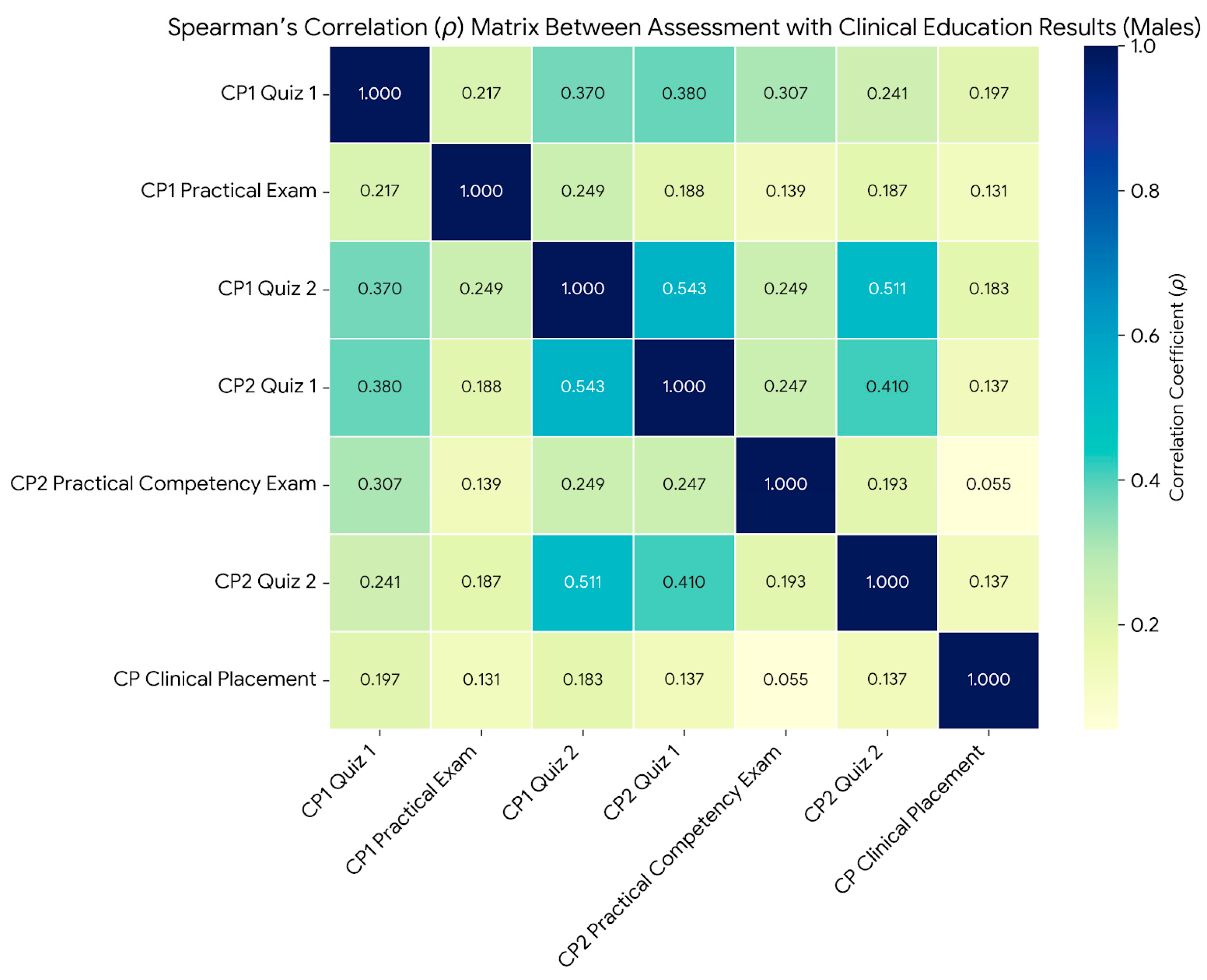
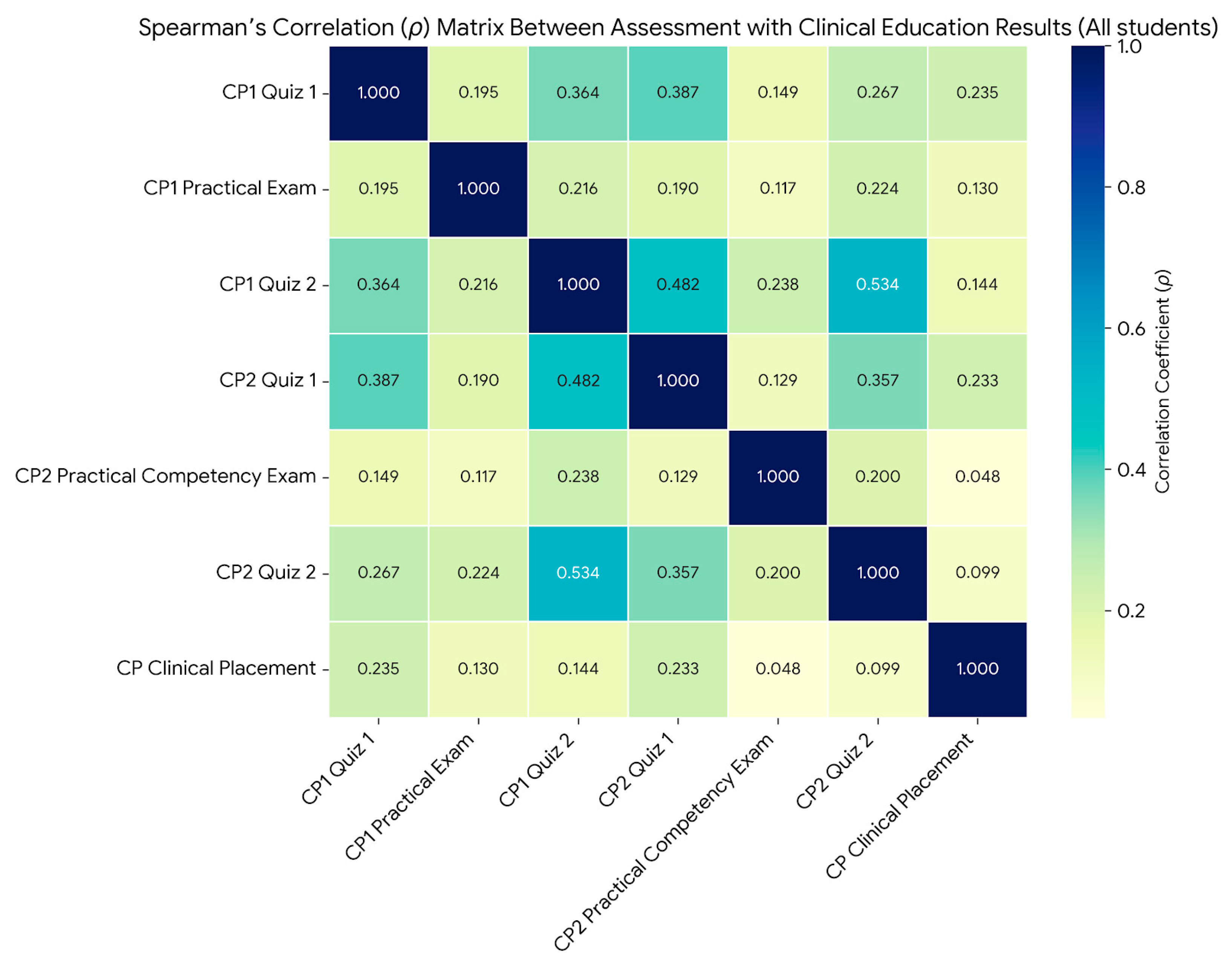
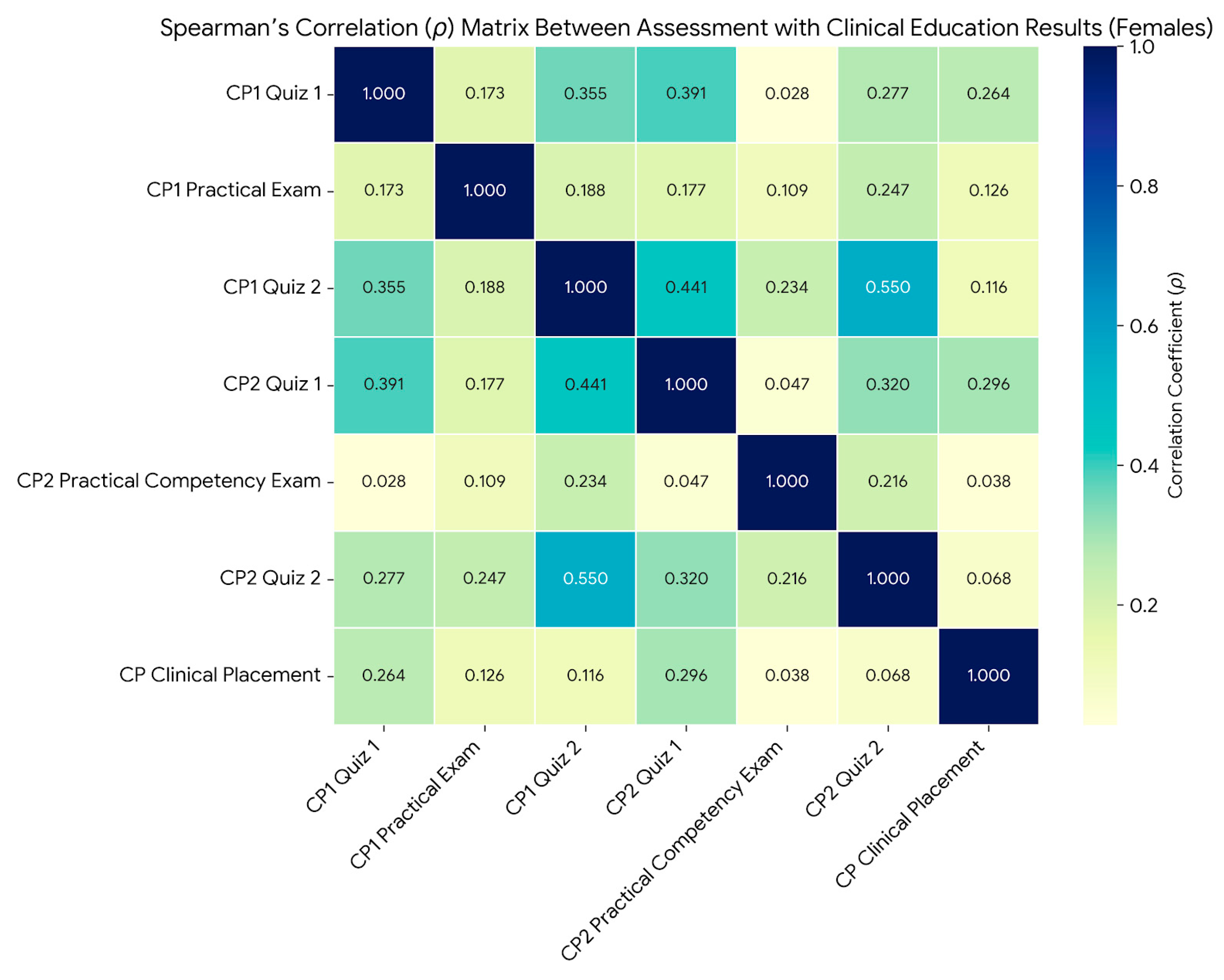
Figure 1 presents the heatmap reporting the overall correlations between the assessments and the clinical placement performance, while
Figure 2 and
Figure 3 display the correlations following adjustment for multiple comparisons using the Benjamini–Hochberg false discovery rate (FDR) procedure, with re-evaluation of the
p-values, and the strength and direction of the observed associations remained consistent. Statistically significant correlations retained significance, confirming the robustness of the findings against Type 1 error inflation.
A noticeable moderate correlation exists between the theory quizzes across the cardiorespiratory physiotherapy modules. However, the two practical assessments across the modules show only a very weak positive correlation (r = 0.117, p = 0.03). Notably, the clinical placement is weakly correlated with all academic assessments from the pre-clinical modules.
4. Discussion
This exploratory study is the first to use retrospective datasets to explore the potential predictive ability of academic performance in influencing clinical placement results in the teaching of cardiorespiratory physiotherapy, with the aims to describe the performance of entry-level physiotherapy students in both academic and clinical assessments, compare the trends in academic and clinical performance between genders, and establish the correlations between pre-clinical academic performance and clinical placement outcomes. This study did not identify a single academic assessment tool that could reliably predict clinical placement performance in cardiorespiratory physiotherapy. Instead, the findings suggest that clinical performance is likely influenced by multifaceted interactions of skills and attributes that extend beyond what was captured in pre-clinical assessments. While trends and correlations were observed, no single measure emerged as a definitive predictor, highlighting that the weak correlations may be attributed to several factors, including the design of the academic assessments and the fundamental differences in the competencies required for clinical success versus those assessed pre-clinically. Written assessments primarily target knowledge recall and problem-solving in controlled scenarios, focusing on students’ understanding and application of theoretical concepts. Practical examinations, although designed to assess hands-on skills and the “does” aspect of physiotherapy, remain structured and highly controlled, using standardised cases or simulated patients to ensure consistency and fairness. In contrast, clinical placements expose students to authentic, dynamic healthcare environments, where performance depends not only on technical competence but also on professionalism, adaptability, effective communication, teamwork, and the integration of multiple competencies in real time. This fundamental difference between controlled assessment settings and the complexity of clinical practice likely contributes to the weak correlations observed between pre-clinical assessments and clinical placement outcomes. This underscores the complexity of evaluating and preparing students for the demands of clinical practice in cardiorespiratory physiotherapy. With the existing results, this study offers a unique perspective on understanding the value of academic assessments for clinical success, addressing a critical gap in the literature on physiotherapy education. The findings contribute to the growing evidence on optimising training pathways, particularly in specialised areas such as cardiorespiratory physiotherapy, where acute care clinical placements demand high competence and adaptability (
Kuśnierz et al., 2020;
Liu et al., 2024;
Saeed & Zyngier, 2012;
Vu et al., 2022).
One plausible interpretation of the moderate correlation coefficients observed between written tests (
Figure 1,
Figure 2 and
Figure 3) is that students who consistently perform in academic assessments tend to maintain this trend across various written assessments, which congruently assess for the same domain of knowledge and theory. This consistency underscores the predictive nature of written assessments for academic performance. The need for clinical reasoning within written assessments requires students to demonstrate more than just the ability to recall knowledge and theory. This emphasises critical thinking and application skills, distinguishing it from standard regurgitative testing. Consequently, the consistently lower median scores observed in Quizzes 2 compared to Quizzes 1 (
Table 4) reflect the increased cognitive demands. Quizzes 2 test for higher-order knowledge and problem-solving capabilities with clinical scenarios, challenging students to engage deeply with complex scenarios rather than rely on rote memorisation.
The low correlation coefficient between pre-clinical assessment and clinical assessment outcomes suggests that little of the six graduate attributes, namely, learning and work integration, professionalism, communication, problem-solving, teamwork, and adaptability, were directly or accurately assessed during pre-clinical modules. This limitation is characteristic of physiotherapy education, where academic assessments primarily focus on theoretical knowledge and technical skills rather than the holistic competencies required for clinical success. This issue is not exclusive to the domain of cardiorespiratory physiotherapy.
By analysing these patterns, this study provides valuable insights into how academic achievements translate to clinical placement outcomes, emphasising areas for potential improvement in training pathways and support mechanisms. The analysis of gender differences in this study revealed no significant differences in academic performance across all assessments, except for the practical exam in the Year 2 Cardiopulmonary Physiotherapy module (
p < 0.02). At the same time, studies on gender differences in academic and clinical performance in healthcare education have produced mixed findings, with some reporting gender disparities and others reporting no significant effect (
Carr et al., 2014;
Chan et al., 2014;
Hammond, 2009;
Kume et al., 2018;
Kuśnierz et al., 2020;
Thieman et al., 2003). This study observed minimal gender-related differences in pre-clinical assessments and clinical placement outcomes. Instead of the singular impact of gender, research suggests that personality traits, including self-discipline, conscientiousness, and extraversion, are associated with better academic performance (
Steinmayr et al., 2019). These traits often enhance students’ ability to engage with learning materials and manage academic pressures effectively. Motivation plays a critical role in academic success (
Kuśnierz et al., 2020). Studies show that intrinsic motivation, driven by personal interest and enjoyment of the subject, strongly correlates with academic achievement (
Kuśnierz et al., 2020;
Liu et al., 2024;
Saeed & Zyngier, 2012;
Vu et al., 2022). On the other hand, extrinsic motivation, often influenced by external rewards or pressures, can lead to different academic outcomes depending on how it interacts with students’ intrinsic motivation; the learning environment, including teacher support and classroom dynamics, can also impact motivation and performance (
Kuśnierz et al., 2020;
Liu et al., 2024;
Saeed & Zyngier, 2012;
Vu et al., 2022). With these specific perspectives, a supportive and interactive clinical learning environment can foster intrinsic and extrinsic motivations. Both personality traits and motivation are integral to the success of clinical placement performance (
Liu et al., 2024), while maintaining the links to how students engaged with their pre-clinical studies. Understanding these relationships can help clinical educators tailor their teaching methods to support students more effectively, particularly by fostering intrinsic motivation and recognising their students’ diverse personality traits (
Liu et al., 2024;
Saeed & Zyngier, 2012).
A key limitation of this study is its single-institution design, which may limit the generalisability of the findings. As the study was conducted within the only physiotherapy training institution in the country, the inclusion of additional training sites was not feasible. Incorporating data from international institutions could introduce confounding influences, such as variations in curriculum structure, clinical assessment tools, supervision models, and healthcare system contexts. Hence, while the findings provide valuable insights within this educational setting, caution should be exercised in extrapolating them to other programmes. In addition, although the Clinical Competency Rating Scale (CCRA) is widely used for evaluating student performance in clinical placements within the institution, there is limited published evidence on its inter-rater reliability across different educator groups and settings. While all clinical educators were registered physiotherapists who received institutional training and orientation before supervising students, minor variations in interpretation and scoring may have occurred, potentially affecting the consistency of clinical assessments. Future research could address this limitation by incorporating standardised rater calibration sessions and cross-healthcare institutional benchmarking to enhance reliability and comparability. Third, the retrospective design, while necessary, restricted control over potential confounding variables. However, it was essential to adopt this approach, as implementing a prospective study to account for all variables without influencing learning outcomes in a high-stakes academic setting is highly challenging. Fourth, this study only included two consecutive cohorts from a single institution, which may limit the generalisability of the results to other contexts. Lastly, the pre-clinical assessments were unable to accurately evaluate critical clinical attributes, such as teamwork and adaptability, which are integral to clinical success. Future research should explore these aspects in broader populations and investigate sociocultural influences on educational outcomes.
5. Conclusions
This study explored the relationships between academic performance in pre-clinical assessments and clinical placement outcomes among entry-level physiotherapy students in cardiorespiratory physiotherapy. The findings demonstrated that students’ academic performance was generally consistent across written assessments. However, the low correlations with clinical placement results suggest that success in clinical environments relies on additional attributes not captured by pre-clinical evaluations. These include professionalism, adaptability, and teamwork, which are essential in clinical practice. Moreover, this study highlighted no significant gender differences in performance, except in practical examinations, emphasising the equity in academic and clinical capabilities among male and female students.
This research accentuates the importance of developing holistic assessment frameworks that bridge the gap between academic preparation and clinical demands. While acknowledging its retrospective design and limited generalisability, this study offers valuable insights into enhancing training and support systems to ensure that future physiotherapists are well-equipped for clinical excellence.