Article

Inquiry-Based Approaches in Two Generations of Science Reference Frameworks in French-Speaking Belgium: A Curricular Analysis


by
Corentin Poffé
* and
Marie Noëlle Hindryckx
Teacher Training Department (Science Didactics), University of Liège, 7 Allée du Six Août, B6c, Quartier Agora, B-4000 Liège, Belgium
*
Author to whom correspondence should be addressed.
Educ. Sci. 2025, 15(12), 1645; https://doi.org/10.3390/educsci15121645
Submission received: 26 September 2025 / Revised: 7 November 2025 / Accepted: 3 December 2025 / Published: 6 December 2025
(This article belongs to the Special Issue The Impact of Inquiry-Based Science Teaching in Secondary Schools)

Abstract

In French-speaking Belgium, new science curricula are being introduced for pupils aged 12 to 15 and will gradually be implemented in classrooms until 2028. At a time when the reference frameworks for the rest of the compulsory curriculum (ages 16 to 18) are being rebuilt, we wanted to ascertain—via qualitative and textometric analyses—the importance of inquiry-based approaches in the new common core reference framework (ages 12 to 15), as well as in the current upper secondary framework (ages 16 to 18) it is being developed to replace. More broadly, we examine and compare the ways in which didactic research findings on these approaches, and the major epistemological orientations underlying them, are operationalised; in this way, we draw up some guidelines for rewriting upper secondary science reference frameworks. Our analysis shows that the common core reference framework is much more explicit about epistemological orientations and inquiry-based approaches than that for upper secondary, although it does not include research in science didactics.

1. Introduction

Interest in inquiry-based approaches to science teaching is not new. This interest can be observed both in research (many researchers have made these approaches their subject of study) and in teaching itself (many international curricula prescribe these approaches).
They are sometimes seen as pedagogical approaches (Calmettes, 2008; Barajas et al., 2011; Boilevin & Brandt-Pomares, 2011; Bächtold, 2012); as a pedagogical prescription (Grugier, 2018); as a ‘label’ open to different pedagogical approaches (Coquidé et al., 2009); or as a way of thinking (Hasni et al., 2018b). It is thus clear that there is no consensus on the definition of these approaches, either in terms of research or curricula (Hasni & Bousadra, 2018). However,
if we adhere to the spirit [of these approaches], this diversity is not a problem in itself. It simply proves that the skills and attitudes […] required to develop and implement a skill as complex as an [inquiry-based approach] are very numerous.
Conversely, some authors (see, for example, Cariou, 2013) see the multiple interpretations and diverse definitions as a hindrance for teachers trying to implement these approaches in their classrooms.
Inquiry-based approaches to the teaching of science are being introduced into curricula, and French-speaking Belgium is no exception. Since the reform of the reference framework governing science teaching (called ‘referentiels’) came into force in 2001, the stated aim has been to move away from traditional science teaching towards a process of pupil ‘knowledge construction’ in the form of a ‘scientific approach’ (Gouvernement de la Communauté française, 1999). The reference framework is a document approved by the government and applied across all schools in the Wallonia–Brussels Federation. It sets out ‘what to teach/what to learn’, but gives no indication of ‘how to teach’; this is the prerogative of teaching networks and therefore appears in reference framework-derived programmes.
Twenty years later, French-speaking Belgium carried out a major new curricular reform called the “Pacte pour un enseignement d’excellence” (Pact for excellent teaching)1. This involves the gradual introduction (starting in 2020 and due to be completed by the start of the 2028 school year) of a common core curriculum (CC) for all pupils aged 3 to 15. This is logically accompanied by a rewriting of the reference framework.
As far as the second part of secondary education is concerned (known as upper secondary, for pupils aged 16 to 18; lower secondary concerns pupils aged 13 to 15), the reference frameworks in force date from 2014 (‘Compétences terminales et savoirs requis’—terminal skills and required knowledge—TSRK, Gouvernement de la Communauté française, 2014) and their rewriting is envisaged to enable gradual implementation from the start of the 2029 school year, following the common core.
Our research focuses on inquiry-based approaches, as envisaged in TSRK in science (Gouvernement de la Communauté française, 2014) and in the new CC reference framework (Ministère de la Fédération Wallonie-Bruxelles, 2022). These reflect a first stage of didactic transposition (Chevallard, 1985) between what scientists do (the ‘scientific approach’) and what the curricula say about it (Boilevin et al., 2012). More specifically, we examine and compare the ways in which the findings of didactic research into these approaches—as well as the major epistemological orientations that underpin them—are operationalised in the reference framework. We believe that the quality of this operationalisation is a necessary, albeit insufficient, condition if teachers are to implement inquiry-based approaches effectively in the classroom in the interest of student learning.
Following this introduction, we present the framework elements that formed the basis of our research. We drew these elements, which enabled us to orientate our reference framework analysis, both from regulations (American standards, French programmes) and from the literature.

2. Conceptual Framework

Regarding the teaching of science (e.g., Bächtold, 2012), mathematics (e.g., Mouton-Legrand & Zaid, 2018) and technology (e.g., Hasni et al., 2018b), the official prescriptions (standards, programmes, plans of study, reference frameworks, etc.) in many countries recommend that pupils carry out an ‘inquiry’. The aim is to give pupils more autonomy by offering them more open-ended tasks requiring higher-level cognitive activities (Boilevin & Brandt-Pomares, 2011; Boilevin, 2013). Such activities enable them to acquire scientific knowledge while giving them a more authentic picture of the nature of science (Osborne, 2014) and how it works (Rocard et al., 2007; Bächtold, 2012; Boilevin, 2013). Boilevin (2013) points out that meeting these objectives requires the development of three axes: learning science, learning about science and doing science. The introduction of these approaches into the curricula results in a tension between a logic of illustration and one of inquiry into scientific content (Childs, 2015; Draghicescu et al., 2015). Underlying this is the idea that “the inquiry that nourishes the scientist [could] instruct the student” (Coquidé et al., 2009, p. 61).
In the French-speaking world, this is sometimes referred to as ‘démarche d’investigation’ (Bächtold, 2012), ‘démarche d’investigation scientifique’ (Hasni et al., 2018a), ‘enseignement par démarche d’investigation’ (Boilevin & Brandt-Pomares, 2011), ‘démarche scientifique’ (Gouvernement de la Communauté française, 1999), and so on. The English-language literature refers to Inquiry-Based Science Education (IBSE), Inquiry-Based Science Teaching (IBST) or Inquiry-Based Learning (IBL).
The benefits of this type of approach for students have been highlighted by a number of authors, both in terms of knowledge acquisition (Blanchard et al., 2010; Hofstein et al., 2005; Minner et al., 2010; Toplis, 2007; Wu & Hsieh, 2006) and in terms of developing a more positive attitude towards science (Gibson & Chase, 2002; Lin et al., 2008). However, some authors question the effectiveness of these approaches, calling on the teaching world to return to more explicit methodologies (Gauthier et al., 2013; Mottint, 2018).
In the USA, the National Science Education Standards (NRC, 1996) state that “Inquiry into authentic questions generated from student experiences is the central strategy for teaching science” (p. 31). With regard to these questions, the same document states that “teachers plan to meet the particular interests, knowledge, and skills of their students and build on their questions and ideas” (p. 31). However, the text remains very open about the forms that investigation can take (Anderson, 2007; cited by Bächtold, 2012). The NRC (2000, p. 25) specified five essential features of inquiry:
  • Learners are engaged by scientifically oriented questions.
  • Learners give priority to evidence, which allows them to develop and evaluate explanations that address scientifically oriented questions.
  • Learners formulate explanations from evidence to address scientifically oriented questions.
  • Learners evaluate their explanations in light of alternative explanations, particularly those reflecting scientific understanding.
  • Learners communicate and justify their proposed explanations.
In a more recent version of the standards (NGSS, 2013), the term “scientific inquiry” is replaced by “scientific and engineering practices”. This change is justified “by the desire to break with […] a vision of inquiry centred on the execution of a series of procedures and taught in a manner dissociated from conceptual knowledge and epistemological questions” (Hasni & Bousadra, 2018, p. 50).
In France, the inquiry-based approach enshrined in legal requirements (Ministère de l’éducation nationale, 2002, 2005, 2008) takes the form of a more pedagogical approach made up of a succession of stages (“seven key moments” in collège, “eight typical stages” in lycée), even if backtracking is sometimes provided for (Bächtold, 2012; Calmettes & Matheron, 2015). Following on from Bachelard’s work, one of the crucial stages in the inquiry-based approach is students’ appropriation of the problem (Robardet, 1990; Fabre & Orange, 1997; Orange, 2005, 2012).
Though they have been studied extensively, we are still far from a consensus on a definition of inquiry-based approaches (Maschietto, 2010). Attempts to characterise these approaches have led to the identification of their necessary characteristics, but no consensus has yet emerged.
Méheut et al. (2006) point out that the inquiry-based approach advocated for in France has two characteristics: consideration of the student and the hypothetico-deductive approach.
Morge and Boilevin (2007) identify three characteristics: new knowledge being brought into play, pupils being involved in formulating and validating/invalidating hypotheses, and devolution (for this last point, see Brousseau, 1998).
For Minner et al. (2010),
inquiry science instruction can be characterized as having three aspects: (1) the presence of science content, (2) student engagement with science content, and (3) student responsibility for learning, student active thinking, or student motivation within at least one component of instruction—question, design, data, conclusion, or communication.
(p. 478)
The hypothetico-deductive approach mentioned by Méheut et al. (2006) is also taken up by Calmettes (2012), who underscores a certain amount of responsibility on the part of students regarding knowledge construction and learning, as well as the mediating role of the teacher.
The European S-TEAM project2 uses four criteria:
The S-TEAM proposal described inquiry-based science teaching (IBST) as being characterised by activities that engage students in the following:
-
Authentic and problem-based learning activities where there may not be a correct answer;
-
A certain amount of experimental procedures, experiments and ‘hands-on’ activities, including searching for information;
-
Self-regulated learning sequences where student autonomy is emphasised;
-
Discursive argumentation and communication with peers (‘talking science’).
For his part, Boilevin (2013) identifies the following characteristics: engaging pupils in scientific content; proposing tasks or problems to be solved that require cognitive and/or experimental activities; allowing argumentative discussions and communication between pupils; and including knowledge structuring.
Grangeat (2013), for his part, identifies six dimensions, each of which presents a continuum3 on which players can situate themselves: question origin (from a question proposed by the teacher to a problem developed by the pupils); the nature of the problem (from a closed problem and a protocol followed by the pupils, to an open problem and a protocol developed by the pupils); pupil empowerment (from strong guidance from the teacher to self-regulated learning); pupil diversity (ranging from a focus on the teacher to a focus on the learner); student argumentation (from communication between students in small groups to the ability to justify positions by referring to results or knowledge); and the clarification of knowledge arising from inquiry (from teachers setting out their expectations for the session, to the clarification of knowledge by learners, coupled with a metacognition activity enabling the reinvestment of acquired knowledge).
Finally, de Hosson et al. (2014) refer to cooperative learning based on student initiative and questioning, the construction of knowledge by the student (and not transmitted by the teacher), and the choice, identification and resolution of a scientific problem as characteristic elements of the inquiry-based approach.
Cariou (2009, 2011) has highlighted ten authenticity criteria for these approaches, with a view to providing guidance to teachers wishing to implement more authentic inquiry-based approaches based on epistemological and historical foundations.
The following are considered to be guarantees of authenticity: (C1) the problem is enigmatic in nature but is within the students’ reach and (C2) is really posed to them; (C3) the hypotheses come from them, (C4) a debate between them on their acceptability is set up and (C5) those chosen have a dubious aspect; that (C6) the activities are designed by them in order to test them, (C7) there is a debate on the relevance of these tests and (C8) no activity undertaken concerns obvious facts or is not directly linked to the main thread of the investigation; that (C9) a new phase of debate is opened up when it comes to interpreting the results obtained in relation to the hypotheses put forward, and finally that (C10) the conclusions are drawn by the pupils and not dictated to them.
These criteria are part of a broader framework developed by the same author: inquiry-based approaches with multi-criteria authenticity. This framework incorporates 22 principles (Cariou, 2009) that aim to implement “inquiry-based learning through the initiative of learner-strategists” (Cariou, 2009, p. 158).
In an English-speaking context, Linn et al.’s (2004, p. 4) definition of inquiry is frequently cited: “the process of learning through inquiry” (Linn et al., 2004, p. 4). They view
inquiry as the intentional process of diagnosing problems, critiquing experiments, distinguishing alternatives, planning investigations, researching conjectures, searching for information; constructing models, debating with peers, and forming coherent arguments.
Minner et al. (2010) set out the five components of the investigation cycle: “generating questions, designing experiments, collecting data, drawing conclusion, and communicating findings” (p. 493).
Cariou (2015) sought to produce an (albeit partial) synthesis of the common criteria used to define the inquiry-based approach; this can be seen in both legal requirements (American standards and French programmes) and in the scientific literature. Its synthesis identifies four elements: the inquiry is initiated by a question; the students are given some conceptual responsibility; there are debates and argued exchanges; and students produce and achieve (p. 17). In an attempt to shed light on these criteria in light of theories evoking the existence of two types of scientific mind—creative and controlling (e.g., Poincaré, 1905; Medawar, 1972; Popper, 1979; Grmek, 1997)—the same author created a list of five criteria likely to describe an inquiry-based approach (Cariou, 2015, p. 21):
  • Criterion I: confrontation with an enigmatic question;
  • Criterion CRÉA1: conception of hypothetical ideas;
  • Criterion CRÉA2: conception of ideas based on new data, after they have been collected;
  • Criterion CTRL1: theoretical control through examination of these ideas (argued debates);
  • Criterion CTRL2: empirical control of hypothetical ideas.
In terms of epistemological references, inquiry-based approaches reject the naïve inductivism that would have us believe that experience always precedes theory, or that “scientific theories are univocal generalisations of observational or experimental data that are themselves devoid of any prior theory or conception” (Bächtold, 2012, p. 12). This stance impacts the way in which experimental activities are approached (Boilevin, 2013; Trna, 2013). While they often take on directive and stereotyped forms in the classroom, aimed at manipulative or conceptual learning, the aim is to move towards open approaches with “formulation, reformulation of a question or problem, formulation of hypotheses, planning of experiments, improvement in a protocol, control of factors, collection and processing of data, interpretation of data, use of simulations, debates, etc.” (Méheut, 2006, p. 60). Boilevin (2013) adds that “the inquiry-based approach is […] centred on the practice of a hypothetico-deductive experimental approach” (p. 29). The hypothesis (formulated by the students) occupies a central place in these approaches (“the very heart”, Dewey, 1910, p. 75, quoted by Cariou, 2015) (Bächtold, 2012).
In terms of both the knowledge involved and teaching–learning methods, inquiry-based approaches are also inspired by constructivism (in particular, the relationship between theory and facts and the role of students’ conceptions) (Cakir, 2008; Minner et al., 2010; Bernard et al., 2012; Draghicescu et al., 2015; Constantinou et al., 2018) and socio-constructivism (in particular, the fact that knowledge is defined within a community) (Mayer, 2004; Hmelo-Silver et al., 2007; Pélissier et al., 2007; Calmettes, 2008, 2009; Bell et al., 2010; Boilevin, 2013). Pupils must have “their interest mobilised by an enigma, [be] placed in a situation where they are constructing their knowledge, [the task must have] a structure that enables everyone to carry out the required mental operations” (Meirieu, 1988, p. 166).
To sum up, it seems to us that pupils’ implementation of hypothetico-deductive approaches and the socio-constructivist foundation are two aspects that are not only unavoidable, but also sufficiently all-encompassing to guide our reference framework analysis.

3. Research Question and Methodology

As science didacticians and science teacher trainers for all levels of compulsory schooling in the Wallonia–Brussels Federation, we wish to examine and better understand the ways in which the reference framework in force in secondary education (aged 12 to 18) operationalises the major didactic and epistemological orientations of inquiry-based approaches in the teaching and learning of science (RQ1).
Secondly, noting that the reference frameworks currently in force are of two different generations (TSRK dating from 2014, CC dating from 2022) and with a view to rewriting the TSRK reference framework, we sought to identify potential differences in the operationalisation of these didactic and epistemological orientations between the two reference frameworks (RQ2).
To answer RQ1, we conducted a descriptive analysis (Fortin & Gagnon, 2016) and to answer RQ2, we combined this descriptive analysis with a textometric analysis. Corresponding to the relevant school level, we restricted our analysis of the CC reference framework to more general aspects and those that corresponded to secondary school (lower secondary, pupils aged 12 to 15), excluding those relating to other levels (primary, pupils aged 6 to 12).
More specifically, the corpus analysed therefore consists of the entire TSRK reference framework and part of the CC. For the latter (CC), we retained all the general sections (foreword, general presentation, issues and general objectives, cross-curricular aspects and crossover between disciplines–see the descriptive analysis below) for the analysis and, with regard to learning content and expectations, we have only retained those relating to lower secondary education, excluding those relating to primary education.
We therefore carried out a descriptive analysis of the two reference frameworks, including the number of pages and the sections of the documents, but also the way in which they operationalise the two main orientations adopted from the didactic and epistemological conceptual framework: hypothetico-deductive approaches and socio-constructivism.
Textometric analysis was carried out on the two reference frameworks using TXM 0.8 software (Heiden et al., 2010). More specifically, the frequency of the different lemmas4 (of more than three characters) present in each repository was calculated. The lemmas with the same lexical root (e.g., explain and explanation) were then grouped together. Finally, each group’s frequency was obtained by summing the frequencies of the lemmas in that group.
All the groups were then reviewed by the two researchers in order to assess their relevance to the framework for inquiry-based approaches in science. Inter-judge agreement dictated the groups retained for further analysis.
Based on the frequencies, an ascending ranking was produced for each frame of reference, with each group of lemmas with the same lexical root assigned a rank. Finally, for each group, the rank calculated for the CC framework was subtracted from that for the TSRK framework. A positive result indicates a higher rank and therefore a group of lemmas that are overall more frequent in the CC reference framework.
Thus, 1904 different lemmas of more than three characters were identified in the TSRK and 1494 in the CC reference framework. Because of their relevance to inquiry-based approaches, 183 and 224 lemmas were retained for the TSRK and CC analyses, respectively. The groupings of these lemmas resulted in the creation of 116 and 131 groups, respectively.

4. Results

4.1. Descriptive Analysis

4.1.1. Terminal Skills and Required Knowledge (TSRK)

The TSRK (Gouvernement de la Communauté française, 2014) provides a framework for upper secondary education (students aged 15 to 18). For science, two versions of this document coexist: a version known as basic science (for pupils taking 3 h of science per week) and one known as general science (for pupils taking 5 to 6 h of science per week). It is this latter version that is the subject of our analysis.
This 65-page document is divided into different sections:
  • Preamble (8 pages);
  • Introduction (5 pages);
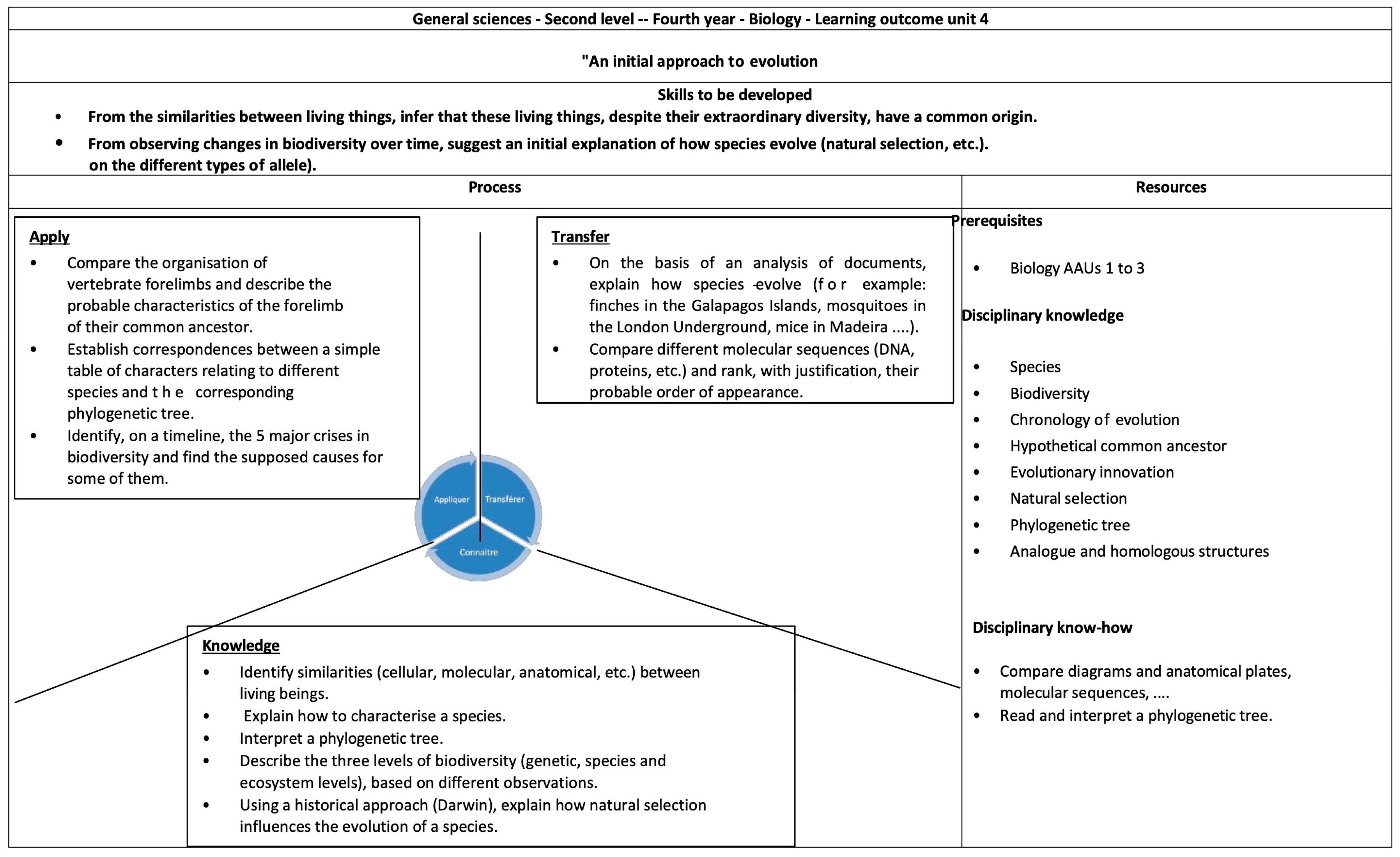
  • Description of the units of learning outcomes (52 pages) (see Figure 1).
We analyse the content of these different sections below.
1.
Preamble
The preamble is common to the reference frameworks for all subjects. It begins with an explanation of the reasons for rewriting the standards, the main one being the lack of precision in the previous iteration (dating from 2001).
It then presents the general organisation of the curriculum, divided into units of learning outcomes (UAA—Unité d’acquis d’apprentissage—“a coherent set of learning outcomes capable of being assessed”, p. 3), the content of which enables one or more competences to be exercised. The exercising of these competences mobilises both resources and processes, themselves classified according to three dimensions: know–apply–transfer.
These three dimensions are described as follows:
Know = Construct and explain resources;
Apply = Mobilise knowledge in dealing with trained situations;
Transfer = Mobilise knowledge acquired in dealing with new situations.
The reference framework also mentions the possibility of using strategies referred to “by convention” as transversal (intra- or trans-disciplinary), without defining what is meant by this expression (Gouvernement de la Communauté française, 2014, p. 4).
In a box, the reference framework goes on to list the specific features of a task aimed at transferring knowledge and skills: learner autonomy; the recontextualisation of learning outcomes; the ability to adjust a concept, a model or a procedure according to the context; and the ability to assemble/integrate various resources (Gouvernement de la Communauté française, 2014, p. 7).
It should be noted that only one bibliographical reference is cited in the footnote (Barth, 1993) with regard to the term “concept”.
2.
Introduction
This section, which is specific to the science reference framework, begins with a presentation of the course objectives:
The aim is both to sustain young people’s interest in science and to make them understand that biology, chemistry and physics
[…]
  • continually use models, models with their limitations, to describe an often complex reality;
  • are experimental sciences that help to develop rational approaches to solving problems;
  • constantly compare spontaneous representations with established models;
[…]
The attitudes that are essential to scientific practice are described as follows: intellectual honesty, a balance between open-mindedness and scepticism, curiosity and a concern to fit one’s work into that of a team. Also described are the essential abilities necessary for this kind of practice:
  • To appropriate fundamental concepts, models and principles.
  • To assess the scope and limits of models and principles.
  • To conduct research and use models.
  • To use experimental procedures.
  • To develop logical reasoning.
  • To use communication procedures.
  • To solve numerical applications.
  • To use appropriate mathematical and IT tools.
  • To understand that current scientific knowledge has a history.
  • To establish links between developments in science and technology.
  • To be able to summarise his/her point of view and defend it in a debate (Gouvernement de la Communauté française, 2014, p. 9).
There is also a section on the role of teachers in scientific education (Gouvernement de la Communauté française, 2014, p. 11):
  • Helping young people to understand the challenges of the 21st century;
  • Placing pupils in a friendly learning environment (using a variety of teaching strategies to suit different learning styles, nurturing motivation for science);
  • Proposing relevant activities (active learning, making links with the known and the concrete, integrating new concepts through research, observation, reflection and experimentation in the laboratory or in the field, giving meaning).
Finally, the introduction states that “the various UAAs are all opportunities to apply a scientific approach” (Gouvernement de la Communauté française, 2014, p. 11). The latter is then described, involving
putting pupils in an inquiry situation, which at the same time enables them to practise a scientific approach. This approach is a process in which pupils have the opportunity to observe, experiment, debate or consult documents and experts. Under the guidance of the teacher, they then develop answers to research questions and construct their own understanding of scientific concepts. This approach should be favoured in classroom practice, either flexibly with the whole class, or more fully with small groups of pupils.
The reference framework also provides information on the cross-curricular strategies that can be employed when implementing an inquiry-based approach, while specifying that it is impossible to work on all of these in the course of a singular investigation. These are classified into three areas:
Taking ownership of the problem
  • Identify a scientific problem and ask related questions.
  • Formulate a hypothesis.
  • Identify dependent and independent variables.
  • Take part in devising an experimental protocol.
  • Plan an experiment.
Gathering information
  • Conduct a documentary search.
  • Gather and select information.
  • Consult experts.
  • Apply a problem-solving strategy.
  • Carry out an experiment.
  • Observe and collect data.
  • Develop manual skills.
  • Follow instructions.
  • Take the necessary precautions to ensure their own safety or that of others.
Processing and communicating information
  • Analyse, interpret and criticise data.
  • Exploit measurement results.
  • Present data (quantities and units, tables, graphs) rigorously.
  • Validate or invalidate a hypothesis.
  • Model a situation.
  • Draw a conclusion and justify it (by analysing how it relates to the original problem).
  • Explain a phenomenon.
  • Solve a numerical application.
  • Communicate results and conclusions in scientific language.
  • Use a mode of communication adapted to the audience concerned (Gouvernement de la Communauté française, 2014, p. 12).
Finally, this introduction closes with a remark on the place of experience in teaching and learning:
The experiment is a commonly used means in the research process. For students, experimentation is also a privileged means of perceiving or feeling a phenomenon or a concept. For these reasons, pupils should, as often as possible, have the opportunity to carry out experiments in a room with suitable equipment.
3.
Description of the UAA
This final part of the reference framework sets out the following, for each UAA and in the form of a table:
  • The title;
  • The skills to be developed;
  • The resources and processes (know–apply–transfer) to be developed and/or used.
Overall, in this reference framework, it is difficult—if not impossible—for the reader to identify the major theories and motivations underlying the inquiry-based approaches selected for analysis. An informed reader will be able to identify some traces of the socio-constructivist underpinning (pupil autonomy, collective dimension, confrontation of pupils’ spontaneous representations), without these being presented as strong guiding elements. As for hypothetico-deductive approaches, the reference framework does not seem to give them any particular emphasis.

4.1.2. Common Core (CC)

As a reminder, the CC reference framework (Ministère de la Fédération Wallonie-Bruxelles, 2022) is a document prescribing what pupils aged 6 to 155 should acquire in terms of knowledge, know-how and skills during their schooling. This 126-page document is structured into six main sections:
  • Foreword (2 pages);
  • General presentation of the common core curriculum (13 pages);
  • Issues and general objectives (8 pages);
  • Learning content and expectations (84 pages);
  • Cross-curricular aspects (7 pages);
  • Crossover between disciplines (9 pages).
In what follows, we will describe the content of these different sections in more detail, mainly focusing on the sections of interest to the theme of this Special Issue (Section 3, Section 4 and Section 5) and on the target audience (secondary school pupils aged 12 to 15).
1.
Foreword
This short section, which is common to the reference frameworks for all subjects and signed by the Minister for Education, sets out the main objective: “to write new reference frameworks adapted to the requirements of a common education for the citizens of the 21st century”. It also describes the broad methodological outlines used to draft the new standards.
2.
General presentation of the common core curriculum
Once again, this section is common to the reference frameworks for all subjects. It begins by explaining the reasons for introducing a common core curriculum for pupils aged 3 to 15. It then describes how the curriculum is organised into five specific areas (French, Arts and Culture; Modern Languages; Mathematics, Science and Technology; Humanities, Education for Philosophy and Citizenship, Religion or Morals; Physical Education, Well-being and Health) and three cross-curricular areas (Creativity, Commitment and Entrepreneurship; Learning to Learn and Making Choices; Learning to Find One’s Way). This section also summarises the major changes brought about by the introduction of the new reference frameworks (2022) in comparison with the old ones (Socles de compétences, Gouvernement de la Communauté française, 1999). It also gives the reader a clearer picture of the benchmarks that have been provided to designers in the form of “qualities to be achieved”. Finally, it describes the common organisational outline for the reference frameworks of all the disciplines.
3.
Issues and general objectives
This section is the first in the reference framework that is truly specific to the sciences. Right from the introduction, the inquiry-based approach is mentioned:
The sciences study the organisation of the natural world and the phenomena that occur in it. They use inquiry-based approaches in which the scientists’ general ideas (hypotheses and theories) are subjected to rigorous controls, usually experimental, to ensure maximum objectivity.
(p. 18)
The tone is set: the reference framework promotes a hypothetico-deductive approach and places significant emphasis on experimental approaches.
Over and above scientific concepts, the reference framework encourages the development of a better understanding of scientists’ activity:
the study of fundamental concepts and scientific activity is one of the keys to understanding the social issues facing citizens. […] It is expected that the construction of knowledge as well as the exercise of modes of reasoning and methods specific to scientific disciplines will arouse the desire and the possibility in a large number of pupils to understand the world in which they live.
(p. 18)
The reference framework gives concrete expression to these challenges by assigning four aims to science teaching:
  • Aim 1: “Practising science”: pupils acquire the skills and attitudes needed to practise science, as well as scientific knowledge.
  • Aim 2: “Learning science”: pupils develop the knowledge and skills specific to science in order to understand the world.
  • Aim 3: “Learning about science”: pupils understand the construction of scientific knowledge over time and the characteristics of scientific thought.
  • Aim 4: “Make choices and take action based on science”: pupils take a stance on societal (related to the environment, health, consumption, etc.) and global issues—based on scientific methods, models and concepts—and act accordingly. (p. 18)
These four aims reflect the areas that Boilevin (2013) encouraged students to develop in order to gain a better understanding of science: learning science (aim 2), learning about science (aim 3) and doing science (aim 1).
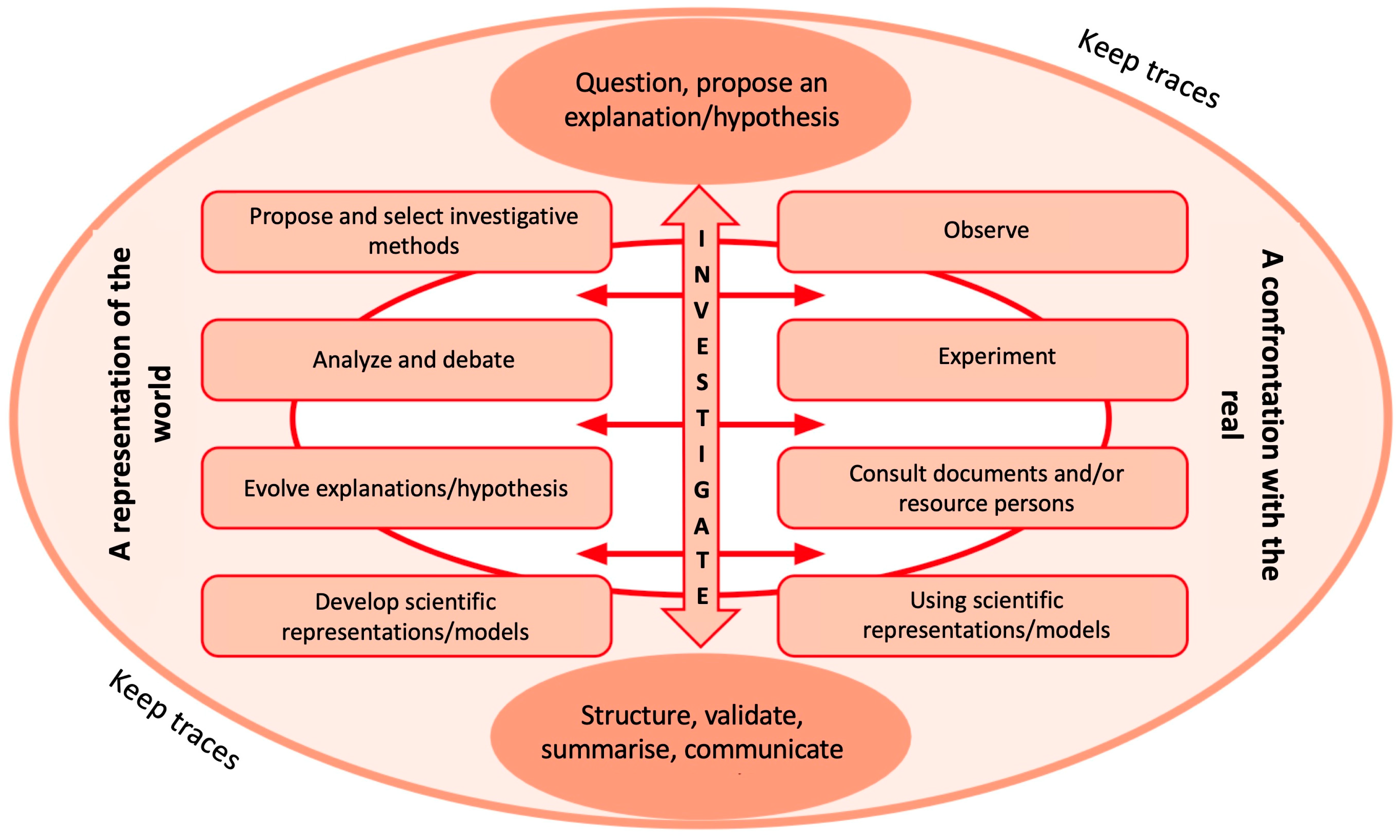
Below, we detail how these four aims are described in the reference framework. Aim 1: Practising Science: This aim is described at the greatest length (three pages, compared with around one page for aims 2, 3 and 4), explaining the process of scientific inquiry as promoted by the reference framework.
This explanation takes the form of a diagram (Figure 2) and text.
There is a strong constructivist underpinning:
In inquiry-based approaches, pupils explore a scientific question about what surrounds them. Using their initial conceptions, they try to propose an explanation, or even formulate a hypothesis, and suggest avenues of investigation.
(p. 19)
The importance attached to debates between pupils suggests that the reference framework intends to develop a socio-constructivist vision of science:
During these investigations, the back and forth between the attempted explanations (hypotheses) and the information gathered (facts, data, results, etc.) leads to debates and possible adaptation of the proposed explanations and hypotheses.
(p. 19)
We also find the two types of mind (creative and controlling) taken up by Cariou (2015) and the two registers of scientific activity (model and empirical registers) evoked by Orange (2012):
Investigation therefore calls, in a complementary way, on the creative imagination, on a form of representation of the world (left-hand side of the diagram) and on rigorous and methodical confrontation with reality (right-hand side of the diagram), which leads to the gradual development of scientific explanations and models.
(p. 19)
This explanation of the approaches to scientific inquiry, as envisaged in the reference framework, is supplemented by a table identifying the skills to be developed in relation to each part of the diagram.
Aim 2: Learning Science: Pupils must acquire knowledge, skills and competences in three areas: life, matter and energy. These three areas have evolved over the last three years of the core curriculum (pupils aged 12 to 15) in biology, chemistry, and physics.
Aim 3: Learning About Science: This aim emphasises the need to train pupils in the way scientific knowledge is constructed.
Once again, we find strong roots in socio-constructivism and an emphasis on the hypothetico-deductive approach (see Table 1).
Aim 4: Make Choices and Take Action Based on Science: This fourth aim emphasises the importance of developing “an ability to relate choices and actions to constructed scientific knowledge” (p. 25).
4.
Learning content and expectations
This section is the largest in the reference framework. It is divided into nine sub-sections: one for each school year, from primary 1st to 6th (pupils aged 6 to 12) and secondary 1st to 3rd (pupils aged 12 to 15). Each sub-section is organised in the same way, beginning with a short text setting out the main issues for the school year in question. This is followed by a synoptic table setting out the main themes to be covered during the year and placing them in perspective with all the themes to be covered during the common core curriculum. This encourages spiral teaching and makes it easier to link various learning activities throughout the pupil’s career6. This is followed by a table highlighting the skills associated with scientific approaches: grey indicates skills worked on previously and black indicates skills added during the school year in question. The skills listed in this table are identical to those listed in the table in the explanation of aim 1 “Science practice”, in the “General aims and objectives” section.
Finally, the various subject areas (biology, chemistry and physics) to be worked on during the school year in question are listed. For each topic, there are three tables: one each for knowledge, skills and competences. Each table is made up of two columns: the left-hand column lists the generic statements of knowledge, skills and competences, and the right-hand column lists the expectations in relation to these generic statements (e.g., in Secondary 2, in the “Evolution” theme for the knowledge “Common ancestor”, the expectation given is “List the characteristics of a common ancestor on the basis of shared attributes” (p. 86)).
5.
Cross-curricular aspects
The section entitled “General presentation of the common core curriculum” describes how the curriculum is divided into five specific areas and three cross-curricular areas (see above). The introduction to the “Cross-curricular aims” section emphasises the essential nature of these cross-curricular areas:
Essential elements of the common core curriculum, cross-curricular areas 6, 7 and 8 define the learning to be developed through the content listed in all the subject reference frameworks.
(p. 110)
These three cross-curricular areas are cited and described:
  • Creativity, commitment and entrepreneurship;
  • Learning to learn and making choices;
  • Learning to find one’s way.
Given the strong interconnection between these areas, they have been grouped around six cross-curricular aims. These should make it possible to cover all the learning related to the three cross-curricular areas:
  • Knowing oneself and being open to others;
  • Learning to learn;
  • Developing critical and complex thinking;
  • Developing creativity and an entrepreneurial spirit;
  • Discovering the world of schooling, the diversity of streams and options available after the core curriculum and gaining a better understanding of the world of professional activities;
  • Developing personal and professional projects: anticipating and making choices.
Each of the six aims is then broken down into components. These components are listed in a table which also gives examples of content or expectations for each component. Table 2 shows that the examples proposed are linked to the targeted content (the “Learning content and expectations” section) by type (C = competency) and level (P3: 3rd year primary) (in brackets).
6.
Crossings between disciplines
In this final section, double-entry tables are used (one per school year). For a series of scientific knowledge, skills and competences listed in the content section, these tables provide information on the links that can be forged with such insights and abilities from other disciplines. The stated aim is to encourage the decompartmentalisation of learning.

4.1.3. Comparative Analysis

The epistemological principles underpinning their vision of science teaching are set out in the “Issues and general objectives” and “Introduction” sections of the two reference frameworks (TSRK and CC). Although these principles (constructivism, socio-constructivism, etc.) are not named, we note that traces of their implementation can nevertheless be detected.
The “Issues” section (CC) is longer: eight pages compared with five for the “Introduction” (TSRK). The elements are mainly explained in full sentences, whereas the introduction to the TSRK is presented in the form of a more concise list. These differences in presentation make it less difficult to identify the epistemological orientations in the CC reference framework, especially for a public of teachers whose training, in French-speaking Belgium, does little to guide them regarding epistemological dimensions.
We can assume that the CC reference framework facilitates the implementation of inquiry-based approaches and their articulation with subject content. Indeed, for each year of study and for each subject area, the CC reference framework presents a table explaining the link between subject-specific knowledge and the skills associated with inquiry-based approaches. It also explains how the latter contribute to the development of cross-curricular areas.
In the TSRK, it is up to the teacher to combine the development of cross-curricular strategies linked to the inquiry-based approach (listed in the introduction to the reference framework), the attitudes and abilities for scientific practice (also listed in the introduction) and the skills, resources and processes to be developed (listed in the descriptions of the units of learning outcomes).
Similarly, the specific features of the sciences mentioned in aim 3 “Learning about the sciences” in the CC reference framework (see Table 1) are explained in greater detail than in the TSRK. The following are notably absent from the latter: the importance of a prior theoretical framework, the place of error in scientific reasoning and the historical dimension of theories. Generally speaking, the TSRK framework places less emphasis on hypothetico-deductive reasoning: the notion of hypothesis is not presented as central. An uninformed reader might understand the definition of the scientific approach (page 12 of the TSRK framework and repeated above) by considering observation, experimentation or debate as stages preceding the development of research questions and hypotheses.
Finally, the two reference frameworks take a different approach to the experimental dimension of science. The TSRK reference framework makes it a central element, to the point of devoting a paragraph to it (see above). However, a more in-depth analysis of the description of the units of learning outcomes shows that this experimental dimension very often takes the form of an analysis of experimental results, rather than the real implementation of experimental procedures on the part of students. For its part, the CC reference framework considers implementing experimental procedures as a means of investigating reality, as well as observation, consulting documents or resource persons or the use of scientific models, without specifically promoting one or other of these means.

4.2. Textometric Analysis

The textometric analysis results will be organised into three sections: an analysis of the ranking determined for the different groups of lemmas in the TSRK; an analysis of that determined for those in the CC; and an analysis of the differences in these between the TSRK and the CC. We assume that the latter in particular will aid in highlighting changes in the priorities of the CC reference framework compared with the TSRK.

4.2.1. Terminal Skills and Required Knowledge

As might be expected, the “science” lemma occupies first place in the ranking.
The second most frequent lemma group is “competence”, appearing 95 times. This is a structuring element of this reference framework, which appears in many titles. This prominence seems logical to us, since this reference framework operationalises the introduction of competence-based teaching promoted by the Ministry of Education (Gouvernement de la Communauté française, 1997).
Of the ten most frequent lemma groups7, just over half are oriented towards knowledge and low-level tasks8: “describe” (3), “know” (3), “explain” (5), “discipline” (7), “apply” (8), and “use” (9). Only one group calls for a high-level task: “develop” (10).
The position of the lemmas grouped under ‘experiment’ (6) reflects the importance attached to this dimension in science and science teaching.
The development of a certain capacity for action in pupils (group of “action” lemmas) is also highlighted (10).

4.2.2. Common Core

The “science” lemma also opens this classification.
The ability to use knowledge in a number of situations, going beyond “knowledge for knowledge’s sake”, and the development of a capacity for action are highlighted: the “use” and “action” lemmas occupy second and third place, respectively.
We can see that the dimensions linked to student learning are taken into account, with the “learning” group in third place.
Within the first 10 groups of lemmas, the balance between low- and high-level taxonomic tasks seems more balanced, with both evidenced (low-level, e.g., “explain” (5), “describe” (10) and high-level, e.g., “model” (6)).
The experimental dimension is also highlighted, with the ‘experiment’ group of lemmas in eighth place.
Finally, two groups of lemmas linked to “investigation”-type approaches are present at the top of the ranking: “investigation” (7) and “approach” (8).

4.2.3. Comparative Analysis

Unsurprisingly, the “science” lemma is the most frequent and places first in both reference frameworks.
The “explain” group of lemmas also occupies the same position in both rankings. Its position at the top (5) reflects the importance attached by the writers of both reference frameworks to the explanatory dimension of science.
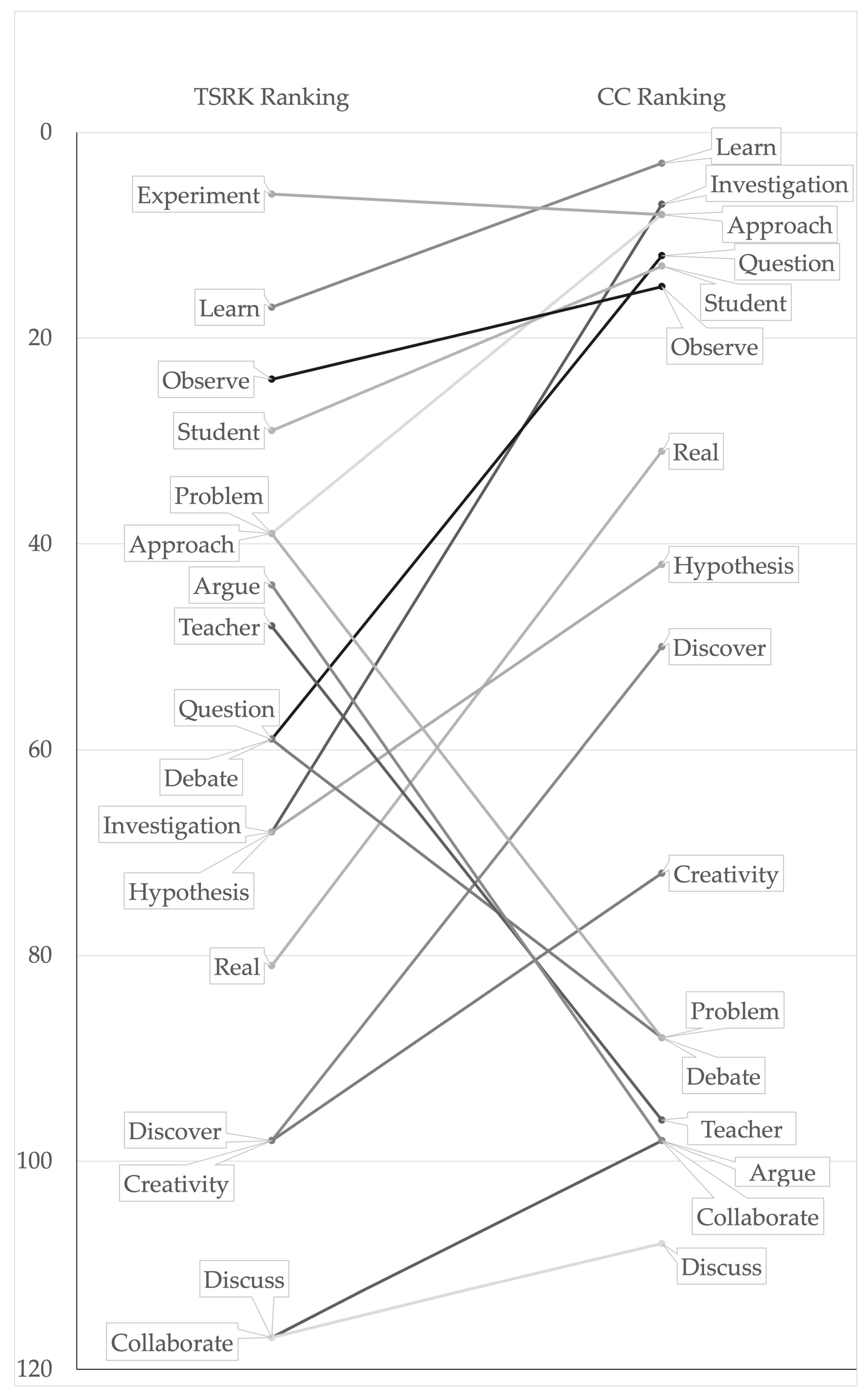
There have also been significant changes in the orientations of the two reference frameworks (see Table 3 and Figure 3). Of the 10 most frequent groups of lemmas in the TSRK reference framework, 6 have seen their ranking decrease, including 4 by more than 10 ranks: “competence” (−35), “knowledge” (−13), “discipline” (−84) and “apply” (−83). It is interesting to note that this has been made in favour of groups of lemmas that are more in phase with inquiry-based approaches (‘investigation’ (+61), ‘approach’ (+31)) and that take account of the pupil as a learner (‘learning’ (+61)).
In the CC ranking, the experimental dimension dropped two places, although it remained an important dimension (64 occurrences).
Finally, it is interesting to note that the vast majority of the lemma groups associated with epistemological orientations linked to inquiry-based approaches moved up in the ranking within the CC reference framework, compared with the TSRK, as shown in the table below.
Thus, the lemma groups “investigation” (+61), “real” (+50), “discover” (+48), “question” (+47) and, to a lesser extent, “approach” (+31) really occupy a more important place in the CT than in the TSRK. Similarly, ‘hypothesis’ (+26), ‘creativity’ (+26), ‘collaborate’ (+19), ‘student’ (+16) and ‘learn’ (+14) appear more prominently in CT, while “observe” (+9) and “discuss” (+9) show a smaller difference in ranking (+9).
Although the lemma group “debate” falls in the CT ranking compared with the TSRK (−29), it has almost as many occurrences in both documents (6 occurrences in TSRK and 9 occurrences in CC). Finally, “teacher” (−48), “problem” (−49) and “argue” (−54) are lemma groups that occur less frequently and drop heavily in ranking. One may wonder why the lemma group “problem” is relatively absent from the CT, whereas “question”, “investigation” and “approach” are clearly on the rise.

5. Discussion

In the context of the reference framework rewriting following major reforms in compulsory education in French-speaking Belgium—as embodied in the “Pacte pour un enseignement d’excellence”—we assume that we can consider the framework for the common core (CC) science curriculum as the first representative of a new generation of reference frameworks in the Wallonia–Brussels Federation.
In this respect, we can highlight a number of elements that can be understood as being likely to encourage the introduction of inquiry-based approaches in the classroom.
Firstly, it should be noted that the CC reference framework makes the links between the general framework of the inquiry-based approach—which it presents in its “Issues and general objectives” section—and the subject content explicit. This explanation is operationalised in the form of tables for each year of study. In the TSRK, this task of linking general considerations and subject content is left to the teacher.
This task is made all the more difficult by the fact that the general considerations relating to the inquiry-based approach in the TSRK are rather laconic and partly in the form of sparsely written lists. In the CC reference guide, the various elements of the inquiry-based approach are described at length, both in the form of written texts and in tables.
Because of the greater level of detail in the general elements relating to the inquiry-based approach, the major didactic and epistemological orientations are more easily discernible in the CC than in the TSRK reference framework. Although this is already a (as we consider it, positive) step forward, we regret that these orientations are only present through their operationalisation in the classroom, without explicit reference to research in science didactics. At a time when teachers are called upon to “master disciplinary content and its epistemological foundations” and to “read critically the results of scientific research in education and didactics” (Décret définissant la formation initiale des enseignants—Gouvernement de la Communauté française, 2019, pp. 4–5), we believe that the reference frameworks would benefit from explicitly detailing the orientations that guided their development and referencing the research that underpins them, in addition to guiding teachers in their operationalisation in the classroom.
Our textometric analysis made it possible to reinforce these observations, which had already been noticed at the time of the descriptive analysis. However, the analysis also revealed new findings.
The upward trend of the groups of “student” lemmas—both in terms of the number of occurrences and ranking—together with the decline in “teacher” equivalents, suggests that the role of the teacher is probably less prominent in the CC than in the TSRK reference framework. However, as the students of the CC are younger, the teacher’s role in guiding them towards autonomy is essential. This suggests that, despite this constraint, pupils are nevertheless placed more at the centre of actions linked to science learning in the CC reference framework.
Within the framework of a socio-constructivist orientation, lemma groups “debate” and “argue” have decreased in frequency. However, this finding needs to be qualified, since while the “debate” lemma group is lower in the ranking, its frequency increases in the CC frame of reference. Furthermore, we must not lose sight of the fact that the two reference frameworks provide an outline for teaching science to different learners.
We hypothesise that the lesser prominence of the “argue” lemma group can be explained, at least in part, by the fact that these are tasks that are more appropriate for older pupils (and therefore concerned with the TSRK reference framework); these are tasks that are also performed in native language learning: defending an opinion orally and in writing and negotiating; giving an argued opinion in reaction to one or more opinion(s) regarding societal, cultural, moral issues, etc. (Gouvernement de la Communauté française, 2018, p. 27).
Similarly, in the context of the CC’s greater emphasis on hypothetico-deductive approaches, we did not expect the “problem” group of lemmas to fall in the ranking established for this reference framework, compared to that of the TSRK. A closer analysis of the contexts of use revealed that these lemmas were used in the TSRK in terms of “problem solving” (in chemistry and physics, in particular, e.g., “solving a problem related to refraction”) in the mathematical sense of the term and not in connection with “problematisation” in the sense that Fabre and Orange understand it (Orange, 2005; Fabre, 2024). Certainly, at lower levels, the emphasis is more on approaches and less on numerical problem solving.
We are well aware that the presence of didactic and epistemological orientations in the reference frameworks does not guarantee that teachers will implement them with their students in their teaching and learning sequences. Indeed, teachers face many challenges in implementing inquiry-based approaches: the amount of subject matter to cover with students, lack of time to prepare such lessons, insufficient science hours in the school timetable, lack of equipment in schools, etc. (Barajas et al., 2011). However, we believe that the presence of these orientations in the standards is a necessary, though not sufficient, condition for their implementation in the classroom. More than ever, teachers are now encouraged by the standards to implement inquiry-based approaches, which have implications for learning environments, lesson planning, and student assessment (Constantinou et al., 2018). In particular, they must shift from being dispensers of knowledge to supporting students in constructing their own learning (Anderson, 2002).
When analysing our results, we hypothesised that our conclusions were the result of an intentional process on the part of the CC reference frameworks’ authors. Although we know that experts in science education were involved in drafting the CC reference framework, we cannot be certain that this was intentional. In fact, reference framework writers often have to deal with a set of constraints (Millar et al., 2025), within which didactic and epistemological considerations are not always given much importance. It would therefore be presumptuous or optimistic to assume that the changes we have identified in the CC reference framework will also be present in the next TSRK.
In conclusion, we believe that the changes that we have been able to highlight in the CC curriculum—the first representative of a new generation of science curricula in French-speaking Belgium—may help in facilitating teachers’ easy implementation of inquiry-based approaches in the classroom. This could be achieved by making the didactic and epistemological orientations underlying the development of these reference frameworks visible; however, these need to be mentioned explicitly and, above all, linked to the relevant literature (only one bibliographical reference is mentioned in the TSRK, and none in the CC).
We hope that these last points will be implemented in the construction of the new science reference framework (the successor to the TSRK framework), the rewriting of which has been announced and which is due to be rolled out at the start of the 2029 academic year. Finally, although the reference frameworks are highly contextualised documents, we believe that the findings we have made (in particular, the means used to make the didactic and epistemological orientations underlying the reference framework more accessible to readers and the usefulness of explaining the links between general considerations about inquiry-based approaches and the disciplinary content to be worked on), as well as the avenues we suggest (for example, explicitly linking reference frameworks to research writings) go beyond the scope of French-speaking Belgium and are likely to inform both the design and analysis of reference frameworks beyond our borders.

Author Contributions

Conceptualisation, C.P. and M.N.H.; methodology, C.P. and M.N.H.; validation, C.P. and M.N.H.; formal analysis, C.P. and M.N.H.; investigation, C.P. and M.N.H.; resources, C.P. and M.N.H.; data curation, C.P. and M.N.H.; writing—original draft preparation, C.P. and M.N.H.; writing—review and editing, C.P. and M.N.H.; visualisation, C.P.; supervision, C.P. and M.N.H.; project administration, C.P. and M.N.H. All authors have read and agreed to the published version of the manuscript.

Funding

This research received no external funding.

Institutional Review Board Statement

Not applicable.

Informed Consent Statement

Not applicable.

Data Availability Statement

The raw data supporting the conclusions of this article will be made available by the authors on request.

Conflicts of Interest

The authors declare no conflicts of interest.

Notes

1
2
3
The two ends of this continuum are shown in brackets after each dimension.
4
Lemma: canonical form of a variable word. A lemma is a chain of signs that forms a semantic unit and can constitute a dictionary entry.
5
The core curriculum begins at age 3. For pupils aged 3 to 5, the learning outcomes are prescribed by another document: the initial skills reference framework (Ministère de la Fédération Wallonie-Bruxelles, 2020).
6
In French-speaking Belgium, so-called generalist primary teachers often work within a single school level (e.g., first year (6-year-olds)), or sometimes two successive levels. At the secondary level, science teachers teach at all three levels (pupils aged either 12 to 15, or 15 to 18).
7
The numbers in brackets indicate lemma group classification.
8
According to the classification of Bloom and Krathwohl (1956).

References

  1. Anderson, R. (2002). Reforming science teaching: What research says about inquiry. Journal of Science Teacher Education, 13(1), 1–12. [Google Scholar] [CrossRef]
  2. Anderson, R. (2007). Inquiry as an organizing theme for science curricula. In S. Abell, & N. Lederman (Eds.), Handbook of research on science education (pp. 807–830). Lawrence Erlbaum. [Google Scholar]
  3. Barajas, M., Trifonova, A., & Gimenez, J. (2011). The pathway to inquiry-based science education in Europe and beyond: Challenges and solutions for IBSE adoption. In S. Sotiriou, & A. Szucs (Eds.), Never waste a crisis! Inclusive excellence, innovative technologies and transformed schools as autonomous learning organisations (pp. 1–6). European Distance and E-Learning Network. [Google Scholar]
  4. Barth, B.-M. (1993). Le savoir en construction (pp. 80–81). Retz. [Google Scholar]
  5. Bächtold, M. (2012). Les fondements constructivistes de l’enseignement des sciences basé sur l’investigation. Tréma, 38, 7–39. [Google Scholar] [CrossRef]
  6. Bell, T., Urhahne, D., Schanze, S., & Ploetzner, R. (2010). Collaborative inquiry learning: Models, tools and challenges. International Journal of Science Education, 32(3), 349–377. [Google Scholar] [CrossRef]
  7. Bernard, P., Maciejowska, I., Odrowaz, E., Dudek, K., & Geoghegan, R. (2012). Untroduction of inquiry based science education into polish science curriculum–General findings of teachers’ attitude. Chemistry-Didactics-Ecology-Metrology, 17(1–2), 49–59. [Google Scholar] [CrossRef]
  8. Blanchard, M. R., Southerland, S. A., Osborne, J. W., Sampson, V., Annetta, L. A., & Granger, E. M. (2010). Is inquiry possible in light of accountability?: A quantitative comparison of the relative effectiveness of guided inquiry and verification laboratory instruction. Science Education, 94(4), 577–616. [Google Scholar] [CrossRef]
  9. Bloom, B. S., & Krathwohl, D. R. (1956). The classification of educational goals, by a committee of college and university examiners. Longmans. [Google Scholar]
  10. Boilevin, J.-M. (2013). La place des démarches d’investigation dans l’enseignement des sciences. In M. Grangeat (Ed.), Les enseignants de sciences face aux démarches d’investigation (pp. 23–44). Presses Universitaires de Grenoble. [Google Scholar]
  11. Boilevin, J.-M., & Brandt-Pomares, P. (2011). Démarches d’investigation en sciences et en technologie au collège: Les conditions d’évolution des pratiques. In M. Grangeat (Ed.), Les démarches d’investigation dans l’enseignement scientifiques. Pratiques de classe, travail collectif enseignant, acquisition des élèves (pp. 51–62). ENS-INRP. [Google Scholar]
  12. Boilevin, J.-M., Brandt-Pomares, P., Givry, D., & Pedregosa, A. (2012). L’enseignement des sciences et de la technologie fondé sur l’investigation: Étude d’un dispositif collaboratif entre enseignants de collège et chercheurs en didactique. In B. Calmettes (Ed.), Didactique des sciences et démarches d’investigation: Références, représentations, pratiques et formation (pp. 241–259). L’Harmattan. [Google Scholar]
  13. Brousseau, G. (1998). Théorie des situations didactiques. La Pensée Sauvage. [Google Scholar]
  14. Cakir, M. (2008). Constructivist approaches to learning in science and their implication for science pedagogy: A literature review. International Journal of Environmental and Science Education, 3(4), 193–206. [Google Scholar]
  15. Calmettes, B. (2008). Des références pour la démarche d’investigation. Analyse de cas: Séances de classe avec des professeurs stagiaires. Les Dossiers des Sciences de L’éducation, 20, 13–28. [Google Scholar] [CrossRef]
  16. Calmettes, B. (2009). Démarche d’investigation en physique. Des textes officiels aux pratiques en classe. Spirale, 43, 139–148. [Google Scholar] [CrossRef]
  17. Calmettes, B. (2012). Démarche d’investigation: Analyses de pratiques ordinaires en classe et en formation. Perspectives curriculaires. In B. Calmettes (Ed.), Didactique des sciences et démarches d’investigation (pp. 153–180). L’Harmattan. [Google Scholar]
  18. Calmettes, B., & Matheron, Y. (2015). Édito—Les démarches d’investigation: Utopies, mythe ou réalité ? Recherche en Éducation, 21, 3–11. [Google Scholar] [CrossRef]
  19. Cariou, J.-Y. (2009). Former l’esprit scientifique en privilégiant l’initiative des élèves dans une démarche s’appuyant sur l’épistémologie et l’histoire des sciences [Doctoral thesis, Université de Genève]. [Google Scholar]
  20. Cariou, J.-Y. (2011). Histoire des démarches en sciences et épistémologie scolaire. RDST, 3, 83–106. [Google Scholar] [CrossRef]
  21. Cariou, J.-Y. (2013). Démarche d’investigation: En veut-on vraiment? Regard décalé et proposition d’un cadre didactique. RDST, 7, 137–166. [Google Scholar] [CrossRef]
  22. Cariou, J.-Y. (2015). Quels critères pour quelles démarches d’investigation ? Articuler esprit créatif et esprit de contrôle. Recherche en éducation, 21, 12–32. [Google Scholar] [CrossRef]
  23. Chevallard, Y. (1985). La transposition didactique. La Pensée sauvage. [Google Scholar]
  24. Childs, P. (2015). Curriculum development in science–Paste, present and future. LUMAT, 3(3), 381–400. [Google Scholar] [CrossRef][Green Version]
  25. Constantinou, C., Tsivitanidou, O., & Rybska, E. (2018). What is inquiry-based science teaching and learning? In O. Tsivitanidou, P. Gray, E. Rybska, L. Louca, & C. Constantinou (Eds.), Professional development for inquiry-based science teaching and learning (pp. 1–23). Springer. [Google Scholar]
  26. Coquidé, M., Fortin, C., & Rumelhard, G. (2009). L’investigation: Fondements et démarches, intérêts et limites. Aster, 49, 49–76. [Google Scholar]
  27. de Hosson, C., Blanquet, E., Picholle, E., Munier, V., Delserieys, A., & Lebrun, N. (2014). Démarches d’investigation en sciences et construction du savoir. Reflets de la Physique, 39, 30–33. [Google Scholar] [CrossRef]
  28. Dewey, J. (1910). How we think. Prometheus Books. [Google Scholar]
  29. Draghicescu, L., Gorghiu, L., & Stancescu, I. (2015). Considerations related to efficiency of sciences lessons based on IBSE strategy. Procedia–Social and Behavioral Sciences, 180, 795–801. [Google Scholar] [CrossRef]
  30. Fabre, M. (2024). Problématisation et savoir scolaire. L’Harmattan. [Google Scholar]
  31. Fabre, M., & Orange, C. (1997). Construction des problèmes et franchissements d’obstacles. Aster, 24, 37–57. [Google Scholar] [CrossRef]
  32. Fortin, M.-F., & Gagnon, J. (2016). Fondements et étapes du processus de recherche: Méthodes quantitatives et qualitatives (3rd ed.). Chenelière Éducation. [Google Scholar]
  33. Gauthier, C., Bissonnette, S., & Richard, M. (2013). Enseignement explicite et réussite des élèves. La gestion des apprentissages. De Boeck. [Google Scholar]
  34. Gibson, H. L., & Chase, C. (2002). Longitudinal impact of an inquiry-based science program on middle school students’ attitudes toward science. Science Education, 86, 693–705. [Google Scholar] [CrossRef]
  35. Gouvernement de la Communauté française. (1997). Décret définissant les missions prioritaires de l’enseignement fondamental et de l’enseignement secondaire et organisant les structures propres à les atteindre. Available online: http://www.enseignement.be/download.php?do_id=401&do_check=IFDOQYXBKT (accessed on 27 June 2025).
  36. Gouvernement de la Communauté française. (1999). Les socles de compétences. Available online: http://enseignement.be/download.php?do_id=10523 (accessed on 27 June 2025).
  37. Gouvernement de la Communauté française. (2014). Compétences terminales et savoirs requis—Humanités générales et technologiques—Sciences générales. Available online: http://www.enseignement.be/download.php?do_id=14749 (accessed on 27 June 2025).
  38. Gouvernement de la Communauté française. (2018). Compétences terminales et savoirs requis—Humanités générales et technologiques—Français. Available online: http://www.enseignement.be/download.php?do_id=14558 (accessed on 27 June 2025).
  39. Gouvernement de la Communauté française. (2019). Décret définissant la formation initiale des enseignants. Available online: https://gallilex.cfwb.be/sites/default/files/imports/46261_009.pdf (accessed on 27 June 2025).
  40. Grangeat, M. (2013). Modéliser les enseignements scientifiques fondés sur les démarches d’investigation: Développement des compétences professionnelles, apport du travail collectif. In M. Grangeat (Ed.), Les enseignants de sciences face aux démarches d’investigation (pp. 199–234). Presses Universitaires de Grenoble. [Google Scholar]
  41. Grmek, M. (1997). Le legs de Claude Bernard. Fayard. [Google Scholar]
  42. Grugier. (2018). Les representations des futurs enseignants d’école primaire concernant la mise en oeuvre d’une démarche d’investigation en sciences et technologie. In A. Hasni, F. Bousadra, & J. Lebeaume (Eds.), Les démarches d’investigation scientifique et de conception technologique (pp. 269–294). Editions Cursus Universitaire. [Google Scholar]
  43. Hasni, A., Belletête, V., & Potvin, P. (2018a). Les démarches d’investigation scientifique à l’école. Available online: https://usherbrooke.scholaris.ca/items/ef2cdcd8-3d94-4f1b-b6c3-0e6975e793e3 (accessed on 27 June 2025).
  44. Hasni, A., & Bousadra, F. (2018). Les démarches d’investigation scientifique dans les classes de secondaire au Québec: Défis théoriques et pratiques. In A. Hasni, F. Bousadra, & J. Lebeaume (Eds.), Les démarches d’investigation scientifique et de conception technologique (pp. 49–96). Editions Cursus Universitaire. [Google Scholar]
  45. Hasni, A., Lebeaume, J., & Bousadra, F. (2018b). De la diversité des fondements, des significations et des modalités de mise en oeuvre des démarches d’investigation scientifique et de conception technologique. In A. Hasni, F. Bousadra, & J. Lebeaume (Eds.), Les démarches d’investigation scientifique et de conception technologique (pp. 1–16). Editions Cursus Universitaire. [Google Scholar]
  46. Heiden, S., Magué, J.-P., & Pincemin, B. (2010, June 9–11). TXM: Une plateforme logicielle open-source pour la textométrie—Conception et développement. JADT 2010: 10th International Conference on the Statistical Analysis of Textual Data (pp. 1021–1032), Rome, Italy. Available online: http://halshs.archives-ouvertes.fr/docs/00/54/97/79/PDF/Heiden_al_jadt2010.pdf (accessed on 27 June 2025).
  47. Hmelo-Silver, C., Duncan, R., & Chinn, C. (2007). Scaffolding and achievement in problem-based and inquiry learning: A response to Kirschner, Sweller, and Clark. Educational Psychologist, 42(2), 99–107. [Google Scholar] [CrossRef]
  48. Hofstein, A., Navon, O., Kipnis, M., & Mamlok-Naaman, R. (2005). Developing students’ability to ask more and better questions resulting from inquiry-type chemistry laboratories. Journal of Research in Science Teaching, 42(7), 791–806. [Google Scholar] [CrossRef]
  49. Jorde, D., & Moberg, A. (2010). Preliminary report (deliverable WP2a). S-TEAM/NTNU. Available online: https://www.ntnu.no/wiki/download/attachments/8325736/WP2%2Breport%2Bcomplete.pdf%3Fversion%3D1%26modificationDate%3D1274257046000&ved=2ahUKEwi1j9uU8J2OAxUTR_4FHZMEOyAQFnoECBUQAQ&usg=AOvVaw0T-q7tYflHbQ1lPFf75ZwE (accessed on 27 June 2025).
  50. Lin, H.-S., Hong, Z.-R., & Cheng, Y.-Y. (2008). The interplay of the classromm learning environment and inquiry-based activities. International Journal of Science Education, 31(8), 1013–1024. [Google Scholar] [CrossRef]
  51. Linn, M. C., Davis, E., & Bell, P. (2004). Internet environments for science education. Erlbaum. [Google Scholar]
  52. Maschietto, M. (2010). Les journées DIES: Bilan et questions ouvertes. In C. Loisy, J. Trgalova, & R. Monod-Ansaldi (Eds.), Ressources et travail collectif dans la mise en place des démarches d’investigation dans l’enseignement des sciences, Actes des journées scientifiques DIES 2010 (pp. 190–199). INRP. [Google Scholar]
  53. Mayer, R. (2004). Should there be a three-strikes rule against pure discovery learning? The case for guided methods of instruction. American Psychologist, 59(1), 14–19. [Google Scholar] [CrossRef]
  54. Medawar, P. B. (1972). The hope of progress. Methuen & Co Ltd. [Google Scholar]
  55. Meirieu, P. (1988). Guide méthodologique pour l’élaboration d’une situation-problème. Cahiers Pédagogiques, 262, 9–16. [Google Scholar]
  56. Méheut, M. (2006). Science Education Research and the Training of Science Teachers. In European Commission (Ed.), Science teaching in schools in Europe, policies and research (pp. 55–72). Eurydice. [Google Scholar]
  57. Méheut, M., de Hosson, C., & Thauvin-Roy, E. (2006). TP top, situation-problème, démarche d’investigation. Des modalités d’évolution pour l’enseignement des sciences physiques ? Bulletin de l’Union des Physiciens, 889, 835–846. Available online: https://op.europa.eu/en/publication-detail/-/publication/1dc3df34-acdf-479e-bbbf-c404fa3bee8b (accessed on 27 June 2025).
  58. Millar, V., Park, W., & Dillon, J. (2025). The science curriculum: Issues, tensions and future prospects. International Journal of Science Education, 47(15–16), 1965–1971. [Google Scholar] [CrossRef]
  59. Ministère de la Fédération Wallonie-Bruxelles. (2020). Référentiel des compétences initiales. Available online: http://www.enseignement.be/download.php?do.id=15913 (accessed on 27 June 2025).
  60. Ministère de la Fédération Wallonie-Bruxelles. (2022). Référentiel de sciences. Available online: http://www.enseignement.be/public/docs/r-f-rentiel-de-sciences.pdf (accessed on 27 June 2025).
  61. Ministère de l’éducation nationale. (2002). Enseigner les sciences à l’école: Cycles des approfondissements (cycle 3). Documents d’application des programmes. CNDP. Available online: http://dpernoux.chez-alice.fr/Docs/sciencescycles123.pdf (accessed on 27 June 2025).
  62. Ministère de l’éducation nationale. (2005). Programmes des collèges: Introduction commune à l’ensemble des disciplines scientifiques. Bulletin Officiel de l’Éducation Nationale, 5, 4–7. Available online: https://www.education.gouv.fr/bo/BoAnnexes/2005/hs5/annexe1.pdf (accessed on 27 June 2025).
  63. Ministère de l’éducation nationale. (2008). Programmes du collège: Programmes de l’enseignement de physique-chimie. Bulletin Officiel de l’Éducation Nationale, 6, 1–26. Available online: http://media.education.gouv.fr/file/special_6/52/7/Programme_physique-chimie_33527.pdf (accessed on 27 June 2025).
  64. Minner, D. D., Jurist-Levy, A., & Century, J. (2010). Inquiry-based science instruction-What is it and does it matter? Results from a research synthesis years 1984 to 2002. Journal of Research in Science Teaching, 47(4), 474–496. [Google Scholar] [CrossRef]
  65. Morge, L., & Boilevin, J.-M. (2007). Séquences d’investigation en physique-chimie. SCEREN. [Google Scholar]
  66. Mottint, O. (2018). Faut-il renoncer aux pédagogies actives? Available online: https://www.skolo.org/CM/wp-content/uploads/2018/04/Mottint-O.-Pe%CC%81dagogies-actives.pdf (accessed on 27 June 2025).
  67. Mouton-Legrand, B., & Zaid, A. (2018). Caractérisation de la démarche d’investigation en mathématiques, en sciences expérimentales et en technologie par les collégiens français. In A. Hasni, F. Bousadra, & J. Lebeaume (Eds.), Les démarches d’investigation scientifique et de conception technologique (pp. 97–124). Editions Cursus Universitaire. [Google Scholar]
  68. NGSS. (2013). Next generation science standards: For states, by states. The National Academy Press. [Google Scholar]
  69. NRC. (1996). National science education standards. The National Academy Press. [Google Scholar]
  70. NRC. (2000). Inquiry in the national science education standards: A guide for teaching and learning. National Academy Press. [Google Scholar]
  71. Orange, C. (2005). Problème et problématisation dans l’enseignement scientifique. Aster, 40, 3–11. [Google Scholar] [CrossRef]
  72. Orange, C. (2012). Enseigner les sciences: Problèmes, débats et savoirs scientifiques en classe. De Boeck. [Google Scholar]
  73. Osborne, J. (2014). Teaching scientific practices: Meeting the challenge of change. Journal of Science Teacher Education, 25, 177–196. [Google Scholar] [CrossRef]
  74. Pélissier, L., Venturini, P., & Calmettes, B. (2007, May 30–31). L’épistémologie souhaitable et l’épistémologie implicite dans l’enseignement de la physique. De l’étude sur l’enseignement en seconde à la démarche d’investigation au collège. Troisièmes journées nationales du collectif « Recherche et Formation en Épistémologie et Histoire des Sciences et de la Technologie » (ReForEHST), Caen, France. [Google Scholar]
  75. Poincaré, H. (1905). La valeur de la sciences. Flammarion. [Google Scholar]
  76. Popper, K. (1979). La connaissance objective. Flammarion. [Google Scholar]
  77. Robardet, G. (1990). Enseigner les sciences physiques à partir de situations-problèmes. Bulletin de l’Union des Physiciens, 84, 17–28. [Google Scholar]
  78. Rocard, M., Csermely, P., Jorde, D., Lenzen, D., Walberg-Henriksson, H., & Hemmo, V. (2007). L’enseignement scientifique aujourd’hui: Une pédagogie renouvelée pour l’avenir de l’Europe. Rapport du groupe d’experts sur l’enseignement des sciences de la direction générale de la recherche, unité « information et communication ». Commission européenne. Available online: http://ec.europa.eu/research/science-society/document_library/pdf_06/report-rocard-on-science-education_fr.pdf (accessed on 27 June 2025).
  79. Toplis, R. (2007). Evaluating Science Investigation at Ages 14–16: Dealing with Anomalous Results. International Journal of Science Education, 29(2), 127–150. [Google Scholar] [CrossRef]
  80. Trna, J. (2013). How to educate and train science teachers in IBSE experimentation. In N. Callaos, W. Lesso, A. Oropeza, & F. Welsch (Eds.), Proceedings, 7th international multi-conference on society, cybernetics and informatics (pp. 176–180). International Institute of Informatics and Systemics. [Google Scholar]
  81. Wu, H. K., & Hsieh, C. E. (2006). Developing sixth graders’ inquiry skills to construct explanations in inquiry-based learning environments. International Journal of Science Education, 28(11), 1289–1313. [Google Scholar] [CrossRef]
Figure 1. Example of a description of a unit of learning outcomes: an initial approach to development (Gouvernement de la Communauté française, 2014, p. 20).
Education 15 01645 g001
Figure 2. Essential aspects of scientific inquiry (Ministère de la Fédération Wallonie-Bruxelles, 2022, p. 19).
Education 15 01645 g002
Figure 3. Ranking of lemma groups related to “investigation” approaches in TSRK and CC.
Education 15 01645 g003
Table 1. Specific features of science according to the reference framework (Ministère de la Fédération Wallonie-Bruxelles, 2022, p. 24).
Specific Features of Science
The characteristics of scienceThe object of science is the real word
Science is a construct of the mind that must be confronted with reality
Scientific knowledge differs from beliefs
Links between science and societyScience is built on questions linked to historical, social, cultural and economic contexts
Science has social, economic, political and ethical implications
Scientific reasoningScientific observation depends on the observer’s theoretical framework and project
The practice of scientific reasoning makes it possible to construct concepts, models and laws
Doubt, trial and error are all part of scientific reasoning
Scientific reasoning involves a confrontation between “what could be” (possibilities) and “what is” (reality)
The construction of scientific knowledgeScientists work together and think critically, which is part of the process of building and validating scientific knowledge
Creative thinking is essential to the development of scientific knowledge
Scientific knowledge evolves and constitutes the best possible representation of a phenomenon at a given time, within a given field of validity
Concepts and theories have a history
Table 2. Components and examples of content or expectations contributing to the aim of “Developing creativity and entrepreneurial spirit” (Ministère de la Fédération Wallonie-Bruxelles, 2022, p. 114).
Components of the Aim Examples of Contributing Content or Expectations
Produce a work, take concrete action
Anticipate the consequences and effects of his/her production
Discover different strategies to solve tasks
Dare to take the initiative, plan and manage projects
Carry out scientific investigations: the growth of a plant (C, P3)
Carry out scientific investigations: project involving electricity (C, P5)
Describe, explain and interpret a phenomenon using scientific investigation: the evolution of living organisms (C, S2)
Develop the ability to relate choices and actions to scientific knowledge: electricity (C, P2), water resources (C, P3), biodiversity (C, S2)
Concepts and theories have a history
Table 3. Frequency, rankings and differences in lemma groups related to “investigation” approaches.
Lemma GroupsTSRK Frequency TSRK RankingCC FrequencyCC RankingDifference TSRK/CC Ranking (in Ranks)
Investigation568667+61
Real3813231+50
Discover1981950+48
Question6595412+47
Approach1339648+31
Hypothesis5682442+26
Creativity1981272+26
Collaborate0117698+19
Student 21295113+16
Learn3817853+14
Observe28244915+9
Discuss01174108+9
Experiment716648−2
Debate659988−29
Teacher948796−48
Problem1339988−49
Argue1044698−54
Disclaimer/Publisher’s Note: The statements, opinions and data contained in all publications are solely those of the individual author(s) and contributor(s) and not of MDPI and/or the editor(s). MDPI and/or the editor(s) disclaim responsibility for any injury to people or property resulting from any ideas, methods, instructions or products referred to in the content.