Physical and Sensory Classroom Environment and Associations with Inclusive Education of Autistic Students in Chile: Construction, Validation and Results of a Teacher-Reported Scale
 , , , and
Abstract
1. Introduction
1.1. Physical and Sensory Characteristics of Learning Environments
1.1.1. Sensory Environmental Conditions and Infrastructure
1.1.2. Spatial Organization and Furniture
1.1.3. Classroom Size and Movement
1.1.4. Student Agency and Classroom Personalization
1.1.5. Comfortable and Aesthetic Classroom Environment
1.2. Physically and Sensorially Enabling Classrooms for Autistic Students in Mainstream Classrooms: What Does It Look Like?
1.2.1. Sensory Environmental Conditions and Infrastructure for Autistic Students
1.2.2. Spatial Organization for Autistic Students
1.2.3. Furniture for Autistic Students
1.2.4. Classroom Size and Movement for Autistic Students
1.2.5. Other Classroom Characteristics for Autistic Students
1.3. Autistic Students in the Chilean School System
1.4. Rationale for the Study
2. Materials and Methods
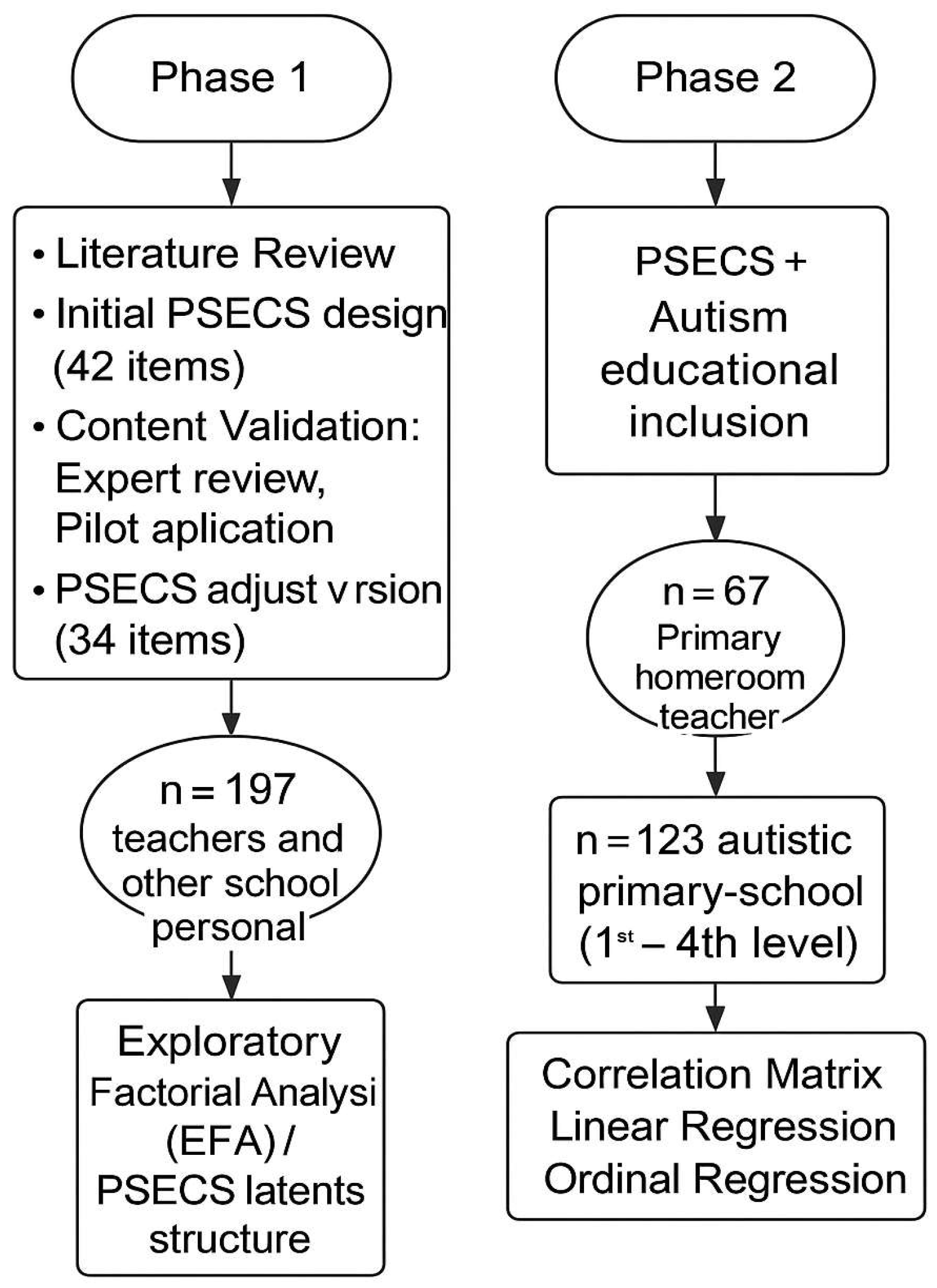
2.1. Content Validation
2.2. Participants
2.2.1. Phase 1: PSCES Validation
2.2.2. Phase 2: PSCES and Inclusive Educational Indicators of Autistic Students
2.3. Data Collection and Analysis
2.4. Ethical Considerations
3. Results
3.1. Phase 1: PSCES Validation
3.1.1. Factor Structure of the Scale
3.1.2. Conceptual Interpretation
3.1.3. Internal Consistency of the Scale
3.1.4. Descriptive Results of the Scale
3.2. Phase 2: PSCES and Inclusion of Autistic Primary School Students
3.2.1. Descriptive Results by Grade Level
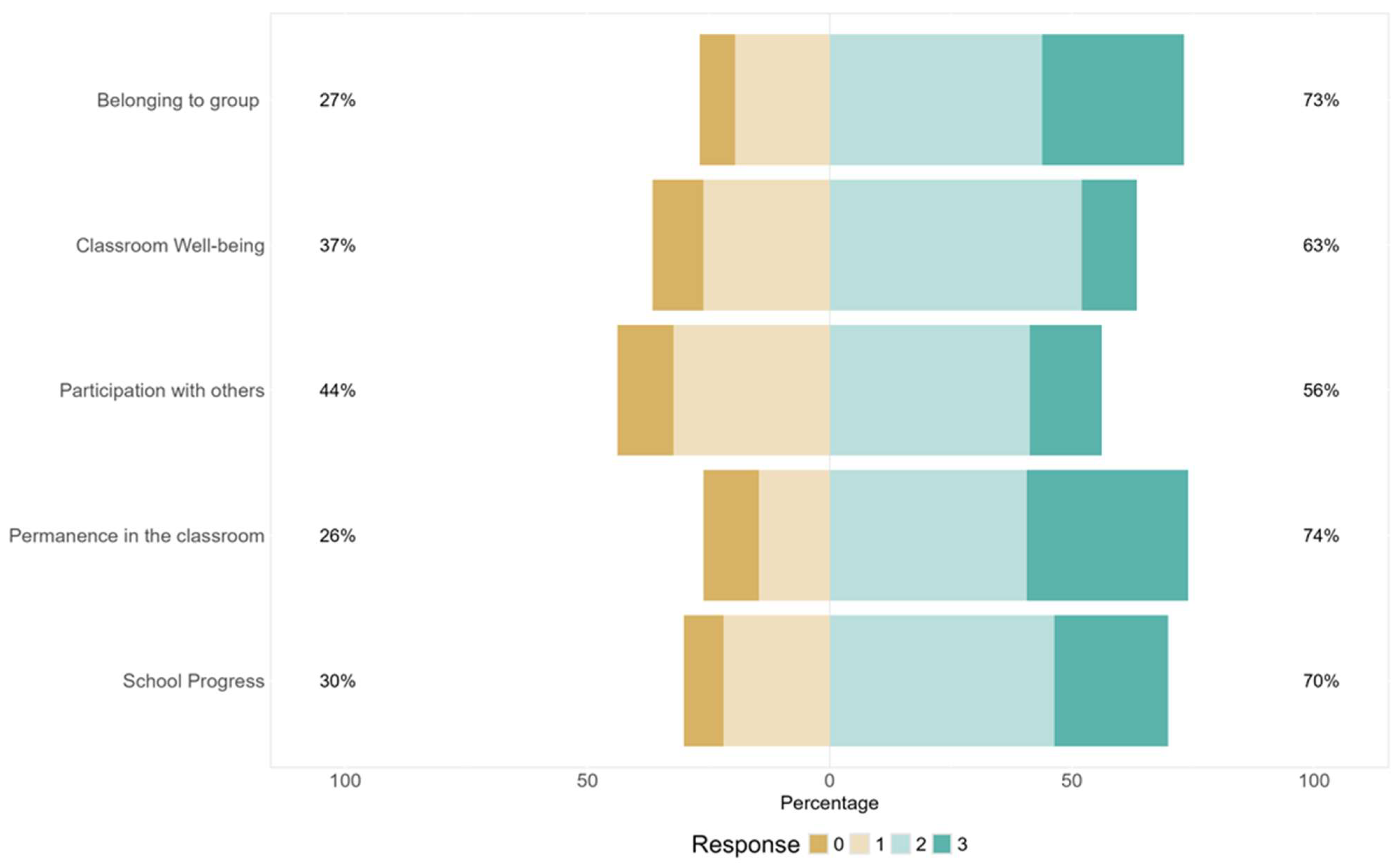
3.2.2. Descriptive Results by Dimension
3.2.3. Relationship Between Teachers’ Perceptions About Inclusion of Autistic Students and Physical and Sensorial Classroom Aspects
3.2.4. Contribution of Physical and Sensory Aspects of the Classroom to Teachers’ Perception of Inclusion of Autistic Students in Mainstream Classrooms
3.2.5. Key PSCES Factors as Predictors of Inclusion of Autistic Primary School Students
4. Discussion
4.1. Overall PSCES Results
4.2. Overall Results of Inclusion for Autistic Primary School Students
5. Conclusions
Author Contributions
Funding
Institutional Review Board Statement
Informed Consent Statement
Data Availability Statement
Acknowledgments
Conflicts of Interest
Abbreviations
| PSCES | Physical and Sensory Classroom Environment Scale |
Appendix A

| Conceptual Definition | Items |
|---|---|
| Infrastructure: The physical space, facilities, and equipment that constitute an educational establishment are designed to ensure optimal conditions of safety, habitability, accessibility, and inclusion (Dirección de Presupuestos, 2021) | Classroom infrastructure: The structural elements and building materials of my classroom are in good condition. Repair and infrastructure maintenance: When there is a malfunction in the classroom, it is possible to contact support staff, and repairs are carried out within a reasonable time frame. |
| Lighting: Lighting conditions necessary for conducting learning activities, including the type of light, its usage, and the adjustability of both natural and artificial light sources (Barrett et al., 2015) | Natural light: My classroom receives adequate natural light. Electric lighting: The electric lighting in the classroom functions properly and supports adequate visibility within the space. |
| Air quality: The level of air pollution, commonly indicated by the ventilation rate and measured through carbon dioxide concentration levels (Barrett et al., 2015) | Ventilated air: The classroom maintains adequate air ventilation (e.g., windows or doors can be opened to allow for air exchange). |
| Noise: Any sound in the school environment that is perceived as disruptive, unpleasant, or inappropriate by students or staff members, potentially interfering with teaching and learning activities (Ministerio del Medio Ambiente, 2011) | External noise: The classroom is located away from noisy areas such as street traffic, playgrounds, fairs, or zones with constant movement within the school. Internal noise: Inside the classroom, noise levels (e.g., voices, chair movement, etc.) are kept low by both students and the teacher. |
| Acoustics: Acoustic qualities of the learning environment that influence the intelligibility of spoken language (Barrett et al., 2015) | Acoustics: The acoustics of my classroom are adequate, allowing all students to hear me without having to raise my voice too much, and the voices do not echo (resonate). |
| Visual information The extent to which the classroom offers appropriate visual diversity, balancing stimulation and clarity to support students’ attention, orientation, and learning (Barrett et al., 2015) | Organized visual stimulation: The classroom provides students with organized visual information (e.g., visuals are concentrated in specific areas, and walls are not excessively decorated or overly colorful). |
| Temperature: Classroom air temperature appropriate for the nature of learning activities and level of physical effort involved, ensuring comfort and concentration (Barrett et al., 2015) | Temperature: The temperature in my classroom is generally comfortable. |
| Aroma: Olfactory sensory stimuli perceived in the classroom | Aroma: The classroom generally maintains a pleasant and neutral smell throughout the school day. |
| Size: Perception of the extent to which students have adequate classroom space to carry out learning activities comfortably (Barrett et al., 2015) | Classroom size: The classroom size is appropriate for the number of students and the pedagogical activities; it does not feel overcrowded or overly full. |
| Movement and Spatial Connection: Spatial connection of learning spaces, possibilities for movement and social interaction, consideringpathways, open space, collaboration. (Barrett et al., 2015) | Movement of teacher: The classroom has clear pathways that allow me to move freely throughout the space and interact with all students. Movement of students: During collaborative or group activities, students are able to move around the classroom to interact and work with their peers. |
| School furniture: Desks and chairs of good quality, appropriate for each age group, that are comfortable and support learning and teaching (Barrett et al., 2015) | Suitable chairs: The students’ chairs and desks are appropriately sized and functional for the educational activities conducted in the classroom. Comfortable chairs: The chairs in my classroom are comfortable for students. Movable and stackable chairs: The students’ chairs and desks can be easily moved and stacked. |
| Spatial organization The spatial arrangement of the classroom, including how the furniture is organized, which can range from a conference format to collaborative or small group settings (Barrett et al., 2015; López et al., 2018) | Furniture reorganization: When necessary, the students’ chairs and desks can be quickly rearranged in under five minutes to create a new layout. Time for reorganization: If necessary, I have sufficient time to rearrange the classroom into different layouts. Organization furniture: My classroom has furniture for organizing or storing students’ belongings and school materials (shelves, lockers, bookcases, or others). Ordered and organized classroom: My classroom remains tidy and organized. Alternative arrangements: Most of the time, I use arrangements other than rows (e.g., group tables, circles, semicircles, horseshoes, etc.). |
| Visibility: The extent to which students can clearly see presentations or audiovisual materials from different areas of the classroom (López et al., 2018) | Visibility in alternative arrangements: When I use arrangements other than ‘rows,’ students can properly see the board or the projection screen. |
| Ownership: The extent to which the distinctive features of the classroom foster students’ sense of belonging and ownership of the space and the degree to which the classroom is individualized for the class as a whole and each student (Barrett et al., 2015) | Personalization: My classroom has been personalized by the students; it includes elements that reflect whose studies there. |
| Agency and Participation: The extent to which students engage and make decisions about their physical learning environment to support their educational experience | Student seating choice: In my class and with the previous organization, students select and decide where they will sit. Seat preferences: I consider students’ preferences and opinions when arranging the seating in my classroom. Comfort Decisions: In my classroom, students can participate in decisions regarding environmental elements that make them feel more comfortable, such as turning off the lights, opening windows, using cushions, moving their desks, etc. |
| Flexibility: The extent to which the physical environment accommodates diverse learning needs, which may vary among students and change over time, supporting both simultaneous and sequential learning scenarios (Barrett et al., 2015) | Managerial support: In my work setting, the managers allow me to make the changes or adjustments that I, as a teacher, find appropriate to promote my students’ learning. Movement possibilities during learning: In my classroom, I always include some pedagogical activity that involves moving, standing, or walking. Postural flexibility: When a student needs it, I allow them to work in different body postures (e.g., sitting on the floor) or in a place other than their desk. |
| Design and aesthetics: How the various elements of the classroom combine to create an environment that is emotionally and visually pleasing, whether coherent and structured or random and chaotic (Barrett et al., 2015; López et al., 2018) | Aesthetic appeal: My classroom is aesthetically appealing; the colors and design of objects and stimuli provided for students are well-balanced. Enjoying the classroom: I like my classroom. |
| Teachers’ Physical well-being and satisfaction with the classroom: Perception of satisfaction with the physical and sensory characteristics of the classroom, including feeling comfortable and well in that space | Physical well-being: I feel physically comfortable and well in this classroom. Overall satisfaction with the classroom: I am satisfied with the physical and sensory conditions of my classroom, as they support learning and enhance the well-being of all my students. |
References
- Ainscow, M. (2025). Reforming education systems for inclusion and equity. Taylor & Francis. [Google Scholar]
- Allen, C. (2018). Flexible seating: Effects of student seating type choice in the classroom [Master’s thesis, Western Illinois University]. Available online: https://www.proquest.com/docview/2061668236 (accessed on 22 September 2025).
- Angulo de la Fuente, V. (2024). Sillas y mesas escolares como agentes de aprendizaje: Reflexiones históricas y actuales. Revista Enfoques Educacionales, 21(1), 256–269. [Google Scholar] [CrossRef]
- Ashburner, J., Bennett, L., Rodger, S., & Ziviani, J. (2013). Understanding the sensory experiences of young people with autism spectrum disorder: A preliminary investigation. Australian Occupational Therapy Journal, 60(3), 171–180. [Google Scholar] [CrossRef]
- Baars, S., Schellings, G. L., Krishnamurthy, S., Joore, J. P., den Brok, P. J., & van Wesemael, P. J. (2021). A framework for exploration of relationship between the psychosocial and physical learning environment. Learning Environments Research, 24(1), 43–69. [Google Scholar] [CrossRef]
- Baars, S., Schellings, G. L. M., Joore, J. P., & van Wesemael, P. J. V. (2023). Physical learning environments’ supportiveness to innovative pedagogies: Students’ and teachers’ experiences. Learning Environments Research, 26, 617–659. [Google Scholar] [CrossRef] [PubMed]
- Baglin, J. (2014). Improving your exploratory factor analysis for ordinal data: A demonstration using FACTOR. Practical Assessment, Research & Evaluation, 19(5), 2. [Google Scholar]
- Barrett, P., Davies, F., Zhang, Y., & Barrett, L. (2015). The impact of classroom design on pupils’ learning: Results of a holistic, multi-level analysis. Building and Environment, 89, 118–133. [Google Scholar] [CrossRef]
- Barrett, P., Treves, A., Shmis, T., Ambasz, D., & Ustinova, M. (2018). The impact of 561 school infrastructure on learning: A synthesis of the evidence. World Bank. Available online: http://documents.worldbank.org/curated/en/853821543501252792 (accessed on 11 July 2025).
- Bedard, C., St John, L., Bremer, E., Graham, J. D., & Cairney, J. (2019). A systematic review and meta-analysis on the effects of physically active classrooms on educational and enjoyment outcomes in school-age children. PLoS ONE, 14(6), e0218633. [Google Scholar] [CrossRef]
- Berglund, B., Lindvall, T., & Schwela, D. H. (2002). New WHO guidelines for community noise. Noise & Vibration Worldwide, 31(4), 24–29. [Google Scholar] [CrossRef]
- Bluteau, A., Aubenas, S., & Dufour, F. (2022). Influence of flexible classroom seating on the well-being and mental health of upper elementary school students: A gender analysis. Frontiers in Psychology, 13, 821227. [Google Scholar] [CrossRef]
- Booth, T., & Ainscow, M. (2011). Index for inclusion: Developing learning and participation in schools (3rd ed.). Centre for Studies on Inclusive Education. [Google Scholar]
- Booth, T., & Ainscow, M. (2015). Guía para la educación inclusiva: Desarrollando el aprendizaje y la participación en los centros escolares. FUHEM- OEI. [Google Scholar]
- Brennan, J., & Crosland, K. (2021). Evaluating the use of stability ball chairs for children with ASD in a clinic setting. Behavior Analysis in Practice, 14(3), 1079–1084. [Google Scholar] [CrossRef]
- Butera, C., Ring, P., Sideris, J., Jayashankar, A., Kilroy, E., Harrison, L., Cermak, S., & Aziz-Zadeh, L. (2020). Impact of sensory processing on school performance outcomes in high-functioning individuals with autism spectrum disorder. Mind, Brain and Education, 14(3), 243–254. [Google Scholar] [CrossRef]
- Byers, T., Mahat, M., Liu, K., Knock, A., & Imms, W. (2018). Systematic review of the effects of learning environments on student learning outcomes. Innovative Learning Environments and Teachers Change. Available online: https://www.iletc.com.au/wp-content/uploads/2018/07/TR4_Web.pdf (accessed on 3 May 2025).
- Cardellino, P., Araneda, C., & Alvarado, R. G. (2017). Classroom environments: An experiential analysis of the pupil-teacher visual interaction in Uruguay. Learning Environments Research, 20, 417–431. [Google Scholar] [CrossRef]
- Castilla, N., Llinares, C., Bravo, J. M., & Blanca, V. (2017). Subjective assessment of university classroom environment. Building and Environment, 122, 72–81. [Google Scholar] [CrossRef]
- Chang, V., & Fisher, D. (2003, November, 29). The validation and application of a new learning environment instrument for online learning in higher education. AARE Annual Conference, Fremantle, Australia. Available online: https://www.aare.edu.au/data/publications/2001/cha01098.pdf (accessed on 11 April 2025).
- Danker, J., Strnadová, I., & Cumming, T. M. (2019). “They don’t have a good life if we keep thinking that they’re doing it on purpose!”: Teachers’ perspectives on the well-being of students with autism. Journal of Autism and Developmental Disorders, 49(7), 2923–2934. [Google Scholar] [CrossRef] [PubMed]
- Dargue, N., Adams, D., & Simpson, K. (2022). Can characteristics of the physical environment impact engagement in learning activities in children with autism? A systematic review. Journal of Autism and Developmental Disorders, 9, 143–159. [Google Scholar] [CrossRef]
- Dirección de Presupuestos. (2021). Infraestructura y equipamiento para la Educación Pública del siglo XXI (Versión 4). Ministerio de Educación. Available online: https://www.dipres.gob.cl/597/articles-212578_doc_pdf1.pdf (accessed on 23 May 2025).
- Domínguez, S. (2014). ¿Matrices policóricas/tetracóricas o matrices Pearson? Un estudio metodológico. Revista Argentina de Ciencias del Comportamiento, 6(1), 39–48. [Google Scholar] [CrossRef]
- Echeita, G., & Ainscow, M. (2011). La educación inclusiva como derecho. Marco de referencia y pautas de acción para el desarrollo de una revolución pendiente [Inclusive education as a right. Framework and guidelines for action for the development of a pending revolution.]. Tejuelo, 12(4), 26–46. [Google Scholar]
- Echeita, G., Simón, C., López, M., & Urbina, C. (2013). Educación inclusiva: Sistemas de referencia, coordenadas y vórtices de un proceso dilemático. In M. A. Verdugo, & R. Schalock (Eds.), Discapacidad e inclusión (pp. 329–358). Alianza Editorial. [Google Scholar]
- Espinosa-Andrade, A., Padilla, L., & Carrington, S. J. (2024). Educational spaces: The relation between school infrastructure and learning outcomes. Heliyon, 10, e38361. [Google Scholar] [CrossRef] [PubMed]
- Ferrando, P. J., Lorenzo-Seva, U., Hernández-Dorado, A., & Muñiz, J. (2022). Decálogo para el análisis factorial de los ítems de un test. Psicothema, 34, 7–17. [Google Scholar] [CrossRef] [PubMed]
- Field, A. (2013). Discovering statistics using IBM SPSS Statistics (4th ed.). Sage. [Google Scholar]
- Fisher, K. (2000). Building better outcomes: The impact of school infrastructure on student outcomes and behaviour. Commonwealth Department of Education, Training and Youth Affairs. [Google Scholar]
- Fitri, A., Dewi, W. N., Hamidy, M. Y., & Saam, Z. (2025). The autistic child friendly school environment model for behavioral development in children with autism. Journal of Education and Health Promotion, 14(1), 358. [Google Scholar] [CrossRef]
- Fusaro, M., Fanti, V., & Chakrabarti, B. (2023). Greater interpersonal distance in adults with autism. Autism Research, 16(10), 2002–2007. [Google Scholar] [CrossRef]
- Gaines, K. S., & Curry, Z. D. (2011). The inclusive classroom: The effects of color on learning and behavior. Journal of Family and Consumer Sciences Education, 29(1), 46–57. [Google Scholar]
- Gentil-Gutiérrez, A., Cuesta-Gómez, J. L., Rodríguez-Fernández, P., & González-Bernal, J. J. (2021). Implication of the Sensory Environment in Children with Autism Spectrum Disorder: Perspectives from School. International Journal of Environmental Research and Public Health, 18(14), 7670. [Google Scholar] [CrossRef]
- George, D., & Mallery, P. (2003). SPSS for Windows step by step: A simple guide and reference (11.0 update) (4th ed.). Allyn & Bacon. [Google Scholar]
- Ghazali, R., Md Sakip, S. R., Samsuddin, I., & Samra, H. (2021). Determinant factors of sensory in creating autism learning environment. Environment-Behaviour Proceedings Journal, 6(16), 113–118. [Google Scholar] [CrossRef]
- González de Rivera, T., Fernández-Blázquez, M. L., Simón Rueda, C., & Echeita Sarrionandia, G. (2022). Educación inclusiva en el alumnado con TEA: Una revisión sistemática de la investigación. Siglo Cero, 53(1), 115–135. [Google Scholar] [CrossRef]
- Goodall, C. (2018). ‘I felt closed in and like I couldn’t breathe’: A qualitative study exploring the mainstream educational experiences of autistic young people. Autism & Developmental Language Impairments, 3, 1–16. [Google Scholar] [CrossRef]
- Goodall, C. (2019). ‘There is more flexibility to meet my needs’: Educational experiences of autistic young people in mainstream and alternative education provision. Support for Learning, 34(1), 4–33. [Google Scholar] [CrossRef]
- Guo, J., Kang, J., & Ma, H. (2024, August 25–29). Acoustic environment in classrooms for children with autism spectrum disorders: Case studies in China. INTER-NOISE and NOISE-CON Congress. [Google Scholar] [CrossRef]
- Han, H., Moon, H., & Lee, H. (2019). The physical classroom environment affects students’ satisfaction: Attitude and quality serve as mediators. Social Behavior and Personality, 47(5), 1–10. [Google Scholar] [CrossRef]
- Haug, P. (2019). Inclusion in Norwegian schools: Pupils’ experiences of their learning environment. Education 3–13, 48(3), 303–315. [Google Scholar] [CrossRef]
- Heinz, M., Graham, L., & Maulana, R. (2025). Towards more equitable and inclusive learning environments: Forging new connections and research directions. Learning Environments Research, 28, 189–199. [Google Scholar] [CrossRef]
- Howe, F. E., & Stagg, S. D. (2016). How sensory experiences affect adolescents with an autistic spectrum condition within the classroom. Journal of Autism and Developmental Disorders, 46(5), 1656–1668. [Google Scholar] [CrossRef]
- JUNAEB. (2019). Informe nacional de monitoreo de la convivencia escolar del año 2018. Available online: https://www.junaeb.cl/wp-content/uploads/2023/03/Monitoreo-de-la-Convivencia-Escolar-Programa-Habilidades-Para-la-Vida.pdf (accessed on 5 March 2025).
- Kanakri, S. M., Shepley, M., Tassinary, L. G., Varni, J. W., & Fawaz, H. M. (2016). An observational study of classroom acoustical design and repetitive behaviors in children with autism. Environment and Behavior, 49(8), 847–873. [Google Scholar] [CrossRef]
- Kanakri, S. M., Shepley, M., Varni, J., & Tassinary, L. (2017). Noise and autism spectrum disorder in children: An exploratory survey. Research in Developmental Disabilities, 63, 85–94. [Google Scholar] [CrossRef] [PubMed]
- Kaundinya, A., & Kaku, S. M. (2025). Sensory responses in autistic individuals—A narrative review. Sensory Neuroscience. Advance online publication. [Google Scholar] [CrossRef]
- Khalfa, S., Bruneau, N., Rogé, B., Georgieff, N., Veuillet, E., Adrien, J. L., Barthélémy, C., & Collet, L. (2004). Increased perception of loudness in autism. Hearing Research, 198(1–2), 87–92. [Google Scholar] [CrossRef] [PubMed]
- Krombach, T., & Miltenberger, R. (2020). The effects of stability ball seating on the behavior of children with autism during instructional activities. Journal of Autism and Developmental Disorders, 50(2), 551–559. [Google Scholar] [CrossRef]
- López, V., Torres-Vallejos, J., Ascorra, P., Villalobos-Parada, B., Bilbao, M., & Valdés, R. (2018). Construction and validation of a classroom climate scale: A mixed methods approach. Learning Environments Research, 21(3), 407–422. [Google Scholar] [CrossRef]
- Lynam, A., Sweeney, M. R., Keenan, L., & McNally, S. (2024). Autistic pupils’ experiences in primary and post-primary schools: A scoping review and consultation with autistic pupils in Ireland. Autism & Developmental Language Impairments, 9, 1–14. [Google Scholar] [CrossRef]
- Martin, R., & Wilkins, J. (2022). Creating visually appealing classroom environments for students with autism spectrum disorder. Intervention in School and Clinic, 57(3), 176–181. [Google Scholar] [CrossRef]
- Martinez, C., Davidoff, A., & Briceño, R. (2023). Early educational trajectories of children with autism spectrum disorder in Chile: Challenges and facilitators. Frontiers in Education, 8, 1259428. [Google Scholar] [CrossRef]
- Marx, A., Fuhrer, U., & Hartig. (1999). Effects of classroom seating arrangements on children’s question-asking. Learning Environments Research, 2, 249–263. [Google Scholar] [CrossRef]
- Marzi, A., Caniato, M., & Gasparella, A. (2025). The influence of indoor temperature and noise on autistic individuals. Scientific Reports, 15(1), 18802. [Google Scholar] [CrossRef] [PubMed]
- Matin Sadr, N., Haghgoo, H., Samadi, S. A., Rassafiani, M., Bakhshi, E., & Hassanabadi, H. (2017). The impact of dynamic seating on the classroom behavior of students with autism spectrum disorder. Iran Journal of Child Neurology, 17(1), 29–36. [Google Scholar]
- Ministerio de Educación de Chile. (2017). Anexo 1: Programa arquitectónico de recintos escolares. División de Planificación y Presupuesto. Available online: https://www.mineduc.cl/wp-content/uploads/sites/19/2017/02/ANEXO1.pdf (accessed on 19 June 2025).
- Ministerio de Educación de Chile. (2023). Marco General de Educación Inclusiva: Documento de trabajo. Gabinete Ministerial. [Google Scholar]
- Ministerio de Educación de Chile. (2024). Apuntes de Educación N° 60: Inclusión educativa de estudiantes que participan del Programa de Integración Escolar (PIE). Available online: https://bibliotecadigital.mineduc.cl/bitstream/handle/20.500.12365/21105/APUNTES%2060_2024_fd01.pdf (accessed on 19 June 2025).
- Ministerio del Medio Ambiente. (2011). Norma de emisión de ruidos generados por fuentes que indica (Decreto Supremo N° 38). Gobierno de Chile. Available online: https://mma.gob.cl (accessed on 19 June 2025).
- Mostafa, M., Sotelo, M., Honsberger, T., Honsberger, C., Brooker Lozott, E., & Shanok, N. (2024). The impact of ASPECTSS-based design intervention in autism school design: A case study. Archnet-IJAR, 18(2), 318–339. [Google Scholar] [CrossRef]
- Nunnally, J. C., & Bernstein, I. H. (1994). Psychometric theory (3rd ed.). McGraw-Hill. [Google Scholar]
- Nyabando, T., & Evanshen, P. (2022). Second grade students’ perspectives of their classrooms’ physical learning environment: A multiple case study. Early Childhood Education Journal, 5, 709–720. [Google Scholar] [CrossRef]
- OECD. (2017a). Revisiones de recursos escolares: Chile 2017. Available online: https://www.oecd.org/es/publications/oecd-reviews-of-school-resources-chile-2017_9789264287112-es.html (accessed on 15 July 2024).
- OECD. (2017b). Learning Environments Evaluation Programme (LEEP). Available online: https://gpseducation.oecd.org/Content/ProjectsMaterial/LEEP_Brochure_OECD.pdf (accessed on 15 July 2024).
- OECD. (2017c). OECD framework for a module on the physical learning environment—Revised edition. Learning Environments Evaluation Programme Series, No. EDU/EDPC/GNEELE(6). OECD. [Google Scholar]
- OECD. (2018). OECD School User Survey: Improving learning spaces together. OECD Publishing. Available online: https://alastair-blyth.com/wp-content/uploads/2018/12/FULL-OECD-School-User-Survey-4.pdf (accessed on 25 July 2024).
- OECD. (2025). Results from TALIS 2024: The state of teaching. OECD. [Google Scholar] [CrossRef]
- Özyildirim, G. (2021). How teachers in elementary schools evaluate their classroom environments: An evaluation of functions of the classroom through an environmental approach. Journal on Efficiency and Responsibility in Education and Science, 14(3), 180–194. [Google Scholar] [CrossRef]
- Plank, S. B., Bradshaw, C. P., & Young, H. (2009). An application of “broken-windows” theory to educational settings. Teachers College Record, 111(2), 451–482. [Google Scholar] [CrossRef]
- Rajotte, E., Grandisson, M., Couture, M. M., Desmarais, C., Chrétien-Vincent, M., Godin, J., & Thomas, N. (2024). A neuroinclusive school model: Focus on the school, not on the child. Journal of Occupational Therapy, Schools, & Early Intervention, 18(2), 281–299. [Google Scholar] [CrossRef]
- República de Chile. (2023). Ley N.º 21.545: Establece la promoción de la inclusión, la atención integral, y la protección de los derechos de las personas con trastorno del espectro autista en el ámbito social, de salud y educación. Biblioteca del Congreso Nacional de Chile. Available online: https://www.bcn.cl/leychile/navegar?idNorma=1190123 (accessed on 15 July 2024).
- Roskos, K., & Neuman, S. B. (2011). The classroom environment: First, last, and always. The Reading Teacher, 65(2), 110–114. [Google Scholar] [CrossRef]
- Saggers, B., & Ashburner, J. (2019). Creating learning spaces that promote wellbeing, participation and engagement: Implications for students on the autism spectrum. In H. Hughes, J. Franz, & J. Willis (Eds.), School spaces for student wellbeing and learning (pp. 139–156). Springer. [Google Scholar] [CrossRef]
- Saggers, B., Klug, D., Harper-Hill, K., Ashburner, J., Costley, D., Clark, T., Bruck, S., Trembath, D., Webster, A. A., & Carrington, S. (2016). Australian autism educational needs analysis—What are the needs of schools, parents, and students on the autism spectrum? Cooperative Research Centre for Living with Autism. Available online: https://eprints.qut.edu.au/95975/ (accessed on 19 June 2025).
- Sasson, I., Malkinson, N., & Oria, T. (2021). A constructivist redesigning of the learning space: The development of a sense of class cohesion. Learning Environments Research, 25, 183–197. [Google Scholar] [CrossRef]
- Schilling, D. L., & Schwartz, I. S. (2004). Alternative seating for young children with autism spectrum disorder: Effects on classroom behavior. Journal of Autism and Developmental Disorders, 34(4), 423–432. [Google Scholar] [CrossRef]
- Shield, B., Conetta, R., Dockrell, J., Connolly, D., Cox, T., & Mydlarz, C. (2015). A survey of acoustic conditions and noise levels in secondary school classrooms in England. Journal of the Acoustical Society of America, 137(1), 177–188. [Google Scholar] [CrossRef]
- Sundaravadhanan, G., Selvarajan, H. G., & McPherson, B. (2017). Classroom listening conditions in Indian primary schools: A survey of four schools. Noise & Health, 19(86), 31–40. [Google Scholar] [CrossRef]
- Superintendencia de Educación. (2025). Denuncias asociadas al autismo (2022–2024). Available online: https://www.supereduc.cl/wp-content/uploads/2025/05/Reporte-Supereduc-N01-1.pdf (accessed on 2 October 2025).
- Suraini, N. S. B., & Aziz, N. F. B. (2023). A review on the trend of physical learning environments and recommendations for future design approach. Malaysian Journal of Sustainable Environment, 10(1), 31–48. [Google Scholar] [CrossRef]
- Tabachnick, B. G., & Fidell, L. S. (2014). Using multivariate statistics (6th ed.). Pearson. [Google Scholar]
- Tanner, C. K. (2009). Effects of school design on student outcomes. Journal of Educational Administration, 47(3), 81–399. [Google Scholar] [CrossRef]
- Travis, J. M. (2017). Student choice and student engagement [Doctoral dissertation, Lindenwood University]. Available online: https://digitalcommons.lindenwood.edu/cgi/viewcontent.cgi?article=1235&context=dissertations (accessed on 5 March 2025).
- UNESCO. (2016). Educación 2030: Declaración de incheon y marco de acción para la realización del objetivo de desarrollo sostenible 4. Available online: https://unesdoc.unesco.org/ark:/48223/pf0000245656_spa (accessed on 5 March 2025).
- UNESCO. (2023). La inclusión de educandos con discapacidad en entornos de aprendizaje de calidad: Herramienta de apoyo a los países en su avance hacia la educación inclusiva. Available online: https://unesdoc.unesco.org/ark:/48223/pf0000380256_spa (accessed on 5 March 2025).
- Van Delden, A. L. E., Band, G. P., & Slaets, J. P. (2020). A good beginning: Study protocol for a group-randomized trial to investigate the effects of sit-to-stand desks on academic performance and sedentary time in primary education. BMC Public Health, 20, 70. [Google Scholar] [CrossRef]
- Villegas Otárola, M., Simón Rueda, C., & Echeita Sarrionandia, G. (2014). La inclusión educativa desde la voz de madres de estudiantes con trastornos del espectro autista en una muestra chilena. Revista Española de Discapacidad, 2(2), 63–82. [Google Scholar] [CrossRef]
- Whiting, C. C., Ochsenbein, M., Schoen, S. A., & Spielmann, V. (2021). A multi-tiered and multi-dimensional approach to intervention in schools: Recommendations for children with sensory integration and processing challenges. Journal of Occupational Therapy, Schools, & Early Intervention, 14(4), 402–420. [Google Scholar] [CrossRef]
- Williams, K. L., Dumont, R. L., Schiano, N. R., Lawlor, K. F., Greaney, K., Kim, R., Duryea, E., Rios-Vega, L., Simms, K. D., & Schaaf, R. C. (2024). Use of sensory adaptive environments with autistic children: A scoping review. Research in Autism Spectrum Disorders, 114, 102362. [Google Scholar] [CrossRef]
- Wood, R., & Happé, F. (2023). What are the views and experiences of autistic teachers? Findings from an online survey in the UK. Disability & Society, 38(1), 47–72. [Google Scholar] [CrossRef]
- Young, D., Green, H. A., Roehrich-Patrick, L., & Gibson, T. (2003). Do K–12 school facilities affect education outcomes? Tennessee Advisory Commission on Intergovernmental Relations. Available online: https://eric.ed.gov/?id=ED479494 (accessed on 30 November 2025).
- Zazzi, H., & Faragher, R. (2018). ‘Visual clutter’ in the classroom: Voices of students with autism spectrum disorder. International Journal of Developmental Disabilities, 64(3), 212–224. [Google Scholar] [CrossRef]


| Item | Wording |
|---|---|
| 1. Classroom infrastructure | The structural elements and building materials of my classroom are in good condition. |
| 2. Repair of maintenance infrastructure | When a malfunction occurs in the classroom, it is possible to contact support staff, and repairs are carried out within a reasonable time frame. |
| 3. Natural lighting | My classroom receives adequate natural light. |
| 4. Electric lighting | The electric lighting in the classroom functions properly and supports adequate visibility within the space. |
| 5. Ventilated air | The classroom maintains adequate air ventilation. |
| 6. External noise | The classroom is located away from noisy areas such as street traffic, playgrounds, fairs, or zones with constant movement within the school. |
| 7. Internal noise | Inside the classroom, noise levels are kept low by both students and the teacher. |
| 8. Acoustics | The acoustics of my classroom are adequate, allowing all students to hear me without having to raise my voice too much, and the voices do not echo (resonate). |
| 9. Organized visual information | The classroom provides students with organized visual information. |
| 10. Temperature | The temperature in my classroom is generally comfortable. |
| 11. Aroma | The classroom generally maintains a pleasant and neutral smell throughout the school day. |
| 12. Classroom size | The size of the classroom is appropriate for the number of students and the pedagogical activities carried out; it does not feel overcrowded or excessively full. |
| 13. Teacher movement | The classroom has clear pathways that allow me to move freely throughout the space and interact with all students. |
| 14. Student movement | During collaborative or group activities, students are able to move around the classroom to interact and work with their peers. |
| 15. Suitable chairs | The students’ chairs and desks are appropriately sized and functional for the educational activities conducted in the classroom. |
| 16. Comfortable chairs | The chairs in my classroom are comfortable for students. |
| 17. Movable, stackable chairs | The students’ chairs and desks can be easily moved and stacked. |
| 18. Quickly rearranged furniture | When necessary, the students’ chairs and desks can be quickly rearranged in under five minutes to create a new layout. |
| 19. Time for reorganization | If necessary, I have sufficient time to rearrange the classroom into different layouts. |
| 20. Organization and storage furniture | My classroom has furniture for organizing or storing students’ belongings and school materials (shelves, lockers, bookcases, or others). |
| 21. Ordered, organized classroom | My classroom remains tidy and organized. |
| 22. Alternative arrangements | Most of the time, I use arrangements other than ‘rows’ (e.g., group tables, circles, semicircles, horseshoes, etc.). |
| 23. Visibility in alternative arrangements | When I use arrangements other than ‘rows,’ students can properly see the board or the projection screen. |
| 24. Personalization | My classroom has been personalized by the students; it includes elements that reflect whose studies there. |
| 25. Student seating choice | In my class and with previous organizations, students select and decide where they will sit. |
| 26. Seat preferences | I consider students’ preferences and opinions when arranging the seating in my classroom. |
| 27. Comfort decisions | In my classroom, students can participate in decisions regarding environmental elements that make them feel more comfortable, such as turning off the lights, opening windows, using cushions, moving their desks, etc. |
| 28. Managerial support | In my work setting, the managers allow me to make the changes or adjustments that I, as a teacher, find appropriate to promote my students’ learning. |
| 29. Movement possibilities during learning | In my classroom, I always include some pedagogical activity that involves moving, standing, or walking. |
| 30. Postural flexibility | When a student needs it, I allow them to work in different body postures or in a place other than their desk. |
| 31. Aesthetic appeal | My classroom is aesthetically appealing; the colors and design of objects and stimuli provided to students are well-balanced. |
| 32. Enjoying the classroom | I like my classroom. |
| 33. Physical well-being | I feel physically comfortable and well in this classroom. |
| 34. Overall satisfaction with the classroom | I am satisfied with the physical and sensory conditions of my classroom, as they support learning and enhance the well-being of all my students. |
| Conceptual Definition | Wording |
|---|---|
| Permanence in the classroom: Refers to the dimension of presence, meaning that students remain in the classroom and not segregated or placed outside or on the periphery of the school space. | My student stays in the classroom for the entire or most of the school day. |
| Social interaction: Focuses on students’ engagement and social participation in classroom life and learning, being, and working collaboratively with peers. | My students always or almost always interacts and engages with their classmates during group activities. |
| Sense of belonging: Involves practicing inclusive values that ensure all members of the school community are recognized, accepted, and valued for who they are. | My student is part of the group and is valued and recognized by their classmates. |
| Learning progress: The student demonstrates continuous improvement in knowledge, skills, and performance, moving closer to the individual or curricular learning objectives established for his or her educational plan. | My student makes progress and achieves advances toward the educational objectives planned for him/her. |
| Classroom well-being: Represents the social and emotional dimension of inclusion that must be fostered and guaranteed by the school and involves feeling good about oneself, implementing inclusive values that promote welcoming school communities, and supporting the physical and mental health of everyone. | My student is always or almost always seen happy and comfortable during class. |
| Factor | R2 |
|---|---|
| Factor 1 | 0.124 |
| Factor 2 | 0.103 |
| Factor 3 | 0.094 |
| Factor 4 | 0.087 |
| Factor 5 | 0.084 |
| Factor 6 | 0.082 |
| Factor 7 | 0.056 |
| Item | 1 | 2 | 3 | 4 | 5 | 6 | 7 | Uniqueness |
|---|---|---|---|---|---|---|---|---|
| 32. Enjoying the classroom | 0.920 | 0.079 | ||||||
| 31. Aesthetic appeal | 0.904 | 0.189 | ||||||
| 33. Physical well-being | 0.883 | 0.049 | ||||||
| 34. Overall classroom satisfaction | 0.801 | 0.230 | ||||||
| 12. Classroom size | 0.876 | 0.212 | ||||||
| 13. Teacher space movement | 0.835 | 0.230 | ||||||
| 14. Student movement | 0.770 | 0.232 | ||||||
| 18. Quickly rearranged furniture | 0.422 | 0.344 | 0.358 | 0.215 | ||||
| 17. Movable and stackable furniture | 0.380 | 0.360 | 0.417 | |||||
| 1. Infrastructure | 0.751 | 0.290 | ||||||
| 5. Ventilated air | 0.647 | 0.317 | ||||||
| 10. Temperature | 0.599 | 0.426 | ||||||
| 4. Electric lighting | 0.596 | 0.472 | ||||||
| 2. Infrastructure repair or maintenance | 0.500 | 0.44 | ||||||
| 3. Natural light | 0.395 | 0.389 | 0.466 | |||||
| 6. Exterior noise | 0.328 | 0.747 | ||||||
| 26. Seat preferences | 0.821 | 0.310 | ||||||
| 27. Comfort decisions | 0.684 | 0.273 | ||||||
| 25. Student seating choice | 0.642 | 0.556 | ||||||
| 30. Postural flexibility | 0.356 | 0.378 | 0.494 | |||||
| 29. Movement possibilities during learning | 0.337 | 0.304 | 0.577 | |||||
| 24. Personalization | 0.322 | 0.426 | 0.456 | |||||
| 23. Visibility in alternative arrangements | 0.694 | 0.355 | ||||||
| 22. Alternative arrangements | 0.622 | 0.478 | ||||||
| 21. Ordered and organized classroom | 0.425 | 0.530 | ||||||
| 19. Time for reorganization | 0.413 | 0.342 | 0.271 | |||||
| 28. Managerial support | 0.346 | 0.551 | ||||||
| 15. Suitable chairs | 0.916 | 0.107 | ||||||
| 16. Comfortable chairs | 0.773 | 0.199 | ||||||
| 20. Organization and storage furniture | 0.367 | 0.636 | ||||||
| 7. Interior noise | 0.750 | 0.408 | ||||||
| 11. Aroma | 0.721 | 0.213 | ||||||
| 8. Acoustics | 0.332 | 0.512 | ||||||
| 9. Organized visual stimulation | 0.302 | 0.492 |
| Factor | Items | Interpretation |
|---|---|---|
| Factor 1: Aesthetic, comfort, and satisfaction with classroom conditions | 32. Enjoying the classroom 31. Aesthetic appeal 33. Physical well-being 34. Overall satisfaction | This factor encompasses items related to overall classroom satisfaction, including teachers’ appreciation of the space, perceptions of an aesthetically pleasing design, and sense of well-being and comfort experienced while working in the environment. It also includes satisfaction with the classroom conditions that support learning and meet the specific needs of students. |
| Factor 2: Classroom size and movement | 12. Size 13. Teacher space movement 14. Student movement 18. Quickly rearranged furniture 17. Movable and stackable furniture | This factor reflects teachers’ perceptions regarding the adequate classroom size for students and the availability of space that enables both teachers and students to move freely and engage in social interactions during pedagogical activities. Additionally, these items reflect the flexibility of school chairs and desks, such as their ability to be easily moved, stacked, and reconfigured. |
| Factor 3: Infrastructure and environmental conditions | 1. Infrastructure 5. Ventilated air 10. Temperature 4. Electric lighting 2. Infrastructure repair or maintenance 3. Natural light 6. Exterior noise | This factor encompasses the condition of materials and classroom infrastructure and maintenance when necessary. These fundamental conditions of the learning environment include adequate ventilation, temperature, natural and artificial lighting, and the placement of the classroom away from exterior noisy areas. |
| Factor 4: Student Agency and Personalization | 26. Seat preferences 27. Comfort decisions 25. Student seating choice 30. Postural flexibility 29. Movement possibilities during learning 24. Personalization | This factor encompasses items related to the participation and agency that both students and teachers have in the physical classroom environment. It includes students’ opportunities to express their preferences about the physical environment, such as choosing their seats or classroom location, and engage in personalization. Additionally, it reflects adjustments that accommodate students’ educational needs, such as flexible and diverse postures and surfaces for learning tasks and provision of opportunities for movement. It highlights the extent to which individuals feel ownership of the classroom and participate in its shaping. |
| Factor 5: Alternative arrangements and spatial organization | 23. Visibility in alternative arrangements 22. Alternative arrangements 21. Ordered and organized classroom 19. Time for new arrangements | This factor encompasses items related to order and spatial classroom organization, along with the various arrangements or layouts that teachers use to adjust the pedagogical space, ensuring proper visibility for students. |
| Factor 6: Furniture | 15. Suitable chairs 16. Comfortable chairs 20. Organization and storage furniture | This factor encompasses items related to the functionality and quality of chairs, their appropriateness for each age group, and their comfort and support of learning and teaching. It also covers furniture for organizing or storing students’ belongings and school materials (shelves, lockers, bookcases, or others). |
| Factor 7: Sensory environment | 7. Interior noise 11. Aroma 8. Acoustics 9. Organized visual stimulation | This factor features items related to the experience of sensory stimuli in the classroom, including indoor noise, acoustics, aromas, and organized visual stimulation. It highlights the importance of creating balanced classrooms in terms of decoration and color. Overall, this factor reflects the classroom’s sensory comfort, underscoring the need for appropriate auditory, olfactory, and visual stimuli to foster an educational environment that supports attention, comfort, and academic performance. |
| Mean | Cronbach’s α | McDonald’s ω |
|---|---|---|
| 1.71 | 0.945 | 0.946 |
| Item | M | SD | Mode | Mdn | A | ω | Item r |
|---|---|---|---|---|---|---|---|
| 1. Infrastructure | 1.81 | 0.93 | 2.00 | 2.00 | 0.94 | 0.94 | 0.59 |
| 2. Infrastructure repair or maintenance | 1.77 | 0.99 | 2.00 | 2.00 | 0.94 | 0.94 | 0.47 |
| 3. Natural light | 1.88 | 0.94 | 2.00 | 2.00 | 0.94 | 0.94 | 0.51 |
| 4. Electric lighting | 1.86 | 0.99 | 2.00 | 2.00 | 0.94 | 0.94 | 0.48 |
| 5. Ventilated air | 2.12 | 0.87 | 2.00 | 2.00 | 0.94 | 0.94 | 0.60 |
| 6. Exterior noise | 1.20 | 0.99 | 1.00 | 1.00 | 0.94 | 0.94 | 0.44 |
| 7. Interior noise | 1.45 | 0.88 | 1.00 | 1.00 | 0.94 | 0.94 | 0.50 |
| 8. Acoustics | 1.72 | 0.96 | 2.00 | 2.00 | 0.94 | 0.94 | 0.66 |
| 9. Organized visual stimulation | 1.81 | 0.93 | 2.00 | 2.00 | 0.94 | 0.94 | 0.59 |
| 10. Temperature | 1.47 | 0.89 | 1.00 | 1.00 | 0.94 | 0.94 | 0.54 |
| 11. Aroma | 1.38 | 0.90 | 2.00 | 2.00 | 0.94 | 0.94 | 0.55 |
| 12. Classroom size | 1.59 | 0.97 | 2.00 | 2.00 | 0.94 | 0.94 | 0.51 |
| 13. Teacher movement | 1.97 | 0.85 | 2.00 | 2.00 | 0.94 | 0.94 | 0.54 |
| 14. Student movement | 1.90 | 0.85 | 2.00 | 2.00 | 0.94 | 0.94 | 0.58 |
| 15. Suitable chairs | 1.66 | 1.01 | 2.00 | 2.00 | 0.94 | 0.94 | 0.63 |
| 16. Comfortable chairs | 1.55 | 0.92 | 2.00 | 2.00 | 0.94 | 0.94 | 0.67 |
| 17. Movable and stackable furniture | 1.68 | 0.94 | 2.00 | 2.00 | 0.94 | 0.94 | 0.57 |
| 18. Quickly rearranged furniture | 1.76 | 0.95 | 2.00 | 2.00 | 0.94 | 0.94 | 0.69 |
| 19. Time for reorganization | 1.63 | 0.97 | 2.00 | 2.00 | 0.94 | 0.94 | 0.68 |
| 20. Organization furniture | 1.66 | 1.05 | 2.00 | 2.00 | 0.94 | 0.94 | 0.55 |
| 21. Ordered, organized classroom | 1.85 | 0.76 | 2.00 | 2.00 | 0.94 | 0.94 | 0.56 |
| 22. Alternative arrangements | 1.76 | 0.95 | 2.00 | 2.00 | 0.94 | 0.94 | 0.48 |
| 23. Visibility in alternative arrangements | 1.89 | 0.91 | 2.00 | 2.00 | 0.94 | 0.94 | 0.51 |
| 24. Personalization | 1.89 | 0.83 | 2.00 | 2.00 | 0.94 | 0.94 | 0.52 |
| 25. Student seating choice | 1.27 | 0.88 | 1.00 | 1.00 | 0.94 | 0.94 | 0.44 |
| 26. Seat preferences | 1.65 | 0.87 | 2.00 | 2.00 | 0.94 | 0.94 | 0.45 |
| 27. Comfort decisions | 1.86 | 0.91 | 2.00 | 2.00 | 0.94 | 0.94 | 0.64 |
| 28. Managerial support | 2.15 | 0.88 | 2.00 | 2.00 | 0.94 | 0.94 | 0.45 |
| 29. Movement during learning | 1.86 | 0.87 | 2.00 | 2.00 | 0.94 | 0.94 | 0.37 |
| 30. Postural flexibility | 1.90 | 0.99 | 2.00 | 2.00 | 0.94 | 0.94 | 0.50 |
| 31. Aesthetic appeal | 1.63 | 0.91 | 2.00 | 2.00 | 0.94 | 0.94 | 0.63 |
| 32. Enjoying the classroom | 1.63 | 0.99 | 2.00 | 2.00 | 0.94 | 0.94 | 0.70 |
| 33. Physical well-being | 1.63 | 0.96 | 2.00 | 2.00 | 0.94 | 0.94 | 0.74 |
| 34. Overall classroom satisfaction | 1.37 | 0.97 | 1.00 | 1.00 | 0.94 | 0.94 | 0.69 |
| Low-Rated Items | High-Rated Items |
|---|---|
| = 1.45) were among the lowest-rated items; 60.7% of participants reported that their classroom was located near noisy outdoor areas, such as streets, playgrounds, or high-traffic zones. Additionally, 50.8% indicated that they were unable to maintain low noise levels inside the classroom. | = 2.12) received a relatively high rating; 77.8% of participants reported being able to maintain good air quality in their classroom, primarily through access to natural ventilation (e.g., opening windows or doors). |
| = 1.55) were among the lower-rated items; 60.2% of teachers indicated that students were not allowed to choose where they sit, and 43.4% reported that the school chairs were uncomfortable for students. | = 2.15); 78.6% of teachers reported that in their work environments, school leadership allowed them to make adaptations or diversifications for students who required them. |
| = 1.37), 53% of participants reported feeling dissatisfied with the physical and sensory conditions of their classroom. | = 1.90) were highly rated; 73% of participants indicated that their classrooms included adequate circulation paths that allowed both teachers and students to move around the space and interact effectively. |
| = 1.47) were low-rated. Unpleasant aromas and uncomfortable temperatures were reported by 47.4% and 51.5% of participants, respectively. | = 1.90) was rated high; 69% of teachers reported allowing their students to adopt different body postures (e.g., sitting on the floor) or use alternative surfaces in the classroom when needed. |
| = 1.59) was poorly rated; 41.8% of participants reported that the classroom size was inadequate for the number of students, feeling it was overcrowded or excessively full. | = 1.89) was rated high; 68.4% of teachers reported that their classrooms had been personalized by students, incorporating elements that reflected their identities. |
| Factor | M | SD | Min | Max | W | p |
|---|---|---|---|---|---|---|
| Factor 1: Teacher satisfaction with aesthetics, comfort, and classroom conditions | 1.65 | 0.93 | 0 | 3 | 0.87 | <0.001 |
| Factor 2: Classroom size and movement | 1.82 | 0.91 | 0 | 3 | 0.85 | <0.001 |
| Factor 3: Infrastructure and environmental conditions | 1.76 | 0.94 | 0 | 3 | 0.85 | <0.001 |
| Factor 4: Student Agency and Personalization | 1.73 | 0.91 | 0 | 3 | 0.86 | <0.001 |
| Factor 5: Alternative arrangements and spatial organization | 1.81 | 0.89 | 0 | 3 | 0.85 | <0.001 |
| Factor 6: Furniture | 1.70 | 0.96 | 0 | 3 | 0.87 | <0.001 |
| Factor 7: Sensory environment | 1.62 | 0.94 | 0 | 3 | 0.87 | <0.001 |
| Grade | n | Mean | Mdn | Mode | SD | Min | Max | Asymmetry | SE | p |
|---|---|---|---|---|---|---|---|---|---|---|
| 1 | 24 | 1.99 | 2.00 | 2.20 | 0.49 | 1.20 | 3.00 | 0.29 | 0.47 | 0.428 |
| 2 | 36 | 1.93 | 2.00 | 2.00 | 0.57 | 0.20 | 3.00 | −0.53 | 0.39 | 0.009 |
| 3 | 28 | 1.74 | 1.60 | 1.40 | 0.72 | 0.00 | 3.00 | −0.21 | 0.44 | 0.251 |
| 4 | 33 | 1.59 | 1.80 | 1.60 | 0.76 | 0.00 | 3.00 | −0.83 | 0.40 | 0.006 |
| Item | n | M | Mdn | Mode | Kurtosis | Asymmetry | W | p |
|---|---|---|---|---|---|---|---|---|
| Permanence in the classroom | 123 | 1.96 | 2 | 2.00 | −0.45 | −0.68 | 0.83 | <0.001 |
| Social interactions | 121 | 1.60 | 2 | 2.00 | −0.64 | −0.14 | 0.87 | <0.001 |
| Learning progress | 123 | 1.85 | 2 | 2.00 | −0.39 | −0.45 | 0.85 | <0.001 |
| Well-being | 123 | 1.64 | 2 | 2.00 | −0.26 | −0.42 | 0.84 | <0.001 |
| Sense of belonging | 123 | 1.95 | 2 | 2.00 | −0.36 | −0.55 | 0.84 | <0.001 |
| Model | B | SE | Β | T | p |
|---|---|---|---|---|---|
| Model 0 intercept | 1.79 | 0.06 | 27.19 | <0.001 | |
| Model 1 intercept | 1.09 | 0.14 | 7.51 | <0.001 | |
| Sensory environment | 0.47 | 0.08 | 0.462 | 5.29 | <0.001 |
| Model 2 intercept | 0.85 | 0.16 | 5.31 | <0.001 | |
| Sensory environment | 0.31 | 0.10 | 0.306 | 3.08 | 0.003 |
| Alternative arrangements and spatial organization | 0.32 | 0.11 | 0.294 | 2.96 | 0.004 |
| Model 3 intercept | 0.59 | 0.19 | 3.08 | 0.003 | |
| Sensory environment | 0.21 | 0.10 | 0.207 | 1.95 | 0.053 |
| Alternative arrangements and spatial organization | 0.26 | 0.11 | 0.242 | 2.42 | 0.017 |
| Student agency and personalization | 0.28 | 0.12 | 0.236 | 2.34 | 0.021 |
| Model | R | R2 | Adj. R2 | RMSE |
|---|---|---|---|---|
| 0 | 0.00 | 0.00 | 0.00 | 0.67 |
| 1 | 0.46 | 0.21 | 0.20 | 0.60 |
| 2 | 0.52 | 0.27 | 0.26 | 0.58 |
| 3 | 0.56 | 0.31 | 0.29 | 0.56 |
| Item | Key PSCES Factor | Recommendations |
|---|---|---|
| Permanence in the classroom | Sensory environment (Factor 7) showed a positive and significant effect (b = 1.10, SE = 0.43, z = 2.56, p = 0.010). | For an adequate Sensory Environment: Manage interior noise (including school furniture, materials, equipment, electronics, and other sources). Provide classroom spaces with appropriate acoustic conditions and low reverberation (echo). Manage the aroma by maintaining proper ventilation conditions or by providing a pleasant or neutral smell throughout the school day. Provide organized visual stimulation by giving students organized visual information (e.g., concentrated in specific areas, walls are not excessively decorated or overly colorful). |
| Learning Progress | Agency, Participation and Personalization (Factor 4) showed a positive and significant effect (b = 0.99, SE = 0.41, z = 2.39, p = 0.017). Furniture showed a significant negative effect (b = −0.75, SE = 0.31, z = −2.41, p = 0.016). | To promote Student Agency, Participation, and classroom personalization Allow students to engage and make decisions about their physical learning environment; for example, by asking about seat preferences and opinions when arranging the seating or space layouts. Provide opportunities to participate in decisions regarding environmental elements that make them feel more comfortable, such as turning off the lights, opening windows, using cushions, moving their desks, etc. Develop students’ sense of belonging and ownership of the space, allowing for personalization, decorations, and other individualized actions that reflect the students. Provide movement opportunities during learning, including some pedagogical activities that involve movement, such as standing or walking. Offer postural flexibility and surface diversifications for completing the work, permitting them to work in different body postures (e.g., sitting on the floor) or in a place other than their desk. |
| Social interactions in the classroom | Furniture (Factor 6) showed a negative and significant effect (b = −0.70, SE = 0.31, z = −2.27, p = 0.023). Agency, Participation, and Personalization showed a positive and significant effect (b = 0.90, SE = 0.44, z = 2.03, p = 0.042). | For adequate and suitable School Furniture Ensure that students’ chairs and desks are the correct size and functional for classroom activities. Make sure that the chairs are comfortable for students. If necessary, provide items that enhance comfort, such as cushions or other supportive accessories. Provide furniture for organizing or storing students’ belongings and school materials (shelves, lockers, bookcases, or others). |
| Sense of belonging | Agency, Participation and Personalization (Factor 4) showed a positive and significant effect (b = 1.10, SE = 0.43, z = 2.50, p = 0.012). | See recommendations for Learning progress. |
| Classroom well-being | No factor reached statistical significance at the p < 0.05 level, although some factors showed trends toward significance: sensory conditions (b = 0.80, p = 0.064), classroom size and movement (b = 0.70, p = 0.068), alternative arrangements and spatial organization (b = 0.79, p = 0.088), and | To promote Spatial Organization and Movement Ensure the classroom has accessible pathways by avoiding unnecessary furniture and rearranging desks and chairs in a layout that allows for fluid student and teacher movement. Prefer chairs and tables that can be moved effortlessly, stacked, or grouped quickly to support different classroom arrangements. It is also essential to design the space in a way that allows visibility of students across different alternative arrangements. |
Disclaimer/Publisher’s Note: The statements, opinions and data contained in all publications are solely those of the individual author(s) and contributor(s) and not of MDPI and/or the editor(s). MDPI and/or the editor(s) disclaim responsibility for any injury to people or property resulting from any ideas, methods, instructions or products referred to in the content. |
© 2025 by the authors. Licensee MDPI, Basel, Switzerland. This article is an open access article distributed under the terms and conditions of the Creative Commons Attribution (CC BY) license (https://creativecommons.org/licenses/by/4.0/).
Share and Cite
Angulo De la Fuente, V.; Urbina, C.; López, V.; Montero, I.; Escobar-Astudillo, F. Physical and Sensory Classroom Environment and Associations with Inclusive Education of Autistic Students in Chile: Construction, Validation and Results of a Teacher-Reported Scale. Educ. Sci. 2025, 15, 1635. https://doi.org/10.3390/educsci15121635
Angulo De la Fuente V, Urbina C, López V, Montero I, Escobar-Astudillo F. Physical and Sensory Classroom Environment and Associations with Inclusive Education of Autistic Students in Chile: Construction, Validation and Results of a Teacher-Reported Scale. Education Sciences. 2025; 15(12):1635. https://doi.org/10.3390/educsci15121635
Chicago/Turabian StyleAngulo De la Fuente, Verónica, Carolina Urbina, Verónica López, Ignacio Montero, and Felipe Escobar-Astudillo. 2025. "Physical and Sensory Classroom Environment and Associations with Inclusive Education of Autistic Students in Chile: Construction, Validation and Results of a Teacher-Reported Scale" Education Sciences 15, no. 12: 1635. https://doi.org/10.3390/educsci15121635
APA StyleAngulo De la Fuente, V., Urbina, C., López, V., Montero, I., & Escobar-Astudillo, F. (2025). Physical and Sensory Classroom Environment and Associations with Inclusive Education of Autistic Students in Chile: Construction, Validation and Results of a Teacher-Reported Scale. Education Sciences, 15(12), 1635. https://doi.org/10.3390/educsci15121635