Article

Students’ Voices: A Qualitative Study on Contextual, Motivational, and Self-Regulatory Factors Underpinning Language Achievement


Faculty of Education, School of Humanities and Social Sciences, University of Cambridge, Cambridge CB2 8PQ, UK
*
Author to whom correspondence should be addressed.
Educ. Sci. 2023, 13(8), 804; https://doi.org/10.3390/educsci13080804

Submission received: 23 June 2023 / Revised: 23 July 2023 / Accepted: 3 August 2023 / Published: 5 August 2023
(This article belongs to the Section Education and Psychology)

Abstract

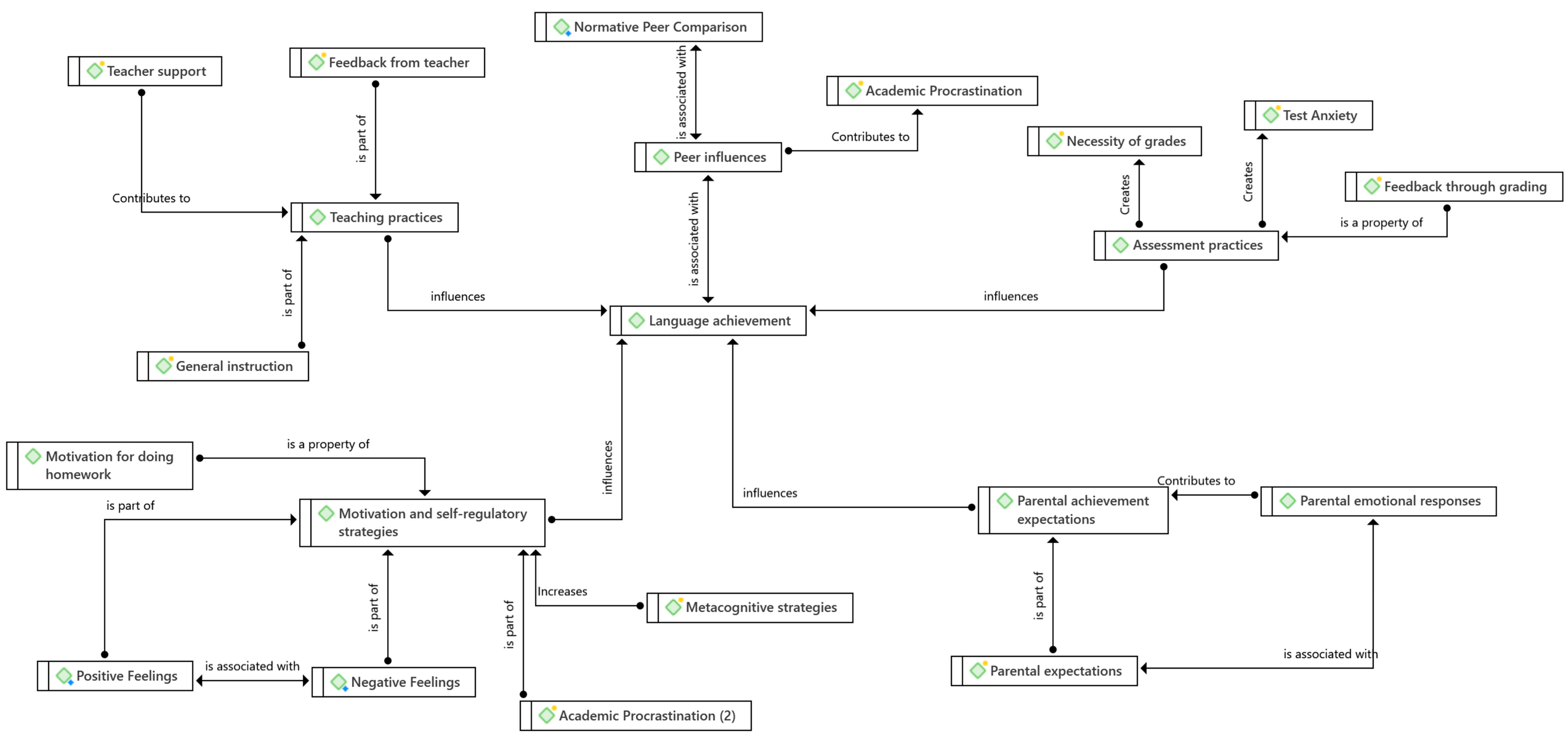
A lack of qualitative studies examining adolescent students’ voices regarding the contextual, relational, and self-regulatory factors that drive their language achievement has been observed. Therefore, the present study aimed to address this issue. Sixteen face-to-face semi-structured interviews were conducted with secondary school students in Greece to document and analyse their perceptions of the factors that influence language achievement. The study was guided by social-cognitive theory and models of self-regulated learning. Computer-assisted thematic analysis was performed using abductive open coding followed by refinement of codes. Three overarching global themes were identified in line with theoretical expectations, namely personal factors (motivation and self-regulatory strategies), relational factors (teachers’ practices, parental achievement expectations, peer influences), and structural factors (the educational system). Afterwards, an abductive thematic network analysis was conducted to explore and theorise about potential relationships between the emergent themes in the data. It was found that parental expectations for higher performance and the teachers’ behaviours were associated with students’ language achievement. Task-related characteristics and peers influenced students’ regulation of effort in learning. The students believed that they were not objectively graded and frequent summative assessments created test anxiety. The findings are discussed in light of existing empirical evidence and in terms of educational implications.
Keywords: metacognitive self-regulation; motivation; academic achievement; parental expectations; educational system; teachers; feedback; test anxiety; self-regulated learning; thematic analysis metacognitive self-regulation; motivation; academic achievement; parental expectations; educational system; teachers; feedback; test anxiety; self-regulated learning; thematic analysis