
Article

Match Theory and the Asymmetry Problem: An Example from Stockholm Swedish

Centre for Languages and Literature, Lund University, 22100 Lund, Sweden
*
Author to whom correspondence should be addressed.
Languages 2023, 8(2), 102; https://doi.org/10.3390/languages8020102

Submission received: 22 February 2021 / Revised: 7 March 2023 / Accepted: 15 March 2023 / Published: 6 April 2023
(This article belongs to the Special Issue Phonology-Syntax Interface and Recursivity)

Abstract

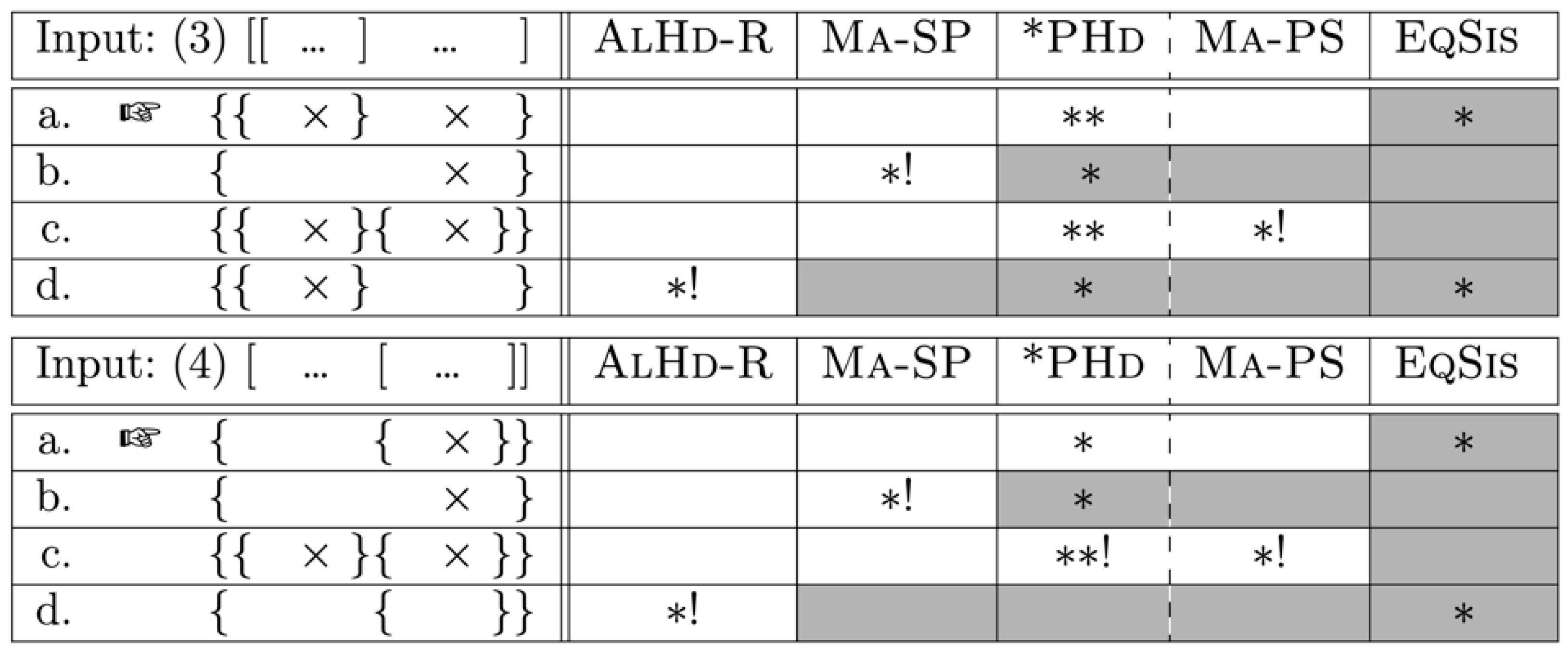
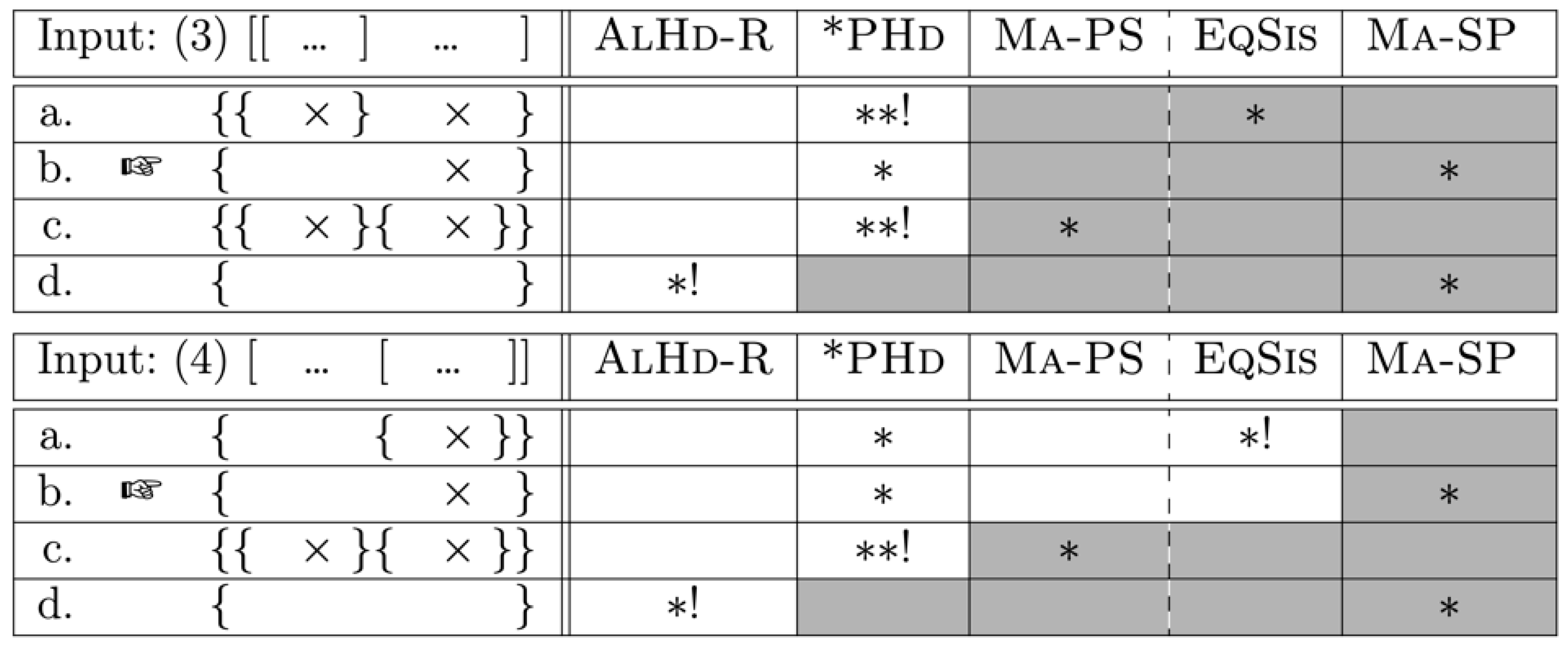
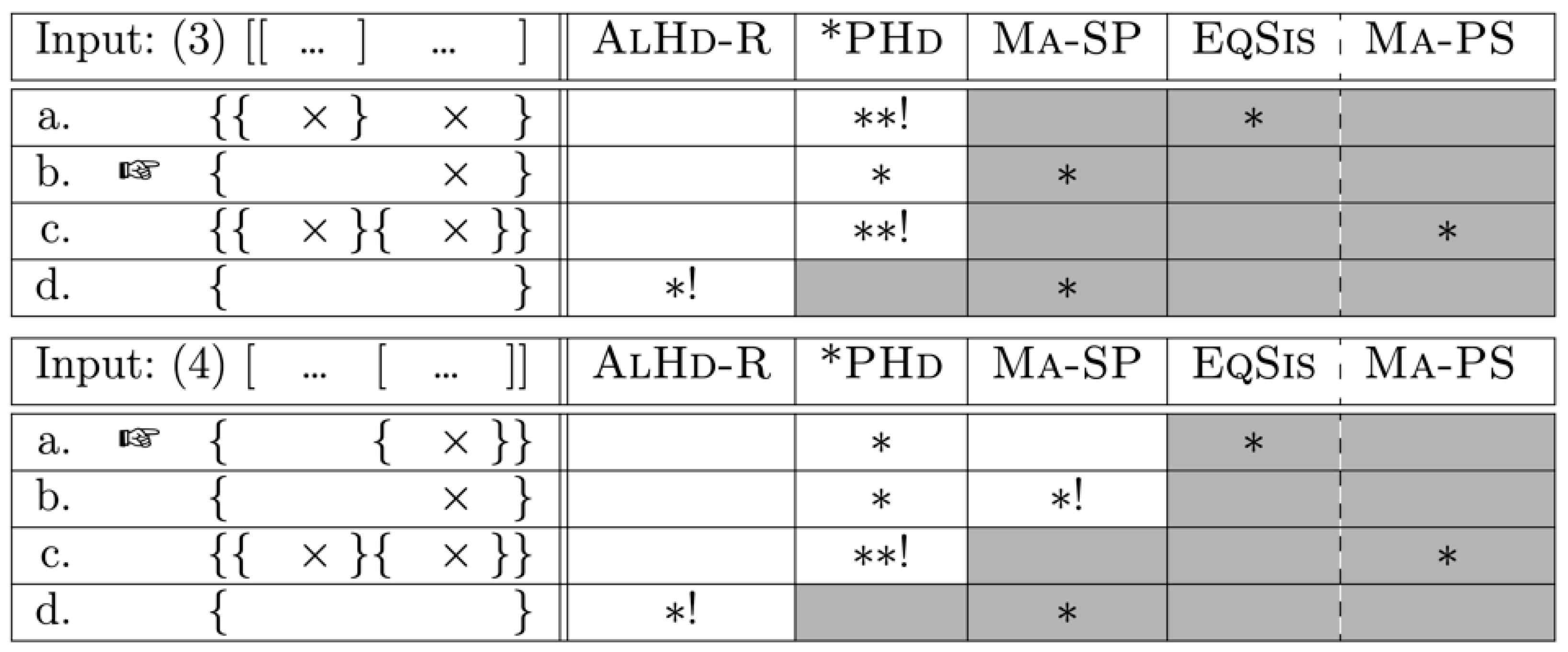
This article discusses what we call the Asymmetry Problem, a theoretical question of how asymmetric properties of prosodic phrasing should generally be accounted for within the framework of Match Theory. Unlike Alignment Theory, in which phrasing asymmetry can be derived by mapping constraints (e.g., Align-XP), Match Theory cannot derive any phrasing asymmetry from mapping (i.e., Match) constraints. Thus, Match Theory may seem to face empirical problems when data appear to call for an asymmetric ranking of mapping constraints. This article starts with the discussion of one such case in Stockholm Swedish, where asymmetric ranking of Alignment constraints has been proposed to account for the data. It will be argued that prosodic asymmetry arises from the directionality of prosodic heads (i.e., right- or left-headedness) rather than asymmetric syntax–prosody mapping, and that asymmetry can be explained through the interaction of Match constraints with markedness constraints that determine the distribution of prosodic heads. Furthermore, it will be proposed that such an analysis reduces the need of Alignment-based mapping constraints and therefore follows the Minimal Interface Hypothesis, which assumes Match constraints as the sole syntax–prosody mapping constraints. To support this line of analysis, it will be shown that the Asymmetry Problem in Japanese, for which it had previously been argued that both Match and Alignment constraints are needed, can also be accounted for under this hypothesis.
Keywords: match theory; alignment theory; the asymmetry problem; syntax–prosody mapping; Stockholm Swedish; Japanese; intonational phrase; phonological phrase match theory; alignment theory; the asymmetry problem; syntax–prosody mapping; Stockholm Swedish; Japanese; intonational phrase; phonological phrase