


Testing the Bilingual Cognitive Advantage in Toddlers Using the Early Executive Functions Questionnaire

Abstract
1. Introduction
1.1. Inhibitory Control
1.2. Attentional Flexibility
1.3. Working Memory
1.4. Regulation
1.5. What Explains the Mixed Evidence on the Bilingual Cognitive Advantage?
1.6. The Present Study
2. Materials and Methods
2.1. Participants
2.2. Measures
2.2.1. Language Exposure Assessment Tool (LEAT)
2.2.2. MacArthur-Bates Communicative Development Inventories: Words and Sentences (MCDI:WS)
French-English Vocabulary Size − Cognates − Semi-Cognates − Total Non-Equivalents)
2.2.3. Early Executive Functions Questionnaire (EEFQ)
2.3. Procedure
3. Results
3.1. Data Cleaning
3.1.1. Total Sample
3.1.2. French-English Sub-Sample
3.2. Language Group Differences
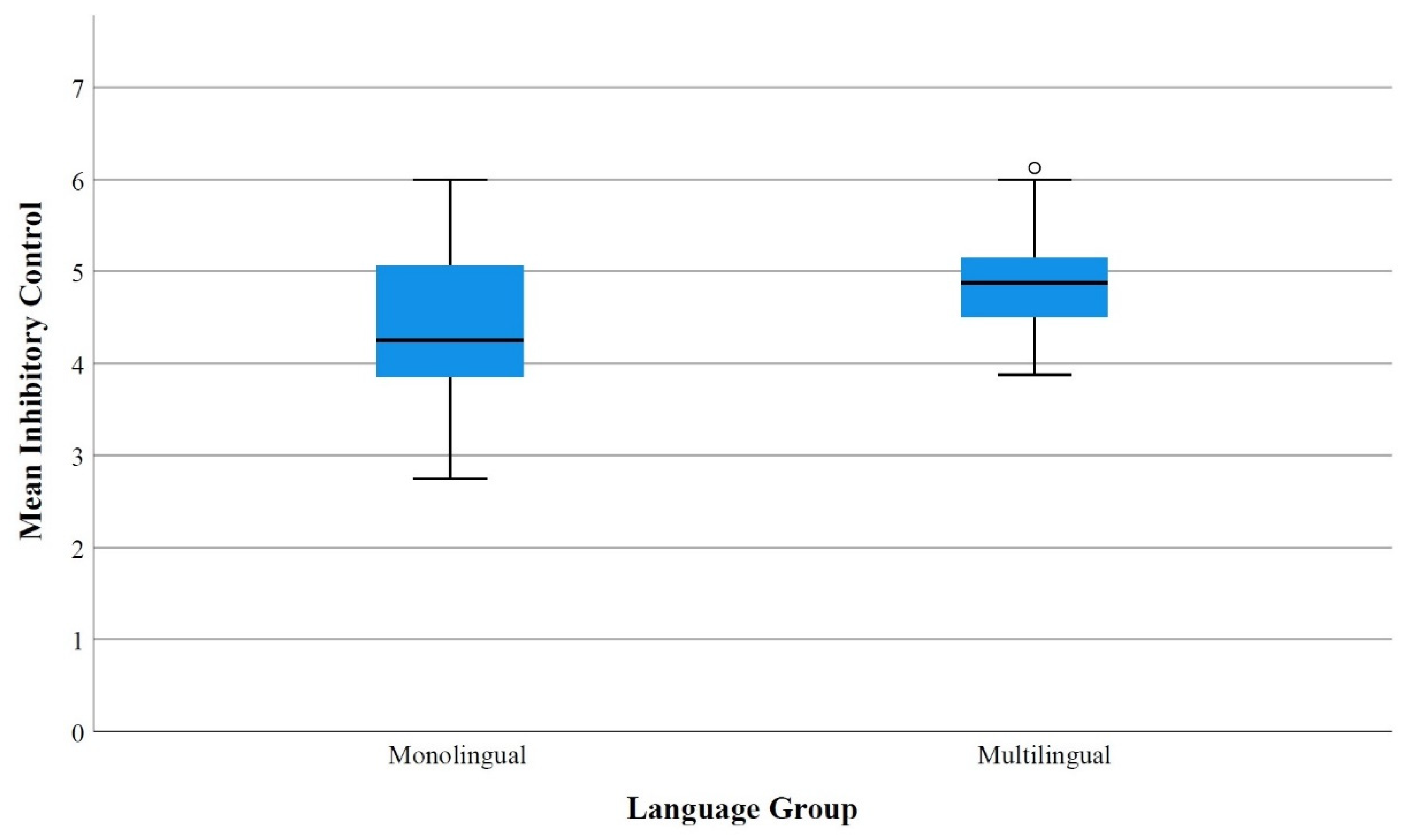
3.2.1. Inhibitory Control
3.2.2. Attentional Flexibility
3.2.3. Working Memory
3.2.4. Regulation
3.2.5. CEF
3.3. Language Exposure on a Continuum
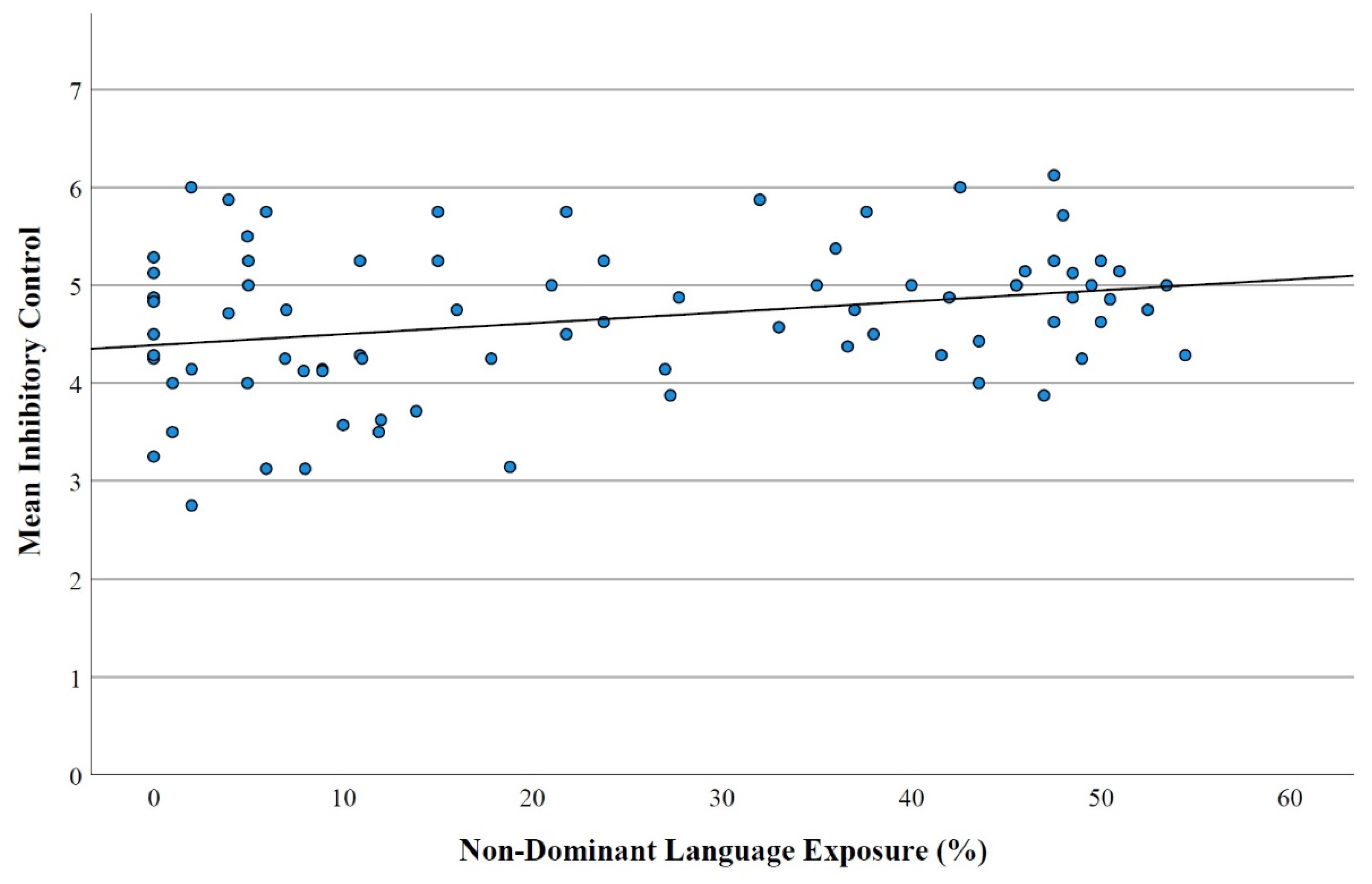
3.3.1. Inhibitory Control
3.3.2. Other Executive Function Skills
3.4. EF, Translation Equivalents, and Vocabulary Production
4. Discussion
4.1. Response Inhibition
4.2. Attentional Flexibility
4.3. Working Memory
4.4. Regulation
4.5. Association between Translation Equivalents and Executive Functioning
4.6. Strengths, Limitations, and Future Directions
5. Conclusions
Author Contributions
Funding
Institutional Review Board Statement
Informed Consent Statement
Data Availability Statement
Acknowledgments
Conflicts of Interest
Appendix A

| Language * | Total |
|---|---|
| First Language | |
| French | 33 |
| English | 28 |
| Spanish | 6 |
| Mandarin | 4 |
| Serbian | 2 |
| Arabic | 1 |
| Bulgarian | 1 |
| Chinese | 1 |
| German | 1 |
| Greek | 1 |
| Korean | 1 |
| Russian | 1 |
| Yoruba | 1 |
| Second Language | |
| English | 32 |
| French | 23 |
| N/A | 8 |
| Arabic | 4 |
| Spanish | 3 |
| Italian | 2 |
| Bulgarian | 1 |
| Chinese | 1 |
| Creole | 1 |
| Filipino | 1 |
| Kabyle | 1 |
| Mandarin | 1 |
| Patois | 1 |
| Portuguese | 1 |
| Bisaya | 1 |
| Third Language | |
| N/A | 47 |
| English | 14 |
| French | 14 |
| Armenian | 1 |
| Mohawk | 1 |
| Polish | 1 |
| Tamil | 1 |
| Ukrainian | 1 |
| Yiddish | 1 |
| Fourth Language | |
| N/A | 79 |
| Chinese Dialect | 1 |
| Spanish | 1 |
Appendix B
| Language * | Total |
|---|---|
| First Language | |
| French | 20 |
| English | 8 |
| Italian | 1 |
| Mandarin | 1 |
| Spanish | 1 |
| Second Language | |
| English | 17 |
| French | 8 |
| Arabic | 2 |
| Bulgarian | 1 |
| Mandarin | 1 |
| Portuguese | 1 |
| Spanish | 1 |
| Third Language | |
| N/A | 17 |
| English | 6 |
| French | 3 |
| Armenian | 1 |
| Italian | 1 |
| Polish | 1 |
| Ukrainian | 1 |
| Yiddish | 1 |
| Fourth Language | |
| N/A | 29 |
| Chinese Dialect | 1 |
| Greek | 1 |
Appendix C
| Variable | F | p | R2 | R2adjusted | ΔR2 | ΔF | β | β 95% CI [LL, UL] | p | |
|---|---|---|---|---|---|---|---|---|---|---|
| Attentional Flexibility | ||||||||||
| Model 1 | 0.60 | 0.551 | 0.02 | −0.01 | 0.02 | 0.60 | 0.551 | |||
| Age | −0.04 | −0.12, 0.05 | 0.380 | |||||||
| Parental Education | 0.02 | −0.05, 0.10 | 0.545 | |||||||
| Model 2 | 0.55 | 0.651 | 0.02 | −0.02 | 0.01 | 0.045 | 0.504 | |||
| Age | −0.04 | −0.12, 0.04 | 0.347 | |||||||
| Parental Education | 0.02 | −0.06, 0.10 | 0.597 | |||||||
| ND Exposure | 0.00 | −0.01, 0.01 | 0.504 | |||||||
| Working Memory | ||||||||||
| Model 1 | 1.40 | 0.252 | 0.04 | 0.01 | 0.04 | 1.40 | 0.252 | |||
| Age | 0.01 | −0.04, 0.06 | 0.710 | |||||||
| Parental Education | 0.04 | −0.01, 0.09 | 0.103 | |||||||
| Model 2 | 0.98 | 0.407 | 0.04 | 0.00 | 0.00 | 0.16 | 0.692 | |||
| Age | 0.01 | −0.04, 0.06 | 0.685 | |||||||
| Parental Education | 0.04 | −0.01, 0.09 | 0.098 | |||||||
| ND Exposure | 0.00 | −0.01, 0.01 | 0.692 | |||||||
| Regulation | ||||||||||
| Model 1 | 1.00 | 0.372 | 0.03 | 0.00 | 0.03 | 1.00 | 0.372 | |||
| Age | −0.08 | −0.19, 0.03 | 0.170 | |||||||
| Parental Education | −0.02 | −0.12, 0.08 | 0.683 | |||||||
| Model 2 | 0.66 | 0.580 | 0.03 | −0.01 | 0.00 | 0.00 | 0.981 | |||
| Age | −0.08 | −0.19, 0.04 | 0.176 | |||||||
| Parental Education | −0.02 | −0.13, 0.08 | 0.688 | |||||||
| ND Exposure | 0.00 | −0.01, 0.01 | 0.981 | |||||||
| CEF | ||||||||||
| Model 1 | 1.17 | 0.314 | 0.03 | 0.00 | 0.03 | 1.17 | 0.314 | |||
| Age | 0.03 | −0.02, 0.08 | 0.264 | |||||||
| Parental Education | −0.02 | −0.07, 0.03 | 0.334 | |||||||
| Model 2 | 1.72 | 0.170 | 0.06 | 0.03 | 0.03 | 2.75 | 0.101 | |||
| Age | 0.03 | −0.02, 0.09 | 0.208 | |||||||
| Parental Education | −0.02 | −0.07, 0.03 | 0.418 | |||||||
| ND Exposure | 0.01 | 0.00, 0.01 | 0.101 | |||||||
References
- Abutalebi, Jubin, and David Green. 2007. Bilingual Language Production: The Neurocognition of Language Representation and Control. Journal of Neurolinguistics 20: 242–75. [Google Scholar] [CrossRef] [Scilit]
- Adesope, Olusola O., Tracy Lavin, Terri Thompson, and Charles Ungerleider. 2010. A Systemic Review and Meta-analysis of the Cognitive Correlates of Bilingualism. Review of Educational Research 80: 207–45. [Google Scholar] [CrossRef] [Scilit]
- Arizmendi, Genesis D., Mary Alt, Shelley Gray, Tiffany P. Hogan, Samuel Green, and Nelson Cowan. 2018. Do Bilingual Children have an Executive Function Advantage? Results from Inhibition, Shifting, and Updating Tasks. Language, Speech, and Hearing Services in Schools 49: 356–78. [Google Scholar] [CrossRef] [Scilit] [PubMed]
- Baddeley, Alan. 2000. The Episodic Buffer: A New Component of Working Memory? Trends in Cognitive Sciences 4: 417–23. [Google Scholar] [CrossRef] [Scilit]
- Barker, Ryan M., and Ellen Bialystok. 2019. Processing Differences between Monolingual and Bilingual Young Adults on an Emotion N-back Task. Brain and Cognition 134: 29–43. [Google Scholar] [CrossRef] [Scilit] [PubMed]
- Bialystok, Ellen. 2017. The Bilingual Adaptation: How Minds Accommodate Experience. Psychological Bulletin 143: 233–62. [Google Scholar] [CrossRef] [Scilit] [PubMed]
- Bialystok, Ellen, and Fergus I. M. Craik. 2022. How does Bilingualism Modify Cognitive Function? Attention to the Mechanism. Psychonomic Bulletin & Review 2022: 1–24. [Google Scholar] [CrossRef] [Scilit]
- Bialystok, Ellen, and Michelle M. Martin. 2004. Attention and Inhibition in Bilingual Children: Evidence from the Dimensional Change Card Sort Task. Developmental Science 7: 325–39. [Google Scholar] [CrossRef] [Scilit]
- Bialystok, Ellen, Fergus Craik, and Gigi Luk. 2008. Cognitive Control and Lexical Access in Younger and Older Bilinguals. Journal of Experimental Psychology 34: 859–73. [Google Scholar] [CrossRef] [Scilit]
- Bialystok, Ellen, Fergus I. M. Craik, David W. Green, and Tamar H. Gollan. 2009. Bilingual Minds. Psychological Science in the Public Interest 10: 89–129. [Google Scholar] [CrossRef] [Scilit]
- Bialystok, Ellen, Raluca Barac, Agnes Blaye, and Diane Poulin-Dubois. 2010. Word Mapping and Executive Functioning in Young Monolingual and Bilingual Children. Journal of Cognition and Development 11: 485–508. [Google Scholar] [CrossRef] [Scilit] [PubMed]
- Bonifacci, Paola, Lucia Giombini, Stéphanie Bellocchi, and Silvana Contento. 2011. Speed of Processing, Anticipation, Inhibition and Working Memory in Bilinguals. Developmental Science 14: 256–69. [Google Scholar] [CrossRef] [Scilit] [PubMed]
- Bosma, Evelyn, and Elma Blom. 2019. A Code-switching Asymmetry in Bilingual Children: Code-switching from Dutch to Frisian requires More Cognitive Control than Code-switching from Frisian to Dutch. International Journal of Bilingualism 23: 1431–47. [Google Scholar] [CrossRef] [Scilit]
- Brito, Natalie H., and Kimberly G. Noble. 2018. The Independent and Interacting Effects of Socioeconomic Status and Dual-Language use on Brain Structure and Cognition. Developmental Science 21: e12688. [Google Scholar] [CrossRef] [Scilit] [PubMed]
- Brito, Natalie H., Amanda Grenell, and Rachel Barr. 2014. Specificity of the Bilingual Advantage for Memory: Examining Cued Recall, Generalization, and Working Memory in Monolingual, Bilingual, and Trilingual Toddlers. Frontiers in Psychology 5: 1369. [Google Scholar] [CrossRef] [Scilit] [PubMed]
- Brito, Natalie H., Ashley Greaves, Ana Leon-Santos, William P. Fifer, and Kimberly G. Noble. 2021. Associations between Bilingualism and Memory Generalization during Infancy: Does Socioeconomic Status Matter? Bilingualism: Language and Cognition 24: 231–40. [Google Scholar] [CrossRef] [Scilit]
- Burgess, Paul W. 1997. Theory and methodology in executive function research. In Methodology of Frontal and Executive Function. Edited by Patrick Rabbitt. East Essex: Psychology Press Publishers, pp. 81–116. [Google Scholar]
- Byers-Heinlein, Krista. 2015. Methods for studying infant bilingualism. In The Cambridge Handbook of Bilingual Processing. Edited by John W. Schwieter. Cambridge: Cambridge University Press, pp. 133–54. [Google Scholar]
- Byers-Heinlein, Krista, and Janet F. Werker. 2013. Lexicon Structure and Disambiguation of Novel Words: Evidence from Bilingual Infants. Cognition 128: 407–16. [Google Scholar] [CrossRef] [Scilit]
- Calcott, Rebecca D., and Elliot T. Berkman. 2015. Neural Correlations of Attentional Flexibility during Approach and Avoidance Motivation. PLoS ONE 10: e0127203. [Google Scholar] [CrossRef] [Scilit]
- Calkins, Susan D., and Stuart Marcovitch. 2010. Emotion regulation and executive functioning in early development: Integrated mechanisms of control supporting adaptation functioning. In Child Development at the Intersection of Emotion and Cognition. Edited by Susan D. Calkins and Martha Ann Bell. Washington, DC: American Psychological Association, pp. 37–57. [Google Scholar]
- Calvo, Alejandra, and Ellen Bialystok. 2014. Independent Effects of Bilingualism and Socioeconomic Status on Language Ability and Executive Functioning. Cognition 130: 278–88. [Google Scholar] [CrossRef] [Scilit]
- Carlson, Stephanie M., and Andrew N. Meltzoff. 2008. Bilingual Experience and Executive Functioning in Young Children. Developmental Science 11: 282–98. [Google Scholar] [CrossRef] [Scilit]
- Carlson, Stephanie M., Louis J. Moses, and Casey Breton. 2002. How Specific is the Relation between Executive Function and Theory of Mind? Contributions of Inhibitory Control and Working Memory. Infant and Child Development 11: 73–92. [Google Scholar] [CrossRef] [Scilit]
- Comishen, Kyle J., Ellen Bialystok, and Scott A. Adler. 2019. The Impact of Bilingual Environments on Selective Attention in Infancy. Developmental Science 22: 1–11. [Google Scholar] [CrossRef] [Scilit] [PubMed]
- Crivello, Cristina, Olivia Kuzyk, Monyka Rodrigues, Margaret Friend, Pascal Zesiger, and Diane Poulin-Dubois. 2016. The Effects of Bilingual Growth on Toddlers’ Executive Function. Journal of Experimental Child Psychology 141: 121–32. [Google Scholar] [CrossRef] [Scilit] [PubMed]
- D’Souza, Dean, Daniel Brady, Jennifer X. Haensel, and Hana D’Souza. 2020. Is Mere Exposure Enough? The Effects of Bilingual Environments on Infant Cognitive Development. Royal Society Open Science 7: 180191. [Google Scholar] [CrossRef] [Scilit]
- David, Annabelle, and Li Wei. 2008. Individual Differences in the Lexical Development of French-English Bilingual Children. International Journal of Bilingual Education and Bilingualism 11: 598–618. [Google Scholar] [CrossRef]
- De Bruin, Angela, Barbara Treccani, and Sergio Della Sala. 2015. Cognitive Advantage in Bilingualism: An Example of Publication Bias? Psychological Science 26: 99–107. [Google Scholar] [CrossRef] [Scilit]
- DeAnda, Stephanie, Laura Bosch, Diane Poulin-Dubois, Pascal Zesiger, and Margaret Friend. 2016. The Language Exposure Assessment Tool: Quantifying Language Exposure in Infants and Children. Journal of Speech, Language, and Hearing Research 59: 1346–56. [Google Scholar] [CrossRef] [Scilit]
- Diamond, Adele. 2002. Normal development of prefrontal cortex from birth to young adulthood: Cognitive functions, anatomy, and biochemistry. In Principles of Frontal Lobe Function. Edited by Donald T. Struss and Robert T. Knight. New York: Oxford University Press, pp. 466–503. [Google Scholar]
- Engel de Abreu, Pascale M. J. 2011. Working Memory in Multilingual Children: Is there a Bilingual Effect? Memory 19: 529–37. [Google Scholar] [CrossRef] [Scilit]
- Esposito, Alena G., Lynne Baker-Ward, and Shane T. Mueller. 2013. Interference Suppression vs. Response Inhibition: An Explanation for the Absence of a Bilingual Advantage in Preschoolers’ Stroop Task Performance. Cognitive Development 28: 354–63. [Google Scholar] [CrossRef] [Scilit]
- Fenson, Larry, Philip S. Dale, J. Steven Reznick, Donna Thal, Elizabeth Bates, Jeffery P. Hartung, Steve Pethick, and Judy S. Reilly. 1993. The MacArthur Communicative Development Inventories: User’s Guide and Technical Manual. San Diego: Singular Publishing Group. [Google Scholar]
- Frank, Michael C., Mika Braginsky, Daniel Yurovsky, and Virginia A. Marchman. 2016. Wordbank: An Open Repository for Developmental Vocabulary Data. Journal of Child Language 44: 677–94. [Google Scholar] [CrossRef] [Scilit]
- Genesee, Fred, and Elena Nicoladis. 2006. Bilingual acquisition. In Handbook of Language Development. Edited by Erika Hoff and Marilyn Shatz. Oxford: Blackwell, pp. 324–42. [Google Scholar]
- Gollan, Tamar H., and Victor S. Ferreira. 2009. Should I Stay or Should I Switch? A Cost-benefit Analysis of Voluntary Language Switching in Young and Aging Bilinguals. Journal of Experimental Psychology: Learning, Memory, and Cognition 35: 640–65. [Google Scholar] [CrossRef] [Scilit] [PubMed]
- Green, David W. 1998. Mental Control of the Bilingual Lexico-semantic System. Bilingualism: Language and Cognition 1: 67–81. [Google Scholar] [CrossRef] [Scilit]
- Grosjean, François. 2010. Bilingual: Life and Reality. Cambridge: Harvard. [Google Scholar]
- Gross, Megan, and Margarita Kaushanskaya. 2015. Voluntary Language Switching in English-Spanish Bilingual Children. Journal of Cognitive Psychology 27: 992–1013. [Google Scholar] [CrossRef] [Scilit] [PubMed]
- Grundy, John G., and Kalinka Timmer. 2016. Bilingualism and Working Memory Capacity: A Comprehensive Mata-analysis. Second Language Research 33: 325–40. [Google Scholar] [CrossRef] [Scilit]
- Gunnerud, Hilde Lowell, Dieuwer Ten Braak, Elin Kirsti Lie Reikerås, Enrica Donolato, and Monica Melby-Lervåg. 2020. Bilingualism Related to a Cognitive Advantage in Children? A Systematic Review and Meta-analysis. Psychological Bulletin 146: 1059–83. [Google Scholar] [CrossRef] [Scilit]
- Hendry, Alexandra, and Karla Holmboe. 2021. Development and Validation of the Early Executive Functions Questionnaire: A Carer-administered Measure of Executive Functions Suitable for 9- to 30-month-olds. Infancy 23: 932–61. [Google Scholar] [CrossRef] [Scilit]
- Hendry, Alexandra, Emily J. H. Jones, and Tony Charman. 2016. Executive Function in the First Three Years of Life: Precursors, Predictions and Patterns. Developmental Review 42: 1–33. [Google Scholar] [CrossRef] [Scilit]
- Ibanez-Lillo, Alexandra, Ferran Pons, Albert Costa, and Nunia Sebastian-Galles. 2010. Inhibitory Control in 8-month-old Monolingual and Bilingual Infants: Evidence from an Anticipatory Eye Movement Task. Paper presented at the 17th Biennial International Conference on Infants Studies, Baltimore, MD, USA, March 14. [Google Scholar]
- IBM Corp. 2020. IBM SPSS Statistics for Windows, Version 27.0. Armonk: IBM Corp. [Google Scholar]
- Kalashnikova, Marina, Jovana Pejovic, and Manuel Carreiras. 2020. The Effects of Bilingualism on Attentional Processes in the First Year of Life. Developmental Science 24: e13011. [Google Scholar] [CrossRef] [Scilit]
- Kovács, Ágnes Melinda, and Jacques Mehler. 2009. Cognitive Gains in 7-month-old Bilingual Infants. Proceedings of the National Academy of Sciences of the United States of America 106: 6556–60. [Google Scholar] [CrossRef] [Scilit]
- Kremin, Lena V., and Krista Byers-Heinlein. 2021. Why Not Both? Rethinking Categorial and Continuous Approaches to Bilingualism. International Journal of Bilingualism 25: 1560–75. [Google Scholar] [CrossRef] [Scilit]
- Lai, Gabrielle, and Beth A. OBrien ’. 2020. Examining Language Switching and Cognitive Control Through the Adaptive Control Hypothesis. Frontiers in Psychology 11: 1171. [Google Scholar] [CrossRef] [Scilit] [PubMed]
- Lanvers, Ursula. 1999. Lexical Growth Patterns in a Bilingual Infant: The Occurrence and Significance of Equivalents in the Bilingual Lexicon. International Journal of Bilingual Education and Bilingualism 2: 30–52. [Google Scholar] [CrossRef] [Scilit]
- Legacy, Jacqueline, Pascal Zesiger, Margaret Friend, and Diane Poulin-Dubois. 2016. Vocabulary Size, Translation Equivalents, and Efficiency in Word Recognition in Very Young Bilinguals. Journal of Child Language 43: 760–83. [Google Scholar] [CrossRef] [Scilit]
- Linck, Jared A., Peter Osthus, Joel T. Joeth, and Michael F. Bunting. 2014. Working Memory and Second Language Comprehension and Production: A Meta-analysis. Psychonomic Bulletin and Review 21: 861–83. [Google Scholar] [CrossRef] [Scilit]
- Lowe, Cassandra J., Isu Cho, Samantha F. Goldsmith, and J. Bruce Morton. 2021. The Bilingual Advantage in Children’s Executive Functioning is Not Related to Language Status: A Meta-analytic Review. Psychological Science 32: 1115–46. [Google Scholar] [CrossRef] [Scilit]
- Luo, Lin, Fergus I. M. Craik, Sylvain Moreno, and Ellen Bialystok. 2013. Bilingualism Interacts with Domain in a Working Memory Task: Evidence from Aging. Psychology and Aging 28: 28–34. [Google Scholar] [CrossRef] [Scilit]
- Meuter, Renata F. I., and Alan Allport. 1999. Bilingual Language Switching in Naming: Asymmetrical Cost of Language Selection. Journal of Memory and Language 40: 25–40. [Google Scholar] [CrossRef] [Scilit]
- Mischel, Walter, Yuichi Shoda, and Monica L. Rodriguez. 1989. Delay of Gratification in Children. Science 244: 933–38. [Google Scholar] [CrossRef] [Scilit]
- Misra, Maya, Taomei Guo, Susan C. Bobb, and Judith F. Kroll. 2012. When Bilinguals Choose a Single Word to Speak: Electrophysiological Evidence for Inhibition of the Native Language. Journal of Memory and Language 67: 224–37. [Google Scholar] [CrossRef] [Scilit]
- Miyake, Akira, and Naomi P. Friedman. 2012. The Nature and Organization of Individual Differences in Executive Functions: Four General Conclusions. Current Directions in Psychological Science 21: 8–14. [Google Scholar] [CrossRef] [Scilit]
- Montanari, Simona. 2010. Translation Equivalents and Emergence of Multiple Lexicons in Early Trilingual Development. First Language 30: 102–25. [Google Scholar] [CrossRef] [Scilit]
- Montroy, Janelle J., Ryan P. Bowles, Lori E. Skibbe, Megan M. McClelland, and Frederick J. Morrison. 2016. The Development of Self-regulation across Early Childhood. Developmental Psychology 52: 1744–62. [Google Scholar] [CrossRef] [Scilit] [PubMed]
- Morales, Julia, Alejandra Calvo, and Ellen Bialystok. 2012. Working Memory Development in Monolingual and Bilingual Children. Journal of Experimental Child Psychology 114: 187–202. [Google Scholar] [CrossRef] [Scilit] [PubMed]
- Paap, Kenneth R. 2019. Bilingualism in cognitive science: The characteristics and consequence of bilingual language control. In The Cambridge Handbook of Bilingualism. Edited by Annick De Houwer and Lourdes Ortega. Cambridge: Cambridge University Press, pp. 435–65. [Google Scholar]
- Patterson, Janet L., and Barbara Zurer Pearson. 2004. Bilingual lexical development: Influences, contexts, and processes. In Bilingual Language Development and Disorders in Spanish-English Speakers. Edited by Brian A. Goldstein. Baltimore: Paul H. Brookes Publishing, pp. 77–104. [Google Scholar]
- Pearson, Barbara Zurer, Sylvia C. Fernández, and D. Kimbrough Oller. 1995. Cross-language Synonyms in the Lexicons of Bilingual Infants: One Language or Two? Journal of Child Language 22: 345–68. [Google Scholar] [CrossRef] [Scilit] [PubMed]
- Pearson, Barbara Zurer, Sylvia C. Fernández, Vanessa Lewedeg, and D. Kimbrough Oller. 1997. The Relation of Input Factors to Lexical Learning by Bilingual Infants. Applied Psycholinguistics 18: 41–58. [Google Scholar] [CrossRef] [Scilit]
- Poarch, Gregory J., and Andrea Krott. 2019. A Bilingual Advantage? An Appeal for a Change in Perspective and Recommendations for Future Research. Behavioral Sciences 9: 95. [Google Scholar] [CrossRef] [Scilit]
- Poarch, Gregory J., and Janet G. van Hell. 2012. Executive Functions and Inhibitory Control in Multilingual Children: Evidence from Second-Language Learners, Bilinguals, and Trilinguals. Journal of Experimental Child Psychology 113: 535–51. [Google Scholar] [CrossRef] [Scilit]
- Poarch, Gregory J., and Janet G. van Hell. 2019. Does performance on executive function tasks correlate? Evidence from child trilinguals, bilinguals, and second language learners. In Bilingualism, Executive Function, and Beyond: Questions and Insights. Edited by Irina A. Sekerina, Lauren Spradlin and Virginia Valian. Amsterdam: John Benjamins Publishing Company, pp. 223–36. [Google Scholar]
- Poulin-Dubois, Diane, Agnes Blaye, Julie Coutya, and Ellen Bialystok. 2011. The Effects of Bilingualism on Toddlers’ Executive Functioning. Journal of Experimental Child Psychology 108: 567–79. [Google Scholar] [CrossRef] [Scilit]
- Poulin-Dubois, Diane, Cassandra Neumann, Sandra Masoud, and Adina Gazith. 2021. Effect of Bilingualism on Infants’ Cognitive Flexibility. Bilingualism: Language and Cognition, 1–14. [Google Scholar] [CrossRef] [Scilit]
- Prior, Anat, and Tamar H. Gollan. 2011. Good Language-Switchers are Good Task-Switchers: Evidence from Spanish-English and Mandarin-English Bilinguals. Journal of International Neuropsychological Society 17: 682–91. [Google Scholar] [CrossRef] [Scilit]
- Ratiu, Ileana, and Tamiko Azuma. 2015. Working Memory Capacity: Is there a Bilingual Advantage? Journal of Cognitive Psychology 27: 1–11. [Google Scholar] [CrossRef] [Scilit]
- Rodriguez-Fornells, Antoni, Ruth De Diego Balaguer, and Thomas F. Münte. 2006. Executive Control in Bilingual Language Processing. Language Learning 56: 133–90. [Google Scholar] [CrossRef] [Scilit]
- Rothbart, Mary K., and Jennifer Alansky Muaro. 1990. Questionnaire approached to the study of infant temperament. In Individual Differences in Infancy: Reliability, Stability, and Predication. Edited by Jeffrey Fagen and John Colombo. Hillside: Erlbaum, pp. 411–29. [Google Scholar]
- Singh, Leher. 2014. One World, Two Languages: Cross-language Semantic Priming in Bilingual Toddlers. Child Development 85: 755–66. [Google Scholar] [CrossRef] [Scilit] [PubMed]
- Sorge, Geoff B., Maggie E. Toplak, and Ellen Bialystok. 2016. Interactions between Levels of Attention Ability and Levels of Bilingualism in Children’s Executive Functioning. Developmental Science 20: e12408. [Google Scholar] [CrossRef] [Scilit] [PubMed]
- Soveri, Anna, Antoni Rodriguez-Fornells, and Matti Laine. 2011. Is there a Relationship between Language Switching and Executive Functions in Bilingualism? Introducing a Within Group Analysis Approach. Frontiers in Psychology 2: 00183. [Google Scholar] [CrossRef] [Scilit]
- Statistics Canada. 2017. Montréal [Census Metropolitan Area], Quebec and Canada [Country] (Table). Census Profile. 2016 Census. Statistics Canada Catalogue no. 98-316-X2016001. Ottawa. Released November 29. Available online: https://www12.statcan.gc.ca/census-recensement/2016/dp-pd/prof/index.cfm?Lang=E (accessed on 2 April 2022).
- Trudeau, Natacha, Ilana Frank, and Diane Poulin-Dubois. 1999. Une adaptation en français québecois du MacArthur communicative development inventory [A Quebec French Adaptation of the MacArthur Communicative Development Inventory]. Revue d’orthophonie et d’audiologie 23: 31–73. [Google Scholar]
- Tsui, Angeline, and Christopher Fennell. 2019. Do Bilingual Infants Possess Enhanced Cognitive Skills? Available online: https://psyarxiv.com/dcn7y/ (accessed on 25 January 2022).
- Tsui, Rachel Ka-Ying, Ana Maria Gonzalez-Barrero, Esther Schott, and Krista Byers-Heinlein. 2021. Are Translation Equivalents Special? Evidence from Simulations and Empirical Data from Bilingual Infants. Available online: https://doi.org/10.31234/osf.io/h4jxe (accessed on 22 January 2022).
- Van den Noort, Maurits, Esli Struys, Peggy Bosch, Lars Jaswetz, Benoît Perriard, Sujung Yeo, Pia Barisch, Katrien Vermeire, Sook-Hyun Lee, and Sabina Lim. 2019. Does the Bilingual Advantage in Cognitive Control Exist and if so, what are its Modulating Factors? A Systemic Review. Behavioral Science 9: 27. [Google Scholar] [CrossRef] [Scilit]
- Ware, Anna T., Melissa Kirkovski, and Jarrad A. G. Lum. 2020. Meta-analysis Reveals a Bilingual Advantage that is Dependent on Task and Age. Frontiers in Psychology 11: 01458. [Google Scholar] [CrossRef] [Scilit]
- Willoughby, Michael T., Clancy B. Blair, R. J. Wirth, and Mark Greenberg. 2010. The Measurement of Executive Function at Age 3 Years: Psychometric Properties and Criterion Validity of a New Battery of Tasks. Psychological Assessment 22: 306–17. [Google Scholar] [CrossRef] [Scilit]
- Ye, Zheng, and Xiaolin Zhou. 2009. Executive Control in Language Processing. Neuroscience & Biobehavioral Reviews 33: 1168–77. [Google Scholar]
- Zelazo, Philip David, Ulrich Müller, Douglas Frye, Stuart Marcovitch, Gina Argitis, Janet Boseovski, Jackie K. Chiang, Donaya Hongwanishkul, Barbara V. Schuster, and Alexandra Sutherland. 2003. The Development of Executive Function in Early Childhood. Monographs of the Society for Research in Child Development 68: 1–157. [Google Scholar] [CrossRef] [Scilit]
| N | Minimum | Maximum | Mean | Standard Deviation | |
|---|---|---|---|---|---|
| Total Sample | |||||
| Age (months) | 81 | 20.00 | 27.00 | 23.36 | 2.27 |
| ND Exposure * | 81 | 0.00% | 54.45% | 24.22% | 18.84% |
| Parental Education (years) ** | 81 | 11 | 23 | 16.75 | 2.50 |
| Monolinguals | |||||
| Age (months) | 39 | 20.00 | 27.00 | 23.46 | 2.27 |
| ND Exposure | 39 | 0.00% | 18.81% | 6.63% | 5.61% |
| Parental Education (years) | 39 | 11 | 23 | 16.78 | 2.64 |
| Multilinguals | |||||
| Age (months) | 42 | 20.00 | 26.00 | 23.26 | 2.30 |
| ND Exposure | 42 | 21.00% | 54.45% | 40.56% | 9.77% |
| Parental Education (years) | 42 | 11 | 22 | 16.73 | 2.39 |
| French-English Multilinguals | |||||
| Age (months) | 31 | 20.00 | 26.00 | 23.58 | 2.157 |
| ND Exposure | 31 | 3.96% | 64.64% | 36.02% | 17.14% |
| French Exposure | 31 | 2.97% | 96.04% | 51.02% | 24.28% |
| English Exposure | 31 | 2.97% | 91.09% | 35.45% | 23.46% |
| TE *** | 31 | 5.8% | 67.7% | 33.99% | 15.04% |
| Dominant Production | 28 | 29 | 507 | 199.00 | 140.15 |
| ND Production | 31 | 10 | 492 | 113.39 | 100.50 |
| Parental Education (years) | 31 | 11 | 23 | 16.92 | 2.43 |
| N | Min. | Max. | Mean (SD *) | Skewness (SE **) | Kurtosis (SE **) | |
|---|---|---|---|---|---|---|
| Total Sample | ||||||
| Inhibitory Control | 80 | 2.75 | 6.13 | 4.66 (0.75) | −0.26 (0.27) | −0.23 (0.53) |
| Attentional Flexibility | 78 | 2.88 | 6.75 | 4.96 (0.83) | 0.03 (0.27) | −0.01 (0.54) |
| Working Memory | 80 | 4.57 | 7.00 | 5.76 (0.52) | 0.17 (0.27) | −0.18 (0.53) |
| Regulation | 79 | 1.63 | 6.60 | 4.56 (1.13) | −0.62 (0.27) | −0.17 (0.54) |
| CEF *** | 81 | 3.83 | 6.39 | 5.12 (0.55) | 0.17(0.27) | −0.48 (0.53) |
| Monolinguals | ||||||
| Inhibitory Control | 39 | 2.75 | 6.00 | 4.41 (0.85) | 0.06 (0.38) | −0.75 (0.74) |
| Attentional Flexibility | 38 | 2.88 | 6.75 | 4.98 (0.91) | −0.22 (0.38) | 0.14 (0.75) |
| Working Memory | 39 | 4.83 | 7.00 | 5.73 (0.51) | 0.29 (0.38) | −0.07 (0.74) |
| Regulation | 38 | 2.38 | 6.60 | 4.59 (1.10) | −0.38 (0.38) | −0.30 (0.75) |
| CEF | 39 | 4.13 | 6.13 | 5.04 (0.52) | .30 (0.38) | −0.79 (0.74) |
| Multilinguals | ||||||
| Inhibitory Control | 41 | 3.88 | 6.13 | 4.90 (0.56) | 0.27 (0.37) | −0.22 (0.72) |
| Attentional Flexibility | 40 | 3.67 | 6.63 | 4.94 (0.75) | 0.42 (0.37) | −0.31 (0.73) |
| Working Memory | 41 | 4.57 | 7.00 | 5.78 (0.54) | 0.05 (0.37) | −0.11 (0.72) |
| Regulation | 41 | 1.63 | 6.25 | 4.54 (1.16) | −0.83 (0.37) | −0.02 (0.72) |
| CEF | 42 | 3.83 | 6.39 | 5.19 (0.57) | 0.02 (0.37) | −0.14 (0.72) |
| French-English Multilinguals | ||||||
| Inhibitory Control | 30 | 3.13 | 6.13 | 4.96 (0.69) | −0.49 (0.43) | 0.37 (0.83) |
| Attentional Flexibility | 29 | 3.75 | 6.63 | 5.12 (0.85) | 0.37 (0.43) | −0.77 (0.85) |
| Working Memory | 30 | 5.00 | 7.00 | 5.87 (0.47) | 0.67 (0.43) | 0.42 (0.83) |
| Regulation | 31 | 2.29 | 6.25 | 4.65 (1.04) | −0.72 (0.42) | 0.14 (0.82) |
| CEF | 30 | 4.33 | 6.41 | 5.32 (0.55) | 0.07 (0.43) | −0.84 (0.84) |
| Inhibitory Control | Attentional Flexibility | Working Memory | Regulation | CEF | |
|---|---|---|---|---|---|
| ND Exposure | |||||
| Correlation | 0.28 | −0.07 | 0.02 | 0.02 | 0.18 |
| p-value (2-tailed) | 0.011 | 0.524 | 0.834 | 0.844 | 0.104 |
| N | 80 | 78 | 80 | 79 | 81 |
| Inhibitory Control | Attentional Flexibility | Working Memory | Regulation | CEF | |
|---|---|---|---|---|---|
| TE | |||||
| Correlation | 0.14 | −0.06 | 0.22 | −0.11 | 0.11 |
| p-value (2-tailed) | 0.46 | 0.75 | 0.27 | 0.57 | 0.58 |
| N | 30 | 29 | 30 | 31 | 30 |
Publisher’s Note: MDPI stays neutral with regard to jurisdictional claims in published maps and institutional affiliations. |
© 2022 by the authors. Licensee MDPI, Basel, Switzerland. This article is an open access article distributed under the terms and conditions of the Creative Commons Attribution (CC BY) license (https://creativecommons.org/licenses/by/4.0/).
Share and Cite
Beaudin, K.; Poulin-Dubois, D. Testing the Bilingual Cognitive Advantage in Toddlers Using the Early Executive Functions Questionnaire. Languages 2022, 7, 122. https://doi.org/10.3390/languages7020122
Beaudin K, Poulin-Dubois D. Testing the Bilingual Cognitive Advantage in Toddlers Using the Early Executive Functions Questionnaire. Languages. 2022; 7(2):122. https://doi.org/10.3390/languages7020122
Chicago/Turabian StyleBeaudin, Kayla, and Diane Poulin-Dubois. 2022. "Testing the Bilingual Cognitive Advantage in Toddlers Using the Early Executive Functions Questionnaire" Languages 7, no. 2: 122. https://doi.org/10.3390/languages7020122
APA StyleBeaudin, K., & Poulin-Dubois, D. (2022). Testing the Bilingual Cognitive Advantage in Toddlers Using the Early Executive Functions Questionnaire. Languages, 7(2), 122. https://doi.org/10.3390/languages7020122

