1. Introduction
In Latin, from the Imperial period onward, we find the attestation of a construction consisting of the imperative form I ‘go’ (V1), of the basic verb of motion īre, followed by the temporal particle nunc ‘now’, and linked by the coordinating conjunction et ‘and’, to a second imperative form (V2). This second verb is not semantically restricted and shares with the first the same morphological markings of person, number, and tense.
Example (1) constitutes one of the earliest attestations of its use:
| (1) | ‘verum / purae sunt plateae, nihil ut meditantibus obstet’. / Festinat calidus mulis gerulisque redemptor, / torquet nunc lapidem, nunc ingens machina tignum, / tristia robustis luctantur funera plaustris, / hac rabiosa fugit canis, hac lutulenta ruit sus: / I nunc et versus tecum meditare canoros! (Hor. epist. 2, 2, 72) |
| | [“Yes, but the streets are clear, so that nothing need hinder you in conning verses.” In hot haste rushes a contractor with mules and porters; a huge crane is hoisting now a stone and now a beam; mournful funerals jostle massive wagons; this way runs a mad dog, that way rushes a mud-bespattered sow: go now and thoughtfully con melodious verses!] |
Already, ancient grammarians and commentators drew attention to the meaning of this construction. Thus, in one of the earliest commentaries on Horace, attributed to Porphyrio, a grammarian born in Africa between the second and third centuries CE, it is noted that in the verses of this epistle
per epitropen ostendit fieri carmina Romae non posse, that is, “it is shown, by means of
epitrope that composing poetry in Rome is impossible.”
1 Likewise, the scholium on this same passage by Pseudo-Acron, a Roman grammarian of the third century CE, although much more succinct, characterizes these verses as
ironicos.
The observations of both commentators are ultimately grounded in a semantic criterion; that is, they apply to the global meaning acquired by the syntactic structure from a compositional perspective. They make it possible to anticipate the most characteristic features of the i nunc et Vimp construction: it is a formally imperative sentence with rhetorical value, by means of which the addressee is ironically exhorted to think or act in a way contrary to what is explicitly expressed. Accordingly, in (1), the imperative i nunc et versus tecum meditare canoros must be interpreted against the vivid catalogue of disturbances that precedes it. Responding to someone who claims that “the streets are clear” (purae sunt plateae), the poet accumulates images of chaos—construction works, funerals, animals running through the streets—which systematically contradict the initial statement. The final imperative therefore does not function as a genuine exhortation but as a non-directive, ironical imperative: The imperative thus operates pragmatically as an ironic conclusion to the scene, transforming what appears syntactically as advice into a rhetorical exposure of urban noise and of unrealistic literary expectations.
This rhetorical strategy therefore presupposes a certain distancing between syntax and semantics, insofar as the meaning of the utterance is not immediately recoverable from the literal interpretation of its syntactic form. The sequence is formally structured as two coordinated imperatives (i + V2imp), yet its communicative value emerges only at the pragmatic and contextual level, where the directive force of the imperative is reinterpreted ironically. What appears syntactically as an exhortation thus functions as a rhetorical device that exposes the discrepancy between what is said and what is meant.
Such a tension between formal structure and interpreted meaning can be fruitfully approached through the notion of analyzability. Within Cognitive Grammar (
Langacker, 1987,
2008) and usage-based models (
Bybee, 2010), analyzability refers to the extent to which speakers perceive a linguistic sequence as internally structured into identifiable, meaning-bearing components, rather than processing it as a single, unanalyzed unit whose elements no longer contribute independent semantic content. From this perspective, the sequence
i nunc et +
Vimp may be treated as a construction, whose overall rhetorical value emerges from the interaction between its constituent elements. The question then arises as to whether this interaction remains transparent to speakers or whether, in the course of its historical development, the sequence tends toward a more holistic interpretation.
On this basis, it now becomes essential to determine whether the construction, over the course of its historical development, can be approached from the diachronic perspective of its analyzability. The aim is to identify the specific contribution of the different elements that make it up to its overall meaning and to the process of its conceptualization.
Our study of i nunc et + Vimp is based on an exhaustive examination of a small, temporally circumscribed corpus. The close analysis of a marginal construction of this kind proves methodologically productive, as it allows the internal relations between its components and the potential processes of reinterpretation affecting the sequence to be observed with greater precision. This case therefore helps to test and support the validity of diachronic analyzability as a framework for investigating the evolution and internal reconfiguration of constructions.
In order to trace the history of
i nunc et V
imp and to address its analyzability diachronically, we start from two observations. On the one hand, several Indo-European languages, including Latin, already attest at their earliest stage sequences of two verbs in the imperative mood, the first of which is a verb of motion, both morphologically marked in the same way: V1[+motion]
imp + V2
imp. This pattern, whose use in Archaic Latin is illustrated in example (2), resembles a Serial Verb Construction (SVC) and would support the hypothesis of a proto-Indo-European primordial construction akin to this type of structure (
Yates, 2014).
On the other hand, also in Archaic Latin, combinations of two imperatives linked by an explicit coordinating nexus are attested, as can be seen in (3). At first glance, if their monoclausal status is established, such combinations could be categorized as cases of verbal Pseudocoordination (PsCV) and undoubtedly constitute the structural basis of
i nunc et V
imp:
| (2) | age abduce hasce intro quas mecum adduxi, Stiche. (Pl. Stich. 418) |
| | [Go on, take these girls inside whom I brought along with me, Stichus] |
| (3) | Non it: negat se ituram. Abi et renuntia. (Pl. Bacch. 592) |
| | [She isn’t going. She says she won’t go. Go away and report back] |
In addition, applying diachronic analyzability to the construction requires considering its constituents separately in order to assess their particular (or articulated) contribution to the configuration of the overall meaning. To this end, it is especially useful to employ a contrastive analysis of related structures, such as that in example (3), with V1 (
abi) and V2 (
renuntia) linked by the coordinating conjunction
et, which must be understood in accordance with the negation expressed in the preceding utterance, and the construction represented in example (4) below, which is asyndetic but features the particle
nunc associated with V1 (
abi), and which should be interpreted ironically in its broader context. In this passage, Cicero refers to a fugitive from a gladiatorial school who, while being punished—immersed in mud up to the waist and burned—appeals to his status as a Roman citizen. The irony lies not only in the mismatch between the fugitive’s desperate situation and his formal legal appeal, but also in the use of
abi, a verb of motion, which invites someone to “go away” even though he is literally stuck in the mud up to the waist and therefore unable to move. In this way, the sequence
abi nunc dismisses his appeal with biting sarcasm, highlighting the futility of invoking civic protections in such circumstances.
| (4) | Abi nunc, populi fidem implora (Cic. Fam. 10, 32) |
| | [Off you go then! Appeal to the People!] |
The consideration and evaluation of these models, as well as the diachronic analysis of the function performed by each constituent of our construction, should allow us to determine its categorization and to gain a better understanding, in general, of the processes of univerbation and the de/recategorization of multiverbal constructions.
Thus, the present article pursues a dual objective. On the one hand, it aims to provide, based on Latin, evidence that contributes to our understanding of multiverbal constructions and their syntactic analyzability in diachrony—understood, following
Langacker (
1987, pp. 452–455), as the degree to which speakers can internally decompose a sequence into its formal and semantic components. On the other hand, it seeks to underscore the importance of analyzability as a process that is not only valid but decisive for explaining, in particular, constructions such as
i nunc et V
imp in light of their components and structural accessibility. This perspective aligns with
Bybee’s (
2010, pp. 34–38) gradient approach to analyzability and with the treatment of
Traugott and Trousdale (
2013), for whom variation in a construction’s internal transparency constitutes a crucial factor in processes of change and in the historical shaping of multiverbal patterns.
The article is organized as follows.
Section 2 presents a description of the corpus of occurrences of
i nunc et V
imp in Latin literature and provides a corresponding list of references. In
Section 3, within the theoretical framework provided by linguistic typology in relation to multiverbal constructions—
Aikhenvald (
2006,
2018),
Haspelmath (
2016), and
Ross (
2022)—we address serial imperative constructions in Archaic Latin, with V1 being a verb of motion.
Section 4 focuses on the examination of the
i nunc et V
imp construction and, based on the collected attestations, provides a detailed analysis of the contribution of each constituent to the joint conceptualization from a diachronic perspective. Finally,
Section 5 presents the conclusions derived from the analysis.
2. Corpus of Occurrences of i nunc et Vimp
In 1898, Emory B. Lease published in
The American Journal of Philology the article
“I nunc and I with Another Imperative,” (
Lease, 1898) in which, as far as the scholarly resources of his time allowed, he gathered and systematized the scattered references to the constructions
i nunc + imperative and
i (and its compounds) + imperative in Latin literature from its beginnings to Late Antiquity. He compiled a quantitative inventory, distinguishing between poetry and prose and between coordination with
et and asyndeton. He concluded that
i nunc is relatively rare (58 cases) compared to
i + imperative (227 cases) and that the former more often appears with a conjunction, whereas the latter more commonly occurs in asyndeton. Although essentially descriptive, his study served for decades as a key documentary reference for research on these constructions.
For the present study, we have used the 2025 version of the Brepolis database, a suitable and valuable tool for corpus-based research. We conducted a comprehensive search of all occurrences of
i nunc et V
imp across the entire Latin literary corpus.
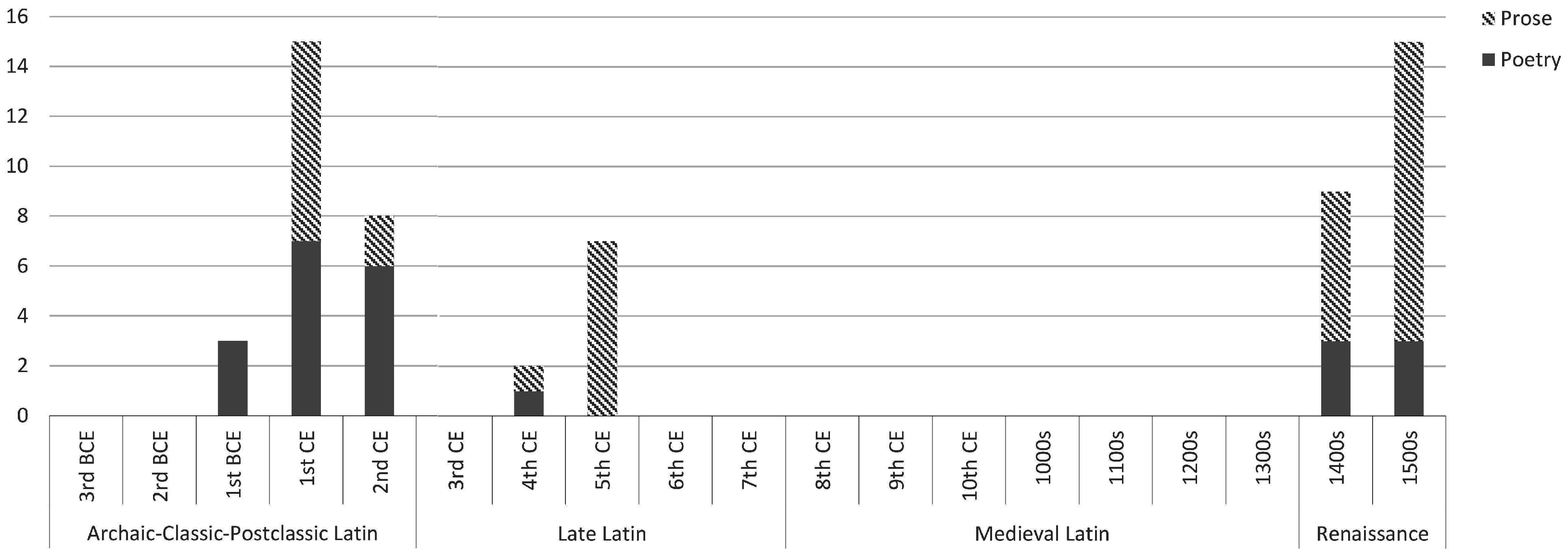
2 This allowed us to obtain a diachronic overview of the use of the construction, which we present in
Figure 1. Of course, we manually verified the identified occurrences, removing textual errors and duplicate instances. The resulting corpus, whose references are provided at the end of this section, constitutes the empirical basis upon which our study is structured.
A total of 26 occurrences of the construction i nunc et Vimp are documented in the period corresponding to the first five centuries of Latin, encompassing the Archaic, Classical, and Postclassical eras (3rd century BCE–2nd century CE). However, the evidence is concentrated almost exclusively between the 1st century BCE and the 1st century CE, the so-called Golden Age of Latin literature. Of these, 16 occur in lyric and elegiac poetry—undoubtedly of a cultivated and learned character—by Ovid, Propertius, and Horace, as well as in Petronius, and also in the satirical and epigrammatic output of Juvenal and Martial. A common formal feature across all these texts is the type of meter employed, characteristic of elevated poetry, specifically the dactylic hexameter (and the pentameter in the case of elegiac couplets).
The remaining ten occurrences, documented in prose texts, mostly belong to the work of the philosopher Seneca, and are also found in the rhetorical works of Seneca the Elder and Quintilian. From the perspective of textual typology, these are works of doctrinal dialogue and declamatory practice. It is worth noting that these texts, like many of the poetic testimonies adopting an epistolary form, invariably include the figure of an interlocutor, whether real or fictitious.
In the period between the 3rd and 7th centuries CE, corresponding to Late Latin, the nine occurrences of the construction i nunc et Vimp are concentrated in the 4th and 5th centuries, in authors representative of Patristic literature such as Zeno of Verona, Augustine of Hippo, and John Cassian. These are mostly homiletic texts, encompassing both exegesis and refutation, or doctrinal works of a dogmatic and polemical nature. All of them, with the exception of the Mosella, a brief idyllion in hexameters by Magnus Ausonius, correspond to prose compositions.
No new occurrences of the construction i nunc et Vimp are recorded in the last two centuries of Late Latin or throughout the medieval period. The predominance of scholastic, historical, and chronicle texts, together with the scarce presence of learned poetry inspired by the classical model, may be linked to the effective disappearance of the construction.
In contrast with the medieval absence of the construction, the Latin intellectual world of the 15th and 16th centuries significantly revived i nunc et Vimp, employing it not only in citations of earlier authors’ works but also in original compositions. During these two centuries, the number of occurrences of the construction (a total of 24) approached that recorded in the Classical period. This increase was contributed to by three of the early Italian humanists—Cortesi, Piccolomini, and Naldi—and, following in their footsteps, the German poet Celtis, founder of German humanism, and Lotichius. The greatest concentration of the construction appears in Christian and moral-reform humanism, represented by Erasmus, More, and Gerson. It also left its mark on theological debates of the Reformation and Counter-Reformation, involving figures such as Luther, Latomus, and Sepúlveda, as well as on the Central European projection of humanism, exemplified by Lobkowicz and Istvanffy. At the turn of the 16th and 17th centuries, the construction can be documented in the work of the Flemish philologist Justus Lipsius, who led the neo-Stoic humanist movement.
Below, we provide an alphabetical list of authors and works in which the construction i nunc et Vimp is documented:
Augustinus Hipponensis: Contra Cresconium 2, 18, 23; Contra Iulianum 1, 646; Epistulae 93, 22; In Iohannis euangelium tractatus 6, 20; Sermones 47
Ausonius, D. Magnus: Mosella 48
Cassianus, Iohannes: De incarnatione Domini contra Nestorium 7, 5; 7, 23
Celtis Protucius, Conradus: Libri odarum quattuor 1, 16, 15
Cortesius, Alexander: De laudibus bellicis Matthiae Coruini Hungariae regis 1128
Erasmus, Desiderius: Adagia 3, 1, 1; Epistulae 102; 1391; 1680; 2700
Gersonius, Iohannes: Sermo in festo Omnium Sanctorum (1 Nou. 1394); Epistula 46; Metrum contra curiositatem scribendi plures libros 22; Sermo in festo sancti Antonii (17 Ian. 1417); Tractatus de laude scriptorum 431
Hassensteinius a Lobkowicz, Bohuslaus: De miseria humana 259
Horatius Flaccus, Quintus: Epistulae 2, 2, 72
Istvanffy, Nicolaus: Carmina 59, 16
Iuvenalis, D. Iunius: Saturae 6, 306; 10, 306; 12, 57
Latomus, Iacobus: Ad Lutherum responsio 2
Lipsius, Iustus: Epistulae 1994
Lotichius Secundus, Petrus: Poemata 1, 2, 48
Lutherus, Martinus: De seruo arbitrio 618
Martialis, M. Valerius: Spectaculorum liber 26, 12; Epigrammata 1, 42, 6; 8, 63, 3; 9, 2,13
Morus, Thomas: De optimo reipublicae statu deque noua insula Utopia libellus uere aureus. Parerga. Epistula ad Petrum Aegidium 44
Naldis, Naldus de: Epigrammaton liber 22, 20
Ovidius Naso, Publius: Ars amatoria 2, 197; Epistulae ex Ponto 1, 3, 61; Heroides 3, 25; 17, 57; (pseudo), Epicedion Drusi (Consolatio ad Liuiam) 361
Petronius Arbiter: Carmina in codice Leidensi Vossiano Lat. Q. 86 (= Z) seruata (= AL 469 ShB) 1
Pius II papa: Epistularium Aeneae Silvii Piccolomini 152
Propertius, Sextus: Elegiae 2, 29, 21
Quintilianus, M. Fabius: (dubium) Declamationes minores 312, 8; (pseudo) Declamationes maiores 18, 12
Seneca, L. Annaeus (rhetor): Controuersiae 7, 2, 2; Suasoriae 6, 2
Seneca, L. Annaeus (philosophus): De beneficiis 6, 35, 5; De breuitate uitae 12, 8; Consolatio ad Heluiam matrem 6, 8; 10, 10; Epistulae morales ad Lucilium 88, 37; Naturales quaestiones 1, 16, 3; (pseudo), Epigrammata in Anthologia Latina seruata 408, 7R
Sepulveda, Iohannes Genesius: De conuenientia militaris disciplinae cum christiana religione dialogus, qui inscribitur Democrates 3, 17
3. Latin Multiverbal Constructions with a Motion Verb as V1
As illustrated by example (1), the construction
i nunc et V
imp is a multiverbal utterance. As such, it might
prima facie be subsumed under the broad category of Multi-Verb Predicate (MVP), proposed by
Ross (
2022, p. 323) as a cover term for the different subtypes of monoclausal multiverbal constructions in which two verbs jointly form a complex predicate.
With respect to the analyzability of our construction, a first crucial step is to determine whether it can in fact be categorized as an MVP. To this end, among the various subtypes of MVPs, particular attention must be paid to Serial Verb Constructions (SVCs) and Verbal Pseudocoordination (PsCV). These two patterns are formally distinguished by the presence or absence of a connector between the verbs: SVCs do not display any linking element (pattern <V1 + V2>), whereas in pseudocoordination the verbs are obligatorily linked by the coordinating conjunction and in the relevant language (pattern <V1 + and + V2>).
Second, since from the third century BCE onward Latin attests uses of MVPs with a motion verb as V1 that instantiate these two patterns, as illustrated in examples (2) and (3), their examination is likewise crucial for a diachronic assessment of the analyzability of i nunc et Vimp, insofar as the earliest documented attestation of the construction dates to the first century BCE.
3.1. Serial Verb Constructions and Pseudocoordination
In her contribution to the seminal typological volume on Serial Verb Constructions,
Aikhenvald (
2006, pp. 56–57) already emphasized the formal and functional diversity of this category, as well as the difficulty of distinguishing SVCs from other multiverbal sequences, such as verbal pseudocoordination, verbal compounds, converbs, and auxiliary constructions, among others. It is therefore appropriate to review first—albeit briefly—the key properties of SVCs and PsCV in order to determine which features are decisive for the analysis of
i nunc et V
imp.
3.1.1. Serial Verb Constructions (SVCs): <V1 + V2>
The definition of SVCs has been the subject of vigorous debate, but certain defining features are generally attributed to them across different proposals: formally, they consist of two (or more) juxtaposed verbs, without any linking element, which share temporal, aspectual, modal, and negative values, as well as argument constituents—typically the subject and/or object (
Ross, 2022, p. 317)—so that functionally they behave as a single syntactic unit.
From a morphosyntactic perspective, two types of constructions are recognized: Agreeing SVCs, in which the verbs show concordant inflection (5), and Sharing SVCs, in which one verb is inflected while the other remains uninflected (6):
3| (5) | kiapa li-le li-oi teuko (Teanu language) |
| | 1pl.incl. 1pl.incl. real-go 1pl.incl. real-throw hook |
| | [We go (and) throw hook; We’re going fishing] |
| (6) | Au u-eu keta sanue isa (Nuaulu language) |
| | I 1sg.-go shoot bird a |
| | [I go shoot a bird; I’m going to shoot a bird] |
Linguists, however, disagree on the interpretation of key concepts involved in the definition of SVCs: which units count as verbs within multiverbal constructions, the relevance of specific morphosyntactic markers in particular languages, and—most importantly—how monoclausality should be defined and diagnosed (
Lovestrand, 2021, p. 110).
Recent revisions of the concept of SVCs emphasize that the boundaries of this category are inherently diffuse and call into question its usefulness as a strictly comparative notion. In this context, particular attention is drawn to the need to establish the monoclausality of multiverbal constructions through independent diagnostic tests, rather than relying solely on intuitive or general typological criteria (
Haspelmath, 2022).
Among the criteria proposed for testing the monoclausal nature of an SVC (
Lovestrand, 2021, p. 114), the following are particularly noteworthy: (i) prosody or intonation consistent with a single event; (ii) negation and interrogation that scope over all verbs within the SVC; (iii) shared subject and TAM (tense, aspect, and mood) marking; and (iv) the “Macro-Event Property” (MEP), that is, the global scope of temporal modifiers over all subevents encoded by the construction.
With regard to the semantic typology of SVCs, it is worth noting that the regions showing the greatest distribution of such constructions are West Africa, Southeast Asia, and Oceania/New Guinea, and that they also appear in numerous creole languages (
Aikhenvald, 2006, p. 1). Consequently, the bulk of the systematic typological literature derives from these areas. According to the verbs constituting the construction, Aikhenvald distinguishes two general types of SVCs: symmetric and asymmetric (
Aikhenvald, 2006, pp. 21–22). The verbs in symmetric SVCs are not restricted to a particular subclass and are semantically interpreted as two closely associated sequential activities, sometimes with a cause–effect value. This lack of restriction in symmetric SVCs can make it difficult to distinguish them from other multiverbal constructions, such as clause-chaining or asyndetic coordination.
By contrast, asymmetric SVCs restrict one of the verb positions in the construction to a particular class of verbs. Some studies on the grammaticalization of verbs in SVCs suggest that the verb restricted in asymmetric SVCs is the one most likely to grammaticalize into a preposition, adverb, or affix. Asymmetric SVCs can be classified according to the semantics of the verbs permitted in the restricted position of the construction. In this respect, the recurrent semantic classes of verbs in asymmetric SVCs include motion, posture, valency change, and aspectual expression (
Lovestrand, 2021, p. 120). From a diachronic perspective, SVCs can be seen as a fertile ground for grammaticalization, insofar as verbs of motion, posture, or transfer may develop into directional markers, prepositions, converbs, or aspectual or auxiliary verbs.
The most common type of asymmetric SVC is constituted with basic motion verbs (
Aikhenvald, 2006, p. 47;
Lovestrand, 2021, pp. 120–121). Among the motion subtypes, one of the most representative is the pattern in which a motion verb (V1) precedes a second verb (V2) and indicates a change of location that occurs prior to the activity expressed by V2. For this pattern, in which the preceding position of the motion verb is almost always emblematic,
Lovestrand and Ross (
2021) propose the term “prior motion SVC”.
3.1.2. Verbal Pseudocoordination (PsCV): <V1 + and + V2>
Verbal Pseudocoordination (PsCV), in turn, refers to the coordination of two verbs by means of the conjunction
and, between which a close semantic relationship exists. Functionally, however, this relationship is neutralized, as the verbs merge into a single syntactic unit:
4| (7) | Y entonces, va y (me) cuenta que ha llamado mi hermana. (Spanish) |
| | [And then goes and tells (me) that has called my sister] |
| (8) | Suena otro de los tres teléfonos. Pilar agarra y cierra uno de ellos. (Spanish) |
| | [Rings another of the three phones. Pilar takes and closes one of them] |
| (9) | Vaju a pigghiu u pani. (Marsalese dialect of Sicily) |
| | [(I) go and (I) fetch the bread] |
| (10) | Han sitter og skriver dikt. (Norwegian) |
| | [He sits and writes poetry] |
As
Ross (
2022, p. 330) notes, PsCV can be conceptualized as a diachronic grammaticalization of the formal coordination schema to fulfill a distinct function.
The use of the pattern <V1 + and + V2> is documented in various Romance languages, as well as in Scandinavian dialects, Balkan languages, Modern Greek, Hebrew, Arabic, Dutch, English, and some African languages. Despite the cross-linguistic differences, the schema exhibits a number of shared properties across all these systems, among which the following are particularly noteworthy (
Bravo, 2020, p. 126):
The V1 position is occupied by a restricted set of verbs belonging to specific semantic classes: motion verbs (7, 9), take-type verbs (8), and, in some Scandinavian languages, certain posture verbs (10). It should be noted that these V1 verbs display varying degrees of grammaticalization depending on the language, ranging from uses with full lexical content to others that are fully grammaticalized.
V1 and V2 systematically appear linked by the corresponding copulative conjunction in each language.
Both verbs necessarily share the same morphological markings for tense, aspect, and mood, as well as for number and person.
From a semantic perspective, V1 and V2 encode a single predication and, thus, constitute a single clause syntactically.
The <V1 + and + V2> schema can express a wide range of semantic–pragmatic values. As Ana Bravo observes, it “conveys from the purely aspectual values to purely discourse functions more or less oriented to the speaker. Specifically, they have an expressive meaning which ranges from annoyance and counter-expectation to strong or abrupt decision on the part of the subject, without them being mutually exclusive” (
Bravo, 2020, p. 128).
Finally, and likely in connection with its expressive value, the pattern appears to be largely restricted to the informal register.
Having examined the concepts of SVC and PsCV, if we combine, among the SVC variants, the Asymmetrical SVC subtype—where one of the verbs is restricted to a specific semantic class—and the Agreeing SVC subtype—where both verbs show identical inflection—the only difference between the <V1 + V2> and <V1 + and + V2> patterns is purely formal, namely, the absence or presence of the conjunction and.
Consequently, for the <V1[+motion] + V2> schema one can speak of asyndetic pseudocoordination, whereas for the <V1[+motion] + and + V2> schema one can speak of syndetic pseudocoordination, which allows the analysis of both patterns to be approached jointly.
5With regard to the analyzability of these multiverbal constructions—which share the functional property of encoding a single predication and for which the broad label Multi-Verb Predicates (MVPs) has been proposed, as noted above—the key notion is, therefore, their syntactic status as monoclausal constructions.
3.2. MVPs in Latin with a Motion Verb as V1 from a Diachronic Perspective
Andrason and Aikhenvald (
2022), in the preface to the monograph
The Rise and Fall of Serial Verb Constructions, emphasize the importance of a diachronic approach to the study of SVCs, highlighting the need to consider their origin and development in order to gain a deeper understanding of these Multi-Verb Predicates (MVPs).
In the field of Indo-European linguistics, research attests to patterns of verbal serialization in some of the earliest historical languages (cf.
Hock, 2014 for Vedic;
van den Hout, 2003,
2010 for Hittite;
Kölligan, 2021 for Classical Armenian). From a diachronic and comparative perspective, Yates, in
On the PIE “Quasi-Serial Verb” Construction: Origin and Development (
Yates, 2014), drawing on data from Latin, Vedic Sanskrit, Homeric Greek, Classical Armenian, and Hittite, argues for the use in Proto-Indo-European (PIE) of a verbal serialization pattern, similar to English
go get, which he labels the Quasi-Serial Verb Construction (QSV). Examining the data from the aforementioned languages, Yates observes that in their earliest stages all attest a syntactic structure resembling an SVC, monoclausal in nature, composed of two verbs morphologically marked in the same way for the second-person imperative. Armenian and Hittite additionally present an equivalent structure in the indicative. The shared characteristics of these constructions are explained by the common inheritance of a QSV construction, already employed in an early stage of Proto-Indo-European, strictly limited to the imperative with a motion verb in the initial position (
Yates, 2014, p. 249).
The PIE QSV construction is hypothesized to have arisen from the asyndetic combination of imperatives: the repeated use of motion verb imperatives (
go! /
come!) without a directional complement, followed by a subsequent imperative, would have led speakers to semantically relate V1 to V2. In this construction, the motion verb (V1) would have become semantically weakened, losing its characteristic feature to function as a marker of spatial orientation and, by extension, temporal sequencing, and would have been reanalyzed together with V2 as part of the same prosodic unit (
Yates, 2014, p. 250).
Regarding the subsequent evolution of the PIE QSV in the historical languages where it is attested, Armenian—under contact with Syriac, a language with verbal serialization—appears to have developed more productive structures. In Hittite, the QSV underwent a reanalysis facilitated by the presence of clitic subjects (an innovation specific to the Anatolian languages), giving rise to the so-called “phrasal” construction. The grammatical and semantic restrictions of the QSV in Latin, Greek, and Vedic can be explained, according to
Yates (
2014, p. 254), as “a reflection of the original PIE situation,” where it functioned as a peripheral syntactic strategy, in much the same way as the English
go get QSV.
In fact, the phrasal combination—whether without a conjunction or with a coordinating conjunction—of two imperatives, the first (V1), a motion verb serving a largely deictic function, and the second (V2), which explicitly conveys the lexical content of the directive act, constitutes a well-established construction in Latin, as well as in many other ancient and modern languages.
6 Löfstedt (
1966, pp. 82–90), in her monograph on Latin expressions of command and prohibition, devoted a chapter to this type of construction—attested throughout the entire span of Latin and perpetuated in the Romance languages—which she called the “associative imperative.” The label is particularly significant when considering the role of the motion verb V1 in the construction, as it characterizes it as a marker of Associated Motion (AM). According to Guillaume and Koch’s definition (
Guillaume & Koch, 2021, p. 3), AM is “a verbal grammatical category, separate from tense, aspect, mood, and direction, whose function is to associate, in different ways, different kinds of translational motion (spatial displacement/change of location) to a (generally non-motion) verb event,” and it can be expressed through verbal affixes, clitics, particles, or auxiliaries (
Guillaume & Koch, 2021, p. 4).
7The following examples illustrate the diachronic use in Latin of MVPs with a motion verb as V1, from the Archaic period onward and in a generalized manner:
Asyndetic pattern (<V1 + V2>)
| (11) | = (2) age abduce hasce intro quas mecum adduxi, Stiche. (Pl. Stich. 418) |
| | [Go on, take these girls inside whom I brought along with me, Stichus] |
| (12) | i, affer mihi arma et loricam adducito (Pl. Cist. 284) |
| | [Go, bring me arms and get me a breastplate] |
| (13) | sed ipsum foras egressum video: ibo adloquar. (Ter. Haut. 426) |
| | [But I see that he himself has gone outside; I’ll go and speak to him] |
| (14) | “Abi, nuntia” inquit “Romanis, caelestes ita velle ut mea Roma caput orbis terrarum sit” (Liv. 1, 16, 7) |
| | [‘Go, announce it’, he said, ‘to the Romans, that the gods wish my Rome to be the head of the world’] |
| (15) | ait illi Iesus si vis perfectus esse vade vende quae habes et da pauperibus (Vulg. Matth. 19, 21)8 |
| | [Jesus said to him, ‘If you want to be perfect, go sell what you have, and give it to the poor’] |
Syndetic pattern (<V1 + y + V2>)
| (16) | = (3) Non it: negat se ituram. Abi et renuntia. (Pl. Bacch. 592) |
| | [She isn’t going. She says she won’t go. Go away and report back] |
| (17) | tu illas abi ac transduce (Ter. Ad. 917) |
| | [You go and bring them over] |
| (18) | Epignomus hicquidemst qui astat. ibo atque adloquar. (Pl. Stich. 464) |
| | [But here is Epignomus, who is standing there. I’ll go and speak to him] |
| (19) | si sapias, eas ac decumbas domi (Pl. Merc. 373) |
| | [If you were prudent, you’d go and lie down at home] |
| (20) | si autem peccaverit in te frater tuus vade et corripe eum inter te et ipsum solum (Vulg. Matth. 18, 15)9 |
| | [If your brother sins against you, go and rebuke him, just between the two of you] |
| (21) | simile est regnum caelorum thesauro abscondito in agro quem qui invenit homo abscondit et prae gaudio illius vadit et vendit universa quae habet et emit agrum illum (Vulg. Matth. 13, 44)10 |
| | [The kingdom of heaven is like a treasure hidden in a field. The man who finds it hides it, and in his joy, goes and sells all that he has and buys that field] |
| (22) | at illa venit et adoravit eum dicens Domine adiuva me (Vulg. Matth. 15, 25)11 |
| | [But she came and knelt before him, saying, ‘Lord, help me!] |
Based on the examples, from a diachronic perspective, Latin shows the persistence and extension of the use of these MVPs in directive speech acts. The examples illustrate their formal realization, predominantly through imperatives (examples (11), (12), (14), and (15) for the asyndetic pattern; examples (16), (17), and (20) for the syndetic pattern); but also, through the indicative, as in the futures of determination ibo and adloquar in examples (13) and (18), or the hortative subjunctives, eas ac decumbas, in (19). All of these uses represent the continuity of the PIE QSV construction, which, as we have seen, was restricted to the imperative with a motion verb as V1.
Uses in assertive speech acts, by contrast, are attested from Late Latin onward, and only with the syndetic pattern. The texts cited in (21) and (22) come from Jerome of Stridon’s Bible translation, produced at the end of the fourth century, based on Greek and Hebrew sources.
12The syndetic MVP
vadit et vendit in (21) reproduces the Greek original literally. It is part of a timeless present parable, where the sequence of events is as follows: “a man finds a hidden treasure in a field, keeps it hidden, sells all his possessions, and buys the field.” The V1
vadit in the MVP
vadit et vendit, like the V1
vade in (15), where we have an asyndetic MVP
vade vende with the same verbs but in the imperative, could be omitted without substantially altering either the syntax or semantics of the sentence, since it is V2 that contributes the semantic content to the predication.
13 V1 contributes pragmatic information, emphasizing that the subject sets themselves in motion to carry out the action expressed by V2. It functions as a kind of trigger to activate V2.
In (22), Jerome, with the MVP
venit et adoravit (lit. “went and worshiped”), translates the participial construction of the Greek original
ἐλθοῦσα προσεκύνει (lit. “(she) having come, worshiped”). The preceding narrative reports that a Canaanite woman asked Jesus for mercy because her daughter was demon-possessed, that he did not respond, that the disciples pleaded with Jesus to send her away because she was calling after them, and that Jesus replied he had been sent only to the Israelites. Despite Jesus’ response, she “went and worshiped” him. Here, the
venit in Jerome’s translation does not contribute narrative information, since the woman is already within the scope of action; it serves a pragmatic function, being purely stylistic and emphatic. The choice of the syndetic pseudocoordinated structure with V1
venit, reproducing the coordinated participial construction of the Greek, which Jerome frequently employs, demonstrates that V1 does not function as a full verb. From a formal perspective, this seems attributable to the influence of Biblical Hebrew, characterized by a typically paratactic syntax (
Tronci, 2021, pp. 155–156), but it also suggests the translator’s intention to employ an expressive and popular register in his version.
We now adopt a synchronic perspective to examine the monoclausality of the MVPs in the examples presented, focusing on those attested in Archaic comic playwrights: examples (11), (12), and (13) of the asyndetic pattern, and examples (16), (17), (18), and (19) of the syndetic pattern, since they attest to the linguistic usage of early Latin. All of them instantiate directive speech acts, and it is worth recalling that, in these theatrical texts, directives involving motion verbs often also serve a metatheatrical function, specifying the unfolding of the action within the scene.
Among the criteria for establishing the monoclausality of MVPs, the first one to note is the adjacency of V1 and V2. In all the selected cases, the two verbs appear contiguously, which suggests a tight prosodic unit (
Yates, 2014, p. 244). In his study on the language and rhythm of Plautus,
Fortson (
2008, pp. 37–41, 200) argued that certain phenomena of Plautine metrics, such as the
correptio found in the sequence
ăg[e] ăbdce in example (11), can be explained precisely by the special treatment of the QSV construction as a single prosodic unit.
Furthermore, within the syndetic pattern, the choice, in most cases, of the conjunction
ac (
atque)—examples (17), (18), and (19)—as opposed to
et—example (16)—also serves as evidence of the unitary character of the verbal construction, since
ac (atque) coordinates “terms closely linked in the reality designated or in thought, but not necessarily equivalent” (
Coseriu, 1995, pp. 18–19).
A second factor determining the monoclausality of an MVP is the inflectional agreement between the two verbs that make up the construction. In all our examples, V1 and V2 share the same subject and bear identical tense, aspect, and mood (TAM) markings. In this regard, consider the passage from Terence cited in (23), presented by
Orlandini and Poccetti (
2008, pp. 102–103;
2011, p. 33) as a case of an anomalous
prédicat consécutif (“serial verb”) in relation to the inflectional agreement of V1 and V2:
| (23) | Tu, quantum potest, / abi atque Hegioni cognato huius rem enarrato omnem ordine. (Ter. Ad. 350–351) |
| | [Off you go as fast as you can and relate the whole story from beginning to end to my relative Hegio.] |
In (23), indeed, the temporal markings of V1
abi, present imperative, and V2
enarrato, future imperative, differ; however, this may not constitute an anomaly, but rather an indication that this is not a case of pseudocoordination. Similarly,
Gentile and Toscano (
2025, pp. 48–49), following Orlandini and Poccetti, present the passage—arguably in a misleading way—as an exceptional case of pseudocoordination in which the criterion of verbal inflectional agreement between V1 and V2 is violated.
14Finally, a decisive criterion for monoclausality is that the motion verb V1 does not govern any locative complement, that any arguments belong to V2, and that adjuncts refer to the entire construction.
Thus, fulfilling the adjacency criterion between V1 and V2 discussed above, in our examples, any complements either precede the construction, as in example (17), or follow it, as in examples (11), (12), and (19). In passages (11), (12), and (17), these are arguments of V2. The constituent order in example (17) is particularly noteworthy, following the most common Latin pattern: subject (
tu)—object (
illas)—verb (
abi ac transduce).
15 Similarly, with regard to the position of arguments, it is instructive to contrast the placement of the dative
mihi and the accusative
arma in (12), after the asyndetic MVP
i,
affer, with that of the dative
Hegioni and the accusative
rem, which appear before the verb
enarrato and after the conjunction
atque, which copulatively coordinates the two predicates formed by
abi and
enarrato in (23). The adjuncts, for their part—
intro and
domi—refer collectively to the MVPs
age abduce in (11) and
eas ac decumbas in (19), respectively.
In conclusion, the construction i nunc et Vimp cannot be considered an MVP, since it does not meet one of the fundamental criteria of monoclausality, namely, the adjacency of the verbs within the construction. While in the MVPs analyzed V1 and V2 appear contiguously, maintaining a tight prosodic and semantic unit, in i nunc et Vimp the interposed adverb nunc between the motion verb i and the lexical imperative form interrupts this continuity, preventing the two verbal forms from constituting a single predication. This prosodic and syntactic feature demonstrates that the construction does not share the monoclausal nature characteristic of MVPs, reinforcing the need to distinguish it from the serial or pseudocoordinated verb sequences attested in Archaic theatrical examples.
4. On the Construction i nunc et Vimp
As outlined in
Section 1, analyzability refers to the extent to which speakers perceive a linguistic sequence as internally structured into identifiable, meaning-bearing components rather than processing it as a single, unanalyzed unit. Analyzability is not a binary property but a gradient one. It is shaped both by the degree of
chunking—that is, the tendency to store and process complex sequences holistically—and by
entrenchment, understood as the cognitive strengthening that results from frequency and repeated usage. Analyzability is also affected by processes of pragmatic conventionalization, whereby specific combinations acquire stable discourse functions that diminish the internal transparency of the construction.
From a diachronic perspective, analyzability plays a crucial role in linguistic change. The gradual erosion of internal transparency typically accompanies processes of grammaticalization and pragmaticalization: as sequences increase in frequency and become functionally specialized, their components tend to be reinterpreted as parts of a more tightly integrated unit, with a corresponding loss of semantic autonomy (
Traugott & Dasher, 2002;
Hopper & Traugott, 2003;
Bybee, 2010). Conversely, reanalysis may occasionally lead to increased analyzability, when speakers resegment expressions that had previously become opaque and assign independent meaning to elements that had been fossilized (
Langacker, 2008;
Bybee, 2010). Analyzability thus emerges as a dynamic parameter that captures the oscillation of constructions between more compositional and more holistic states, as well as their contribution to the emergence of new linguistic categories and functions.
This perspective can now be applied to the internal makeup of the construction i nunc et Vimp. Formally, the construction consists of two imperatives, both marked for second-person singular present imperative morphology. The first element is the motion verb īre ‘to go’, immediately followed by the temporal particle nunc ‘now’ and the coordinator et ‘and’, which links the sequence to a second imperative whose lexical semantics are only weakly constrained. From a purely formal standpoint, the components of the sequence are fully segmentable. Nevertheless, their distributional and pragmatic behavior suggests a high degree of internal cohesion, particularly within the initial sequence i nunc et.
No instances of interpolation between
i and
nunc are attested in the corpus, which points to a strong bond between these two elements. Intervening material between
i nunc and
et is likewise rare. In Late Latin, however, some examples show
i nunc accompanied—typically in directive speech acts—by extra-clausal material such as a vocative (24) or a parenthetical conditional clause (25).
| (24) | I nunc, Donate, et clama: disertus sum; i nunc, et clama: doctus sum. Quantum disertus? Quantum doctus? Numquid linguis angelorum locutus es? (Aug. in euang. Ioh. 6, 20) |
| | [Go now, Donatus, and cry, ‘I am eloquent;’ go now, and cry, ‘I am learned.’ How far eloquent? How far learned? Have you spoken with the tongues of angels?] |
| (25) | Quid autem exclamavit? Dominus, inquit, meus et deus meus. I nunc, si potes, et Christum a deo separa (Cassian. c. Nest. 3, 15) |
| | [And what did he exclaim? ‘My Lord and my God,’ he said. Go now, if you can, and separate Christ from God] |
While the second imperative (V2) may immediately follow the sequence
i nunc et, it is very common, across all periods, for V2 to be preceded by argumental material. This most often consists of the direct object of a transitive verb, realized either as a noun phrase (26) or as a clausal complement (27).
| (26) | Optime mehercule mihi videtur in militari facinore illa exclamasse: ‘I nunc et nega, i nunc et alienam pecuniam converte in tuas cupiditates: non uteris tamen’. (Quint. decl. 312, 8) |
| | [By Hercules, it seems to me that in such a military crime she could rightly have exclaimed: ‘Go now and deny it, go now and divert another’s money to your own desires; yet you shall not use it.’] |
| (27) | Omnia volvuntur semper et in transitu sunt; ut lex et naturae necessitas ordinavit, aliunde alio deferuntur; cum per certa annorum spatia orbes suos explicuerint, iterum ibunt per quae venerant: I nunc et humanum animum ex isdem, quibus divina constant, seminibus compositum moleste ferre transitum ac migrationem puta, cum dei natura adsidua et citatissima commutatione vel delectet se vel conservet. (Sen. dial. 12, 6, 8) |
| | [All things are always in motion and in transit; as the law and necessity of nature have ordained, they are carried from one place to another; and when they have unfolded their circuits over fixed spans of years, they will once again travel along the paths from which they came. Go now, then, and suppose that the human mind, composed of the same elements from which the divine is constituted, is distressed by passage and migration, when the nature of the gods either takes delight in—or indeed is sustained by—unceasing and exceedingly rapid change] |
As the examples discussed thus far —drawn exclusively from prose texts—show, the sequence
i nunc invariably occupies clause-initial position, following strong punctuation. In verse texts, by contrast, which belong to learned poetic genres employing dactylic hexameter and pentameter, the beginning of the clause coincides with the beginning of the verse. In these cases,
i nunc consistently appears in verse-initial position, functioning in a manner reminiscent of epic formulae. Metrically, it forms the spondee of the first foot, whether in hexameter or pentameter, as illustrated by the Ovidian passages cited in examples (28) and (29).
| (28) | ī nūnc et veterum nobis exempla virorum, |
| | qui forti casum mente tulere, refer (Ov. Pont. 1, 3, 61) |
| | [And now, bring to mind also the examples of the men of old, who endured their misfortunes with a steadfast spirit] |
| (29) | Paruit imperio dominae Tirynthius heros: / ī nūnc et dubita ferre, quod ille tulit! (Ov. ars 2, 222) |
| | [The hero of Tiryn obeyed the command of his mistress; and now, hesitate to endure what he endured!] |
4.1. Analyzability of the Component ‘i’
The imperative form i of the motion verb īre, which opens the construction i nunc et Vimp, is grammatically transparent and easily recognizable as an independent verbal form. This is memorably illustrated by a well-known—if often apocryphal—Classical anecdote in which two individuals (in some versions, the satirist Alexis Piron and Voltaire) compete to produce the shortest possible utterance: one writes eo rus (“I am going to the countryside”), while the other replies simply i (“go”), thereby winning the contest. The anecdote underscores the status of i as a minimal communicative unit. When the goal of motion is inferable from context or overtly expressed, the second-person singular imperative i can function as the verbal head of a directive clause, exhibiting a high degree of both syntactic and semantic analyzability.
At the same time, Latin has long attested—by inheritance from Indo-European—multiverbal predicate constructions of the type i/age/vade [et/ac (atque)] Vimp. These form monoclausal units in which the initial motion verb no longer functions as a fully lexical predicate. Instead, it assumes a largely deictic or pragmatic role, operating as an AM marker. In such constructions, it is the second imperative that encodes the lexical content of the directive act and serves as the nucleus of the predication. Consequently, the analyzability of i is reduced: it becomes tightly integrated with Vimp and relinquishes its independent predicative function.
These two functional profiles of
i are illustrated in the following examples.
| (30) | I pedes quo te rapiunt et aurae, / dum favet nox et Venus, i secundo / omine et nostri memorem sepulcro / scalpe querelam (Hor. carm. 3, 11, 49–50) |
| | [Go where your feet and the winds sweep you away, while Night and Venus watch over you; go with favorable auspices and inscribe upon my tomb a lament that will keep my memory alive] |
| (31) | = (12) I, affer mihi arma et loricam adducito. (…) i, curre, equom affer. (Pl. Cist. 284) |
| | [Go, bring me arms, and get me a breastplate (…) Go, run, bring me a horse] |
In example (30), the imperative i occurs twice, forming two independent directive utterances. In both cases, it functions as the verbal nucleus of the predication. Its semantic value of motion is fully preserved, and it lexically encodes the directive act. In the first occurrence, the specification provided by the relative clause indicating the destination toward which the addressee is to move (pedes quo te rapiunt et aurae) clearly confirms its status as a full lexical verb. The second i constitutes the first predicate of a complex directive clause: it is copulatively coordinated by et with another imperative (scalpe), and the adjunct phrase secundo omine, which further specifies the manner of motion, likewise corroborates its predicative function.
In example (31), we again find two occurrences of the imperative i, but in neither case does it function as a full lexical verb. In both instances, i appears in correlation with another verbal form bearing identical TAM features (affer; curre), and it is not complemented by any specification of the destination of motion. As a result, it does not serve as the verbal nucleus of a predication. Instead, in (31) the imperative i functions as a movement trigger, activating and reinforcing the directive force of the subsequent imperatives affer and curre. It is also worth noting that the two MVPs are coordinated—i, affer by means of the conjunction et, and i, curre asyndetically—with other directive predications likewise expressed by imperatives, namely loricam adducito and equom affer, respectively.
In connection with the semantic weakening of imperatives of motion—and, consequently, with the attenuation of their predicative force—
Orlandini and Poccetti (
2011, p. 41) note as a general diagnostic that such forms often appear repeated and conventionally occupy clause-initial position, followed by other imperatives that retain their full lexical meaning.
In contexts of this kind, speakers formally recognize the imperative
i, but do not recover its literal meaning (‘go’). Rather, they access the illocutionary value associated with the imperative form of a motion verb. Much like the interjection
eia (‘come on!’), used to express impatient exhortation, the imperative
i functions as a stimulus that propels the directive expressed by the following verb. It has undergone a process of pragmaticalization
16 and fulfills a role comparable to that of the likewise morphologically imperative
age, as well as to certain parenthetical verbs such as
obsecro or
quaeso, which commonly occur in conventionalized directive expressions. As
Risselada (
1993, pp. 93–95) observes, such idiomatic expressions often extend their range of use from contexts fully compatible with the verb’s literal meaning to others that are only partially related and no longer coincide with the original lexical semantics. It should further be noted that, given the inherently directive nature of
i, its uses as a pragmatic marker are naturally confined to texts involving communicative interaction (cf.
Unceta, 2017, p. 209 on
abi as a pragmatic marker).
Let us now contrast these examples with the following passage, in which the construction
i nunc et V
imp is attested, in order to assess the analyzability of the imperative form
i in this context.
| (32) | Quanta luxuria erat, cui centiens sestertium egestas fuit. I nunc et puta pecuniae modum ad rem pertinere, non animi. Sestertium centiens aliquis extimuit et, quod alii voto petunt, veneno fugit. (Sen. dial. 12, 10, 10) |
| | [But how great was his luxury if ten millions counted as poverty! Go now and think that it is the amount of money and not the state of mind that matters! Ten million sesterces made one man shudder, and a sum that others seek by prayer he escaped from by poison!] |
The figure referred to by Seneca in (32) is the celebrated first-century gourmet Apicius, a man of immense wealth who, after squandering his fortune on lavish feasts and banquets and realizing that he only had ten million sesterces left, judged this sum to be negligible and took his own life by poisoning. With the directive expression i nunc et puta, the philosopher exhorts a generic addressee to entertain a line of thought that runs counter to what would be logically expected after the preceding account. In doing so, he highlights the absurdity of such reasoning and, in effect, delivers his judgment indirectly and with rhetorical force.
As far as the analyzability of the imperative i in this utterance is concerned, it might at first sight appear comparable to that of i secundo omine et … scalpe in (30). In (32), however, i does not constitute the predicative nucleus of an independent clause coordinated with another by means of et. As in (31), the imperative form i in (32) shows a clear semantic detachment from its prototypical meaning of motion and lacks genuine predicative force: Seneca is not exhorting his interlocutor to perform a physical movement to some location and then to think. Unlike (31), however, although in the sequence i nunc et puta in (32) the imperative i likewise occupies a conventionalized clause-initial position and is syndetically coordinated with another imperative sharing the same morphological markings of tense, number, and person, the presence of the intervening particle nunc disrupts the principle of adjacency between V1 and V2 that characterizes MVPs. As a result, i cannot be analyzed straightforwardly as a component of an MVP.
In the sequence i nunc et puta in Seneca’s passage (32), the imperative i functions instead as a pragmatic operator introducing an ironic and antithetical inference. This pragmatic reinterpretation substantially reduces its semantic compositionality, since the literal contribution of the verb eo (‘to go’) to the overall interpretation of the sequence is virtually null.
In terms of pragmatic compositionality (
Traugott & Trousdale, 2013;
Vincent, 2015),
i here acts as a marker of discourse transition, introducing an evaluative statement that interrupts the preceding narrative. This function, which recurs throughout Seneca’s moral prose (he is the author in our corpus who most frequently employs the construction
i nunc et V
imp), illustrates how the imperative of a motion verb can develop a procedural value (“activate this evaluative perspective now”), fully detached from its original lexical semantics.
4.2. Analyzability of the Component ‘nunc’
The general and basic meaning of
nunc, understood as the common denominator of its various uses (
Risselada, 1994, p. 322), corresponds to the notion of “actualization” and is explained by its own etymology.
Nunc is a particle of Proto-Indo-European origin, retaining features of the archaic temporal adverb
nu and its extended form
nu-m (
De Vaan, 2008, s.v.
num).
Ernout and Meillet (
1959, s.v. num) notes that, in Latin, when the form
num becomes specialized as an interrogative particle, the temporal value of “now” is restricted to
nunc, a deictic derivative of
num marking present time in contrast with
tum/tunc “then”
17. Cross-linguistic correspondences suggest that it is precisely the suffix *
-k that endows
nunc with its deictic–temporal meaning, “now, at this moment” (
Rosén, 2009, p. 368).
Building on this core meaning, nunc develops a variety of functions in Latin depending on the level of the utterance in which it occurs. At the sentence-representational level, nunc primarily functions as a temporal adjunct; at the illocutionary or interactional level, it operates as a discourse marker.
Nunc functions as a deictic temporal adjunct when it links the state of affairs expressed in the utterance (for example, in (33) “my name is Menaechmus”) to a specific point in real-world time (the reference time), thereby contributing to the truth conditions of the proposition. Although
nunc does not occupy a fixed position within the sentence in this use, it integrates smoothly into the syntactic (and prosodic) contour of the clause. It is incompatible with other temporal adjuncts and, because it refers to the time of speaking, is primarily associated with the present tense (
nunc est)
18, in contrast with
tum, which is linked to past time (
vocabant).
| (33) | mes. uno nomine ambo eratis? men. Minime. nam mihi hoc erat, / quod nunc est, Menaechmo: illum tum vocabant Sosiclem. (Pl. Men. 1122–1123) |
| | [mes. Tell me, did you have the same name? men. Certainly not: I had the name I have now, Menaechmus; people called that other one Sosicles at the time.] |
On other occasions, the particle nunc does not serve to situate a state of affairs in time—its contribution to the truth conditions of the clause is therefore irrelevant—but functions as a discourse marker, linking the current unit of discourse to what has come before. As a discourse marker, nunc does not indicate the precise nature of this connection; its role is purely cohesive, signaling that the new state of affairs, whether a continuation or a contrast, represents the next step relative to the preceding context.
In example (34), three states of affairs are sequenced. The first depicts Jupiter impersonating Amphitryon; the first nunc then introduces a new state of affairs, more directly relevant to the development of the comedy, marked by the arrival of the real Amphitryon and his slave. A second nunc facilitates the transition to a final state, clarifying the recognition cues necessary to prevent audience confusion.
Thus, the use of
nunc as a cohesive change marker—whether signaling continuation or contrast—explains its consistent clause-initial placement. Moreover, when functioning as a discourse marker, temporal restrictions are relaxed: the relation is to discourse time rather than reference time, which accounts for the appearance of the future tense (
veniet and
habebo) in the two clauses marked by
nunc.
| (34) | Nunc hodie Amphitruo veniet huc ab exercitu / et servos, quoius ego hanc fero imaginem. / Nunc internosse ut nos possitis facilius, / ego has habebo usque in petaso pinnulas. (Pl. Amph. 140–143) |
| | [Now today Amphitruo will come here from the army, and also his slave, whose likeness I bear. Now, in order that you can tell us apart more easily, I’ll have these little wings here on my hat throughout.] |
Textual typology can also influence the use of
nunc as a discourse marker.
Risselada (
1996, p. 124) notes that this function of
nunc is typically associated with spontaneously produced texts, mainly of an informal character, reflecting spoken language. Given its communicative orientation,
Rosén (
2009, p. 403) highlights its occurrence throughout the Latin tradition in dialogue and direct discourse, and, less frequently, in narrative accounts by eyewitnesses.
Occasionally, the uses of
nunc as a deictic temporal adjunct and as a discourse marker occur in close proximity. These are cases in which a temporal adjunct
nunc appears in a context that is otherwise characteristic of discourse-marking
nunc.
Risselada (
1996, p. 146) explains this overlap by noting that situating a state of affairs in the present reference time often presupposes the existence of a preceding state. The present state is then interpreted as a new and distinct stage within the sequence of events described in the preceding or past discourse. Let us consider an example:
| (35) | Audistis, iudices, quantum Clodi interfuerit occidi Milonem: convertite animos nunc vicissim ad Milonem (Cic. Mil. 34) |
| | [You have heard, gentlemen, how greatly it was to Clodius’s interest that Milo should be slain; now in turn consider Milo] |
In example (35), the state of affairs placed in the present reference time (“now in turn consider Milo”) through the temporal adjunct nunc simultaneously introduces a new stage relative to the event described in the preceding discourse, with which it is causally connected. Thus, although nunc does not occupy clause-initial position (which would normally mark it as an adjunct), by emphasizing the present in contrast with the past, it facilitates the transition to a new discourse unit within a larger coherent structure.
Contexts of this kind are particularly relevant for assessing the analyzability of nunc within the construction i nunc et Vimp, because, as in example (35), the discourse unit in which nunc occurs is directive in nature. Consider a couple of examples.
In one of his epigrammatic pieces, Martial praises the determination of Porcia, who intends to take her own life. Upon learning of her husband Brutus’s death, she seeks a sword to commit suicide, but precisely to prevent this, her family has placed it out of her reach. When, against all odds, Porcia manages to find a means to end her life, there is a shift in the discourse: attention moves from a previous state of affairs (“she swallowed burning coals”) to the vehement reproach the speaker directs at those who denied Porcia the dignified death she sought with the sword.
| (36) | dixit et ardentis avido bibit ore favillas. / I nunc et ferrum, turba molesta, nega! (Mart. 1, 42, 5–6) |
| | [She spoke, and with greedy throat drank down the glowing embers. Go now, impertinent crowd, and deny her the sword!] |
In light of the proposed analyzability and functional roles of nunc, its function as a temporal and deictic adjunct in the context of (36) is to mark the reference time of the absurd exhortation to deny Porcia the sword after she has already taken her own life. At the same time, this temporal emphasis links the new discourse segment to the immediately preceding one, which recounts Porcia’s death. In this way, nunc functions as an organizing discourse marker—a cohesive, transitional, or topic-shifting device: “she swallowed burning coals: well then, deny her the sword now.”
This analysis, however, faces at least two challenges. First, from a syntactic perspective, treating
nunc as a temporal adjunct of the directive expressed by V
imp must take into account the non-monoclausal nature of the construction discussed in
Section 3.
I nunc et V
imp cannot be considered an MVP, in part because inserting
nunc between
i and
et violates the adjacency principle that would otherwise allow the sequence to be interpreted as a single predication. Accordingly, it is implausible to claim that
nunc emphatically marks a fully lexical imperative that lies outside its syntactic domain. In contrast, the contiguity of
i nunc suggests a tightly integrated syntactic and prosodic unit. Across all textual attestations, the sequence
i nunc consistently appears as a compact entity in clause-initial position or, in hexameter verse, aligned with the first spondee of the line.
Second, the semantic challenge concerns the rhetorical force of the construction. I nunc et Vimp always carries a pragmatic function that cannot be explained solely by the analyzability of its individual components. Yet examining i nunc as a cohesive unit reveals the rhetorical strategy at work: the temporal and deictic emphasis of nunc is projected onto i, a verb that exhibits low semantic weight and contributes minimally to the literal interpretation of the utterance. As a result, i nunc signals a discourse transition while simultaneously driving the ironic inversion of the directive expressed by Vimp, steering its interpretation in the opposite direction of the literal command.
A second example illustrates this perspective further. In a markedly different context, Seneca recounts the story of Hostius Cuadra, a paradigmatic figure of greed and lust. Cuadra installed curved mirrors in his house that exaggerated the appearance of participants’ genitalia during his orgies, even though the attendees had presumably already been selected for the ostensible size of their attributes.
| (37) | in omnibus quidem balneis agebat ille dilectum, et aperta mensura legebat uiros, sed nihilominus mendaciis quoque insatiabile malum oblectabat. I nunc et dic speculum munditiarum causa repertum! (Sen. nat. 1, 16, 3) |
| | [He certainly went about the public baths making his selections, and chose men by their obvious proportions, yet he still took delight in his insatiable evil through deception. Go now and proclaim that the mirror was invented for the sake of cleanliness!] |
In example (37), the extended narrative surrounding the character’s unusual use of mirrors abruptly culminates in an ironic exhortation to continue believing that the mirrors are merely grooming tools. The cohesion between these two discourse segments—logically at odds—is largely achieved through the use of nunc, which links the preceding narrative to the following ironic directive, signaling a shift in discourse that foregrounds the speaker’s perspective.
Notably, in this case,
nunc does not appear in the typical clause-initial position associated with discourse-marking uses; instead, it occupies a neutral position closely tied to the imperative
i. This reflects, and at the same time demonstrates, that
i nunc functions as an indivisible unit, where a semantically minimal verb and an emphatic marker combine to produce a complex rhetorical effect.
Orlandini and Poccetti (
2011, p. 42) interpret the presence of
nunc here as evidence of the weakening of
i’s verbal force, suggesting that the present imperative alone could convey immediacy. We would extend this analysis further: within
i nunc,
nunc triggers the ironic reading of the subsequent directive, a rhetorical effect that rarely occurs without the particle (cf. example (12)
i, affer mihi arma). In this way,
i nunc operates as a quasi-formulaic unit that prompts action—or thought—in a manner contrary to the expectation set by the preceding narrative.
Within the construction i nunc et Vimp, nunc is highly analyzable syntactically, as it is clearly identifiable both formally and functionally. Semantically, however, the pragmatic refunctionalization it undergoes positions it at an intermediate to low level of analyzability.
4.3. Analyzability of the Component ‘et’
As already noted in the description of the corpus, the interpolation of elements between nunc and et is limited to three isolated instances—two from a late period and one from the Renaissance—which do little more than confirm the unitary character of the sequence i nunc et.
In Latin, et (conj., adv., ‘and; and what is more, too’) is the unmarked connective particle of coordination and, as such, fulfills a primary additive function. This is supported by its PIE etymological base *h1eti, shared with av. aiti ‘beyond, over, to’ and gr. ἔτι ‘still, also, further’ (De Vaan, s.v. et).
Unlike
-que and
ac (
atque), which serve to refer to a set without considering its elements individually (38), the use of
et entails the coordination of two independent elements that share the same semantic role (39):
et thus marks discursive cohesion between heterogeneous elements.
| (38) | i, puer, atque meo citus haec subscribe libello (Hor. sat. 1, 10, 92) |
| | [Go, lad, and quickly add these lines to my little book] |
| (39) | = (27) I secundo / omine et nostri memorem sepulcro / scalpe querelam (Hor. carm. 3, 11, 49–50) |
| | [Go with favorable auspices and inscribe upon my tomb a lament that will keep my memory alive] |
The additive particle
et also exhibits a dual functionality, serving both as an adverbial marker and as a connective marker. Consequently, depending on the context, it can develop a range of semantic values, including temporal (‘and then’), illative (‘and so’), inferential (‘therefore’), weak adversative (‘and yet’), scalar-argumentative (‘and moreover’), concessive (‘even so’), among others (
Orlandini & Poccetti, 2008, p. 104).
In the construction
i nunc et V
imp, however,
et, although formally identifiable as a coordinating conjunction, does not function as a prototypical additive coordinator linking parallel predications. The first unit, the imperative
i, as noted above, does not constitute a fully propositional predication; rather, together with
nunc, it operates as a pragmatic operator marking a transition to a new discourse unit. This functional asymmetry causes
et to acquire a continuative–discursive value, linking the initial directive impulse to the nuclear predication expressed by the subsequent imperative. From the perspective of Cognitive Grammar and usage-based models,
et in this construction retains high formal analyzability, insofar as it remains segmentable and readily identifiable, but shows reduced semantic analyzability, since it functions as a pragmatic connector organizing the progression of speech acts within the discourse (
Langacker, 1987,
2008;
Bybee, 2010;
Traugott & Dasher, 2002). Let us consider this with a couple of examples drawn from our corpus.
| (40) | Exquisisti ancillas, non apparuit ministra flagitii? Non obscena litterarum commercia, non fatentis deprehendisti nefanda blanditias? Nihil invenis maritus, dominus, pater? I nunc et dic scisse rumorem! (Ps.Quint. decl. 18, 12) |
| | [You searched the maidservants—did no attendant of vice appear? Did you not discover obscene exchanges of letters, did you not catch the wicked flatteries of those who confessed? Do you find nothing, husband, master, father? And now, go and declare that you have learned the rumor!] |
| (41) | Tunc adversis urgentibus illuc / reccidit ut malum ferro submitteret, ac se / explicat angustum: discriminis ultima, quando / praesidia afferimus navem factura minorem. / I nunc et ventis animam committe dolato confisus ligno. (Iuv. 12, 57) |
| | [Then, with the opposing forces pressing, he fell back there to strike the apple with his sword, and he unfolded himself in the narrow space—the last point of danger, since we were bringing supports for the ship that was to be smaller. And now, entrust your life to the winds, relying on the carved wood] |
Passage (40) occurs within the speech of the advocate for a mother who brings her husband to court for having abused their son to the point of causing his death. The victim is described as a handsome young man, about whom rumors of incest with his mother were circulating.
The text is composed of a sequence of chained rhetorical questions, characteristic of a declamatory style. Their purpose is not to elicit information but to expose the husband’s improper conduct. The questions are arranged in an ascending gradatio (climax) that strengthens the argument: potential witnesses (ancillae), written evidence (litterae obscenae), and demonstrations of affection (blanditiae). The complete absence of incriminating evidence (nihil) leads to the final ironic punchline (i nunc et dic scisse rumorem).
In the culminating exclamation i nunc et dic scisse rumorem!, the particle et displays high formal analyzability, since it is segmentable and recoverable as a lexical unit, but reduced semantic compositionality, because it does not coordinate equipollent propositional contents. Instead, it links the pragmatic imperative i with the imperative dic, which carries a rhetorically propositional content. In this context, et does not function as an additive connector, but rather as a discourse marker with a scalar value (roughly, “Go on now, and on top of that say you knew it was only a rumor”).
The instance cited in example (41), i nunc et ventis animam committe, likewise has a markedly rhetorical character. In the preceding context, Juvenal underscores the dangers of navigation and the risks inherent in maritime commerce. The passage comes at the end of the account of a shipwreck experienced by a friend of the satirist, which culminates in the in extremis solution of cutting down the mast in order to survive, and exemplifies a procedure typical of Juvenalian satire. From the concrete episode, the following sarcastic and moralizing conclusion is drawn: it has been demonstrated that embarking entails the risk of losing everything; shipwrecks are commonplace; knowing this, one may well go ahead and entrust one’s life to the winds in a nutshell, but doing so reveals consummate foolishness.
The functional properties of et in the utterance i nunc et ventis animam committe are very similar to those observed in (40), albeit with additional metrical and rhythmic nuances due to its position within the hexameter. As in (40), the imperative i, lacking full predicative or propositional value, occupies the strong position of the first foot and provides the initial impulse, while the actual predication is carried by the second imperative committe. Under these conditions, et again fails to function as a prototypical additive coordinator, since it does not link two units belonging to the same functional or semantic level. Rather, it operates as a continuative or pragmatic connector, chaining the initial impulse (i) to the nuclear predication (committe). Moreover, its position in the hexameter reinforces its discourse value: et occupies the strong beat of the second foot, creating a trihemimeral caesura that marks transition and emphasis, so that discursive progression is tightly integrated with prosody.
4.4. Analyzability of i nunc et Vimp
In the preceding sections, the analyzability of the individual components of the sequence i nunc et has been examined. Although each element displays a high degree of formal analyzability, their interpretation is not strictly compositional. This allows the sequence to be treated as a whole, that is, as a chunk: a lexicalized unit with its own functional and prosodic properties. Building on this assumption, we now turn to the joint analyzability of the full construction i nunc et Vimp.
From this perspective, the initial chunk
i nunc et functions as an entrenched frame within which the V
imp is embedded. In fact,
i nunc et acts as a modalizing element of the V
imp, in a way not unlike the behavior of certain Latin particles when combined with an imperative form (
dum, age, modo, quin, vero, sane, proinde). As
Risselada (
1994, p. 319) observes, the contribution of such elements to a directive is highly diverse: they may mark urgency in the execution of the directive, mitigate it, clarify the speaker’s intention in issuing it, or even indicate how the directive fits into the surrounding context. In the case at hand,
i nunc et contributes to the directive as a modalizing and pragmatic device and can therefore be conceptualized as a
metadirective chunk.
The modalizing impact of the metadirective chunk i nunc et on the Vimp gives rise to a series of “secondary effects” in the utterance, whereby the directive is reinterpreted ironically and activates a reading that runs counter to its literal meaning. It is true that many imperatives can, in and of themselves, function rhetorically whenever the sincerity condition is not met; however, it should be emphasized that in our case the construction i nunc et Vimp systematically includes a formal and explicit cue (nunc) that pragmatically signals a non-literal, ironic interpretation.
We are therefore dealing with a non-prototypical type of directive, understood, in Risselada’s words (
Risselada, 1993, p. 115), as the result of “a rhetorical exploitation of one of the commitments that conventionally ensue from the performance of a directive, viz. the speaker’s commitment that he is somehow positively disposed towards the realization of the action involved.” In addition to the violation of the sincerity condition, it is worth noting that the requirement of control over the state of affairs associated with the imperative is also not upheld in this type of pattern (
Bolkestein, 1980, p. 44). The speaker relinquishes literal semantic control, since there is no expectation that the command will be carried out, but retains rhetorical control, thereby steering the interpretation in a direction opposite to the surface form.
As a consequence of this rhetorical exploitation, the utterance i nunc et Vimp exhibits a mismatch between form and meaning: by antiphrasis, what is said contradicts what is implicated. Thus, despite being morphologically and syntactically an imperative clause, from a semantic–pragmatic perspective, it instantiates an assertive–expressive speech act, expressing the speaker’s negative judgment concerning either the possibility or the advisability of the addressee carrying out the action denoted by the imperative.
Let us return to Horace’s example (42), introduced as (1) in the opening pages, to illustrate the construction
i nunc et V
imp. The poet finds neither peace nor inspiration in the city and argues against those who claim that there exist secluded places where one can withdraw into one’s own thoughts.
| (42) | = (1) ‘verum / purae sunt plateae, nihil ut meditantibus obstet’. / Festinat calidus mulis gerulisque redemptor, / torquet nunc lapidem, nunc ingens machina tignum, / tristia robustis luctantur funera plaustris, / hac rabiosa fugit canis, hac lutulenta ruit sus: / I nunc et versus tecum meditare canoros! (Hor. epist. 2, 2, 72) |
| | [“Yes, but the streets are clear, so that nothing need hinder you in conning verses.” In hot haste rushes a contractor with mules and porters; a huge crane is hoisting now a stone and now a beam; mournful funerals jostle massive wagons; this way runs a mad dog, that way rushes a mud-bespattered sow: go now and thoughtfully con melodious verses!] |
Indeed, the utterance
i nunc et versus tecum meditare canoros does not constitute a directive speech act but rather an assertive one with negative polarity. The epistemic modal base proposed by
Bravo (
2017, p. 158) for Spanish
vete tú a also allows for a more fine-grained interpretation here, yielding a meaning along the lines of “it is impossible to set oneself to thinking about melodious verses.” With this assertion, the speaker’s rhetorical intention is to make the addressee aware of the impossibility of carrying out the activity of “meditating upon melodious verses.”
From a pragmatic perspective, however, and taking into account the preceding context—where the countless distractions capable of derailing anyone’s thoughts are described—as well as Horace’s intention to refute his interlocutor’s view, namely that there are still places in Rome where one can compose in peace, the modality associated with the utterance
i nunc et versus tecum meditare canoros is, in our view, not epistemic in nature, that is, not evaluable in terms of “true or false,” but dynamic, where “possibility” is tied to the situational circumstances: roughly, “let us see whether, under the circumstances described, you are still able to believe that it is possible to think about melodious verses.” In fact,
Bravo (
2017, pp. 183–184) explicitly notes that the type of modality associated with rhetorical imperatives is circumstantial in character, since rhetorical imperatives “are assertions about the circumstances (including the internal characteristics of the addressee) given in a certain situation rather than assertions about the consequences of the epistemic state of knowledge of the speaker.” Naturally, in examples such as (1), where the described circumstances and the speaker’s knowledge coincide, epistemic and dynamic modality are not mutually exclusive.
Within
Searle’s (
1975) framework of speech acts, rhetorical imperatives qualify as indirect speech acts, given the discrepancy between their literal and their actual illocutionary force. In this respect, they share properties with so-called sarcastic directives, although in the latter case the communicative intention aims at producing a pragmatic effect of reproach or disapproval through irony or even sarcasm. Sarcastic directives include concessions and challenges or threats (
Risselada, 1993, pp. 115–116). Let us now turn to a final pair of examples from this perspective.
In (43), Ovid presents Paris and Helen competing with respect to their respective lineages. Paris boasts of his ancestors, but Helen outdoes him: in Paris’s case, five generations are required to trace his descent back to Jupiter, whereas Helen descends directly from Jupiter.
| (43) | Dat mihi Leda Iovem cygno decepta parentem, / quae falsam gremio credula fovit avem. / I nunc et Phrygiae late primordia gentis / cumque suo Priamum Laomedonte refer! Quos ego suspicio; sed qui tibi gloria magna est / quintus, is a nostro nomine primus erit. (Ov. epist. 17, 55–60) |
| | [Deceived by a swan, Leda—who, trusting, cherished a false bird in her lap—grants me Jupiter as my father. And now, recall the widely spread origins of the Phrygian people and Priam along with his Laomedon! I honor them; but he who is a great glory to you, the fifth, will be first by our name!] |
Helen addresses Paris from a discursive position marked by resentment and rivalry, with the ultimate aim of asserting her moral superiority. The rhetorical architecture of her speech is carefully constructed and consistently oriented toward an unfavorable evaluation of her interlocutor. From the outset, Helen’s divine ancestry is established as an argumentative presupposition more than sufficient to demonstrate her hierarchical advantage. Despite this obvious sufficiency, she deploys at this point the discursive and pragmatic strategy of rhetorical condescension, acknowledging Paris’s right to recall his own ancestors.
Even in the absence of additional markers, the invitation to evoke Paris’s Trojan origins would be enough, in this context, to trigger an ironic interpretation of the imperative refer and to endow it with the concessive value that is later reinforced by the adversative connector sed. If, however, the concession was limited to the imperative form alone, discursive cohesion would be seriously weakened. For this reason, the presence of the metadirective chunk i nunc et is crucial at this point. On the one hand, it ensures pragmatic–discursive cohesion within the period, thanks in particular to the role of nunc as a discourse marker. On the other hand, the chunk i nunc et rhetorically modalizes refer, transforming apparent condescension toward the performance of this action into a disparaging expression of its futility and, ultimately, into a clear confirmation of Helen’s superiority.
The rhetorical force extends to the subsequent utterance quos ego suspicio. Helen can afford to express respect for Paris’s ancestors because such respect is neither literal nor detrimental to her argumentative position: facts remain facts, and direct descent from Jupiter places her in a position of indisputable advantage. At this point, the discourse sheds its irony and, by returning to the initial argument, concludes in a circular fashion that coherently reinforces it.
Among non-prototypical directives with sarcastic value, challenges and threats also figure prominently. The speaker ironically challenges the addressee to do something that both know he is incapable of doing, or else dares him to do something he should not do, with the corresponding implicit or explicit threat that, if he does so, the consequences will turn against him.
For instance, asking the gods that one’s children be beautiful and attractive may have disastrous consequences and bring about all kinds of misfortune, by turning them into objects of desire for corrupters and tyrants.
| (44) | Nam prodiga corruptoris / improbitas ipsos audet temptare parentes: / tanta in muneribus fiducia. Nullus ephebum / deformem saeva castravit in arce tyrannus, / nec praetextatum rapuit Nero loripedem nec / strumosum atque utero pariter gibboque tumentem. / I nunc et iuvenis specie laetare tui, quem / maiora exspectant discrimina. fiet adulter / publicus et poenas metuet quascunque maritis / iratis debet, nec erit felicior astro / Martis, ut in laqueos nunquam incidat. (Iuv. 10, 304–314) |
| | [For the prodigal shamelessness of the corrupter dares to test even the parents themselves, so great is his confidence in bribes. No tyrant ever castrated a deformed youth in his relentless fortress, and Nero did not seize any gangly adolescent, nor one scrofulous and swollen alike in belly and hump. Go on, then, take pride in your lad’s good looks—there are greater dangers that await him. He will become a professional adulterer, fearing all the punishments owed to enraged husbands, and he will have no better star than Mars to keep him from ever falling into the trap] |
In this passage (44) from his tenth satire, Juvenal does not merely express his disapproval of the pride that a child’s beauty may arouse, nor does he literally exhort the addressee to take pride in it. Rather, through the utterance i nunc et iuvenis specie laetare tui, he sarcastically challenges the addressee to delight in that beauty, under the explicit threat of the serious dangers that await the young man if he does so.
From a discourse perspective, it is important to note that the sequence i nunc et … laetare plays a key organizing role in the discursive structure, as it is positioned between two narrative units—an initial descriptive one and a final evaluative one—precisely at the point of maximum argumentative condensation in the text. This placement, in turn, emphatically highlights the rhetorical character of the directive and facilitates its sarcastic interpretation.
In sum, the directive is the result of rhetorical exploitation, and the modalizing strategy imposed by the metadirective chunk i nunc et transforms it into an assertive–evaluative discourse act, aimed at reinforcing the author’s thesis that it is foolish to desire what, far from ensuring prestige or happiness, exposes the individual to manifest risks.
5. Conclusions
This study demonstrates that the Latin construction i nunc et Vimp, attested from the Imperial period onward, offers a particularly revealing case for examining the diachronic development of syntactic analyzability. While its formal structure clearly reflects serial imperative patterns already observed in Archaic Latin—especially pseudo-coordination schemes of the type <V1 + V2> and <V1 + et + V2>, with an initial motion verb—the typological and functional analysis indicates that it cannot be classified as a strictly multiverbal predicate (MVP). Unlike genuine pseudo-coordinations such as i affer or abi et renuntia, the sequence i nunc et Vimp fails to meet the criteria of monoclausality, semantic integration, and directive transparency that characterize these constructions. The inclusion of nunc and the coordinating et creates greater internal segmentability, allowing the constituents to retain distinct functional roles rather than merge into a single predicative unit. This positions the construction midway along the analyzability continuum and highlights the syntactic and pragmatic reconfigurations at work in the diachronic evolution of Latin.
By applying the concept of analyzability to i nunc et Vimp, based on the extant evidence, it is possible to trace the specific contributions of each element to the overall conceptualization of the utterance over time. Compositional analysis shows that the initial sequence i nunc et is fully segmentable (i “go,” nunc “now,” et “and”), so that the lexical content of each component can be readily identified. Yet, from a discourse-processing perspective, the sequence functions less as full coordination and more as a complex marker of exhortation and narrative progression. The recurrent combination of the imperative i with the adverb nunc and the connective et leads to a process of unitization, whereby the sequence becomes conventionalized as a pragmatic chunk that rhetorically modulates the action expressed by the imperative. Accordingly, the construction exhibits partial analyzability: while its components remain formally recognizable, the global discourse function emerges from their combination rather than from the sum of their individual meanings. Its frequent use reinforces its entrenchment as a syntactic unit with a specific discourse function, comprising a pragmatically fixed chunk and an imperative verb. In this sense, although the construction is highly analyzable formally and syntactically, its semantic and pragmatic transparency is limited: the chunk does not contribute compositionally to the propositional content but functions as a metadirective marker, enhancing the illocutive force of the imperative that follows.
Diachronic evidence further demonstrates the remarkable formal and functional stability of i nunc et Vimp throughout Latin. Its internal structure remains consistent, with the second verb invariably realized as an activity verb—typically verba agendi, dicendi, or sentiendi—without signs of productive reanalysis or combinatorial expansion. This formal fixation, coupled with its occurrence primarily in learned and literary texts, supports its interpretation as a metadirective chunk rather than a colloquial pattern or a productive directive MVP. While the imperative presupposes an immediate addressee, the interactional frame is subordinate to a broader discursive context of expository or argumentative nature, which fully activates the construction’s function. Thus, although i nunc et Vimp formally reproduces a directive speech act, pragmatically it operates as an assertive, evaluative act. This explains both its superficial resemblance to dialogic constructions such as i affer or abi et renuntia—from which it differs in its lack of direct-action orientation—and its absence in the works of Archaic dramatists, where truly colloquial and directive patterns are attested. Altogether, these findings justify treating i nunc et Vimp as an autonomous construction within the Latin system, characterized by high diachronic invariability and anchored in rhetorical rather than conversational textual contexts.