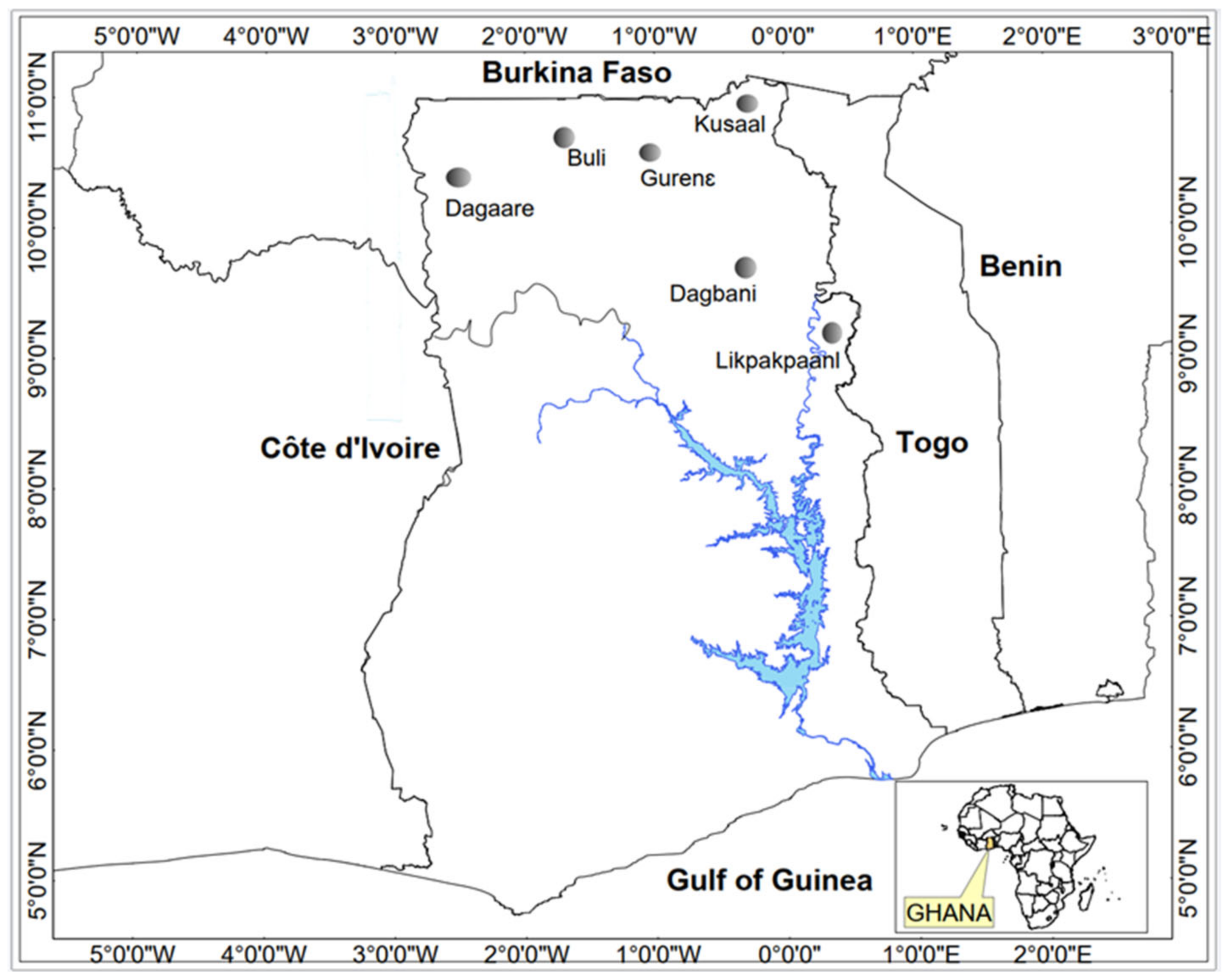

Tone in Mabia Languages: Structure and Processes

 , ,
, , 
Abstract
1. Introduction1
2. Tone in West African Languages
2.1. Typology and Number of Levels
2.2. Tone-Bearing Units
2.3. Contour Tones in West African Languages
3. Tone in Mabia Languages: General Features
3.1. Tone in Dagaare
| (1) | Minimal pairs | |||
| H | L | |||
| tú | ‘dig’ | tù | ‘follow’ | |
| kʊ́ | ‘kill’ | kʊ̀ | ‘give’ | |
| báá | ‘dog’ | bàà | ‘grow’ | |
| zɛ́lɪ́ | ‘poison’ | zɛ̀lɪ̀ | ‘lift’ | |
| (2) | a. | ʊ̀ | kʊ́ŋ | wá |
| 3sg | pst.irr.neg | come | ||
| ‘S/he should not have come’ | ||||
| b. | ʊ̀ | kʊ̀ŋ | wá | |
| 3sg | fut.neg | come | ||
| ‘S/he will not come’ | ||||
3.1.1. Tone-Bearing Unit in Dagaare
- (3)


- (4)


3.1.2. Distribution of Verbal Tone
- (5)
- Underlying and surface forms for the default verb


- (6)
- Underlying and surface forms of the imperfective

3.1.3. Distribution of Nominal Tone
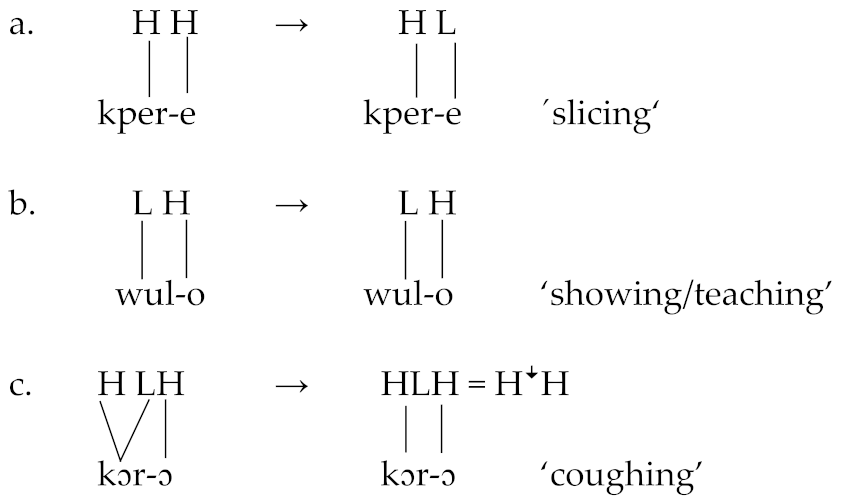
3.1.4. Contour Tones in Dagaare
- HL contours: nɪ́ɛ̀ ‘person.sg’, dáà ‘push’.
- LH contours: tùó ‘baobab.sg’, wɪ̀ɛ́ ‘farm.sg’.
- nû ‘hand’, zû ‘head’, ɡbô ‘heart’, ʧî ‘millet’.
- There is a restricted number of L-L nouns in Dagaare;
- There are no surface HLH patterns within simple words (nouns and verbs) in Dagaare;
- A contour tone in Dagaare has a maximum of two levels of pitch, HL and LH, that is, a maximum of two tones associated to a TBU;
- Both rising and falling contours are attested in nouns, but only falling contours are attested in verbs (=*LH in verbs);
- There is no evidence suggesting the presence of a floating H, but L tones can float between high tones, causing downstep.
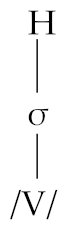
- (7)
- Underlying roots


- (8)
- Suffix

3.2. Tone in Dagbani
| (9) | Minimal pairs | ||||
| H | L | ||||
| dám | ‘alcohol’ | dàm | ‘shake’ | ||
| kpáŋ | ‘guinea fowl’ | kpàŋ | ‘axe’ | (Issah, 2020, p. 16) | |
| (10) | H vs. L verbs | ||
| a. | CV | ||
| dú ‘go up’ | lù ‘fall’ | ||
| ɲé ‘put down’ | tò ‘pound’ | ||
| b. | CVN | ||
| ném ‘grind’ | wùm ‘hear’ | ||
| jém ‘yawn’ | dèm ‘play’ | ||
| kpán ‘axe’ | |||
| dán | ‘to carry with difficulty’ | ||
| c. | CVC(i) | ||
| sábí ‘write’ | làbì ‘return (intr)’ | ||
| lábí ‘throw’ | tàɡì ‘exchange’ | ||
| d. | CVV(i) | ||
| ɡbááí ‘catch’ | ɡùùì ‘run’ | ||
| lóóí ‘cross’ | jòòì ‘open’ | ||
| e. | CVCC(i) | ||
| wálɡí ‘divide’ | zàɡsì ‘refuse’ | ||
| sírɡí ‘go down’ | zìlsì ‘wander’ | ||
| f. | CVC(i)C | ||
| dáhím ‘taste’ | kàrìm ‘read’ | ||
| jóhím ‘deceive’ | làɡìm ‘meet’ |
- Within the morphological structure, a Dagbani verb stem can consist of a root only or of a root plus a suffix, e.g., /lab/ ‘return’ (intr.) vs. /lab-si/ ‘return’ (tr.), where /-si/ is a causative suffix.
- Within the syllable structure on the surface level, a verb stem can be monosyllabic (CV, CVN, CVV) or disyllabic (CV.Ci, CV.Vi, CVC.Ci, CV.Cim), noting that the only permissible word-final consonants in Dagbani are /m/ and /n/, as seen in (10b).
- Still on the syllable, the second syllable [i] is always predictable in Dagbani. That is, it occurs only after final oral consonants as in (8c–e) and long vowels as in (10d), and between an oral consonant and /m/ as in (10f).
- And finally, the root structures of the verbs as seen in the data above are thus /CV/, /CVN/, /CVC/, /CVV/, and /CVCC/. The different placement of the second syllable [i] as in (10e,f) is thus predictable; both can be argued to be underlyingly CVCC, e.g., /zaɡs/, /karm/, where /s/ and /m/ may be (frozen) suffixes.
| (11) | Verb paradigms for which systematic tonal data was collected | |||
| Tenses | Aspects | Clause type | Polarity | |
| Present (0) | Perfective (PFV) | Main Clause | Affirmative | |
| Today Past (P1) | Imperfective (IPFV) | Relative Clause | Negative | |
| General Past (P2) | ||||
| General Future (F) | ||||
| Incipient ‘about to’ | ||||
| hence: Main Clause Affirmative, (MCA), Main Clause Negative (MCN), Relative Clause Affirmative (RCA), and Relative Clause Negative (RCN). | ||||
- H: H tone pattern, merger of L and H lexical root tones of CV and CVC stems, as in ló ‘tie’ and ʧím ‘fry’, respectively;
- LH: LH tone pattern, merger of L and H lexical root tones in all stems, as in mè ‘build’ and sàbrá ‘writing’;
- HL: HL tone pattern, merger of L and H lexical root tones except on CV and CVC stems, as in móóì ‘fetch’ and bíì ‘heat’;
- Lex: L and H lexical root tones realized on each stem syllable.
| (12) | Hierarchy of paradigmatic verb tone assignment | ||||||||
| Future | IPFV | {Neg, Incip} | MC PFV | RC PFV | |||||
| H | >> | LH | >> | HL | >> | LH | >> | Lex | |
3.2.1. Tone-Bearing Unit in Dagbani
- In Dagbani, monomoraic roots count as single TBUs: CV and CVC roots (e.g., dú ‘climb’, lù ‘fall’, ném ‘grind’, wùm ‘hear’ (L)) merge L and H lexical tones into a single surface H or L on one TBU in paradigms like future perfective, as tone spreads across the single mora regardless of underlying contrast.
- Bimoraic roots support multiple TBUs: CVV and CVN roots with long vowels (e.g., ɡbááí ‘catch’ (H), ɡùùì ‘run’ (L), píí ‘choose’, záɡsí ‘refuse’) realize distinct LH or HL patterns across two TBUs, as seen in future perfective, where L roots show doubly linked H (ò-n záɡsí kóꜜdú) vs. H roots with HL (ò-n tábsì kôdú).
- Finally, TBU count drives paradigmatic tone hierarchy: The number of TBUs in roots determines tone realization in hierarchies (Future IPFV > {Neg, Incip} > MC PFV > RC PFV), with monomoraic verbs uniformly H (ò-n tó kóꜜdú) but bimoraic ones differentiating via spreading rules like HTS/LTS, yielding downstep or falling contours only on multi-TBU structures.
3.2.2. Tone Assignment Rules in Dagbani
| (13) | Without HTS: ò zàɡsí yá ‘he has refused’. Here, the L tone subject pronoun and LH verb melody remain intact. This is in line with the proposal of Hyman (1993) and Olawsky (1999) that an underlying H tone will spread to the right, delinking an immediately following L tone. |
| (14) | With HTS: n zàgsì yá → ń záɡsî yá ‘I have refused’. Here, the H tone from the subject pronoun spreads, creating an H plus HL falling sequence. |
| (15) | Input: ò zàɡsí kòdú ‘he has refused a banana’. |
- ✓
- HTS applies first: ò zàɡsí kóꜜdú.
- ✓
- Then, LTS spreads the L tone: ò zàɡsì kóꜜdú.
- ✓
- This results in a downstepped H tone on kóꜜdú.
3.2.3. Application to Future Perfective Forms
| (16) | a. | L tone verb ò-n tó kóꜜdú (‘he will pound banana’) |
| b. | H tone verb ò-n nyé kóꜜdú (‘he will put down banana’). | |
| c. | L tone verb ò-n záɡsí kóꜜdú (‘he will refuse banana’). | |
| d. | H tone verb ò-n tábsì kôdú (‘he will touch banana’). |
3.2.4. Complications in Dagbani Verb Tone Assignment
| (17) | MCA Future Perfective (“H tone pattern”): verb + /kòdú/ ‘banana’ | |
| H Tone Verb Roots | ||
| ô-n tó kóꜜdú ‘he will pound banana’ | ô-n nyé kóꜜdú ‘he will put down banana’ | |
| ô-n tág kóꜜdú ‘he will exchange banana’ | ô-n láb kóꜜdú ‘he will throw banana’ | |
| ò-n záɡsí kóꜜdú ‘he will refuse banana’ | ò-n tásíb kóꜜdú ‘he will touch banana’ | |
| ò-n píí kóꜜdú ‘he will choose banana’ | ò-n gbáá kóꜜdú ‘he will catch banana’ | |
- ✓
- Why does an L tone verb like záɡsí have a doubly linked H tone?
- ✓
- Why does an H tone verb like tábsì instead show a H-L sequence?
3.3. Tone in Gurenɛ
3.3.1. Tone Inventory
| (18) | Two-tone contrasts in Gurenɛ | ||||
| a. | Verbs | ||||
| kóné | ‘knock (on head)’ | kònè | ‘miss something’ | ||
| bélégé | ‘coax’ | bèlègè | ‘over apply oil (on body)’ | ||
| nyáŋɛ́ | ‘pluck leaves’ | nyàŋɛ̀ | ‘overcome’ | ||
| b. | Nouns | ||||
| sánɛ́ | ‘melon’ | sànɛ̀ | ‘debt’ | ||
| báŋá | ‘ring’ | bàŋà | ‘lizard’ | ||
| (Atintono, 2004) | |||||
| (19) | Three-tone contrasts in Gurenɛ (Adongo, 2018, p. 198) | |||||
| láá | ‘bowl’ | dāā | ‘past’ | làà | ‘falling position’ | |
| díá | ‘food’ | dìá | ‘dance’ | dīà | ‘animal’ | |
| (20) | Tone sequences | ||||
| a. | One-syllable words | zóm (H) ‘flour’, | dā (M) ‘past’ | zòm (L) ‘climb’ | |
| b. | Two-syllable words | dʊ́kɔ́ (H-H) ‘pot’, zʊ̄ʊ̄rɛ̄ (M-M) ‘tail’ | sìrā (L-M) ‘tail’ | ||
| c. | Three-syllable words | átíà (H-H-L) ‘tree’ | |||
| d. | Four-syllable words | pɔ̀ɣə̀dírí (L-L-H-H) ‘marriage’ | |||
| e. | Five-syllable words | átíābííté (H-H-M-H-H) ‘atia’s seed’ | |||
| (21) | a. | báŋá | ‘ring’ | bàŋà | ‘lizard’ |
| b. | kóné | ‘knock (e.g., on head)’ | kònè | ‘to miss’ |
| (22) | a. | dá | kínɛ́ | ‘don’t go!’ | (singular) | |
| b. | dá | kínɛ̀ | yá | ‘don’t go!’ | (plural) |
3.3.2. Tonal Processes in Gurenɛ
| (23) | Tone assimilation | |
| a. | zóm + kòɁóm → zóŋkóɁóm ‘flour + water’ → ‘beverage’ | |
| b. | sɔ̀gɔ́rɔ̀ + pììsɛ̀ + ká → sɔ̀ɣɔ̂píísə́ká ‘rubbish broom’ | |
| (24) | Downstep |
| díá ꜜdʊ́kà ‘food cooking’ | |
| dɔ́ɔ́rɔ́ ꜜkʊ́ká ‘wooden chair’ |
3.4. Tone in Kusaal
| (25) | ō | dì-t |
| 3sg | eat.hab | |
| ‘S/he eats’ | ||
| ò | dì-tnɛ́ | |
| 3sg | eat-prog | |
| ‘S/he is eating’ | ||
| ò | dì-yá | |
| 3sg | eat.pfv | |
| ‘S/he has eaten’ | ||
| (26) | tī | dʊ̄ɡ-ʊ̄d-nɛ̀ | ꜜsūm-ā |
| 1pl | cook-hab-foc | groundnut-pl | |
| ‘We are cooking groundnut’ | |||
| (27) | tĩ | wá’-ád-nɛ̀ | ꜜɡē’ùŋ |
| 1pl | dance-hab-foc | type of dance | |
| ‘We are dancing ge’uŋ’ | |||
3.4.1. Functions of Tone in Kusaal
| (28) | Lexical functions | ||||
| a. | bá | ‘father’ | bà | ‘to fix into’ | |
| b. | ká | ‘complementizer/conjunction’ | kà | ‘focus particle’ | |
| (29) | Grammatical functions | ||||
| a. | ò | pù | mɔ́r | bíígá | |
| 3sg | neg | have | child | ||
| ‘S/he has no child’ | |||||
| b. | ò | pù | mɔ́r | bíígà-à? | |
| 3sg | neg | have | child | ||
| ‘Doesn’t s/he have a child?’ | |||||
| c. | ò | pù | dá | dííbí | |
| 3sg | neg | buy | food | ||
| ‘S/he did not buy food’ | |||||
| d. | ò | pù | dá’ | dííbì-ì? | |
| 3sg | neg | buy | food | ||
| ‘Didn’t s/he buy food?’ | |||||
| (30) | a. | bííɡ | lá | kʊ̀ | dìì |
| child | def | fut.neg | eat | ||
| ‘The child will not eat’ | |||||
| b. | bííɡ | lá | kʊ́ | dīī | |
| child | def | pfv.neg | eat | ||
| ‘The child did not eat’ | |||||
| (31) | a. | Aduk | sá | dì | múì | lá | wúsá |
| Aduk | pst | eat | rice | def | all | ||
| ‘Aduk will eat all the rice’ | |||||||
| b. | Aduk | ná | dī | múì | lá | wúsá | |
| Aduk | fut | eat | rice | def | all | ||
| (32) | a. | dáʊ́ | lá | dà | búúg | lá | |
| man | def | buy | goat | def | |||
| ‘The man bought the goat’ | |||||||
| b. | dáʊ́ | lá | ná | da¯ | búúg | lá | |
| man | def | fut | buy | goat | def | ||
| ‘The man will buy the goat’ | |||||||
3.4.2. Tone-Bearing Units
- (33)


| (34) | sáán ‘stranger’ | kèm ‘go!’ | yùùm | ‘year’ |
3.5. Tone in Likpakpaln
3.5.1. Tone Inventories
| (35) | ḿ.máál | ‘birth’ |
| kàl | ‘to sit’ |
3.5.2. Functions of Tone in Likpakpaln
| (36) | kɪ̄nà | lē | tɪ̄ | bán |
| this | foc | 1pl | want | |
| ‘This is what we want’ | ||||
| (37) | kɪ̄ná | lē | tɪ̄ | bã́ |
| that | foc | 1pl | want | |
| ‘That is what we want’ | ||||
| (38) | bī-píí-b | chùùn | cháá | kī-nyá-ŋ |
| cl.pl-woman-cl.pl | walk.hab | go | cl.sg-market-cl.sg | |
| ‘Women walk to the market’ | ||||
| (39) | bī-píí-b | chúún | búèn | kī-nyá-ŋ |
| cl.pl-woman-cl.pl | walk.pfv | go.pfv | cl.sg-market-cl.sg | |
| ‘Women have walked to the market’ | ||||
| (40) | sī | àà | nyán | ḿ-máál | mún | pōnnɪ̄ | ná |
| 2sg.sbj | ipfv | come.from | cl.sg-family-cl.sg | rel | inside | def | |
| ‘The family that you come from’ | |||||||
| (41) | sī | áá | nyán | ḿ-máá-l | múè | pōnnɪ̄ | |
| 2sg.sbj | neg | come.from | cl.sg-family-cl.sg | this | inside | ||
| ‘You’re not from this family’ | |||||||
| (42) | Homonym | Unrelated meanings |
| sū | ‘to have sexual intercourse’ or ‘to steal’ | |
| béé | ‘these = prox’ or ‘to know’ | |
| kíí | ‘to respond, to accept’ or ‘to snap (of a rope)’ | |
| kpáá | ‘to nail’ or ‘to be deaf’ |
3.6. Tone in Buli
| (43) | Minimal Pairs | |||
| Low vs. High Tone | ||||
| bììk | ‘language’ | nààb | ‘chief’ | |
| bíík | ‘child | nááb | ‘cow’ | |
| Mid vs. Low Tone | High-Low vs. Low-Low | |||
| bāŋ | ‘bangle’ | búlùk | ‘armpit’ | |
| bàŋ | ‘lizard’ | bùlùk | ‘hometown of Bulisa’ | |
| Mid-Mid vs. High-High | Mid-Mid vs. Low-Low | |||
| vīɔ̄k | ‘leaf’ | lālīk | ‘bull’, | |
| vɪ́ɔ́k | ‘wind’ | làlɪ̀k | ‘clay’ | |
| (44) | Minimal Triplets | |||
| kɔ̀k | ‘ghost’ | síúk | ‘path’ | |
| kɔ̄k | ‘feather’ | sìùk | ‘fish’ (special type) | |
| kɔ́k | ‘mahogany’ | sīūk | ‘navel’ | |
| (45) | wà | à | dɛ̄ | sāāb3 |
| cl.1 | pfv | eat | saab | |
| (46) | wà | lì | dɛ̄ | sāāb |
| cl.1 | fut | eat | saab | |
| ‘He will eat saab’ | ||||
| (47) | bà | sùùrì | ní-sá |
| cl.2 | wash.pfv | hand-cl.6 | |
| ‘They washed (their) hands’ | |||
| (48) | bà | sūūrī | ní-sá |
| cl.2 | wash | hand-cl.6 | |
| ‘They should wash (their) hands’ | |||
| (49) | pɛ̄ | wén | |
| swear | god | ||
| ‘Swear unto god’ | |||
| (50) | bà | pɛ̄ | wén |
| cl.2 | swear | god | |
| ‘They should swear (unto) god’ | |||
| (51) | nì | pɛ̄ | wén |
| 2pl | swear | god | |
| ‘Swear unto god’/‘You should swear (unto) god’ | |||
Tone Change
| (52) | /…àtɪ̀ mí ɲà bííká tà mí-jéŋ/[…àtɪ̀ !mí ɲà !bííká tà !mí-jéŋ]4 | |
| ‘…and I saw that the child had a single rope’ | ||
 | ||
| (53) | |
| a. | b. |
 |  |
| (54) | |
| a. | b. |
 |  |
| (55) | /bà fòrì míí.ká/ | [bà | fòrì | mìì-ká] |
| cl.2 | untie.pfv | rope-def.5 | ||
| ‘They (people) untied the rope’ | ||||
| (56) | /sì nɛ̀ zúé/ | [sì | nɛ̀ | zù-é] |
| cl.6 | swallow.pfv | worm-cl.4 | ||
| ‘They (chicken) swallowed worms’ | ||||
| (57) | /bà fòrì míí.ká/ | [bà | fòrì | míí-ká] |
| cl.2 | untie.pfv | rope-def.5 | ||
| They (people) untied THE ROPE (not the scarf) | ||||
| (58) | /sì nɛ̀ zúé/ | [sì | nɛ̀ | zú-é] |
| cl.6 | swallow.pfv | worm-cl.4 | ||
| They (chicken) swallowed WORMS (not houseflies) | ||||
| Emphatic | Non-Emphatic | ||||||||
| (59) | /bà fòrì míí.ká/ | a. | [bá | fórí | míí-ká] | b. | [bà | fòrì | mìì-ká] |
| cl.2 | untie.pfv | rope-def.5 | cl.2 | untie.pfv | rope-def.5 | ||||
| ‘They untied the rope’ | ‘They untied the rope’ | ||||||||
| (60) | /nàmá fòrì míí.ká/ | a | [nàmá | fórí | míí-ká] | b. | [nàmá | fòrì | mìì-ká] |
| 2pl.excl | untie | rope-def.5 | 2pl.excl | untie | rope-def.5 | ||||
| ‘You untied the rope’ | ‘You untied the rope’ | ||||||||
| (61) | /tàmá fòrì míí.ká/ | a. | [tàmá | fórí | míí-ká] | b. | [tàmá | fòrì | mìì-ká] |
| 1pl.incl | untie | rope-def.5 | 1pl.incl | untie | rope-def.5 | ||||
| ‘We untied the rope’ | ‘We untied the rope’ | ||||||||
| (62) | wà | ɲù | kà | dáám |
| cl.1 | drink.pfv | foc | alcohol | |
| ‘S/he drank alcohol’ | ||||
| (63) | wà | ɲù | ká | dáám |
| cl.1 | drink.pfv | foc | alcohol | |
| ‘S/he drank alcohol’ | ||||
3.7. Comparative Summary of the Six Tonal Systems
4. Conclusions
Author Contributions
Funding
Institutional Review Board Statement
Informed Consent Statement
Data Availability Statement
Acknowledgments
Conflicts of Interest
Abbreviations
| 1 | First person |
| 2 | Second person |
| 3 | Third person |
| COMP | Complementizer |
| CONJ | Conjunction |
| CL | Class marker |
| DEF | Definite marker |
| DET | Determiner |
| FOC | Focus |
| FUT | Future |
| IPFV | Imperfective |
| IMP | Imperative |
| INT | Intransitive |
| IRR | Irrealis |
| NEG | Negation |
| NOM | Nominal |
| PFV | Perfective |
| PL | Plural |
| PST | Past |
| Q | Question marker |
| REP | Repetitive particle |
| SBJ | Subject |
| SG | Singular |
| 1 | All data in this chapter are in broad phonetic transcription. For the purposes of clarity, orthographic representations such as ky, gy, ny, ng, ngm, and y are represented as [ʧ], [ʤ], [ɲ], [ŋ], [ŋm], and [j] in the IPA, respectively. |
| 2 | Rare examples of LL simple nouns in some Dagaare varieties include ɡbàɡà/ɡbɔ̀ɡɔ̀ ‘savanna monitor lizard’, tɔ̀bɔ̀ ‘tobacco’ (loan version of tobacco), and ʤùɡlì/ʤùùnì ‘vulture’ |
| 3 | Saab is a local dish of the Bulisa prepared with millet flour or corn flour. |
| 4 | The data cited here are based on one of the authors’ descriptive fieldworks. Some of the examples have also appeared in earlier studies on the same topic (e.g., Akanlig-Pare & Kenstowicz, 2002; Schwarz, 2005). |
References
- Abakah, E. N. (2005). Tone rules in Akan. Journal of West African Languages, 32(1–2), 109–134. [Google Scholar]
- Abdul Moomin, A.-A. (2015). Aspects of Waali phonology [Master’s thesis, University of Ghana]. [Google Scholar]
- Abubakari, H. (2018). Aspects of Kusaal grammar: The syntax-information structure interface [Ph.D. dissertation, University of Vienna]. [Google Scholar]
- Abubakari, H. (2022). The grammar of the Kusaal language of Ghana [Unpublished manuscript]. Institute of African Studies, University of Ghana.
- Adjong, D. (2025). Aspects of the grammar of Buli, a Gur language of northern Ghana. HKU Theses Online (HKUTO). [Google Scholar]
- Adongo, E. A. (2018). Aspects of gurenɛ phonology. University of Ghana. [Google Scholar]
- Akanlig-Pare, G. (2005). Buli tonology: A non-linear approach [Unpublished Ph.D. dissertation, Department of Linguistics, University of Ghana]. [Google Scholar]
- Akanlig-Pare, G., & Kenstowicz, M. (2002). Tone in Buli. Studies in African Linguistics, 31(1), 56–95. [Google Scholar] [CrossRef]
- Akinlabi, A., Ahoua, F., & Gondo, B. G. (2022). On five-level tone contrasts: The case of dan-gblewo. Stellenbosch Papers in Linguistics Plus, 62(2), 35–50. [Google Scholar] [CrossRef]
- Angsongna, A. (2021). Tone alternation in Dàgáárè verbs: Perfectives and imperfectives. Studies in African Linguistics, 50(2), 326–345. [Google Scholar] [CrossRef]
- Angsongna, A. (2023). Aspects of the morphophonology of Dagaare. University of British Columbia. [Google Scholar]
- Ansah, M. A. (2022). Polar interrogatives in Lɛtɛ discourse. Legon Journal of the Humanities, 32(2), 37–54. [Google Scholar] [CrossRef]
- Anttila, A., & Bodomo, A. (1996). Stress and tone in Dagaare. Rutgers Optimality. [Google Scholar]
- Anttila, A., & Bodomo, A. (2000). Tonal polarity in Dagaare. In Trends in African linguistics. Africa World Press. [Google Scholar]
- Anttila, A., & Bodomo, A. (2007, January 6). OCP effects in Dagaare. 81st Annual Meeting of the Linguistic Society of America, Anaheim, CA, USA. [Google Scholar]
- Anttila, A., & Bodomo, A. (2022). Tone and morphological level ordering in Dagaare. Phonology, 39(3), 443–471. [Google Scholar] [CrossRef]
- Archangeli, D., & Pulleyblank, D. (2022). Emergent phonology (Vol. 7). Language Science Press. [Google Scholar]
- Archangeli, D., & Pulleyblank, D. G. (1994). Grounded phonology (Vol. 25). MIT Press. [Google Scholar]
- Atintono, S. A. (2004). A morpho-syntactic study of the Gurenɛ verb [Unpublished Master’s thesis, University of Ghana]. [Google Scholar]
- Bearth, T., & Zemp, H. (1967). The phonology of Dan (Santa). Journal of African Languages, 6(1), 9–29. [Google Scholar]
- Bemile, S. K. (1983). Dagara phoneme contrasts (No. 1). Institut für Phonetik, Universität des Saarlandes. [Google Scholar]
- Bisilki, A. K. (2022). Aspects of the grammar of Likpakpaanl: A Mabia (Gur) language spoken in Ghana. HKU Theses Online (HKUTO). [Google Scholar]
- Bodomo, A. (1997). The structure of Dagaare. CSLI Publications. [Google Scholar]
- Bodomo, A. (2006, April). The structure of ideophones in African and Asian languages: The case of Dagaare and Cantonese. In Selected proceedings of the 35th Annual Conference on African Linguistics: African languages and linguistics in broad perspectives (pp. 203–213). Harvard University Press. [Google Scholar]
- Bodomo, A. (2020). Mabia: Its etymological genesis, geographical spread, and some salient genetic features. In Handbook of the Mabia languages of West Africa (pp. 5–34). Galda Verlag. [Google Scholar]
- Bright-Ajoku, C. A., & Okumo, F. (2020). A comparative analysis of tone in the Igbo and Ukwuani. Journal of Language and Linguistics, 6(3), 89–105. [Google Scholar]
- Cahill, M. C. (2004). Tone Polarity in Kɔnni nouns. pdf. Studies in African Linguistics, 33(1), 1–33. [Google Scholar] [CrossRef]
- Cahill, M. C. (2007). More universals of tone. Ms. SIL. Available online: https://www.sil.org/resources/archives/7816 (accessed on 23 April 2026).
- Cahill, M. C. (2016). Kɔnni intonation. In Intonation in African languages (pp. 53–88). De Gruyter Mouton. [Google Scholar]
- Chen, M. Y. (2000). Tone sandhi: Patterns across Chinese dialects (Vol. 92). Cambridge University Press. [Google Scholar]
- Connell, B. (2011). Downstep. In The blackwell companion to phonology (pp. 1–24). Wiley. [Google Scholar]
- Courtenay, K. (1974). On the nature of the Bambara tone system. The African Studies Center, The University of California, Los Angeles, 5(3), 303. [Google Scholar]
- Creissels, D. (2024). A sketch of Mandinka. In F. Lüpke (Ed.), The Oxford guide to the Atlantic languages of West Africa. Oxford University Press. [Google Scholar]
- Creissels, D., & Grégoire, C. (1993). La notion de ton marqué dans l’analyse d’une opposition tonale binaire: Le cas du mandingue. Journal of African Languages and Linguistics, 14(2), 107–154. [Google Scholar] [CrossRef]
- Dakubu, M. E. K. (1996). A grammar of Gurenε. University of Ghana. [Google Scholar]
- Deklu, G. (2021). Ewe vowel harmony: Implications for theories of underspecification [Doctoral dissertation, Memorial University of Newfoundland]. [Google Scholar]
- Downing, L. J. (2005). Tone in some African reduplicative systems’. In Studies on reduplication (p. 28). De Gruyter. [Google Scholar]
- Dundaa, M. G. (2013). Aspects of birfor phonology [Master’s thesis, University of Ghana]. [Google Scholar]
- England, N. C., & Ladusaw, W. A. (1985). Question formation in Kusaal. Studies in African Linguistics, 105–110. [Google Scholar]
- Ezenwafor-Afuecheta, C. I., & Inyani, A. (2021). An overview of Etulo: An Idomoid language. International Journal of Language and Linguistics, 9(3), 133–139. [Google Scholar] [CrossRef]
- Gborsi, D. K. (2015). Aspects of tùtrùgbù (nyagbo) phonology. University of Ghana. [Google Scholar]
- Goldsmith, J. (1976). Autosegmental phonology [Ph.D dissertation, MIT]. [Google Scholar]
- Gordon, M. (2001). A typology of contour tone restrictions. Studies in Language. International Journal Sponsored by the Foundation Foundations of Language, 25(3), 423–462. [Google Scholar] [CrossRef]
- Green, C. R. (2010). Prosodic phonology in Bamana (Bambara): Syllable complexity, metrical structure, and tone [Ph.D. dissertation, Indiana University]. [Google Scholar]
- Green, C. R. (2013). Formalizing the prosodic word domain in Bambara tonology. Journal of West African Languages, 40(1), 3–20. [Google Scholar]
- Gussenhoven, C., & Chen, A. (Eds.). (2021). The Oxford handbook of language prosody Oxford handbooks (2020 online ed.). Oxford Academic. [Google Scholar] [CrossRef]
- Hobley, J. (1964). A preliminary tonal analysis of the Bassa language. Journal of West African Languages, 1(2), 51–55. [Google Scholar]
- Hoffman, C. (1963). A grammar of the Margi language. Oxford University Press. [Google Scholar]
- Hudu, F. (2010). Dagbani Tongue-root Harmony: A formal account with ultrasound investigation [Ph.D. thesis, The University of British Columbia]. [Google Scholar]
- Hudu, F., & Nindow, M. O. (2020). Nasality in dagbani prosody. Folia Linguistica, 54(3), 527–550. [Google Scholar] [CrossRef]
- Hyman, L. M. (1985). Word domains and downstep in Bamileke-Dschang. Phonology, 2(1), 47–83. [Google Scholar] [CrossRef]
- Hyman, L. M. (1993). Structure preservation and postlexical tonology in Dagbani. Studies in Lexical Phonology, 235–254. [Google Scholar]
- Hyman, L. M. (2007). Universals of tone rules: 30 years later. Tones and Tunes: Studies in Word and Sentence Prosody, 1, 1–34. [Google Scholar]
- Hyman, L. M. (2011). Tone: Is it different? In The handbook of phonological theory (pp. 197–239). Wiley. [Google Scholar]
- Hyman, L. M. (2018). What tone teaches us about language. Language, 94(3), 698–709. [Google Scholar] [CrossRef]
- Hyman, L. M., & Leben, W. R. (2017). Word prosody II: Tone systems. UC Berkeley PhonLab Annual Report, 13(1), 178–209. [Google Scholar] [CrossRef]
- Hyman, L. M., & Leben, W. R. (2021). Tone systems. In C. Gussenhhoven, & A. Chen (Eds.), The Oxford handbook of language prosody Oxford handbooks (2020 online ed.). Oxford Academic. [Google Scholar] [CrossRef]
- Hyman, L. M., & Olawsky, K. J. (2004). Dagbani verb tonology. Trends in African Linguistics, 4, 97–108. [Google Scholar]
- Hyman, L. M., & Schuh, R. G. (1974). Universals of tone rules: Evidence from West Africa. Linguistic Inquiry, 5(1), 81–115. [Google Scholar]
- Innes, G. (1960). An outline of the Grebo verbal system. African Language Studies, 1, 164–176. [Google Scholar]
- Innes, G. (1981). Les langues kru; Le grebo. In Les langues dans le monde ancien et moderne. I. les langues de l’Afrique subsaharienne (pp. 125–135). UNESCO. [Google Scholar]
- Issah, S. A. (2015). An analysis of interrogative constructions in Dagbani. Journal of West African Languages, 1(42), 46–63. [Google Scholar]
- Issah, S. A. (2020). On the structure of A-bar constructions in Dagbani: Perspectives of wh-questions and fragment answers. Peter Lang GmbH Internationaler. [Google Scholar]
- Kandybowicz, J. (2004). Nupe tonology and the categorical identity of verb copy tones: A pilot experimental study. University College London Working Papers in Linguistics, 16, 17–53. [Google Scholar]
- Katamba, F. (1989). An introduction to phonology. Longman. [Google Scholar]
- Kennedy, J. (1966). Collected field reports on the phonology of dagaari. Institute of African Studies, University of Ghana. [Google Scholar]
- Kenstowicz, M. J. (1994). Phonology in generative grammar. In Blackwell textbooks in linguistics. Blackwell. [Google Scholar]
- Kenstowicz, M. J. (2006). Tone loans: The adaptation of English loanwords into Yoruba. In Selected proceedings of the 35th annual conference on African linguistics (Vol. 13). Academia. [Google Scholar]
- Kenstowicz, M. J., Nikiema, E., & Ourso, M. (1988). Tonal polarity in two Gur languages. Studies in the Linguistic Sciences, 18(1), 77–103. [Google Scholar]
- Kenstowicz, M. J. (2020). Phonology and phonetics. Oxford University Press. [Google Scholar]
- Kuubezelle, N. (2013). An autosegmental analysis of phonological processes in Dagara. University of Ghana. [Google Scholar]
- Leben, W. R. (1973). Suprasegmental phonology [Ph.D dissertation, MIT]. [Google Scholar]
- Lefebvre, C., & Brousseau, A.-M. (2011). A grammar of Fongbe (Vol. 25). Walter de Gruyter. [Google Scholar]
- Lojenga, C. K. (2018). Tone and tonology in African languages. In The routledge handbook of African linguistics (pp. 72–92). Routledge. [Google Scholar]
- Maddieson, I. (1978). Universals of tone. In J. H. Greenberg (Ed.), Universals of human language: Vol. 2: Phonology (pp. 335–366). Stanford University Press. [Google Scholar]
- Manessy, G. (1960). Les substantifs a prefixes et suffixes dan 1es 1angues voltaiques. Journal of African Languages, 4, 170–181. [Google Scholar]
- Meeussen, A. E. (1970). Tone typologies for West African languages. African Language Studies, 11, 266–271. [Google Scholar]
- Melick, C. M. (2012). Tone in the Mbelime verb system. SIL International. Available online: https://www.sil.org/system/files/reapdata/12/24/18/122418536905309022538246076268750821795/e_Book_47_Melick_ToneinMbelimeVerbSystem_FINAL.pdf (accessed on 23 April 2026).
- Musah, A. A. (2010). Aspects of Kusaal phonology [Unpublished Master’s thesis, University of Ghana]. [Google Scholar]
- Musah, A. A. (2017). Syllable weight and tonal patterning in Kusaal. Syllable Weight in African Languages, 338, 177. [Google Scholar]
- Musah, A. A. (2018). A grammar of Kusaal: A Mabia (Gur) language of northern Ghana. Peter Lang GmbH, Internationaler Verlag der Wissenschaften. [Google Scholar]
- Neukom, L. (1995). Description grammaticale du nateni (Bénin): Système verbal, classification nominale, phrases complexes, textes. University of Zurich. [Google Scholar]
- Newman, P. (1986). Contour tones as phonemic primes in Grebo. In The phonological representation of suprasegmentals (pp. 175–193). De Gruyter. [Google Scholar]
- Newman, P. (1995). Hausa tonology: Complexities in an ‘easy’tone language. Blackwell. [Google Scholar]
- Newman, P., & Jagger, P. J. (1989). Low tone raising in Hausa: A critical assessment. Studies in African Linguistics, 20(3), 263–264. [Google Scholar] [CrossRef]
- Niggli, U. (2014). The Structure of Burkina Faso Kusaal. The structure of Burkina Faso Kusaal. Available online: https://kusaal-bf.com/sites/www.kusaal-bf.com/files/uploads/The%20structure%20of%20Burkina%20Faso%20Kusaal.pdf (accessed on 22 April 2026).
- Odden, D. (1995). Tone: African languages. In The handbook of phonological theory. John Wiley & Sons. [Google Scholar]
- Odden, D. (2020). Tone. In R. Vossen, & G. J. Dimmendaal (Eds.), The Oxford handbook of African languages (pp. 29–47). Oxford University Press. [Google Scholar] [CrossRef]
- Olawsky, K. J. (1999). Aspects of Dagbani grammar: With special emphasis on phonology and morphology. Lincom Europa. [Google Scholar]
- Pulleyblank, D. (1983). Extratonality and polarity. Proceedings of the West Coast Conference on Formal Linguistics, 2, 204–216. [Google Scholar]
- Pulleyblank, D. (1986). Tone in lexical phonology. In Studies in natural language and linguistic theory. Springer. [Google Scholar]
- Pulleyblank, D. (2003). Yoruba. In The world’s Major languages (pp. 971–990). Routledge. [Google Scholar]
- Riccitelli, J. M. (1965). Tone analysis: A practical approach. The Bible Translator, 16(2), 54–73. [Google Scholar] [CrossRef]
- Roberts, D. (2022). Moraic tone-bearing units in Kabiye. Linguistique et Langues Africaines, 8(1), 1–35. [Google Scholar] [CrossRef]
- Rolle, N., & Kari, E. E. (2022). Tone and prosodic recursion in Degema nouns and noun phrases. Journal of African Languages and Linguistics, 43(2), 249–283. [Google Scholar] [CrossRef]
- Schuh, R. G. (1989). The reality of Hausa low tone raising a response. Studies in African Linguistics, 20(3), 253–262. [Google Scholar] [CrossRef]
- Schwarz, A. (2003). Low tone spreading in Buli. Gur Papers, 6, 121–130. [Google Scholar]
- Schwarz, A. (2005). Aspekte der Morphosyntax und tonologie im Buli: Mit schwerpunkt auf dem Buli von Wiaga [Ph.D. dissertation, Humboldt-University]. [Google Scholar]
- Schwarz, A. (2007). The Particles lé and lá in the Grammar of Konkomba (Vol. 8, pp. 115–139). Universitätsverlag Potsdam. [Google Scholar]
- Schwarz, A. (2009). Tonal focus reflections in Buli and some Gur relatives. Lingua, 119(6), 950–972. [Google Scholar] [CrossRef]
- Selkirk, E., & Tateishi, K. (1991). Interdisciplinary Approaches to Language. In Interdisciplinary approaches to language. Springer. [Google Scholar]
- Spratt, D., & Spratt, N. (1968). Collected field reports on the phonology of Kusal collected language Notes 10. Institute of African Studies University of Ghana. [Google Scholar]
- Steele, M., & Weed, G. (1966). Collected field reports on the phonology of Konkomba (Vol. 3). Institute of African Studies, University of Ghana. [Google Scholar]
- Sulemana, A. R. (2021). Non-finite complementation: A case study of Bùlì [Doctoral dissertation, Massachusetts Institute of Technology]. [Google Scholar]
- Suzuki, K. (1998). A typological investigation of dissimilation [Ph.D dissertation, The University of Arizona]. [Google Scholar]
- Vydrin, V. (2008). Emergence of morphological cases in South Mande: From the amorphous type to inflectional? In Case, valency and transitivity (pp. 49–64). John Benjamins Publishing Company. [Google Scholar]
- Vydrin, V. (2016). Tonal inflection in mande languages: The cases of bamana and dan-gwɛɛtaa. In Tone and Inflection: New Facts and New Perspectives (pp. 83–105). Dokumen. [Google Scholar]
- Wedekind, K. (1985). Thoughts when drawing a map of tone languages. Afrikanistische Arbeitspapiere, 1, 105–124. [Google Scholar]
- Welmers, W. E. (1959). Tonemics, morphotonemics, and tonal morphemes. General Linguistics, 4(1), 1. [Google Scholar]
- Welmers, W. E. (1970). Igbo tonology. Studies in African Linguistics, 1(3), 255. [Google Scholar]
- Wescott, R. W. (1962). Two Ibo Songs. In Anthropological linguistics (pp. 10–15). JSTOR. [Google Scholar]
- Yip, M. (2002). Tone. Cambridge University Press. [Google Scholar]



| Tone | Default | Gloss | Tone | Imperfective | Gloss |
|---|---|---|---|---|---|
| L | dì | ‘eat’ | L-H | dì-ré | ‘eat-IPFV’ |
| tùò | ‘carry’ | tùò-ró | ‘carry-IPFV’ | ||
| wù̀lì | ‘show’ | wùl-ó | ‘show-IPFV’ | ||
| H | lé | ‘tie’ | H-L | lé-rè | ‘tie-IPFV’ |
| lɔ́ɔ́ | ‘drop/throw’ | lɔ́ɔ́-rɔ̀ | ‘drop/throw-IPFV’ | ||
| dʊ́ɡɪ́ | ‘cook/boil’ | dʊ́ɡ-rɔ̀ | ‘cook/boil-IPFV | ||
| HL | dɪ̂ | ‘take’ | H-LH = H-!H | dɪ́-ꜜrɛ́ | ‘take-IPFV’ |
| dáà | ‘push’ | dáá-ꜜrá | ‘push-IPFV’ | ||
| kɔ́rɪ̀ | ‘cough’ | kɔ́r-ꜜɔ́ | ‘cough-IPFV’ |
| Tone | Root | Singular | Gloss | Plural | Gloss | |
|---|---|---|---|---|---|---|
| a. | H | bi- | bíé | ‘child’ | bíí-rí | ‘children’ |
| bʊ- | bʊ́ɔ́ | ‘goat’ | bʊ́ʊ́-rɪ́ | ‘goats’ | ||
| taŋ- | táŋ-á | ‘mountain’ | tán-nɪ́ | ‘mountains’ | ||
| b. | LH | pì- | pìé 1 | ‘rock’ | pìì-rí | ‘rocks’ |
| ɲù- | ɲùó | ‘navel’ | ɲùù-rí | ‘navels’ | ||
| bùɡ- | bùɡ-ó | ‘silo’ | bùɡ-rí | ‘silos’ | ||
| c. | HL | mí- | mí-rì | ‘rope’ | míè | ‘ropes’ |
| nɔ́ | nʊ́ɔ̀ | ‘hen’ | nʊ́ʊ́-rɪ̀ | ‘hens’ | ||
| dʊ́ɡ- | dʊ́ɡ-ɪ̀ | ‘pot’ | dʊ́ɡ-rɪ̀ | ‘pots’ |
| MCA | MCN | RCA | RCN | ||||
|---|---|---|---|---|---|---|---|
| PFV | IPFV | PFV | IPFV | PFV | IPFV | PFV | IPFV |
| LH | LH | HL | LH | Lex | LH | HL | LH |
| zàgsìyá | kùrá | málì | sàɣsìrá | bàrá | dúɣì | sàbrá | |
| ‘refused | ‘killing’ | ‘have/own’ | ‘shifting’ | ‘riding’ | ‘cooked’ | ‘writing’ | |
| LH | LH | HL | LH | Lex | LH | HL | LH |
| zàgsí | dìrá | chíhì | chìmdá | wàrtá | dúhì | ŋùbrá | |
| ‘refused’ | ‘eating’ | ‘mark’ | ‘frying’ | ‘splitting’ | ‘raised’ | ‘chewing’ | |
| LH | LH | HL | LH | Lex | LH | HL | LH |
| zàgsí | mìrá | chírígì | wùrìndá | yù:ná | gábì | bùɣsìrá | |
| ‘refused’ | ‘raining’ | ‘meet’ | ‘destroying’ | ‘watching’ | ‘mix’ | ‘measuring’ | |
| H | H | H | H | (H) | (H) | H | H |
| dí ‘ate’ | ló ‘tie’ | kú ‘kill’ | yá | chím ‘fry’ | zíŋ | bá ‘ride’ | ӡí ‘carry’ |
| ‘harvest’ | ‘miss’ | ||||||
| HL | LH | HL | LH | HL | LH | (HL) | (LH) |
| zágsì | sìbrá | dónì | lòrá | díhyá ‘fed’ | dàrá | gòyá | wàrá |
| ‘refused’ | ‘writing’ | ‘lie’ | ‘tying’ | ‘buying’ | ‘travelled’ | ‘dancing’ | |
| H | L | ||
|---|---|---|---|
| báŋ | ‘bracelet/trap’ | bàŋ | ‘to know’ |
| bʊ́k | ‘to be weak’ | bʊ̀k | ‘to divine’ |
| búɡ | ‘to be drunk’ | bùɡ | ‘to carry on shoulder’ |
| sáád | ‘brooms’ | sààd | ‘pricing’ |
| yɛ́l | ‘trouble’ | yɛ̀l | ‘say’ |
| H | M | L | |||
|---|---|---|---|---|---|
| sáám | ‘father’ | sāām | ‘to mash’ | sààm | ‘guests’ |
| kʊ́ | ‘kill’ | kʊ̄ | ‘cut/break into pieces’ | kʊ̀ | ‘fut.neg’ |
| HH | HM | HL | MH | MM | ML |
|---|---|---|---|---|---|
| váʊ́ɡ ‘leaf’ | kɔ́dīɡ ‘slaughter’ | áɡɔ̀l ‘high’ | ātá ‘three’ | ūdīɡ ‘sweep away’ | ɡbànā ‘books’ |
| kʊ́ɡʊ́s ‘chairs’ | tʊ́ʊ́lʊ̄ɡ ‘heat’ | bámà ‘those’ | tʊ̄bīs ‘spit’ | ɡʊ̄līs ‘write’ | |
| ɡbíɡím ‘lion’ | líkīn ‘dark’ | ánsìb ‘uncle’ | |||
| LH | ML | LL | |||
| kʊ̀láʊ́ɡ ‘stream’ | lūōbùg ‘sling’ | kʊ̀rʊ̀ɡ ‘old’ | |||
| màbíl ‘stepmother’ | nìnsààl ‘human’ |
| H | M | L |
|---|---|---|
| ńtúún ʿgourdʾ | ńtūūn ʿmessageʾ | ńtùùn ‘beans’ |
| wáár ‘to cut food’ | wāār ‘to be mad’ | wààr ‘to open, to expand’ |
| līwól ‘crowd’ | līwōl ‘flute’ | - |
| gbʊ̄g ‘to bark’ | gbʊ̀g ‘to shake’ | |
| táb ‘to be pasted to/to be affixed to’ | - | tàb ‘to press’ |
| lībííl ‘breast’ | - | lībììl ‘cover/lid’ |
| lībuul ‘pot’ | - | lībùùl ‘pit’ |
| bál ‘to reduce (price)’ | - | bàl ‘to sling over’ |
| líí ‘to allow/to drop’ | - | lìì ‘to be in the lead’ |
| káá ‘to not be afraid’ | kàà ‘to sit, habitual’ |
| M Tone | H Tone | ||||||
|---|---|---|---|---|---|---|---|
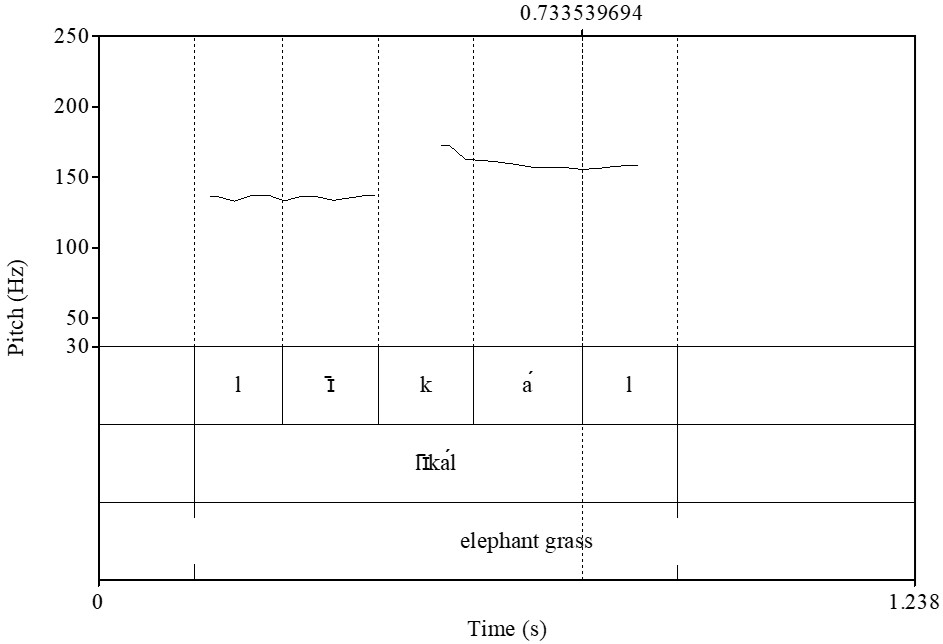
| Hertz | lībɔ́l | līkál | līmúl | Hertz | lībɔ́l | līkál | līmʊ́l |
| Mean Hz of M tone | 134.67 | 135.33 | 131.97 | Mean Hz of H tone | 154.26 | 158.75 | 141.48 |
| Highest Hz of M tone | 136.65 | 137.30 | 135.48 | Highest Hz of H tone | 156.25 | 161.85 | 144.12 |
| Lowest Hz of M tone | 132.69 | 133.36 | 128.47 | Lowest Hertz of H tone | 152.27 | 155.66 | 138.85 |
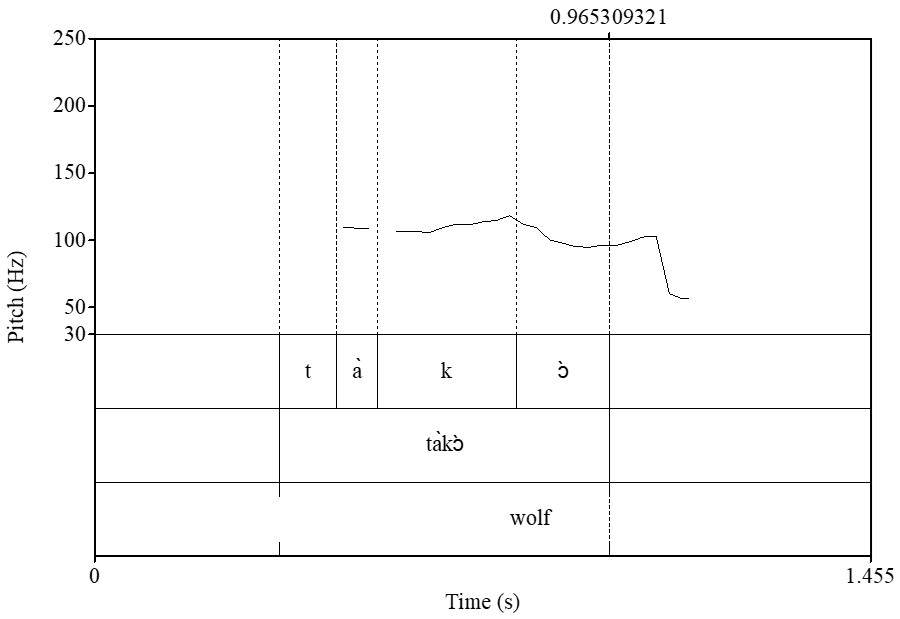
| Hertz | tàkɔ̀ | bànààn | dàfìl |
|---|---|---|---|
| Mean Hz of L tone | 109.07 | 72.94 | 96.37 |
| Highest Hz of L tone | 115.23 | 96.02 | 101.34 |
| Lowest Hz of L tone | 102.91 | 49.86 | 91.41 |
| Daagare | Dagbani | Gurenε | Kusaal | Likpakpaln | Buli | |
|---|---|---|---|---|---|---|
| Number of contrastive tones | 2 | 2 | 2/3 | 3 | 3 | 3 |
| Tonal minimal pairs/triplets | √ | √ | √ | √ | √ | √ |
| Contour-like tones | √ | √ | √ | √ | (√) | (√) |
| Polarity/dissimilation | √ | - | √ | - | - | - |
| Tone-bearing unit | syllable | syllable | mora | mora | syllable | - |
| Downstep/downdrift | √ | √ | √ | √ | √ | (√) |
| Tone spreading | √ | √ | √ | √ | - | √ |
| Grammatical function of tone | √ | - | √ | √ | √ | √ |
| Language | Grammatical Functions |
|---|---|
| Dagaare | Grammatical distinction
|
| Dagbani | Unclear |
| Gurenɛ | Grammatical distinction
|
| Kusaal | Grammatical distinction
|
| Likpakpaln | (i) Grammatical distinction
|
| Buli | Grammatical distinction
|
Disclaimer/Publisher’s Note: The statements, opinions and data contained in all publications are solely those of the individual author(s) and contributor(s) and not of MDPI and/or the editor(s). MDPI and/or the editor(s) disclaim responsibility for any injury to people or property resulting from any ideas, methods, instructions or products referred to in the content. |
© 2026 by the authors. Licensee MDPI, Basel, Switzerland. This article is an open access article distributed under the terms and conditions of the Creative Commons Attribution (CC BY) license.
Share and Cite
Angsongna, A.; Issah, S.A.; Abubakari, H.; Adjong, D.; Bisilki, A.K.; Atintono, S.A.; Bodomo, A. Tone in Mabia Languages: Structure and Processes. Languages 2026, 11, 104. https://doi.org/10.3390/languages11050104
Angsongna A, Issah SA, Abubakari H, Adjong D, Bisilki AK, Atintono SA, Bodomo A. Tone in Mabia Languages: Structure and Processes. Languages. 2026; 11(5):104. https://doi.org/10.3390/languages11050104
Chicago/Turabian StyleAngsongna, Alexander, Samuel Alhassan Issah, Hasiyatu Abubakari, Darius Adjong, Abraham Kwesi Bisilki, Samuel Awinkene Atintono, and Adams Bodomo. 2026. "Tone in Mabia Languages: Structure and Processes" Languages 11, no. 5: 104. https://doi.org/10.3390/languages11050104
APA StyleAngsongna, A., Issah, S. A., Abubakari, H., Adjong, D., Bisilki, A. K., Atintono, S. A., & Bodomo, A. (2026). Tone in Mabia Languages: Structure and Processes. Languages, 11(5), 104. https://doi.org/10.3390/languages11050104