
Article

The Acquisition of Syntactic Structures in Typical and Atypical Language Development: Insights from Growing Trees and Syntactic Cartography in a New Sentence Repetition Task

1
Child and Adolescent Neuropsychiatry Unit, Azienda USL della Romagna, 48121 Ravenna, Italy
2
Department of Social, Political and Cognitive Sciences, University of Siena, 53100 Siena, Italy
*
Authors to whom correspondence should be addressed.
Languages 2026, 11(5), 106; https://doi.org/10.3390/languages11050106
Submission received: 7 April 2026 / Revised: 11 May 2026 / Accepted: 12 May 2026 / Published: 19 May 2026
(This article belongs to the Special Issue Morpho(phono)logy/Syntax Interface)

Abstract

This study presents a newly developed Sentence Repetition Task/SRT as a tool designed to investigate the acquisition of different syntactic structures in children with typical development (TD) and Developmental Language Disorder (DLD). The tool is grounded in the Growing Trees (GT, henceforth) approach, which assumes that developmental progression reflects the hierarchical growth of the syntactic tree, as described in cartographic analyses of clause structure. The SRT Protocol was constructed following the three developmental stages identified by GT: VP/TP, lower zone of the Left Periphery (LP henceforth), and higher LP zone. A preliminary pilot version was administered to 27 TD and 28 DLD children, followed by a revised second version with improved item design and broader syntactic coverage, administered to 28 TD and 21 DLD children. Descriptive and inferential analyses demonstrate a clear hierarchy in the acquisition of Italian morphosyntax, fully consistent with the three-stage developmental progression predicted by the model. Children with DLD follow the same path but with delayed acquisition and slower consolidation of certain structures. These findings provide developmentally grounded benchmarks for identifying morphosyntactic delays and show that the SRT Protocol is a reliable tool for profiling early syntactic development. Crucially, the protocol supports diagnosis and clinical practice by helping clinicians ensuring interventions that are both theoretically informed and aligned with syntactic growth.

1. Introduction

Language development is a complex and multifaceted process that plays a fundamental role in various aspects of human communication, cognition, and social interaction. The ability to produce syntactically correct sentences is a critical milestone in language acquisition, which serves as an indicator of linguistic competence and developmental progression. By supporting syntactic development, the overall language skills can be enhanced, aiming at promoting not only positive social interactions, but also facilitating success in various aspects of life. Nevertheless, certain children, especially those who manifest a possible delay or difficulty in the development of language, may encounter notable obstacles in mastering morpho-syntactic production, especially when complex syntactic computations are involved (e.g., Moscati et al. (2020) for non-local agreement configurations; Araya et al. (2023) for subordinate clause structures, a.o.). In this respect, approximately 11–13% of children aged between 18- and 36-months exhibit delays in expressive language development, as noted by various studies (Rescorla, 2011; Hawa & Spanoudis, 2014; Collisson et al., 2016, a.o.). Importantly, these delays are observed in the absence of conditions such as hearing impairment, intellectual disability, brain injury, and cognitive disorders. However, 70% of these children greatly improve expressive language skills within 3 years (Bello et al., 2018; Chilosi et al., 2019), ultimately achieving language development that aligns with typical developmental expectations. At the same time, nearly a range of 5–7% of the children, who exhibit delays in expressive language development, continue to show difficulties beyond this period, which presumably are not spontaneously recovering. These cases are currently identified as Developmental Language Disorder (DLD), a condition characterized by significant and enduring impairments in the comprehension and/or production of language that interfere with everyday social functioning and are likely to persist over time, in the absence of an identifiable biomedical cause (Bishop et al., 2017; Sansavini et al., 2021).
Investigating the trajectories of morphosyntactic growth in both typically developing (TD) children and those with atypical language development offers valuable insights into the nature and mechanisms of language acquisition and can also shed light on detection, prevention, and support of language delay as well.
In order to determine the morphosyntactic development of TD children in comparison with DLD children and to understand some fundamental aspects of the nature of the difficulties that DLD children experience in the domain of morphosyntax, here we present an account for the assessment of the order of acquisition of different syntactic structures. Our account is grounded in the Growing Trees/GT approach (Friedmann et al., 2021) according to which the stages of language acquisition mirror the hierarchical structure of the syntactic tree, following the cartographic analysis of clause structure, as first presented by Rizzi (1997) and subsequent literature (Rizzi and Bocci (2017) for overview). Language acquisition appears to proceed in a bottom-up fashion, with the initial stages involving only the lower portions of the syntactic tree, such as the verb phrase (VP) and lower inflectional projections (TPs), while higher functional layers, including those associated with the left peripheral (LP) area, expressing different types of preposed constituents (such as Topic, Focus, interrogative phrases, adverbial modifiers) and expressing embedding, develop later in a gradual manner (Friedmann et al., 2021). Thus, syntactic representations in early child grammar gradually expand to include higher functional projections as the child grows and gains access to more complex syntactic computations (Rizzi, 2004; Moscati & Rizzi, 2021).
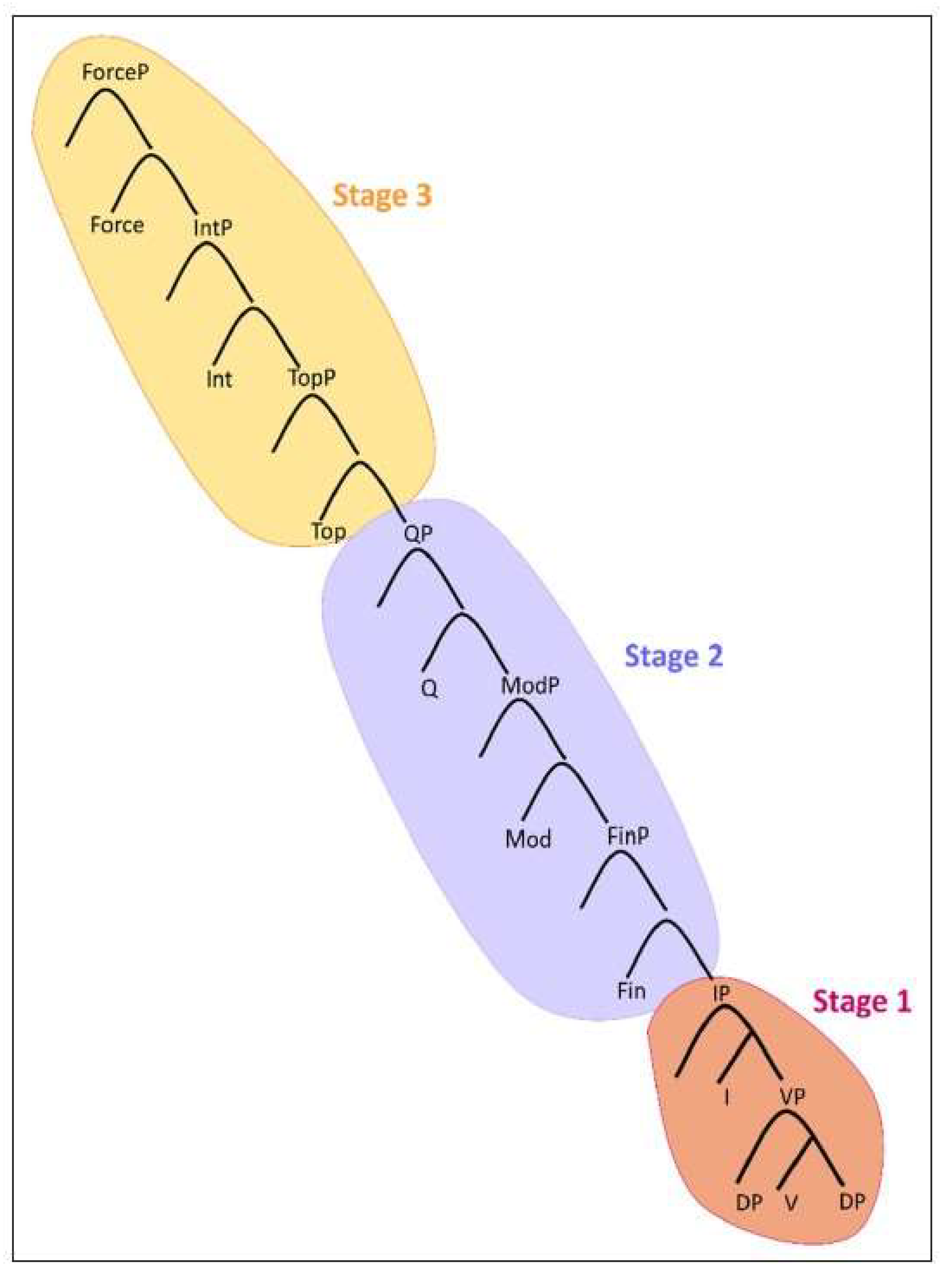
In this paper we illustrate the data from a new Sentence Repetition Task (SRT Protocol henceforth) created ex novo and based on the three developmental stages of the syntactic tree, identified by the GT approach, reproduced in Figure 1 from Friedmann et al. (2021). The protocol has been divided in three levels (1st = VP + TP, 2nd = lower field of LP, 3rd = higher field of LP) with each level including specific syntactic structures that reflect the growth of the syntactic tree up to the highest LP projections, as well as the application of computational constraints, such as those related to aspects of passivization in the 1st stage and intervention locality in the 3rd stage.
The intent was to verify the step-by-step progression of the acquisition of syntactic structures, as well as to shed light on the developmental trajectories and potential areas of divergence between TD and DLD children. A first preliminary version of the SRT Protocol was initially created. This first version was subsequently tested on a sample of children with DLD, specifically those showing impairments in language production, as well as on a control group of children with typical language development. We aimed, not only at investigating patterns of syntactic development, but also at assessing whether the SRT Protocol was able to differentiate the two samples. Following the initial testing phase, however, certain limitations in the design of the first version were identified. In response to these issues, the tool underwent a comprehensive revision, resulting in the development of a second version of the SRT Protocol. This revised version retained the same theoretical foundation and stage-based structure, but with improved item design and better control of linguistic variables, as well as a broader series of syntactic structures tested, particularly in the first stage. The second version, like the first one, was administered to both DLD and TD children, allowing for a more refined analysis of syntactic development and cross-group comparisons. The progressive development and testing of the protocol aimed to ensure its reliability for assessing morpho-syntactic production in young children.
The rest of this article is organized as follows: first a detailed description of the protocol is provided in Section 2, followed by the presentation of the participants in Section 3, a description of the procedure and data collection in Section 4, and a report of the results in Section 5. The article concludes with a discussion of the findings and their implications in Section 6.

2. The Sentence Repetition Task Protocol

Construction of the SRT Protocol

To assess morphosyntactic production, the Sentence Repetition Task (SRT) was selected as the most appropriate methodology mainly due to the fact that it is easily administered (Rujas et al., 2021; Ward et al., 2024). Moreover, it allows for the systematic elicitation of specific target structures to a greater extent than it is possible to encounter through spontaneous production alone (Seeff-Gabriel et al., 2010; Rujas et al., 2021).
As described by Levelt (2001), sentence repetition is not merely a memory task since, to accurately reproduce a sentence, children must parse the input, analyze thematic relations, compute the underlying syntactic representation, elaborate an articulatory plan, and produce the utterance. Furthermore, Devescovi and Caselli (2007) showed that children experience difficulty in repeating structures for whose computation they are not ready, while Riches (2012) demonstrated a substantial overlap between sentence repetition errors and those made in spontaneous contexts. More generally, many studies indicate that SRT is a reliable tool for identifying language difficulties and is particularly effective in discriminating between DLD and TD children (Devescovi & Caselli, 2007; Rujas et al., 2021; McDonald & Oetting, 2025; Ward et al., 2024). In this respect, the ability to repeat a sentence has also been proposed as a potential clinical marker of DLD (see Christensen (2019) for Danish and Taha et al. (2021) for Arabic).
The SRT Protocol is based on the GT approach, particularly on the three stages identified by Friedmann and Reznick (2021), as developed in Friedmann et al. (2021), relying on the stage-by-stage acquisition of syntactic structures in typical development. The SRT Protocol has been developed to include syntactic structures associated with the three stages of the GT approach, namely:
1st.
Stage: Verb Phrase (VP) + Tense Phrase (TP) → The VP layer expresses properties of the argument structure of the verb, i.e., the distribution of thematic roles; the TP system expresses properties signaled by verbal inflections, properties of modality–tense–aspect semantics, as well as properties of the case-agreement system.
2nd.
Stage: Lower field of the LP up to the QP(/FocP) layer.
3rd.
Stage: Higher field of the LP up to highest ForceP layer.
The 2° and 3° stages involve the development of the LP area, which expresses properties of scope–discourse semantics and embedding. The syntactic structures included within each level were based on the findings of Friedmann and Reznick (2021) and Friedmann et al. (2021) on Hebrew1 and enriched with other structures in Italian, involving the different stages. For every syntactic structure of each level three to six targets were designed, trying as much as possible to include match and mismatch of gender and number features between the subject and the object. Notably, in Italian, the number feature of the subject triggers an agreement relation with the finite verb, manifested in subject–verb agreement within the inflectional domain (Rizzi, 1982; Belletti, 1990).
The structures which enriched the second version of the SRT Protocol included:
  • 1° level (VP + TP):
-
VS, V unaccusative, with indefinite post-verbal S (e.g., Escono dei cani—some dogs came out).
-
VS, V unergative (e.g., Dorme il gatto—The cat is sleeping).
-
VS, V transitive sentences with clitic pronouns (e.g., La pettina la nonna—The grandmother combs her).
-
Non-preposed adverbs structures (e.g., Il cavallo corre velocemente—The horse runs quickly).
-
Structures with non-finite complements of modal verbs, divided into three subcategories (dovere, potere, volere—must, can, want), with three items for each modal verb (e.g., Il cane vuole dormire—The dog wants to sleep, la macchina deve partire—The car has to leave, il bambino può nuotare in piscina—The child can swim in the pool).
-
Sentences combining non-finite complements of modal verbs with clitics, i.e., ‘Restructuring’ structures with clitic climbing (e.g., Il bambino la vuole mangiare—The child wants to eat it).
-
Different types of passive structures:
Copular passive constructions (e.g., I conigli sono accarezzati dai bambini—The rabbits are petted by the children).
Si-causative passive (with si, e.g., Il pulcino si fa lavare dall’elefante—The chick lets itself be washed by the elephant).
Venire passive (e.g., La torta viene mangiata dalle nonne—The cake is being eaten by the grandmothers).
  • 2° level (lower field of LP):
-
Targets with preposed adverbs, for a total of 6 items with the following adverbs in the preposed position: suddenly—improvvisamente, tonight—stasera, quickly—rapidamente, later—più tardi, now—ora, before—prima.
These adverbs were included due to the observation that, in the previous pilot version of the protocol, items involving preposed adverbs seemed relatively difficult, for both TD and DLD children. To better align the task with the developmental patterns observed in early language acquisition, the newly added adverbs were selected to follow the developmental trajectory described by Patrizi and Sanfelici (2024).
  • 3° level (higher field of LP):
-
Targets with topicalization/Clitic Left Dislocation/CLLD: 6 items of object topicalization in a configuration of intervention locality (e.g., Il succo, il bambino lo beve—The juice, the child drinks it).
The sentences of the 1° stage have been structured using as much as possible high-frequency lexical items as they are found in the first linguistic productions during acquisition. The target SV containing transitive and unergative verbs included in the protocol have been characterized by animate subjects, also including third plural ones requiring plural verbal inflections, known to pose a challenge for DLD children (Leonard et al., 1992; Bortolini et al., 1997; Belletti & Guasti, 2015). SV/VS with unaccusative V, in addition to animate subjects, also contained inanimate subjects. For all three sentence types, SV transitive, unergative, and unaccusative, a target containing an auxiliary + past participle was also included.
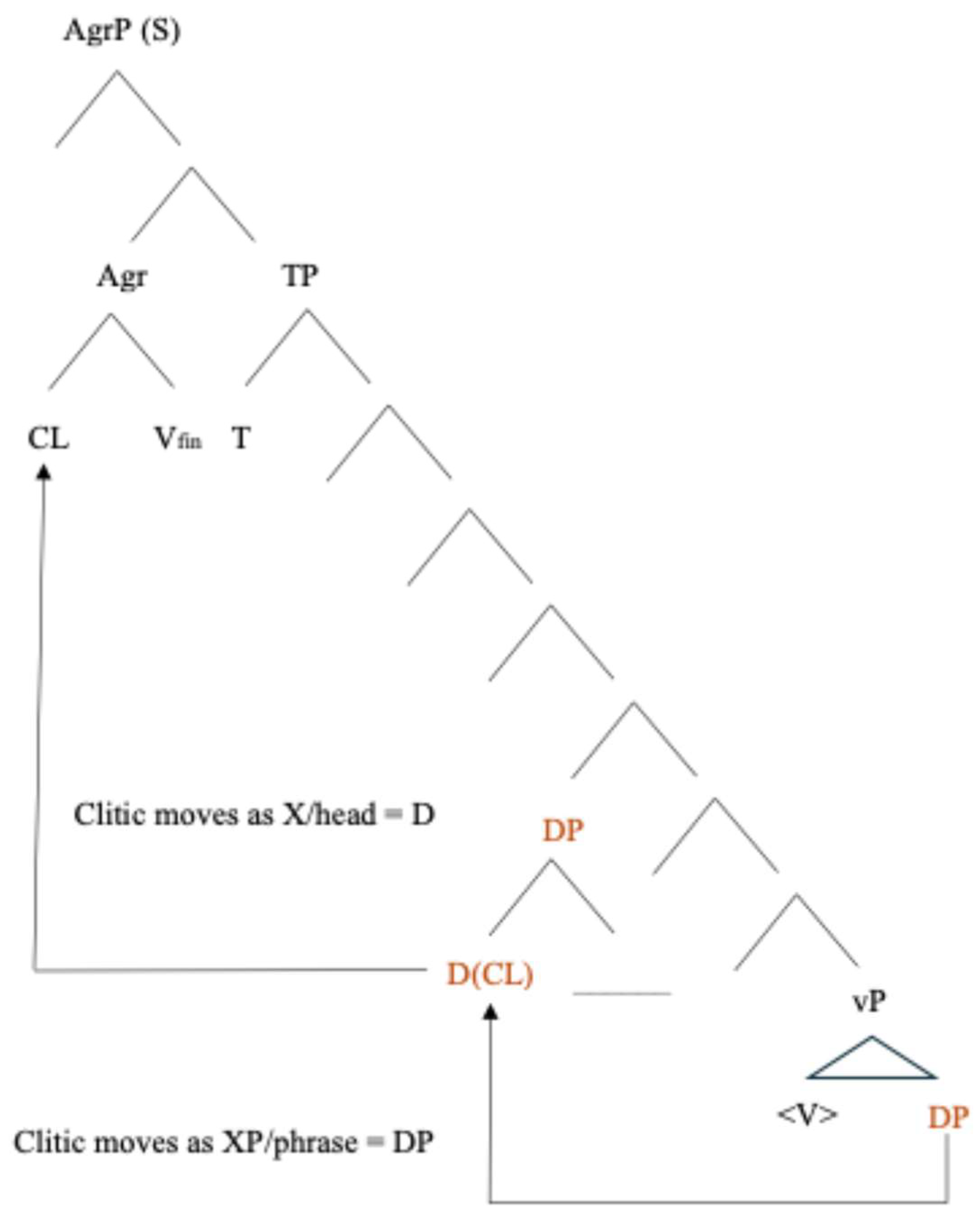
As far as clitic structures are concerned, the object clitics employed in the target sentences of the protocol were all third person singular. The Italian cliticization is characterized by two processes, proclisis and enclisis, depending on the finiteness of the verbal inflection. In level 1° of the protocol, the target clitics structures employed were all finite, hence they all contained proclitics, namely structures where the clitic is found in a high functional (agreement-type) position, along the lines of the derivation exemplified below (Figure 2, assuming for concreteness a movement derivation of the pronominal clitic). In finite clauses, this is the same position hosting the inflected verb: CL head moves to head hosting V and it adjoins to V, as illustrated in Figure 22 (from Belletti (1999)).
In DLD children, no position errors are documented, but a delayed and problematic acquisition is attested (Bottari et al., 2000; Pozzan, 2007) with a prolonged omission stage, with the later alternative use of a lexical DP instead of the expected (clitic) pronoun (Belletti & Guasti, 2015). Therefore, since there is a complete absence of position errors and inappropriate uses of clitic pronouns in first language acquisition, associated with a quick overcoming of the omission stage, clitics have been identified as classical markers of DLD in the literature (Bortolini et al., 2006). For this reason, this syntactic structure has been included in level 1° of the SRT Protocol.
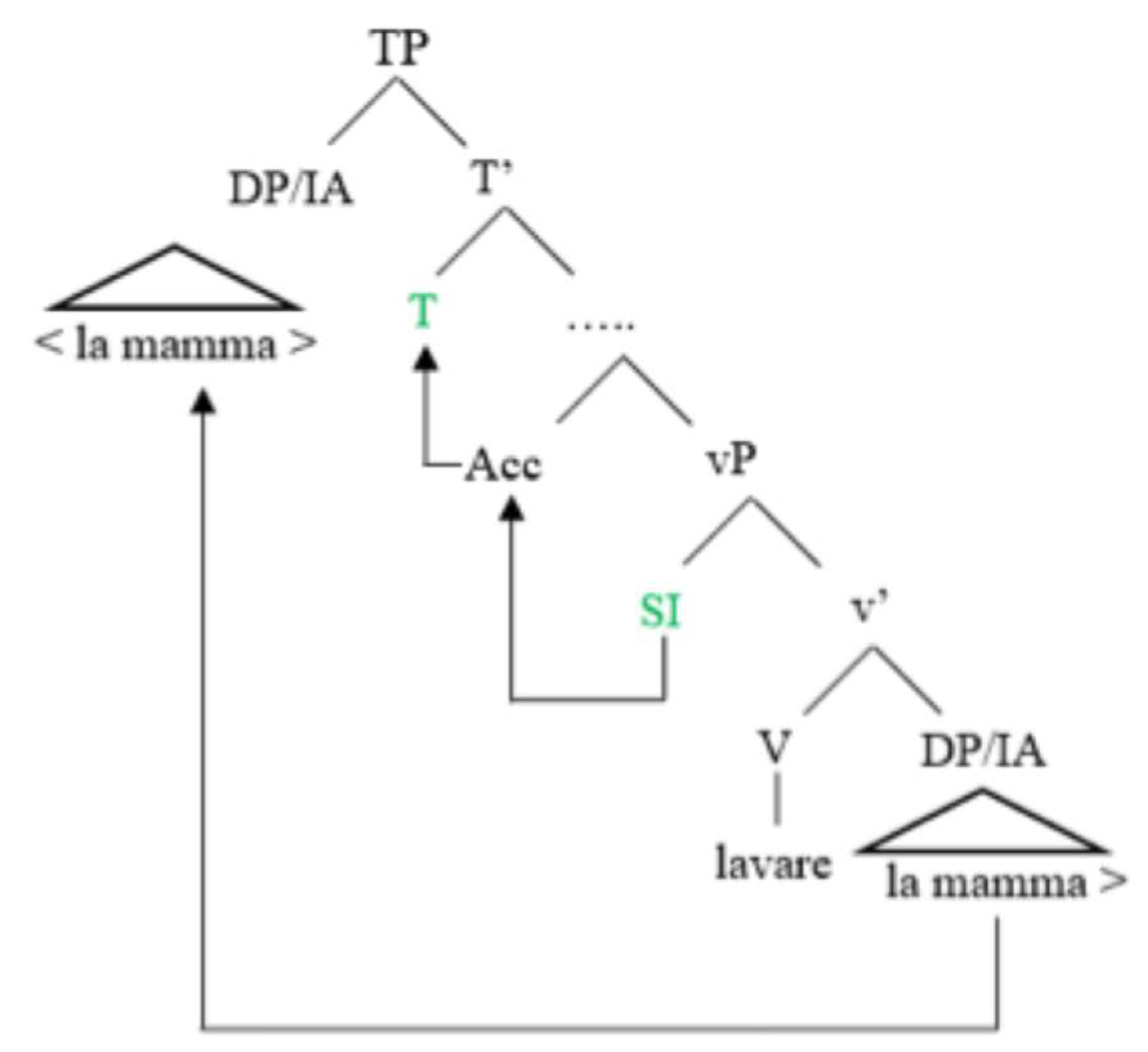
Moving forward, reflexive structures are known to be mastered early on (Snyder et al., 1995; Hamann, 2002; Hyams & Snyder, 2005, 2006; Snyder & Hyams, 2015; Raminelli & Belletti, 2021), locating their acquisition at level 1° of the growth of the syntactic tree. In Figure 3, the derivation assumed for structures involving reflexive si is reported (Belletti (2020), and the related discussion therein).
Si is assigned the external θ-role by v, due to its merge as the EA of the lexical verb (Cinque, 1988; D’Alessandro, 2002). Then, Si moves towards T and it takes the accusative case. In this way, it blocks its availability for DP/IA3. What yields the reflexive interpretation is coindexation between the moved DP/IA and si. The three target sentences employed in level 1° of the protocol are one plural and two singular items (both compatible with si, which is invariable for number and gender).
Another structure contained in level 1° of the SRT Protocol is the syntactic structure modals + non-finite complement, including the modals volere/want, dovere/must, and potere/can. These modals are Deontics and assert that the subject has a certain property, namely the property of having a particular desire, obligation, or permission. They can be seen as the expression of the functional layer in the sense of Cinque (2006). In this respect, they are akin to auxiliaries4.
The first structure that has been included in level 2° of the SRT Protocol is the yes/no question structure. Friedmann et al. (2021) found that yes/no questions appeared simultaneously with root Wh questions, suggesting that the yes/no feature resides in Q/Foc, in the lower LP area, as the wh feature (Figure 1). The target sentences constructed consist of three items: two of them contain a transitive verb taking HAVE as the aspectual auxiliary, whereas one contains an unaccusative verb that takes BE as the aspectual auxiliary. Moving on to the preposed adverb structure, the pilot version of the protocol initially included four target items: improvvisamente/suddenly, rapidamente/quickly, stasera/tonight, and più tardi/later. These were subsequently revised to incorporate the addition of two further targets, as described above (ora/now and prima/before). Again, the data from Friedmann et al. (2021) sustain the hypothesis according to which preposed adverbs move to Spec-Mod (Figure 1), so that their acquisition is expected to also appear in stage 2, together with Yes/No questions and Wh questions.
In the second stage also, focalization is acquired. According to Bianchi et al. (2015), different types of focus exist: Corrective, Mirative, and New Information Focus. Concentrating on Corrective Focus, in Italian, it is hosted in the functional projection in the LP5 and therefore it appears when the syntactic tree has grown up to the lower part of the Left Periphery, namely stage 2. Three Corrective Focus structures have been included in the SRT Protocol.
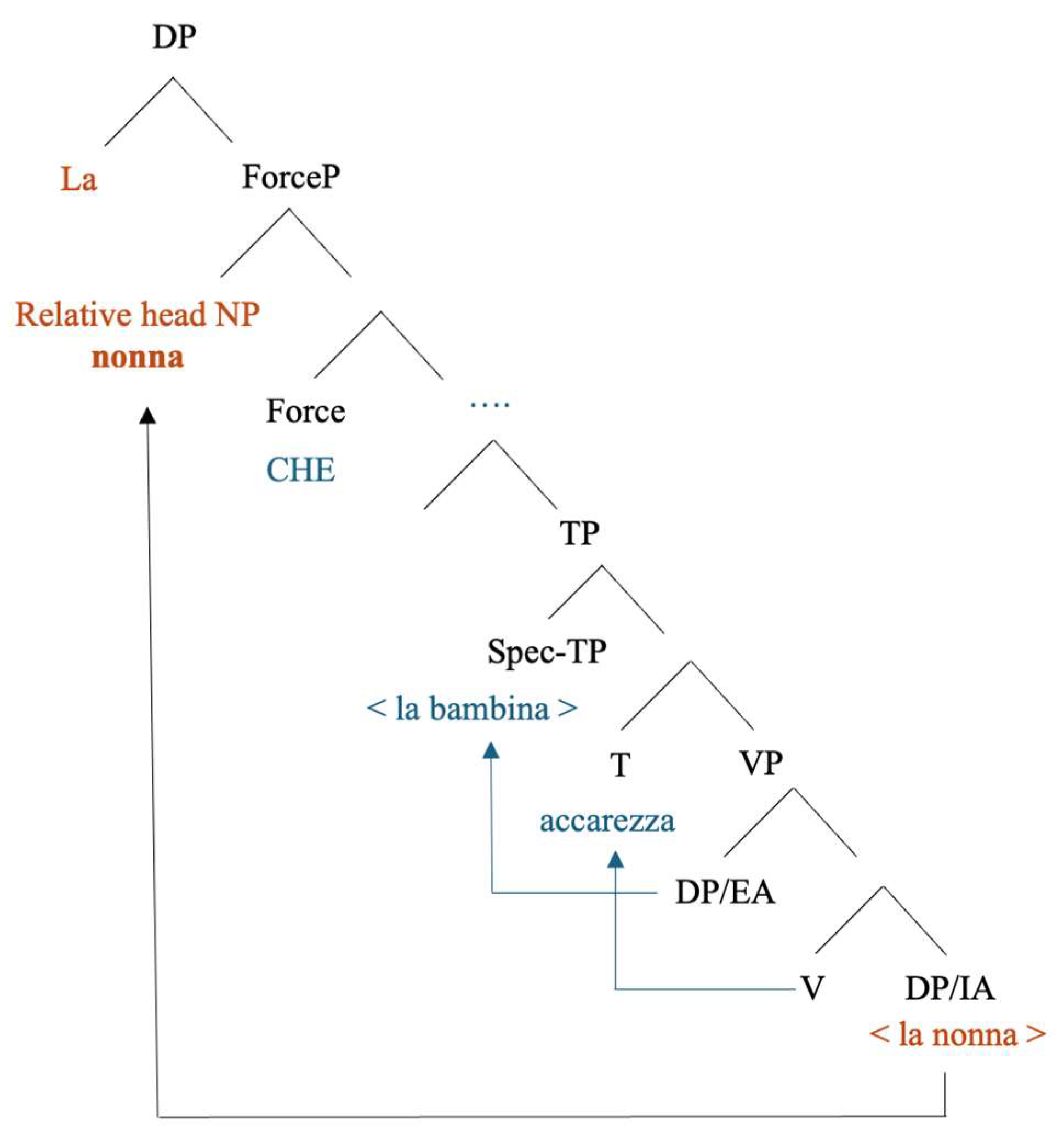
Regarding Wh questions, in many cartographic analyses, the lower part of this LP configuration includes the landing site of Wh questions (Rizzi & Cinque, 2016; Rizzi & Bocci, 2017). Thereby, for the GT account, Wh questions are expected to be acquired as soon as the lower part of the LP becomes available, namely in stage 2. Hence, the Wh questions structures, which appear in the second stage, have been included in the protocol to be tested. Wh questions are derived by the A-bar wh-movement process, namely the wh phrase moves to Spec/Q/FocP in the cartographic tree. The wh phrase can move from subject position or from object position, yielding, respectively, a subject question or an object question. Wh questions such as Chi/Who, Quale/Which, and Cosa/What, and also adjuncts Dove/Where, Quando/When, and Come/How have been included in the protocol; all these questions have been documented to appear at the same stage, without differences between subject and object questions (Friedmann et al. (2021) based on Hebrew data; Moscati and Rizzi (2021), for Italian). Regarding level 3° of the protocol, relative clauses have been included in this level since their acquisition is determined by the availability of the higher field of the LP, in the third stage of the GT approach. Relative clauses are derived from the A-bar-movement of a DP from within the embedded clause to the Spec-/ForceP position of the main clause. No subject–object asymmetry is present in children’s productions of relative clauses. However, there is a specific configuration that is problematic for children until around 6 years of age. This is a so-called intervention configuration expressed in terms of the locality principle (featural) Relativized Minimality (Rizzi, 1990, 2004), characterized by the A-bar-movement of a lexically restricted DP across an intervening lexically restricted DP. In the domain of relative clauses, this situation is characteristically present in lexically headed object relative clauses containing a lexically restricted subject in the relative clause (Friedmann et al. (2009); Belletti and Guasti (2015) on Italian). The derivation of an example of object relative clause with intervention is reported in the syntactic tree in Figure 4.
In the SRT Protocol, subject relative and object relative with and without intervention have been included. In addition to relative clause structures, also why questions were included: Why crucially involves a position in the higher field of the LP, and hence it is predicted to appear at stage 3. Specifically, the Wh element why occurs in a distinct and higher position from the Spec/Q position hosting the other Wh elements (Rizzi, 2001; Bianchi et al., 2017; Moscati & Rizzi, 2021). It is assumed to occupy the layer Int, in the higher LP field (Friedmann et al., 2021; Thornton, 2008, 2016; Soare, 2021). Therefore, this structure is tested in level 3° of the Protocol with three target sentences. Besides the production of relative clauses and why questions, the acquisition of other structures that appear in stage 3 is also expected: other types of embedded clauses (e.g., declaratives) and topicalization structures. Thus, also these structures have been included in level 3° of the SRT Protocol.
As far as topicalization is concerned, six target sentences have been built, all Clitic Left Dislocations (CLLDs) with the left dislocated phrase corresponding to the direct object topic (e.g., il succo, il bambino lo beve// ‘the juice, the child drinks it’). In the case of object topicalization in Italian, the object, e.g., ‘il succo’, is displaced from its merge position inside the verb phrase (VP) and moved to the LP of the clause, specifically to the position Spec-TopP in the cartographic map (Rizzi, 1997; Rizzi & Bocci, 2017). This movement is discourse-driven, marking the object as a topic, and is accompanied by a resumptive clitic (‘lo’) in the sentence following the preposed topic, which predicates some properties of it. The subject ‘il bambino’ remains in Spec-TP (after moving from the merge position in Spec-vP, Chomsky (1981, 1995), stemming from Koopman and Sportiche (1991)).
The presence of both the fronted object and the preverbal subject create a configuration of intervention in this type of CLLD, as the subject intervenes between the object’s original merge position and its landing site in the LP. This instantiates once again a familiar intervention locality situation, leading to a (featural) relativized minimality issue (Rizzi, 1990, 2004): the locality effect disrupts the construction of the (movement created) dependency when an element of a similar featural type—i.e., another lexically restricted DP—hierarchically intervenes. As Belletti and Manetti (2019) show in the domain of CLLD structures, this configuration is particularly challenging in the course of language acquisition. Indeed, children acquiring Italian often struggle with these topic structures: the intervening lexical subject blocks the dependency between the topicalized object and its original merge position (necessary to yield the proper thematic interpretation). Marking the preposed object topic with preposition ‘a’ is a common strategy adopted by young children, which creates a proper featural distinction between the preposed object and intervening lexical subject that the principle is sensitive to and that children can master (Belletti & Manetti, 2019)6.
Finally, the last syntactic structure that is included as part of level 3° of the SRT Protocol is the embedded clause structure. The selection of finite embedded clauses is expressed in ForceP, the highest position of the LP. For this reason, an embedded clause requires a complete LP layer up to force and thus appears in stage 3. Also embedded whether/if questions appear in this stage and they are tested in level 3° of the protocol with embedded declarative structures. Three embedded declaratives and three embedded whether/if questions have been included in the Protocol.
Since passive structures were not included in the first version of the pilot study, it was decided to integrate these syntactic structures in the second version of the SRT Protocol to also test their acquisition, as a subcategory of the first stage. Passive constructions in Italian are derived through a number of movement operations within a hierarchically structured syntactic architecture cartographically expressed, as extensively discussed by Belletti (2021), based on (Collins, 2005; Belletti & Rizzi, 2012; Belletti & Collins, 2021). According to this approach to the computations involved in passive types, the internal argument, i.e., the object of the verb, is first smuggled to a position higher than the external argument and from there it raises to the subject position (Spec-TP, where it satisfies the Extended Projection Principle/EPP and nominative case requirements, Chomsky (1981, 1995)). The external argument is either not pronounced, or it is optionally expressed as a by-phrase (da-phrase). The distinctions among passive types formed with auxiliaries such as essere and venire or with ‘middle’ si display differences in aspectual, morphological, and syntactic properties (Burzio, 1986; Belletti & Manetti, 2019).
In the copular passive construction formed with essere + past participle, exemplified by the sentence ‘I conigli sono accarezzati dai bambini’ (‘The rabbits are petted by the children’), the internal argument is initially merged in the internal argument/object position, while the external argument is expressed via a by-phrase. The passive auxiliary essere occupies a high functional T(-type) position, and the internal argument raises to Spec-TP. Movement of the internal argument into subject position is not direct in this case, due to the familiar intervention locality reasons described, but involves a first smuggling step in Collins’s (2005) sense (Belletti & Collins, 2021), whereby the process affects the past participle and the internal argument, moving the verbal chunk to a position higher than the DP-external argument. The past participle agrees in gender and number with the raised subject.
The causative passive with si fa, as in ‘Il pulcino si fa lavare dall’elefante’ (‘The chick lets itself be washed by the elephant’), manifests a more articulated derivation combining causation and passivization. Note that both operations involve (forms of) smuggling or moving a verbal chunk containing the verb (in the infinitive in the case of causative; in the past participle in the case of copular and also in venire passive) and its internal argument7. The derived subject of the matrix verb (il pulcino) corresponds to the internal argument of the embedded infinitival verb. The reflexive clitic si ‘initiates’ (Ramchand, 2008) the event as the external argument of the causative (semi-functional) verb ‘fare’; the external argument of the infinitival verb is expressed via a by-phrase.
The passive construction with venire, illustrated by ‘La torta viene mangiata dalle nonne’ (‘The cake is being eaten by the grandmothers’), shares crucial derivational steps with the copular passive, i.e., the raising of the internal argument to Spec-TP through smuggling and the optional expression of the external argument of the verb as a by-phrase, but differs in the auxiliary choice and aspectual interpretation. The auxiliary venire occupies a T-type position instead of essere and contributes an aspectual nuance, often signaling an ongoing or dynamic event, in contrast with the more stative reading of essere passives. This type is typical of eventive interpretations and is incompatible with resultative or stative meanings.
Table 1 shows the syntactic structures tested for each level. Overall, the final version of the SRT Protocol includes a total of:
  • Three levels.
  • Thirty-five syntactic structures.
  • One-hundred-and-fifteen target sentences.

3. Participants

The preliminary pilot testing of the first version of the SRT Protocol was carried out between October 2023 and February 2024 with children residing in the Emilia–Romagna region of Italy; 48 participants in total, assigned to two groups. The first group included 27 TD children aged in the range of 18–92 months (M = 46.85, SD = 23.28). The second group consisted of 28 children diagnosed with DLD, aged in the range of 38–83 months (M = 60.75, SD = 10.91), all of whom had a formal diagnosis of Expressive Developmental Language Disorder (ICD-10 code F80.1). TD children were recruited through local educational services, whereas children with DLD were recruited through the National Health Service.
The final version of the SRT Protocol was administered between March and July 2025. A total of 49 children participated in this phase of the study; all were recruited from the Emilia–Romagna region of Italy. Participants were divided into two groups: 28 typically developing (TD) children and 21 children diagnosed with Developmental Language Disorder (DLD). The TD group comprised 28 children (19 males, 9 females) aged between 41 and 74 months (M = 51.56 months, SD = 9.25). The majority of TD participants were preschoolers. Recruitment took place through local kindergartens that had agreed to participate in the project. The DLD group consisted of 21 children (14 males, 7 females) aged between 37 and 91 months (M = 65.29 months, SD = 15.58). This group included 14 preschool-aged and 7 school-aged children. Participants were recruited through the National Health Service, specifically the Neuropsychiatry Service for Childhood and Adolescence of Ravenna (AUSL della Romagna). All children in this group had a formal diagnosis of Expressive Developmental Language Disorder (ICD-10 code F80.1). In accordance with clinical practice, no children under 36 months of age were included, as diagnosis is not typically established before this age.

3.1. Inclusion and Exclusion Criteria

Inclusion criteria for both groups required performance within the normal range on standardized morphosyntactic comprehension tasks. For the DLD group, an additional requirement was the presence of a confirmed diagnosis of F80.1 (Expressive Language Disorder, according to the ICD-10 classification). Exclusion criteria for all participants included any neurological, genetic, or developmental disorders (e.g., ASD, ADHD, cerebral palsy, Down syndrome), as well as scores below −2 SD on morphosyntactic comprehension assessments.

3.2. Assessment Measures

Morphosyntactic comprehension was assessed using age-appropriate standardized tests (BVL Batteria per la Valutazione del Linguaggio, Marini (2015); TROG-2 Test for Reception of Grammar–2, Bishop (2009); TVL Test di Valutazione del Linguaggio, Cianchetti and Sannio Fancello (1997); TPL Test del Primo Linguaggio, Axia (1995)). Children who had not undergone a recent evaluation (within the preceding six months) were retested prior to participation to ensure up-to-date assessment. Those who scored below the required threshold were excluded from this study.

4. Procedure

4.1. Method of Administration

To administer the Sentence Repetition Task (SRT) Protocol, a structured elicitation methodology was designed to prompt children to repeat target sentences. The materials used included the SRT Protocol, a stimuli book with corresponding images, and a soft toy named Coco. The toy played a central role in the interaction, serving as a communicative partner within the fictional context of the task. Prior to starting the task, each child was told that Coco had difficulty hearing. For this reason, they were asked to repeat aloud the sentences spoken by the examiner, so that Coco could understand. This narrative provided a playful yet consistent framework for eliciting sentence repetition in a fairly natural manner.
  • General Procedure:
    • The examiner presented an image depicting the content of the target sentence.
    • The examiner introduced the sentence using a contextual prompt (e.g., ‘Now I will tell Coco what is happening in the picture…’).
    • After the sentence was produced, the examiner asked the child to repeat it (e.g., ‘Coco didn’t hear well. Can you repeat it for him?’).
    • The child was then expected to repeat the target sentence aloud.
A variety of prompts were used to elicit different syntactic structures. Below are illustrative examples of the elicitation method:
  • Prompt: ‘Cosa fa la mamma alla bambina? Aspetta che lo dico a Coco… Coco non ha sentito bene, ripetiglielo tu.’
    ‘What is the mother doing to the girl? Let me tell Coco… Coco didn’t hear well, can you repeat it to him?’
    Target Sentence: La pettina—She is combing her (the girl).
  • Prompt: ‘Non sappiamo se il coniglio ha mangiato. Coco lo sa, glielo chiedo… Non ha sentito bene, ripetiglielo tu.’
    ‘We don’t know if the rabbit has eaten. Coco knows, I’ll ask him… He didn’t hear well, can you repeat it?’
    Target Sentence: Ha mangiato il coniglio?—Has the rabbit eaten?
  • Prompt: ‘Qui, il gatto lecca l’uccellino. Qui, le bambine lavano il gatto. Quale gatto è questo? Aspetta che lo dico a Coco… Coco non sente bene, ripetiglielo tu.’
    ‘Here, the cat is licking the bird. Here, the girls are washing the cat. Which cat is it? Let me tell Coco… Coco can’t hear well, can you repeat it to him?’
    Target Sentence: Il gatto che le bambine lavano—The cat that the girls are washing.
  • Prompt: ‘C’è un bambino che piange, ma non sappiamo il motivo. Coco sa tutto, aspetta che gli chiedo… Coco non sente bene, ripetiglielo tu.’
    ‘There’s a boy crying, but we don’t know why. Coco knows everything, let me ask him… Coco didn’t hear well, can you repeat it to him?’
    Target Sentence: Perché il bambino piange?—Why is the boy crying?
The protocol notation during the administration required to select + if the sentence was repeated correctly, namely if it was produced exactly in the same way as the target (identical repetition). Otherwise, if the child made changes, it was required to write the entire sentence pronounced by the child.
The SRT Protocol is not bound to a specific age of administration due to its modular structure, which is organized into three levels corresponding to the major stages of syntactic acquisition based on the GT logic and the findings described in previous Section 1 and Section 2, from the functional domain in the TP to the lower and higher layers of the left periphery. The Protocol has been designed to test children on the basis of the level at which they are. Thus, children who showed mastery of structures of stage 1, together with (possibly partial) acquisition of those of stage 2, were administered the entire protocol up to the third level. Children who experienced difficulty in structures of stage 1 and were unable to produce the target structures of stage 2 were not administered the structures belonging to stage 3.
The administration procedure closely followed the child’s development, ensuring that each participant was evaluated on structures that are appropriate for the attained syntactic maturity.

4.2. Scoring Notation

The scoring of the SRT Protocol followed a quantitative approach, informed by an initial qualitative analysis. Sentence repetitions that completely matched the target utterance were marked as correct (+). In cases where the child’s production differed from the target, a qualitative analysis was conducted to determine whether the intended syntactic structure was still present. The primary criterion for correctness was the presence of the target syntactic structure, regardless of minor lexical or morphological variations. Therefore, productions that deviated from the exact target form, but preserved the syntactic structure were still considered correct. These accepted variations included:
1.Article omission:Il papà legge il libro
DET N V DET N
 
__ papà legge __ libro
__ N V __ N
Daddy reads __ book
2.Lexical substitution of subject/object:Il papà legge il libro
DET N V DET N
Il ragazzo legge il libro
DET N V DET N
The boy reads the book
3.Tense variation:La mamma preparerà la valigia
DET N V.FUT.3SG DET N
La mamma prepara la valigia
DET N V.PRS.3SG DET N
Mom packs the suitcase
4.Null subject (pro):Il coniglio dorme
DET N V.PRS.3SG
____ dorme
pro V.PRS.3SG
[It] sleeps
Conversely, responses in which the syntactic structure was missing, altered, or replaced were marked as incorrect. All child productions were transcribed into structured files and organized using a Guttman scale format (see Appendix A and Appendix B).

4.3. Stimuli Book

As mentioned, to enhance the Sentence Repetition Task (SRT) and sustain participant engagement, each target sentence was presented with a corresponding image designed to reflect the meaning conveyed by its syntactic structure. These visual stimuli provided contextual support throughout the task. The images were generated using two different artificial intelligence-based tools. The first, Midjourney, was accessed via Discord, where prompts describing each target sentence were entered using the /imagine command. From the four generated outputs, one image was selected for use in the task. The second tool, Adobe Firefly, is a web-based platform integrated into Adobe Creative Cloud, which allows for greater control over visual style and content. Prompts were entered directly into the browser interface, and images were generated in accordance with the semantic and structural requirements of each target sentence. In all cases, images were selected to represent the overall meaning and syntactic context of the sentences, ensuring that children could easily understand and relate to the visual scene during the repetition task.

5. Results

The analysis presented in this section builds on the empirical findings in Friedmann and Reznick (2021) and Friedmann et al. (2021) and reports the results from the second final version of the SRT Protocol, which replicated and improved the findings of the initial pilot study. Both descriptive and inferential statistical methods were employed in the analysis of the data. Descriptive statistics were used to calculate response percentages and to construct graphical representations, providing an overview of the distribution and trends in the participants’ performance. Inferential statistics were applied to assess whether the differences observed between the two groups, TD children, who served as the control group, and children with DLD, were statistically significant and could be generalized to the broader populations they represent.
Given the characteristics of the dataset, specifically the small sample sizes and the lack of a normal distribution, a non-parametric approach was employed. Between group comparison were conducted using the Mann–Whitney U test, which is robust for ordinal data and non-normal distributions. A one-tailed hypothesis was adopted, based on the a priori prediction, as widely documented in the literature, which predicted that TD children would outperform children with DLD. The level of statistical significance was set at α = 0.05.

5.1. Descriptive Statistics

The tables below (Table 2, Table 3, Table 4 and Table 5) report accuracy scores, expressed as the percentage of correctly repeated sentences relative to the total number of trials, for each syntactic level and individual syntactic structure, as well as overall performance across the entire SRT protocol. In addition to these quantitative measures, a qualitative analysis of the most salient error patterns produced by both groups is provided. Error types are described and quantified in terms of relative frequency (percentage calculated over the total number of items per child of that syntactic structure), and absolute frequency, reported in brackets.
  • Stage 1: each structure included three items.

Table 2. Percentage (and absolute frequency) of correct responses by group at level 1.
1st STAGETDDLD
SV transitive V98.81% (83)84.13% (53)
SV unergative V100.00% (84)88.89% (56)
SV unaccusative V100.00% (84)87.30% (55)
VS unaccusative V97.62% (82)95.24% (60)
VS unaccusative V—indefinite article98.81% (83)84.13% (53)
VS unergative V100.00% (84)93.65% (59)
Clitics100.00% (84)87.30% (55)
VS transitive + clitic100.00% (84)74.60% (47)
Reflexive actions100.00% (84)69.84% (44)
Non-finite complement want92.86% (78)73.02% (46)
Non-finite complement must100.00% (84)79.37% (50)
Non-finite complement can98.81% (83)74.60% (47)
Adverbs (not preposed)98.81% (83)82.54% (52)
Non-finite complements + clitics95.24% (80)34.92% (22)
Si causative passive94.05% (79)28.57% (18)
Simple/copular passive96.43% (81)42.86% (27)
Venire passive83.33% (70)25.40% (16)
As reported in Table 2, the TD group performed at the ceiling level in the majority of the syntactic structures included in level 1.
As for simple SV structures, DLD children show lower accuracy than their TD peers across transitive, unergative, and unaccusative targets. The observed error patterns include verbless productions (e.g., ‘bambino mela’ [child apple] in place of ‘il bambino ha mangiato la mela’ [the child ate the apple]), auxiliary omission, and single element productions (e.g., ‘bambino’ [child]). Significantly, while DLD children show lower accuracy in SV structures (transitive SV: 84.13%; unergative SV: 88.89%; unaccusative SV: 87.30%) compared to TD peers (98.81–100%), their performance with VS unaccusative (95.24%) and VS unergative (93.65%) structures is higher. On the contrary, VS unaccusative with indefinite subject is characterized by a reduction in accuracy (84.13%), compared to other VS structures, even though this structure is mastered early by Italian children (18–36 months) (Lorusso, 2014). Since this reduction in performance is related to the omission of the indefinite article (14.28%; (9)) or its substitution with the definite article (4.76%; (3)), it is possible that DLD children have access to VS order and are sensitive to the unaccusative verb class but have trouble with the expression of indefiniteness.
Following this, in our data, children with DLD showed difficulties with VS transitive V + clitic structure. The most common error pattern was the omission of the clitic in a context in which it is required (19.05% (12)). Thus, the difficulty is related to the presence of the clitic, and not to the VS transitive structure per se.
Focusing on clitics, and in line with previous research, the failure to produce clitics has been identified as a clinical marker for DLD (Bortolini et al., 2006; see also Arosio et al., 2014). This is largely due to the demanding nature of clitic production (Belletti & Hamann, 2004; Bortolini et al., 2006). Indeed, since typical first language acquisition is characterized by a quick overcoming of the omission stage and a complete absence of position errors, the persistent failure to produce clitics represents a core feature of linguistic impairment (Bortolini et al., 2006). In our data, children with DLD showed difficulties with both the clitic and, to a greater extent, the VS transitive V + clitic structures. In both clitic-related structures, the most common error pattern was the omission of the clitic (in clitic structure 9.52% (6); in VS transitive V + clitic 19.05% (12)). Clitic omissions were found exclusively in the DLD group and never in the TD group. These findings are consistent with the substantial derivational complexity involved in cliticization and its selective vulnerability in DLD (Belletti & Hamann, 2004; Bortolini et al., 2006; Arosio et al., 2014; Belletti & Guasti, 2015; Varlokosta et al., 2016). Another error, occurring to a limited extent, involved mismatches in gender and number features of the direct object clitic (4.76%; (6)).
Moreover, our results show that non-finite complement structures emerge early in Italian-speaking TD children, with higher accuracy for dovere (‘must’), followed by potere (‘can’) and then volere (‘want’). The data suggest that children acquire restructuring verbs at stage 1 and that the GT hypothesis accounts for the appearance of this type of non-finite complement structures in early productions. These findings are consistent with previous research: Sgrizzi (2024) reports a similar early emergence of potere and dovere, with volere sometimes emerging simultaneously (reflecting the salience of volitional semantics expressing desire). Following Cinque’s (2006) approach to restructuring, according to which these modal verbs are merged as functional heads in TP, their early availability should indeed be expected as soon as children can project the TP layer.
A significant difference emerged with the group of DLD children, who showed a clear difficulty with the modal + infinitival complement structure. The main errors in the production of non-finite complements structure were substitutions, predominantly by the DLD population, who produced an SV finite structure (4.23%; (8)), omitting the modal. While the resulting sentence preserves the core propositional content, the modal meaning is lost (e.g., ‘la bambina mangia il gelato’/the girl eats the ice cream/instead of ‘la bambina vuole mangiare il gelato’/the girl wants to eat the ice cream/), yielding an eventive interpretation instead of an intentional one. In addition, DLD children not only substitute non-finite complement structure with a finite one, but also may omit want/can/must altogether, leaving the verb at the infinitival form (9.52%; (18)), as in (1a) which was produced as in (1b).
(1)a.Ilpapàpuòcantareunacanzone
DETpapàpotere.PRS.3SGcantare.INFunacanzone
‘Daddy can sing a song’
b.Ilpapà___cantareunacanzone
DETpapà___cantare.INFunacanzone
‘Daddy ___ sing a song’
Rather than a generic simplification, the frequent omission of the modal employed by DLD children may reflect a possible structural uncertainty regarding the semantic value of different modals and their precise location in TP. Consequently, they appear to avoid the modals to reduce morphosyntactic and derivational demands. They simplify the sentence structure, by eliminating the modal and leaving the verb in its non-finite form; they thus end up producing an ungrammatical output (Araya et al., 2023). This avoidance of the modals stands in sharp contrast with TD children.
Furthermore, DLD children showed a substantial gap from the TD peers also in the structure combining non-finite complements + clitic i.e., the restructuring configuration with clitic climbing, (e.g., laCL vuole mangiare (la mela)—he wants to eat it (the apple)/leCL deve allacciare (le scarpe)—she must fasten it for her (the shoes)/loCL può prendere (il topo)—the cat can take it (the mouse)). In addition to modal + clitic omission (e.g., Il bambino __CL __modal mangiare instead of Il bambino la vuole mangiare) attested in 9.52% of the cases (6), another rather frequent error pattern of DLD children concerns the omission of the clitic alone8 (47.61%, (30)). As shown in (2), children often produce sentences in which the modal is correctly realized, while the clitic is omitted, predominantly without overt expression of the direct object, and to a lesser extent, with the direct object overtly expressed.
(2)Ilbambino____vuolemangiare(la mela)
DETbambinoCL.ACCvolere.PRS.3SGMangiare.INF(la mela)
‘The child wants to eat [it] (the apple)’
In (2), the interpretation of the verb as intransitive when the object was not overtly expressed is not acceptable, because the target sentence included a specific object (la mela/the apple).
In addition, children with DLD exhibited marked difficulties in several other structures, such as reflexives and passives. The reflexive structure showed a marked discrepancy in performance between the two groups, with ceiling-level scores for the TD children and substantially lower scores for the DLD group (69.84%). The most common pattern which emerged from reflexive structures was that DLD children repeated the target sentence (3a) omitting the reflexive “si” and leaving intact the rest of the clause (20.63%; (13)), as exemplified in (3b).
(3)a.Lamammasilava(le mani)
DETmammaREF.3SGlavare. PRS.3SG(le mani)
‘Mom washes herself’
b.Lamamma___lava(le mani)
DETmamma___lavare. PRS.3SG(le mani)
‘Mom washes ___’
Through this simplification strategy, DLD children produced a transitive structure in which the subject functions solely as agent (see Raminelli & Belletti, 2021; Smith, 2021), with the object only occasionally overtly expressed and visually present in the image. On the contrary, TD children were able to master this structure from very early on, correctly employing the reflexive interpretation of the clitic si. As the omission of the reflexive pronoun si occurred only in children with DLD and was not observed in the TD group, the computation involved in structures with reflexive si appeared to be particularly taxing for children with DLD.
With regard to passive constructions, a differentiated pattern emerged in level 1. TD children demonstrated comparable accuracy in copular passives and si-causative passives, while showing greater difficulty with venire passives. In contrast, children with DLD encountered difficulties not only with venire passives, but also with si-causative passives, a pattern that diverges from that observed in the TD group. Among passive structures, copular passives were produced more accurately by children with DLD than other passive types, although their performance remained well below the mean (around 50%). The most common mistake concerned the omission of the preposition by and of the verb BE (essere) (20.63%; (13)).
(4)a.Ilpulcinoèaccarezzatodall’elefante
DETpulcinoAUX.PRS.3SGaccarezzare.PTCPDa.DETelefante
‘the chick is petted by the elephant’
b.Ilpulcino___accarezzato___elefante
DETpulcino___accarezzare.PTCP___elefante
‘the chick __ petted __ elephant’
In the child’s production in example (4b), the past participle accarezzato and the main arguments (il pulcino, l’elefante) are present, whereas higher functional elements, specifically tense and auxiliary, as well as the preposition by are absent. The copular passive is not derived: this production lacks a complete sentential functional structure, in which the core arguments are retained, resulting in an incomplete structure. Such productions can be interpretated as a nominal phrase centered on the DP pulcino accarezzato, with the agent (elefante) reduced in a residual fragment9. Notably, this pattern could be related to the idea proposed by Borer and Wexler (1987), according to which early child passives are often adjectival rather than full verbal passive. Namely, the participle behaves more like an adjective. Furthermore, there could be a possible relation with access to a highly ‘truncated’ structure (à la Rizzi’s view (1993)). Similarly, in venire passives, the same pattern reported in (4b) was attested even with non-masculine singular subjects, as reported in example (5b), demonstrating that agreement was correctly mastered.
(5)a.Lamacchinavienelavatadalbambino
DETmacchinaAUX.PRS.3SGlavare.PTCPDa.DETbambino
‘the car is washed by the boy’
b.Lamacchina___lavata___bambino
DETmacchina___lavare.PTCP___bambino
‘the car __ washed __ boy’
In addition, a common pattern observed was that DLD children employ the SVO structure in place of the passive (6.35%; (4)), preserving the meaning (6):
(6)a.Ilbambinoèvestitodalpapà
DETpulcinoAUX.PRS.3SGvestire.PTCPDa.DETpapà
‘the child is dressed by the father’
b.Ilpapà vesteilbambino
DETpapà vestire.PRS.3SGDETbambino
‘the father dresses the child’
Other minor error patterns included generally ungrammatical production, lack of repetition, and omission only of the preposition by.
In conclusion, passive sentences that require a smuggling derivation (see Section 2) with a multi-step computation, may exceed young children computational capacities (Snyder & Hyams, 2015). Children with DLD, who typically show weaknesses in inflectional morphology, verbal working memory, and the management of long-distance dependencies, are particularly vulnerable to such high computational demands (Delage & Frauenfelder, 2020; Moscati et al., 2023). As a result, they tend to avoid passive constructions, relying instead on simpler alternatives such as active SVO sentences (Moscati et al., 2023) or kinds of reduced structures. Moreover, we finally note that, although the si-causative passive, which also involves smuggling, appears early in typical development (Belletti & Manetti, 2015), as is also confirmed by our TD group, children with DLD often fail to compute full passive of different kinds, including the si-causative one. The difficulties (DLD) children encounter with si-structure patterns with their difficulties with clitics in general. Hence a ‘difficult’ structure like a passive one would become even more difficult when si is involved.
  • Stage 2: each structure included three items, but the preposed adverb structure, which included six items and which-O Wh questions, which included four items.
Table 3. Percentage (and absolute frequency) of correct responses by group at level 2.
2nd STAGETDDLD
Yes/no questions100.00% (84)82.54% (52)
Preposed Adv71.43% (120)42.86% (54)
Focalization76.19% (64)38.10% (24)
Wh questions who-S98.81% (83)82.54% (52)
Wh questions who-O97.62% (82)80.95% (51)
Wh questions which-S86.90% (73)60.32% (38)
Wh questions which-O77.68% (87)45.24% (38)
Wh questions what100.00% (84)82.54% (52)
Wh questions where98.81% (83)80.95% (51)
Wh questions when100.00% (84)73.02% (46)
Wh questions how92.86% (78)57.14% (36)
At stage 2, TD children’s performance parallels the trajectory observed at stage 1, with accuracy scores approaching ceiling for most syntactic structures, except for preposed adverb, focalization and which object structures.
Despite remaining above the mean, the preposed adverb structure yielded the lowest accuracy scores for TD children at level 2. This decrease may be related to specific adverbs (e.g., improvvisamente ‘suddenly’ and rapidamente ‘quickly’), which were more frequently omitted10. Though this effect was evident in TD children, DLD children were further challenged not only by these items, but also by other targets (e.g., prima ‘before’ and ora ‘now’), which were mastered well by TD children.
Generally, the performance of children with DLD reflects the general trend observed in the TD group, with systematically lower accuracy. The three areas of greatest performance difficulty for the DLD group, as shown in Table 3, correspond to the preposed adverb, focalization, which object Wh questions, and how Wh questions. Additional challenges were observed in other structures, including, yes/no questions and which subject questions.
Specifically, focusing on yes/no questions, some DLD children omitted the auxiliary11, producing only the past participle form (11.11% of the productions; (7)). These productions correspond to reduced structures most likely obtained through truncation (Rizzi, 1993). These data are coherent with previous studies (Leonard & Bortolini, 1998; Bottari et al., 2001) that found that DLD children show a greater and longer omission of auxiliaries than TD children, meaning that DLD children stay for a longer period in a stage in which computational resources are limited (Belletti & Guasti, 2015).
Regarding focalization structures, the process of focalization appears to be somewhat complex for DLD children, and to a lower extent also for TD children. The target sentences were all Corrective Focus (CF), which ‘implies that accepting both the antecedent proposition and the corrective claim would lead to an inconsistency: this is what gives rise to the correction effect, whereby speaker A’s assertion is rejected by speaker B’ (Bianchi & Bocci, 2012). The difficulty in mastering focalization structures in DLD children is manifested with absence of subject focalization (38.09%; (24)), which is produced without the expected prosodic contour, which marks focalization. Indeed, a fronted CF is prosodically marked by a pitch reaching very high values and preceded by a low tone (Bianchi et al., 2015). The most plausible hypothesis developed to support the results concerns the nature of the communication act required to repeat this specific structure. In fact, the request addressed to the entire sample involved the ability to repeat a syntactic structure, using the same prosody employed by the examiner, given its central role in focalization. As a result, the workload lies not only in computing the word order, but also in understanding why a particular prosody is used especially in SVO (which would be the unmarked order for a simple declarative). That is, the ability to grasp the purpose of the speech act, with its scope discourse properties. In support of this line of interpretation, the children who did not focalize the subject showed difficulty in performing the link between the syntactic structure and the associated discourse appropriate prosody.
This hypothesis could be supported also by the fact that DLD children, who are diagnosed with a developmental disorder, may develop this ability later than peers, due to the nature of their communicative developmental disorder (Andreou et al., 2022; Giberga et al., 2025).
As for Wh questions, error analysis indicates that most errors produced by children with DLD can be divided into three main types as reported by Arosio and Guasti (2019): (1) agreement errors; (2) substitution of the Wh element (e.g., chi [who] replaced with cosa [what]); and (3) other errors, such as the production of declarative sentences, irrelevant questions with omission of the wh element, or ungrammatical production in general. Furthermore, in who and which object questions, agreement errors often result in the transformation of object questions into subject questions. In addition, as reported by Belletti and Guasti (2015), Italian speaking children manifest a subject/object asymmetry, in which object wh questions are more challenging for both TD children and DLD children.
Moreover, questions introduced by which (e.g., which subject, which object) consistently appear among the most challenging Wh questions. The difficulty for Italian-speaking children in producing both subject and object which questions is due to additional sources of complexity, such as the movement of the which phrase, which involves pied-piping of the nominal element (Belletti & Guasti, 2015). In addition, both the which element and the N element must agree. As known since De Vincenzi et al. (1999) in comprehension and Guasti et al. (2012) in production, which object questions with a lexical post-verbal subject—such as those tested through the SRT Protocol (e.g., ‘Which ice cream is the child eating?/Quale gelato mangia il bambino?’)—require a more complex computation. These processes are particularly taxing for TD children and, to a greater extent, for children with DLD, often exceeding their computational capacities.
A relevant consideration concerns the emergence of yes/no questions and Wh questions. As reported by Friedmann et al. (2021), the data from Hebrew show no precedence in appearance between these two structures. Similarly, in our findings, the accuracy rates for yes/no questions and for Wh questions in general (except for the which structure, which poses distinct challenges as just noted) are comparable across both groups. In fact, the acquisition data indicate that no TD child produced one structure without also producing the other, and all, but one child with DLD (who produced Wh questions who, what, when before), produced both yes/no questions and Wh questions. These results therefore support the view that the two structures emerge concurrently in Italian, as originally observed for Hebrew.
  • Stage 3: Relative clause structures included four items, why QP and embedded structures three items, and topic structures six items.
Table 4. Percentage (and absolute frequency) of correct responses by group at level 3.
3rd STAGETDDLD
Relative Clause − Subject93.75% (105)26.19% (22)
Relative Clause − Object + int81.25% (91)22.62% (19)
Relative Clause − Object − int93.75% (105)46.43% (39)
Why QP100.00% (84)82.54% (52)
Topic70.24% (118)37.30% (47)
Embedded Declarative “che”77.38% (65)36.51% (23)
Embedded Interrogative “se”79.76% (67)17.46% (11)
With regard to level 3 of the protocol, the structure that elicited the highest accuracy scores from both TD and DLD children was the why Wh question, suggesting that this structure posed comparatively ‘fewer’ difficulties. Further discussion of this result is provided in Section 5.2 (Inferential Statistics).
Among TD children, w.r.t the relative structures, the most challenging proved to be the object relative clause with intervention. Also, topicalized structures (all with intervention) and embedded declarative clauses were challenging, in particular for youngest children. A similar trend was observed in the DLD group, who performed lowest on object relatives with intervention, embedded che clauses, and embedded interrogative se structures.
Performances on syntactic structures involving intervention, such as object relative clauses with intervention and topicalization, were generally low, particularly in children with DLD. This difficulty reflects not only the need to compute the syntactic tree up to the highest LP layers, but also the effects of intervention locality. Within the Featural Relativized Minimality framework (Rizzi, 1990, 2004; Belletti, 2004; Friedmann et al., 2009), an intervening element sharing relevant features with the moved constituent can block the dependency. Children with DLD are especially sensitive to such intervention effects, which likely contributes to their reduced accuracy in the structures tested. As proposed by Belletti and Rizzi (2013), the effect of Featural Relativized Minimality is also reflected in the slowed parsing of these structures by healthy adults. This further supports the hypothesis that TD children may likewise experience slowed processing of the tested structures involving intervention, resulting in a worse performance compared to other relative structures without intervening elements.
As for common patterns that emerges from the repetition of relative clauses, the complementizer omission was attested in both populations, even though there was a relevant increase in the use of this simplification process in the DLD sample (SR: 64.29% (54); OR: 28.57% (24); OR + intervener: 36.90% (31)) w.r.t TD children (SR: 6.25% (7); OR: 1.78% (2); OR + intervener: 2.68% (3)). As suggested also by Contemori and Garraffa (2010), DLD children seem to perform poorer in the production of both subject relative (SR) and object relative (OR). Indeed, they most likely interpret SRs as simple declaratives, since the order of arguments without the complementizer mirrors the canonical declarative sentences’ order (Belletti & Guasti, 2015) and they overwhelmingly adopt this simplification, as noted. However, unlike SRs, in Ors, the complementizer omission leads to a non-canonical order of the arguments, which appear to be challenging for DLD children. This leads them to produce the correct structure more often, processing the OR: in our results DLD children show a higher accuracy in object relative clauses (without intervention) than subject relative clauses (although accuracy was still below 50%). However, in 26,19% of cases, they omit the complementizer ’che’ producing a structure where the object of the matrix clause (la torta) precedes the verb (e.g., La torta ___Comp ___pro ha cucinato instead of La torta che ___pro ha cucinato).
No significant asymmetries were found in TD children performances on subject vs. object relative clauses (without intervention). Instead, for OR with intervention, the most common patterns of substitution were with finite SVO (DLD: 22.62% (19); TD: 4.46% (5)), the production of OR without complementizer ‘che’ leaving intact the rest of the clause, as in example (7b) (DLD: 27.38% (23); TD: 1.78% (2)), and to a lesser extent, OR with post-verbal subject and complementizer ‘che’ omission (only adopted by DLD: 3.57% (3)) as in example (7c).
(7)a.Ilgattochelebambinelavano
DETgattoCOMPDETbambinelavare.PRS.3PL
‘the cat that the girls wash’
b.Ilgatto___lebambinelavano
DETgatto___DETbambinelavare.PRS.3PL
‘the cat ___ the girls wash’
c.Ilgatto___lavanolebambine
DETgatto___lavare.PRS.3PLDETbambine
‘the cat ___ wash the girls’
Other simplifications adopted only by TD children were also the production of a subject relative (5.36% (6)) instead of the target object relative, an object relative without intervention (4.46% (5)) and a clitic structure (2.68% (3)). Overall, TD children tended to replace the target sentence with grammatically well-formed structures that corresponded to an earlier developmental stage, whereas children with DLD mostly ended up producing ungrammatical sentences.
Furthermore, topic structures, all with intervention, which not surprisingly by now posed considerable difficulty for DLD children, and to a lesser degree also for TD children, were often simplified into either a finite SVO (Il bambino lava il cavallo/The child washes the horse in place of Il cavallo il bambino loCL lava/’The horse the child him washes’, TD: 0.60% (1); DLD: 15.08% (19)) or replacing the lexical subject with a pronominal null subject (e.g., example 8b), or with a clitic structure (example 9b) leaving the topic unpronounced, thus eliminating the intervention configuration in both cases, both widely adopted (TD: 14.88% (25); DLD: 12.70% (16)). Moreover, the inversion of the object with the subject was also attested (TD: 4.16% (7); DLD: 3.17% (4)) as in (8c).
(8)a.Ilcavalloilbambinololava
DETcavalloDETbambinoCL.ACC.3SGlavare.PRS.3SG
‘the horse, the child washes it’
b.Ilcavallo ___lolava
DETcavallo ___CL.ACC.3SGlavare.PRS.3SG
‘the horse, [he] washes it’
c.Ilbambinoilcavallololava
DETbambinoDETcavalloCL.ACC.3SGlavare.PRS.3SG
‘the child, the horse he washes it’
(9)a.Lamelalamammalamangia
DETmelaDETmammaCL.ACC.3SGmangiare.PRS.3SG
‘the apple, the mother eats it’
b. ___lamammalamangia
DETmelaDETmammaCL.ACC.3SGmangiare.PRS.3SG
‘___, the mother eats it’
The example (9b) aligns with Belletti and Manetti’s (2019) observation that in contexts not involving a contrastive topic, a most natural production is one in which the topicalized constituent is left unpronounced, yielding a configuration of topic continuity. As noted by Rizzi (2005), repeating the discourse topic can be perceived as redundant, which may further encourage the omission of the overt topic in the non-contrastive topic situations included in the SRT.
In addition, both types of embedded structures proved challenging for the DLD group, which in fact demonstrated considerable difficulty across all structures of level 3. Embedded declaratives and embedded whether/if questions become accessible to TD children once the full LP is acquired, including the highest functional projections ForceP and IntP, i.e., at stage 3 (Friedmann et al., 2021; Moscati & Rizzi, 2021). However, our data confirm that children with DLD show persistent difficulties with embedded clauses (Hamann & Tuller, 2014; Araya et al., 2023). Observed error patterns (i.e., substitution with other types of syntactic structures, such as simple SVO12 or omission of the declarative che13/interrogative se14), suggest that the challenge for the DLD group involves both impaired syntactic computation and difficulties in the selection of embedded clause type (Araya et al., 2023), consistent with theoretical accounts linking embedding failures to reduced access to the LP (Moscati & Rizzi, 2021).
Overall, the DLD population failed to reach mastery of the structures associated with stage 3. The main difficulty in OR + Int. and topicalization + Int. configurations lies in intervention locality, beyond the computational requirement of projecting the syntactic tree up to ForceP. Moreover, consistently low accuracy was also observed across embedded clause structures, where the challenge concerns the complexity of the hierarchical embedding rather than intervention effects. At a qualitative level, a clear difference emerged between the two groups. When faced with syntactic structures that are not yet fully acquired, TD children systematically tended to simplify the target sentence by producing structures belonging to a lower syntactic level (e.g., SVO in place of relatives or CLLD), while preserving grammaticality. In contrast, again also for the structures of this stage, DLD children more frequently ended up producing ungrammatical sentences.
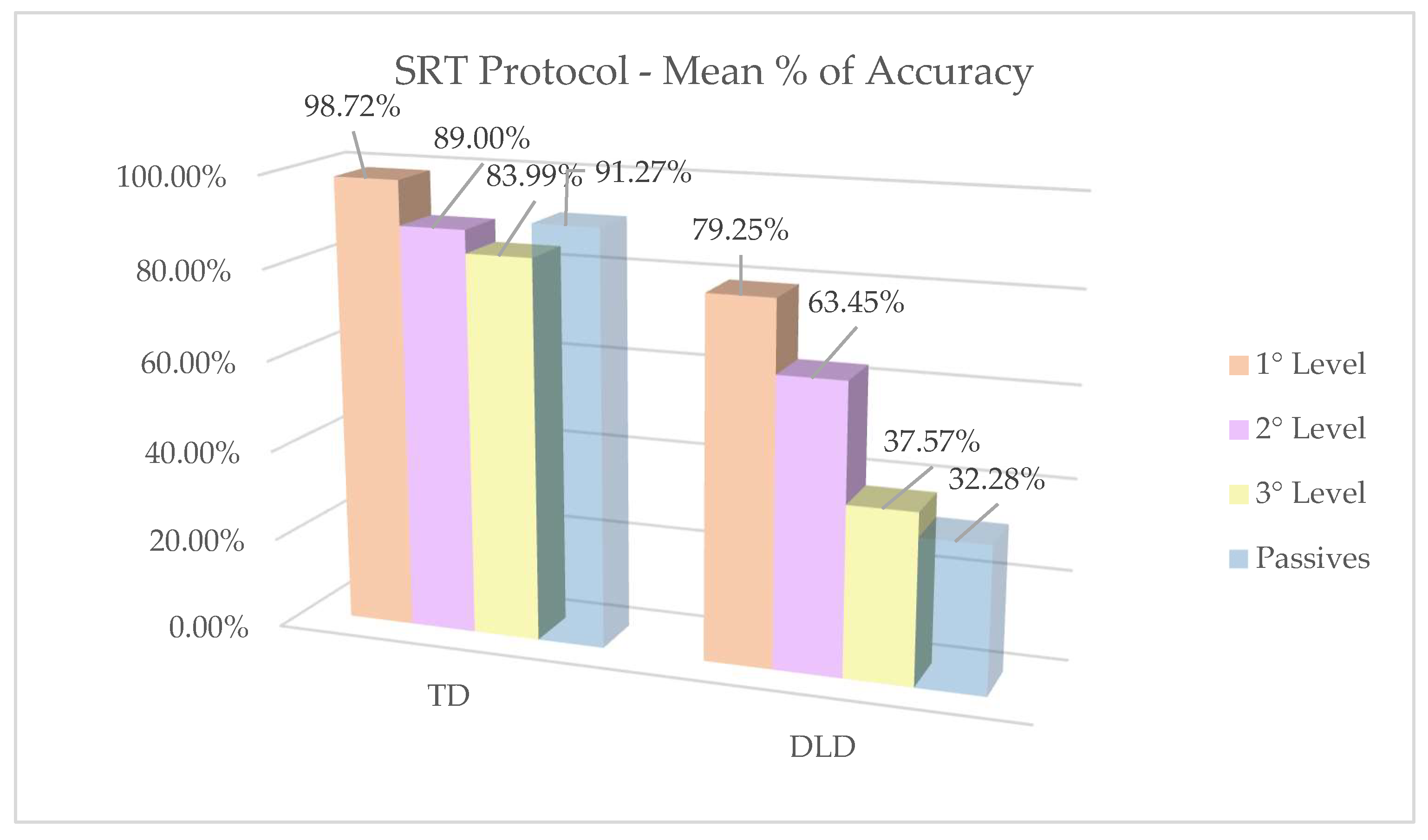
To further examine whether the decline in performance was proportional to the increasing complexity of the structures present in the protocol, mean accuracy scores were calculated for each level/stage, as well as for the overall SRT protocol (Table 5; Figure 5).
Table 5. Overall correct response rate in the SRT Protocol % (absolute frequency).
SRT ProtocolTDDLD
1° STAGE98.72% (1160)79.25% (699)
2° STAGE89.00% (922)63.45% (494)
3° STAGE83.99% (635)37.57% (213)
Passives91.27% (230)32.28% (61)
TOTAL91.58%60.70%
As illustrated in Figure 5, the SRT Protocol reveals comparable patterns of performance across groups and levels. TD children performed at near-ceiling on level 1 and slightly worse on level 2, indicating that the syntactic structures at these stages are largely acquired and processed with minimal difficulty. Accuracy declines at the third level, reflecting the increased syntactic complexity and the later developmental emergence of constructions associated with stage 3.
The reduced accuracy observed at the third level is likely attributable to the computational demands inherent in these structures, which require not only a fully developed syntactic tree extending into the higher LP projections, but also the ability to manage intervention locality, master discourse prosodic values (as in contrastive focalization), and select specific embedding, challenges that affect also TD children, to some extent.
For DLD children, the data exhibit a similar pattern of gradual decline across the three levels, with a marked drop in performance at level 3 and for passive structures. While most structures of stage 1 are generally within reach, structures of stage 2 show significant difficulties, likely due to the necessity of accessing lower projections of the LP, which require more demanding syntactic computations. Structures of stage 3, involving embedding and intervention configurations also in non-embedded topicalization/CLLD, yield accuracy scores well below 50%, indicating that these computations remain largely unattained by children with DLD.
Regarding passives, TD children’s performance falls between the accuracy observed at levels 1 and 2, consistent with the observation that these structures do not require access to the lower portion of the LP (see Section 2). In contrast, children with DLD show very low accuracy, comparable to that observed for level 3 structures, indicating that these constructions are just largely unattained in this population, despite the availability of the relevant space in the syntactic tree (for more on passives see Section 6).

5.2. Inferential Statistics

To assess whether the SRT Protocol reliably distinguishes between DLD and TD children, inferential statistical analyses were conducted across all levels of the protocol and for the overall scores. The results, presented in Table 6, indicate statistically significant differences between the two groups across all sections of the SRT Protocol. Overall, the statistical analyses conducted on the first pilot version of the Protocol are replicated in the second final version presented here, which confirms the previous findings and provide greater reliability and robustness of the observed patterns.
For levels 1, 2, and 3, the differences between TD and DLD groups were statistically significant (p < 0.001), reflecting robust group effects. Passive structures also reached the same level of significance (p < 0.001), further supporting the tool sensitivity in assessing morphosyntactic competence. Similarly, the total SRT score demonstrated a highly significant group difference (p < 0.001). Collectively, these results confirm the SRT protocol as a highly sensitive measure for detecting syntactic deficits in children with syntactic DLD and distinguishing them from typically developing peers across varying levels of syntactic complexity.
The syntactic structures assessed at each level are summarized in Table 7, Table 8 and Table 9, which also indicate their statistical significance in differentiating the two study groups.
Statistically significant differences between TD and DLD groups were found for the VS transitive + clitic structure (p = 0.002), reflexive actions (p = 0.006), and each of the three non-finite complements structure individually: volere/want (p = 0.047), dovere/must (p = 0.046), and potere/can (p = 0.004). In addition, significant group differences emerged for structures with adverbs (not preposed) (p = 0.020), non-finite complements combined with clitics (i.e., ‘Restructuring’ structures with clitic climbing) (p < 0.001), and all three types of passive constructions: si-causative passives, simple passives, and venire passives (p < 0.001).
  • Regarding clitic structures (e.g., laCL pettina (la bambina)/She combs her), the significance was slightly above the standard cut-off (p = 0.08) suggesting that the measure is trending in the expected direction and could likely differentiate between the two groups, possibly with a larger sample.
Overall, these results confirm that the SRT Protocol effectively differentiates between groups across syntactic domains of varying complexity. Specifically, it captures deficits in clitic placement, passivization, and the use of modal verbs in non-finite contexts, showing that DLD group can master structures belonging to the first level of growth of the syntactic tree, but exhibits further difficulties that also go beyond basic structure-building abilities.
In the second level of the SRT Protocol, several syntactic structures yielded statistically significant differences between the TD and DLD groups, showing consistent and informative patterns. Statistically significant differences were observed for preposed adverbs (p = 0.001) and focalization (p = 0.001), confirming the increased complexity of these structures for children with DLD. Within the Wh question domain, the following structures reached significance: who object (p = 0.031), which subject (p = 0.004), which object (p = 0.001), what (p = 0.024), when (p = 0.001), and how (p = 0.003). In contrast, yes/no questions and some Wh structures, such as who subject and where15, did not yield statistically significant group differences. These findings confirm that yes/no and Wh questions belong to the same developmental stage, supporting the conclusion that they are acquired together, as previously discussed (see Section 5.1).
The data show that the second level of the SRT protocol is effective in distinguishing between TD and DLD populations, particularly in structures involving A-bar movement, focalization, and some Wh dependencies, as also pointed out in the previous section (Section 5.1).
As far as level 3 is concerned, significant differences were found for all the syntactic structures tested, with the exception of why questions, which narrowly missed statistical significance (p = 0.081). It is important to clarify that this structure, however, necessarily appears after all other Wh questions belonging to stage 2 for both the TD and the DLD group, as directly implied by the GT stage by stage growth: the derivation of why questions requires the presence of the higher portion of the LP. Further aspects of our acquisition data strongly support this hypothesis: no DLD child produced a why question without production of other Wh questions, whereas two DLD children could produce Wh questions without being able to produce why questions. Similarly, in the dataset from the 1° pilot version of the Protocol, three TD and three DLD children produced Wh questions without presence of why questions. This suggests that why questions seem to be easier to master w.r.t the other structures belonging to stage 3. Nevertheless, why questions are always acquired at the third stage, implying the necessary prior presence of other Wh questions belonging to the second stage.
All other structures showed statistically significant group differences, suggesting that structures of stage 3, characterized by syntactic dependencies like embedding and typically those involving intervention, are particularly challenging for children with DLD, who have overall difficulty in mastering the constructions belonging to the stage 3.
To clearly illustrate the stage-wise acquisition of the tested structures, the data from the 1° pilot and the 2° final version of the protocol were combined for the TD and DLD groups and are presented in Table 10 and Table 11 in the form of Gutmann scales. Stages marked in a dark color indicate that the stage is fully acquired, or that only a few structures are missing for full acquisition. In contrast, stages marked in a light color represent emergent stages, defined by the presence of only one of the structures tested at that level (i.e., why questions in the stage 3° and yes/no questions in the stage 2°).
This representation makes it possible to observe how acquisition unfolds through the three stages. In particular, the development of stage 2 necessarily presupposes the acquisition of stage 1, and the development of stage 3 requires the prior acquisition of both stages 1 and 2, in line with Friedmann et al. (2021).
Similarly, the data from both groups and samples are summarized in Appendix A and Appendix B, through Gutmann scales, which specify the main structures included for each stage16.
It is evident that both groups follow the same developmental path. What differs in the two groups is the timing: overall, the DLD group starts later and progresses more slowly through each stage of acquisition than their typically developing peers.

6. Discussion

6.1. Linguistic Theory, Diagnostic Practice, and Clinical Implications

The GT hypothesis (Friedmann et al., 2021) proposes a detailed articulated architecture of syntactic development in which the child’s grammar grows bottom-up following the growth of the syntactic tree. The primary aim of our study was to establish the order of acquisition of different syntactic structures in Italian, within the framework of the GT model17, by developing a morphosyntactic production assessment tool, the SRT Protocol. A secondary aim was to evaluate whether the Protocol could reliably differentiate between TD and DLD children.
Syntactic structure development follows the GT logic and cartography offers a detailed characterization of hierarchically ordered sets of functional heads that constitute the zones of the clausal structure. Consequently, creating the SRT Protocol following finely articulated representations can offer a structural basis to understand the stage-by-stage unfolding of syntactic development. As evidence of this, our data indicate that syntactic structures develop following the Growing Trees logic in Italian, independently from age, meaning that every child follows the same path, with individual variability in the timing of each stage of acquisition (Friedmann & Reznick, 2021).
Regarding the order of acquisition of different syntactic structures, our results indicate that TD and DLD children first acquire stage 1 structures. However, a clear gap emerges: DLD children exhibit a worse performance compared to TD peers, across SV structures with all verb classes. On the contrary, performance on VS structures (with unergative V and unaccusative V + definite subject) reveals better results, nearly reaching the level of the TD group. In this respect, DLD children show a selective reduction in accuracy specifically for VS structures with unaccusative V and indefinite DP subjects. As reported in Section 5, this pattern contrast both with TD children’s performance, who produce this structure with both definite and indefinite subjects at high accuracy, and with developmental evidence, indicating that TD children begin to produce indefinite post-verbal subjects with unaccusative verbs from early on (18–36 months; Lorusso (2014)). Notably, DLD children do not show any difficulties in producing VS unaccusative with definite subject, as previously discussed, suggesting that their difficulty is specific to indefiniteness, rather than to the VS order or the unaccusative verb class per se. According to Lorusso (2017), the distribution of overt subjects in Italian is guided not only by the lexical properties of the verb, but also by the informational and referential properties of the DP. Post-verbal subjects in unaccusatives represent a property of the event (Belletti & Bianchi, 2016) and TD children can integrate syntactic position, definiteness, and informational contribution to the event (Lorusso, 2017). By contrast, DLD children preferentially use definite post-verbal subject, expressing the new information status of the post-verbal subject (Belletti, 2004) much as they do with the other verb classes, particularly clear with the unergative one.
Building on this, TD children performed well on other structures tested in the first level of the sentence repetition Protocol, such as clitics, reflexive actions, non-finite complements of modal verbs, adverbs, and non-finite complements + clitics in restructuring contexts. In contrast, children with DLD exhibited considerable difficulties with these structures, suggesting that some computational mechanisms are more demanding than others. Specific difficulties and different patterns were uncovered between the two groups also in the domain of types of passive examples. At this stage, children acquired VP and TP projections, mastering A-movement from the thematic position internal to the VP to the subject position in Spec-TP. Overall, both populations appear to acquire stage 1 structures, but children with DLD progress more slowly.
A similar pattern was observed for stage 2. TD children performed at near-ceiling for the majority of structures, except for preposed adverbs, focalization, and Which questions (in particular which object questions with intervention). Children with DLD, in addition to these difficulties, showed a worse performance for Wh questions in general and yes/no questions. Stage 2 is characterized by the availability of the lower field of the LP. Lower LP projections such as FinP, ModP, and Foc/QP become available; Wh questions (excluding why questions) involve movement into this area (Foc/QP). Performance on preposed adverbs and focalization was worse for both populations, though more pronounced for children with DLD. We hypothesize that this may reflect task-related factors, as the repetition task used in the SRT Protocol may have interfered with the children’s ability to interpret and produce discourse-related structures in the discourse neutral repetition context. Testing these structures in a more naturalistic context could help clarify the specific patterns and mechanisms underlying the observed limitations. Overall, children with DLD appear to acquire stage 2 later than TD children, with persistent difficulties in specific structures such as which object questions (with intervention, also harder for the TD group).
In both stage 1 and stage 2, target items that included structures featuring a past participle were present. Consider, for instance, the derivation of a sentence such as ‘Il bambino ha mangiato la mela’ (The child has eaten the apple). In adult grammar, this structure is generated by projecting TP with a finite auxiliary avere in T, which expresses tense and agreement features. This auxiliary selects a verbal projection containing the main verb in its past participle form (mangiato). The auxiliary licenses the perfect aspect, while the internal argument (la mela) is merged within the VP and remains in the dedicated object position (case related, e.g., an AgrOP type position) (Belletti, 2006).
Unlike TD children, who exhibited near-ceiling performance on participial structures, six children with DLD produced these forms only in an elliptical/truncated manner, with auxiliary omission, for example, ‘Bambino mangiato mela’ instead of the full finite structure. According to Rizzi (1993), a truncated clause is a structure in which the high functional layers of the clause are missing or underspecified. Such structures characteristically retain partial extended projections of the verb phrase, lacking tense, agreement, and auxiliary support, thereby reflecting an incomplete syntactic clausal configuration.
The children in question were aged 47, 50, 60, 68, and 71 months. This underscores the persistence of their truncated productions well beyond the age at which TD children acquire stable participial constructions including the aspectual auxiliary18. Supporting the interpretation of these structures as truncated, most of these DLD children had not yet developed stage 3, and several also showed incomplete mastery of stage 2. These findings indicate that the grammatical system of children with DLD is immature and requires substantially more time than that of TD children to reach full development19, i.e., even when a stage is reached, the structures are produced less consistently.
Moving on to stage 3, it shows a qualitatively different pattern. While TD children are able to master these structures at a more advanced developmental stage, children with DLD appear largely unable to do so. Stage 3 involves the development of the higher field of the LP, allowing for the emergence of relative clauses, topicalization structures, and sentence embedding, all involving higher projections such as TopP, IntP, and ForceP. These structures seem largely unattainable for DLD children, whereas TD children show a moderate ability to master them, with the exception of structures involving intervention locality and more complex embedding (see Section 5), which are mastered at a later developmental stage (in accord with the discussion in Friedmann et al. (2021)). An exception concerns why questions, which, as discussed in Section 5, do not pose difficulties comparable to other stage 3 structures. Why questions are hosted in Spec-Int, above QP, which hosts the Wh questions in stage 2 (Rizzi, 2001). We hypothesize that, because why questions emerge in Spec-Int (Rizzi, 2001; Soare, 2021) and do not require additional operations (e.g., movement from TP) beyond basic structure building, they can be mastered more readily than relatives, topicalization, or embedded structures, which otherwise require additional computational operations. Indeed, our results, as in Friedmann et al. (2021), show that the production of why questions aligns with the acquisition of other stage 3 structures and this happens in both groups (see Appendix A and Appendix B), with the exception of one TD child for whom why questions are the only acquired structure of stage 320.
All in all, the production data reported in Section 5 show that both TD and DLD children follow a clear three-stage developmental trajectory: first they master structures associated with stage 1, then structures requiring the lower field of the LP linked to stage 2, and finally structures requiring stage 3 with the availability of the higher LP zone. As illustrated in Figure 5, the performance data reveal a clear sequential emergence of syntactic structures, corresponding to the three developmental stages, and manifesting as a stepwise progression across the visible scale. Moreover, distributional patterns illustrated in Table 10 and Table 11 confirm that children produce structures of stage 2 only once stage 1 is available, and stage 3 structures only once stages 1 and 2 are mastered. This hierarchical dependency holds in both groups, TD and DLD children, suggesting that the internal structural pre-requisites of the syntactic tree are the same across populations, even if DLD children show delayed or less stable activation of higher projections in particular.
Importantly, these findings are further supported by the observation that when children, particularly those with DLD, fail to produce structures of a given stage, they typically substitute them with structures from the preceding stages (e.g., a structure with preposed adverb or focalization [stage 2] realized as a SVO structure [stage 1]; a subject relative [stage 3] substituted with a simple SVO clause [stage 1]; a topic structure [stage 3] replaced by a clitic construction [stage 1]). This pattern of substitution highlights the cumulative nature of syntactic development: children rely on already-acquired constructions when higher required projections are not yet accessible. Such evidence reinforces the notion that the observed limitations do not reflect random errors, but rather systematic strategies grounded in the hierarchical architecture of the developing syntactic tree.
Focusing specifically on the assessment tool, the SRT Protocol was found to significantly differentiate between the two groups, effectively providing stage-sensitive evaluation.
However, the repetition task may not be the most suitable format for assessing the mastery of certain discourse-related configurations. Future perspectives could include aligning the SRT with targeted elicitation tasks to create more felicitous contexts for assessing discourse related structures.
Overall, these results have important implications for diagnostic assessment. Specifically, assessment instruments should respect the three stages order. We support the idea that, due to its design, the SRT Protocol allows testing children independently of their chronological age, focusing instead on their current syntactic stage and following the developmental growth of the syntactic tree. In this sense, as a stage-by-stage diagnostic, the instrument is ideal for applying the principle that higher-level structures should not be tested before lower ones, which should be firmly in place.
The same logic applies to clinical intervention. Language therapy for children with morphosyntactic delays should define treatment goals that target structures appropriate to the child’s current developmental stage. Therapy should advance to higher-level constructions only after lower-level structures are fully stabilized. This stepwise approach to intervention mirrors the natural progression of syntactic development as uncovered by the GT model.

6.2. Not Only Structure Building

Although morphosyntactic development generally follows the growth of the syntactic tree up to the ForceP layer, acquisition involves more than tree structure growing (Friedmann et al., 2021). Indeed, the present data support the claim by Friedmann et al. (2021) that an additional stage of development exists, which does not concern structure building itself, but rather the emergence of specific computational abilities required to handle intervention configurations. This implies that a child may have a fully developed syntactic tree yet still facing difficulties in computing certain constructions (i.e., object relative clauses in an intervention locality configuration). Successful computation of such structures depends not only on the presence of the relevant portion of the syntactic tree with its functional projections, but also on the acquisition of the ability to process intervention locality. In other words, tree growth provides the necessary structural scaffold, but additional computational skills are required for the child to correctly parse and produce syntactic configurations involving intervention.
In addition, the ability to handle complex syntactic structures also depends on more general cognitive constraints such as e.g., working memory. Embedded constructions, such as embedded declaratives and if-interrogatives in stage 3, may be harder to process also as they require holding incomplete clauses in memory until the sentence is complete (Kimball, 1973). As children develop, their ability to manage deeper embeddings improves, leading to greater use of complex structures (Hamann & Tuller, 2014). In our study, both TD and DLD children found embedded declaratives and embedded if-interrogatives somewhat challenging, but children with DLD were disproportionately affected. This may explain why performances of both groups on why questions, which do not involve embedding nor displacement from inside the TP (Rizzi, 2001; Soare, 2021) nor are they involved in intervention locality configurations, were generally better computed compared to other syntactic structures tested at level 3 of the SRT Protocol. Moreover, it is important to note that, although topicalization structures are not embedded structures, the targets included in the Protocol involved the intervention locality configuration, which likely reduced performance in both groups, particularly in DLD children.
Similarly, our findings indicate that passive structures, although in principle compatible with the earliest stage of syntactic growth (stage 1), remain challenging for children with DLD even once they can project the verb phrase and higher functional projections in the TP layer. These structures also show later emergence compared to other constructions of the same stage in TD children. This indicates that accurate passive production depends not only on the availability of early structural layers, but on additional derivational operations, that place demands beyond basic structure building, consistent with the GT approach and its account in the domain of intervention locality mentioned before (Friedmann et al., 2021).
In Italian, passive constructions require a smuggling derivation (see Section 2). This operation presupposes not only the presence of structural positions provided by the verb phrase and its functional extended projection in TP, but also the ability to master their morphosyntactic requirements (e.g., the identification of the functional head attracting the appropriate portion of the verbal chunk into its specifier) as well as to properly manage verbal working memory and long-distance dependencies in general, domains in which children with DLD typically exhibit specific vulnerabilities (Delage & Frauenfelder, 2020; Moscati et al., 2023). Consistent with these computational limitations, children with DLD frequently omit core elements of the passive morphology, such as the auxiliary essere or the preposition by; hence, they characteristically end up avoiding the passive entirely, replacing it with structurally simpler active SVO constructions preserving the propositional content and thematic role assignment (e.g., ‘Il bambino è vestito dal papà’ [The child is dressed by the father] is produced as ‘Il papà veste il bambino’ [The father dresses the child]). It is likely that the images provided during the repetition task played a key role, encouraging a descriptive approach by clarifying the thematic relations (who is doing what). This led the children to describe the scene rather than just repeating the sentence; thus, they turned the difficult passive sentence into a much simpler and appropriate active one.
A similar pattern emerges when considering clitic constructions, which, like passives, involve forms of object displacement. Developmental studies indicate that both clitics and passives are acquired later than simple SVO declaratives (Schaeffer, 2000) and typically around after 3 years of age (Manetti, 2013). A direct comparison between the two domains comes from Manetti (2013), who observed that children aged in the range of 3;6–4;6 systematically avoided passives and preferred clitic constructions, suggesting that passives impose a heavier computational load at this stage. More broadly, children experience greater difficulty comprehending non-canonical structures, compared to canonical actives (Boyle et al., 2013) consistent with movement-based accounts of grammatical complexity (Moscati et al., 2023). Importantly, in clitic constructions the object clitic itself also undergoes movement and cliticization as a head (Belletti & Manetti, 2015). This additional syntactic operation increases the computational demands of the structure, helping to explain why clitic constructions are challenging, and particularly so for DLD children.
Building on this evidence, Moscati et al. (2023) argued that object movement increases processing load, making both passives and clitics more difficult than canonical SVO sentences. It is important to emphasize that these difficulties do not conflict with the assumptions of the GT approach. Rather, they indicate that while the structural layers required for early passives may be available, the further morphosyntactic operations involved, including smuggling and the identification of the relevant (morphological) head(s) responsible for triggering the operation, develop along a distinct trajectory that is independent from the growth of the syntactic tree. In this view, structural maturation is necessary, but not sufficient, for the computation of both sentences in the passive voice and those involving clitic pronouns. What distinguishes children with DLD in these cases is not impaired tree growth per se, but the reduced capacity to perform the additional computational steps that these derivations require. Thus, the observed pattern supports a model in which syntactic structure building and types of derivational computations are partially independent developmental dimensions, each contributing to children’s performance as in the case of both passive and clitic constructions, even though the former is a necessary condition.

6.3. Where Stages Meet Ages: Stages of Development and Age Considerations

However, a closer examination of the age variable indicates considerable individual differences in the pace at which children acquire these structures. Notably, each stage of syntactic development encompasses a range of ages, and children of the same chronological age may occupy different stages. This pattern aligns with Friedmann and Reznick (2021), showing that TD and DLD children follow the same core developmental path, although children with DLD progress more slowly than their typically developing peers.
In line with Friedmann and Reznick (2021), also our data suggest that each syntactic structure can be characterized by two temporal milestones: the emergence age, marking the first appearance of the structure in a child’s production, and the stabilization age, indicating when the structure is consistently and reliably produced. Crucially, the developmental period from emergence to stabilization can extend over several years, highlighting that the acquisition of a given structure is a gradual process rather than an event tied to a specific age. Even though TD and DLD children follow the same order of acquisition, DLD children exhibit a chronological gap in their development, marked by a later age of first appearance and a prolonged period for full stabilization21.
These findings have important implications for clinical practice. The age of stabilization for each set of structures can serve as a milestone, helping clinicians evaluate whether a child’s syntactic development is proceeding within the expected range. Specifically, if a child’s stabilization of a given structure occurs significantly later than the typical age range observed in TD children, this may signal the presence of a morphosyntactic language disorder. Importantly, the core idea emerging from these data is that, despite individual variability in timing, all children follow the same developmental stagewise trajectory. Clinicians, therefore, must distinguish between variability within typical development and delays that warrant intervention, ensuring timely support.
Importantly, for children with DLD, the timing of acquisition for certain structures remains uncertain, and it is not yet clear whether they will ever fully be able to handle sentences that require operations beyond structure building.

6.4. From Theories to Clinical Profiles: Age-Match Case Studies

To illustrate the gap between typical and atypical trajectories, three comparisons between representative age match cases from the sample are reported here. This qualitative analysis highlights how syntactic structures are mastered at specific chronological milestones.
  • Case 1: early divergence at 3;11 (47 months)
At this age, the TD child has already stabilized almost all tested structures across all three stages (with the sole exception of preposed adverbs at stage 2). In contrast, the DLD child shows a severely restricted profile:
  • Stage 1 + passives: only basic VS structures (with unergative V and unaccusative + definite subject), clitics, and reflexives are present; passives are absent.
  • Stage 2: only basic interrogatives are present (yes/no, who object, and what questions).
  • Stage 3: no structures were acquired.
This comparison demonstrates that by 4 years of age, the chronological gap is already substantial. While the TD peer is successfully navigating complex stage 3 structures, the child with DLD is still struggling with stage 1.
  • Case 2: widening the gap at 4;9 (57 months)
By 57 months, the TD child has achieved full mastery across all stages. However, the DLD child remains ‘stuck’ in a transitional phase:
  • Stage 1 + passives: still lack a non-finite modal + clitic structure, as well as both si causative and copular passives, with initial emergence of venire passive.
  • Stage 2: most structures are present, yet how questions remain absent.
  • Stage 3: only why questions and topic structures are present, while relative clauses and embedding structures remain out of reach.
  • Case 3: the persistent plateau at 5;7 (67 months)
At nearly 6 years old, the TD profile is adult-like. The DLD child, despite having more time for maturation, exhibits a ‘plateau’ effect, appearing to have hit a possible developmental ceiling:
  • Stage 1 + passives: most structures are present, yet si causative and venire passives are still missing.
  • Stage 2: gaps persist in preposed adverb, focalization, and which object/how questions.
  • Stage 3: consistent with case 2, only why questions and topic structures are present, with no sign of emergence for relative clauses and embedding.
These case studies reveal a crucial pattern: children with DLD not only exhibit a slower acquisition rate, but also they appear to encounter a computational bottleneck at stage 3. While TD children transition linearly from emergence to full stabilization across the syntactic hierarchy, children with DLD reach a ‘stagnation’ point. The persistent absence of relative clauses and embeddings across all cases (47 to 67 months) suggests that these structures are not simply ‘delayed’. Instead, they may represent a developmental ceiling that these children struggle to overcome. This ‘stagnation’ indicates that, for the DLD population, chronological maturation does not guarantee the mastery of stage 322. It remains an open question whether this plateau represents a permanent grammatical deficit or a bottleneck that requires clinical intervention to be breached.

7. Conclusions

Our findings support the claim that Italian-speaking TD and DLD children acquire syntactic structures in a staged, hierarchical progression, thus confirming the GT approach to syntactic development (Friedmann et al., 2021). While TD children follow this trajectory efficiently, children with DLD show delayed productions with a possible “plateau” effect, where syntactic growth seems to stagnate at the threshold of stage 3. Furthermore, as previously noted, our findings also confirm that syntactic development depends not only on the availability of structural projections, but also on cognitive and morphosyntactic computational and processing capacities, as already highlighted in the original proposal of the GT approach (Friedmann et al., 2021). The difficulties observed in both groups suggest that some computational steps, such as, e.g., smuggling in passives or intervention locality in relatives and topicalization, develop along a trajectory partly independent of the growth of the syntactic tree. Overall, the SRT Protocol proves to be an effective assessment tool, offering stage-sensitive evaluation and supporting a stepwise clinical approach aligned with natural syntactic growth.

Author Contributions

Conceptualization, E.C. and A.B.; methodology, E.C. and A.B.; formal analysis, E.C.; investigation, E.C.; resources, E.C. and A.B.; data curation, E.C.; writing—original draft preparation, E.C. and A.B.; writing—review and editing, A.B.; supervision, A.B. All authors have read and agreed to the published version of the manuscript.

Funding

This research received no external funding.

Institutional Review Board Statement

The study was conducted in accordance with the Declaration of Helsinki, and approved by the Ethics Committee of Romagna (CEROM—Comitato Etico della Romagna) (protocol code 6067/2023 I.5/160, approved on 5 October 2023).

Informed Consent Statement

Written informed consent and privacy agreements were obtained from all caregivers of all subjects involved in the study prior to data collection.

Data Availability Statement

The data presented in this study are available on request from the corresponding authors. The data are not publicly available due to privacy and ethical restrictions.

Conflicts of Interest

The authors declare no conflicts of interest.

Abbreviations

The following abbreviations are used in this manuscript:
GTsGrowing Trees
TDTypically Developing
DLDsDevelopmental Language Disorders
SRTSentence Repetition Task
LPLeft Periphery
VPVerb Phrase
TPTense Phrase
EA/IAExternal/Internal Argument
DPDeterminer Phrase
CLLDClitic Left Dislocation
ASDAutism Spectrum Disorder
ADHDAttention Deficit Hyperactivity Disorder
CFCorrective Focus
SRSubject Relative
ORObject Relative

Appendix A

Table A1. TD children acquisition data. The symbol ✓ indicates that the syntactic structure is present, the symbol ✗ indicates that the structure is absent.
MonthsSTAGE 1° STAGE 2° STAGE 3°
SV TranSV UnacVS UnacY/N QWH QFocPrep.AdvWhy QSR/OR − IntOR + IntTopic + IntEmbedding
18
18
21
25
28
28
29
29
29
30
36
38
38
39
41
41
42
42
42
42
42
43
43
45
46
47
47
47
47
48
48
48
52
54
56
56
57
57
58
59
60
60
63
64
64
66
66
67
70
74
77
88
84
90
92

Appendix B

Table A2. DLD children acquisition data. The symbol ✓ indicates that the syntactic structure is present, the symbol ✗ indicates that the structure is absent.
MonthsSTAGE 1° STAGE 2° STAGE 3°
SV TranSV UnacVS UnacY/N QWH QFocPrep.AdvWhy QSR/OR − IntOR + IntTopic + IntEmbedding
37
38
42
43
47
48
50
50
50
51
53
54
55
57
57
58
59
59
59
61
61
61
61
64
64
64
66
67
67
67
68
68
71
71
71
71
72
72
72
72
73
73
76
80
82
83
84
84
86
86
90
91

Notes

1
Which, as discussed in the reference quoted, shows the same distribution of left-peripheral syntactic positions as Italian (as well as the other languages investigated in this perspective also through developmental data; Belletti et al., forthcoming).
2
The fundamental insight can also be gained by assuming direct merge of the clitic onto its host functional head, as in base generation analyses (Sportiche (1996) and related literature). For concreteness, we assume a traditional movement analysis (dating back to Kayne (1975)), with the implementation given in the text that clearly expresses the computational complexity necessarily involved in the cliticization process.
3
This is a crucial property shared with different forms of passive. In reflexive structures, movement of the DP/IA takes place without resorting to smuggling (Raminelli & Belletti, 2021). The hypothesis is that this happens because si is reduced in its internal structure and feature composition, not acting as an intervener for the featural relativized minimality principle (Rizzi, 1990, 2004), Belletti (forthcoming).
4
Sgrizzi (2024) on the early acquisition of these modals of the ‘Restructuring’ class (Rizzi, 1982; Cinque, 2006) and their non-finite complementation, in contrast with other types of (lexical) control verbs. A result also in accord with the Growing Trees logic.
5
In contrast with new information focus, which is internal to TP in the periphery of vP, following Belletti (2004). New information focus is not included in SRT.
6
In set theoretic terms, the feature relation is one of ‘intersection’ that is known to be mastered early by children in contrast with the feature inclusion one (Belletti et al., 2012; Bentea & Durrleman, 2017).
7
Belletti (2017, 2021) for detailed presentation of the derivational assumptions for si-causative passive structures within the smuggling perspective, and reference cited there on the relation of the approach with classical analyses of causatives dating back to Kayne (1975) and Burzio (1986).
8
Consistent with the very low accuracy score of cliticization in general.
9
It is likely that the repetition being accompanied by the picture below prompted the children to produce the fragment.
10
Error rates for preposed adverbs omission: ora/now (7.14% (2) TD; 28.57% (6) DLD), stasera/tonight (21.43% (6) TD; 28.57% (6) DLD), prima/before (14.29% (4) TD; 33.33% (7) DLD), più tardi/later (28.57% (8) TD; 42.86% (9) DLD), rapidamente/quickly (42.85% (12) TD; 71.43% (15) DLD), and improvvisamente/suddenly (57.14% (16) TD; 76.19% (16) DLD).
11
With both auxiliaries be and have.
12
DLD: 30.16% (19); TD: 8.33% (7) over the total of embedded clauses.
13
DLD: 19.04% (12); TD: 3.57% (3) over the total of embedded clauses.
14
DLD: 66.67% (42); TD: 9.52% (8) over the total of embedded clauses.
15
Our data suggest that where questions tend to be somewhat easier w.r.t other Wh questions. This pattern aligns with findings in French, where where questions appear early in child production (Hamann, 2006; Palasis et al., 2023). However, no studies specifically compare the emergence of where with other Wh forms such as who, what, or when, leaving this issue still largely in need of further dedicated investigation.
16
Only a limited set of syntactic structures for each stage was reported in the Appendixes to highlight those most representative of each stage and better visualize the developmental scale. Each row summarizes the production of a different child: a green (shaded) cell indicates that the child produced the structure, while a white (unshaded) cell indicates that the child did not produce any instance of it.
17
Empirically, the Growing Trees model was originally validated on longitudinal data from Hebrew-speaking children. Developmental data from other languages were then collected and still are; crosslinguistic data confirm the expectation of the stage-wise growth, with more structures included in the analysis as in our investigation (Belletti et al., forthcoming).
18
According to our data, the TD group show stable use of such constructions from around 30 months.
19
Following Salustri et al. (2004), auxiliary omission could also be linked to a delay in the fixation of the participle movement parameter, compared with TD children, who appear to converge on the target consistent setting earlier in development. Note also the possible omission of the determiner, as in the example quoted in the text, that instantiate a further reduced structure of the nominal extended functional projection.
20
This case is particularly significant from a clinical perspective: once a baseline for the DLD group is established, the isolated appearance of why questions could serve as a ‘clinical warning sign’. For such children, a follow-up assessment after a few months would be recommended to verify if the remaining stage 3 structures emerge or if the profile suggests need of further attention.
21
In this regard, it would be advisable to follow longitudinally the children who show a warning of late appearance for specific structures. Indeed, stabilization in the SRT is inferred indirectly: children with DLD may be able to produce a structure but often rely on structures from an earlier, more consolidated, stage.
22
Due to both structure building and computational operations such as intervention.

References

  1. Andreou, G., Lymperopoulou, V., & Aslanoglou, V. (2022). Developmental Language Disorder (DLD) and Autism Spectrum Disorder (ASD): Similarities in pragmatic language abilities. A systematic review. International Journal of Developmental Disabilities, 70(5), 777–791. [Google Scholar] [CrossRef] [Scilit]
  2. Araya, C., Coloma, C. J., Quezada, C., & Benavente, P. (2023). Development of clause complexity in children with specific language impairment/language development disorder: A longitudinal study. Children, 10(7), 1152. [Google Scholar] [CrossRef] [Scilit] [PubMed]
  3. Arosio, F., Branchini, C., Barbieri, L., & Guasti, M. T. (2014). Failure to produce direct object clitic pronouns as a clinical marker of SLI in school-aged Italian-speaking children. Clinical Linguistics & Phonetics, 28(9), 639–663. [Google Scholar] [CrossRef] [Scilit]
  4. Arosio, F., & Guasti, M. T. (2019). The production of wh-questions in Italian-speaking children with SLI. Clinical Linguistics & Phonetics, 33(4), 349–375. [Google Scholar] [CrossRef] [Scilit]
  5. Axia, G. (1995). TPL: Test del primo linguaggio. Erickson. [Google Scholar]
  6. Belletti, A. (1990). Generalized verb movement: Aspects of verb syntax. Rosenberg & Sellier. [Google Scholar]
  7. Belletti, A. (1999). Italian/Romance clitics: Structure and derivation. In H. van Riemsdijk (Ed.), Clitics in the languages of Europe (pp. 543–579). Mouton de Gruyter. [Google Scholar] [CrossRef] [Scilit]
  8. Belletti, A. (2004). Aspects of the low IP area. In L. Rizzi (Ed.), The structure of CP and IP: The cartography of syntactic structures (Vol. 2, pp. 16–51). Oxford University Press. [Google Scholar] [CrossRef] [Scilit]
  9. Belletti, A. (2006). (Past) participle agreement: A case study. In M. Everaert, & H. van Riemsdijk (Eds.), The blackwell companion to syntax (Vol. III, pp. 493–521). Blackwell. [Google Scholar] [CrossRef] [Scilit]
  10. Belletti, A. (2017). Labeling (Romance) causatives. In E. Aboh, E. Haeberli, G. Puskás, & M. Schönenberger (Eds.), Elements of comparative syntax: Theory and description (pp. 13–46). De Gruyter Mouton. [Google Scholar] [CrossRef] [Scilit]
  11. Belletti, A. (2020). (Reflexive) Si as a route to passive in Italian. In L. Franco, & P. Lorusso (Eds.), Linguistic variation: Structure and interpretation (pp. 73–86). De Gruyter Mouton. [Google Scholar] [CrossRef] [Scilit]
  12. Belletti, A. (2021). Ways of smuggling in syntactic derivations. In A. Belletti, & C. Collins (Eds.), Smuggling in syntax (Oxford studies in comparative syntax) (pp. 13–37). Oxford University Press. [Google Scholar] [CrossRef] [Scilit]
  13. Belletti, A. (forthcoming). Different clitics and their acquisition trajectories. In J. Agullo (Ed.), Theoretical approaches to clitics. John Benjamins. [Google Scholar]
  14. Belletti, A., & Bianchi, V. (2016). Definiteness effect and unaccusative subjects: An overview and some new thoughts. In S. Fischer, T. Kupisch, & E. Rinke (Eds.), Definiteness effects: Bilingual, typological and diachronic variation (pp. 14–65). Cambridge Scholars Publishing. [Google Scholar]
  15. Belletti, A., & Collins, C. (2021). Introduction. In A. Belletti, & C. Collins (Eds.), Smuggling in syntax (pp. 1–12). Oxford University Press. [Google Scholar] [CrossRef] [Scilit]
  16. Belletti, A., Friedmann, N., Brunato, D., & Rizzi, L. (2012). Does gender make a difference? Comparing the effect of gender on children’s comprehension of relative clauses in Hebrew and Italian. Lingua, 122(10), 1053–1069. [Google Scholar] [CrossRef] [Scilit]
  17. Belletti, A., & Guasti, M. T. (2015). The acquisition of Italian: Morphosyntax and its interfaces in different modes of acquisition (Vol. 57). John Benjamins Publishing Company. [Google Scholar] [CrossRef] [Scilit]
  18. Belletti, A., & Hamann, C. (2004). On the L2/bilingual acquisition of French by two young children with different source languages. In P. Prévost, & J. Paradis (Eds.), The acquisition of French in different contexts: Focus on functional categories (pp. 147–174). John Benjamins Publishing Company. [Google Scholar] [CrossRef] [Scilit]
  19. Belletti, A., & Manetti, C. (2015). Causatives and the acquisition of the Italian passive. In S. Hamann, & E. Ruigendijk (Eds.), Language acquisition and development: Selected proceedings of GALA 2013 (pp. 282–298). Cambridge Scholars Publishing. [Google Scholar]
  20. Belletti, A., & Manetti, C. (2019). Topics and passives in Italian-speaking children and adults. Language Acquisition, 26(2), 153–182. [Google Scholar] [CrossRef] [Scilit]
  21. Belletti, A., & Rizzi, L. (2012). Moving verbal chunks in the low functional field. In L. Brugé, A. Cardinaletti, G. Giusti, N. Munaro, & C. Poletto (Eds.), Functional heads: The cartography of syntactic structures (Vol. 7, pp. 129–137). Oxford University Press. [Google Scholar]
  22. Belletti, A., & Rizzi, L. (2013). Intervention in grammar and processing. In I. Caponigro, & C. Cecchetto (Eds.), From grammar to meaning: The spontaneous logicality of language (pp. 294–311). Cambridge University Press. [Google Scholar] [CrossRef] [Scilit]
  23. Belletti, A., Rizzi, L., & Friedmann, N. (forthcoming). Growing trees in child grammars: Cartography as an analytic tool for syntactic development. In S. Wolfe (Ed.), The Oxford handbook of syntactic cartography. OUP. [Google Scholar]
  24. Bello, A., Onofrio, D., Remi, L., & Caselli, C. (2018). Prediction and persistence of late talking: A study of Italian toddlers at 29 and 34 months. Research in Developmental Disabilities, 75, 40–48. [Google Scholar] [CrossRef] [Scilit]
  25. Bentea, A., & Durrleman, S. (2017). Now you hear it, now you don’t: Number mismatch in the comprehension of relative clauses in French. In M. LaMendola, & J. Scott (Eds.), Proceedings of the 41st annual Boston University conference on language development (pp. 60–73). Cascadilla Press. [Google Scholar]
  26. Bianchi, V., & Bocci, G. (2012). Should I stay or should I go? Optional focus movement in Italian. In C. Piñón (Ed.), Empirical issues in syntax and semantics (Vol. 9, pp. 1–18). CSSP. [Google Scholar]
  27. Bianchi, V., Bocci, G., & Cruschina, S. (2015). Focus fronting and its implicatures. In E. O. Aboh, J. C. Schaeffer, & P. Sleeman (Eds.), Romance languages and linguistic theory 8: Selected papers from “Going Romance” Amsterdam 2013 (pp. 1–20). John Benjamins. [Google Scholar] [CrossRef] [Scilit]
  28. Bianchi, V., Bocci, G., & Cruschina, S. (2017). Two types of subject inversion in Italian wh-questions. Revue Roumaine de Linguistique, 62(3), 233–252. [Google Scholar]
  29. Bishop, D. V. M. (2009). TROG-2: Test for reception of grammar (2nd ed.). Pearson. [Google Scholar]
  30. Bishop, D. V. M., Snowling, M. J., Thompson, P. A., Greenhalgh, T., & the CATALISE-2 Consortium. (2017). Phase 2 of CATALISE: A multinational and multidisciplinary Delphi consensus study of problems with language development: Terminology. Journal of Child Psychology and Psychiatry, 58, 1068–1080. [Google Scholar] [CrossRef] [Scilit]
  31. Borer, H., & Wexler, K. (1987). The maturation of syntax. In H. Borer (Ed.), Studies in theoretical psycholinguistics (Vol. 4, pp. 71–102). Springer. [Google Scholar] [CrossRef] [Scilit]
  32. Bortolini, U., Arfé, B., Caselli, C. M., Degasperi, L., Deevy, P., & Leonard, L. B. (2006). Clinical markers for specific language impairment in Italian: The contribution of clitics and non-word repetition. International Journal of Language & Communication Disorders, 41(6), 695–712. [Google Scholar] [CrossRef] [Scilit]
  33. Bortolini, U., Caselli, M. C., & Leonard, L. B. (1997). Grammatical deficits in Italian-speaking children with specific language impairment. Journal of Speech, Language, and Hearing Research, 40(4), 809–820. [Google Scholar] [CrossRef] [Scilit]
  34. Bottari, P., Cipriani, P., & Chilosi, A. M. (2000). Dissociations in the acquisition of clitic pronouns by dysphasic children: A case study from Italian. In S. M. Powers, & C. Hamann (Eds.), The acquisition of scrambling and cliticization. Studies in theoretical psycholinguistics (Vol. 26). Springer. [Google Scholar] [CrossRef] [Scilit]
  35. Bottari, P., Cipriani, P., Chilosi, A. M., & Pfanner, L. (2001). The Italian determiner system in normal acquisition, specific language impairment, and childhood aphasia. Brain and Language, 77(3), 283–293. [Google Scholar] [CrossRef] [Scilit] [PubMed]
  36. Boyle, W., Lindell, A. K., & Kidd, E. (2013). Investigating the role of verbal working memory in young children’s sentence comprehension. Language Learning, 63(2), 211–242. [Google Scholar] [CrossRef] [Scilit]
  37. Burzio, L. (1986). Italian syntax: A government-binding approach. Springer. [Google Scholar]
  38. Chilosi, A. M., Pfanner, L., Pecini, C., Salvadorini, R., Casalini, C., Brizzolara, D., & Cipriani, P. (2019). Which linguistic measures distinguish transient from persistent language problems in Late Talkers from 2 to 4 years? A study on Italian speaking children. Research in Developmental Disabilities, 89, 59–68. [Google Scholar] [CrossRef] [Scilit]
  39. Chomsky, N. (1981). Lectures on government and binding: The Pisa lectures. Foris Publications. [Google Scholar]
  40. Chomsky, N. (1995). The minimalist program. MIT Press. [Google Scholar]
  41. Christensen, R. V. (2019). Sentence repetition: A clinical marker for developmental language disorder in danish. Journal of Speech, Language, and Hearing Research, 62(12), 4450–4463. [Google Scholar] [CrossRef] [Scilit]
  42. Cianchetti, C., & Sannio Fancello, G. (1997). TVL—Valutazione del linguaggio. Erickson. [Google Scholar]
  43. Cinque, G. (1988). On si constructions and the theory of visible case. Linguistic Inquiry, 19(4), 521–581. [Google Scholar]
  44. Cinque, G. (2006). Restructuring and functional structure. In Restructuring and functional heads: The cartography of syntactic structures (Vol. 4, pp. 11–63). Oxford University Press. [Google Scholar] [CrossRef] [Scilit]
  45. Collins, C. (2005). A smuggling approach to the passive in English. Syntax, 8(2), 81–120. [Google Scholar] [CrossRef] [Scilit]
  46. Collisson, B. A., Graham, S. A., Preston, J. L., Rose, M. S., McDonald, S., & Tough, S. (2016). Risk and protective factors for late talking: An epidemiologic investigation. The Journal of Pediatrics, 172, 168–174.e1. [Google Scholar] [CrossRef] [Scilit]
  47. Contemori, C., & Garraffa, M. (2010). Comparison of modalities in SLI syntax: A study on the comprehension and production of non-canonical sentences. Lingua, 120(8), 1940–1955. [Google Scholar] [CrossRef] [Scilit]
  48. D’Alessandro, R. (2002). Agreement in italian impersonal si constructions: A derivational analysis. Revista da ABRALIN, 1(1), 35–72. [Google Scholar] [CrossRef] [Scilit]
  49. Delage, H., & Frauenfelder, U. H. (2020). Relationship between working memory and complex syntax in children with Developmental Language Disorder. Journal of Child Language, 47(3), 600–632. [Google Scholar] [CrossRef] [Scilit]
  50. Devescovi, A., & Caselli, M. C. (2007). Sentence repetition as a measure of early grammatical development in Italian. International Journal of Language & Communication Disorders, 42(2), 187–208. [Google Scholar] [CrossRef] [Scilit]
  51. De Vincenzi, M., Arduino, L. S., Ciccarelli, L., & Job, R. (1999). Parsing strategies in children’s comprehension of interrogative sentences. In S. Bagnara (Ed.), Proceedings of the European conference on cognitive science (pp. 301–308). Istituto di Psicologia del CNR. [Google Scholar]
  52. Friedmann, N., Belletti, A., & Rizzi, L. (2009). Relativized relatives: Types of intervention in the acquisition of A-bar dependencies. Lingua, 119(1), 67–88. [Google Scholar] [CrossRef] [Scilit]
  53. Friedmann, N., Belletti, A., & Rizzi, L. (2021). Growing trees: The acquisition of the left periphery. Glossa: A Journal of General Linguistics, 6(1), 131. [Google Scholar] [CrossRef] [Scilit]
  54. Friedmann, N., & Reznick, J. (2021). Stages rather than ages in the acquisition of movement structures: Data from sentence repetition and 27696 spontaneous clauses. Glossa: A Journal of General Linguistics, 39(1), 143. [Google Scholar] [CrossRef] [Scilit]
  55. Giberga, A., Guerra, E., Ahufinger, N., Igualada, A., Aguilera, M., & Esteve Gibert, N. (2025). How children with and without developmental language disorder use prosody and gestures to process phrasal ambiguities. Languages, 10(4), 61. [Google Scholar] [CrossRef] [Scilit]
  56. Guasti, M. T., Branchini, C., & Arosio, F. (2012). Interference in the production of Italian subject and object wh-questions. Applied Psycholinguistics, 33(1), 185–223. [Google Scholar] [CrossRef] [Scilit]
  57. Hamann, C. (2002). From syntax to discourse: Pronominal clitics, null subjects and infinitives in child language. In Studies in theoretical psycholinguistics (Vol. 29). Springer. [Google Scholar]
  58. Hamann, C. (2006). Speculations about early syntax: The production of wh-questions by normally developing French children and French children with SLI. Catalan Journal of Linguistics, 5(1), 143–189. [Google Scholar] [CrossRef] [Scilit]
  59. Hamann, C., & Tuller, L. (2014). Genuine versus superficial relatives in French: The depth of embedding factor. Rivista di Grammatica Generativa/Research in Generative Grammar, 36, 47–82. [Google Scholar]
  60. Hawa, V. V., & Spanoudis, G. (2014). Toddlers with delayed expressive language: An overview of the characteristics, risk factors and language outcomes. Research in Developmental Disabilities, 35(2), 400–407. [Google Scholar] [CrossRef] [Scilit]
  61. Hyams, N., & Snyder, W. (2005). Young children never smuggle: Reflexive clitics and the Universal Freezing Hypothesis. In Proceedings of the 30th Boston University conference on language development (BUCLD 30). Boston University. [Google Scholar]
  62. Hyams, N., & Snyder, W. (2006). Young children are frozen: Reflexive clitics and the universal freezing hypothesis. UCLA; University of Connecticut. [Google Scholar]
  63. Kayne, R. S. (1975). French syntax: The transformational cycle. MIT Press. [Google Scholar]
  64. Kimball, J. P. (1973). Seven principles of surface structure parsing in natural language. Cognition, 2(1), 15–47. [Google Scholar] [CrossRef] [Scilit]
  65. Koopman, H., & Sportiche, D. (1991). The position of subjects. Lingua, 85(2–3), 211–258. [Google Scholar] [CrossRef] [Scilit]
  66. Leonard, L. B., & Bortolini, U. (1998). Grammatical morphology and the role of weak syllables in the speech of Italian-speaking children with specific language impairment. Journal of Speech, Language, and Hearing Research, 41(6), 1363–1374. [Google Scholar] [CrossRef] [Scilit]
  67. Leonard, L. B., Bortolini, U., Caselli, M. C., McGregor, K. K., & Sabbadini, L. (1992). Morphological deficits in children with specific language impairment: The status of features in the underlying grammar. Language Acquisition, 2(2), 151–179. [Google Scholar] [CrossRef] [Scilit]
  68. Levelt, W. J. (2001). Spoken word production: A theory of lexical access. Proceedings of the National Academy of Sciences of the United States of America, 98(23), 13464–13471. [Google Scholar] [CrossRef] [Scilit]
  69. Lorusso, P. (2014). Verbs in child grammar: The acquisition of the primitive elements of the VP at the syntax-semantics interface [Ph.D. Dissertation, Universitat Autònoma de Barcelona]. TDX Repository. Available online: http://www.tdx.cat/bitstream/handle/10803/283726/pl1de1.pdf?sequence=1 (accessed on 11 May 2026).
  70. Lorusso, P. (2017). Lexical parametrization and early subjects in L1 Italian. International Journal of Linguistics, 9(6), 146–163. [Google Scholar] [CrossRef] [Scilit]
  71. Manetti, C. (2013). On the production of passives in Italian: Evidence from an elicited production task and a syntactic priming study with preschool children. In S. Baiz, N. Goldman, & R. Hawkes (Eds.), Proceedings of the 37th annual Boston University conference on language development: Online proceedings supplement (pp. 1–16). Cascadilla Press. Available online: http://www.bu.edu/bucld/supplementvol37/ (accessed on 11 May 2026).
  72. Marini, A. (2015). BVL—Batteria per la valutazione del linguaggio. Giunti O.S. [Google Scholar]
  73. McDonald, J. L., & Oetting, J. B. (2025). Predictors of sentence recall performance in children with and without DLD: Complexity matters. Journal of Child Language, 52(5), 1104–1128. [Google Scholar] [CrossRef] [Scilit]
  74. Moscati, V., Marini, A., & Biondo, N. (2023). What a thousand children tell us about grammatical complexity and working memory: A cross-sectional analysis on the comprehension of clitics and passives in Italian. Applied Psycholinguistics, 44(6), 1161–1184. [Google Scholar] [CrossRef] [Scilit]
  75. Moscati, V., & Rizzi, L. (2021). The layered syntactic structure of the complementizer system: Functional heads and multiple movements in the early left periphery—A corpus study on Italian. Frontiers in Psychology, 12, 627841. [Google Scholar] [CrossRef] [Scilit] [PubMed]
  76. Moscati, V., Rizzi, L., Vottari, I., Chilosi, A. M., Salvadorini, R., & Guasti, M. T. (2020). Morphosyntactic weaknesses in Developmental Language Disorder: The role of structure and agreement configurations. Journal of Child Language, 47(5), 909–944. [Google Scholar] [CrossRef] [Scilit] [PubMed]
  77. Palasis, K., Faure, R., & Meunier, F. (2023). Wh-in-situ in child French: Deictic triggers at the syntax-semantics interface. Journal of French Language Studies, 33(3), 273–298. [Google Scholar] [CrossRef] [Scilit]
  78. Patrizi, S., & Sanfelici, E. (2024). Timing of adverb production in Italian children’s early speech. In Proceedings of the 48th annual Boston University conference on language development. Cascadilla Press. Available online: https://hdl.handle.net/11577/3535001 (accessed on 11 May 2026).
  79. Pozzan, L. (2007). The dissociation between clitics and determiners in a group of Italian SLI children. In Proceedings of the 8th CUNY-SUNY-NYU mini-conference. LIBA (Linguistics in the Big Apple: CUNY/NYU Working Papers in Linguistics). [Google Scholar]
  80. Ramchand, G. C. (2008). Verb meaning and the lexicon: A first-phase syntax. Cambridge University Press. [Google Scholar] [CrossRef] [Scilit]
  81. Raminelli, L., & Belletti, A. (2021). On the comprehension of (reflexive) si in preschool Italian-speaking children. Rivista di Grammatica Generativa, 43, 5. [Google Scholar]
  82. Rescorla, L. (2011). Late talkers: Do good predictors of outcome exist? Developmental Disabilities Research Reviews, 17(2), 141–150. [Google Scholar] [CrossRef] [Scilit]
  83. Riches, N. G. (2012). Sentence repetition in children with specific language impairment: An investigation of underlying mechanisms. International Journal of Language & Communication Disorders, 47(5), 499–510. [Google Scholar] [CrossRef] [Scilit]
  84. Rizzi, L. (1982). A restructuring rule in Italian syntax. In Issues in Italian syntax (pp. 1–48). De Gruyter. [Google Scholar] [CrossRef] [Scilit]
  85. Rizzi, L. (1990). Relativized minimality. MIT Press. [Google Scholar]
  86. Rizzi, L. (1993). Some notes on linguistic theory and language development: The case of root infinitives. Language Acquisition, 3(4), 371–393. [Google Scholar] [CrossRef] [Scilit] [PubMed]
  87. Rizzi, L. (1997). The fine structure of the left periphery. In L. Haegeman (Ed.), Elements of grammar: A handbook of generative syntax (pp. 281–337). Kluwer. [Google Scholar] [CrossRef] [Scilit]
  88. Rizzi, L. (2001). On the position “Int(errogative)” in the left periphery of the clause. In G. Cinque, & G. Salvi (Eds.), Current studies in Italian syntax: Essays offered to Lorenzo Renzi (pp. 287–296). Elsevier. [Google Scholar] [CrossRef] [Scilit]
  89. Rizzi, L. (2004). Locality and the left periphery. In A. Belletti (Ed.), Structures and beyond: The cartography of syntactic structures (Vol. 3, pp. 223–251). Oxford University Press. [Google Scholar]
  90. Rizzi, L. (2005). On some properties of subjects and topics. In L. Brugé, G. Giusti, N. Munaro, W. Schweikert, & G. Turano (Eds.), Proceedings of the XXX incontro di grammatica generativa (pp. 203–224). Cafoscarina. [Google Scholar]
  91. Rizzi, L., & Bocci, G. (2017). Left periphery of the clause: Primarily illustrated for Italian. In The Wiley Blackwell companion to syntax (2nd ed., pp. 1–30). Wiley-Blackwell. [Google Scholar] [CrossRef] [Scilit]
  92. Rizzi, L., & Cinque, G. (2016). Functional categories and syntactic theory. Annual Review of Linguistics, 2, 139–163. [Google Scholar] [CrossRef] [Scilit]
  93. Rujas, I., Mariscal, S., Murillo, E., & Lázaro, M. (2021). Sentence repetition tasks to detect and prevent language difficulties: A scoping review. Children, 8(7), 578. [Google Scholar] [CrossRef] [Scilit]
  94. Salustri, M., Berger-Morales, J., & Sy, M. (2004). Participial constructions in child grammar: Correlations with verb movement properties. In J. van Kampen, & S. Baauw (Eds.), Proceedings of GALA 2003 (Vol. 3, pp. 409–420). LOT Occasional Series. Netherlands Graduate School of Linguistics. [Google Scholar]
  95. Sansavini, A., Favilla, M. E., Guasti, M. T., Marini, A., Millepiedi, S., Di Martino, M. V., Vecchi, S., Battajon, N., Bertolo, L., Capirci, O., Carretti, B., Colatei, M. P., Frioni, C., Marotta, L., Massa, S., Michelazzo, L., Pecini, C., Piazzalunga, S., Pieretti, M., … Lorusso, M. L. (2021). Developmental language disorder: Early predictors, age for the diagnosis, and diagnostic tools. A scoping review. Brain Sciences, 11(5), 654. [Google Scholar] [CrossRef] [Scilit]
  96. Schaeffer, J. C. (2000). The acquisition of direct object scrambling and clitic placement: Syntax and pragmatics. John Benjamins Publishing Company. [Google Scholar]
  97. Seeff-Gabriel, B., Chiat, S., & Dodd, B. (2010). Sentence imitation as a tool in identifying expressive morphosyntactic difficulties in children with severe speech difficulties. International Journal of Language & Communication Disorders, 45(6), 691–702. [Google Scholar] [CrossRef] [Scilit] [PubMed]
  98. Sgrizzi, T. (2024). When infinitives are not under control: The growing trees hypothesis and the developmental advantage of restructuring verbs. Rivista di Grammatica Generativa, 46, 1–39. [Google Scholar]
  99. Smith, G. (2021). Patterns in clitic pronouns: Assessment of clitics in Italian in typical and non-typical populations [Ph.D. Dissertation, University of Trento]. Available online: https://hdl.handle.net/11572/290788 (accessed on 11 May 2026).
  100. Snyder, W., & Hyams, N. (2015). Minimality effects in children’s passives. In E. Di Domenico, C. Hamann, & S. Matteini (Eds.), Structures, strategies and beyond: Studies in honour of Adriana Belletti (pp. 343–368). John Benjamins Publishing Company. [Google Scholar] [CrossRef] [Scilit]
  101. Snyder, W., Hyams, N., & Crisma, P. (1995). Romance auxiliary selection with reflexive clitics: Evidence for early knowledge of unaccusativity. In E. V. Clark (Ed.), Proceedings of the 26th annual child language research forum (pp. 127–136). CSLI Publications. [Google Scholar]
  102. Soare, G. (Ed.). (2021). Why is ‘Why’ unique: Its syntactic and semantic properties. John Benjamins. [Google Scholar] [CrossRef] [Scilit]
  103. Sportiche, D. (1996). Clitic constructions. In J. Rooryck, & L. Zaring (Eds.), Phrase structure and the lexicon. Studies in natural language and linguistic theory (Vol. 33). Springer. [Google Scholar] [CrossRef] [Scilit]
  104. Taha, J., Stojanovik, V., & Pagnamenta, E. (2021). Sentence repetition as a clinical marker of developmental language disorder: Evidence from Arabic. Journal of Speech, Language, and Hearing Research: JSLHR, 64(12), 4876–4899. [Google Scholar] [CrossRef] [Scilit]
  105. Thornton, R. (2008). Why continuity. Natural Language and Linguistic Theory, 26, 107–146. [Google Scholar] [CrossRef] [Scilit]
  106. Thornton, R. (2016). Acquisition of questions. In J. L. Lidz, W. Snyder, & J. Pater (Eds.), The Oxford handbook of developmental linguistics (pp. 1–25). Oxford University Press. [Google Scholar] [CrossRef] [Scilit]
  107. Varlokosta, S., Belletti, A., Costa, J., Friedmann, N., Gavarró, A., Grohmann, K. K., Guasti, M. T., Tuller, L., Lobo, M., Anđelković, D., Argemí, N., Avram, L., Berends, S., Brunetto, V., Delage, H., Ezeizabarrena, M.-J., Fattal, I., Haman, E., van Hout, A., … Yatsuhiro, K. (2016). A cross-linguistic study of the acquisition of clitic and pronoun production. Language Acquisition, 23(1), 1–26. [Google Scholar] [CrossRef] [Scilit]
  108. Ward, L., Polišenská, K., & Bannard, C. (2024). Sentence repetition as a diagnostic tool for developmental language disorder: A systematic review and meta-analysis. Journal of Speech, Language, and Hearing Research: JSLHR, 67(7), 2191–2221. [Google Scholar] [CrossRef] [Scilit]
Figure 1. Three stages of acquisition of the syntactic structure of the clausal map (Friedmann et al., 2021).
Languages 11 00106 g001
Figure 2. Proclisis process of derivation. Arrows indicate movement paths: lower arrow for XP/phrase (DP) and upper arrow for X/head (D). Orange text (DP, D(CL)) highlights the moved elements. Abbreviations: AgrP, Agreement Phrase; TP, Tense Phrase; CL, Clitic; Finite Verb; DP, Determiner Phrase; vP, light Verb Phrase.
Languages 11 00106 g002
Figure 3. Reflexive structure derivation. Arrows indicate movement paths of the object and clitic. Green text (T, SI) highlights the functional heads involved in the derivation. Abbreviations: TP, Tense Phrase; DP/IA, Determiner Phrase/Internal Argument; Acc, Accusative; vP, light Verb Phrase; V, Verb.
Languages 11 00106 g003
Figure 4. Object relative clause with intervention locality derivation. Arrows: long arrow for relative head movement; short arrows for verb/subject movements. Orange text (la nonna, DP/IA): relative head and trace. Blue text (CHE, la bambina, accarezza): intervening subject and functional heads. Abbreviations: DP, Determiner Phrase; ForceP, Force Phrase; TP, Tense Phrase; Spec-TP, Spec-Tense Phrase; VP, Verb Phrase; EA, External Argument; IA, Internal Argument.
Languages 11 00106 g004
Figure 5. Correct responses rate on the SRT Protocol (%).
Languages 11 00106 g005
Table 1. Syntactic structures tested for each level in the final version of the SRT protocol.
1st STAGE: VP + TP2nd STAGE: Lower Field of LP3rd STAGE: Higher Field of LP
SV transitive verbsYes/No QuestionsSubject relative clause
SV unergative verbsPreposed AdverbsObject relative clause + intervener
SV unaccusative verbsFocalizationObject relative clause − intervener
VS unaccusative verbsWH Question Who (subject)Why questions
VS unaccusative verbs
(S indefinite)
WH Question Who (object)Topic structures
(with intervener)
VS unergative verbsWH Question Which (subject)Embedded clauses:
Simple (copular) passiveWH Question Which (object)- Declarative che
Venire passiveWH Question What- Interrogative se
Si causative passiveWH Question Where
CliticsWH Question When
VS transitive + cliticWH Question How
Reflexive actionsWH Question What
Non-finite complements: Volere/want, Potere/can, Dovere/must)
Adverbs not preposed
‘Restructuring’ structures with clitic climbing
Table 6. SRT Protocol statistical analysis. Asterisk (*) indicate statistically significant results (p < 0.05).
SRT ProtocolUzp (One Tailed)r
1st STAGE79.04.33<0.001 *0.62
2nd STAGE94.04.03<0.001 *0.58
3rd STAGE62.04.68<0.001 *0.67
PASSIVES21.05.51<0.001 *0.79
TOTAL1485.04.54<0.001 *0.65
Table 7. First-stage statistical analysis. Asterisk (*) indicate statistically significant results (p < 0.05).
1st StageUzp (One Tailed)r
SV transitive V2331.220.1110.17
SV unergative V2241.400.0810.20
SV unaccusative V2241.400.0810.20
VS unaccusative V300−0.110.456−0.02
VS unaccusative V—indefinite article2191.510.0660.21
VS unergative V2660.560.2880.08
Clitics2241.400.0810.20
VS transitive + clitic1542.820.002 *0.40
Reflexive actions1682.540.006 *0.36
Non-finite complement volere/want2111.670.047 *0.24
Non-finite complement dovere/must2101.690.046 *0.24
Non-finite complement potere/can162.52.650.004 *0.38
Adverbs (not preposed)191.52.060.020 *0.29
Non-finite modals + clitics684.56<0.0001 *0.65
Si causative passive474.98<0.0001 *0.71
Copular passive52.54.87<0.0001 *0.70
Venire passive80.54.30<0.0001 *0.61
Table 8. Second-stage statistical analysis. Asterisk (*) indicate statistically significant results (p < 0.05).
2nd StageUzp (One Tailed)r
Yes/no questions2241.400.0810.20
Preposed Adv1462.990.001 *0.43
Focalization1462.980.001 *0.42
Wh questions who-S2331.220.1110.18
Wh questions who-O2011.870.031 *0.27
Wh questions which-S1622.670.004 *0.39
Wh questions which-O1393.120.001 *0.44
Wh questions what1961.970.024 *0.28
Wh questions where2470.950.1710.14
Wh questions when1403.100.001 *0.44
Wh questions how1552.800.003 *0.40
Table 9. Third-stage statistical analysis. Asterisk (*) indicate statistically significant results (p < 0.05).
3rd StageUzp (One Tailed)r
Relative Clause − Subject58.54.75<0.001 *0.68
Relative Clause − Object + int88.04.15<0.001 *0.59
Relative Clause − Object − int140.03.100.001 *0.44
Why QP224.01.400.0810.20
Topic134.53.210.001 *0.46
Embedded Declarative “che”129.53.31<0.001 *0.47
Embedded Interrogative “se”70.54.51<0.001 *0.64
Table 10. Gutmann scale TD children.
MonthsStage 1° Stage 2° Stage 3°
18
18
21
25
28
28
29
29
29
30
36
38
38
39
41
41
42
42
42
42
42
43
43
45
46
47
47
47
47
48
48
48
52
54
56
56
57
57
58
59
60
60
63
64
64
66
66
67
70
74
77
84
88
90
92
Table 11. Gutmann scale DLD children.
MonthsStage 1° Stage 2° Stage 3°
37
38
42
43
47
48
50
50
50
51
53
54
55
57
57
58
59
59
59
61
61
61
61
64
64
64
66
67
67
67
68
68
71
71
72
72
72
72
73
73
80
82
83
84
84
86
86
90
91
Disclaimer/Publisher’s Note: The statements, opinions and data contained in all publications are solely those of the individual author(s) and contributor(s) and not of MDPI and/or the editor(s). MDPI and/or the editor(s) disclaim responsibility for any injury to people or property resulting from any ideas, methods, instructions or products referred to in the content.